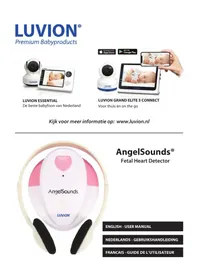
AngelSounds - Baby monitor Luvion - Free user manual and instructions
Find the device manual for free AngelSounds Luvion in PDF.


| Product type | Baby monitor (fetal heartbeat detector) |
| Brand | Luvion |
| Model | AngelSounds |
| Power supply | 9V alkaline battery (IEC 6F22) |
| Operating frequency | 3.3 MHz (Doppler ultrasound) |
| Estimated battery life | More than 500 one-minute exams (new battery) |
| Operating temperature | 0°C to 40°C |
| Operating humidity | 0% to 85% |
| Storage temperature | -10°C to 60°C |
| Storage humidity | 0% to 95% |
| Storage pressure | 500 hPa to 1060 hPa |
| Audio output | Two headphone jacks (3.5 mm) |
| Recording function | Via dual-link cable to external recorder |
| Power indicator | LED |
| Cleaning and maintenance | Dry with a soft cloth after use; do not expose to sunlight |
| Safety | Compliant with BS5724, IEC601-1, UL544 standards; Type B, internal power |
| Repairability | Not user-repairable; service only by qualified personnel |
| Classification | Class IIa medical device (CE 93/42/EEC) |
| Included accessories | Headphones, dual-link cable, ultrasound transmission gel (not included but recommended) |
| Manufacturer | Egerium B.V., Kleveringweg 25, 2616 LZ Delft, Netherlands |
| Weight | Designed to fit in hand, lightweight (weight not specified) |
Frequently Asked Questions - AngelSounds Luvion
User questions about AngelSounds Luvion
0 question about this device. Answer the ones you know or ask your own.
Ask a new question about this device
Download the instructions for your Baby monitor in PDF format for free! Find your manual AngelSounds - Luvion and take your electronic device back in hand. On this page are published all the documents necessary for the use of your device. AngelSounds by Luvion.
USER MANUAL AngelSounds Luvion
Premium Babyproducts
natural_image
LUVION® smart home camera and smartphone displaying a sleeping baby photo (no text or symbols visible on device body)LUVION ESSENTIAL
front

natural_image
Simple line drawing of a mechanical or electrical component with a circular base and two hanging pins (no text or symbols)back
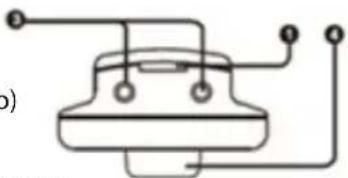
- On/Off/volume slider
- Power indicator light
- Headphone socket(two)
- Sensor
- Battery compartment cover
natural_image
Pure electrical circuit lines without any symbolsside
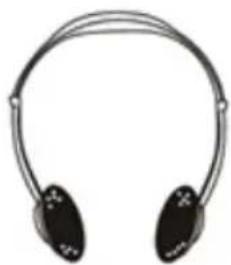
Accessories
natural_image
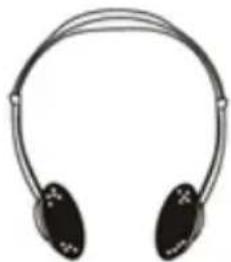
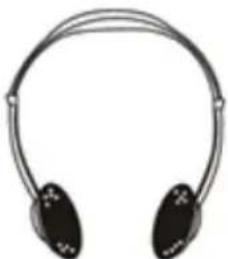
Close-up of a pair of black headphones with earbuds (no text or symbols visible)earphones
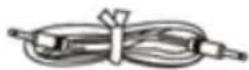
Audiocabel
Introduction
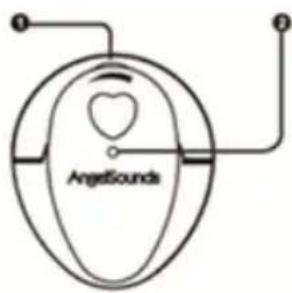
The AngelSounds fetal doppler is a single-hand device for detection of the fetal heart. The fetal heart may be detected from early pregnancy, and more easily from pregnancies greater than 12 weeks. Every AngelSounds is supplied with a dry-cell battery. A dry-cell battery must NOT be placed in a recharging device and must NOT be disposed of by burning. The AngelSounds fetal doppler operates at a nominal frequency of 3.3MHz, using Doppler ultrasound. There is an 'on/off/volume key(1)', it's easy to operate. The LED working indicator light (2) shows working condition. A headset and an audio line are available. The AngelSounds fetal doppler is lightweight and designed to fit comfortably in your hand.
Operation instruction
Insert the headset jack securely into the socket(3). Apply a small amount of acoustic coupling gel to the examination site. Or put some gel on the top of the sensor (4).
Switching on On/Off/volume key (1)
This key is used to select either high or low volume level, too. Hold the AngelSounds Fetal doppler. Plug in the earphones.
The AngelSounds fetal doppler is now ready for use.
Operation
Place the transducer on the examination site and move it around slowly until a good signal is obtained. This will sound like 'galloping horses'. It may be necessary to angle the transducer slightly to obtain the optimum signal.
Use of audio line
Insert one jack of the audio line into the main unit's headset socket (any of the two), put another plug into the recorder, then the fetal heart beat can be recorded by the recorder. Move the transducer to the pregnant woman's left chest to record her heart beat and play the mother's heart beat to the baby. After the baby is born, this can calm the baby down. To switch off, just turn the 'On/Off/Volume Slider'.
Battery fitting or replacement
How to fit or replace the battery on the AngelSounds fetal doppler:
Remove the rear battery compartment cover (5) carefully. Remove the old battery. Fit the new battery (IEC6F22 9V alkaline). Then close the battery cover.
- Use only the specified battery type and insert the battery according to polarity instruction (check the + and – poles).
• Always dispose of empty batteries in accordance with regulations. Do not dispose together with household garbage.
New alkaline battery will give more than 500 one minute examinations. Battery should be removed if the unit is not in regular use. After use, the AngelSounds fetal doppler should be dried thoroughly with a soft cloth.
Operating condition:
Do NOT leave the AngelSounds fetal doppler exposed to direct sunlight.
Operating temperature: 0-40 °C
Operating humidity: 0% - 85%
Battery: IEC 6F22 9V alkaline
Safety check list:
The AngelSounds fetal doppler Fetal Heart Detector is designed to comply with BS5724 part 1, IEC601-1, UL544 and other international medical safety standards for battery-operated (internally powered) medical equipment.
Warning
- Device is sealed and NOT user-serviceable. Device must be serviced only by authorized and qualified personnel to maintain safety, and reliability. Damage may result if the AngelSounds Fetal doppler is knocked or dropped.
Classification:
Type of protection against electric shock: Internally powered equipment.
Degree of protection against electric shock: Type B
Type B protection means that this equipment will comply with:
EN 60601-1/ Medical Electrical Equipment Part 1:
IEC 60601-1 General Requirements for safety
EN 60601-1-2/ Standard for electromagnetic compatibility
IEC 60601-1-2 requirements for medical electrical equipment
U.S. Federal law restricts this device to use on or by the order of a Physician. Degree of protection against harmful ingress of water: Ordinary equipment Mode of operation: design for continuous operation
Degree of safety of application in the presence of a flammable
Anaesthetic mixture with air or with oxygen or nitrous oxide:
Do not use in the presence of flammable anaesthetics.
This detector is not explosion-proof and must not be used in the presence of flammable anaesthetics.
Statement
The medical electrical equipment needs special precautions
regarding EMC and needs to be installed and put into service according to the EMC information provided in the accompanying documents (this instruction). Portable and mobile RF communications equipment can affect the medical electrical equipment.
The equipment is without a manual sensitivity adjustment, hence: The minimum amplitude or value of patient physiological signal is 90dB.
Warning:
• Operation of the equipment or system below this amplitude or valuemay cause inaccurate results.
- The use of accessories, transducers and cables other than those specified, with the exception of transducers and cables sold by the manufacturer of the equipment or system as replacement parts for internal components, may result in increased emission or decreased.
Acoustic output data
The acoustic output of the AngelSounds fetal doppler transducer has been measured in water using a calibrated hydrophone at authorized Laboratory. Normalized values, which estimate the maximum 'in-situ' dosage to tissue at the point of highest intensity in the beam path have been calculated. These data are presented in the following tables.
Ultrasound safety considerations and data
General Diagnostic ultrasound has been in use for over 25 years with no confirmed adverse effects on patients or instrument operators at the intensities typical of present diagnostic instruments. Although the total absence of adverse effects to human subjects after such extensive use at diagnostic power levels is gratifying, available data are not conclusive and the possibility that biological effects may be identified in the future remains. It is therefore deemed desirable by medical and other scientific authorities in this field that exposure to ultrasound should be limited to the duration and intensity appropriate for the clinical objective. Because fetal tissue could be more sensitive to biological effects by reason of pregnant subjects be kept to a minimum. At present, there is a clear consensus that the benefits to patients of prudent use of diagnostic ultrasound outweigh the risks, if any, that may be present.
AngelSounds fetal doppler is a portable battery operated detector designed to detect fetal life and confirmation of continued life during pregnancy. Minimizing patient exposure Acoustic output of the AngelSounds fetal doppler is internally controlled and cannot be changed by the operator in the course of the examination. The duration is, however, fully under the control of the operator. Mastery of the techniques described in the operating instructions
will facilitate limit the maximum amount of diagnostic information with the minimum of exposure.
table 1. Maximum acoustic output measured in water
(Parameters of Angelsounds fetal doppler Transducer)
| Operating mode Continuous Doppler | |
| Frequency 3.3 MHz | |
| Intended use Fetal heart detection | |
| Intended for fetal use Yes | |
| Control settings None | |
| Acoustic intensity I *(mW/cm2) | < 10mW/cm2 SPTA |
| Peak negative pressure < 1 | Mpa |
| Output beam intensity < 20 | mW/cm2 |
^* I = spatial peak, temporal average
Intensity in tissue estimate the 'in-situ' value in tissue at the point of examination, where:
I = Spatial peak intensity 'in-situ' (tissue) T
I = Spatial peak intensity in water W
F=Ultrasound frequency(MHz)
Z=Distance from the face of the transducer to the point of measurement (cm) then:
I = I exp.(-0.069f.z.) T W
For example; at a typical point of measurement using the AngelSounds fetal doppler the following value of maximum intensity is obtained:
Parameter of AngelSounds fetal doppler transducer
Typical measurement 4.8
Depth in tissue(cm)
Maximum intensity | 0.8 SPTA
in tissue(mW/cm2)
This also conforms to the requirements of IEC1157 (details on request).
If you have questions, please contact:
Luvion, Kleveringweg 25, 2616LZ Delft, the Netherlands, informatie@luvion.nl,
www.luvion.com
Transport and storage conditions

Temperature:
from -10^ to 60^
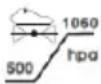
Air pressure:
from 500hpa to 1060hpa

Humidity:
from 0% to 95%

Use no hooks
General information

This CE mark on a product denotes conformity with the European council directive 93/42/EEC(MDD) concerning medical devices

European Representative:
Wellkang Ltd.
Suite B, 29 Harley Street, London, W1G9QR, UK
PZN: 2686378

Manufacturer:
Shenzen Jumper Medical Equipment Co. Ltd
Made in China
General Importeur:
Egerium B.V.
Kleveringweg 25
2616 LZ Delft
the Netherlands
NEDERLANDS - GEBRUIKSHANDLEIDING
AngelSounds - fetal doppler
voor

natural_image
Simple line drawing of a mechanical or electrical component with no text or symbolsachter
natural_image
Pure electrical circuit lines without any symbolsboven
Accessoires
natural_image
Front view of a pair of black headphones with earbuds (no text or symbols visible)hoofdtelefoon
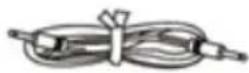
audiokabel
Introductie
vue face

natural_image
Simple line drawing of a mechanical component with a circular base and two hanging rods (no text or symbols)vue arrière
natural_image
Pure electrical circuit lines without any symbolsvue de dessus
Accessoires
natural_image
Black and white headband with earbuds (no text or symbols visible)Intensity in tissue estimate the 'in-situ' value in tissue at the point of examination, where:
I = (-0.069fz) TW
Shenzen Jumper Medical Equipment
Co. Ltd
Made in China
natural_image
Two Luvion brand telephones, one with a camera and the other with a photo of a smiling baby on screen (no text or symbols visible on device body)LUVION®
Premium Babyproducts
www.luvion.com