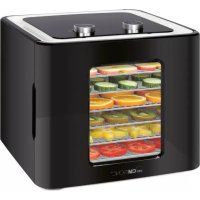
DR 3773 - Food Dehydrator CLATRONIC - Free user manual and instructions
Find the device manual for free DR 3773 CLATRONIC in PDF.



| Product type | Food dehydrator |
| Brand | Clatronic |
| Model | DR 3773 |
| Net weight | Approx. 3.6 kg |
| Power supply | 220–240 V~, 50–60 Hz |
| Power consumption | 370–450 W |
| Protection class | II |
| Number of trays | 6 grid trays + 1 crumb tray |
| Temperature range | 35 °C – 70 °C |
| Maximum capacity per tray | 0.6 kg |
| Ventilation type | Hot air circulation by blower |
| Main functions | Dehydration of fruits, vegetables, meat, fish, herbs, and pet food |
| Temperature setting | Rotary knob TEMP |
| On/Off | Button ① with indicator light |
| Door | With observation window and recessed handle |
| Care and cleaning | Trays and crumb tray washable with warm water and mild detergent; wipe housing with damp cloth; do not immerse appliance |
| Safety | Do not use with external timer; do not leave unattended; do not use for more than 24h; cool down for 2h before reuse; do not repair yourself |
| Spare parts and repairability | Grid trays, crumb tray – available as accessories; repair by authorized technician only |
| Intended use | Private, domestic use |
| Storage of dehydrated food | Up to one year in airtight containers, cool and dark |
Frequently Asked Questions - DR 3773 CLATRONIC
User questions about DR 3773 CLATRONIC
0 question about this device. Answer the ones you know or ask your own.
Ask a new question about this device
Download the instructions for your Food Dehydrator in PDF format for free! Find your manual DR 3773 - CLATRONIC and take your electronic device back in hand. On this page are published all the documents necessary for the use of your device. DR 3773 by CLATRONIC.
USER MANUAL DR 3773 CLATRONIC
natural_image
Black square microwave oven with fruit slices inside, showing a grid of food items (no text or symbols visible on the appliance itself)DEUTSCH
Inhalt
Elimination......Page 22
ESPAÑOL
Indice
Overview of the Components ...... Page 3
Instruction Manual......Page 35
Technical Data......Page 40
Thank you for choosing our product. We hope you will enjoy using the appliance.
Symbols in this Instruction Manual
Important information for your safety is specially marked. It is essential to comply with these instructions in order to avoid accidents and prevent damage to the appliance:

WARNING:
This warns you of dangers to your health and indicates possible injury risks.

CAUTION:
This refers to possible hazards to the appliance or other objects.

NOTE:
This highlights tips and information.
General Notes
Read the operating instructions carefully before putting the appliance into operation and keep the instructions including the warranty, the receipt and, if possible, the box with the internal packing. If you give this appliance to other people, please also pass on the operating instructions.
- The appliance is designed exclusively for private use and for the envisaged purpose. This appliance is not fit for commercial use.
- Do not use it outdoors. Keep it away from sources of heat, direct sunlight, humidity (never dip it into any liquid) and sharp edges. Do not use the appliance with wet hands. If the appliance is humid or wet, unplug it immediately.
- When cleaning or putting it away, switch off the appliance and always pull out the plug from the socket (pull the plug itself, not the lead) if the appliance is not being used and remove the attached accessories.
- The appliance and the mains lead have to be checked regularly for signs of damage. If damage is found the appliance must not be used.
- Use only original spare parts.
- In order to ensure your children's safety, please keep all packaging (plastic bags, boxes, polystyrene etc.) out of their reach.

WARNING:
Do not allow small children to play with the plastic foil.
There is a danger of suffocation!
Special Safety Precautions for this Appliance
- Please do not operate the appliance with an external timer or a separate remote control system.
- Due to the rising heat and vapours the appliance should not be operated under wall cupboards.
- Keep the appliance at a safe distance from easily inflammable objects such as furniture, curtains, etc. (30 cm). Under no circumstances should the appliance be installed in cupboards.
- Ventilation: Always keep the ventilation slots free from any obstructions and dirt.
-
Do not leave the appliance unattended for hours at a time. Do not leave your home whilst the appliance is in operation.
-
Do not operate the appliance for a period exceeding 24 hours. Allow the appliance to cool for a period of 2 hours before operating it again.
- Do not repair the appliance by yourself. Always contact an authorized technician. If the supply cord is damaged, it must be replaced by the manufacturer, its service agent or similarly qualified persons in order to avoid a hazard.
- This appliance can be used by children, from the age of 8 years and persons with reduced physical, sensory or mental capabilities or lack of experience and / or knowledge if they have been given supervision or instruction concerning use of the appliance in a safe way and understand the hazards involved.
• Children shall not play with the appliance. - Cleaning and user maintenance shall not be made by children unless they are older 8 years and supervised.
- Keep the appliance and its cord out of reach of children less than 8 years.
CAUTION:
This appliance is not intended to be immersed in water during cleaning. Please observe the instructions that we have included for you in the chapter “Cleaning”.
Unpacking the Appliance
- Remove the appliance from the package.
- Remove all packaging material such as films, filler, cable holders and cardboard.
- Check the delivery contents for completeness.
- Should the package contents be incomplete or damages be found, do not take the appliance into operation. Take it immediately back to the dealer.
i NOTE:
Dust or production residues can be located on the appliance. We recommend to clean the appliance as described under "Cleaning".
Overview of the Components / Scope of Delivery
1 button with indicator light (switching the appliance on/off)
2 Temperature controller TEMP
3 Housing
4 Air vents
5 Recessed grip for opening the door
6 Grid tray (6 pieces)
7 Crumb tray
8 Door
9 Viewing window
Worth Knowing in Advance
Dehydrating is a method of long-term food preservation.
Vegetable and animal food contains a lot of water – this is the reason why many foods only have a short shelf life. Water is the basis of survival for bacteria and other pathogens, such as fungi. By removing the water, pathogens lose their livelihoods, which in turn prolongs the shelf life of foods. The advantage over other preservation methods is: The vitamins, minerals and dietary fibres of the food are preserved.
Your food dehydrator has a blower that circulates warm air via the grid tray. Thus, it becomes possible to speed up the dehydrating process compared to drying in the open air.
You can adjust the desired drying temperature on the appliance itself. Temperature range: 35 °C – 70 °C.
You have the option of using just one grid tray to dry, or you can use up to six at a time. If you want to dry thicker foodstuffs, then do not use all of the grid trays.
Please note that food which you have produced at home in your food dehydrator may have a different appearance to convenience foods that you buy in the supermarket or organic food shop. The reason for this is that no artificial colourings or preservatives are used in your food dehydrator.
You can also (partially) reverse the drying process by simply soaking the dried fruit or vegetables in cold water or cooking them with other foods (e. g. soup vegetables or mushrooms).
What Else Should You Consider?
- Do not use frozen foods. They contain too much water.
• Always use fresh foods.
• Overripe foods or food with rotten areas are not suitable. - Do you want the dehydrating process of one type of foods to be completed at the same time? In that case, the pieces should be equally thick, so that they can dry at the same speed.
- Place the pieces you have prepared on the grid trays so that they do not overlap.
- The drying time depends on several factors: size, condition of the pieces, quantities used, set temperature at the appliance and ambient temperature. You will find the standard values in a table at the end of this chapter.
-
It is only partially visible to the eye whether the food dehydration has already been completed. Instead of the visual inspection, it is advisable to touch the food.
-
Fruits must not produce moisture when exposed to pressure.
- Dried vegetables should feel almost like leather.
- Herbs are done when they crumble when grated.
- The meat must not have any spots that feel soft. However, it must not break even when you bend it.
Fruits
- We recommend using ripe fruits because they contain a high level of natural sugar. Unripe fruits often taste bitter after drying.
- Wash and dry the fruits thoroughly.
- If necessary, remove kernels, stones and all bruises.
- Fruits with a naturally waxed skin, such as grapes or plums, can be pre-blanched in boiling water. This shortens the dehydrating time.
- Cut larger fruits in equally thick slices (3 – 6 mm). Halve medium sized fruits.
- It is normal that brightly coloured fruits, such as apples or bananas, become darker when dehydrating. You can prevent this by previously soaking the fruit slices for 2 minutes into lemon or pineapple juice. Dry the fruits then thoroughly with paper towels.
Vegetables
- Wash the vegetables thoroughly.
- Cut them in about 6 mm thick slices or pieces.
- Blanch the vegetables for 1 – 2 minutes in boiling water. Afterwards, we recommend to shock them by tossing them in ice water. Thus, they retain the colour, flavour and structure.
- Then dry the vegetables thoroughly with a paper towel.
Fish
• After having been prepared for eating, fish are divided lengthwise.
- Fillet large fish and cut them into strips. Do not remove the skin, so that the strips are held together.
• Dab the fish dry with paper towels.
Herbs
- Harvest the herbs preferably on a rain-free morning. Before harvesting, they should have been exposed to at least 1 or 2 days of sunlight. Early in the morning, in the evening hours and on rainy days herbs have the least aroma.
- If possible, do not wash the herbs. Shake off the dust only. Should you wish to wash the herbs, dab them dry with paper towels.
- Mince the herbs as little as possible. Place whole stems on the food dehydrator's grid trays.
- Some herbs are not suitable for drying, as they quickly lose their flavour after harvesting (e. g. lovage, borage, sorrel, watercress). It's best to freeze these herbs.
- The following herbs are moderately well up to well suited: parsley, basil, dill, chives, lemon balm.
- Herbs which are very suitable are: mugwort, savory, marjoram, oregano, rosemary, sage, thyme, chamomile, peppermint, lavender, sweet woodruff.
Beef Jerky
Meat types with low fat content are generally suitable for the production of dried meat.
Theoretically, meat types with higher fat content, such as mutton, duck, goose, or marbled beef also can be used.
Dried meat or jerky prepared in this fashion will only keep for a few days, however.
| Low-fat High-fat | |||
| Type of Meat | Fat per 100 g | Type of Meat | Fat per 100 g |
| Beef fillet 4 g Mutton | 12 g | ||
| Lean pork 6 g Duck | 14 g | ||
| Saddle of venison | 3 g Goose 20 g | ||
| Chicken breast 1 g | Marbled beef | 18 g | |
| Turkey 3 g Lamb 13 g | |||
- 1 kg of meat will produce approximately 350 g of beef jerky.
- The meat should have a thickness of 3 – 5 mm and a width of 3 – 4 cm.
- Mix the meat with a marinade and allow it to sit overnight.
• Dab the meat dry using a paper towel.
Meat
- Lean, well-hung meat is best suited for dehydrating.
- Wash and dry the meat thoroughly.
- Remove the skin, tendons and fat from the meat.
- Cut 2 – 4 mm thin slices.
TIP: It is easier to cut partially frozen meat into thin slices. Or use meat rolls.
- Cut the slices in 2 – 3 cm thin strips.
- Marinade the meat with a seasoning mix of your choice. Let the meat for at least 6 – 8 hours marinade in the refrigerator.
- Before you place the meat in the dehydrator, squeeze the marinade with pressure out of the meat. Dab it dry with paper towels.
Animal Nutrition
The dehydrator is also suitable for the production of pet food and animal feed. The following types of meat are suitable for this purpose:
- Turkey
- Lean beef
- Chicken
• Giblets, such as hearts and livers - Belly
• Goulash
Temperatures and Dehydrating Times
| Food | Temperature in °C | Dehydrating Time in Hours |
| Fruits | 55 – 65 | 5 – 21 |
| Pineapple | 10 – 21 | |
| Apples | 5–12 | |
| Apricots | 10 – 18 | |
| Bananas | 8–12 | |
| Pears | 8–12 | |
| Dates | 5–7 | |
| Figs | 5–7 | |
| Mango | 10 – 20 | |
| Oranges | 8–20 | |
| Plums | 10 – 18 | |
| Grapes | 12 – 21 | |
| Vegetables | 55 – 70 | 2 – 12 |
| Turnip cabbage | 6–10 | |
| Leek | 6–10 | |
| Carrots | 6–8 | |
| Peppers | 8–12 | |
| Celery | 6–10 | |
| Mushrooms | 40 | 5–6 |
| Meat | 60 | 6–12 |
| Beef Jerky | 45–70 | 6–12 |
| Fish | 60 | 8–11 |
| Herbs | 40 | 2–3 |
Storage of Dried Foods
After dehydrating, let the foods cool down completely before storing them in closed vessels.
To ensure an optimal durability, the proper storage plays an important role. Protect the dried foods from humidity. Airtight lockable boxes or jars are best suitable. You can also use resealable plastic bags with Zipper ^® or bags sealed with a vacuum sealer.
If moisture becomes visible in the vessel, the foods must definitely be dried again.
The vessels should be stored in a cool room and be protected from light.
Properly dried and stored foods can be kept for up to one year.
Notes for Use
Location
- Place the appliance on the dry, non-slip surface.
• Take care that the appliance and the mains cable never are placed onto hot surfaces or near heat sources (e. g. range, hob).
Electric Connection
- Before inserting the power plug into the outlet, check that the mains voltage to be used matches that of the appliance. You can find the required information on the nameplate.
- Connect the appliance to a properly installed earthed socket.
Before Initial Use
- There is a protective layer on the heating element. To remove this, operate the appliance for about 30 minutes without any contents.


WARNING:
Allow the appliance to cool down before you clean it!
- Disconnect the mains plug from the wall socket.
- Wipe the inside of the appliance and clean the accessories before using the appliance.
Adjusting the Temperature
Turn the controller TEMP to adjust the desired temperature.
Switching the Appliance On / Off
Turn the appliance on and off by using the ① button. The indicator lamp in the button will light up during operation.
Operation of the Appliance
- Arrange the food items on the grid trays.

CAUTION:
Do not overload the grid trays! (Max. 0.6 kg)
- Open the door.
- Place the crumb tray on the floor of the appliance.
- Insert the grid trays containing the food items.
- Close the door.
- Adjust the desired temperature using the controller TEMP.
- Press the ☐ button. The appliance will begin operating.

NOTE:
Make a note of the start time, or use a kitchen clock, or set a reminder time.
End of Operation
- To stop operating the appliance, press the button. The indicator light will go out.
- Disconnect the mains plug from the socket.

WARNING: Risk of Burning!
Use potholders or oven mitts to remove items from the food dehydrator, as the grid trays will become hot during operation.
Cleaning

WARNING:
• Always remove the mains lead before cleaning.
- Wait until the appliance has cooled down completely!
- Do not immerse the appliance in water! Doing so may result in an electric shock or fire.

CAUTION:
- Do not use a wire brush or any abrasive items.
- Do not use any acidic or abrasive detergents.
- After each use, clean the grid trays and the crumb tray using warm water and a little dish detergent. Remove tenacious dirt with a soft nylon brush.
- Wipe out the inside of the appliance using a damp cloth. For tougher dirt and stains, use a soft brush.
- Clean the housing after use using a slightly moist cloth.
Storage
- Clean the appliance as described. Let everything dry completely.
- We recommend that you store the appliance in its original packaging when it is not to be used for a longer period.
- Always store the appliance at a well ventilated and dry place outside the reach of children.
Technical Data
Model: DR 3773
Power supply: 220–240 V\~, 50–60 Hz
Power consumption: 370-450W
Protection class:....II
Net weight: .... approx. 3.6 kg
The right to make technical and design modifications in the course of continuous product development remains reserved.
This appliance has been tested according to all relevant current CE guidelines, such as electromagnetic compatibility and low voltage directives, and is manufactured according to the latest safety regulations.
Disposal
Meaning of the "Dustbin" Symbol
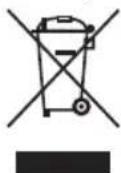
Protect our environment: do not dispose of electrical equipment in the domestic waste.
Please return any electrical equipment that you will no longer use to the collection points provided for their disposal.
This helps avoid the potential effects of incorrect disposal on the environment and human health.
This will contribute to the recycling and other forms of re-utilisation of electrical and electronic equipment.
Information concerning where the equipment can be disposed of can be obtained from your local authority.
Instrukcja obsługi
CTC Clatronic Sp. z o.o
Ul. Brzeska 1
45-960 Opole