ManualGo.com
DUC122ZK - Saw MAKITA - Free user manual and instructions
Find the device manual for free DUC122ZK MAKITA in PDF.



Download the instructions for your Saw in PDF format for free! Find your manual DUC122ZK - MAKITA and take your electronic device back in hand. On this page are published all the documents necessary for the use of your device. DUC122ZK by MAKITA.
USER MANUAL DUC122ZK MAKITA
Cordless Chain Saw Instruction Manual
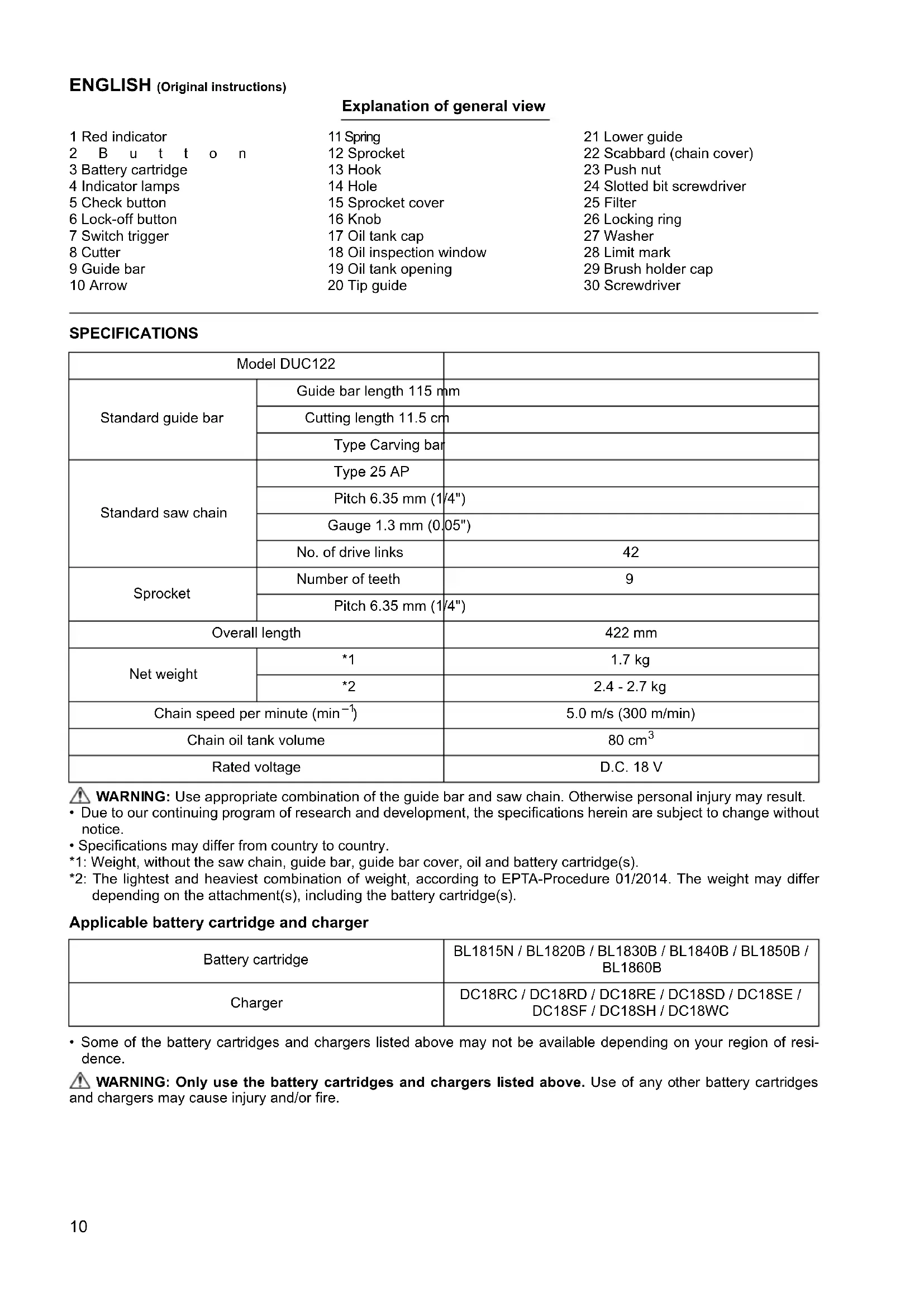
WARNING: Use appropriate combination of the guide bar and saw chain. Otherwise personal injury may result.
- Due to our continuing program of research and development, the specifications herein are subject to change without notice.
- Specifications may differ from country to country. *1: Weight, without the saw chain, guide bar, guide bar cover, oil and battery cartridge(s). *2: The lightest and heaviest combination of weight, according to EPTA-Procedure 01/2014. The weight may differ depending on the attachment(s), including the battery cartridge(s). Applicable battery cartridge and charger
- Some of the battery cartridges and chargers listed above may not be available depending on your region of resi- dence.
WARNING: Only use the battery cartridges and chargers listed above. Use of any other battery cartridges
and chargers may cause injury and/or fire. Model DUC122 Standard guide bar Guide bar length 115 mm Cutting length 11.5 cm Type Carving bar Standard saw chain Type 25 AP Pitch 6.35 mm (1/4") Gauge 1.3 mm (0.05") No. of drive links 42 Sprocket Number of teeth 9 Pitch 6.35 mm (1/4") Overall length 422 mm Net weight *1 1.7 kg *2 2.4 - 2.7 kg Chain speed per minute (min
Rated voltage D.C. 18 V Battery cartridge BL1815N / BL1820B / BL1830B / BL1840B / BL1850B / BL1860B Charger DC18RC / DC18RD / DC18RE / DC18SD / DC18SE / DC18SF / DC18SH / DC18WC11 Symbols The followings show the symbols which may be used for the equipment. Be sure that you understand their mean- ing before use. ENE090-1 Intended use The tool is intended for cutting branches / pruning trees. It is also suitable for tree service. GEA010-2 General power tool safety warnings
WARNING: Read all safety warnings, instruc-
tions, illustrations and specifications provided with this power tool. Failure to follow all instructions listed below may result in electric shock, fire and/or serious injury. Save all warnings and instructions for future reference. The term “power tool” in the warnings refers to your mains-operated (corded) power tool or battery-operated (cordless) power tool. GEB119-3 Cordless Chain saw safety warnings
1. Keep all parts of the body away from the saw
chain when the chain saw is operating. Before you start the chain saw, make sure the saw chain is not contacting anything. A moment of inatten- tion while operating chain saws may cause entan- glement of your clothing or body with the saw chain.
2. Always hold the chain saw with your right hand
on the top handle and your left hand on the front handle. Holding the chain saw with a reversed hand configuration increases the risk of personal injury and should never be done.
3. Hold the power tool by insulated gripping sur-
faces only, because the saw chain may contact hidden wiring. Saw chains contacting a “live” wire may make exposed metal parts of the power tool “live” and could give the operator an electric shock.
4. Wear safety glasses and hearing protection. Fur-
ther protective equipment for head, hands, legs and feet is recommended. Adequate protective clothing will reduce personal injury by flying debris or acci- dental contact with the saw chain.
5. Always keep proper footing.
6. When cutting a limb that is under tension be
alert for spring back. When the tension in the wood fibres is released the spring loaded limb may strike the operator and/or throw the chain saw out of con- trol.
7. Use extreme caution when cutting brush and
saplings. The slender material may catch the saw chain and be whipped toward you or pull you off bal- ance.
8. Carry the chain saw by the front handle with the
chain saw switched off and away from your body. When transporting or storing the chain saw always fit the guide bar cover. Proper han- dling of the chain saw will reduce the likelihood of accidental contact with the moving saw chain.
- Wear ear protection.
- Wear a helmet, goggles and ear protection.
- Use appropriate protection for foot- leg and hand-arm.
- Do not expose to moisture.
- Maximum permissible cut length
- Direction of chain travel
- Only for EU countries Due to the presence of hazardous components in the equipment, waste electrical and electronic equipment, accumulators and bat- teries may have a negative impact on the environment and human health. Do not dispose of electrical and electronic appliances or batteries with household waste! In accordance with the European Directive on waste electrical and electronic equipment and on accu- mulators and batteries and waste accumulators and batteries, as well as their adaptation to national law, waste electrical equipment, batter- ies and accumulators should be stored separately and delivered to a separate collection point for munici- pal waste, operating in accordance with the regulations on environmen- tal protection. This is indicated by the symbol of the crossed-out wheeled bin placed on the equipment. Ni-MH Li-ion
- Guaranteed sound power level according to EU Outdoor Noise Directive.
- Sound power level according to Australia NSW Noise Control Regu- lation.12
9. Follow instructions for lubricating, chain ten-
sioning and changing accessories. Improperly tensioned or lubricated chain may either break or increase the chance for kickback.
10. Keep handles dry, clean, and free from oil and
grease. Greasy, oily handles are slippery causing loss of control.
11. Cut wood only. Do not use chain saw for pur-
poses not intended. For example: do not use chain saw for cutting plastic, masonry or non-wood build- ing materials. Use of the chain saw for operations different than intended could result in a hazardous situation.
12. Causes and operator prevention of kickback:
Kickback may occur when the nose or tip of the guide bar touches an object, or when the wood closes in and pinches the saw chain in the cut. Tip contact in some cases may cause a sudden reverse reaction, kicking the guide bar up and back towards the operator. Pinching the saw chain along the top of the guide bar may push the guide bar rapidly back towards the operator. Either of these reactions may cause you to lose control of the saw which could result in serious personal injury. Do not rely exclu- sively upon the safety devices built into your saw. As a chain saw user, you should take several steps to keep your cutting jobs free from accident or injury. Kickback is the result of tool misuse and/or incorrect operating procedures or conditions and can be avoided by taking proper precautions as given below:
- Maintain a firm grip, with thumbs and fingers encircling the chain saw handles, with both hands on the saw and position your body and arm to allow you to resist kickback forces. Kickback forces can be controlled by the operator, if proper precautions are taken. Do not let go of the chain saw.
- Do not overreach and do not cut above shoulder height. This helps prevent unintended tip contact and enables better control of the chain saw in unexpected situations.
- Only use replacement bars and chains specified by the manufacturer. Incorrect replacement bars and chains may cause chain breakage and/or kickback.
- Follow the manufacturer’s sharpening and main- tenance instructions for the saw chain. Decreas- ing the depth gauge height can lead to increased kickback.
13. Before starting work, check that the chain saw is
in proper working order and that its condition complies with the safety regulations. Check in particular that:
- The run-down brake is working properly;
- The bar and the sprocket cover are fitted cor- rectly;
- The chain has been sharpened and tensioned in accordance with the regulations.
14. Do not start the chain saw with the chain cover
being installed on it. Starting the chain saw with the chain cover being installed on it may cause the chain cover to thrown out forward resulting in per- sonal injury and damage to objects around the oper- ator. Additional safety warnings:
1. Keep bystanders or animals away from the work
area during operation of the chain-saw. Top handle chainsaw specific safety warnings
1. This chain saw is designed especially for tree
care and surgery. The chain saw is intended to be used by properly trained persons only. Observe all instructions, procedures and recom- mendations from the relevant professional orga- nization. Otherwise fatal accidents may occur. It is recommend that always using a rising plat- form (cherry picker, lift) for sawing in trees. Rap- pelling techniques are extremely dangerous and require special training. The operators must be trained to become familiar with safety equipment usage and climbing techniques. Always use the appropriate belts, ropes and carabiners when working in trees. Always use restraining equip- ment for both the operator and the saw.
2. Perform cleaning and maintenance before stor-
age in accordance with the instruction manual.
3. Ensure safe positioning of the chain saw during
car transportation to avoid fuel or chain oil leak- age, damage to the tool and personal injury.
4. Do not fill the chain oil near fire. Never smoke
when you fill the chain oil.
5. National regulation may restrict the use of the
6. If the equipment gets heavy impact or fall, check
the condition before continuing work. Check the controls and safety devices for malfunction. If there is any damage or doubt, ask our autho- rized service center for the inspection and repair.
7. Hold the saw firmly in place to avoid skating
(skid movement) or bouncing of the saw when starting a cut.
8. At the end of the cut, be careful to keep your bal-
ance due to the “drop”.
9. Take into account the direction and speed of the
wind. Avoid sawdust and chain oil mist. Protective equipment
1. In order to avoid head, eye, hand or foot injuries
as well as to protect your hearing the following protective equipment must be used during oper- ation of the chain saw: – The kind of clothing should be appropriate, i. e. it should be tight-fitting but not be a hindrance. Do not wear jewelry or clothing which could become entangled with bushes or shrubs. If you have long hair, always wear a hairnet!
– It is necessary to wear a protective helmet when- ever working with the chain saw. The protective helmet is to be checked in regular intervals for damage and is to be replaced after 5 years at the latest. Use only approved protective helmets. – The face shield of the protective helmet (or the goggles) protects against sawdust and wood chips. During operation of the chain saw always wear a goggle or a face shield to prevent eye inju- ries. – Wear adequate noise protection equipment (ear muffs, ear plugs, etc.) – The protective jacket consists of 22 layers of nylon and protects the operator against cuts. It is always to be worn when working from elevated platforms (cherry pickers, lifts), from platforms mounted on ladders or when climbing with ropes. – The protective brace and bib overall is made of a nylon fabric with 22 layers and protects against cuts. We strongly recommend its use. – Protective gloves made of thick leather are part of the prescribed equipment and must always be worn during operation of the chain saw. – During operation of the chain saw safety shoes or safety boots fitted with anti skid sole, steel toe caps and protection for the leg must always to be worn. Safety shoes equipped with a protective layer provide protection against cuts and ensure a secure footing. For working in trees the safety boots must be suitable for climbing techniques. Vibration
1. Individuals with poor circulation who are exposed to
excessive vibration may experience injury to blood vessels or the nervous system. Vibration may cause the following symptoms to occur in the fingers, hands or wrists: “Falling asleep” (numbness), tin- gling, pain, stabbing sensation, alteration of skin colour or of the skin. If any of these symptoms occur, see a physician! To reduce the risk of “white finger disease”, keep your hands warm during oper- ation and well maintain the equipment and accesso- ries. SAVE THESE INSTRUCTIONS.
DO NOT let comfort or familiarity with product (gained from repeated use) replace strict adherence to safety rules for the subject product. MISUSE or failure to follow the safety rules stated in this instruc- tion manual may cause serious personal injury. ENC007-17
1. Before using battery cartridge, read all instruc-
tions and cautionary markings on (1) battery charger, (2) battery, and (3) product using bat- tery.
2. Do not disassemble or tamper with the battery
cartridge. It may result in a fire, excessive heat, or explosion.
3. If operating time has become excessively
shorter, stop operating immediately. It may result in a risk of overheating, possible burns and even an explosion.
4. If electrolyte gets into your eyes, rinse them out
with clear water and seek medical attention right away. It may result in loss of your eyesight.
5. Do not short the battery cartridge:
(1) Do not touch the terminals with any conduc- tive material. (2) Avoid storing battery cartridge in a container with other metal objects such as nails, coins, etc. (3) Do not expose battery cartridge to water or rain. A battery short can cause a large current flow, overheating, possible burns and even a break- down.
6. Do not store and use the tool and battery car-
tridge in locations where the temperature may reach or exceed 50 °C (122 °F).
7. Do not incinerate the battery cartridge even if it
is severely damaged or is completely worn out. The battery cartridge can explode in a fire.
8. Do not nail, cut, crush, throw, drop the battery
cartridge, or hit against a hard object to the bat- tery cartridge. Such conduct may result in a fire, excessive heat, or explosion.
9. Do not use a damaged battery.
10. The contained lithium-ion batteries are subject
to the Dangerous Goods Legislation require- ments. For commercial transports e.g. by third parties, for- warding agents, special requirement on packaging and labeling must be observed. For preparation of the item being shipped, consult- ing an expert for hazardous material is required. Please also observe possibly more detailed national regulations. Tape or mask off open contacts and pack up the bat- tery in such a manner that it cannot move around in the packaging.
11. When disposing the battery cartridge, remove it
from the tool and dispose of it in a safe place. Follow your local regulations relating to disposal of battery.
12. Use the batteries only with the products speci-
fied by Makita. Installing the batteries to non-com- pliant products may result in a fire, excessive heat, explosion, or leak of electrolyte.
13. If the tool is not used for a long period of time,
the battery must be removed from the tool.
14. During and after use, the battery cartridge may
take on heat which can cause burns or low tem- perature burns. Pay attention to the handling of hot battery cartridges.
15. Do not touch the terminal of the tool immediately
after use as it may get hot enough to cause burns.
16. Do not allow chips, dust, or soil stuck into the
terminals, holes, and grooves of the battery car- tridge. It may cause heating, catching fire, burst and malfunction of the tool or battery cartridge, resulting in burns or personal injury.
17. Unless the tool supports the use near high-volt-
age electrical power lines, do not use the battery cartridge near high-voltage electrical power lines. It may result in a malfunction or breakdown of the tool or battery cartridge.
18. Keep the battery away from children.14
SAVE THESE INSTRUCTIONS. CAUTION: Only use genuine Makita batteries. Use of non-genu- ine Makita batteries, or batteries that have been altered, may result in the battery bursting causing fires, personal injury and damage. It will also void the Makita warranty for the Makita tool and charger. Tips for maintaining maximum battery life
1. Charge the battery cartridge before completely
discharged. Always stop tool operation and charge the battery cartridge when you notice less tool power.
2. Never recharge a fully charged battery cartridge.
Overcharging shortens the battery service life.
3. Charge the battery cartridge with room tempera-
ture at 10 °C - 40 °C (50 °F - 104 °F). Let a hot bat- tery cartridge cool down before charging it.
4. When not using the battery cartridge, remove it
from the tool or the charger.
5. Charge the battery cartridge if you do not use it
for a long period (more than six months). FUNCTIONAL DESCRIPTION CAUTION:
- Always be sure that the tool is switched off and the bat- tery cartridge is removed before adjusting or checking function on the tool. Installing or removing battery cartridge (Fig. 1)
- Always switch off the tool before installing or removing of the battery cartridge.
- Hold the tool and the battery cartridge firmly when installing or removing battery cartridge. Failure to hold the tool and the battery cartridge firmly may cause them to slip off your hands and result in damage to the tool and battery cartridge and a per- sonal injury. To remove the battery cartridge, slide it from the tool while sliding the button on the front of the cartridge. To install the battery cartridge, align the tongue on the battery cartridge with the groove in the housing and slip it into place. Insert it all the way until it locks in place with a little click. If you can see the red indicator on the upper side of the button, it is not locked completely. CAUTION:
- Always install the battery cartridge fully until the red indicator cannot be seen. If not, it may accidentally fall out of the tool, causing injury to you or someone around you.
- Do not install the battery cartridge forcibly. If the car- tridge does not slide in easily, it is not being inserted correctly. Tool / battery protection system The tool is equipped with a tool/battery protection sys- tem. This system automatically cuts off the power to extend tool and battery life. The tool will automatically stop during operation if the tool or battery is placed under one of the following conditions:
- Overload protection This protection works when the tool is operated in a manner that causes it to draw an abnormally high current. In this situation, turn the tool off and stop the application that caused the tool to become over- loaded. Then turn the tool on to restart.
- Overheat protection This protection works when the tool or battery is overheated. In this situation, let the tool and battery cool before turning the tool on again.
- Overdischarge protection This protection works when the remaining battery capacity gets low. In this situation, remove the bat- tery from the tool and charge the battery. Indicating the remaining battery capacity (Fig. 2) Only for battery cartridges with the indicator Press the check button on the battery cartridge to indi- cate the remaining battery capacity. The indicator lamps light up for a few seconds.
- Depending on the conditions of use and the ambient temperature, the indication may differ slightly from the actual capacity.
- The first (far left) indicator lamp will blink when the bat- tery protection system works. Switch action (Fig. 3) CAUTION:
- Before inserting the battery cartridge into the tool, always check to see that the switch trigger actuates properly and returns to the “OFF” position when released. To prevent the switch trigger from being accidentally pulled, a lock-off button is provided. To start the tool, depress the lock-off button and pull the switch trigger. Release the switch trigger to stop. ASSEMBLY CAUTION:
- Always be sure that the tool is switched off and the bat- tery cartridge is removed before carrying out any work on the tool. Indicator lamps Remaining Capacity Lighted Off Blinking 75% to 100% 50% to 75% 25% to 50% 0% to 25% Charge the battery. The battery may have malfunctioned.15 Installing or removing saw chain CAUTION:
- Always be sure that the tool is switched off and the bat- tery cartridge is removed before installing or removing the saw chain.
- Always wear gloves when installing or removing the saw chain.
- Use only saw chain and guide bar with bar tip designed for this chain saw (see the Extract from the spare parts list).
- In order to prevent kickback, do not remove the bar tip or replace the guide bar with one without a bar tip. Installing the saw chain Fit in one end of the saw chain on the top of guide bar. At this time, fit the saw chain as shown in the figure because it rotates in the direction of arrow. (Fig. 4) Place the saw chain so that the spring is positioned inside it and fit in the other end of saw chain around the sprocket as shown in the figure. (Fig. 5) While turning the guide bar counterclockwise, install it so that the end of guide bar contacts the spring. (Fig. 6) Insert the hook of sprocket cover into the hole in the tool and then place the sprocket cover on the tool. (Fig. 7) Turn the knob clockwise to tighten the screw firmly. (Fig. 8) Removing the saw chain Loosen the screw by turning counterclockwise the knob until the sprocket cover comes off. (Fig. 9) Remove the sprocket cover. Remove saw chain and guide bar from the tool. Adjusting saw chain tension (Fig. 10 & 11) Just a slight loosening of the screw allows the saw chain tension to be adjusted. After adjusting, retighten the screw firmly. CAUTION:
- For a while after a new saw chain is installed, it tends to become loosened. From time to time check the saw chain tension before use.
- Low tension of saw chain may cause coming out of place.
- Installing or removing saw chain should be carried out in a clean place free from sawdust and the like. Spiked bumper (optional accessory) (Fig. 12) To install spike bumper, perform the following steps:
1. Remove the sprocket cover, saw chain and guide
bar as described in this instruction manual.
2. Fit the holes of spike bumper along with the holes on
3. Tighten them firmly with screws.
OPERATION Lubrication (Fig. 13) Saw chain is automatically lubricated when the tool is in operation. Check the amount of remaining oil in the oil tank through the oil inspection window. To refill the tank, remove the cap from the oil tank open- ing. After refilling the tank, always screw the provided oil tank cap on the chain saw. CAUTION:
- When filling the chain saw with chain oil for the first time, or refilling the tank after it has been completely emptied, add oil up to the bottom edge of the filler neck. The oil delivery may otherwise be impaired.
- As a saw chain oil, use oil exclusively for Makita chain saws or oil available in market.
- Never use oil including dust and particles or volatile oil.
- When pruning trees, use botanical oil. Mineral oil may harm trees.
- Never force the chain saw when pruning trees.
- Before cutting out, make sure that the provided oil tank cap is screwed in place. Hold the chain saw away from the tree. Start it and wait until lubrication on saw chain is adequate. Bring the tip guide/lower guide into contact with the branch to be cut before switching on. Cutting without bringing the tip guide/lower guide into contact with the branch may cause the guide bar to wobble, resulting in injury to operator. Saw the wood to be cut by just moving it down. Pruning trees CAUTION:
- Keep all parts of the body away from the saw chain when the motor is operating.
- Hold the chain saw firmly with both hands when the motor is running.
- Do not overreach. Keep proper footing and balance at all times. Bring the tip guide/lower guide into contact with the branch to be cut before switching on. Cutting without bringing the tip guide/lower guide into contact with the branch may cause the guide bar to wobble, resulting in injury to operator. (Fig. 14 & 15) When cutting thick branches, first make a shallow under- cut and then make the finish cut from the top. (Fig. 16) If you try to cut off thick branches from the bottom, the branch may close in and pinch the saw chain in the cut. If you try to cut off thick branches from the top without a shallow undercut, the branch may splinter. (Fig. 17) If you cannot cut the timber right through with a single stroke: Apply light pressure to the handle and continue sawing and draw the chain saw back a little; then apply the spike a little lower and finish the cut by raising the handle. (Fig. 18) Carrying tool (Fig. 19) Always remove the battery cartridge from the tool and overlap the guide bar with the scabbard before carrying the tool. Also cover the battery cartridge with the battery cover. MAINTENANCE CAUTION:
- Always be sure that the tool is switched off and the bat- tery cartridge is removed before attempting to perform inspection or maintenance.
- Always wear gloves when performing any inspection or maintenance.
- Never use gasoline, benzine, thinner, alcohol or the like. Discoloration, deformation or cracks may result.16 Sharpening the saw chain CAUTION:
- Always remove the battery cartridge and wear safety gloves when performing work on the saw chain. Sharpen the saw chain when: – Mealy sawdust is produced when damp wood is cut; – The chain penetrates the wood with difficulty, even when heavy pressure is applied; – The cutting edge is obviously damaged; – The saw pulls to the left or right in the wood. The rea- son for this behaviour is uneven sharpening of the saw chain, or damage to one side only. (Fig. 20) Sharpen the saw chain frequently, but remove only a little material each time. Two or three strokes with a file are usually sufficient for routine resharpening. When the saw chain has been resharpened several times, have it sharpened in a MAKITA specialist repair shop. File and file guiding (Fig. 21) – Use a special round file (optional accessory) for saw chains, with a diameter of 4 mm, to sharpen the chain. Normal round files are not suitable. – The file should only engage the material on the for- ward stroke. Lift the file off the material on the return stroke. – Sharpen the shortest cutter first. The length of this cut- ter is then the gauge dimension for all other cutters on the saw chain. – Guide the file as shown in the figure. – The file can be guided more easily if a file holder (accessory) is employed. The file holder has markings for the correct sharpening angle of 30° (align the markings parallel to the saw chain) and limits the depth of penetration (to 4/5 of the file diameter). Guide the file as shown in the figure. (Fig. 22) – After sharpening the chain, check the height of the depth gauge using the chain gauge tool (optional accessory). – Remove any projecting material, however small, with a special flat file (optional accessory). – Round off the front of the depth gauge again. – Wash away dust and particles from saw chain after adjusting the height of depth gauge. Cleaning guide bar (Fig. 23) Chips and sawdust will build up in the guide bar groove, clogging it and impairing oil flow. Always clean out the chips and sawdust when sharpening or replacing the saw chain. Cleaning the oil filter at the oil discharge hole Small dust or particles may be built up in the oil filter at the oil discharge hole during operation. Small dust or particles built up in the oil filter may impair the oil discharge flow and cause an insufficient lubrica- tion on the whole saw chain. When a poor chain oil delivery occurs at the top of guide bar, clean the filter as follows. Remove the battery cartridge from the tool. Remove the sprocket cover and saw chain from the tool. (Refer to the section titled “Installing or removing saw chain”.) Remove the push nut using a slotted bit screwdriver with a slender shaft or the like. (Fig. 24) Take the filter out of the chain saw and remove small dust or particles from it. When the filter is too dirty, replace it with a new one. (Fig. 25) Insert the battery cartridge into the tool. Pull the switch trigger to flow built-up dust or particles off the oil discharge hole by discharging chain oil. (Fig. 26) Remove the battery cartridge from the tool. Insert the cleaned oil filter into the oil discharge hole. When the filter is too dirty, replace it with a new one. (Fig. 27) Insert the push nut with its correct side facing up as shown in the figure into the oil discharge hole to secure the filter. When the filter cannot be secured with a disfig- ured push nut, replace the push nut with a new one. (Fig. 28) Reinstall the sprocket cover and saw chain on the tool. Replacing the sprocket (Fig. 29 & 30) Before fitting a new saw chain, check the condition of the sprocket. CAUTION:
- A worn sprocket will damage a new saw chain. Have the sprocket replaced in this case. The sprocket need to be installed so that it always faces as shown in the figure. Always fit a new locking ring when replacing the sprocket. Replacing carbon brushes (Fig. 31 & 32) Remove and check the carbon brushes regularly. Replace when they wear down to the limit mark. Keep the carbon brushes clean and free to slip in the holders. Both carbon brushes should be replaced at the same time. Use only identical carbon brushes. Use a screwdriver to remove the brush holder caps. Take out the worn carbon brushes, insert the new ones and secure the brush holder caps. Storing tool Clean the tool before storing. Remove any chips and sawdust from the tool after removing the sprocket cover. After cleaning the tool, run it under no load to lubricate the saw chain and guide bar. Cover the guide bar with the scabbard. Remove oil from the oil tank to empty it and place the chain saw with the tank cap facing upward. To maintain product SAFETY and RELIABILITY, repairs, any other maintenance or adjustment should be per- formed by Makita Authorized Service Centres, always using Makita replacement parts.17 Instructions for periodic maintenance To ensure long life, prevent damage and ensure the full functioning of the safety features the following maintenance must be performed regularly. Warranty claims can be recognized only if this work is performed regularly and properly. Failure to perform the pre- scribed maintenance work can lead to accidents! The user of the chain saw must not perform maintenance work which is not described in the instruction manual. All such work must be carried out by authorized service centre.
Operating time Item Before operation Everyday Every week Every 3 month Annually Before storage Chain Saw Inspection. Cleaning. Check at authorized service center. Saw chain Inspection. Sharpening if necessary. Guide bar Inspection. Remove from the chain saw. Chain lubrication Check the oil feed rate. Switch trigger Inspection. Lock-off button Inspection. Oil tank cap Check tightness. Chain catcher Inspection. Screws and nuts Inspection.18 TROUBLE SHOOTING Before asking for repairs, conduct your own inspection first. If you find a problem that is not explained in the manual, do not attempt to dismantle the tool. Instead, ask Makita Authorized Service Centers, always using Makita replace- ment parts for repairs.
OPTIONAL ACCESSORIES CAUTION:
- These accessories or attachments are recommended for use with your Makita tool specified in this manual. The use of any other accessories or attachments might present a risk of injury to persons. Only use accessory or attachment for its stated purpose. If you need any assistance for more details regarding these accessories, ask your local Makita Service Center.
- Various type of Makita genuine batteries and chargers
- Some items in the list may be included in the tool pack- age as standard accessories. They may differ from country to country. Noise The typical A-weighted noise level determined according to EN62841-1 and EN ISO 11681-2 as applicable: Sound pressure level (L
- The declared noise emission value(s) has been mea- sured in accordance with a standard test method and may be used for comparing one tool with another.
- The declared noise emission value(s) may also be used in a preliminary assessment of exposure.
- Wear ear protection.
- The noise emission during actual use of the power tool can differ from the declared value(s) depend- ing on the ways in which the tool is used especially what kind of workpiece is processed.
- Be sure to identify safety measures to protect the operator that are based on an estimation of expo- sure in the actual conditions of use (taking account of all parts of the operating cycle such as the times when the tool is switched off and when it is running idle in addition to the trigger time). Vibration The vibration total value (tri-axial vector sum) determined according to EN62841-1 and EN ISO 11681-2 as appli- cable: Work mode: cutting wood Vibration emission (a h,W ) : 5.9 m/s
Malfunction status Cause Action Chain saw does not start. Battery cartridge is not installed. Install the charged battery cartridge. Battery problem (under voltage). Recharge the battery cartridge. If recharging is not effective, replace battery cartridge. Motor stops running after a little use. Battery’s charge level is low. Recharge the battery cartridge. If recharging is not effective, replace battery cartridge. No oil on the chain. Oil tank is empty. Fill the oil tank. Oil guide groove is dirty. Clean the groove. Malfunction of oil pump. Ask your local authorized service center for repair. It does not reach maximum RPM. Battery cartridge is installed improperly. Install the battery cartridge as described in this manual. Battery’s charge level is low. Recharge the battery cartridge. If recharging is not effective, replace battery cartridge. The drive system does not work correctly. Ask your local authorized service center for repair. Chain does not stop: Stop the machine immediately! Malfunction of switch. Ask your local authorized service center for repair. Abnormal vibration: Stop the machine immediately! Loose guide bar or saw chain. Adjust the guide bar and saw chain tension. Tool malfunction. Ask your local authorized service center for repair.19 NOTE:
- The declared vibration total value(s) has been mea- sured in accordance with a standard test method and may be used for comparing one tool with another.
- The declared vibration total value(s) may also be used in a preliminary assessment of exposure.
- The vibration emission during actual use of the power tool can differ from the declared value(s) depending on the ways in which the tool is used especially what kind of workpiece is processed.
- Be sure to identify safety measures to protect the operator that are based on an estimation of expo- sure in the actual conditions of use (taking account of all parts of the operating cycle such as the times when the tool is switched off and when it is running idle in addition to the trigger time).
DECLARATIONS OF CONFORMITY
DÉCLARATIONS DE CONFORMITÉ
- WAARSCHUWING - DEZE KET-