ManualGo.com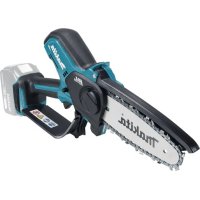
DUC150 - Saw MAKITA - Free user manual and instructions
Find the device manual for free DUC150 MAKITA in PDF.



Download the instructions for your Saw in PDF format for free! Find your manual DUC150 - MAKITA and take your electronic device back in hand. On this page are published all the documents necessary for the use of your device. DUC150 by MAKITA.
USER MANUAL DUC150 MAKITA
Cordless Pruning Saw INSTRUCTION MANUAL 8
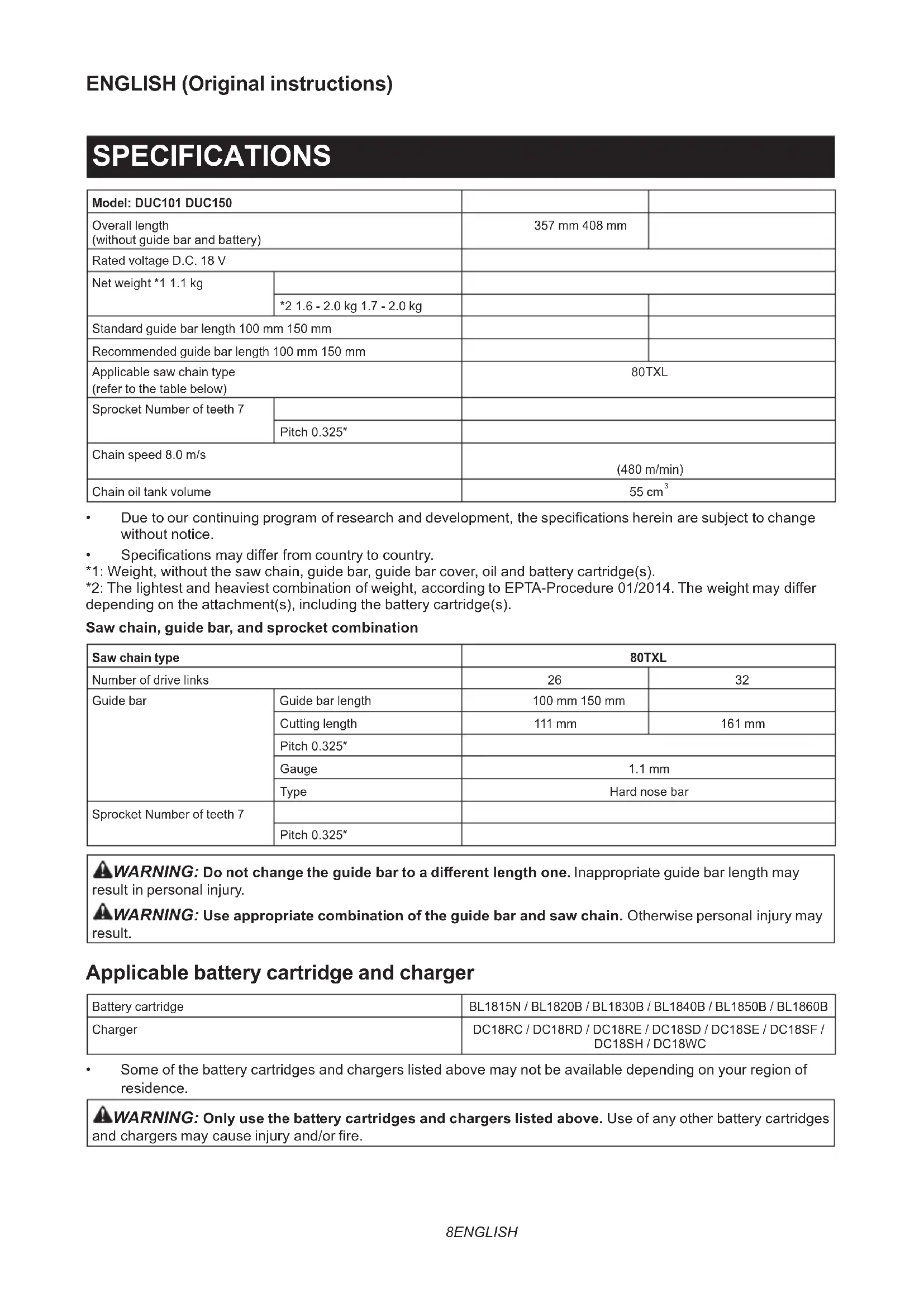
- Specicationsmaydierfromcountrytocountry. *1: Weight, without the saw chain, guide bar, guide bar cover, oil and battery cartridge(s). *2:Thelightestandheaviestcombinationofweight,accordingtoEPTA-Procedure01/2014.Theweightmaydier depending on the attachment(s), including the battery cartridge(s). Saw chain, guide bar, and sprocket combination Saw chain type 80TXL Number of drive links 26 32 Guide bar Guide bar length 100 mm 150 mm Cutting length 111 mm 161 mm Pitch 0.325″ Gauge 1.1 mm Type Hard nose bar Sprocket Number of teeth 7 Pitch 0.325″
WARNING: Do not change the guide bar to a dierent length one. Inappropriate guide bar length may
- Some of the battery cartridges and chargers listed above may not be available depending on your region of residence.
WARNING: Only use the battery cartridges and chargers listed above. Use of any other battery cartridges
andchargersmaycauseinjuryand/orre.9 ENGLISH Recommended cord connected power source Portable power pack PDC01
- The cord connected power source(s) listed above may not be available depending on your region of residence.
- Before using the cord connected power source, read instruction and cautionary markings on them. Symbols The followings show the symbols which may be used for the equipment. Be sure that you understand their meaning before use. Read instruction manual. Wear safety glasses and ear protection. Always use two hands when operating the tool. Beware of kickback and avoid contact with bar tip. Do not expose to moisture. Maximum permissible cut length Direction of chain travel Ni-MH Li-ion Only for EU countries Due to the presence of hazardous com- ponents in the equipment, waste electrical and electronic equipment, accumulators and batteries may have a negative impact on the environment and human health. Do not dispose of electrical and electronic appliances or batteries with household waste! In accordance with the European Directive on waste electrical and electronic equip- ment and on accumulators and batteries and waste accumulators and batteries, as well as their adaptation to national law, waste electrical equipment, batteries and accumulators should be stored separately and delivered to a separate collection point for municipal waste, operating in accor- dance with the regulations on environmen- tal protection. This is indicated by the symbol of the crossed-out wheeled bin placed on the equipment. Guaranteed sound power level according to EU Outdoor Noise Directive. Sound power level according to Australia NSW Noise Control Regulation. Intended use This tool is intended for cutting branches of trees or bushes by means of a saw-chain. Noise The typical A-weighted noise level determined accord- ing to EN62841-4-1: Model DUC101 Sound pressure level (L
) : 87 dB (A) Uncertainty (K) : 3 dB(A) NOTE: The declared noise emission value(s) has been measured in accordance with a standard test method and may be used for comparing one tool with another. NOTE: The declared noise emission value(s) may also be used in a preliminary assessment of exposure.
WARNING: Wear ear protection.
WARNING: The noise emission during actual
use of the power tool can dier from the declared value(s) depending on the ways in which the tool is used especially what kind of workpiece is processed.
WARNING: Be sure to identify safety mea-
sures to protect the operator that are based on an estimation of exposure in the actual conditions of use (taking account of all parts of the operating cycle such as the times when the tool is switched o and when it is running idle in addition to the trigger time). Vibration The vibration total value (tri-axial vector sum) deter- mined according to EN62841-4-1: Model DUC101 Work mode: cutting wood Vibration emission (a h,W ) : 4.6 m/s
Model DUC150 Work mode: cutting wood Vibration emission (a h,W ) : 4.8 m/s
NOTE: The declared vibration total value(s) has been measured in accordance with a standard test method and may be used for comparing one tool with another. NOTE: The declared vibration total value(s) may also be used in a preliminary assessment of exposure.10 ENGLISH
WARNING: The vibration emission during
actual use of the power tool can dier from the declared value(s) depending on the ways in which the tool is used especially what kind of workpiece is processed.
WARNING: Be sure to identify safety mea-
sures to protect the operator that are based on an estimation of exposure in the actual conditions of use (taking account of all parts of the operating cycle such as the times when the tool is switched o and when it is running idle in addition to the trigger time). Declarations of Conformity For European countries only The Declarations of conformity are included in Annex A to this instruction manual. SAFETY WARNINGS General power tool safety warnings WARNING Read all safety warnings, instruc- tions, illustrations and specications provided with this power tool. Failure to follow all instructions listed belowmayresultinelectricshock,reand/orserious injury. Save all warnings and instruc- tions for future reference. The term "power tool" in the warnings refers to your mains-operated (corded) power tool or battery-operated (cordless) power tool. General pruner saw safety warnings
1. Keep all parts of the body away from the
saw chain when the pruner saw is operating. Before you start the pruner saw, make sure the saw chain is not contacting anything. A moment of inattention while operating pruner saws may cause entanglement of your clothing or body with the saw chain.
2. Always hold the pruner saw with one hand
on the rear handle and the other hand on the auxiliary handle.
3. Hold the pruner saw by insulated gripping
surfaces only, because the saw chain may con- tact hidden wiring. Saw chains contacting a "live" wire may make exposed metal parts of the pruner saw "live" and could give the operator an electric shock.
4. Wear eye protection. Further protective equip-
ment for hearing, head, hands, legs and feet is recommended. Adequate protective equipment willreducepersonalinjuryfromyingdebrisor accidental contact with the saw chain.
5. Do not operate a pruner saw in a tree, on a lad-
der, from a rooftop, or any unstable support. Operation of a pruner saw in this manner could resultinseriouspersonalinjury.
6. Always keep proper footing and operate the
pruner saw only when standing on xed, secure and level surface. Slippery or unstable surfaces may cause a loss of balance or control of the pruner saw.
7. When cutting a branch that is under tension,
be alert for spring back. When the tension in the woodbresisreleased,thespringloadedbranch may strike the operator and/or throw the pruner saw out of control.
8. Use extreme caution when cutting brush and
saplings. The slender material may catch the saw chainandbewhippedtowardyouorpullyouo balance.
9. Carry the pruner saw with the pruner saw
switched o and away from your body. When transporting or storing the pruner saw, always t the guide bar cover. Proper handling of the pruner saw will reduce the likelihood of accidental contact with the moving saw chain.
10. Follow instructions for lubricating, chain
tensioning and changing the bar and chain. Improperly tensioned or lubricated chain may either break or increase the chance for kickback.
11. Cut wood only. Do not use pruner saw for pur-
poses not intended. For example: do not use pruner saw for cutting metal, plastic, masonry or non-wood building materials. Use of the prunersawforoperationsdierentthanintended could result in a hazardous situation.
12. This pruner saw is not intended for tree felling.
material, storing or servicing the pruner saw. Make sure the switch is o and the battery pack is removed.
14. Causes and operator prevention of kickback:
Kickback may occur when the nose or tip of the guidebartouchesanobject,orwhenthewood closes in and pinches the saw chain in the cut. Tip contact in some cases may cause a sudden reverse reaction, kicking the guide bar up and back towards the operator. Pinching the saw chain along the top of the guide bar may push the guide bar rapidly back towards the operator. Either of these reactions may cause you to lose control of the saw which could result in serious personalinjury.Donotrelyexclusivelyuponthe safety devices built into your saw. As a pruner saw user, you should take several steps to keep your cuttingjobsfreefromaccidentorinjury. Kickback is the result of pruner saw misuse and/or incorrect operating procedures or conditions and can be avoided by taking proper precautions as given below:
- Maintain a rm grip, with thumbs and n- gers encircling the pruner saw handles, with both hands on the saw and position your body and arm to allow you to resist kickback forces. Kickback forces can be controlled by the operator, if proper precau- tions are taken. Do not let go of the pruner11 ENGLISH saw. ►Fig.1
- Do not overreach and do not cut above shoulder height. This helps prevent unin- tended tip contact and enables better control of the pruner saw in unexpected situations.
- Only use replacement guide bars and saw chains specied by the manufacturer. Incorrect replacement guide bars and saw chains may cause chain breakage and/or kickback.
- Follow the manufacturer’s sharpening and maintenance instructions for the saw chain. Decreasing the depth gauge height can lead to increased kickback.
15. Follow all instructions when clearing jammed
material, storing or servicing the pruner saw. Make sure the switch is o and the battery pack is removed. Additional Safety Instructions Personal protective equipment
1. Clothing must be close-tting, but must not
2. Wear the following protective clothing during
- A tested safety helmet, if a hazard is pre- sented by falling branches or similar;
- Firm leather safety gloves;
- Long trousers manufactured from strong fabric;
- Protective dungarees of cut-resistant fabric;
- Safety shoes or boots with non-slip soles, steel toes, and cut-resistant fabric lining;
- A breathing mask, when carrying out work which produces dust (e.g. sawing dry wood). Operation
1. Before starting work, check that the tool is in
proper working order and that its condition complies with the safety regulations. Check in particular that:
- The run-down brake is working properly;
- Thebarandthesprocketcoveraretted correctly;
- The chain has been sharpened and ten- sioned in accordance with the regulations.
2. Do not start the tool with the chain cover being
installed on it. Starting the tool with the chain cover being installed on it may cause the chain cover to thrown out forward resulting in personal injuryanddamagetoobjectsaroundtheoperator.
3. Do not stand directly under the branch that
is being cut. Pay attention to the falling branches.
4. Do not operate the tool in bad weather or if
there is a risk of lightning.
5. When you use the tool on muddy ground, wet
slope, or slippery place, pay attention to your footing. Electrical and battery safety
1. Avoid dangerous environment. Don't use the
tool in damp or wet locations or expose it to rain. Water entering the tool will increase the risk of electric shock.
2. Do not dispose of the battery(ies) in a re.
The cell may explode. Check with local codes for possible special disposal instructions.
3. Do not open or mutilate the battery(ies).
Released electrolyte is corrosive and may cause damage to the eyes or skin. It may be toxic if swallowed.
4. Do not charge battery in rain, or in wet
5. Do not charge the battery outdoors.
6. Do not handle charger, including charger plug,
and charger terminals with wet hands.
7. Do not replace the battery with wet hands.
8. Do not leave the battery in the rain, nor charge,
use, or store the battery in a damp or wet place.
9. Do not wet the terminal of battery with liquid
such as water, or submerge the battery. If the terminal gets wet or liquid enters inside of battery, the battery may be short circuited and there is a riskofoverheat,re,orexplosion.
10. After removing the battery from the machine or
charger, be sure to attach the battery cover to the battery and store it in a dry place.
11. If the battery cartridge gets wet, drain the
water inside and then wipe it with a dry cloth. Dry the battery cartridge completely in a dry place before use. SAVE THESE INSTRUCTIONS.
WARNING: DO NOT let comfort or familiarity
with product (gained from repeated use) replace strict adherence to safety rules for the subject product. MISUSE or failure to follow the safety rules stated in this instruction manual may cause serious personal injury. Important safety instructions for battery cartridge
1. Before using battery cartridge, read all instruc-
tions and cautionary markings on (1) battery charger, (2) battery, and (3) product using battery.
2. Do not disassemble or tamper with the battery
cartridge.Itmayresultinare,excessiveheat, or explosion.
3. If operating time has become excessively
shorter, stop operating immediately. It may result in a risk of overheating, possible burns and even an explosion.
4. If electrolyte gets into your eyes, rinse them
out with clear water and seek medical atten- tion right away. It may result in loss of your eyesight.
5. Do not short the battery cartridge:
(1) Do not touch the terminals with any12 ENGLISH conductive material. (2) Avoid storing battery cartridge in a con- tainer with other metal objects such as nails, coins, etc. (3) Do not expose battery cartridge to water or rain. A battery short can cause a large current ow, overheating, possible burns and even a breakdown.
6. Do not store and use the tool and battery car-
tridge in locations where the temperature may reach or exceed 50 °C (122 °F).
7. Do not incinerate the battery cartridge even if
it is severely damaged or is completely worn out. The battery cartridge can explode in a re.
8. Do not nail, cut, crush, throw, drop the battery
cartridge, or hit against a hard object to the battery cartridge. Such conduct may result in a re,excessiveheat,orexplosion.
9. Do not use a damaged battery.
10. The contained lithium-ion batteries are subject
to the Dangerous Goods Legislation require- ments. For commercial transports e.g. by third parties, forwarding agents, special requirement on pack- aging and labeling must be observed. For preparation of the item being shipped, consult- ing an expert for hazardous material is required. Please also observe possibly more detailed national regulations. Tapeormaskoopencontactsandpackupthe battery in such a manner that it cannot move around in the packaging.
11. When disposing the battery cartridge, remove
it from the tool and dispose of it in a safe place. Follow your local regulations relating to disposal of battery.
12. Use the batteries only with the products
specied by Makita. Installing the batteries to non-compliantproductsmayresultinare,exces- sive heat, explosion, or leak of electrolyte.
13. If the tool is not used for a long period of time,
the battery must be removed from the tool.
14. During and after use, the battery cartridge may
take on heat which can cause burns or low temperature burns. Pay attention to the han- dling of hot battery cartridges.
15. Do not touch the terminal of the tool imme-
diately after use as it may get hot enough to cause burns.
16. Do not allow chips, dust, or soil stuck into the
terminals, holes, and grooves of the battery cartridge.Itmaycauseheating,catchingre, burst and malfunction of the tool or battery car- tridge,resultinginburnsorpersonalinjury.
17. Unless the tool supports the use near
high-voltage electrical power lines, do not use the battery cartridge near high-voltage electri- cal power lines. It may result in a malfunction or breakdown of the tool or battery cartridge.
18. Keep the battery away from children.
SAVE THESE INSTRUCTIONS. CAUTION: Only use genuine Makita batteries. Use of non-genuine Makita batteries, or batteries that have been altered, may result in the battery bursting causingres,personalinjuryanddamage.Itwill also void the Makita warranty for the Makita tool and charger. Tips for maintaining maximum battery life
1. Charge the battery cartridge before completely
discharged. Always stop tool operation and charge the battery cartridge when you notice less tool power.
2. Never recharge a fully charged battery car-
tridge. Overcharging shortens the battery service life.
3. Charge the battery cartridge with room tem-
perature at 10 °C - 40 °C (50 °F - 104 °F). Let a hot battery cartridge cool down before charging it.
4. When not using the battery cartridge, remove
it from the tool or the charger.
5. Charge the battery cartridge if you do not use
it for a long period (more than six months). PARTS DESCRIPTION ►Fig.2 1 Auxiliary handle 2 Safety cover 3 Saw chain 4 Guide bar 5 Oil tank cap 6 Guide bar cover 7 Sprocket cover 8 Lock-olever 9 Rear handle 10 Switch trigger 11 Lever 12 Battery cartridge13 ENGLISH FUNCTIONAL DESCRIPTION CAUTION: Always be sure that the tool is switched o and the battery cartridge is removed before adjusting or checking function on the tool. Installing or removing battery cartridge CAUTION: Always switch o the tool before installing or removing of the battery cartridge. CAUTION: Hold the tool and the battery car- tridge rmly when installing or removing battery cartridge. Failure to hold the tool and the battery cartridgermlymaycausethemtoslipoyourhands and result in damage to the tool and battery cartridge andapersonalinjury. ►Fig.3: 1. Red indicator 2. Button 3. Battery cartridge To remove the battery cartridge, slide it from the tool while sliding the button on the front of the cartridge. To install the battery cartridge, align the tongue on the battery cartridge with the groove in the housing and slip it into place. Insert it all the way until it locks in place with a little click. If you can see the red indicator as showninthegure,itisnotlockedcompletely. CAUTION: Always install the battery cartridge fully until the red indicator cannot be seen. If not, itmayaccidentallyfalloutofthetool,causinginjuryto you or someone around you. CAUTION: Do not install the battery cartridge forcibly. If the cartridge does not slide in easily, it is not being inserted correctly. Indicating the remaining battery capacity Only for battery cartridges with the indicator Press the check button on the battery cartridge to indi- cate the remaining battery capacity. The indicator lamps light up for a few seconds. ►Fig.4: 1. Indicator lamps 2. Check button Indicator lamps Remaining capacity Lighted O Blinking 75% to 100% 50% to 75% 25% to 50% 0% to 25% Charge the battery. Indicator lamps Remaining capacity Lighted O Blinking The battery may have malfunctioned. NOTE: Depending on the conditions of use and the ambienttemperature,theindicationmaydierslightly from the actual capacity. NOTE:Therst(farleft)indicatorlampwillblinkwhen the battery protection system works. Tool / battery protection system The tool is equipped with a tool/battery protection sys- tem.Thissystemautomaticallycutsopowertothe motor to extend tool and battery life. The tool will auto- matically stop during operation if the tool or battery is placed under one of the following conditions: Overload protection When the tool or battery is operated in a manner that causes it to draw an abnormally high current, the tool automaticallystops.Inthissituation,turnthetoolo and stop the application that caused the tool to become overloaded. Then turn the tool on to restart. Overheat protection When the tool or battery is overheated, the tool stops automatically. In this case, let the tool and battery cool before turning the tool on again. Overdischarge protection When the battery capacity is not enough, the tool stops automatically. In this case, remove the battery from the tool and charge the battery. Switch action
WARNING: For your safety, this tool is
equipped with lock-o lever which prevents the tool from unintended starting. NEVER use the tool if it runs when you simply pull the switch trigger without pressing the lock-o lever. Return the tool to our authorized service center for proper repairs BEFORE further usage.
WARNING: NEVER tape down or defeat pur-
pose and function of lock-o lever. CAUTION: Before installing the battery car- tridge into the tool, always check to see that the switch trigger actuates properly and returns to the "OFF" position when released. NOTICE: Do not pull the switch trigger hard with- out pressing the lock-o lever. This can cause switch breakage. To prevent the switch trigger from being accidentally14 ENGLISH pulled,alock-oleverisprovided.Tostartthetool, depressthelock-oleverandpulltheswitchtrigger. Release the switch trigger to stop. ►Fig.5: 1. Switch trigger 2.Lock-olever Checking the run-down brake CAUTION: If the saw chain does not stop within a few seconds in this test, stop using the tool and consult our authorized service center. Run the tool, and then release the switch trigger com- pletely. The saw chain must come to a standstill within a few seconds. ASSEMBLY CAUTION: Always be sure that the tool is switched o and the battery cartridge is removed before carrying out any work on the tool. CAUTION: Do not touch the saw chain with bare hands. Always wear gloves when handling the saw chain. Removing or installing saw chain CAUTION: The saw chain and the guide bar are still hot just after the operation. Let them cool down enough before carrying out any work on the tool. CAUTION: Carry out the procedure of install- ing or removing saw chain in a clean place free from sawdust and the like. Removing the saw chain To remove the saw chain, perform the following steps:
1. Pull the lever up.
3. Remove the sprocket cover then remove the saw
chain and guide bar from the tool body. Installing the saw chain To install the saw chain, perform the following steps:
1. Pull the lever up.
4. Align the hole on the guide bar with the pin on the
tool body, and then place the guide bar as shown in the gure. ►Fig.10: 1. Guide bar 2. Hole 3. Pin
6. Remove the guide bar from the tool body.
7. Check the direction of the saw chain. Match the
direction of the saw chain with that of the mark on the tool body. ►Fig.12: 1. Mark on tool body
8. Fit one end of the saw chain on the top of the
9. Fit the other end of the saw chain around the
sprocket, then attach the guide bar to the tool body so that the hole on the guide bar is aligned with the pin on the body. ►Fig.13: 1. Sprocket Press the guide bar against the tool body to release the pin.Thesawchaintensionisautomaticallyadjusted. ►Fig.14: 1. Saw chain 2. Pin 3. Sprocket
10. Place the sprocket cover so that the bolt and pin
onthetoolbodytintotherecessesonthesprocket cover,andscrewheadonthesprocketcovertsinto the recess in the tool body. ►Fig.15: 1. Sprocket cover 2. Bolt 3. Pin 4. Screw head 5. Recess NOTICE: Make sure that the mating surfaces of the sprocket cover and the tool body are aligned.
11. Turn the lever clockwise until the sprocket cover is
secured then return it to the original position. ►Fig.16: 1. Lever 2. Sprocket cover Make sure that the saw chain does not loose and the saw chain can be moved smoothly back and forth. If necessary,adjustthetensionofthesawchainbyrefer- ringtothesectionforadjustingsawchaintension. Adjusting saw chain tension CAUTION: A chain which is too loose can jump o the bar and it may cause an injury or accident. The saw chain may become loose after many hours of use. From time to time check the saw chain tension before use. Ifthesawchainisloose,adjustthesawchaintension.
1. Pull the lever up.
2. Turn the lever counterclockwise a little to loosen
thesprocketcoverlightly.Thechaintensionisadjusted automatically. ►Fig.18: 1. Sprocket cover 2. Lever
3. Turn the lever clockwise until the sprocket cover is
secured then return it to the original position. ►Fig.19: 1. Lever 2. Sprocket cover15 ENGLISH OPERATION Lubrication CAUTION: Do not operate the tool when the tank is empty. Replenish the oil in due time before the tank is empty. CAUTION: Prevent the oil from coming into contact with the skin and eyes. Contact with the eyes causes irritation. In the event of eye contact, ush the aected eye immediately with clear water, then consult a doctor at once. CAUTION: Never use waste oil. Waste oil con- tains carcinogenic substances. The contaminants in waste oil cause accelerated wear of the oil pump, the bar and the chain. Waste oil is harmful to the environment. NOTICE: When the tool is used for the rst time, it may take up to two minutes for the saw chain oil to begin its lubricating eect upon the saw mech- anism. Run the saw without load until it does so. NOTICE: When lling the chain oil for the rst time, or relling the tank after it has been com- pletely emptied, add oil up to the bottom edge of the ller neck. The oil delivery may otherwise be impaired. NOTICE: Use the saw chain oil exclusively for Makita tools or equivalent oil available in the market. NOTICE: Never use oil including dust and parti- cles or volatile oil. NOTICE: When pruning trees, use botanical oil. Mineral oil may harm trees. NOTICE: Before the cutting operation, make sure that the provided oil tank cap is screwed in place. Saw chain is automatically lubricated when the tool is in operation. Check the amount of remaining oil in the oil tank periodically through the oil inspection window. ►Fig.20: 1. Oil inspection window 2. Oil tank cap Tolltheoil,performthefollowingsteps:
1. Clean the area around the oil tank cap thoroughly
to prevent any dirt from entering the oil tank.
2. Lay the tool on its side.
3. Push the button on the oil tank cap so that the
button on the other side stands up, and then remove the oil tank cap by turning it. ►Fig.21: 1. Oil tank cap 2. Tighten 3. Loosen
4. Fill the oil tank with the oil. The proper amount of
6. Wipe away any spilt chain oil carefully.
NOTE:Ifitisdiculttoremovetheoiltankcap,insert the tip of slotted screwdriver into the slot of the oil tank cap, and then remove the oil tank cap by turning it counterclockwise. ►Fig.22: 1. Slot 2. Slotted screwdriver Afterrelling,holdthetoolawayfromthematerialto be cut. Start it and wait until lubrication on saw chain is adequate. ►Fig.23 Working with the tool CAUTION: Keep all parts of the body away from the saw chain when the tool is operating. CAUTION: Hold the tool rmly with both hands when the tool is operating. CAUTION: Do not overreach. Keep proper footing and balance at all times. NOTICE: Never toss or drop the tool. NOTICE: Do not cover the vents of the tool. Before starting the tool, bring the root of guide bar and the support part of tool body in contact with the branch tobecutasshowninthegure.Whilecontactingthe branch with the tool and guide bar, start the tool and saw the branch by moving the tool down along the branch. ►Fig.24 CAUTION: Before the cutting operation, make sure that the branch to be cut is in contact with the root of guide bar and the support part of tool body. Otherwise, the tool may be pulled toward the tip of guide bar and the guide bar may wobble, and mayresultinaninjury. Carrying tool Before carrying the tool, always remove the battery cartridge from the tool. Then attach the guide bar cover. Also cover the battery cartridge with the battery cover. ►Fig.25: 1. Guide bar cover 2. Battery cover Holster Optional accessory ►Fig.26
WARNING: If you are using DUC150, do not
use the holster for 100 mm guide bar length, and be sure to use the holster for 150 mm guide bar length. If you use the holster for 100 mm guide bar length, theguidebarofyourtoolwillnottcompletelyinthe holster and it is very dangerous. MAINTENANCE CAUTION: Always be sure that the tool is switched o and the battery cartridge is removed before attempting to perform inspection or maintenance. CAUTION: Always wear gloves when perform- ing any inspection or maintenance.16 ENGLISH NOTICE: Never use gasoline, benzine, thinner, alcohol or the like. Discoloration, deformation or cracks may result. To maintain product SAFETY and RELIABILITY, repairs,anyothermaintenanceoradjustmentshould be performed by Makita Authorized or Factory Service Centers, always using Makita replacement parts. Sharpening the saw chain Sharpen the saw chain when:
- Mealy sawdust is produced when damp wood is cut;
- Thechainpenetratesthewoodwithdiculty,even when heavy pressure is applied;
- The cutting edge is obviously damaged;
- The saw pulls to the left or right in the wood. (caused by uneven sharpening of the saw chain or damage to one side only) Sharpen the saw chain frequently but a little each time. Twoorthreestrokeswithaleareusuallysucientfor routine resharpening. When the saw chain has been resharpened several times, have it sharpened in our authorized service center. Sharpening criteria:
WARNING: An excessive distance between
the cutting edge and depth gauge increases the risk of kickback. ►Fig.27: 1. Cutter length 2. Distance between cutting edge and depth gauge 3. Minimum cutter length (3 mm) — Allcutterlengthmustbeequal.Dierentcutter lengths prevent the saw chain from running smoothly and may cause the saw chain to break. — Do not sharpen the chain when the cutter length has reached 3 mm or shorter. The chain must be replaced with new one. — The chip thickness is determined by the distance between the depth gauge (round nose) and the cutting edge. — The best cutting results are obtained with following distance between cutting edge and depth gauge.
- Chain blade 80TXL : 0.65 mm ►Fig.28 — The sharpening angle of 30° must be the same on allcutters.Dierentcutteranglescausethechain to run roughly and unevenly, accelerate wear, and lead to chain breaks. — Useasuitableroundlesothatthepropersharp- ening angle is kept against the teeth.
- Chain blade 80TXL : 55° File and le guiding — Useaspecialroundle(optionalaccessory)for saw chains to sharpen the chain. Normal round lesarenotsuitable. — Diameteroftheroundleforeachsawchainisas follows:
- Chain blade 80TXL : 4.0 mm — Theleshouldonlyengagethecutteronthefor- wardstroke.Lifttheleothecutteronthereturn stroke. — Sharpentheshortestcutterrst.Thenthelength of this shortest cutter becomes the standard for all other cutters on the saw chain. — Guidetheleasshowninthegure. ►Fig.29: 1. File 2. Saw chain — Thelecanbeguidedmoreeasilyifaleholder (optionalaccessory)isemployed.Theleholder has markings for the correct sharpening angle of 30° (align the markings parallel to the saw chain) and limits the depth of penetration (to 4/5 of the lediameter). ►Fig.30: 1. File holder — After sharpening the chain, check the height of the depth gauge using the chain gauge tool (optional accessory). ►Fig.31 — Removeanyprojectingmaterial,howeversmall, withaspecialatle(optionalaccessory). — Roundothefrontofthedepthgaugeagain. Cleaning the guide bar Chips and sawdust will build up in the guide bar groove. Theymayclogthebargrooveandimpairtheoilow. Clean out the chips and sawdust every time when you sharpen or replace the saw chain. ►Fig.32 Cleaning the sprocket cover Chips and saw dust will accumulate inside of the sprocket cover. Remove the sprocket cover and saw chain from the tool then clean the chips and saw dust. ►Fig.33 Cleaning the oil discharge hole Small dust or particles may be built up in the oil dis- charge hole during operation. These dust or particles mayimpairtheoiltoowandcauseaninsucient lubrication on the whole saw chain. When a poor chain oil delivery occurs at the top of guide bar, clean the oil discharge hole as follows.
1. Remove the sprocket cover and saw chain from
screwdriver or the like. ►Fig.34: 1. Slotted screwdriver 2. Oil discharge hole
3. Insert the battery cartridge into the tool. Pull the
switchtriggertoowbuilt-updustorparticlesotheoil discharge hole by discharging chain oil.
4. Remove the battery cartridge from the tool.
Reinstall the sprocket cover and saw chain and guide bar on the tool. Replacing the sprocket CAUTION: A worn sprocket will damage a new saw chain. Have the sprocket replaced in this case. Beforettinganewsawchain,checktheconditionof17 ENGLISH the sprocket. ►Fig.35: 1. Sprocket 2. Areas to be worn out Alwaystanewlockingringwhenreplacingthe sprocket. ►Fig.36: 1. Locking ring 2. Sprocket NOTICE: Make sure that the sprocket is installed as shown in the gure. Storing the tool
1. Clean the tool before storing. Remove any chips
and sawdust from the tool after removing the sprocket cover.
2. After cleaning the tool, run it under no load to lubri-
cate the saw chain and guide bar.
3. Cover the guide bar with the guide bar cover.
4. Empty the oil tank.
Instructions for periodic maintenance To ensure long life, prevent damage and ensure the full functioning of the safety features, the following maintenance must be performed regularly. Warranty claims can be recognized only if this work is performed regularly and properly. Failure to perform the prescribed maintenance work can lead to accidents! The user of the tool must not perform maintenance work which is not described in the instruction manual. All such work must be carried out by our autho- rized service center. Check item / Operating time Before operation Everyday Every week Every 3 month Annually Before storage Whole tool Inspection.
Check at authorized service center.
Guide bar Inspection. - - - - Remove from the tool.
Chain lubrication Check the oil feed rate.
Switch trigger Inspection.
Lock-olever Inspection.
Oil tank cap Check tightness.
Screws and nuts Inspection. - -
TROUBLESHOOTING Beforeaskingforrepairs,conductyourowninspectionrst.Ifyoundaproblemthatisnotexplainedinthemanual, do not attempt to dismantle the tool. Instead, ask Makita Authorized Service Centers, always using Makita replace- ment parts for repairs. Malfunction status Cause Action The tool does not start. Battery cartridge is not installed. Install a charged battery cartridge. Battery problem (low voltage). Recharge the battery cartridge. If recharg- ingisnoteective,replacethebattery cartridge. The motor stops running after a little use. Battery's charge level is low. Recharge the battery cartridge. If recharg- ingisnoteective,replacethebattery cartridge. No oil on the chain. Oil tank is empty. Fill the oil tank. Oil guide groove is dirty. Clean the groove.18 ENGLISH Malfunction status Cause Action The tool does not reach maximum RPM. Battery cartridge is installed improperly. Install the battery cartridge as described in this manual. Battery power is dropping. Recharge the battery cartridge. If recharg- ingisnoteective,replacethebattery cartridge. The drive system does not work correctly. Ask the authorized service center in your region for repair. Abnormal vibration: Stop the tool immediately! Loose guide bar or saw chain. Adjusttheguidebarandsawchain tension. Tool malfunction. Ask the authorized service center in your region for repair. The saw chain cannot be installed. The combination of saw chain and sprocket is not correct. Use the correct combination of saw chain and sprocket by referring to the section for specications. OPTIONAL ACCESSORIES CAUTION: These accessories or attachments are recommended for use with your Makita tool specied in this manual. The use of any other accessories or attachments might present a risk of injurytopersons.Onlyuseaccessoryorattachment for its stated purpose. If you need any assistance for more details regard- ing these accessories, ask your local Makita Service Center.