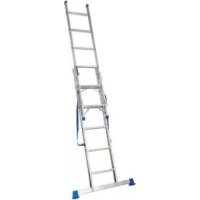
Z30473 - Ladder POWERFIX - Free user manual and instructions
Find the device manual for free Z30473 POWERFIX in PDF.



| Product type | Multi-function ladder |
| Brand | Powerfix |
| Model | Z30473 |
| Dimensions (ladder mode) | 77 × 169 × 117 cm (L × H × D) |
| Dimensions (scaffold mode) | 236 × 90 × 77 cm (L × H × D) |
| Material | Aluminum, steel, plastic |
| Ladder weight | Approx. 12 kg |
| Weight of work platform | Approx. 5.2 kg (each) |
| Maximum load capacity | 150 kg (user + tools included) |
| Intended use | Indoor and outdoor, non-professional use, for short-duration tasks |
| Number of work platforms | 2 (one short, one long) |
| Adjustment mechanism | Swivel joints with release lever and control display |
| Ladder feet | Removable, non-slip plastic |
| Included accessories | 2 ladder feet, 4 screws, 4 washers, 4 nuts, 2 work platforms, 1 instruction manual |
| Maintenance and cleaning | Clean with a damp cloth and mild detergent; dry thoroughly |
| Safety instructions | Check before each use, use on stable ground, do not exceed 150 kg, do not use if damaged, do not use under the influence of alcohol, etc. |
| Warranty | 3 years from date of purchase |
| Maximum number of users | 1 person on each climbable side |
| Use heights | Adjustable via swivel joints (multiple positions) |
| Transport | Fold and secure tightly when transporting on a vehicle |
Frequently Asked Questions - Z30473 POWERFIX
User questions about Z30473 POWERFIX
0 question about this device. Answer the ones you know or ask your own.
Ask a new question about this device
Download the instructions for your Ladder in PDF format for free! Find your manual Z30473 - POWERFIX and take your electronic device back in hand. On this page are published all the documents necessary for the use of your device. Z30473 by POWERFIX.
USER MANUAL Z30473 POWERFIX
Assembly, operating and safety instructions
NL BE
MULTIFUNCTIONE LADDER
Intended use.. Page 16
Description of parts.. Page 16
Technical data.. Page 16
Included items . Page 17
Safety instructions.. Page 17
General safety instructions.. Page 17
Safety instructions with regard to setting up the ladder . Page 17
Safety instructions for using the ladder.. Page 18
Before use . Page 20
How to use . Page 21
Attaching the stabilisers.. Page 21
Operating the hinge system.. Page 21
Using the working platforms.. Page 22
Folding the ladder together.. Page 22
Repair, maintenance and storage . Page 22
Cleaning and care.. Page 22
Disposal.. Page 23
Warranty . Page 23
Multi-Purpose Ladder
Introduction

We congratulate you on the purchase of your new product. You
have chosen a high quality product. Familiarise yourself with the product before using it for the first time. In addition, please carefully refer to the operating instructions and the safety advice below. Only use the product as instructed and only for the indicated field of application. Keep these instructions in a safe place. If you pass the product on to anyone else, please ensure that you also pass on all the documentation with it.
Intendeduse
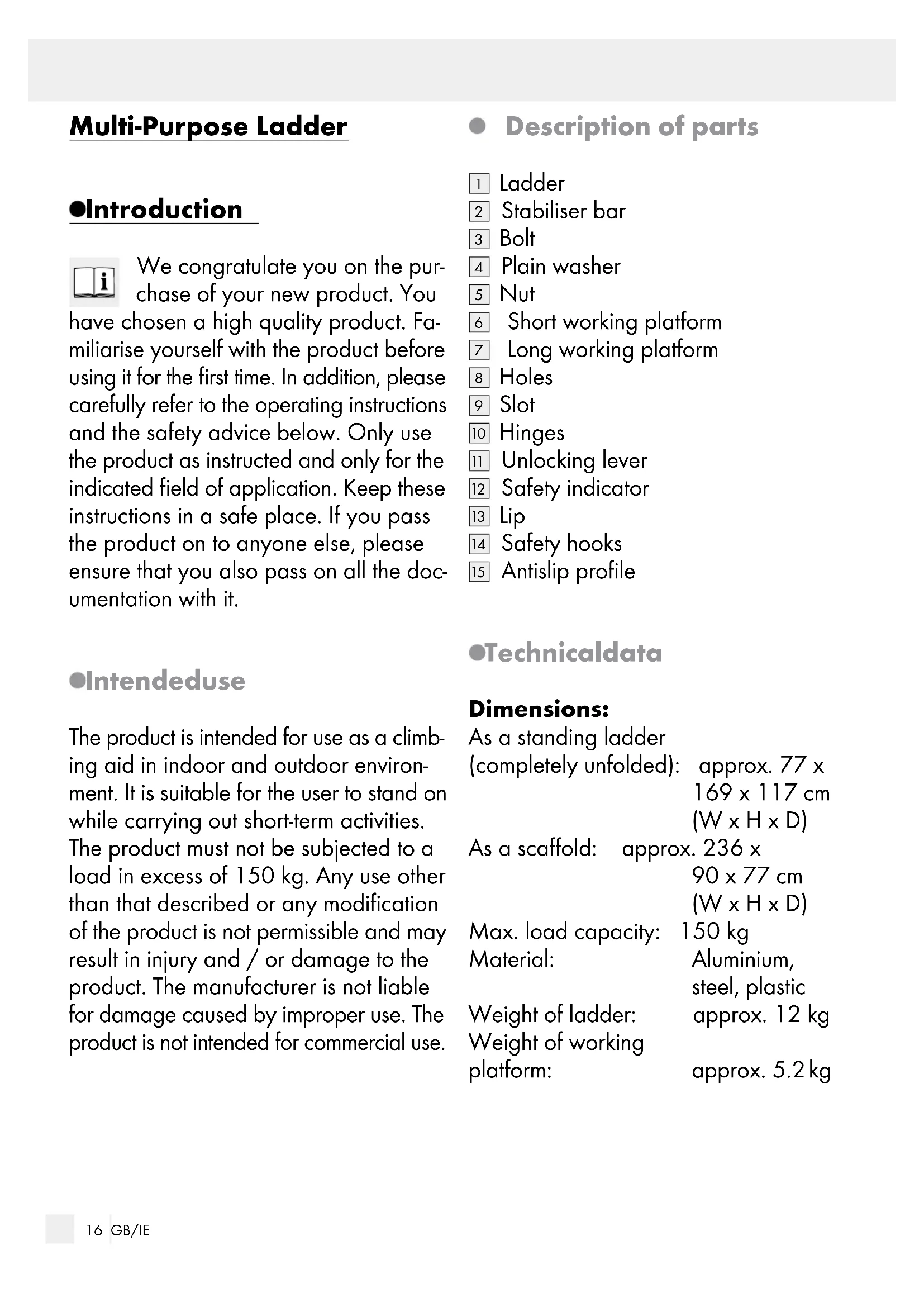
The product is intended for use as a climbing aid in indoor and outdoor environment. It is suitable for the user to stand on while carrying out short-term activities. The product must not be subjected to a load in excess of 150kg . Any use other than that described or any modification of the product is not permissible and may result in injury and/or damage to the product. The manufacturer is not liable for damage caused by improper use. The product is not intended for commercial use.
Description of parts
Ladder
2 Stabiliser bar
3 Bolt
4 Plain washer
5 Nut
Short working platform
7 Long working platform
Holes
Slot
10 Hinges
Unlocking lever
Safety indicator
13 Lip
14 Safety hooks
Antislip profile
-Technicaldata
Dimensions:
As a standing ladder
(completely unfolded): approx. 77 x 169 x 117 cm (W x H x D)
As a scaffold: approx. 236 x
$$ 9 0 \times 7 7 c m $$
$$ (W \times H \times D) $$
Max. load capacity: 150kg
Material:
Aluminium,
steel, plastic
Weight of ladder:
approx. 12 kg
Weight of working
approx. 5.2kg
IncludedItems
1 Multi-Function ladder
2 Stabiliser bars
4 Bolts
4 Plain washers
4 Nuts
2 Working platforms
1 Instructions for use

Safetyinstructions
- General safety instructions

ADING
TO LIFE AND RISK OF
ACCIDENTS FOR INFANTS AND
CHILDREN! Never leave children unattended with the packaging material or the product. The packaging material can cause danger of suffocation and danger to life by strangulation. Children often underestimate the danger. Always keep children away from this product. This product is not a toy.

Maximum total load 150kg
tools and other materials must not exceed 150kg
Visually inspect the ladder following delivery and prior to first use. Verify all parts are functioning and undamaged.
Do not try to repair a damaged ladder yourself. Always have a professional carry out any repairs.
■ Be particularly careful if there is any wind, rain or frost. Do not use the ladder outdoors in bad weather (e.g. high winds).
- Keep the ladder clean and remove any dirt. Keep the ladder dry to avoid any slippage or toppling over.
- When transporting ladders on roof bars or in a truck, ensure they are suitably placed / fixed to prevent damage.
Before using a ladder at work a risk assessment should be carried out respecting the legislation in the country of use.
- Safety instructions with regard to setting up the ladder
Before using it, check all parts of the ladder. Do not use the ladder if any parts are missing, damaged or worn.
- Do not use any attachments, components or accessories that have not been expressly approved for this ladder.
Only place the ladder onto a level, dry, unmovable and firm subsurface. Never try to increase the working height by putting the ladder onto other objects.
When using the product on a substrate with different levels (e.g. steps), ensure that the appropriate hinges are articulated and properly engaged. If this is not the case, the product is being subject to improper use, which can lead to severe injury and / or damage to the product.
- Do not attempt to articulate a part of the product if the hinge is not fully unlocked.
Do not use the ladder on slippery surfaces.
CAUTION! RISK OF CRUSHING!
Take particular care when opening or closing the ladder. Keep your distance from moving parts and the safety devices.
Do not place the ladder in front of doors that have not been locked.
- Do not use the ladder as a bridging structure.
Make sure that all plastic feet are firmly on the floor.
- Be particularly careful when you set the ladder up on protective film, a carpet or other protective subsurfaces. The plastic feet may not have enough grip and may, therefore, slip.
The use of frame attachments is prohibited for this ladder.
ATTENTION! Metal is an electrical conductor! Make sure that no part of the ladder is touching a live cable.
Do not use conductive ladders for when working under electric voltage is unavoidable.
- When positioning the ladder take into account risk of collision with the ladder e.g. from pedestrians, vehicles or doors. Secure doors (not fire exits) and windows where possible in the work area.
Lean straight ladders against an even and stable surface and secure it prior to use, e.g. by fixing or using a suitable means to secure stability.
Only reposition the ladder from the ground.
- Avoid excessive lateral loads, e.g. while drilling in brick or concrete walls.
Ladder shall be stood on its feet, not the rungs or steps.
Safetyinstructions for using the ladder
WARNING! DANGER TO LIFE AND DANGER OF ACCIDENTS!
Do not pull too hard on objects and do not exert any strong pressure on objects when you are on the ladder. This could make the ladder topple over and could injure or kill you.
- Do not use the ladder if you are under the influence of alcohol, drugs or strong medication. Do not use the ladder if you are ill or do not feel well.
Do not use the ladder if it is wet, damaged or if it has become slippery because of water, ice or snow.
Wear non-slip footwear when using the ladder.
■ Be careful when getting on or off the ladder.
Always hold on tightly to the ladder and always face the ladder when getting on and off the ladder.
Do not carry bulky or heavy objects when climbing up the ladder. - Do not try to change the location of the ladder when you are standing on it. Get off the ladder first and then change the position of the ladder. Then get onto the ladder again.
Make sure that no-one is under the ladder when it is in use.
This ladder is not a toy and is not suitable for use by children. Make sure that the ladder cannot be used by children. Do not leave the ladder unattended after you have set it up.
Do not lean out too far when you are on the ladder. Keep the centre of your body between the ladder stringers and stand with both feet on the same rung.
Do not use step ladders to access other levels.
Make sure that you do not get tired when working and take breaks. Tiredness represents an increased security risk and could lead to accidents
Ladders should only be used for light work of short duration.
- Maintain a handhold whilst working from a ladder or take additional safety precautions if you cannot.
- Do not use the top three rungs of the ladder as a working platform when you are using the ladder as a leaning extension ladder.
Do not stand on one of the upper 2 rungs of a standing ladder.
- Attached to the ladder frame you will find labels with pictograms for a safe use of the ladder. Follow the advices on the pictograms to avoid accidents.
This ladder is not design to use in the stairs.
| Before using the ladder, please read the use instructions very carefully. | |
| Maximum intended. | |
| Visual check before use. | |
| Ensure standing ladder is fully opened before use. | |
| Check the ladder feet. | |
| Maximum number of the users each ladder. | |
| Erect on a firm base. | |
| Never step off the ladder sideways. | |
| Do not use the ladder as a bridge. | |
| Keep your body centered on the ladder avoiding leaning too far sideways. | |
| Make sure that the ground is dry, clean and free from any pollution, such as water, oil or waste, which can cause that the ladder slips. | |
| Beware of electrical hazards when transporting ladder. | |
| The ladder may only be used by one person at a time. | |
| Face ladder when ascending or descending ladder. | |
| Ladder extension above landing point. | |
| Correct angle of erection. | |
| Secure top / bottom ladder ends. | |
| Always keep hinges clean and oiled. | |
| Do not use ladder without stabilisers. | |
| Do not stand on one of the upper 3 rungs of a leaning ladder! | |
| Do not stand on one of the upper 2 rungs of a standing ladder. | |
| Warning! Do not insert your fingers into the holes in the ladder frame. | |
| Do not stand on the top rung! | |
| Ensure that the top end of the ladder is properly supported! | |
| Erect on a level base. | |
| Max. loading on platfrom. |
| Do not stand on the top of the ladder in “stand-off” position. |
- Beforeuse
- Avoid damage when transporting ladders on roof racks or in a lorry. Make sure that the ladder 1 is appropriately fastened in place.
Before using the ladder, visually inspect it. Check that all parts are undamaged and in good working order. Do not use a damaged ladder.
Remove all contamination on the ladder 1, such as wet paint, dirt, oil or snow.
Lock all doors and windows (but not emergency exits) in the area around the ladder 1 where you are going to work.
Verify the ladder is suitable for the respective use.
The ladder must be inspected before use. For regular inspection, the following items shall be taken into account: - check that the stiles / legs (uprights) are not bent, bowed, twisted, dented, cracked, corroded or rotten;
- check that the stiles / legs around the fixing points for other components are in good condition;
- check that fixings (usually rivets, screws or bolts) are not missing, loose, or corroded;
-
check that rungs / steps are not missing, loose, excessively worn, corroded or damaged;
-
check that the hinges between front and rear sections are not damaged, loose or corroded;
- check that the locking stays horizontal, back rails and corner braces are not missing, bent, loose, corroded or damaged;
- check that the stabilizer bars are fixed and in a good condition.
- check that rubber feet / end caps are not missing, loose, excessively worn, corroded or damaged;
- check that the entire ladder is free from contaminants (e.g. dirt, mud, paint, oil or grease);
- check that locking catches (if fitted) are not damaged or corroded and function correctly;
- check that the working platform (if fitted) has no missing parts or fixings and is not damaged or corroded. If any of the above checks cannot be fully satisfied, you should NOT use the ladder.
How to use
CAUTION! RISK OF CRUSHING!
Take particular care when opening or closing the ladder.1. Keep your distance from moving parts and the safety devices.
- Attaching the stabilisers
ATTENTION! Never use the ladder without the stabilisers attached 2
Use the supplied stabilisers 2 only.
Insert the stabilisers 2 into the slots 9 at the ends of the ladder 1 (see Fig. D). Ensure that the holes 8 in the stabiliser and the ladder end align with one another.
Guide four bolts (included) through the holes and secure the connection with one plain washers and nut on each bolt (see Fig. D).
ATTENTION! Check every time before loading the ladder 1 that the stabilisers 2 are correctly attached.
- Operating the hinge system
Before each use, check that all the hinges 10 are properly engaged. The hinges 10 lying parallel to one another must always be engaged at the same setting.
Unlock the hinges by pulling the unlocking lever backwards (see Fig. E).
■ Articulate the desired section of the ladder at the hinges 10. The hinges engage automatically in the next position. Unlock the hinges 10 again if you would like to articulate the ladder further.
ATTENTION! The hinges 10 engage with an audible click. However, you should always check that the safety indicator 12 shows "engaged" (see Fig. G). Do not load the ladder if the safety indicator 12 shows "unlocked" (see Fig. F).
Using the working platforms
- Do not use the ladder without a working platform 6, 7 when you are carrying out an activity that requires a working platform 6, 7 (see Fig. B). Do not use a working platform 6, 7 for ladder positions that are not designed to have working platforms fitted (see Fig. A, C). Failure to observe this advice when using the product can lead to severe injury and / or damage to the product.
Use the supplied working platforms 6, 7 only.
Use the working platforms 6, 7 only with the antislip profile 15 facing upwards (see Fig. I). - Hook the lip 13 on the end of the working platforms 6, 7 over the last rung of the ladder section and check that the other end of the working platform 6, 7 also rests on a rung in a similar manner. The safety hooks 14 prevent the working platforms 6, 7 from sliding out of position. If necessary press the working platform lightly downwards to ensure the working platform 6, 7 rests correctly on the ladder.
Check that the working platform 6, 7 rests correctly on the ladder before you step on or load the working platform.
When using the product on a substrate with different levels (e.g. steps), ensure that the working platform 6, 7 is horizontal. Do not attempt to bring
the working platform to the horizontal by placing an object beneath it.
- Check before stepping on to a working platform 6, 7 that it is not slippery. Check that there are no objects on the working platform 6, 7 that could give rise to a trip or slip hazard.
- Folding the ladder together
- Fold the ladder together as shown in Fig. J.
Repair, maintenance and storage
AWARNING! Have your device repaired only by qualified specialist personnel using original manufacturer parts only. This will ensure that the product remains safe to use.
When not using it, store the ladder in a safe, dry place.
- Cleaning and care
Clean the ladder after every use.
To do so, use a slightly damp, lint-free cloth.
If it is very contaminated, use a slightly damp cloth and, if necessary, a mild detergent.
On no account should you use corrosive or aggressive cleaning agents.
Carefully dry the product off after cleaning it.
Disposal
The packaging is made entirely of recyclable materials, which you may dispose of at local recycling facilities.
Contact your local refuse disposal authority for more details of how to dispose of your worn-out product.
Warranty
The product has been manufactured to strict quality guidelines and meticulously examined before delivery. In the event of product defects you have legal rights against the retailer of this product. Your legal rights are not limited in any way by our warranty detailed below.
The warranty for this product is 3 years from the date of purchase. Should this product show any fault in materials or manufacture within 3 years from the date of purchase, we will repair or replace it - at our choice - free of charge to you.
The warranty period begins on the date of purchase. Please keep the original sales receipt in a safe location. This document is required as your proof of purchase. This warranty becomes void if the product has been damaged, or used or maintained improperly.
The warranty applies to defects in material or manufacture. This warranty does not cover product parts subject to normal
wear, thus possibly considered consumables (e.g. batteries) or for damage to fragile parts, e.g. switches, rechargeable batteries or glass parts.
Introduction
Fourniture.. Page 26
Avant I'usage.. Page 30


- MULTIFUNCTIONE LADDER
- Safety instructions.. Page 17
- Before use . Page 20
- How to use . Page 21
- Repair, maintenance and storage . Page 22
- Cleaning and care.. Page 22
- Disposal.. Page 23
- Warranty . Page 23
- Multi-Purpose Ladder
- Introduction
- Intendeduse
- Description of parts
- -Technicaldata
- Dimensions:
- IncludedItems
- Safetyinstructions
- - General safety instructions
- ADING
- TO LIFE AND RISK OF
- ACCIDENTS FOR INFANTS AND
- - Safety instructions with regard to setting up the ladder
- CAUTION! RISK OF CRUSHING!
- Safetyinstructions for using the ladder
- WARNING! DANGER TO LIFE AND DANGER OF ACCIDENTS!
- - Beforeuse
- How to use
- - Attaching the stabilisers
- - Operating the hinge system
- Using the working platforms
- - Folding the ladder together
- Repair, maintenance and storage
- - Cleaning and care
- Disposal
- Warranty
- Avant I'usage.. Page 30
Brand : POWERFIX
Model : Z30473
Category : Ladder