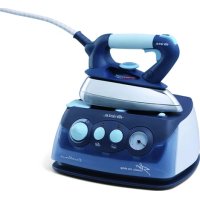
6387 - Iron ARIETE - Free user manual and instructions
Find the device manual for free 6387 ARIETE in PDF.



| Product type | Iron with boiler (steam station) |
| Brand | Ariete |
| Model | 6387 |
| Power supply | 230 V ~ 50 Hz |
| Power | 2000 W |
| Water tank capacity | Approximately 1 L |
| Weight | Approximately 2.5 kg |
| Dimensions (L x W x H) | 30 x 15 x 25 cm |
| Main functions | Steam burst, continuous steam, vertical ironing, dry ironing |
| Temperature setting | Thermostat knob with positions for synthetic, wool, cotton, linen |
| Steam setting | Rotary knob from min to max |
| Pressure gauge | Indicates internal pressure and low water level |
| Cable winder | Integrated under the iron |
| Soleplate type | Metal soleplate (likely steel or ceramic) |
| Boiler material | Metal (steel) |
| Safety | Do not use without water, avoid contact with hot parts |
| Maintenance | Clean soleplate with diluted vinegar, clean boiler every 3 months |
| Spare parts | Measuring cup, funnel, tank cap, boiler cap |
| Repairability | Repair only by Ariete approved service |
Frequently Asked Questions - 6387 ARIETE
User questions about 6387 ARIETE
0 question about this device. Answer the ones you know or ask your own.
Ask a new question about this device
Download the instructions for your Iron in PDF format for free! Find your manual 6387 - ARIETE and take your electronic device back in hand. On this page are published all the documents necessary for the use of your device. 6387 by ARIETE.
USER MANUAL 6387 ARIETE
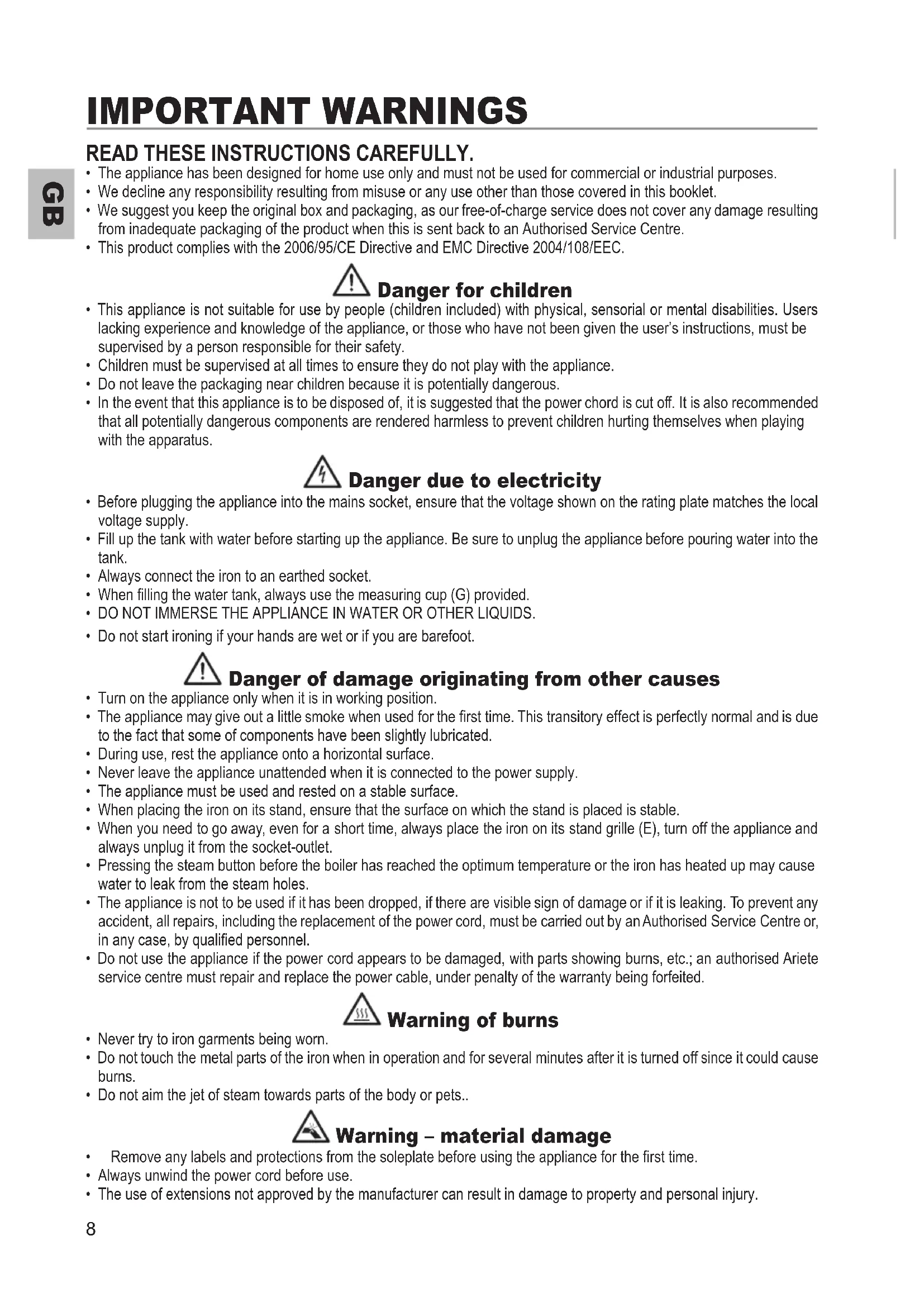
READ THESE INSTRUCTIONS CAREFULLY.
- The appliance has been designed for home use only and must not be used for commercial or industrial purposes.
We decline any responsibility resulting from misuse or any use other than those covered in this booklet.
We suggest you keep the original box and packaging, as our free-of-charge service does not cover any damage resulting from inadequate packaging of the product when this is sent back to an Authorised Service Centre. - This product complies with the 2006/95/CE Directive and EMC Directive 2004/108/EEC.

Danger for children
- This appliance is not suitable for use by people (children included) with physical, sensorial or mental disabilities. Users lacking experience and knowledge of the appliance, or those who have not been given the user's instructions, must be supervised by a person responsible for their safety.
Children must be supervised at all times to ensure they do not play with the appliance. - Do not leave the packaging near children because it is potentially dangerous.
- In the event that this appliance is to be disposed of, it is suggested that the power chord is cut off. It is also recommended that all potentially dangerous components are rendered harmless to prevent children hurting themselves when playing with the apparatus.

Danger due to electricity
- Before plugging the appliance into the mains socket, ensure that the voltage shown on the rating plate matches the local voltage supply.
- Fill up the tank with water before starting up the appliance. Be sure to unplug the appliance before pouring water into the tank.
Always connect the iron to an earthed socket. - When filling the water tank, always use the measuring cup (G) provided.
DO NOT IMMERSE THE APPLIANCE IN WATER OR OTHER LIQUIDS. - Do not start ironing if your hands are wet or if you are barefoot.

Danger of damage originating from other causes
- Turn on the appliance only when it is in working position.
- The appliance may give out a little smoke when used for the first time. This transitory effect is perfectly normal and is due to the fact that some of components have been slightly lubricated.
- During use, rest the appliance onto a horizontal surface.
- Never leave the appliance unattended when it is connected to the power supply.
- The appliance must be used and rested on a stable surface.
- When placing the iron on its stand, ensure that the surface on which the stand is placed is stable.
- When you need to go away, even for a short time, always place the iron on its stand grille (E), turn off the appliance and always unplug it from the socket-outlet.
- Pressing the steam button before the boiler has reached the optimum temperature or the iron has heated up may cause water to leak from the steam holes.
- The appliance is not to be used if it has been dropped, if there are visible sign of damage or if it is leaking. To prevent any accident, all repairs, including the replacement of the power cord, must be carried out by an Authorised Service Centre or, in any case, by qualified personnel.
- Do not use the appliance if the power cord appears to be damaged, with parts showing burns, etc.; an authorised Ariete service centre must repair and replace the power cable, under penalty of the warranty being forfeited.

Warning of burns
- Never try to iron garments being worn.
- Do not touch the metal parts of the iron when in operation and for several minutes after it is turned off since it could cause burns.
- Do not aim the jet of steam towards parts of the body or pets..

Warning - material damage
- Remove any labels and protections from the soleplate before using the appliance for the first time.
Always unwind the power cord before use. -
The use of extensions not approved by the manufacturer can result in damage to property and personal injury.
-
Do not use sparkling (carbonated) water.
- When the iron is hot, do not rest it onto the power cord. Take special care in ensuring that the cable and the cord do not come into contact with the soleplate when it is hot.
- Do not pull the power cord to unplug the appliance.
- The appliance must only be cleaned with a soft, slightly damped, cloth after unplugging the iron and allowing all its parts to cool down. Never use solvents which may damage the plastic parts.
- Clean the boiler at least every three months so as to eliminate any residue of lime that could jeopardize proper operation of the appliance.
- Do not pour vinegar, escalers or other scented substances into the tank; under penalty of immediate cancellation of the warranty.
- Do not wrap the power cord around the soleplate, especially when the iron is hot.
- Do not put the soleplate in contact with metal surfaces.
- Before storing the appliance, turn it off by pressing (B) and (S) buttons, always unplug it from the mains, and allow it to cool down before emptying the boiler completely.
- Do not expose the appliance to atmospheric agents (rain, sun ...).
- KEEP THESE INSTRUCTIONS IN A SAFE PLACE AT ALL TIMES
DESCRIPTION OF THE APPLIANCE (FIG. 1)
A - Boiler
B - Iron on-off switch
C - Iron on-off indicator lamp
D-Cord storage device
E - Iron stand grille
F - Safety cap
G - Water measuring cup
H - Tank
I - Power supply cable
L - Iron temperature control indicator light
M - Thermostat knob
N - Plate
O - Steam button
P - Continuous steam button
Q - Continuous steam lock slider
R - Iron/boiler connection cable
S - Boiler on-off switch
T - Boiler on-off indicator lamp
U - Manometer
V - Steam regulator
W-Boiler cap
INSTRUCTIONS FOR USE
Installation
Place the appliance on an horizontal and stable surface.
For the steam ironing you can use tap water (hardness 15 French degrees max.). In the event of excessively hard water, we suggest you use demineralised water instead. Do not add any additives, under penalty of immediate cancellation of the warranty.
Filling the tank
Lift the cap (F) and pour water into the tank while being careful to not exceed the MAX limit (Fig. 3). Replace the cap.

Warning!
To avoid damage the pump, never operate the appliance without any water in the tank, even for dry ironing.
Switching on the appliance
Connect the appliance to the power supply, ensuring that the voltage indicated on the identification plate corresponds to your local power supply.
Press the boiler on-off switch (S). Turn the steam adjustment knob (V) to the desired value, and wait about eight minutes until the steam is ready while keeping the iron on its stand. Then press the switch (B) to switch on the iron.

When first used, the iron may give out a little smoke. This transitory effect is perfectly normal and will disappear very soon.
Set thermostat knob (M) on the desired temperature.
When the indicator light (L) comes on for the second time, it means that the iron has reached the required temperature and is now ready for use.
Before applying a jet of steam to the article to be ironed, release two or three good jets of steam towards the floor to stabilise the steam flow (Fig. 4).

Warning!
Do not release steam when the iron is standing on its grille rest (E).
If the supply of steam is reduced during ironing, it indicates that the water has fallen to its reserve level.
Shot of steam
Turn the steam adjustment knob (V) to MAX. Set the ironing temperature by turning the adjustment knob (M) past the symbol ( ) and wait until the iron indicator lamp turns off. When you press the steam button (O) 3 to 5 seconds, a concentrated jet of steam will be delivered when the button is released.
Continuous steam
Turn the steam adjustment knob (V) to MAX. Set the ironing temperature by turning the adjustment knob (M) past the symbol ( ) . When the temperature is reached, press the steam button (P). The cursor (Q) will lock the button, making the jet of steam exit continuously and steadily (Fig. 6). To unlock the button (P) and stop the continuous jet, press the cursor (Q) forward (Fig. 7).
Temperature selection
First check whether the fabric has a label containing ironing instructions and compare the symbol with the instructions which follow.
If there is no label with instructions, but you know the type of material, follow the instructions below.
Note that these instructions refer to fabrics which have not been treated with starch or similar substances. If they have, they should be ironed at a lower temperature.
Steam adjustment
This appliance is equipped with a knob (V) that lets you adjust the amount of steam from minimum to maximum, according to the ironing needs.
Manometer
The product has a manometer (U) that indicates the steam pressure inside the boiler. If the hand points to the symbol (空) during use, this means that the water in the boiler is almost depleted. Fill it up following the instructions provided in the chapter "Filling the boiler during use".
Filling the boiler during use
Always check the level of water in the tank while you are ironing.
Add enough water to the tank so that the water level is always visible. Don't exceed the MAX limit.
When the water in the tank reaches the minimum level of visibility, the appliance still has a 15-minute ironing autonomy since the tank - which is only partially visible - still contains water. Should the water run out a vibration and a louder sound will be heard. Turn off the appliance by pressing the switch (B) and (S). Disconnect the power supply cable from the socket-outlet.
If the appliance is not turned off promptly, the pump's heating may cause the appliance to be momentarily stopped. It is therefore necessary to turn off the iron, fill the tank and wait at least an hour and a half until the appliance cools down and resumes normal operation.
Lift the cap (F) and pour water into the tank using the water measuring cap (G), while being careful to not exceed the MAX limit. Replace the cap (F). Connect the appliance to the power supply and press the iron on-off switch (B) and (S). If the iron has not been used for some time (several weeks), before ironing it is advisable to hold it in a horizontal position and operate the steam supply button (O) for about 30 seconds to clean the internal steam ducts.

Warning!
Never release the steam when the iron is on its stand (E).
VERTICAL IRONING
You can use the jet of continuous steam for ironing hanging fabrics. This special ironing procedure serves to remove creases from curtains, fabrics, etc...; Turn the steam adjustment knob (V) to MAX. Set the ironing temperature by turning the adjustment knob (M) past the symbol ( ) . Put the curtain or fabric in the position you want to iron it vertically and press the steam button.

Warning!
Do not iron fabrics held by other people.
DRY IRONING
To iron 'dry', or without steam, after connecting the appliance to the power supply, just switch on the iron (button B) and adjust the thermostat (M) to the required temperature. These operations must be performed without any water inside the boiler.
SUGGESTIONS
Divide the articles to be ironed according to the types of material: wool with wool, cotton with cotton, etc...
Because the iron heats up much more quickly than it cools down, it is advisable to start with those fabrics which require lower temperatures and move on to those which require progressively higher temperatures.
If the material is made up of more than one type of fibre, always set the temperature to the fibre which requires less heat. For example, if the material is made up of 70% synthetics and 30% cotton, set the temperature control to position () (see table) without steam, that is, the temperature for synthetic fabrics.
| Label Ironing instructions | Kind of fabric Thermostat | |
| Synthetic fabrics: Acetate Acrylic Viscose Poliammide (Nylon) Viscose (Rayon) Silk | ● | |
| Wool | ●● | |
| Cotton Linen | ●●● | |
| The mark on the label means “do not iron” | ||
If you do not know the composition of the article to be ironed, choose a part of the article which will not be seen. Do a test ironing on this part to establish the appropriate temperature (always start with a relatively low temperature and work up until the ideal temperature is reached). Pure (100%) wool articles can be ironed with the iron set to one of the steam positions. To avoid pure wool, silk and synthetic materials becoming shiny, it makes good sense to iron them on the reverse side. For other materials, especially velvet, which can become shiny very easily, cover them with a cloth and iron in one direction only, using light pressure. The iron must be kept constantly moving over the fabric.
AFTER IRONING
Turn the boiler off by pressing the switch (B). The appliance is still energized when plugged in and it is possible to eliminate the pressure remaining in the boiler by pressing the steam button (O). Turn the iron off by pressing the switch (B). Remove the power cable from the socket-outlet. Wait a few minutes so the appliance cools down. Let the iron cool down on its stand, taking care not to touch the power cables and connection with the hot parts of the appliance. Afterwards empty the boiler completely so as to prevent water from stagnating in the boiler, forming lime deposit.
Put the appliance back on top of a stable surface and out of the reach of children.
CLEANING THE APPLIANCE

Warning!
Before cleaning, always disconnect the plug from the power point and allow the iron to cool down on its stand grille (E).

Warning!
Never immerse the appliance in water or other liquids.

Warning!
Check the state of the power cable of your iron on a regular basis before using it, and if it is damaged, take it to the service centre closest to you to have it replaced only by specialised personnel.

Cleaning the soleplate
Any deposits and other residue material on the soleplate can be removed using a cloth soaked in a water and vinegar solution. Always dry the soleplate with a dry cloth.

Warning!
Do not use abrasives for cleaning the soleplate. Try and keep the soleplate smooth: avoid contact with metal objects.
Cleaning the iron
For the iron cleaning use only a damp cloth.
Emptying the boiler and cleaning it internally

Warning!
If an ironing operation has only recently finished, switch off the appliance, disconnect the power cable from the mains and wait at least two hours, until the appliance is cold.

Warning!
Do not put vinegar, decalcifying agents or other fragrant substances inside the boiler, under penalty of immediate cancellation of the warranty.
For this operation take a screwdriver or a coin.
Lift the cap (F) and tilt the appliance over a sink to allow the complete emptying of the tank (Fig. 8).
A portion of the tank is invisible, so you must make sure to have completely emptied it before cleaning the boiler.
Do not unscrew the boiler cap (W) (Fig. 9) with the appliance in its working position, as this may cause the water in the boiler to escape unexpectedly (Fig. 10).
Turn the appliance upside-down so to have the boiler safety cap (S) on top. Remove the protective rubber in order to discover the boiler cap (Fig. 11). Using a screwdriver or a coin unscrew the boiler cap (W).
While holding the appliance over a sink, empty the boiler completely (Fig. 12).
Fill the boiler with tap water. Tighten the cap (W) and shake the appliance. Empty the boiler completely for a second time. Repeat this operation until the water coming out of the boiler is clean and clear.
After cleaning the boiler, pour approx. 400cc of water (Fig. 13) into the boiler and refit the cap tightening it slightly, without forcing it excessively
Clean the boiler at least every three months so as to eliminate any residue of lime that could jeopardize proper operation of the appliance.
CONSEILS DE SECURITE
LISEZ ATTENTIVEMENT CES INSTRUCTIONS.
BESCHRIJVING VAN HET APPARAAT (FIG. 1)
PonHocbpoa3MoTaB NtAIOU KaeJIb.
IopKIOHTb np6Op K 3JIeKTPocETn, npOBepB npeBaPntelbHO, yTObI HApJxHHe Ha TaBNIuKe np6Opa COOTBeTCTBOBaIHO HApJxHHe 3JIeKTPocETn. HaxaTb KONky BKIOUeHn KaTla (S). YcTAHOBtpeyIaTOp noaH npa (V) Ha XeJaEMoe 3NaueHne, I, yCTaHOBv yTHo HA CNEuaNbHy o peWeTKy, NOOxDaT b OKOIO BOCBM MInyT Noka 6yDet rOtob nap. 3aTeM HaxaTb KONky (B) dR BKnUOeHn yTOra.
Pn nepBOM BkIIOeHnn yTHa MoKet npOn3oHTn IerKn BBIXoD dbIMa - 3TO a6COJIOTHO HopMaJIbHOE ABJHeHne, KOtOpoe npoxOHT uepe3 KOPOTKoe Bpem.
Bb6paTb Jknaemyu TeMnepatypy C nomou bno nepeKIOHateJI TepMOCTata (M).
IobTOHOe BkHIOUHe NCBTOBOrO INHINKAtopa (L) O3Haayet, YTO XeJIaEMa TEmNepaTpya DoCTnHyTa, N yTOr IOTOB K nCIOJIb3OBAHnIO. IpexJe, Yem HApBaNTb Nap Ha OJExy, BblNyCTnTB DBe NIn TpN Ctpyn Napa B HAnpaBJeHN NOna dnn cStaBnIzauuN CTpyn (Pnc. 4).

BHIMAHne!
He BbInyckaTb nap, KOrJa yTHor HaxoDnTcH aNoCTaBKe (E).
Ecn npn rnaKke ctpy npa yMeHbWaeTcR, 3HaHT, yMeHbWaeTcKONuYeCTBO BODI B napOBOM KOTne.
Bb6poc napa
YctahOBtbppeyIaTOp npa (V) Ha 3naeHm MAX. YcTaHOBtB TemnepaTy dIra ImaKpnpeyIaTOpom (M) 60JIbWe CmMbOJa ( ) nIOdoXdAtpb BbIKIOUeHn HINKaTOpa yTORa. Pnp HaxKaTN KONKn IOaun npa (O) ot 3 do 5 cekyn, CNbHaar cTpy npa 6yDet BbInuSeHa npn OTnyckAHN KONKn.
NocToHHa nOdaHa npa
YcTaHOBtbperyIop npa(V)Ha 3NaHeHm MAX.YcTaHOBtbpemepaTypIra IpaKnpeyIopom(M)6oJIwe CmBOna().Ipn DoCTNKeHm 3aDaHHoro 3NaHeHn TeMnpaTpbl HaxaTb KONky nOaun npa(P).Kycpc (Q) 3a6IOkmpyET KONky, Bbl3bIBa NOCTOHNHyO ctpyo npa(Pnc.6).Ipy OTKIOUeHn KONKn (P) npeKpaueHn nOaun ctpyn npa noDBHyb Kycpc Bnepeq (Q) Pnc.7.
Bb6op TemnepaTypbl
IpoBepntb HAnuHHe Ha TKAHN 3TnKETKN C INHCTpykUJMAH N O rJaXKe, I npOBepntb, COOTBeTCTByeT JN CNMBON, Yka3aHHbI Ha 3TnKETKe, HnKeYka3aHHoT Ta6nue. EcnH Ha TKAHN OTCyTCTByeT 3TnKETKa C INHCTpykUJMAH N O rJaXKe, HO n3BeCTeH TnT KAnH, CneDobAtb INHCTpykUJMA, Yka3aHHbIM B Ta6nue. B Ta6nue npNUOaTcR Tnbl TKAHe 6e3 npIMeHEHn AnnpettnPobAHnI INI NOo6Ho OTDeIKN, B pOToNBHom cnyae IN MOxHO rJaNTb pNi BoJe Hn3KO TeMnepaType.
Perynupobka napa
Pnpbop ochaen peyIaTOpom (V), nO3BOJIAUcIMpeyIpaBaTB KOJIueCTBO npa, OT MInHMajbHoro Do MaKcImaJIbHOro 3HaueHnB 3aBcMocTo NTpTe6HoTe npr fJaXke.
MaHometp
Pnp6op ochaen MaHometpom (U), yka3bIbaIOzIM daBneHne npa BHytpn KOTna. Ecn np pa6oTe cTpeNka yka3bIbaeT Ha CmB0l (X), 3TO 3HaHT, YTO KOJIueCTBO BObl B KOTJIe HeIOCTaTOH: HANOHNb KOTJI B COOTBeTCTBNN C npOceDypoi, onncAHHO B naparpape "HaONHeHne KOTNa B npOecce NcOnlb3OBAHNA".
HanoJIHeHne 6aka B npOceCe npIMeHnHa
Bcerda npoBepaTb ypoBeH bOdbI B 6ake Bo BpeM rnaKn.
DobabnBbody B6ak Do Tex np, noka ypoBeHb BOdbI 6ydtocBaTbCBAIM. He npebblaTb MAX ypoBeHb.
Korda Boda B 6ake DoCTnHET MNHmAlbHO BnIMoro ypOBH, np6op MoKet PPOJOnKaTb pa6Oty eue B TeueHne 15 MNHyT, TAK KAK B 6ake (CoepXnMOe KOtporo He BnHO POJIHOCTbHO) CoepXnTCs Eue HEMHO BObl. Korda Boda B 6ake 3aKOHHTcR, 6ydt YvBCTBOBaTcBn6paunr n 60nee CnIbHbN Wm. B 3tOM cIyae Heo6xOIMO BblKnHHT p6Op BblKnHOT BnIKy nITaHOero Ka6eYr OTp3TK.
Ecn np6op He 6ydt BbIKIOueH BOBpMa, nepepeh HAcoca MoKet Bbl3BaTb HEmeIeHHyO OCTaHOBY Knp6opa. Heo6xOIMO BbIKIOHTb yTHr, HanOpHtB 6ak n IIOOXdaTb He MeHee NOnTopa Yaca do OxnaKeHHn np6opa n Bo306HOBHeHHa HopMaIbHoi pa6Tobl.
IopnBbKoNpAOK(F) nOobabTb Body, noB3yrcb MepHbIM CTAkAHNcOM (G) Pnc. 3, cne3a TeM, yTO6b He npBeBcHbYka3aHHb MAX ypoBHe. BHOb ycTaHOBtB KOONaOK(F), BCTaBtB BNky Ka6eBn B po3eTKy nHTaIOUeCetn HnKaHb BByKIOuATEB (B) n (S). Ecnn yTHor He nCnoB3yETcB TceHene DOnrO BpeMeHn (HeckOJIbKO HeJeB), nepei rAnKoN peKomeHdyETcNoepKxAbEro B ROpN3OHTaNBom NonoXeHm N HaxMAtb KOnkY noaunnapa (O) B TeueHne npImepHo 30 cekHyd dny OuchKn BHyTpEHnX kaHaoNpoxOKeHnna napa. He npOBoNTb daHHyo npoueDpy hnd noCDtaKBon dnyytora (E).

BHIMAHne!
He BbInyckatb nap, KOrda yTHor haxoDntcH aNoctabke (E).
BEPTNKAJbHARIJAxKKA
MoKeTe npImeHrTb CtpyH HepepbIBHO rapa dIra IraKkTN KaHeB B BepTuKaJIbHOM NIOXeHn. 3Ta CneuaJIbHa npo- ceDpya Heo6xOIMMa npi NOMrTbIX uTopax,TKaHxN T.D.YCTAHOBtB peryIaTOp npa (V) Ha 3NaeHm MAX. YcTAHOBtB TemnepaTy pIaKKn npi NMOU peryIuPyuOe pykoTkn (M) nocne 3haka ( ) . YcTAHOBtB uTOpy mN TkaHb B Heo6xOIMy BO bIbpaHHyBO Bamn BepTuKaJIbHyO NO3NUH OraKKn HaxKaTb Ha KhoNky npa

BHHMaHHe!
He rnaadntb TkaHb, depkauyo DpymMn IIOdbMn.
CYXARIAXKA
Ipy cyxoh rnaekn, to ectb 63 npa, nocne nooCoeHHeHn np6op a K cetn, doCTaTOHb BKnOHTb np6op (KHOkA B) n HAcTPOntb TepmoperyIyIop (M) Ha xenaaemyu Tempepatyp. 3Ta npoueDpya DOJXHa BBIOJIHNrBc PnO OTCYCTBNB0DbI B KOJIe.
COBETbl
IodrotobTbTKaHn Dnra Tnaam: wepctb C wepctbIO, XJIONOK CXJNONKOM N.T.D.
IockoNkBy Harpe NODOWBbl yTOra npOnCXoNT HAMHOrO 6bICTpee OxJaXeHnHa, peKOMeHNyETcH HaUNHaTb rNaXky TkaHei, KOTOpBIE Tpe6yIO Tboee HN3KOI TemnepaTybpI, YTO6bl 3aTeM NOCTeNEHNO nepeHTN K DpyrIM TKaHm, No3BOJNoUWM rNaXky pRn BoJeE BbICoKoI TemnepaType. Ecn TKAhB COCTOIT N3 HECKoJIbKnX TINOB BOLOKH, YCTaHOBtB TemnepaTypY dNBAOLOKHa, Tpe6yUeero CamHyO HN3KyIO TemnepaTypy. HanpImep, ecn TKAhB COCTOIT N3 70% CInTeNUeCKNX BOLOKH N 30% XlONKa, Heo6XoDmO yCTaHOBtB TemnepaTypy Ha No3uNIO (^) (cm.TabNci) 6e3 NcNoJIb3OBAHnna napa, To eCtBa H N03uNIO dNRAJXkN CInTeNUeCEckNX TkaHei.
EMC 2004/108/CEE 2006/95/CE
Jabj
aai aai iai jai jai jai jai jai jai jai jai jai jai jai jai jai jai jai jai jai jai jai jai jai jai jai jai jai jai jai jai jai jai jai jai jai jai jai jai jai jai jai jai jai jai jai jai jai jai jai jai jai jai
i j 1
jll jaiinl ie pao xue ie Jgua nuiu iie jia paeic ai jy
.
j 1
yolal jolal kki, gale jbs jwaa aikall jna wannl aljai Jkui 2 yai joi jilai jai jai jai jai jai jai jai jai jai jai jai jai jai jai jai jai jai jai jai jai jai jai jai jai jai jai jai jai jai jai jai jai jai jai jai jai jai jai jai jai jai jai jai jai
ii. k S 且 jk ≥ jk + 1
4
A. aB. bC. dD. e
j 1
y
aal 15 1
1
yjxlll jn jwll jnx jny jyll jyll jyll jyll jyll jyll
cllly 21111111111
aally j jall aie solei ie jgall g 2r gall (G) waiall loia Jae
Jaaa aag y S Lyie Ia jai Jai
i 1
y
Juaaui 1ai jai bao jia
y
aill jiaaaeae aie 1jaii iie
e 1
Ae 15
S_ OBC = 12 · CO · BC = 12 × CD × 5
a a a a a a a a a a a a a a a a a a a a a a a a a a a
.
Jace piai j iia clll yaiy jale cai laoe jgag g jajlge abaa a jjglal Juaic
g 1
a aaa a a a a a a a a a a a a a a a a a a a a a a a a a a a a a a a a a a a
J 1
J 1
aJw wOgSall a 1y y
aegaae
m = 311
Aol/olal Jaiy jie 1
Aa/olal Jai
a a a a a a a a a a a a a a a a a a a a a a a a a a
(4J)
14
(E)

y j 1 y
(....) 1 (M) 1 1 1 1 1 1 1 1 1 1 1 1 1 1 1 1 1 1 1 1 1 1 1 1 1 1 1 1 1 1
J 5 13 0
S OBC = S COD + S_ BOC
j
. (…) 1000 (M) 1000 1000 1000 1000 1000 MAX) 1000 1000 1000 1000 1000 1000 1000 1000 1000 1000 1000 1000 1000 1000 1000 1000 1000 1000 1000 1000 10
jai jaii iiaai ai jai jaii jaii jaii jaii jaii jaii jaii jaii jaii jaii jaii jaii jaii jaii jaii jaii jaii jaii jaii jaii jaii jaii jaii jaii jaii jaii jaii jaii jaii jaii jaii jaii jaii jaii
1
"Jaoi
Juaauiy 1i jia
Sdlae pli jll aaiial plal aai iia
a clll 1
MAX 1
m = 311
14
y
olgolai
AaBj JaaB Jaaii jaii
4

1
a aab 1 1 1 1 1 1 1 1 1 1 1 1 1 1 1 1 1 1 1 1 1 1 1 1 1 1 1 1
aI 10
(11) (12) (13) (14)
J 1



- READ THESE INSTRUCTIONS CAREFULLY.
- Danger for children
- Danger due to electricity
- Danger of damage originating from other causes
- Warning of burns
- Warning - material damage
- DESCRIPTION OF THE APPLIANCE (FIG. 1)
- INSTRUCTIONS FOR USE
- Installation
- Filling the tank
- Warning!
- Switching on the appliance
- Shot of steam
- Continuous steam
- Temperature selection
- Steam adjustment
- Manometer
- Filling the boiler during use
- VERTICAL IRONING
- DRY IRONING
- SUGGESTIONS
- AFTER IRONING
- CLEANING THE APPLIANCE
- Cleaning the soleplate
- Cleaning the iron
- Emptying the boiler and cleaning it internally
- CONSEILS DE SECURITE
- LISEZ ATTENTIVEMENT CES INSTRUCTIONS.
- BESCHRIJVING VAN HET APPARAAT (FIG. 1)
- BHIMAHne!
- Bb6poc napa
- NocToHHa nOdaHa npa
- Bb6op TemnepaTypbl
- Perynupobka napa
- MaHometp
- HanoJIHeHne 6aka B npOceCe npIMeHnHa
- BEPTNKAJbHARIJAxKKA
- BHHMaHHe!
- CYXARIAXKA
- COBETbl
- Jabj
- 4
- 1
Brand : ARIETE
Model : 6387
Category : Iron