
CPDE100 - Other computer accessories SONY - Free user manual and instructions
Find the device manual for free CPDE100 SONY in PDF.



| Product Type | 15-inch CRT Monitor |
| Brand | Sony |
| Model | CPD-E100 |
| Diagonal Screen Size | 15 inches (14 inches viewable) |
| Display Technology | Trinitron with aperture grille |
| Maximum Resolution | 1280 x 1024 (horizontal x vertical) |
| Recommended Resolution | 800 x 600 |
| Horizontal Frequency | 30 to 70 kHz |
| Vertical Frequency | 48 to 120 Hz |
| Power Supply | 100-240 V AC, 50-60 Hz, 1.6-0.8 A |
| Power Consumption (Normal Operation) | ≤ 95 W |
| Power Consumption (Standby) | ≤ 15 W |
| Power Consumption (Deep Sleep) | ≤ 5 W |
| Input Connectors | 1 x VGA HD15 (video input), 1 x AC IN (power) |
| Power Saving Features | VESA DPMS compliant, ENERGY STAR, NUTEK |
| OSD Adjustments | Brightness, contrast, H/V size/position, geometry (pincushion, trapezoid, parallelism), rotation, zoom, color (5000K/6500K/9300K color temperature and user adjustment), degaussing, moiré cancellation |
| Self-Diagnosis | Built-in, displays color bars (white, red, green, blue) when test passes |
| Supplied Accessories | Power cord, Windows Monitor Information Disk, warranty card, user manual |
| Maintenance and Cleaning | Soft cloth for the screen; do not use solvents (alcohol, benzene) or antistatic cleaners |
| Safety | Install on a stable surface, away from heat sources and moisture; do not block ventilation openings |
| Repairability | Contact an authorized Sony dealer for any repairs; use original packaging for transport |
Frequently Asked Questions - CPDE100 SONY
User questions about CPDE100 SONY
0 question about this device. Answer the ones you know or ask your own.
Ask a new question about this device
Download the instructions for your Other computer accessories in PDF format for free! Find your manual CPDE100 - SONY and take your electronic device back in hand. On this page are published all the documents necessary for the use of your device. CPDE100 by SONY.
USER MANUAL CPDE100 SONY
Trinitron Color Computer Display
Operating Instructions US
Mode d'emploi FR
The model and serial numbers are located at the rear of the unit. Record these numbers in the spaces provided below. Refer to them whenever you call upon your dealer regarding this product. Model No. __ Serial No. ____
WARNING
To prevent fire or shock hazard, do not expose the unit to rain or moisture.
Dangerously high voltages are present inside the unit. Do not open the cabinet. Refer servicing to qualified personnel only.
FCC Notice
This equipment has been tested and found to comply with the limits for a Class B digital device, pursuant to Part 15 of the FCC Rules. These limits are designed to provide reasonable protection against harmful interference in a residential installation. This equipment generates, uses, and can radiate radio frequency energy and, if not installed and used in accordance with the instructions, may cause harmful interference to radio communications. However, there is no guarantee that interference will not occur in a particular installation. If this equipment does cause harmful interference to radio or television reception, which can be determined by turning the equipment off and on, the user is encouraged to try to correct the interference by one or more of the following measures:
- Reorient or relocate the receiving antenna.
- Increase the separation between the equipment and receiver.
- Connect the equipment into an outlet on a circuit different from that to which the receiver is connected.
- Consult the dealer or an experienced radio/TV technician for help.
You are cautioned that any changes or modifications not expressly approved in this manual could void your authority to operate this equipment.
INFORMATION
This product complies with Swedish National Council for Metrology (MPR) standards issued in December 1990 (MPR II) for very low frequency (VLF) and extremely low frequency (ELF).
INFORMATION
This notice is applicable for USA/Canada only.
If shipped to USA/Canada, install only a UL LISTED/CSA LABELLED power supply cord meeting the following specifications:
SPECIFICATIONS
Plug Type Nema-Plug 5-15p
Cord Type SVT or SJT, minimum 3 18 AWG
Length Maximum 15 feet
Rating Minimum 7 A, 125 V
NOTICE
As an ENERGY STAR Partner, Sony Corporation has determined that this product meets the ENERGY STAR guidelines for energy efficiency.
Declaration of Conformity
Trade Name: Sony
Model No.: CPD-E100
Responsible Party: Sony Electronics Inc.
Address: 1 Sony Drive, Park Ridge, NJ. 07656 USA
Telephone No.: 201-930-6970
This device complies with Part 15 of the FCC Rules. Operation is subject to the following two conditions: (1) This device may not cause harmful interference, and (2) this device must accept any interference received, including interference that may cause undesired operation.
Identifying parts and controls 5
Setup. .6
Step 1: Connect your monitor to your computer 6
Step 2: Connect the power cord. 6
Step 3: Turn on the monitor and computer 7
Selecting the on-screen menu language
LANGUAGE/INFORMATION) 7
Customizing Your Monitor 8
Navigating the menu. 8
Adjusting the brightness and contrast. 9
Adjusting the horizontal size or centering of the picture (H-SIZE/CENTER) 10
Adjusting the vertical size or centering of the picture (V-SIZE/CENTER) 10
Adjusting the curvature of the picture's sides (PIN/PIN BALANCE). 10
Adjusting the angle of the picture's sides (KEY/KEY BALANCE) 10
Adjusting the picture's rotation (ROTATION) 11
Enlarging or reducing the picture (ZOOM) 11
Adjusting the color of the picture (COLOR) 11
Additional settings (DEGAUSS/CANCEL MOIRE) 12
Resetting the adjustments 12
Technical Features 13
Preset and user modes. 13
Power saving function. 13
Troubleshooting. 13
If thin line appears on your screen (damper wire) 13
On-screen messages 13
Trouble symptoms and remedies 14
Self-diagnosis function 16
Specifications. 16
Appendix.
Preset mode timing table
-
Trinitron is a registered trademark of Sony Corporation.
-
Macintosh is a trademark licensed to Apple Computer, Inc., registered in the U.S.A. and other countries.
-
Windows and MS-DOS are registered trademarks of Microsoft Corporation in the United States and other countries.
-
IBM PC/AT and VGA are registered trademarks of IBM Corporation of the U.S.A.
VESA and DDC are trademarks of the Video Electronics Standard Association.
-
ENERGY STAR is a U.S. registered mark.
-
All other product names mentioned herein may be the trademarks or registered trademarks of their respective companies.
-
Furthermore, "[ ] and [" ] are not mentioned in each case in this manual.
Precautions
Warning on power connections
- Use the supplied power cord. If you use a different power cord, be sure that it is compatible with your local power supply. For the customers in the U.S.A.
If you do not use the appropriate cord, this monitor will not conform to mandatory FCC standards.
Example of plug types
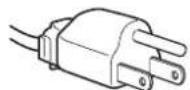
for 100 to 120 V AC
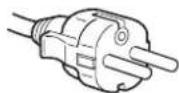
for 200 to 240 V AC
- Before disconnecting the power cord, wait at least 30 seconds after turning off the power to allow the static electricity on the screen's surface to discharge.
After the power is turned on, the screen is demagnetized (degaussed) for about 5 seconds. This generates a strong magnetic field around the screen which may affect data stored on magnetic tapes and disks placed near the monitor. Be sure to keep magnetic recording equipment, tapes, and disks away from the monitor.
The equipment should be installed near an easily accessible outlet.
Installation
Do not install the monitor in the following places:
- on surfaces (rugs, blankets, etc.) or near materials (curtains, draperies, etc.) that may block the ventilation holes
- near heat sources such as radiators or air ducts, or in a place subject to direct sunlight
- in a place subject to severe temperature changes
- in a place subject to mechanical vibration or shock
on an unstable surface - near equipment which generates magnetism, such as a transformer or high voltage power lines
- near or on an electrically charged metal surface
Maintenance
- Clean the screen with a soft cloth. If you use a glass cleaning liquid, do not use any type of cleaner containing an anti-static solution or similar additive as this may scratch the screen's coating.
- Do not rub, touch, or tap the surface of the screen with sharp or abrasive items such as a ballpoint pen or screwdriver. This type of contact may result in a scratched picture tube.
- Clean the cabinet, panel and controls with a soft cloth lightly moistened with a mild detergent solution. Do not use any type of abrasive pad, scouring powder or solvent, such as alcohol or benzene.
Transportation
When you transport this monitor for repair or shipment, use the original carton and packing materials.
Use of the tilt-swivel
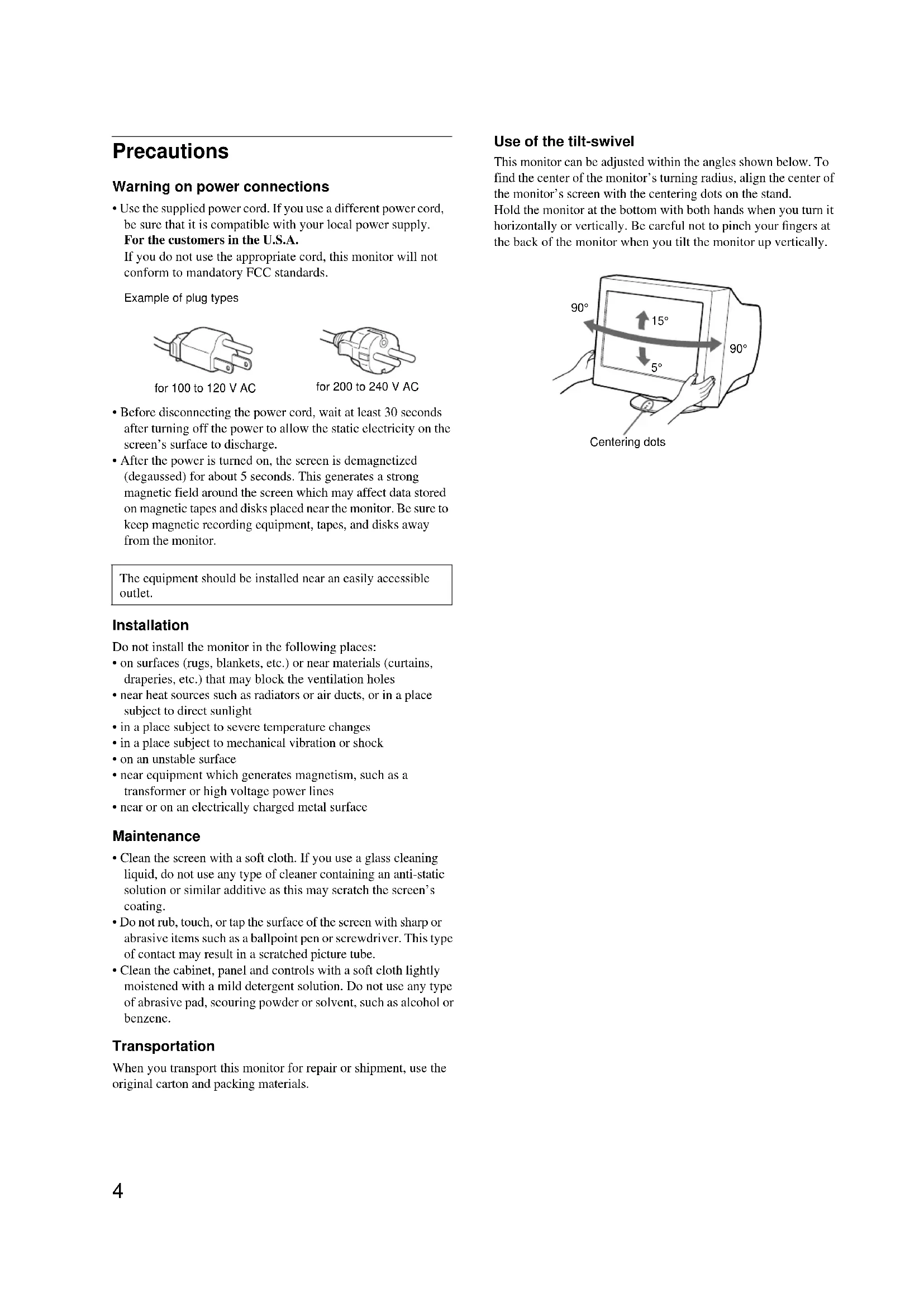
This monitor can be adjusted within the angles shown below. To find the center of the monitor's turning radius, align the center of the monitor's screen with the centering dots on the stand.
Hold the monitor at the bottom with both hands when you turn it horizontally or vertically. Be careful not to pinch your fingers at the back of the monitor when you tilt the monitor up vertically.
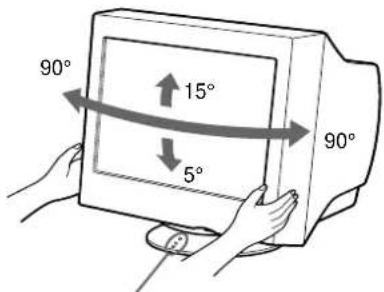
Centering dots
Identifying parts and controls
See the pages in parentheses for further details.
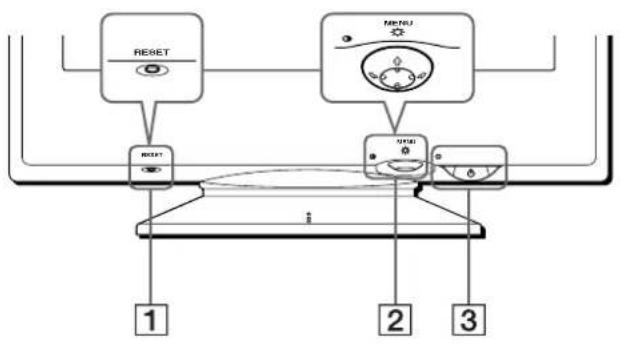
1RESET button (page 12)
This button resets the adjustments to the factory settings.
2Control button (page 9)
The control button is used to display the menu and make adjustments to the monitor, including brightness and contrast adjustments.
3 (power) switch and indicator (pages 7, 13, 16)
This button turns the monitor on and off. The power indicator lights up in green when the monitor is turned on, and either flashes in green and orange, or lights up in orange when the monitor is in power saving mode.
RearFront
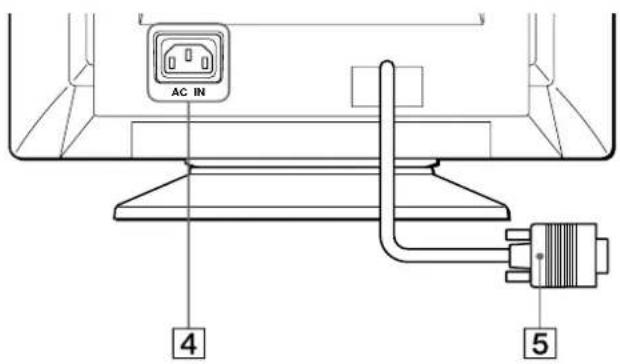
4AC IN connector (page 6)
This connector provides AC power to the monitor.
5Video input connector (HD15) (page 6)
This connector inputs RGB video signals (0.700 Vp-p, positive) and sync signals.
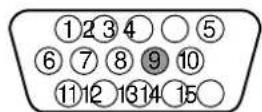
Pin No. Signal
| 1 Red | |||
| 2 Green (Sync on Green) | |||
| 3 B l u c | |||
| 4 ID (Ground) | |||
| 5 DDC Ground* | |||
| 6 Red Ground | |||
| 7 Green Ground | |||
| 8 Blue Ground | |||
| 9 - | |||
| 10 Ground | |||
| 11 ID (Ground) | |||
| 12 Bi-Directional Data (SDA)* | |||
| 13 H. Sync | |||
| 14 V. Sync | |||
| 15 Data Clock (SCL)* |
- DDC (Display Data Channel) is a standard of VESA.
Setup
Before using your monitor, check that the following accessories are included in your carton:
Power cord (1)
- Windows Monitor Information Disk (1)
Warranty card (1)
Notes on cleaning the screen's surface (1)
This instruction manual (1)
Step 1:Connect your monitor to your computer
Turn off the monitor and computer before connecting.
Note
Do not touch the pins of the video cable connector as this might bend the pins.
- Connecting to an IBM PC/AT or compatible computer
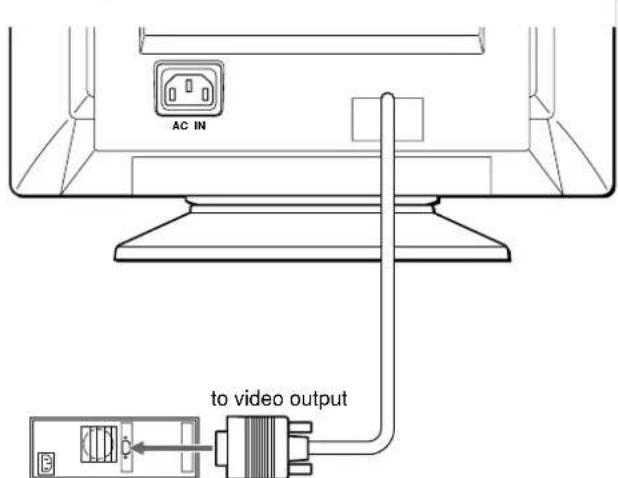
IBM PC/AT or compatible computer
- Connecting to a Macintosh or compatible computer
You will need a Macintosh adapter (not supplied).
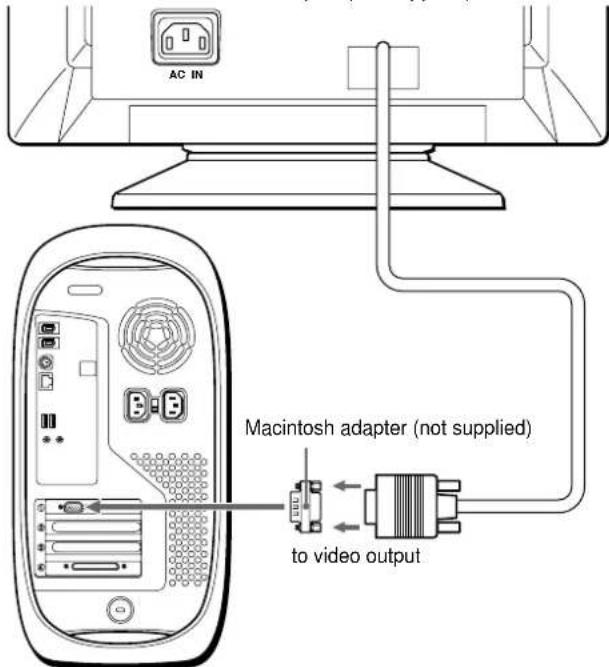
Macintosh or compatible computer
Step 2:Connect the power cord
With the monitor and computer switched off, first connect the power cord to the monitor, then connect it to a power outlet.
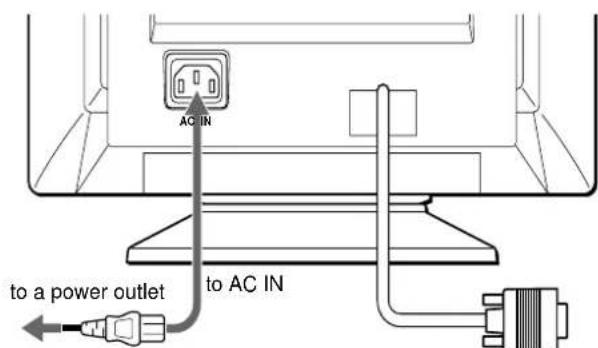
power cord (supplied)
Step 3:Turn on the monitor and computer
First turn on the monitor, then turn on the computer.
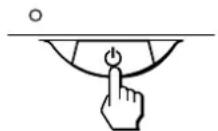
The installation of your monitor is complete.
If necessary, use the monitor's controls to adjust the picture.
If no picture appears on your screen
- Check that the monitor is correctly connected to the computer.
- If NO INPUT SIGNAL appears on the screen, confirm that your computer's graphic board is completely seated in the correct bus slot.
- If you are replacing an old monitor with this model and OUT OF SCAN RANGE appears on the screen, reconnect the old monitor. Then adjust the computer's graphic board so that the horizontal frequency is between 30 - 70kHz , and the vertical frequency is between 48 - 120Hz .
For more information about the on-screen messages, see "Trouble symptoms and remedies" on page 14.
For customers using Windows 95/98
To maximize the potential of your monitor, install the new model information file from the supplied Windows Monitor Information Disk onto your PC.
This monitor complies with the "VESA DDC" Plug & Play standard. If your PC/graphics board complies with DDC, select "Plug & Play Monitor (VESA DDC)" or this monitor's model name as the monitor type in the "Control Panel" of Windows 95/98. If your PC/graphics board has difficulty communicating with this monitor, load the Windows Monitor Information Disk and select this monitor's model name as the monitor type.
For customers using Windows NT4.0
Monitor setup in Windows NT4.0 is different from Windows 95/98 and does not involve the selection of monitor type. Refer to the Windows NT4.0 instruction manual for further details on adjusting the resolution, refresh rate, and number of colors.
Adjusting the monitor's resolution and color number
Adjust the monitor's resolution and color number by referring to your computer's instruction manual. The color number may vary according to your computer or video board. The color palette setting and the actual number of colors are as follows:
High Color (16 bit) → 65,536 colors
True Color (24 bit) → about 16.77 million colors
In true color mode (24 bit), speed may be slower.
Selecting the on-screen menu language (LANGUAGE/ INFORMATION)
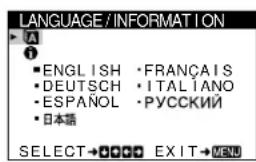
English, French, German, Italian, Spanish, Russian and Japanese versions of the on-screen menus are available. The default setting is English.
1 Press the center of the control button.
See page 9 for more information on using the control button.
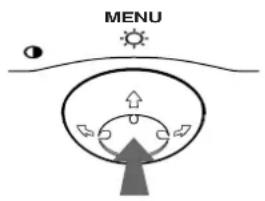
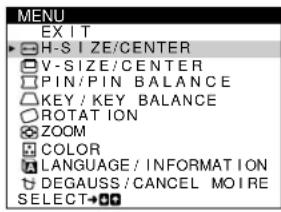
2 Move the control button / to highlight LANGUAGE/INFORMATION and press the center of the control button again.
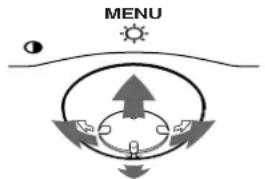
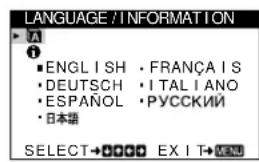
3 Move the control button / to select (LANGUAGE) and move ← / → to select a language.
- ENGLISH
FRANÇAIS: French - DEUTSCH: German
ITALIANO:Italian - ESPANOL: Spanish
·RMSIGKNI
·:中
To close the menu
Press the center of the control button once to return to the main MENU, and press again selecting EXIT to return to normal viewing. If no buttons are pressed, the menu closes automatically after about 30 seconds.
To reset to English
Press the RESET button while the ANGUAGE) menu is displayed on the screen.
Customizing Your Monitor
You can make numerous adjustments to your monitor using the on-screen menu.
Navigating the menu
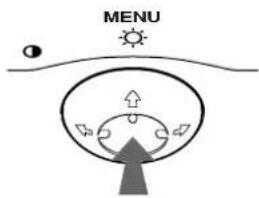
Press the center of the control button to display the main MENU on your screen. See page 9 for more information on using the control button.
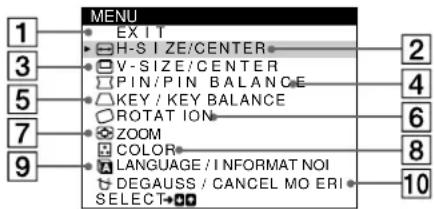
Use the control button to select one of the following menus.
1 EXIT
Select EXIT to close the menu.
2 H-SIZE/CENTER (page 10) Select the H-SIZE/CENTER menu to adjust the picture's horizontal size and centering.
3 V-SIZE/CENTER (page 10) Select the V-SIZE/CENTER menu to adjust the picture's vertical size and centering.
4 PIN/PIN BALANCE (page 10) Select the PIN/PIN BALANCE menu to adjust the curvature picture's sides.
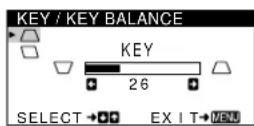
5 KEY/KEY BALANCE (page 10) Select the KEY/KEY BALANCE menu to adjust the angle of the picture's sides.
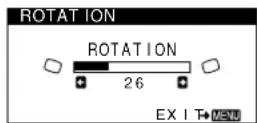
6 ROTATION (page 11) Select the ROTATION menu to adjust the picture's rotation.
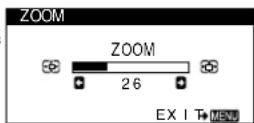
7 ZOOM (page 11) Select the ZOOM menu to enlarge or reduce the picture.
8 COLOR (page 11)
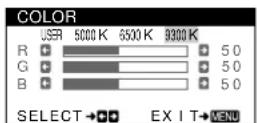
Select the COLOR menu to adjust the picture's color temperature. You can use this to match the monitor's colors to a printed picture's colors.
LANGUAGE/INFORMATION (page 7, 15)
Select the LANGUAGE/ INFORMATION menu to choose the on-screen menu's language and display this monitor's information box.
DEGAUSS/CANCEL MOIRE (page 12)
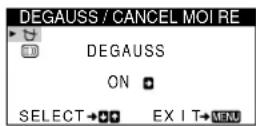
Select the DEGAUSS/CANCEL MOIRE menu to degauss the screen and adjust the moire cancellation level.
Using the control button
1 Display the main MENU.
Press the center of the control button to display the main MENU on your screen.
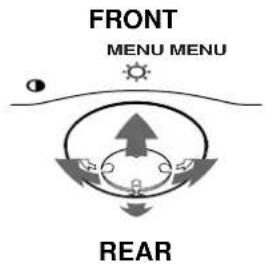
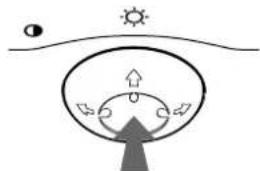
2 Select the menu you want to adjust.
Highlight the desired menu by moving the control button towards the rear to go up () , towards the front to go down () , and left (←) or right (→) to move sideways.
3 Adjust the menu.
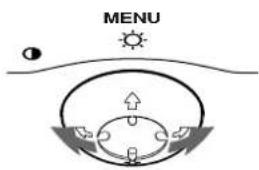
Move the control button left (←) or right (→) to make the adjustment.
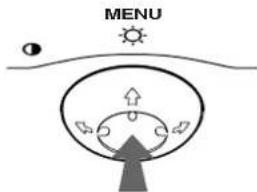
4 Close the menu.
Press the center of the control button once to return to the main MENU, and press again selecting EXIT to return to normal viewing. If no buttons are pressed, the menu closes automatically after about 30 seconds.
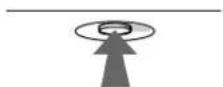
Resetting the adjustments
Press the RESET button. See page 12 for more information on resetting the adjustments.
RESET
Adjusting the brightness and contrast
Brightness and contrast adjustments are made using a separate BRIGHTNESS/CONTRAST menu.
These settings are stored in memory for all input signals.
1 Move the control button in any direction.
The BRIGHTNESS/CONTRAST menu appears on the screen.
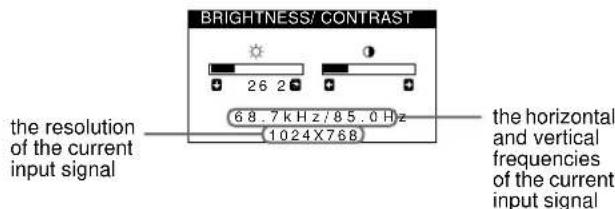
The horizontal and vertical frequencies of the current input signal are displayed in the BRIGHTNESS/CONTRAST menu. If the signal matches one of this monitor's factory preset modes, the resolution is also displayed.
2 Move the control button / to adjust the brightness (O), and ← / → to adjust the contrast (1).
The menu automatically disappears after about 3 seconds.
Adjusting the horizontal size or centering of the picture (H-SIZE/ CENTER)
These settings are stored in memory for the current input signal.
1 Press the center of the control button.
The main MENU appears on the screen.
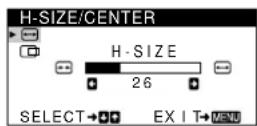
2 Move the control button / to highlight SIZE/ CENTER and press the center of the control button again.
The H-SIZE/CENTER menu appears on the screen.
3 First move the control button / to select the desired adjustment item. Then move the control button ← / → to make the adjustment.
Select To
H-SIZE
adjust the horizontal size
H-CENTER
adjust the horizontal centering
Adjusting the vertical size or centering of the picture (V-SIZE/ CENTER)
These settings are stored in memory for the current input signal.
1 Press the center of the control button.
The main MENU appears on the screen.
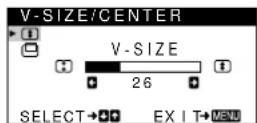
2 Move the control button / to highlight SIZE/ CENTER and press the center of the control button again.
The V-SIZE/CENTER menu appears on the screen.
3 First move the control button / to select the desired adjustment item. Then move the control button ← / → to make the adjustment.
Select To
V-SIZE
adjust the vertical size

V-CENTER
adjust the vertical centering
Adjusting the curvature of the picture's sides (PIN/PIN BALANCE)
These settings are stored in memory for the current input signal.
1 Press the center of the control button.
The main MENU appears on the screen.
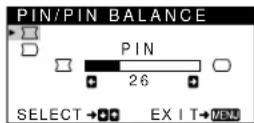
2 Move the control button / to highlight PIN/PIN BALANCE and press the center of the control button again.
The PIN/PIN BALANCE menu appears on the screen.
3 First move the control button / to select the desired adjustment item. Then move the control button ← / → to make the adjustment.
Select To
PIN
expand or contract the picture sides
PIN
shift the picture sides to the left or right
Adjusting the angle of the picture's sides (KEY/KEY BALANCE)
These settings are stored in memory for the current input signal.
1 Press the center of the control button.
The main MENU appears on the screen.
2 Move the control button / to highlight KEY/ KEY BALANCE and press the center of the control button again.
The KEY/KEY BALANCE menu appears on the screen.
3 First move the control button / to select the desired adjustment item. Then move the control button ← / → to make the adjustment.
Select To
KEY
adjust the picture width at the top of the screen
KEYBALANCE
shift the picture to the left or right at the top of the screen
Adjusting the picture's rotation (ROTATION)
This setting is stored in memory for all input signals.
1 Press the center of the control button.
The main MENU appears on the screen.
2 Move the control button / to highlight ROTATION and press the center of the control button again.
The ROTATION menu appears on the screen.
3 Move the control button to rotate the picture.
Enlarging or reducing the picture (ZOOM)
This setting is stored in memory for the current input signal.
1 Press the center of the control button.
The main MENU appears on the screen.
2 Move the control / button to highlight ZOOM and press the center of the control button again.
The ZOOM menu appears on the screen.
3 Move the control button ← / → to enlarge or reduce the picture.
Note
Adjustment stops when either the horizontal or vertical size reaches its maximum or minimum value.
Adjusting the color of the picture (COLOR)
The COLOR settings allow you to adjust the picture's color temperature by changing the color level of the white color field. Colors appear reddish if the temperature is low, and bluish if the temperature is high. This adjustment is useful for matching the monitor's colors to a printed picture's colors. This setting is stored in memory for all input signals.
1 Press the center of the control button.
The main MENU appears on the screen.
2 Move the control button / to highlight COLOR and press the center of the control button again.
The COLOR menu appears on the screen.
3 Move the control button ← / → to select a color temperature.
The preset color temperatures are 5000K, 6500K, and 9300K. Since the default setting is 9300K, the whites will change from a bluish hue to a reddish hue as the temperature is lowered to 6500K and 5000K.
4 If necessary, fine tune the color temperature.
First move the control button ← / → to select USER. Then move the control button / to select R (red), G (green), or B (blue) and move ← / → to make the adjustment.
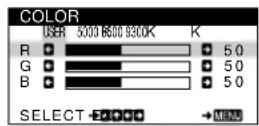
If you fine tune the color temperature, the new color settings are stored in memory and recalled whenever you select USER.
Additional settings (DEGAUSS/CANCEL MOIRE)
You can manually degauss (demagnetize) the monitor, and adjust the moiré cancellation level.
1 Press the center of the control button.
The main MENU appears on the screen.
2 Move the control button / to highlight DEGAUSS/CANCEL MOIRE and press the center of the control button again.
The DEGAUSS/CANCEL MOIRE menu appears on the screen.
3 Move the control button / to select the desired adjustment item.
Adjust the selected item according to the following instructions.
Degaussing the screen
The monitor is automatically demagnetized (degaussed) when the power is turned on.
To manually degauss the monitor, first move the control button / to select tDEGAUSS). Then move the control button.
The screen is degaussed for about 5 seconds. If a second degauss cycle is needed, allow a minimum interval of 20 minutes for the best result.
Adjusting the moiré*
If elliptical or wavy patterns appear on the screen, adjust the moiré cancellation level.
To adjust the amount of moiré cancellation, first move the control button / to select (CANCEL MOIRE). Then move the control button ← / → until the moiré effect is at a minimum.
- Moire is a type of natural interference which produces soft, wavy lines on your screen. It may appear due to interference between the pattern of the picture on the screen and the phosphor pitch pattern of the monitor.
Example of moiré
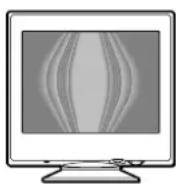
Resetting the adjustments
This monitor has the following three reset methods. Use the RESET button to reset the adjustments.
RESET

Resetting a single adjustment item
Use the control button to select the adjustment item you want to reset, and press the RESET button.
Resetting all of the adjustment data for the current input signal
Press the RESET button when no menu is displayed on the screen.
Note that the following items are not reset by this method:
- on-screen menu language (page 7)
- picture's rotation (page 11)
Resetting all of the adjustment data for all input signals
Press and hold the RESET button for more than two seconds.
Note that the following item is not reset by this method:
- color menu user settings (page 11)
Technical Features
Preset and user modes
When the monitor receives an input signal, it automatically matches the signal to one of the factory preset modes stored in the monitor's memory to provide a high quality picture at the center of the screen. (See Appendix for a list of the factory preset modes.) For input signals that do not match one of the factory preset modes, the digital Multiscan technology of this monitor ensures that a clear picture appears on the screen for any timing in the monitor's frequency range (horizontal: 30 - 70kHz , vertical: 48 - 120Hz ). If the picture is adjusted, the adjustment data is stored as a user mode and automatically recalled whenever the same input signal is received.
Note for Windows users
For Windows users, check your video board manual or the utility program which comes with your graphic board and select the highest available refresh rate to maximize monitor performance.
Power saving function
This monitor meets the power-saving guidelines set by VESA, ENERGY STAR, and NUTEK. If the monitor is connected to a computer or video graphics board that is DPMS (Display Power Management Signaling) compliant, the monitor will automatically reduce power consumption in three stages as shown below.
| Power mode | Power consumption (power) indicator |
| normal operation | ≤ 95 W green |
| 1 standby ≤ 15 W green and orange | |
| alternate | |
| 2 suspend (sleep)* | ≤ 15 W green and orange |
| alternate | |
| 3 active off** (deep sleep)* | ≤ 5 W orange |
| power off 0 W off | |
- "Sleep" and "deep sleep" are power saving modes defined by the Environmental Protection Agency.
** When your computer enters the "active off" mode, the input signal is cut and NO INPUT SIGNAL appears on the screen. After 20 seconds, the monitor enters the power saving mode.
Troubleshooting
Before contacting technical support, refer to this section.
If thin line appears on your screen (damper wire)
The line you are experiencing on your screen is normal for the Trinitron monitor and is not a malfunction. This is shadow from the damper wire used to stabilize the aperture grill and is most noticeable when the screen's background is lightly (usually white). The aperture grille is the essential element that makes a Trinitron picture tube unique by allowing more light to reach the screen, resulting in a brighter, more detailed picture.
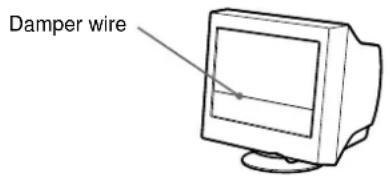
On-screen messages
If there is something wrong with the input signal, one of the following messages appears on the screen. To solve the problem, see "Trouble symptoms and remedies" on page 14.
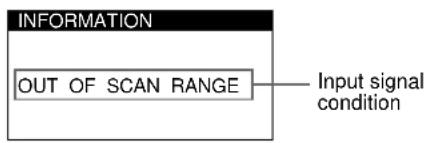
The input signal condition OUT OF SCAN RANGE
indicates that the input signal is not supported by the monitor's specifications.
NO INPUT SIGNAL
indicates that no signal is being input to the monitor.
Trouble symptoms and remedies
If the problem is caused by the connected computer or other equipment, please refer to the connected equipment's instruction manual.
Use the self-diagnosis function (page 16) if the following recommendations do not resolve the problem.
| Symptom Check these items | |
| No pictureIf the (power) indicator is not lit | ·Check that the power cord is properly connected.·Check that the (power) switch is in the "on" position. |
| If the NO INPUT SIGNAL message appears on the screen, or if the (power) indicator is either orange or alternating between green and orange | ·Check that the video signal cable is properly connected and all plugs are firmly seated in their sockets (page 6).·Check that the HD15 video input connector's pins are not bent or pushed in.■Problems caused by the connected computer or other equipment·The computer is in power saving mode. Try pressing any key on the computer keyboard.·Check that the computer's power is "on."·Check that the graphic board is completely seated in the proper bus slot. |
| If the OUT OF SCAN RANGE message appears on the screen | ■Problems caused by the connected computer or other equipment·Check that the video frequency range is within that specified for the monitor. If you replaced an old monitor with this monitor, reconnect the old monitor and adjust the frequency range to the following. Horizontal: 30 - 70 kHzVertical: 48 - 120 Hz |
| If no message is displayed and the (power) indicator is green or flashing orange | ·Use the Self-diagnosis function (page 16). |
| If using Windows 95/98 · If you replaced an old monitor with this monitor, reconnect the old monitor and do the following. Install the Windows Monitor Information Disk (page 7) and select this monitor ("CPD-E100") from among the Sony monitors in the Windows 95/98 monitor selection screen. | |
| If using a Macintosh system · Check that the Macintosh adapter (not supplied) and the video signal cable are properly connected (page 6). | |
| Picture flickers, bounces, oscillates, or is scrambled | ·Isolate and eliminate any potential sources of electric or magnetic fields such as other monitors, laser printers, electric fans, fluorescent lighting, or televisions.·Move the monitor away from power lines or place a magnetic shield near the monitor.·Try plugging the monitor into a different AC outlet, preferably on a different circuit.·Try turning the monitor \(90^{\circ}\) to the left or right.■Problems caused by the connected computer or other equipment·Check your graphics board manual for the proper monitor setting.·Confirm that the graphics mode (VESA, Macintosh 16" Color, etc.) and the frequency of the input signal are supported by this monitor (Appendix). Even if the frequency is within the proper range, some video boards may have a sync pulse that is too narrow for the monitor to sync correctly.·Adjust the computer's refresh rate (vertical frequency) to obtain the best possible picture. |
| Picture is fuzzy | ·Adjust the brightness and contrast (page 9).·Degauss the monitor* (page 12).·Select CANCEL MOIRE and adjust the moirc cancellation effect (page 12). |
| Picture is ghosting | · Eliminate the use of video cable extensions and/or video switch boxes. · Check that all plugs are firmly seated in their sockets. |
| Picture is not centered or sized properly | · Adjust the size or centering (page 10). Note that some video modes do not fill the screen to the edges. |
| Edges of the image are curved | · Select PIN/PIN BALANCE, KEY/KEYBALANCE, or ROTATION, and adjust the picture's shape and rotation (page 10, 11). |
| Wavy or elliptical pattern (moire) is visible | · Select CANCEL MOIRE and adjust the moire cancellation effect (page 12). ■Problems caused by the connected computer or other equipment · Change your desktop pattern. |
| Color is not uniform | · Degauss the monitor* (page 12). If you place equipment that generates a magnetic field, such as a speaker, near the monitor, or if you change the direction the monitor faces, color may lose uniformity. |
| White does not look white | · Adjust the color temperature (page 11). |
| A hum is heard right after the power is turned on | · This is the sound of the auto-degauss cycle. When the power is turned on, the monitor is automatically degaussed for five seconds. |
- If a second degauss cycle is needed, allow a minimum interval of 20 minutes for the best result. A humming noise may be heard, but this is not a malfunction.
Displaying this monitor's name, serial number, and date of manufacture (INFORMATION)
1 Press the center of the control button.
The main MENU appears on the screen.
2 Move the control button / to highlight LANGUAGE/INFORMATION and press the center of the control button again.
The LANGUAGE/INFORMATION menu appears on the screen.
3 Move the control button / to select (INFORMATION).
This monitor's information box appears on the screen.
Example
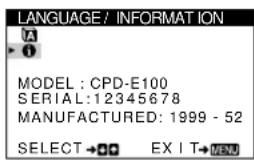
If the problem persists, call your authorized Sony dealer and give the following information.
- Model name: CPD-E100
- Serial number
- Name and specifications of your computer and graphics board.
Self-diagnosis function
This monitor is equipped with a self-diagnosis function. If there is a problem with your monitor or computer, the screen will go blank and the (power) indicator will either light up green or flash orange. If the (power) indicator is lit in orange, the computer is in power saving mode. Try pressing any key on the keyboard.
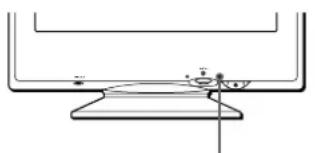
( power) indicator
If the (power) indicator is green
1 Disconnect the video input cable or turn off the connected computer.
2 Press the (power) button twice to turn the monitor off and then on.
3 Move the control button → for 2 seconds before the monitor enters power saving mode.
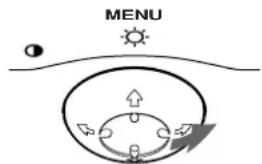
If all four color bars appear (white, red, green, blue), the monitor is working properly. Reconnect the video input cable and check the condition of your computer.
If the color bars do not appear, there is a potential monitor failure. Inform your authorized Sony dealer of the monitor's condition.
If the (power) indicator is flashing orange
Press the (power) button twice to turn the monitor off and then on.
If the (power) indicator lights up green, the monitor is working properly.
If the (power) indicator is still flashing, there is a potential monitor failure. Count the number of seconds between orange flashes of the (power) indicator and inform your authorized Sony dealer of the monitor's condition. Be sure to note the model name and serial number of your monitor. Also note the make and model of your computer and video board.
Specifications
CRT 0.24mm aperture grille pitch (center)
1 5 inchesmeasured
9 0 - degree
Viewable image size Approx. 285 214mm (w/h)
(1 1 ^ 1 / 4 · 8 ^ 1 / 2 inches)
1 4. 0 ^ viewingimage
Resolution
MaximumHoriztal : 1 2 8 0 dots Vertical : 1 0 2 4 lines
RecommendedHoriztantlarrow 8 0 0 dots
Vertal : 6 0 0 lines
Standard image area Approx. 270 202mm w/h
(1 0 ^ 3 / 4 · 8 inches)
Deflection frequency* Horizontal: 30 to 70kHz
Vertical : 4 8 to 1 2 0 Hz
AC input voltage/current 100 to 240V 50 - 60Hz 1.6 - 0.8A
Power consumption Max. 95 W
Approx. 356 - 378 - 388 mm (w/h/d)
(1 4 ^ 1 / 8 · 1 5 · 1 5 ^ 3 / 8 inches)
Mass Approx. 15kg 33 lb 1 oz
Plug and Play DDC1/DDC2B
Supplied accessories See page 6
- Recommended horizontal and vertical timing condition
Horizontal sync width should be more than 1.0µsec
Horizontal blanking width should be more than 3.6µsec
Vertical blanking width should be more than 500 µsec
Design and specifications are subject to change without notice.
Table des Matieres
Precautions 4
Consummation electrode Max. 95 W
Dimensions Approx
1.356·378·388mm
(1 / h / p)(141 / 8· 15· 153 / 8 pouces)
Poids Approx. 15kg 33 lb 1 oz
Plug & Play DDC1/DDC2B
Plug and Play DDC1/DDC2B
当社は、CONBUN-UN-UN-UN-UN-UN-UN-UN-UN-UN-UN-UN-UN-UN-UN-UN-UN-UN-UN-UN-UN-UN-UN-UN-UN-UN-UN-UN-UN-UN-UN-UN-UN-UN-UN-UN-UN-UN-UN-UN-UN-UN-UN-UN-UN-UN-UN-UN-UN-UN-UN
This display is designed for use in Japan only and cannot be used in any other country.
主仕樣
CRT 0.24mm トチ一格ル比切
(中心部)
- TRINITRON COLOR COMPUTER DISPLAY
- WARNING
- FCC NOTICE
- INFORMATION
- NOTICE
- DECLARATION OF CONFORMITY
- SETUP
- CUSTOMIZING YOUR MONITOR
- TECHNICAL FEATURES
- TROUBLESHOOTING
- SPECIFICATIONS
- APPENDIX
- PRECAUTIONS
- WARNING ON POWER CONNECTIONS
- INSTALLATION
- MAINTENANCE
- TRANSPORTATION
- USE OF THE TILT-SWIVEL
- IDENTIFYING PARTS AND CONTROLS
- RESET BUTTON (PAGE 12)
- CONTROL BUTTON (PAGE 9)
- (POWER) SWITCH AND INDICATOR (PAGES 7, 13, 16)
- REARFRONT
- AC IN CONNECTOR (PAGE 6)
- VIDEO INPUT CONNECTOR (HD15) (PAGE 6)
- STEP 1:CONNECT YOUR MONITOR TO YOUR COMPUTER
- NOTE
- CONNECTING TO AN IBM PC/AT OR COMPATIBLE COMPUTER
- CONNECTING TO A MACINTOSH OR COMPATIBLE COMPUTER
- STEP 2:CONNECT THE POWER CORD
- STEP 3:TURN ON THE MONITOR AND COMPUTER
- IF NO PICTURE APPEARS ON YOUR SCREEN
- FOR CUSTOMERS USING WINDOWS
- FOR CUSTOMERS USING WINDOWS NT
- ADJUSTING THE MONITOR'S RESOLUTION AND COLOR NUMBER
- SELECTING THE ON-SCREEN MENU LANGUAGE (LANGUAGE/ INFORMATION)
- PRESS THE CENTER OF THE CONTROL BUTTON
- MOVE THE CONTROL BUTTON / TO HIGHLIGHT LANGUAGE/INFORMATION AND PRESS THE CENTER OF THE CONTROL BUTTON AGAIN
- MOVE THE CONTROL BUTTON / TO SELECT (LANGUAGE) AND MOVE ← / → TO SELECT A LANGUAGE
- TO CLOSE THE MENU
- TO RESET TO ENGLISH
- NAVIGATING THE MENU
- USING THE CONTROL BUTTON
- DISPLAY THE MAIN MENU
- SELECT THE MENU YOU WANT TO ADJUST
- ADJUST THE MENU
- CLOSE THE MENU
- RESETTING THE ADJUSTMENTS
- ADJUSTING THE BRIGHTNESS AND CONTRAST
- MOVE THE CONTROL BUTTON IN ANY DIRECTION
- MOVE THE CONTROL BUTTON / TO ADJUST THE BRIGHTNESS (O), AND ← / → TO ADJUST THE CONTRAST (1)
- ADJUSTING THE HORIZONTAL SIZE OR CENTERING OF THE PICTURE (H-SIZE/ CENTER)
- ADJUSTING THE VERTICAL SIZE OR CENTERING OF THE PICTURE (V-SIZE/ CENTER)
- ADJUSTING THE CURVATURE OF THE PICTURE'S SIDES (PIN/PIN BALANCE)
- ADJUSTING THE ANGLE OF THE PICTURE'S SIDES (KEY/KEY BALANCE)
- ADJUSTING THE PICTURE'S ROTATION (ROTATION)
- ENLARGING OR REDUCING THE PICTURE (ZOOM)
- ADJUSTING THE COLOR OF THE PICTURE (COLOR)
- ADDITIONAL SETTINGS (DEGAUSS/CANCEL MOIRE)
- DEGAUSSING THE SCREEN
- ADJUSTING THE MOIRÉ
- RESETTING A SINGLE ADJUSTMENT ITEM
- RESETTING ALL OF THE ADJUSTMENT DATA FOR THE CURRENT INPUT SIGNAL
- RESETTING ALL OF THE ADJUSTMENT DATA FOR ALL INPUT SIGNALS
- PRESET AND USER MODES
- NOTE FOR WINDOWS USERS
- POWER SAVING FUNCTION
- IF THIN LINE APPEARS ON YOUR SCREEN (DAMPER WIRE)
- ON-SCREEN MESSAGES
- THE INPUT SIGNAL CONDITION OUT OF SCAN RANGE
- NO INPUT SIGNAL
- TROUBLE SYMPTOMS AND REMEDIES
- DISPLAYING THIS MONITOR'S NAME, SERIAL NUMBER, AND DATE OF MANUFACTURE (INFORMATION)
- SELF-DIAGNOSIS FUNCTION
- IF THE (POWER) INDICATOR IS FLASHING ORANGE
- TABLE DES MATIERES
- 主仕樣
Brand : SONY
Model : CPDE100
Category : Other computer accessories