PCWAC300S - Other computer accessories SONY - Free user manual and instructions
Find the device manual for free PCWAC300S SONY in PDF.



| Product Type | Wireless PC Card Network Card (Type II CardBus) |
| Wireless Standards | IEEE 802.11g (54 Mbit/s) and 802.11b (11 Mbit/s) |
| Radio Frequency | 2.4 to 2.4835 GHz (ISM band) |
| Modulation | DS-SS (802.11b), OFDM (802.11g) |
| Connection Modes | Access Point (Infrastructure) and Peer-to-Peer (Ad-Hoc) |
| Security | WEP Encryption (40-bit or 128-bit) |
| Software Included | Driver and Wireless Panel Utility |
| Compatible Operating Systems | Windows Me, Windows 2000, Windows XP |
| Minimum System Requirements | 128 MB RAM, CardBus slot, CD-ROM drive |
| Dimensions (L x H x D) | 54 x 5 x 91 mm (antenna height 14 mm) |
| Weight | Approximately 40 g |
| Power Supply | 3.3 V DC supplied by the computer via the CardBus connector |
| Power Consumption | 700 mA max in transmit, 370 mA max in receive |
| Connector | PC Card Type II (CardBus) |
| Operating Temperature | 5 °C to 35 °C (non-condensing) |
| Antenna | Built-in, protruding part 9 mm |
| Maintenance and Cleaning | Clean with a soft, slightly damp cloth. Do not use alcohol, benzene, or abrasive products. |
| Safety Precautions | Do not open the product. Keep at least 22 cm away from a pacemaker. Do not use in hospitals or airplanes. |
| Warranty | Sony manufacturer's warranty. Any opening voids the warranty. |
| Included Accessories | PC Card, installation CD-ROM, quick start guide, warranty card |
Frequently Asked Questions - PCWAC300S SONY
User questions about PCWAC300S SONY
0 question about this device. Answer the ones you know or ask your own.
Ask a new question about this device
Download the instructions for your Other computer accessories in PDF format for free! Find your manual PCWAC300S - SONY and take your electronic device back in hand. On this page are published all the documents necessary for the use of your device. PCWAC300S by SONY.
USER MANUAL PCWAC300S SONY
The model and serial numbers are located on the back of the unit. Record the serial number in the space provided below. Refer to them whenever you call upon your Sony dealer regarding this product.
Model No. PCWA-C300S
Serial No.
You are cautioned that any changes or modifications not expressly approved in this manual could void your authority to operate this equipment.
Safety Information
WARNING
- Opening the product, for whatever reason, could lead to damages that are not covered by the warranty.
- Do not use this product on hospital premises. Doing so may cause medical devices to malfunction.
- If using the product near a pacemaker, make sure it is at least 9 inches (22 cm) away from the pacemaker.
- Do not use this product in an aircraft, as doing so could cause the aircraft's equipment to malfunction. Make sure you remove the equipment from the PC card slot before carrying your computer onto an aircraft.
- Do not apply unnecessary physical strain on the product when it is inserted in your computer as this could damage the product and/or your computer.
Regulatory Information
Please consult the Wireless LAN Regulations
Guide provided with this Product.
About the supplied software
THE SUPPLIED SOFTWARE IS SUPPLIED PURSUANT TO THE APPLICABLE END-USER LICENSE AGREEMENT.
• Copyright laws prohibit reproducing the software or the software manual in whole or in part, or renting the software without the permission of the copyright holder.
- In no event will SONY be liable for any financial damage or loss of profits, including claims made by third parties, arising out of the use of the software supplied with this product.
- In the event a problem occurs with this software as a result of defective manufacturing, SONY will replace it at SONY's option or issue a refund; however, SONY bears no other responsibility.
- The software provided with this product cannot be used with equipment other than that which is designated for use with.
- Please note that, due to continued efforts to improve quality, the software specifications may be changed without notice.
Program © 2001, 2002, 2003 Sony Corporation, © 2000-2003 Atheros Communications, Inc., All Rights Reserved
Documentation © 2003 Sony Corporation
Sony, VAIO, , and the Carrier Gate
Eco Info logo are trademarks of Sony Corporation.
Microsoft and Windows are registered trademarks of Microsoft Corporation in the United States of America and/or other countries.
MMX and Pentium are registered trademarks of Intel Corporation.
All other trademarks are trademarks of their respective owners.

text_image
ATHEROS DRIVEN®Table of contents
Overview 4
Capabilities 4
System requirements ...... 7
Documentation and Help file......
Getting started
Unpacking.... 10
Supplied software 10
Installing the supplied software ..... 11
Making Access Point Connection Settings 16
Windows Me or Windows 2000 operating system .... 16
Windows XP operating system .... 19
Removing the Wireless LAN PC Card and Precautions When Inserting it ...... 23
To remove the Wireless LAN PC Card 23
If your computer has two PC Card slots 23
Wireless LAN connection
Checking the communication status ..... 24
Checking the wireless signal strength 24
Checking network information .... 24
Using the Wireless Panel 25
Opening the Wireless Panel ...... 25
Additional information
Manually installing, verifying, and removing the supplied software ..... 26
Installing the Wireless LAN PC Card driver manually 26
Installing the Wireless Panel manually 28
Connecting to the Access Point with Wireless Panel (Windows Me/2000 operating system) ...... 30
Verifying Wireless LAN PC Card driver installation .... 31
Uninstalling the Wireless LAN PC Card driver .... 38
Uninstalling the Wireless Panel ... 41
Precautions 44
Specifications 45
Getting help 45
Glossary 46
Troubleshooting 47
- In this manual, Microsoft ^ Windows ^ Millennium Edition is referred to as Windows Me.
- In this manual, Microsoft ^ Windows ^ 2000 Professional is referred to as Windows 2000.
- In this manual, Microsoft ^ Windows ^ XP Professional and Microsoft ^ Windows ^ XP Home Edition are referred to as Windows XP.
Notes
- The user interface of the Sony supplied software may differ slightly from that shown in this manual.
- This manual is written based on the assumption that you are familiar with basic operations of the Windows operating system. For computer operations, refer to manuals that come with your computer.
Overview
Capabilities
The Wireless LAN PC Card (IEEE 802.11g: 2.4 GHz/54 Mbps)
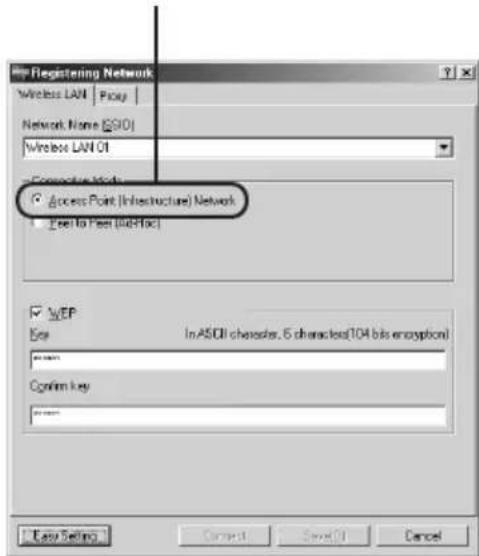
PCWA-C300S is a PC Card type wireless network card. With this card, you can build a wireless LAN, allowing multiple computers to communicate and exchange data without needing any physical connection. The supplied Wireless Panel software lets you easily configure the card for multiple networks. For example, you can store different settings required for networking at the office and at home, or quickly switch between Access Point (Infrastructure) Network connection mode and Peer to Peer (Ad-Hoc) Network connection mode. This greatly facilitates use of the card in various environments and for a range of applications.
Hints
- The network mode can easily be switched using the supplied Wireless Panel software.
- To use the card in Access Point Network connection mode, an IEEE 802.11g or IEEE 802.11b compliant Wireless LAN Access Point* (available separately) is necessary.
With the Windows Me or Windows 2000 operating system:
Access Point (Infrastructure) Network connection mode
text_image
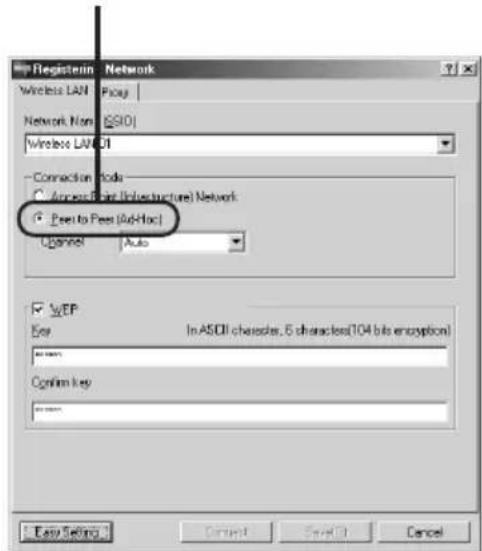
Registering Network Wireless LAN | Play | Network Name (SIDI) Wireless LAN OI Connective Node: Access Point (Infrastructure) Network Feel to Feel (AirFrac) WEP Key In A501 character, 6 characters(104 bits encryption) Confirm key Easy Setting Cancel Save Out CancelPeer to Peer (Ad-Hoc) Network connection mode
text_image
Registrar Network Wireless LAN Policy Network Name: [SIO] Wireless LAN/CI Connection Node Access Point (Infrastructure) Network Peet to Pees (Ad-Hoc) Channel: Auto ✓ EP Key In ASCII character, 6 characters(104 bits encryption) Confirm key Easy Setting Cancel Save Out Cancel* If using the separately available Wireless LAN Access Point PCWA-A320, also refer to the documentation supplied with the unit.
Windows XP Service Pack 1:
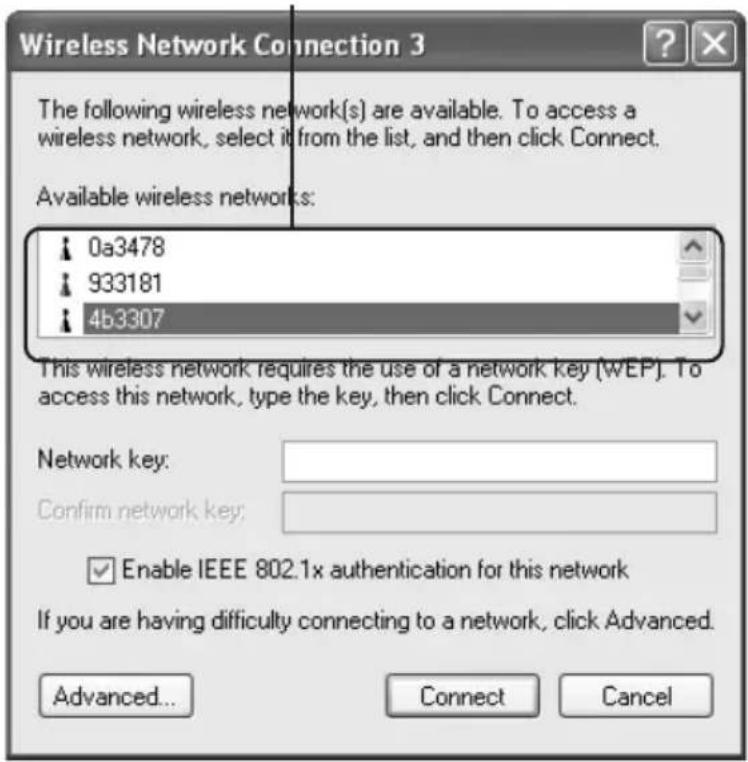
Available Wireless Networks
text_image
Wireless Network Connection 3 The following wireless network(s) are available. To access a wireless network, select it from the list, and then click Connect. Available wireless networks: 0a3478 933181 4b3307 This wireless network requires the use of a network key (WEP). To access this network, type the key, then click Connect. Network key: Confirm network key: Enable IEEE 802.1x authentication for this network If you are having difficulty connecting to a network, click Advanced. Advanced... Connect CancelIn Windows XP, this dialog box might be slightly different.
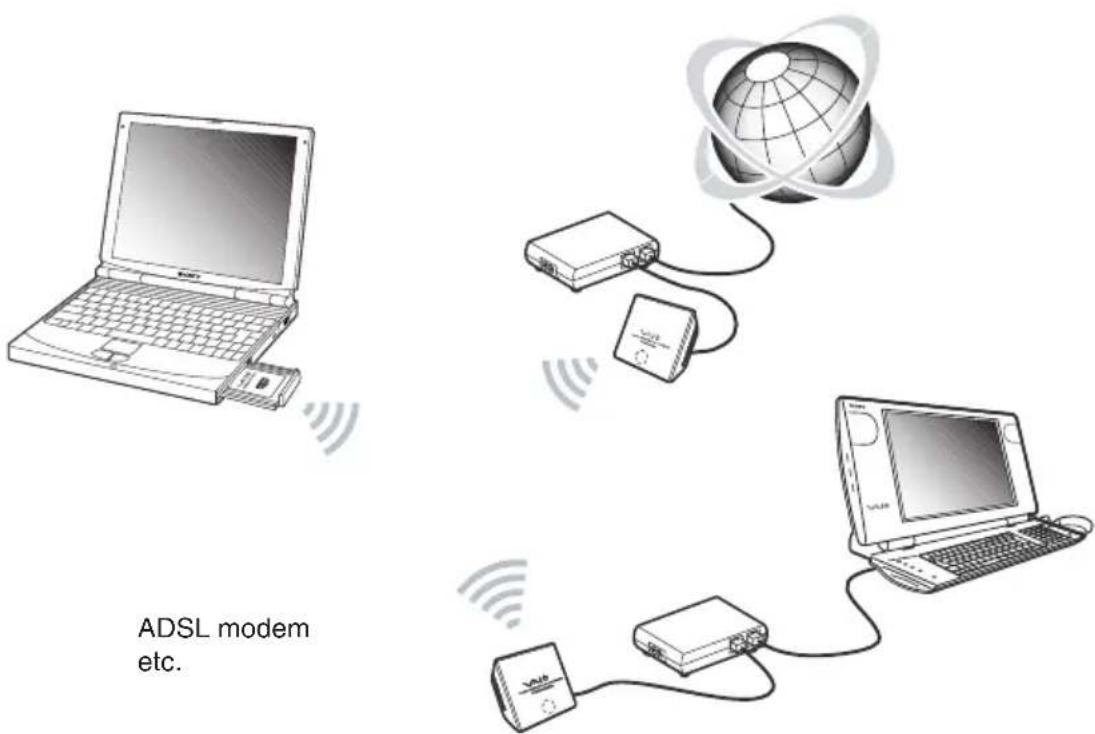
Accessing the Internet from various points within your home (Access Point Network connection mode)
With a separately available Access Point you can easily build a wireless network. By connecting a DSL modem, cable modem, or ISDN router to the Access Point, you can access the Internet from the living room, bedroom, or any other convenient location in the house. Equipping multiple computers with a Wireless LAN PC Card also allows you to exchange files between the computers via the Access Point.
text_image
ADSL modem etc.Hint
The illustration above gives an example of a system configuration using the Access Point Infrastructure connection mode. Two computers equipped with Wireless LAN PC Cards establish a communication with the Wireless Access Point PCWA-A320. The Wireless Access Point is connected to a ADSL/Cable router modem/router, therefore it is possible to access the Internet through this wireless connection. If your ADSL/Cable modem does not include the router function, make sure you have a router device between the ADSL/Cable modem and the Wireless Access Point.
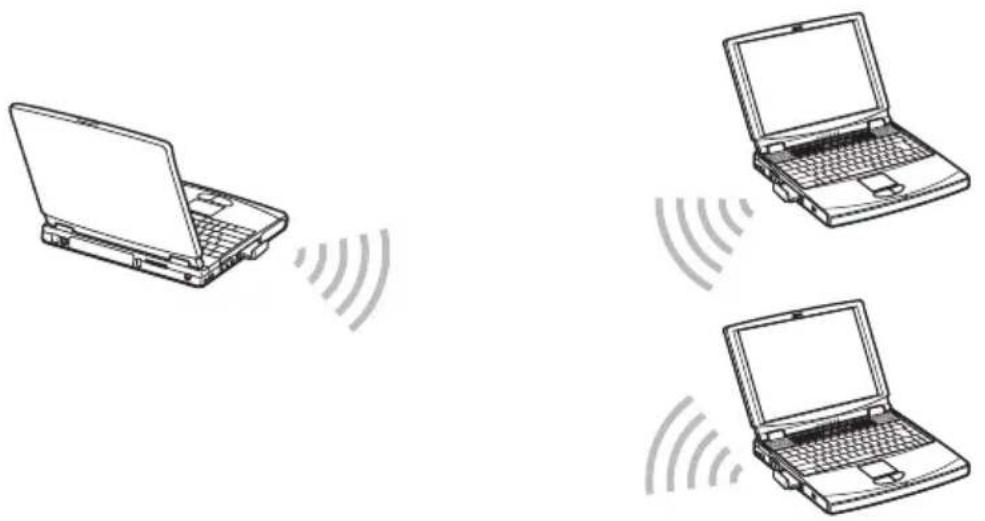
Direct communication between computers (Peer to Peer Network connection mode)
The Peer to Peer Network connection mode enables computers equipped with Wireless LAN PC Cards to communicate directly. This allows file sharing in locations where the Wireless LAN Access Point is not present.
natural_image
Illustration of three laptops with wireless signal waves, no text or symbols presentSystem requirements
To use the supplied software, the following system requirements must be met:
Windows ^® -compatible PC:
- 128 MB RAM or more
- Card Bus compliant PC Card slot
- CD-ROM drive (for software installation)
□Operating system:
- Microsoft ^® Windows ^® Millennium Edition
- Microsoft® Windows® 2000 Professional
- Microsoft ^® Windows ^® XP Home Edition
- Microsoft® Windows® XP Professional
□Display:
High color (16-bit color) or higher, 800 × 480 pixels or higher
Notes
- Correct operation is not assured for all computers, even if satisfying the above system requirements.
- Correct operation in an OS upgrade environment is not assured, except for factory provided Windows XP operating system upgrade packages for Sony VAIO® series computers.
- For Internet access via the wireless LAN, an IEEE 802.11g or IEEE 802.11b compliant Wireless LAN Access Point (available separately) is necessary.
- An Internet Service Provider (ISP) is required for Internet access.
Precaution when using the PCWA-C300S
Because of the particular shape of the PCWA-C300S, it may not be possible to insert it into all computers.
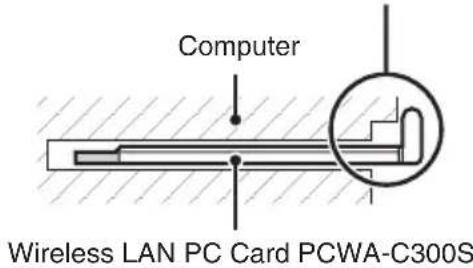
1 The PCWA-C300S has an antenna protruding up 0.4 in. (9 mm). If obstructions 0.6 in. (15 mm) in length or more come in contact with it when you insert the PCWA-C300S into the PC card slot, you cannot fully insert the wireless LAN PC card into the slot.
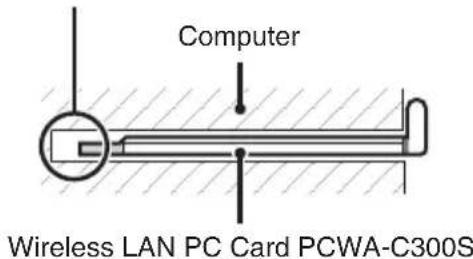
2 If the PC card slot of your computer is more than 3.3 in. (85 mm) in length, you cannot fully insert the PCWA-C300S into the slot.
The antenna is obstructed. The PCWA-C300S cannot be inserted.
text_image
Computer Wireless LAN PC Card PCWA-C300SThe PC card slot is longer than 3.3 in. (85 mm). The PCWA-C300S cannot be inserted.
text_image
Computer Wireless LAN PC Card PCWA-C300SDocumentation and Help file
This product comes with the following documentation and help files.
☐Operating Instructions (this document)
Explains how to install the Wireless LAN PC Card and how to configure all settings of the card.
□Quick Start Guide
This document explains how to install software required to use the Wireless LAN PC Card (IEEE 802.11g: 2.4 GHz/54 Mbps) PCWA-C300S.
□Troubleshooting Guide
This document contains answers to frequently asked questions and common problems.
□Wireless Panel Online Help
This is the Online Help of the supplied Wireless Panel software. Refer to it for instructions on how to use the software. Access the Wireless Panel Online Help as follows.
■Access from the Easy Installation Wizard
1 On the main menu of the Easy Installation Wizard, click "Documents".
2 On the screen that opens, click "Wireless Panel Online Help".
■Access from Wireless Panel
1 Install the Wireless Panel software, following the instructions in this manual.
2 Start the Wireless Panel.
3 Right-click the Wireless Panel icon on your Windows operating system taskbar and click Help on the shortcut menu.
Hint
You can also access Help by clicking 📋 on the Wireless Panel title bar.
Unpacking
Your Wireless LAN PC Card comes with the following items:
- Wireless LAN PC Card
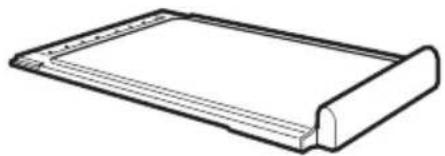
natural_image
Simple line drawing of a rectangular object with rounded ends and a flat top (no text or symbols)- CD-ROM (Setup disc)
- Quick Start Guide
- Warranty card
Supplied software
The supplied CD-ROM contains the following software.
□Wireless LAN PC Card driver
This device driver is necessary to the operation of the Wireless LAN PC Card.
□Wireless Panel
Wireless Panel is a utility software that lets you configure the computer for the wireless LAN and monitor the communication status. The software is also used to switch between networks.
Normally, the Wireless Panel appears as an icon on your Windows operating system taskbar, which shows the communication status.
When using the card for the first time, see page 11 for information on how to install the Wireless LAN PC Card driver and the Wireless Panel.
Installing the supplied software
This section explains how to use the supplied CD-ROM to install the Wireless LAN PC Card device driver and Wireless Panel. You must insert the Wireless LAN PC Card into your computer before installing the device driver and Wireless Panel.
The installation procedures are performed with an easy-to-use wizard. Before you start, verify the following.
- The wizard located on the CD-ROM supplied with the Wireless LAN PC Card. Make sure that your CD-ROM drive is ready for use.
- When using the Wireless LAN PC Card in Access Point Network Connection mode, you must install the Access Point and make the necessary settings before proceeding. For details about these procedures, refer to your Access Point user's guide.
Notes
- To install the supplied software on a computer running the Windows 2000 operating system, log on with a user account listed in “Administrators”. To install the supplied software on a computer running the Windows XP operating system, log on with a user account with administrator access privileges. You cannot install the software or modify settings when logged on with any other account.
- To change any of the Wireless Panel settings on a computer running the Windows 2000 operating system, log on with a user account listed in “Administrators”. You cannot modify settings when logged on with any other account.
- Exit all other Windows operating system programs.
Important
Computer Firewall Functions
When using the Windows XP "Internet Connection Firewall" function
Enabling the Windows XP “Internet Connection Firewall” function may prevent you from being able to access your computer through wireless communication. (This function is inactive under the Windows XP operating system default settings.) Because of this function, you may not be able to connect to your network when you change your Access Point settings. If this happens, deactivate the “Internet Connection Firewall” function, connect to the network, and then reactivate the function. For details, refer to Windows XP Help.
Note
Network security is an important issue. You are urged to consider carefully how best to protect your computer.
When using a personal firewall function provided by virus scanning or network security software
Virus scanning and network security software sometimes includes a function called a “personal firewall” that is designed to prevent illegal access by outside entities. Depending on the software, the security level of this function may be initially set to a high level. If this high security level setting is left in effect, it may be impossible for an outside entity to access your computer. This can cause problems such as not being able to connect to the network when changing the Access Point’s settings. In this event, lower the security level in order to permit the network connection. For details, refer to the manuals provided with your software.
Notes
- Pay special attention to security issues.
- For questions regarding firewall functions, please contact your firewall software manufacturer.
1 When using the Wireless LAN PC Card in Access Point Network Connection mode, turn on the Access Point.
2 Insert the supplied CD-ROM into the CD-ROM drive of your computer.
The Easy Installation Wizard starts automatically.
Hint
If the Easy Installation Wizard does not appear when you insert the supplied CD-ROM into your CD-ROM drive, double-click "Setup.exe" ( ) on the CD-ROM. Depending on the settings of your computer, the file name may be "Setup".
3 When the installation message appears, click "OK".
4 Click the button that corresponds to your type of CD-ROM drive (i.e., Built-in or External).
If you are using an external CD-ROM drive, follow the instructions on the screen and copy the contents of the CD-ROM to your hard disk. When the copy is complete, click “Main Menu”.
The Main Menu of the Easy Installation Wizard appears.
5 Click "Install Driver".
Insert the Wireless LAN PC Card and follow the instructions on the screen to install the device driver.
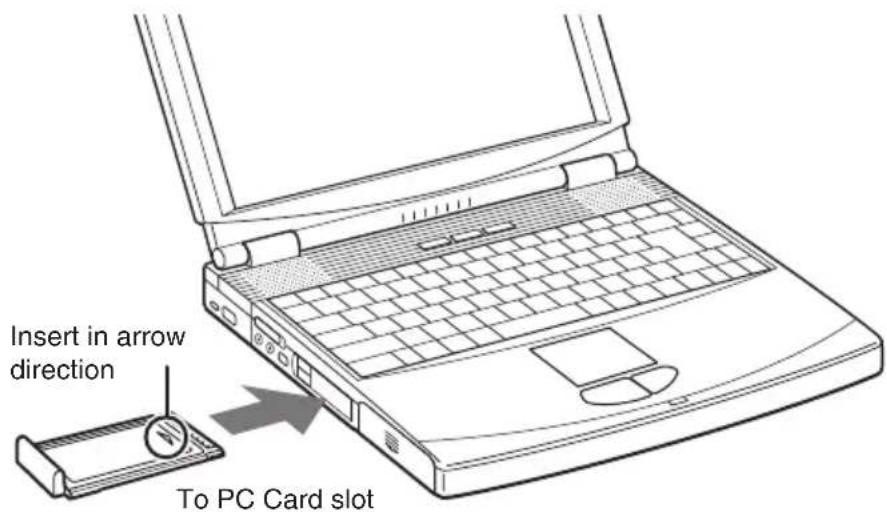
6 Insert the Wireless LAN PC Card in the PC card slot.
You do not need to turn off your computer when you insert the Wireless LAN PC Card.
text_image
Insert in arrow direction To PC Card slotNotes
- If your computer has two PC Card slots, insert the Wireless LAN PC Card into the top slot. If inserted into the bottom slot, the antenna of the Wireless LAN PC Card will block the top slot. See section “If your computer has two PC Card slots” on page 23.
- Depending on the depth and configuration of PC card slots on your computer, you may not be able to insert the Wireless LAN PC Card.
Push the Wireless LAN PC Card into the slot until it is firmly seated. If the card does not fit easily, do not force it in. Take the card out and try reinserting it.
When you insert the Wireless LAN PC Card, the device driver installed automatically. When installation is complete, proceed to step 7.
7 At the end of the installation process, click "Continue".
8 Click "Install Software Utility".
The utility installation starts.
9 Follow the instructions on the screen to complete the installation.
This completes the installation of the software.
Once Wireless Panel is installed, 📂 appears on your Windows operating system taskbar.
What to do next
Make Access Point connection settings.
When using the Windows Me or Windows 2000 operating system, proceed to page 16.
When using the Windows XP operating system, proceed to page 19.
Hint
When using the Windows XP operating system, click “Main Menu” as necessary to return to the first screen of the wizard, or click to close the Easy Installation Wizard.
Making Access Point Connection Settings
After installing the necessary software, you must make the necessary settings to establish a connection with the Access Point.
If you want to establish a connection in Peer to Peer Network connection mode, refer to the Wireless Panel Help for details about the necessary settings.
Windows Me or Windows 2000 operating system
1 Click "Connect to Access Point".
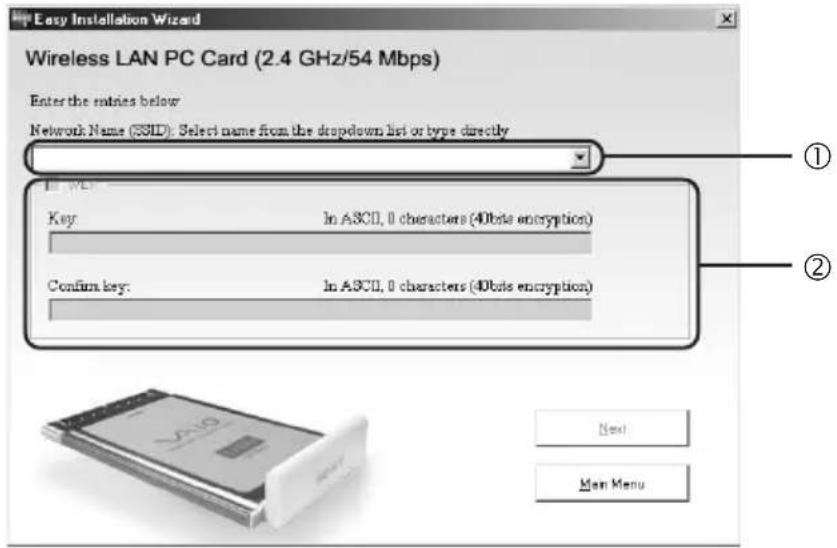
2 Make the appropriate settings.
text_image
Easy Installation Wizard Wireless LAN PC Card (2.4 GHz/54 Mbps) Enter the entries below: Network Name (SSID): Select name from the dropdown list or type directly ① Key: In ASCII, 0 characters (40bits encryption) Confirm key: In ASCII, 0 characters (40bits encryption) Next Main Menu① Network Name (SSID)
This is a unique ID used to identify wireless networks. The setting can be made individually for Access Point Network connection mode and Peer to Peer Network connection mode. When connecting to an existing network, consult your network administrator regarding the proper settings. When changing an existing Network Name, you can use up to 32 alphanumeric characters (including symbols).
Hints
- Opening the “Network Name” drop-down list will show the Network Names of any Access Points within range. You can then select a Network Name from the list.
- When using the Wireless LAN Access Point PCWA-A320, the default Network Name (SSID) of the Access Point is shown on the ID label of the Access Point. For details on the position of the label and other information, refer to the manuals provided with the Access Point.
② WEP
If Data Encryption (WEP) is enabled for the Access Point to which you connect, select this item. When this item is selected, you also need to enter the encryption key (WEP key) in the “Key” and “Confirm key” fields.
The data encryption function serves to prevent unauthorized access to the network. For security reasons, it is strongly recommended that you enable this feature. The setting can be configured individually for Access Point Network connection mode and Peer to Peer Network connection mode. When connecting to an existing network, consult your network administrator regarding the proper settings. For information on how to control this setting at the Access Point, refer to the manuals of the Access Point.
Key
If data encryption (WEP) is enabled for the Access Point, enter the encryption key (WEP key) here. Because this key functions as a password that enables communication with the network, the key entered here must be exactly the same as that set for the Access Point. Only computers for which the key has been configured correctly can join the network. The number of characters depends on the “ASCII/Hex” and “Length” settings (see table below).
| ASCII Hexadecimal |
| Permissible characters Alphanumeric characters 0 to 9, A to F, a to f |
| Maximum number 5 or 13 characters 10 or 26 characters of characters |
Confirm key
Re-enter the encryption key that you entered in the "Key" box.
Hint
This product supports a function called “roaming” which allows the creation of a wireless network with multiple Access Points for wider coverage. When using this function, configure all Access Points to the same Network Name (SSID) and Data Encryption (WEP) settings.
3 When you are done, click "Next".
The following screen appears.
4 Make sure that the settings are correct, and then click "Connect".
Wait until the Wireless LAN PC Card connects to the Access Point. When the Wireless LAN PC Card establishes the connection with the Access Point, a message appears explaining that the computer is connected to the office.
This completes the Access Point connection settings procedure.
Hint
You can change the connection settings and network connection mode from Wireless Panel. For details about how to use Wireless Panel, refer to the Wireless Panel Help.
After installing the necessary software, you must make the necessary settings to establish a connection with the Access Point.
If you want to establish a connection in Peer to Peer Network connection mode, refer to the Wireless Panel Help for details about the necessary settings.
Note
Before configuring the Wireless LAN PC Card
Perform the following steps to confirm that the “Use Windows to configure my wireless network settings” check box is selected. This option is selected by default.
1 Click "Start", "Control Panel", and double-click "Network Connections".
Hint
If “Network Connections” is not displayed, click “Switch to Classic View”.
2 Right-click "Wireless Network Connection *" ("*" is a number that differs according to the computer settings), and click "Properties" on the shortcut menu.
3 Click the "Wireless Network" tab.
4 Confirm that the "Use Windows to configure my wireless network settings" check box is selected. If not, select it.
1 Click "Start", point to "Connect To", and click "Show all connections".
The “Network Connections” window appears.
2 Right-click "Wireless Network Connection *" ("*" is a number that differs according to the computer settings), and click "View Available Wireless Networks" on the shortcut menu.
The “Connect to Wireless Network” dialog box appears.
Hints
- If the computer is not connected to a wireless network, an “x” is shown for the “Wireless Network Connection *” icon in the “Network Connections” window.
- If you have installed Windows XP Service Pack 1, see page 21.
3 From the “Available Wireless Networks” list in the “Connect to Wireless Network” dialog box, select the Access Point to which you want to connect.
Hint
The “Available Wireless Networks” list shows the names of Access Points within communication range of the computer. When using the Wireless LAN Access Point PCWA-A320, the default Network Name (SSID) of the Access Point is shown on the ID label of the card. For details on the position of the label and other information, refer to the manuals of the Access Point. Because the Network Name of an Access Point may have been changed, consult your network administrator if you are not sure.
4 If Data Encryption (WEP) is enabled for the Access Point, enter the encryption key (WEP key) in the “Network key” field.
The key entered here must be exactly the same as that set for the Access Point. Permissible characters and their maximum number are detailed below.
| ASCII Hexadecimal |
| Permissible characters Alphanumeric characters 0 to 9, A to F, a to f |
| Maximum number 5 or 13 characters 10 or 26 characters of characters |
Hints
- ASCII and hexadecimal characters are automatically identified.
- The data encryption (WEP) function serves to prevent unauthorized access to the network. When the function is enabled, only computers configured with the correct encryption key (WEP key) can join the network. For security reasons, it is strongly recommended that you enable this feature. The setting can be made individually for Access Point Network connection mode and Peer to Peer Network connection mode. When connecting to an existing network, consult your network administrator regarding the proper settings. For information on how to control this setting at the Access Point, refer to the manuals of the Access Point.
□When using Service Pack 1
If you installed Windows XP Service Pack 1, steps 3 and 4 must be performed as follows.
3 From the "Available Wireless Networks" list in the "Connect to Wireless Network" dialog box, select the Access Point to which you want to connect.
4 Depending on the Data Encryption (WEP) settings of the Access Point, proceed as follows.
- Data Encryption (WEP) at selected Access Point is enabled
Enter the encryption key (WEP key) in the “Network key” field. (The input is shown only as asterisks.) For verification, the same string must be entered once more in the “Confirm network key” field.
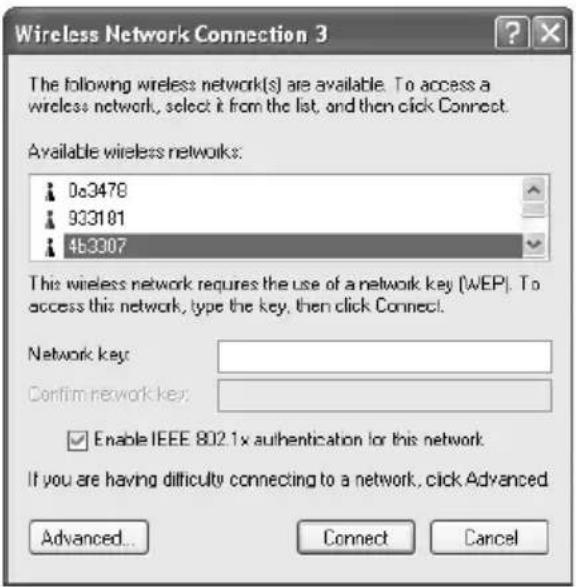
text_image
Wireless Network Connection 3 The following wireless network(s) are available. To access a wireless network, select it from the list, and then click Connect. Available wireless networks: 063478 933181 463307 This wireless network requires the use of a network key (WEP). To access this network, type the key, then click Connect. Network key: Confirm network key: Enable IEEE 802.1x authentication for this network. If you are having difficulty connecting to a network, click Advanced Advanced... Connect Cancel- Data Encryption (WEP) at selected Access Point is disabled
Select the “Allow me to connect to the selected wireless network, even though it is not secure” check box. (For security reasons, enabling data encryption is recommended.)
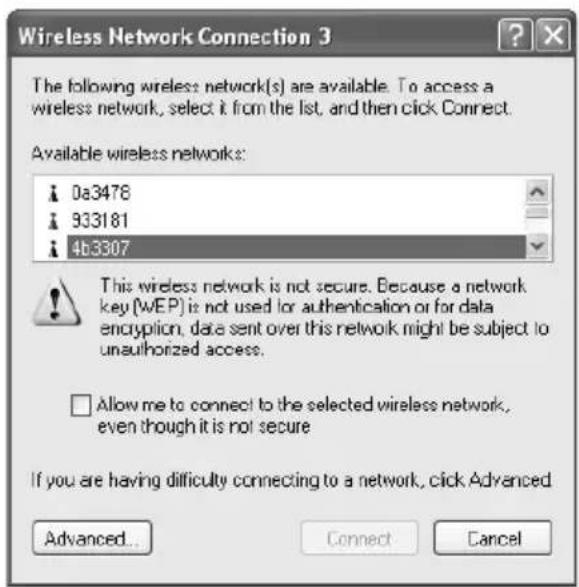
text_image
Wireless Network Connection 3 The following wireless network(s) are available. To access a wireless network, select it from the list, and then click Connect. Available wireless networks: 0a3478 933181 4b3307 This wireless network is not secure. Because a network key (WEP) is not used for authentication or for data encryption, data sent over this network might be subject to unauthorized access. Allow me to connect to the selected wireless network, even though it is not secure If you are having difficulty connecting to a network, click Advanced Advanced... Connect Cancel5 Click "Connect".
Connection to the Access Point is established.
If the Access Point has already been configured, the setup procedure is now complete.
If you want to change the Access Point settings, refer to the manuals of the Access Point for information on how to proceed.
Note
To use an Access Point to connect to the Internet, you must change the Access Point default settings.
Hint
For additional information on the wireless network capabilities of the Windows XP operating system, refer to Windows XP "Help and Support". (Click "Start", and click "Help and Support", enter "wireless" into the Search field, and click the green arrow icon.) You may also wish to consult the Windows XP operating system documentation.
Removing the Wireless LAN PC Card and Precautions When Inserting it
This section explains how to remove the Wireless LAN PC Card and outlines precautions when inserting the card in a computer with two card slots arranged one above the other.
Hint
You do not need to turn off your computer when you insert or remove the Wireless LAN PC Card.
To remove the Wireless LAN PC Card
1 Quit any software accessing the wireless LAN (e.g. Internet Explorer).
2 Click 📋 on your Windows operating system taskbar.
3 Click "Safely remove Sony 802.11g Wireless LAN Adapter" or "Stop Sony 802.11g Wireless LAN Adapter" on the shortcut menu that appears.
If your computer has two PC Card slots
Notes
- When using a computer which has two PC Card slots arranged vertically (one above the other), insert the Wireless LAN PC Card into the top slot. If inserted into the bottom slot, the antenna of the Wireless LAN PC Card will block the top slot.
- If you insert the Wireless LAN PC Card into a slot other than the one you usually use, the computer treats the card as a new device and automatically begins installing device drivers for it. Completing the driver installation makes it possible to use the Wireless LAN PC Card in that slot. Installation is performed automatically by the installation wizard. (For instructions on how to uninstall the Wireless LAN PC Card driver, see page 38.)
Hint
If you are using the Windows Me or Windows 2000 operating system, you can register up to 32 networks for each PC card slot. However, you have to register each network individually. You cannot share the settings across slots.
Checking the communication status
Checking the wireless signal strength
The communication status is shown by the signal level indicator on your Windows operating system taskbar.
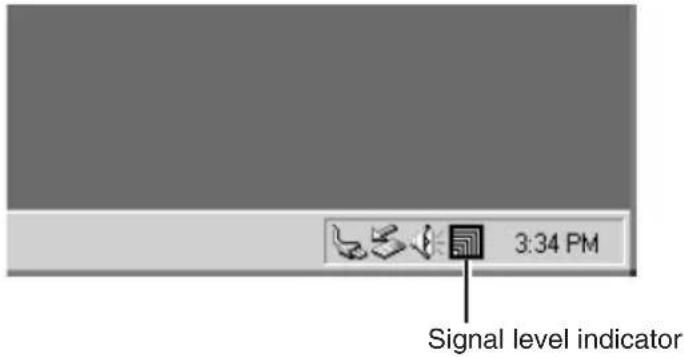
text_image
3:34 PM Signal level indicatorMeaning of indicator appearance
 | Excellent |
 | Good |
 | Poor |
 | Out of range |
 | Card not inserted(Wireless LAN PC Card is not inserted or not recognized correctly) |
 | Peer to Peer(Communicating in Peer to Peer Network connection mode) |
Checking network information
To obtain information about the network to which you are connected, proceed as follows.
Double-click the signal level indicator on your Windows operating system taskbar.
The Wireless Panel main screen appears, and information about the network connection is shown. For details, refer to the Wireless Panel Help.
Using the Wireless Panel
The Wireless Panel is a software application that shows information about the communication status of the computer connected to the wireless network. Normally, the Wireless Panel runs in the background and only shows the radio signal condition by means of the signal level indicator on your Windows operating system taskbar. The main screen of the Wireless Panel contains more detailed information. When running under operating systems other than Windows XP, communication setup and network switching are also performed using the Wireless Panel.
Notes
- To use the Wireless Panel under the Windows 2000 operating system to modify communication settings, log on with a user account listed in “Administrators”. You cannot modify settings when logged on with any other account.
- On a computer running the Windows XP operating system, communication setup and network switching are not performed with the Wireless Panel but with built-in functions of the Windows XP operating system. However, the Wireless Panel can be used to check the communication status.
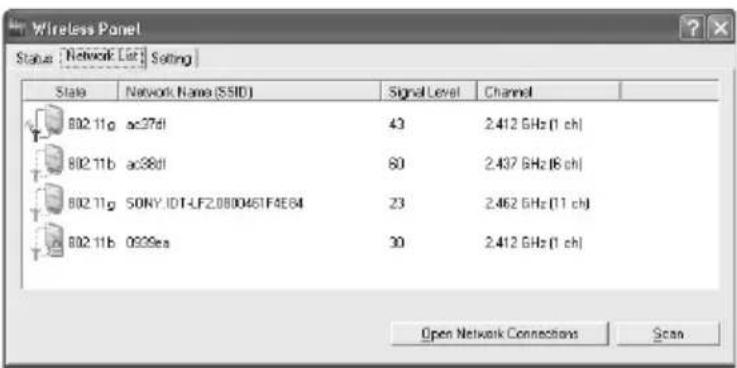
Opening the Wireless Panel
To open the Wireless Panel, proceed as follows.
Double-click the signal level indicator on your Windows operating system taskbar.
The Wireless Panel appears.
text_image
Wireless Panel Status [Network List] Setting State Network Name (SSID) Signal Level Channel 802.11g ac37dl 43 2.412 GHz (1 ch) 802.11b ac38dl 60 2.437 GHz (6 ch) 802.11g SONY.IDT-LFZ.0800451F4E84 23 2.462 GHz (11 ch) 802.11b 0939ea 30 2.412 GHz (1 ch) Open Network Connections ScanHints
- For information on the signal level indicator, see “Checking the wireless signal strength” on page 24.
- When you move the mouse pointer over an item in the Wireless Panel screen, a short description of that item appears.
- For details about how to use Wireless Panel, refer to the Wireless Panel Help. For details about how to access Help, see page 9.
Manually installing, verifying, and removing the supplied software
Installing the Wireless LAN PC Card driver manually
Notes
- To install the supplied software on a computer running the Windows 2000 operating system, log on with a user account listed in “Administrators”. To install the supplied software on a computer running the Windows XP operating system, log on with a user account with administrator access privileges. You cannot install the software or modify settings when logged on with any other account.
- Exit all other Windows operating system programs.
1 Insert the supplied CD-ROM into the CD-ROM drive of your computer.
2 In the Easy Installation Wizard dialog box, click "Exit".
3 If your computer has only one PC card slot and it is currently used, copy the "Driver" folder from the supplied CD-ROM to the hard disk of your computer before inserting the Wireless LAN PC Card.
The following explanation assumes that a folder called “temp” was created on drive C and that the data was copied to this folder.
4 Insert the Wireless LAN PC Card into the PC Card slot of the computer.
5 Install the Wireless LAN PC Card driver.
The actual procedure differs slightly, depending on whether you are using the Windows Me, Windows 2000, or Windows XP operating system. See the section specific to your operating system.
Windows Me operating system:
1 Select "Specify the location of the driver" and click "Next".
2 Select the "Specify a location" check box.
3 Click "Browse" and specify the location of the driver in the dialog box that appears.
Hint
If the “Driver” folder from the CD-ROM has been copied to the “temp” folder on drive C, enter “C:\temp\Driver\WinMe”.
4 Click "OK".
5 Click "Next".
6 Click "Next".
The driver is installed.
7 Click "Finish".
Restart the computer.
Windows 2000 operating system:
1 Click "Next".
2 Select "Search for a suitable driver for my device" and click "Next".
3 Select the "Specify a location" check box and click "Next".
4 Click "Browse" and specify the location of the driver in the dialog box.
Hint
If the “Driver” folder from the CD-ROM has been copied to the “temp” folder on drive C, enter “C:\temp\Driver\WinXP2K”.
5 Click "OK".
6 Click "Next".
The driver is installed.
7 Click "Finish".
Windows XP operating system:
1 Select "Install from a list or specific location" and click "Next".
2 Select the "Include this location in the search" check box and click "Browse".
3 In the dialog box that appears, select the folder that contains the driver and click "OK".
Hint
If the “Driver” folder from the CD-ROM has been copied to the “temp” folder on drive C, select “C:temp\Driver\WinXP2K”.
4 Click "OK".
5 Click "Next".
6 Click "Finish".
Installing the Wireless Panel manually
Note
When using the Windows 2000 operating system, log on with a user account listed in “Administrators”. When using the Windows XP operating system, log on with a user account with administrator access privileges.
Before installation
- Install the Access Point and connect it to a power outlet when using the Access Point Network connection mode.
- Complete installation of the Wireless LAN PC Card driver. (See page 26)
- Exit all other Windows operating system programs.
1 Insert the supplied CD-ROM into the CD-ROM drive of your computer.
2 In the Easy Installation Wizard dialog box, click "Exit".
3 If your computer has only one PC card slot and it is currently used, copy the "WPanel" folder from the supplied CD-ROM to the hard disk of your computer before inserting the Wireless LAN PC Card.
The following explanation assumes that a folder called “temp” was created on drive C and that the data was copied to this folder.
4 Go to the "WPanel" folder copied from the CD-ROM and double-click "Setup.exe".
Depending on your computer's settings, the file name "Setup.exe" may be displayed as "Setup". If there are multiple files named "Setup" in the same folder, double-click the one with the following icon.
5 Click "Next".
6 The "License Agreement" dialog box appears. Click "Yes" to accept.
The “Choose Destination Location” dialog box appears.
7 Click "Next".
The Wireless Panel software is installed.
8 Click "Finish".
Once Wireless Panel is installed, 📋 appears on your Windows operating system taskbar.
If you installed Wireless Panel manually, see the following for details about how to connect to the Access Point.
- With the Windows Me and Windows 2000 operating systems, see “Connecting to the Access Point with Wireless Panel (Windows Me/2000 operating system)” on page 30.
- With the Windows XP operating system, see “Making Access Point Connection Settings” on page 16.
Connecting to the Access Point with Wireless Panel (Windows Me/2000 operating system)
1 Double-click 📂 on your Windows operating system taskbar. The Wireless Panel screen appears.
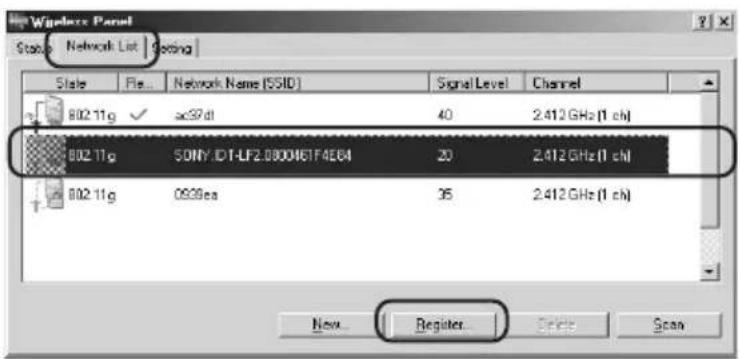
2 Click the "Network List" tab, select a wireless network from the list, and click "Register".
text_image
Wireless Panel Status: Network List Setting State Fire... Network Name (SSID) Signal Level Channel 802.11g ac97dl 40 2.412 GHz(1 ch) 802.11g SONY.DT-LF2.000061F4E64 20 2.412 GHz(1 ch) 802.11g 0939ea 35 2.412 GHz(1 ch) New... Register... Cancel ScanThe “Registering Network” dialog box appears.
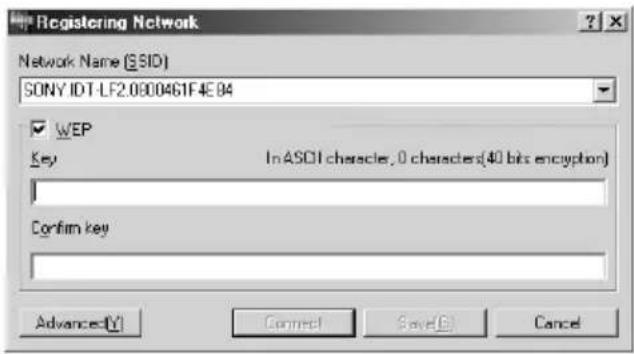
3 If data encryption (WEP) is enabled for the Access Point, select the "WEP" check box, enter the encryption key in the "Key" box, and then confirm it by entering it again in the "Confirm key" box.
text_image
Registering Network Network Name (SSID) SONY IDT-LF2.0900461F4E84 WEP Key In ASCII characters, 0 characters(40 bits encryption) Confirm key Advanced(Y) Connect Save(C) Cancel4 Click "Connect".
The Wireless LAN PC Card connects to the Access Point.
Verifying Wireless LAN PC Card driver installation
To verify that the Wireless LAN PC Card driver has been installed properly, perform the following steps.
Windows Me operating system:
1 Click "Start", point to "Settings", and click "Control Panel". Control Panel appears.
2 Double-click the "System" icon.
Hint
If the “System” icon is not shown, select “View all Control Panel options”.
3 Click the "Device Manager" tab.
4 Click "View devices by type".
5 Double-click "Network adapters".
6 Double-click "Sony 802.11g Wireless LAN Adapter".
The “Sony 802.11g Wireless LAN Adapter Properties” dialog box appears.
Note
The Wireless LAN PC Card is not working properly in the following cases:
- “Sony 802.11g Wireless LAN Adapter” is shown with an “X” or “!” symbol. →Click “Sony 802.11g Wireless LAN Adapter” and click “Remove” to uninstall the driver. Then repeat the installation process.
- Double-clicking “Network Adapters” does not display “Sony 802.11g Wireless LAN Adapter”.
→Remove the Wireless LAN PC Card. Then repeat the installation process.
- Double-clicking “Other devices” displays “Ethernet Controller”.
→Click “Ethernet Controller”, then click “Remove” to uninstall the driver. Repeat the installation process.
7 Confirm that the message "This device is working properly." is displayed under "Device status".
Note
If “This device is working properly.” is not shown, the Wireless LAN PC Card is not working correctly. Perform steps 1 - 5, click “Sony 802.11g Wireless LAN Adapter”, then click “Remove” to uninstall the driver. After uninstalling, restart the computer and repeat the installation process.
8 Click "OK" to close the "Sony 802.11g Wireless LAN Adapter Properties" dialog box.
The “System Properties” dialog box appears.
9 Click "OK" to close the "System Properties" dialog box. Control Panel appears.
10 Click ✗ close Control Panel.
If the computer you are using incorporates another Ethernet interface besides the Wireless LAN PC Card, disable the other interface as follows.
1 Click "Start", point to "Settings", and click "Control Panel". Control Panel appears.
2 Double-click the "System" icon.
Hint
If the “System” icon is not shown, select “View all Control Panel options”.
3 Click the "Device Manager" tab and double-click "Network adapters".
4 Double-click the network adapter to disable.
5 Click the "General" tab, then select the "Disable in this hardware profile" check box.
6 Click "OK" to close the Properties dialog box for the network adapter to disable.
The “System Properties” dialog box appears.
7 Click "OK" to close the "System Properties" dialog box.
Control Panel appears.
8 Click to close Control Panel.
Windows 2000 operating system:
1 Click "Start", point to "Settings", and click "Control Panel". Control Panel appears.
2 Double-click the "System" icon.
The "System Properties" dialog box appears.
3 Click the "Hardware" tab, then click "Device Manager". The "Device Manager" window appears.
4 In the "View" menu, click "Devices by type".
5 Double-click "Network adapters".
6 Double-click "Sony 802.11g Wireless LAN Adapter". The "Sony 802.11g Wireless LAN Adapter Properties" dialog box appears.
Note
The Wireless LAN PC Card is not working properly in the following cases:
- “Sony 802.11g Wireless LAN Adapter” is shown with an “X” or “!” symbol.
→Right-click “Sony 802.11g Wireless LAN Adapter” and click “Remove” to uninstall the driver. Then repeat the installation process. - Double-clicking “Network Adapters” does not display “Sony 802.11g Wireless LAN Adapter”.
→Remove the Wireless LAN PC Card. Then repeat the installation process. - Double-clicking “Other devices” displays “Ethernet Controller”.
→Right-click “Ethernet Controller”, then click “Remove” to uninstall the driver. Repeat the installation process.
7 Confirm that the message "This device is working properly." is displayed under "Device status".
Note
If “This device is working properly.” is not shown, the Wireless LAN PC Card is not working correctly. Perform steps 1 - 5, right-click “Sony 802.11g Wireless LAN Adapter”, then click “Remove” to uninstall the driver. After uninstalling, restart the computer and repeat the installation process.
8 Click "OK" to close the "Sony 802.11g Wireless LAN Adapter Properties" dialog box.
The “Device Manager” window appears.
9 Click to close the "Device Manager" window.
The “System Properties” dialog box appears.
10 Click "OK" to close the "System Properties" dialog box.
Control Panel appears.
11 Click x close Control Panel.
If the computer you are using incorporates another Ethernet interface besides the Wireless LAN PC Card, disable the other interface as follows.
1 Click "Start", point to "Settings", and click "Network and Dial-up Connections".
The “Network and Dial-up Connections” window appears.
2 Select the network adapter to disable.
3 On the "File" menu, click "Disable".
4 Click to close the "Network and Dial-up Connections" window.
Windows XP operating system:
1 Click "Start" and click "Control Panel".
Control Panel appears.
2 Double-click the "System" icon.
The “System Properties” dialog box appears.
Hint
If the “System” icon is not displayed, click “Switch to Classic View”.
3 Click the "Hardware" tab, then click "Device Manager".
The “Device Manager” window appears.
4 On the "View" menu, click "Devices by type".
5 Double-click "Network adapters".
6 Double-click "Sony 802.11g Wireless LAN Adapter".
The “Sony 802.11g Wireless LAN Adapter Properties” dialog box appears.
Note
The Wireless LAN PC Card is not working properly in the following cases:
- “Sony 802.11g Wireless LAN Adapter” is shown with an “X” or “!” symbol.
→Right-click “Sony 802.11g Wireless LAN Adapter” and click “Remove” to uninstall the driver. Then repeat the installation process. - Double-clicking “Network Adapters” does not display “Sony 802.11g Wireless LAN Adapter”.
→Remove the Wireless LAN PC Card. Then repeat the installation process. - Double-clicking “Other devices” displays “Ethernet Controller”.
→Right-click “Ethernet Controller”, then click “Remove” to uninstall the driver. Repeat the installation process.
7 Confirm that the message "This device is working properly." is displayed under "Device status".
Note
If “This device is working properly.” is not shown, the Wireless LAN PC Card is not working correctly. Perform steps 1 - 5, right-click “Sony 802.11g Wireless LAN Adapter”, then click “Remove” to uninstall the driver. After uninstalling, restart the computer and repeat the installation process.
8 Click "OK" to close the "Sony 802.11g Wireless LAN Adapter Properties" dialog box.
The “Device Manager” window appears.
9 Click to close the "Device Manager" window.
The “System Properties” dialog box appears.
10 Click "OK" to close the "System Properties" dialog box.
Control Panel appears.
11 Click to close Control Panel.
If the computer you are using incorporates another Ethernet interface besides the Wireless LAN PC Card, disable the other interface as follows.
1 On the "Start" menu, click "Control Panel", and double-click "Network Connections".
The “Network Connections” window appears.
Note
If “Network Connections” is not displayed, click “Switch to Classic View” on the left of Control Panel.
2 From "LAN or high-speed Internet", select the network adapter to disable.
3 On the "File" menu, click "Disable".
4 Click to close the "Network Connections" window.
Uninstalling the Wireless LAN PC Card driver
To uninstall the Wireless LAN PC Card driver, proceed as follows.
Hint
For information on how to install the Wireless LAN PC Card driver, see page 26.
Windows Me operating system:
1 Click "Start", point to "Settings", and click "Control Panel". Control Panel appears.
2 Double-click the "System" icon.
The “System Properties” dialog box appears.
Hint
If the “System” icon is not shown, select “View all Control Panel options”.
3 Click the "Device Manager" tab.
4 Click "View devices by type".
5 Double-click "Network adapters".
6 Click "Sony 802.11g Wireless LAN Adapter", then click "Remove".
The “Confirm Device Removal” dialog box appears.
7 Click "OK" to uninstall.
The message “To finish removing your hardware, you must restart your computer. Do you want to restart your computer now?” appears.
8 Remove the Wireless LAN PC Card from its slot, then click "Yes".
The computer restarts. This completes uninstallation of the driver.
Windows 2000 operating system:
Notes
- With the Windows 2000 operating system, only users with administrator access privileges can uninstall drivers. Log on to the Windows 2000 operating system with a user account listed in “Administrators”.
- Exit all programs before running the uninstall process.
1 Click "Start", point to "Settings", and click "Control Panel". Control Panel appears.
2 Double-click the "System" icon.
The "System Properties" dialog box appears.
3 Click the “Hardware” tab, then click “Device Manager”. The “Device Manager” window appears.
4 On the "View" menu, click "Devices by type".
5 Double-click "Network adapters", and double-click "Sony 802.11g Wireless LAN Adapter". The "Sony 802.11g Wireless LAN Adapter Properties" dialog box appears.
6 Click the "Driver" tab, then click "Uninstall".
The "Confirm Device Removal" dialog box appears.
7 Click "OK".
The Device Manager window appears.
8 Click to close the "Device Manager" window. The "System Properties" dialog box appears.
9 Click "OK" to close the "System Properties" dialog box. Control Panel appears.
10 Click ✗ close Control Panel.
Windows XP operating system:
Notes
- With the Windows XP operating system, only users with administrator access privileges can uninstall drivers. Log on to the Windows XP operating system with a user account with administrator access privileges.
- Exit all programs before running the uninstall process.
1 Click "Start" and click "Control Panel". Control Panel appears.
2 Double-click the "System" icon.
The “System Properties” dialog box appears.
Hint
If the “System” icon is not displayed, click “Switch to Classic View”.
3 Click the “Hardware” tab, then click “Device Manager”. The “Device Manager” window appears.
4 On the "View" menu, click "Devices by type".
5 Double-click “Network adapters”, and Double-click “Sony 802.11g Wireless LAN Adapter”. The “Sony 802.11g Wireless LAN Adapter Properties” dialog box appears.
6 Click the "Driver" tab, then click "Uninstall". The "Confirm Device Removal" dialog box appears.
7 Click "OK". The Device Manager window appears.
8 Click to close the Device Manager window. The “System Properties” dialog box appears.
9 Click "OK" to close the "System Properties" dialog box. Control Panel appears.
10 Click to close Control Panel.
Uninstalling the Wireless Panel
To uninstall the Wireless Panel, proceed as follows.
Note
Exit the Wireless Panel with the icon on your Windows operating system taskbar before proceeding.
Hint
For information on how to install the Wireless Panel, see page 28.
Windows Me operating system:
Note
Exit all programs before running the uninstall process.
1 Click "Start", point to "Settings", and click "Control Panel". Control Panel appears.
2 Double-click the “Add/Remove Programs” icon.
The “Add/Remove Programs Properties” dialog box appears.
3 Select "Wireless Panel" and click "Add/Remove". The "Confirm File Deletion" dialog box appears.
4 Click "OK".
The software uninstall process is carried out.
5 Click "Finish".
The uninstall process is complete.
Windows 2000 operating system:
Notes
- With the Windows 2000 operating system, only users with administrator access privileges can uninstall software. Log on to the Windows 2000 operating system with a user account listed in “Administrators”.
- Exit all programs before running the uninstall process.
1 Click "Start", point to "Settings", and click "Control Panel". Control Panel appears.
2 Double-click the “Add/Remove Programs” icon. The “Add/Remove Programs” dialog box appears.
3 Select "Wireless Panel" and click "Change/Remove". The "Confirm File Deletion" dialog box appears.
4 Click "OK".
The software uninstall process is carried out, and then the InstallShield completion dialog box appears.
5 Click "Finish".
The uninstall process is complete.
Windows XP operating system:
Notes
- With the Windows XP operating system, only users with administrator access privileges can uninstall software. Log on to the Windows XP operating system with a user account with administrator access privileges.
- Exit all programs before running the uninstall process.
1 Click "Start" and click "Control Panel".
Control Panel appears.
2 Double-click the "Add or Remove Programs" icon.
The “Add or Remove Programs” window appears.
Hint
If the “Add or Remove Programs” icon is not displayed, click “Switch to Classic View”.
3 Select "Wireless Panel" and click "Change/Remove".
The “Confirm File Deletion” dialog box appears.
4 Click "OK".
The software uninstall process is carried out, and then the maintenance completion dialog box appears.
5 Click "Finish".
The uninstall process is complete.
Precautions
Safety
Do not drop or cause a mechanical shock to the Wireless LAN PC Card, as this may damage the unit.
Installation
Do not expose the Wireless LAN PC Card to the following conditions:
- Unstable surfaces
• High humidity or poor ventilation - Excessive dust
- Direct sunlight or extreme heat
- Closed cars
- Magnetized location (near magnets, speakers, or televisions)
- Locations exposed to frequent vibration
- Locations where the transmission of radio waves may be obstructed by metal plates or concrete walls
Operation
If the Wireless LAN PC Card is moved directly from a cold location to a warm locations, or if it is placed in a very damp environment, moisture may condense on the parts inside. The Wireless LAN PC Card may not operate properly if moisture condensation occurs.
Cleaning
Clean the casing with a soft cloth, lightly moistened with water or a mild detergent solution. Do not use any type of abrasive pad, scouring powder, or solvent such as alcohol or benzene as it may damage the finish of the casing.
Specifications
Protocol support
TCP/IP compliant
Standard compliance
IEEE 802.11b
IEEE 802.11g
Radio frequency
2.4 GHz wireless network:
2.4 to 2.4835 GHz (ISM band)
Modulation
DS-SS
OFDM
General
Power requirements
3.3 V DC (supplied from the computer through the PC card adapter)
Current
Peak current at transmission: 700 mA
Peak current at reception: 370 mA
Connector
PC Card Card Type II (Card Bus)
Dimensions
Approx. 2.2 × 0.2 × 3.6 inches
(Approx. 54 × 5 × 91 ~mm ) (W × H × D)
(Antenna height: 0.55 inches (Approx. 14 mm))
Mass
Approx. 1.4 oz. (Approx. 40 g)
Operating temperature
41^ F to 95^ F ( 5^ C to 35^ C) (not condensed)
Environment temperature
-4^ to 140^ (-20^ to 60^) (not condensed)
Supplied accessories
See “Unpacking” on page 12.
Design and specifications are subject to change without notice.
Getting help
This section describes how to get help and support from Sony, as well as troubleshooting tips for your Wireless LAN PC Card.
About Sony's Support Options
Sony provides several support options for your Wireless LAN PC Card.
☐Operating Instructions explains how to use your Wireless LAN PC Card.
☐Quick Start Guide explains how to install software required to use the Wireless LAN PC Card (IEEE 802.11g: 2.4 GHz/54 Mbps) PCWA-C300S.
□Troubleshooting Guide
This document contains answers to frequently asked questions and common problems.
☐Wireless Panel Online Help is the Online Help of the supplied Wireless Panel utility software. Refer to it for instructions on how to use the software.
□Sony support Web site http://www.vaio-link.com
Glossary
Access Point (Infrastructure) Network mode
A method of building a wireless network using one or more Access Points. For details, see “Capabilities” on page 5.
Channel
A part of the frequency spectrum to be used for wireless communication.
Only client computers and Access Points set to the same channel can communicate with each other.
Client
A computer connected to a LAN (Local Area Network). Also may be called a client computer.
DHCP (Dynamic Host Configuration Protocol)
DHCP lets network administrators centrally manage and automate assignment of client computer IP addresses.
DNS (Domain Name System)
A system that translates host names into IP addresses.
Networks that use the TCP/IP protocol, such as the Internet, use a set of numbers like 192.168.0.1 (IP address) to identify a computer. However, since the IP address is hard to memorize, DNS was developed to allow a name like “www.sony.com” to identify a computer for convenience. DNS servers manage these translations from host names into IP addresses.
LAN (Local Area Network)
A network which is accessible only to its members, unlike the Internet which is open to an unlimited number of people. A LAN may be built for different purposes. For example, you can build an office LAN that is accessible only to members of the same department or a home LAN that is accessible only to family members.
Network Name (SSID)
A wireless LAN group identifier according to the IEEE 802.11 standard. SSID stands for “Service Set ID”. The Network Name can be set individually for each Access Point and Peer to Peer Network to connect to. When roaming among multiple Access Points is used, all Access Points must be configured for the same Network Name (SSID) and WEP encryption key.
TCP/IP (Transmission Control Protocol/Internet Protocol)
TCP/IP is the network communications protocol that is used to communicate over the Internet. TCP is a connection-oriented protocol for establishing reliable, sequenced data transfer. TCP ensures that data reaches its destination.
IP assembles and addresses data packets for transmission to their network destinations.
WAN (Wide Area Network)
A network that interconnects remote LANs through the Internet or telephone lines.
Troubleshooting
Read the Troubleshooting section of this guide before calling Sony Customer Information Services. If you still cannot resolve your issue after reading this section, call Sony Customer Information Services.
| Symptom Cause/Remedy | |
| My computer does not detect the Wireless LAN PC Card. | The Wireless LAN PC Card may not be properly inserted into the PC card slot of your computer.→Check that the Wireless LAN PC Card is inserted in the proper direction, then push it in as far as it will go. |
| I cannot see other computers. | You did not enter a password when your Windows operating system started.→Make sure that you enter a user name and appropriate password when you log on to your Windows operating system.Windows settings are incorrect.→Check your Windows operating system network settings.If there are no other computers on the network to which you are connected, no other computer is displayed. |
| I cannot access the Internet. | The Access Point is not connected.→Follow the instructions in the Access Point Operating Instructions to connect it properly.The Wireless LAN PC Card may not be inserted into your computer.→See the instructions on page 17 of this manual to insert it properly.Communication between the Access Point and your computer are not established.→Check the communication status using the Wireless Panel.For details on how to check the status, see “Checking the communication status” (page 29).The Access Point is not properly configured.→Configure the Access Point with the connection method of your choice.Distance between computer and Access Point is too great.The maximum allowable distance is about 150 feet in line of sight, but this will vary depending on usage conditions.→Check the signal level indicator on your Windows operating system taskbar. If the level is low, bring the computer and Access Point closer together. |
Symptom Cause/Remedy
| Data transfer speed is slow | There is interference with other Access Points.* Try changing the Access Point channel setting.The network is handling a large amount of simultaneous traffic.* Try again when the network load is lower.Communication distance is long.* Reduce the communication distance.There are obstacles (objects blocking radio transmission) within the communication range.* Remove the obstacles or change the installation location. |
| I cannot remember the WEP Key. | * When using an Access Point, reset the Access Point to its defaults. For further information about how to reset the Access Point, see the Access Point Operating Instructions.* When using a Wireless LAN PC Card in Peer to Peer Network connection mode, delete the network settings registered on each computer connected to the network, then reconfigure the computer’s wireless network settings. |
Benutzerhandbuch
Wireless LAN PC Card
(IEEE 802.11g: 2,4 GHz/54 Mbit/s)
PCWA-C300S
ACHTUNG!
natural_image
Illustration of three laptops with wireless signal waves, no text or symbols presentWireless LAN PC Card PCWA-C300S
text_image
Computer Wireless LAN PC Card PCWA-C300S- Wireless LAN PC Card
natural_image
Simple line drawing of a rectangular object with a rounded top and horizontal base (no text or symbols)- Kurzeinführung
- Garantiekarte
PC Card Card Type II (Card Bus)
Abmessungen
Ca. 54 × 5 × 91 mm (B × H × T)
DHCP (Dynamic Host Configuration Protocol)
Wireless LAN PC Card
(IEEE 802.11g: 2.4 GHz/54 Mbps)
AVERTISSEMENT
Documentation © 2003 Sony Corporation
text_image
Modem ADSL, etc.Conseil
natural_image
Illustration of three laptops with wireless signal waves, no text or symbols presentnatural_image
Simple line drawing of a rectangular object with a rounded top and horizontal base (no text or symbols)DHCP (Dynamic Host Configuration Protocol)
Symptôme Causes possibles/Solutions