
LUMIX DMW-MS1PP - Photo Accessories PANASONIC - Free user manual and instructions
Find the device manual for free LUMIX DMW-MS1PP PANASONIC in PDF.



| Product type | Stereo condenser microphone for Panasonic cameras |
| Brand | Panasonic |
| Model | DMW-MS1 |
| Directivity | Unidirectional (stereo) / Non-directional (monaural) |
| Frequency response | 100 Hz - 20,000 Hz |
| Sensitivity | -47 dB (0 dB = 1 V/Pa, 1 kHz) |
| Output impedance | 600 Ω |
| Signal-to-noise ratio | 67 dB or more |
| Power supply | 1 AAA battery (1.5 V) – type R03 (manganese) or LR03 (alkaline) |
| Battery life | Approx. 500 h (manganese), 1000 h (alkaline) at 23°C |
| Dimensions (L x H x D) | 47 x 55 x 158 mm (excluding cable) |
| Weight | 67.5 g (unit only) / 76.5 g (battery included) |
| Operating temperature | 0 °C to 40 °C |
| Operating humidity | 35% to 80% |
| Main functions | OFF/MONO/STEREO selector, wind cut switch ON/OFF, battery level indicator |
| Connector | 2.5 mm stereo mini-jack, L-shaped (cable length 140 mm) |
| Mounting | Accessory shoe with locking ring |
| Supplied accessories | AAA R03 battery, windscreen |
| Maintenance and cleaning | Wipe with a soft dry cloth. For stubborn dirt, use a damp cloth then dry. Do not use benzene, solvents, or alcohol. Remove battery before cleaning. |
| Safety | Do not expose to rain, moisture, or splashes. Do not disassemble. Use only recommended accessories. Keep batteries out of reach of children. |
| Spare parts and repairability | Standard AAA battery, replaceable windscreen. No user-serviceable parts inside. |
| General information | Designed exclusively for Panasonic digital cameras equipped with a microphone jack and accessory shoe. |
Frequently Asked Questions - LUMIX DMW-MS1PP PANASONIC
User questions about LUMIX DMW-MS1PP PANASONIC
0 question about this device. Answer the ones you know or ask your own.
Ask a new question about this device
Download the instructions for your Photo Accessories in PDF format for free! Find your manual LUMIX DMW-MS1PP - PANASONIC and take your electronic device back in hand. On this page are published all the documents necessary for the use of your device. LUMIX DMW-MS1PP by PANASONIC.
USER MANUAL LUMIX DMW-MS1PP PANASONIC
Operating Instructions
Before connecting, operating or adjusting this product, please read the instructions completely.
Information for Your Safety 2
Precautions 4
Supplied accessories 4
Names of the Components 5
About the batteries 5
Inserting and Removing the Unit's Battery. 7
Mounting the Unit onto the Digital Camera, and Removing it 8
Using the Microphone 10
Frequency Response and Directionality Pattern Diagrams ...11
Cautions for Use 11
Specifications 13
Information for Your Safety
- This stereo microphone is exclusively for Panasonic digital cameras.
It is designed for use with a digital camera equipped with a microphone socket and a hot shoe.
- This stereo microphone can be switched to record sound in either stereo or monaural.
WARNING:
TO REDUCE THE RISK OF FIRE, ELECTRIC SHOCK OR PRODUCT DAMAGE,
DO NOT EXPOSE THIS APPARATUS TO RAIN, MOISTURE, DRIPPING OR SPLASHING AND THAT NO OBJECTS FILLED WITH LIQUIDS, SUCH AS VASES, SHALL BE PLACED ON THE APPARATUS.
- USE ONLY THE RECOMMENDED ACCESSORIES.
- DO NOT REMOVE THE COVER (OR BACK); THERE ARE NO USER SERVICEABLE PARTS INSIDE. REFER SERVICING TO QUALIFIED SERVICE PERSONNEL.
-If you see this symbol




Cd
Information for Users on Collection and Disposal of Old Equipment and used Batteries
These symbols on the products, packaging, and/or accompanying documents mean that used electrical and electronic products and batteries should not be mixed with general household waste.
For proper treatment, recovery and recycling of old products and used batteries, please take them to applicable collection points, in accordance with your national legislation and the Directives 2002/96/EC and 2006/66/EC.
By disposing of these products and batteries correctly, you will help to save valuable resources and prevent any potential negative effects on human health and the environment which could otherwise arise from inappropriate waste handling.
For more information about collection and recycling of old products and batteries, please contact your local municipality, your waste disposal service or the point of sale where you purchased the items.
Penalties may be applicable for incorrect disposal of this waste, in accordance with national legislation.
For business users in the European Union
If you wish to discard electrical and electronic equipment, please contact your dealer or supplier for further information.
[Information on Disposal in other Countries outside the European Union]
These symbols are only valid in the European Union. If you wish to discard these items, please contact your local authorities or dealer and ask for the correct method of disposal.
Note for the battery symbol (bottom two symbol examples):
This symbol might be used in combination with a chemical symbol. In this case it complies with the requirement set by the Directive for the chemical involved.
About the batteries
CAUTION
Danger of explosion if battery is incorrectly replaced. Replace only with the same or equivalent type recommended by the manufacturer. Disposal of used batteries according to the manufacturer's instructions.
- Do not heat or expose to flame.
- Do not leave the battery in an automobile exposed to direct sunlight for a long period of time with doors and windows closed.
Precautions
■ Handling the unit
- Do not subject the unit to strong vibration or impact. Doing so may not only cause the unit to malfunction but also cause the stereo microphone to break.
- Sand and dirt may cause the unit to malfunction. When using the unit in an environment such as a beach, take steps to protect it from sand and dirt.
- When using the unit on rainy days or on a beach, take care to keep the unit dry.
- The unit is not waterproof. If rain or drops of water splash onto the unit, wipe off the water with a dry cloth. If the unit does not operate normally, consult the dealer or your nearest servicenter.
- Read the operating instructions for your digital camera.
■ When the unit is not going to be used for a prolonged period
- Be absolutely sure to remove the battery from the unit.
- If the battery is left inside the unit, a faint current will flow continuously, even when the unit's power is off, gradually discharging the battery.
- Store the batteries in a cool, moisture-free location where the temperature is kept as constant as possible.
[Recommended temperature range: 15ircC to 25ircC (59°F to 77°F); recommended humidity range: 40% to 60%]
- If you plan to store the unit and/or its batteries inside a closet or cupboard, it is recommended that you put a desiccant (silica gel) in with them.
Supplied accessories
[Inspection to be performed when you unpack the unit] When removing the unit from its packing box, check that the main unit and its supplied accessory are there and also check their external appearance and functions to verify that they have not sustained any damage during distribution and transportation.
If you discover any trouble, contact your vendor before using the product.
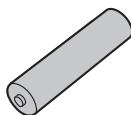
Manganese dry battery AAA, R03
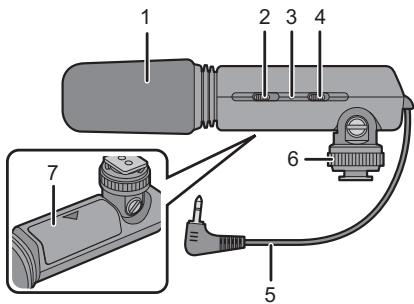
1 Wind Shield (Microphone condenser)
2 Off/On Mode Selector Switch [OFF/MONO/STEREO] (P10)
3 Battery Check Lamp [BATTERY] (P10)
4 [WIND CUT OFF/ON] Switch (P10)
5 φ 2.5mm L shaped stereo mini plug cord (P9)
6 Lock ring (P8)
7 Battery cover (P7)
About the batteries
Types of batteries that can be used
AAA Manganese dry batteries (R03)
AAA Alkaline dry batteries (LR03)
- AAA EVOLTA/AAA EVOIA batteries (new Panasonic battery) can be used, too.
- The performance of the batteries used may significantly differ depending on which battery brand is used, how long the batteries have been stored since they were manufactured and how they have been stored.
- The performance of the batteries decreases temporarily at low temperatures [below 10ircC ( 50ircF )], but will be restored when the temperature returns to room temperature.
- Malfunctioning may occur under certain ambient temperatures and operating conditions. However, this is not indicative of trouble.
- In order to ensure that the batteries will function for as long as possible, it is recommended that you turn off the unit's power during the intervals between using the unit.
- Once depleted, batteries may recover their performance when left standing for a while, but they will quickly become unusable again. For this reason, always make a point of replacing depleted batteries with fresh ones.
Types of batteries with which operation is not guaranteed
| Ni-Cd batteries |
| Nickel-manganese batteries |
| Nickel Hydrogen batteries |
| Lithium batteries |
| Oxyride (oxy-nickel-hydroxide) dry batteries |
- Panasonic offers no guarantees that the unit will operate properly when any of the batteries listed above are used. Furthermore, use of these batteries may result in electrolyte leakage, power failure, risk of explosion etc.
Batteries with shapes that cannot be used
- Installing batteries with irregular shapes in the unit may cause electrolyte leakage, heat generation and even rupturing of the batteries themselves.
-
Some batteries sold on the market have part or all of their jackets missing: Under no circumstances should such batteries be used. (Refer to the figure below.)
-
Batteries (bare batteries) with no external jackets or batteries with parts of their jackets missing
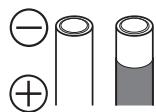
- Batteries whose electrode is flat
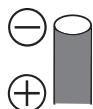
Handling the batteries
Mishandling of batteries may cause electrolyte leakage, heat generation and even rupturing of the batteries themselves. Note the following cautions:
- Do not expose batteries to water or seawater or allow their terminal areas to become wet.
- Do not remove their external jackets or damage them in any way.
- Do not drop the batteries, knock them into other objects or subject them to any other kind of strong impact.
- Stop using the batteries as soon as you notice any electrolyte leakage, deformation, discoloration or any other such trouble.
- Do not store batteries in locations where the temperature and/or humidity levels are high.
- Keep batteries out of the reach of infants and small children.
- Remove the battery from the unit when you do not intend to use the unit for a prolonged period.
- The battery may be hot immediately after the unit has been used. Before removing it from the unit, turn off the unit's power and wait until the temperature of the battery has dropped.
- At low temperatures [under 10ircC ( 50ircF )], the performance of the battery will deteriorate and the operating time of the unit will be sharply reduced. The operating duration of batteries tends to be shorter particularly when alkaline/manganese dry batteries are used so warm them in your pocket before use. When warming batteries in your pocket, avoid direct contact with cigarette lighters and other metal objects as well as with pocket/ body warmers.
- The operating time of the unit may also be sharply reduced if the and electrodes of the battery are exposed to oils from the skin or other forms of dirt. Before installing the battery, wipe the and electrodes carefully using a soft, dry cloth.
If electrolytes should leak from the battery, wipe away all traces of the electrolyte in the battery compartment, and then insert a fresh battery.
If you should get electrolyte on your hands or clothes, rinse it off thoroughly with water. If you should get electrolyte in your eyes, you risk losing your sight. In such a case, do not rub your eyes but immediately wash them with clean water, and then seek medical advice.
Service life of batteries
| Batteries used | Operating time |
| AAA Manganese dry batteries (R03) | Approx. 500 h |
| AAA Alkaline dry batteries (LR03) | Approx. 1,000 h |
Operating conditions
- Temperature: 23 irc C( 73.4 irc F)

Note
- The operating time differs slightly depending on the storage status of the batteries and the operating conditions.
Inserting and Removing the Unit's Battery
- Check that the unit's power is off. (Make sure the Off/On Mode Selector Switch is set to [OFF].)
1 Open the battery cover.
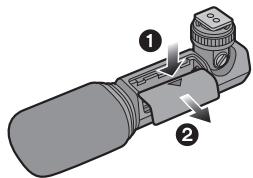
- Press the [ ] mark on the cover in the direction of arrow 1 and slide the cover in the direction of arrow 2.
2 When inserting the battery, ensure that the and pole of the battery are aligned correctly.
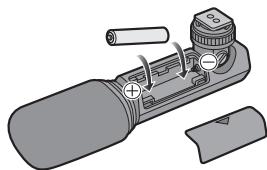
3 Close the battery cover.
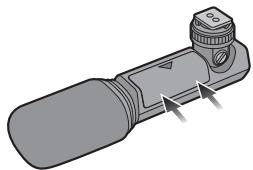

Note
After using the unit, take out the battery.
- Keep the AAA battery out of reach of children to prevent swallowing.
- Keep the battery cover out of reach of children to prevent swallowing.
Mounting the Unit onto the Digital Camera, and Removing it
- Check that the power of the digital camera and unit is off. (Mounting the unit onto, or disengaging it from, the camera while the power is on may cause trouble and is not recommended.)
Mounting the unit
1 Loosen the lock ring.
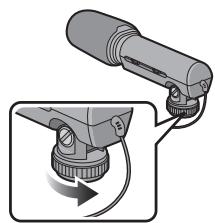
- Do not apply more force than is necessary to the lock ring.
2 Slide the unit into the hot shoe of the digital camera, ensuring that it is fully inserted.
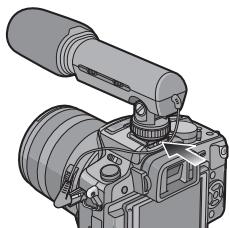
3 Rotate the lock ring in the direction of the arrow until it stops.
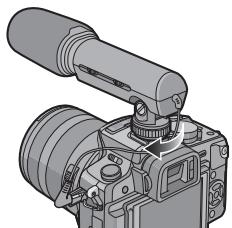
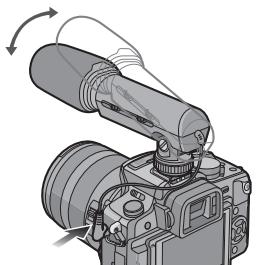
4 Securely connect the Stereo Mini-Plug Cord to the [MIC] socket of the digital camera.
- You can adjust the microphone angle within the range shown in the figure.
- Take care that the stereo microphone connection does not become loose while in use.
Removing the unit
Completely loosen the lock ring, and slide the unit off from the hot shoe.
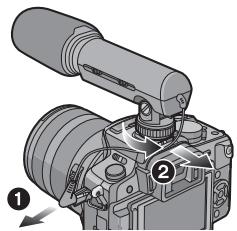

Note
- Hold the lock ring portion when attaching and removing the microphone.
Using the Microphone
Changing the Off/On Mode Selector Switch
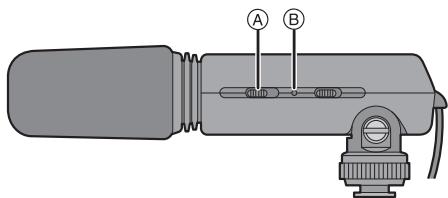
Off/On Mode Selector Switch [OFF/MONO/STEREO]
| [OFF] | Turn off the microphone power. |
| [MONO] | Records sound in front of the digital camera in monaural. |
| [STEREO] | Records sound in a wide area in stereo. |
Battery Check Lamp [BATTERY] ⑧
- When the Off/On Mode Selector Switch is changed from [OFF] to [MONO] or [STEREO], the Battery Check Lamp [BATTERY] will light temporarily if there is still plenty of power in the battery. If the Battery Check Lamp [BATTERY] does not light temporarily, replace the battery with a new one.
Changing the [WIND CUT OFF/ON] Switch
This microphone is equipped with a wind shield that is designed to cut down wind noise, but when the wind is so strong that even the wind shield is not adequate to keep down the noise, set the [WIND CUT OFF/ON] switch to [ON] to further reduce the wind noise.
![PANASONIC LUMIX DMW-MS1PP - Changing the [WIND CUT OFF/ON] Switch - 1](/content/2020/04/53492/images/d796f931ac456266c3c6cb6ac5b6679ff149294eaf62f9fccffa246ca6c6de86.jpg)
[WIND CUT OFF/ON] Switch
| [OFF] | The microphone should usually be used with this position. |
| [ON] | Set the [WIND CUT OFF/ON] switch to this position to reduce wind noise. |
![PANASONIC LUMIX DMW-MS1PP - Changing the [WIND CUT OFF/ON] Switch - 2](/content/2020/04/53492/images/3dabe2fccfb710edfd3224b61a0a015fea871d4ead437e5e8a6b3c7af732b6f4.jpg)
Note
- Although you can change the setting of the Off/On Mode Selector Switch or the [WIND CUT OFF/ON] switch while recording, the sound of the switch being changed may be recorded.
- When this unit is connected, [WIND CUT] cannot be set on the digital camera. Set with this unit.
Frequency Response and Directionality Pattern Diagrams
■ Frequency Response (WIND CUT OFF/ON)
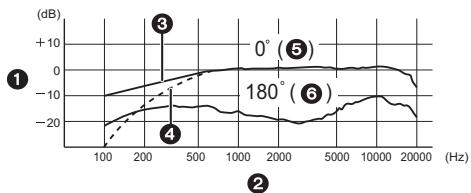
1 Response
3 Wind Cut Off
5 Front
Frequency
4 Wind Cut On
Rear
Directionality Pattern
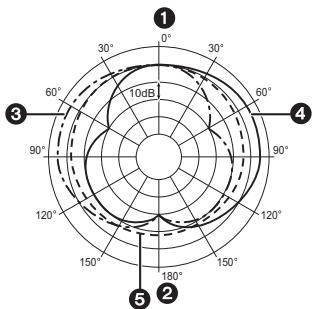
0 Front
3 Stereo (left)
5 Monaural
Rear
4 Stereo (Right)
Cautions for Use
About the unit
Do not use the unit near radio transmitters or high-voltage lines.
- If you record near radio transmitters or high-voltage lines, the recorded pictures and sound may be adversely affected.
Keep the unit away from insecticide sprays and other volatile substances.
- If the unit is exposed to these sprays or substances, its external case may deteriorate and/or its paint may peel off.
- Do not leave the unit in contact with any items made of rubber or PVC for prolonged periods of time.
Do not carry the unit when it is still attached to the camera body.
-
Under no circumstances should the unit be stored in any of the following locations since doing so may cause trouble in operation or malfunctioning.
-
In direct sunlight or on a beach in summer
- In locations with high temperatures and humidity levels or where the changes in temperature and humidity are acute
- In locations with high concentrations of sand, dust or dirt
- Where there is fire
- Near heaters, air conditioners or humidifiers
- Where water may make the unit wet
Where there is vibration -
Inside a vehicle
-
The unit cannot be used with an external flash.
- The unit cannot be used with a remote shutter.
-
Do not drop the unit, knock it into other objects or subject it to any other kind of strong impact or shock.
-
A dirty plug may result in faulty contact. Be sure to wipe the plug with a dry soft cloth before connecting the microphone.
- Do not connect or disconnect the stereo mini-plug with the digital camera turned on.
- When the unit is not going to be used for a prolonged period, mold and other problems may cause failure of the unit. It is recommended that you check the unit's operation prior to use.
- Take care to not apply excessive force to the wind shield. It may cause malfunction.
Cleaning
Before cleaning the unit, remove the battery. Then wipe the unit with a dry soft cloth.
- When the unit is soiled badly, it can be cleaned by wiping the dirt off with a wrung wet cloth, and then with a dry cloth.
- Do not use solvents such as benzine, thinner, alcohol, kitchen detergents, etc., to clean the unit, since it may deteriorate the external case or the coating may peel off.
- When using a chemical cloth, be sure to follow the accompanying instructions.
About the batteries
Be sure to remove the battery when you will not be using the unit for a long period of time.
- If the temperature is too high or low, the terminals may rust causing a malfunction.
If you drop the battery accidentally, check to see if the body of the battery or the terminals are damaged.
- Inserting a damaged battery in the unit will damage the unit.
Bring charged spare batteries when going out.
- Be aware that the operating time of the batteries becomes shorter in low temperature conditions such as at a ski resort.
Dispose of unusable batteries.
- Batteries have a limited life.
- Do not throw batteries into fire because they may cause an explosion.
Do not allow battery terminals to come into contact with metal objects (such as necklaces, hairpins, etc.).
- This can cause short circuiting or heat generation and you may be badly burned if you touch the batteries.
Do not attempt to recharge dry batteries.
Do not throw batteries into a fire or expose to excessive heat such as sunlight.
Power requirements: DC 1.5 V
| Batteries recommended for use | AAA Manganese dry batteries (R03)×1/ AAA Alkaline dry batteries (LR03)×1 |
| Model | Electret condenser type microphone |
| Directionality characteristics | Unidirectional (stereo) Nondirectional (monaural) |
| Frequency response | 100 Hz to 20,000 Hz |
| Sensitivity | -47 dB (0 dB=1 V/Pa, 1 kHz) |
| Output impedance | 600 Ω |
| S/N ratio | 67 dB or more |
| Cord | φ 2.5 mm L shaped stereo mini plug cord (length 140 mm) |
| Switch | Off/On Mode Selector Switch [OFF/MONO/STEREO][WIND CUT OFF/ON] Switch |
| Dimensions | Approx. 47.0 mm (W)×55.0 mm (H)×158.0 mm (D)[1 7/8" (W)×2 3/16" (H)×6 3/4"(D)] (excluding the cord portion) |
| Mass (weight) | Approx. 67.5 g/2.381 oz (main unit) Approx. 76.5 g/2.698 oz (including battery) |
| Operating temperature | 0 °C to 40 °C (32 °F to 104 °F) |
| Operating humidity | 35% to 80% |
Panasonic Consumer Electronics Company, Division of Panasonic Corporation of North America One Panasonic Way, Secaucus, NJ 07094
Panasonic Canada Inc. 5770 Ambler Drive, Mississauga, Ontario, L4W 2T3
© Panasonic Corporation 2009
Printed in Japan
Table des matieres
Panasonic Canada Inc.
5770 Ambler Drive,
Mississauga, Ontario
L4W 2T3
(905)624-5010
www.panasonic.ca
© Panasonic Corporation 2009
Imprimé au Japon
Table des matieres
Ha3BaHnIcoCTaBbIX qacteI 89
O 6atapex .89
UcTaHOBka n 3BnEueHne 6aTapeu n3 MmKpOfoHa .91
YcTaHOBka BCnblkHa ZnΦpOByIO φOTOKaMepy I ChrTne c Hee. 92
IcnoJIb3OBAHHe MmKpOfoHa 94
ДиаграмьчастOTHoxapakTePcTnKIN HanpaBHeHHocTn. 95
IpeoctopoxkHOCTn npu nCnoB3OBaHn 95
TexHnueckne xapaKTepeNCTnKn 97
HΦopMaζη no 6e3oNaChoctn
Tunbi6atapei, KOTOpbe Moryt NcNoIb3ObaTbcra
MapraHueBbIe cyxne 6aTaapeKn (R03) Tuna AAA
Cyxne ⅢeNochbIe 6aTapeKn AAA (LR03)
-Такке можно IncnoIb3ObaTb 6aTapeи Tnna AAA EVOLTA/AAA EVOIA (Новы{Tиб 6aTapeи Panasonic).
- 3ФфсгТИВHOCьбатарь в 3нанчтельноCTeпени 3aBиСNT OT
Mapки батар,在OTTO,CKOLьКВВреMuиnpOшлОСМOMeHTa
Бынуckaбатар,在a takke cnoCo6a nx xpaHEnia.
- Ckopoctb pa3pda 6aTapeek BpeMeHNO yBelenuNbBaETc npn Hn3knx temnepaTpyax (Hnke 10ircC) , HO onptb yMeHbIaeTcdo HaayalbHoi, KOrDa tempePaTpya BHOBB NOBbIaaeTc DO KOMHATHOI.
- Pn OnpeIeHbIX TempeaTypax OkpykaIOuei CpeIb I paOouHX ycNoBnx MOKeT pOncXoNDt bCbo B paOteY cTPOINCTBa. 3TO, OHaKo, He ChTuAeTc HEnCnpaBHOCTbIO.
- TTo6bI MaKcImaJIbHO YBeJIuNtB dJIITeJIbHOCTb pa6Otbl 6batapei, peKOMeHdyeTcA OTKJIouHaTb NITaHne MmKpOfoHa B nePnObl MeJdy erO nCNoJIb3OBAHNEM.
- Послpeразяdkи батарен могут BOCCTAHOBITb CBOO EMKOCtБ Д
некоторо CTENEHи, ecm IX OCTaBIVt Na HeKOTOPoe BPEMr,
ODnako посе зTORO OHI OChIb БбICTPO CHOBA сdYt. ПО.sto
п顺序е сдetyet BCERda HocNTb C cOBoi HOBs IE bataeikn,
ЧТББИ МОКНо БЛЮ В ЛЮБОМОмeHT 3aMeHITb pa3PЯжEHьe
HA HOBIE.
Tunbi 6atapei, pa6ota Ha KOtOpbIX He rapaHTnpyETcA
PpeOocToPOxHOCTn PpHNCNoJIb3OBaHN
B OTHOseHmN FOToBcNbIiKn He IcNoJIb3yIte Mnkpofoh Bo3Je paDnonepeaTtHKOB JINB BlicOKOBJbTHbIX JINH.
- EcnI npOn3Bovntb 3aIncsB Bo3ne paAnonepeDaTcNkOB nIN BbICOKOBoJbTHbIX -JIInnM, MOKET yxUdWntbC8 KaueCTBO 3aIncaHbIX IN3o6paXeHn IN 3Byka.
He pacnblIyIte B6IIN3u ycTpoIcTB uHceKTuNdHbIX cnpeEB uDpynx leTyuNX BeueCTB.
-При nx ПОпаданн ha yctpoCTBO erO BHeuHn BnD MoKET yxUdUnTbCЯ n/NJN OTCNoNTbCЯ kpaKa.
- He octablaIte foTOBcIbIky HaJOnIro B KOHTaKTe C n3deJIyMaN 3 pe3HbI JIN pIaCTnKa.
He hocnte yctpoiCTBO npncOeHHeHHbIM K Kopnycy foTOkamepbl.
-Kateropueckn 3anpeaaetcnoIb3oBaTbcS cTOBcIIuKo IxpanHTbe B CNeDyUOux YCIOBnx, TAK KAK 3TO MOKeT npVBectn K c6oam B pa6ote nHn HnnpaBnblHo pa6ote.
ПОДВОЗдейстбемпямьх солн electы пуechи на плжес leTOM
B MeCTHOCTx C BbICOKO BnaxKHOCTbHO Bo3dYxa N BbICOKMn Tempepatpam, nIc pe3KmN nepenadaMn Tempepatpybl N BnaxKHOCTn
B MeCTHOCTX C BbICOKIMN KOHcHTpaCnMn neCKa, Nblnn nnn rpr3n
-ПисрабаТьВани BCпИшКИ
- BozJIe o6oRpeBaTeNei, KOHdIuIIOHePOB uIy yBvIaXHHTeNeI
-「Дe BO3MOXHO HAMOKaHne yCTpoIcTbA
-ΓДe npucytCTByET Bn6paunr
B aTOMo6nne
MnKpOoH HeIb3a IcNoJIb3OBaTb C BHeUHeB BCbIuKOJ.
MnKpOΦoH HeIb3r IcNoJIb3OBaTb C IINCTaHcIOHOHbIM 3aTBOPOM.
- He poHnIte yCTpoIeCTBO, He yDapAriTe mO dpYrIe ppeMTebl Hne noDBeRpaIe erO npYrIM CINbHbIM yDapAM.
3aqr3HeHHbI WTeKeP MoKeT PnBecT N KOTcYCTBnIO KOtAkaTb. O63aTeNbHO IpOtpnTE WTeKeP cyXoM MrgKo TKaHbIO nepeD TeM, KaK NOdkJIIOuHTb MmKpOΦOH.
- He nodkJIOUaJIte N He oTKJIOUaJIte CTepeofoHnueckN MmHnIwTekep npB KJIIOUeHHOu IuΦpOBou Kamepe.
- Ecnn yctpoiCTBO He nCnOJIb3yETcB T TeueHne dInTeIbnHO reroIIOA BpeMeHn, To pIeCEHb I npYrNe IpO6IeMb MOrYT NOBpeINb YcTPOCTBO. IpcEJe cemNcOnb3oBaTb, peKOMeHNdyETc PNOBepaTb paBotoCnOcoBHOCTb yCTPOIcTBa NOCNE TAKOTO INTeIbnHO rXpAHHeH.
CJIeIte 3a TeM, YTO6bI He pIIMeHrTb Ype3MePhyIO CnJy K aKyCTuYeCKOMy 3KpaHy. 3To MoKeT npIBeCTN K HEnCnpaBHOCTN.
OuNTka
Ipeed YnCTKoM MKNpOFOHa BbInbTe N3 Hero 6aTapeHO.3aTEM npOTPnte yCTpoINCTBO cyXoM MraKoT KtaHbIO.
BcIyueae CINbHoro 3aRpa3HeHn yCTpoNCTBa erO MOxHO nOHTb C NOMOIO OTOAToB BnaXHO TKAHN, a 3aTEM BbITepb cyoH TKaHbIO.
Для чпку устюй Са Ве Нсповьуг Расьрптей, Таим Кам Кам Кам Кам Кам Кам Кам Кам Кам Кам Кам Кам Кам Кам Кам Кам Кам Кам Кам Кам Кам Кам Кам Кам Кам Кам Кам Кам Кам Кам Кам Кам Кам Кам Кам Кам Кам Кам Кам Кам Кам Кам Кам Кам Кам Кам Кам Кам Кам Кам KOMТКOMТКOMТКOMТКOMТКOMТКOMТКOMТКOMТКOMТКOMТКOMТКOMТКOMT
-ПиИСЮЛБЗOBAHИN TKAHIN C ПОПИТКО XIIIМУЧЕСКIM BESECTBOM 6OB3aTeIbHO CNeDyIte ПиИЯТeMoK K HeI INHCTPyKlUN.
B OTHOseHn 6aTapei
EcIn Bbl He 6ydeTe Nolb3ObaTc8 yCTpoiCTBOM B TeueHHe dInTeJIbHO BpemeH, BblbTe H3 Hero 6aTaapeI.
- Ecπn TemnepaTpa 6ydt CπuKOM BbICOKO uNn CπuKOM H3KOJ, KOHTaKTbI MOγT OKuCπtBcR, YTO 6ydt Bb3bBaTb C60N B pa6ote.
EcIn Bbl CnyaHNO yOHNn 6atapeo, npOBepbTe, He deOpMnPOBaIcN IIN KOpNc INN KOHTaTbI 6atapen.
BCTaBAKnOBpeXDeHNO6aTapeKn B yCTpoIcTBo MoKet nOBpeIb erO.
Bcerda Hocnte c co6o npn CbeMke 3anachbIe 6aTapeKu.
- YuTHTe, YTO paOoee BpemA aKKyMylTopa COKpaaTeTc npn Hn3KoI TeMnepaType, HApPIMeH Na IbXhIX Tpaccax.
YtJIn3aunr Otpa6oTaHHbIX 6aTapeek.
-БатAPEйКи ИмЕТОгоранчehньсрOKсnyжбbl.
He 6pocai Te 6aTapeKn B OROHb, TAK KAK OHN MOrYt B3OpBaTbcra.
He donyckaTb KOthakTa pa3beMoB 6aTape n C MeTaalnueckmN npEmdetamn (kak HapnpMep, OkepeIbya, WnIIbKn dJa BOIOc, n T.n.).
- 3TO MOKET ПИВЕСТИ K KОРТКOMУ 3amblkaHNU ИПИ HarpeBy 6aTapeeK, TAK UTO Bbl MOKETI NOIyUHTb CnIbHbI OXKOr, ECII IN PnIKOCHTeCb K HIM.
He nbitaeTecb nepe3apxatb cyxne 6aTaPeien.
He 6pocai Te 6aTaPeKn B OOrHb H He NOpBepraTe cnIbHomy HarpeBaHHo, HanpImepOT cOnHeuHbIX Lyuei.
TexHnueckne xapaKTepeNCTnKN
XapakTepeNCTnKu
Pursuant to at the directive 2004/108/EC, article 9(2)
Panasonic Testing Centre
Panasonic Marketing Europe GmbH
Winsberging 15, 22525 Hamburg, Germany
- Operating Instructions
- Information for Your Safety
- WARNING:
- -If you see this symbol
- Information for Users on Collection and Disposal of Old Equipment and used Batteries
- For business users in the European Union
- [Information on Disposal in other Countries outside the European Union]
- Note for the battery symbol (bottom two symbol examples):
- About the batteries
- CAUTION
- Precautions
- ■ Handling the unit
- ■ When the unit is not going to be used for a prolonged period
- Supplied accessories
- Types of batteries that can be used
- Types of batteries with which operation is not guaranteed
- Batteries with shapes that cannot be used
- Handling the batteries
- Operating conditions
- Note
- Inserting and Removing the Unit's Battery
- Open the battery cover.
- When inserting the battery, ensure that the and pole of the battery are aligned correctly.
- Close the battery cover.
- Mounting the Unit onto the Digital Camera, and Removing it
- Mounting the unit
- Using the Microphone
- Changing the Off/On Mode Selector Switch
- Battery Check Lamp [BATTERY] ⑧
- Changing the [WIND CUT OFF/ON] Switch
- Frequency Response and Directionality Pattern Diagrams
- ■ Frequency Response (WIND CUT OFF/ON)
- Directionality Pattern
- Cautions for Use
- About the unit
- Keep the unit away from insecticide sprays and other volatile substances.
- Do not carry the unit when it is still attached to the camera body.
- Cleaning
- Before cleaning the unit, remove the battery. Then wipe the unit with a dry soft cloth.
- Be sure to remove the battery when you will not be using the unit for a long period of time.
- If you drop the battery accidentally, check to see if the body of the battery or the terminals are damaged.
- Bring charged spare batteries when going out.
- Dispose of unusable batteries.
- Do not allow battery terminals to come into contact with metal objects (such as necklaces, hairpins, etc.).
- Do not attempt to recharge dry batteries.
- Table des matieres
- HΦopMaζη no 6e3oNaChoctn
- Tunbi6atapei, KOTOpbe Moryt NcNoIb3ObaTbcra
- Tunbi 6atapei, pa6ota Ha KOtOpbIX He rapaHTnpyETcA
- PpeOocToPOxHOCTn PpHNCNoJIb3OBaHN
- B OTHOseHmN FOToBcNbIiKn He IcNoJIb3yIte Mnkpofoh Bo3Je paDnonepeaTtHKOB JINB BlicOKOBJbTHbIX JINH.
- He pacnblIyIte B6IIN3u ycTpoIcTB uHceKTuNdHbIX cnpeEB uDpynx leTyuNX BeueCTB.
- He hocnte yctpoiCTBO npncOeHHeHHbIM K Kopnycy foTOkamepbl.
- OuNTka
- B OTHOseHn 6aTapei
- Bcerda Hocnte c co6o npn CbeMke 3anachbIe 6aTapeKu.
- YtJIn3aunr Otpa6oTaHHbIX 6aTapeek.
- TexHnueckne xapaKTepeNCTnKN
Brand : PANASONIC
Model : LUMIX DMW-MS1PP
Category : Photo Accessories