DMWMCFT5PP - Photo Accessories PANASONIC - Free user manual and instructions
Find the device manual for free DMWMCFT5PP PANASONIC in PDF.



| Product Type | Underwater housing for digital camera |
| Brand | Panasonic |
| Model | DMW-MCFT5 |
| Category | Photo accessories |
| Material | Impact-resistant polycarbonate |
| Dimensions (L × H × W) | Approx. 152 mm × 99 mm × 62 mm (without protrusions) |
| Weight | Approx. 389 g (including diffuser) |
| Maximum operating depth | 45 m (148 ft) |
| Water temperature range | 0 °C to 40 °C |
| Compatible models | Panasonic DMC-FT5 / DMC-TS5 (as of 01/2013) |
| Supplied accessories | Spare O-ring, silica gel (1 g × 5), grease tube, wrist strap, diffuser with cord |
| Seal type | Rubber O-ring |
| O-ring replacement frequency | Recommended annually, even without visible damage |
| O-ring grease | Use only the supplied grease (tube VZG0372) |
| Silica gel | Use to prevent condensation; always fresh gel |
| Closing system | Locking latch with lever |
| Recommended leak test | Immerse empty housing in fresh water for at least 3 minutes before each use |
| Precautions before flying | Remove O-ring to prevent pressure damage |
| Maintenance after saltwater use | Immerse in fresh water for 30 minutes, wipe, dry at room temperature |
| Prohibited cleaning agents | Alcohol, solvents, chemical detergents, anticorrosion products, anti-fog agents, adhesives |
| Long-term storage | Remove O-ring, apply thin layer of grease, store in polyester bag away from light and heat |
| Recommended servicing | Approximately every 3 years by an authorized dealer |
| Manufacturer warranty | Panasonic disclaims any liability for damage caused by water ingress due to improper handling |
Frequently Asked Questions - DMWMCFT5PP PANASONIC
User questions about DMWMCFT5PP PANASONIC
0 question about this device. Answer the ones you know or ask your own.
Ask a new question about this device
Download the instructions for your Photo Accessories in PDF format for free! Find your manual DMWMCFT5PP - PANASONIC and take your electronic device back in hand. On this page are published all the documents necessary for the use of your device. DMWMCFT5PP by PANASONIC.
USER MANUAL DMWMCFT5PP PANASONIC
natural_image
Technical line drawing of a mechanical housing or enclosure component (no text or symbols)natural_image
Top-down line drawing of a camera frame layout (no text or symbols)Please read these instructions carefully before using this product, and save this manual for future use.
Operating Instructions
Marine Case
Thank you for purchasing Panasonic product.
Please read these instructions carefully before using this product, and save this manual for future use.
Contents
Getting Started
Before Use....3
Accessories....5
Components......6
Preparation
What is the O-ring? 7
Setting the O-ring....8
Checking the Case is Waterproof 12
Attaching the Digital Camera 13
Operation
Taking Pictures....16
Tips for Taking Pictures in the Water 17
After Use 18
Others
Cleaning and Storing 20
Handling and Care 20
Caution for Use 21
Specifications 23
- This Marine Case is designed for a Panasonic Digital Camera.
You can enjoy taking pictures underwater at depths up to 45 m/148 feet. - In the case of water leakage due to insufficient care, Panasonic is in no way liable for damage to any products (digital camera, batteries, card etc.) inside this Case, photography costs or any other expenses.
- Panasonic also offers no compensation for accidents resulting in injury or damage to property.
- Read the operating instructions for your digital camera.
- Before attaching the digital camera, submerge the case in water for about 3 minutes or more to check that there is no water leakage.
■ About handling this Case
- Use under the following conditions.
— Water depth: Up to 45 m/148 feet
— Ambient temperature: 0 °C to 40 °C/32 °F to 104 °F
- Do not use the Case in water over 40^ / 104^ . The heat may damage the Case or cause water leakage.
- The Case is made of impact resistant polycarbonate however be careful when you are using it. It can be easily scratched when taking pictures in rocky places etc. and can be damaged by the impact if dropped etc. When travelling, pack the Case carefully to prevent any direct impact if it is dropped etc. and do not leave the digital camera in the Case. Only attach the digital camera to the case if you are transporting it a short distance such as from the airport to the diving spot. (You cannot reuse the material the Case was packed in at the time of purchase to transport it.)
- When boarding a plane, the change in atmospheric pressure may cause the inside of the Case to expand causing damage to the Case. Remove the O-ring before boarding a plane.
Insert the removed O-ring into the supplied exclusive polyester bag.
- Do not leave the digital camera in the Case for a long period of time in a car, a ship, exposed to direct sunlight etc. The Case is an airtight device so the temperature inside the Case will become very high and the digital camera may stop operating properly. Do not let the temperature inside the Case become too high.
■ Using the Case in high or low temperatures
- If you open or close the Case where it is humid or hot and then move to a place that is cold or dive underwater, condensation may appear inside the Case, the glass surface may become cloudy and the digital camera may be damaged.
- If you suddenly move the Case from a cold place or cold water to a warm place, the glass surface may become cloudy. Wait until the Case becomes close to the air temperature before taking pictures.
■ About preparation
- Do not open or close the Case where it may be splashed by water or sand may get in it. We recommend opening or closing the Case indoors.
- Replace the battery, card etc. and attach the digital camera indoors where there is little moisture.
-
If you must open or close the Case at the diving spot to replace the battery or the card, be sure to follow the steps below.
-
Select a place where the Case will not be splashed by water and sand will not get in it.
— Blow off any drops of water in the gap between the rear case and the front case and on the buckle. Thoroughly wipe off any remaining drops of water with a dry cloth.
— Thoroughly wipe off any drops of water on your body or hair.
— Be particularly careful about any water coming from the sleeves of your thermal suit.
—Do not touch the digital camera if your hands are wet from sea water. Wet a towel with fresh water and place it in a polyester bag beforehand. Use this towel to wipe off any drops of water or sand on your hands or body.
- This Case does not absorb shock. If you place a heavy object on the Case or cause shock to it, the digital camera may be damaged. Be careful when you are using the case.
When you first open the package, check that the Case and all the accessories are included and that there has been no damage to the Case or any of the accessories during distribution or transportation. If you find something unusual, consult your dealer before using the Case. Do not use any accessories except those specified below.
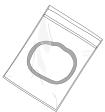 | Replacement O-ringVMG1798* In exclusive polyester bag* One has been attached to the unit in advance. |  | Silica Gel(Desiccant)(1 g/5 pieces)VZG0371 | |
 | Grease (for O-ring)VZG0372 |  | Hand StrapVFC4190 | |
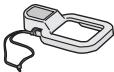 | Diffuser/StringVYK3E56• You can remove this diffuser when not using it.Removing  | Attaching 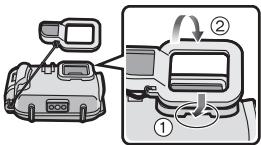 Align with the mark on the back of the case and attach. Align with the mark on the back of the case and attach. | ||
text_image
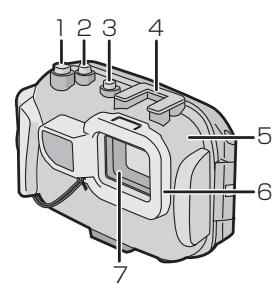
1 2 3 4 5 6 7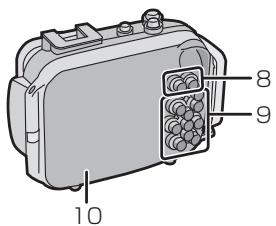
text_image
8 9 10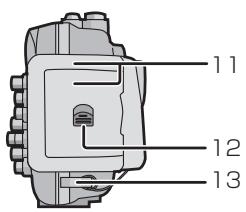
text_image
11 12 131 Shutter Button
2 Motion Picture Button
3 Camera ON/OFF button
4 Mounting shoe for INON Inc., external strobe*1
5 Front Case
6 Diffuser (supplied)
7 Front Glass
8 Zoom Button
9 Button operation section*2
(Read the operating instructions of the digital camera for details about each button operation.)
10 Rear Case
11 Buckle
12 Lock Release Lever
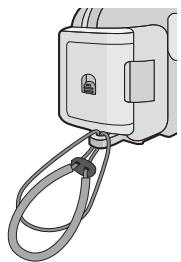
13 Strap Eyelet
(for attaching the supplied hand strap and diffuser)
natural_image
Illustration of a wall-mounted device with a coiled cable and connector (no text or symbols)*1 This is a mounting shoe dedicated for an external strobe manufactured by INON Inc.
Please refer to INON Inc. regarding compatible strobe.
http://www.inon.jp/
*2 Functions vary depending on the digital camera being used, so follow the indication on the digital camera.
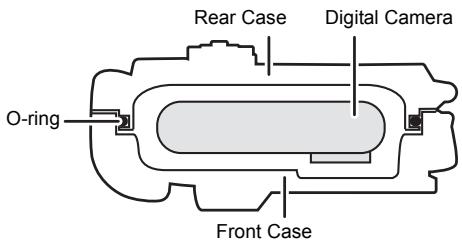
- The O-ring is a waterproofing packing used for underwater cameras, watches and diving equipment.
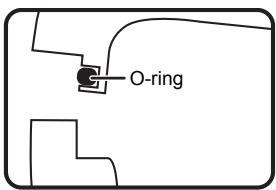
- The O-ring keeps the Case waterproof by sealing the gap between the rear case and the front case.
■ How the O-ring keeps the Case waterproof
text_image
Rear Case Digital Camera O-ring Front CaseThe gum comes into contact with the sides of the Case making the Case waterproof and stopping water from entering from the gap.
text_image
O-ring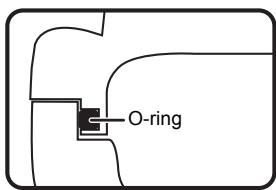
text_image
O-ringWhen water pressure acts on the O-ring, the surface of the O-ring expands and the Case is sealed more tightly.
The O-ring prevents water leakage by coming into uniform contact with the sides of the Case. Therefore, good care of the O-ring is very important. Incorrect care of the O-ring may cause water leakage.
Be sure to set the O-ring before attaching a digital camera.
Thoroughly wash and dry your hands before handling the O-ring. Place the O-ring where there is no sand or dust.
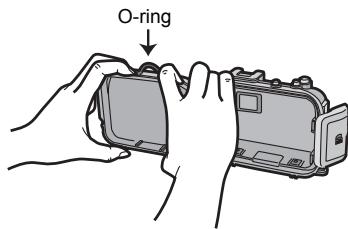
1 Loosen the O-ring with your fingers to remove it.
- Loosen part of the O-ring with the tips of two fingers and then lift the loosened part. Be careful not to scratch the O-ring with your fingernails.
text_image
O-ring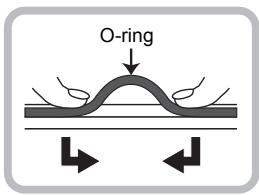
text_image
O-ring
Note
- Do not use a pointed object to remove the O-ring. This may scratch or damage the O-ring.
2 Check the O-ring.
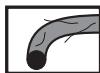
- Check that there is no dirt, sand, hair, dust, salt crystals, lint or grease on the O-ring. If you find any of these, remove them with a soft, dry cloth.
①

① Dirt
② Sand
②

③

③ Hair
④ Dust
④

⑤

⑥
⑤ Salt crystals
⑥ Lint
- There may be dirt on the O-ring that you cannot see. Check if there is any dirt by rubbing your finger over the O-ring.
- Be careful not to leave any fibers from the dry cloth on the O-ring when wiping it.
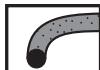
- Check that the O-ring is not ripped, twisted, squashed, frayed or scratched and that there is no sand sticking to it. Replace the O-ring in these cases.
⑦

⑦ Ripped
⑧ Twisted
⑧

⑨

⑨ Squashed
⑩ Frayed
⑩

⑪

⑪ Scratched
⑫ Sand
⑫
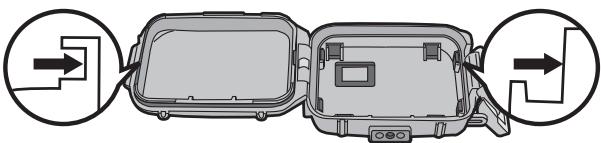
3 Inspect the O-ring groove.
- Grains of sand or hardened salt crystals may get into the O-ring groove. Remove them carefully with an air spray or a cotton swab. If you use a cotton swab, be careful not to leave any fibers from it in the O-ring groove.
flowchart
graph TD
    A["Input"] --> B["Process Box"]
    B --> C["Output"]
- Inspect the front case groove as well as the rear case (side where O-ring is set) groove.
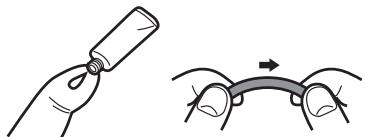
4 Apply the grease (supplied).
Apply O-ring grease to clean the surface of the O-ring and replenish the oil.
natural_image
Illustration showing a hand holding a pen and a close-up of hands adjusting a curved object (no text or symbols present)- Apply a rice-grain size of grease (supplied) evenly to the O-ring with the tip of your finger. (Do not apply the grease with paper or a cloth. The fibers from the paper or cloth may stick to the O-ring.)
- If there is too much grease on the O-ring, dirt and dust will stick to it causing water to leak in. Therefore, hold the O-ring between the balls of your finger and thumb and gently remove excess grease.
- By applying the O-ring grease thinly and evenly, the O-ring fits flexibly to the groove of the marine case and keeps it airtight.
- The surface of the O-ring may stretch or rip, causing a water leak, when an O-ring grease other than supplied is used, so always use the specified O-ring grease.
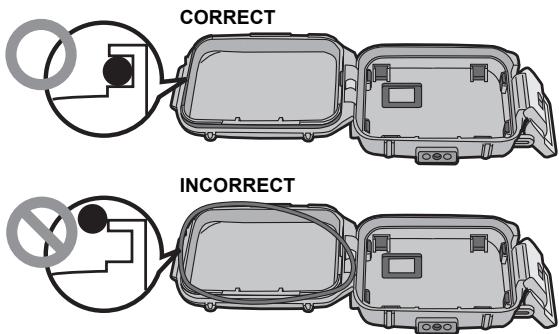
5 Fit the O-ring evenly into the O-ring groove.
Check the following:
• There is no dirt sticking to the O-ring.
• The O-ring has not come out.
• The O-ring is not twisted.
- The O-ring is not stretched too much.
text_image
CORRECT INCORRECT6 Inspect the O-ring one last time.
Check the following one more time:
• There is no dirt sticking to the O-ring.
• The O-ring has not come out.
• The O-ring is not twisted.
- There are no scratches or squashed parts on the O-ring.
Thoroughly wipe any grease off your hands with a dry cloth.
Afterwards wash thoroughly with fresh water.
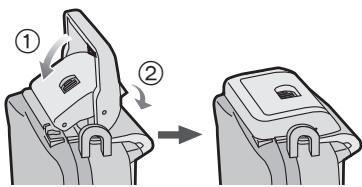
7 Close the buckle.
text_image
Diagram showing two steps of a mechanical component with numbered labels indicating process flow.- Check that no foreign materials are sticking to the outer surface of the O-ring or the buckle on the front case and then close the Case.

Notes
- To keep the Case completely airtight, do not scratch the surface of the O-ring that comes into contact with the sides of the Case.
- Never use an O-ring that has been scratched or damaged by dirt etc. This will cause water leakage.
• Each time you use the Case, remove the O-ring and check that there is no dirt, sand, hair or other foreign materials in the O-ring groove and then apply a thin coat of grease (supplied). If you apply too much grease, dirt and the dust may stick to the O-ring causing water leakage. - Be sure to bring a spare O-ring in case the O-ring that you are using becomes damaged or scratched.
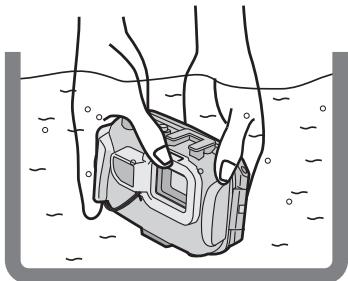
After setting the O-ring, check that no water leaks into the Case by submerging it in a water tank, bath tub etc. for about 3 minutes before attaching a digital camera.
- Do not use the Case in water over 40^ / 104^ . The heat may damage the Case or cause water leakage.
natural_image
Illustration of hands holding a submerged object in water (no text or symbols)- Carry out the same test after attaching the digital camera to the Case. (P15)

Notes
- If bubbles rise from the Case when it is submerged in water or there is water inside the Case when you take it out of the water, there is water leakage. In these cases, consult your dealer.
- If water leaks into the Case while you are using it and the digital camera is submerged in water, remove the battery immediately. Hydrogen gas can cause burning or explosion if there is a fire nearby.
- If you dive quickly while holding the Case or throw the Case from a ship into the sea, some water leakage may occur because of high pressure. This is not a malfunction of the Case. Always dive slowly into the water.
- The Case is designed to be used at a depth of up to 45 m/148 feet. If you dive deeper than 45 m/148 feet, part of the Case may be damaged beyond repair.
- When closing the Case, be careful that no foreign materials get caught between the O-ring and the O-ring groove. Even one strand of hair or one grain of sand can cause water leakage.
Read the notes on page 15 before attaching the digital camera. Turn off the digital camera and remove the strap from it.
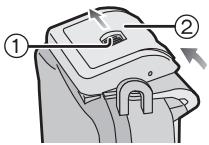
1 Push ② up with your finger while sliding ① to open the buckle.
text_image
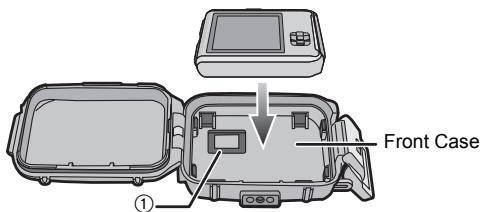
Diagram showing a mechanical component with numbered parts, likely illustrating a step or assembly process.2 Attach the digital camera to the Case.
Be careful of the direction and insert the digital camera into the Case as shown in the illustration.
text_image
Front Case ①- Check that there is no remaining water inside the digital camera and the Case.
- Be careful not to catch the shading hood ①.
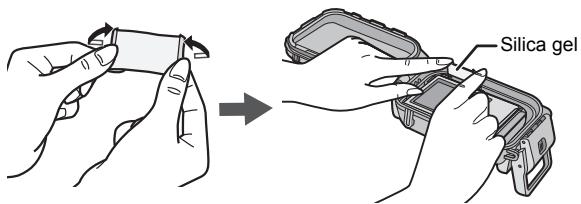
3 Insert the silica gel (supplied).
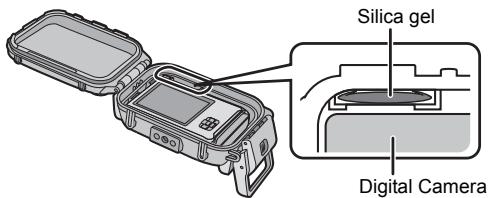
- If the air temperature is high and the water temperature is low, condensation may appear inside the Case. To prevent condensation, insert silica gel (supplied) inside the Case in advance. To prevent the Case from becoming fogged up, insert the silica gel about 1 to 2 hours before using the Case.
• Always use new silica gel.
text_image
Silica gel Digital Camera- When inserting the silica gel, bend it as shown in the illustration below and then insert it as far as possible. If you close the Case with the silica gel not fully inserted, the silica gel will get caught in the O-ring causing water leakage.
text_image
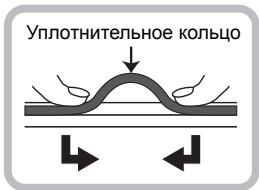
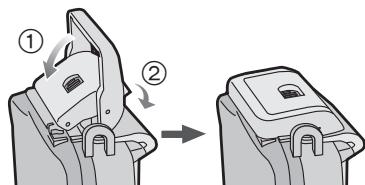
Silica gel4 Close the buckle.
text_image
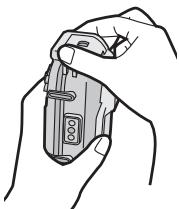
Diagram showing two steps of a device grip or mounting mechanism, labeled ① and ②, with directional arrows indicating movement.- Check that the buckle is closed firmly. Do not insert the strap etc. in the buckle.
natural_image
Line drawing of hands holding a small electronic device (no text or symbols visible)5 After you have attached the digital camera, check one more time that no water leaks into the Case. (P12)

Notes
- Be careful not to get the shading hood dirty with fingerprints etc.
- Check one more time that the O-ring is fitted evenly into the O-ring groove.
- Avoid opening or closing the Case where there is a lot of sand or dust and in humid or wet places.
- If there is a sudden change of humidity caused by moist air entering the Case, condensation may appear inside the Case.
- To prevent condensation, set the digital camera in as dry a place as possible. Also, check that the silica gel (supplied) is sufficiently dry before inserting.
- If sunscreen or suntan oil sticks to the Case, wash it off immediately with lukewarm water to prevent reduced waterproofness or discoloration.
- Submerge in fresh water for approximately 10 minutes after using the digital camera at the beach or in water. Read the operating instructions for details.
When a digital camera with compass, altimeter (depth meter), and barometer is attached to the marine case, measurements may not be possible, or may contain major errors.
When using a digital camera with GPS/Wi-Fi®/NFC function
| GPS | Wi-Fi | NFC | |
| When the marine case is attached | ^*1 | ^*2 | — |
| Underwater use | — | — | — |
○: Available —: Not available
*1 If a digital camera is attached to the marine case, failure of positioning or other major errors may occur due to interference in the reception of radio waves from the GPS satellite.
*2 When connecting the digital camera to a smartphone by using the NFC function, do so before attaching it to the marine case.
"Wi-Fi" is a registered mark of the "Wi-Fi Alliance".
■ Be sure to check the following before entering the water Check the following before diving.
• Is there sufficient remaining battery power?
• Is there sufficient memory in the card?
- Is the O-ring fitted evenly into the O-ring groove?
- Have you checked that no water leaks into the Case?
• Is the buckle closed firmly?
■ Taking pictures
1 Turn the camera on.
2 Set to the [Advanced Underwater Mode].
3 Aim the AF area on the LCD monitor at the subject you want to focus on.
4 Fix the focus and take the picture.
For details of [Advanced Underwater Mode] setting or fixing the focus, refer to the operating instructions of the digital camera.

Notes
- If there are any particles floating in front of the camera, it may focus on them instead of the subject.
- If there are drops of water or dirt sticking to the front glass, you may not be able to focus properly. Be sure to wipe the front glass before taking pictures.
- Sound cannot be recorded correctly when recording motion pictures.
Tips for Taking Pictures in the Water
It is recommended to use the Recording Mode (Advanced Underwater) appropriate for underwater when recording underwater.
It may not be possible to record images with intended brightness or color depending on the recording conditions (depth/weather/subject), so try using following functions together.
| Color is reddish, bluish |  | White balance fine adjustment(Advanced Underwater Mode)• This can adjust the red or blue tone. |
| Too bright/too dark |  | Exposure compensation(For models with an Exposure Compensation Function)• This can adjust the brightness.Auto bracket function(For models with an Auto Bracket Function)• This can record multiple images with different exposure at once. |
It is recommended to use burst function to record subject that is moving fast, etc.

Note
- For details of white balance fine adjustment (Advanced Underwater Mode) or other functions, refer to the operating instructions of the digital camera.
After you have finished taking pictures, follow the steps below.
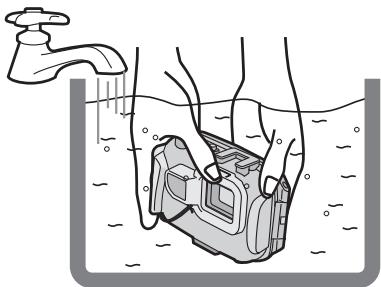
1 Submerge the Case in fresh water for about 30 minutes or more without removing the digital camera to remove any salt crystals etc.
natural_image
Illustration of hands holding a submerged device in a water-filled container (no text or symbols)- Press all the operation buttons etc. on the Case to wash away any seawater. If the salt crystals are not removed from the buttons etc., they will harden and the buttons will become inoperable.
- Do not wash the Case with fast-running or pressurized water etc. as it may cause water leakage.
2 Wipe the water with a dry cloth that has no salt crystals sticking to it and then dry the Case completely.
- Do not dry the Case by exposing it to direct sunlight. This may discolor or damage the Case or may hasten deterioration of the O-ring.
3 Open the rear of the case to remove the digital camera. After thoroughly wiping your hands, apply your finger as shown in the illustration and take out the digital camera.
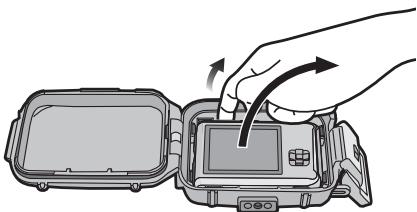
natural_image
Illustration of a hand inserting a device into a container with arrows indicating rotation (no text or symbols)4 Remove the O-ring from the Case and check that there is no dirt etc. in the O-ring groove.
5 Check that there are no scratches etc. on the O-ring while you are applying the grease.

Notes
Be careful of the following points when taking out the digital camera.
- Remove the camera with clean hands. (Wash your hands with fresh water and then thoroughly dry them.)
- Thoroughly dry any moisture on your body or hair. (Be particularly careful about any water coming from the sleeves of your thermal suit.)
1 Wash the outside of the Case with water.
- Wash the outside of the Case until it is clean. (P18)
- Confirm that the O-ring is set securely, be sure to close the Case, and then wash only the outside with water.
- Wipe off any dirt inside the Case with a wet, soft cloth.
2 Store the Case after drying it thoroughly at room temperature.

Notes
- Do not wash the Case with high-pressure water as it may cause water leakage. Remove the digital camera before washing the Case with water.
- Do not leave the digital camera inside the Case when storing it.
- Detach the O-ring from the marine case and store so it will not dry. For details, please read page 21.
When storing for a long period of time, insert in the supplied exclusive polyester bag after first removing the O-ring.
Handling and Care
- Do not place the Case where it may fall.
- If the Case falls on your head or foot, it will injure you and cause the Case to malfunction.
- Never alter the Case.
- If water leaks into the digital camera because the Case was altered, the digital camera may be damaged beyond repair.
- If you continue to use the digital camera after water has leaked into it, this may cause a fire.
- Do not use the Case while scuba diving without proper training.
- You should only operate the Case while scuba diving if you have been properly trained and certified for this sport.
- Never place the Case, grease, silica gel or O-ring within the reach of infants.
— If any part of an infant's body is caught in the Case, it may cause an injury.
— Infants may accidentally swallow the grease, silica gel or O-ring.
- Consult a doctor immediately if you think an infant may have swallowed the grease, silica gel or O-ring.
- Do not hang the strap around your neck underwater.
— It may become wound around your neck causing suffocation or other serious injuries.
• Thoroughly wash any grease on your hands.
— Do not allow the grease on your hands to come into contact with your mouth or eyes.
- If water leaks into the case, stop using it immediately.
— This may cause an electric shock, burning or a fire.
- Consult your dealer.
- If anything abnormal occurs while using the Case underwater, please follow all necessary procedures and guidelines for decompressing when you ascend.
— If you ascend too quickly, you may get caisson disease.
- If smoke or abnormal heat, smells or sounds come from the Case, stop using it immediately.
— These may cause an electric shock, burning or fire.
- Remove the digital camera from the Case and then immediately remove the battery from the digital camera.
- Consult your dealer.
- Be careful when opening the Case after water leakage.
— The leaked water may blow out or the rear case may flip.
- Do not leave the Case where the temperature is high.
— The temperature inside the Case becomes very high particularly when it is exposed to direct sunlight on a beach, a ship etc. or when it is left in an airtight car in the summer. The heat may damage the Case or its inner parts.
— If a digital camera is attached to the Case, it may also be damaged.
— If you use the attached digital camera when the temperature inside the Case is very high, it may cause leakage, short-circuiting or insulation failure resulting in fire or malfunction.
- Do not handle the digital camera or the battery with wet hands.
— This may cause an electric shock or malfunction.
■ When taking pictures with the flash
- When taking pictures with the flash, the corners of the picture may be vignetted or the picture may not be lit evenly.
- When taking pictures with the flash, the available flash range is less underwater than on land.
Caution for Use
■ Handling of the O-ring
- Do not use alcohol, thinner or a chemical cleaning agent for cleaning the O-ring. This will cause damage to, or deterioration of, the O-ring.
- If you will not be using the Case for a long period of time, remove the O-ring from the O-ring groove, apply a thin coat of grease (supplied), place it in a polyester bag and then store it in a cool, dark place to prevent the surface from being damaged. When you use the O-ring again, thoroughly check that it is not scratched, damaged or split.
- Do not use the O-ring grease other than the supplied O-ring grease. Surface of the O-ring will deteriorate, causing a water leak.
- The O-ring comes into contact with the sides of the Case making the Case waterproof. Do not knock, insert foreign materials (dirt, sand, hair etc.) or scratch the O-ring or sides of the Case.
- Use the tips of your fingers to remove the O-ring. Do not use a pointed object as it may scratch or damage the O-ring.
- After removing the O-ring from the rear case, wipe off any dirt, sand, hair or other foreign materials on it. Also wipe the O-ring groove and the inner sides of the front case which come into contact with the O-ring.
- Never use an O-ring that has been scratched or damaged by dirt etc. This will cause water leakage. Replace it with a new O-ring.
• After replacing the O-ring, when not in use for a long period of time, after attaching the digital camera or when replacing the battery, if the marine case is opened please thoroughly check the O-ring for damage or any cracks.
After checking, shut the marine case, immerse in water (a water tank or a bath tub) for approximately 3 minutes or more, then check that there are no water leaks. (P12)
- O-rings are consumable products. Although the lifespan of O-rings will depend on how well they are maintained, how often they are used and their storage conditions, we recommend replacing them every year even if you cannot see any scratches.
■ About maintenance
- Do not use the chemicals shown below for cleaning, rustproofing, defogging or repair. Using them directly or indirectly (with a chemical spray etc.) on the Case may cause it to crack.
| Prohibited chemicals | Cautions |
| Volatile organic solvents/ Chemical cleansers | Do not clean the Case with volatile organic solvents such as alcohol, gasoline or thinner or with chemical cleansers. Clean it with fresh water or lukewarm water. |
| Anti-corrosives | Do not use anti-corrosives as the metal parts of the Case are made from stainless steel or brass. Clean it with fresh water. |
| Anticlouding agents | Do not use commercially available anticlouding agents. Be sure to use the silica gel indicated in these operating instructions. |
| Adhesives | Do not use adhesives for repair. If the Case needs to be repaired, consult your dealer. |
- If grease sticks to the digital camera, wipe it off with a soft, dry cloth.
- When wiping the inside of the Case, only use a soft, dry cloth. Wipe the inside of the front glass with a soft, dry cloth before and after use to keep the glass clear.
■ About storage and inspection after use
• Always take the digital camera out of the Case.
- Make sure that no dirt or dust is stuck to the O-ring.
- When storing, remove the buckle so that the marine case will not be closed airtight.
- We recommend that the Case be inspected about 3 years after purchase. This inspection involves dismantling and cleaning the Case, inspecting all the parts and repairing them if necessary and checking the waterproofness of the Case using the same hydrostatic test equipment that was used to check the waterproofness before purchase. The customer is responsible for all transportation costs.
- Do not dismantle any parts or use any accessories not specified in these operating instructions and do not alter the Case. If the Case does not work properly, consult your dealer.
Specifications
| Compatible model | DMC-FT5/DMC-TS5(As of January 2013*) |
| Dimensions | Approx. 152 mm (W)×99 mm (H)×62 mm (D)[5.98" (W)×3.90" (H)×2.44" (D)](excluding the projecting parts) |
| Mass (Weight) | Approx. 389 g/0.858 lb (including the diffuser) |
| Material | Polycarbonate |
| Waterproof construction | O-ring sealing |
| Water resistant depth | 45 m/148 feet |
* Refer to the operating instructions, catalogue, website etc. of the digital camera for the latest information on models that can be used.
Panasonic Consumer Marketing Company of North America, Division of Panasonic Corporation of North America
One Panasonic Way, Secaucus, NJ 07094
Panasonic Canada Inc.
5770 Ambler Drive, Mississauga, Ontario, L4W 2T3
natural_image
Illustration of a wall-mounted device with a coiled cable and connector (no text or symbols)text_image
Joint torquetext_image
Joint torque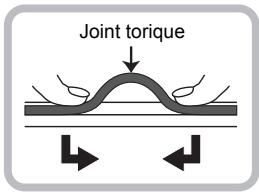
text_image
Joint torque
Nota
natural_image
Illustration showing a hand holding a pen and a close-up of hands holding a curved object with an arrow indicating motion (no text or symbols)text_image
Diagram showing two steps of a mechanical component with numbered annotations indicating process flow.natural_image
Illustration of hands holding a submerged device in water (no text or symbols)text_image
Technical diagram showing a mechanical component with numbered parts labeled ① and ②text_image
Diagram showing two steps of a mechanical component with numbered labels indicating sequence.natural_image
Line drawing of hands holding a device with a small screen (no text or symbols visible)natural_image
Illustration of hands holding a water dispenser in a liquid container (no text or symbols)natural_image
Illustration of a hand inserting a device into a plastic case (no text or symbols)Panasonic Canada Inc.
5770 Ambler Drive
Mississauga, Ontario
L4W 2T3
(905) 624-5010
www.panasonic.ca
© Panasonic Corporation 2013
Imprimé au Japon
Bedienungsanleitung
Unterwassergehäuse
natural_image
Illustration of a wall-mounted electrical plug with a coiled cable (no text or symbols)flowchart
graph TD
    A["Container 1"] --> B["Container 2"]
    B --> C["Arrow to Box 1"]
    C --> D["Arrow to Box 2"]
natural_image
Illustration showing a hand holding a pen and a close-up of hands holding a curved object with an arrow indicating motion (no text or symbols)text_image
Diagram showing two steps of a mechanical component with labeled parts and directional arrows indicating process flow.natural_image
Illustration of hands holding a submerged device in water (no text or symbols)text_image
Diagram showing a mechanical component with numbered parts and directional arrow indicating motion or assembly.text_image
Diagram showing two steps of a mechanical component with labeled parts and directional arrows indicating motion.natural_image
Line drawing of hands holding a small electronic device (no text or symbols visible)natural_image
Illustration of hands cleaning a water container with a faucet (no text or symbols)natural_image
Illustration of a hand inserting a device into a plastic case (no text or symbols)natural_image
Illustration of a wall-mounted device with a coiled cable and connector (no text or symbols)natural_image
Illustration showing a hand holding a pen and a close-up of hands holding a curved object with an arrow indicating motion (no text or symbols)natural_image
Diagram of an open and closed electronic device casing with a circular connector and 'OK' label (no text or symbols on the diagram itself)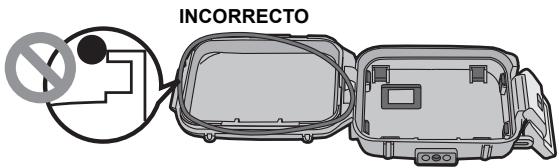
text_image
INCORRECTOtext_image
Diagram showing two steps of a mechanical component with numbered annotations indicating process flow.natural_image
Illustration of hands holding a submerged device in water (no text or symbols)text_image
Diagram showing a mechanical component with numbered parts and directional arrows indicating assembly or motion.text_image
Diagram showing two steps of a mechanical component with labeled parts and directional arrows indicating process flow.natural_image
Line drawing of hands holding a device with a small screen (no text or symbols visible)natural_image
Illustration of hands cleaning a water tank with a faucet (no text or symbols)natural_image
Illustration of a hand inserting a device into a plastic case (no text or symbols)natural_image
Illustration of a wall-mounted electrical plug with a coiled cable (no text or symbols)2 Controllare l'O-ring.
natural_image
Illustration showing a hand holding a pen and a close-up of hands holding a curved object with an arrow indicating rotation (no text or symbols)text_image
Diagram showing two steps of a mechanical component with labeled parts and directional arrows indicating process flow.natural_image
Illustration of hands holding a submerged device in water (no text or symbols)text_image
Diagram showing two labeled parts (① and ②) of a mechanical component with arrows indicating direction or movement.text_image
Diagram showing two steps of a mechanical component with labeled parts and directional arrows indicating process flow.natural_image
Line drawing of hands holding a device with a small screen (no text or symbols visible)natural_image
Illustration of hands cleaning a water container with a faucet (no text or symbols)natural_image
Illustration of a hand inserting a device into a plastic case (no text or symbols)natural_image
Illustration of a wall-mounted device with a coiled cable and connector (no text or symbols)flowchart
graph TD
    A["Top Panel"] --> B["Bottom Panel"]
    B --> C["Arrow to Top Panel"]
    B --> D["Arrow to Bottom Panel"]
natural_image
Illustration showing a hand holding a pen and a close-up of hands holding a curved object with an arrow indicating motion (no text or symbols)text_image
Diagram showing two steps of a mechanical component with labeled parts and directional arrows indicating process flow.natural_image
Illustration of hands holding a submerged object in water (no text or symbols)text_image
Diagram showing a mechanical component with numbered parts and directional arrows indicating assembly or motion.text_image
Diagram illustrating a mechanical assembly process with numbered steps of lifting or fastening a component.natural_image
Line drawing of hands holding a small electronic device (no text or symbols visible)natural_image
Illustration of hands cleaning a water tank with a faucet (no text or symbols)natural_image
Illustration of a hand inserting a device into a plastic case (no text or symbols visible)natural_image
Illustration of a wall-mounted device with a coiled cable and connector (no text or symbols)natural_image
Illustration of hands holding a device with a downward arrow indicating compression (no text or symbols)