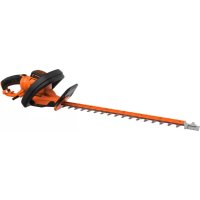
BEHTS551 - Hedge trimmers BLACK & DECKER - Free user manual and instructions
Find the device manual for free BEHTS551 BLACK & DECKER in PDF.



| Brand | Black & Decker |
| Model | BEHTS551 |
| Product type | Corded electric hedge trimmer |
| Supply voltage | 230 V AC |
| Power consumption | 650 W |
| Blade length | 60 cm |
| No-load blade stroke | 1840 min⁻¹ |
| Cutting capacity (main blade) | 25 mm |
| Cutting capacity (saw blade) | 35 mm |
| Weight | 3.1 kg |
| Double insulation | Yes |
| Safety system | Dual control (two-hand operation) |
| Pivoting handle | Yes, 180° with 0°, 45° and 90° positions |
| Integrated saw blade | Yes |
| Protective sheath | Included |
| Sound pressure level (LpA) | 87.5 dB(A) |
| Sound power level (LWA) | 98.5 dB(A) |
| Vibration emission (total value) | < 3.8 m/s² |
| Warranty | 24 months |
| Maintenance and cleaning | Regular lubrication of blades, cleaning of air vents |
| Spare parts and repairability | Available from BLACK+DECKER retailers and authorized service centers |
| Intended use | Cutting hedges, bushes and brambles |
Frequently Asked Questions - BEHTS551 BLACK & DECKER
User questions about BEHTS551 BLACK & DECKER
0 question about this device. Answer the ones you know or ask your own.
Ask a new question about this device
Download the instructions for your Hedge trimmers in PDF format for free! Find your manual BEHTS551 - BLACK & DECKER and take your electronic device back in hand. On this page are published all the documents necessary for the use of your device. BEHTS551 by BLACK & DECKER.
USER MANUAL BEHTS551 BLACK & DECKER
Your BLACK+DECKERTM BEHTS551 hedgetrimmers has been designed for trimming hedges, shrubs and brambles.
This tool is intended for consumer use only.
Safety instructions
General power tool safety warnings

Warning! Read all safety warnings and all instructions. Failure to follow the warnings and instructions listed below may result in electric shock, fire and/or serious injury.
Save all warnings and instructions for future reference.
The term "power tool" in the warnings refers to your mains operated (cored) power tool or battery operated (cordless) power tool.
ENGLISH
(Original instructions)
1. Work area safety
a. Keep work area clean and well lit. Cluttered or dark areas invite accidents.
b. Do not operate power tools in explosive atmospheres, such as in the presence of flammable liquids, gases or dust. Power tools create sparks which may ignite the dust or fumes.
c. Keep children and bystanders away while operating a power tool. Distractions can cause you to lose control.
2. Electrical safety
a. Power tool plugs must match the outlet. Never modify the plug in any way. Do not use any adapter plugs with earthed (grounded) power tools. Unmodified plugs and matching outlets will reduce risk of electric shock.
b. Avoid body contact with earthed or grounded surfaces such as pipes, radiators, ranges and refrigerators. There is an increased risk of electric shock if your body is earthed or grounded.
c. Do not expose power tools to rain or wet conditions. Water entering a power tool will increase the risk of electric shock.
d. Do not abuse the cord. Never use the cord for carrying, pulling or unplugging the power tool. Keep cord away from heat, oil, sharp edges or moving parts. Damaged or entangled cords increase the risk of electric shock.
e. When operating a power tool outdoors, use an extension cord suitable for outdoor use. Use of a cord suitable for outdoor use reduces the risk of electric shock.
f. If operating a power tool in a damp location is unavoidable, use a residual current device (RCD) protected supply. Use of an RCD reduces the risk of electric shock.
3. Personal safety
a. Stay alert, watch what you are doing and use common sense when operating a power tool. Do not use a power tool while you are tired or under the influence of drugs, alcohol or medication. A moment of inattention while operating power tools may result in serious personal injury.
b. Use personal protective equipment. Always wear eye protection. Protective equipment such as dust mask, non-skid safety shoes, hard hat, or hearing protection used for appropriate conditions will reduce personal injuries.
c. Prevent unintentional starting. Ensure the switch is in the off-position before connecting to power source and/or battery pack, picking up or carrying the tool. Carrying power tools with your finger on the switch or energising power tools that have the switch on invites accidents.
d. Remove any adjusting key or wrench before turning the power tool on. A wrench or a key left attached to a rotating part of the power tool may result in personal injury.
e. Do not overreach. Keep proper footing and balance at all times. This enables better control of the power tool in unexpected situations.
f. Dress properly. Do not wear loose clothing or jewellery. Keep your hair, clothing and gloves away from moving parts. Loose clothes, jewellery or long hair can be caught in moving parts.
g. If devices are provided for the connection of dust extraction and collection facilities, ensure these are connected and properly used. Use of dust collection can reduce dust-related hazards.
h) Do not let familiarity gained from frequent use of tools allow you to become complacent and ignore tool safety principles. A careless action can cause severe injury within a fraction of a second.
4. Power tool use and care
a. Do not force the power tool. Use the correct power tool for your application. The correct power tool will do the job better and safer at the rate for which it was designed.
b. Do not use the power tool if the switch does not turn it on and off. Any power tool that cannot be controlled with the switch is dangerous and must be repaired.
c. Disconnect the plug from the power source and/or the battery pack from the power tool before making any adjustments, changing accessories, or storing power tools. Such preventive safety measures reduce the risk of starting the power tool accidentally.
d. Store idle power tools out of the reach of children and do not allow persons unfamiliar with the power tool or these instructions to operate the power tool. Power tools are dangerous in the hands of untrained users.
e. Maintain power tools. Check for misalignment or binding of moving parts, breakage of parts and any other condition that may affect the power tools operation. If damaged, have the power tool repaired before use. Many accidents are caused by poorly maintained power tools.
f. Keep cutting tools sharp and clean. Properly maintained cutting tools with sharp cutting edges are less likely to bind and are easier to control.
g. Use the power tool, accessories and tool bits etc. in accordance with these instructions, taking into account the working conditions and the work to be performed. Use of the power tool for operations different from those intended could result in a hazardous situation.
h) Keep handles and grasping surfaces dry, clean and free from oil and grease.
Slippery handles and grasping surfaces do not allow for safe handling and control of the tool in unexpected situations.
5. Service
a. Have your power tool serviced by a qualified repair person using only identical replacement parts. This will ensure that the safety of the power tool is maintained.
Additional power tool safety warnings

Warning! Additional safety warnings for hedge trimmers
Keep all parts of the body away from the cutter blade. Do not remove cut material or hold material to be cut when blades are moving. Make sure the switch is off when clearing jammed material. A moment of inattention while operating the tool can result in serious personal injury.
Carry the hedge trimmer by the handle with the cutter blade stopped. When transporting or storing the hedge trimmer always fit the cutting device cover.
Proper handling of the hedge trimmer will reduce possible personal injury from the cutter blades.
- When transporting or storing the hedge trimmer, always fit the blade cover. Proper handling of the hedge trimmer will decrease the risk of personal injury from the blades.
When clearing jammed material or servicing the unit, make sure all power switches are off and the power cord is disconnected. Unexpected actuation of the hedge trimmer while clearing jammed material or servicing may result in serious personal injury.
Do not use the hedge trimmer in bad weather conditions, especially when there is a risk of lightning. This decreases the risk of being struck by lightning.
Hold the power tool by insulated gripping surfaces only, because the cutter blade may contact hidden wiring or its own cord. Cutter blades contacting a "live" wire may make exposed metal parts of the power tool "live" and could give the operator an electric shock.
Keep all power cords and cables away from cutting area. Power cords or cables may be hidden in hedges or bushes and can be accidentally cut by the blade.
The intended use is described in this instruction manual. The use of any accessory or attachment or performance of any operation with this tool other than those recommended in this instruction manual can present a risk of personal injury and/or damage to property.
If you have not used a hedge trimmer before, preferably seek practical instruction by an experienced user in addition to studying this manual.
Never touch the blades while the tool is running.
Never attempt to force the blades to come to a stand-still.
Do not put the tool down until the blades have come to a complete standstill.
Regularly check the blades for damage and wear. Do not use the tool when the blades are damaged.
Take care to avoid hard objects (e.g. metal wire, railings) when trimming. Should you accidentally hit any such object, immediately switch the tool off and check for any damage.
Should the tool start to vibrate abnormally, immediately switch it off and disconnect it from the mains supply then check for any damage.
- If the tool stalls, immediately switch it off. Disconnect it from the mains supply before attempting to remove any obstructions.
After use, place the blade sheath supplied over the blades. Store the tool, making sure that the blade is not exposed.
Always ensure that all guards are fitted when using the tool. Never attempt to use an incomplete tool or a tool with unauthorised modifications.
Never allow children to use the tool.
Be aware of falling debris when cutting the higher sides of a hedge.
Always hold the tool with both hands and by the handles provided.
Check the hedges and bushes for foreign objects, e.g. wire fences and hidden wiring.
Before operating the hedge trimmer, the user should make sure the locking device(s) of any moving elements (e.g. the extended shaft and pivoting element), if any, are in the locked position.
Residual risks
Additional residual risks may arise when using the tool which may not be included in the enclosed safety warnings. These risks can arise from misuse, prolonged use etc.
Even with the application of the relevant safety regulations and the implementation of safety devices, certain residual risks can not be avoided. These include:
Injuries caused by touching any rotating/moving parts.
Injuries caused when changing any parts, blades or accessories.
Injuries caused by prolonged use of a tool. When using any tool for prolonged periods ensure you take regular breaks.
Impairment of hearing.
Health hazards caused by breathing dust developed when using your tool (example:- working with wood, especially oak, beech and MDF.)
ENGLISH
(Original instructions)
Vibration
The declared vibration emission values stated in the technical data and the declaration of conformity have been measured in accordance with a standard test method provided by EN 62841 and may be used for comparing one tool with another.
The declared vibration emission value may also be used in a preliminary assessment of exposure.
Warning! The vibration emission value during actual use of the power tool can differ from the declared value depending on the ways in which the tool is used. The vibration level may increase above the level stated.
When assessing vibration exposure to determine safety measures required by 2002/44/EC to protect persons regularly using power tools in employment, an estimation of vibration exposure should consider, the actual conditions of use and the way the tool is used, including taking account of all parts of the operating cycle such as the times when the tool is switched off and when it is running idle in addition to the trigger time.
Labels on tool
The following pictograms are shown on the tool along with the date code:

Warning! To reduce the risk of injury, the user must read the instruction manual.

Wear safety glasses or goggles when operating this tool.

Wear ear protection when operating this tool.
Keep hands away from blade.

Immediately disconnect the cable from the mains if it is damaged or cut.

Do not expose the tool to rain or high humidity.

Directive 2000/14/EC guaranteed sound power.
Electrical safety

This tool is double insulated; therefore no earth wire is required. Always check that the power supply corresponds to the voltage on the rating plate.
- If the supply cord is damaged, it must be replaced by the manufacturer or an authorised BLACK+DECKER Service Centre in order to avoid a hazard.
When using the tool outdoors, only use extension cables intended for outdoor use.
A suitable rated BLACK+DECKER extension cable of up to 30m can be used without loss of power.
Electric safety can be further improved by using a high-sensitivity 30mA residual current device (RCD).
Features
This tool includes some or all of the following features.
- Blade
- Guard
- Bail handle
- Lock off button
- Trigger switch
- Switch handle
- Cord retainer
- Sawblade
-
Rotate button
-
Sheath
Assembly
Warning! Before assembly, make sure that the tool is switched off and unplugged and that the blade sheath is fitted over the blades.
Attaching extension cord to trimmer (Fig. A)
A cord retainer (7) is incorporated into the rear of the switch handle (6).
Near the end of the extension cord, fold the extension cord to create a loop.
Feed the loop into the cord retainer housing as shown in Fig. A.
Hook the loop onto the cord retainer (7) so it rests in the cord retainer.
Plug the extension cord into the unit.
Use
Warning! Let the tool work at its own pace. Do not overload. check the hedges and bushes for foreign objects, e.g. wire fences and hidden wiring.
Before operating the hedge trimmer, the user should make sure the locking device(s) of any moving elements (e.g. the extended shaft and pivoting element), if any, are in the locked position.
Switching on and off
Note: For your safety, this tool is equipped with a double switching system. This system prevents starting the tool inadvertently and will only allow operation while holding the tool with both hands.
Switching on (fig. B)
To turn the tool "ON", press the lock off button (4) in the switch handle (6) to the left or right and squeeze the trigger switch (5). Depress the safety switch in the Bail handle (3a) as shown in figure B.
Once the unit is running, you may release the lock off button. In order to keep the unit running you must continue to squeeze the trigger. To turn the tool "OFF", release the trigger.
Warning! Never attempt to lock a switch in the ON position.
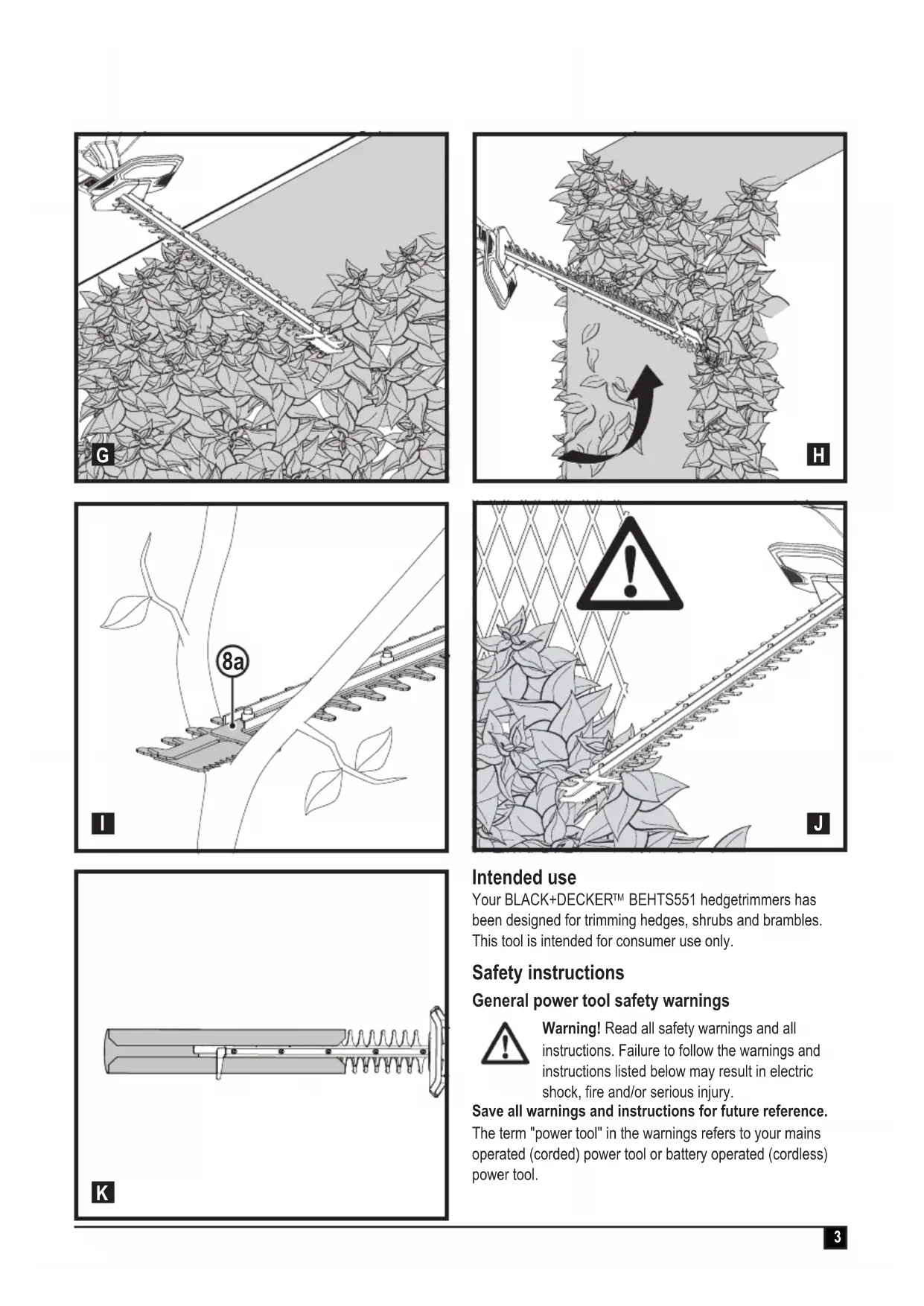
Rotating the Rear Handle (Fig. C)
The rear handle has the capability of rotating 180^ . There are optional stops at 0^ , 45^ and 90^ which are ideal for side cuts and rounded or irregular shaped shrubs.
To rotate the rear handle, press in on the rotate button (9) and turn in the desired direction as shown in Figure C.
Correct hand position (Fig. D)
Always hold the trimmer, as shown in the illustrations in this manual, with one hand on the switch handle and one hand on the bail handle (Fig. D). Never hold the unit by the blade guard.
Guidelines for trimming
Extension cord (fig. E)
Always keep extension cord behind trimmer and away from the trimming operation as shown in figure E. Never drape it over a hedge being trimmed.
If you cut or damage the cord, unplug it at the electrical outlet immediately, before inspecting or repairing cord.
Working position
Maintain proper footing and balance and do not overreach.
Wear safety goggles, non-skid footwear and rubber gloves when trimming.
Hold the tool firmly in both hands and turn the tool ON. Always hold the trimmer, as shown in Fig. D, with one hand on the switch handle and one hand on the auxiliary handle. Never hold the tool by the blade guard.
Trimming new growth (fig. F)
A wide, sweeping motion, feeding the blade teeth through the twigs is most effective. A slight downward tilt of the blade, in the direction of motion gives the best cutting.
Warning! Do not use trimmer for cutting stems greater than 16mm . Use the trimmer only for cutting normal shrubbery found around houses and buildings.
Level hedges (fig. G)
To obtain exceptionally level hedges, a piece of string can be stretched along the length of the hedge as a guide.
Side trimming hedges (fig.H)
Begin at the bottom and sweep up.
Sawblade (fig. 1)
For branches too large for the blade (1) to cut, use the sawblade (8). Position the sawblade as close to the bottom of the branch as possible. Place the sawblade shoe (8a) against the branch. Turn the hedge trimmer on as described above, allowing the tool to work at its own pace until the branch is fully cut.
The cutting blades are made from high quality, hardened steel and with normal usage, they will not require sharpening. However, if you accidentally hit a wire fence (Fig. J), stones, glass or other hard objects, you may put a nick in the blade. There is no need to remove this nick as long as it does not interfere with the movement of the blade. If it does interfere, unplug the cord and use a fine toothed file or sharpening stone to remove the nick. If you drop the trimmer, carefully inspect it for damage. If the blade is bent, housing cracked, or handles broken or if you see any other condition that may affect the trimmer's operation contact your local BLACK+DECKER Service Center for repairs before putting it back into use. Fertilizers and other garden chemicals contain agents which greatly accelerate the corrosion of metals. Do not store the unit on or adjacent to fertilizers or chemicals.
Blade Lubrication (Fig. K)
After use, disconnect the power source.
Carefully apply a resin solvent to the exposed blades.
Connect the power source and turn the trimmer vertical with the blades toward the ground and run the trimmer for a few seconds to fully disperse the lubrication.
- Keeping your hands away from the blade, slide the sheath (10) over the blade until it snaps into place as shown in Figure K.
Accessories
The performance of your tool depends on the accessory used. BLACK+DECKER accessories are engineered to high quality standards and designed to enhance the performance of your tool. By using these accessories you will get the very best from your tool.
Maintenance
Your BLACK+DECKER corded/cordless appliance/tool has been designed to operate over a long period of time with a minimum of maintenance. Continuous satisfactory operation depends upon proper tool care and regular cleaning.
Lubrication oil is available from your BLACK+DECKER dealer (cat. no. A6102-XJ).
Warning! Before performing any maintenance on corded/ cordless power tools:
Switch off and unplug the appliance/tool.
Or switch off and remove the battery from the appliance/ tool if the appliance/tool has a separate battery pack.
Or run the battery down completely if it is integral and then switch off.
Unplug the charger before cleaning it. Your charger does not require any maintenance apart from regular cleaning.
- Regularly clean the ventilation slots in your appliance/tool/ charger using a soft brush or dry cloth.
- Regularly clean the motor housing using a damp cloth. Do not use any abrasive or solvent-based cleaner.
After use, carefully clean the blades. After cleaning, apply a film of light machine oil to prevent the blades from rusting.
Mains plug replacement (U.K. & Ireland only)
If a new mains plug needs to be fitted:
Safely dispose of the old plug.
Connect the brown lead to the live terminal in the new plug.
Connect the blue lead to the neutral terminal.
Warning! No connection is to be made to the earth terminal. Follow the fitting instructions supplied with good quality plugs. Recommended fuse: 5 A.
Protecting the environment

Separate collection. Products and batteries marked with this symbol must not be disposed of with normal household waste.
Products and batteries contain materials that can be recovered or recycled reducing the demand for raw materials. Please recycle electrical products and batteries according to local provisions. Further information is available at www.2helpU.com
Troubleshooting
| Problem | Possible Cause Possible Solution | Solution |
| Slow running, noisy or hot blades. | Dry, corroded blades. Blades or blade support bent. Bent or damaged teeth. Loose blade bolts. | Lubricate blades. Straighten blade or blade support. Straighten teeth. Tighten blade bolts. |
| Unit will not start. | Lock off not fully operated. | Check that lock off is fully forward prior to moving main trigger. |
| Cord not plugged in. | Plug cord into a working outlet. | |
| Circuit fuse is blown. | Replace circuit fuse.(If the product repeatedly causes the circuit fuse to blow, discontinue use immediately and have it serviced at a BLACK+DECKER service center or authorized servicer.) | |
| Circuit breaker is tripped. | Reset circuit breaker. (If the product repeatedly causes the circuit breaker to trip, discontinue use immediately and have it serviced at a BLACK+DECKER service center or authorized servicer.) | |
| Cord or switch is damaged. | Have cord or switch replaced at BLACK+DECKER Service Center or Authorized Servicer. |
Technical data
| BEHTS551 Type 1 | ||
| Voltage V | AC | 230 |
| Power input W | 650 | |
| Blade strokes (no load) | min-1 | 1840 |
| Blade length | cm | 60 |
| Blade gap | mm 25 | |
| Blade brake time | s | <1 |
| Saw blade Max cut | mm | 35 |
| Weight | kg 3.1 |
| Level of sound pressure according to EN 62841: |
| Sound pressure at operator position (Lpa) 87.5 dB(A), uncertainty (K) 1.1 dB(A) |
| Sound power (Lmax) 98.5 dB(A), uncertainty (K) 1.3 dB(A) |
| Vibration total values (triax vector sum) according to EN 62841: |
| Vibration emission value (ah, d) 3.8 m/s2; uncertainty (K) 1.5 m/s2 |
EC declaration of conformity
MACHINERY DIRECTIVE UTDOOR NOISE DIRECTI

BEHTS551-Hedge Trimmer
Black & Decker declares that these products described under "technical data" are in compliance with: 2006/42/EC, EN 62841-1:2015; EN 62841-4-2:2019
2000/14/EC, Hedge trimmer, Annex V, DEKRA Certification B.V. Meander 1051 / P.O. Box 5185
ENGLISH
(Original instructions)
6825 MJ ARNHEM / 6802 ED ARNHEM, Netherlands Notified Body ID No.: 0344
Measured emission sound pressure level (LpA) 87,5 dB(A); uncertainty K: 1,1 dB(A)
Guaranteed sound power (LwA) 100 dB(A)
These products also comply with Directive 2014/30/EU and 2011/65/EU.
For more information, please contact Black & Decker at the following address or refer to the back of the manual.
The undersigned is responsible for compilation of the technical file and makes this declaration on behalf of Black & Decker.
Becky Cotsworth
Director - Outdoor Products Group
Black & Decker Europe, 270 Bath Road, Slough,
Berkshire, SL1 4DX
United Kingdom
11/10/2019
Guarantee
Black & Decker is confident of the quality of its products and offers consumers a 24 month guarantee from the date of purchase. This guarantee is in addition to and in no way prejudices your statutory rights. The guarantee is valid within the territories of the Member States of the European Union and the European Free Trade Area.
To claim on the guarantee, the claim must be in accordance with Black&Decker Terms and Conditions and you will need to submit proof of purchase to the seller or an authorised repair agent. Terms and conditions of the Black&Decker 2 year guarantee and the location of your nearest authorised repair agent can be obtained on the Internet at www.2helpU.com, or by contacting your local Black & Decker office at the address indicated in this manual.
Please visit our website www.blackanddecker.co.uk to register your new Black & Decker product and receive updates on new products and special offers.
Director - Outdoor Products Group
Black & Decker Europe, 270 Bath Road, Slough,
Berkshire, SL1 4DX
Black & Decker Europe, 270 Bath Road, Slough,
Berkshire, SL1 4DX
Royaume-Uni
11/10/2019
Garantie
Black & Decker Europe, 270 Bath Road, Slough,
Berkshire, SL1 4DX
Regno Unito
11/10/2019
Garanzia
Director - Outdoor Products Group
Black & Decker Europe, 270 Bath Road, Slough,
Berkshire, SL1 4DX
Verenigd Koninkrijk
11/10/2019
NEDERLANDS
Black & Decker Europa, 270 Bath Road, Slough,
Berkshire, SL1 4DX
Reino Unido
11/10/2019
Garantia
Black & Decker Europe, 270 Bath Road, Slough,
Berkshire, SL1 4DX
Reino Unido
11/10/2019
Garantia
Director - Outdoor Products Group
Black & Decker Europe, 270 Bath Road, Slough,
Berkshire, SL1 4DX
Storbritannien
11/10/2019
Garanti
Black & Decker Europe, 270 Bath Road, Slough,
Berkshire, SL1 4DX
Storbritannia
11/10/2019
Garanti
BEHTS551 - Haekkipper
Black & Decker Europe, 270 Bath Road, Slough,
Berkshire, SL1 4DX
Storbritannien
11/10/2019
Garanti
Black & Decker Europe, 270 Bath Road, Slough,
Berkshire, SL1 4DX
Iso-Britannia
11/10/2019
Takuu
Black & Decker Europe, 270 Bath Road, Slough,
Berkshire, SL1 4DX
United Kingdom (Hvμενo Baσiδει)
11/10/2019
Eyyunon
H Black & Decker εivai σiyounp yia tvn poiotnta twv
Tpoiovtw vns kai Tpooepei OTouc katavaawte c Eyyunon
24 nvyavto nvyepounvia ayopac. Autn n eyyunon
ouptnpwei kai me kaveva tpoTIOE VAPABALTTI
ta vouipa diakaiomega taac. H eyyunon IOxue I EVTOCS TNS
ETIKPATEIA cs TW xwpw MEAWV ts Eupwnaiiknc Evwongkai
tns Eupwnaiikng Zwvn EeUthetapw Suvaalaywv.
Tia va uTOBalaTe aIomega nBaose I Tc Eyyunons, n aIomega tha TTpeTE va eivai ouawynuE touc Opouc kai TTPOUToeOeic ts Black&Decker kai 0a xpeiaotei va uTObaale tAtoDeig ayopac stov TiwAntnn oE EouoiOobotnevo AvTTPOsWTO epBi. MTOpeite va atoknoete Touc Opuc kai TTPOUToeOeic ts Eyyunons 2 Etow ts Black&Decker kai va maTheTE Tnv TOTOneia Tou PAnaiotepou EouoiOobotnevou avTTIPooWtou ETIOKEuw vto Internet 0to www.2helpU.com, nETIKOIVWvwVtac Me To TOTIKO aac ypaepio Black & Decker OTN dieuovn TIO TOIOBekvuetai OT npov Exyepioio.
IapakaIoue EIOKEΦeIe TnV IOToeIIDA μac www. blackanddecker.gr yia va kataxwpioTe to veo oac Ipoiov Black & Decker kai yia va evnuepwoTe yia ta vea Ipoiovta kai tic EIOIKcπpOqopεc.
| België/Belgique/Luxembourg Stanley Black & Decker Belgium BVBA Tel. NL +32 15 47 37 65www.blackanddecker.be Egide Walschaertsstraat 16 Tel. FR +32 15 47 37 66enduser.be@sbdinc.com 2800 Mechelen Fax. +32 15 47 37 99 | |||
| Danmark Black & Decker kundeservice.dk@sbdinc.comRoskildevej 22 www.blackanddecker.dk2620 Albertslund | |||
| Deutschlandwww.blackanddecker.deinfobidge@sbdinc.com | Stanley Black & Decker Deutschland GmbHBlack & Decker Str. 40, D - 65510 Idstein | Tel.Fax | 06126 21-006126 21-2980 |
| Ελλάδαwww.blackanddecker.grgreece.service@sbdinc.com | Stanley Black & Decker (Ελλάδι) E.I.P.EΓΑΦΕΙΑ: Στράβωνος 7 & Bouλιαγμένης166 74 Γλυφάδα - Αθήνα | TηλФαξ | 210-8981616210-8983570 |
| SERVICE: | Ημερος Κότος 2-Xάνι Αδάμ193 00 Αστρότιρους - Αθήνα | Tηλ. ServiceΦαξ | 210-8985208210-5597598 |
| Espanawww.blackanddecker.esrespuesta(posventa@sbdinc.co | Stanley Black & Decker Ibérica, S.C.A.Parc de Negocis "Mas Blau"Edificio Muntadas, c/Bergadá, 1, Of. A608820 El Prat de Llobregat (Barcelona) | Tel.Fax | 934 797 400934 797 419 |
| Francewww.blackanddecker.fr | Black & Decker (France) S.A.S.5 allée des HétresB.P. 3008469579 Limonest Cédex | Tel.Fax | 04 72 20 39 2004 72 20 39 00 |
| Helvetiawww.blackanddecker.chservice@rofoag.ch | ROFO AGGewerbezone Seeblick3213 Kleinössingen | Tel.Fax | 026-6749393026-6749394 |
| Italiawww.blackanddecker.itservice.italia@sbdinc.com | Stanley Black & Decker ItaliaVia Energypark 620871 Vimercante (MB) | Tel.Fax | 039-9590200039-9590313Numero verde 800-213935 |
| Nederlandwww.blackanddecker.nlenduser.nl@sbdinc.com | Stanley Black & Decker Netherlands BVHoltum Noordweg 35, 6121 RE BORNPostbus 83, 6120 AB BORN | Tel.Fax | +31 164 283 065+31 164 283 200 |
| Norge | Black & Decker kundeservice.no@sbdinc.comPostboks 4613, Nydalen0405 Oslo | www.blackanddecker.no | |
| Österreichwww.blackanddecker.atservice.austria@sbdinc.com | Stanley Black & Decker Austria GmbHOberlaamerstraße 248, A-1230 Wien | Tel.Fax | 01 66116-001 66116-614 |
| Portugalwww.blackanddecker.ptresposta(posventa@sbdinc.com | Black & Decker Limited SARLQuinta da Fonte - Edificio Q55 D. DinizRua dos Malhões, 2 e 2A - Piso 2 Esquerdo2770 - 071 Paço de Arcos | Tel.Fax | 214667500214667580 |
| Suomi | Black & DeckerPL4700521, Helsinki | asiakaspalvelu.fi@sbdinc.comwww.blackanddecker.fi | |
| Sverige | Black & Decker ABBox 94, 431 22 Mölndal | kundservice.sewww.blackanddecker.se | |
| Türkiyewww.blackanddecker.com.tr | KALE Hrdavat ve Makina A.§.Defterdar Mah. Savaklar Cad. No:15Edirnekapi / Eyüp / Istanbul 34050 | Tel.Fax | 0212 533 52 550212 533 10 05 |
| United Kingdom &Republic Of Irelandwww.blackanddecker.co.ukemeaservice@sbdinc.com | Black & Decker270 Bath RoadSlough, Berkshire SL1 4XD | Tel.Fax | 01753 51123401753 512365 |
| Middle East & Africawww.blackanddecker.eaeservice.mea@sbdinc.com | Black & DeckerP.O.Box - 17164Jebel Ali Free Zone (South), Dubai,UAE | Tel.Fax | +971 4 8863030+971 4 8863333 |

- Safety instructions
- General power tool safety warnings
- ENGLISH
- (Original instructions)
- Work area safety
- Electrical safety
- Personal safety
- Power tool use and care
- Service
- Additional power tool safety warnings
- Residual risks
- Vibration
- Labels on tool
- Electrical safety
- Features
- Assembly
- Attaching extension cord to trimmer (Fig. A)
- Use
- Switching on and off
- Switching on (fig. B)
- Rotating the Rear Handle (Fig. C)
- Correct hand position (Fig. D)
- Guidelines for trimming
- Extension cord (fig. E)
- Working position
- Trimming new growth (fig. F)
- Level hedges (fig. G)
- Side trimming hedges (fig.H)
- Sawblade (fig. 1)
- Blade Lubrication (Fig. K)
- Accessories
- Maintenance
- Mains plug replacement (U.K. & Ireland only)
- Protecting the environment
- Troubleshooting
- Technical data
- EC declaration of conformity
- Guarantee
- Garantie
- Garanzia
- NEDERLANDS
- Garantia
- Garanti
- Takuu
- Eyyunon
Brand : BLACK & DECKER
Model : BEHTS551
Category : Hedge trimmers