AirDuo - Protective helmet ABUS - Free user manual and instructions
Find the device manual for free AirDuo ABUS in PDF.



| Product type | Protective helmet for horseback riding and cycling |
| Brand | ABUS |
| Model | AirDuo |
| Intended use | Horseback riding and cycling (Fig. A) |
| Certification standards | EN 1078:2012+A1:2012 (cyclists and rollerbladers), EN 1384:2017 + VG1 01.040 (horseback riding), ASTM F 1163-15 (SEI) |
| Certification body | Telefication B.V., Wilmersdorf 50, 7327 AC Apeldoorn, Netherlands (Notified body No. 0560) |
| Available sizes | Two shell sizes with head ring adjustment system |
| Adjustment system | Adjustable head ring, straps with double-sided dividers and locking system |
| Chin strap closure | Audible click closure (child safety) |
| Maximum storage temperature | 60 °C (147 °F) |
| Maximum lifespan | 8 years after production date (replace earlier depending on use) |
| Replacement after impact | Immediate, even without visible damage |
| Care and cleaning | Hand wash with lukewarm water, soft cloth, and solvent-free cleaner |
| Spare parts | Use only original ABUS spare parts |
| Materials | Not hazardous to health, do not cause skin diseases |
| Disposal | Comply with legal requirements; sort packaging by type |
Frequently Asked Questions - AirDuo ABUS
User questions about AirDuo ABUS
0 question about this device. Answer the ones you know or ask your own.
Ask a new question about this device
Download the instructions for your Protective helmet in PDF format for free! Find your manual AirDuo - ABUS and take your electronic device back in hand. On this page are published all the documents necessary for the use of your device. AirDuo by ABUS.
USER MANUAL AirDuo ABUS
INSTRUCTION MANUAL AIRDUO
“细不
The source image is illegible due to extreme pixelation and distortion. No characters can be confidently identified. Therefore, no OCR output can be generated.
alzinoferweg
15890 m: tter
E-Hallmab160824u.4
Id: 141235-6240
2014年1月1日
35th 7h:5:000
(1) 本说明仅供参考。
试压电流
ME15 0101-2
Drill 2 Third May Church,
Savannahs
Congratulations! You are now the owner of a top quality ABUS horse riding helmet. This helmet has been produced under strict conditions and is certified according to the following standards:
- Please read and follow these safety instructions. Non-observance of these instructions could lead to injury to persons and/or device damage!
- Keep packaging material away from children: Danger of suffocation!
- ABUS August Bremicker Söhne KG hereby declares that this helmet is Category II personal protective equipment (PPE), and complies with Regulation (EU) 2016/425. The full EU Declaration of Conformity can be found online at: docs.abus.com
- UK Declaration of Conformity: Hereby, ABUS August Bremicker Söhne KG declares that the personal protective equipment (PPE) helmet is in compliance with the Regulation 2016/425 on personal protective equipment as brought into UK law. The full text of the UK declaration of conformity is available at the following internet address: docs.abus.com
• EN 1078:2012+A1:2012 – European standard for cyclists, skateboarders and inline skaters. - This helmet conforms to the EN 1384:2017 + VG 1 01.040 (2014-12) norm for equestrian riding helmets.
• This helmet has been certified by Telefication B.V., Wilmersdorf 50, 7327 AC Apeldoorn, The Netherlands. Notified Body No. 0560.
• The SEI logo signifies that this helmet has been manufactured under the control of the Safety Equipment Institute, USA (ASTM F 1163-15).
Attention: Please note that no helmet is indestructible and will not prevent all head injuries or deaths.
The helmet is designed to absorb a portion of the applied force in the event of an impact by partially destroying the helmet shell or protective padding, or both. It is designed to reduce the likelihood of injury. Whilst helmets reduce the likelihood of injury, in certain circumstances injury cannot prevented. In particular, helmets are not designed to protect the head in the event of crushing by a horse.
For the best possible protection, please observe the following guidelines:
1. Usage
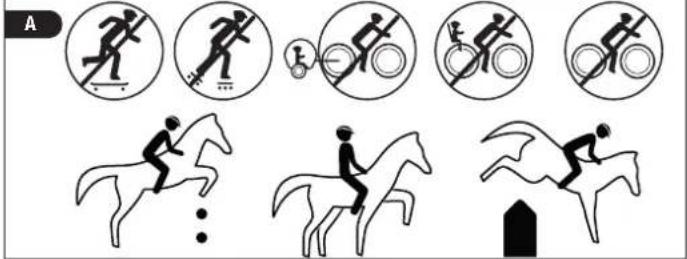
This helmet is designed exclusively for equestrian sports and cycling, recommended as protective equipment for the following activities (fig. A).
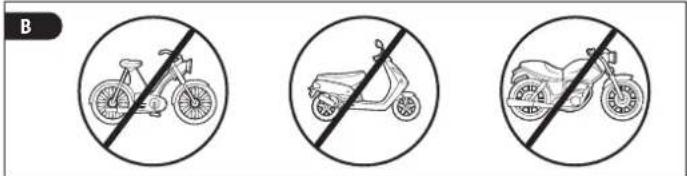
It is not suitable for the following activities (fig. B).
Attention: Please note that it is necessary for children to remove their helmets before entering playgrounds. This helmet should not be used by children while climbing or doing other activities when there is a risk of strangulation/hanging if the child gets trapped with the helmet.
2. Optimum fit
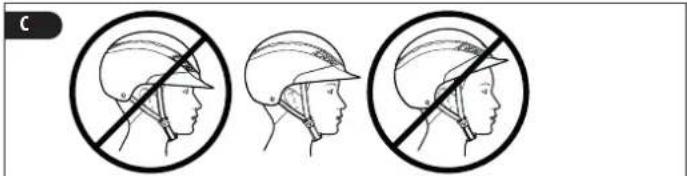
- Do not pull the helmet over your forehead, reducing visibility.
- Do not push the helmet towards the back of your head, as this will not protect your forehead.
- Please try various sizes for comfort and security, ensuring that the helmet sits horizontally on your head.
The helmet can only protect your head if it fits correctly (fig. C). Never select a helmet that is too large for children on the basis that they will „grow into“ it.
3. Adjustment of the head ring
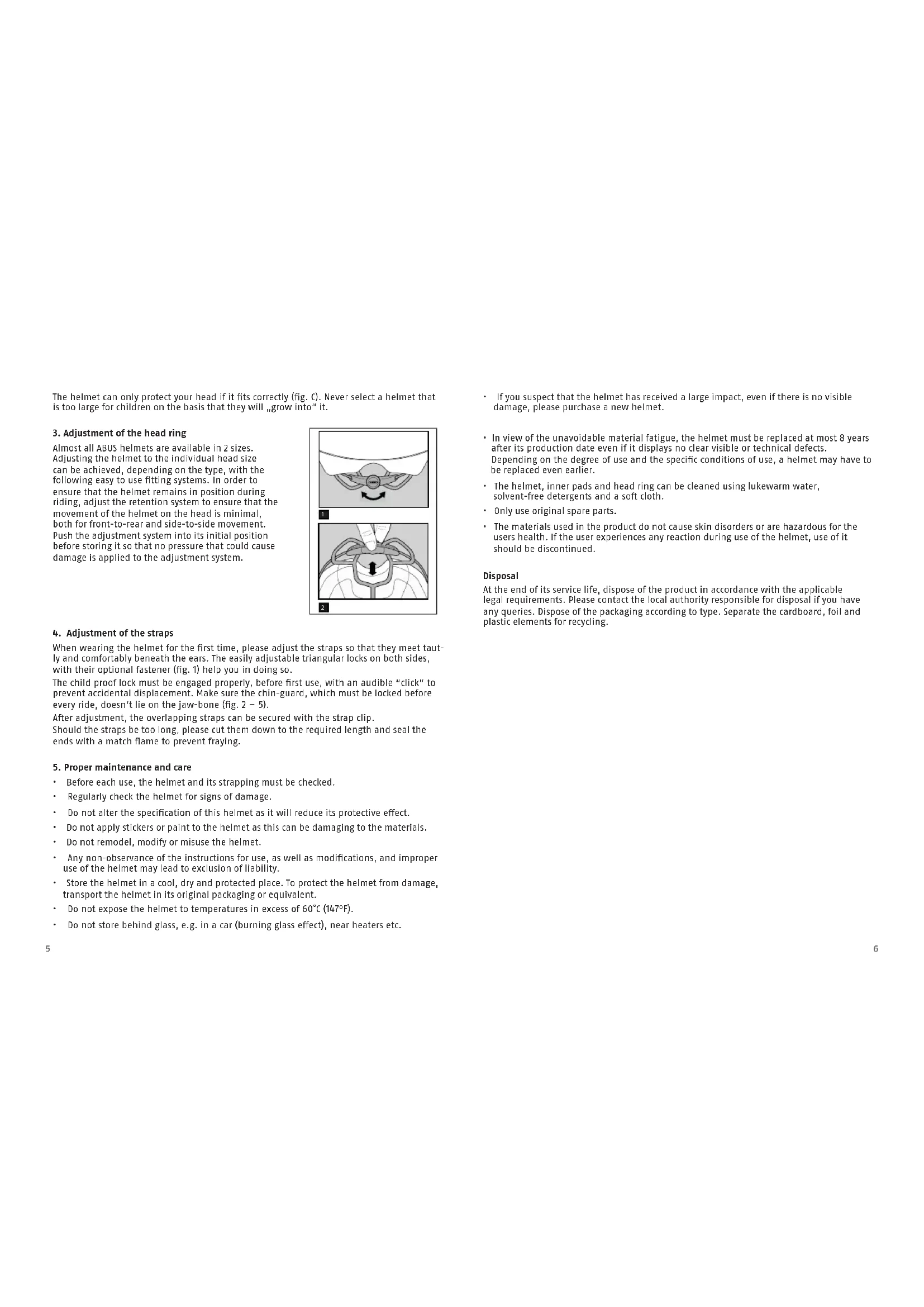
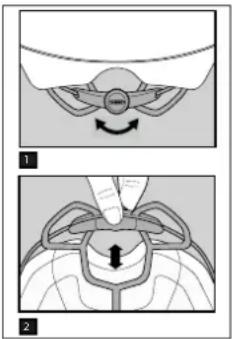
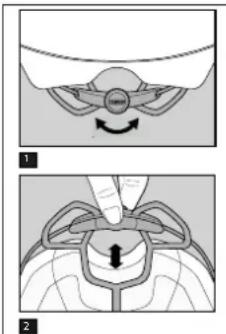
Almost all ABUS helmets are available in 2 sizes. Adjusting the helmet to the individual head size can be achieved, depending on the type, with the following easy to use fitting systems. In order to ensure that the helmet remains in position during riding, adjust the retention system to ensure that the movement of the helmet on the head is minimal, both for front-to-rear and side-to-side movement. Push the adjustment system into its initial position before storing it so that no pressure that could cause damage is applied to the adjustment system.
4. Adjustment of the straps
When wearing the helmet for the first time, please adjust the straps so that they meet tautly and comfortably beneath the ears. The easily adjustable triangular locks on both sides, with their optional fastener (fig. 1) help you in doing so.
The child proof lock must be engaged properly, before first use, with an audible "click" to prevent accidental displacement. Make sure the chin-guard, which must be locked before every ride, doesn't lie on the jaw-bone (fig. 2 - 5).
After adjustment, the overlapping straps can be secured with the strap clip.
Should the straps be too long, please cut them down to the required length and seal the ends with a match flame to prevent fraying.
5. Proper maintenance and care
• Before each use, the helmet and its strapping must be checked.
• Regularly check the helmet for signs of damage.
- Do not alter the specification of this helmet as it will reduce its protective effect.
- Do not apply stickers or paint to the helmet as this can be damaging to the materials.
- Do not remodel, modify or misuse the helmet.
- Any non-observance of the instructions for use, as well as modifications, and improper use of the helmet may lead to exclusion of liability.
- Store the helmet in a cool, dry and protected place. To protect the helmet from damage, transport the helmet in its original packaging or equivalent.
- Do not expose the helmet to temperatures in excess of 60^ (147°F).
- Do not store behind glass, e.g. in a car (burning glass effect), near heaters etc.
- If you suspect that the helmet has received a large impact, even if there is no visible damage, please purchase a new helmet.
- In view of the unavoidable material fatigue, the helmet must be replaced at most 8 years after its production date even if it displays no clear visible or technical defects. Depending on the degree of use and the specific conditions of use, a helmet may have to be replaced even earlier.
- The helmet, inner pads and head ring can be cleaned using lukewarm water, solvent-free detergents and a soft cloth.
• Only use original spare parts. - The materials used in the product do not cause skin disorders or are hazardous for the users health. If the user experiences any reaction during use of the helmet, use of it should be discontinued.
Disposal
At the end of its service life, dispose of the product in accordance with the applicable legal requirements. Please contact the local authority responsible for disposal if you have any queries. Dispose of the packaging according to type. Separate the cardboard, foil and plastic elements for recycling.

Congratulations! You are now the owner of a top quality ABUS horseback riding helmet. Please read this manual before riding with your new helmet.
natural_image
Three identical line drawings of a person wearing helmets with a diagonal crossed-out circle, no text or symbols present.THIS MANUAL IS SUBJECT IN ALL RESPECTS TO THE ABUS USA, LLC STANDARD TERMS AND CONDITIONS, WHICH ARE AVAILABLE AT https://www.abus.com/us/Resources/Brochures-Catalogs/Product-Catalog ("TERMS"). YOUR USE OF THIS PRODUCT CONSTITUTES YOUR BINDING AND ENFORCEABLE AGREEMENT TO THE TERMS AND THIS MANUAL. IF YOU DO NOT AGREE, THEN YOU HSOULD NOT USE THE PRODUCT. AMONG OTHER THINGS, THE TERMS INCLUDE PROVISIONS RELATED TO WARRANTY TERMS, LIMITATION OF LIABILITY, INDEMNITY, AND REQUIREMENT TO SUBMIT DISPUTES TO BINDING ARBITRATION. PLEASE READ THE TERMS CAREFULLY.
This manual and the sticker inside your helmet contain instructions and warnings about your helmet. Carefully read and follow these instructions. Incorrect use or maintenance of your helmet could void your warranty and, most importantly, could result in serious injury or death. If you are a parent or guardian and this helmet is for your child, you are responsible for your child using the helmet in accordance with this manual. Please take the time to read this manual and make sure that your child uses the helmet in accordance with these instructions and warnings. In case of emergency or injury, call 911 immediately.
The SEI logo signifies that this helmet has been manufactured under the control of the Safety Equipment Institute (USA), in accordance with American Society for Testing and Materials (ASTM) standards (ASTM F 1163-15).
- Please read and follow these safety instructions. Non-observance of these instructions could lead to injury to persons and/or device damage!
- Keep packaging material away from children: Danger of suffocation!
WARNING
Please note that no helmet is indestructible, and no helmet will prevent all head injuries or deaths. No helmet can protect against all possible impacts, and serious injury or death can occur even while wearing a helmet. The helmet is designed to absorb a portion of the applied force in the event of an impact by partially destroying the helmet shell or protective padding, or both. It is designed to reduce the likelihood of injury. While helmets reduce the likelihood of injury, in certain circumstances injury cannot prevented. In particular, helmets are not designed to protect the head in the event that a horse is out of control and walks on top of its rider.
To improve protection, please observe the following guidelines:
1. Intended usage
This helmet is intended solely for equestrian sports. However, even these activities are inherently dangerous. While no helmet can guarantee your safety, wearing a helmet, taking lessons, riding responsibly and within your skill level and abilities, as well as riding at lower speeds, can help reduce the risk of series head injuries resulting from equestrian sports. This helmet is not intended for motorsport, moped or similar activities, and doing so shall void the warranty.
WARNING
Please note that it is necessary for children to remove their helmets after riding, including removing helmets before entering playgrounds or while climbing trees, walls, or other structures. This helmet should not be used by children while climbing or doing other activities when there is a risk of strangulation/hanging. This product is not a toy. It is sports equipment and is designed and intended for equestrian sports (See Figure A on page 7).
2. Optimum fit
WARNING
Your helmet is intended to reduce the harmful effects of a blow to the head from certain directions. Accordingly, the helmet must fit properly, be worn properly and be taken care of properly. For the intended protection, the helmet must be fitted and attached properly to the wearer's head in accordance with the manufacturer's fitting instructions found below. The helmet will only provide the intended protection if it fits correctly and sits horizontally on your head. If the helmet slips, then the helmet is the wrong size and should not be worn. See Figure C:
- Make sure you wear the right size, including fitting the helmet with the hairstyle that will be worn during riding, for optimum comfort and the intended protection.
- Start by positioning the helmet on your head so that the front is level with the back and parallel to the ground.
-
Do not pull the helmet over your forehead as this can hinder your sight and thus reduces protection.
-
Do not push the helmet towards the back of your head as this leaves your forehead unprotected.
- Adjust the helmet by using the head ring and straps described below.
- Check the adjustment before every ride.
- Please try various sizes for comfort and security, ensuring that the helmet sits horizontally on your head. The front rim should fit approximately an inch above the rider's eyebrows, and the back of the helmet should not touch the rider's neck.
WARNING The helmet can only protect your head if it fits correctly, as displayed in Figure C. Never select a helmet that is too large for a child on the basis that they will "grow into it". If after adjustment the helmet does not fit properly, do not use the helmet.
3. Adjustment of the head ring
Almost all ABUS helmets are available in 2 sizes. Both sizes of the ABUS Horseback Riding Helmet can be adjusted to the individual head size, depending on the type, with the following head ring fitting systems. The head ring tightens or loosens the helmet around your head to help ensure the helmet is in place while riding. Figure D illustrates how the head ring can be adjusted for each rider. In order to ensure that the helmet remains in position while riding, adjust the retention system until movement on the helmet on the head is minimal, both for front-to-rear and side-to-side movement. To test out whether the helmet is on your head tightly enough, you can gently nod your head back and forth. If the helmet falls over your forehead or onto your neck, it should be readjusted to a tighter fit.
4. Adjustment of the straps
The helmet is designed to be retained by straps under the lower jaw. See illustration 2. When wearing the helmet for the first time, please adjust the straps so that they meet tightly and comfortably beneath the ears. Adjust the straps by opening the triangular lock and then locking it again when you have found the right position. The easily adjustable triangular locks (Figure 1) on both sides, with their optional fastener (Figure 1) help you in doing so.
The lock on the chin strap is intended to be resistant to opening by a child and must be secured properly before every ride. Listen for the "click" to know it is properly fastened and to prevent accidental displacement. Make sure the chin-guard, which must be locked before every ride, doesn't lie on the jaw-bone (Figures 3-5).
After adjustment, the overlapping straps can be secured with the strap clip (Figure 6). Should the straps be too long, please cut them down to the required length and seal the ends with a match flame to prevent fraying. If you choose to cut the excess strap on the chinstrap, leave a protrusion of approx. 2 inches or 4 cm above the lock. Have an adult heat the cut ends carefully with a match or lighter to prevent the webbing from unravelling. Be careful with high heat near the helmet because the strap and helmet are flammable. Do not allow the webbing to catch fire. Avoid contact with melted nylon.
5. Proper maintenance and care
- Before each use, the helmet (including its fit and condition) must be checked. - Regularly check the helmet for signs of damage.
• Do not alter the specification of this helmet as it will reduce its protective effect.
- Do not modify or use the helmet for any purpose other than as intended.
- Do not apply stickers or paint to the helmet as this can be damaging to the materials.
- Do not remodel, modify or misuse the helmet.
- Any non-observance of the instructions for use, as well as modifications, and improper use of the helmet may lead to exclusion of liability.
- Store the helmet in a cool, dry and protected place. To protect the helmet from damage, transport the helmet in its original packaging or equivalent.
• Do not expose the helmet to temperatures exceeding 60°C (147°F).
- Do not store behind glass, for example in a car (risk of melting) or near heaters, etc.
- If you suspect that the helmet has received a large impact, even if there is no visible damage, please purchase a new helmet.
- In view of the unavoidable material fatigue, the helmet must be replaced at most 8 years after its production date even if it displays no clear visible or technical defects. Depending on the degree of use and the specific conditions of use, a helmet may have to be replaced even earlier.
- The helmet, inner pads and head ring can be cleaned using lukewarm water, solvent-free detergents and a soft cloth.
• Only use original spare parts.
- If the user experiences any reaction of any kind during use of the helmet, use of it should be discontinued immediately.
- Do not place any objects in the ventilation holes, nor in the inside or the notch for the ABUS Quin sensor.
6. Disposal
At the end of its service life, dispose of the product in accordance with the applicable legal requirements. Please contact the local authority responsible for disposal if you have any queries. You may be able to obtain information on collection points, for example, from your local municipal or city administration, your local waste disposal company or your specialist dealer. Dispose of the packaging according to type. Separate the cardboard, foil and plastic elements for recycling, if recycling of such materials is available where you open the product.
7. Safety Information
WARNINGS
- Activities involving horses are inherently dangerous and accidents causing death, serious health problems and material damage can always happen. You are responsible for your own actions, decisions and safety.
- No helmet system can protect you from serious brain and/or neck injuries, including paralysis or death. To completely avoid these risks, you should not engage with horses.
- In the event of an impact or blow, do not use this helmet. The helmet is designed to absorb shock by partial destruction of the shell and liner. There may be damage to the helmet that is not visible to the user and the helmet may be no longer adequate to protect the head against further impacts. In the event of an impact or blow, even if there is no visible damage, the helmet should be replaced with a new one and the old one destroyed.
- The helmet can be damaged by contact with common substances (for example, certain solvents (like ammonia), cleaners, bleach, paints, petroleum products or abrasives), and this damage may not be visible to the user. Do not use this helmet if it has been exposed
to such substances.
- Horses are inherently unpredictable and can act in a sudden and dangerous way, especially when frightened or hurt. Always remember, that you are riding an animal that has its own reactions to its surroundings, even if the horse is well trained. Always stay alert and be prepared to respond quickly.
- Riding helmets should be treated with care and not exposed to extreme heat.
- Horseback riding helmets that meet proper safety standards are necessary, not only while riding, but during any activity involving horses (including walking or feeding horses).
• Always stay focused and alert during your activity with horses, even if you are not riding. Do not ride a horse when you are tired, taking medications, or under the influence of alcohol. - Smoking, filming, smartphone use, or any other distraction of any kind while riding or engaging with horses may lead to serious injury and should always be refrained from while riding or engaging in close proximity with horses.
- Horses should only be handled or ridden by competent and responsible persons or by persons under the direct and visual control of a competent and responsible adult person. Amateurs should ride on open, flat terrain or in monitored riding arenas. Jumps and stunts require a higher level of riding skill and should not be attempted by beginners. Do not attempt jumps or stunts without adult supervision. When trail riding, do not go off trail and heed all warning signs.
- Horses can kill or severely injure you by kicking. For this reason, you should never stand or walk behind a horse.
- Parts of the helmet can become detached through misuse. Detached parts can be swallowed by riders and may lead to suffocation.
- The riding helmet must not be used outside its intended function. You should not sit on it, stand on it or use it as a means of transportation.
- Attaching foreign objects such as cameras or lamps to the helmet significantly reduces the protection provided by the helmet and can lead to dangerous rider distractions, and as such ABUS strongly recommends against attaching any objects to the helmet.
- The vizor of the helmet is hard and narrow, if the helmet falls on objects or parts of the body, the vizor may cause injury or damage.
• If the helmet is broken, do not repair the helmet yourself.
• The riding helmet is not bulletproof. - When dropped from significant heights, the helmet may cause serious or even fatal injury or significant damage, and as such all users should refrain from dropping the helmet any height onto a person or object.
Important: Riding helmets must be replaced after an accident, regardless of the severity of such accident. Even if no external damage is visible, the helmet may have fine hairline cracks - these reduce the protective effect considerably during the next fall.
- For the same reason you should not buy a used helmet because there is a risk that damage will not be detected.
ABUS recommends that a helmet should be replaced after 5 years in use and 8 years up from production.
WARNING: CALIFORNIA PROPOSITION 65 WARNING. This product contains chemicals known to the State of California to cause cancer and birth defect or other reproduction harm - www.P65Warnings.ca.gov
FR
4. Nastavenie remienkov
4. Reglarea chingilor
Brand : ABUS
Model : AirDuo
Category : Protective helmet