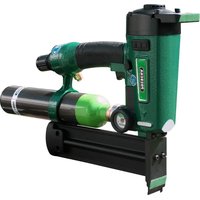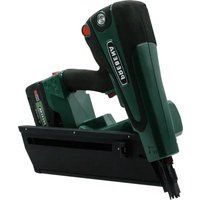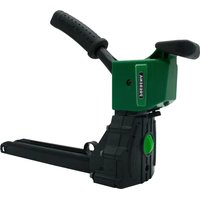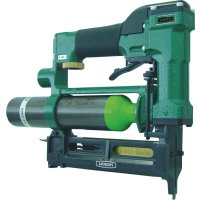
PKT2ES40S - Stapler Prebena - Free user manual and instructions
Find the device manual for free PKT2ES40S Prebena in PDF.



User questions about PKT2ES40S Prebena
0 question about this device. Answer the ones you know or ask your own.
Ask a new question about this device
Download the instructions for your Stapler in PDF format for free! Find your manual PKT2ES40S - Prebena and take your electronic device back in hand. On this page are published all the documents necessary for the use of your device. PKT2ES40S by Prebena.
USER MANUAL PKT2ES40S Prebena
This operating manual is provided as an aid for
proper,
- safe, and
economical
use of the following cordless air nailers:
- PKT-2-ES40-S and PKT-2-ES40-SY
- PKT-2-CLIP45-SY
- PKT-2-J50-S and PKT-2-J50-SY
- PKT-2-J50 SVN
- PKT-2-N65-S.
These cordless air nailers are referred to as a pneumatic tool in this operating manual.
We assume that every user of the pneumatic tool has experience handling devices that are powered by compressed air, and experience with the materials used. Those who do not have this experience must be instructed in the operation of the pneumatic tool.
Every person who
- operates,
- cleans, or
- disposes
of this pneumatic tool must have read and understood this operating manual.
This operating manual is considered as a component of the product. Always keep this operating with the pneumatic tool. If you sell the pneumatic tool, or provide it another party ensure that the operating manual is included with the pneumatic tool.
Table of Contents
Organizational Features 5
General Organizational Features 5
Features of the safety instructions 6

Basic Safety Instructions 7
Proper Use 7
Hazard - avoid fatal injuries 9
Avoid explosion hazards 9
Avoid injury hazards 9
Avoid damage to the pneumatic tool 10
Description 11
Device Overview and Scope of Delivery 11
Function 13
Product features of the pneumatic tools 13
Left/right and direction information 15
Safety fixtures 15
Accessories 16
Rating Plate Information 16
Preparing the pneumatic tool 17
Unpacking the pneumatic tool 17
Check the status 18
Attaching the compressed air cartridge 19
Filling the magazine 21
Check the function 27
Operating the pneumatic tool 28
Adjusting depth-of-drive 28
Using the glass-stop 31
Driving the fasteners 32
Reloading the magazine 34
After operation 35
Remove the compressed air cartridge 35
Emptying the magazine 36
Transporting and storing the pneumatic tool 37
Packing 37
Transport 39
Storage 40
Cleaning the pneumatic tool 41
Troubleshooting 43
Malfunction overview 43
Removing jammed fasteners (PKT-2-N65-S) 47
Removing jammed fasteners (other device types) 49
Ordering accessories 50
Ordering fasteners 50
Ordering additional compressed air cartridges 54
Ordering other accessories 54
Pneumatic tool disposal 55
Technical data 56
PKT-2-ES40-S and PKT-2-ES40-SY 56
PKT-2-CLIP45-SY 57
PKT-2-J50-S and PKT-2-J50-SY 58
PKT-2-J50 SVN 59
PKT-2-N65-S 60
KT-1000 compressed air cartridge 60
Manufacturer's address 61
Guarantee 62
Index 63
Organizational Features
General Organizational Features
Different elements of the operating manual have specified organizational features. These features make it easy to differentiate normal text,
- listings, or
action steps.
These instructions contain additional information, such as special tips on economical use of the pneumatic tool.
Features of the safety instructions
All safety instructions contained in this operating manual are structured on the same pattern. To the left there is a symbol that indicates the type of hazard. To the right a signal word that indicates the seriousness of the hazard. Below there is a description of the hazard source and instructions on how you can avoid this hazard.

HAZARD
Instructions with the word HAZARD warn of hazards that directly result in serious or fatal injuries.

WARNING
Instructions with the word WARNING warn of hazards that could possibly result in serious or fatal injuries.

CAUTION
Instructions with the word CAUTION warn of hazards in which light to medium severity injuries, property damage, or damage to the environment can possibly occur.
Basic Safety Instructions
Comply with and heed all warnings and instructions in this operating manual and on the pneumatic tool when handling the pneumatic tool.
Proper Use
Type PKT-2-J50-S, PKT-2-J50-SY, PKT-2-J50 SVN and PKT-2-N65-S pneumatic tools are used to drive brads into wood.
Pneumatic tool types PKT-2-ES40-S and PKT-2-ES40-SY, on the other hand are used to drive staples into wood.
These pneumatic tools can also be used to anchor rubber mats and plates onto wood. Only rubber mats and plates with the following material characteristics should be used:
- Shore hardness "A" rubber mats that are half as thick (maximum) as the length of the fastener.
- Zinc and aluminum sheet metal with a thickness of max. 0.7 ~mm and tensile strength of max. 180 ~N / mm^2 .
Pneumatic tool type PKT-2-CLIP45-SY is used to drive magazined cable clips into the following materials:
Wood:
Pumice stone
Insulating mortar joints
Gypsum plaster board
- Sand-lime brick
- Cellar stone
- Glued joints
- Breeze concrete
- Wall joints
OSB panels
- Door lintels
- Ytong (aerated concrete),
- Cement joints,
Brick
Using the pneumatic tool on other materials is only permitted after consultation with the manufacturer.
Proper use also includes compliance with accident prevention regulations and legal guidelines and standards applicable at the site of implementation. Any other use is considered to be improper use and can result in property damage, or even personal injury.
Improper use particularly includes operation
- by persons who have no experience operating pneumatic tools, or no experience with the materials used,
with bypassed safety fixtures, - of pneumatic tools that have been modified without the manufacturer's authorization.
with accessories other than those listed in this operating manual, - with compressed air sources that are not listed in this operating manual.
PREBENA WILFRIED BORNEMANN GMBH & CO. KG assumes no liability for damage that occurs due to improper use.
Hazard - avoid fatal injuries
- Never point the pneumatic tool at people, animals, or body parts.
- Only activate the trigger of the pneumatic tool when the tool nose is pressed against the workpiece.
- Do not let children play with packaging; there is risk of suffocation.
- Ensure that the fasteners are not driven into electrical lines.
Avoid explosion hazards
- Do not use the pneumatic tool at locations that are potentially explosive.
- Never operate the pneumatic tool with oxygen or other flammable gasses or gas mixtures.
- Never expose the compressed air cartridge to temperatures in excess of 100^ .
Avoid injury hazards
-
Store the pneumatic tool where it is inaccessible to children and other unauthorized persons.
-
Disconnect the pneumatic tool from the compressed air cartridge prior to every transport.
- Wear protective goggles, ear protection, and stable work clothing when operating the pneumatic tool.
- Hold the pneumatic tool in such a manner that you cannot be injured by possible recoil.
- Always adopt sure footing and a stable position when using the pneumatic tool.
Avoid damage to the pneumatic tool
- Never open the pneumatic tool housing. Only have qualified specialists perform repair work.
- Do not use the pneumatic tool if it has fallen down or is damaged. Have it checked by qualified, specialized personnel before you operate it again.
- Only install permanently mounted pneumatic tools in securely anchored holding fixtures. The pneumatic tool should not turn or shift in the holding fixture. The holder should not damage the pneumatic tool or its accessories.
Description
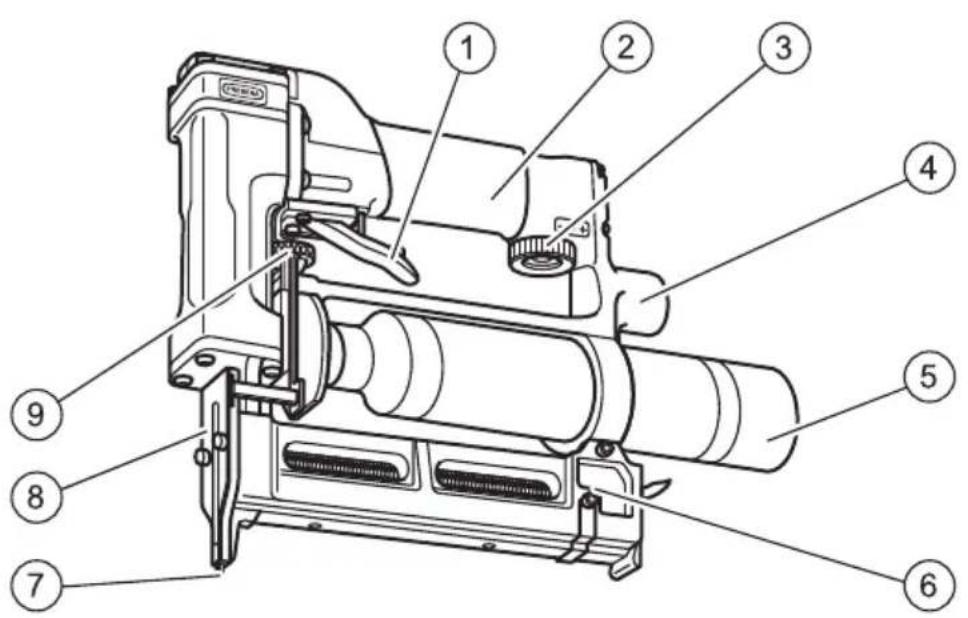
Device Overview and Scope of Delivery
| No. | Explanation |
| 1 | Discharge |
| 2 | Handle |
| 3 | Knurled screw for driving force (only PKT-2-ES40-S(Y), PKT-2-CLIP45-SY and PKT-2-N65-S) |
| 4 | Fill-level indicator for compressed air cartridge |
| 5 | KT-1000 compressed air cartridge, |
| 6 | Magazine for fasteners (depending on type - staples, brads, or magazined cable clips) |
| 7 | Safety device |
| 8 | Cover plate |
| 9 | Adjustment wheel for depth adjustment: (not with PKT-2-CLIP45-SY and PKT-2 J50-SVN) |

Type PKT-2-ES40-SY, PKT-2-CLIP45-SY and PKT-2-J50-SY pneumatic tools are shipped in a plastic Systainer. Systainers can be combined. Thus for example the pneumatic tool and replacement cartridges can be simply transported in two connected Systainers.
All of the other types of pneumatic tools described here are shipped in a plastic transport case.
Scope of delivery includes:
- One transport case or Systainer,
- One pneumatic tool,
- Two KT-1000 compressed air cartridges (one with PKT-2-CLIP45-SY),
- One Allen wrench size 3, one Allen wrench size 4,
The operating manual,
The Declaration of Conformity
Function
The pneumatic tool drives PREBENA single fasteners (brads or staples depending on type) into a piece of wood through compressed air. The materials into which magazined cable clips may be driven are listed on page 52. A PREBENA KT-1000 cartridge is mounted on the pneumatic tool as the compressed air source.
With the type PKT-2-CLIP45-SY pneumatic tool, the depth-of-drive can only be controlled by adjusting the driving force.
You can control the depth-of-drive via the adjustment wheel. For types PKT-2-ES40-S(Y) and PKT-2-N65-S the driving force can also be regulated.
Product features of the pneumatic tools
All types
The pneumatic tools have the following features in common:
Operation with PREBENA KT-1000 compressed air cartridges,
-
Compressed air cartridge fill-level indicator,
-
Safety device
PKT-2-ES40-S
The pneumatic tool has the following additional features:
- Bottom loading magazine
- Depth adjustment
- Regulated driving force via adjustable pressure reduction valve.
PKT-2-ES40-SY
The pneumatic tool has the same features as PKT-2-ES40-S. However it is shipped in a Systainer.
PKT-2-CLIP45-SY
The pneumatic tool has the following additional features:
- Lock-out safety device,
- Side-loading magazine,
- Regulated driving force via adjustable pressure reduction valve.
PKT-2-J50-S
The pneumatic tool has the following additional features:
- Side loading magazine,
- Depth adjustment,
- Pressure reduction valve with fixed setting.
PKT-2-J50-SY
The pneumatic tool has the same features as the PKT-2-J50-S; however it is shipped in a Systainer.
PKT-2-J50 SVN
The pneumatic tool has the following additional features:
- Side-loading magazine,
- Pressure reduction valve with fixed setting,
- Special tool for invisible glass border attachment.
PKT-2-N65-S
The pneumatic tool has the following additional features:
- Side-loading magazine,
- Depth adjustment,
- Regulated driving force via adjustable pressure reduction valve.
Left/right and direction information
The left/right and direction information in this operating manual is based on view direction towards the material.
Safety fixtures
Safety device
The pneumatic tool has a safety device on the tool nose. Discharge is only released when the safety device is pushed in.

WARNING!
If the safety device is defective or bypassed maximum severity injuries are possible when operating the pneumatic tool.
- Only use the pneumatic tool if the safety device is functional.
Only release the pneumatic tool when the tool nose is firmly pressed against the material.
Lock-out safety device
The PKT-2-CLIP45-SY pneumatic tool is equipped with a lock-out safety device on the top end of the magazine. The lock-out safety device blocks the discharge when there are no fasteners left in the magazine.
Accessories
The following accessories are available for the pneumatic tool:
- KT-1000 compressed air cartridge,
- Five KT-1000 compressed air cartridges in the Systainer,
- Different fasteners depending on the type (see page 50),
- Special PREBENA nailer oil.
Rating Plate Information
The rating plate is bonded to the compressed air cartridge holder. It contains the following information:
- Company name and country of origin,
- Type designation of the pneumatic tool,
- Type designation of the fasteners that can be used,
- CE mark (the product satisfies the standards listed in the accompanying Declaration of Conformity)
- GS mark (the product has a passed a safety inspection in accordance with the Equipment and Product Safety Act).
- Inverted triangle (this triangle indicates that you should only operate this device if the safety device is functional).
Preparing the pneumatic tool
Unpacking the pneumatic tool
- Remove the pneumatic tool from the packaging.
- Remove all packaging material, such as foil, fill material, and packing box.

WARNING!
A risk of suffocation exists for children when playing with the packaging foil.
- Never permit children to play with packaging foil.
-
Store packaging material where it is inaccessible to children.
-
Store the packaging for later use.
- Keep the transport case for transport of the pneumatic tool.
Only transport the pneumatic tool in the transport case.
Check the condition

WARNING
An injury hazard exists when operating a damaged pneumatic tool, or if accessories are not properly mounted.
Check the condition of the pneumatic tool prior to each use.
Only use pneumatic tools that are in trouble-free condition.
Check the following points in particular:
- All pneumatic tool parts and all accessory parts must be securely attached.
- The safety fixtures should not be blocked or otherwise impaired in function.
- The spring of the safety device should not be damaged.
- The pneumatic tool and its accessories should not show any external damage such as scratches or dents.
① Scratches in the paint of the housing or of the magazine are not considered damage.
- Do not connect a damaged pneumatic tool to a compressed air cartridge.
- Have specialized personnel repair a damaged pneumatic tool before placing it in service.
Attaching the compressed air cartridge

WARNING
Injury hazard due to unsuitable compressed air cartridges.
- Only use original PREBENA type KT-1000 cartridges.
Important instructions for handling compressed air cartridges
- Only use original KT-1000 compressed air cartridges to operate the pneumatic tools described in this document.
- Only use the KT-1000 compressed air cartridge to supply compressed air to the pneumatic tools described in this manual.
- Keep the valve of the compressed air cartridge, and the pneumatic tool connection clean, and protect these elements from damage. Remove fouling prior to placing in service. Heavy fouling should only be removed by the manufacturer.
- Do not use defective or damaged compressed air cartridges. Exchange defective or damaged compressed air cartridges through your dealer.
- The lettering on the compressed air cartridge should not be removed or made illegible.
- Only transport and store compressed air cartridges in the original packaging or in the pneumatic tool's transport case.
- Do not transport the compressed air cartridge when it is connected. Disconnect the compressed air cartridge from the device after each use.
Connecting the compressed air cartridge
- Remove the protective cap from the connection thread of the compressed air cartridge.
Check the connection and the connection thread of the compressed air cartridge for foreign objects and fouling.
Clean the connection and the connection thread if necessary.
Check the status of the pneumatic tool (see page 18).

WARNING
Inadvertent release can result in serious or fatal injuries.
Do not point the pneumatic tool at people or animals.
Empty the magazine before connecting.
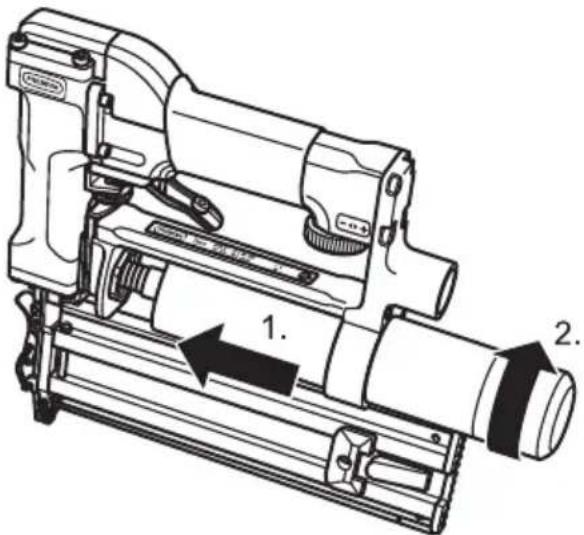
▶ Slide the compressed air cartridge into the holders (1.).
Screw the compressed air cartridge hand-tight into the thread on the connection element (2.).
The fill-level indicator shows whether the pressure available in the compressed air cartridge is sufficient. The pneumatic tool is ready for operation when the pointer of the fill level-indicator is in the green area.
If the fill-level indicator's pointer is in the red area, then the pressure available in the compressed air cartridge is no longer sufficient to operate the pneumatic tool.
In this case replace the compressed air cartridge with a full compressed air cartridge.
Filling the magazine

WARNING
Inadvertent release when filling the magazine can result in serious or fatal injuries.
Do not point the pneumatic tool at people or animals.

CAUTION
Non-suitable fasteners can result in injuries, impair trouble-free function of the pneumatic tool, or damage the pneumatic tool.
- Only use the specified fasteners listed on page 50 for the pneumatic tool.
Different magazines are used depending on the device type. How to fill the magazine for the different device types is described on the following pages.
See the rating plate to identify the device type of your pneumatic tool.
- Load the magazine as described in the section for your device type.
Device type PKT-2-ES40-S or PKT-2-ES40-SY
A bottom loading system is used on these pneumatic tools.
Press the safety catch on the magazine down (1.).
Pull out the lower slide (2.).
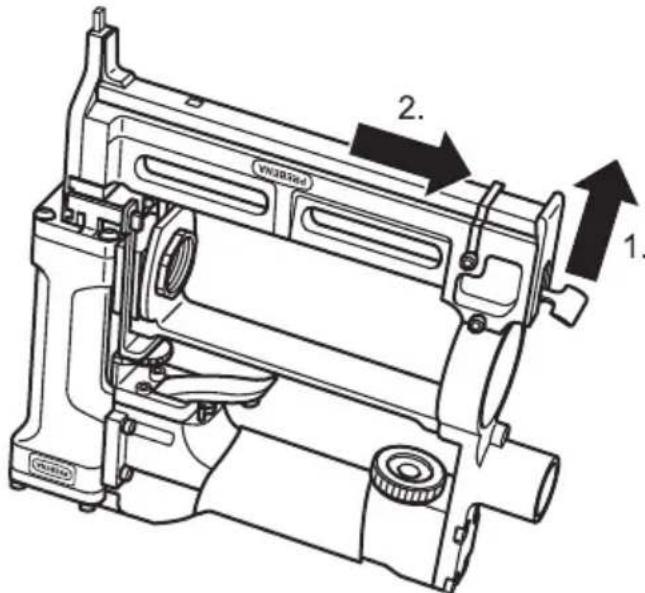
Place the fasteners in the magazine as shown (1).
- Push the lower slide up (2.) until it audibly clicks into place.
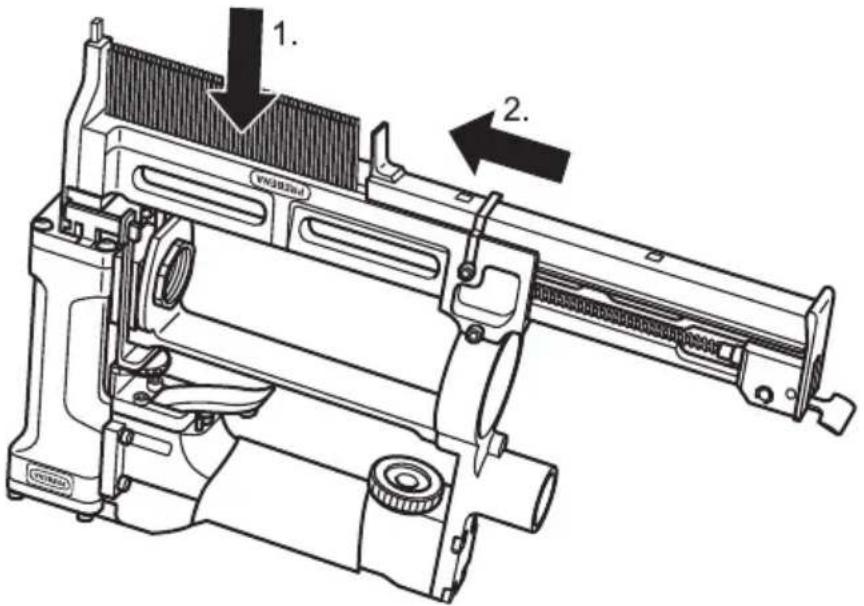
The magazine is now loaded.
Device type PKT-2-CLIP45-SY
A side loading system is used on this pneumatic tool.
Press the safety catch (1.) on the side of the magazine down and pull out the side slide (2.).
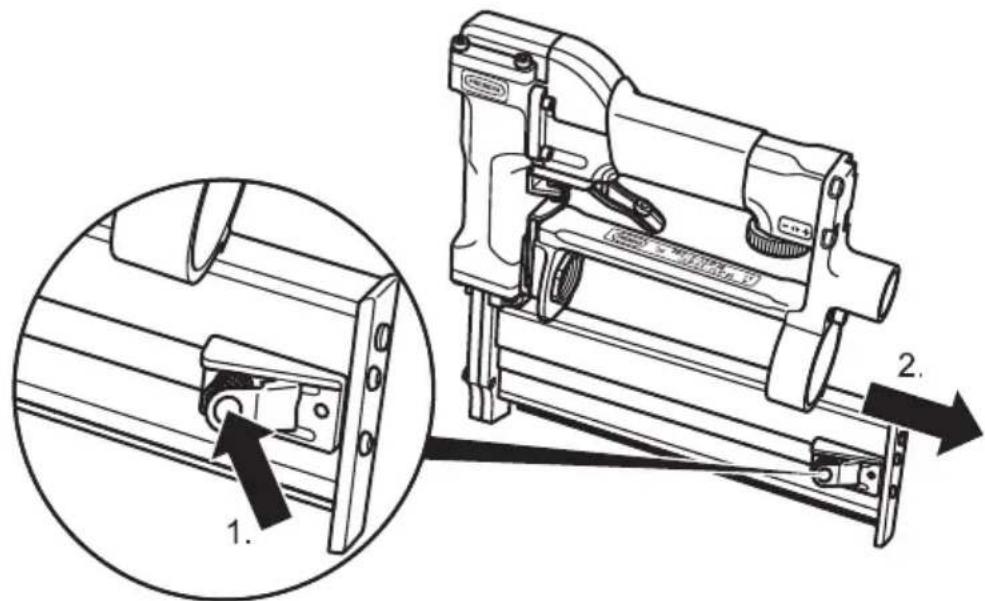
Insert the magazined cable clamps in such a manner that the staple tips point to the floor of the magazine (1.)
▶ Slide the side slide up (2.) until it clicks into place.
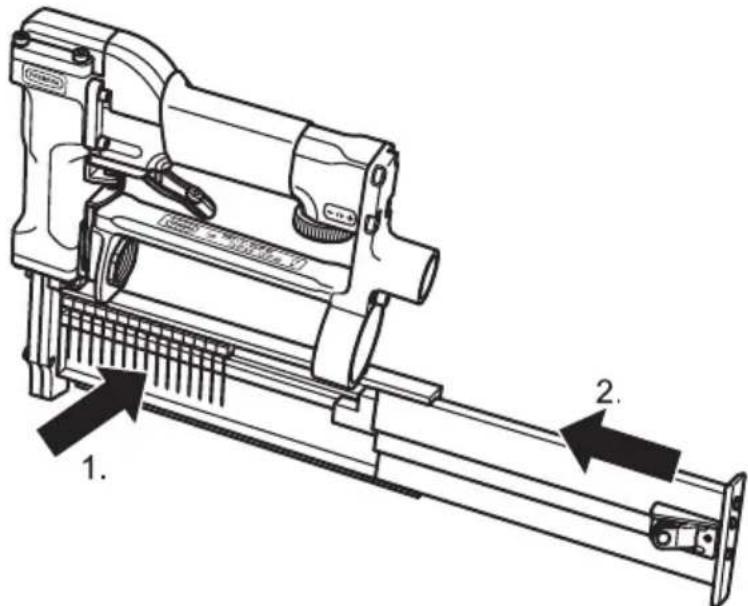
The magazine is now loaded.
Device type PKT-2-J50-S, PKT-2-J50-SY or PKT-2-J50 SVN
A side loading system is used on these pneumatic tool types.
Press the button (1.) on the side of the magazine down and pull out the side slide (2.).
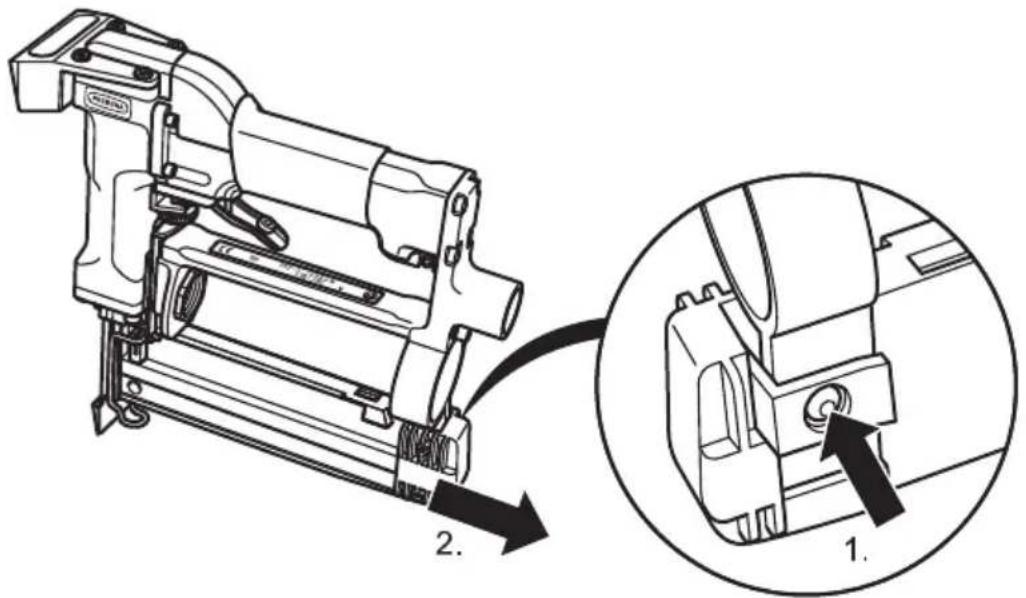
- Insert the fasteners in such a manner that their tips are resting on the floor of the magazine (1.).
▶ Slide the side slide up (2.) until it engages.
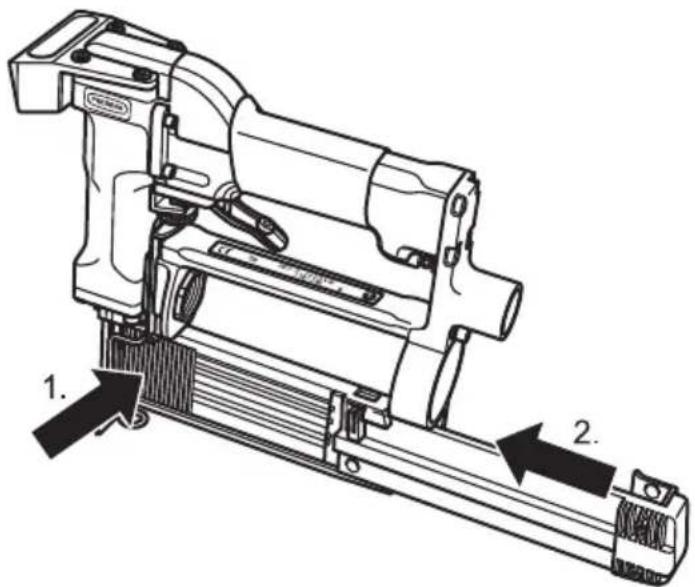
The magazine is now loaded.
Device type PKT-2-N65-S
A side loading system is used on this pneumatic tool.
Press the safety catch (1.) to the side and down on the magazine and pull out the side slide (2.).
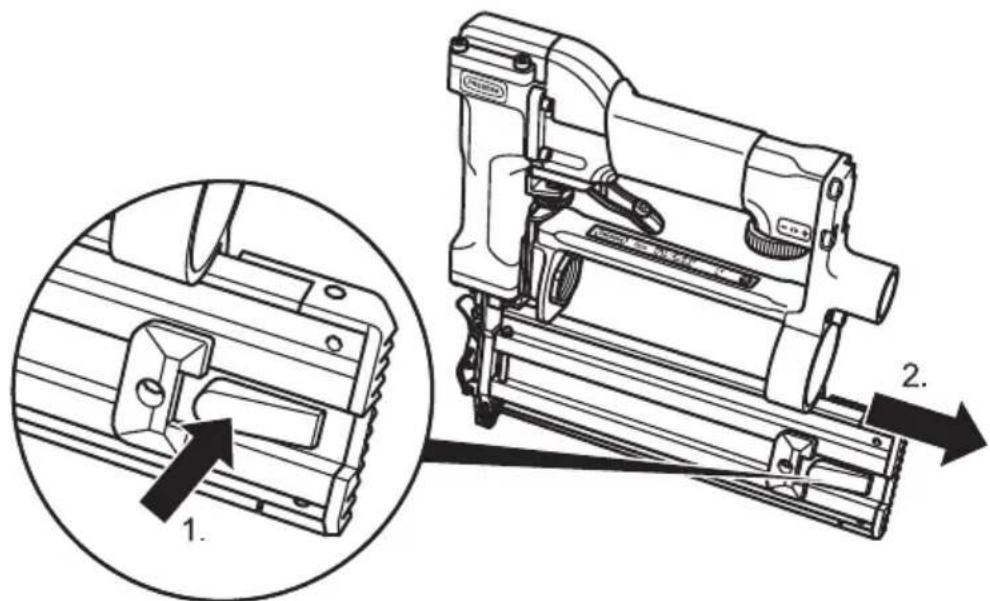
- Insert the fasteners so that the tips are resting on the floor of the magazine (1.).
Push the side slide up until it engages (2.).
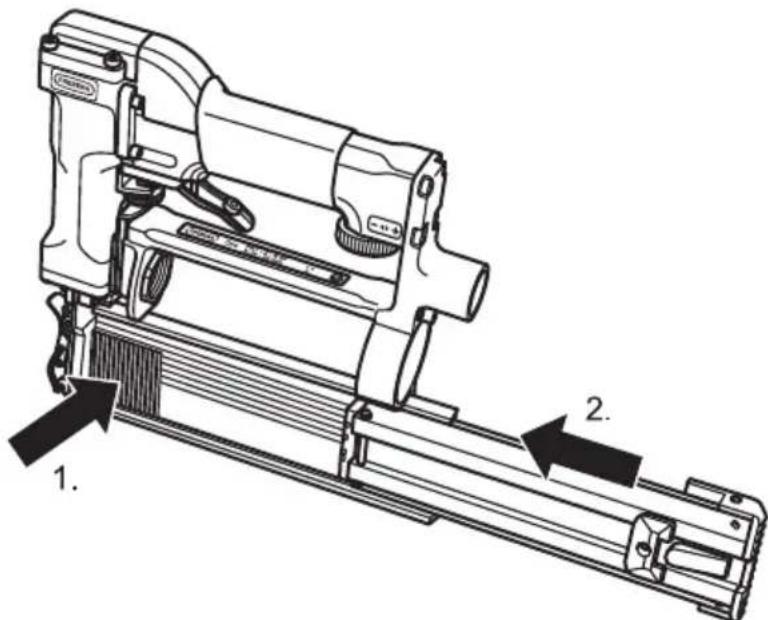
The magazine is now loaded.
Check the function
Proceed as follows for trouble-free pneumatic tool function:

CAUTION
A hazard of injury or property damage exists when operating the pneumatic tool.
Comply with the safety instructions in the section "Operating the pneumatic tool" starting on page 28.
-
Place the nose of the pneumatic tool on a piece of wood that is at least eight centimeters thick.
Release the pneumatic tool (see section "Driving the fasteners" starting on page 32).
In this process check the following characteristics: -
Release is only executed when the safety device is depressed.
-
A fastener must be driven into the piece of wood each time the release is activated...
-
Use the adjustment wheel to get the desired depth-of-drive (see page 28, except PKT-2-CLIP45-SY and PKT-2-J50 SVN).
Repeat these steps as necessary.
For the following types you can also adjust the driving force:
- PKT-2-ES40-S
- PKT-2-ES40-SY
- PKT-2-CLIP45-SY
- PKT-2-N65-S.
For this proceed as described in the section "Adjusting the driving force" on page 29.
The pneumatic tool is now ready for operation.
Operating the pneumatic tool
Adjusting depth-of-drive
Use the adjustment wheel to set the depth-of-drive
For all types except PKT-2-CLIP45-SY and PKT-2-J50 SVN you can set the depth-of-drive of the fasteners with the adjustment wheel of the depth adjustment (see page 11).
To reduce the depth-of-drive turn the adjustment wheel counterclockwise.
To increase the depth-of-drive, turn the adjustment wheel clockwise.

WARNING
Operating the pneumatic tool with defective or bypassed safety device can cause severe injuries.
- Only use the pneumatic tool if the safety device is functioning.
Only release the pneumatic tool when the nose of the tool is firmly pressed against the material.
Press the nose of the tool against a trial piece of wood that has the same characteristics as the wood that you want to process.
- Check the setting with a single shot (see section "Driving the fasteners" starting on page 32) on the trial piece of wood.
Repeat these steps until you have set the desired depth-of-drive.
Adjusting the driving force
With the following device types you can also adjust the driving force and thus the depth-of-drive by regulating the operating pressure via the knurled screw of the driving force (se page 11):
- PKT-2-ES40-S,
- PKT-2-ES40-SY,
- PKT-2-N65-S.
For type PKT-2-CLIP45-SY the driving force and thus the depth-of-drive can only be adjusted by regulating operating pressure.
You can only adjust the driving force, if the compressed air cartridge is disconnected.
Proceed as follows to adjust the driving force:
- Disconnect the compressed air cartridge from the pneumatic tool.
The knurled screw engages in five steps; each step represents a pressure adjustment of approximately 5 bar.
To reduce the driving force turn the knurled screw clockwise in the “-” direction.
To increase the driving force turn the knurled screw counterclockwise in the "+" direction.
Re-attach the compressed air cartridge.

WARNING
The most serious injuries are possible when operating the pneumatic tool with defective or bypassed safety device.
- Only use the pneumatic tool if the safety device is functional.
Only release the pneumatic tool when the nose of the tool is firmly pressed against the material.
Press the nose of the tool against a trial piece of wood that has the same characteristics as the wood that you want to process.
- Check the setting with a single shot (see page 32) on the trial piece of wood.
Repeat these steps until the desired driving force has been set.
Adjust the operating pressure so that you just reach the desired depth-of-drive. This offers the following advantages:
- You save energy (compressed air),
- You reduce the noise level and
- You reduce wear on the pneumatic tool.
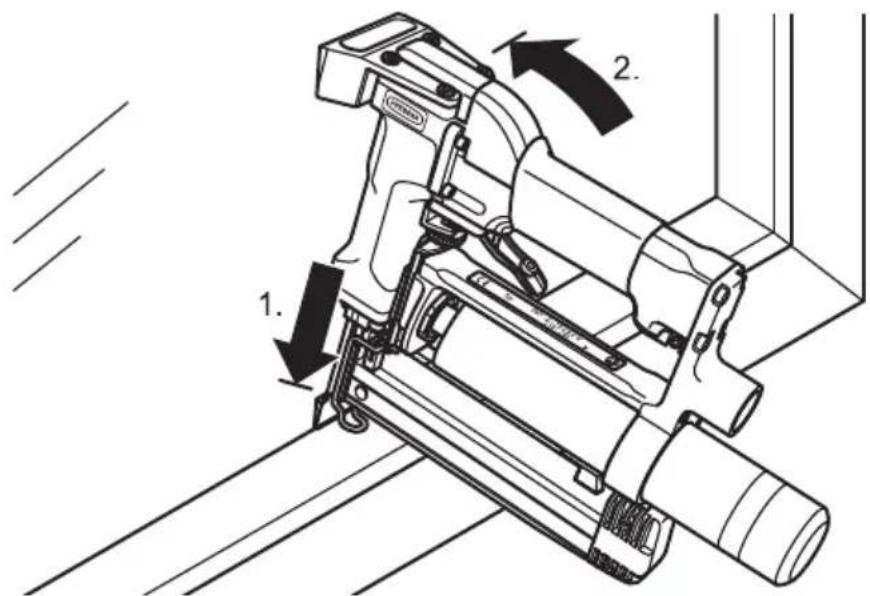
Using the glass-stop
The PKT-2-J50 SVN pneumatic tool is equipped with a glass-stop. It is used to support the device on a pane of glass during the driving process.
Place the tool on the glass pane (1.).
Tip the pneumatic tool until the glass-stop rests on the pane (2.).
Drive in the fastener as described on page 32.
Driving the fasteners

WARNING
Injury hazard due to electrical shock.
Prior to release ensure that there will be no contact with electrical lines.
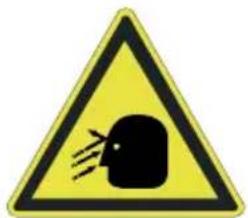
WARNING
Eye injuries or other injuries are possible due to flying particles during operation.
- Wear protective goggles and suitable protective clothing when operating the tool.
Comply with applicable industrial health and safety regulations.

WARNING
Hearing damage is possible due to loud operating noises.
Wear suitable ear protection.
Comply with applicable noise abatement procedures.
- Select the lowest possible operating pressure.

WARNING
Injury hazard due to fasteners that glance off of the material, fasteners that are driven-in too deep, or due to recoil.
- Only use the pneumatic tool for wooden objects.
- Ensure that depth-of-drive is not greater than the thickness of the piece of wood.
Press the nose of the tool firmly against the workpiece.
If fasteners are driven into workpieces that are too hard, or into other fasteners, strong recoil is produced. The pneumatic tool can slip off the workpiece in this situation.
Depth-of drive depends on the hardness and thickness of the piece of wood and on the set operating pressure.
Ensure that no one is behind the piece of wood.
- Check the pneumatic tool function at low operating pressure with a single shot (see chapter "Driving the fasteners" starting on page 32).
- Adjust the depth-of-drive and the driving force in accordance with the resistance of the wood you are using (see chapter "Operating the pneumatic tool" starting on page 28).
Releasing the pneumatic tool
Proceed as follows to release the pneumatic tool:

WARNING
The most serious injuries are possible when operating the pneumatic tool with defective or bypassed safety device.
- Only use the pneumatic tool if the safety device is functional.
- Only release the pneumatic tool when the nose of the tool is firmly pressed against the material.
Press the nose of the tool onto the piece of wood.
Pull the trigger all the way through.
A fastener will be driven into the piece of wood.
Release the trigger.
- Lift the pneumatic tool off of the piece of wood.
Repeat these steps to drive-in another fastener.
Reloading the magazine
- Fill the magazine as described on page 21.
The PKT-2-CLIP45-SY pneumatic tool is equipped with a lock-out safety device. The lock-out safety device is activated when there are no more fasteners in the magazine. If the lock-out safety device is activated you will be unable to release the pneumatic tool. You will not be able to drive-in any other fasteners.
In this case fill the magazine as described starting on page 21.
After operation
Execute the steps described below after operation, or if you anticipate longer interruptions in operation.
Remove the compressed air cartridge
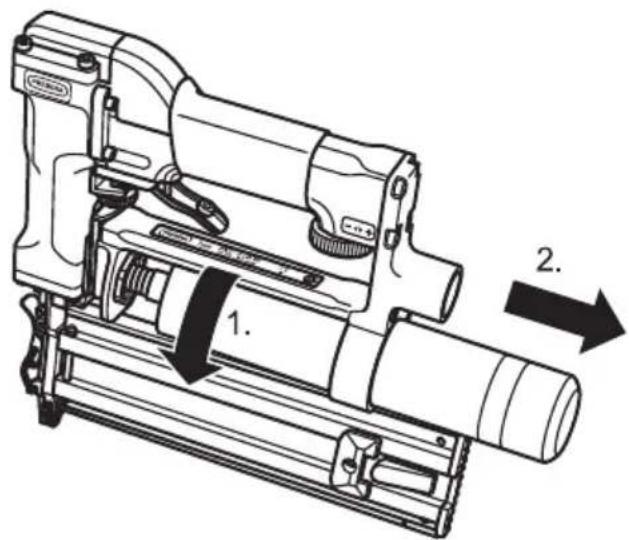
Unscrew the compressed air cartridge from the connection thread (1.).
The compressed air contained in the pneumatic tool will dissipate audibly.
Pull the compressed air cartridge out of the holder on the pneumatic tool (2.),
- Keep the compressed air cartridge in the supplied transport case where it will be protected from bumps and impact.
You can exchange an empty cartridge when purchasing a full cartridge from your dealer.
Emptying the magazine
Remove the unused fasteners from the magazine, if you are no longer using the pneumatic tool.
Proceed as follows for this.

WARNING
Inadvertent release when emptying the magazine can result in severe or fatal injuries.
-
Detach the compressed air cartridge from the pneumatic tool.
-
Open the magazine as described on page 21.
Remove any fasteners remaining in the magazine.
Close the magazine.
Transporting and storing the pneumatic tool
Packing
Pack the pneumatic tool prior to storage or transport in the following situations:
- Distances greater than 10m
- Distances that lead over unstable substrates
- Distances that are traversed in unusual body positions.
For packing perform the following steps:
- Remove the compressed air cartridge (see page 35).
- Allow the air to dissipate completely from the pneumatic tool.
Empty the magazine (see page 36). -
Clean the compressed air connections of foreign objects or fouling if necessary.
-
Place the pneumatic tool and the compressed air cartridges in the transport case as shown.
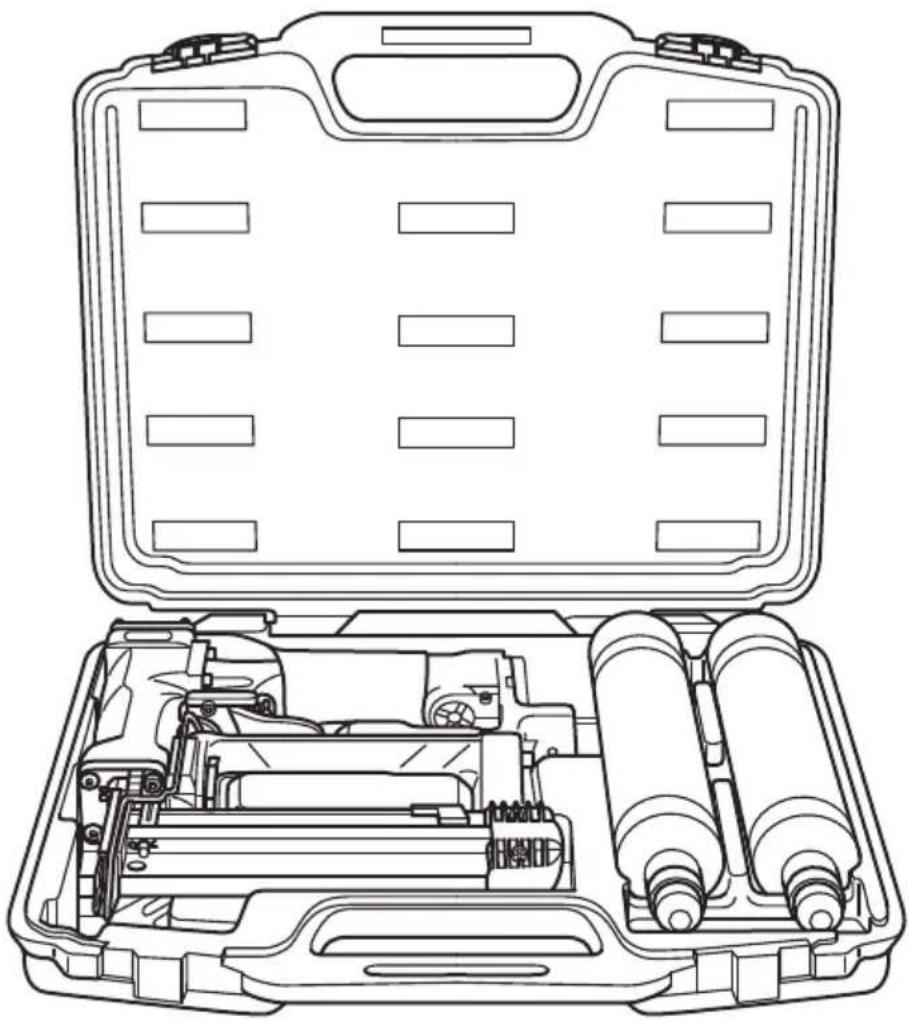
- Close transport case and secure the latch for the lid.
Transport
The type of transport depends on whether the pneumatic tool will be transported for longer or shorter distances.
Transport over short distances
Short distances and distances of maximum 10 m.

WARNING
Inadvertent release can result in severe or fatal injuries.
- Detach the compressed air cartridge from the pneumatic tool for each transport.
-
Only carry the pneumatic tool by the handle.
Do not touch the discharge when transporting the pneumatic tool. -
Detach the pneumatic tool from the compress air supply.

CAUTION
Impacts or bumps can damage the pneumatic tool.
Do not drop the pneumatic tool.
- Protect the pneumatic tool from bumping against obstacles.
- Carry the pneumatic tool by the handle with the nose of the tool pointing towards the ground.
- Only connect the compressed air cartridge when you have reached the new implementation location.
Transport over longer distances
When transporting the pneumatic tool the following situations are considered "long distances":
- Distances in excess of 10m
- Distances over an unstable substrate and
- Distances that are traversed in an unusual body position.
Proceed as follows to transport the pneumatic tool over long distances:
- Pack the pneumatic tool in the supplied transport case (see page 37).
- Carry the transport case by the handle to the desired implementation location.
- Only put the transport case down in a horizontal position with the lid side up.
Storage
- Oil all metal parts of the pneumatic tool with a thin application of PREBENA nailer oil.
Pack the pneumatic tool in the transport case. - Store the pneumatic tool at room temperature in a dry and dust-protected area.
Cleaning the pneumatic tool
The pneumatic tool should only be cleaned by personnel who have the necessary skill, capability, and experience. All tasks not described here should only be performed by the manufacturer's customer service organization, or in the manufacturer's facilities.

WARNING
Inadvertent release when emptying the magazine can result in severe or fatal injuries.
- Remove compressed air cartridge prior to cleaning (see page 35).
Empty magazine prior to cleaning (see page 35).

CAUTION
Non-suitable cleaning agents can damage the pneumatic tool or the accessories.
- Only use a dry cloth, a slightly damp cloth, or a cloth slightly dampened with a mild soap solution, to clean the pneumatic tool.
Light fouling
Wipe off the housing of the pneumatic tool with a dry cloth.
- Oil all metal parts of the pneumatic tool with a thin application of PREBENA special nailer oil.
Heavy fouling
Wipe off the pneumatic tool housing with a cloth that has been slightly dampened with a mild soap solution.
- Then wipe the housing with a cloth that has been slightly dampened with tap water.
Wipe off the pneumatic tool with a dry soft cloth.
- Oil all metal parts of the pneumatic tool with a thin application of PREBENA special nailer oil.
Troubleshooting

WARNING
Serious or fatal injuries are possible when operating a damaged or malfunctioning pneumatic tool.
If there is a malfunction immediately remove the compressed air cartridge from the pneumatic tool (see page 35)
Empty the magazine (see page 36).
Do not use the pneumatic tool until the malfunction has been resolved.

CAUTION
The pneumatic tool can be damaged if repairs are performed by unauthorized persons.
Only have repairs performed by the manufacturer.
Malfunction overview
| Symptom | Possible cause: | Remedy |
| The pneumatic tool loses air. | The anchoring screws are loose. | ▶ Tighten the anchoring screws. |
| A seal is defective. | ▶ Notify customer service (see page 61). | |
| Driving force adjustment is not effective. (Only for PKT-2-ES40-S, PKT-2-ES40-SY, PKT-2-N65-S and PKT-2-CLIP45-SY). | The pressure reduction valve is defective. | ▶ Notify customer service (see page 61). |
| Fasteners are not driven in completely. | Insufficient operating pressure. | • Increase operating pressure (see page 29, only for PKT-2-ES40-S, PKT-2-ES40-SY, PKT-2-CLIP45-SY and PKT-2-N65-S). • Change the compressed air cartridge (see page 29). |
| Incorrect depth-of-drive. | • Adjust the depth-of-drive (see page 28). | |
| The nailer tip on the pneumatic tool is worn. | • Notify customer service (see page 61). | |
| Release is not possible. | Insufficient operating pressure. | Change the compressed air cartridge (see page 19). |
| After a longer period of storage the moving parts are jammed with lubricant. | Clean the pneumatic tool and apply oil again. Adjust for maximum operating pressure (see page 29, only for PKT-2-ES40-S, PKT-2-ES40-SY, PKT-2-CLIP45-SY and PKT-2-N65-S).Then release several times.After it has released, adjust the desired operating pressure (see page 29, only for PKT-2-ES40-S, PKT-2-ES40-SY, PKT-2-CLIP45-SY and PKT-2-N65-S).Otherwise notify customer service (see page 29). | |
| The lock-out safety device is activated (only for PKT-2-CLIP45-SY). | Fill magazine (see page 21). | |
| The pressure reduction valve is defective. | Notify customer service (see page 9). | |
| When the tool is released no fasteners are driven in (empty shot) | The pusher spring is defective. | Notify customer service (see page 61). |
| The magazine is fouled. | Clean the magazine. | |
| The wrong fasteners are loaded in the magazine. | Empty the magazine (see page 36). Only fill the magazine with PREBENA fasteners that are suitable for the device (see page 36). | |
| Insufficient operating pressure. | Increase operating pressure (see page 29, only for PKT-2-ES40-S, PKT-2-ES40-SY, PKT-2-CLIP45-SY and PKT-2-N65-S) Change the compressed air cartridge (see page 29). | |
| The piston with the driver does not return to start position after the driving process. | Notify customer service (see page 61). | |
| The release process does not execute completely. | Notify customer service (see page 61). | |
| The driver is bent | Notify customer service (see page 61). | |
| Fasteners jam. | Remove the jammed or bent fastener (see page 47) |
If a malfunction cannot be resolved in spite of these instructions, notify your dealer or the manufacturer (see page 61).
Removing jammed fasteners (PKT-2-N65-S)
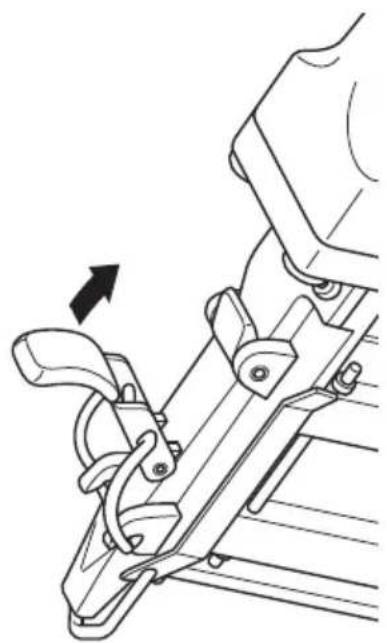
The PKT-2-N65-S has a cover plate on the nose of the tool. This cover plate allows removal of jammed or deformed fasteners from the nose of the tool.
Proceed as follows to remove a jammed fastener:
-
Detach the compressed air cartridge from the pneumatic tool (see page 35).
Empty the magazine (see page 36). -
Open the snap fastener by pressing it down.
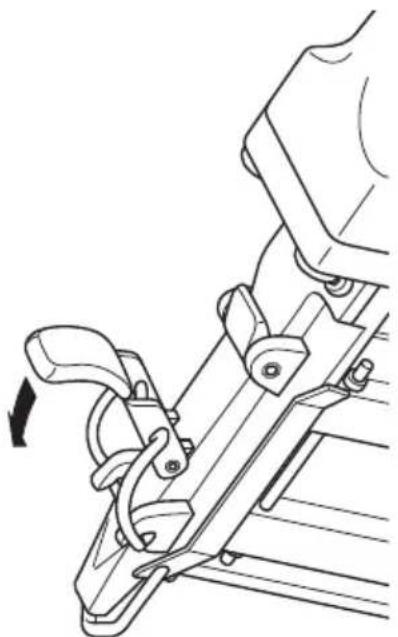
Open the clip
- Open the cover plate.
Removed the jammed or deformed fastener.
- Close the cover plate.
Press the clip into the receptacle provided.
Push the snap fastener up.

CAUTION
Injury hazard posed by an unlocked snap fastener.
- Ensure that the clip engages in the receptacle provided and that the snap fastener is locked.
Fill the magazine (see page 21).
Attach the compressed air cartridge (see page 19).
Press the nose of the tool against a trial piece of wood and check the function.
If the malfunction is not resolved, then contact your dealer or the manufacturer (see page 61).
Removing jammed fasteners (other device types)
Proceed as follows to remove jammed fasteners.
- Remove the compressed air cartridge from the pneumatic tool (see page 35).
Empty the magazine (see page 36). - Loosen and remove the Allen screws on the cover plate.
- Remove the cover plate from the housing (see page 11).
Removed the jammed or deformed fastener.
Attach the cover plate with the Allen screws.
Fill the magazine (see page 21).
Attach the compressed air cartridge (see page 19).
Press the nose of the tool against a trial piece of wood and check the function.
If the malfunction is not resolved, then contact your dealer or the manufacturer (see page 61).
Ordering accessories
You can order accessories from the manufacturer (see page 61). Only use original PREBENA accessories, or accessories that have been approved by PREBENA for pneumatic tool operation.
Ordering fasteners
The pneumatic tools should only be operated with the PREBENA fasteners listed on the rating plate.
Type designation explanation
Example: ES30 C NK HA BR
| Abbreviation | Explanation |
| ES30 | PREBENA type and shank length |
| C | Cutting point |
| NK | Wire quality |
| HA | Coating |
| BR | Paint finish |
Other coating or fastener quality on request.
Further information on the type designation is available from Prebena.
PKT-2-ES40-S and PKT-2-ES40-SY
Only use type ES fasteners from Prebena for these devices.
| Types | Wire gauge | Length | Crown |
| ES15 CNKHA | 0.8 mm × 1.1 mm | 15 mm | 6 mm |
| ES18 CNKHA | 0.8 mm × 1.1 mm | 18 mm | 6 mm |
| ES23 CNKHA | 0.8 mm × 1.1 mm | 23 mm | 6 mm |
| ES26 CNKHA | 0.8 mm × 1.1 mm | 26 mm | 6 mm |
| ES30 CNKHA | 0.8 mm × 1.1 mm | 30 mm | 6 mm |
| ES32 CNKHA | 0.8 mm × 1.1 mm | 32 mm | 6 mm |
| ES35 CNKHA | 0.8 mm × 1.1 mm | 35 mm | 6 mm |
| ES40 CNKHA | 0.8 mm × 1.1 mm | 40 mm | 6 mm |
| ES26 CRFHA | 0.8 mm × 1.1 mm | 26 mm | 6 mm |
| ES30 CRFHA | 0.8 mm × 1.1 mm | 30 mm | 6 mm |
| ES40 CRFHA | 0.8 mm × 1.1 mm | 40 mm | 6 mm |
PKT-2-CLIP45-SY
Only use magazined PREBENA cable clips type CLIP8 and CLIP10 with this device.
| Types | For cable diameters | Length |
| CLIP8/9,5BK | 8 mm | 9.5 mm |
| CLIP8/18BK | 8 mm | 18 mm |
| CLIP8/25BK | 8 mm | 25 mm |
| CLIP8/35BK | 8 mm | 35 mm |
| CLIP8/45BK | 8 mm | 45 mm |
| CLIP10/9,5BK | 10 mm | 9.5 mm |
| CLIP10/18BK | 10 mm | 18 mm |
| CLIP10/25BK | 10 mm | 25 mm |
| CLIP10/35BK | 10 mm | 35 mm |
| CLIP10/45BK | 10 mm | 45 mm |
The length of the magazined cable clips based on the substrate is indicated in the table below.
| 9.5 mm | 18 mm | 25 mm | 35 mm | 45 mm | |
| Pumice stone | - | - | - | × | × |
| Insulating mortar joints | - | - | - | × × | |
| Gypsum plasterboard | × | × | × | × | × |
| Wooden structures | × | × | × | × | × |
| Sand-lime brick | × | - | - | - | - |
| Cellar stone | × | × | - | - | - |
| Glued joints | × | × | - | - | - |
| Breeze concrete | × | × | × | - | - |
| Wall joints | - | - | × | × | × |
| OSB panels | - | × | × | × | × |
| Door lintel | × | × | - | - | - |
| Ytong (aerated concrete) | - | - | - | × × | |
| Cement joint | - | × | × | × | - |
| Brick | × | - | - | - | - |
PKT-2-J50-S, PKT-2-J50-SY and PKT-2-J50 SVN
Only use PREBENA type J brads with these devices.
| Types | Wire gauge | Length |
| J16 CNKHA | 1.05 mm × 1.25 mm | 16 mm |
| J19 CNKHA | 1.05 mm × 1.25 mm | 19 mm |
| J25 CNKHA | 1.05 mm × 1.25 mm | 25 mm |
| J30 CNKHA | 1.05 mm × 1.25 mm | 30 mm |
| J32 CNKHA | 1.05 mm × 1.25 mm | 32 mm |
| J35 CNKHA | 1.05 mm × 1.25 mm | 35 mm |
| J40 CNKHA | 1.05 mm × 1.25 mm | 40 mm |
| J45 CNKHA | 1.05 mm × 1.25 mm | 45 mm |
| J50 CNKHA | 1.05 mm × 1.25 mm | 50 mm |
| J16 CRF | 1.05 mm × 1.25 mm | 16 mm |
| J19 CRF | 1.05 mm × 1.25 mm | 19 mm |
| J25 CRF | 1.05 mm × 1.25 mm | 25 mm |
| J32 CRF | 1.05 mm × 1.25 mm | 32 mm |
| J40 CRF | 1.05 mm × 1.25 mm | 40 mm |
| J50 CRF | 1.05 mm × 1.25 mm | 50 mm |
PKT-2-N65-S
Only use PREBENA type N brads with this device.
| Types | Wire gauge | Length |
| N25 CNKHA | 1.5 mm × 1.65 mm | 25 mm |
| N30 CNKHA | 1.5 mm × 1.65 mm | 30 mm |
| N35 CNKHA | 1.5 mm × 1.65 mm | 35 mm |
| N40 CNKHA | 1.5 mm × 1.65 mm | 40 mm |
| N44 CNKHA | 1.5 mm × 1.65 mm | 44 mm |
| N50 CNKHA | 1.5 mm × 1.65 mm | 50 mm |
| N56 CNKHA | 1.5 mm × 1.65 mm | 56 mm |
| N63 CNKHA | 1.5 mm × 1.65 mm | 63 mm |
| N65 CNKHA | 1.5 mm × 1.65 mm | 65 mm |
| N30 CRF | 1.5 mm × 1.65 mm | 30 mm |
| N35 CRF | 1.5 mm × 1.65 mm | 35 mm |
| N40 CRF | 1.5 mm × 1.65 mm | 40 mm |
| N50 CRF | 1.5 mm × 1.65 mm | 50 mm |
Ordering additional compressed air cartridges
You can exchange empty KT-1000 compressed air cartridges and purchase full cartridges from your dealer.
You can order the compressed air cartridges individually (KT-10000) or you can order them in the special transport container ("Systainer KT-10000-SY") with five compressed air cartridges (KT-10000).
Ordering other accessories
| Designation | Order number |
| PREBENA special nailer oil | Z200.10 |
Pneumatic tool disposal

CAUTION
Improper disposal can be harmful to the environment.
Clean the pneumatic tool prior to disposal.
Comply with the applicable regulations for disposal of oil.


Never dispose of the pneumatic tool or parts of the pneumatic tool in normal household waste containers. Contact your city or community authorities to determine possibilities for recycling, or environmentally responsible and proper disposal of the pneumatic tool.
Information on the materials used in the pneumatic tool is available from the manufacturer (see page 61).
Technical data
PKT-2-ES40-S and PKT-2-ES40-SY
| Dimensions pneumatic tool (L x W x H): | 326 × 257 × 60 mm |
| Weight pneumatic tool without compressed air cartridge: with compressed air cartridge: | 2.5 kg 3.7 kg |
| Dimensions transport case (L x W x H): 415 × 357 × 85 mm | |
| Weight transport case with content:: | 5.5 kg |
| Dimensions Systainer (L x W x H): | 400 × 300 × 105 mm |
| Weight Systainer with content (only PKT-2-ES40-SY): 5.7 kg | |
| Work pressure adjustable: | 30–60 bar |
| Driving processes per filled compressed air cartridge: Approximately | 400 to 800 |
| Magazine type: | Bottom-loading system |
| Release system: | Single shot with safety device |
| Fasteners: | PREBENA staples type ES15 – ES40 mm |
| Implementation temperature: | -5 to +45 °C |
| Storage/transport temperature: | Room temperature |
| Vibration parameter: | < 2.5 m/s² |
| Noise parameters: (in accordance with DIN 12549: 1999): | LwA, 1 s: 92 dB LpA, 1 s: 83 dB |
PKT-2-CLIP45-SY
| Dimensions pneumatic tool (L x W x H): | 326 × 257 × 60 mm |
| Weight pneumatic tool without compressed air cartridge: with compressed air cartridge: | 2.58 kg 3.6 kg |
| Dimensions Systainer (L x W x H): | 400 × 300 × 105 mm |
| Weight Systainer with content (only PKT-2-ES40-SY): 4.7 kg | |
| Work pressure adjustable: | 30-60 bar |
| Driving processes per filled compressed air cartridge: Approximately | 400 to 800 |
| Magazine type: | Side-loading system |
| Release system: | Single shot with safety device |
| Fasteners: | Magazined PREBENA cable clips type CLIP8 and CLIP10 |
| Implementation temperature: | -5 to +45 °C |
| Storage/transport temperature: | Room temperature |
| Vibration parameter: | < 2.5 m/s² |
| Noise parameters: (in accordance with DIN 12549: 1999): | LwA, 1 s: 92 dB LpA, 1 s: 83 dB |
PKT-2-J50-S and PKT-2-J50-SY
| Dimensions pneumatic tool (L x W x H): | 326 × 257 × 60 mm |
| Weight pneumatic tool without compressed air cartridge: with compressed air cartridge: | 2.15 kg3.17 kg |
| Dimensions transport case (L x W x H): 415 × 357 × 85 mm | |
| Weight transport case with content:: | 5.2 kg |
| Dimensions Systainer (L x W x H) (only PKT-2-J50-SY): 400 × 300 × 105 mm | |
| Weight Systainer with content: | 5.7 kg |
| Work pressure: | 40 bar |
| Driving processes per filled compressed air cartridge: Approximately | 500 |
| Magazine type: | Side-loading system |
| Release system: | Single shot with safety device |
| Fasteners: | PREBENA bradsType J15 – J50 mm |
| Implementation temperature: | -5 to +45 °C |
| Storage/transport temperature: | Room temperature |
| Vibration parameter: | < 2.5 m/s2 |
| Noise parameters: (in accordance with DIN 12549: 1999): | LWA, 1 s: 92 dBLpA, 1 s: 83 dB |
PKT-2-J50 SVN
| Dimensions pneumatic tool (L x W x H: | 387 × 255 × 70 mm |
| Weight pneumatic tool without compressed air cartridge: with compressed air cartridge: | 2.35 kg 3.37 kg |
| Dimensions transport case (L x W x H): 450 × 360 × 106 mm | |
| Weight transport case with content: | 5.2 kg |
| Work pressure: | 40 bar |
| Driving processes per filled compressed air cartridge: Approximately | 500 |
| Magazine type: | Side-loading system |
| Release system: | Single shot with safety device |
| Fasteners: | PREBENA brads Type J16 – J50 mm |
| Implementation temperature: | -5 to +45 °C |
| Storage/transport temperature: | Room temperature |
| Vibration parameter: | < 2.5 m/s² |
| Noise parameters: (in accordance with DIN 12549: 1999): | LWA, 1s: 92 dB LpA, 1s: 83 dB |
PKT-2-N65-S
| Dimensions pneumatic tool (L x W x H): | 326 × 265 × 60 mm |
| Weight pneumatic tool without compressed air cartridge: with compressed air cartridge: | 2.5 kg 3.52 kg |
| Dimensions transport case (L x W x H): 450 × 360 × 106 mm | |
| Weight transport case with content: | 5.66 kg |
| Work pressure adjustable: | 30-60 bar |
| Driving processes per filled compressed air cartridge: Approximately | 300 to 750 |
| Magazine type: | Side-loading system |
| Release system: | Single shot with safety device |
| Fasteners: | PREBENA brads Type N25 – N65 mm |
| Implementation temperature: | -5 to +45 °C |
| Storage/transport temperature: | Room temperature |
| Vibration parameter | < 2.5 m/s² |
| Noise parameters: (in accordance with DIN 12549: 1999): | LwA, 1 s: 92 dB LpA, 1 s: 83 dB |
KT-1000 compressed air cartridge
| Length: | Approximately 275 mm |
| Diameter: | Approximately 51 mm |
| Weight (filled): | 1.02 kg |
| Contents: | 0.36 l compressed air |
| Fill pressure: | 300 bar |
| Implementation temperature: | -5 to +45 °C |
Manufacturer's address
PREBENA
Fastening Technology
Seestr. 20-26
D-63679 Schotten
Telephone: +49 (0) 60 44 / 96 01-0
Fax: +49 (0) 60 44 / 96 01-80
For the designated device PREBENA provides a 1-year guarantee starting from the date of purchase in accordance with the following guarantee conditions. PREBENA guarantees no-charge resolution of defects that are attributable to material or manufacturing errors. Malfunction or damage that has been caused by improper use is not considered eligible for the no-charge guarantee.
Moreover only original PREBENA fasteners may be used; if this condition is not complied with, then PREBENA assumes no product liability, and thus there is no guarantee claim. The guarantee does not extend to parts subject to wear, such as O-rings, etc. Prebena will either repair the defective part or ship a replacement at its discretion. More extensive claims do not exist.
To claim the guarantee, the completely filled-out guarantee card with dealer stamp and purchase date must be provided, or a receipt that shows the dates and information in accordance with the guarantee card must be provided.
Shipping: The device in question must be carefully packed so that it cannot be damaged during transport, and sent at customer's expense to PREBENA.

Guarantee card
Model designation: Purchase date:
Dealer: (Stamp)
Index
A
Accessories
compressed air cartridges 54
description 16
fasteners 50
nailer oil 54
order numbers 54
ordering 50
Adjusting depth of drive 28
Adjusting the driving force 29
After operation
emptying the magazine 36
C
Check
condition 18
Check the condition
safety fixtures 18
Checking the condition
external damage 18
safety device 18
Checking the function 27
Cleaning
heavy fouling 42
housing and surfaces 41
light fouling 41
Compressed air cartridge
attaching 19
ordering 54
removing 35
technical data 60
Customer service 61
D
Description
accessories 16
device overview 11
features 13
function 13
left/right and direction
information 15
rating plate 16
safety fixtures 15
scope of delivery 11
Device overview 11
Disposal 55
Driving the fasteners 32
F
Fasteners
emptying the magazine 36
Filling the magazine 21
jammed 47
ordering 50
Features 13
Filling
magazine 21
Function 13
G
Guarantee 62
L
Left/right and direction
information 15
Lock-out safety device 34
Long distances 40
M
Magazine
emptying 36
filling 21
Maintenance
cleaning the surfaces 41
Manufacturer's address 61
0
Operating pressure
economic setting 30
Operation
after operation 35
materials 33
preparation 17
releasing once 34
troubleshooting 43
Organizational features
general text 5
safety instructions 6
P
Packing 37
Pneumatic tool
carry 39
cleaning 41
disposal 55
operation 28
packing 37
packing in transport case
38
preparation 17
storage 40
technical data 56
Transport 39
unpacking 17
Positioning 9
Prebena 61
Preparation
checking the condition 18
checking the function 27
filling the magazine 21
Unpacking 17
Proper use 7
R
Rating plate 16
Release
once 34
Removing heavy fouling 42
Removing light fouling 41
s
Safety device
checking the condition 18
Safety fixtures
checking the condition 18
lock-out safety device 15
safety device 15
Safety instructions
basic instructions 7
organizational features 6
positioning 9
proper use 7
Short distances 39
Storage 40
T
Technical data
compressed air cartridge 60
pneumatic tool 56
Transport
long distances 40
short distances 39
Transport case 38
Troubleshooting 43
U
Unpacking 17
Using the glass stop 31
Prólogo
hincar 27, 28, 32, 33
Llenar cargador 21
Medios de sujeción
Volverapedir 50
0
Operación
Encrassement important
Commercant: (cachet)
Index
A
Accessoires
encrassement important 42