S2_PM510DC - Polisher Vonroc - Free user manual and instructions
Find the device manual for free S2_PM510DC Vonroc in PDF.



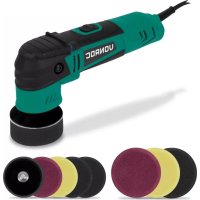
| Product Type | Cordless Polisher |
| Brand | Vonroc |
| Model | S2_PM510DC |
| Rated Voltage | 20 V |
| No-Load Speed | 2000 – 5000 rpm |
| Disc Diameter | 125 mm |
| Weight (without battery) | 0.735 kg |
| Battery Type | Lithium-Ion (VPOWER 20 V platform) |
| Battery Capacity | 2 Ah (CD828AA) or 4 Ah (CD829AA) |
| Charger | CD830AA: input 220-240 V, 50-60 Hz, output 21 V 4 A |
| Charging Time | Approx. 35 min for 2 Ah battery, 60 min for 4 Ah |
| Sound Pressure Level (LPA) | 77 dB(A), KPA = 3 dB(A) |
| Sound Power Level (LWA) | 85 dB(A), KWA = 3 dB(A) |
| Vibrations | 4.9 m/s², K = 1.5 m/s² |
| Maximum Operating Temperature | +45 °C |
| Intended Use | Polishing and brushing of metal and coated surfaces |
| Main Functions | On/off switch, safety lock, variable speed control (7 positions) |
| Included Accessories | Backing plate, polishing pad, hex key |
| Maintenance and Cleaning | Clean with a soft cloth and soap; avoid solvents. Keep ventilation openings clean. |
| Safety | Wear safety glasses, hearing protection and gloves. Read warnings before use. |
| Warranty | Statutory, according to VONROC conditions |
| Spare Parts and Repairability | Use only original spare parts; repair by an authorized service center |
| General Information | Complies with European directives. Do not dispose of with household waste. |
Frequently Asked Questions - S2_PM510DC Vonroc
User questions about S2_PM510DC Vonroc
0 question about this device. Answer the ones you know or ask your own.
Ask a new question about this device
Download the instructions for your Polisher in PDF format for free! Find your manual S2_PM510DC - Vonroc and take your electronic device back in hand. On this page are published all the documents necessary for the use of your device. S2_PM510DC by Vonroc.
USER MANUAL S2_PM510DC Vonroc
natural_image
White silhouette of a stylized tool or device against a black background (no text or symbols)EN Original Instructions 04
DE Übersetzung Der Originalbetriebsanleitung 11
NL Vertaling van de oorspronkelijke gebruiksaanwijzing 20
FR Traduction de la notice originale 28
ES Traducción del manual original 37
IT Traduzione delle istruzioni originali 45
SV Bruksanvisning i original 53
FI Alkuperäisten ohjeiden käännös 61
NO Oversatt fra orginal veiledning 68
DA Original vejledning 76
PL Tłumaczenie instrukcji oryginalnej 83
RO Traducere a instructiunilor originale 91
PT Instruções originais 99
CE Declaration of conformity 133
WEEE Directive 134
A
1. SAFETY INSTRUCTIONS
Read the enclosed safety warnings, the additional safety warnings and the instructions. Failure to follow the safety warnings and the instructions may result in electric shock, fire and/or serious injury. Save the safety warnings and the instructions for future reference.
The following symbols are used in the user manual or on the product:

Read the user manual.

Denotes risk of personal injury, loss of life or damage to the tool in case of non-observance of the instructions in this manual.

Risk of electric shock.

Wear safety goggles. Wear hearing protection.

Wear safety gloves.

Do not press the spindle lock button while the motor is running.

Indoor use only.

Max temperature 45°C.

Do not throw the battery into fire.

Do not throw the battery into water.

Separate collection for Li-ion battery.

Do not dispose of the product in unsuitable containers.

The product is in accordance with the applicable safety standards in the European directives.
GENERAL POWER TOOL SAFETY WARNINGS

WARNING! Read all safety warnings and all instructions. Failure to follow the warnings and instructions may result in electric shock, fire and/or serious injury.
Save all warnings and instructions for future reference.
The term “power tool” in the warnings refers to your mains-operated (corded) power tool or battery-operated (cordless) power tool.
1) Work area safety
a) Keep the work area clean and well lit. Cluttered or dark areas invite accidents.
b) Do not operate power tools in explosive atmospheres, such as in the presence of flammable liquids, gases or dust. Power tools create sparks which may ignite the dust or fumes.
c) Keep children and bystanders away while operating a power tool. Distractions can cause you to lose control.
2) Electricalsafety
a) Power tool plugs must match the outlet. Never modify the plug in any way. Do not use any adapter plugs with earthed (grounded) power tools. Unmodified plugs and matching outlets will reduce risk of electric shock.
b) Avoid body contact with earthed or grounded surfaces, such as pipes, radiators, ranges and refrigerators. There is an increased risk of electric shock if your body is earthed or grounded.
c) Do not expose power tools to rain or wet conditions. Water entering a power tool will increase the risk of electric shock.
d) Do not abuse the cord. Never use the cord for carrying, pulling or unplugging the power tool. Keep cord away from heat, oil, sharp edges or moving parts. Damaged or entangled cords increase the risk of electric shock.
e) When operating a power tool outdoors, use an extension cord suitable for outdoor use. Use of a cord suitable for outdoor use reduces the risk of electric shock.
f) If operating a power tool in a damp location is unavoidable, use a residual current device (RCD) protected supply. Use of an RCD reduces the risk of electric shock.
3) Personalsafety
a) Stay alert, watch what you are doing and use common sense when operating a power tool. Do not use a power tool while you are tired or under the influence of drugs, alcohol or medication. A moment of inattention while operating power tools may result in serious personal injury.
b) Use personal protective equipment. Always wear eye protection. Protective equipment such as dust mask, non-skid safety shoes, hard hat, or hearing protection used for appropriate conditions will reduce personal injuries.
c) Prevent unintentional starting. Ensure the switch is in the off-position before connecting to power source and/or battery pack, picking up or carrying the tool. Carrying power tools with your finger on the switch or energising power tools that have the switch on invites accidents.
d) Remove any adjusting key or wrench before turning the power tool on. A wrench or a key left attached to a rotating part of the power tool may result in personal injury.
e) Do not overreach. Keep proper footing and balance at all times. This enables better control of the power tool in unexpected situations.
f) Dress properly. Do not wear loose clothing or jewellery. Keep your hair, clothing and gloves away from moving parts. Loose clothes, jewellery or long hair can be caught in moving parts.
g) If devices are provided for the connection of dust extraction and collection facilities, ensure these are connected and properly used. Use of dust collection can reduce dust related hazards.
h) Do not let familiarity gained from frequent use of tools allow you to become complacent and ignore tool safety principles. A careless action can cause severe injury within a fraction of a second.
4) Power tool use and care
a) Do not force the power tool. Use the correct power tool for your application. The correct power tool will do the job better and safer at the rate for which it was designed.
b) Do not use the power tool if the switch does not turn it on and off. Any power tool that cannot be controlled with the switch is dangerous and must be repaired.
c) Disconnect the plug from the power source and/or the battery pack from the power tool before making any adjustments, changing accessories,
or storing power tools. Such preventive safety measures reduce the risk of starting the power tool accidentally.
d) Store idle power tools out of the reach of children and do not allow persons unfamiliar with the power tool or these instructions to operate the power tool. Power tools are dangerous in the hands of untrained users.
e) Maintain power tools. Check for misalignment or binding of moving parts, breakage of parts and any other condition that may affect the power tool's operation. If damaged, have the power tool repaired before use. Many accidents are caused by poorly maintained power tools.
f) Keep cutting tools sharp and clean. Properly maintained cutting tools with sharp cutting edges are less likely to bind and are easier to control.
g) Use the power tool, accessories and tool bits etc. in accordance with these instructions, taking into account the working conditions and the work to be performed. Use of the power tool for operations different from those intended could result in a hazardous situation.
h) Keep handles and grasping surfaces dry, clean and free from oil and grease. Slippery handles and grasping surfaces do not allow for safe handling and control of the tool in unexpected situations.
5) Battery tool use and care
a) Recharge only with the charger specified by the manufacturer. A charger that is suitable for one type of battery pack may create a risk of fire when used with another battery pack.
b) Use power tools only with specifically designated battery packs. Use of any other battery packs may create a risk of injury and fire.
c) When battery pack is not in use, keep it away from other metal objects, like paper clips, coins, keys, nails, screws or other small metal objects that can make a connection from one terminal to another. Shorting the battery terminals together may cause burns or a fire.
d) Under abusive conditions, liquid may be ejected from the battery; avoid contact. If contact accidentally occurs, flush with water. If liquid contacts eyes, additionally seek medical help. Liquid ejected from the battery may cause irritation or burns.
e) Do not use a battery pack or tool that is damaged or modified. Damaged or modified
batteries may exhibit unpredictable behaviour resulting in fire, explosion or risk of injury.
f) Do not expose a battery pack or tool to fire or excessive temperature. Exposure to fire or temperature above 130 °C may cause explosion. NOTE The temperature „130 °C“ can be replaced by the temperature „265 °F“.
g) Follow all charging instructions and do not charge the battery pack or tool outside the temperature range specified in the instructions. Charging improperly or at temperatures outside the specified range may damage the battery and increase the risk of fire.
6)Service
a) Have your power tool serviced by a qualified repair person using only identical replacement parts. This will ensure that the safety of the power tool is maintained.
b) Never service damaged battery packs. Service of battery packs should only be performed by the manufacturer or authorized service providers.
KICKBACK AND RELATED WARNINGS
Kickback is a sudden reaction to a pinched or snagged rotating wheel, backing pad, brush or any other accessory. Pinching or snagging causes rapid stalling of the rotating accessory which in turn causes the uncontrolled power tool to be forced in the direction opposite of the accessory's rotation at the point of the binding. For example, if an abrasive wheel is snagged or pinched by the workpiece, the edge of the wheel that is entering into the pinch point can dig into the surface of the material causing the wheel to climb out or kick out. The wheel may either jump toward or away from the operator, depending on direction of the wheel's movement at the point of pinching. Abrasive wheels may also break under these conditions. Kickback is the result of power tool misuse and/or incorrect operating procedures or conditions and can be avoided by taking proper precautions as given below.
a) Maintain a firm grip on the power tool and position your body and arm to allow you to resist kickback forces. Always use auxiliary handle, if provided, for maximum control over kickback or torque reaction during start-up. The operator can control torque reactions or kickback forces, if proper precautions are taken.
b) Never place your hand near the rotating accessory. Accessory may kickback over your hand.
c) Do not position your body in the area where power tool will move if kickback occurs. Kickback will propel the tool in direction opposite to the wheel's movement at the point of snagging.
d) Use special care when working corners, sharp edges etc. Avoid bouncing and snagging the accessory. Corners, sharp edges or bouncing have a tendency to snag the rotating accessory and cause loss of control or kickback.
e) Do not attach a saw chain woodcarving blade or toothed saw blade. Such blades create frequent kickback and loss of control.
ADDITIONAL SAFETY WARNINGS FOR POLISHING

If you have used the machine for sanding, make sure you properly clean the machine before polishing to prevent scratches.
a) This power tool is intended to function as a polisher. Read all safety warnings, instructions, illustrations and specifications provided with this power tool. Failure to follow all instructions listed below may result in electric shock, fire and/or serious injury.
b) Operations such as grinding, wire brushing, or cutting-off are not recommended to be performed with this power tool. Operations for which the power tool was not designed may create a hazard and cause personal injury.
c) Do not use accessories which are not specifically designed and recommended by the tool manufacturer. Just because the accessory can be attached to your power tool, it does not assure safe operation.
d) The rated speed of the accessory must be at least equal to the maximum speed marked on the power tool. Accessories running faster than their rated speed can break and fly apart.
e) The outside diameter and the thickness of your accessory must be within the capacity rating of your power tool. Incorrectly sized accessories cannot be adequately guarded or controlled.
f) Threaded mounting of accessories must match the grinder spindle thread. For accessories mounted by flanges, the arbour hole of the accessory must fit the locating diameter of
the flange. Accessories that do not match the mounting hardware of the power tool will run out of balance, vibrate excessively and may cause loss of control.
g) Do not use a damaged accessory. Before each use inspect the accessory such as abrasive wheels for chips and cracks, backing pad for cracks, tear or excess wear, wire brush for loose or cracked wires. If power tool or accessory is dropped, inspect for damage or install an undamaged accessory. After inspecting and installing an accessory, position yourself and bystanders away from the plane of the rotating accessory and run the power tool at maximum no-load speed for one minute. Damaged accessories will normally break apart during this test time.
h) Wear personal protective equipment. Depending on application, use face shield, safety goggles or safety glasses. As appropriate, wear dust mask, hearing protectors, gloves and workshop apron capable of stopping small abrasive or workpiece fragments. The eye protection must be capable of stopping flying debris generated by various operations. The dust mask or respirator must be capable of filtrating particles generated by your operation. Prolonged exposure to high intensity noise may cause hearing loss.
i) Do not run the power tool while carrying it at your side. Accidental contact with the spinning accessory could snag your clothing, pulling the accessory into your body.
j) Do not allow any loose portion of the polishing bonnet or its attachment strings to spin freely. Tuck away or trim any loose attachment strings. Loose and spinning attachment strings can entangle your fingers or snag on the workpiece.
SAFETY WARNINGS FOR BATTERY
a) Do not open the battery. Danger of short-circuiting.
b) Protect the battery against heat, e. g., against continuous intense sunlight, fire, water, and moisture. Danger of explosion.
c) In case of damage and improper use of the battery, vapours may be emitted. Ventilate the area and seek medical help in case of complaints. The vapours can irritate the respiratory system.
d) Use the battery only in conjunction with your VONROC product. This measure alone protects the battery against dangerous overload.
e) The battery can be damaged by pointed objects such as nails or screwdrivers or by force applied externally. An internal short circuit can occur and the battery can burn, smoke, explode or overheat.
SAFETY WARNINGS FOR CHARGER
Intended use
Charge only CD801AA, CD803AA, CD828AA and CD829AA type rechargeable Battery packs with the charger. Other types of batteries may burst causing personal injury and damage.
a) The appliance is not to be used by persons (including children) with reduced physical, sensory or mental capabilities, or lack of experience and knowledge, unless they have been given supervision or instruction.
b) Children being supervised not to play with the appliance.
c) Do not recharging non-rechargeable batteries!
d) During charging, batteries must be placed in the well ventilated area!
Residual risks
Even when the power tool is used as prescribed it is not possible to eliminate all residual risk factors. The following hazards may arise in connection with the power tool's construction and design:
a) Health defects resulting from vibration emission if the power tool is being used over longer period of time or not adequately managed and properly maintained.
b) Injuries and damage to property to due to broken accessories that are suddenly dashed.

Warning! This power tool produces an electromagnetic field during operation. This field may under some circumstances interfere with active or passive medical implants. To reduce the risk of serious or fatal injury, we recommend persons with medical implants to consult their physician and the medical implant manufacturer before operating this power tool.
2. MACHINE INFORMATION
Intended use
This machine is intended for polishing and brushing metal and coated surfaces.
The manufacturer is not liable for damages caused by an improper use or incorrect operation of this product.
| Model No. PM510DC | |
| Voltage 20V | --- |
| No-load speed 2000-5.000/min | |
| Disc diameter ∅ 125 mm | |
| Weight (without battery) 0.735 kg | |
| Sound pressure level L | _PA : 77dB(A) K_PA : 3dB(A) |
| Acoustic power level L | _WA : 85dB(A) K_WA : 3dB(A) |
| Vibration 4.9m/s | ^2K=1.5m/s^2 |
| Temperature Max. +45 °C | |
| Storage 0 to +45 °C | |
TECHNICAL SPECIFICATIONS

This manual has been drawn up for different sets / article numbers. Check the corresponding article number in below specifications table for the correct composition and contents of your set.
| Model No. | Batteries included | Chargers included | Pads |
| PM510DC | --- | ||
| S_PM510DC | CD828AA | CD802AA | 5 Pads (Bevelled edge) |
| S2_PM510DC | 2 x CD828AA | CD802AA | 5 Pads (Bevelled edge) |
| S3_PM510DC | CD829AA | CD802AA | 5 Pads (Bevelled edge) |
| S4_PM510DC | 2 x CD829AA | CD802AA | 5 Pads (Bevelled edge) |
| Model No. CD828AA | |
| Battery Type | Lithium-Ion |
| Voltage | 20V— |
| Capacity | 2.0 Ah |
| Weight | 0.4 kg |
| Model No. CD829AA | |
| Battery type | Lithium-Ion |
| Voltage | 20V— |
| Capacity | 4.0 Ah |
| Weight | 0.658 kg |
| Model No. CD830AA | |
| Charger input | 220-240V, 50-60Hz, Max 1.5A |
| Charger output | 21V 4.0A, 86W |
| Charging time with 2Ah battery | 35 minutes |
| Charging time with 4Ah battery | 60 minutes |
| Recommended batteries | CD801AA, CD803AA, CD828AA, CD829AA |
| Weight | 0.43 kg |
Only use the following batteries of the VONROC VPOWER 20V battery platform. Using any other batteries could cause serious injury or damage the tool.
CD828AA 20V, 2Ah, 2Ah Lithium-Ion CD829AA 20V, 4Ah Lithium-Ion
The batteries of the VONROC VPOWER 20V battery platform are interchangeable with all the VONROC VPOWER 20V battery platform tools.
Vibration level
The vibration emission level stated in this instruction manual has been measured in accordance with a standardized test given in EN 62841; it may be used to compare one tool with another and as a preliminary assessment of exposure to vibration when using the tool for the applications mentioned.
- Using the tool for different applications, or with different or poorly maintained accessories, may significantly increase the exposure level.
- The times when the tool is switched off or when it is running but not actually doing the job, may significantly reduce the exposure level.
Protect yourself against the effects of vibration by maintaining the tool and its accessories, keeping your hands warm, and organizing your work patterns.
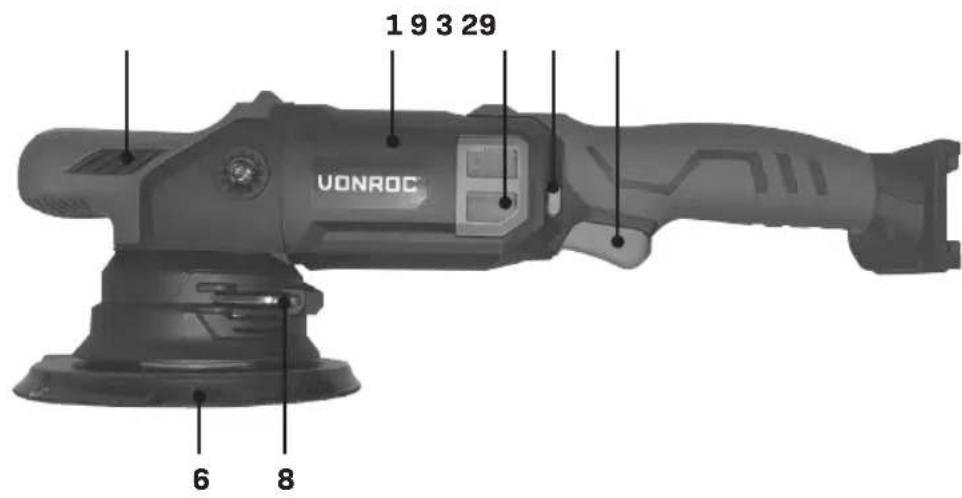
DESCRIPTION
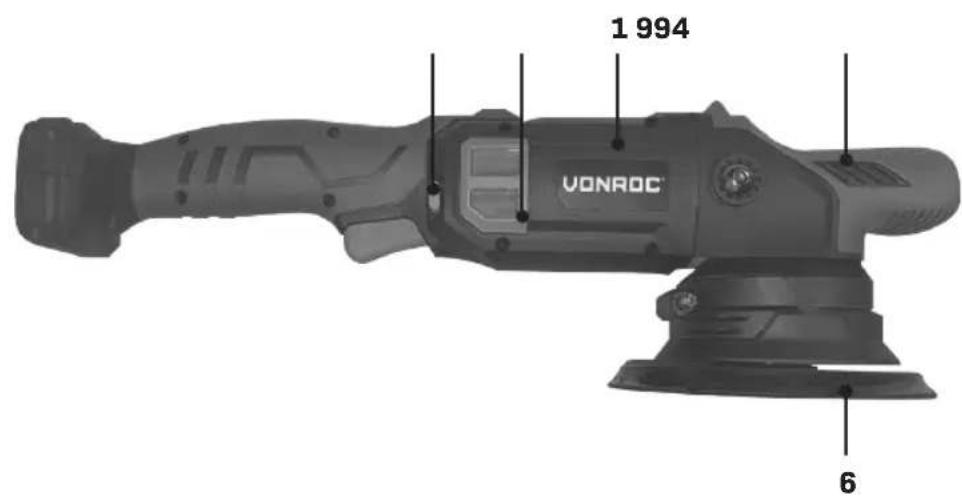
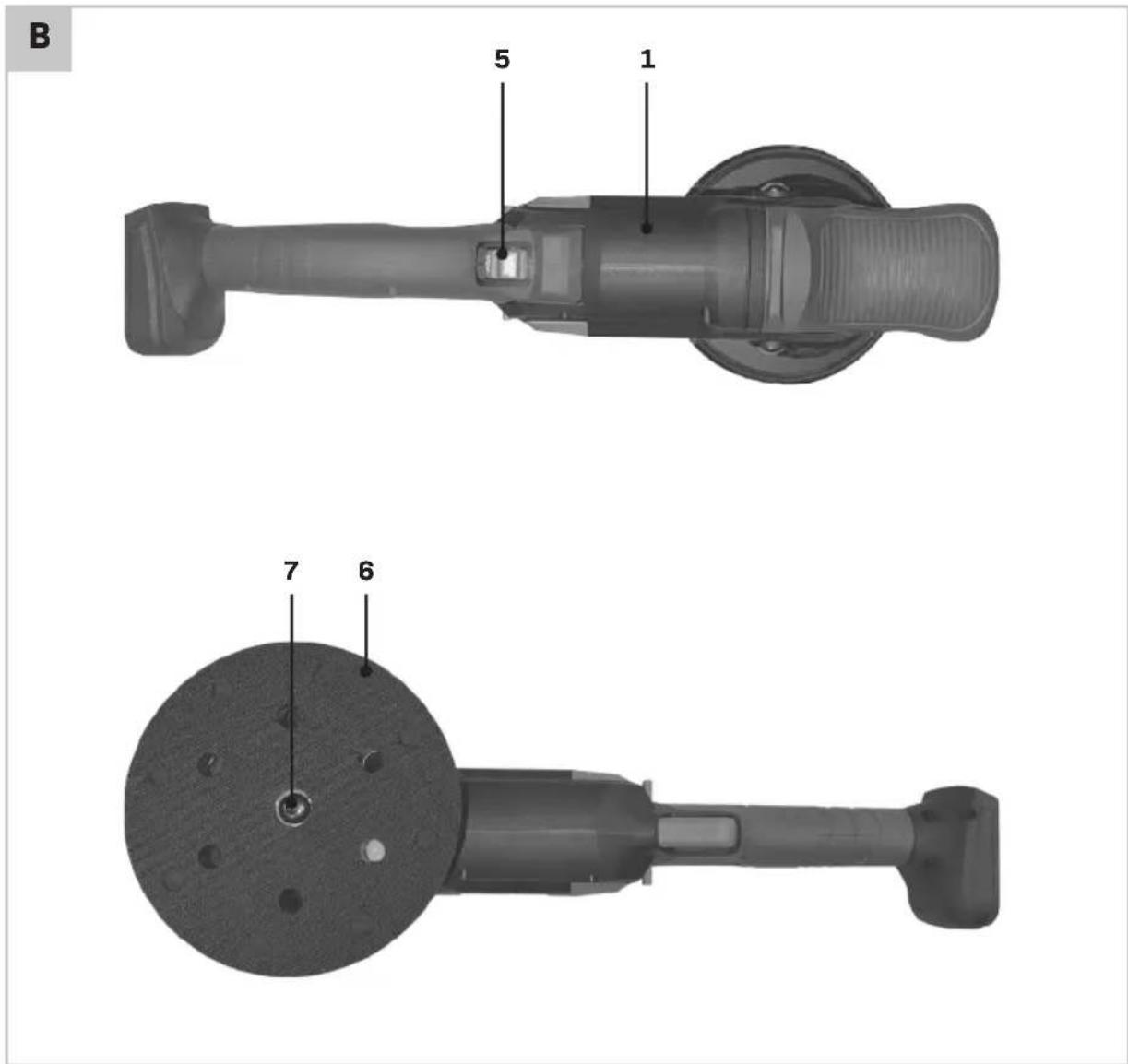
The numbers in the text refer to the diagrams on page 2-3.
- Machine
- Switch
- Safety lock button
- Lock-on button
- Speed dial
- Backing plate
- Backing plate hex screw
- Hex key
- Ventilation ports
- Battery
- Battery unlock button
- Battery LED indicators button
- Battery LED indicators
- Charger
- Charger LED indicators
3. ASSEMBLY

Before any work on the power tool, remove the battery.

The battery must be charged before first use.
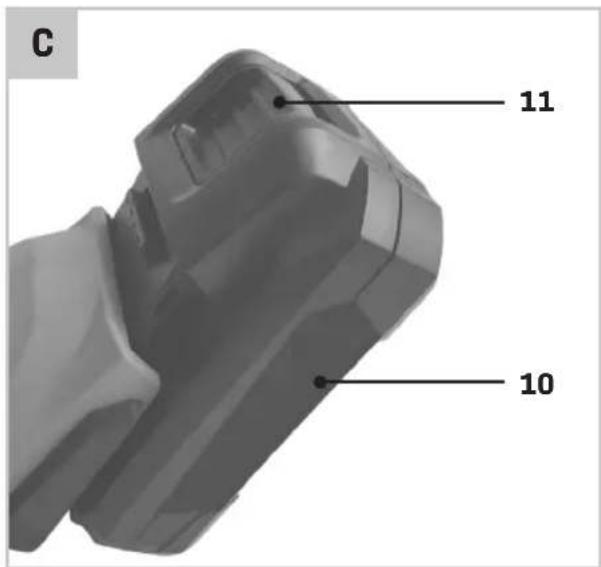
Inserting the battery into the machine (Fig. A, C)
Ensure that the exterior of the battery is clean and dry before connecting to the charger or machine.
- Insert the battery (10) into the base of the machine as shown in Fig. A, C.
- Push the battery further forward until it clicks into place.
Removing the battery from the machine (Fig. A, C)
- Push the battery unlock button (11)
- Pull the battery out of the machine like shown in Fig. F.
Checking the battery charging status (Fig. D)
- To check the battery charge status, push the button (12) on battery shortly.
- The battery has 3 lights indicating the charge level, the more lights that burn, the more charge the battery has left.
- When the lights are not burning it means the battery is empty and must be charged immediately.
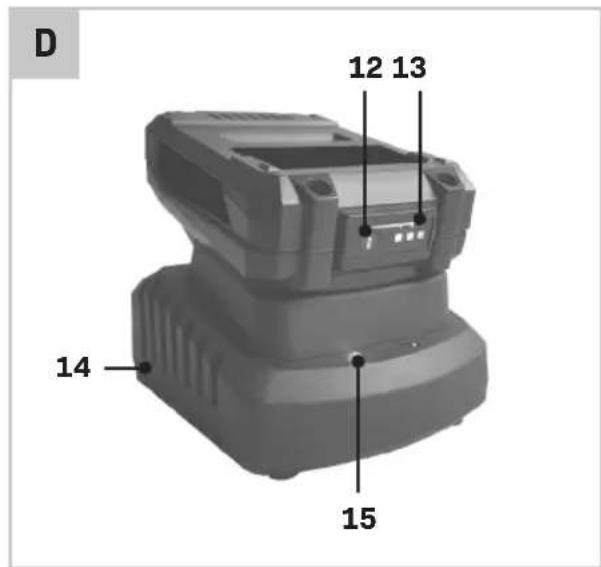
Charging the battery with the charger (Fig. D)
- Take the battery (10) from the machine.
- Turn the battery (10) to upside down position and slide it onto the charger (13) as shown in Fig. D.
- Push the battery until it is fully pushed into the slot.
- Plug the charger plug into an electrical outlet and wait for a while. The LED indicators on the charger (15) will lighten up and show the charger status.
The charger has 2 LED indicators (15) which indicate the status of the charging process:
| Red LED Status | Green LED status | Charger status |
| Off Off No power | ||
| Off On | Standby mode:- No battery is inserted or,- Battery inserted but charging has finished | |
| On Off | Battery charging in progress |
- Fully charging the 2Ah battery may take up to 60 minutes.
- Fully charging the 4Ah battery may take up to 120 minutes.
After the battery is fully charged remove the charger plug from the outlet and remove the battery from the charger.
Warning: When the machine is not being used over a longer period of time it is best to store the battery in charged condition.

Before assembly, always switch off the machine and remove the battery
Mounting and removing accessories (Fig. A, B)
Make sure to use the right accessory for the corresponding material. Use undamaged and clean polishing accessories only.
Backing plate
- Place the machine on its back.
- Put the hex key (8) in the backing plate hex screw (7).
- Hold the backingplate (6) with one hand to keep it from rotating.
- Unscrew the backingplate hex screw (7) using the hex key (8). Polishing pad
- Place the machine on its back.
- Firmly press the polishing pad onto the hook and loop backingplate (6).
To remove the polishing pad, simply pull the pad from the backingplate (6).
4. OPERATION

The battery must be charged before first use.

Wear protective gloves when changing the tool so as to avoid injuries from cuts.

Caution! The Backing plate (6) still runs for some time when the machine is turned off.
Switching on and off (Fig. A)
The on/off switch (2) is used for activating the machine
- To switch on the machine, press the on/off switch (2).
- To switch off the machine, release the on/off switch (2).
Locking the switch in to safety (Fig. A)
Press the safety lock button (3) to keep the switch from being pressed.
Locking the switch in the on position (Fig. A)
Lock the switch into the on position by pressing the lock-on button (4)
Speed control (Fig. B)
The speed of the disc can be controlled with the variable speed switch on top of the handle. The higher the position, the higher the speed. The variable speed switch can be set to 7 positions. When used for sanding the ideal speed depends on the required grain size and on the material to be worked. When using wax on the polishing pad do not start at a high speed.

Do not set the speed during use.
Hints for optimum use during polishing
- Always make sure the machine if properly cleaned before use to prevent scratches during polishing.
- For best results, the surface should be clean and dry.
- Do not apply polish directly to workpiece. Apply a small amount of polish on the polishing bonnet.
- Begin by polishing larger flat surfaces. Use a sweeping motion in a criss-cross pattern.
- Once flat surfaces have been covered, polish curved surfaces.
- For hard to reach areas, apply polish by hand.
- Do not use any type of abrasive cleanser as it may damage or scratch the surface.
5. MAINTENANCE

Before cleaning and maintenance, always switch off the machine and remove the battery pack from the machine.
Clean the machine casings regularly with a soft cloth, preferably after each use. Make sure that the ventilation openings are free of dust and dirt. Remove very persistent dirt using a soft cloth moistened with soapsuds. Do not use any solvents such as gasoline, alcohol, ammonia, etc. Chemicals such as these will damage the synthetic components.
WARRANTY
VONROC products are developed to the highest quality standards and are guaranteed free of defects in both materials and workmanship for the period lawfully stipulated starting from the date of original purchase. Should the product develop any failure during this period due to defective material and/or workmanship then contact VONROC directly.
The following circumstances are excluded from this guarantee:
- Repairs and or alterations have been made or attempted to the machine by unauthorized service centers;
- Normal wear and tear;
- The tool has been abused, misused or improperly maintained;
- Non-original spare parts have been used.
This constitutes the sole warranty made by company either expressed or implied. There are no other warranties expressed or implied which extend beyond the face hereof, herein, including the implied warranties of merchantability and fitness for a particular purpose. In no event shall VONROC be liable for any incidental or consequential damages. The dealers remedies shall be limited to repair or replacement of nonconforming units or parts.
The product and the user manual are subject to change. Specifications can be changed without further notice.
EXTRA VEILIGHEIDSWAARSCHUWINGEN VOOR POLIJSTEN

VEILIGHEIDSWAARSCHUWINGEN VOOR ACCU
VEILIGHEIDSWAARSCHUWINGEN VOOR DE OPLADER
Beoogd gebruik
2. MACHINE-INFORMATIE
Beoogd gebruik
| Modèle | Piles incluses | Chargeur inclus | Tampons abrasifs |
| PM510DC | --- | ||
| S_PM510DC | CD828AA CD802AA | 5 tampons (bord biseauté) | |
| S2_PM510DC | 2 x CD828AA | CD802AA | 5 tampons (bord biseauté) |
| S3_PM510DC | CD829AA CD802AA | 5 tampons (bord biseauté) | |
| S4_PM510DC | 2 x CD829AA | CD802AA | 5 tampons (bord biseauté) |
Comutator on/off (Fig. A)
DECLARATION OF CONFORMITY
PM510DC / S\_PM510DC / S2\_PM510DC / S3\_PM510DC / S4\_PM510DC
(EN) We declare under our sole responsibility that this product is in conformity with directive 2011/65/EU of the European parliament and of the council of 8 June on the restriction of the use of certain hazardous substances in electrical and electronic equipment is in conformity and accordance with the following standards and regulations:
(DE) Der Hersteller erklärt eigenverantwortlich, dass dieses Produkt der Direktive 2011/65/EU des Europäischen Parlaments und des Rats vom 8. Juni 2011 über die Einschränkung der Anwendung von bestimmten gefährlichen Stoffen in elektrischen und elektronischen Geräten entspricht. den folgenden Standards und Vorschriften entspricht:
(NL) Wij verklaren onder onze volledige verantwoordelijkheid dat dit product voldoet aan de conform Richtlijn 2011/65/EU van het Europees Parlement en de Raad van 8 juni 2011 betreffende beperking van het gebruik van bepaalde gevaarlijke stoffen in elektrische en elektronische apparatuur en in overeenstemming is met de volgende standaarden en reguleringen:
(FR) Nous déclarons sous notre seule responsabilité que ce produit est conforme aux standards et directives suivants: est conforme à la Directive 2011/65/EU du Parlement Européen et du Conseil du 8 juin 2011 concernant la limitation d'usage de certaines substances dangereuses dans l'équipement électrique et électronique.
(ES) Declaramos bajo nuestra exclusiva responsabilidad que este producto cumple con las siguientes normas y estándares de funcionamiento: se encuentra conforme con la Directiva 2011/65/UE del Parlamento Europeo y del Consejo de 8 de junio de 2011 sobre la restricción del uso de determinadas sustancias peligrosas en los equipos eléctricos y electrónicos
(IT) Dichiariamo, sotto la nostra responsabilità, che questo prodotto è conforme alle normative e ai regolamenti seguenti: è conforme alla Direttiva 2011/65/UE del Parlamento Europeo e del Consiglio dell'8 giugno 2011 sulla limitazione dell'uso di determinate sostanze pericolose nelle apparecchiature elettriche ed elettroniche.
(SV) Vi garanterar på eget ansvar att denna produkt upp fyller och följer följande standarder och bestämmelser: uppfyller direktiv 2011/65/EU från Europeiska parlamentet och EG-rådet från den 8 juni 2011 om begränsningen av användning av farliga substanser i elektrisk och elektronisk utrustning.
(DA) Vi erklærer under eget ansvar, at dette produkt er i overensstemmelse med følgende standarder og bestemmelser: er i overensstemmelse med direktiv 2011/65/EU fra Europa-Parlamentet og Rådet af 8. juni 2011 om begrænsning af anvendelsen af visse farlige stoffer i elektrisk og elektronisk udstyr.
(PL) Deklarujemy na własną odpowiedzialność, że ten produkt spełnia wymogi zawarte w następujących normach i przepisach: jest zgodny z Dyrektywą 2011/65/UE Parlamentu Europejskiego i Rady z dnia 8 czerwca 2011 r. w sprawie ograniczenia stosowania niektórych niebezpiecznych substancji w sprzęcie elektrycznym i elektronicznym.
(RO) Declarăm prin aceasta cu răspunderea deplină că produsul acesta este în conformitate cu următoarele standarde sau directive: este în conformitate cu Directiva 2011/65/UE a Parlamentului European și a Consiliului din 8 iunie 2011 cu privire la interzicerea utilizării anumitor substanțe periculoase la echipamentele electrice și electronice.
(PT) Declaramos por nossa total responsabilida-de que este produto está em conformidade e cumpre as normas e regulamentações que se seguem: está em conformidade com a Directiva 2011/65/EU do Parlamento Europeu e com o Conselho de 8 de Junho de 2011 no que respeita à restrição de utilização de determinadas substâncias perigosas existentes em equipamento eléctrico e electrónico.
(HU) Felelősségünk teljes tudatában kijelentjük, hogy ez a termék teljes mértékben megfelel az alábbi szabványoknak és előírásoknak: je v souladu se směrnicí 2011/65/EU Evropského parlamentu a Rady EU ze dne 8. června 2011, která se týká omezení použití určitých nebezpečných látek v elektrických a elektronických zařízeních.
(CS) Na naši vlastní zodpovědnost prohlašujeme, že je tento výrobek v souladu s následujícími standardy a normami: Je v súlade s normou 2011/65/EÚ Európskeho parlamentu a Rady z 8. júna 2011 týkajúcej sa obmedzenia používania určitých nebezpečných látok v elektrickom a elektronickom vybavení.
(TR) Tek sorumlusu biz olmak üzere bu ürünün Avrupa Parlamentosunun 2011/65/EU ve 8 Haziran 2011 tarihli konseyin elektrikli ve elektronik ekipmanlarda belirlenmiş tehlikeli malzeme kullanımının kısıtlanması hakkındaki talimatları ile birlikte aşağıda belirtilen standart ve yönergelere uygun ve uyumlu olduğunu beyan ederiz:
EN IEC55014-1, EN IEC55014-2, EN62841-1, EN62841-2-4, 2006/42/EC, 2011/65/EU, 2012/19/EU, 2014/30/EU
S_PM510DC / S2_PM510DC / S3_PM510DC / S4_PM510DC:
EN 55014-1, EN 55014-2, EN 62841-1, EN 62841-2-4, EN 61000-3-2,
EN 61000-3-3, EN 60335-1, EN 60335-2-29
2006/42/EC, 2014/30/EU, 2012/19/EU, 2011/65/EU, 2014/35/EU
Zwolle, 01-05-2025 H.G.FRosberg CEO
VONROC • Lingenstraat 6 • 8028 PM Zwolle • The Netherlands