ManualGo.com
KNS 18 LTX 150 - Sander METABO - Free user manual and instructions
Find the device manual for free KNS 18 LTX 150 METABO in PDF.

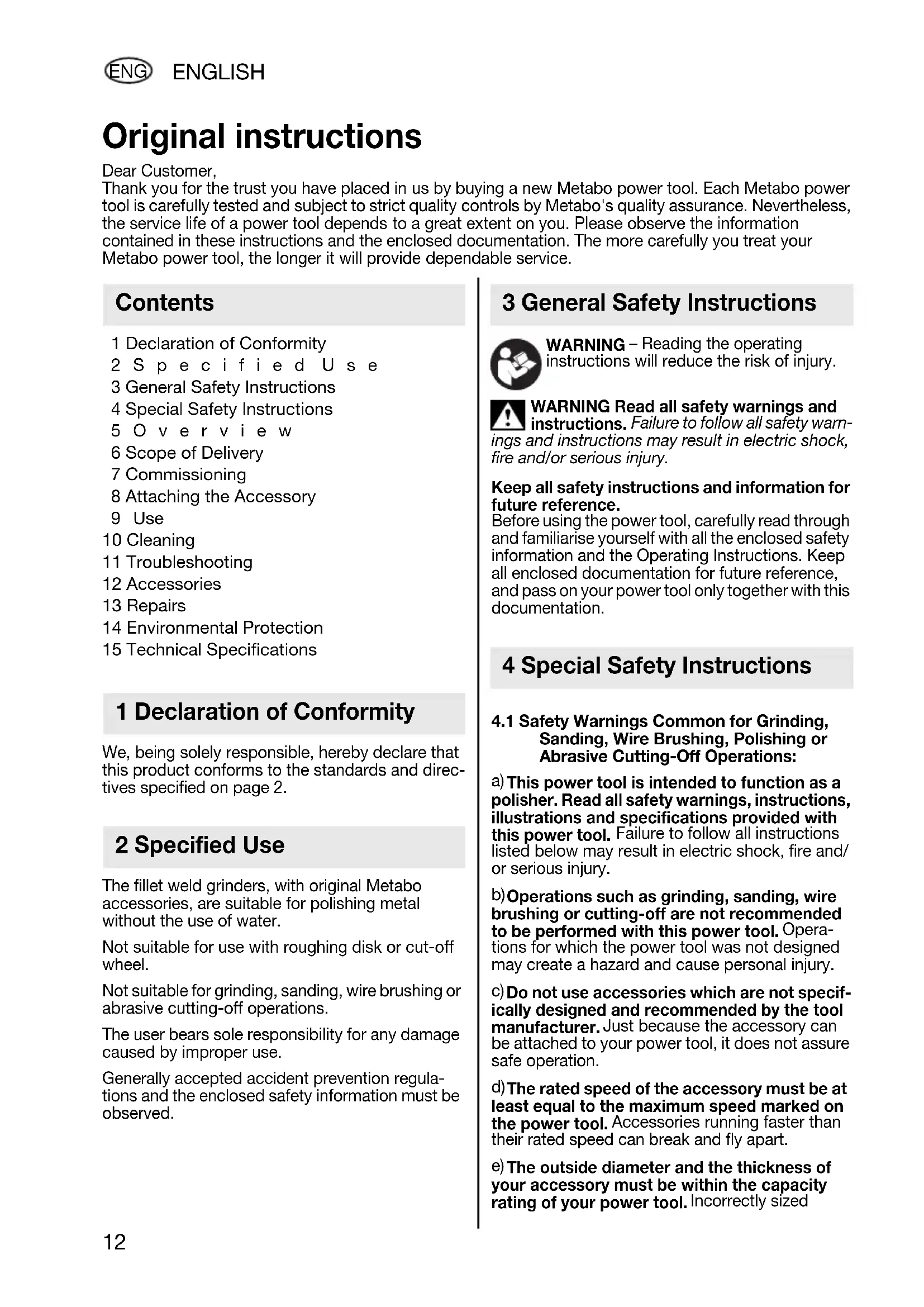


Download the instructions for your Sander in PDF format for free! Find your manual KNS 18 LTX 150 - METABO and take your electronic device back in hand. On this page are published all the documents necessary for the use of your device. KNS 18 LTX 150 by METABO.
USER MANUAL KNS 18 LTX 150 METABO
m kg (lbs) 3,0 (6.6)
pA/WA = Unsicherheit (Schallpegel) Beim Arbeiten kann der Geräuschpegel 80 dB(A) überschreiten. Gehörschutz tragen! Messwerte ermittelt gemäß EN 60745. Die angegebenen technischen Daten sind toleranzbehaftet (entsprechend den jeweils gültigen Standards). 17027055_0411 KNS 18 LTX 150.book Seite 11 Dienstag, 26. April 2011 2:46 1412 ENGLISH ENG 1 Declaration of Conformity 2Specified Use 3 General Safety Instructions 4 Special Safety Instructions 5Overview 6 Scope of Delivery 7 Commissioning 8 Attaching the Accessory 9Use 10 Cleaning 11 Troubleshooting 12 Accessories 13 Repairs 14 Environmental Protection 15 Technical Specifications We, being solely responsible, hereby declare that this product conforms to the standards and direc- tives specified on page 2. The fillet weld grinders, with original Metabo accessories, are suitable for polishing metal without the use of water. Not suitable for use with roughing disk or cut-off wheel. Not suitable for grinding, sanding, wire brushing or abrasive cutting-off operations. The user bears sole responsibility for any damage caused by improper use. Generally accepted accident prevention regula- tions and the enclosed safety information must be observed. WARNING – Reading the operating instructions will reduce the risk of injury. WARNING Read all safety warnings and instructions. Failure to follow all safety warn- ings and instructions may result in electric shock, fire and/or serious injury. Keep all safety instructions and information for future reference. Before using the power tool, carefully read through and familiarise yourself with all the enclosed safety information and the Operating Instructions. Keep all enclosed documentation for future reference, and pass on your power tool only together with this documentation.
4.1 Safety Warnings Common for Grinding,
Sanding, Wire Brushing, Polishing or Abrasive Cutting-Off Operations:
This power tool is intended to function as a polisher. Read all safety warnings, instructions, illustrations and specifications provided with this power tool. Failure to follow all instructions listed below may result in electric shock, fire and/ or serious injury.
Operations such as grinding, sanding, wire brushing or cutting-off are not recommended to be performed with this power tool. Opera- tions for which the power tool was not designed may create a hazard and cause personal injury.
Do not use accessories which are not specif- ically designed and recommended by the tool manufacturer. Just because the accessory can be attached to your power tool, it does not assure safe operation.
The rated speed of the accessory must be at least equal to the maximum speed marked on the power tool. Accessories running faster than their rated speed can break and fly apart.
The outside diameter and the thickness of your accessory must be within the capacity rating of your power tool. Incorrectly sized Original instructions Dear Customer, Thank you for the trust you have placed in us by buying a new Metabo power tool. Each Metabo power tool is carefully tested and subject to strict quality controls by Metabo's quality assurance. Nevertheless, the service life of a power tool depends to a great extent on you. Please observe the information contained in these instructions and the enclosed documentation. The more carefully you treat your Metabo power tool, the longer it will provide dependable service. Contents 1 Declaration of Conformity 2 Specified Use 3 General Safety Instructions 4 Special Safety Instructions 17027055_0411 KNS 18 LTX 150.book Seite 12 Dienstag, 26. April 2011 2:46 14ENGLISH
ENG accessories cannot be adequately guarded or controlled.
The arbour size of wheels, flanges, backing pads or any other accessory must properly fit the spindle of the power tool. Accessories with arbour holes that do not match the mounting hard- ware of the power tool will run out of balance, vibrate excessively and may cause loss of control.
Do not use a damaged accessory. Before each use inspect the accessory such as abra- sive wheels for chips and cracks, backing pad for cracks, tear or excess wear, wire brush for loose or cracked wires. If a power tool or accessory is dropped, inspect for damage or install an undamaged accessory. After inspecting and installing an accessory, position yourself and bystanders away from the plane of the rotating accessory and run the power tool at maximum no-load speed for one minute. Damaged accessories will normally break apart during this test time.
Wear personal protective equipment. Depending on application, use face shield, safety goggles or safety glasses. As appro- priate, wear dust mask, hearing protectors, gloves and workshop apron capable of stop- ping small abrasive or workpiece fragments. The eye protection must be capable of stopping flying debris generated by various operations. The dust mask or respirator must be capable of filtering particles generated by your operation. Prolonged exposure to high intensity noise may cause hearing loss.
Keep bystanders a safe distance away from work area. Anyone entering the work area must wear personal protective equipment. Fragments of workpiece or of a broken accessory may fly away and cause injury beyond immediate area of operation.
Hold power tool by insulated gripping surfaces only, when performing an operation where the cutting accessory may contact hidden wiring or its own cord. Cutting accessory contacting a "live" wire may make exposed metal parts of the power tool "live" and could give the operator an electric shock.
Position the cord clear of the spinning acces- sory. If you lose control, the cord may be cut or snagged and your hand or arm may be pulled into the spinning accessory.
Never lay the power tool down until the accessory has come to a complete stop. The spinning accessory may grab the surface and pull the power tool out of your control.
Do not run the power tool while carrying it at your side. Accidental contact with the spinning accessory could snag your clothing, pulling the accessory into your body.
Regularly clean the power tool’s air vents. The motor’s fan will draw the dust inside the housing and excessive accumulation of powdered metal may cause electrical hazards.
Do not operate the power tool near flam- mable materials. Sparks could ignite these mate- rials.
Do not use accessories that require liquid coolants. Using water or other liquid coolants may result in electrocution or shock.
4.2 Kickback and Related Warnings
Kickback is a sudden reaction to a pinched or snagged rotating wheel, backing pad, brush or any other accessory. Pinching or snagging causes rapid stalling of the rotating accessory which in turn causes the uncontrolled power tool to be forced in the direction opposite of the accessory’s rotation at the point of the binding. For example, if an abrasive wheel is snagged or pinched by the workpiece, the edge of the wheel that is entering into the pinch point can dig into the surface of the material causing the wheel to climb out or kick out. The wheel may either jump toward or away from the operator, depending on direction of the wheel’s movement at the point of pinching. Abrasive wheels may also break under these conditions. Kickback is the result of power tool misuse and/or incorrect operating procedures or conditions and can be avoided by taking proper precautions as given below.
Maintain a firm grip on the power tool and position your body and arm to allow you to resist kickback forces. Always use auxiliary handle, if provided, for maximum control over kickback or torque reaction during start-up. The operator can control torque reactions or kick- back forces, if proper precautions are taken.
Never place your hand near the rotating accessory. Accessory may kickback over your hand.
Do not position your body in the area where power tool will move if kickback occurs. Kickback will propel the tool in direction opposite to the wheel’s move- ment at the point of snagging.
Use special care when working corners, sharp edges etc. Avoid bouncing and snagging the accessory. Corners, sharp edges or bouncing have a tendency to snag the rotating accessory and cause loss of control or kickback.
4.3 Safety Warnings Specific for Polishing:
Loose parts on the polishing guard, especially the fastening cords, are not permitted. Tuck away or shorten the fastening cords. Loose, spinning fastening cords may make contact with your fingers or become caught in the workpiece.
4.4 Additional Safety Instructions
Use elastic cushioning layers if they have been supplied with the abrasive and if required. Observe the specifications of the tool or accessory manufacturer! Protect the discs from grease or impacts! Accessories must be stored and handled with care in accordance with the manufacturer's instruc- tions. The workpiece must lay flat and be secured against slipping, e.g. using clamps. Large work- pieces must be sufficiently supported. For your own protection and for the protection of your power tool, pay attention to all parts of the text that are marked with this symbol! Always wear protective goggles. Use of a fixed extractor system is recommended. Dust from materials such as lead-containing paint and metal may be harmful to health. Contact with or inhalation of the dust may cause allergic reac- tions and/or respiratory diseases to the operator or bystanders. Certain kinds of dust are classified as carcino- genic. Material containing asbestos must only be treated by specialists. - Where the use of a dust extraction device is possible it shall be used. - The work place must be well ventilated. - The use of a dust mask of filter class P2 is recommended. Follow national requirements for the materials you want to work with. Materials that generate dusts or vapours that may be harmful to health (e.g. asbestos) must not be processed. When working in dusty conditions, ensure that ventilation openings are not blocked. If it becomes necessary to remove dust, first remove the battery pack (use non-metallic objects) and avoid damaging internal components. Damaged, eccentric or vibrating tools must not be used. Remove the battery pack from the machine before any adjustments, conversions or servicing are performed. Before fitting the battery pack, make sure that the machine is switched off. A damaged or cracked additional handle must be replaced. Never operate a machine with a defec- tive additional handle. A damaged or cracked hand guard must be replaced. Never operate a machine with a defec- tive hand guard.
4.5 Safety instructions for battery packs:
Protect battery packs from water and moisture! Do not expose battery packs to naked flame! Do not use faulty or deformed battery packs! Do not open battery packs! Do not touch or short-circuit battery packs! Slightly acidic, flammable fluid may leak from defective Li-ion battery packs! If battery fluid leaks out and comes into contact with your skin, rinse immediately with plenty of water. If battery fluid leaks out and comes into contact with your eyes, wash them with clean water and seek medical attention immediately. See page 3. 1 Hand protection 2 Extension arm 3 Screw for adjusting the extension arm 4 Additional handle / Additional handle with vibration damping * 5Sliding on/off switch 6 Electronic signal indicator
attery pack release button 8 Capacity indicator button 9 Capacity and signal indicator 10 Battery pack 11 Dust filter 12 Adjusting nut 13 Accessory * 14 Support flange 15 Spindle 16 Screws for securing the hand guard 17 Allen key 18 2-hole spanner
ENG The machine is also available with different acces- sory parts. An overview can be found on page 4. Subject to change. A Battery pack B Nylon web compact disk C File for profiling nylon web compact disks D Sanding paper strips for file
7.1 Attaching the additional handle
Always work with the additional handle attached (4)! Attach the additional handle on the left or right of the machine and secure.
7.2 Attaching the hand guard
Always work with the hand guard (1) attached. To rotate hand guard (if required): See illustration c, page 3. Extract the screws (16), remove the hand guard (1) and replace it so it is turned. Secure with screws (16).
See illustration c on page 3. Always fit the dust filter if the surroundings are heavily polluted (11). The machine heats up faster when the dust filter is fitted (11). It is protected by the elec- tronics system from overheating (see chapter11). To fit: See fig. page 3. Attach the dust filter (11) as shown. To remove: Holding the dust filter at the edges, raise it slightly (11) and then pull it downwards and remove.
7.4 Rotating battery pack
See illustration c on page 3. The rear section of the machine can be rotated 270° in three stages, thus allowing the machine's shape to be adapted to the working conditions. Only operate the machine when it is in an engaged position.
Charge the battery pack before use (10). If performance diminishes, recharge the battery pack. The ideal storage temperature is between 10°C and 40°C. "Li-Power" li-ion battery packs have a capacity and signal indicator: (9) - Press the button (8), the LEDs indicate the charge level. - If one LED is flashing, the battery pack is almost flat and must be recharged.
7.6 Removing and inserting the battery
pack Removal: Press the battery pack release (7) button and pull the battery pack (10) forwards. Inserting: Slide in the battery pack (10) until it engages.
7.7 Twist the extension arm, if necessary.
- Slacken the screw (3). - Twist the extension arm (2) (but not so far that it hits the gearbox housing). The extension arm must be fitted as far as the limit stop on the gearbox flange. Firmly tighten the screw (3) again. Before carrying out any modifications: remove the battery pack from the machine. The machine must be switched off and the spindle at a standstill.
8.1 Positioning the accessory
See illustration c, page 3. - The two sides of the support flange (14) are different: Place the support flange (14) around the spindle (15) in such a way that the large collar diameter which corresponds to the accessory (13) is facing upwards. - Place the accessory (13) on the support flange (14). The accessory must lay flat on the supporting flange. 6 Scope of delivery 7 Initial Operation 8 Attaching the accessory 17027055_0411 KNS 18 LTX 150.book Seite 15 Dienstag, 26. April 2011 2:46 1416 ENGLISH ENG 8.2 Tightening/loosening the clamping nutSecuring the clamping nut (12):See illustration d on page 3.The 2 sides of the clamping nut (12) are different. Screw the clamping nut onto the spindle (15) as follows: A) In the case of thick (6 mm) accessories:The collar of the clamping nut (12) faces down-wards so that the clamping nut can be attached securely to the spindle.B) In the case of thin (3 mm) accessories:The collar of the clamping nut (12) faces upwards so that the thin accessory can be clamped securely.- Lock the spindle (15) using the Allen key (17). Tighten the clamping nut (12) by turning it clock-wise using the 2-hole spanner (18) (see illustra-tion c, page 3).Releasing the clamping nut:- Lock the spindle using the Allen key (17). Remove the clamping nut (12) by turning it anticlockwise using the 2-hole spanner (18) (see illustration b, page 3).9.1 Switching On and OffAlways guide the machine with both hands.Switch on first, then guide the accessory towards the workpiece.The machine must not be allowed to draw in additional dust and shavings. When switching the machine on and off, keep it away from dust deposits. After switching off the machine, only place it down when the motor has come to a standstill.Avoid switching on the machine accidentally: always switch it off when the battery pack is removed from the machine.In continuous operation, the machine continues running if it is forced out of your hands. Therefore, always hold the machine with both hands using the handles provided, stand in a safe position and concentrate.Switching on: Push the slide switch (5) forward. For continuous operation, flip the switch down until it locks in place.Switching off: Press the rear end of the slide switch (5) and release.9.2 Working instructionsPress down lightly on the machine and move over and back across the surface.Motor cleaning: blow compressed air through the rear ventilation slots of the machine regularly, frequently and thoroughly. Here, the machine must be held firmly. The electronic signal display (6) lights up and the load speed decreases. The temperature is too high! Run the machine in idling until the electronics signal indicator switches off. The electronic signal display (6) flashes and the machine does not start. The restart protection is active. The machine will not start if the battery pack is inserted while the machine is on. Switch the machine off and on again.Use only genuine Metabo accessories.If you need any accessories, check with your dealer.For dealers to select the correct accessory, they need to know the exact model designation of your power tool.For a complete range of accessories, see www.metabo.com or the main catalogue. 9Use 9A9B 10 Cleaning 11 Troubleshooting 12 Accessories
ENG Repairs to electrical tools must be carried out by qualified electricians ONLY! If you have Metabo electrical tools that require repairs, please contact your Metabo service centre. For addresses see www.metabo.com. You can download spare parts lists from www.metabo.com. The sanding dust generated may contain hazardous materials: do not dispose of with the household waste, but at a special collection point for hazardous waste. Metabo's packaging can be 100% recycled. Scrap power tools and accessories contain large amounts of valuable resources and plastics that can be recycled. Battery packs must not be disposed of with regular waste. Return faulty or used battery packs to your Metabo dealer! Do not allow battery packs to come into contact with water! Only for EU countries: Never dispose of power tools in your household waste! In accordance with European Guideline 2002/ 96/EC on used electronic and electric equipment and its implementation in national legal systems, used power tools must be collected separately and handed in for environmentally compatible recycling. Before disposal, discharge the battery pack in the power tool. Prevent the contacts from short- circuiting (e. g. by protecting them with adhesive tape). These instructions are printed on chlorine-free bleached paper. Explanation of details on page 2 . Subject to changes serving technical progress. U = Voltage of battery pack
max = maximum diameter of accessory
max,1 = max. permitted thickness of clamping shank on accessory when using clamping nut (12)
max,3 = max. permitted thickness of accessory M = Spindle thread l = Length of the grinding spindle n = No-load speed (maximum speed) m = Weight with smallest battery pack Vibration total value (vector sum of three directions) determined in accordance with EN 60745:
h, P = Vibration emission value (polishing)
h,P = Uncertainty (vibration) The vibration emission level given in this informa- tion sheet has been measured in accordance with a standardised test given in EN 60745 and may be used to compare one tool with another. It is also suitable for a provisional estimate of the vibratory load. The specified vibration level applies to the main applications of the power tool. However, if the tool is used for other applications, with different acces- sories or is poorly maintained, the vibration level may vary. This can considerably increase the vibratory load over the entire working period. An estimation of the level of exposure to vibration should also take into account the times when the tool is switched off or when it is running but not actually doing the job. This can considerably reduce the vibratory load over the entire working period. Identify additional safety measures to protect the operator from the effects of vibration such as: maintain the tool and the accessories, keep the hands warm, organisation of work patterns. A-effective perceived sound levels:
= Sound pressure level
= Acoustic power level
pA/WA = Uncertainty (noise level) During operation the noise level can exceed 80 dB(A). Wear ear protectors! Measured values determined in conformity with EN 60745. The technical specifications quoted are subject to tolerances (in compliance with the relevant valid standards). 13 Repairs 14 Environmental Protection 15 Technical Specifications 17027055_0411 KNS 18 LTX 150.book Seite 17 Dienstag, 26. April 2011 2:46 1418 FRANÇAIS
h, P = Vibrationsemission (polering)