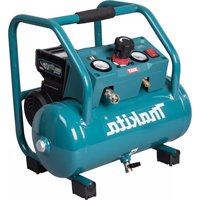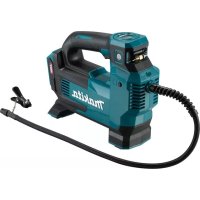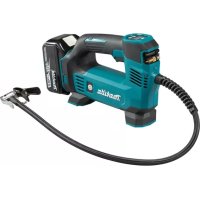
DMP180RT1J - Compressor MAKITA - Free user manual and instructions
Find the device manual for free DMP180RT1J MAKITA in PDF.



User questions about DMP180RT1J MAKITA
0 question about this device. Answer the ones you know or ask your own.
Ask a new question about this device
Download the instructions for your Compressor in PDF format for free! Find your manual DMP180RT1J - MAKITA and take your electronic device back in hand. On this page are published all the documents necessary for the use of your device. DMP180RT1J by MAKITA.
USER MANUAL DMP180RT1J MAKITA
natural_image
Line drawing of a portable air purifier with coiled tubing and control panel (no text or symbols)SPECIFICATIONS
| Model: DMP180 | |
| Overall length 251 – 266 mm (9-7/8" – 10-1/2") | |
| Maximum air pressure 830 kPa (121 PSI) | |
| Duty cycle 5 minutes On / 5 minutes Off | |
| Rated voltage D.C. 18 V | |
| Net weight 1.4 - 1.7 kg (3.1 - 3.7 lbs) |
• Due to our continuing program of research and development, the specifications herein are subject to change without notice.
- Specifications and battery cartridge may differ from country to country.
- The weight may differ depending on the attachment(s), including the battery cartridge. The lightest and heaviest combinations, according to EPTA-Procedure 01/2014, are shown in the table.
Applicable battery cartridge and charger
| Battery cartridge | BL1815N / BL1820B / BL1830 / BL1830B / BL1840B / BL1850B / BL1860B |
| Charger | DC18RC / DC18RD / DC18RE / DC18SD / DC18SE / DC18SF / DC18SH |
• Some of the battery cartridges and chargers listed above may not be available depending on your region of residence.

WARNING: Only use the battery cartridges and chargers listed above. Use of any other battery cartridges and chargers may cause injury and/or fire.
SAFETY WARNINGS
General power tool safety warnings

WARNING: Read all safety warnings, instructions, illustrations and specifications provided with this power tool. Failure to follow all instructions ed below may result in electric shock, fire and/orious injury.
Save all warnings and instructions for future reference.
The term "power tool" in the warnings refers to your mains-operated (corded) power tool or battery-operated (cordless) power tool.
Work area safety
- Keep work area clean and well lit. Cluttered or dark areas invite accidents.
- Do not operate power tools in explosive atmospheres, such as in the presence of flammable liquids, gases or dust. Power tools create sparks which may ignite the dust or fumes.
- Keep children and bystanders away while operating a power tool. Distractions can cause you to lose control.
Electrical Safety
-
Power tool plugs must match the outlet. Never modify the plug in any way. Do not use any adapter plugs with earthed (grounded) power tools. Unmodified plugs and matching outlets will reduce risk of electric shock.
-
Avoid body contact with earthed or grounded surfaces, such as pipes, radiators, ranges and refrigerators. There is an increased risk of electric shock if your body is earthed or grounded.
- Do not expose power tools to rain or wet conditions. Water entering a power tool will increase the risk of electric shock.
- Do not abuse the cord. Never use the cord for carrying, pulling or unplugging the power tool. Keep cord away from heat, oil, sharp edges or moving parts. Damaged or entangled cords increase the risk of electric shock.
- When operating a power tool outdoors, use an extension cord suitable for outdoor use. Use of a cord suitable for outdoor use reduces the risk of electric shock.
- If operating a power tool in a damp location is unavoidable, use a ground fault circuit interrupter (GFCI) protected supply. Use of a GFCI reduces the risk of electric shock.
- Power tools can produce electromagnetic fields (EMF) that are not harmful to the user. However, users of pacemakers and other similar medical devices should contact the maker of their device and/or doctor for advice before operating this power tool.
Personal Safety
-
Stay alert, watch what you are doing and use common sense when operating a power tool. Do not use a power tool while you are tired or under the influence of drugs, alcohol or medication. A moment of inattention while operating power tools may result in serious personal injury.
-
Use personal protective equipment. Always wear eye protection. Protective equipment such as dust mask, non-skid safety shoes, hard hat, or hearing protection used for appropriate conditions will reduce personal injuries.
- Prevent unintentional starting. Ensure the switch is in the off-position before connecting to power source and/or battery pack, picking up or carrying the tool. Carrying power tools with your finger on the switch or energising power tools that have the switch on invites accidents.
- Remove any adjusting key or wrench before turning the power tool on. A wrench or a key left attached to a rotating part of the power tool may result in personal injury.
- Do not overreach. Keep proper footing and balance at all times. This enables better control of the power tool in unexpected situations.
- Dress properly. Do not wear loose clothing or jewellery. Keep your hair, clothing and gloves away from moving parts. Loose clothes, jewellery or long hair can be caught in moving parts.
- If devices are provided for the connection of dust extraction and collection facilities, ensure these are connected and properly used. Use of dust collection can reduce dust-related hazards.
- Do not let familiarity gained from frequent use of tools allow you to become complacent and ignore tool safety principles. A careless action can cause severe injury within a fraction of a second.
- Always wear protective goggles to protect your eyes from injury when using power tools. The goggles must comply with ANSI Z87.1 in the USA. It is an employer's responsibility to enforce the use of appropriate safety protective equipment by the tool operators and by other persons in the immediate working area.
Power tool use and care
- Do not force the power tool. Use the correct power tool for your application. The correct power tool will do the job better and safer at the rate for which it was designed.
- Do not use the power tool if the switch does not turn it on and off. Any power tool that cannot be controlled with the switch is dangerous and must be repaired.
- Disconnect the plug from the power source and/or remove the battery pack, if detachable, from the power tool before making any adjustments, changing accessories, or storing power tools. Such preventive safety measures reduce the risk of starting the power tool accidentally.
- Store idle power tools out of the reach of children and do not allow persons unfamiliar with the power tool or these instructions to operate the power tool. Power tools are dangerous in the hands of untrained users.
-
Maintain power tools and accessories. Check for misalignment or binding of moving parts, breakage of parts and any other condition that may affect the power tool's operation. If damaged, have the power tool repaired before use. Many accidents are caused by poorly maintained power tools.
-
Keep cutting tools sharp and clean. Properly maintained cutting tools with sharp cutting edges are less likely to bind and are easier to control.
- Use the power tool, accessories and tool bits etc. in accordance with these instructions, taking into account the working conditions and the work to be performed. Use of the power tool for operations different from those intended could result in a hazardous situation.
- Keep handles and grasping surfaces dry, clean and free from oil and grease. Slippery handles and grasping surfaces do not allow for safe handling and control of the tool in unexpected situations.
- When using the tool, do not wear cloth work gloves which may be entangled. The entanglement of cloth work gloves in the moving parts may result in personal injury.
Battery tool use and care
- Recharge only with the charger specified by the manufacturer. A charger that is suitable for one type of battery pack may create a risk of fire when used with another battery pack.
- Use power tools only with specifically designated battery packs. Use of any other battery packs may create a risk of injury and fire.
- When battery pack is not in use, keep it away from other metal objects, like paper clips, coins, keys, nails, screws or other small metal objects, that can make a connection from one terminal to another. Shorting the battery terminals together may cause burns or a fire.
- Under abusive conditions, liquid may be ejected from the battery; avoid contact. If contact accidentally occurs, flush with water. If liquid contacts eyes, additionally seek medical help. Liquid ejected from the battery may cause irritation or burns.
- Do not use a battery pack or tool that is damaged or modified. Damaged or modified batteries may exhibit unpredictable behaviour resulting in fire, explosion or risk of injury.
- Do not expose a battery pack or tool to fire or excessive temperature. Exposure to fire or temperature above 130 °C may cause explosion.
- Follow all charging instructions and do not charge the battery pack or tool outside the temperature range specified in the instructions. Charging improperly or at temperatures outside the specified range may damage the battery and increase the risk of fire.
Service
- Have your power tool serviced by a qualified repair person using only identical replacement parts. This will ensure that the safety of the power tool is maintained.
- Never service damaged battery packs. Service of battery packs should only be performed by the manufacturer or authorized service providers.
- Follow instruction for lubricating and changing accessories.
- Do not modify or attempt to repair the appliance or the battery pack except as indicated in the instructions for use and care.
Cordless inflator safety warnings
-
When inflating objects, connect the air chuck, adapter, and valve tightly. Otherwise, the object, hose, air chuck, or adapter may be damaged and you may be injured.
-
Release air pressure slowly. When removing the hose after inflating objects, hold the object, hose, and air chuck firmly. The object, air chuck, or adapter may bounce due to exhaust air and cause an injury.
-
Do not inflate object beyond the maximum pressure of the object. Otherwise, the tool or object may be damaged and you may be injured.
-
Do not use the tool beyond the maximum output pressure of the tool. Using the tool at output pressure greater than the maximum output pressure of the tool may burst the object or the tool.
-
Inflate the objects intended to be inflated by the manufacturer only, such as tire, sport ball, or small floating tube. Inflating other objects may damage them and cause an injury.
-
When inflating objects, check the pressure gauge, status of the tool and object, and check that there is no air leak. Otherwise, the tool or object may be damaged and cause an injury.
-
When carrying the tool, hold the handle of the tool. Do not hold or pull the hose. The tool may be damaged and cause an injury.
-
After inflating objects, check the air pressure using a reliable and calibrated measuring equipment. Use the pressure gauge of the tool only as a reference.
-
After using the tool for 5 minutes continuously, stop using the tool for 5 minutes for cooling down. Do not use the tool beyond the continuous operating time allowed. Otherwise, the tool may be damaged and cause an injury.
-
Do not use the tool on sand or dusty surface. Foreign objects may enter the inside of the tool and cause a malfunction.
-
Do not point the outlet of the hose to yourself or others. Objects may be blown away and cause an injury.
-
Do not point the outlet of the hose to dust or similar. The dust may be scattered and cause an injury.
-
Do not inflate large capacity objects. If you inflate a large capacity object, the tool may become extremely hot and could burn your skin.
-
Do not touch the tool, hose, air chuck, or adapter right after inflating objects. The metal parts may become extremely hot and could burn your skin.
-
Do not use the tool with wet hands.
-
When folding the clamp of air chuck, be careful not to pinch your fingers between the air chuck and clamp.
-
Make sure that the hose is not entangled. The entangled hose may cause loss of balance and cause an injury.
-
Never leave the tool unattended when the hose is attached to the object or during operation.
-
Do not use the tool as a breathing device.
-
Do not use the tool to spray chemicals. Your lungs may be damaged by inhaling toxic fumes.
-
Operate the tool in an open area at least 50 cm (20") away from any wall or object that could restrict air flow to ventilation openings.
-
Do not disassemble the tool.
-
Use only standard accessories provided by Makita. The use of any other accessories or attachments might present a risk of injury to persons.
-
This tool is for household use only.
-
Do not store the tool in locations where the temperature may go -20 °C (-4 °F) or less, or, 60 °C (140 °F) or more.
-
Do not use the tool in locations where the temperature may go -10 °C (14 °F) or less, or, 40 °C (104 °F) or more.
Symbols
The followings show the symbols used for tool.
| v | volts |
| — | direct current |
| ... |
Important safety instructions for battery cartridge
-
Before using battery cartridge, read all instructions and cautionary markings on (1) battery charger, (2) battery, and (3) product using battery.
-
Do not disassemble battery cartridge.
-
If operating time has become excessively shorter, stop operating immediately. It may result in a risk of overheating, possible burns and even an explosion.
-
If electrolyte gets into your eyes, rinse them out with clear water and seek medical attention right away. It may result in loss of your eyesight.
-
Do not short the battery cartridge:
(1) Do not touch the terminals with any conductive material.
(2) Avoid storing battery cartridge in a container with other metal objects such as nails, coins, etc.
(3) Do not expose battery cartridge to water or rain.
A battery short can cause a large current flow, overheating, possible burns and even a breakdown.
- Do not store the tool and battery cartridge in locations where the temperature may go -20 °C (-4 °F) or less, or, 50 °C (122 °F) or more.
- Do not incinerate the battery cartridge even if it is severely damaged or is completely worn out. The battery cartridge can explode in a fire.
- Be careful not to drop or strike battery.
-
Do not use a damaged battery.
-
The contained lithium-ion batteries are subject to the Dangerous Goods Legislation requirements.
For commercial transports e.g. by third parties, forwarding agents, special requirement on packaging and labeling must be observed.
For preparation of the item being shipped, consulting an expert for hazardous material is required.
Please also observe possibly more detailed national regulations.
Tape or mask off open contacts and pack up the battery in such a manner that it cannot move around in the packaging.
- When disposing the battery cartridge, remove it from the tool and dispose of it in a safe place. Follow your local regulations relating to disposal of battery.
- Use the batteries only with the products specified by Makita. Installing the batteries to non-compliant products may result in a fire, excessive heat, explosion, or leak of electrolyte.
- If the tool is not used for a long period of time, the battery must be removed from the tool.
SAVE THESE INSTRUCTIONS.
⚠️CAUTION: Only use genuine Makita batteries.
Use of non-genuine Makita batteries, or batteries that have been altered, may result in the battery bursting causing fires, personal injury and damage. It will also void the Makita warranty for the Makita tool and charger.
Tips for maintaining maximum battery life
- Charge the battery cartridge before completely discharged. Always stop tool operation and charge the battery cartridge when you notice less tool power.
- Never recharge a fully charged battery cartridge. Overcharging shortens the battery service life.
- Charge the battery cartridge with room temperature at 10 °C - 40 °C (50 °F - 104 °F). Let a hot battery cartridge cool down before charging it.
- Charge the battery cartridge if you do not use it for a long period (more than six months).
FUNCTIONAL DESCRIPTION
CAUTION: Always be sure that the tool is switched off and the battery cartridge is removed before adjusting or checking function on the tool.
Installing or removing battery cartridge
CAUTION: Always switch off the tool before installing or removing of the battery cartridge.
CAUTION: Hold the tool and the battery cartridge firmly when installing or removing battery cartridge. Failure to hold the tool and the battery cartridge firmly may cause them to slip off your hands and result in damage to the tool and battery cartridge and a personal injury.
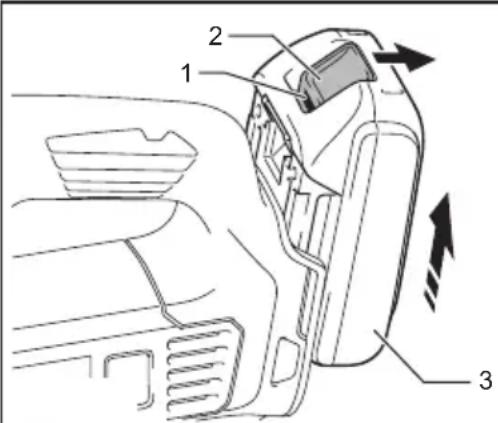
text_image
Technical diagram of a car interior showing labeled parts and directional arrows indicating movement or flow.▶ 1. Red indicator 2. Button 3. Battery cartridge
To remove the battery cartridge, slide it from the tool while sliding the button on the front of the cartridge.
To install the battery cartridge, align the tongue on the battery cartridge with the groove in the housing and slip it into place. Insert it all the way until it locks in place with a little click. If you can see the red indicator on the upper side of the button, it is not locked completely.
⚠️ CAUTION: Always install the battery cartridge fully until the red indicator cannot be seen. If not, it may accidentally fall out of the tool, causing injury to you or someone around you.
CAUTION: Do not install the battery cartridge forcibly. If the cartridge does not slide in easily, it is not being inserted correctly.
Indicating the remaining battery capacity
Only for battery cartridges with the indicator
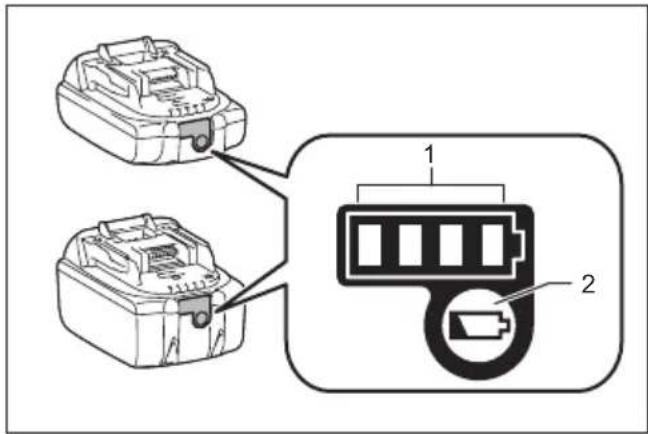
text_image
Diagram showing two connected components with labeled parts, likely illustrating a battery or connector assembly.▶ 1. Indicator lamps 2. Check button
Press the check button on the battery cartridge to indicate the remaining battery capacity. The indicator lamps light up for a few seconds.
| Indicator lamps Remaining | capacity | ||
| Lighted Off | Blinking | ||
 | 75% to 100% | ||
 | 50% to 75% | ||
 | 25% to 50% | ||
 | 0% to 25% | ||
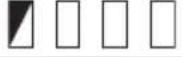 | Charge the battery. | ||
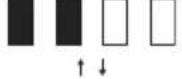 | The battery may have malfunctioned. | ||
NOTE: Depending on the conditions of use and the ambient temperature, the indication may differ slightly from the actual capacity.
Tool / battery protection system
The tool is equipped with a tool/battery protection system. This system automatically cuts off the power to extend tool and battery life. The tool will automatically stop during operation if the tool or battery is placed under one of the following conditions:
Overload protection
This protection works when the tool is operated in a manner that causes it to draw an abnormally high current. In this situation, turn the tool off and stop the application that caused the tool to become overloaded. Then turn the tool on to restart.
Overheat protection
This protection works and the light blinks when the tool or battery is overheated. In this situation, let the tool and battery cool before turning the tool on again.
Overdischarge protection
This protection works when the remaining battery capacity gets low. In this situation, remove the battery from the tool and charge the battery.
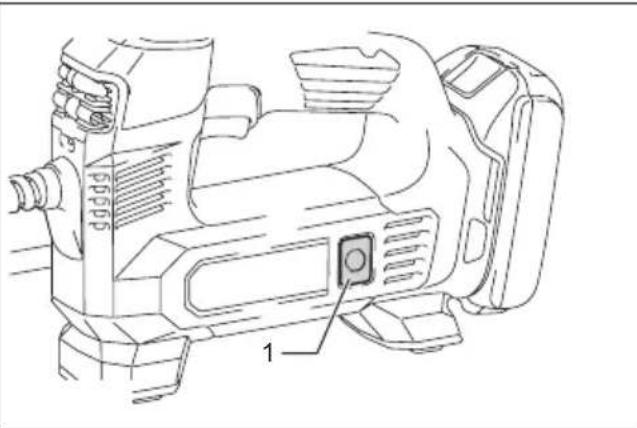
Main power switch
⚠ WARNING: Always turn off the main power switch when not in use.
⚠️ CAUTION: When carrying the tool, turn off the main power switch. Otherwise, pulling the switch trigger unintentionally may cause an injury.
natural_image
Technical line drawing of a mechanical device with labeled component (1), no readable text or symbols beyond the label▶ 1. Main power switch
To turn on the tool, press the main power switch. To turn off the tool, press the main power switch again.
NOTE: This tool employs the auto power-off function. To avoid unintentional start up, the main power switch will automatically shut down when the switch trigger is not pulled for a certain period after the main power switch is turned on.
Switch action
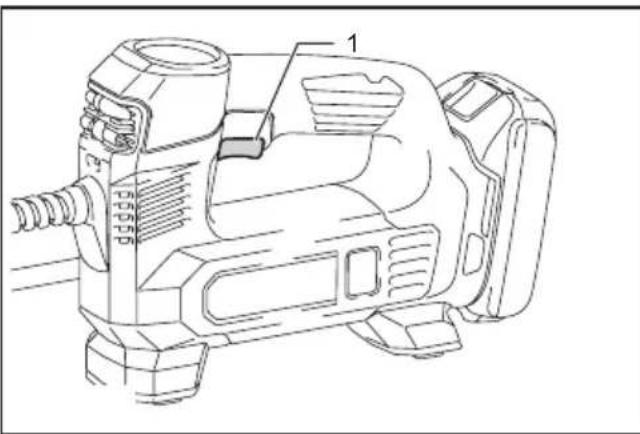
⚠ WARNING: Before installing the battery cartridge into the tool, always check to see that the switch trigger actuates properly and returns to the "OFF" position when released.
natural_image
Technical line drawing of a mechanical device with labeled parts (no text or symbols present)▶ 1. Switch trigger
To start the tool, simply pull the switch trigger. Release the switch trigger to stop.
Pressure gauge
text_image
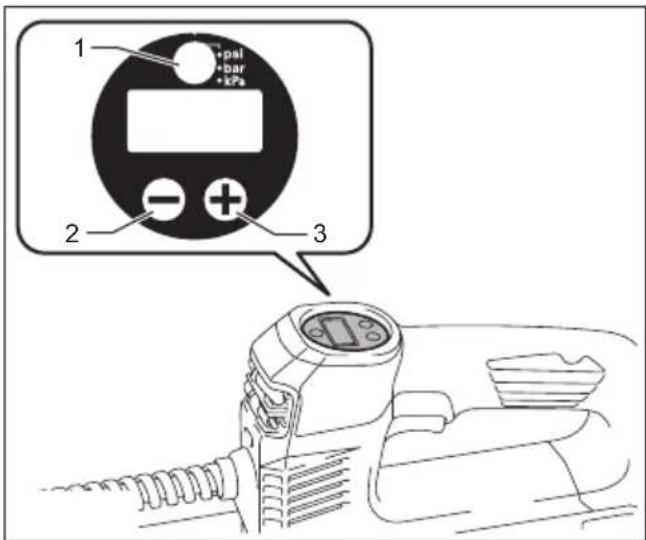
1 +psl +bar +kPa 2 - + 3▶ 1. Unit button 2. Minus button 3. Plus button
If the object to be inflated is connected to the tool, the air pressure of the object is displayed on the pressure gauge when you turn on the tool. If nothing is connected to the tool, the pressure gauge displays "0".
You can set the air pressure on the pressure gauge. To change the unit, press the unit button. To increase the pressure value, press the plus button. To decrease the pressure value, press the minus button. You can set the pressure value between 20 kPa (3 PSI) and 830 kPa (121 PSI).
Lighting up the front lamp
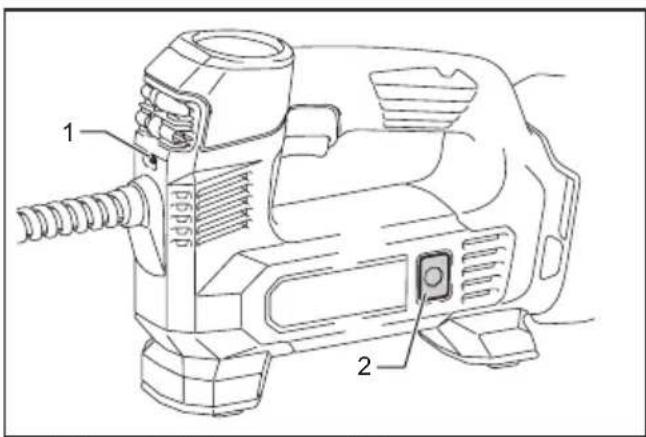
text_image
Technical diagram of a mechanical device with labeled parts 1 and 2▶ 1. Lamp 2. Main power switch
⚠️CAUTION: Do not look in the light or see the source of light directly.
When you turn on the tool by pressing the main power switch, the lamp lights up. When you turn off the tool by pressing the main power switch, the lamp goes out.
NOTICE: When the tool is overheated, the lamp flickers. Cool down the tool fully before operating the tool again.
NOTE: Use a dry cloth to wipe the dirt off the lens of the lamp. Be careful not to scratch the lens of lamp, or it may lower the illumination.
Storing adapter
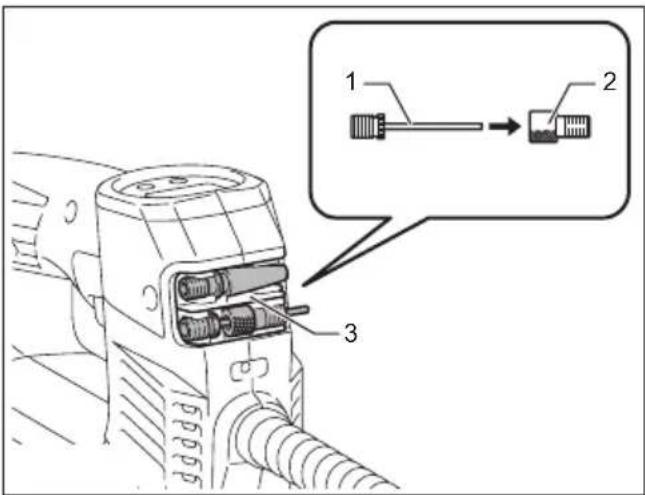
text_image
Technical diagram of a connector with labeled parts and an inset showing a connector being inserted into a socket.▶ 1. Sport ball needle 2. Presta valve adapter 3. Adapter holder
The adapters can be stored in the adapter holder of the tool. Insert the sport ball needle into the Presta valve adapter before attaching them to the adapter holder.
Storing hose
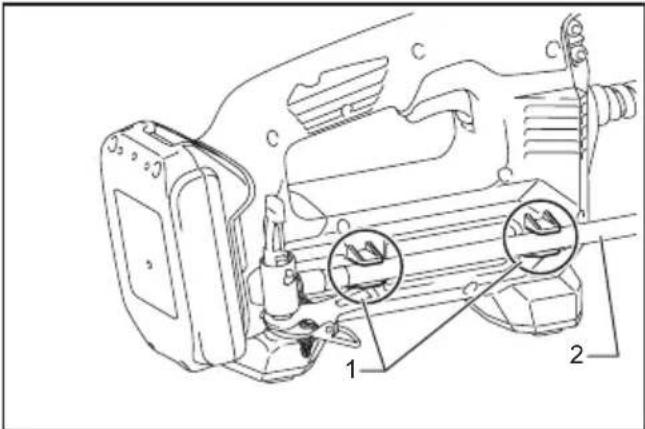
text_image
Technical diagram of a mechanical assembly with labeled parts and two circular insets showing internal components.▶ 1. Hose holder 2. Hose
The hose can be attached to the hose holder of the tool.
OPERATION
NOTE: The standard adapters vary depending on the country.
Using the Schrader valve adapter
- Unfold the air chuck clamp.
- Attach the air chuck to the valve stem.
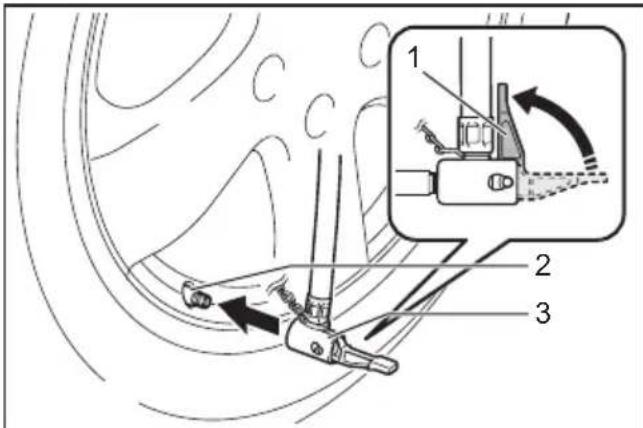
text_image
Technical diagram showing mechanical assembly with labeled parts and a magnified inset highlighting a component with rotational motion.▶ 1. Air chuck clamp 2. Valve stem 3. Air chuck
- Fold the air chuck clamp firmly.
- Turn on the tool, and then set the pressure value appropriate for the tire using the pressure gauge.
- Keep pulling the switch trigger until the tool stops. The tire is inflated with the specified pressure.
Using the Presta valve adapter
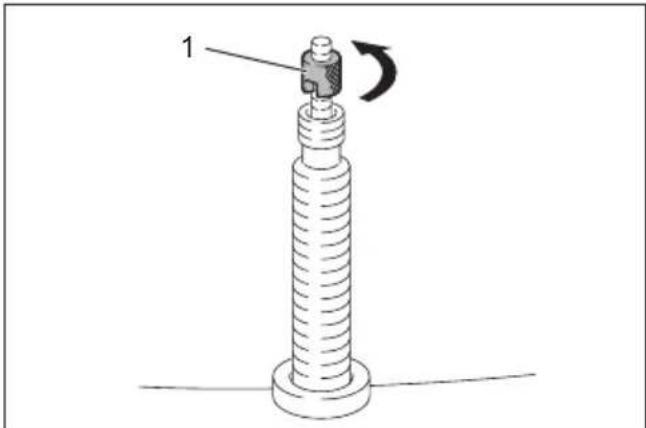
- Loosen the locking nut on the valve stem.
natural_image
Diagram of a mechanical component with a cylindrical shaft and a knob, showing rotational motion (no text or symbols)-
Locking nut
-
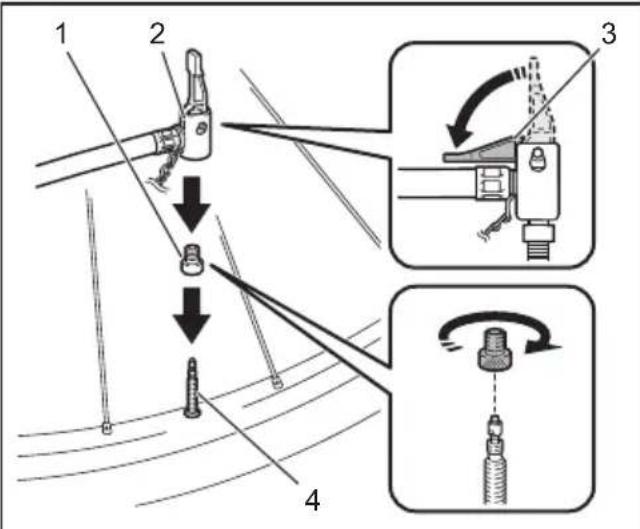
Unfold the air chuck clamp.
-
Attach the Presta valve adapter to the valve stem, and then attach the air chuck to the Presta valve adapter.
text_image
Technical diagram illustrating cable fastening steps with labeled components and directional arrows▶ 1. Presta valve adapter 2. Air chuck 3. Air chuck clamp 4. Valve stem
- Fold the air chuck clamp firmly.
- Turn on the tool, and then set the pressure value appropriate for the tire using the pressure gauge.
- Keep pulling the switch trigger until the tool stops. The tire is inflated with the specified pressure.
- Remove the air chuck and Presta valve adapter, and then tighten the locking nut.
Using the sport ball needle or tapered adapter
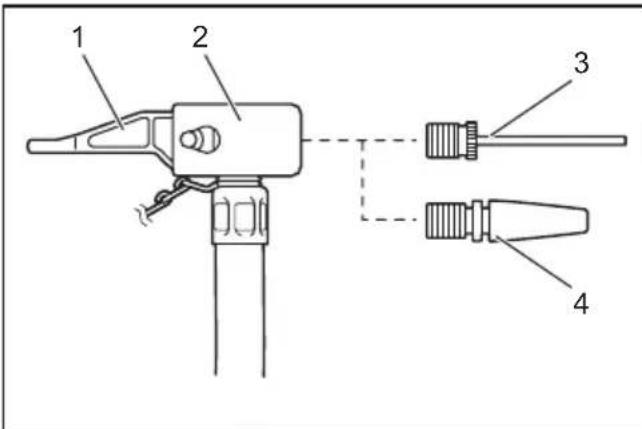
You can inflate small items such as sport balls or floating tubes. To inflate sport balls, use the sport ball needle. To inflate floating tubes, use the tapered adapter.
- Unfold the air chuck clamp.
- Attach the sport ball needle or tapered adapter to the air chuck.
text_image
1 2 3 4▶ 1. Air chuck clamp 2. Air chuck 3. Sport ball needle 4. Tapered adapter
3. Fold the air chuck clamp firmly.
4. Insert the sport ball needle or tapered adapter into the hole on the item.
- Turn on the tool, and then set the appropriate pressure value using the pressure gauge.
NOTICE: When inflating a floating tube, the pressure gauge will not display an accurate value since the pressure of floating tube is less than 20 kPa (3 PSI). When inflating a floating tube, do not use the value on the pressure gauge, but inflate it by checking the status of the floating tube.
- Keep pulling the switch trigger until the tool stops. The item is inflated with the specified pressure.
Using the English valve adapter
Country specific
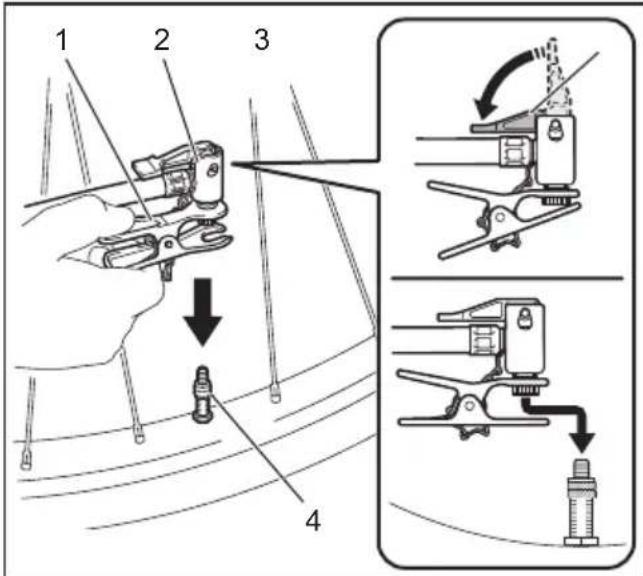
- Unfold the air chuck clamp.
- Insert the English valve adapter into the air chuck.
- Fold the air chuck clamp firmly.
text_image
Technical diagram showing a mechanical assembly with numbered components and directional arrows indicating motion or assembly steps.▶ 1. English valve adapter 2. Air chuck 3. Air chuck clamp 4. Valve stem
- Attach the English valve adapter to the valve stem while opening the English valve adapter.
- Turn on the tool.
- Inflate the tire by pulling the switch trigger while checking the status of the tire.
NOTICE: When using the English valve adapter, the pressure gauge will not display an accurate value due to characteristics of the valve. When inflating a tire, do not use the value on the pressure gauge, but inflate it by checking the status of the tire.
If the tool stops before the tire reaches the desired air pressure, adjust the pressure value, and then inflate the tire again.
MAINTENANCE
CAUTION: Always be sure that the tool is switched off and the battery cartridge is removed before attempting to perform inspection or maintenance.
NOTICE: Never use gasoline, benzine, thinner, alcohol or the like. Discoloration, deformation or cracks may result.
To maintain product SAFETY and RELIABILITY, repairs, any other maintenance or adjustment should be performed by Makita Authorized or Factory Service Centers, always using Makita replacement parts.
MAKITA LIMITED WARRANTY
Please refer to the annexed warranty sheet for the most current warranty terms applicable to this product. If annexed warranty sheet is not available, refer to the warranty details set forth at below website for your respective country.
United States of America: www.makitatools.com
Canada: www.makita.ca
Other countries: www.makita.com
SPÉCIFICATIONS
text_image
Technical diagram of a vehicle interior showing labeled parts and directional arrows indicating movement or flow.▶ 1. Voyant rouge 2. Bouton 3. Batterie
text_image
Diagram showing two connected electrical components with labeled parts 1 and 2, likely illustrating a power or signal connection.natural_image
Technical line drawing of a mechanical device with labeled component (no text or symbols present)natural_image
Technical line drawing of a mechanical device with labeled component 1 (no text or symbols beyond label)- Gâchette
text_image
Technical diagram of a mechanical device with labeled parts 1 and 2text_image
Technical diagram of a connector with labeled parts and an inset showing a connector being inserted into a socket.text_image
Technical diagram of a mechanical assembly with labeled parts and two circular annotations highlighting specific features.▶ 1. Support de boyau 2. Boyau
text_image
Technical diagram showing mechanical assembly with labeled parts and a magnified inset highlighting a component with rotational motion.natural_image
Diagram of a mechanical component with a pin labeled '1' and rotation arrow, no text or symbols presenttext_image
Technical diagram illustrating cable fastening steps with labeled components and directional arrowstext_image
Technical diagram showing a tool manipulation step with labeled parts and directional arrows indicating sequence.text_image
Technical diagram of a car interior showing labeled parts and directional arrows indicating movement or flow.text_image
Diagram showing two connected components with labeled parts, likely illustrating a battery or connector assembly.natural_image
Technical line drawing of a mechanical device with labeled component 1 (no text or symbols beyond label)▶ 1. Gatillo interruptor
text_image
Technical diagram of a mechanical device with labeled parts 1 and 2text_image
Technical diagram of a connector with labeled parts and an inset showing two connectors with internal components.text_image
Technical diagram of a mechanical assembly with labeled parts and two circular insets showing component details.text_image
Technical diagram showing mechanical assembly with labeled parts and a magnified inset of a device mechanism.text_image
Technical diagram illustrating mechanical assembly steps with labeled components and directional arrows indicating motion or movement.text_image
Technical diagram of a mechanical device with labeled parts 1, 2, 3, and 4text_image
Technical diagram showing a tool manipulation step with labeled parts and directional arrows indicating sequence.Some dust created by power sanding, sawing, grinding, drilling, and other construction activities contains chemicals known to the State of California to cause cancer, birth defects or other reproductive harm. Some examples of these chemicals are:
- lead from lead-based paints,
• crystalline silica from bricks and cement and other masonry products, and
• arsenic and chromium from chemically-treated lumber.
Your risk from these exposures varies, depending on how often you do this type of work. To reduce your exposure to these chemicals: work in a well ventilated area, and work with approved safety equipment, such as those dust masks that are specially designed to filter out microscopic particles.
3-11-8, Sumiyoshi-cho,
Anjo, Aichi 446-8502 Japan