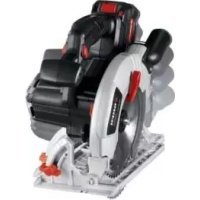
PHKSAP 20Li A1 - Electric saw PARKSIDE - Free user manual and instructions
Find the device manual for free PHKSAP 20Li A1 PARKSIDE in PDF.

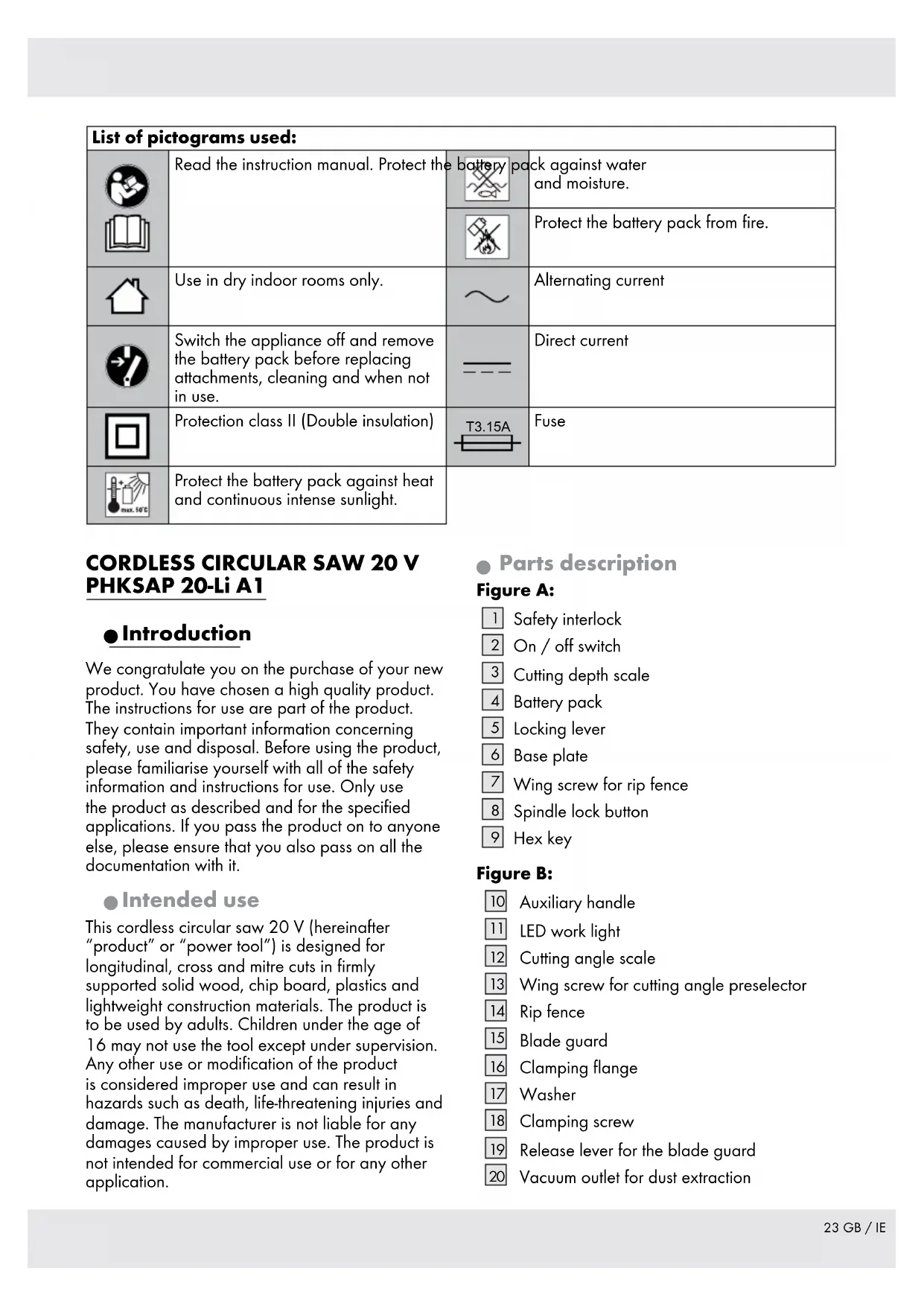


| Product type | Cordless circular saw |
| Brand | Parkside |
| Model | PHKSAP 20Li A1 |
| Power supply | Lithium-ion battery 20 V, 5 Ah |
| Charger | Fast charger 100-240 V~, 50-60 Hz, output 14.4-20 V, 4 A, charging time approx. 90 min |
| No-load speed | 4500 min⁻¹ |
| Max. cutting depth | 62 mm (at 90°), 45 mm (at 45°) |
| Spindle diameter | 20 mm |
| Battery type | Lithium-ion, 10 cells, capacity 5 Ah |
| Main functions | Rip cuts, cross cuts, bevel cuts, with parallel guide, depth adjustment, protective guard, LED light |
| Delivery contents | Saw, battery pack, fast charger, parallel guide, hex key, manual |
| Weight (approx.) | 3.5 kg (with battery) |
| Dimensions (approx.) | 300 x 250 x 200 mm |
| Sound pressure level | 88.9 dB(A) |
| Sound power level | 99.9 dB(A) |
| Vibration (main handle) | 3.65 m/s² (K=1.5 m/s²) |
| Vibration (auxiliary handle) | 2.97 m/s² (K=1.5 m/s²) |
| Safety | Lock-off switch, lower protective guard, spindle lock, double insulation (charger) |
| Maintenance and cleaning | Clean with a dry cloth and brush; use compressed air (max 3 bar) for stubborn dirt; do not use aggressive agents |
| Spare parts and repairability | Repairs must be carried out by a professional; wear parts: saw blade, battery; warranty 5 years (battery 1 year) |
| General information | Intended use: wood, chipboard, plastic, light construction materials; domestic use; not intended for children under 16 without supervision |
Frequently Asked Questions - PHKSAP 20Li A1 PARKSIDE
User questions about PHKSAP 20Li A1 PARKSIDE
0 question about this device. Answer the ones you know or ask your own.
Ask a new question about this device
Download the instructions for your Electric saw in PDF format for free! Find your manual PHKSAP 20Li A1 - PARKSIDE and take your electronic device back in hand. On this page are published all the documents necessary for the use of your device. PHKSAP 20Li A1 by PARKSIDE.
USER MANUAL PHKSAP 20Li A1 PARKSIDE
PARKSIDE
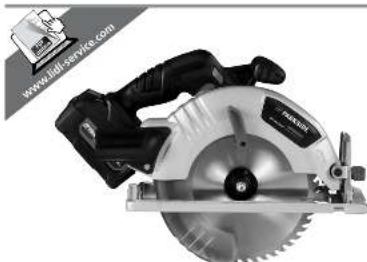
AKKU-HANDKREISSAGE 20 V/ CORDLESS CIRCULAR SAW 20V/ SCIE CIRCULAIRE SANSI L 20V PHKSAP 20-L1 AI
DMW/Deutsch-K.G. KIR
Department of Mathematics,
DCCT-7, DCCT-indikatoren
CIB2004
Tel.: +86 3195 20000
10.1002/1002- 4357(2016)8(1):1- 10
GIRLHERMENGERBARD REV
1999-2000
1999-2000
1999-2000
1999-2000
1999-2000
1999-2000
1999-2000
1999-2000
1999-2000
1999-2000
1999-2002
001-1
CONSOLIDATED EARNINGS REVENING 2017
Year Ended December 31, 2018
in euro million (except ratios)
AUM INCOME/(EXPENSE) PLATA 2019
In millions of euros per year.
Revenue from operations before tax expense.
SNEEELARALGALOGAL 307
SNEEELARALGALOGAL 307
SNEEELARALGALOGAL 307
TELEGLERAL PLANNERS
REMARQUES 307
TELEGLERAL PLANNERS
REMARQUES 307


IAN 289755IAN 289755
例
i
D/AT/CI Eudnng and Gdhnnn
1
()
1
C1 C1a aagaaanrnnn
25 Indmntnre hneepnnrnnn rnrnnn
Inhaltsverzeichnis
List of pictograms used
Introduction
Intended use Page 23
Parts description..
Scope of delivery.. 24
Technical data.. 24
Safety warnings Page 25
General power tool safety warnings.. Page 25
Circular saw warnings . 26
Vibration and noise reduction.. Page 28
Behaviour in emergency situations.. Page 28
Residual risks.. Page 28
Battery charger safety warnings.. Page 29
Initial use.. Page 30
Unpacking Page 30
Accessories . 30
Before use
Attaching / removing the battery pack.. Page 30
Charging the battery pack.. Page 30
Checking the battery level.
Attaching / removing the saw blade.. Page 31
Attaching / removing a dust extraction device . Page 31
Checking the blade guard.
Operation
Setting the cutting depth.. Page 32
Switching on and off.. Page 32
Cutting. Page 32
Cutting with angle. Page 33
Cutting with rip fence.
After use.. Page 33
Cleaning and care
Cleaning.. 33
Maintenance.. Page 33
Repair . Page 33
Storage.. Page 33
Transportation
Troubleshooting
Disposal
Service
Warranty
Translation of original declaration of conformity.. Page 36
| List of pictograms used: | |||
| Read the instruction manual. Protect the battery pack against water and moisture. | |||
| Use in dry indoor rooms only. | ~ | Alternating current | |
| Switch the appliance off and remove the battery pack before replacing attachments, cleaning and when not in use. | —— | Direct current | |
| Protection class II (Double insulation) | T3.15A | Fuse | |
| Protect the battery pack against heat and continuous intense sunlight. | |||
CORDLESS CIRCULAR SAW 20 V PHKSAP 20-Li A1
Introduction
We congratulate you on the purchase of your new product. You have chosen a high quality product. The instructions for use are part of the product. They contain important information concerning safety, use and disposal. Before using the product, please familiarise yourself with all of the safety information and instructions for use. Only use the product as described and for the specified applications. If you pass the product on to anyone else, please ensure that you also pass on all the documentation with it.
Intended use
This cordless circular saw 20V (hereinafter "product" or "power tool") is designed for longitudinal, cross and litre cuts in firmly supported solid wood, chip board, plastics and lightweight construction materials. The product is to be used by adults. Children under the age of 16 may not use the tool except under supervision. Any other use or modification of the product is considered improper use and can result in hazards such as death, life-threatening injuries and damage. The manufacturer is not liable for any damages caused by improper use. The product is not intended for commercial use or for any other application.
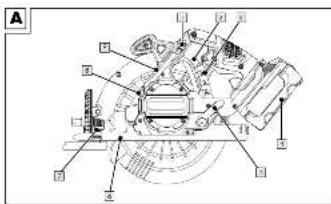
Parts description
Figure A:
Safety interlock
2 On/off switch
3 Cutting depth scale
4 Battery pack
5 Locking lever
6 Base plate
7 Wing screw for rip fence
8 Spindle lock button
9 Hex key
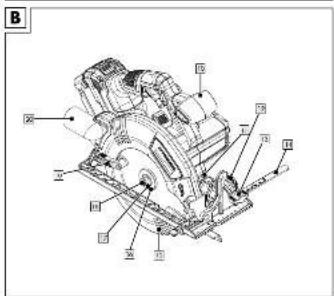
Figure B:
10 Auxiliary handle
11 LED work light
Cutting angle scale
13 Wing screw for cutting angle preselector
14 Rip fence
15 Blade guard
16 Clamping flange
17 Washer
18 Clamping screw
19 Release lever for the blade guard
20 Vacuum outlet for dust extraction
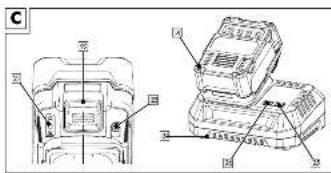
Figure C:
21 Battery level indication light
22 Release button
23 Battery level button
24 Rapid battery charger
25 Charging status LED - Green
26 Charging status LED - Red
Scope of delivery
1 Cordless circular saw 20 V PHKSAP 20-Li A1
1 Battery pack PHKSAP 20-Li A1-1
1 Rapid battery charger PHKSAP 20-Li A1-2
1 Rip fence
1 Hex key
1 Instruction manual
Technical data
Cordless circular saw: PHKSAP 20-Li A1
Rated voltage: 20V

No load speed n0 : 4500 min

Saw blade diameter: 190mm
Arbour diameter: 20mm
Max. cutting depth: 90irc : 62 mm
4 5 ^ irc: 4 5 mm
Battery pack: PHKSAP 20-Li A1-1
Type: Lithium ion
Rated voltage: 20V
= - - - .
Capacity: 5 Ah
Number of cells: 10
Rapid battery charger: PHKSAP 20-Li A1-2
INPUT:
Rated voltage and
1 0 0 - 2 4 0 V ,
frequency:
5 0 - 6 0 Hz
Power consumption:
9 5 W
OUTPUT:
Rated voltage: 14.4 - 20 V

Charging current:
4A
Charging time:
approx. 90 min
Protection class:

Noise emission value:
Noise measurement value determined in accordance with EN 60745. The A-rated noise level of the product is typically as follows:
Sound pressure level LpA : 89.4 dB(A)
Uncertainty KPA:3 dB
Sound power level LWA : 100.4 dB(A)
Uncertainty KWA : 3 dB
Vibration emission value:
Total vibration values (vector total of three directions) determined in accordance with EN 60745:
Cutting wood
(main handle)
Hand/arm vibration an,W : 3.65 m/s²
(auxiliary handle)
Hand/arm vibration ah,W : 2.97 m/s²
Uncertainty K 1.5m / s2

WARNING!
The vibration level varies in accordance with the use of the power tool and may be higher than the value specified in these instructions in some cases. There is a risk of underestimation of the vibration load if the power tool is used regularly in this manner. Try to keep the vibration loads as low as possible. Measures to reduce the vibration load are, e.g. wearing gloves and limiting the working time. Wherein all states of operation must be included (e.g. times when the power tool is switched off and times where the power tool is switched on but running without load).
NOTE
The vibration level specified in these instructions has been measured in accordance with a standardised measuring procedure specified in EN 60745 and can be used to make equipment comparisons. The specified vibration emission value can also be used to make an initial exposure estimate.

Safety warnings
- General power tool safety warnings

WARNING!
Read all safety warnings and all instructions. Failure to follow the warnings and instructions may result in electric shock, fire and/or serious injury.
Save all warnings and instructions for future reference.
The term "power tool" in the warnings refers to your mains-operated (corded) power tool or battery-operated (cordless) power tool.
Work area safety
- Keep work area clean and well lit. Cluttered or dark areas invite accidents.
- Do not operate power tools in explosive atmospheres, such as in the presence of flammable liquids, gases or dust. Power tools create sparks which may ignite the dust or fumes.
- Keep children and bystanders away while operating a power tool. Distractions can cause you to lose control.
Electrical safety
- Power tool plugs must match the outlet. Never modify the plug in any way. Do not use any adapter plugs with earthed (grounded) power tools. Unmodified plugs and matching outlets will reduce risk of electric shock.
- Avoid body contact with earthed or grounded surfaces, such as pipes, radiators, ranges and refrigerators. There is an increased risk of electric shock if your body is earthed or grounded.
- Do not expose power tools to rain or wet conditions. Water entering a power tool will increase the risk of electric shock.
-
Do not abuse the cord. Never use the cord for carrying, pulling or unplugging the power tool. Keep cord away from heat, oil, sharp edges or moving parts. Damaged or entangled cords increase the risk of electric shock.
-
When operating a power tool outdoors, use an extension cord suitable for outdoor use. Use of a cord suitable for outdoor use reduces the risk of electric shock.
- If operating a power tool in a damp location is unavoidable, use a residual current device (RCD) protected supply. Use of an RCD reduces the risk of electric shock.
Personal safety
- Stay alert, watch what you are doing and use common sense when operating a power tool. Do not use a power tool while you are tired or under the influence of drugs, alcohol or medication. A moment of inattention while operating power tools may result in serious personal injury.
- Use personal protective equipment. Always wear eye protection. Protective equipment such as dust mask, non-skid safety shoes, hard hat, or hearing protection used for appropriate conditions will reduce personal injuries.
- Prevent unintentional starting. Ensure the switch is in the off-position before connecting to power source and/or battery pack, picking up or carrying the tool. Carrying power tools with your finger on the switch or energising power tools that have the switch on invites accidents.
- Remove any adjusting key or wrench before turning the power tool on. A wrench or a key left attached to a rotating part of the power tool may result in personal injury.
- Do not overreach. Keep proper footing and balance at all times. This enables better control of the power tool in unexpected situations.
- Dress properly. Do not wear loose clothing or jewellery. Keep your hair, clothing and gloves away from moving parts. Loose clothes, jewellery or long hair can be caught in moving parts.
- If devices are provided for the connection of dust extraction and collection facilities, ensure these are connected and properly used. Use of dust collection can reduce dust-related hazards.
Power tool use and care
- Do not force the power tool. Use the correct power tool for your application. The correct power tool will do the job better and safer at the rate for which it was designed.
- Do not use the power tool if the switch does not turn it on and off. Any power tool that cannot be controlled with the switch is dangerous and must be repaired.
- Disconnect the plug from the power source and/or the battery pack from the power tool before making any adjustments, changing accessories, or storing power tools. Such preventive safety measures reduce the risk of starting the power tool accidentally.
- Store idle power tools out of the reach of children and do not allow persons unfamiliar with the power tool or these instructions to operate the power tool. Power tools are dangerous in the hands of untrained users.
- Maintain power tools. Check for misalignment or binding of moving parts, breakage of parts and any other condition that may affect the power tool's operation. If damaged, have the power tool repaired before use. Many accidents are caused by poorly maintained power tools.
- Keep cutting tools sharp and clean. Properly maintained cutting tools with sharp cutting edges are less likely to bind and are easier to control.
- Use the power tool, accessories and tool bits etc. in accordance with these instructions, taking into account the working conditions and the work to be performed. Use of the power tool for operations different from those intended could result in a hazardous situation.
Battery tool use and care
- Recharge only with the charger specified by the manufacturer. A charger that is suitable for one type of battery pack may create a risk of fire when used with another battery pack.
-
Use power tools only with specifically designated battery packs. Use of any other battery packs may create a risk of injury and fire.
-
When battery pack is not in use, keep it away from other metal objects, like paper clips, coins, keys, nails, screws or other small metal objects, that can make a connection from one terminal to another. Shorting the battery terminals together may cause burns or a fire.
- Under abusive conditions, liquid may be ejected from the battery; avoid contact. If contact accidentally occurs, flush with water. If liquid contacts eyes, additionally seek medical help. Liquid ejected from the battery may cause irritation or burns.
Service
-
Have your power tool serviced by a qualified repair person using only identical replacement parts. This will ensure that the safety of the power tool is maintained.
-
Circular saw warnings
Safety instructions for all saws - Cutting procedures
- DANGER! Keep hands away from cutting area and the blade. Keep your second hand on auxiliary handle, or motor housing. If both hands are holding the saw, they cannot be cut by the blade.
- Do not reach underneath the workpiece. The guard cannot protect you from the blade below the workpiece.
- Adjust the cutting depth to the thickness of the workpiece. Less than a full tooth of the blade teeth should be visible below the workpiece.
- Never hold piece being cut in your hands or across your leg. Secure the workpiece to a stable platform. It is important to support the work properly to minimise body exposure, blade binding, or loss of control.
-
Hold the power tool by insulated gripping surfaces only, when performing an operation where the cutting tool may contact hidden wiring. Contact with a "live" wire will also make exposed metal parts of the power tool "live" and could give the operator an electric shock.
-
When ripping, always use a rip fence or straight edge guide. This improves the accuracy of cut and reduces the chance of blade binding.
- Always use saw blades with correct size and shape (diamond versus round) of arbour holes. Blades that do not match the mounting hardware of the saw will run eccentrically, causing loss of control.
- Never use damaged or incorrect blade washers or bolts. The blade washers and bolt were specially designed for your saw, for optimum performance and safety of operation.
Further safety instructions for all saws - Kickback causes and related warnings
A kickback is a sudden reaction to a pinched, bound or misaligned saw blade, causing an uncontrolled saw to lift up and out of the workpiece toward the operator;
when the blade is pinched or bound tightly by the kerf closing down, the blade stalls and the motor reaction drives the unit rapidly back toward the operator;
if the blade becomes twisted or misaligned in the cut, the teeth at the back edge of the blade can dig into the top surface of the wood causing the blade to climb out of the kerf and jump back toward the operator.
Kickback is the result of saw misuse and/or incorrect operating procedures or conditions and can be avoided by taking proper precautions as given below.
- Maintain a firm grip with both hands on the saw and position your arms to resist kickback forces. Position your body to either side of the blade, but not in line with the blade. Kickback could cause the saw to jump backwards, but kickback forces can be controlled by the operator, if proper precautions are taken.
- When blade is binding, or when interrupting a cut for any reason, release the trigger and hold the saw motionless in the material until the blade comes to a complete stop. Never attempt to remove the saw from the work or pull the saw backwards while the blade is in motion or kickback may occur.
Investigate and take corrective actions to eliminate the cause of blade binding.
- When restarting a saw in the workpiece, centre the saw blade in the kerf and check that saw teeth are not engaged into the material. If saw blade is binding, it may walk up or kickback from the workpiece as the saw is restarted.
- Support large panels to minimise the risk of blade pinching and kickback. Large panels tend to sag under their own weight. Supports must be placed under the panel on both sides, near the line of cut and near the edge of the panel.
- Do not use dull or damaged blades. Unsharpened or improperly set blades produce narrow kerf causing excessive friction, blade binding and kickback.
- Blade depth and bevel adjusting locking levers must be tight and secure before making cut. If blade adjustment shifts while cutting, it may cause binding and kickback.
- Use extra caution when sawing into existing walls or other blind areas. The protruding blade may cut objects that can cause kickback.
Safety instructions for circular saws with outer pendulum guard - Lower guard function
- Check lower guard for proper closing before each use. Do not operate the saw if lower guard does not move freely and close instantly. Never clamp or tie the lower guard into the open position. If saw is accidentally dropped, lower guard may be bent. Raise the lower guard with the retracting handle and make sure it moves freely and does not touch the blade or any other part, in all angles and depths of cut.
- Check the operation of the lower guard spring. If the guard and the spring are not operating properly, they must be serviced before use. Lower guard may operate sluggishly due to damaged parts, gummy deposits, or a build-up of debris.
- Lower guard may be retracted manually only for special cuts such as "plunge cuts" and "compound cuts". Raise lower guard by retracting handle and as soon as blade enters the material, the lower guard must be released. For all other sawing, the lower guard should operate automatically.
4. Always observe that the lower guard is covering the blade before placing saw down on bench or floor.
An unprotected, coasting blade will cause the saw to walk backwards, cutting whatever is in its path. Be aware of the time it takes for the blade to stop after switch is released.
Additional circular saw safety warnings
Do not use any abrasive wheels.
Use only saw blades with diameters corresponding to the product label and technical data.
Use only the recommended saw blades.
When cutting wood or other materials which may create dusts that are hazardous to health, always connect a suitable, certified vacuum extractor device.
Wear a dust mask when cutting wood.
Always wear ear protectors.
Do not allow the teeth of the saw blade to overheat.
When cutting plastic, avoid melting the plastic.
Saw blade safety warnings
Only use saw blades if you have knowledge of how to use and handle them.
Pay attention to the maximum rotational speed. The maximum rotational speed marked on the saw blade shall not be exceeded.
Do not use working saw blades which are cracked. Scrap of saw blades which bodies are cracked. Repairing is not permitted.
Clamping surfaces shall be cleaned to remove dirt, grease, oil and water.
Do not use loose rings or sleeves to "make up" bore sizes on saw blades.
Ensure that fixed reduction rings for securing the accessory have the same diameter and at least 1/3 of the cutting diameter.
Ensure fixed rings are parallel to each other.
- Handle saw blades with care. Store them in the original packaging or in special boxes. Wear gloves for handling and to reduce injuries.
Ensure all guards are correctly fixed before using saw blades.
Before use, make sure that the saw blade complies with the technical requirements of the product and is correctly fixed.
A longer period of use may lead to overheating of the blade tips. Therefore take breaks of approx. 15 minutes on a regular basis to let the blade tips cool down.
Vibration and noise reduction
To reduce the impact of noise and vibration emission, limit the time of operation, use lowvibration and low-noise operating modes as well as wear personal protective equipment. Take the following points into account to minimise the vibration and noise exposure risks:
Only use the product as intended by its design and these instructions.
Ensure that the product is in good condition and well maintained.
Use correct cutting attachments for the product and ensure they are in good condition.
Keep tight grip on the handles/grip surface.
- Maintain this product in accordance with these instructions and keep it well lubricated (where appropriate).
Plan your work schedule to spread any high vibration tool use across a longer period of time.
Behaviour in emergency situations
Familiarise yourself with the use of this product by means of this instruction manual. Memorise the safety warnings and follow them to the letter. This will help to prevent risks and hazards.
Always be alert when using this product, so that you can recognise and handle risks early. Fast intervention can prevent serious injury and damage to property.
Switch the product off and remove the battery pack if there are malfunctions. Have the product checked by a qualified professional and repaired, if necessary, before you operate it again.
Residual risks
Even if you are operating this product in accordance with all the safety requirements, potential risks of injury and damage remain. The following dangers can arise in connection with the structure and design of this product:
Health defects resulting from vibration emission if the product is being used over long periods of time or not adequately managed and properly maintained.
Injuries and damage to property due to broken cutting attachments or the sudden impact of hidden objects during use.
Danger of injury and property damage caused by flying objects.

WARNING!
This product produces an electromagnetic field during operation! This field may under some circumstances interfere with active or passive medical implants! To reduce the risk of serious or fatal injury, we recommend persons with medical implants to consult their doctor and the medical implant manufacturer before operating this product!
Battery charger safety warnings
This appliance can be used by children aged from 8 years and above and persons with reduced physical, sensory or mental capabilities or lack of experience and knowledge if they have been given supervision or instruction concerning use of the appliance in a safe way and understand the hazards involved.
Children shall not play with the appliance.
- Cleaning and user maintenance shall not be made by children without supervision.
- Do not recharge non-rechargeable batteries. Disregarding this instruction may be hazardous.
If the supply cord is damaged, it must be replaced by the manufacturer, its service agent or similarly qualified persons in order to avoid a hazard.
- Protect the electrical parts against moisture. Do not immerse such parts in water or other liquids to avoid electrical shock. Never hold the appliance under running water. Pay attention to the instructions provided for cleaning, maintenance and repair.
The appliance is suitable for indoor use only.
This appliance is only designed for charging the battery pack type: Parkside Performance 20V battery.

CAUTION! RISK OF EXPLOSION

Never charge non-rechargeable batteries! Protect the battery against heat, e. g., against continuous intense sunlight, fire, water and moisture. Danger of explosion.


Initial use
Unpacking

WARNING!
The product and the packaging are not children's toys! Children must not play with plastic bags, sheets and small parts! There is a danger of choking and suffocation!
- Unpack all parts and lay them on a flat, stable surface.
- Remove all packing materials and shipping devices if applicable.
- Make sure the delivery contents are complete and free of any damage. If you find that parts are missing or show damage do not use the product but contact your dealer. Do not use the product unless missing parts have been delivered in addition or defective parts have been replaced. Using an incomplete or damaged product represents a hazard to people and property.
- Ensure that you have all the accessories and tools needed for assembly and operation. This also includes suitable personal protective equipment.
Accessories
To operate this product safely and correctly, the following accessories, i.e. tools and attachments, are necessary:
Sawblade
Ensure that you have the accessories and tools needed for commissioning and operation available. This also includes suitable personal protective equipment.
Accessories and tools are available through your authorised dealer. When buying always consider the technical requirements of this product (see "Technical data").
If you are not certain, ask a qualified specialist and get advice from your trusted dealer.
NOTE
This instruction manual contains information and suggestions for several attachments and their uses. The attachments depicted are not necessarily included in the shipment, but are meant to indicate additional possibilities for using this product.
Before use
- Attaching / removing the battery pack
Attaching the battery pack:
- Align the battery pack 4 to the handle and slide it onto it. Ensure it clicks noticeably in place.
Removing the battery pack:
- Press the release button 22 and remove the battery pack 4.
- Charging the battery pack
NOTE
The battery pack comes partly charged.
Always pull out the plug of the charge from the mains before removing or connecting the battery pack 4 to the charger.
Never charge the battery pack 4 when the ambient temperature is below 10ircC or above 40ircC .
Rest the charge for at least 15 minutes between successive charging sessions.
If no battery pack is inserted into the charger 24 and the charger is connected to mains, the charging status LED 25 lights up green.
- Connect the battery pack 4 to the battery charger24.
- Insert the mains plug into the socket. The charging status LED lights up red. Once the battery pack is completely charged, the green charging status LED indicates that the charging process is complete.
- Disconnect the charger 24 from the mains and remove the battery pack 4 from the charger.
- Attach the battery pack 4 back to the product.
Charging status LEDs
| Green LED lights up without battery pack | Charger ready |
| Green LED lights up with battery pack | Battery pack fully charged |
| Red LED lights up with battery pack | Battery pack charging |
| Red LED flashes with battery pack | Battery pack defect |
| Green LED flashes with battery pack | Battery pack too cold or warm |
- Checking the battery level
Press the battery level button to check the charging level of the battery pack 4. The status / remaining charge will be shown on the battery level indication light 21
| 3 Red LEDs light up maximum charging level |
| 2 Red LEDs light up medium charging level |
| 1 Red LEDs lights up low charging level |
Charge the battery pack before operation when it is at medium or low charging level.
- Attaching / removing the saw blade
WARNING!
Always remove the battery pack from the product before changing the saw blade in order to avoid switching it on accidentally.
Always use the correct accessories according to the intended use! Observe the technical requirements of this product (see section Technical data) when purchasing and using accessories!
Accessories can be sharp and become hot during use! Handle them carefully! Wear safety gloves when handling accessories in order to avoid injuries like burns and cuts!
Never press the spindle lock whilst the spindle is rotating!
The arrow on the accessory must correspond to the arrow showing the direction of rotation (running direction shown on the product).
Ensure that the accessory is suitable for the rotational speed of the product.
-
Set the cutting depth to the minimum position, 0mm (see "Setting the cutting depth").
-
Swing the blade guard 15 back using the release lever 19 and put the product down.
- Press the spindle lock button 8 until it engages. Keep the button pressed and loosen the clamping screw 18 with the hex key 9.
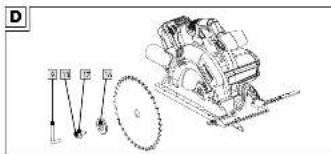
- Remove the clamping screw [18], washer [17] and the clamping flange [16] (Fig. D).
- Remove saw blade, if necessary.
- Clean the flanges and spindle from dust.
- Place a suitable saw blade, the clamping flange 16, the washer 17 and the clamping screw 18 onto the spindle. The arrow on the saw blade must correspond to the arrow showing the direction of rotation (running direction shown on the product).
- Press the spindle lock button 8 until it engages. Keep the button pressed and tighten the clamping screw 18 with the hex key 9
- Turn the saw blade by hand to test if it is rotating smoothly. The blade should not flutter.
- Switch the product on and let it run idle for about one minute, to confirm that the saw blade has been installed properly. Switch off the product and re-fit the saw blade as described, should there any abnormal vibration or excessive noise occur.
- Attaching / removing a dust extraction device
WARNING!
During operation fine dust will be generated! Some dusts are highly inflammable and explosive! Always attach a dust extraction device when using this product in order to keep the working area clean! Wear a dust mask when operating this product! Dust can be harmful to health! Especially dust and chips of wood that has been treated, e.g. with wood preservative or a stain!
Do not smoke during operation, keep heat sources and open flames out of the working area!
- Connect an approved dust and chip extraction device to the vacuum outlet for dust extraction 20
- Checking the blade guard
- Pull the release lever for the blade guard back as far as the stop. The blade guard must move freely without jamming and must spring back into its starting position automatically when the release lever for the blade guard is released.
Operation

CAUTION! RISK OF INJURY!
- Keep your hands away from the accessory when the product is in operation.

Setting the cutting depth
NOTE
Select a cutting depth of approx. 3mm more than the thickness of the material for a clean cut.
- Loosen the locking lever 5, set the desired cutting depth on the cutting depth scale 3 and then retighten the locking lever 5.

Switching on and off
Switching on:
- Push the safety interlock to the left or right and keep it pressed.
- Press the on/off switch 2. Release the safety interlock 1 once the product is running.
NOTE
The LED work light lights up when the on/off switch 2 is depressed. It illuminates the work area in low lighting condition.
Switching off:
- Release the on/off switch 2 to switch the product off.
NOTE
The LED work light remains on for about 10 seconds after the product has been switched off.

Cutting

WARNING!
During operation fine dust will be generated! Some dusts are highly inflammable and explosive! Do not smoke during operation, keep heat sources and open flames out of the working area! Always wear a dust mask to protect yourself against hazards resulting from fine dust.
- Avoid damaging the cutting edge of sensitive materials, e.g. coated chip boards or doors, by sticking masking tape along the cutting line. Another benefit of this is that it is easier to mark a line on the tape than on a shiny surface. An even more effective method of protecting the cutting edges is to clamp a thin piece of wood along the cutting line (this wood is also sawn).
Cut in the direction of the wood grain whenever possible to avoid jamming the saw blade and fraying edges.
Take the cutting edge into consideration when cutting along marked cutting lines. Do not cut directly on the line but next to it.
Ensure the workpiece is free of obstacles like nails or screws before operation. Remove them if required.
Ensure that there is sufficient clearance for the saw blade under the workpiece. - Never hold the workpiece with your hands or across your leg. Secure the workpiece with proper clamps to a stable worktop. Support longer workpieces to avoid tilting.
Hold the product firmly with both hands on main and auxiliary handle. Never try to operate the product with only one hand! Keep your hands away from under the workpiece. - Switch the product on and wait until it runs at full speed before placing it on the workpiece.
- Carefully lead the product to the workpiece. Place the front of the base plate flat on the workpiece and push the product forward at an even speed.
Only apply as much pressure as necessary to keep the product flat on the workpiece. Higher pressure will not increase but lower the performance of the product and leads to uneven results. - Keep the product moving at all times, do not stop in one position to avoid grooves.
-
Lift the product from the workpiece before switching it off.
-
Switch on the product (see "Switching on and off") and then place it with the front edge of the base plate 6 on the material.
- Align the product using the rip fence 14 or by using a marked line.
- Hold the product in both hands using the handles and cut by exerting an even pressure.
Cutting with angle
Select the cutting angle using the cutting angle scale 12
- Loosen the wing screw for cutting angle preselector [13], set the desired cutting angle on the cutting angle scale [12] and then retighten the wing screw for cutting angle preselector [13].
- Switch the product on and operate as described.
Cutting with rip fence
The rip fence 14 enables exact cuts along a workpiece edge and cutting strips of the same width.
- Loosen the wing screw for rip fence 7, insert the rip fence into the rip fence slot and adjust to the desired width.
- Retighten the wing screw for rip fence 7
NOTE
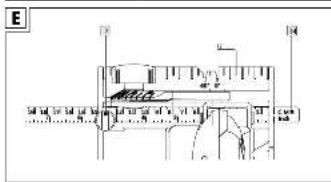
The 0irc cutting mark indicates the position of the saw blade for right-angled cuts. The 45irc cutting mark indicates the position of the saw blades for 45irc cuts (Fig. E).
- Apply light lateral pressure to the workpiece and guide the product along the edge when cutting.
After use
- Switch the product off, remove the battery back 4 and let it cool down.
- Check, clean and store the product as described below.
Cleaning and care
WARNING!

Always switch the product off, remove the battery pack and let the product cool down before performing inspection, maintenance and cleaning work!
Cleaning
The product must always be kept clean, dry and free from oil or grease. Remove debris from it after each use and before storage.
Regular and proper cleaning will help ensure safe use and prolong the life of the product.
Inspect the product before each use for worn and damaged parts. Do not operate it if you find broken and worn parts.
Never allow fluids to get into the product.
Clean the product with a dry cloth. Use a brush for areas that are hard to reach.
In particular clean the air vents after every use with a cloth and brush.
- Remove stubborn dirt with high pressure air (max. 3 bar).
NOTE
Do not use chemical, alkaline, abrasive or other aggressive detergents or disinfectants to clean this product as they might be harmful to its surfaces.
- Maintenance
Before and after each use, check the product and accessories (or attachments) for wear and damage. If required, exchange them for new ones as described in this instruction manual. Observe the technical requirements (see "Technical data").
Repair
This product does not contain any parts that can be repaired by the user. Contact an authorised service centre or a similarly qualified person to have it checked and repaired.
Storage
- Switch the product off and remove the battery pack 4.
Clean the product as described above.
Store the product and its accessories in a dark, dry, frost-free, well-ventilated place.
Always store the product in a place that is inaccessible to children. The ideal storage temperature is between 10ircC and 30ircC .
We recommend using the original package for storage or covering the product with a suitable cloth or enclosure to protect it against dust.
Regularly check the charge level of the battery pack, if it is to be stored for an extended period. Optimum storage conditions are cool and dry.
- Transportation
- Switch the product off and remove the battery pack 4.
- Attach transportation guards, if applicable.
Always carry the product by its handles.
Protect the product from any heavy impact or strong vibrations which may occur during transportation in vehicles. - Secure the product to prevent it from slipping or falling over.
Troubleshooting

WARNING!
Only perform the steps described within these instructions! All further inspection, maintenance and repair work must be performed by an authorised service centre or a similarly qualified specialist if you cannot solve the problem yourself!
Suspected malfunctions are often due to causes that the users can fix themselves. Therefore check the product using this section. In most cases the problem can be solved quickly.
| Problem | Possible cause Solution | |
| Product does not start | Battery pack not properly attached | Attach properly |
| Battery pack discharged | Remove and charge battery pack | |
| Battery pack damaged | Check by a specialist electrician | |
| Other electrical defect to the product | Check by a specialist electrician | |
| Product does not reach full power | Battery pack capacity too low | Charge battery pack |
| Air vents are blocked | Clean the air vents | |
| Unsatisfactory result | Accessory is worn | place with a new one |
| Accessory not suitable for intended operation | Use suitable accessory | |
| Product suddenly stops | Product overloaded | Remove the product from the workpiece and switch it on again |
| Battery pack discharged | Remove and charge battery pack | |
| Battery pack too hot | Remove battery pack and let it cool down | |
| Excessive vibration or noise | Accessory is dull/ damaged | Replace with a new one |
| Bolts/nuts are loose | Tighten bolts/nuts | |
Disposal
The packaging is made entirely of recyclable materials, which you may dispose of at local recycling facilities.

Observe the marking of the packaging materials for waste separation, which are marked with abbreviations (a) and numbers (b) with following meaning: 1 - 7: plastics / 20 - 22: paper and fibreboard / 80 - 98: composite materials

The product and packaging materials are recyclable, dispose of it separately for better waste treatment. The Triman logo is valid in France only.

Contact your local refuse disposal authority for more details of how to dispose of your worn-out product.

To help protect the environment, please dispose of the product properly when it has reached the end of its useful life and not in the household waste. Information on collection points and their opening hours can be obtained from your local authority.
Faulty or used batteries / rechargeable batteries must be recycled in accordance with Directive 2006/66/EC and its amendments. Please return the batteries / rechargeable batteries and / or the product to the available collection points.

Environmental damage through incorrect disposal of the batteries / rechargeable batteries!
Remove the batteries / battery pack from the product before disposal. Batteries /rechargeable batteries may not be disposed of with the usual domestic waste. They may contain toxic heavy metals and are subject to hazardous waste treatment rules and regulations. The chemical symbols for heavy metals are as follows:
Cd = cadmium, Hg = mercury, Pb = lead. That is why you should dispose of used batteries / rechargeable batteries at a local collection point.
Service
WARNING!
Have your product repaired at the service centre or an electrician, using only original manufacturer parts. This will maintain the safety of this product.
Always have a plug or power cord replaced by the product manufacturer or its service centre. This will maintain the safety of this product.
Warranty
The product has been manufactured to strict quality guidelines and meticulously examined before delivery. In the event of product defects you have legal rights against the retailer of this product. Your legal rights are not limited in any way by our warranty detailed below. The warranty for this product is 5 years from the date of purchase. Should this product show any fault in materials or manufacture within 5 years from the date of purchase, we will repair or replace it - at our choice - free of charge to you. The warranty period begins on the date of purchase. Please keep the original sales receipt in a safe location. This document is required as your proof of purchase. This warranty becomes void if the product has been damaged, or used or maintained improperly.
The warranty applies to defects in material or manufacture. This warranty does not cover product parts subject to normal wear, thus possibly considered consumables (e.g. batteries) or for damage to fragile parts, e.g. switches, rechargeable batteries or glass parts.
The warranty for this rechargeable battery pack is 1 year from the date of purchase.
Warranty claim procedure
To ensure quick processing of your case, please observe the following instructions:
Please have the till receipt and the item number (e.g. IAN 123456) available as proof of purchase. You will find the item number on the type plate, an engraving on the front page of the instructions (bottom left), or as a sticker on the rear or bottom of the product.
If functional or other defects occur, please contact the service department listed either by telephone or by e-mail.
You can return a defective product to us free of charge to the service address that will be provided to you. Ensure that you enclose the proof of purchase (till receipt) and information about what the defect is and when it occurred.
GB Service Great Britain
Tel.: 0871 5000 720 (£ 0.10/Min.)
E-Mail: owim@lidl.co.uk
IE Service Ireland
Tel.: 1890 930 034
(0,08 EUR/Min., (peak))
(0,06 EUR/Min., (off peak))
E-Mail: owim@lidl.ie
IAN 289755
Translation of original declaration of conformity
We, OWIM GmbH & Co. KG, Stiftsbergstraße 1, DE-74167 Neckarsulm, GERMANY, hereby declare under our sole responsibility that the product: cordless circular saw 20 V PHKSAP 20-Li A1, Model No.: HG02737, Version: 08 / 2017, to which this declaration refers, complies with the standards / normative documents of 2006/42/EC, 2014/35/EU, 2014/30/EU, 2011/65/EU.
Applied harmonised standards:
EN 60745-1:2009+A11:2010
EN 60745-2-5: 2010
EN 60335-1:2012+A11:2014
EN 60335-2-29: 2004+A2: 2010
EN 62233: 2008
EN 55014-1: 2006+A1: 2009+A2: 2011
EN 55014-2: 2015
EN 61000-3-2: 2014
EN 61000-3-3:2013
EN 50581:2012
Serial number: IAN 289755
Tobias Konig
Division Manager / Responsible for documentation
The declaration of conformity can also be viewed at: www.owim.com.

The object of the declaration described above satisfies the provisions of Directive 2011/65/EU of the European Parliament and the Council of 8 June 2011 on limiting the use of certain harmful substances in electrical and electronic appliances.
Sommaire
Gedrag in noodsituations
Ensure that you have the accessories and tools needed for commissioning and operation available. This also includes suitable personal protective equipment.
Accessories and tools are available through your authorised dealer. When buying always consider the technical requirements of this product (see "Technical data").
If you are not certain, ask a qualified specialist and get advice from your trusted dealer.
AVISO


- Inhaltsverzeichnis
- List of pictograms used
- Introduction
- Safety warnings Page 25
- Initial use.. Page 30
- Before use
- Operation
- Cleaning and care
- Troubleshooting
- Disposal
- Service
- Warranty
- Translation of original declaration of conformity.. Page 36
- CORDLESS CIRCULAR SAW 20 V PHKSAP 20-Li A1
- Intended use
- Parts description
- Figure A:
- Figure B:
- Figure C:
- Scope of delivery
- Technical data
- Cordless circular saw: PHKSAP 20-Li A1
- Battery pack: PHKSAP 20-Li A1-1
- Rapid battery charger: PHKSAP 20-Li A1-2
- Noise emission value:
- Vibration emission value:
- Cutting wood
- WARNING!
- NOTE
- Safety warnings
- - General power tool safety warnings
- Save all warnings and instructions for future reference.
- Work area safety
- Electrical safety
- Personal safety
- Power tool use and care
- Battery tool use and care
- Safety instructions for all saws - Cutting procedures
- Further safety instructions for all saws - Kickback causes and related warnings
- Safety instructions for circular saws with outer pendulum guard - Lower guard function
- Always observe that the lower guard is covering the blade before placing saw down on bench or floor.
- Additional circular saw safety warnings
- Saw blade safety warnings
- Vibration and noise reduction
- Behaviour in emergency situations
- Residual risks
- Battery charger safety warnings
- CAUTION! RISK OF EXPLOSION
- Initial use
- Unpacking
- Accessories
- - Attaching / removing the battery pack
- Attaching the battery pack:
- Removing the battery pack:
- - Charging the battery pack
- Charging status LEDs
- - Checking the battery level
- - Attaching / removing a dust extraction device
- - Checking the blade guard
- CAUTION! RISK OF INJURY!
- Setting the cutting depth
- Switching on and off
- Switching on:
- Switching off:
- Cutting
- Cutting with angle
- Cutting with rip fence
- After use
- Cleaning
- - Maintenance
- Repair
- Storage
- - Transportation
- Environmental damage through incorrect disposal of the batteries / rechargeable batteries!
- Warranty claim procedure
- GB Service Great Britain
- IE Service Ireland
- IAN 289755
- Translation of original declaration of conformity
- Applied harmonised standards:
- Serial number: IAN 289755
- Sommaire
- Gedrag in noodsituations
- AVISO
Brand : PARKSIDE
Model : PHKSAP 20Li A1
Category : Electric saw