USER MANUAL NEX-6B SONY
The model and serial numbers are located on the bottom. Record the serial number in the space provided below. Refer to these numbers whenever you call your Sony dealer regarding this product.
Model No. NEX-6
Serial No.
Model No. AC-UB10/AC-UB10B/AC-UB10C/AC-UB10D
Serial No.
WARNING
To reduce fire or shock hazard, do not expose the unit to rain or moisture.
IMPORTANT SAFETY INSTRUCTIONS
-SAVE THESE INSTRUCTIONS DANGER
-TO REDUCE THE RISK OF FIRE OR ELECTRIC SHOCK, CAREFULLY FOLLOW THESE INSTRUCTIONS
If the shape of the plug does not fit the power outlet, use an attachment plug adaptor of the proper configuration for the power outlet.
CAUTION
Battery pack
If the battery pack is mishandled, the battery pack can burst, cause a fire or even chemical burns. Observe the following cautions.
- Do not disassemble.
- Do not crush and do not expose the battery pack to any shock or force such as hammering, dropping or stepping on it.
- Do not short circuit and do not allow metal objects to come into contact with the battery terminals.
- Do not expose to high temperature above 60^ (140^) such as in direct sunlight or in a car parked in the sun.
- Do not incinerate or dispose of in fire.
- Do not handle damaged or leaking lithium ion batteries.
- Be sure to charge the battery pack using a genuine Sony battery charger or a device that can charge the battery pack.
- Keep the battery pack out of the reach of small children.
- Keep the battery pack dry.
- Replace only with the same or equivalent type recommended by Sony.
- Dispose of used battery packs promptly as described in the instructions.
AC Adaptor
Use the nearby wall outlet (wall socket) when using the AC Adaptor. Disconnect the AC Adaptor from the wall outlet (wall socket) immediately if any malfunction occurs while using the apparatus.
The power cord (mains lead), if supplied, is designed specifically for use with this camera only, and should not be used with other electrical equipment.
For Customers in the U.S.A. and Canada
I RECYCLING LITHIUM-ION BATTERIES
Lithium-Ion batteries are recyclable.
You can help preserve our environment by returning your used rechargeable batteries to the collection and recycling location nearest you.
For more information regarding recycling of rechargeable batteries, call toll free
1-800-822-8837, or visit http://www.rbrc.org/
Caution: Do not handle damaged or leaking Lithium-Ion batteries.

Battery pack and lens (If lens supplied)
This device complies with Part 15 of the FCC Rules. Operation is subject to the following two conditions:
(1) This device may not cause harmful interference, and (2) this device must accept any interference received, including interference that may cause undesired operation.
This Class B digital apparatus complies with Canadian ICES-003.
This equipment complies with FCC/IC radiation exposure limits set forth for an uncontrolled environment and meets the FCC radio frequency (RF) Exposure Guidelines in Supplement C to OET65 and RSS-102 of the IC radio frequency (RF) Exposure rules. This equipment has very low levels of RF energy that are deemed to comply without testing of specific absorption ratio (SAR).
For Customers in the U.S.A.
UL is an internationally recognized safety organization.
The UL Mark on the product means it has been UL Listed.
If you have any questions about this product, you may call:
Sony Customer Information Center
1-800-222-SONY (7669)
The number below is for the FCC related matters only.
Trade Name:SONY
Model No.: NEX-6
Responsible Party: Sony Electronics Inc.
Address: 16530 Via Esprillo, San Diego, CA 92127 U.S.A.
Telephone No.: 858-942-2230
This device complies with Part 15 of the FCC Rules. Operation is subject to the following two conditions: (1) This device may not cause harmful interference, and (2) this device must accept any interference received, including interference that may cause undesired operation.
This equipment must not be co-located or operated in conjunction with any other antenna or transmitter.
CAUTION
You are cautioned that any changes or modifications not expressly approved in this manual could void your authority to operate this equipment.
I Note:
This equipment has been tested and found to comply with the limits for a Class B digital device, pursuant to Part 15 of the FCC Rules.
These limits are designed to provide reasonable protection against harmful interference in a residential installation. This equipment generates, uses, and can radiate radio frequency energy and, if not installed and used in accordance with the instructions, may cause harmful interference to radio communications. However, there is no guarantee that interference will not occur in a particular installation. If this equipment does cause harmful interference to radio or television reception, which can be determined by turning the equipment off and on, the user is encouraged to try to correct the interference by one or more of the following measures:
- Reorient or relocate the receiving antenna.
- Increase the separation between the equipment and receiver.
- Connect the equipment into an outlet on a circuit different from that to which the receiver is connected.
- Consult the dealer or an experienced radio/TV technician for help.
The supplied interface cable must be used with the equipment in order to comply with the limits for a digital device pursuant to Subpart B of Part 15 of FCC Rules.
For Customers in Canada
This device complies with Industry Canada licence-exempt RSS standard(s).
Operation is subject to the following two conditions: (1) this device may not cause interference, and (2) this device must accept any interference, including interference that may cause undesired operation of the device.
Under Industry Canada regulations, this radio transmitter may only operate using an antenna of a type and maximum (or lesser) gain approved for the transmitter by Industry Canada. To reduce potential radio interference to other users, the antenna type and its gain should be so chosen that the equivalent isotropically radiated power (e.i.r.p.) is not more than that necessary for successful communication.
For Customers in Europe
Notice for the customers in the countries applying EU Directives
The manufacturer of this product is Sony Corporation, 1-7-1 Konan Minato-ku Tokyo, 108-0075 Japan. The Authorized Representative for EMC and product safety is Sony Deutschland GmbH, Hedelfinger Strasse 61, 70327 Stuttgart, Germany. For any service or guarantee matters please refer to the addresses given in separate service or guarantee documents.
CE
Hereby, Sony Corporation, declares that this NEX-6 Interchangeable Lens Digital Camera is in compliance with the essential requirements and other relevant provisions of the Directive 1999/5/EC. For details, please access the following URL: http://www.compliance.sony.de/
This product has been tested and found compliant with the limits set out in the R&TTE Directive for using connection cables shorter than 3 meters (9.8 feet).
Attention
The electromagnetic fields at the specific frequencies may influence the picture and sound of this unit.
Notice
If static electricity or electromagnetism causes data transfer to discontinue midway (fail), restart the application or disconnect and connect the communication cable (USB, etc.) again.
Disposal of Old Electrical & Electronic Equipment (Applicable in the European Union and other European countries with separate collection systems)


This symbol on the product or on its packaging indicates that this product shall not be treated as household waste. Instead it shall be handed over to the applicable collection point for the recycling of electrical and electronic equipment. By ensuring this product is disposed of correctly, you will help prevent potential negative consequences for the environment and human health, which could otherwise be caused by inappropriate waste handling of this product. The recycling of materials will help to conserve natural resources. For more detailed information about recycling of this product,
please contact your local Civic Office, your household waste disposal service or the shop where you purchased the product.
Disposal of waste batteries (applicable in the European Union and other European countries with separate collection systems)

This symbol on the battery or on the packaging indicates that the battery provided with this product shall not be treated as household waste. On certain batteries this symbol might be used in combination with a chemical symbol. The chemical symbols for mercury (Hg) or lead (Pb) are added if the battery contains more than 0.0005% mercury or 0.004% lead. By ensuring these batteries are disposed of correctly, you will help prevent
potentially negative consequences for the environment and human health which could otherwise be caused by inappropriate waste handling of the battery. The recycling of the materials will help to conserve natural resources.
In case of products that for safety, performance or data integrity reasons require a permanent connection with an incorporated battery, this battery should be replaced by qualified service staff only. To ensure that the battery will be treated properly, hand over the product at end-of-life to the applicable collection point for the recycling of electrical and electronic equipment.
For all other batteries, please view the section on how to remove the battery from the product safely.
Hand the battery over to the applicable collection point for the recycling of waste batteries. For more detailed information about recycling of this product or battery, please contact your local Civic Office, your household waste disposal service or the shop where you purchased the product.
Notice for customers in the United Kingdom
A moulded plug complying with BS 1363 is fitted to this equipment for your safety and convenience.
Should the fuse in the plug supplied need to be replaced, a fuse of the same rating as the supplied one and approved by ASTA or BSI to BS 1362, (i.e., marked with an or mark) must be used.
If the plug supplied with this equipment has a detachable fuse cover, be sure to attach the fuse cover after you change the fuse. Never use the plug without the fuse cover. If you should lose the fuse cover, please contact your nearest Sony service station.
Caution if using the camera in Italy
Use of the LAN network is governed: - with respect to private use, by the Legislative Decree of 1.8.2003, no. 259 ("Code of Electronic Communications"). In particular Article 104 indicates when the prior obtaining of a general authorization is required and Art. 105 indicates when free use is permitted; - with respect to the supply to the public of the LAN access to telecom networks and services, by the Ministerial Decree 28.5.2003, as amended, and Art. 25 (general authorization for electronic communications networks and services) of the Code of electronic communications.
Caution if using the camera in Norway
Use of this radio equipment is not allowed in the geographical area with in a radius of 20km from the centre of Ny-Alesund, Svalbard.
For Customers in Singapore
Complies with
IDA Standards
DB00353
For customers who purchased their camera from a store in Japan that caters to tourists
I Note
All Wireless function designated for the NEX-6 Interchangeable Lens Digital Camera are applicable in the U.S.A., Canada, Mexico, France, Sweden, Russia, Ukraine, Australia, Singapore, Korea, the Philippines, Thailand, Taiwan, India and China.
This manual covers several models supplied with different lenses.
The model name varies depending on the supplied lens. The available model varies depending on the countries/regions.
| Model name | Lens |
| NEX-6 | Not supplied |
| NEX-6L | E16 – 50 mm |
| NEX-6Y | E55 – 210 mm and E16 – 50 mm |
Checking the supplied items
First check the model name of your camera (page 8). The accessories supplied differ depending on the model.
The number in parentheses indicates the quantity.
Comes with all models
- Camera (1)
- Power cord (mains lead) (1)^* (not supplied in the U.S.A. and Canada)

- Multiple power cords may be supplied with your camera. Use the appropriate one that matches your country/region.
- Rechargeable battery pack NP-FW50 (1)


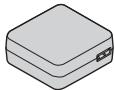
- AC adaptor AC-UB10/UB10B/UB10C/UB10D (1)
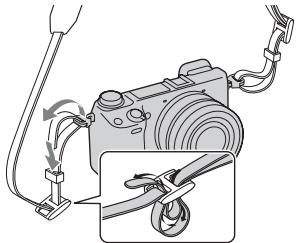
Shoulder strap (1)


-
Shoe Cap (1) (Attached on the camera)
CD-ROM (1)
-
Application Software for camera
-
Handbook
-
Instruction Manual (This manual) (1)
NEX-6
- Body cap (1) (attached to the camera)
NEX-6L
- E16 - 50 mm zoom lens (1)/Front lens cap (1) (attached to the camera)
NEX-6Y
- E16 - 50 mm zoom lens (1)/Front lens cap (1) (attached to the camera)
E55-210 mm zoom lens (1)/Front lens cap (1)/Rear lens cap (1)/Lens hood (1)
Identifying parts
See the pages in parentheses for details on operation for the parts.

When the lens is removed

1 Flash
[2] Shutter button (27)
3 Hook for shoulder strap Attach the shoulder strap to prevent damage caused by dropping the camera.
4 Fn (Function) button
5 Remote sensor
6 ON/OFF (Power) switch (24)
AF illuminator/Self-timer lamp/ Smile Shutter lamp
8 Multi Interface Shoe1)2
9 Microphone3)
Lens (19)
Lens release button (20)
12 Mount
Image sensor4)
Lens contacts4
1) For details on compatible accessories of the Multi Interface Shoe, visit the Sony web site in your area, or consult your Sony dealer or local authorized Sony service facility. Accessories for the Accessory Shoe can also be used. Operations with other manufactures' accessories are not guaranteed.

Multi Interface Shoe
Accessory Shoe
2) Accessories for the Auto-lock Accessory Shoe can also be attached using the Shoe Adaptor (sold separately).
Auto-lock Accessory Shoe
3) Do not cover this part during movie recording.
4) Do not touch this part directly.

1 Image sensor position mark
Viewfinder (23)
3 Eyepiece cup (23)
- Not attached to the camera at the factory.
4 Eye sensor
[5] Wi-Fi sensor (built-in)
Charge lamp
7 Micro USB terminal
8 HDMI terminal
9 LCD screen
You can adjust the LCD screen to an easily viewable angle and shoot from any position.

10 (Flash pop-up) button
11 Playback) button (28)
12 Mode dial (34)
13 Control dial (32)
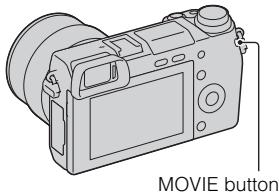
MOVIE button (27)
15 AEL button
16 Soft key A (32)
17 Control wheel (31)
18 Soft key C (32)
19 Soft key B (32)
Diopter-adjustment dial (23)

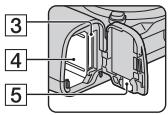
1 Battery/memory card cover (14, 21)
2 Access lamp (22)
3 Memory card insertion slot (21)
4 Battery compartment (14)
5 Connection plate cover Use this when using an AC-PW20 AC Adaptor (sold separately). Insert the connection plate into the battery compartment, and then pass the cord through the connection plate cover as shown below.
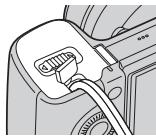
- Make sure that the cord is not pinched when you close the cover.
6 Tripod socket hole
- Use a tripod with a screw length of less than 5.5mm (7/32 inch). You will be unable to firmly secure the camera to tripods using screws longer than 5.5mm (7/32 inch), and may damage the camera.
7 Speaker
Lens
See page 61 on the specifications of the lenses.
E PZ 16 - 50 mm F3.5-5.6 OSS (supplied with NEX-6L/NEX-6Y)
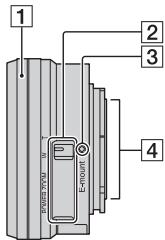
1 Zooming/Focusing ring
2 Zooming lever
3 Mounting index
4 Lens contacts1)
1) Do not touch this part directly.
E55-210 mm F4.5-6.3 OSS
(supplied with NEX-6Y)


1 Focusing ring
2 Zooming ring
3 Focal-length scale
4 Focal-length index
Lens contacts1
6 Mounting index
1) Do not touch this part directly.
Charging the battery pack
When using the camera for the first time, be sure to charge the NP-FW50 "InfoLITHIUM" battery pack (supplied).
The "InfoLITHIUM" battery pack can be charged even when it has not been fully depleted. The battery pack can also be used when it has not been fully charged.
The charged battery pack is discharged little by little, even when you do not use it. To avoid missing an opportunity to shoot, charge the battery pack again before you shoot.
1 Set the power switch to OFF.

2 Open the cover by sliding the lever.
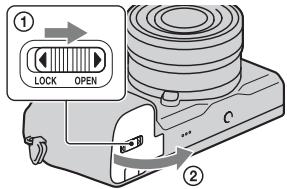
3 Insert the battery pack completely, using the tip of the battery to press the lock lever.

4 Close the cover.

5 Connect the camera to the AC Adaptor (supplied), using the micro USB cable (supplied). Connect the AC Adaptor to the wall outlet (wall socket).

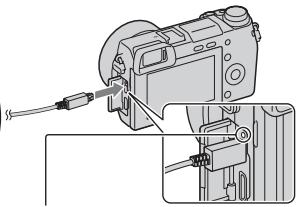
The charge lamp lights orange, and charging starts.
- Set the power switch to OFF while charging the battery. If the power switch is set to ON, the camera cannot charge the battery.
- When the charge lamp flashes, remove and re-insert the battery pack.
Charge lamp
Lit: Charging
Off: Charging finished
- Flashing: Charging error or charging temporarily stopped because the temperature is outside the recommended range.
Notes
- If the charge lamp on the camera flashes when the AC Adaptor is connected to the wall outlet (wall socket), this indicates that charging is temporarily stopped because the temperature is outside the recommended range. When the temperature gets back within the appropriate range, the charging resumes. We recommend charging the battery pack in an ambient temperature of between 10^ and 30^ (50^ and 86^) .
- The charge lamp may flash quickly when the battery pack is used for the first time, or the battery pack has not been used for a long time. In such cases, remove the battery pack and re-insert it, and then charge the battery pack.
- Do not try to charge the battery pack again right after it has been charged, or when it has not been used after being charged. Doing so will affect the performance of the battery pack.
- When charging is finished, disconnect the AC Adaptor from the wall outlet (wall socket).
- Be sure to use only genuine Sony brand battery packs, micro USB cable (supplied) and AC Adaptor (supplied).
Charging time
The charging time is approximately 280min using the AC Adaptor (supplied).
Notes
- The above charging time applies when charging a fully depleted battery pack at a temperature of 25^ ( 77^ ). Charging may take longer depending on conditions of use and circumstances.
Charging by connecting to a computer
The battery pack can be charged by connecting the camera to a computer using a micro USB cable.
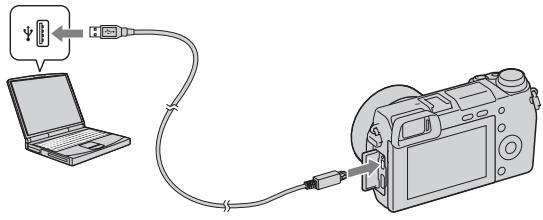
Notes
Note the following points when charging via a computer:
- If the camera is connected to a laptop computer that is not connected to a power source, the laptop battery level decreases. Do not leave the camera connected to a computer for an extended period of time.
- Do not turn on/off or restart the computer, or wake the computer to resume from sleep mode when a USB connection has been established between the computer and the camera. The camera may cause a malfunction. Before turning on/off, or restarting the computer or waking the computer from sleep mode, disconnect the camera from the computer.
- We do not guarantee operation with all computers. No guarantees are made for charging using a custom-built computer, a modified computer, or charging via a USB hub. You may not be able to operate the camera properly, depending on the types of USB devices you are using at the same time.

Using your camera abroad — Power source
You can use your camera and AC Adaptor in any countries/regions where the power supply is within 100V to 240V AC, 50Hz / 60Hz .
An electronic voltage transformer is unnecessary and its use may cause a malfunction.
Checking the remaining battery level
Check the level with the following indicators and percent figures displayed on the LCD screen.
| Battery level | | | | | “Battery exhausted.” |
| High | Low | You cannot shoot any more image. |
Notes
- The displayed battery power level may not be correct under certain circumstances.

What is an "InfoLITHIUM" battery pack?
An "InfoLITHIUM" battery pack is a lithium-ion battery pack that has functions for exchanging information related to operating conditions with your camera. Using the "InfoLITHIUM" battery pack, the remaining battery time in percent figures is displayed according to the operating conditions of your camera.
Removing the battery pack
Turn off the camera, make sure that the access lamp is not lit, slide the lock lever in the direction of the arrow, and pull out the battery pack. Be careful not to drop the battery pack.

Attaching/removing the lens
Set the power switch of the camera to OFF before you attach or remove the lens.
1 If the cap or the packaging lid is attached, remove it from the camera or the lens.
- Quickly change the lens somewhere away from dusty locations so as to keep dust or debris from getting inside the camera.
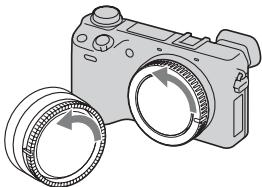
2 Mount the lens by aligning the white index marks on the lens and the camera.
- Hold the camera's face downward to prevent the dust from entering into the camera.

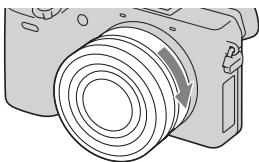
3 While pushing the lens lightly toward the camera, turn the lens clockwise until it clicks into the locked position.
- Be sure to put the lens on straight.
Notes
- When attaching a lens, do not press the lens release button.
- Do not use excessive force when attaching a lens.
- The Mount Adaptor (sold separately) is required to use an A-mount lens (sold separately). For details, refer to the operating manual supplied with the Mount Adaptor.
- When using a lens equipped with a tripod socket, attach the socket on the lens side to the tripod to maintain balance.
1 Press the lens release button all the way in and turn the lens counterclockwise until it stops.
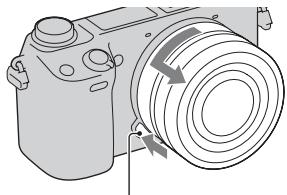
Lens release button
Notes
- If dust or debris gets inside the camera while you are changing the lens and adheres to the surface of the image sensor (the part that converts the light source to a digital signal), it may appear as dark spots on the image, depending on the shooting environment. The camera vibrates slightly when it is turned off, due to the anti-dust function, to prevent dust from adhering to the image sensor. However, attach or remove the lens quickly somewhere away from dusty locations.
- Do not leave the camera with the lens removed.
- When you want to use body caps or rear lens caps, please purchase ALC-B1EM (Body cap) or ALC-R1EM (Rear lens cap) (sold separately).
- When you use a lens with a power zoom, set the power switch of the camera to OFF and confirm that the lens is completely retracted before switching lenses. If the lens has not retracted, do not press the lens in by force.
Inserting a memory card (sold separately)
1 Open the cover.
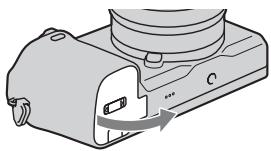
2 Insert a memory card.
- Insert the memory card until it clicks as illustrated.

Check on the direction of the notched corner.
3 Close the cover.
Memory cards that you can use
You can use following types of memory cards with this camera. However, proper operation cannot be guaranteed for all types of the memory cards.
| Usable memory card | Still image | Movie | Term in this manual |
| “Memory Stick PRO Duo” media | ✓ | ✓ (Mark2) | “Memory Stick PRO Duo” media |
| “Memory Stick PRO-HG Duo” media | ✓ | ✓ |
| SD memory card | ✓ | ✓ (Class 4 or more) | SD card |
| SDHC memory card | ✓ | ✓ (Class 4 or more) |
| SDXC memory card | ✓ | ✓ (Class 4 or more) |
You cannot use MultiMediaCard.
Notes
- Images recorded on an SDXC memory card cannot be imported to or played on computers or AV devices that are not compatible with exFAT. Make sure that the device is compatible with exFAT before connecting it to the camera. If you connect your camera to an incompatible device, you may be prompted to format the card. Never format the card in response to this prompt, as doing so will erase all data on the card. (exFAT is the file system used on SDXC memory cards.)
Removing the memory card
Open the cover, make sure that the access lamp is not lit, and push the memory card once.

Access lamp
Notes
- When the access lamp is lit, do not remove the memory card or the battery pack, or turn off the power. The data may be corrupted.
Adjusting the viewfinder (diopter adjustment)
Adjust the viewfinder so that you can see the screen displays clearly.
1 Turn the diopter-adjustment dial.

Attaching/removing the eyepiece cup
It is recommended that you attach the eyepiece cup when you intend to use the viewfinder.
1 Align the top of the eyepiece cup with the viewfinder, and snap it onto the bottom of the viewfinder.
- To remove the eyepiece cup, push on the sides and pull the eyepiece cup off the viewfinder.

Notes
- Remove the eyepiece cup when you attach an accessory (sold separately) to the Multi Interface Shoe.
Setting the date and time
When you turn on the camera for the first time, the screen to set date and time appears.
1 Set the power switch to ON to turn on the camera.
The screen to set date and time appears.
- To turn off the camera, set the power switch to OFF.
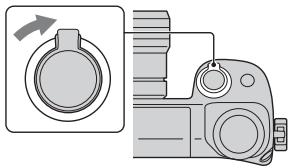
2 Press the center of the control wheel.

3 Select your area by pressing the right or left of the control wheel and press the center.

4 Press the left or right of the control wheel to select each item, and press the top or bottom, or turn it to select the numeric value.
Daylight SVG.: Turns on or off the daytime saving time setting.
Date Format: Selects the format to display date.
- Midnight is indicated as 12:00 AM, and noon as 12:00 PM.

5 Repeat step 4 to set other items, and then press the center of the control wheel.
GB
Notes
- You cannot superimpose the date on images on this camera. Using "PlayMemories Home" stored on the CD-ROM (supplied), you can save or print images with date. Refer to "PlayMemories Home Help Guide" for more details (page 37).
Resetting the date and time/Checking the current clock setting
Select MENU [Setup] [Date/Time Setup].
Maintaining the date and time setting
This camera has an internal rechargeable battery for maintaining the date and time and other settings regardless of whether the power is on or off, or the battery is installed or not. For details, see page 55.
Shooting still images
In the i (Intelligent Auto) mode, the camera analyzes the subject, and allows you to shoot with appropriate settings.
1 Set the mode dial to i (Intelligent Auto).

2 Point the camera to the subject.
When the camera recognizes the scene, the Scene Recognition icon and guide appear on the LCD screen:
Night Scene), Tripod Night Scene), (Night Portrait),
Backlight), (Backlight Portrait), (Portrait),
(Landscape), (Macro),
(Spotlight), (Low Brightness), or (Baby).

Scene Recognition icon and guide
3 Adjust the zoom scale.
Lens with zooming lever: Slide the zooming lever.
Lens with zooming ring: Rotate the zooming ring.
- Optical zooming is not available with a fixed focus lens.
- When you operate the lens with power zoom, the camera shifts automatically to the [Zoom] feature of the camera when the magnification scale is greater than that of the optical zoom.

When the focus is confirmed, beeps sound and lights up.

Focus indicator
GB
When the camera detects and shoots a face with [Auto Port. Framing] set to [Auto], the captured image is automatically trimmed into a suitable composition. Both the original and the trimmed images are saved.
Recording movies
1 Point the camera to the subject.
Focus and brightness are adjusted automatically.
- If you press the shutter button halfway down during recording, you will be able to focus more quickly.
Notes
- The sound of the camera and the lens in operation might be recorded while recording a movie. You can disable the sound recording by selecting MENU → [Setup] → [Movie Audio Rec] → [Off].
- The continuous recording time of a movie depends on the ambient temperature or the condition of the camera.
- When you are recording continuously for a long time, you may feel that the camera is warm. This is normal. Also, "Internal temp. high. Allow it to cool." may appear. In such cases, turn the camera off and wait until the camera is ready to shoot again.
Playing back images
The last recorded image is displayed on the LCD screen.
- Press the center of the control wheel to enlarge the displayed image.


(Playback) button
Selecting the image
Turn the control wheel.
1 Select MENU [Playback] [Still/Movie Select] [Folder View(MP4)] or [AVCHD View].
- To return to still image playback, select [Folder View(Still)].

2 Turn the control wheel to select the desired movie, and press the center.
GB
| During movie playback | Control wheel operation |
| Pause/resume | Press the center. |
| Fast-forward | Press the right, or turn the control wheel clockwise. |
| Fast-rewind | Press the left, or turn the control wheel counterclockwise. |
| Forward slow playback | Turn clockwise during pause. |
| Reverse slow playback* | Turn counterclockwise during pause. |
| Adjust sound volume | Press the bottom → top/bottom. |
- The movie is played back frame-by-frame.
Deleting images
You can delete the image that is currently displayed.
1 Press面 (Delete).

2 Press the center of the control wheel.
- Select x to quit the operation.


Deleting several images
Select MENU [Playback] [Delete] to select and delete several images at the same time.
Operating the camera
The control wheel, control dial and soft keys allow you to use various functions of the camera.
Control wheel
When shooting, DISP (Display Contents), 2 (Exposure Comp.), / (Drive Mode) and ISO (ISO) functions are assigned to the control wheel. When playing back, DISP (Display Contents) and (Image Index) functions are assigned to the control wheel.
When you turn or press the top/bottom/right/left parts of the control wheel following the on-screen display, you can select setting items. Your selection is determined when you press the center of the control wheel.
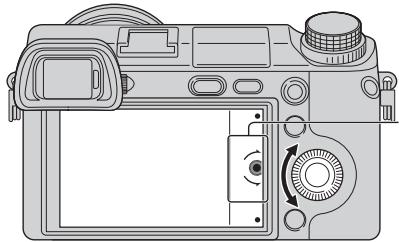
The arrow means you can turn the control wheel.

When options are displayed on the screen, you can browse through them by turning or pressing the top/bottom/left/right parts of the control wheel. Press the center to make your choice.
- The application downloading function may not be available in some countries/ regions.
Control dial
You can set the aperture value and shutter speed, etc. by turning the control dial. The setting value assigned to the control dial changes for each shooting mode.

Soft keys
The soft keys have different roles, depending on the context.
The assigned role (function) of each soft key is shown on the screen.
To use the function shown at the upper right corner of the screen, press soft key A. To use the function shown at the lower right corner of the screen, press soft key B. To use the function shown at the center, press the center of the control wheel (soft key C).
In this manual, the soft keys are indicated by the icon or the function shown on the screen.

In this case,soft key A works as the MENU (Menu) button,and soft key B as the View on Smartphone) button.
When you press MENU, the menu items [Camera], [Image Size], [Brightness/ Color], [Playback], [Application]* and [Setup] appear on the screen.
You can set various functions in each item. Items that cannot be set in the context are displayed in gray.
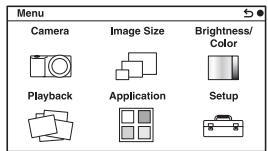
* The application downloading function may not be available in some countries/ regions.
GB
Using the guide function of the camera
The camera provides various "Help Guides" which explain the functions, and "Shooting tips" which introduce tips for better shooting. Use these guides to make better use of the camera.
Help Guides
The camera displays the Help Guides to explain the selected function, when you change the setting, etc.
You can hide the Help Guides by selecting MENU [Setup] [Help Guide Display] [Off].
Shooting tips
You can display shooting tips for better shooting from [Table of contents] by selecting MENU [Camera] [Shooting Tip List].
You can also assign [Shoot. Tips] to the AEL button or soft key B.
Shooting with various shooting modes
1 Select the shooting mode by turning the mode dial.

(Intelligent Auto): The
camera evaluates the subject and makes the proper settings.
SCN (Scene Selection):
Shoots with preset settings according to the subject or condition.

(Sweep Panorama): Shoots with panoramic size.
M (Manual Exposure): Adjusts the aperture and shutter speed.
S (Shutter Priority): Adjusts the shutter speed to express the movement of the subject.
A (Aperture Priority): Adjusts the range in focus, or defocuses the background.
P (Program Auto): Automatic shooting that allows you to customize settings, except for the exposure (shutter speed and aperture).
i^a + (Superior Auto): Shoots images with a wider range of shooting functions than those of Intelligent Auto shooting. Recognizes and evaluates the shooting conditions automatically, performs Auto HDR, and chooses the best image.
Installing the software
To utilize images recorded with the camera, the following software is provided with CD-ROM (supplied):
- "Image Data Converter"
You can open RAW format image files.
- "PlayMemories Home" (Windows only)
You can import still images or movies recorded with the camera to your computer so that you can view them, and use various convenient features to enhance the images you have shot.
Notes
- Log on as Administrator.
- Use "Image Data Converter" to play back RAW images.
- If "PMB" (Picture Motion Browser) supplied with a camera that was purchased before 2011 has already been installed on the computer, "PMB" will be overwritten by "PlayMemories Home," and you may be unable to use some functions of "PMB" that were previously available.
- "PlayMemories Home" is not compatible with Mac computers. When you play back images on Mac computers, use the appropriate application software supplied with the Mac computer.
Windows
The following computer environment is recommended when using the supplied software and importing images via a USB connection.
| OS (pre-installed) | Microsoft Windows XP* SP3/Windows Vista** SP2/Windows 7 SP1 |
| "PlayMemories Home" | CPU: Intel Pentium III 800 MHz or faster
For playing/editing the High Definition movies: Intel Core Duo 1.66 GHz or faster/Intel Core 2 Duo 1.66 GHz or faster (Intel Core 2 Duo 2.26 GHz or faster (AVC HD (FX/FH)), Intel Core 2 Duo 2.40 GHz or faster (AVC HD PS))
Memory: Windows XP 512 MB or more (1 GB or more is recommended), Windows Vista/Windows 7 1 GB or more
Hard Disk: Disk space required for installation—approximately 500 MB
Display: Screen resolution—1024 × 768 dots or more |
| "Image Data Converter Ver.4" | CPU/Memory: Pentium 4 or faster/1 GB or more
Display: 1024 × 768 dots or more |
- 64-bit editions and Starter (Edition) are not supported. Windows Image Mastering API (IMAPI) Ver. 2.0 or later is required to use the function for creating discs.
** Starter (Edition) is not supported.
1 Turn on your computer, and insert the CD-ROM (supplied) into the CD-ROM drive.
The installation menu screen appears.
- If the installation menu does not appear, double-click [Computer] (For Windows XP: [My Computer]) (PMHOME) [Install.exe].
- If the AutoPlay screen appears, select "Run Install.exe" and follow the instructions that appear on the screen to proceed with the installation.
2 Connect the camera to the computer.
3 Click [Install].
- Make sure that both "Image Data Converter" and "PlayMemories Home" are checked and follow the instructions on the screen.
- When the restarting confirmation message appears, restart the computer following the instructions on the screen.
- DirectX may be installed depending on the system environment of your computer.
4 Remove the CD-ROM after the installation is complete.
The following software is installed and shortcut icons appear on the desktop.
"Image Data Converter"
"PlayMemories Home"
"PlayMemories Home Help Guide"
Mac
The following computer environment is recommended when using the supplied software and importing images via a USB connection.
| OS (pre-installed) | USB Connection: Mac OS X v10.3 to v10.8
“Image Data Converter”: Mac OS X v10.5 to v10.8 |
| “Image Data Converter Ver.4” | CPU: Intel processor, such as Intel Core Solo/Core Duo/Core 2 Duo
Memory: 1 GB or more is recommended.
Display: 1024 × 768 dots or more |
1 Turn on your Mac computer, and insert the CD-ROM (supplied) into the CD-ROM drive.
2 Double-click the CD-ROM icon.
3 Copy the [IDC_INST.dkg] file in the [MAC] folder to the hard disk icon.
4 Double-click the [IDC_INST].pkg] file in the destination folder.
- Follow the instructions on the screen to complete the installation.
What you can do with the supplied software
"PlayMemories Home"
With "PlayMemories Home," you can do the following:
- You can import images shot with the camera to your computer and display them on the computer.
- You can trim and resize images.
- You can organize images on the computer on a calendar by shooting date to view them.
- You can retouch (Red Eye Correction, etc.), print, send still images as e-mail attachments and change the shooting date.
- You can print or save still images with the date.
- You can create a Blu-ray Disc, AVCHD disc or DVD disc from AVCHD movies imported to a computer. (An internet connection environment is required when a Blu-ray Disc/DVD disc is created for the first time.)
For details on "PlayMemories Home," refer to "PlayMemories Home Help Guide".
Double-click the shortcut of (PlayMemories Home Help Guide) on the desktop, or click [Start] [All Programs] [PlayMemories Home] [PlayMemories Home Help Guide].
"PlayMemories Home" support page (English only) http://www.sony.co.jp/pmh-se/
Notes
- "PlayMemories Home" is not compatible with Mac computers. When you play back images on Mac computers, use the appropriate application software supplied with the Mac computer.
- Movies recorded with the [60p 28M(PS)/50p 28M(PS)]/[60i 24M(FX)/50i 24M(FX)]/[24p 24M(FX)/25p 24M(FX)] setting in [Record Setting] are converted by "PlayMemories Home" in order to create an AVCHD recording disc. This conversion can take a long time. Also, you cannot create a disc in the original image quality. If you want to keep the original image quality, store your movies on a Blu-ray Disc.
Image Data Converter
With "Image Data Converter," you can do the following:
- You can play back and edit images recorded in RAW format with various corrections, such as tone curve and sharpness.
- You can adjust images with white balance, exposure, and [Creative Style], etc.
- You can save the images displayed and edited on a computer.
You can either save the image as RAW format or save it in the general file format.
- You can display and compare the RAW images and JPEG images recorded by this camera.
- You can rank images in 5 grades.
- You can apply color labels, etc.
For details on "Image Data Converter," refer to Help.
Click [Start] [All Programs] [Image Data Converter] [Help] [Image Data Converter Ver.4].
"Image Data Converter" support page (English only)
Adding functions to the camera
You can add the desired functions to your camera by connecting to the application downloading website (PlayMemories Camera Apps) via the Internet.
For example, the following functions are available:
- You can control the camera using a Smartphone.
- You can use various effects for shooting images.
- You can upload images to network services directly from the camera.
Some applications may be fee-based.
Starting up downloading services
1 Access the application downloading website.
http://www.sony.net/pmca
- Use Internet Explorer 8 or 9 for Windows, and Safari 5 for Mac.
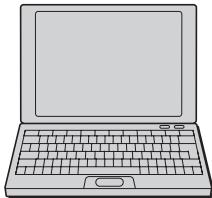
2 Follow the instructions on the screen and acquire a service account.
- Follow the instructions on the screen to download the desired application to the camera.
Notes
- The application downloading function may not be available in some countries and regions. For details, refer to the application downloading website above.
1 Access the application downloading website.
http://www.sony.net/pmca
- Use Internet Explorer 8 or 9 for Windows, and Safari 5 for Mac.
2 Select the desired application and download the application to the camera following the instructions on the screen.
- Connect the computer and the camera using the micro USB Cable (supplied), following the instructions on the screen.

To the USB terminal

How to download applications directly using Wi-Fi action of the camera
You can download applications using the Wi-Fi function without connecting to a computer.
Select MENU [Application] (PlayMemories Camera Apps), then follow the instructions on the screen to download applications.
Acquire a service account in advance (page 39).
- Launching the downloaded application
1 Select MENU [Application] desired application to launch.
Transferring images to a Smartphone
You can transfer still images to a Smartphone and view them. Download the application "PlayMemories Mobile" to your Smartphone from the application store.
1 Press Wi-Fi View on Smartphone) and select the desired mode.
- If another function is assigned to soft key B, select MENU → [Playback] → [View on Smartphone].
This Image: Transfers the most recently shot or played back image to the Smartphone.
All Images on This Date:
Transfers all still images in the same date range as the most recently shot or played back image to the Smartphone.
All Images in The Device:
Transfers all still images in the camera to the Smartphone.

2 If the camera is ready for the transfer, the information screen appears on the camera. Connect the Smartphone and the camera using that information.
- For details on operation of the Smartphone, refer to "α Handbook."

Notes
- Some images may not be displayed on the Smartphone, depending on the recording format.
- The camera shares the connection information for [View on Smartphone] with a device that has permission to connect. If you want to change the device that is permitted to connect to the camera, reset the connection information by following these steps. MENU [Setup] [Reset View on Smartphone]. After resetting the connection information, you must register the Smartphone again.
- "PlayMemories Mobile" is not available in some countries/regions. [View on Smartphone] is not available in some countries/regions that are not compatible with "PlayMemories Mobile."
Connecting to a network
You can transfer images on the camera via Wi-Fi network and view them on other devices. The setting procedure differs depending on your LAN router or wireless LAN access point.
- A computer or TV that is already connected to a network is required at your home, etc.
- Be sure to set the network connection inside your wireless LAN access point area (the accessible area).
Refer to the table below for how to register the access point.
| Access point | How to register |
| Your access point has the WPS button. | Use [WPS Push]. |
| Other than above. | Use [Access Point Settings]. |
WPS Push
1 Select MENU [Setup] [WPS Push].

2 Press the WPS button on the access point you want to register.
The camera starts communicating with the access point.
1 Select MENU [Setup] [Access Point Settings].

2 Select the access point you want to register. If the desired access point is displayed on the screen:
Select the access point.
If the desired access point is not displayed on the screen:
Select [Manual Setting] and set the access point following the instructions on the screen.
- For details, refer to "α Handbook."
Notes
- When aboard an airplane, turn off the camera.
Saving images to a computer
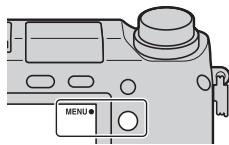
You can save images on the camera to a computer that is connected to a network. Before saving, install the software "PlayMemories Home" on your computer, connect the computer and the camera using a USB cable, and register the camera to "PlayMemories Home."
1 Select MENU [Playback] [Send to Computer].
Notes
- Depending on the application settings on your computer, the camera may turn off automatically after the images have been saved.
Viewing images on a TV
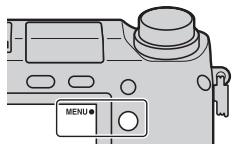
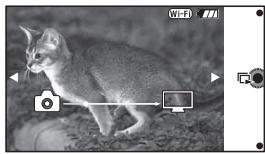
You can transfer images on the camera to a network-compatible TV without connecting them using a cable. The transferred images can be played back on the TV.
1 Select MENU [Playback] [View on TV].
2 Select the device to be connected to the camera.

3 Press the center of the control wheel to play back images as a slideshow.
- Press the right/left side of the control wheel to move to the next/ previous image.
- Press OPTION, and then [Device list] to change the device to be connected.
Checking the number of recordable images
Once you insert a memory card into the camera and set the power switch to ON, the number of images that can be recorded (should you continue to shoot using the current settings) is displayed on the LCD screen.

Notes
- When "0" (the number of recordable images) flashes in yellow, the memory card is full. Replace the memory card with another one, or delete images in the current memory card (page 30).
- When "NO CARD" (the number of recordable images) flashes in yellow, it means no memory card has been inserted. Insert a memory card.
Number of still images and time of movies recordable on a memory card
Still images
The following table shows the approximate number of still images that can be recorded on a memory card formatted with this camera. The values are defined using Sony standard memory cards for testing. The values may vary depending on the shooting conditions.
Image size: L 16M
Aspect ratio: 3:2*
(Units: images)
| Capacity
Quality | 2GB | 4GB | 8GB | 16GB | 32GB | 64GB |
| Standard | 410 | 820 | 1650 | 3350 | 6700 | 13000 |
| Fine | 290 | 590 | 1150 | 2400 | 4800 | 9600 |
| RAW & JPEG | 79 | 160 | 320 | 640 | 1300 | 2600 |
| RAW | 105 | 215 | 440 | 880 | 1750 | 3550 |
- When [Aspect Ratio] is set to [16:9], you can record more images than the numbers shown in the table above (except for [RAW]).
Movies
The following table shows the approximate recording times available. These are the total times for all movie files.
(h (hour), m (minute))
| Capacity Record Setting | 2GB | 4GB | 8GB | 16GB | 32GB | 64GB |
| 60i 24M(FX) 50i 24M(FX) | 10 m | \( {20}\mathrm{\;m} \) | 40 m | \( 1\mathrm{\;h}{30}\mathrm{\;m} \) | \( 3\mathrm{\;h} \) | \( 6\mathrm{\;h} \) |
| 60i 17M(FH) 50i 17M(FH) | 10 m | 30 m | \( 1\mathrm{\;h} \) | \( 2\mathrm{\;h} \) | \( 4\mathrm{\;h}5\mathrm{\;m} \) | \( 8\mathrm{\;h}{15}\mathrm{\;m} \) |
| 60p 28M(PS) 50p 28M(PS) | 9 m | 15 m | 35 m | \( 1\mathrm{\;h}{15}\mathrm{\;m} \) | \( 2\mathrm{\;h}{30}\mathrm{\;m} \) | \( 5\mathrm{\;h}5\mathrm{\;m} \) |
| 24p 24M(FX) 25p 24M(FX) | 10 m | \( {20}\mathrm{\;m} \) | 40 m | \( 1\mathrm{\;h}{30}\mathrm{\;m} \) | \( 3\mathrm{\;h} \) | \( 6\mathrm{\;h} \) |
| 24p 17M(FH) 25p 17M(FH) | 10 m | 30 m | \( 1\mathrm{\;h} \) | \( 2\mathrm{\;h} \) | \( 4\mathrm{\;h}5\mathrm{\;m} \) | \( 8\mathrm{\;h}{15}\mathrm{\;m} \) |
| 1440×1080 12M | \( {20}\mathrm{\;m} \) | \( {40}\mathrm{\;m} \) | \( 1\mathrm{\;h}{20}\mathrm{\;m} \) | \( 2\mathrm{\;h}{45}\mathrm{\;m} \) | \( 5\mathrm{\;h}{30}\mathrm{\;m} \) | \( {11}\mathrm{\;h}5\mathrm{\;m} \) |
| VGA 3M | \( 1\mathrm{\;h}{10}\mathrm{\;m} \) | \( 2\mathrm{\;h}{25}\mathrm{\;m} \) | \( 4\mathrm{\;h}{55}\mathrm{\;m} \) | 10 h | \( {20}\mathrm{\;h}5\mathrm{\;m} \) | \( {40}\mathrm{\;h}{15}\mathrm{\;m} \) |
Notes
- The recording time of movies varies because the camera uses VBR (Variable Bit Rate), an encoding method that automatically adjusts image quality according to the shooting situation.
When you record a fast-moving subject, the image is clearer but the recording time is shorter because much memory is used.
The recording time also varies depending on the shooting condition or your subject or the setting of image quality/size.
- The duration of time available for movie recording varies with the temperature or condition of the camera before you start recording. If you frequently recompose or shoot still images after the power is turned on, the temperature inside the camera rises and the recording time available will be shorter.
- If the camera stops movie recording due to the temperature, leave the camera for several minutes with the power turned off. Restart recording after the temperature inside the camera goes down.
-
If you observe the following points, the recording time is longer.
-
Keep the camera out of direct sunlight.
-
Turn the camera off when it is not being used.
-
The maximum size of a movie file is about 2 GB. When the file size is about 2 GB, the movie recording stops automatically when [File Format] is set to [MP4], and a new movie file is created automatically when [File Format] is set to [AVCHD].
- The maximum continuous recording time is approximately 29 minutes.
Number of still images recordable with a single charge of the battery pack
The following table shows the approximate number of images that can be recorded, when using the camera with the battery pack (supplied) at full capacity.
Note that the actual numbers may be less depending on the conditions of use.
| When using an LCD screen | Approx. 360 images |
| When using the viewfinder | Approx. 270 images |
-
The number of images is calculated using full charged battery pack under the following conditions:
-
At an ambient temperature of 25^ (77^)
- An E PZ 16-50 mm F3.5-5.6 OSS lens is attached.
- [Quality] is set to [Fine].
- [Autofocus Mode] is set to [Single-shot AF].
- Shooting once every 30 seconds.
- The flash strobes once every two times.
- The power turns on and off once every ten times.
- Using the battery pack that is charged for an hour after the charge lamp goes out.
-
Using Sony "Memory Stick PRO Duo" media (sold separately).
-
The measurement method is based on the CIPA standard.
(CIPA: Camera & Imaging Products Association)
List of icons on the LCD screen
Icons are displayed on the screen to indicate the camera status.
You can change the screen display using DISP (Display Contents) on the control wheel.

Shooting standby

Graphic display
Movie recording

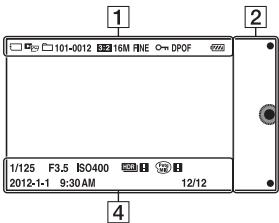
Playback
1
| Display | Indication |
| ● | Soft keys |
3
| Display | Indication |
| AUTO SLOW REAR
WL | Flash Mode/Red
Eye Reduction |
| ±0.0 | Flash
compensation |
| 10 C2 C3
C5 0.3EV U7EV | Drive Mode |
| Metering Mode |
| DME AF-S AF-C MF | Focus mode |
| [ ] [ ] [ ] ON | Focus area mode |
| [ ] OFF [ ] ON | Face Detection |
| AWB [ ] [ ] [ ] -1 [ ] [ ] [ ] +1 [ ] +2 [ ] [ ] 7500K A7 G7 | White Balance |
| [ ] [ ] [ ] [ ] [ ] L0 [ ] [ ] [ ] OFF | Soft Skin Effect |
| [ ] [ ] [ ] [ ] [ ] AUTO AUTO | DRO/Auto HDR |
| [ ] [ ] [ ] [ ] AUTO OFF | Auto Port. Framing |
| [ Std. ] [ Vivid] [ Port. ] [ Land. ] [ Sunset] [ B/W] | Creative Style |
| [ ] [ ] [ ] [ ] [ ] [ ] [ON] [ON] [ON] [ON] [ON] | Smile Shutter |
| [ ] [ ] [ ] [ ] [ ] [ ] [ ] [ ] [ ] [ ] [ ] [ ] [ ] [ ] [ ] [ ] [ ] [ ] [ ] [ ] [ ] [ ] [ ] [ ] [ ] [ ] [ ] [ ] [ ] [ ] [ ] [ ] [ ] [ ] [ ] [ ] [ ] [ ] [ ] [ ] [ ] [ ] [ ] [ ] [ ] [ ] [ ] [ ] [ ] [ ] [ ] | Picture Effect |
| Display | Indication |
| [●] | Smile detection sensitivity indicator |
4
| Display | Indication |
| Level | Level |
| Phase Detection AF ranging points |
| Focus status |
| 1/125 | Shutter speed |
| F3.5 | Aperture value |
| Metered manual |
| Exposure compensation |
| ISO400 | ISO sensitivity |
| AE lock |
| Shutter speed indicator |
| Aperture indicator |
| REC 0:12 | Recording time of the movie (m:s) |
| 2012-1-19:30AM | Recorded date/time of the image |
| 12/12 | Image number/Number of images in the view mode |
| HDR | Appears when HDR did not work on the image. |
| Big | Appears when [Picture Effect] did not work on the image. |
| Histogram |
GB
Learning more about the camera (α Handbook)
"α Handbook," which explains how to use the camera in detail, is included on the CD-ROM (supplied). Refer to "α Handbook" for in-depth instructions on the many functions of the camera.
For Windows users
1 Turn on your computer, and insert the CD-ROM (supplied) into the CD-ROM drive.
2 Click [Handbook].
3 Click [Install].
4 Start "α Handbook" from the shortcut on the desktop.
For Mac users
1 Turn on your computer, and insert the CD-ROM (supplied) into the CD-ROM drive.
2 Select the [Handbook] folder and copy "Handbook.pdf" stored in the [GB] folder to your computer.
3 After copying is complete, double-click "Handbook.pdf."
Precautions
On the functions available with the camera
- Your camera is 1080 60i-compatible or 1080 50i-compatible.
To check whether the camera is 1080 60i-compatible or 1080 50i-compatible, check for the following marks on the bottom of the camera. 1080 60i-compatible camera: 60i 1080 50i-compatible camera: 50i
- Your camera is compatible with 1080 60p/50p movies. Unlike existing standard recording modes, which record in an interlacing method, this camera records using a progressive method. This increases the resolution, and provides a smoother, more realistic image.
On the LCD screen and lens
- The LCD screen is manufactured using extremely high-precision technology so over 99.99% of the pixels are operational for effective use. However, there may be some tiny black points and/or bright points (white, red, blue or green in color) that constantly appear on the LCD screen. These points are normal in the manufacturing process and do not affect the images in any way.
Black, white, red, blue and green points
- Do not hold the camera by the LCD screen.
- Images may trail across on the LCD screen in a cold location. This is not a malfunction. When turning on the camera in a cold location, the LCD screen may become temporarily dark.
- Do not press against the LCD screen. The monitor may be discolored and that may cause a malfunction.
- Do not expose the camera to direct sunlight. If reflected sunlight is focused on a nearby object, it may cause a fire. When you must place the camera under direct sunlight, attach the front lens cap.
On using the lenses and accessories
It is recommended that you use Sony lenses/accessories designed to suit the characteristics of this camera. Using the products of other manufacturers may cause the camera not to operate to its capability, or result in accidents and malfunctions of the camera.
On the Multi Interface Shoe
- Set the power switch of the camera to OFF before you attach or remove an accessory, such as the flash, to the Multi Interface Shoe. When attaching an accessory, plug the accessory into the Multi Interface Shoe to the end and fasten the screw. Make sure that the accessory is attached to the camera securely.
- Do not use a commercially available flash with high-voltage synchro terminals or with reverse polarity. It may cause a malfunction.
Do not use/store the camera in the following places
- In an extremely hot, dry or humid place
In places such as in a car parked in the sun, the camera body may become deformed and this may cause a malfunction.
-
Storing under direct sunlight or near a heater
The camera body may become discolored or deformed, and this may cause a malfunction.
-
In a location subject to rocking vibration
Near strong magnetic place
- In sandy or dusty places
- Be careful not to let sand or dust get into the camera. This may cause the camera to malfunction, and in some cases this malfunction cannot be repaired.
On storing
Be sure to attach the front lens cap when not using the camera.
On the temperature of the camera
Your camera and battery may get hot due to continuous use, but it is not a malfunction.
On operating temperatures
Your camera is designed for use under the temperatures between 0^ and 40^ (32°F and 104°F).
Shooting in extremely cold or hot places that exceed this range is not recommended.
On moisture condensation
If the camera is brought directly from a cold to a warm location, moisture may condense inside or outside the camera. This moisture condensation may cause a malfunction of the camera.
How to prevent moisture condensation
When bringing the camera from a cold place to a warm place, seal the camera in a plastic bag and allow it to adapt to conditions at the new location over about an hour.
If moisture condensation occurs
Turn off the camera and wait about an hour for the moisture to evaporate. Note that if you attempt to shoot with moisture remaining inside the lens, you will be unable to record clear images.
On the internal rechargeable battery
This camera has an internal rechargeable battery for maintaining the date and time and other settings regardless of whether the power is on or off, or the battery is installed or not. This rechargeable battery is continually charged as long as you are using the camera. However, if you use the camera for only short periods, it gradually discharges. If you do not use the camera at all for about three months it becomes completely discharged. In this case, be sure to charge this rechargeable battery before using the camera. However, even if this rechargeable battery is not charged, you can still use the camera as long as you do not record the date and time. If the camera resets to the default settings each time you charge the battery, the internal rechargeable battery may be dead. Consult your Sony dealer or local authorized Sony service facility.
Charging method of the internal rechargeable battery
Insert a charged battery pack into the camera, or connect the camera to a wall outlet (wall socket) using the AC Adaptor (supplied), and leave the camera for 24 hours or more with the power off.
On memory cards
Do not attach a label, etc. on a memory card or a card adaptor. This may cause a malfunction.
On recording/playback
- When you use a memory card with this camera for the first time, it is recommended to format the card using the camera for stable performance of the memory card before shooting. Note that formatting permanently erases all data on the memory card, and is unrecoverable. Save precious data on a computer, etc.
- If you repeatedly record/delete images, fragmentation of data may occur on the memory card. Movies may not be able to be saved or recorded. In such a case, save your images to a computer or other storage location, and then format the memory card.
-
The recorded contents cannot be compensated for even if recording or playback is not possible due to a malfunction of the camera or memory card, etc.
-
To avoid the potential risk of data loss, always copy (back up) data to other media.
- Before you record one-time events, make a trial recording to make sure that the camera is working correctly.
- This camera is neither dust-proof, nor splash-proof, nor water-proof.
- Do not aim the camera at the sun or other bright light. It may cause the malfunction of the camera.
- Do not look at the sun or a strong light through a removed lens. This may cause irrecoverable damage to your eyes. Or it may cause a malfunction of the lens.
- Do not use the camera near a place that generates strong radio waves or emits radiation. The camera may not be able to record or play back properly.
- Using the camera in sandy or dusty place may cause malfunctions.
- If moisture condensation occurs, remove it before using the camera (page 54).
- Do not shake or strike the camera. In addition to malfunctions and an inability to record images, this may render the memory card unusable, or cause image data breakdown, damage or loss.
-
Clean the flash surface with a soft cloth. The heat of flash emission may cause dirt to adhere on the flash surface, resulting in smoking or scorching.
-
Keep the camera, supplied accessories, etc., out of the reach of children. A memory card, etc., may be swallowed. If such problem occurs, consult a doctor immediately.
Importing AVCHD movies to a computer
When importing AVCHD movies to a computer, for Windows, use the software "PlayMemories Home" in the CD-ROM (supplied).
On RAW images
To view RAW images recorded with the camera, "Image Data Converter" on the CD-ROM (supplied) is required. If you do not intend to modify the images you record, we recommend that you shoot images using the JPEG format.
Notes on playing movies on other devices
-
This camera uses MPEG-4 AVC/ H.264 High Profile for AVCHD format recording. Movies recorded in AVCHD format with this camera cannot be played by the following devices.
-
Other devices compatible with AVCHD format that does not support High Profile
Devices incompatible with the AVCHD format
-
This camera also uses MPEG-4 AVC/H.264 Main Profile for MP4 format recording. For this reason, movies recorded in MP4 format with this camera cannot be played on devices other than those that support MPEG-4 AVC/H.264.
- Discs recorded with HD (high definition) image quality can be played back only on AVCHD format-compatible devices. DVD-based players or recorders cannot play back HD image quality discs, as they are incompatible with the AVCHD format. Also, DVD-based players or recorders may fail to eject HD image quality discs.
Movies recorded in 1080 60p/1080 50p format can be played back only on 1080 60p/1080 50p-supported devices.
Caution when flying
When aboard an airplane, turn off the camera.
Warning on copyright
Television programs, films, videotapes, and other materials may be copyrighted. Unauthorized recording of such materials may be contrary to the provisions of the copyright laws.
The pictures used in this manual
The photographs used as examples of pictures in this manual are reproduced images, and are not actual images shot using this camera.
On the data specifications described in this manual
The data on performance and specifications are defined under the following conditions, except as described in this manual: at an ordinary ambient temperature of 25^ (77^) , and using a battery pack that has been fully charged for about an hour after the charge lamp has turned off.
Specifications
Camera
[System]
Camera type: Interchangeable lens digital camera
Lens: E-mount lens
[Image sensor]
Image sensor: APS-C format (23.5mm× 15.6mm) CMOS image sensor
Total pixel number of image sensor: Approx. 16700000 pixels
Effective pixel number of camera: Approx. 16 100 000 pixels
[Anti-dust]
System: Charge protection coating on Low-Pass Filter and ultrasonic vibration mechanism
[Auto focus system]
System: Fast Hybrid AF (Phase detection system/Contrast detection system)
Sensitivity range: EV0 to EV20 (at ISO 100 equivalent, with F2.8 lens)
[Exposure control]
Metering method: 1 200-segment metering by the image sensor
Metering range: EV0 to EV20 (at ISO 100 equivalent, with F2.8 lens)
ISO sensitivity (Recommended exposure index):
Still images: AUTO, ISO 100 - 25600
Movies: AUTO, ISO 100 - 6400 equivalent
Exposure compensation: ± 3.0 EV (1/3 EV step)
[Shutter]
Type: Electronically-controlled, vertical-traverse, focal-plane type
Speed range:
Still images: 1/4 000 second to 30 seconds, BULB
Movies: 1/4 000 second to 1/4 second (1/3 EV step), 1080 60i-compatible device up to 1/60 second in AUTO mode (up to 1/30 second in [Auto Slow Shutter] mode)
1080 50i-compatible device up to 1/50 second in AUTO mode (up to 1/25 second in [Auto Slow Shutter] mode)
Flash sync speed: 1/160 second
"Memory Stick PRO Duo" media, SD card
[Electronic viewfinder]
Type: Electronic viewfinder
Screen size: 1.3cm (0.5 type)
Total number of dots: 2359296 dots
Frame coverage: 100%
Magnification: 1.09× with 50~mm lens at infinity, -1m^-1 (diopter)
Eye point: Approx. 23mm from the eyepiece, 21mm from the eyepiece frame at -1m^-1
Diopter adjustment: -4.0m^-1 to +1.0m^-1 (diopter)
[LCD screen]
LCD panel: Wide, 7.5cm (3.0 type) TFT drive
Total number of dots: 921600 dots
USB: Micro USB type B
HDMI: HDMI type C minijack
[Power]
Used battery pack: Rechargeable battery pack NP-FW50
[Power consumption]
When using an E PZ 16-50 mm F3.5-5.6 OSS lens*
When using the viewfinder:
Approx. 3.3 W
When using an LCD screen:
Approx. 2.5 W
[Others]
Exif Print: Compatible
PRINT Image Matching III: Compatible
DPOF: Compatible
Dimensions (CIPA compliant):
Approx. 119.9mm× 66.9mm×
42.6mm (4 3/4 inches ×
2 3/4 inches × 1 1/16 inches)
(W/H/D)
Mass (CIPA compliant):
Approx. 345g 12.2 oz
(including battery and "Memory
compliant, RAW (Sony ARW
2.3 Format)
Movie (AVCHD format): AVCHD
format Ver. 2.0 compatible,
Video: MPEG-4 AVC/H.264
Audio: Dolby Digital 2ch
Dolby Digital Stereo Creator
Manufactured under license from Dolby Laboratories.
Movie (MP4 format):
Video: MPEG-4 AVC/H.264
Audio: MPEG-4 AAC-LC 2ch
USB communication: Hi-Speed USB (USB 2.0)
[Flash]
Flash guide number: GN 6 (in meters at ISO 100)
Recycling time: Approx. 4 seconds
Flash coverage: Covering 16mm lens (focal length that the lens indicates)
Flash compensation: ± 2.0 EV (1/3 EV step)
[Wireless LAN]
Supported format: IEEE 802.11 b/g/n
AC Adaptor AC-UB10/ UB10B/UB10C/UB10D
Power requirements: AC 100 V to 240V 50Hz / 60Hz 70mA
Output voltage: DC 5 V, 0.5 A
Operating temperature: 0^ to 40^ (32^ to 104^)
Storage temperature: -20^ to +60^ (-4^ to +140^)
Dimensions:
Approx. 50mm× 22mm× 54mm (2 inches × 7 / 8 inches × 21/4 inches) W/H/D
Mass:
For the USA and Canada: Approx. 48g (1.7 oz)
For countries or regions other than the USA and Canada: Approx. 43g (1.5 oz)
Rechargeable battery pack NP-FW50
Used battery: Lithium-ion battery
Maximum voltage: DC 8.4 V
Nominal voltage: DC 7.2 V
Maximum charge voltage: DC 8.4 V
Maximum charge current: 1.02 A
Capacity: Typical 7.7 Wh (1080 mAh)
Minimum 7.3 Wh (1020 mAh)
Maximum dimensions:
Approx. 31.8mm× 18.5mm× 45mm (1 5/16 inches × 3 / 4 inches × 1 13/16 inches) (W/H/D)
Mass: Approx. 57g (2.1 oz)
Lens
| Lens | E16 – 50 mm zoom lens1) | E55 – 210 mm zoom lens |
| Camera | NEX-6L/6Y | NEX-6Y |
| Equivalent
35 mm-format focal
length2) (mm) | 24 – 75 | 82.5 – 315 |
| Lens groups-
elements | 8–9 | 9–13 |
| Angle of view2) | 83° – 32° | 28.2° – 7.8° |
| Minimum focus3)
(m (feet)) | 0.25 – 0.3 (0.82 – 1) | 1.0 (3.28) |
| Maximum
magnification (×) | 0.215 | 0.225 |
| Minimum f-stop | f/22 – f/36 | f/22 – f/32 |
| Filter diameter
(mm) | 40.5 | 49 |
| Dimensions (max.
diameter × height)
(Approx. mm (in.)) | 64.7 × 29.9
(2 5/8 × 1 3/16) | 63.8 × 10⁸
(2 5/8 × 4 3/8) |
| Mass (Approx. g
(oz.)) | 116 (4.1) | 345 (12.2) |
| SteadyShot | Available | Available |
1) Power zoom
2) The values for equivalent 35mm -format focal length and angle of view are based on digital cameras equipped with an APS-C sized image sensor.
3) Minimum focus is the shortest distance from the image sensor to the subject.
Design and specifications are subject to change without notice.
On focal length
The picture angle of this camera is narrower than that of a 35mm -format camera. You can find the approximate equivalent of the focal length of a 35mm -format camera, and shoot with the same picture angle, by increasing the focal length of your lens by half. For example, by using a 50~mm lens, you can get the approximate equivalent of a 75mm lens of a 35mm -format camera.
On image data compatibility
- This camera conforms with DCF (Design rule for Camera File system) universal standard established by JEITA (Japan Electronics and Information Technology Industries Association).
- Playback of images recorded with your camera on other equipment and playback of images recorded or edited with other equipment on your camera are not guaranteed.
Trademarks
- ±b is a trademark of Sony Corporation.
"Memory Stick," 念 , "Memory Stick PRO, "Memory Stick Duo,"
MEMORY STICK DUO, "Memory Stick PRO Duo,"
MEMORY STICK PRO DUO, "Memory Stick PRO-HG Duo,"
MEMORY STICK PRO-HG DUO, "Memory Stick Micro," "MagicGate," and
MAGICGATE are trademarks of Sony Corporation.
- "InfoLITHIUM" is a trademark of Sony Corporation.
-
"PlayMemories Camera Apps" is a trademark of Sony Corporation.
-
"PhotoTV HD" is a trademark of Sony Corporation.
- Blu-ray Disc^TM and Blu - ray^TM are trademarks of the Blu-ray Disc Association.
- "AVCHD Progressive" and "AVCHD Progressive" logotype are trademarks of Panasonic Corporation and Sony Corporation.
- Dolby and the double-D symbol are trademarks of Dolby Laboratories.
- Microsoft, Windows, and Windows Vista are either registered trademarks or trademarks of Microsoft Corporation in the United States and/or other countries.
- HDMI, the HDMI logo and High-Definition Multimedia Interface are trademarks or registered trademarks of HDMI Licensing LLC.
- Mac and Mac OS are trademarks or registered trademarks of Apple Inc.
- iOS is a trademark or registered trademark of Cisco Systems Inc.
- Intel, Intel Core, and Pentium are trademarks or registered trademarks of Intel Corporation.
Android is a registered trademark of Google Inc.
- DLNA and DLNA CERTIFIED are trademarks of Digital Living Network Alliance.
- SDXC logo is a trademark of SD-3C, LLC.
- Eye-Fi is a trademark of Eye-Fi Inc.
- MultiMediaCard is a trademark of MultiMediaCard Association.
- “-B.” and “PlayStation” are registered trademarks of Sony Computer Entertainment Inc.
-
Adobe is a registered trademark or a trademark of Adobe Systems Incorporated in the United States and/or other countries.
-
In addition, system and product names used in this manual are, in general, trademarks or registered trademarks of their respective developers or manufacturers. However, the TM or ® marks are not used in all cases in this manual.

- Add further enjoyment with your PlayStation 3 by downloading the application for PlayStation 3 from PlayStation Store (where available).
- The application for PlayStation 3 requires PlayStation Network account and application download. Accessible in areas where the PlayStation Store is available.

InfoLITHIUM


MEMORY STICK TM

HIGHOEPION MULTIMEDIA INTERPACE

CLASS④
AVCHD
Progressive
Additional information on this product and answers to frequently asked questions can be found at our Customer Support Website.
http://www.sony.net/
Printed using VOC (Volatile Organic Compound)-free vegetable oil based ink.
Français
Monture E
Aide-memoire
Complies with IDA Standards DB00353
Auto-lock Accessory Shoe
(h (heure), m (minute))
| Capacité Réglage d'enregistr. | 2Go | 4Go | 8Go | 16Go | 32Go | 64Go |
| 60i 24M(FX)50i 24M(FX) | 10 m | 20 m | 40 m | 1 h 30 m | 3 h | 6 h |
| 60i 17M(FH)50i 17M(FH) | 10 m | 30 m | 1 h | 2 h | 4 h 5 m | 8 h 15 m |
| 60p 28M(PS)50p 28M(PS) | 9 m | 15 m | 35 m | 1 h 15 m | 2 h 30 m | 5 h 5 m |
| 24p 24M(FX)25p 24M(FX) | 10 m | 20 m | 40 m | 1 h 30 m | 3 h | 6 h |
| 24p 17M(FH)25p 17M(FH) | 10 m | 30 m | 1 h | 2 h | 4 h 5 m | 8 h 15 m |
| 1440×1080 12M | 20 m | 40 m | 1 h 20 m | 2 h 45 m | 5 h 30 m | 11 h 5 m |
| VGA 3M | 1 h 10 m | 2 h 25 m | 4 h 55 m | 10 h | 20 h 5 m | 40 h 15 m |
Remarques
(DCF Ver. 2.0, Exif Ver. 2.3, MPF
Baseline), RAW (Format Sony ARW 2.3)
Film (Format AVCHD) :
Compatible format AVCHD
Ver. 2.0
Batterie rechargeable NP-FW50
Works with PlayStation®3
Auto-lock Accessory Shoe
"Play Memories Home"
,PlayMemories Home-Hilfetext"
Mac
(CIPA: Camera & Imaging Products Association)
Works with PlayStation®3
Auto-lock Accessory Shoe
"Image Data Converter"
"PlayMemories Home"
"Guiá detips de PlayMemories Home"
Mac
Works with PlayStation®3
"Image Data Converter"
"PlayMemories Home"
(CIPA: Camera & Imaging Products Association)
Works with PlayStation®3
Auto-lock Accessory Shoe
(Macro), (Projector),
(Pouca luz), ou (Bebe).

"Image Data Converter"
"PlayMemories Home"
"Guia de Ajuda do PlayMemories Home"
Mac
(CIPA: Camera & Imaging Products Association)
Works with PlayStation®3
Auto-lock Accessory Shoe
(Landschap), (Macro),
(Spotlight), (Duister) of
(Kind).
"Image Data Converter"
"Image Data Converter"
"Play Memories Home"
"Play Memories Home help-gids"
Mac
"Image Data Converter"
Meer informatatie over "Image Data Converter", vindt u in help.
Klik op [start] [Alle programma's] [Image Data Converter] [Help]
[Image Data Converter Ver.4].
"Image Data Converter"-ondersteuningspagina (alleen Engels)
(PlayMemories Camera Apps).
(CIPA: Camera & Imaging Products Association)
Works with PlayStation®3
Auto-lock Accessory Shoe
(CIPA: Camera & Imaging Products Association)
[System autofocususa]
Sony Europe Limited, The Heights, Brooklands, Weybridge, Surrey, KT130XW, United Kingdom
E-fattning
WARNING
Utsatt inte enchoten for regn eller fukt aftersom det kan medforariskorbrandelleselstotar.
VIKTIGA SÄKERHETSANVISNINGAR -SPARA DESSA ANVISNINGAR VARNING FÖLJ DESSA ANVISNINGAR NOGGRANT FÜR ATT MINSKA RISKEN FÜR BRAND OCH ELSTÖTAR
WARNING!
Batteri
"Image Data Converter"
"PlayMemories Home"
"Hjalpguide for PlayMemories Home"
Mac
"I"PlayMemories Home
"Image Data Converter"
"PlayMemories Home"
"PlayMemories Home Help Guide"
Mac
"I"PlayMemories Home
"Image Data Converter"
"PlayMemories Home"
"PlayMemories Home Help Guide"
NO
Mac
Folgende datamaskinmiljø anbefales ved bruk av den medfølgende programvaren og import av Bilder via en USB-tilkobling.
| Operativsystem (forhåndsinstallert) | USB-tilkobling: Mac OS X v10.3 til v10.8
“Image Data Converter”: Mac OS X v10.5 til v10.8 |
| "Image Data Converter Ver.4" | CPU: Intel processor, f.eks. Intel Core Solo/Core Duo/ Core 2 Duo
Minne: 1 GB aller mer anbefales.
Skjerm: 1024 × 768 punkter aller mer |
1 Slå på Mac-datamaskinen din og sett CD-ROM-en (inkludert) inn i CD-ROM-stasjonen.
2 Dobbeltklikp a CD-ROM-ikonet.
3 Kopier [IDC_INST].pkg]-filen i [MAC]-mappen til harddiskikonet.
4 Dobbeltklikp [IDC_INST.pkg]-filen i malmöappen. Følg instruksjönene paskjermen for a fullfore installmenten.
"Image Data Converter"
Med "Image Data Converter" kan du gjore folgende:
Installation of software
"Image Data Converter"
"PlayMemories Home"
"PlayMemories Home Help Guide"
DK
Mac
"Image Data Converter"