
MZ-E310 - MiniDisc Player SONY - Free user manual and instructions
Find the device manual for free MZ-E310 SONY in PDF.

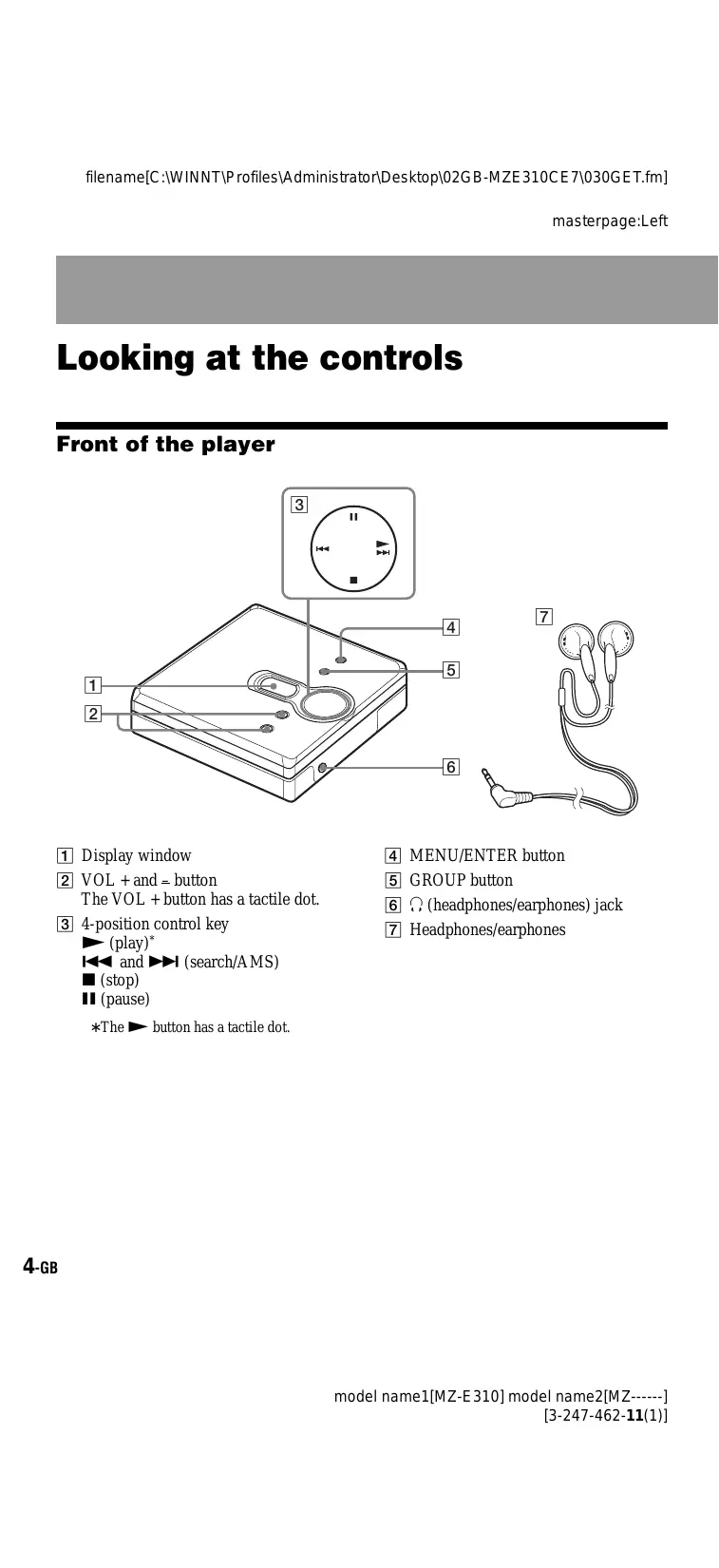


| Product Type | MiniDisc Player |
| Brand | Sony |
| Model | MZ-E310 |
| Dimensions (W x H x D) | Approx. 81 x 28.9 x 74.4 mm (without protrusions) |
| Weight | Approx. 93 g (player only) |
| Power Source | 1 alkaline LR6 (AA) battery not included |
| Battery Life (approximate) | Up to 41 h (SP), 50 h (LP2), 56 h (LP4) with Sony LR6 battery |
| Headphone/Earphone Jack | Stereo mini-jack, max output 3.5 mW + 3.5 mW at 16 ohms |
| Supported Audio Formats | SP, LP2, LP4, MONO (auto playback) |
| Anti-skip Function | G-Protection (improved shock resistance) |
| Sound Adjustment | Digital Sound Preset (bass/treble adjustment, 2 presets) |
| Group Mode | Group play, group skip, group programming |
| Hearing Protection | AVLS (automatic volume limiter system) |
| Control Lock | HOLD function (side switch) |
| Playback Modes | Normal, repeat (1 track/all), shuffle, programmed (up to 20 tracks) |
| Quick Search | By index (number/title) or time (elapsed time) |
| Laser Type | GaAlAs diode, wavelength 790 nm, class 1 |
| Maintenance | Clean the casing with a soft, dry or slightly damp cloth; clean the headphone plug and battery terminals regularly |
| Spare Parts and Repairability | Contact Sony after-sales service for parts and repairs |
| General Information | User manual available in multiple languages; usage precautions: avoid moisture, shocks, extreme temperatures |
Frequently Asked Questions - MZ-E310 SONY
User questions about MZ-E310 SONY
0 question about this device. Answer the ones you know or ask your own.
Ask a new question about this device
Download the instructions for your MiniDisc Player in PDF format for free! Find your manual MZ-E310 - SONY and take your electronic device back in hand. On this page are published all the documents necessary for the use of your device. MZ-E310 by SONY.
USER MANUAL MZ-E310 SONY
Portable MiniDisc Player
"WALKMAN" is a registered trademark of Sony Corporation to represent Stereo products. WALKMAN is a trademark of Sony Corporation.
MZ-E310
WARNING
To prevent fire or shock hazard, do not expose the unit to rain or moisture.
Do not install the appliance in a confined space, such as a bookcase or built-in cabinet.
To prevent fire, do not cover the ventilation of the apparatus with newspapers, table-cloths, curtains, etc. And don't place lighted candles on the apparatus.
To prevent fire or shock hazard, do not place objects filled with liquids, such as vases, on the apparatus.
Certain countries may regulate disposal of the battery used to power this product. Please consult with your local authority.
Caution
The use of optical instruments with this product will increase eye hazard.
CAUTION - INVISIBLE LASER RADIATION WHEN OPEN
DO NOT STARE INTO BEAM OR VIEW DIRECTLY WITH OPTICAL INSTRUMENTS
Information
IN NO EVENT SHALL SELLER BE LIABLE FOR ANY DIRECT, INCIDENTAL OR CONSEQUENTIAL DAMAGES OF ANY NATURE, OR LOSSES OR EXPENSES RESULTING FROM ANY DEFECTIVE PRODUCT OR THE USE OF ANY PRODUCT.
CE The validity of the CE marking is restricted to only those countries where it is legally enforced, mainly in the countries of the EEA (European Economic Area).

The C-Tick mark on the Walkman is valid only for the products marketed in Australia.
Table of contents
Looking at the controls 4
Getting started! 6
Playing an MD right away! 8
Various ways of playback 10
Searching for a specific track or a position quickly (Quick Search) .... 10
Selecting the play mode 10
Listening to tracks in a desired sequence (Program Play) 12
Using the group function 12
What is a disc with group settings? 12
Listening to tracks in a specific group (Group Mode Playback) ... 13
Selecting and playing specific groups (Group Skip Function) .... 13
Registering groups using your MiniDisc recorder 14
Adjusting treble or bass (Digital Sound Preset) 15
Selecting the sound quality 15
Adjusting the sound quality 15
Other Operations 17
Viewing the track name and playing time 17
Protecting your hearing (AVLS) 18
Locking the controls (HOLD) 18
Additional information 19
Precautions 19
Troubleshooting 21
Specifications 23
Looking at the controls
Front of the player
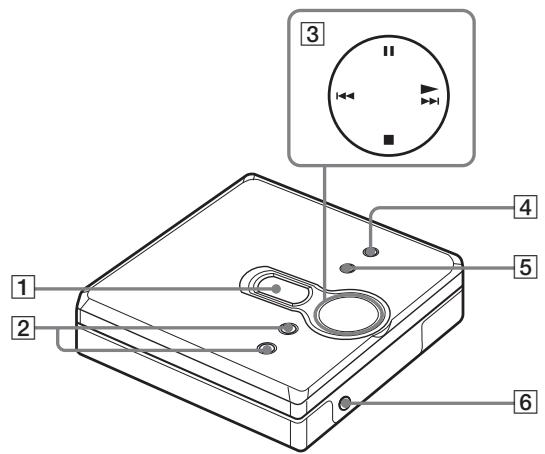
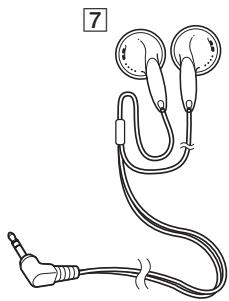
1 Display window 2 VOL + and - button
The VOL + button has a tactile dot.
4-position control key
▶ (play)* and (search/AMS) stop) II (pause)
- The ▶ button has a tactile dot.
4 MENU/ENTER button 5 GROUP button 6 (headphones/earphones) jack 7 Headphones/earphones
Back of the player
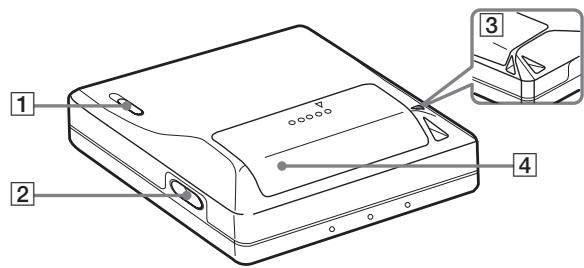
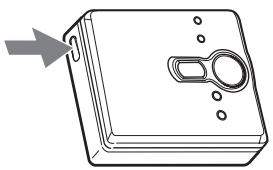
HOLD switch 2 OPEN button
3 Hand strap hole Use the hole to attach your own strap. 4 Battery compartment lid
The display window of the player
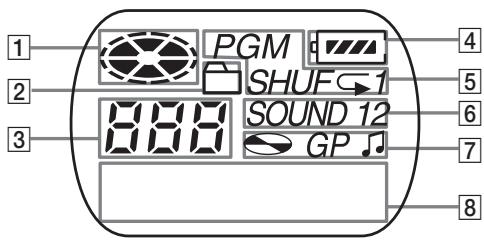
1 Disc indication 2 Group mode indication Lights up when group mode is on. 3 Track number display 4 Battery level indication Shows approximate battery condition. 5 Play mode indication Shows play mode of the MD. 6 SOUND indication 7 Disc, group, track indication
8 Character information display Displays the track names, elapsed time, etc.
Getting started!
1 Insert an alkaline dry battery.
Slide to open the battery compartment lid.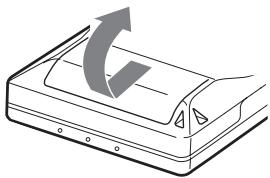
Insert one LR6 (size AA) alkaline dry battery minus end first.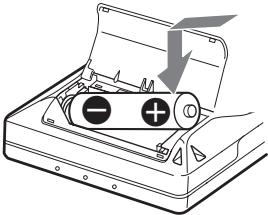
Close the lid.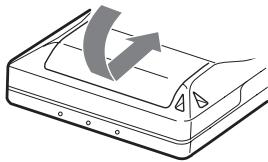
When to replace the battery
You can check the battery condition through the battery indicator while using the player.
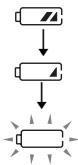
Battery power decreasing
Weak battery
The battery has gone out.
"LoBATT" flashes in the display, and the power goes off.
Battery life
(Unit: approx. (hours) (JEITA1)
| Battery | SP Stereo | LP2 Stereo | LP4 Stereo |
| LR6 (SG) Sony alkaline dry battery2) | 41 | 50 | 56 |
1) Measured in accordance with the JEITA (Japan Electronics and Information Technology Industries Association) standard. 2) When using a Sony LR6 (SG) "STAMINA" alkaline dry battery (produced in Japan).
Note
The battery life may be shorter than that specified, depending on the operating conditions, the temperature of the location, and varieties of batteries.
2
Make connections and unlock the control.
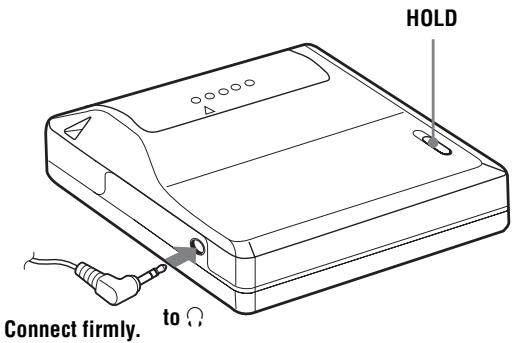
① Connect the headphones/earphones to
② Slide HOLD in the opposite direction of the arrow indicated on the player (HOLD →) to unlock the controls.
Playing an MD right away!
1 Insert an MD.
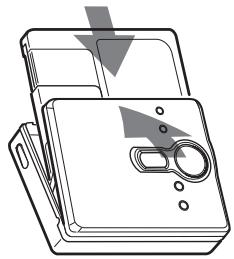
① Press OPEN to open the lid.
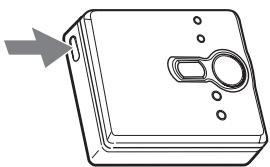
② Insert an MD with the label side facing front, and press the lid down to close.
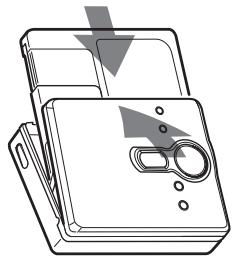
2 Play an MD.
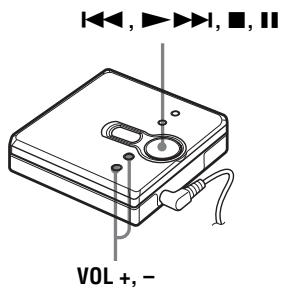
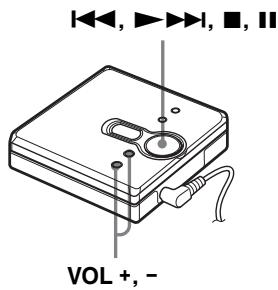
① Press ▶▶I. ② Press VOL + or - to adjust the volume. The volume indicator appears in the display allowing you to check the volume level.
To stop play, press ■.
Playback starts from the point you last stopped playing. To start playback from the beginning of the first track, hold down ▶ for 2 seconds or more.
| To | Operation |
| Find the beginning of the current track or the previous \( track^{1)} \) | Press !←. Press !← repeatedly until the beginning of the desired track appears. |
| Find the beginning of the next \( track^{2)} \) | Press ▷▶ once. |
| Go backwards while playing | Hold down !←. |
| Go forward while playing | Hold down ▷▶. |
| Pause | Press !. Press ! again to resume play. |
| Remove the MD | Press ■, and then press OPEN.3) |
1) If you press twice continuously while playing the first track of the disc, the player goes to the beginning of the last track on the disc. 2) If you press ▶▶ during the last track of the disc, the player goes to the beginning of the first track on the disc. 3) If you open the lid, the playback will begin from the beginning of the first track (except when group mode is on).
Suppressing the skip of the sound (G-PROTECTION)
The G-PROTECTION function was developed to provide a higher level of shock resistance than that of existing players in order to allow the player to be used while jogging.
Note
The playback sound may skip if:
- the player receives stronger continuous shock.
- a dirty or scratched MiniDisc is played.

- The MZ-E310 supports the newly developed DSP TYPE-R for ATRAC. It thus allows you to enjoy TYPE-R high-quality sound from MDs recorded in SP stereo on TYPE-R-equipped MD decks, etc.
- The player can play tracks recorded in 2x or 4x long playing mode (LP2 or LP4). Normal stereo playback, LP2 stereo playback, LP4 stereo playback, or monaural playback is automatically selected to match the audio source.
- The display will turn off shortly after you press.
Searching for a specific track or a position quickly (Quick Search)
You can do two kinds of quick searches.
- Index search — Searching quickly while monitoring the track number or track name (factory setting).
- Time search - Searching quickly while monitoring the elapsed time.
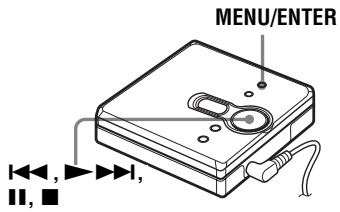
1 During playback, press MENU/ENTER. 2 Press or repeatedly until "SEARCH" flashes in the display, and then press MENU/ENTER. 3 Press < or > repeatedly until "Index" (index search) or "Time" (time search) flashes in the display, and then press MENU/ENTER. 4 Press II. 5 Hold down |< or >| until the desired track number/track name (index search) or the desired elapsed time (time search) appears in the display. 6 Press II. Playback starts from the selected track.
To cancel the procedure
Press ■.

- If you do this procedure while the player is in shuffle play mode, shuffle play starts from the track that you selected.
- If the player reaches the first track or the last track on the disc as you are holding |< or >| button in step 5, it will return to the last track or the first track, respectively. (In group mode, if the player reaches the first track or the last track in a group as you are holding |< or >| button in step 5, it will return to the last track or the first track in that group, respectively.) (See "Using the group function" (page 12).)
Selecting the play mode
You can select various play modes such as normal play, repeat play (1Rep.), shuffle play (Shuff), or program play (PGM).
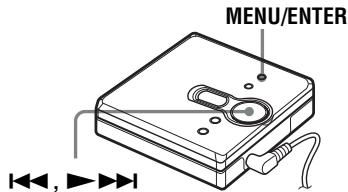
1 During playback, press MENU/ENTER. 2 Press or repeatedly until "P-MODE" flashes in the display, and then press MENU/ENTER.
Press ◀ or ▶ repeatedly to select the play mode, and then press MENU/ENTER.
Each time you press ▶▶▶, the display item indicated by A changes as follows:
Pressing MENU/ENTER while A is flashing causes the play mode to change.
The new mode then appears in the display indicated by B.
Pressing ▶ repeatedly changes A.
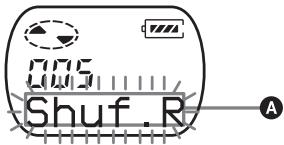
Θ lights up when you press MENU/ENTER.
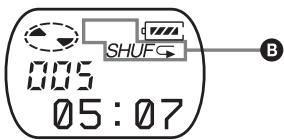
Indication A/B (play mode)
Normal/—(normal play)
All the tracks are played once.

AllRep/ C
All the tracks are played repeatedly.

1 Track/1
A track is played once.

1Rep./C 1
A single track is played repeatedly.

Shuff/SHUF
After the currently selected track finishes playing, the remaining tracks are played in random order.

Shuf.R/SHUF
After the currently selected track finishes playing, the remaining tracks are played repeatedly in random order.

PGM/PGM
The tracks are played in the order that you specified.

PGMRep/PGM
The tracks are played repeatedly in the order that you specified.
To cancel the procedure
Press ■.
Listening to tracks in a desired sequence (Program Play)
1 Do the steps 1 and 2 in "Selecting the play mode" (page 10), select "PGM" in step 3 and then press MENU/ENTER.
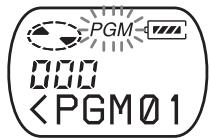
2 Press ◀ or ▶ repeatedly to select the track number.
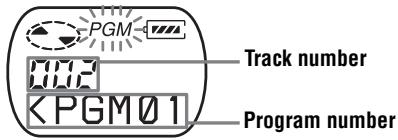
3 Press MENU/ENTER. The track is entered.
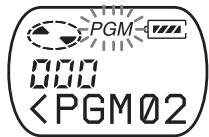
4 Repeat steps 2 and 3 to select other tracks in the desired sequence. 5 Press MENU/ENTER for 2 seconds or more.
The settings are entered and playback starts from the first programmed track.

- The program play settings will remain in memory even after playback finishes or is stopped.
- You can set the program play up to 20 tracks.
- You can specify the play mode for a selected group when group mode is on. To activate group mode, see "Selecting and playing specific groups (Group Skip Function)" (page 13).
- The play mode can also be selected when the player is paused or stopped.
Notes
- All program settings are lost when the lid is opened.
- If no settings are made for 5 minutes while the player is stopped, the settings made up to that point are entered.
- During program setting, you cannot do group mode's on/off setting.
- If you turn on group mode during program play, the program play is canceled.
Using the group function
The player can be used with a disc which has group setting.
The group function is useful for playing a great number of tracks, or tracks that have been recorded in MDLP (LP2/LP4) mode.
What is a disc with group settings?
This is a disc with settings that organize tracks into groups, and which allow those groups to be selected.
The player does not support the recording of group settings. Use your MD recorder to record information, and then use the player for playback.
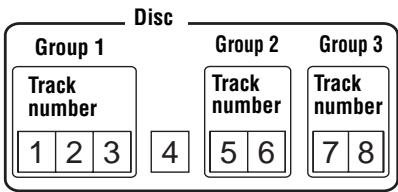

If your recorder has a function for editing disc names, you can use it to register groups. For details, see "Registering groups using your MiniDisc recorder" (page 14).
Listening to tracks in a specific group (Group Mode Playback)
Playback when group mode is off: Playback starts with the first track in the disc, and stops with the last track in the disc.
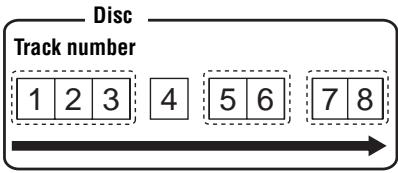
Playback when group mode is on: Playback of the selected group starts with the first track in the group, and stops with the last track in the group.
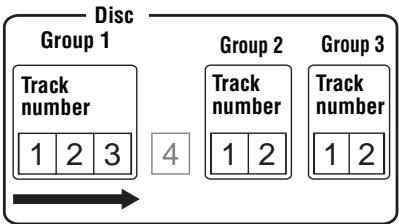
1 Insert a disc which has group settings into the player, and then play the disc. 2 Press GROUP for 2 seconds or more. "□" and "GP ON" light up in the display and group mode is turned on. Playback stops at the end of the last track in the selected group. For details on selecting another group, see "Selecting and playing specific groups (Group Skip Function)" (page 13).
To turn off group mode
Press GROUP for 2 seconds or more again.

- When group mode is on, it is possible to do repeat play, shuffle play, or program play. For details on the respective operations, see "Selecting the play mode" (page 10).
- In group mode, pressing ▶ during the last track of the group moves playback to the first track of the group. Pressing ▶ twice continuously while playing the first track of a group moves playback to the last track of the group.
Note
In group mode, the player treats all tracks without group settings as belonging to the last group on the disc. The last group is indicated in the display as "GP --". Within a group, the tracks appear in their order on the disc, not their order within the group.
Selecting and playing specific groups (Group Skip Function)
When playing a disc with group settings, the group skip function allows you to jump from the currently playing group to any other group on the MD. The group skip function can be used at any time during playback, regardless of whether the player is in group mode on or not.
When group mode is off:
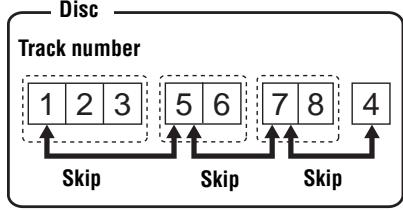
When group mode is on:
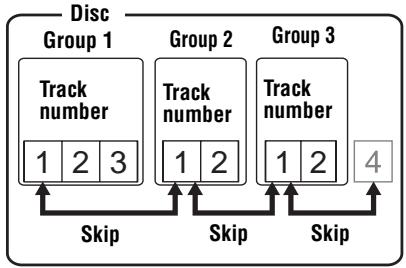
1 Insert a disc which has group settings into the player, and then play the disc. 2 Press GROUP.
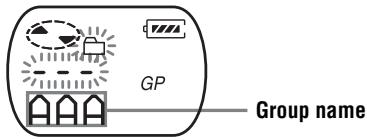
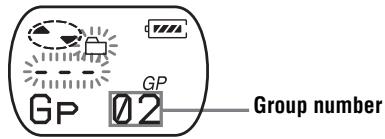
“” and “---” flash in the display and groups skip mode is turned on. 3 Within 5 seconds, press or repeatedly until the name or number of the desired group appears. The player starts playing from the first track in the group.
When there is a group name (Example: AAA)
When there is no group name
To cancel the procedure
Press ■.
Note
If no operation is performed within 5 seconds in step 3, group skip mode is canceled. To do the procedure, start from step 2 again.
Registering groups using your MiniDisc recorder
If your MD recorder (MD deck or recording MD Walkman) has a function for editing disc names, you can use it to register groups even if your recorder does not have the group function.
Make sure you enter the text string exactly as described below. The group function will not work if you enter the text string incorrectly.
To specify groups
1 Change the disc name to the following by using your MD recorder:
0;[Disc name] // [First track of group 1] A B
[Last track of group 1]; [Name of group 1]// B C
[First track of group 2] - [Last track of group 2] ; B
[Name of group 2] // ....
A Disc name <B> Track number <C> Group name
// Separator between groups
Hyphen placed between the first track and the last track ; Separator between track number and group name
(Ex.) Set the following groups for the disc named "Collections":
Group name for tracks 1-7: My Favorites "2002winter"
Group name for tracks 8-17: Jun&Tac"sunshine head
Group name for tracks 18-24: THE NIGHT BUTTERFLYS
Group name for tracks 25-32: Dream World/Kiss Me!
Text string entered: 0;Collections// 1-7;My Favorites"2002winter"/ 8-17;Jun&Tac“sunshine head”// 18-24;THE NIGHT BUTTERFLYS// 25-32;Dream World/Kiss Me!//

- Up to 99* groups can be registered on a single MD.
- The characters ";", "/", and "-" can be used in a group name.
- You can register the same group name twice or more on the same MD.
- You can specify a group without entering a group name (®) for it.
- The actual number will be less than 99 if you have entered more characters than are allowed per disc.
Note
Depending on the specifications of your MD recorder, the group function will not work.
Adjusting treble or bass (Digital Sound Preset)
You can adjust the treble and bass to suit your taste. The player can store two sets of treble-bass adjustments, which can then be selected later during playback.
MENU/ENTER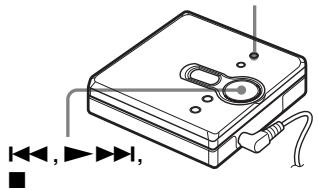
Selecting the sound quality
Factory settings
Factory settings of the digital sound preset are as follows:
"ROUND 1": bass +1, treble ±0 - "SOUND 2": bass +3, treble ±0
1 During playback, press MENU/ENTER. 2 Press < or > repeatedly until "S-SEL" flashes in the display, and press MENU/ENTER. 3 Press < or > repeatedly to select "SOUND 1", "SOUND 2", or "OFF" in the display, and then press MENU/ENTER.
Selecting "OFF" turns off the digital sound preset function.
Adjusting the sound quality
You can change the preset sound quality. To change the preset sound quality, select "SOUND 1" or "SOUND 2", the one you want to change, in advance.
1 While playing and "SOUND 1" or "SOUND 2" has been selected, press MENU/ENTER. 2 Press < or > repeatedly until "S-SET" flashes in the display, and then press MENU/ENTER.
The display shows the currently "BASS" sound setting.
3 Press < or > repeatedly to adjust the sound level.
Shows "SOUND 1" or "SOUND 2" is selected
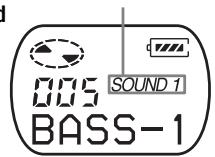
The sound can be adjusted in 8 steps. (-4, -3, ..., +0, ..., +2, +3)
4 Press MENU/ENTER.
"BASS" is set and the display changes to "TRE" (treble) setting mode.
5 Press < or > repeatedly to adjust the sound level, and then press MENU/ENTER.
"TRE" (treble) is set.
The sound settings are saved and the playback display appears again.
To cancel the procedure
Press ■.

You can set a preset sound while playback is paused.
Note
When using a digital sound preset, the sound may break or become distorted if the volume is turned up too high, depending on the settings or the track. In this case, change the settings of the sound quality.
Viewing the track name and playing time
You can check the track name, disc name, etc. during playback. Group-related items appear only when a track with group settings is played.
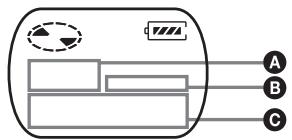
| A | B | C |
| Track number | — | The elapsed time |
| Track number | ● | Track name |
| The number of total tracks in the groups | GP | Group name |
| The number of total tracks | ● | Disc name |
| Track number | — | Track mode |
1 Press MENU/ENTER. 2 Press or repeatedly until "DISP" flashes in the display, and then press MENU/ENTER.
3 Press or repeatedly until the information that you want flashes in the display, and then press MENU/ENTER.
Each time you press ▸▸▸, the display changes as follows:
LapTim (The elapsed time of the current track)
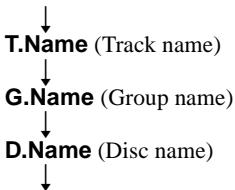
T-MODE (indicates the recording mode selected on the MD recorder used; i.e., "SP", "LP2", "LP4", or "MONO".)
Notes
- Items may appear differently or may not be selectable, depending on the group mode's on/off status, the player's operating status, or the player and disc settings.
- The mode indication appears only during playback. It appears for 2 seconds, and is then replaced by the elapsed time of the current track.
Protecting your hearing (AVLS)
The AVLS (Automatic Volume Limiter System) function keeps down the maximum volume to protect your ears.
MENU/ENTER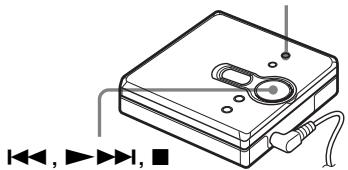
1 Press MENU/ENTER. 2 Press or repeatedly until "OPTION" flashes in the display, and then press MENU/ENTER.
"AVLS" flashes in the display.
3 Press MENU/ENTER. 4 Press or repeatedly until "ON" flashes in the display, and then press MENU/ENTER.
"ON" appears in the display, and after 2 seconds, the playback display appears again.
To cancel the AVLS function
Select "OFF" in step 4, and press MENU/ENTER.
To cancel the procedure
Press ■.
Locking the controls (HOLD)
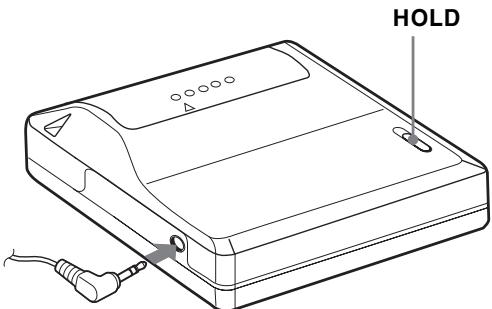
To prevent the buttons from being accidentally operated when you carry the player, use this function.
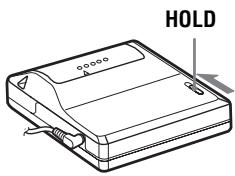
1 Slide HOLD in the direction of the to lock.
To unlock the controls
Slide HOLD to the opposite direction of the arrow.
Precautions
On safety
- Do not carry or store the dry battery in the same place with metallic objects such as coins, key rings, or necklaces. This may cause a short-circuit and the generation of heat.
- Incorrect battery usage may cause the battery fluid to leak or the battery to burst. To prevent such accidents, make sure the battery is installed with the + and - poles oriented correctly.
- If a battery leak should develop, carefully and thoroughly wipe away the battery fluid in the battery compartment before inserting a new battery.
- If you will not use the player for a long time, be sure to remove the dry battery.
On Handling
- Do not drop or bump the player. This may cause the player to malfunction.
- Do not pull headphones/earphones cords.
- Do not place the player in the following places:
—An extremely hot place (over 60°C (140°F)) A place exposed to direct sunlight or near a heater In a car with the windows rolled up (especially in the summer) In a damp place such as a bathroom —Near a source of electromagnetic fields such as a magnet, speaker, or TV In a dusty place
On heat build-up
Heat may build up in the player if it is used for an extended period of time. This, however, is not a malfunction.
On mechanical noise
The player emits mechanical noise while operating, which is caused by the power-saving system of the player. This is not a malfunction.
On installation
Never use the player where it will be subjected to extremes of light, temperature, moisture or vibration.
On the MiniDisc cartridge
- Do not touch the internal disc directly. Forcing the shutter open may damage the internal disc.
- When transporting a MiniDisc, keep it in its case.
- Do not place the cartridge where it will be subjected to light, temperature, moisture or dust.
- Do not affix the label outside of the specified area on the MD. Make sure the label is placed within the recessed space on the disc.
On the headphones/earphones
Road safety
- Do not use headphones/earphones while driving, cycling, or operating any motorized vehicle. This may lead to a traffic accident and is illegal in many areas. It can also be potentially dangerous to play your player at high volumes while walking, especially at pedestrian crossings. You should exercise extreme caution or discontinue using the player in potentially hazardous situations.
- If you experience an allergic reaction to the supplied headphones/earphones, stop using them at once and consult a doctor or a Sony service center.
Preventing hearing damage
Avoid using headphones/earphones at high volumes. Hearing experts advise against continuous, loud and extended play. If you experience a ringing in your ears, reduce the volume or discontinue use.
Caring for others
Keep the volume at a moderate level. This will allow you to hear outside sounds and to be considerate of the people around you.
On cleaning
- After wiping the player casing with a soft cloth slightly moistened with water, wipe it again with a dry cloth. Do not use any type of abrasive pad, scouring powder or solvent such as alcohol or benzene as this may mar the finish on the casing.
- Wipe the disc cartridge with a dry cloth to remove dirt.
- Dust on the lens may prevent the unit from operating properly. Be sure to close the disc compartment lid after inserting or ejecting an MD.
- To maintain good sound quality, use a soft cloth to clean the plugs of the headphones/earphones. A dirty plug may cause noise or intermittent breaks in the sound during playback.
- Clean the terminals periodically with a cotton swab or a soft cloth as illustrated.
Dry battery compartment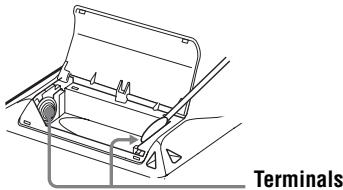
If you have any questions or problems concerning your player, please consult your nearest Sony dealer. (If a trouble occurred when the disc was in the player, we recommend that the disc be left in the player when you consult your Sony dealer so that the cause of trouble may be better understood.) When consulting your Sony dealer, be sure to bring the player, and the headphones/earphones.
Troubleshooting
Should any problem persist after you have made these checks, consult your nearest Sony dealer.
| Symptom | Cause/Solution |
| The player does not work or works poorly. | You tried to operate the player with no MD in it. ("NoDISC" flashes in the display).Insert an MD.The HOLD function is turned on ("HOLD" appears in the display when you press an operation button on the player).Disable HOLD by sliding the HOLD switch to the opposite direction of the arrow (pages 7, 18).Moisture has condensed inside the player.Take the MD out and leave the player in a warm place for several hours until the moisture evaporates.The dry battery is weak ("LoBATT" flashes or nothing appears).Replace the dry battery with the new one (page 6).The dry battery has been inserted incorrectly.Insert the battery correctly (page 6).An MD with nothing recording on it is inserted. ("BLANK" flashes in the display).Insert a recorded MD.The player cannot read the disc. (It's scratched or dirty).("ERROR" flashes in the display).Reinsert or replace the disc.While operating, the player received a mechanical shock, too much static, etc.Restart the operation as follows:1 Remove the dry battery.2 Leave the player for about 30 seconds.3 Reinsert the dry battery. |
| The MD does not play normally. | The player is set to repeat mode. ("←" is displayed on the player).Select "Normal" for the play mode and start playback. For more details, "Selecting the play mode" (page 10).The disc is playing in group mode.Turn off group mode. |
| The MD does not play from the first track. | The disc stopped playing before reaching the last track.Hold down ▷for 2 seconds or more to start playing from the first track.The disc is playing in group mode.Turn off group mode and stop playback. Then hold down ▷for 2 seconds or more to start playing from the first track. |
| The digital sound preset function does not work. | ·The digital sound preset is off. →Select “SOUND 1” or “SOUND 2”. For more details, see “Adjusting treble or bass (Digital Sound Preset)” (page 15). |
| The playback sound skips. | ·The player is placed where it receives continuous vibration. →Put the player on a stable place. ·A very short track may cause sound to skip. →Try not to create a track under one second long. |
| The sound has a lot of static. | ·Strong magnetism from a television or such device is interfering with operation. →Move the player away from the source of strong magnetism. |
| Noise is momentarily heard. | ·The sound was recorded in LP4 stereo mode. →Because of the nature of the compression method used in LP4 mode, noise may be output on very rare occasions during playback of sound recorded in this mode. |
| The player does not operate properly. | ·An attempt was made to enter group mode with program play selected. →Change to group mode before selecting program play. |
| No sound comes through the headphones/earphones. | ·The headphones/earphones plug is not firmly connected. →Plug in the plug of the headphones/earphones firmly to the ∩ jack. ·Volume is too low. →Adjust the volume by pressing VOL + or -. ·The plug is dirty. →Clean the plug. |
| Volume cannot be turned up. | ·AVLS is on. →Set AVLS to “OFF” (page 18). |
| The group function does not operate. | ·While using a disc that has no group information, an attempt was made to turn group mode on. →Use a disc with a group information. ·While a track that belongs to no group is playing, an attempt was made to turn group mode on. →The group function cannot be used while a track that belongs to no group is playing. ·When selecting program play, an attempt was made to turn group mode on. →Turn group mode on, before selecting program play. |
| When rewinding or fast forwarding, the track does not go back to the previous track or go forward to the next track. | ·Group skip mode is on. →Turn off group skip mode. Group skip mode is automatically canceled if no operation is performed within 5 seconds. For more details, see “Selecting and playing specific groups (Group Skip Function)” (page 13). |
Specifications
MD Player
Audio playing system
MiniDisc digital audio system
Laser diode properties
Material: GaAlAs
Wavelength: λ = 790 nm
Emission duration: continuous
Laser output: less than 44.6 μW
(This output is the value measured at a distance
of 200 mm from the objective lens surface on
the optical pick-up block with 7 mm aperture.)
Revolutions
Approx. 300 rpm to 2,700 rpm
Error correction
ACIRC (Advanced Cross Interleave Reed
Solomon Code)
Sampling frequency
44.1 kHz
Coding
ATRAC (Adaptive TRansform Acoustic
Coding)
ATRAC3 - LP2/LP4
Modulation system
EFM (Eight to Fourteen Modulation)
Number of channels
2 stereo channels
1 monaural channel
Frequency response
20 to 20,000 Hz ± 3 dB
Wow and Flutter
Below measurable limits
Outputs
○: stereo mini-jack, maximum output level
3.5 mW + 3.5 mW load impedance 16 Ω
General
Power requirements
One LR6 (size AA) alkaline battery (not supplied)
Battery operation time
See "Battery life" (page 6)
Dimensions
Approx. 81 × 28.9 × 74.4 mm (w/h/d) (3 1/4 × 1 3/16 × 3 in.) without projections.
Mass
Approx. 93 g (3.3 oz) the player only
US and foreign patents licensed from Dolby Laboratories.
Design and specifications are subject to change without notice.
Optional accessories
MDR series stereo Headphones/earphones* SRS series Active Speakers
- When using optional headphones, use only headphones/earphones with stereo mini plugs. You cannot use headphones/earphones with micro plugs.
Your dealer may not handle some of the above listed accessories. Please ask the dealer for detailed information about the accessories in your country.
WARNING
Reading of an MD 8
ACIRC (Advanced Cross Interleave Reed Solomon Code)
ATRAC (Adaptive TRansform Acoustic Coding)
ATRAC3 - LP2/LP4
EFM (Eight to Fourteen Modulation)
Number of channels
2 channels stereo
1 channel monaural
Position (Quick Search) 10
ACIRC (Advanced Cross Interleave Reed Solomon Code)
Sampling frequency
ACIRC (Advanced Cross Interleave Reed Solomon Code)
Sampling frequency
44.1 kHz
Coding
ATRAC (Adaptive TRansform Acoustic
Coding)
ATRAC3 - LP2/LP4
Modulation system
EFM (Eight to Fourteen Modulation)
Number of channels
2 stereo channels
1 monaural channel
Frequency response
ACIRC (Advanced Cross Interleave Reed
Solomon Code)
ATRAC (Adaptive TRansform Acoustic
Coding)
ATRAC3 - LP2/LP4
EFM (Eight to Fourteen Modulation)
Number of channels
2 stereo channels
1 monaural channel
ACIRC (Advanced Cross Interleave Reed
Solomon Code)
Sampling frequency
44.1 kHz
Coding
ATRAC (Adaptive TRansform Acoustic
Coding)
ATRAC3—LP2/LP4
Modulation system
EFM (Eight to Fourteen Modulation)
Number of channels
2 stereo channels
1 mono channel
Playback frequency
20 to 20000Hz± 3 dB
Wow and flutter
Lower than measurable
Outputs
: stereo mini jack, maximum output level
3,5mW + 3,5mW load impedance
16 ohm
General
Power supply
HOLD button 2 OPEN button
ACIRC (Advanced Cross Interleave Reed
Solomon Code)
Sampling frequency
44.1 kHz
Coding
ATRAC (Adaptive TRansform Acoustic
Coding)
ATRAC3 - LP2/LP4
Modulation system
EFM (Eight to Fourteen Modulation)
Number of channels
2 stereo channels
1 mono channel
Frequency response
20 to 20000 Hz ± 3 dB
Wow and flutter
1 Interrupttore HOLD 2 Tasto OPEN
ACIRC (Advanced Cross Interleave Reed
Solomon Code)
ATRAC (Adaptive TRansform Acoustic
Coding)
ATRAC3 - LP2/LP4
1 HOLD switch 2 OPEN button
ACIRC (Advanced Cross Interleave Reed
Solomon Code)
ATRAC (Adaptive TRansform Acoustic
Coding)
ATRAC3 - LP2/LP4
Modulation system
MiniDisc player (MD player)
ACIRC (Advanced Cross Interleave Reed Solomon Code)
Sampling frequency
44.1 kHz
Coding
ATRAC (Adaptive TRansform Acoustic
Coding)
ATRAC3 - LP2/LP4
EFM (Eight to Fourteen Modulation)
Number of channels
2 stereo channels
1 monaural channel
Frequency response
20-20,000 Hz ± 3 dB
Wow and flutter
Manipulation of MiniDisc discs
ATRAC (Adaptive TRansform Acoustic
Coding)
ATRAC3 - LP2/LP4
Modulation system
EFM (Eight to Fourteen Modulation)
Number of channels
2 channels stereo
1 channel mono
ACIRC (Advanced Cross Interleave Reed Solomon Code)
Sampling frequency
44.1 kHz
Coding
ATRAC (Adaptive TRansform Acoustic
Coding)
ATRAC3 - LP2/LP4
Modulation system
EFM (Eight to Fourteen Modulation)
Number of channels
2 stereo channels
1 mono channel
Frequency response
20 to 20,000 Hz ±3 dB
ACIRC (Advanced Cross Interleave Reed Solomon Code)
ATRAC (Adaptive TRansform Acoustic
Coding)
ATRAC3 - LP2/LP4
System modulation
EFM (Eight to Fourteen Modulation)
Number of channels
2 stereo channels
1 channel mono
Frequency response
20 to 20000 Hz ± 3 dB
Wow and flutter distortion
1 PLAY indicator 2 OPEN button
3 Strap hole This hole is used for attaching a user strap. 4 Battery compartment cover
Player display
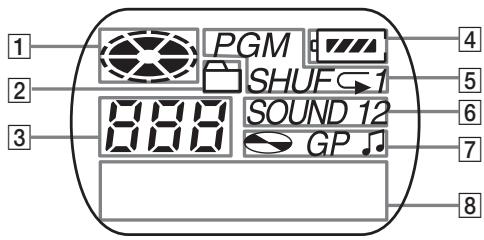
1 DISC indicator 2 GROUP mode indicator Lights when group mode is on. 3 Track number display 4 Battery charge indicator Shows approximate battery charge.
5 PLAY MODE indicator Shows the play mode of the disc. 6 SOUND indicator 7 Disc, group, track name display 8 Alphanumeric display Shows track names, elapsed play time, etc.
Getting started
1 Insert a dry cell battery.
Open the battery compartment by sliding the cover.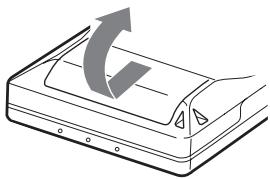
Insert a dry cell battery LR6 (AA size), observing polarity (negative pole first).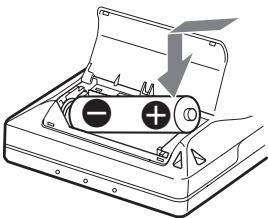
Close the cover.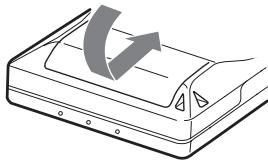
When it is necessary to replace the battery
The battery status can be checked using the battery charge indicator.
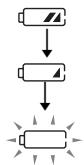
Battery charge decreases
Weak battery charge
Battery is discharged.
"PLAY" starts blinking on the display, and power is turned off.
Battery operating time
(Unit of measurement: hours, approximately) (DATA1)
1 Insert the miniDisc.
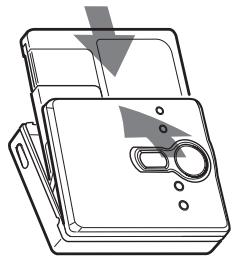
1 Press OPEN to open the lid.
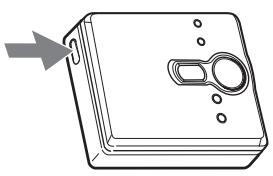
2 Insert the miniDisc with the label side facing up, then close the lid.
2 Start playback of the miniDisc.
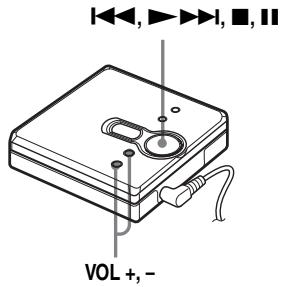
1 Press ▷ ▷ ▷I. 2 Adjust the volume. While pressing, the volume indicator appears on the display, allowing you to control the volume level.
To stop playback, press ■.
Playback will resume from the point where it was previously stopped. To start playback from the beginning of the first track, press and hold the button for 2 seconds or more.
Using the track grouping function
The player can work with discs containing group installations.
Functioning is usually used for playback of a large number of tracks, as well as for playback of tracks recorded in MDLP mode (LP2/LP4).
If the group has no name
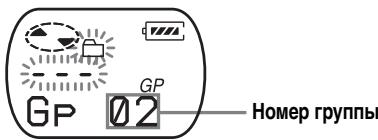
To cancel
Press ■.
Note
If within 5 seconds the user does not perform any operations, the group playback selection mode is turned off. To turn on this mode again, perform step 2 once more.
Registering groups using a MiniDisc recorder
If your MiniDisc recorder (MiniDisc deck or MiniDisc recorder Walkman) has the function of editing disc names, you can use such a recorder to register groups, even if it does not have the function of working with groups. The text string must be entered exactly as shown below. If the text string is entered incorrectly, the group playback function of the recordings will not work.
To specify groups
1 Using the MiniDisc recorder, change the MiniDisc name to the following:



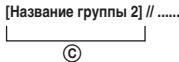
A disc name Track number Group name
// Separator between groups, placed between the first and last tracks ; Separator of the number and name of the group
(Example) Set the following for a disc that has the name "Collections":
Group name for tracks 1-7: My Favorites"2002winter
Group name for tracks 8-17: Jun&Tac "sunshine head"
Group name for tracks 18-24: THE NIGHT BUTTERFLYS
Group name for tracks 25-32: Dream World/Kiss Me!
Text string to be entered:
0:Collections// 1-7;My Favorites"2002winter"/ 8-17;Jun&Tac"sunshine head"/ 18-24;THE NIGHT BUTTERFLYS// 25-32;Dream World/Kiss Me!//

Up to 99* groups can be registered on one minidisc. In group names, the symbols ";", "/", and "-" can be used. A group name can be registered only once on the same minidisc. You can also define a group without a name (C). *The actual number will be less than 99 if the number of entered symbols exceeds the allowable value for one disc.
Note
Some recording players of minidiscs do not support the group function for recordings.
Adjusting the high and low frequencies (Digital Sound Preset)
You can adjust the level of high and low frequencies to your taste. You can store two variations of the high and low frequency settings in the player's memory. These variations can be selected later and during playback.
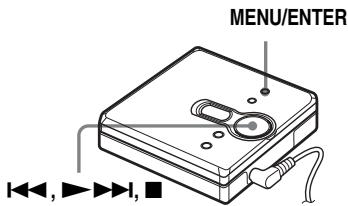
Selecting the sound quality
Default settings
The digital sound is set by default as follows:
"ROUND 1": Low frequencies +1, High frequencies ±0 "ROUND2": Low frequencies +3, High frequencies ±0
1 During playback, press MENU/ENTER. 2 Press it several times until "S-SEL" appears on the display, then press MENU/ENTER. 3 Press ▶▶ or ◀◀ to select "SOUND 1", "SOUND 2", or "OFF", then press MENU/ENTER. If "OFF" is selected, the Digital Sound Preset function is disabled.
Sound quality adjustment
You can change the preset sound quality. To change the preset sound quality, first select the parameter "SOUND 1" or "SOUND 2" that you want to change.
1 During playback, if "SOUND 1" or "SOUND 2" is selected, press MENU/ENTER. 2 Press the "S-SET" button until the display flashes, then press MENU/ENTER.
The currently selected sound setting "BASS" is displayed.
3 Press the button to adjust the sound level.
This is not a malfunction.
Mechanical noise
During operation, the player produces noise, the source of which is its power-saving system. This is not a sign of malfunction.
Installation
Do not expose the player to prolonged direct sunlight or vibration. Avoid using it in very high or very low temperatures, as well as in conditions of high humidity.
Card for MiniDisc
Do not touch the working surface of the disc. To avoid damaging the working surface of the disc, do not open the disc shutter manually. - Store MiniDiscs in their cases. Do not keep the card where it may be exposed to sunlight, high or low temperatures, or moisture, as well as in places where dust accumulates. - The label should be affixed only in the designated place on the MiniDisc case. - The label must be placed within the recessed area on the disc case.
Headphones
Road safety
Do not wear headphones while driving a car, riding a bicycle, or operating any other means of transport. This may lead to a traffic accident. Moreover, in many countries it is prohibited by law. Also, avoid listening to the player at high volume while walking, especially at pedestrian crossings. You must exercise extreme caution and stop using the device in case of a dangerous situation. - If you experience an allergic reaction to the headphones included in the package, stop using them immediately and consult a doctor or the Sony service center.
Hearing organs
Do not listen to recordings at high volume. Experts do not recommend frequent and prolonged listening at high volume. If you hear ringing in your ears, reduce the volume or stop listening.
Do not forget about those around you
Listen to the player at a moderate volume. This way you will be able to hear surrounding sounds and those nearby.
Cleaning
Wipe the player casing with a soft cloth slightly moistened with water, and then wipe the casing dry with a dry cloth. Do not use abrasive cleaners, cleaning sprays, or solvents such as alcohol or benzene, as they may damage the casing finish. - Remove dust from the surface of the disc cartridge with a dry cloth.
- Dust accumulated on the lens of the laser can cause malfunctions. Do not forget to close the lid of the disc compartment after inserting or removing the disc. - For the best sound quality, wipe the headphone plugs with a soft cloth. Dirty plugs may cause noise and intermittent sound. Periodically clean the battery terminals with a soft cloth as shown in the figure.
Battery compartment for dry battery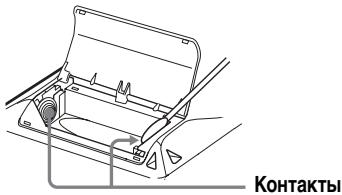
If you have any questions or problems regarding your player, contact your nearest Sony dealer. (If a malfunction occurs while the disc is in the player, we recommend leaving the disc in the player so that the cause of the malfunction can be easily identified when consulting your Sony dealer. When consulting your Sony dealer, be sure to bring the player and headphones.)
Troubleshooting
If you cannot resolve the problem even after following all the instructions provided, contact your nearest Sony dealer.
ACIRC (Advanced Cross Interleave Reed Solomon Code)
Sampling frequency
44.1 kHz
Coding
ATRAC system (Adaptive TRansform Acoustic Coding)
ATRAC3 - LP2/LP4
System
EFM (Eight to Fourteen Modulation)
Number of channels
2 stereo phonic channels
1 monophonic channel
Frequency characteristics
20 to 20000 Hz ± 3 dB
Distortion coefficient
Lower measured level
Outputs
Stereo headphone jack, maximum output power
3.5 mW + 3.5 mW, impedance 16 Ω
General information
Power requirements
One LR6 (AA size) battery (not supplied)
Battery life
See “Battery life” (page 6)
Dimensions
Approx. 81 mm × 28.9 mm × 74 mm (W/H/D) without projecting parts.
Mass
Approx. 93 g (player only)
Patents U.S. and other countries acquired under license from Dolby Laboratories.
Design and specifications are subject to change without notice.
Optional accessories
Stereo headphones* MDR Active speakers series S
*For headphones: Use only headphones that have stereo mini plugs. Do not use headphones with micro plugs.
Your dealer or representative may not have some of the accessories listed above. Please consult the dealer for more detailed information on the accessories available in your country.
Jun&Tac"sunshine head
Group name for tracks 18-24:
ACIRC (Advanced Cross Interleave Reed Solomon Code)
Sampling frequency
44.1 kHz
Encoding
ATRAC (Adaptive TRansform Acoustic Coding)
ATRAC3 - LP2/LP4
Modulation system
EFM (Eight to Fourteen Modulation)
Number of channels
2 stereo channels
1 mono channel
Frequency response
20 to 20000 Hz ± 3 dB
Below the measurable limit
Output
(play)* ↑↑↑ (search/AMS) stop) (pause)
2 2
① 1
HOLD
SAnOn3KnLrJFkRf (G-PROTECTION)
MD REXD (MD BOK # # # # # # # # # # # # # # # # # # # # # # # # # # # # # # # # # # # # # # # # # # # # # # # # # # # # # # # # # # # # # # # # # # # # # # # # # # # # # # # # # # # # # # # # # # # # # # # # # # # # # MD Walkman) e d s k c i
MD REXD (MD BOK # # # # # # # # MD Walkman) e d s k c i
MD REXD (MD BOK # # # # # # # MD Walkman) e d s k c i
MD REXD (MD BOK # # # # # # MD Walkman) e d s k c i
ACIRC (Advanced Cross Interleave Reed-Solomon Code)
Reed Solomon Code)
44.1kHz
KoDING
ATRAC (Adaptive TRansform Acoustic Coding)
Coding)
ATRAC3 - LP2/LP4
EFM (Eight to Fourteen Modulation)
#
Stereo 2
Mono 1
20 to 20,000 Hz ± 3 dB
Stereo Mini, Tt
LR6 (AA size) alkaline batteries
[Battery]
“Ni-MH” (63)
J
81 × 28.9 × 74.4 mm (w/h/d) (3 1/4 ×
1 3/16 × 3 13
93 g (3.30 oz)
Manufactured under license from Dolby Laboratories. T. HU
MDR-SR1KS Stereo Headphones
Printed using VOC (Volatile Organic
Compound)-free vegetable oil ink.
- PORTABLE MINIDISC PLAYER
- WARNING
- CAUTION
- INFORMATION
- TABLE OF CONTENTS
- LOOKING AT THE CONTROLS
- GETTING STARTED
- PLAYING AN MD RIGHT AWAY
- VARIOUS WAYS OF PLAYBACK
- OTHER OPERATIONS
- ADDITIONAL INFORMATION
- FRONT OF THE PLAYER
- BACK OF THE PLAYER
- THE DISPLAY WINDOW OF THE PLAYER
- INSERT AN ALKALINE DRY BATTERY
- WHEN TO REPLACE THE BATTERY
- BATTERY LIFE
- NOTE
- MAKE CONNECTIONS AND UNLOCK THE CONTROL
- INSERT AN MD
- PLAY AN MD
- TO STOP PLAY, PRESS
- SUPPRESSING THE SKIP OF THE SOUND (G-PROTECTION)
- SEARCHING FOR A SPECIFIC TRACK OR A POSITION QUICKLY (QUICK SEARCH)
- TO CANCEL THE PROCEDURE
- SELECTING THE PLAY MODE
- INDICATION A/B (PLAY MODE)
- LISTENING TO TRACKS IN A DESIRED SEQUENCE (PROGRAM PLAY)
- NOTES
- USING THE GROUP FUNCTION
- WHAT IS A DISC WITH GROUP SETTINGS
- LISTENING TO TRACKS IN A SPECIFIC GROUP (GROUP MODE PLAYBACK)
- TO TURN OFF GROUP MODE
- SELECTING AND PLAYING SPECIFIC GROUPS (GROUP SKIP FUNCTION)
- WHEN GROUP MODE IS OFF
- WHEN GROUP MODE IS ON
- WHEN THERE IS A GROUP NAME (EXAMPLE: AAA)
- WHEN THERE IS NO GROUP NAME
- PRESS
- REGISTERING GROUPS USING YOUR MINIDISC RECORDER
- TO SPECIFY GROUPS
- ADJUSTING TREBLE OR BASS (DIGITAL SOUND PRESET)
- SELECTING THE SOUND QUALITY
- FACTORY SETTINGS
- ADJUSTING THE SOUND QUALITY
- VIEWING THE TRACK NAME AND PLAYING TIME
- PROTECTING YOUR HEARING (AVLS)
- TO CANCEL THE AVLS FUNCTION
- LOCKING THE CONTROLS (HOLD)
- TO UNLOCK THE CONTROLS
- PRECAUTIONS
- ON SAFETY
- ON HANDLING
- ON HEAT BUILD-UP
- ON MECHANICAL NOISE
- ON INSTALLATION
- ON THE MINIDISC CARTRIDGE
- ON THE HEADPHONES/EARPHONES
- ROAD SAFETY
- PREVENTING HEARING DAMAGE
- CARING FOR OTHERS
- ON CLEANING
- TROUBLESHOOTING
- SPECIFICATIONS
- MD PLAYER
- REVOLUTIONS
- ERROR CORRECTION
- SAMPLING FREQUENCY
- CODING
- MODULATION SYSTEM
- NUMBER OF CHANNELS
- FREQUENCY RESPONSE
- WOW AND FLUTTER
- OUTPUTS
- GENERAL
- POWER REQUIREMENTS
- BATTERY OPERATION TIME
- DIMENSIONS
- MASS
- OPTIONAL ACCESSORIES
- READING OF AN MD
- CHANNEL MONAURAL
- PLAYBACK FREQUENCY
- POWER SUPPLY
- MINIDISC PLAYER (MD PLAYER)
- MANIPULATION OF MINIDISC DISCS
- SYSTEM MODULATION
- WOW AND FLUTTER DISTORTION
- PLAYER DISPLAY
- INSERT A DRY CELL BATTERY
- WHEN IT IS NECESSARY TO REPLACE THE BATTERY
- BATTERY OPERATING TIME
- INSERT THE MINIDISC
- START PLAYBACK OF THE MINIDISC
- TO STOP PLAYBACK, PRESS
- USING THE TRACK GROUPING FUNCTION
- IF THE GROUP HAS NO NAME
- TO CANCEL
- REGISTERING GROUPS USING A MINIDISC RECORDER
- ADJUSTING THE HIGH AND LOW FREQUENCIES (DIGITAL SOUND PRESET)
- DEFAULT SETTINGS
- SOUND QUALITY ADJUSTMENT
- MECHANICAL NOISE
- INSTALLATION
- CARD FOR MINIDISC
- HEADPHONES
- HEARING ORGANS
- DO NOT FORGET ABOUT THOSE AROUND YOU
- CLEANING
- SYSTEM
- FREQUENCY CHARACTERISTICS
- DISTORTION COEFFICIENT
- GENERAL INFORMATION
- ENCODING
- STEREO CHANNELS
- OUTPUT
- SANON3KNLRJFKRF (G-PROTECTION)
- KODING
- [BATTERY]
- J
Brand : SONY
Model : MZ-E310
Category : MiniDisc Player