RM 4203 - Fridge DOMETIC - Free user manual and instructions
Find the device manual for free RM 4203 DOMETIC in PDF.



User questions about RM 4203 DOMETIC
0 question about this device. Answer the ones you know or ask your own.
Ask a new question about this device
Download the instructions for your Fridge in PDF format for free! Find your manual RM 4203 - DOMETIC and take your electronic device back in hand. On this page are published all the documents necessary for the use of your device. RM 4203 by DOMETIC.
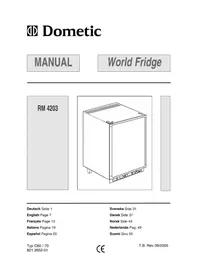
USER MANUAL RM 4203 DOMETIC
natural_image
Line drawing of a rectangular refrigerator with ventilation grilles and control buttons (no text or symbols)Deutsch Seite 1
English Page 7
Français Page 13
Italiano Pagina 19
Español Pagina 25
Svenska Sida 31
Dansk Side 37
Norsk Side 43
Nederlands Pag. 49
Suomi Sivu 55
Typ C60 / 70
821 2652-01
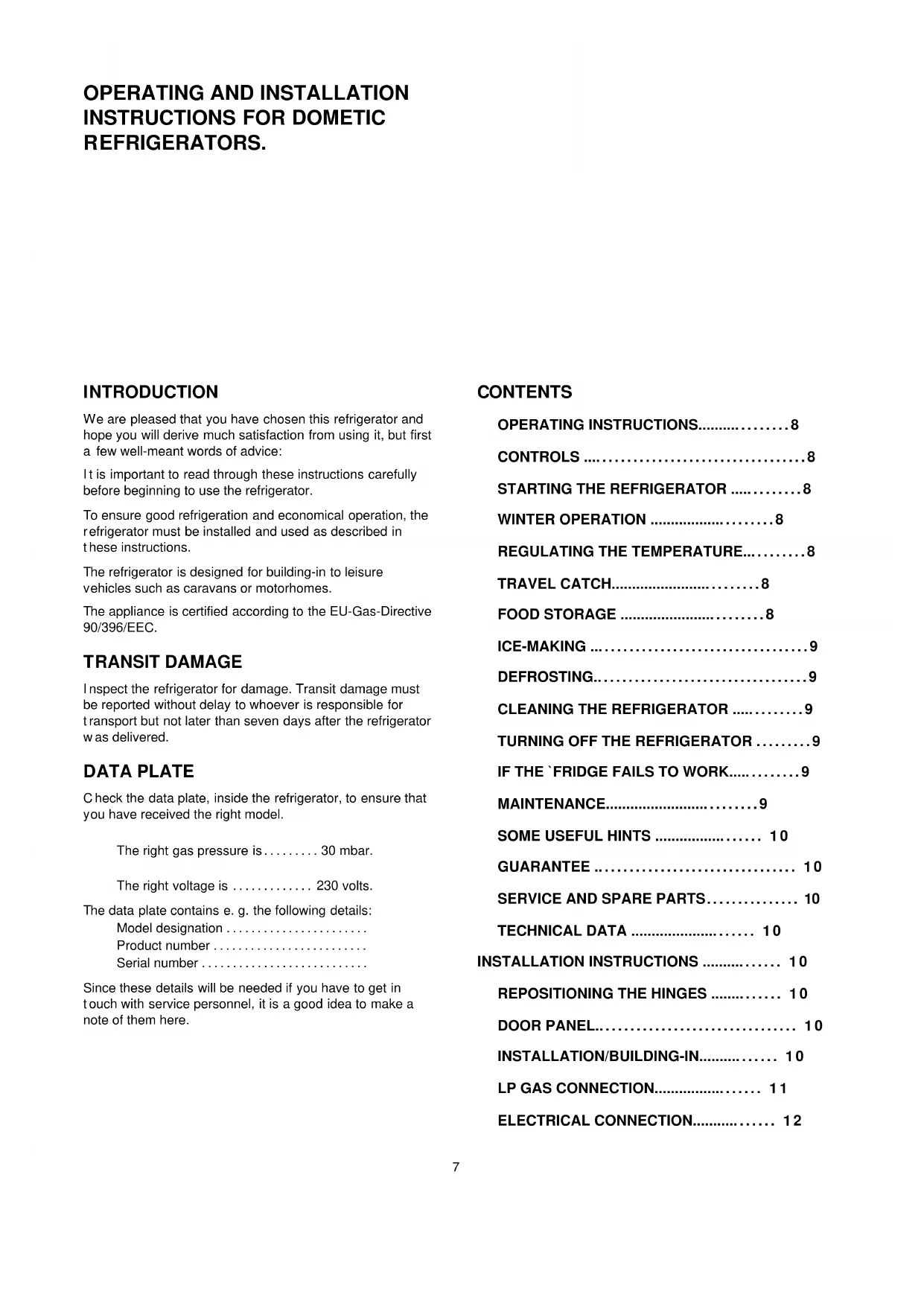
We are pleased that you have chosen this refrigerator and hope you will derive much satisfaction from using it, but first a few well-meant words of advice:
It is important to read through these instructions carefully before beginning to use the refrigerator.
To ensure good refrigeration and economical operation, the refrigerator must be installed and used as described in these instructions.
The refrigerator is designed for building-in to leisure vehicles such as caravans or motorhomes.
The appliance is certified according to the EU-Gas-Directive 90/396/EEC.
TRANSIT DAMAGE
Inspect the refrigerator for damage. Transit damage must be reported without delay to whoever is responsible for transport but not later than seven days after the refrigerator was delivered.
DATA PLATE
Check the data plate, inside the refrigerator, to ensure that you have received the right model.
The right gas pressure is..... 30 mbar.
The right voltage is .... 230 volts.
The data plate contains e. g. the following details:
Model designation ....
Product number ....
Serial number ....
Since these details will be needed if you have to get in touch with service personnel, it is a good idea to make a note of them here.
CONTENTS
OPERATING INSTRUCTIONS......8
CONTROLS 8
STARTING THE REFRIGERATOR ....8
WINTER OPERATION 8
REGULATING THE TEMPERATURE......8
TRAVEL CATCH....8
FOOD STORAGE 8
ICE-MAKING 9
DEFROSTING....9
CLEANING THE REFRIGERATOR .....9
TURNING OFF THE REFRIGERATOR .....9
IF THE `FRIDGE FAILS TO WORK....9
MAINTENANCE....9
SOME USEFUL HINTS .... 10
GUARANTEE 10
SERVICE AND SPARE PARTS.... 10
TECHNICAL DATA 10
INSTALLATION INSTRUCTIONS .... 10
REPOSITIONING THE HINGES .... 10
DOOR PANEL.... 10
INSTALLATION/BUILDING-IN...... 10
LP GAS CONNECTION.... 11
ELECTRICAL CONNECTION.... 12
OPERATING INSTRUCTIONS
CONTROLS
The refrigerator can be run on either 230 V, 12 V or LP gas. Changing between these modes of operation is carried out by means of the controls of the control paner shown in fig 3.
The voltage selector (A) can be set at either 230 V, 12 V or 0.
Refrigerator temperature is controlled by a thermostat (B) when the unit runs on 230 V.
The gas supply is turned on/off by means of the knob (C). It also serves to select one of three different gas inputs.
The refrigerator is fitted with a safety device which automatically shuts off the supply of gas if the flame goes out. The safety device can be opened manually by depressing control (C).
The piezoelectric igniter discharges a spark over the burner when the button (D) is depressed.
Inside the refrigerator at bottom left is a sight glass for the burner. A blue light can be seen through it when the flame is alight.
STARTING THE REFRIGERATOR
The position numbers refer to fig. 3.
Caution!
Only use one source of energy at a time
LP Gas operation
After initial installation, after servicing, changing gas cylinders etc., the gas lines may contain some air which should be allowed to escape by briefly turning on the refrigerator or other appliances. This will ensure that the flame lights immediately.
Before you start gas operation:
- Open the shut-off valve of the gas bottle (check that there is enough gas). Open any on-board shut-off valve.
- Check that the switches for mains and 12 V operation are off.
- Turn the gas control (C) to position MAX.
- Depress the knob (C) of the flame failure device and hold it down while depressing the piezoelectric igniter button (D) several times in quick succession.
- Check the flame indicator/sight glass that the flame is alight.
- Keep the knob (C) depressed for a further 10-15 sec.
- Release the knob and again check that the flame stays alight.
To terminate gas operation, turn knob (C) to ●.
230 V Operation
- Turn off the gas by means of the shut-off valve.
- Set the voltage selector (A) to 230 V.
- Turn the electric thermostat (B) to the highest (coldest) position.
12 V Operation
Only operate your refrigerator on 12 V when the engine of the vehicle is running - otherwise your battery will soon be discharged.
- If applicable, turn off the gas operation
- Depress the voltage selector (A) to position 12 V.
WINTER OPERATION
Please check that the ventilation grilles or the flue outlet are not blocked by snow, leaves, etc.
DOMETIC ventilation grilles A 1620 (fig. 11), can be fitted with winter covers, modell WA 120, to protect the cooling unit against cold air. The covers may be fitted when the outside temperature is below approx. 10^ C and should be fitted when the temperature is below freezing point.
We suggest that you fit the winter covers also in the case that the vehicle is laid up during the winter season.
REGULATING THE TEMPERATURE
The position number refers to fig. 3.
Once the refrigerator has been started it will take a few hours to become cold.
On 230 V operation the refrigerator is controlled by a thermostat and the thermostat knob (B) should be set at 3-5. If a lower (colder) temperature is desired, set the thermostat to a higher figure.
On 12 V operation the refrigerator works continuously.
LP gas operation should always be initiated with the knob (C) at the max position. If the ambient temperature is above 25^ C and/or the door of the refrigerator is frequently opened the knob should be left at that position. Below 25^ C the knob should be set at mid and below 10^ C at min to avoid temperature below freezing in the main compartment.
TRAVEL CATCH
Make sure that the travel catch is engaged when the caravan is on the move.
The travel catch at the top of the door can be set in two different positions. In one position the door is held tightly shut. In the other position the door is secured ajar so that the refrigerator can be aired when not in use.
FOOD STORAGE
Always keep food in closed containers. Never put hot food in the refrigerator; allow it to cool first.
NEVER KEEP ITEMS IN THE REFRIGERATOR WHICH MGHT GIVE OFF FLAMMABLE GASES.
The 2-star ( ^** ) frozen food compartment is intended for the storage of frozen food and for making ice. It is not suitable for freezing items of food.
Never put bottles or cans of fizzy drinks in the frozen food storage compartment as they may burst when freezing. Also don't give children ice lollies straight from the compartment as they could cause frost burns.
Most kinds of frozen food can be stored in the frozen food compartment for about a month. This period of time may vary, however, and it is important to follow the instructions on the individual packings.
ICE-MAKING
Fill the ice tray just below the brim with drinking water and put the tray on the freezer shelf.
It is possible to make ice faster by turning the control knob temporarily to its highest value but do not forget to turn it back to its regular setting afterwards as the refrigerator might otherwise become too cold.
DEFROSTING
Frost will gradually accumulate on the refrigerating surfaces. It must not be allowed to grow too thick as it acts as an insulator and adversely affects refrigerator performance.
Check the formation of frost regularly every week and when it is about 3 mm thick it will be necessary to defrost the refrigerator.
To defrost the refrigerator, turn it off and remove the ice tray and all food items. Normally the temperature of items of frozen foods would rise unduly during defrosting and so they should be consumed within 24 h or discarded.
Do not try to accelerate defrosting by using any kind of heating appliance as the plastic surfaces of the refrigerator might then be damaged. Neither should any sharp objects be used to scrape off the ice.
The defrost water runs from a collector channel down a tube to a drip tray at the rear of the refrigerator where it evaporates. When all the ice has melted, wipe the refrigerator dry and restart it.
Place the food items back inside but wait until the refrigerator is cold before making ice cubes.
CLEANING THE REFRIGERATOR
Clean the inside of the refrigerator regularly to keep it fresh and hygienic.
Soak a cloth in a solution consisting of a teaspoon of bicarbonate of soda to half a litre of warm water. Wring out the cloth and use it to clean the interior of the refrigerator and its fittings.
Never use detergents, scouring powder, strongly scented products or wax polish to clean the interior of the refrigerator as they may damage the surfaces and leave a strong odour.
The exterior of the refrigerator should be wiped clean now and again, using a damp cloth and a small quantity of detergent. But not the door gasket, which should only be cleaned with soap and water and then thoroughly dried.
The cooling unit behind the refrigerator should be cleaned with a brush from time to time, but make sure that the refrigerator is switched off when doing this.
If the refrigerator is not to be used for some time:
- Shut off any on-board valve in the gas line to the refrigerator.
- Set the voltage selector (A), fig. 3, to 0.
- Set the gas valve (C) to .
- Empty the refrigerator. Defrost and clean it as described earlier. Leave the doors of the refrigerator and the frozen food compartment ajar. Use the travel catch to hold in this position.
IF THE \`FRIDGE FAILS TO WORK
Check the following points before calling a service technician:
- That the STARTING THE REFRIGERATOR instructions have been followed.
-
The refrigerator is level.
-
If it is possible to start the refrigerator on any of the connected sources of energy.
-
If the refrigerator fails to work on gas, check:
- That the gas bottle is not empty.
- That all LP-gas valves are open.
- If the refrigerator fails to work on 12 V, check:
- That the 12 V supply is connected to the refrigerator.
- That the fuse on the 12 V supply is intact.
- That the 12 V switch is on.
- If the refrigerator fails to work on 230 V, check:
- That the 230 V supply is connected to the refrigerator.
- That the fuse is intact.
If the refrigerator is not cold enough it may be because:
- The ventilation is inadequate owing to reduced area of the ventilation passages (partial blockage of grilles from wire mesh etc).
- The evaporator is frosted up.
- The temperature control setting is incorrect.
- The gas pressure is incorrect - check the pressure regulator at the gas container.
- The ambient temperature is too high.
- To much food is loaded at the same time.
- The door is not properly closed or the magnetic sealig strip is defective.
- More than one source of energy is used at the same time. If the refrigerator still does not work properly, call a service technician.
The sealed cooling system must not be opened, since is under high pressure.
MAINTENANCE
Concerning gas- and electric installations, only authorized experts are allowed to carry out maintenance and repair works. Besides, it is recommendable to contact an authorized service if it comes to repair works.
According to the valid regulations G607 of DVGW, the gas
installation as well as the connect flue oulets are to be checked every two years by an expert (this has to be arranged by the person responsible).
SOME USEFUL HINTS
Make sure that:
- The refrigerator is not operating on 12 V when the vehicle is parked, otherwise you will drain the car battery in a short time.
- Defrosting is carried out periodically.
- The refrigerator is clean and dry with the door left open when it is not to be used for some time.
- Liquids or items with a strong odour are well packa-ged.
- The ventilation openings are unobstructed.
- The door is secured by means of the travel catch when the caravan is on the move.
- Only one mode of operation at a time is used to run the refrigerator.
GUARANTEE
The refrigerator is guaranteed for one full year on condition that it is used in a correct manner and in accordance with these operating and installation in-structions.
It is also embraced by a European guarantee as described in the brochure supplied with the refrigerator.
SERVICE AND SPARE PARTS
Service and spare parts are obtainable from your dealer or DOMETIC - consult the yellow pages of the telephone directory.
TECHNICAL DATA RM 4203
Overall dimensions
Height (incl. controls) 606 mm
Width 486 mm
Depth (incl. cooling unit)
without door....4 4 0 mm
with door....480mm
Build-in dimensions
Height 610mm
Width 490mm
Depth 460 mm
Capacity
gross 60lit
net 51lit
frozen food compt....6 lit
Weight (without packaging).... 21 kg
Electrical data
Input 230 V .... 105 watt
12V 100watt
Energy consumption/24 hours .....2.3 kWh
Lp gas data
Input (max) 186 watt
ditto, low flame 86 watt
Energy consumption/24 hours
max 0.35 kg
mid....0,24 kg
min....0.16 kg
Cooling medium ....Ammonia (R 717)
INSTALLATION INSTRUCTIONS
REPOSITIONING THE HINGES
The door hinges can be moved to the opposite side in the following way:
- Unscrew the upper hinge pin, taking care not to lose the set of washers and bushes.
- Lift the door from the lower hinge pin.
- Unscrew the pin and mount it on the opposite side hinge.
- Unscrew the travel catch and mount it on the opposite side.
- Carefully prise out and exchange the plastic inserts in the holes for the tarvel catch in the upper door frame. (fig. 10)
- Fit the door on the pin and reassemble the pin with washers and bushes in its new position.
- Check that the door closes properly and seals all round.
DOOR PANEL
The door panel can easily be mounted or changed. The dimensions of the panel must be:
Height 532mm
Width 453mm
Thickness.....max3,8mm
- Remove the door, see REPOSITIONING THE HINGES.
- Remove the lower trim moulding and then withdraw the panel by sliding it downwards.
- Fit the new panel in place and slide it up as far as possible.
• Fit the trim moulding back in place.
INSTALLATION/BUILDING-IN
Installation in open air applications.
(Under an awning, on a veranda, etc.)
- Place the refrigerator protected from rain, direct sun exposure and strong draught.
- The location should be cool and with good air circulation to avoid concentration of the flue gases. The ventilation opening at the top of the refrigerator must not be covered.
- Place the refrigerator on a sturdy base so that it does not tipp over when its door is opened.
- The base must be level. Check with a water level and adjust if necessary.
Installation indoors
The room should have a capacity (lenght x width x height) of at least 20 m ^3 and have a window (wich can be opened) or a door to the outside.
It is important that the refrigerator is not subject to heat radiation from a stove etc.
For best performance also at high ambient temperatures there must be a free air circulation over the cooling unit at the rear of the refrigerator.
The refrigerator is designed for a free-standing installation and the clearance to side walls etc., should be at least 5 cm (2").
If the refrigerator is to be built-in, openings with sufficient area must be foreseen for the access and exit of air for the cooling unit, as shown in fig. 2. The letters in the figure refer to:
F Access for cooling air
G Exit for air (upwards)
H Exit forwards (alternative)
Installation in a caravan or motorhome
The refrigerator must be installed in a recess (fig. 2) with the dimensions given in TECHNICAL DATA.
The refrigerating unit is ventilated via two openings in the wall of the caravan. The opening must be fitted with suitable grilles, to give a free cross-section of at least 250 cm ^4 .
Grilles specially developed for this application can be obtained from DOMETIC (model A 1620).
Four fasteners are fitted in the plastic bushings in the side walls of the fridge, fig. 4. They are used for securing the refrigerator in the enclosure.
The side walls of the enclosure and/or any wooden braces installed to fix the refrigerator must be dimensioned to seat the screws securely, also considering the forces due to the movement of the vehicle.
With the refrigerator in place, drive the screws through the bushings in the lining of the refrigerator into the walls of the enclosure. There must not be more than 3mm of clearance between refrigerator and enclosure on each side. If necessary, wooden strips or similar should be fitted.
Note: This is the only approved means of securing the refrigerator to the enclosure and to the vehicle. Fasteners penetrating other parts of the insulation (PU) foam of the refrigerator might damage components like electric wiring etc.
Flue gas must be exhausted through a flue extension, to be ordered separately or purchased through our service organisation,
The distance between the flue tube and combustible material must not be less than 20 mm at any point. The space around the tube where it passes through the caravan wall should be packed with glass wool protected with suitable metal plates. Install the flue extension as shown in fig. 5.
The upper DOMETIC grille has an integrated flue outlet, fig. 7. In this case the traditional flue outlet, is not needed which simplifies the installation.
If there is no outer grille at floor level where leaking gas can escape, a 40 mm hole should be made in the floor of the recess to drain the gas. The hole should be fitted with wire mesh and an angled plate to protect it from stones, mud etc.
LP GAS CONNECTION
The refrigerator is designed for operation on liquified petroleum gas (LPG), the pressure of which must be:
• for Butane type LPG 28 mbar
• for Propane type LPG 37 mbar
Check that this is stated on the data plate.
The refrigerator is not designed for operation on town gas or natural gas.
CAUTION!
CHECK THAT THE GAS SUPPLIED TO THE REFRIGERATOR IS AT THE CORRECT PRESSURE. CHECK THE REDUCING VALVE ON THE LP GAS
The gas equipment is shown in fig. 6. In the burner (P) is a thermocouple (O), which generates an electric current through the flame failure device (N), keeping it open as long as the flame burns. The valve (M) opens/closes the gas mechanically. It also has a ``MIN'' position for cold weather. The piezo igniter (L) is connected to the spark plug (Q). The gas connecting tube (K) has a nipple (J) with left hand thread R 1/4.
... in open air applications
For this application a hose connection to the LPG-bottle is used. Only use rubber hose with crimped on connectors approved for LPG.
A pressure regulator (as described above) is assembled to the LPG-bottle. Check that the rubber gasket in the shut off valve of the bottle is clean and undamaged, as also the sealing surface in the pressure regulator. The nut should only be thightened by hand - otherwise the gasket might be damaged.
The connection is made as follows (figs. 6/9):
- Put the refrigerator on its side
- Connect hose to nipple (J) and thigten by hand. (Note: left hand thread!).
- Thigten carefully with a wrench, thereby holding the nipple (J) with second wrench.
- In the same way, connect other end of hose to pressure regulator on LPG bottle.
- Open shut off valve of bottle, putting the hose under pressure.
- Check for leaks at the connections, using water with detergent, watching for bubbles. If leaking: carefully thigten with two wrenches as explained above until formation of bubbles stops.
- In similar way check also thigtness between nipple (J) and tube (K) and thighten if necessary.
- Also check connection between pressure regulator and LPG bottle. If leaking, clean sealing surfaces and inspect for damage. If found defective: exchange (return LPG bottle), but do not use any foreign sealing compound.
CAUTION: If there are still leaks, call in a service technician.
... indoors
The gas installation should only be carried out by an authorisid gas fitter.
A flexible tube/hose, of max 1,5 m length approved for LPG is connected to the threaded nipple (J) of fig. 6. Its other end is connected to the reducing valve of the gas bottle as shown in 8 ig. 9 or to an easily accessible gas shut off valve which forms a part of the fixed gas installation of the building.
... in vehicles
The gas supply pipe should be connected to the gas inlet pipe on the right hand side of the gas control valve by means of a suitable threaded coupling.
In making the connection to the refrigerator, a gas cock of an approved type for use on LPG must be incorporated in the supply line in a position which is readily accessible to the user. For eventual servicing purposes, the union should be on the outlet side of the cock and the pipework should be positioned so as not to prevent the refrigerator from being readily withdrawn.
ELECTRICAL CONNECTION
The electrical installation must be carried out in a proper and durable manner, taking into account all relevant regulations and codes of practice. For mains voltage operation, it is important that the circuit to and in the caravan is effectively earthed.
ALL MAINS VOLTAGE WIRING IN THE CARAVAN MUST BE INSTALLED IN ACCORDANCE WITH CURRENT I.E.E. REGULATIONS INCLUDING THE USE OF AN OUTLET AND COUPLER TO BS4343/- CEE17.
For connection to a 230 V electricity supply, the refrigerator has a 3-core mains lead which is intended for connection to a properly earthed plug and socket outlet.
IMPORTANT: The wires in the mains lead of this appliance are coloured in accordance with the following code:
GREEN-AND-YELLOW = EARTH
BLUE = NEUTRAL
BROWN = LIVE
As the colours of the wires may not correspond with the coloured markings identifying the terminals in your plug, in the United Kingdom, proceed as follows:
The wire which is coloured GREEN-AND-YELLOW must be connected to the terminal in the plug which is marked with the letter E or by the earth symbol ± or coloured green or green-and-yellow.
The wire which is coloured BLUE must be connected to the terminal which is marked with the letter N or coloured black.
The wire which is coloured BROWN must be connected to the terminal which is marked with the letter L or coloured red.
WARNING - THIS APPLIANCE MUST BE EARTHED.
In the United Kingdom, the plug or circuit to the refrigerator must be fitted with a fuse not greater than 5 amps. If a 13 amp.(B.S.1363) fused plug is used, it should be fitted with a 3 amp. fuse. In other countries, the fuse rating will depend upon the voltage and local practice.
230 V Supplies.
Check that the voltage stated on the data plate is the same as the mains voltage in use (230 V).
Electrical leads
must be routed and secured so that they cannot come into contact with hot or sharp parts of the refrigerator.
12 V Supplies
Connect the refrigerator to the vehicle battery or alterna-tor by a direct cable. To avoid a voltage drop, the cross-section area of the connecting cable between battery/alter-nator and refrigerator must be at least 2.5 mm ^2 if the distance is less than 9 meters, and at least 4 mm ^2 if the distance is more than 9 meters
To ensure satisfactory operation, the positive lead must be fitted with a fuse rated at max. 16 A.
To prevent the refrigerator from draining the battery, make sure that the current supplied to the caravan is cut off when the vehicle engine is not running, for example by fit-ting an ignition control relay.
Wiring diagram, see fig. 8.
The notations in the wiring diagramme are:
I. Diagramme for the mains installation.
II. Diagramme for the 12 V installation.
S. 12 V heating element
T. Switch for 230 V/12 V operation
U. Electric thermostat
V. Heating element, 230 V
INSTALLATION ET UTILISATION DES RÉFRIGÉRATEURS DOMETIC.
GÉNÉRALITÉS
(Auvent, véranda, etc.)
... in roulottes e campers
INNEHÅLLSFÖRTECKNING
BRUKSANVISNING 32
KONTROLLPANEL 32
SÅ STARTAR MAN KYLSKÅPET ...... 32
VINTERFUNKTION 32
TEMPERATURREGLERING 32
FÄRDSPÄRR 32
LIVSMEDELSFÖRVARING .... 32
ISTILLVERKNING.... 33
AVFROSTNING 33
RENGÖRING AV KYLSKÅPET .... 33
AVSTÄNGNING AV KYLSKÅPET 33
OM KYLSKÅPET INTE FUNGERAR ..... 33
SKÖTSEL 33
NÅGRA ALLMÄNNA TIPS.... 33
GARANTI.... 33
SERVICE OCH RESERVDELAR. 34
TEKNISKA DATA 34
INSTALLATIONSANVISNING. 34
FLYTTNING AV GÅNGJÄRN.... 34
DÖRRPANEL 34
INBYGGNAD.... 34
VENTILATION AV KYLAPPARATEN..... 34
GASOLANSLUTNING 35
ELANSLUTNING.... 36
BRUKSANVISNING
KONTROLLPANEL
| Electrolux DECLARATION OF CONFORMITY | ||
| according to | ||
| Low Voltage Directive 73/23/EEC and the Amendment to LVD 90/683/EEC | ||
| EMC Directive 89/336/EEC | ||
| EMC Automotive Directive 72/245/EEC and the Amendment 95/54/EC Annex I (Electronic subassembly) | ||
| Gas Directive 90/396/EEC | ||
| CE Marking Directive 93/68/EEC | ||
| Type of equipment | Absorption Refrigerator | |
| Brand Name | ELECTROLUX | |
| Type designation | C 40/110 (type family) | |
| Manufacturer's (Factory) name | ELECTROLUX Siegen GmbH | |
| adress | In der Steinwiese 16, D 57074 Siegen | |
| telephone no | INT+49 - 271 692 0 | |
| telefax no | INT+49 - 271 692 304 | |
| The following harmonized standards or technical specifications (designations) which comply with good engineering practice in safety matters in force within the EEA have been practiced. | ||
| EN 60335-1 (IEC 335-1), EN 60335-2-24 (IEC 335-2-24) Low Voltage Directive | ||
| EN 60555-2, EN 60555-3, EN 50082-1, EN 55014 | EMC Directive | |
| PR EN 732, DIN 3370, DIN 30694 T4 | Gas Directive | |
| The equipment conforms completely with the above stated harmonized standards or technical specifications. | ||
| By signing this document, the undersigned declares as manufacturer, or the manufacturer's authorized representative established within the EEA, that the equipment in question complies with the requirements stated above. | ||
| Manufacturer | ||
| Date | Signature | Position |
| 04.03.96 | G.Billuol | General Manager |
| Clarification | ||
| Gunter Bittner | ||