
WL 24 AHA - Refrigerator HOTPOINT - Free user manual and instructions
Find the device manual for free WL 24 AHA HOTPOINT in PDF.
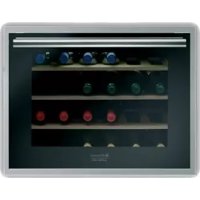



| Product Type | Wine Refrigerator (Wine Cellar) |
| Brand | Hotpoint |
| Model | WL 24 AHA |
| Dimensions (W x H x D) | 60 x 44.8 x 55 cm |
| Weight | 30.5 kg (empty) |
| Power Supply | 220-240 V, 50 Hz, 0.3 A, 62 W |
| Energy Consumption | 0.38 kWh/24h |
| Bottle Capacity | Up to 28 bottles (standard configuration 24) |
| Temperature Zone | 1 zone, adjustable temperature |
| Default Temperature | 15 °C (preset at factory) |
| Temperature Range | Not specified in the manual, manual adjustment via UP/DOWN buttons |
| Internal Lighting | 3 W bulb, temporarily turns off if internal temperature > 24 °C |
| Shelves | 6 removable wooden shelves (without bottles) |
| Storage Type | Bottles lying down, adaptable configuration (Champagne, Alsace…) |
| Main Functions | Wine aging, constant temperature regulation, interior lighting |
| Maintenance and Cleaning | Unplug before cleaning, clean with a soft cloth, do not use electrical appliances inside |
| Safety | Do not block ventilation openings, do not damage the refrigeration circuit, do not use an extension cord |
| Spare Parts and Repairability | Contact an authorized service center for any intervention, original parts mandatory |
| General Information | Manual available in several languages, CE compliance, disposal via separate collection |
Frequently Asked Questions - WL 24 AHA HOTPOINT
User questions about WL 24 AHA HOTPOINT
0 question about this device. Answer the ones you know or ask your own.
Ask a new question about this device
Download the instructions for your Refrigerator in PDF format for free! Find your manual WL 24 AHA - HOTPOINT and take your electronic device back in hand. On this page are published all the documents necessary for the use of your device. WL 24 AHA by HOTPOINT.
USER MANUAL WL 24 AHA HOTPOINT
Location and power connection
Technical information
Product Description, 14
Interior Parts
Control Panel
Using the Wine Cellar 15-16
Bottle ageing compartment
Manual temperature control
Taking out the wooden shelves
Table of ideal wine temperatures
Stocking the wine bottles, 17
How to stock the bottles
Maintenance and troubleshooting, 18
Care and Maintenance
Troubleshooting
WL 24 A/HA
Assistance, 19
EN
Notices
! Remember to keep this booklet so you can refer to it at any time. In case of sale, transfer or should you move, remember to keep it together with the device. ! Read the instructions carefully: there is important information about installation, use and safety. ! To prevent danger stemming from instability of the device, you must fasten it in place, following the assembly instructions strictly. ! Whenever moving or transporting the device, keep it in a vertical position. ! The beverage centre must not be used by children or invalids, without supervision by an adult or a tutor, in order to prevent the cellar from being used improperly. ! Children may use the beverage centre only if supervised by an adult, in order to prevent them from playing with the cellar. ! After installing the device, the power cable and socket must be easy to reach. ! Keep the ventilation openings on the casing of the device free. ! Do not use mechanical devices, or any means not suggested by the manufacturer, to speed up defrosting. ! Do not damage the coolant circuit. ! Contact the after sales service to replace the neon. ! The cable must not be bent or crushed.
! The cable must be checked on a routine basis and replaced only by authorised technicians. ! The power supply cable is of a Y type. Contact the after sales service to replace it. ! Do not use electrical equipment inside the food compartments, unless they are of a kind suggested by the manufacturer. ! The Manufacturer shall not be liable if any of the above rules are not complied with.
| DATA SHEET | |
| Model | WL 24 A/HA |
| Temperatures | 1 Zone |
| Dimensions | width cm 60 length cm 44,8 depth cm 55 |
| Weight** | 30,5 Kg |
| Weight | 35,5 Kg |
| Power | 62 W |
| Current | 0,3 A |
| Lamp | 3 W |
| Consumption | 0,38 kWh / 24h |
| Voltage* | 220 - 240 V |
| Frequency Hz* | 50 |
| * These values may change in different countries. In order to find the specific features of your device, check the product features plate. ** When the device is empty. | |
This appliance is intended to be used exclusively for the storage of wine.
Positioning and connection
Unpacking
1 Unpack the device immediately and make sure it has not been damaged during transport. Should it be damaged, do not connect, and get in touch with the Dealer. 2 Carefully remove the protections and the adhesives, open the door and make sure all the components are present. 3 Take out the power supply cable.
Positioning
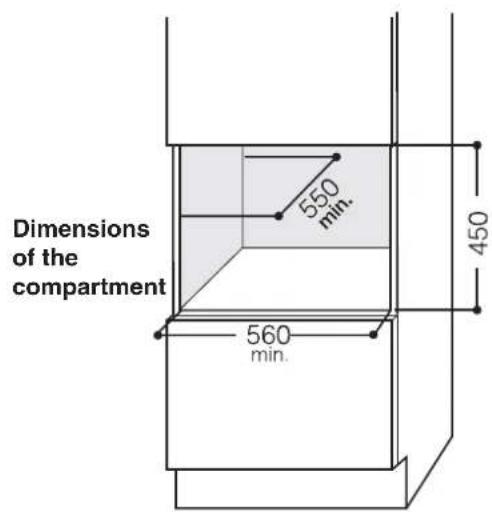
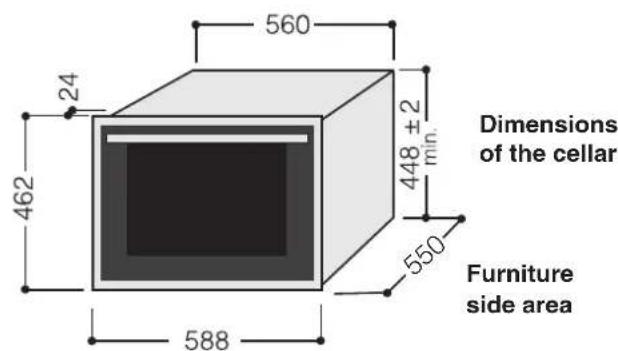
1 Position the device in a well ventilated area, not damp and free (avoid cabinets with closed walls). 2 Keep the device away from heat sources. 3 Make sure the minimum distances between the device and the walls of the room where it is placed are kept, in order to ensure perfect ventilation of the device.
See figure.

Wiring connection
After transport, stand the device vertically, and wait for at least 3 hours before connecting it to the wiring system. Before putting the plug into the power socket, make sure that:
The socket must be earthed and comply with legal regulations; the socket must be able to handle the maximum power load of the machine, as indicated on the Data Sheet table or on the feature plate at the bottom right (see Description of the device); the power supply voltage must fall within the range indicated on the Data Sheet table or on the feature plate at the bottom right (see Description of the device); the power socket must be compatible with the plug of the device. Otherwise, replace the socket or the plug; do not use extensions or multiple sockets.
Product Description

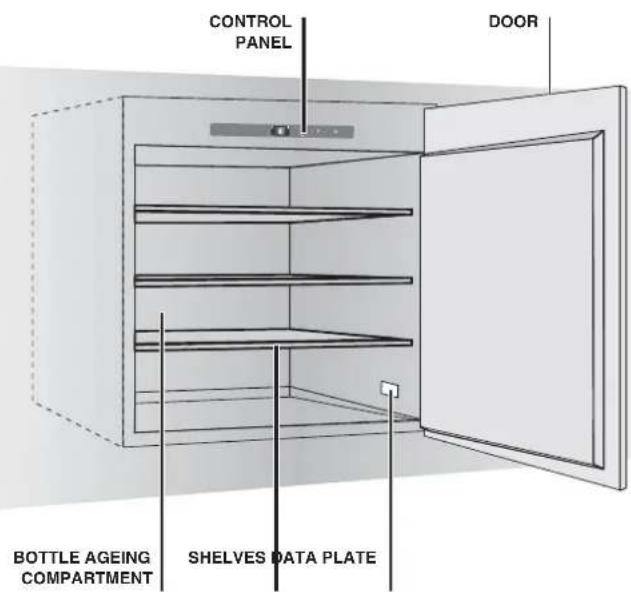
Interior Parts
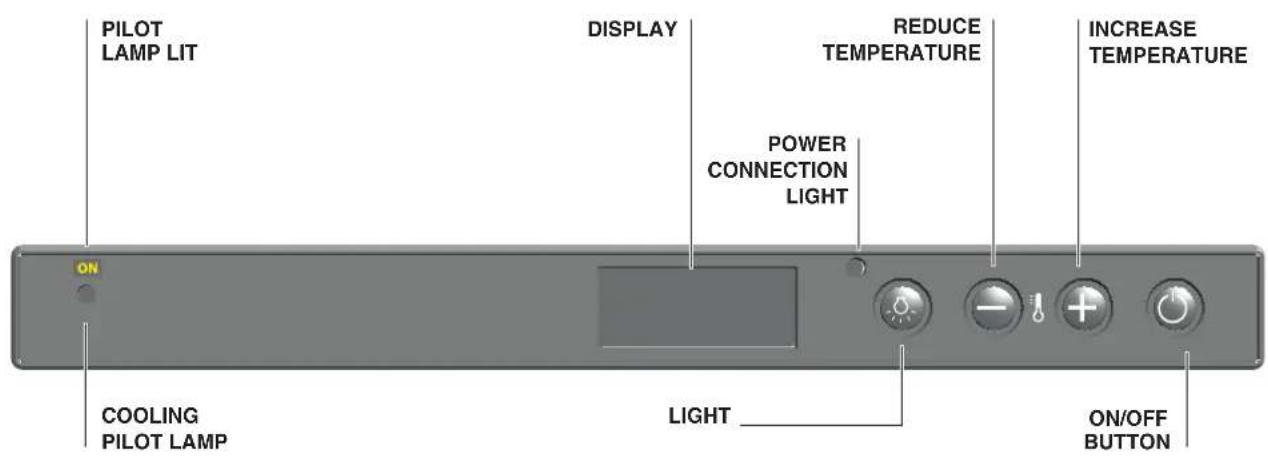
Control Panel
Bottle Ageing Compartment
The ageing compartment's main function is to guarantee that your wines are preserved in optimal conditions.
The temperature has been set at the factory to a temperature considered excellent in most cases, and is 15°C in the upper compartment.
Wine has a complex nature and derives from a long and slow process. To best express its attributes, very specific conditions are necessary. All wines are preserved at the same temperature, but, depending on their different characteristics, wines are served and tasted at very different temperatures (see the Table of Ideal Wine Temperatures).
Therefore, just as for manufacturers' wine cellars, for your new appliance, the absolute temperature value is not important for preserving your wine. Rather, the constant temperature over time is important. Wine preservation is ideal at any temperature, as long as that temperature does not vary.
Manual Temperature Control
When you plug in your wine cellar, the display shows the temperature inside the cellar: it has been set to reach 15°C and become steady on it. Should you need to adjust it, follow the instructions below:
- When you plug in your wine cellar, the display shows the temperature that has been set.
- Press the button for one second (see the Control Panel). The temperature will begin to blink.
- Press the + or - buttons until you reach the desired temperature.
- Wait 5 seconds for the temperature to stop blinking.
- Wait until the wine cellar reaches its temperature before you place the wine bottles inside.
The inside light does not go on (or it goes off temporarily) when the inside temperature goes over 24°C. This allows you to reach the pre-set temperature more quickly.
Taking out the wooden shelves
WARNING:
The wooden shelves are not sliding. Do not take them out when loaded with bottles, to prevent the risk of the bottles breaking.
You can take the shelves out for cleaning only when they are not loaded with any bottles.

Table of ideal wine temperatures
This table indicates the approximate temperatures at which wine should be served. Should one of your wines need to be served at a temperature that is greater than the temperature inside your wine cellar, we suggest that you leave it out for the time that is necessary before you serve it.
| Amarone | 17°C |
| Barbaresco | 17°C |
| Barolo | 17°C |
| Beaujolais | 13°C |
| White liquered Bordeaux | 6°C |
| Dry White Bordeaux | 8°C |
| Red Bordeaux | 17°C |
| White Bourgogne | 11°C |
| Red Bourgogne | 18°C |
| Brunello | 17°C |
| Champagne | 6°C |
| Chianti Classico | 16°C |
| Languedoc-Roussillon | 13°C |
| Passito di Pantelleria | 6°C |
| Rosé Provence | 12°C |
| Dry and Sweet Sparkling Wines | |
| Verdicchio di Matelica e dei Castelli di Jesi | 8°C |
| White wines from Trentino Alto Adige | 11°C |
| Franciacorta White Wines | 11°C |
| Dry aromatic white wines | 10°C |
| Dry, young, and fruity white wines | 8°C |
| White wines from Friuli Venezia Giulia | 11°C |
| Rodano wines | 15°C |
| Dry white wines from the Loire | 10°C |
| Liquered wines from the Loire | 7°C |
| Red wines from the Loire | 14°C |
| Liquered Passito wines | 8-18°C |
| Rosè Wines, New Wines | 12°C |
| Light red wines with mild tannic | 14°C |
| Red, rather tannic wines with medium structure | 16°C |
Stocking the wine bottles
Standard 24-bottle stock
The 24-bottle stock (for standard, mixed, and renana bottles) is recommended for wines that need to be visible and easily removed.
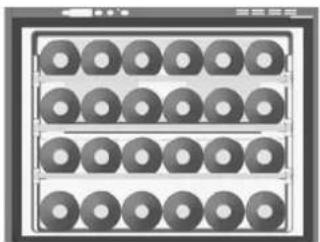
STANDARD
24 Bottles (100% lying down)
3 shelves
Position each bottle into the slots on the 3 wooden shelves. 6 bottles can be placed on the bottom of the wine cellar.
We suggest you place the Renana bottles onto the lower shelf and the bottom of the wine cellar because they have been specially designed to hold larger bottles.
The wooden shelf can safely hold up to 22 bottles.
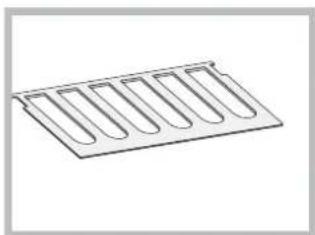
Champagne bottle stock
Champagne bottles are larger than standard bottles. They must be placed onto the base of the wine cellar, which can hold up to 5.
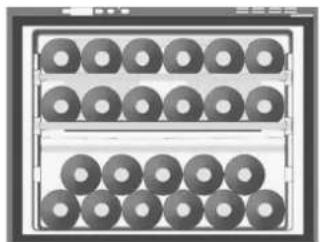
If you want to stock more than 5 Champagne bottles in your wine cellar, remove the 3rd shelf and stock the bottles in two rows (placing the bottles in the second row between those on the bottom row). This will hold up to 9 bottles.
Some stocking configurations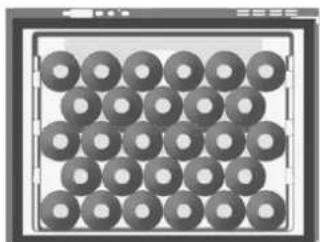
PRESERVATION
28 Bottles (100% lying down)
Maintenance and troubleshooting

Care and maintenance
Disconnecting the wine cellar
During cleaning and maintenance, it is imperative that you unplug the wine cellar
Troubleshooting
If you notice that your wine cellar is not working properly, check the following list before you call your Service Centre.
Problem
The compressor does not work
Possible causes/solutions
The plug is not plugged into the wall-outlet or not enough to make contact. Or, there could be a power failure in your home. The wall-outlet is not in working order. Plug the wine cellar into another wall-outlet to check.
The compressor never stops
- Contact the Service Centre
! Any work that is done to the wine cellar should be performed by your authorized local Service Centre.
! Short term faults, such as power failure, will not compromise the wines. It is only when working faults are left unsettled for a long time that the wine may suffer.
The appliance was designed and manufactured in compliance with international safety standards. The following warnings are provided for safety reasons and must be read carefully.
This appliance complies with the following Community Directives:

- 73/23/EEC of 19/02/73 (Low Voltage) and subsequent amendments;
- 89/336/EEC of 03.05.89 (Electromagnetic Compatibility) and subsequent amendments;
- 2002/96/CE.
Disposal

- Observe local environmental standards when disposing packaging material for recycling purposes.
- The European Directive 2002/96/EC on Waste Electrical and Electronic Equipment (WEEE), requires that old household electrical appliances must not be disposed of in the normal unsorted municipal waste stream. Old appliances must be collected separately in order to optimise the recovery and recycling of the materials they contain and reduce the impact on human health and the environment. The crossed out "wheeled bin" symbol on the product reminds you of your obligation, that when you dispose of the appliance it must be separately collected.
Consumers should contact their local authority or retailer for information concerning the correct disposal of their old appliance.
Before calling for Assistance:
- Check if the malfunction can be solved on your own (see Troubleshooting).
- If after all the checks, the appliance still does not operate or the problem persists, call the nearest Service Centre
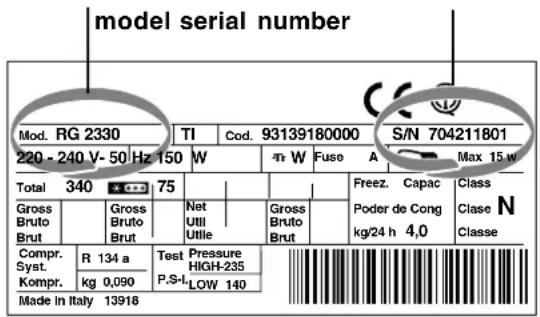
Communicating:
- type of malfunction
- appliance model (Mod.)
- serial number (S/N)
This information can be found on the data plate located on the bottom left side of the refrigerator compartment.
Never call on unauthorized technicians and always refuse spare parts which are not originals.


Russian, 51

Kazakh, 63
Table of contents
FR
Aging compartment
Compartment for aging wine bottles
Temperature control group
Removal of wooden shelves
Temperature table, daily for wine
Placement of wine bottles, 57-58
How to place bottles
Maintenance and troubleshooting, 59-60
Maintenance and troubleshooting
Technical maintenance, 61
WL 24 A/HA
AIO 77
! Keep this manual as a source of reference information about the equipment. It must accompany the refrigerator in case of its sale / transfer or relocation. ! Read this manual carefully: it contains important information on installation, safe operation and maintenance of the equipment. ! To prevent instability of the equipment, secure it in place, strictly following the installation instructions. ! When moving or transporting the equipment, keep it vertical. ! To exclude unreliable use, persons with limited physical capabilities should not use the equipment without supervision of adults or instructors. ! Do not allow children to play with the equipment. ! After installation of the equipment, free access to the power cable and socket must be ensured. ! Do not block the ventilation openings on the equipment body. ! Do not use starters, brakes, mechanical devices or any other devices not recommended by the manufacturer. ! Do not damage the cooling circuit.
! If a malfunction occurs, contact an authorized service center. ! The cable must not be kinked or pinched. ! The cable should be checked regularly; its replacement must be carried out only by authorized personnel. ! The power cable has a plug. For its replacement, contact an authorized service center. ! The manufacturer is not responsible in case of non-compliance with the specified safety measures.
Compressor does not work
Compressor works continuously
Possible causes / Solution
- The equipment is not connected to the electrical network or the plug is poorly inserted into the socket, not ensuring contact, or a power failure in the house. - The socket is faulty; to check, connect the equipment to another socket.
- Contact an authorized service center. When calling, provide:
- Date of purchase; warranty document number (service book, service certificate, etc.); type of malfunction; model (Mod.) and serial number (S/N) of the equipment, indicated in the technical data table of the equipment (see Description), or in the warranty document.
! Any repair and technical maintenance of the equipment must be performed only by specialists of an authorized service center. ! Short-term power supply failures do not affect the safety of the equipment. The warranty may be void only if problems in the operation of the equipment remain unresolved for a long time.
Service life 10 years


The manufacturer reserves the right
to make changes to the design and configuration without prior notice,
that do not impair the efficiency of the equipment.
Some parameters given in this instruction
The manufacturer is not responsible for
unintentional deviations from the specified values.
Manufacturer.
Indesit Company S.p.A.
Legal address:
Viale A. Merloni, 47
Technical assistance
Ophaty, 83
Contact center
Technical assistance, 84
Spare parts
Our products
Technical assistance, 85
Warranty and service information
Manual regulating at temperatures
Manual regulating at temperatures
The displayed temperature is the temperature in the storage compartment.
- EN
- NOTICES
- POSITIONING AND CONNECTION
- UNPACKING
- POSITIONING
- WIRING CONNECTION
- PRODUCT DESCRIPTION
- INTERIOR PARTS
- CONTROL PANEL
- BOTTLE AGEING COMPARTMENT
- MANUAL TEMPERATURE CONTROL
- TAKING OUT THE WOODEN SHELVES
- WARNING
- TABLE OF IDEAL WINE TEMPERATURES
- STOCKING THE WINE BOTTLES
- STANDARD 24-BOTTLE STOCK
- CHAMPAGNE BOTTLE STOCK
- MAINTENANCE AND TROUBLESHOOTING
- CARE AND MAINTENANCE
- DISCONNECTING THE WINE CELLAR
- TROUBLESHOOTING
- PROBLEM
- THE COMPRESSOR DOES NOT WORK
- POSSIBLE CAUSES/SOLUTIONS
- THE COMPRESSOR NEVER STOPS
- DISPOSAL
- BEFORE CALLING FOR ASSISTANCE
- COMMUNICATING
- TABLE OF CONTENTS
- AGING COMPARTMENT
- COMPRESSOR WORKS CONTINUOUSLY
- POSSIBLE CAUSES / SOLUTION
- OPHATY
- TECHNICAL ASSISTANCE
- MANUAL REGULATING AT TEMPERATURES
Brand : HOTPOINT
Model : WL 24 AHA
Category : Refrigerator