17229 - Air bed Wehncke - Free user manual and instructions
Find the device manual for free 17229 Wehncke in PDF.


| Brand | Wehncke |
| Model | 17229 |
| Product type | Inflatable air bed |
| Power supply | 230 V ~ 50 Hz |
| Built-in pump | Yes, electric |
| Inflation time | Approximately 3 minutes 30 seconds |
| Deflation function | Automatic |
| Non-return valve | Yes, for manual inflation |
| Capacity | 1 person |
| Material | PVC with flocked surface |
| Use | Indoor use only |
| Storage temperature | Frost-free storage |
| Cleaning | Damp cloth, mild detergent, air drying |
| Repair | PVC repair kit (not included) |
| Environmental protection | Recyclable, do not dispose of with household waste |
| Safety instructions | Do not use in water, avoid sharp objects, do not leave unattended |
| Pump usage limit | 5 minutes max continuous, then 30 minutes off |
| Included accessories | Storage bag |
| Valve type | Integrated non-return valve |
| Number of chambers | Single |
Frequently Asked Questions - 17229 Wehncke
User questions about 17229 Wehncke
0 question about this device. Answer the ones you know or ask your own.
Ask a new question about this device
Download the instructions for your Air bed in PDF format for free! Find your manual 17229 - Wehncke and take your electronic device back in hand. On this page are published all the documents necessary for the use of your device. 17229 by Wehncke.
USER MANUAL 17229 Wehncke
natural_image
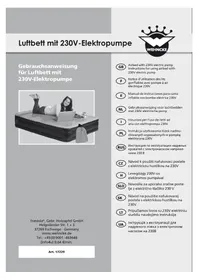
Black-and-white photo of a woman lying on a large bed with a laptop, no visible text or symbolsGB Airbed with 230V electric pump Instructions for using airbed with 230V electric pump
GB: Part identification:
Operating element (A)
Switch (B)
Cable compartment (C)
Power cable (D)
Non-return valve (E)
Clapet anti-retour (E)
The airbed is designed purely for domestic use.
The airbed must not be used as a trampoline – risk of damage and injury.
Take care with sharp objects and uneven surfaces – risk of damage. Always place a tarpaulin between floor and airbed for ideal protection. Check for seal tightness before use. Do not use airbed in water, protect pump against humidity!
Keep the airbed away from open flames and heat sources.
This inflatable product must never be used in water or outdoors; it must not be used as a buoyancy aid for children or non-swimmers!
General information:
Every airbed may lose some of its air over time. The amount of air loss depends on the material, environmental factors and intensity of use. This not a flaw in the material but a normal process with this type of material. Please replenish air as required.
Operating instructions
Inflating and deflating:
Spread the airbed out on the floor with the flocked side up.
Open the cable compartment (C) and plug the connector (D) into a 230V alternating current socket. Make sure that the transparent non-return valve is closed.
To inflate the airbed, turn the switch (B) to the "Inflate /Aufblasen" position. Inflating begins when the switch engages.
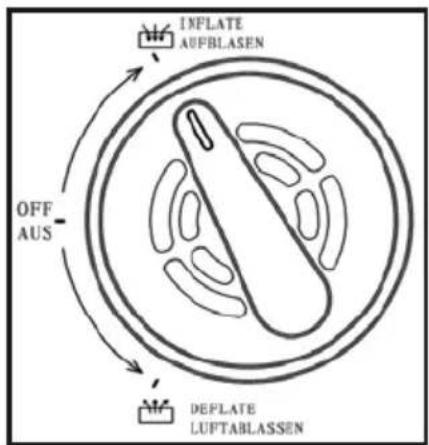
flowchart
graph TD
    A["INFLATE AUFBLASEN"] --> B["OFF AUS"]
    B --> C["DEFLATE LUFTABLASSEN"]
    C --> A
Inflating
After around 3 ½ minutes the airbed is inflated and ready for use. Continue inflating for more hardness.
Warning: Do not overinflate the airbed! Folds should still be visible on the edge!
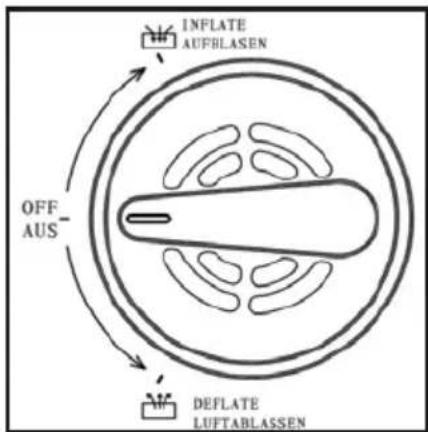
flowchart
graph TD
    A["INFLATE AUFLBLASSEN"] --> B["OFF-AUS"]
    B --> C["DEFLATE LUFTABLASSEN"]
    C --> D["Outward flow arrow"]
    D --> A
Power off
When the airbed has reached the desired degree of firmness, turn the rotary switch to "Off / Aus" to stop inflating.
If the pressure is too high and the bed area too hard, turn the switch to "Deflate / Luft-ablassen" until the switch engages and air is pumped out of the airbed. When the airbed has reached the desired degree of firmness, turn the switch to "Off / Aus".
The power cable (D) can be put back into cable compartment.
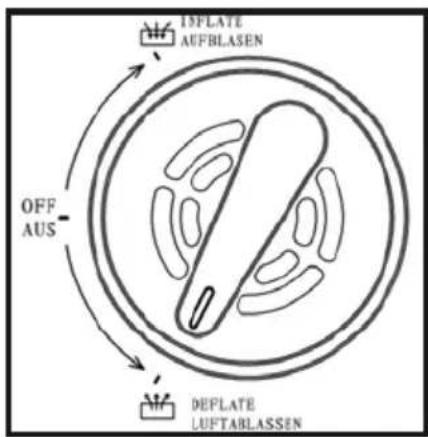
flowchart
graph TD
    A["ISPLATE AUFBLASEN"] --> B["OFF AUS"]
    B --> C["DEPLATE LUFTABLASSEN"]
    C --> A
Deflating
To deflate the airbed, plug the connector back into the 230V socket and turn the switch to "Deflate / Luftablassen". Once the airbed is completely deflated, turn the switch to "Off / On" to stop the deflation process. Put the cable back into the cable compartment on the pump.
Now fold the airbed up for storage. Any residual air can be removed by pressing down on the surface and pushing towards the pump. When doing so, disconnect the power plug and turn the pump switch to "Deflate / Luftablassen".
Important instructions and warnings for using the 230V electric pump:
- The pump is an electrical appliance and not a toy! To avoid dangers such as fire and electric shock, keep the electric pump out of reach of children!
- The electric pump is not designed for continuous operation. Do not run the pump continuously for more than 5 minutes. Then switch off the pump for 30 minutes before using it again, otherwise the pump may overheat and cut out automatically.
- Disconnect the power plug from the mains socket when the electric pump is not in operation.
- Do not overinflate the airbed. Bursting objects can cause severe injuries.
- Never leave the pump unattended while it is in operation.
- Avoid any contact with moisture! If the air pump has come into contact with moisture or water, it must not be put into operation. This could cause severe injury or death from electric shock. Contact customer service before using the device again.
- WARNING: To avoid electric shock, never expose the device to rain. Store indoors and protect against humidity.
- Only store indoors.
• Make sure that no sand, small stones etc. enter the pump inlet/outlet while it is running.
- Never put your hand or fingers into the air inlet/outlet.
• The air inlet/outlet must not be covered. Risk of overheating!
• Always ask a qualified technician to replace a damaged cable to avoid the risk of accidents and injuries.
- Only connect the air pump to a properly installed earthing contact socket to ensure long-term protection against electric shock.
GB
- The air pump must never be operated outdoors.
- For repairs or servicing, only use spare parts ordered through the customer service department.
- This appliance is not intended for use by persons (including children) with reduced physical, sensory or mental capabilities, or lack of experience and knowledge, unless they have been given supervision for instruction concerning use of the appliance by a person responsible for their safety. Children must be supervised to ensure that they do not play with the appliance.
Inflating via the non-return valve:
In the event that the electric pump cannot be operated, the airbed can also be inflated via the transparent non-return valve (E). For this purpose use a pump from the Wehncke range, such as the Wehncke Double-Stroke Pump.
To inflate, first fully extract the valve from the valve insert and then pull the stopper out of the valve neck. Then use a suitable pump to inflate the chamber until it is firm but folds are still visible on the outer seam. Never use a compressor or compressed air. After inflating, seal immediately with the stopper. To deflate the air chamber, remove the valve from the valve seat and the stopper from the valve neck; now, using two fingers, press the non-return valve at the lower end of valve neck together so that the air is released. While doing so, press down on the air chamber as well to allow all the air to escape.
Instructions for use:
Please transport the airbed with care. Avoid abrasive contact with walls and floors (risk of damage). Improper use (breaking or tearing the material) will result in loss of warranty. Direct sunlight will increase the air pressure. In this event, release air via the stopper valve until the outer seams show folds again.
Repairing:
For repairing small punctures or tears in the material you can use the special commercially available repair sets for PVC air beds.
These repair sets contain film patches in different colours and special glue.
Please follow the instructions on the repair set carefully when using the glue and patches.
Cleaning and storage:
After use, the airbed must be cleaned of dirt using a (damp) cloth. Use a mild detergent for cleaning if necessary. Do not scrub. Then leave to air-dry before deflating completely. Now fold up the airbed and pack it into the pack sack provided, then store it in a dry, frost-free location. When folding up make sure there are no severe kinks in the material.
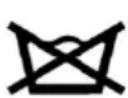
a)
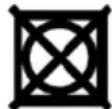
b)
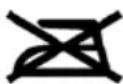
c)
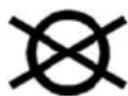
d)
WARNING: Protect the pump against damp when cleaning!
a) do not wash
b) do not tumble dry
c) do not iron
d) do not dry clean
Notes on environmental protection
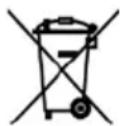

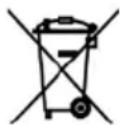
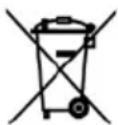
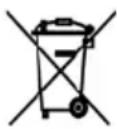
At the end of its service life this product must not be disposed of with domestic waste. Instead it must be disposed of at collection point for recycling electrical and electronic appliances. This is indicated by the symbol on the product, instructions or packaging. The materials and packaging can be recycled in accordance with the respective label. Reuse, material utilisation or other other means of recycling old appliances enables you to make a valuable contribution to the protection of our environment. Please ask your municipal authority about the appropriate disposal point.
flowchart
graph TD
    A["INFLATE AUFBLASEN"] --> B["DEFLATE LUFTABLASSEN"]
    B --> C["OFF-AUS"]
    C --> D["Deflating a UFBLASEN"]
    D --> A
Desinflar
The Ground Truth image displays a single, solid horizontal line. According to Rule 2 (UNDERSCORE & LINE RULES), this is a stylistic or background line, not a placeholder underscore. Therefore, the OCR result must ignore it and output nothing or only meaningful text. The provided OCR content is "____", which consists of four underscores. This is an incorrect interpretation of the line as a placeholder, violating the rule that stylistic lines must be ignored. The OCR has hallucinated underscores where none should exist based on the GT's visual context. Hence, the OCR result is inconsistent with the Ground Truth.
flowchart
graph TD
    A["INFLATE AUFLBLASSEN"] --> B["OFF-AUS"]
    B --> C["DEFLATE LUFTABLASSSEN"]
    C --> A
Uitschakelen
The Ground Truth image displays a single, solid horizontal line. According to Rule 2 (UNDERSCORE & LINE RULES), if the GT contains lines used for stylistic emphasis or as background (like ruled paper), the OCR result must ignore them. The OCR content provided is "____", which consists of four underscores. This is incorrect because underscores are not equivalent to a solid line and are not permitted under the “Stylistic/Background Lines (Ignore)” rule. Outputting underscores for a stylistic line violates the rule and constitutes an error. Therefore, the OCR result is inconsistent with the Ground Truth.
The Ground Truth image displays a single, solid horizontal line. According to Rule 2 (UNDERSCORE & LINE RULES), this is a stylistic or background line, not a placeholder underscore. Therefore, the OCR result must ignore it and output nothing or only meaningful text. The provided OCR content is "____", which consists of four underscores. This is an incorrect interpretation of the line as a placeholder, violating the rule that stylistic lines must be ignored. The OCR has hallucinated underscores where none should exist based on the GT's visual context. Hence, the OCR result is inconsistent with the Ground Truth.
flowchart
graph TD
    A["INFLATE AUFBLASEN"] --> B["DEFLATE LUFTABLASSEN"]
    B --> C["OFF-AUS"]
    C --> A
Nafukování
flowchart
graph TD
    A["INFLATE AUFBLASEN"] --> B["OFF-AUS"]
    B --> C["DEFLATE LUFTABLASSEN"]
    C --> A
Накачування