USER MANUAL Digitradio 360 CD IR TECHNISAT
Stereo Internet, DAB+/FM radio with MP3/CD player
CONTENTS
ENGLISH 3-74
FRANCAIS .75-146
ITALIANO 147-218
NEDERLANDS 219-290
NORSK 291-362
DANSK 363-434
POLsKE. 435-506
CESTINA 507-578
SLOVENSKÉ 579-650
Instruction Manual
DIGITRADIO 360 CD IR
DIGITRADIO 361 CD IR
Stereo Internet, DAB+/FM radio with MP3/CD player
TechniSat
1 Illustrations
Front operation:
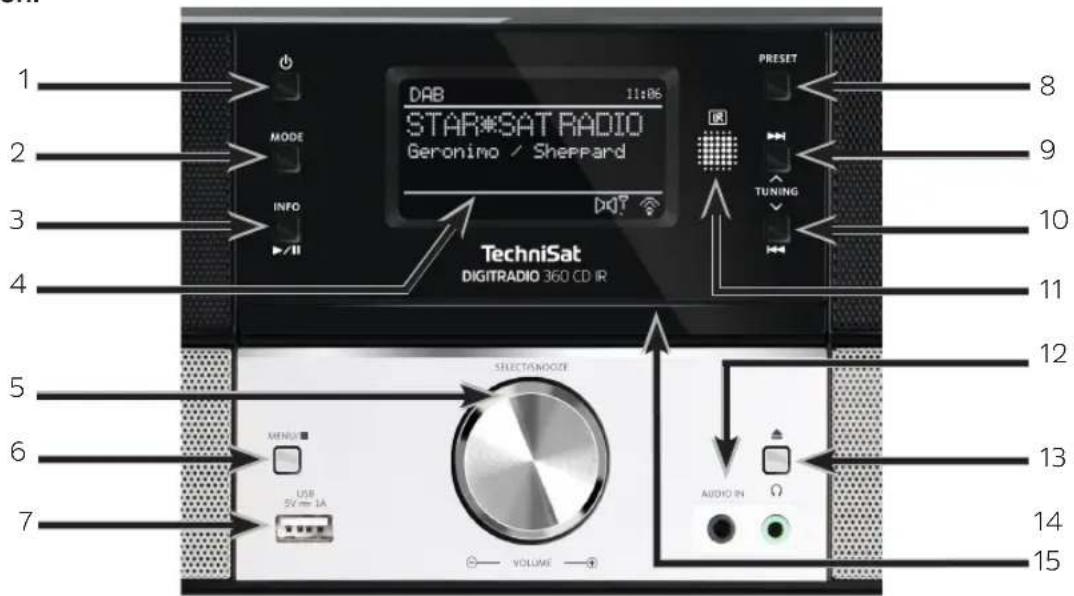
1 ON/STANDBY
2 MODE
3 PLAY/PAUSE /INFO
4 DISPLAY
5 SELECT / SNOOZE / VOLUME
6 MENU / STOP
7 USB CONNECTION
8 PRESET
9 FORWARD/TUNING △/
10 BACK/TUNINGV/
11 IR RECEIVER
12 AUDIO INPUT
13 EJECT/ open/close CD compartment
14 HEADPHONE CONNECTION
15 CD compartment
Rear:
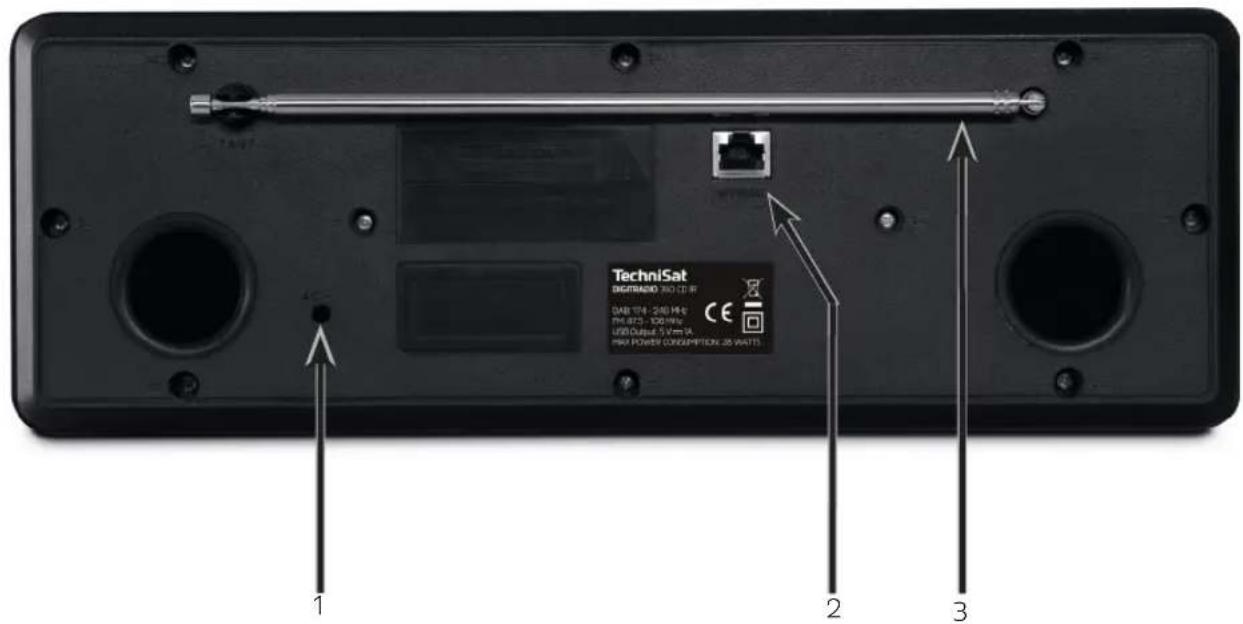
1 MAINS CABLE
2 LAN CONNECTION
3 TELESCOPIC ANTENNA
Remote control*:
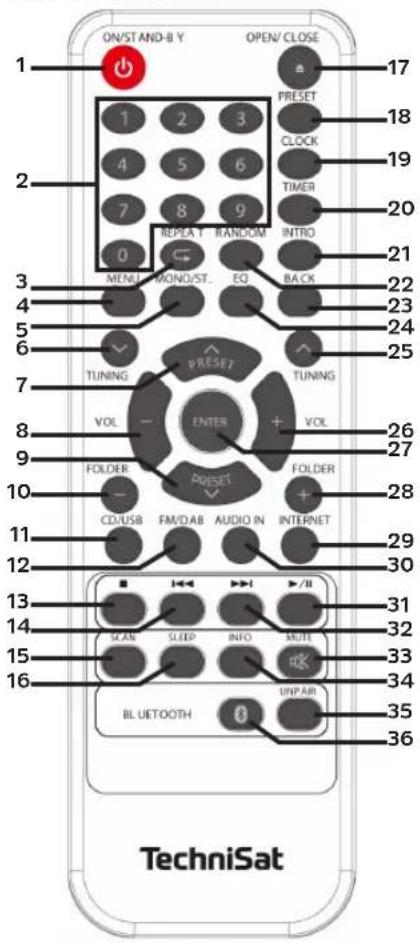
1 ON/STANDBY Device on/off (Standby), Alarm off
2 0-9 Number buttons: track choice - CD, USB, retrieve saved stations PRESETs, press number button, hold down and save station
3 REPEAT Repeat function for CD, USB
4 MENU Open, close menu
5 MONO/ST. Mono, stereo changeover
6 TUNING FM: Set frequency/down
7 PRESET Select DAB, FM TUNER: PRESET
8 VOL - Decrease volume
9 PRESET Select DAB, FM TUNER: PRESET
10 FOLDER - MP3/USB: Album /folder selection
11 CD/USB CD/USB mode selection
12 FM/DAB FM/DAB mode selection
13 Stop CD/USB playback
14 CD, USB: Track selection, scan FM: Set frequency / back
15 SCAN automatic FM/DAB scan
16 SLEEP Switch on and select snooze
17 OPEN/CLOSE Open/close CD compartment
18 PRESET Programming function
19 CLOCK Set time Display (station, track, artist etc.)
*Figure shows the remote control for the DIGITRADIO 361 CD IR.
20 TIMER Setting the alarm time
21 INTRO CD, USB: Preview function, 10 s per track
22 RANDOM CD, USB: Random function
23 BACK Reset menu / step
24 EQ Equaliser sound setting
25 TUNING FM: Set frequency/upwards
26 VOL + Increase volume
27 ENTER Select menu, confirm entry
28 FOLDER + CD/USB: Album/folder selection
29 INTERNET INTERNET mode selection
30 AUDIO IN AUDIO IN mode selection
31 CD, USB: Start playback, pause
32 CD, USB: Track selection, scan FM: Set frequency / forward
33 MUTE Mute function
34 INFO Display FM mode info
(Name, PTY, RT, frequency) Display DAB mode info
(Station, track, artist etc.) Display CD/USB mode info (Track, artist etc.)
35 UNPAIR Disconnect Bluetooth connection (DIGITRADIO
361 CD IR only)
SPOTIFY SPOTIFY CONNECT selection (DIGITRADIO 360 CD IR only)
36 Bluetooth Activate Bluetooth connection (DIGITRADIO 361 CD IR only)
Contents
1 Illustrations 4
2 Foreword 11
2.1 Target group for this instruction manual 11
2.2 Important information 11
3 Setting up the device 20
3.1 Remote control 22
4 Description of the DIGITRADIO 360/361 CD IR 22
4.1 Scope of delivery 22
4.2 The special features of the DIGITRADIO 360/361 CD IR. 22
4.3 Preparing the DIGITRADIO 360/361 CD IR for operation 24
4.4 General device functions 26
4.5 Visual display 30
4.6 Switching off the device 30
5 Menu operation 30
5.1 Main menu 31
5.2 Source selection 31
6 Internet radio 32
6.1 Last listened to 32
6.2 Station list 32
6.3 Saving stations to a memory slot 33
6.4 Retrieving a station from a memory slot 33
7 Playing music (UPnP & USB media) 34
7.1 Playing audio files 34
7.2 Providing music via the Windows media player 36
8 Spotify Connect (DIGITRADIO 360 CD IR only) 36
9 Bluetooth-Playback (DIGITRADIO 361 CD IR only) 37
9.1 Activating the Bluetooth mode 37
9.2 Pairing 38
9.3 Playing music 38
10 DAB radio. 39
10.1 Performing the station scan 39
10.2 Saving DAB stations to a memory slot 40
10.3 Retrieving DAB stations from a memory slot 40
10.4 Signal intensity 41
10.5 删除 inactive stations 41
10.6 Setting the volume adjustment (DRC) 41
10.7 Sorting the stations 42
10.8 Manual setting 42
11 FM mode 42
11.1 Manual station scan 43
11.2 Automatic station scan 43
11.3 Saving FM stations to a memory slot 43
11.4 Retrieving FM stations from a memory slot 44
11.5 Audio setting (Mono/Stereo) 44
12 Audio input 44
13 CD/MP3 player 45
13.1 General information on CDs/MP3 CDs 45
13.2 Discs you can use 46
13.3 Playing CDs 46
13.4 Setting the track 48
13.5 Quick search 48
13.6 Repeat function 48
13.7 Random playback 49
13.8 Track sampling 49
13.9 Programming function 49
13.10 CD advice 50
14 Other functions 52
14.1 Sleep function 52
14.2 Alarm 52
15 System settings. 54
15.1 Equaliser 54
15.2 Internet settings 55
15.3 Time settings 59
15.4 Language 60
15.5 Factory setting 60
15.6 Software update 60
15.7 Set-up wizard 61
15.8 Display backlight 63
15.9 Multiroom (DIGITRADIO 360 CD IR only) 63
16 App operation 64
17 Using headphones 66
18 Cleaning 67
19 Troubleshooting 68
20 Technical data. 73
2 Foreword
This instruction manual helps you to use your radio system properly and safely, hereinafter referred to as DIGITRADIO or device.
2.1 Target group for this instruction manual
The instruction manual is intended for anyone who is installing, operating, cleaning or disposing of the device.
2.1.1 Intended use
The device has been developed for the reception of DAB+/FM radio programmes. The device has been designed for private use and is not suitable for commercial purposes.
Please observe the following instructions to avoid any safety hazards, prevent damage to the TV, and help protect the environment.
Please read all the safety information carefully and keep it for future reference. Always follow all the warnings and instructions in this instruction manual and on the rear of the device.
Caution - This identifies important information that must be observed to prevent device defects, data loss/misuse or undesired operation.
Tip - This identifies information relating to the described function, as well as to another related function that may have to be taken into account, with reference to the corresponding section in the manual.
2.2.1 Safety
For your own protection you should read the safety precautions carefully before using your new device. The manufacturer accepts no liability for damage caused by inappropriate handling, or by non-compliance with the safety precautions.
Never open the device!
Touching live parts poses a danger to life!
Any necessary repairs to the receiver should only be carried out by qualified personnel.
The device must only be operated in an appropriate climate.
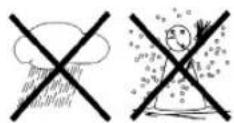
In the event of extended transport in the cold and a subsequent change to warm rooms, do not switch on immediately; wait for the temperature to equalise.
Do not expose the device to dripping or splashing water. If water has penetrated the device, switch it off and inform the Service department.
Do not expose the device to heat sources that will heat it up more than normal use.

In the event of a thunderstorm, disconnect the device from the mains. Overvoltage can damage the device.
In the event of an obvious fault with the device, emanation of odour or smoke, substantial malfunctions, damage to the housing or fluid ingress, immediately switch off the device and contact the Service department.
Only connect the device to a mains voltage of 100V - 240V 50 / 60Hz
Never try to operate the device with another voltage.
Do not connect the mains voltage until the installation has been completed according to regulations.
If the device shows signs of damage, it may not be put into operation.
When removing the mains cable from the power outlet, pull on the plug, not the cable.
Do not put the device into operation in the vicinity of baths, swimming pools or splashing water.
Never try to repair a faulty device yourself. Always contact one of our customer service locations.
Foreign bodies, e.g. nails, coins, etc., must not be allowed to fall inside the device. Do not touch the connection contacts with metal objects or fingers. This could lead to short-circuits.
Do not place any open flames such as burning candles on the device.
Never allow children to use the device unsupervised.
Even when switched off and on standby, the device is still connected to the mains power supply. If you do not intend to use the device for a prolonged period, remove the mains plug from the power outlet. Only pull on the plug, not on the cable.
Do not listen to music or the radio at high volume. Doing so can cause permanent hearing impairment.
This device is not intended to be used by people (including children) with limited physical, sensory or mental capacities or lack of experience and/or knowledge, unless they are supervised by a person responsible for their safety or they are instructed by them as to how to use the device.
Children must be supervised to ensure that they do not play with the device.
It is forbidden to carry out modifications to the device.
Damaged devices or damaged accessories must not continue to be used.
The CD player uses an invisible laser beam. If used incorrectly, this can injure your eyes. Never look directly into the open CD compartment.

This devices has been classified as CLASS 1 LASER. The corresponding sticker (CLASS 1 LASER PRODUCT) is on the rear of the device.
Using the batteries
Ensure that the batteries are kept out of the reach of children. Children could put the batteries into their mouths and swallow them. This could lead to serious injuries. Therefore ensure that the batteries and remote control are out of reach of young children. Seek medical advice immediately if this occurs!
Normal batteries may not be charged, reactivated using other means, disassembled, heated or disposed of in an open fire (explosion hazard!).
Promptly change batteries that are losing power.
Clean the battery contact and device contacts prior to inserting them.
There is an explosion hazard if a battery is inserted incorrectly.
Dispos of used batteries immedately. Only replace batteries with the correct type of batteries and the correct model number.
Caution! Do not expose batteries to extreme conditions.
Do not place them on radiators, or expose them to direct sunlight.
Leaking or damaged batteries can cause burns if they come into contact with the skin. In this case use suitable protective gloves. Clean the battery compartment using a dry cloth.
2.2.2 Disposal
The device packaging is exclusively comprised of recyclable materials. Please sort the components appropriately, and dispose of them in line with your local waste disposal regulations
At the end of its service life, this device must not be disposed of with your regular household waste. It must be taken to a recycling collection point for electrical and electronic equipment.
This is indicated by the symbol on the product, the instruction manual or the packaging.
The materials are recyclable according to their identification.
An important contribution is made to our environment by recycling, the recovery of materials or other kinds of recycling for old devices.

Please ask local authorities for the location of the relevant disposal point. Please ensure that discharged batteries and electronic waste are not disposed of with your regular household waste, but are correctly disposed of (collection points in the retail trade, special waste)
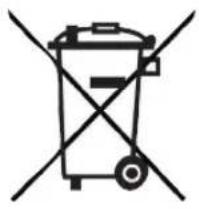
Batteries can contain poisonous substances which harm the environment. Batteries are subject to European Directive 2006/66/EC. They must not be disposed of with normal domestic waste.
2.2.3 Legal notices
i TechniSat herewith declares that the DIGITRADIO 360 CD IR and DIGITRADIO 361 CD IR radio system model complies with Directive 2014/53/EU. The complete text of the EU declaration of conformity is available at the following website:
DIGITRADIO 360 CD IR: http://konf.tsat.de/?ID=11100
DIGITRADIO 361 CD IR: http://konf.tsat.de/?ID=11630
i TechniSat accepts no liability for product damage as a result of external influences, wear or improper handling, unauthorised repairs, modifications or accidents.
Changes and printing errors reserved. Version 03/18.
Copy and reproduction are subject to the publisher's consent.
The respective current version of the instructions can be downloaded in pdf format in the download area of the TechniSat homepage at www.technisat.de.
This device is intended for use in all countries of the European Union and in Switzerland, Norway,
Liechtenstein and Iceland. Operation within the frequency range 5150 MHz - 5350 MHz is only permitted in enclosed spaces.
i DIGITRADIO 360 CD IR, DIGITRADIO 361 CD IR and TechniSat are registered trademarks of:
2.2.4 Service instructions
This product is quality-tested and provided with the legal warranty period of 24 months as from the date of purchase. Please keep your receipt as proof of purchase.
Caution! If you encounter a problem with this equipment, please contact our Technical Hotline initially.
Mon.-Fri.8:00 am-8:00 pm
+49 (0)3925 9220 1800
If the device needs to be sent back, please use the following address only:
39418 Staßfurt, Germany
The names of the companies, institutions or makes referred to are trademarks or registered trademarks of the respective owners.
3 Setting up the device
Place the device on a firm, secure and horizontal base. Make sure the area is well ventilated.
Caution!
Do not place the radio on soft surfaces such as carpets and blankets or near to curtains and wall hangings. These could obstruct the ventilation openings. The necessary flow of air could be interrupted as a result. This could potentially lead to fire in the device.
The ventilation slots at the rear and the sides must always be unobstructed. They must not be obstructed by curtains, blankets or newspapers.
Do not place the device near to sources of heat, such as radiators. Avoid direct sunlight and very dusty environments.
Do not select a location for the device with high air humidity, e.g. a kitchen or sauna, as the precipitation of condensation water could damage the device. The device is intended for use in a dry environment and in a moderate climate and must not be exposed to dripping or splashing water.
Please note that the device footings could leave coloured marks on some types of furniture surfaces in certain situations. Place a protective layer between your furniture and the device.
You may only operate the device in a horizontal position. Do not use outdoors!
Keep the DIGITRADIO away from devices which generate strong magnetic fields.
Do not place any heavy objects on the device.
If you move the device from a cold environment to a hot environment, moisture could accumulate inside the device. In such a case, wait approximately one hour before putting it into operation.
Lay the mains cable in such a way that nobody can trip over it.
Ensure that the mains plug for the device is always easily accessible so that the device can be quickly disconnected from the power supply.
The power outlet should be as close to the device as possible.
Insert the plug fully into the socket to ensure connection to the mains.
Use a suitable, easy-to-access mains connection and avoid using multiple socket strips.
Do not touch the mains plug with wet hands; electric shock hazard.
In the event of a malfunction or the detection of smoke or odour from the housing, remove the plug from the power outlet immediately.
Remove the plug before a storm starts.
Remove the plug if the device is not going to be used for a prolonged period, e.g. before going away on a long trip.
Excessive volume, in particular when using headphones, can damage hearing.
Do not set up the unit in the vicinity of devices which emit intense magnetic fields (e.g. motors, speakers, transformers). Even telephones or mobile phones can lead to malfunctions.
3.1 Remote control
If the device is not to be used for a long time, remove the batteries since they could leak and damage the device.
4 Description of the DIGITRADIO 360/361 CD IR
4.1 Scope of delivery
Please ensure that all the following accessories are in the box:
1×DIGITRADIO 360/361 CD IR
1 x remote control with battery
1 x instruction manual
4.2 The special features of the DIGITRADIO 360/361 CD IR
The DIGITRADIO 360/361 CD IR is comprised of a stereo Internet radio, UPnP media player, CD/MP3 player and DAB+/FM receiver with timer function and AUX input.
The DIGITRADIO 360 CD IR also includes Spotify Connect and multi-room support. This enables you to receive digital radio or to stream media.
- You can store up to 10 DAB+, FM and Internet stations respectively.
- The device has a time and date display.
- The device has 2 alarm functions available as well as a sleep function.
- You can choose whether you wish to be woken by Internet, DAB, FM radio, CD/MP3 player or buzzer.
- You can operate the device easily using the remote control.
In conjunction with the MyDigitRadio Pro app, the device offers multi-room support (DIGITRADIO 360 CD IR only; you can find more information in the MyDigitRadio Pro app and on the website www.technisat.de)
- Spotify Connect support (DIGITRADIO 360 CD IR only).
- Audio playback of CD/MP3, CD-DA, CD-ROM, CD-R, CD-RW and USB media.
- USB devices version 1.1 and 2.0 are supported.
- The device supports USB media up to 32GB. The maximum folder number is limited to 99, the tracks to 999. 128 tracks can be stored per folder.
- The USB connection provides 5 V at 1A. Connected devices are charged when there is an existing mains connection. Read the USB device manufacturer's instructions before using the USB connection.
- Bluetooth music streaming (DIGITRADIO 361 CD IR only)
4.3 Preparing the DIGITRADIO 360/361 CD IR for operation
4.3.1 Connecting the device
Connect the device to the power supply using the mains plug.
Ensure that the operating voltage of the radio coincides with the local mains voltage before you attach it to the wall socket.
i When you connect to the mains for the first time, "TechniSat" appears on the display.
When the device is not being used, remove the plug from the socket.
Remove the plug when there is a storm. Also remove the plug if the device is not to be used for a prolonged period, e.g. before going on a long trip.
The heat generated during operation must be dissipated by sufficient air circulation. Therefore the device must not be covered or installed in a closed cupboard. Ensure there is free space of at least 10 cm around the device.
4.3.2 Improving the antenna reception
The number and quality of the stations to be received depend on the reception conditions at the installation location. Excellent reception can be achieved with the telescopic antenna.
Remove the telescopic antenna on the rear of the device from its holder, align it and extend it.
The exact alignment of the telescopic antenna is often important, in particular on the outskirts of the respective broadcasting area. You can quickly find the location of the nearest transmission mast on the Internet, at www.digitalradio.de.
i Start the first scan at a window in the direction of the transmission mast.
In the event of bad weather it may be that DAB+ reception is only possible to a limited extent.
You can find the optimum antenna alignment using the signal intensity display (section 10.4) and hence find the best installation location for DAB reception.
In the event of poor reception, change the antenna alignment or the radio location. The bar modulation should increase.
4.3.3 Inserting the battery
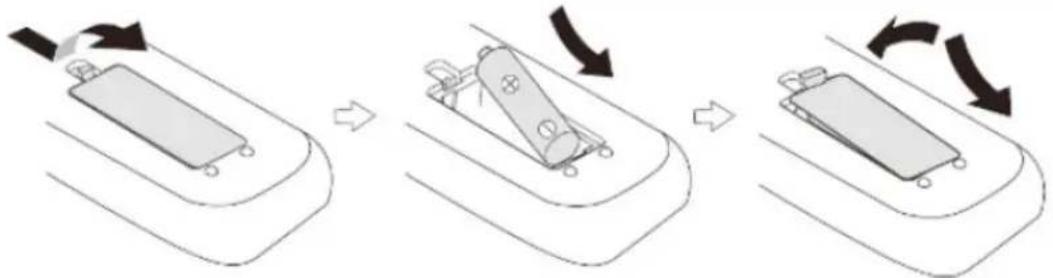
Close the battery compartment lid carefully again to ensure that the lid retaining tabs engage in the housing.
To operate the remote control, an alkaline battery (type mignon, 1.5 V, LR6/AA) is required. Ensure that the polarity is correct when inserting.
Change a battery that is losing power promptly.
Leaking batteries can cause damage to the remote control.
If the device is not to be used over a prolonged period, remove the battery from the remote control.
Important information for disposal: batteries can contain poisonous substances which harm the environment. Therefore, it is imperative to dispose of the batteries according to the legal provisions in force. Never dispose of batteries in normal household waste.
Never leave the remote control on extremely hot or very wet surfaces.
4.4 General device functions
Settings can be carried out both using the buttons on the device and with the remote control. The description of the operation refers to the buttons on the remote control.
4.4.1 Switching on the device
Using the On/Standby button on the device (1) or on the remote control (1) you can switch on the device or switch it back to standby.
i After switching on for the first time, you can launch the set-up wizard (Section 15.7). Here you can set the time format, time zone, summertime adjustment and the date and time updating (via DAB+, FM, Internet or no update) using the / PRESET, VOL+, VOL- and ENTER buttons on the remote control (7, 9, 8, 26, 27) or by rotating and pressing SELECT/VOLUME knob on the device (5).
The device will then attempt to find a connection to a network. To do so, select the corresponding WLAN network or LAN [cable] and enter the WLAN password if required using the / PRESET, VOL+, VOL- and ENTER buttons on the remote control (7, 9, 8, 26, 27) or by rotating and pressing the SELECT/VOLUME knob on the device (5).
4.4.2 Operating the device with the remote control
With the infrared remote control you can operate the most important device functions from the comfort of your armchair. When operating the device with the remote control, please take into account the following points:
Point the remote control towards the front of the device.
There must be a line of sight between the remote control and the radio.
If the range of the remote control reduces, replace the battery with a new one.
The maximum range is approximately 4 metres from the front of the device.
4.4.3 Adjusting the volume
Adjust the volume using the VOLUME -/+ buttons (8, 26) on the remote control or by rotating the SELECT/ VOLUME knob (5) on the device. The set volume is shown on the display (4).
4.4.4 Switching to mute
You can switch off the sound by pressing the MUTE button (33) on the remote control.
This mode is indicated on the status bar by a corresponding symbol.
The sound is switched back on by pressing the MUTE button (33) again on the remote control.
4.4.5 Retrieving displays
By repeatedly pressing the INFO button (34) on the remote control or on the device (3) (in this case the INFO button must not be released for approx. 2 sec.) while a source is being played, you can display and scroll through the following information:
DAB mode: FM mode:
DLS: continuous text with additional information, station RT radio text (if broadcast)
Genre PTY -Programme type
Ensemble/multiplex (group name) frequency, channel Frequency
Signal intensity Date
Signal error rate bit rate in kbps sound format
Date
Track, artist
Track, artist Track
Description
Artist
Genre
Album
Reliability Bit rate, sound format
Bit rate, codec, sampling rate Playback buffer
Playback buffer Duration
Today's date Date
CD/MP3 and USB playback: Spotify Connect*:
Track
Track
Artist
Artist
Album
Album
Folder Bit and sampling rate
PathPlaybackbuffer
Bit and sampling rate Duration
Playback buffer
Date
Duration
ID3 on/off (show text information if available)
4.5 Visual display

4.6 Switching off the device
You can use the On/Standby button (1) on the device or on the remote control (1) to switch the device to standby mode; the time appears. After approx. 10 seconds the display brightness dims.
The menu is divided into the menu corresponding to the currently selected source, the main menu, plus the respective submenus featured therein. Navigation in the different menus can be performed using both the remote control and the device.
By pressing the MENU button on the remote control (4) or by holding it down (approx. 2 seconds) on the device (6), you can retrieve the menu and exit it again.
i After approx. 20 seconds without operation, the menu is exited automatically.
The highlight is moved by turning the SELECT/VOLUME knob (5) on the device or by pressing the / PRESET or VOL-/VOL+ buttons on the remote control (7, 9, 8, 26).
You can confirm the respectively highlighted item by pressing the ENTER button on the remote control (27) or the SELECT/VOLUME knob (5) on the device to open or select it.
By pressing the BACK button (23) on the remote control, you can go one step back or reach the respective superordinate menu.
i A * highlights the current selection/setting.
5.1 Main menu
The main menu takes you to all the functions and settings for the DIGITRADIO 360/361 CD IR.
Open the menu by pressing the MENU button on the remote control(4) or by holding it down (approx. 2 seconds) on the device (6).
If you are currently in a playback source, you can use the MENU button to retrieve the menu for this source.
Highlight the Main menu item and confirm with the ENTER button to switch to the main menu.
5.2 Source selection
Press the MODE button (2) on the device as often as required until the desired source is shown on the display (4) or press the CD/USB (11), FM/DAB (12), AUDIO IN (30) or INTERNET (29) buttons on the remote control to select the sources directly.
Alternatively:
Press the MENU button.
Now switch to the main menu if required by selecting the Main menu item.
Select the desired playback source and confirm the selection by pressing the ENTER button.
6 Internet radio
In order to receive Internet radio streaming, you need Internet access, which can be provided via WLAN or LAN. This can be achieved using a conventional router.
Select the Internet radio source as described in Section 5.2.
If you launch the Internet radio mode and no LAN/WLAN connection has been configured, the search wizard appears. Now select the corresponding WLAN network or LAN [Cable], and enter the WLAN password if required via the remote control (7, 9, 8, 26, 27) or the SELECT/VOLUME knob (5). Alternatively, you can carry out the network settings as described in Section 15.2.
6.1 Last listened to
Open the MENU and select Last listened to, to display the list with the last Internet streams played.
Then select the Internet stream you wish to listen to.
6.2 Station list
Given the range of available Internet radio streams, they are shown divided into different categories/orders (e.g. Stations > Local Germany > Selected Stations > ... or Stations > Countries > Europe > Spain > ...).
Open the MENU, select Station list followed by the next category in each case until you are shown the Internet radio streams.
To add your own stations, register them on the following website: www.wifiradio-frontier.com. To do so, you need to enter an access code, which you can obtain in the DIGITRADIO in MENU > Station list > Help > Access code.
6.3 Saving stations to a memory slot
As described above, select the Internet radio station you wish to store on a memory slot.
During playback, press and hold the PRESET button on the remote control (18) or on the device (8) until the menu Save preset appears.
The list of the 10 available memory slots now appears.
Using the / PRESET buttons, select the desired memory slot and confirm it.
The process is finally confirmed on the display (4).
i Alternatively, you can also hold down one of the number buttons to save a station.
6.4 Retrieving a station from a memory slot
In order to retrieve a station that you have saved to a memory slot, press the PRESET button on the remote control (18) or on the device (8).
The list of the 10 available memory slots now appears.
Using the / PRESET buttons, select the memory slot with the desired Internet radio stream and confirm your selection.
The selected Internet radio stream is now played.
i Alternatively, you can also press one of the number buttons.
It is possible to play audio files stored on a UPnP server or USB data medium via the DIGITRADIO.
For playback from a UPnP server, a network connection is required in the same network where the desired UPnP server is located, or the USB data medium to be used for playback must be connected to the USB connection.
The device does not support the connection of USB media (hubs, etc.) via a USB extension cable.
Not suitable for direct connection to PCs.
i Please observe the instructions in Section 15.2 for setting up a LAN/WLAN connection.
As described in Section 5.2, select the Play music source.
7.1 Playing audio files
Select Shared media for UPnP playback, or USB playback to play from a USB data storage device.
The look of the Categorisation/folder depends on the structure on your media server or USB medium. As such, take note of the information on the display (4).
If required, select the categorisation or folder and the subfolder it contains until you reach the track you want in order to play it.
By pressing the / Play/Pause button on the remote control (31) or on the device (3), you can pause playback, or press it again to continue.
You can use the Forward or Back buttons on the remote control (14, 32) or on the device (9, 10) to skip to the next or previous track respectively.
Keep the Forward or Back buttons pressed to quickly skip forward or back during a track for as long as the button is pressed.
7.1.1 Random playback & repeat
The menu has random playback and repeat playback options available.
In order to use the random playback and/or repeat function, switch these on in MENU > Random playback: or MENU > Repeat: On, or, if you no longer wish to use them, switch them Off again.
Alternatively:
If, during playback, you press the RANDOM button on the remote control (22), the random playback symbol appears on the display (4).
To switch the function off again, press the RANDOM button (22) again.
7.1.2Playback list
You can use the playback list to organise different tracks and folders from different sources and play back using these.
To do so, select any folders or individual tracks from your USB data medium and/or from a UPnP server.
Hold down the ENTER button on the remote control (27) or SELECT/VOLUME on the device (5) to add the track/folder to the playback list.
Select MENU >Playback list and a track from the list to start the playback with this track.
7.1.3 Clearing the playback list
You can use MENU > Clear playback list to remove all the entries in your playback list.
7.1.4 Remove server
Use this menu item to delete the list of UPnP media servers found.
If you then open the Shared media item, a search is performed for the available media servers in the network.
As an alternative to an independent UPnP server, it is possible to provide music via the Windows Media Player as from version 10. To do so, music sharing must be set up in the Windows Media Player.
Ensure that the Windows PC and the DIGITRADIO are in the same network and switched on.
Start the Media Player and enable media streaming sharing.
If required, select the DIGITRADIO from the device overview which appears and select Allow.
Depending on the Windows Media Player version, the process may vary.
8 Spotify Connect (DIGITRADIO 360 CD IR only)
Join us in welcoming Spotify Premium
With Spotify Premium you can listen to millions of songs without adverts. Your favourite and up-and-coming artists along with the latest hits - just for you! Simply press "Play" and you can hear any song you want in top quality sound. Test Premium for 30 days free of charge at spotify.com/freetrial
Your new radio has Spotify Connect
With Spotify Connect you can use your mobile phone, tablet or PC to control the music playing on your radio. You can make calls, play games and even switch off your mobile phone - the music will play on. Find out more at Spotify.com/connect
How to use Connect
You need Spotify Premium to be able to use Connect.
- With your new radio, establish a connection to the same WLAN network as your mobile phone, tablet or PC.
- Open the Spotify app on your mobile phone, tablet or PC and play a track.
- If you are using the app on your mobile phone, tap on the image corresponding to the track at the bottom left of the screen. Go to step 4 if using a tablet or PC.
- Tap the connect symbol.
- Select your radio from the list. If it is not displayed, ensure that it is connected to the same WLAN network as your mobile phone, tablet or PC.
And that's it! Have fun listening to your music!
The Spotify software is subject to third-party licences that you can find here: http://www.spotify.com/connect/third-party-licenses
9 Bluetooth playback (DIGITRADIO 361 CD IR only)
9.1 Activating the Bluetooth mode
Press the MODE button as often as required until Bluetooth appears on the display, or press the Bluetooth (36) button.
Alternatively:
Press the MENU button and then select Main menu > Bluetooth.
In the status bar on the display, a flashing indicates the pairing mode.
If the DIGITRADIO 361 CD IR has already been paired with another device which is within range, the connection is automatically established.
9.2 Pairing
Activate Bluetooth on your music player, e.g. a smartphone or tablet.
If you activate Bluetooth on your music player, please consult the corresponding instruction manual for the devices which you wish to pair with the DigitRadio.
Please note that only 1 device can be connected to the DIGITRADIO 361 CD IR at any time.
Ensure that you do not exceed the maximum Bluetooth range of 10 metres to guarantee excellent playback quality.
Select the list of Bluetooth devices found on your music player.
In the list, search for the item DIGITRADIO 361 and select it. If the selection requires a PIN, enter 0000 (4 x zero).
If the pairing has completed successfully, the Bluetooth symbol on the DIGITRADIO display flashes flashing.
9.3 Playing music
Select a music track on your music player and play it.
The sound is now played via the DIGITRADIO 361 CD IR.
You can use the playback buttons on the remote control or on the device to control playback on your music player (only with compatible devices).
Ensure that the volume on your music player is not too low, otherwise there could be background noise.
10 DAB radio
DAB stands for "Digital Audio Broadcasting", i.e. the digital dissemination of audio signals via antenna. The "+" stands for modern transmission in optimum sound quality which, moreover, also accommodates additional programme information such as traffic news, weather, track and artist, album cover or the current news headlines (functional scope depends on the terminal). Info on DAB+, such as station areas, can be found at www.dabplus.de or www.dabplus.ch.
As described in Section 5.2, select the DAB Radio source.
If DAB radio is being started for the first time, a complete station scan is performed and a station list in alphanumeric order is stored.
During the scan a progress bar is displayed.
i After completing the scan the first station on the list is played.
You can use MENU > Complete scan or press the SCAN (15) button on the remote control to launch the automatic complete scan.
In doing so, the automatic scan scans all DAB Band III stations and thereby finds all stations being broadcast within the reception range.
During the scan a progress bar is displayed.
If no station is found, check the antenna position and change the location of the radio if required (see Section 4.3.2).
10.1.1 Next/previous DAB station
Pressing the / TUNING buttons on the remote control (6, 25) or on the device (9, 10) switches to the respective next or previous station on the station list and immediately plays it.
10.1.2 Selecting DAB stations from the station list
Open the station list via MENU > Station list or by pressing the / PRESET buttons on the remote control (7, 9).
In the station list shown, select the desired station and confirm with the ENTER button on the remote control (27) to start playback.
10.2 Saving DAB stations to a memory slot
The programme memory can store up to 10 stations in the DAB range - these are not lost in the event of a power cut.
As described above, first select the DAB station that you wish to store on a memory slot.
During playback, press and hold the PRESET button on the remote control (18) or on the device (8) until the menu Save preset appears. Alternatively, you can also use the number buttons for saving directly.
The list of the 10 available memory slots now appears.
The memory slots which are still free are shown with [Not available].
Select the desired memory slot and confirm.
The procedure is shown as confirmed on the display
10.3 Retrieving DAB stations from a memory slot
In order to retrieve a station that you have saved to a memory slot, press the PRESET button on the remote control (18) or on the device (8).
The list of the 10 available memory slots now appears.
Select the memory slot with the DAB station you want and confirm your selection.
The selected DAB station will now be played.
If no station is saved on the selected programme slot, [Memory slot empty] appears.
10.4 Signal intensity
Press the INFO button (34) on the remote control or hold down the INFO button on the device (3) several times consecutively until the signal intensity is shown.
The bar modulation shows the level of the currently selected DAB station. The first field shows the minimum signal intensity for fault-free reception.
Stations with a signal intensity below the required minimum signal intensity are not transmitting a strong enough signal. If required, align the antenna as described in section 4.3.2.
10.5 Deleting inactive stations
By selecting MENU > Delete inactive stations, you can clear stations from the station list which are no longer being broadcast or cannot be received.
Select YES when prompted to start the process.
In order to receive a deleted station again (if it starts broadcasting again or can be received again), a new scan is required as in Section 10.1.
10.6 Setting the volume adjustment (DRC)
The compression rate balances dynamic vibrations and thereby any volume variations that occur.
Open the volume adjustment via MENU > Volume adjustment.
Select the desired compression rate:
iDRC high High compression
DRC low Low compression
DRC off Compression switched off.
10.7 Sorting the stations
Via MENU > Station order you can sort the order of the stations.
i You can choose between:Alphanumeric,Provider and Valid.
10.8 Manual setting
In this menu item you can select the reception channels individually and display their signal intensity. You can adjust the telescopic antenna optimally for channels suffering from poor reception in the installation location. This is how stations which have not been found during a scan up until now can be found and played.
To do this, see section 4.3.2.
Open the channel list via MENU > Manual setting and select the channel to be displayed.
You can change the channel to be displayed by pressing the / PRESET and ENTER buttons on the remote control (7,9,27) or by rotating and pressing SELECT/VOLUME on the device (5).
11 FM mode
As described in section 5.2, select the FM Radio source.
When switching on for the first time, the frequency 87.5 MHz is set.
If you have already set or saved a station, the radio plays the station last set.
The display (4) features the RDS information RT (Radio text), PS (Station name), PTY (Programme type), provided that the selected station broadcasts these data.
Align the antenna to improve reception (section 4.3.2).
11.1 Manual station scan
Press the TUNING / buttons on the remote control (6, 25) or on the device (10, 9) as often as required until the frequency of the radio station you want is reached.
The frequency will be adjusted in 50 kHz steps. However, given that the display (4) shows the broadcasting frequency in MHz, the display changes accordingly in steps of 0.05 MHz.
11.2 Automatic station scan
Press SCAN (15) or hold the TUNING / buttons for approx. 1 second on the remote control to start the scan.
If a FM station with sufficient signal intensity is found, the scan stops and the station is played.
i Via MENU > Scan setting, you can set whether the scan only stops at stations with a strong signal (Strong stations only? > YES) or also at stations with a weaker signal (Strong stations only? > NO).
11.3 Saving FM stations to a memory slot
The programme memory can save up to 10 stations in the FM range. These are not lost even if there is a power cut.
As described above, select the FM station you wish to store on a memory slot.
During playback, press and hold the PRESET button on the remote control (18) or on the device (8) until the list Save preset appears.
The list of the 10 available memory slots now appears.
The memory slots which are still free are shown with [Not available].
Select the desired memory slot and confirm.
The process is finally confirmed on the display (4).
11.4 Retrieving FM stations from a memory slot
In order to retrieve a station that you have saved to a memory slot, press the PRESET button on the remote control (18) or on the device (8).
The list of the 10 available memory slots now appears.
Select the memory slot with the FM station you want and confirm your choice.
The selected FM station is now played.
If no station is saved on the selected programme slot, [Memory slot empty] appears.
11.5 Audio setting (Mono/Stereo)
With MENU > Audio setting, you can preselect whether you wish the sound to be emitted in mono only (Only mono? > YES).
Alternatively:
Press the MONO/STEREO button on the remote control (5).
i With FM stations with poor reception, mono playback can lead to an audible reduction in static noise.
You can play sound on an external device via the DIGITRADIO speaker.
Connect the external device to the AUDIO IN connection (3.5 mm jack) on the DIGITRADIO.
Select the 5.2 AUX IN source as described in Section.
For optimum volume setting, use the volume control on the radio as well as the one on the connected device.
Take into account that, when the volume setting is very low on the connected device and the volume setting on the radio is higher, irritating noises/murmurs are amplified accordingly and can be heard more clearly. It is recommended that the volume on the DIGITRADIO e.g. on a DAB+ or FM station, is set and switched to audio input, and then the volume on the connected device is adjusted in such a way that the overall volume of the audio input corresponds approximately to the volume of the DAB+/FM station. In this way you can also avoid considerable volume differences when switching between the functions on the DIGITRADIO.
13 CD/MP3 player
The device is designed for music CDs that are played with audio data (CD-DA or MP3 for CD-R and CD-RW). MP3 formats must be created with ISO 9660 Level 1 or Level 2. Multi-session CDs cannot be read. In MP3 mode, the terms "Folder" = Album and "Track" are critical. "Album" corresponds to the folder on the PC, "track" to the PC file or a CD-DA track. The device sorts the albums or the tracks on an album into alphabetical order by name. If you prefer a different order, change the name of the track or album and place a number in front of the name. When burning a CD-R and CD-RW with audio data, various problems can arise which could occasionally compromise smooth playback. This is caused by faulty software and hardware settings or a blank disc being used. Should such errors arise, you should contact your CD burner/burner software manufacturer or search for the relevant information, e.g. on the Internet.
If you create audio CDs, observe the legal requirements and do not breach third-party copyrights.
Always keep the CD compartment closed to prevent the accumulation of dust on the laser optics.
The device can play CDs with MP3 data and normal audio CDs (CD-DA). Do not use any other extensions such as .doc, .txt, .pdf, etc. if audio files are being converted to MP3. Music files ending in .AAC, .DLF, .M3U and .PLS or .WMA and some others cannot be played back.
Due do the range of different encoder software, it cannot be guaranteed that every MP3 file can be played error-free.
In the event of tracks/files being faulty, playback will continue with the next track/file.
When burning the CD, it is worth doing so at low speed and creating the CD as a single session and finalising.
13.2 Discs you can use
The CD player is compatible with CD, CD-R/RW and MP3 CD media. You can play all the discs referred to here (disc size 12 cm/8 cm CDs, playing time 74 min. or 24 min. max.) with this device without an adapter.
If you are transporting the device, remove the disc from the drive. This prevents damage to the CD player and the disc.
The playback quality with MP3 CDs depends on the bit rate setting and the burning software used.
13.3 Playing CDs
Select the 5.2 CD source as described in Section.
To insert CDs, press the EJECT button on the device (13), or OPEN/CLOSE on the remote control (17). The CD compartment (15) opens outwards. It should not be prevented from doing so.
When the CD compartment is open, ensure that no foreign objects. The lens of the laser sensor must not be touched under any circumstances.
±bi Only open the CD compartment when the CD has stopped.
Insert the CD carefully with the printed side facing upwards. Ensure that the CD is not positioned at an angle.
Close the CD compartment using the EJECT (13) button on the device or OPEN/CLOSE (17) on the remote control. The CD is read and this is shown on the display (4).
After the reading process has finished the first track is played. The track number of the current track, as well as the playing time, appear on the display (4). With MP3 CDs, the album number also appears. If the CD is inserted incorrectly or if the CD appears to be faulty, "No CD" appears on the display (4).
i Do not perform any operation until the CD content has been completely read, to ensure that all the required information on the CD has been read. With MP3 CDs in particular, this process can take some time.
To insert/remove the CD, please hold it by the edge.
By pressing the Play/Pause button on the device (3), or button II on the remote control (31), playback can be paused (playback flashes on the display (4)), or continued by pressing it again.
The playback can be stopped by pressing the STOP button on the device (6) or the button on the remote control (32). The total number of tracks appears on the display (4).
Always stop the playback prior to removing the CD.
If there is no playback, the DIGITRADIO changes to standby after 15 minutes.
13.4 Setting the track
If required, select the categorisation or folder and the subfolder it contains until you reach the track you want in order to play it.
Folders/Albums can be selected with the FOLDER- or FOLDER+ (10, 28) buttons.
You can use the TUNING / and TUNING / (9, 10) buttons on the device, or the or buttons on the remote control (14, 32), to skip to the next or previous track respectively.
The display (4) shows the set track number.
13.5 Quick search
While the track is playing, you can perform a quick search forwards or backwards to find a specific section. There is no playback during the search process.
Hold down the TUNING / or TUNING / on the device (9, 10) or the or buttons on the remote control (14, 32), to perform a quick forwards and backwards search while the track is playing for as long as the buttons are kept pressed.
13.6 Repeat function
You can select whether a track, the entire folder/album (only for MP3 CDs) or all of the tracks on the CD are to be repeated.
To do so press the REPEAT button on your remote control (3) repeatedly. The selected mode is shown on the display (4) (RepTrack, Rep folder/album, Rep.all).
To switch the function off again, press the REPEAT button as often as required until the repeat display is no longer shown.
13.7 Random playback
With the random generator, the CD tracks can be played back in a randomly mixed order.
If, during playback, you press the RANDOM button on the remote control (22), the random playback symbol appears on the display (4).
To switch the function off again, press the RANDOM button (22) again.
13.8 Track sampling
This function enables the first 10 seconds of the tracks to be sampled.
Press the INTRO button (21) on your remote control to start/end the function. The selected mode is shown on the display (4).
13.9 Programming function
With the programming function, you can play up to 32 tracks on a music CD or 64 tracks on an MP3/WMA-CD in an order determined by you.
You can only carry out programming if there is a disc in the closed CD compartment and the device is in stop mode.
Access the stop function by pressing the button on the remote control (13) or on the device (6).
Press the PRESET button on the remote control (18)
For a normal audio CD, the display (4) shows PRG; the track number "T01" flashes, as does the memory slot P01.
Use the TUNING / and TUNING / 9,10 buttons on the device or the or buttons on the remote control (14, 32) to select the first track to be programmed.
Save the track number you want using the ENTER button on the remote control (27) or by pressing the SELECT/VOLUME knob on the device (5). The track is now programmed on memory slot 01.
The display (4) shows the number of the next memory slot. Programme the desired sequence of tracks in the same way. Use the PRESET button or the button on the remote control (18, 13) to end the process.
Press the / II (31) button on the remote control or the / II (6) button on the device to start playing the selection. The display shows PRG, the current track number and the playing time.
If you would like to interrupt the playback of the programmed selection, press button /II once.
To end the programmed playback, press the button on the remote control (13) or on the device (6).
If you open the CD compartment or activate another source, the programme memory is deleted. The programming function is also ended by pressing the button twice.
With MP3 CDs you also indicate the folder/album number.
After starting the programming process using the PRESET button, first of all an F flashes on the display followed by the folder/album number. Select the folders/alphums using the FOLDER- or FOLDER+ (10, 28) buttons on the remote control.
Track entry then takes place as with audio CDs.
13.10 CD advice
Always keep the CD in its cover and only hold it by the edges. The rainbow-coloured, shimmering surface must never be touched and must always be kept clean. Do not stick paper or adhesive tape to the label side of the disc. The CD should be kept away from sunlight and heat sources such as radiators. Likewise, CDs must not be left in a parked car directly in the sun, since the interior temperature in the car can rise considerably. Clean off fingerprints and dust on the silver side using a clean, dry cleaning cloth.
To clean CDs, do not use record cleaning agents such as record spray, cleaning liquids, anti-static spray or solvents such as petrol, thinner or other commercially available chemicals. Tough stains can sometimes be removed using a moist chamois leather.
Wipe from the centre to the edge of the disc. Circular movements when cleaning cause scratches. This can lead to errors during playback.
14 Other functions
14.1 Sleep function
You can set the sleep function using MENU > Main menu > Sleep.
Using the / PRESET buttons on the remote control (7, 9), or by rotating SELECT/VOLUME on the device (5), you can set the period in steps of 15, 30, 45 and 60 minutes after which the device switches to standby, or you can switch the Sleep function off again by selecting Sleep off.
Confirm your selection with the ENTER button on the remote control (27) or by pressing the SELECT/ VOLUME knob on the device (5).
Alternatively:
Press the SLEEP button on the remote control (16) as often as required until the desired value is shown on the display (4).
When the sleep function is active, a clock symbol appears on the status bar on the display with the remaining time until the DIGITRADIO switches to standby.
14.2 Alarm
Using MENU > Main menu > Alarm you can retrieve the alarm settings.
Alternatively:
Press the TIMER button on the remote control (20), to access the alarm settings directly.
14.2.1 Setting the alarm time
The alarm function cannot be used until the correct time has been set. Depending on the set-up, this either occurs automatically or has to be set manually.
The time can either be set manually or automatically using DAB/FM or updated using the Internet. See Section 15.3.2 for further information.
Select one of the alarm time memories (Alarm 1 or Alarm 2) and set the desired values item by item using the / PRESET (7, 9) and ENTER (27) buttons on the remote control, or by rotating and pressing the SELECT/VOLUME knob on the device (5).
Repeat Choose between the repeat options of Daily, Once, Weekend, Working days.
Time Set the time at which you wish to be woken.
If the repeat option Once is selected, the date will also be requested.
Mode Select the source with which you wish to be woken. You have the choice of Buzzer, Internet radio, DAB, FM, CD.
Programme Select whether playback is to be from the pre-set source (Last listened to or one of the Station memories 1-10).
Volume Select the volume with which you wish to be woken.
The alarm settings are not accepted until selecting Save.
The alarm is active provided you have set the alarm repeat to Daily, Once, Weekend, or Working days.
An alarm symbol appears on the status bar with the corresponding number of the active alarm In the Off setting, the alarm is not active for the set time.
14.2.2 Switching off the alarm after being woken
Select the SELECT/VOLUME button on the device (5) to switch on the snooze function.
i By repeatedly pressing SELECT/VOLUME you can also select the length of the pause from 5, 10, 15 or 30 minutes.
Press the On/Standby button on the remote control (1) or on the device (1) to switch off the alarm.
The display (4) shows the alarm symbol again if the alarm repeat is set to Daily, Weekend or Working days.
14.2.3 Switching off/deactivating the alarm
Select the Alarm 1 or Alarm 2 memory, depending on which you wish to switch off/deactivate.
Open Repeat and set it to Off to deactivate the alarm.
The alarm settings are not accepted until selecting Save.
The alarm settings are retained so that they can be easily switched on/activated again at a later date.
14.2.4 Switching on/activating the alarm
Select the alarm memory (Alarm 1 or Alarm 2) you wish to switch on/activate.
Open Repeat and set this to Daily, Once, Weekend, or Working days to activate the alarm with the settings already available.
If required, you can adjust the other settings as described in Section 14.2.1.
The alarm settings are not accepted until selecting Save.
15 System settings
15.1 Equaliser
To adjust the sound of the DIGITRADIO, you can use the equaliser with the available preset tunings Middle, Classic, Rock, Pop and Jazz.
Via MENU > Main menu > System settings > Equaliser you can retrieve the equaliser settings.
Alternatively:
Press the EQUALISER button (EQ) on the remote control (24) to access the equaliser settings directly. Select the desired equaliser setting.
i A * highlights the current selection/setting.
15.2 Internet settings
You can use MENU > Main menu > System settings > Internet settings to retrieve network settings.
15.2.1 Connection via a network cable
To configure a network connection via a network cable, you can either use the network wizard or do so manually.
15.2.1.1 Network wizard configuration
Select the network wizard to start this.
The network wizard searches for all the WLAN networks within the range and displays them, as well as the [Cable] option.
In order to use the network connection via a network cable (LAN), select [Cable].
i After confirmation, required settings such as IP address, gateway, subnet mask, are automatically retrieved from your router, provided the DHCP function is activated in the router.
15.2.1.2 Manual configuration
Select Manual settings and then Cable to start manual configuration.
Now select whether you wish to automatically retrieve the IP address, gateway etc. from your router (DHCP active) or to enter it manually (DHCP inactive).
Please take into account that automatic retrieval of the IP address, gateway, subnet mask etc. only works if the DHCP function is activated in your router.
In sequence, enter the IP address, subnet mask, gateway address, primary DNS and secondary DNS (if required), using the / PRESET, VOL+, VOL- buttons on the remote control (7, 9, 8, 26).
15.2.2 Connection via WLAN
To configure the network connection via WLAN, you can either use the network wizard or configure this manually.
15.2.2.1 Network wizard configuration
Select the network wizard to start this.
The network wizard now searches for all the WLAN networks within range and displays them.
Then select your WLAN network.
You can now choose whether to use the WPS function or whether you prefer to enter your WLAN password manually.
If you would like to use the WPS function, launch it on your router as per its instruction manual and then select Press button in the network wizard.
Please observe the display overlays. The connection process is generally completed after a few seconds and the WLAN connection can be used.
If you wish to enter your WLAN password manually, or if your router does not support the WPS function, select Skip WPS.
Enter your WLAN password using the / PRESET, VOL+, VOL- and ENTER buttons on the remote control (7, 9, 8, 26, 27) or by rotating and pressing the SELECT/VOLUME knob on the device (5) and confirm with OK.
The entered password is now verified. This process is generally completed after a few seconds and the WLAN connection can now be used.
15.2.2.2 Configuration via the WPS function
This establishes a direct connection to the router. Selecting and/or entering a WLAN network (SSID) and password is not required.
Start the WPS function on your router as per the instruction manual.
Then select PBC WLAN set-up to start the connection process.
Please observe the display overlays. The connection process is generally completed after a few seconds and the WLAN connection can be used.
15.2.2.3 Manual configuration
Select Manual settings followed by Wireless to start manual configuration.
Now select whether you wish to automatically retrieve the IP address, gateway etc. on your router (DHCP active) or to enter it manually (DHCP inactive).
Please take into account that automatic retrieval of the IP address, gateway, subnet mask etc. only works if the DHCP function is activated in your router.
In sequence, enter the IP address, subnet mask, gateway address, primary DNS and secondary DNS (if required) using the / PRESET, VOL+, VOL- buttons.
Now enter the name (SSID) of your WLAN network with the / PRESET, VOL+, VOL- buttons and confirm with OK.
Select whether your WLAN network is Open, encrypted by WEP or by WPA/WPA2 and confirm the following item.
Now enter your WLAN password using the / PRESET, VOL+, VOL- buttons and confirm your selection with OK to start the connection process.
In general, the WLAN connection can be used after a few seconds.
15.2.2.4 Display settings
Select Display settings to display the current network settings.
15.2.2.5 NetRemote PIN setup
Under certain circumstances, it may be necessary to secure the connection to the DIGITRADIO with a PIN. > Enter a 4-digit PIN in NetRemote PIN setup.
15.2.2.6 Delete network profile
Use this menu item to end an existing connection to a WLAN and to delete the settings made. If you wish to connect the device to this network again, you must carry out all settings again
15.2.2.7 Delete settings
Activate this setting to delete the access data to the set WLAN. All other settings are retained.
15.2.3 WLAN/LAN connection on standby
In Allow WLAN/LAN on Standby? select whether the WLAN/LAN connection is to be retained in standby mode (YES) or not (NO).
Note that, for unrestricted and smooth multi-room mode and operation via the MyDigitRadio Pro app, this function must remain switched on.*
*DIGITRADIO 360 CD IR only
15.3 Time settings
You can retrieve the settings for the time and date via MENU > Main menu > System settings > Time and date.
15.3.1 Time/date setting
Select Time/date setting to set the time and date manually.
15.3.2 Update settings
In Update settings, select whether the time and date update should take place automatically via DAB (DAB update), via FM (FM Update) or via Internet (NET Update), or whether No update is required.
When selecting NET update, the menu items Set time zone and Summertime are also available.
In Set format you can choose whether the time is to be shown in 12 or 24 hour format.
15.3.4 Setting the time zone for the NET update only
In Time zone, select the time zone which corresponds to your location.
15.3.5 Summertime for the NET update only
In Summertime you can determine whether it is currently summertime (On) or wintertime (Off).
15.4 Language
Via MENU > Main menu > System settings > Language you can select the preferred menu language.
15.5 Factory setting
Retrieve the MENU > Main menu > System settings > Factory setting to reset your DIGITRADIO to the delivery status.
Please note that, in this case, all the settings performed by you (e.g. network connection or saved stations) will be lost and must subsequently be set again to be able to use the radio as usual.
If you actually wish to reset the radio, select the security prompt YES or abort the process with NO.
After completion of the factory settings, the radio switches to standby. When next switched on, the set-up wizard is launched again (Section 15.7).
15.6 Software update
From time to time software updates may be provided which could contain improvements or bug fixes. This keeps the DIGITRADIO permanently up-to-date.
Go to MENU > Main menu > System settings > Software update.
If the DIGITRADIO is to search periodically for new software versions, go to Auto update and select > YES, or NO if this is not to be carried out automatically.
Select Check now, if you want to check immediately whether a new software version is available.
If a software update has been located, follow the instructions on the display (4).
In order to find and upload software updates, the radio must be connected to the Internet.
Do not switch the DIGITRADIO off during the update process.
15.7 Set-up wizard
Go to MENU > Main menu > System settings > Set-up wizard to run the set-up wizard again.
When switching on for the first time, the set-up wizard starts automatically.
As soon as Run now is shown on the display (4) select YES.
If you select No, the wizard closes and you must perform the required settings manually.
You will be taken through the settings in various steps.
In Time format, you can choose whether the time is to be shown in 12 or 24 hour format.
In the next step you can select the source via which the time is to be synchronised; DAB (DAB update), FM (FM update) or Internet (NET update), or whether No update should take place. For more information see Section 15.3.2.
If you have selected NET update, in the next steps you must select the Time zone where you are located as well as whether it is currently Summertime (YES) or not (NO).
If you select No update you must then set the time and date manually.
Now select whether the network connection should remain active on standby (YES) or not (NO).
Note that, for unrestricted, smooth multi-room mode and operation via the MyDigitRadio Pro app, this function must remain switched on.*
Then select your WLAN network or [Cable], if you have connected the radio via LAN cable to your network.
If you select your WLAN network, you can now select whether you wish to use the WPS function or enter your WLAN password manually.
If you would like to use the WPS function, launch it on your router as per its instruction manual and then select Press button in the network wizard.
If you wish to enter your WLAN password manually, or if your router does not support the WPS function, select Skip WPS.
Enter your WLAN password using the / PRESET, VOL+, VOL- and ENTER buttons on the remote control (7, 9, 8, 26, 27) or by rotating and pressing the SELECT/VOLUME knob on the device (5) and confirm with OK.
If the display (4) shows Set-up wizard closed, press the ENTER button on the remote control (27) or the SELECT/VOLUME knob on the device (5).
*DIGITRADIO 360 CD IR only
15.7.1 Info
In MENU > Main menu > System settings > Info you can display the SW version currently installed in the device as well as, for example, the Spotify version*.
*DIGITRADIO 360 CD IR only
15.8 Display backlight
Via MENU > Main menu > System settings > Backlight you can retrieve the settings for the display backlight.
Select Operation or Standby to carry out the setting for operating mode or standby mode.
You can now set the brightness during operation in three increments of High, Medium and Low, and for standby in Standby level, at Medium, Low or Off.
For standby mode, you can also set the duration after which the display backlight changes to the set brightness under Display time.
15.9 Multi-room (DIGITRADIO 360 CD IR only)
In conjunction with the MyDigitRadio Pro app (available in the Apple App Store, Google Play store and AppStock), the DIGITRADIO 360 CD IR offers multi-room support (for further information please see MyDigitRadio Pro app and on the website www.technisat.de).
With the MyDigitRadio Pro app, it is possible to remotely control multi-room enabled devices or to combine groups on which the same music can then be played synchronously. If a device in a group is removed/added, all other devices in the same group are likewise removed/added.
The group set-up can also be undertaken in the Menu > Main menu > System settings > Multi-room.
Note that this function must remain switched on for unrestricted, smooth multi-room mode and operation via the MyDigitRadio Pro app.
15.9.1 Displaying details
This menu shows the current grouping status.
Amongst other things, here you can determine whether the radio is connected as the Server or Client in a group.
15.9.2 Creating a new group
First enter a group name.
Then select the devices you wish to add to the group.
identifies devices already added to the group.
15.9.3 Add to group
Use this menu to add more devices to an existing group.
In order to be able to add devices, a group must first of all have been created.
15.9.4 Show clients
This menu shows you all the devices belonging to the group (clients). It is also possible to remove clients from the group.
To do so, select devices from the list and remove by pressing the ENTER button on the remote control (27) or the SELECT/VOLUME knob on the device (5).
15.9.5 Exit group
Use this menu item to exit the current group.
15.9.6 Delete group
This menu item deletes the current group and releases all the devices added to the group again.
16 App operation
As an alternative to operation via the device or the remote control, the DIGITRADIO can also be operated using the MyDigitRadioPro app on a mobile phone or tablet.
You can download the MyDigitRadioPro app free of charge at Google Play or in the Apple AppStore.
To enable operation of the DIGITRADIO using the app, both devices (smartphone/tablet with MyDigitRadioPro and the DIGITRADIO) must be in the same network.
Launch the MyDigitRadioPro app on your smartphone/tablet.
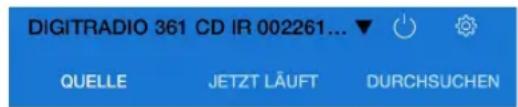
The DIGITRADIO 360 CD IR or DIGITRADIO 361 CD IR item appears in the device overview in the app. Tap it to select the DIGITRADIO.

In the next overview you can choose between the three tabs SOURCE, NOW RUNNING and SCROLL. Tap the respective tab to open the view.
SOURCE:
In SOURCE, all of the DIGITRADIO's available sources are displayed. You can switch sources by tapping the respective item.
NOW RUNNING:
Tap NOW RUNNING to display the current playback. Depending on the selected source, you can pause or continue playback, change tracks or switch to the next/previous station. Tap the respective button to do so. The volume can be adjusted in the bottom line.
BROWSE:
If you are in a source with a channel list, e.g. Internet radio or DAB, this list can be retrieved by selecting the BROWSE tab.
If you wish to switch the DIGITRADIO on or off using the app, tap the standby icon.
To retrieve other settings, tap the gear wheel icon. This provides you with access to the device functions of sleep timer, equaliser, date and time and factory settings.
17 Using headphones
Do not listen to music at a high volume when using headphones. Doing so can cause permanent hearing impairment. Turn down the radio volume to the lowest volume before using headphones.
When you connect headphones (not included in the scope of delivery), the speakers are muted and sound is only heard via the headphones.
Only use headphones with a 3.5 mm jack plug.
Insert the headphone connector into the headphone socket (14) on the device.
If you would like to listen via the speakers again, remove the headphone connection from the headphone socket on the device.
18 Cleaning
To prevent the risk of an electric shock, you may not clean the device using a wet cloth or under running water. Remove the mains plug prior to cleaning!
You may not use scouring pads, scouring powder and solvents such as alcohol, petrol, spirits, thinners, etc.; they could damage the surface of the device.
Do not use any of the following substances: salt water, insecticides, chlorine or acid-based solvents (ammonium chloride).
Clean the housing using a soft, moist cloth.
i Only clean the display with a soft, cotton cloth. If required, use the cotton cloth with a reduced volume of non-alkaline, diluted water-based soap solution.
Use the cotton cloth to gently rub the surface until it is completely dry.
19 Troubleshooting
If the device does not operate as intended, check the following tables for information.
19.1 Problems with the device
| Symptom Possible cause/remedy | |
| The device cannot be switched on. | The device is not being supplied with power.
Connect the mains plug correctly to the mains outlet. If necessary, select another power outlet. |
| No sound can be heard. | Increase the volume. If necessary, the incorrect source has been selected.
Are headphones plugged in? |
| The display does not switch on. | Switch off the device, disconnect from the mains.
Switch on the device. |
| Interference can be heard. | In the vicinity of the device, a mobile phone or other device is emitting disruptive radio waves.
Remove the mobile phone or the device from the environment of the unit. |
| Other operational malfunctions, loud noises or a malfunctioning display are occurring. | Electronic components in the device are faulty.
Remove the mains plug. Leave the device disconnected from the power source for approx. 10 seconds. Reconnect the device. |
| Symptom Possible cause/remedy | |
| No playback possible. | The device is not in USB mode.
Switch to the respective source using MODE. |
| Medium not inserted or empty.
Insert the medium correctly or provide it with music data. |
19.3 Problems with the remote control
| Symptom Possible cause/remedy | |
| The remote control does not work. | Batteries are inserted incorrectly or are low.
Check the polarity. Change the batteries. |
| IR connection interrupted.
Remove objects located between the remote control and the device. |
| Distance too great.
Max. distance from the device is approx. 4 metres |
19.4 Problems with the radio
| Symptom Possible cause/remedy | |
| No radio stations are being received. | The device is not in radio mode.
Press the MODE button. |
| No DAB signal is being received. | Check whether DAB reception is possible in the region.
Readjust the antenna. Try to receive other stations.
Perform a station scan. |
| The sound is low or of poor quality. | Other devices, e.g. televisions, are interfering with reception.
Position the device further away from such devices. |
| The antenna is not extended or correctly orientated.
Extend the antenna.
Rotate the antenna to improve reception. |
19.5 Problems with the CD player
| Symptom Possible cause/remedy | |
| The CD is not playing or skips during playback. | The device is not in CD mode. Faulty CD inserted. |
| The CD compartment is not closed. Close the CD compartment. |
| The CD is incorrectly inserted. Insert the CD with the labelled side facing upwards. The CD must be properly centred in the CD compartment. |
| The CD is dirty or faulty. Clean the CD, use another CD. |
| Moisture has penetrated the CD compartment. Remove the CD and leave the CD compartment open for approx. 1 hour to dry. |
| The CD playing time is more than 74 minutes. |
| The sound is intermittent. | The volume is set too high.
Decrease the volume. |
| The CD is damaged or dirty.
Clean the CD or replace it. |
| The device is being exposed to vibration.
Install the device in a location with low vibration levels. |
| Symptom Possible cause/remedy | |
| No sound from the external input (AUX). | Is the device connected correctly? |
| Has AUX been selected as the input source? |
| Has playback been started on the external device and has the output volume been set? |
If the malfunction has not been resolved, even after performing the checks described, please contact the Technical Hotline (for further information see Page 19).
20 Technical data
| Reception channels | Internet, DAB/DAB+, FM, USB, CD/MP3 UPnP, AUX, Bluetooth (DIGITRADIO 361 CD IR) |
| Frequencies | FM: 87.5-108MHz
DAB/DAB+: 174-240MHz |
| Mains voltage AC Input: 110-240; 50Hz | |
| USB supply DC 5V 1.0A | |
| Output power Speaker 2 x 5W RMS | |
| Power consumption 28W | |
| Power consumption on standby <1W | |
| AUX input 500mV | |
| Headphones 47KΩ | |
| Dimensions 350mm x 125mm x 215mm | |
| Weight 2.6 kg | |
| Operating conditions 5°C to 35°C, 5% to 90% air humidity |
Subject to technical changes and errors. The dimensions are approximate values.
Mode d'emploi
DIGITRADIO 360 CD IR
DIGITRADIO 361 CD IR
15.2.3 Connessione WLAN/LAN in standby
15.2.2 Verbinding via wifi
Vis info under DAB-drift
(Kanal, tittel, artist...)
Vis info under CD/USB-drift (Tittel, artist...)
35 UNPAIR Opphev Bluetooth-forbindelse (kun DIGITRADIO 361 CD IR)
SPOTIFY Ga i SPOTIFY CONNECT-modus (kun DIGITRADIO
360 CD IR)
36 Bluetooth Aktiver Bluetooth-forbindelse (kun DIGITRADIO 361 CD IR)
Innholdsfortegnelse
Tittel, artist Tittel
Beskrivelse
Artist
Sjanger
Album
Paliitelighet Bitrate, Lydformat
Bitrate, kodek, samplingsfrekvens Avspillingsbuffer
Avspillingsbuffer
Spiletid
Datoen idag Dato
11.5 Mono/stereo-innstilling
15 Systeminnstillinger
15.1 Tonekontroll (Equalizer)
15.2.2.4 Vise innstillinger
Velg Vis innstillinger for a vise de aktuelle nettverksinnstillingene.
15.2.2.5 NetRemote PIN-Setup
Under visse omstendigheter kan det vare ndvendig a sikre forbindelsen til DIGITRADIOmed en PIN-kode. >NetRemote PIN-Setup gir muligheten til a skrive inn en 4-sifret PIN-kode.
15.2.2.6 Slett nettverksprofil
Du skal have Spotify Premium for at kinne bruge Connect.