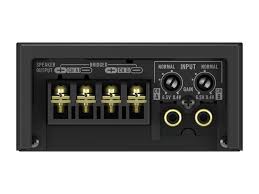
PRS-D800 - Car amplifier PIONEER - Free user manual and instructions
Find the device manual for free PRS-D800 PIONEER in PDF.



| Product type | Car amplifier |
| Brand | PIONEER |
| Model | PRS-D800 |
| Dimensions (W × H × D) | 255 mm × 50 mm × 104 mm |
| Weight | 1.6 kg |
| Supply voltage | 14.4 V DC (10.8 V to 15.1 V acceptable) |
| Grounding | Negative terminal |
| Power consumption | 23 A (4 Ω continuous) |
| Average current draw | 6.4 A (4 Ω, 2 channels) / 4.1 A (4 Ω, 1 channel) / 8 A (2 Ω, 2 channels) |
| Recommended fuse | 30 A × 2 |
| Maximum output power | 250 W × 2 (4 Ω, 2 channels) / 600 W × 1 (4 Ω, bridged) |
| Continuous output power | 125 W × 2 (4 Ω, 20-20 kHz, ≤0.8% THD) / 150 W × 2 (2 Ω, 1 kHz, ≤0.8% THD) / 300 W × 1 (4 Ω bridged, 1 kHz, ≤0.8% THD) |
| Load impedance | 4 Ω (2 Ω to 8 Ω acceptable) |
| Frequency response | 10 Hz to 30 kHz (+0 dB, -3 dB) |
| Signal-to-noise ratio | 105 dB (IEC-A) |
| Distortion | 0.004% (4 W, 1 kHz) |
| Channel separation | 70 dB (10 W, 1 kHz) / 65 dB (10 W, 100 Hz-10 kHz) |
| Gain control | 400 mV to 6.5 V |
| Maximum input level (RCA) | 6.5 V / 22 kΩ |
| Protection function | Protection against overheating, short circuit, DC voltage, under/over voltage |
| Inputs | 2 x RCA (A and B), speaker input |
| Speaker outputs | Screw terminals for 2 channels (stereo) or 1 channel (bridged) |
| Maintenance and cleaning | Clean with a soft, dry cloth. Do not use abrasive products or solvents. |
| Safety | Disconnect the battery before installation. Use a 30 A fuse. Do not expose to water. Do not modify the device. |
| Spare parts and repairability | Contact an authorized Pioneer center. Original spare parts are available. |
| General information | Made in China. Website: www.pioneer.fr |
Frequently Asked Questions - PRS-D800 PIONEER
User questions about PRS-D800 PIONEER
0 question about this device. Answer the ones you know or ask your own.
Ask a new question about this device
Download the instructions for your Car amplifier in PDF format for free! Find your manual PRS-D800 - PIONEER and take your electronic device back in hand. On this page are published all the documents necessary for the use of your device. PRS-D800 by PIONEER.
USER MANUAL PRS-D800 PIONEER
BRIDGEABLE TWO-CHANNEL POWER AMPLIFIER
AMPLIFICATEUR DE PUISSANCE PONTABLE A
DEUX CANAUX
AMPLIFICATORE DI POTENZA A DUE CANALI
COLLEGBABLE A PONTE
PykoBoDCTBO NOIb3OBaTeJIa
Thank you for purchasing this PIONEER product
To ensure proper use, please read through this manual before using this product. It is especially important that you read and observe warnings and CAUTIONs in this manual. Please keep the manual in a safe and accessible place for future reference.

If you want to dispose this product, do not mix it with general household waste. There is a separate collection system for used electronic products in accordance with legislation that requires proper treatment, recovery and recycling.
Private households in the member states of the EU, in Switzerland and Norway may return their used electronic products free of charge to designated collection facilities or to a retailer (if you purchase a similar new one).
For countries not mentioned above, please contact your local authorities for the correct method of disposal.
By doing so you will ensure that your disposed product undergoes the necessary treatment, recovery and recycling and thus prevent potential negative effects on the environment and human health.
Visit our website
Visit us at the following site: http://www.pioneer.co.uk
- Register your product. We will keep the details of your purchase on file to help you refer to this information in the event of an insurance claim such as loss or theft.
We offer the latest information about PIONEER CORPORATION on our website.
In case of trouble
Should this product fail to operate properly, please contact your dealer or nearest authorized Pioneer Service Station.
Before connecting/ installing the amplifier
WARNING
- This unit is for vehicles with a 12 V battery and negative grounding. Before installing in recreational vehicles, trucks or buses, check the battery voltage.
Always use a fuse of the rating prescribed. The use of an improper fuse could result in overheating and smoke, damage to the product and injury, including burns. - Check the connections of the power supply and speakers if the fuse of the separately sold battery wire or the amplifier fuse blows. Determine and resolve the cause, then replace the fuse with and identical equivalent.
- Do not allow this unit to come into contact with liquids. Electrical shock could result. Also, damage to this unit, smoke, and overheating could result from contact with liquids. The surfaces of the amplifier and any attached speakers may also heat up and cause minor burns.
- In the event of any abnormality, the power supply to the amplifier is cut off to prevent equipment malfunction. If this occurs, switch the system power off and check the power supply and speaker connections. If you are unable to determine the cause, please contact your dealer.
Before you start
Always disconnect the negative terminal of the battery beforehand to avoid the risk of electric shock or short circuit during installation.
- Do not attempt to disassemble or modify this unit. Doing so may result in fire, electric shock or other malfunction.

CAUTION
Always keep the volume low enough to hear outside sounds.
- Extended use of the car stereo while the engine is at rest or idling may exhaust the battery.
About the protection function
The protection function will operate in the conditions outlined below. If the protection function is turned on, the power indicator will turn off, and the amplifier will shut down.
- The output will be muted in the situations outlined below.
If a DC voltage is applied to the speaker output terminal.
If the speaker output terminal and speaker wire are short-circuited.
If there is an error in the internal power supply voltage.
- The power indicator will turn off and the amplifier shut down in the situations outlined below.
If the temperature inside the amplifier gets too high.
If the input voltage becomes irregular.
What's what
Right side
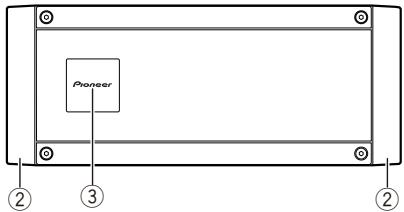
Front side
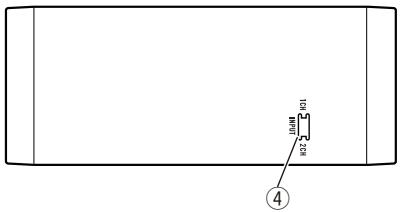
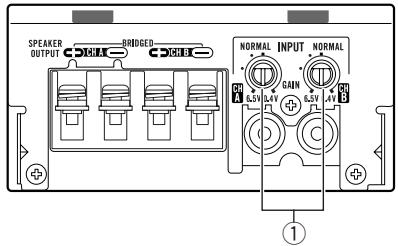
Back side
To adjust the switch, use a flathead screwdriver if needed.
① GAIN (gain) control
If output remains low, even when the car stereo volume is turned up, turn controls to lower level. If distortion occurs when the car stereo volume is turned up, turn these controls to higher level.
- For use with an RCA equipped car stereo (standard output of 500mV ), set to the NORMAL position. For use with an RCA equipped Pioneer car stereo, with maximum output of 4V or more, adjust level to match that of the car stereo output.
-
If you hear too much noise when using the speaker input terminals, turn the gain control to higher level.
-
If using only one input plug, set the gain controls for speaker outputs A and B to the same position.
② Terminal cover
Remove the cover before connecting the amplifier. For details, refer to Before connecting the amplifier on page 6.
③ Power indicator
The power indicator lights up to indicate power ON.
④ INPUT (input) switch
Select 2CH for two-channel input and 1CH for one-channel input.
Setting gain properly
- Protective function included to prevent malfunction of the unit and/or speakers due to excessive output, improper use or improper connection.
- When outputting high volume sound etc., this function cuts off the output for a few seconds as a normal function, but output is restored when the volume of the head unit is turned down.
- A cut in sound output may indicate improper setting of the gain control. To ensure continuous sound output with the head unit at a high volume, set amplifier gain control to a level appropriate for the preout maximum output level of the head unit, so that volume can remain unchanged and to control excess output.
- Despite correct volume and gain settings, the unit sound still cuts out periodically. In such cases, please contact the nearest authorized Pioneer Service Station.
Gain control of this unit
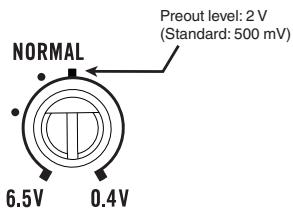
Above illustration shows NORMAL gain setting.
Relationship between amplifier gain and head unit output power
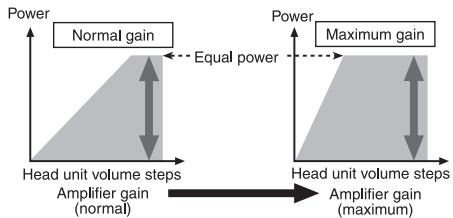
If amplifier gain is raised improperly, this will simply increase distortion, with little increase in power.
Signal waveform when outputting at high volume using amplifier gain control
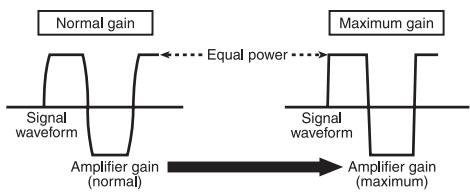
Signal waveform distorted with high output, if you raise the gain of the amplifier the power changes only slightly.
Connection diagram
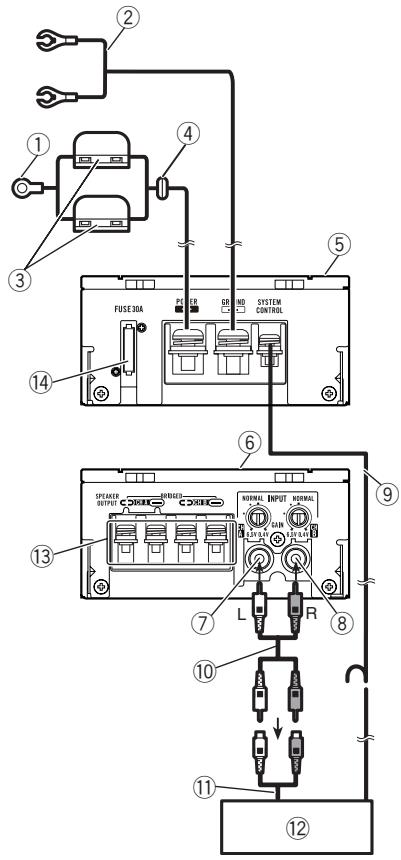
① Special red battery wire RD-223 (sold separately)
After completing all other amplifier connections, finally connect the battery wire terminal of the amplifier to the positive () battery terminal.
② Ground wire (Black)
RD-223 (sold separately)
Connect to metal body or chassis.
③ Fuse (30A)× 2
④ Grommet
⑤ Left side
⑥ Right side
⑦ RCA input jack A
⑧ RCA input jack B
⑨ System remote control wire (sold separately) Connect male terminal of this wire to the system remote control terminal of the car stereo. The female terminal can be connected to the auto-antenna relay control terminal. If the car stereo lacks a system remote control terminal, connect the male terminal to the power terminal via the ignition switch.
10 Connecting wire with RCA pin plugs (sold separately) Please see the following section for RCA input connection instruction. Refer to Connecting the speakers and RCA input on page 8.
11 External output
12 Car stereo with RCA output jacks (sold separately)
13 Speaker output terminals Please see the following section for speaker connection instructions. Refer to Connecting the speakers and RCA input on page 8.
14 Fuse(30A)
Before connecting the amplifier
WARNING
- Secure the wiring with cable clamps or adhesive tape. To protect the wiring, wrap sections in contact with metal parts in adhesive tape.
- Never cut the insulation of the power supply to feed power to other equipment. Current capacity of the wire is limited.
CAUTION
- Never shorten any wires, the protection circuit may malfunction.
- Never ground speaker wire directly or band together multiple speakers' negative (Θ) lead wires.
- If the system remote control wire of the amplifier is connected to the power terminal via the ignition switch (12V DC), the amplifier will remain on with the ignition whether the car stereo is on or off, which may exhaust battery if the engine is at rest or idling.
Connecting the units
- Install and route the separately sold battery wire as far as possible from the speaker wires. Install and route the separately sold battery wire, ground wire, speaker wires and the amplifier as far away as possible from the antenna, antenna cable and tuner.
- Avoid routing wires through hot areas, such as near the heater outlet. Heat may damage the insulation, resulting in a short-circuit through the vehicle body.
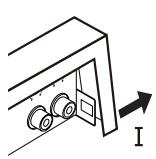
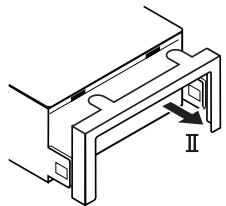
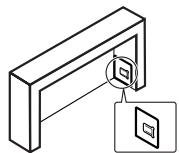
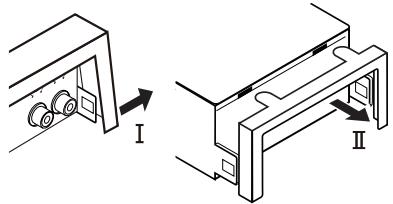
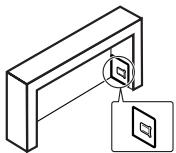
Removal of the terminal cover
Before connecting and installing the amplifier, you need to remove the terminal cover.
1 Slide the terminal cover outward (I) and pull it toward (II) you.
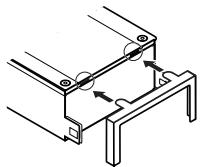
Reattachment of the terminal cover
1 With the terminal cover slid open, attach the cover as shown in the illustration below.
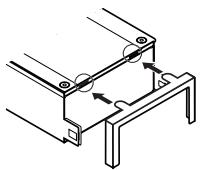
2 Press on the upper sides of the terminal cover to make sure that the cover is firmly attached to this unit.
3 Press on the lower sides of the terminal cover.
Make sure that the hook on the terminal cover has been inserted firmly into this unit. Refer to the illustration for details.

About bridged mode
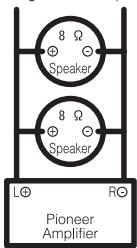
Diagram A - Proper
4Ω Bridged Mode
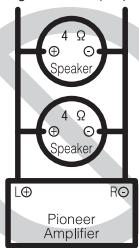
Diagram B - Improper
2Ω Bridged Mode
The maximum speaker impedance is 4 . Please carefully check. Improper connection to the amplifier may result in malfunction or personal injury due to burns from overheating.
For bridged mode for a two-channel amplifier, with a 4 load, either wire two 8 speakers in parallel, Left and Right (Diagram A) or use a single 4 speaker. For other amplifiers, please follow the speaker output connection diagram for bridging shown on rear: two 8 speakers in parallel for a 4 load or a single 4 speaker per channel.
For any further enquiries, contact your local authorized Pioneer dealer or customer service.
About suitable specification of speaker
Ensure speakers conform to the following standards, otherwise there is a risk of fire, smoke or damage. Speaker impedance is 2 to 8 for stereo connection, or 4 to 8 for monaural and other bridge connection.
Subwoofer
| Speaker channel | Power |
| Two-channel output | Nominal input: Min. 125 W |
| One-channel output | Nominal input: Min. 300 W |
Other than subwoofer
| Speaker channel | Power |
| Two-channel output | MAX input: Min. 250 W |
| One-channel output | MAX input: Min. 600 W |

Connecting the speakers and RCA input
The RCA input mode can be two-channel (stereo) or one-channel (mono).
The figures below show examples of connection. Connect the speaker leads and RCA input accordingly to suit the mode.
Two-channel input (Stereo) When connecting two speakers (Left and right)
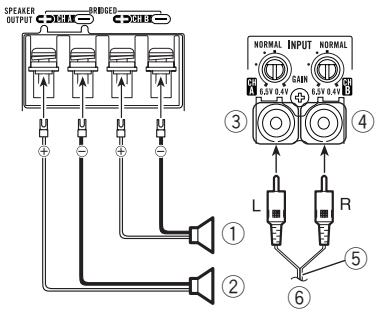
① Speaker output (Right)
② Speaker output (Left)
③ RCA input jack A
④ RCA input jack B
⑤ RCA cable (sold separately)
⑥ From car stereo (RCA output)
Two-channel input (Stereo) When connecting a speaker (Bridge)
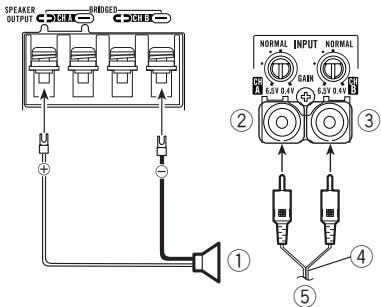
① Speaker output
② RCA input jack A
③ RCA input jack B
④ RCA cable (sold separately)
⑤ From car stereo (RCA output)
One-channel input (Mono) When connecting two speakers (front left and rear left)
- Slide INPUT (input) switch to 1CH position.
Audio from RCA input A will be output from the speakers.
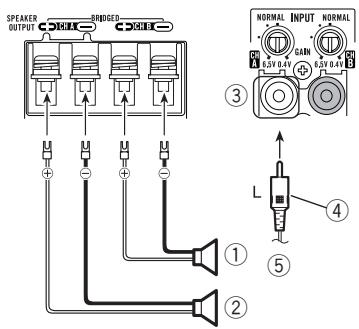
① Front speaker output (Left)
② Rear speaker output (Left)
③ RCA input jack A
④ RCA cable (sold separately)
⑤ From car stereo (RCA output)
One-channel input (Mono) When connecting a speaker (Bridge)
- Slide INPUT (input) switch to 1CH position.
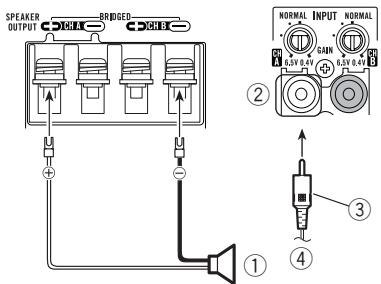
① Speaker output
② RCA input jack A
③ RCA cable (sold separately)
④ From car stereo (RCA output)
Connecting the power terminal
The use of a special red battery and ground wire RD-223 (sold separately), is recommended. Connect the battery wire directly to the car battery positive terminal and the ground wire to the car body.
WARNING
If the battery wire is not securely fixed to the terminal using the terminal screws, there is a risk of overheating, malfunction and injury, including minor burns.
1 Route battery wire from engine compartment to the vehicle interior.
After completing all other amplifier connections, finally connect the battery wire terminal of the amplifier to the positive () battery terminal.
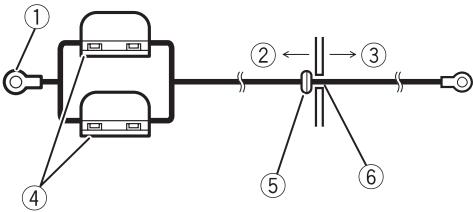
① Positive () terminal
② Engine compartment
③ Vehicle interior
④ Fuse (30A)× 2
⑤ Insert the O-ring rubber grommet into the vehicle body.
⑥ Drill a 14 mm hole into the vehicle body.
2 Connect the wires to the terminal.
Fix the wires securely with the terminal screws.
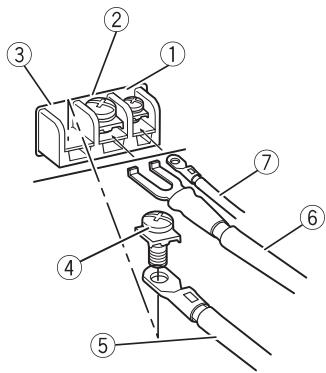
① System remote control terminal
Connecting the units
② Ground terminal
③ Power terminal
④ Terminal screws
⑤ Battery wire
⑥ Ground wire
⑦ System remote control wire
Connecting the speaker output terminals
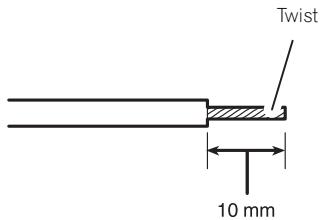
1 Use wire cutters or a utility knife to strip the end of the speaker wires to expose about 10mm of wire and then twist the wire.
2 Attach lugs to wire ends.
Use pliers, etc., to crimp lugs to wires.
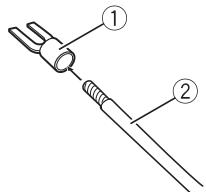
① Lug (sold separately)
② Speaker wire
3 Connect the speaker wires to the speaker output terminals.
Fix the speaker wires securely with the terminal screws.
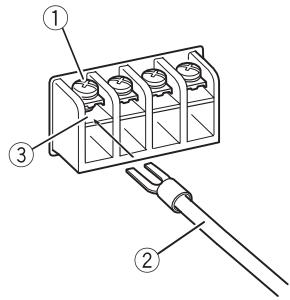
① Terminal screws
② Speaker wires
③ Speaker output terminals
Before installing the amplifier

WARNING
- To ensure proper installation, use the supplied parts in the manner specified. If any parts other than those supplied are used, they may damage internal parts of the amplifier, or become loose causing the amplifier to shut down.
- Do not install in:
Places where it could injure the driver or passengers if the vehicle stops suddenly.
Places where it may interfere with the driver, such as on the floor in front of the driver's seat.
Install tapping screws in such a way that the screw tip does not touch any wire. This is important to prevent wires from being cut by vibration of the car, which can result in fire.
- Make sure that wires do not get caught in the sliding mechanism of the seats or touch the legs of a person in the vehicle as short-circuit may result.
- When drilling to install the amplifier, always confirm no parts are behind the panel and protect all cables and important equipment (e.g. fuel/brake lines, wiring) from damage.

CAUTION
-
To ensure proper heat dissipation of the amplifier, ensure the following during installation:
-
Allow adequate space above the amplifier for proper ventilation.
- Do not cover the amplifier with a floor mat or carpet.
Always install the amplifier on a flat surface. Do not install the amplifier on a surface that is not flat or on a surface with a protrusion. Doing so could result in malfunction.
- When installing the amplifier, do not allow parts such as extra screws to get caught between the amplifier and the automobile.
Doing so could cause malfunction.
- Protection function may activate to protect the amplifier against overheating due to installation in locations where sufficient heat cannot
be dissipated, continuous use under high-volume conditions, etc. In such cases, the amplifier shuts down until it has cooled to a certain designated temperature.
- The optimal installation location differs depending on the car model. Secure the amplifier at a sufficiently rigid location.
- Firstly make temporary connections and check to ensure the amplifier and system operate properly.
- After installing the amplifier, confirm that the spare tire, jack and tools can be easily removed.
- Make sure to hold the middle part of the unit when carrying. If the terminal cover is held to lift the unit, the cover may come off and cause the unit to fall, and result in injury.
Example of installation on the floor mat or chassis
1 Install the brackets to the bottom of the unit.
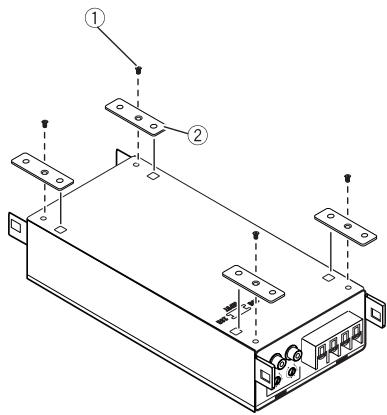
① Screws (3mm × 8mm)
② Mounting bracket
04 (Installation
2 Install the unit.
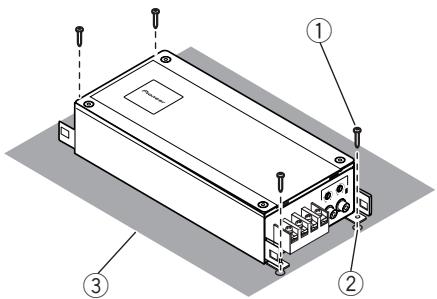
① Tapping-screws (4mm × 18mm)
② Drill a 2.5 mm diameter hole
③ Floor mat or chassis
Specifications
Power source 14.4 V DC (10.8 V to 15.1 V
allowable)
Grounding system Negative type
Current consumption 23A (at continuous power,
4Ω)
Average current consumption
6.4 A (4Ω for two channels)
4.1 A (4 Ω for one channel)
8A (2Ω for two channels)
Fuse 30 A
Dimensions (W× H× D) ...255mm×50mm×
104mm
Weight 1.6 kg
Maximum power output ....250W × 2 at 14.4V,4Ω
2 ch) / 600 W × 1 (at 14.4 V,
4Ω,1 ch BRIDGE)
Continuous power output ... 125W× 2 (at 14.4V,4
20 Hz to 20 kHz, ≤ 0.8%
THD)
300W× 1 (at 14.4V,4
BRIDGE 1 kHz, ≤ 0.8% THD)
150W×2 (at 14.4V, 2Ω)
1 kHz, ≤ 0.8% THD)
Load impedance 4Ω (2Ω to 8Ω allowable)
Frequency response .10 Hz to 30 kHz (+0 dB,
-3dB)
Signal-to-noise ratio 105 dB (IEC-A network)
Distortion .0.004% (4W,1kHz)
Separation 70 dB (10 W, 1 kHz)
65 dB (10 W, 100 Hz to
10 kHz)
Gain control 400 mV to 6.5 V
Maximum input level / impedance:
RCA 6.5V/22kΩ
Notes
- Specifications and the design are subject to modifications without notice.
- The average current drawn is nearly the maximum current drawn by this unit when an audio signal is input. Use this value when working out total current drawn by multiple power amplifiers.
Avant de commencer
① Commande GAIN (gain)
BRIDGE 1 kHz, ≤0,8% THD)
150W×2(a 14,4V,2Ω
1 kHz, ≤0,8% THD)
PoiKJIIOUeHHe yCTpOuCTB
He hapuwaIte n3OJauNIO npoBOIoB nITaHnIa IpaIauNII pTaHnIHa npyroE o6pyoBaHnIe. IppoBoJa IMeIoT orpaHnueHHyIO dOny-CTmMyIO Harpy3Kyo TOky.

BHIMAHNE
3anpeaetcyaKopauBaTb npoBoa, cenb 3aunTb MOKeT BbIuN3 CTPOJ.
He npKlOaIte npOBoI rpoMkoROBOpTeIe I He nocpeIcTBeHNO K 3a3EmIeHIO I He CBA- 3bIBaTe BMeCTe HECKOJIbKO OTPuCaTeIbHbIX () BBIOOB npOBoD IOrpoMkoROBOpTeIeI.
- Ecni npOBoC nCtEmbl DnCTaHcUHOHHORO ynpabJIeHnY ycINITeHem NODKlIOUeH K KlEMMe NiIaHnY uepe3 3amok 3axJrAHHa (12 B noCT. TOKa), TO ycINITeB 6yDet HaxOHTbCBA BKIIQUEHHom COCTOHN Ipi BVKIIQUeHHOM 3axJrAHH BHE 3aBNCIMOCn OTTO, BKIIQUeHa ABTOMOBbHna ayDIOOCNCTema IINI HET; 3TO MOKeT npNBecTN K pa3pIKe aKKMyJIaTOpA, ecNI dBINrAteBbIKLIQUeH NII pa60Taet Ha XOIOCTbIX O6opOTax.
- PpOIOxNte I3aKpeIInTe pnpO6peTaembI OTdJIbHO pOBOD dIg IOKKnUChEHN K aKKMyJITOpTy KaK MOXHO DaJIbSe O T pOBoDOb rPOMKOrOBoPnteNeI.
ПрлoxиTe n 3akpenTe npno6peTaembI OTdJIbHo npBOd nIЯ NOKJIHcHnI K aKKymJIaTOpy, npBOd 3a3eMJIeHnI, npBOda rPOMKOrOBOpNTeNeI n YcINITeNJa KaK MoXHO daJIbWe OT aHTeHHbI, Ka6eIaHTeHHbI n TIO-hepA.
He donyckaT npoknadkn npoBODOB Mectax C NOBbIeHNO TEmpePaTypoi, HApnpMeP, B6n3n peWetKn OobpReBaTeJI. Nod Bo3deiCTBnEM BblcOKO TEmpePaTybI MOKeT HApuyuINTBcN 130JNAIpyno PPOBOOB, UTO, B CBOO OuepeDb, MOKeT Bbl3BaTb KOpOTKoe 3aMbikaHne Ha KOpNyc ABTomO6nJIa.
ChTne 3aunTHoro KOKxyKa KIeMMbl
Ipeep IopkIIOHHeM m yCTaHOBKOY cUNIINTEy Heo6xOIMMO CHrTb 3aUHTbY KOKyX KJIeMMbl.
1 CdBnHbTe KoxyX nHa npabIeHIO BOBHe (I) nNotAHHTe Ha ce6a (II).
YctaHOBka 3aIHTHOKoKxyKa KJIeMMbHa MecTO
1 Ppi CdbinyTOM KoxyxE yCTaHOBtE 3aUNTHbI KOxYX, KaK NOKa3aHO Ha pNCyHKe HNKe.
2 Haxmte Ha BepxHne CTOpOnbI 3aUInTHoro Koxyxa, yTo6bI y6eINtbcra, yTO KoxyX HaedKHO 3akpenHeHa ycTpoiCTBE.
3 Haxmnte Ha HxHne cToPOhbl 3aunTHoro Koxyxa. Y6eINTecb, yTO KpOcK 3aunTHoro Koxyxa nIOTHO BoWeB KOpNyc ycTpoiCTBa. POpPob6Hee CM. Ha pncyHke.

Pexm MocToBOro CoeHHeHn
CzemaA-PrabainBHoe PNDKOHUHNE
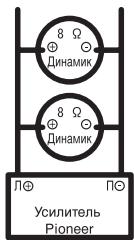
Mocboe coednene 4Ω
CXMBA-HenpBAAHBoe pOJIKHOENHE
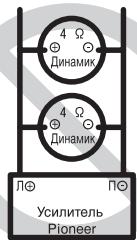
Mocboe coedneHne 2Ω
MaKcImaJIbHoe cOpOTnBJIeHne rPOMKOrOBOpIeTЯ He dONXHO npeBbIaTaB 4 Ω. Y6eJntEcB, yTO daHHe yCIOBne BbIOnHeNo. HeBepHoe NOkLIIOHeHne ycINTeJI MOKET npINBeCTN K erO NOBpeJDeHIO IIN K TpaBMam B BVNe OxKOrOB, BbI3BaHHbIX nepeRpeBOM.
MocToboe coeDInHeHne DByXkaHaIbHoro ycNITe n C Harpy3ko4 O npedctabnaret c6oB npaPJIeBHO NOkKnOChHeNe DByx rpOMKOrOBOpNTe n C conPoTINBnEHm 8 O KaJdbI, IeBoro n npaBoro (Cxema A), IIn6o OndHO rPOMKOrOBOpNTe n C conPoTINBnEHm 4 O.ДЯdpYnx yCnINTe n cm.Cxemy MocTOBO IOkNIOUChnrgomKOrOBOpNTe n Ha 3aHne nAnei: DBa rPOMKOrOBOpNTe n C conPoTINBnEHm 8 O, NOkKnOChHHbIX npaJIeNBHO,ДЯHarpy3kn 4 O, IIn6o OOnn rPOMKOrOBOpNTe h C conPoTINBnEHm 4 O Ha KaXdbI KaHaJI.
2 YctaHOBNTyeCTpoCTBO.
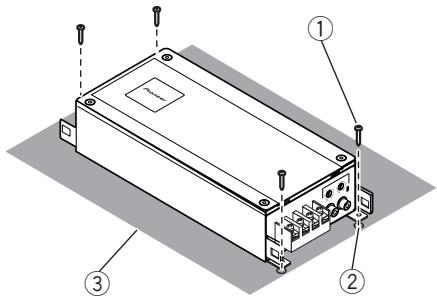
① Camohape3aIOUne BnHTbI (4MM×18MM)
② Порocверпinte OTBерстные Диаметром 2,5MM
③ HanoIbHbI KOBpIK IINIaaccn
Visit www.pioneer.co.uk (or www.pioneer.eu) to register your product.
UmmopTeP OOO "IIOHEP PYC"
125040, Pocnra, r. MockBa, yn. PpaBbl, d.26
Ten.: +7(495) 956-89-01
PIONEER ELECTRONICS (USA) INC.
P.O. Box 1540, Long Beach, California 90801-1540, U.S.A.
TEL: (800) 421-1404
PIONEER EUROPE NV
Haven 1087, Keetberglaan 1, B-9120 Melsele, Belgium/Belgique
TEL: (0) 3/570.05.11
PIONEER ELECTRONICS ASIACENTRE PTE. LTD.
253 Alexandra Road, #04-01, Singapore 159936
TEL: 65-6472-7555
PIONEER ELECTRONICS AUSTRALIA PTY. LTD.
5 Arco Lane, Heatherton, Victoria, 3202 Australia
TEL: (03) 9586-6300
PIONEER ELECTRONICS OF CANADA, INC.
340 Ferrier Street, Unit 2, Markham, Ontario L3R 2Z5, Canada
TEL: 1-877-283-5901
TEL: 905-479-4411
PIONEER ELECTRONICS DE MEXICO, S.A. de C.V.
Blvd.Manuel Avila Camacho 138 10 piso
Col.Lomas de Chapultepec, Mexico, D.F. 11000
TEL: 55-9178-4270
先鋒股份有限公司
台北市內湖區瑞光路407號8樓
電話:886- (0)2- 2657-3588
先鋅電子(香港)有限公司
香港九龍長沙灣道909號5樓
電話:852-2848-6488
© 2011 PIONEER CORPORATION.
All rights reserved.
© 2011 PIONEER CORPORATION.

- Thank you for purchasing this PIONEER product
- Visit our website
- In case of trouble
- Before connecting/ installing the amplifier
- WARNING
- Before you start
- CAUTION
- About the protection function
- What's what
- ① GAIN (gain) control
- ② Terminal cover
- ③ Power indicator
- ④ INPUT (input) switch
- Setting gain properly
- Gain control of this unit
- Relationship between amplifier gain and head unit output power
- Signal waveform when outputting at high volume using amplifier gain control
- Connection diagram
- Before connecting the amplifier
- Connecting the units
- Removal of the terminal cover
- Reattachment of the terminal cover
- About bridged mode
- About suitable specification of speaker
- Connecting the speakers and RCA input
- Two-channel input (Stereo) When connecting two speakers (Left and right)
- Two-channel input (Stereo) When connecting a speaker (Bridge)
- One-channel input (Mono) When connecting two speakers (front left and rear left)
- One-channel input (Mono) When connecting a speaker (Bridge)
- Connecting the power terminal
- Route battery wire from engine compartment to the vehicle interior.
- Connect the wires to the terminal.
- Connecting the speaker output terminals
- Before installing the amplifier
- Example of installation on the floor mat or chassis
- (Installation
- Install the unit.
- Specifications
- Notes
- Avant de commencer
- ① Commande GAIN (gain)
- PoiKJIIOUeHHe yCTpOuCTB
- BHIMAHNE
- ChTne 3aunTHoro KOKxyKa KIeMMbl
- YctaHOBka 3aIHTHOKoKxyKa KJIeMMbHa MecTO
- Pexm MocToBOro CoeHHeHn
- UmmopTeP OOO "IIOHEP PYC"
- PIONEER ELECTRONICS (USA) INC.
- PIONEER EUROPE NV
- PIONEER ELECTRONICS ASIACENTRE PTE. LTD.
- PIONEER ELECTRONICS AUSTRALIA PTY. LTD.
- PIONEER ELECTRONICS OF CANADA, INC.
- PIONEER ELECTRONICS DE MEXICO, S.A. de C.V.
- 先鋒股份有限公司
- 先鋅電子(香港)有限公司
Brand : PIONEER
Model : PRS-D800
Category : Car amplifier