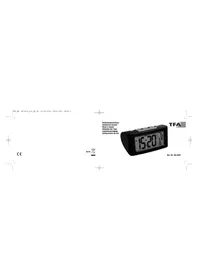
60.2532 - Alarm bell TFA - Free user manual and instructions
Find the device manual for free 60.2532 TFA in PDF.



| Product type | Radio-controlled alarm clock |
| Brand | TFA |
| Model | 60.2532 |
| Dimensions | 138 x 70 x 70 mm |
| Weight | 168 g (device only) |
| Power supply | 2 AA 1.5 V batteries (not included) |
| Temperature range | -10 °C to 50 °C (14 °F to 122 °F) |
| Temperature unit | °C or °F selectable |
| Radio-controlled reception | Yes, DCF-77 signal (77.5 kHz) |
| Alarm function | With snooze function (5 minutes) |
| Nap timer | Up to 360 minutes, adjustable in steps of 5, 15 or 30 minutes |
| Display | Time, alarm, temperature, nap timer, DCF reception symbol |
| Backlight | Yes, activation via SNOOZE/LIGHT button (10 seconds) |
| Time format | 12 or 24 hours |
| Battery compartment | For 2 AA batteries, observe polarity |
| Maintenance and cleaning | Soft damp cloth, no solvents or abrasives |
| Safety precautions | Keep out of reach of children, do not throw batteries into fire, observe polarity |
| Used batteries | Mandatory recycling, do not dispose of with household waste |
| Protection rating | Avoid exposure to moisture, vibrations and extreme temperatures |
| Approval | Compliant with Directive 2014/53/EU (radio equipment) |
| Languages of manual | FR, DE, EN, ES, IT, NL, and others available on request |
Frequently Asked Questions - 60.2532 TFA
User questions about 60.2532 TFA
0 question about this device. Answer the ones you know or ask your own.
Ask a new question about this device
Download the instructions for your Alarm bell in PDF format for free! Find your manual 60.2532 - TFA and take your electronic device back in hand. On this page are published all the documents necessary for the use of your device. 60.2532 by TFA.
USER MANUAL 60.2532 TFA
m = 311 ;
图
m = 311
牛
SIESTA - Radio-controlled alarm clock

Thank you for choosing this Instrument from TFA.
1. Before you use this product
- Please make sure you read the instruction manual carefully.
This information will help you to familiarize yourself with your new device, to learn all of its functions and parts, to find out important details about its first use and how to operate it and to get advice in the event of a malfunction.
- Following and respecting the instructions in your manual will prevent damage to your instrument and loss of your statutory rights arising from defects due to incorrect use.
Likewise, we take no responsibility for any incorrect readings or for any consequences resulting from them.
We shall not be liable for any damage occurring as a result of non following of these instructions.
- Please take particular note of the safety advice!
- Please keep this instruction manual safe for future reference.
2. Scope of delivery
Radio-controlled alarm clock
- Instruction manual
SIESTA - Radio-controlled alarm clock
- Field of operation and all the benefits of your new instrument at a glance
- Highest precision radio-controlled clock
- Count down timer (Nap timer)
Alarm with snooze function
Indication of indoor temperature - Manual setting option
-
Backlight
-
For your safety
This product is exclusively intended for the field of application described above. The product should only be used as described within these instructions.
- Unauthorized repairs, alterations or changes to the product are prohibited

Caution!
Risk of Injury:
- Keep this instrument and the batteries out of the reach of children.

SIESTA - Radio-controlled alarm clock

- Batteries must not be thrown into a fire, short-circuited, taken apart or recharged. Risk of explosion!
- Batteries contain harmful acids. Batteries contain harmful acids. Low batteries should be changed as soon as possible to prevent damage caused by leaking. Never use a combination of old and new batteries together, or batteries of different types.
- Wear chemical-resistant protective gloves and safety glasses when handling leaking batteries.

Important Information on product safety!
-
Do not place your device near extreme temperatures, vibrations or shocks.
Protect it from moisture -
Elements
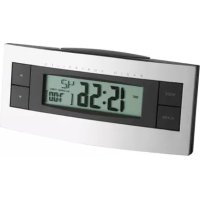
A:Display
A1:PM(in 12-hour display format),optionally radio controlled symbol, time
A 2: Snooze symbol
A 3: NAP display with timer symbol
SIESTA - Radio-controlled alarm clock
A4: Alarm time display with alarm symbol
A5: Temperature dispaly with backlight symbol
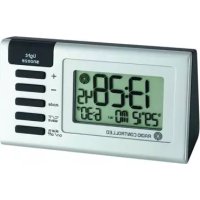
B: Buttons:
B1:Switch setting time and alarmtime,ALARMON/OFF
B2:CLEAR button
B3:HR button
R4:5and15a
5:MIN button
6.5.NNOO7EUG
C: Housing
C1: Battery compartment
6. Getting started
- Open the battery compartment and Insert two new batteries 1.3 V AA polarity as illustrated
- Close the battery compartment again.

SIESTA - Radio-controlled alarm clock

The device will alert you with a beep and all segments will be displayed for a short moment.
The Indoor temperature (default ^ C ) appears on the display. It may take 3-8 minutes until the correct temperature is displayed.
6.1 Reception of the radio controlled time
- Attention: The radio reception only works in normal mode (switch to position ALON / OFF)
The clock will now scan the DCF frequency signal and the DCF symbol will be flashing on the display. When the time code is received successfully after 7 minutes, the radio-controlled time and the DCF symbol are displayed steadily on the display. - The DCF reception always takes place daily at 1:00, 2:00, 3:00, 4:00 and 5:00 o'clock in the morning. If the reception is not successfully received until 5:00 o'clock, the next receive operation is again at 1:00 o'clock in the morning.
- You can start the initialization manually.
- Press and hold HR button for three seconds.
The DCF reception symbol will be flashing.
To end the DCF reception attempt, press the HR button short. The DCF reception symbol disappears.
SIESTA - Radio-controlled alarm clock
There are three different reception symbols:
flashing - reception is activestays - reception is very good
no symbol - no reception/reception is shut down/set time manually
- If the clock can not detect the DCF-signal (for example due to disturbances, transmitting distance, etc.), the time can be set manually. The clock will then work as a normal quartz clock. (see: Manual setting of the clock).
Note for radio-controlled time
The lima base for the radio-controlled time is a caesium atomic clock operated by the Physikalisch Technische Bundesanstalt Braunschweig. It has a time deviation of less than one second in one million years. The time is coded and transmitted from Mainllingen near Frankfurt via frequency signal DCF-77 (77.5 kHz) and has a transmitting range of approximately 1,500 km. Your radio-controlled clock receives this signal and converts it to show the precise time. Changeover from summer time or winter time is automatic. In Daylight Saving Time DST is shown on the display. The quality of the reception depends mainly on the geographic location. Normally there should be no reception problems within a 1,500 km radius around Frankfurt.

SIESTA - Radio-controlled alarm clock

Therefore, please note the following steps:
The recommended distance to any interfering sources like computer monitors or TV sets is at least 1.5 - 2 meters. Inside ferro-concrete rooms (basements, superstructures), the received signal is naturally weakened. In extreme cases, please place the unit close to a window to improve the reception.
- During night-time, the atmospheric interference is usually less severe and reception is possible in most cases. A single daily reception is adequate to keep the accuracy deviation under 1 second.
7. Operation
- Press and hold the HR or MIN button in the setting mode for fast running.
The device will automatically quit the setting mode if no button is pressed for a long period of time.
7.1 Manual settings of the clock
- Slide the switch to TIME SET.
- The time will be flashing on the large display.
- Press the HR button to adjust the hours.
SIESTA - Radio-controlled alarm clock
- With this setting, you also select, if the time will be displayed in the 12 or 24 hour system. First, the hours will appear in
24-hour system then the hours will appear in 12-hour system (PM appears from 12 to 24 o'clock on the display). - Press the M&K button to adjust the minutes.
- Slide the switch to the position AL ON or AL OFF, to exit the setting mode.
- On the display appears the adjusted time.
- By a successful reception of the DCF signal, the manually set time will be overwritten.
7.2 Setting of the alarm time
- Slide the switch to the position AL SFT,
The alarm time (default 7:00) will be flashing on the middle display. - Press the HR button to adjust the hours.
- Press the MIN button to adjust the minutes.
- Slide the switch on the position AL ON, to activate the alarm function.
The alarm symbol appears on the display.
7.3 Alarm functions
- When the adjusted alarm time is reached, the alarm will ring.
The alarm symbol will be flashing.

SIESTA - Radio-controlled alarm clock

The backlight turns on for a short time.
The increasing alarm will automatically turn off a few minutes.
- Press any button to turn off the alarm sound or press the SNDOZE/LIGHT button and the snooz function will be activated.
The alarm symbol and the snooz e symbol disappear on the display.
The alarm sound will be interrupted for five minutes.
- Press any button to turn off the snooze function
The sponze symbol will disappear
The alarm symbol stays on the display and the alarm time will be reactivated at the same time.
- Slide the switch to the position Al OFF, to turn off the alarm function.
The alarm symbol will disappear.
7.4 Setting of the NAP function
- On the upper display (default 00) appears the adjusted time for the MAP function.
- Select with the 5, 15 or 30 button the time how long you want to sleep. With each further button operation the time will be
added (until 360 minutes). - With the setting of the minutes the NAP function will be activated.
- With the CLEAR button you can delete the set time or stop the timer
An alarm sounds when the set time has elapsed.


SIESTA - Radio-controlled alarm clock
The symbols will be flashing.
OO appears on the display.
The backlight turns on for ten seconds.
Press any button to stop the aarm sound. The NAP function is denoted
7.5 Backlight
- Press the SNOOZE/LIGHT button.
The backlight turns on for ten seconds.
7.6 Setting of the temperature unit
- On the lower display appears the indoor temperature (default °C).
- Press the HR button to toggle between Celsius (°C) or Fahrenheit (°F) as temperature unit.
8. Care and maintenance
Clean the device with a soft damp cloth. Do not use solvents or scouring agents.
- Remove the batteries if you do not use the device for a long period of time.
- Keep the device in a dry place.

SIESTA - Radio-controlled alarm clock
8.1 Battery replacement
- Change the batteries when the battery symbol appears on the display.
- Open the battery compartment and insert two new batteries 1.5 V AA, polarity as illustrated.
- Close the battery compartment again.
9. Troubleshooting
Problems Solution
No display Ensure that the ballaries polarity are correct.
Change the batteries
No DCF reception Switch on the position AL ON/OFF
Press and hold the HR button for three seconds and start the reception manually
Wait for attempted reception during the night
Choose another place
Set the clock manually
Check if there is any source of interference
Restart the instrument according to the manual
SIESTA - Radio-controlled alarm clock

Indication: LL.L. / HH.H → Temperature is outside measuring range
Incorrect Indication Change the batteries
If your device fails to work despite these measures contact the supplier from whom you purchased it.
10. Waste disposal
This product has been manufactured using high-grade materials and components which can be recycled and reused. Never dispose of empty batteries and rechargeable batteries in household waste.
As a consumer, you are legally required to take them to your retail store or (to an appropriate collection site depending on national or local regulations in order to protect the environment.
The symbols for the heavy metals contained are: Cd=cadmium, Hg = mercury, Pb = lead
This instrument is labelled in accordance with the EU Waste Electrical and Electronic Equipment Directive (WEEE). Please do not dispose of this instrument in household waste. The user is obliged to take end-of-life devices to a designated collection point for the disposal of electrical and electronic equipment, in order to ensure environmentally-compatible disposal.
SIESTA - Radio-controlled alarm clock

11. Specifications
Power consumption: Batteries 2 x 1.5 V AA (not Included)
Temperature measuring range: -10^ ... 50^ (14°F.. 122°F). ^ C / ^ F -reversible
Housing dimension: 138× 70× 70mm
Weight: 168 g (instrument only)
No part of this manual may be reproduced without written consent of TFA Doostman. The technical data are correct at the time of going to print and may change without prior notice.
The latest technical data and information about your product can be found by entering your product number on our homepage.
EU declaration of conformity
Hereby, TFA Dasstmann declares that the radio equipment type 60.2532 is in compliance with Directive 2014/53/EU. The full text of the EU declaration of conformity is available at the following internet address:
www.tfa-dostmann.de
E-Mail:info@ta-dostman.de
TFA Doslmann GmbH & Co KG, Zum Ottersberg 12, D-97877 Wertheim, Germany 09:16

C1:Compartment piles
6. Mise en service
8. Entretion at maintenance
m = 311 ;
10 : 91 = 81 + 1 = 171
- m = 311 ;
- 图
- m = 311
- 牛
- SIESTA - Radio-controlled alarm clock
- Scope of delivery
- B: Buttons:
- C: Housing
- Getting started
- Reception of the radio controlled time
- Note for radio-controlled time
- Therefore, please note the following steps:
- Operation
- Manual settings of the clock
- Setting of the alarm time
- Setting of the NAP function
- Backlight
- Setting of the temperature unit
- Care and maintenance
- Battery replacement
- Troubleshooting
- Problems Solution
- Waste disposal
- Specifications
- Mise en service
- Entretion at maintenance
Brand : TFA
Model : 60.2532
Category : Alarm bell