FCT 4101 N XS - Refrigerator FRANKE - Free user manual and instructions
Find the device manual for free FCT 4101 N XS FRANKE in PDF.



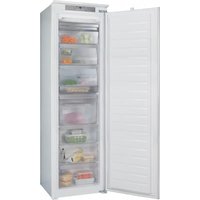
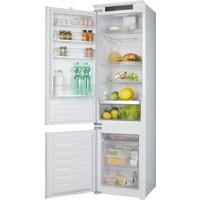
| Product type | Refrigerator-freezer combo |
| Brand | Franke |
| Model | FCT 4101 N XS |
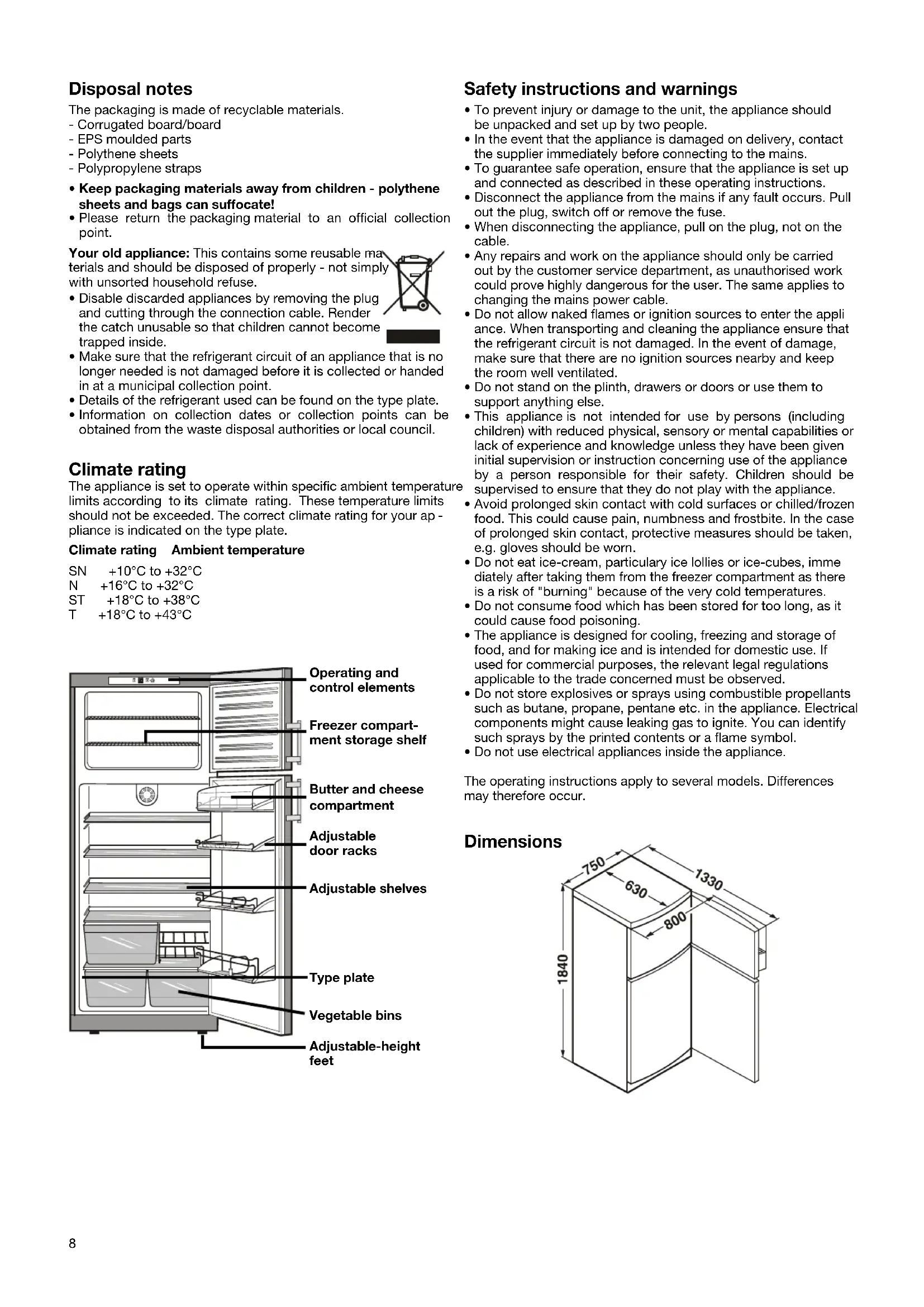
| Height (mm) | 1840 |
| Width (mm) | 800 |
| Depth (mm) | 630 |
| Climate class | SN, N, ST, T |
| Refrigerant | R600a |
| Protection fuse | 10 A |
| Interior light bulb | 15 W, socket E14 |
| Superfrost function | Yes, manual activation |
| Open door alarm | Yes (after 60 seconds) |
| Freezer temperature alarm | Yes |
| Interior fan | Yes, switchable |
| Refrigerator defrost | Automatic |
| Freezer defrost | Manual |
| Freezing capacity | Variable (see rating plate) |
| Electrical supply | 220-240 V, 50 Hz |
| Installation type | Integration possible under worktop |
| Door reversal | Possible |
| Material | Stainless steel |
| Refrigerant | R600a |
| Net weight | Not specified |
Frequently Asked Questions - FCT 4101 N XS FRANKE
User questions about FCT 4101 N XS FRANKE
0 question about this device. Answer the ones you know or ask your own.
Ask a new question about this device
Download the instructions for your Refrigerator in PDF format for free! Find your manual FCT 4101 N XS - FRANKE and take your electronic device back in hand. On this page are published all the documents necessary for the use of your device. FCT 4101 N XS by FRANKE.
USER MANUAL FCT 4101 N XS FRANKE
natural_image
Technical diagram of a mechanical assembly with labeled components (no text or symbols present)Flaschenablagerost
natural_image
Simple line drawing of a multi-level storage cabinet or rack unit (no text or symbols)Innenbeleuchtung
Kühlen
Einordnungsbeispiel
① Butter, Käse
natural_image
Diagram showing a tray with a lid and a grid of circular objects inside, no text or symbols present.Abtauen
Kühlteil
natural_image
Diagram showing a mechanical assembly with layered components and an arrow indicating motion (no text or symbols)Gefrierteil
Disposal notes
The packaging is made of recyclable materials.
- Corrugated board/board
- EPS moulded parts
- Polythene sheets
- Polypropylene straps
- Keep packaging materials away from children - polythene sheets and bags can suffocate!
- Please return the packaging material to an official collection point.
Your old appliance: This contains some reusable materials and should be disposed of properly - not simply with unsorted household refuse.
- Disable discarded appliances by removing the plug and cutting through the connection cable. Render the catch unusable so that children cannot become trapped inside.
- Make sure that the refrigerant circuit of an appliance that is no longer needed is not damaged before it is collected or handed in at a municipal collection point.
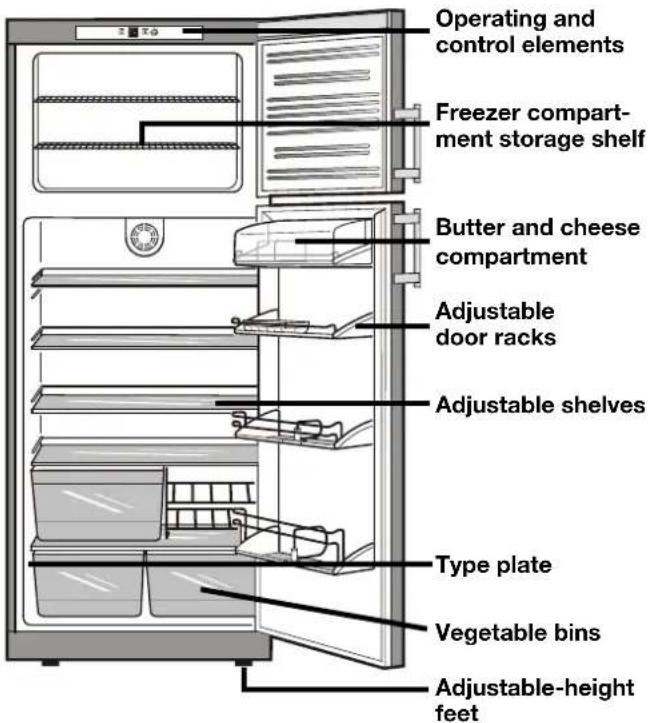
- Details of the refrigerant used can be found on the type plate.
• Information on collection dates or collection points can be obtained from the waste disposal authorities or local council.
Climate rating
The appliance is set to operate within specific ambient temperature limits according to its climate rating. These temperature limits should not be exceeded. The correct climate rating for your appliance is indicated on the type plate.
Climate rating Ambient temperature
SN +10°C to +32°C
N +16°C to +32°C
ST +18°C to +38°C
T +18°C to +43°C
Safety instructions and warnings
- To prevent injury or damage to the unit, the appliance should be unpacked and set up by two people.
- In the event that the appliance is damaged on delivery, contact the supplier immediately before connecting to the mains.
- To guarantee safe operation, ensure that the appliance is set up and connected as described in these operating instructions.
-
Disconnect the appliance from the mains if any fault occurs. Pull out the plug, switch off or remove the fuse.
-
When disconnecting the appliance, pull on the plug, not on the cable.
- Any repairs and work on the appliance should only be carried out by the customer service department, as unauthorised work could prove highly dangerous for the user. The same applies to changing the mains power cable.
- Do not allow naked flames or ignition sources to enter the appliance. When transporting and cleaning the appliance ensure that the refrigerant circuit is not damaged. In the event of damage, make sure that there are no ignition sources nearby and keep the room well ventilated.
- Do not stand on the plinth, drawers or doors or use them to support anything else.
- This appliance is not intended for use by persons (including children) with reduced physical, sensory or mental capabilities or lack of experience and knowledge unless they have been given initial supervision or instruction concerning use of the appliance by a person responsible for their safety. Children should be supervised to ensure that they do not play with the appliance.
- Avoid prolonged skin contact with cold surfaces or chilled/frozen food. This could cause pain, numbness and frostbite. In the case of prolonged skin contact, protective measures should be taken, e.g. gloves should be worn.
- Do not eat ice-cream, particularly ice lollies or ice-cubes, imme diately after taking them from the freezer compartment as there is a risk of "burning" because of the very cold temperatures.
- Do not consume food which has been stored for too long, as it could cause food poisoning.
- The appliance is designed for cooling, freezing and storage of food, and for making ice and is intended for domestic use. If used for commercial purposes, the relevant legal regulations applicable to the trade concerned must be observed.
- Do not store explosives or sprays using combustible propellants such as butane, propane, pentane etc. in the appliance. Electrical components might cause leaking gas to ignite. You can identify such sprays by the printed contents or a flame symbol.
- Do not use electrical appliances inside the appliance.
The operating instructions apply to several models. Differences may therefore occur.
Dimensions
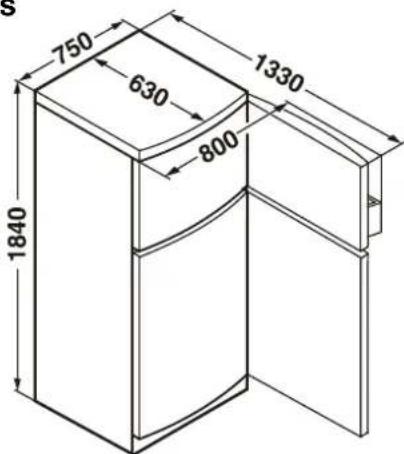
Setting up
- Avoid positioning the appliance in direct sunlight or near cookers, radiators and similar sources of heat.
- The floor on which the appliance stands should be horizontal and level. To compensate for any unevenness, adjust the height of the feet with the open-ended spanner supplied.
- The ventilation grilles should not be obstructed. Always ensure that there is good ventilation and that the outward flowing air is able to escape.
- Do not place heat-emitting appliances, e.g. microwave oven, toaster, etc., on top of the appliance.
- Standard EN 378 specifies that the room in which you install your appliance must have a volume of 1m3 per 8g of R 600a refrigerant used in the appliance, so as to avoid the formation of inflammable gas/air mixtures in the room where the appliance is located in the event of a leak in the refrigerant circuit. The quantity of refrigerant used in your appliance is indicated on the type plate on the inside of the appliance.
Connecting to the mains
Power supply (AC) and voltage at the operating point must comply with the details on the type plate, which is located on the inside left of the appliance. The socket must be fused with a 10 A fuse or higher, it must be away from the rear of the appliance and must be easily accessible.
Connect the appliance with a properly earthed fused plug and socket only.
The wires in the mains lead are coloured in accordance with the following code: green/yellow = earth, blue = neutral, brown = live. Warning! This appliance must be earthed.
Notes on energy saving
- Avoid opening the door unnecessarily for long periods of time.
- Allow hot food to cool to room temperature before storing it in the appliance.
Switching the appliance on and off
You are recommended to clean the appliance before switching it on for the first time (see "Cleaning").
To switch the appliance on:
Connect the appliance to the mains - the appliance is switched on.
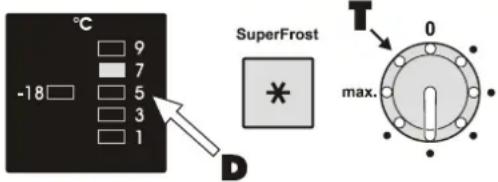
- The temperature display D shows the set interior temperature (Refrigerator).
- The red visual warning light - comes on. The visual warning light goes out as soon as the freezer compartment is cold enough.
To switch the appliance off:
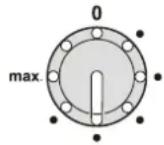
Pull out the mains plug or set the temperature T control to "0".
Setting the temperature
Turn the temperature control T to set the desired temperature.
The display of the set temperature in display D changes in accordance with the temperature setting.
When storing pre-frozen food in the freezer compartment, we recommend a temperature setting of between 5irc C and 3irc C, in order to achieve temperatures of -18irc C or lower inside the compartment.
NB: The temperature shown on the display is not the current temperature inside the appliance but the set temperature.
Freezer temperature display
Once the freezer temperature is low enough, the "freezer temperature display" lights up. Adjust the temperature control if necessary.
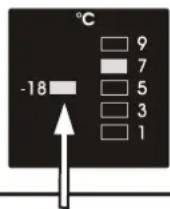
Freezer temperature display
Audible warning on/off button
The appliance is equipped with an alarm function.
Audible door alarm:
If an appliance door is left open for more than 60 seconds, the audible warning signal will sound. Press the audible warning on/off button to cancel the alarm. The alarm switches back to standby when the door is shut.
Audible/visual temperature alarm:
If the temperature in the freezer compartment rises too high, the audible warning signal will sound and the LED in the audible warning on/off button will flash.
Press the audible warning on/off button to cancel the alarm. The LED will stop flashing and will light continuously. The LED will go out as soon as the temperature in the freezer compartment is low enough.
This can be caused by:
- the freezer door being left open for a long time, allowing warm ambient air to enter;
- a long power failure;
- a fault in the appliance.
In each case, make sure food has not defrosted or perished. If the visual warning LED does not go out, contact the customer service department (see section on "Malfunctions").
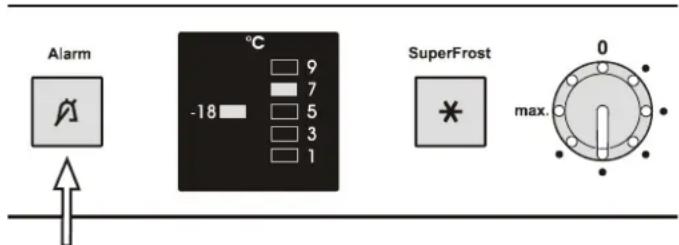
Audible warning on/off button
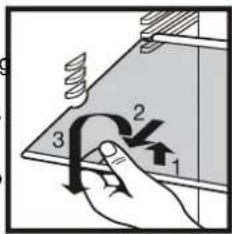
Changing shelf arrangement
You can re-arrange the storage shelves as required. Lift up shelves at the front, pull them out halfway and remove by tilting upwards or downwards.
When inserting a shelf, the guard bar / raised edge at the back must be facing upwards, otherwise food may freeze to the rear wall.
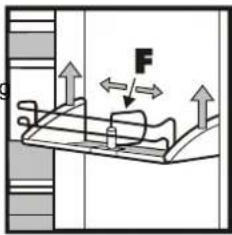
Repositioning the door racks
Lift door rack vertically, lift out to the front and re-insert at a different height, following these steps in the reverse order.
By shifting the bottle holder F you can protect the bottles from falling over when opening or closing the door.
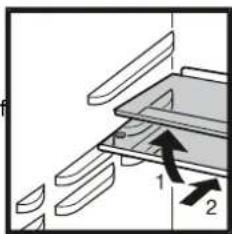
If you require space for large bottles and containers, slide one half of the glass shelf to the back.
natural_image
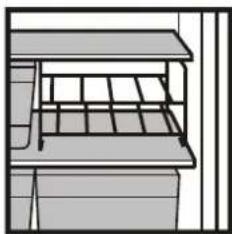
Technical diagram of a mechanical assembly with labeled components (no readable text or symbols)Bottle grid
The bottle grid serves as an additional storage surface for cooling drinks.
natural_image
Simple line drawing of a two-tiered storage unit or shelf with no text or symbolsInterior light
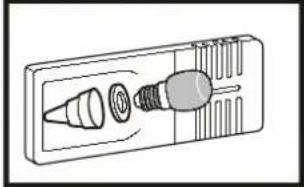
Bulb data: 15 W (never use a bulb rated at more than 15 W). The voltage should agree with the details on the type plate. Bulb fitting: E 14.
Replacing the bulb:
Pull out the mains plug or switch off or unscrew the fuse.
- Press the light cover together at the sides 1, lift out and unclip at the back 2.
- Replace the bulb. When insert - ing the new bulb, make sure the seal is correctly positioned in the socket.
- Clip the back end of the cover in and clip the sides into place.

natural_image
Diagram of a mechanical component with internal parts and a central shaft (no text or symbols)Cooling
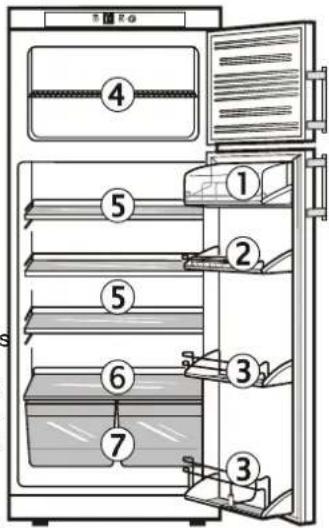
Storage example
① butter, cheese
② eggs
③ bottles, cans, tubes
④ frozen food, ice cubes
⑤ meat, sausage products, dairy products
⑥ baked goods, pre-cooked meals, drinks
⑦ fruit, vegetables, salad,
Note
- Food which gives off or absorbs odours and flavours as well as liquids should always be stored covered or in closed containers. High-percentage alcohols should be tightly sealed and stored upright.
- Fruit, vegetables and salad can be stored unpacked in the bins.
- Reusable plastic, metal, aluminium and glass containers can be used for packaging.
Refrigerating with fan
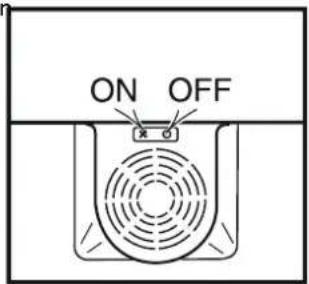
This achieves a relatively even temperature distribution over at all storage levels; all foods are equally cool, at an adjustable temperature. Due to the enforced air circulation, the various tem
perature ranges of normal operation are raised.
It is generally recommended:
- with high room temperature (above approx. 30°C),
- with high humidity, e.g. on summer days.
Switching on/off:
Press fan switch.
♀ = on, 0 = off.
Freezing
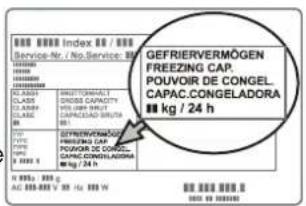
The maximum amount of food wich can be frozen in 24 hours is shown on the type plate ("Freezing capacity". This amount varies according to the model and climate rating.
Freezing
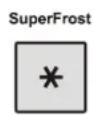
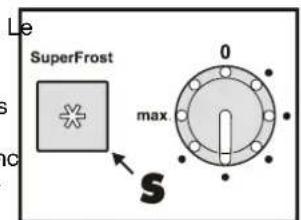
- Press the Superfrost button S. The Superfrost lamp comes on.
- Wait 24 hours.
- Place the fresh food in the freezer.
• The Superfrost facility automatically switches the fast freezing procedure off after 65 hours.
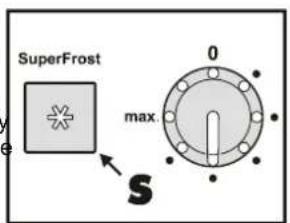
You should not switch on the
Superfrost function:
- when placing frozen food in the freezer;
- when freezing up to approx. 1 kg fresh food daily.
Notes on freezing and storage
- Items suitable for freezing: meat, game, poultry, fresh fish, vegetables, fruit, dairy products, bread, baked goods, pre-cooked meals. Not suitable: lettuce, radishes, grapes, whole apples and pears, fatty meat.
- Pack food which you are freezing yourself in quantities appropriate to your household. To ensure that the food freezes right through, the following quantities should not be exceeded per package:
fruit, vegetables: up to 1 kg, meat: up to 2.5 kg.
- Blanch vegetables after washing and cutting them. (Add to boiling water for 2-3 minutes, remove and quickly cool down in cold water).
- Do not salt or season fresh food or blanched vegetables before freezing. Only lightly salt and season other food. The intensity of flavour of some spices can change.
- Pack frozen food in standard freezer bags or reusable plastic, metal or aluminium containers.
- Do not allow fresh food which is to be frozen to come into contact with food already frozen. Always keep packs dry in order to avoid them sticking together.
- Always write the date and contents on the pack and do not exceed the stated storage time for the food.
- Do not freeze bottles and cans which contain carbonated drinks as they might burst.
- Only take out as much food as is immediately required for thawing. Cook food which has been thawed as quickly as possible.
Frozen food can be thawed in the following ways:
- in a fan oven
- in a microwave oven
- at room temperature
– in the refrigerator: the cold given off by the frozen food is used for cooling.
Flat portions of meat and fish can be cooked when partly thawed.
Vegetables can be cooked from frozen (in half the normal time).
Making ice cubes
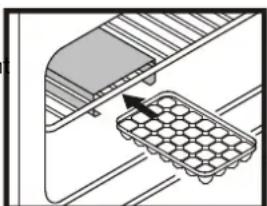
- Fill the ice-cube tray with water.
- Slide the ice-cube tray into the moun ing in the freezer compartment.
- The ice cubes can be removed from the tray by twisting or by holding upside down for a short time under running water.
natural_image
Diagram showing a mechanical assembly with a grid-patterned tray and an arrow pointing to a component (no text or symbols)Defrosting
Refrigerator compartment
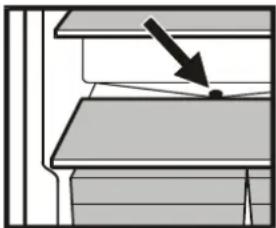
The refrigerator compartment defrosts automatically. The water that forms on the rear wall drains into a reservoir at the back of the appliance and evaporates automatically through the compressor heat. Ensure that the water can flow without hindrance through the hole above the vegetable bins (see "Cleaning").
natural_image
Diagram showing a mechanical or structural component with an arrow indicating direction (no text or symbols present)Freezer compartment
After a long period of operation, a layer of frost or ice can build up inside the freezer compartment. This increases energy consumption. You should therefore defrost the freezer compartment regularly.
- Switch the appliance off to defrost.
Pull out the mains plug or set the temperature control to "0". - Wrap the frozen food in paper or blankets and store in a cool place.
- To speed up the defrosting process put a saucepan of hot but not boiling water on one of the cooling elements.
- Leave the door of the appliance open while defrosting. After de frosting mop up the remaining water and clean the appliance.
Do not use any mechanical devices or other artificial aids for defrosting other than those recommended by the manufacturer.
Cleaning
Before cleaning, always switch off the appliance. Disconnect from the mains or unscrew or switch off the fuse.
Clean the inside, equipment parts and outer walls with lukewarm water and a little detergent. Do not use abrasive or acid cleaners or chemical solvents.
Do not use steam cleaning equipment because of the risk of injury and damage.
- Ensure that no cleaning water penetrates into the electrical components or ventilation grille.
- Dry all parts well with a cloth.
- The dust should be removed from the refrigeration unit and heat exchanger - metal grid at the back of the appliance - once a year.
- Clean the drain hole in the refrigerator compartment with a thin object, e.g. cotton swab or the like.
- Do not damage or remove the type plate on the inside of the appliance. It is very important for servicing purposes.
- Use a commercially available stainless-steel cleaning agent for stainless-steel appliances.
- In order to achieve best possible protection, apply a stainless-steel care agent uniformly in grinding direction after cleaning. Points which are darker at the start and a more intensive coloration of the stainless-steel surface are normal.
- Do not use abrasive sponges or scourers, do not use concentrated cleaning agents and never use cleaning agents containing sand, chloride or acid or chemical solvents, as these would damage the surfaces and could cause corrosion.
Malfunctions
Installing appliance in a row of kitchen units
Your appliance is designed and manufactured for a lengthy, reliableTo adapt the height of the appliance to the surrounding furniture a
operating life with no malfunctions. If a malfunction nonetheless occurs during operation, check whether it is due to an operating error. Please note that even during the warranty period the resultant servicing costs in this case will have to be borne by the owner.
You may be able to rectify the following faults by checking the possible causes yourself:
• Appliance does not function:
- Is the appliance switched on?
- Is the plug correctly fitted in the mains socket?
- Is the socket fuse intact?
- Loud running noise:
- Is the appliance set up firmly on the floor?
- Does the appliance cause nearby items of furniture or objects to vibrate? Please note that noises caused by the refrigerant circuit cannot be avoided.
• The temperature is not low enough:
- Is the temperature setting correct (see "Setting the temperature")?
- Have excessive amounts of fresh food been placed in the appliance?
- Does the separately installed thermometer show the correct reading?
- Is the ventilation system working properly?
- Is the appliance set up too close to a heat source?
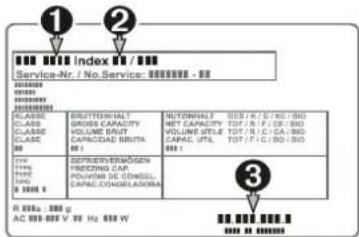
If none of the above causes apply and you cannot rectify the fault yourself, contact the nearest customer service department stating the type designation ①, index ② and appliance number ③ as indicated on the type plate. The type plate is located on the inside left of the appliance.
Shutting your appliance down
If your appliance is to be shut down for any length of time, switch it off and disconnect the plug or switch off or unscrew the fuse. Clean the appliance and leave the door open in order to prevent unpleasant smells.
The refrigerant circuit has been tested for leaks.
The appliance is radio-suppressed to EN 55014 and thus complies with EC Directive 87/308/EEC.
All types and models are subject to continuous improvement and the manufacturer therefore reserves the right to make modifications to the shape, equipment and technology.
top unit ① can be added. A gap of at least 50 mm depth must be provided behind and along the entire width of this unit so as to ensure sufficient ventilation. The area of ventilation underneath the ceiling should be at least 300 cm 2 .
When setting up the appliance next to a wall ④, a distance of approx. 50 mm must be provided on the hinge side between the appliance and the wall (for the handle when the door is open).
① top unit
② refrigerator/freezer
③ kitchen unit side panel
④ wall
![min.300 cm min.50 [mm] ① ② ③ ④ ca. 50](/content/2026/03/447589/images/ba1224e495ddcae7b655e69f2d8f8794b577de4d36fec8240b8f41e3ddddff63.jpg)
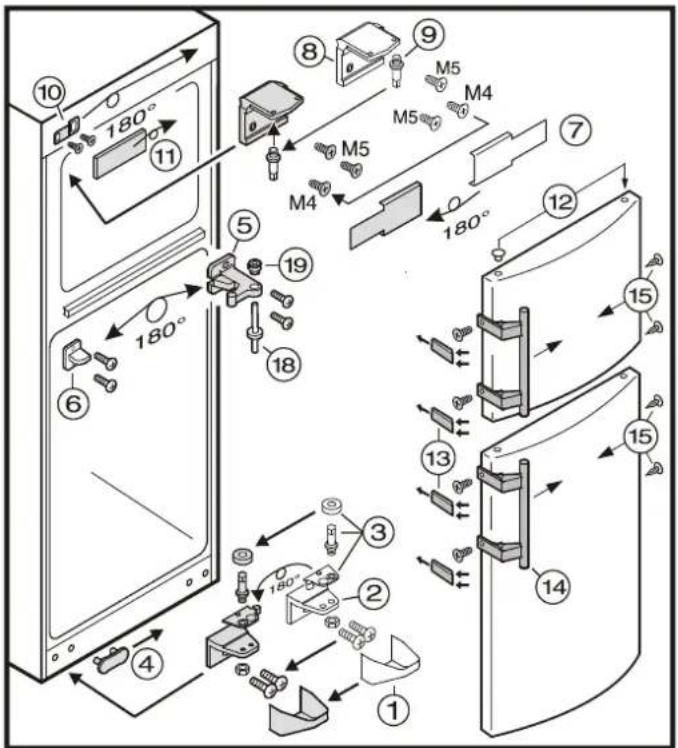
Changing over door hinges
- Remove cover ①.
- Unscrew hinge bracket②. Remove lower door.
- Transfer cover plate④ to the opposite side.
- Transfer hinge components ③ on the hinge bracket ② to the opposite side.
- Pull middle hinge pin ⑱ out from underneath. Remove upper door.
- Transfer plug(12).
- Unscrew hinge bracket⑤.
- Transfer cover ⑥ to the opposite side.
- Turn hinge bracket ⑤ through 180irc and screw into place.
- Remove mounting point (19) and insert from top.
- Remove cover ⑦.
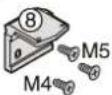
- Unscrew hinge bracket ⑧.
- Transfer pin ⑨ on hinge bracket ⑧ to the opposite side.
- Transfer angle ⑩ and cover ⑪ to the opposite side.
- Screw on hinge bracket ⑧ on the left-hand side of the appliance. Screw M4 must be screwed into the left-hand hole on the hinge bracket. The other two screws are M5 screws.
- Replace cover ⑦.
- Suspend upper door on hinge pin ⑨ and close.
- Slide middle hinge pin ⑱ into the door mounting from below through the hinge ⑤.
- Suspend lower door on hinge pin ⑤ and close.
- Insert hinge bracket ② in lower door mounting and screw into place.
- Click cover ① into place.
- Lever out pressure plates ⑬ at the front and slide away.
- Transfer door handles ⑭ and plugs ⑮ to the other side.
- Attach pressure plates⑬.
natural_image
Diagram of a mechanical assembly with two labeled components (1 and 2), showing no text or symbols beyond labels.Flessenrooster
natural_image
Simple line drawing of a multi-level storage cabinet or rack unit (no text or symbols)Binnenverlichting
Koelen
Indelingsvoorbeeld
① boter, kaas
natural_image
Diagram showing a tray with a lid and a grid of circular objects inside, no text or symbols present.Ontdooien
Koelgedeelte
natural_image
Diagram showing a mechanical assembly with a downward arrow indicating force or direction (no text or symbols present)Vriesgedeelte
natural_image
Diagram of a mechanical assembly with two labeled components (1 and 2), showing no text or symbols beyond labels.Range-bouteilles
natural_image
Simple line drawing of a two-tier refrigerator shelf with no text or symbolsEclairage intérieur
Réfrigération
natural_image
Diagram showing two labeled storage containers with a directional arrow indicating movement (no text or symbols present)Dégivrage
Réfrigérateur
natural_image
Diagram showing a mechanical assembly with a downward arrow indicating force or direction (no text or symbols present)s Congélateur
natural_image
Technical diagram of a mechanical assembly with two labeled components (1 and 2), showing no readable text or symbols.natural_image
Simple line drawing of a two-tiered storage cabinet or rack unit (no text or symbols)Raffreddamento
natural_image
Diagram showing a rack with a component and a grid of hexagonal cells, no text or symbols presentSbrinamento
Vano frigorifero
natural_image
Diagram showing a mechanical assembly with an arrow indicating direction (no text or symbols present)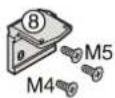
natural_image
Pure mechanical assembly diagram showing two labeled components (1 and 2) without any text or symbolsnatural_image
Architectural line drawing of a multi-level storage cabinet or rack unit (no text or symbols)Congelación
natural_image
Diagram showing a tray with a lid and an inset of a grid-patterned container (no text or symbols)Desescarche
Frigorífico
natural_image
Diagram showing a mechanical assembly with an arrow indicating direction (no text or symbols present)Congelador
natural_image
Diagram of a mechanical assembly with two labeled components (1 and 2), showing no text or symbols beyond labels.Prateleira de grelha para garrafas
natural_image
Simple line drawing of a two-tiered storage shelf with no text or symbolsIluminação interior
Refrigeração
natural_image
Diagram showing a rack with a component and a grid of circular wells, no text or symbols present.Descongelação
Frigorífico
natural_image
Diagram showing a mechanical assembly with layered components and an arrow indicating motion (no text or symbols)Congelador
natural_image
Mechanical assembly diagram showing two components with arrows indicating motion (no text or symbols)Σχάρα φιαλών
natural_image
Simple line drawing of a two-tier refrigerator shelf with no text or symbolsΕσωτερικός φωτισμός
Ψύξη
natural_image
Diagram showing two components: a tray with a lid and a grid of hexagonal cells inside, connected by an arrow (no text or symbols)Απόψυξη
Ψυγείο
natural_image
Diagram showing a mechanical assembly with a downward arrow indicating motion or force (no text or symbols present)Καταψύκτης
natural_image
Pure mechanical assembly diagram showing layered components with directional arrows (no text or symbols)Şişe saklama yeri
natural_image
Simple line drawing of a two-tier storage cabinet or rack unit (no text or symbols)İç aydınlatma
Soğutma
Yerleştirme örneği
natural_image
Diagram showing a tray with a lid and a grid of circular trays, no text or symbols presentBuzun eritilmesi
Soğutma Bölümü
natural_image
Diagram showing a mechanical assembly with an arrow indicating direction (no text or symbols present)Dondurucu Bölüm
Çalışmayı durdurmak



- Flaschenablagerost
- Innenbeleuchtung
- Kühlen
- Einordnungsbeispiel
- Abtauen
- Kühlteil
- Gefrierteil
- Disposal notes
- Climate rating
- Climate rating Ambient temperature
- Safety instructions and warnings
- Setting up
- Connecting to the mains
- Notes on energy saving
- Switching the appliance on and off
- To switch the appliance on:
- To switch the appliance off:
- Setting the temperature
- Freezer temperature display
- Audible warning on/off button
- Audible door alarm:
- Audible/visual temperature alarm:
- This can be caused by:
- Changing shelf arrangement
- Repositioning the door racks
- Bottle grid
- Interior light
- Cooling
- Storage example
- Note
- Refrigerating with fan
- Freezing
- You should not switch on the
- Superfrost function:
- Notes on freezing and storage
- Frozen food can be thawed in the following ways:
- Making ice cubes
- Defrosting
- Refrigerator compartment
- Freezer compartment
- Cleaning
- Malfunctions
- Installing appliance in a row of kitchen units
- You may be able to rectify the following faults by checking the possible causes yourself:
- Shutting your appliance down
- Changing over door hinges
- Flessenrooster
- Binnenverlichting
- Koelen
- Indelingsvoorbeeld
- Ontdooien
- Koelgedeelte
- Vriesgedeelte
- Range-bouteilles
- Eclairage intérieur
- Réfrigération
- Dégivrage
- Réfrigérateur
- s Congélateur
- Raffreddamento
- Sbrinamento
- Vano frigorifero
- Congelación
- Desescarche
- Frigorífico
- Congelador
- Prateleira de grelha para garrafas
- Iluminação interior
- Refrigeração
- Descongelação
- Σχάρα φιαλών
- Εσωτερικός φωτισμός
- Ψύξη
- Απόψυξη
- Ψυγείο
- Καταψύκτης
- Şişe saklama yeri
- İç aydınlatma
- Soğutma
- Yerleştirme örneği
- Buzun eritilmesi
- Soğutma Bölümü
- Dondurucu Bölüm
- Çalışmayı durdurmak
Brand : FRANKE
Model : FCT 4101 N XS
Category : Refrigerator