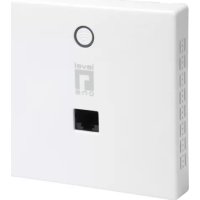
WAP8221 - Access Point LEVELONE - Free user manual and instructions
Find the device manual for free WAP8221 LEVELONE in PDF.


| Product type | Wi-Fi Access Point |
| Brand | LevelOne |
| Model | WAP8221 |
| Network interface | 1 LAN port 10/100 Mbps, 1 WAN/PoE port 10/100 Mbps |
| Power supply | PoE IEEE 802.3af (48 V DC) via PoE adapter (sold separately) |
| Default IP address | 192.168.188.253 |
| Default username | admin |
| Default password | admin |
| Physical button | Multi-function button (enable/disable SSID, reset) |
| LED indicator | SYS LED (solid green: SSID enabled, off: SSID disabled, blinking blue: reset) |
| Main function | Wi-Fi range extender, wireless access point |
| Configuration | Web interface (browser) via default IP address |
| Reset | Press the Reset button for 10 to 12 seconds |
| Security | Wireless security protocol configurable via web interface |
| Maintenance | Clean with a soft, dry cloth; do not use chemicals |
| Reparability | Spare parts not available; contact LevelOne support |
| Operating temperature | 0 °C to 40 °C (estimated) |
Frequently Asked Questions - WAP8221 LEVELONE
User questions about WAP8221 LEVELONE
0 question about this device. Answer the ones you know or ask your own.
Ask a new question about this device
Download the instructions for your Access Point in PDF format for free! Find your manual WAP8221 - LEVELONE and take your electronic device back in hand. On this page are published all the documents necessary for the use of your device. WAP8221 by LEVELONE.
USER MANUAL WAP8221 LEVELONE
Quick Installation Guide
(WAP-8221)

V1.2
Digital Data Communications GmbH, Germany. http://www.level1.com
Table of Content
English 1
Deutsch 5
Francais. 9
Espanol. 13
Portugues. 17
Italiano 21
Appendix
Figure 1. 25
Figure 2. 25
Figure 3. 26
Figure 4. 26
Figure 5 (Product Dimensioning Diagram). 27
Figure 6 (Unplug product shell Dimensioning Diagram).28
Package Contents
- Screw Kit
- Quick Installation Guide
- Resource CD (User Manual, QIG)
English
Default Settings
| IP Address | 192.168.188.253 |
| User name | admin |
| Password | admin |
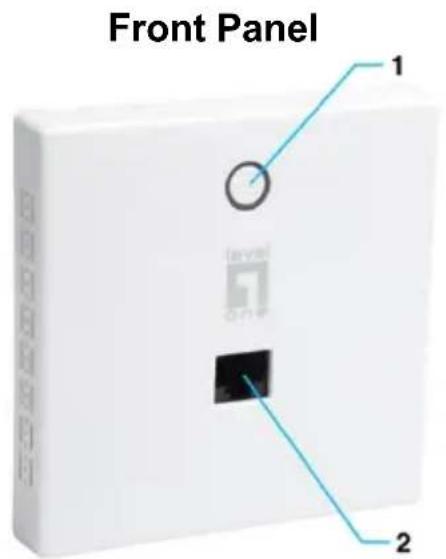
Connections :
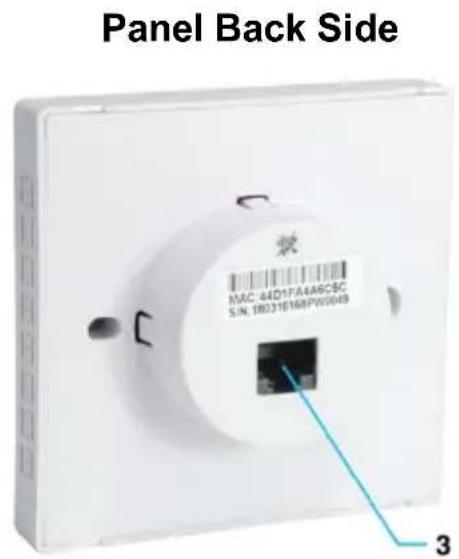
- WIFI SSID Broadcast ON/OFF, Reset to Defaults
- LAN Port
- WAN/POE Port
Button Light State
| Task to be Performed | Time Period of Pressing Button | SYS LED Behavior |
| WIFI SSID Broadcast ON | 0 ~ 1 seconds | ON Green |
| WIFI SSID Broadcast OFF | 0 ~ 1 seconds | Light off |
| Reset to Defaults | 10 ~ 12 seconds | Blinking Green |
Installation
| LED/Button/Interface | Description |
| WIFI SSD Broadcast ON/OFF | To turn on or off the WIFI SSD Broadcast |
| Reset to Defaults | With the AP powered on, press the Reset button for 10 ~ 12 seconds until the Signal Strength LED blink faster than ever. The AP will restart itself and reset the device to factory default settings. |
| LAN port | The LAN port is used to connect to network devices, such as a switch or PC / NB |
| WAN/POE Port | The WAN/POE port is used to connect to network devices, such as a POE switch OR POE adapter to power the device (IEEE802.3af) 48 VDC. (POE adapter unit is to be ordered separately) |
Hardware Installation
Power on the Device.
- Plug one end of your Ethernet cable into the WAN port of the AP, and the other end into a port on a PoE switch or a 802.3af PoE adapter.
Configuring the Device
To set up and manage the AP, you can use one of the following methods:
- Connect the access point and your computer to the same PoE switch. Manage the access point from the computer. (Figure 1)
Software Installation
To login to the LevelOne AP, please perform the following steps:
- Check Your Network Settings to login web UI.
Please make sure your PC can get IP address automatically, so the router can communicate with your PC during configuration.
- Select "Control Panel" > "Network Connections".
- Right click the "Local Area Connection" and choose "Properties".
- Select the TCP/IP protocol for your network card.
-
Change the IP Address of PC: To configure the IP Address, click the network icon to open the Ethernet dialog to configure the IP Address. Select "Properties", choose "Internet Protocol (TCP/IP)" and select "Properties". Input the IP Address "192.168.188.2 ~ 192.168.188.250" and continue. (Figure 2)
-
Launch a Web browser (Microsoft Internet Explorer 8 for example), enter the AP's default LAN IP address 192.168.188.253 in the address bar, and then press Enter, as shown in the following picture. (Figure 3)
-
Then enter the default user name of admin and password of admin in the User Name and Password fields, click "OK" to access the AP's Web GUI. (Figure 4)