Geovid 42 BRF - Binoculars LEICA - Free user manual and instructions
Find the device manual for free Geovid 42 BRF LEICA in PDF.



| Product type | Binoculars with laser rangefinder |
| Brand | Leica |
| Model | Geovid 42 BRF |
| Magnification | 8x or 10x depending on version |
| Objective diameter | 42 mm |
| Exit pupil | 5.25 mm (8x42) / 4.2 mm (10x42) |
| Field of view at 1000 m | 125 m (7.1°) for 8x42 / 110 m (6.3°) for 10x42 |
| Diopter adjustment | ± 3.5 diopters |
| Minimum measuring distance | 10 m / yds |
| Maximum range | Approx. 1200 m / 1300 yds |
| Measuring accuracy | ± 1 m up to 350 m, ± 2 m up to 700 m, ± 0.5% beyond |
| Power supply | 1 lithium 3V battery type CR2 |
| Battery life | Approx. 500 measurements at 20°C |
| Waterproof | Up to 5 m depth (0.5 bar) |
| Operating temperature | -15°C to +55°C |
| Dimensions (L x H x D) | Approx. 124 x 174 x 65 mm |
| Weight (incl. batteries) | Approx. 930 g |
| Housing material | Die-cast aluminum |
| Care and cleaning | Clean with a soft, lint-free cloth; rinse with running water if necessary |
| Safety | Class 1 laser, harmless to the eyes |
| Supplied accessories | Carrying strap, case, protective caps, objective covers, CR2 battery, warranty card |
| Spare parts available | Tripod adapter (ref. 42 220), orange floats strap (ref. 42 163) |
Frequently Asked Questions - Geovid 42 BRF LEICA
User questions about Geovid 42 BRF LEICA
0 question about this device. Answer the ones you know or ask your own.
Ask a new question about this device
Download the instructions for your Binoculars in PDF format for free! Find your manual Geovid 42 BRF - LEICA and take your electronic device back in hand. On this page are published all the documents necessary for the use of your device. Geovid 42 BRF by LEICA.
USER MANUAL Geovid 42 BRF LEICA
Designation of parts
1.Eyepiececups
Position a: Unscrewed for viewing without glasses
Position b: Screwed in for viewing with glasses
- Central focusing dial
- Dioptrc compensation dial with a. Scale
- Eyelets for carrying strap
- Release button for distance metering
- Laser transmission optics
- Dioptre compensation for target mark with a. Scale
- Hinged axis for adjustment of eye spacing
- Battery compartment
- Battery compartment cap
Scope of delivery
- Binoculars
- 1 lithium cell 3 V Type CR 2
- Carrying strap
Ever ready case - Eyepiece cover
- 2 lens covers
- Guarantee Card
Foreword
Dear customer
Throughout the world, the name Leica stands for premium quality, precision mechanics, excellent reliability and long service life.
We wish you a great deal of enjoyment and success with your new Leica Geovid BRF binoculars.
To ensure that you can use them correctly, we recommend that you read this manual first.
Contents
Designation of parts. 15
Scope of delivery 15
Foreword 15
Possible applications 17
Attaching the carrying strap and the eyepiece cover 17
Attaching the lens covers 17
Inserting and changing the battery 18
Battery charge level 19
Adjusting the eyepiece cups / Using with and without glasses 20
Adjusting the eyebase 20
Setting the focus / Dioptre compensation. 21
Distance metering 22
Scan mode 23
Metering range and accuracy 23
Maintenance / cleaning 24
Accessories 24
Spare parts 24
Troubleshooting 25
Technical data 26
Leica Academy 27
Leica on the Internet 27
Leica info service 27
Leica customer Care 27
Warning notice: As with all binoculars, to prevent damaging the eyes avoid using your Leica Geovid BRF to look directly at bright sources of light.
Possible applications
The Leica Geovid BRF binoculars have a robust aluminium housing, allowing them to be used even under adverse conditions. This means that you do not have to worry about them getting wet - they are absolutely waterproof to a depth of 5m and there is no fogging in the internal optical system thanks to a nitrogen filling.
Attaching the carrying strap and the eyepiece cover
If you want to attach the eyepiece cover to the carrying strap, you must thread the strap through the eyelet on the eyepiece cover before you attach the carrying strap to the left-hand side of the binoculars.
Attaching the lens covers
To fit the two lens covers, place the rubber rings of the covers over the binocular tubes from the lens side so that the covers open downwards.
Inserting and changing the battery
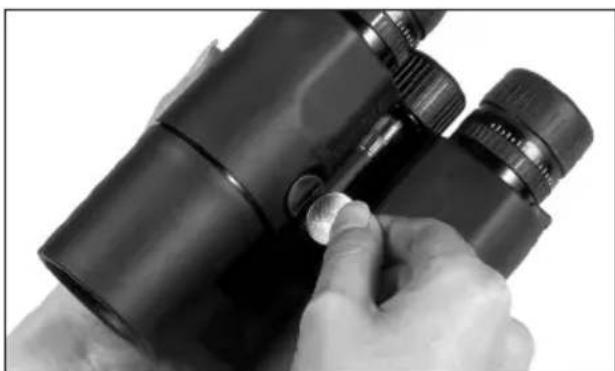
The Leica Geovid BRF binoculars are supplied with power by one 3 Volt lithium cell (e.g. Duracell DL CR2, Ucar CR2, Varta CR2, or otherCR2 types).
- Open the battery compartment (9) cover (10) by turning it anticlockwise, with a coin for example.
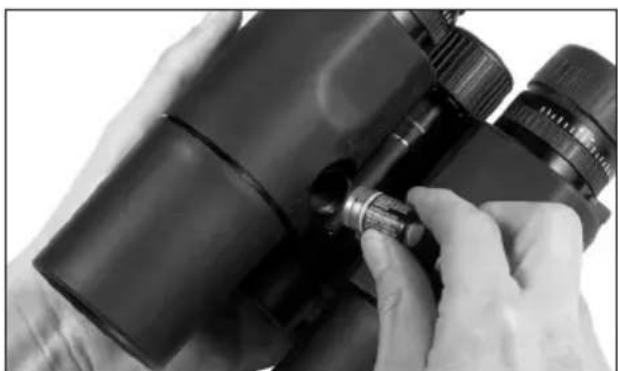
- Insert the battery with its positive contact facing forwards (as marked in the battery compartment).
- Close the cover again by turning it clockwise.
Notes:
- Batteries should be stored in a cool dry place.
- If the binoculars are not going to be used for a long time, the battery should be removed.
Warning:
- Batteries should never be put in a fire, heated, recharged, disassembled, or broken apart.
- Used batteries may not be disposed of as normal, household waste as they contain hazardous materials that are harmful to the environment. To ensure that they are properly recycled, they should be returned to the dealer or disposed of as special waste (at a collection point).
Battery charge level
A new battery is sufficient for more than 500 measurements at 20^ .
Depending on the conditions of use, the battery life can be significantly shorter or longer than this. Low temperatures and frequent use of the scan mode (see p. 23) shorten the battery life.
A flat battery is indicated by a flashing measured value and target display. Once this flashing starts, around 50 more measurements are possible, but with a continuously reduced range.
Warning: Cold conditions impair the battery performance. At low temperatures, the Leica Geovid BRF should therefore be carried close to the body and used with a fresh battery.
Adjusting the eyepiece cups / Using with and without glasses
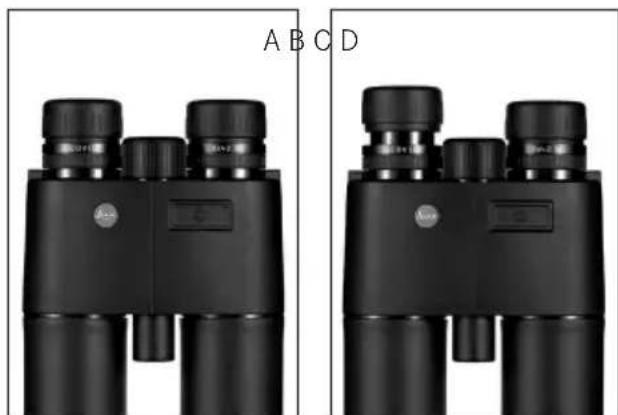
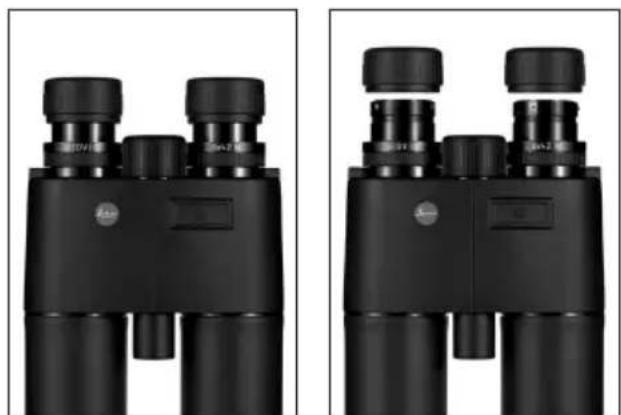
The eyepiece cups (1) can easily be adjusted by turning them and lock securely into the selected position. They can also be completely removed for thorough cleaning.
For viewing with glasses (Figure A), they remain in their fully screwed in position.
For viewing without glasses, they are unscrewed by turning them anticlockwise. Two positions are available for optimum adjustment (Figures B, C).
If the eyepieces are very dirty, it is recommended that the eyepiece cups are removed for cleaning (Figure D). To do this, they are removed by pulling them slightly when in their fully unscrewed position.
Adjusting the eyebase
The individual eyebase is adjusted by bending the binoculars around the hinged axis (8). The right and left fields of view must merge into a circular field.
Dioptrc compensation
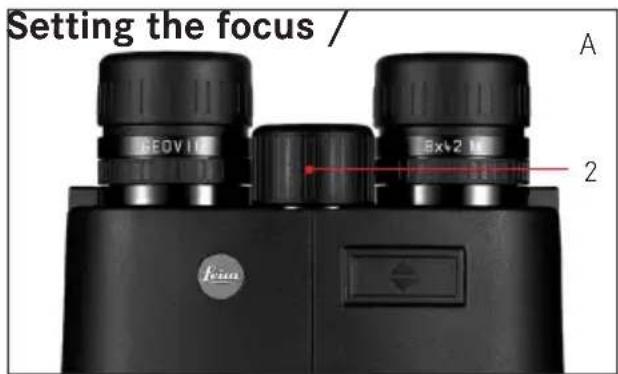
On the Leica Geovid BRF binoculars, the focus is set for objects different distances using the central focusing dial (2).
The two dioptre compensation dials (3/7) are used to compensate for individual vision defects for viewing without glasses and for focusing on the target mark.
Run carefully through the steps described below. You will then be able to fully utilize the optical capabilities of the binoculars.
- Turn both dioptre compensation dials to their zero positions.
- While viewing with both eyes, focus on a distant object using the central focusing dial.
- Now press the release button (5) to activate the
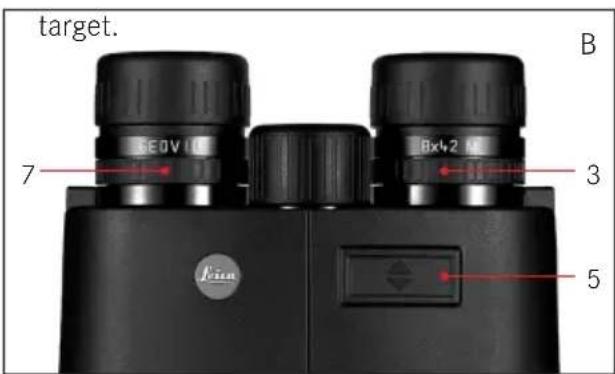
- Once the target appears, while continuing to view with both eyes adjust the right-hand dioptre compensation dial (7, red index) so that the target is in focus in the right-hand optical field.
- Then, with the target still activated but now viewing with the right eye only, use the central focusing dial for fine focusing of the image in the right-hand tube.
- Then adjust the image in the left-hand tube to optimum focus using the left-hand dioptre dial (3).
You can read off the set n^ + and n^ - values on the dioptrc scales (3a/7a).
Note: When looking through the binoculars with the right or left eye only, the other eye should be kept tightly shut, or simply place your hand in front of the lens on the other side of the binoculars.
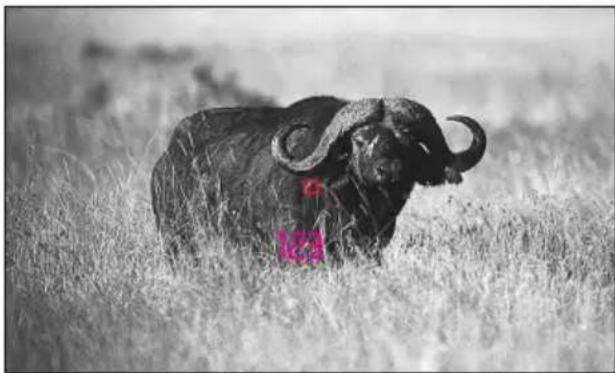
Distance metering
To measure the distance to an object, you must lock onto it precisely. To do this, activate the target mark by pressing the release button (5) once. Once the button is released, the target mark remains illuminated for around another 4 s. If the button is held down, the target marker is illuminated continuously. While it is illuminated, lock onto the object and carry out the distance metering by pressing the release button again. The measured value is then displayed. The target mark disappears briefly during metering.
You can start a new measurement at any time by pressing the release button again, as long as the target mark is illuminated.
If the object distance is less than 10 meters / yards or if the range is exceeded or the object does not reflect sufficient light, the display shows
When the display goes out, the distance meter is automatically deactivated.
Notes:
Depending on the angle of the optical systems to each other, i.e. the set interpupillary distance, the displays may appear slightly slanted.
- The Leica Geovid BRF binoculars are available in different versions displaying the distance in meters or yards. Externally, the different versions can be recognised by the information on the cover of the central focusing dial.
Scan mode
The Leica Geovid BRF binoculars can also be used for continuous metering. If you hold down the release button (5) after the second press, after approx. 0.5 s the binoculars switch to this scan mode and then perform constant metering. This can be identified by the changing display: A new measured value is output approx. every 1.5 s.
Scan mode is particularly practical when metering small targets.
Notes:
- Scan mode consumes more power than individual metering due to the constant metering.
- Scan mode automatically shuts down after 10 s, to preserve the battery in case the button is pressed accidentally.
Metering range and accuracy
The Leica Geovid BRF binoculars have a metering accuracy of up to ± 1 meter / yard.
The maximum range is achieved with highly reflective target objects and visibility of 10km . The metering range is influenced by the following factors:
Range Higher Lower
| Colour of object | White | Black |
| Angle to object | Vertical | Acute |
| Object size | Large | Small |
| General brightness (cloudy) | Low | High |
| Atmospheric conditions | Clear | Hazy |
| Homogeneous | Inhomogeneous | |
| Object structure | (building wall) | (bush, tree) |
With sunshine and good visibility, the ranges and accuracies are as follows:
| Range | 10 m/yds up to approx. 1200 m/1300 yds |
| Accuracy | ±1 m/yd up to 350 m/380 yds |
| ±2 m/yds up to 700 m/763 yds | |
| ±0.5 % above 700 m/763 yds |
Maintenance / Cleaning
Your Leica Geovid BRF binoculars do not require any special maintenance. Coarse dirt particles, such as sand, should be removed with a fine hair brush or blown away. Fingerprints etc. on lenses or eyepieces can be wiped off with a soft, clean leather or dust-free cloth. For heavy soiling, e.g. to the rotating eyepiece cups, the binoculars can be cleaned by simply rinsing them under running water. Saltwater can be rinsed off in the same way.
Warning: Do not exert excessive pressure when wiping heavily soiled lens surfaces. Although the coating is highly resistant to abrasion, sand or salt crystals can still damage it.
As well as its type designation, each set of Leica Geovid BRF binoculars have their „personal“ serial number. Make a note of this number in your documents for security.
Accessories Order no.
Tripod adapter with 1 / 4 " thread. 42 220
Swimming carrying strap, orange. 42 163
Spare parts
If you should require any spare parts for your binoculars, e.g. eyepiece cups, covers or carrying strap, please contact our Customer Care department (for address, see p. 27) or the Leica office in your country (see Warranty Card for addresses).
Troubleshooting
Fault Cause Remedy
| Circular field is not achieved a) The binoculars are not a) Simply correct the during viewing correctly adjusted to eyebase of the two personal eye base. binocular tubes by bending the hinged axis inwards or outwards. | ||
| b) The viewer's pupil is not in b) Correct head, eye and the binoculars' exit pupil. binocular position. | ||
| c) The position of the eyepiece cups does not match the correct use with and without glasses. | c) Correct adjustment: If wearing glasses, screw in eyepiece cups; for viewing without glasses: unscrew eyepiece cups. | |
| Image out of focus is not accurate | Dioptré compensation compensation (see p. 21) | Repeat dioptre |
| During distance metering, the a) Object too close or metering range exceeded | Note information on metering range (see p. 23) | |
| b) The object is insufficiently reflective | ||
| Display is flashing or metering not possible | Battery flat | Replace battery (see p. 18) |
Technical Data
LEICA GEOVID 8x42 BRF LEICA GEOVID 10x42 BRF
| Magnification | 8x | |
| Lens diameter | 42 mm | |
| Exit pupil | 5.25 mm | 4.2 mm |
| Twilight number | 18.33 | |
| Geometric luminous intensity | 27.56 | 17.64 |
| Field of view (at 1000m/yds) | 125 m/yds/7.1° | 110 m/yds 6.3° (wide angle) |
| Close range limit (at 0 dioptres) approx. 5.6 m/18'4" approx. 5.6 m/18'4" | ||
| Exit pupil longitudinal distance | 18.5 mm | 15.6 mm |
| Pupil distance | 56-74 mm | |
| Prism type | Roof | |
| Coating | ||
| on lenses High Durable Coating (HDC™) | ||
| on prisms Phase correction coating P40 | ||
| Dioptre compensation approx. ± 3.5 dioptres | ||
| Suitable for wearers of glasses | Yes | |
| Operating temperature -15°C/5°F – +55°C/+131°F | ||
| Storage temperature -40°C/-40°F – +85°C/+185°F | ||
| Water tightness 0.5 bar (approx. 5 m water depth) | ||
| Housing material Die cast aluminium | ||
| Maximum range approx. 1200 m / 1300 yds | ||
| Minimum distance | 10 m/yds | |
| Metering accuracy | ±1 m/yd up to 350 m/380 yds | |
| ±2 m/yds up to 700 m/ 763 yds | ||
| ±0.5% above 700 m / 763 yds | ||
| Display | 4-digit LED | |
| Battery | 1 lithium cell 3V Type CR 2 | |
| \( Battery life^1 \) | ± 500 measurements | |
| Laser | Safe for eyes to EN and FDA Class 1 | |
| Laser beam divergence | 2.5 x 0.5 mrad | |
| Maximum metering duration | approx. 1.4 s | |
| Dimensions (W2 x H3 x D2) | approx. 124 x174 x65 mm | |
| Weight (including battery) | approx. 930 g | |
At 20^ and average usage profile 2 With eye spacing 65mm 3 With eyepiece cups screwed in
Leica Academy
Our seminars offer participants practical information on the Leica world of values and the fascination of skilled use of Leica products. Course programs are application-oriented and informative. They offer a wealth of practical suggestions, help, and advice. More details, along with the current program of seminars, are available from:
Leica Camera AG
Leica Akademie
Oskar-Barnack Str. 11
D-35606 Solms
Tel.: +49 (0) 6442-208-421
Fax: +49 (0) 6442-208-425
e-mail: la@leica-camera.com
Leica Information Service
Should you have any technical questions regarding the use of Leica products, the Leica Information Service will be happy to answer in writing or by phone, fax, or e-mail:
Leica Camera AG
For service of your Leica equipment and in case of necessary repairs please contact the customer Care of Leica Camera AG or of any national Leica agency (see warranty card for address list). Ask your authorized dealer and Leica specialist for advice.
Leica Camera AG
Customer Care
Chere cliente, cher client,

- Designation of parts
- Scope of delivery
- Foreword
- Contents
- Possible applications
- Attaching the carrying strap and the eyepiece cover
- Attaching the lens covers
- Inserting and changing the battery
- Notes:
- Warning:
- Battery charge level
- Adjusting the eyepiece cups / Using with and without glasses
- Adjusting the eyebase
- Dioptrc compensation
- Distance metering
- Scan mode
- Metering range and accuracy
- Maintenance / Cleaning
- Accessories Order no.
- Spare parts
- Troubleshooting
- Fault Cause Remedy
- Technical Data
- Leica Academy
- Leica Information Service
Brand : LEICA
Model : Geovid 42 BRF
Category : Binoculars