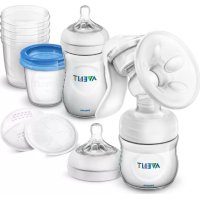
AVENT SCD221 - Breast pump PHILIPS - Free user manual and instructions
Find the device manual for free AVENT SCD221 PHILIPS in PDF.



| Product type | Manual breast pump |
| Brand | Philips |
| Model | AVENT SCD221 |
| Dimensions (approx.) | 20 x 15 x 10 cm |
| Weight (approx.) | 200 g |
| Power source | Manual (no batteries or mains) |
| Materials | BPA-free plastic, silicone |
| Capacity of included bottle | 125 ml |
| Main functions | Breast milk expression, adaptive massage cushion, ergonomic handle |
| Care and cleaning | Hand wash or dishwasher (top rack); steam sterilization or boiling water for 5 min |
| Safety | Do not use while pregnant; check before each use; do not leave unattended |
| Spare parts available | Massage cushion, valve, diaphragm, bottles, nipples, caps |
| Repairability | Individually replaceable parts |
| General information | Compatibility with Philips Avent bottles; single-person use; BPA-free |
Frequently Asked Questions - AVENT SCD221 PHILIPS
User questions about AVENT SCD221 PHILIPS
0 question about this device. Answer the ones you know or ask your own.
Ask a new question about this device
Download the instructions for your Breast pump in PDF format for free! Find your manual AVENT SCD221 - PHILIPS and take your electronic device back in hand. On this page are published all the documents necessary for the use of your device. AVENT SCD221 by PHILIPS.
USER MANUAL AVENT SCD221 PHILIPS
natural_image
Illustration of a medical manual pump device with AVENT brand logo and Philips branding (no text or symbols on the device itself)
natural_image
Diagram of a folded paper or document with two panels, each showing an open door and a curved arrow indicating rotation (no text or symbols)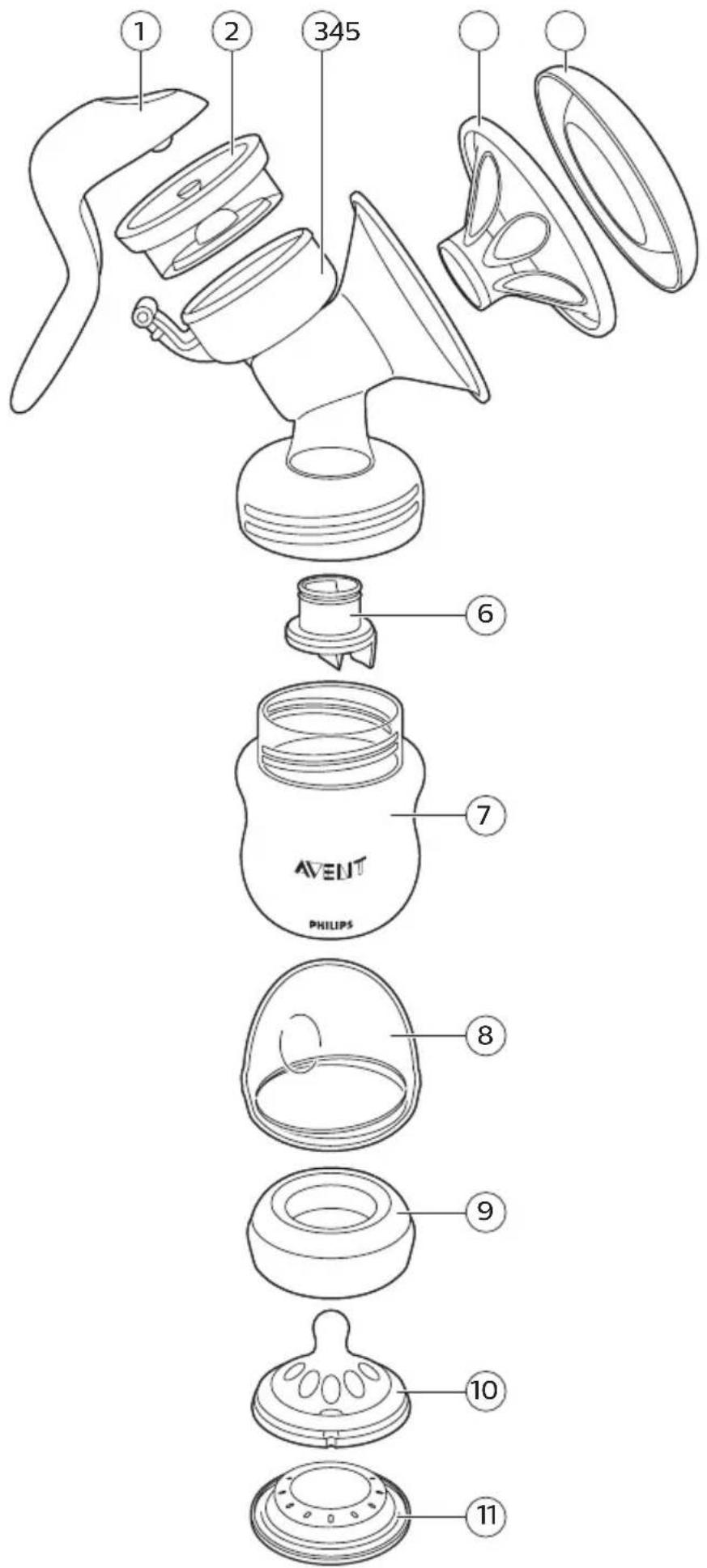
SCF330/50
SCF330/13
SCD221/00
English 6
Dansk 14
Deutsch 22
Español 31
Français 39
Italiano 49
Nederlands 56
Norsk 65
Português 73
Suomi 82
Svenska 90
Ελληνικά 98
הכלה 114
Introduction
Congratulations on your purchase and welcome to Philips Avent! To fully benefit from the support that Philips Avent offers, register your product at www.philips.com/welcome.
The Philips Avent manual breast pump has a unique design that enables you to sit in a more comfortable position while expressing. The soft massage cushion* is designed to feel soft and warm and imitates your baby's sucking action to provide fast milk flow - quietly, comfortably and gently. The pump is compact, easy to assemble and all parts are dishwasher-safe and BPA-free. Healthcare professionals say that breast milk is the best nutrition for babies during the first year, combined with solid food after the first 6 months. Your breast milk is specially adapted to your baby's needs and contains antibodies which help protect your baby against infection and allergies. A breast pump can help you to breastfeed longer. You can express and store your milk so that your baby can still enjoy the benefits of it, even if you cannot be there to provide it yourself. As the pump is compact and discrete to use, you can take it with you anywhere, allowing you to express milk at your own convenience and maintain your milk supply.
*The massage cushion included with this pump was designed to comfortably fit the majority of mothers. However, should you need it, you can buy a massage cushion for larger nipples separately.
General description (Fig. 1)
1 Handle
2 Silicone diaphragm with stem
3 Pump body
4 Massage cushion
5 Cover
6 White valve
7 Philips Avent Natural bottle (except SCF330/13)
8 Cap (except SCF330/40)
9 Screw ring
10 Teat (except SCF330/40)
11 Sealing disc (except SCF330/13)
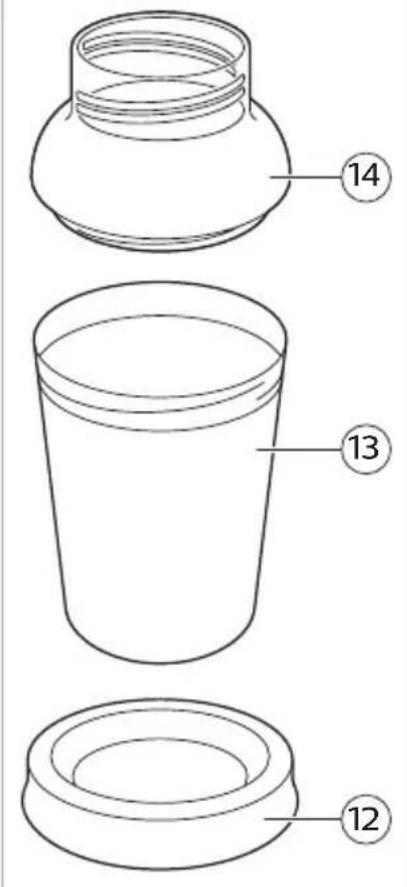
12 Lid of storage cup (SCF330/13, SCD221/00 only)
13 Philips Avent storage cup (SCF330/13, SCD221/00 only)
14 Adapter ring (SCF330/13, SCD221/00 only)
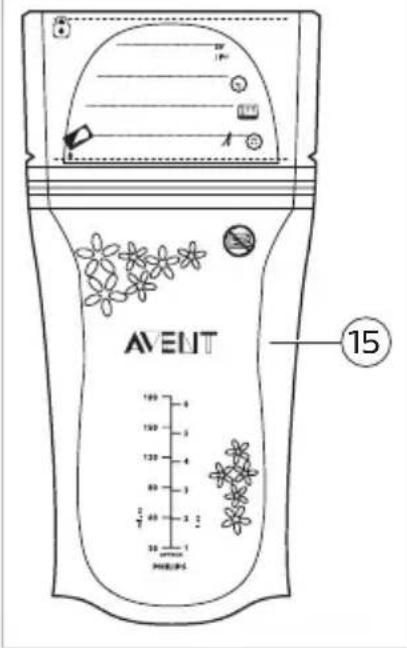
15 Breast milk storage bags (SCF330/50 only)
Intended use
The Philips Avent manual breast pump is intended to express and to collect milk from the breast of a lactating woman. The device is intended for a single user.
Important safety information
Read this user manual carefully before you use the breast pump and save it for future reference.
Contraindication
- Never use the breast pump while you are pregnant, as pumping can induce labor.
Warning
- This breast pump is not intended for use by persons (including children) with reduced physical, sensory or mental capabilities, or lack of experience and knowledge, unless they have been given supervision or instruction concerning use of the product by a person responsible for their safety.
- Children should be supervised to ensure that they do not play with the breast pump.
- Inspect the breast pump for signs of damage before each use. Do not use the breast pump if it does not work properly.
-Never use the breast pump while you are sleepy or drowsy. - Do not expose the breast pump to extreme heat and do not place it in direct sunlight.
- If you are a mother who is infected with Hepatitis B, Hepatitis C or Human Immunodeficiency Virus (HIV), expressing breast milk will not reduce or remove the risk of transmitting the virus to your baby through your breast milk.
Philips Avent storage cups, Natural bottle, cap, screw ring and teat
For your child's safety and health
WARNING!
-Always use this product with adult supervision.
-Continuous and prolonged sucking of fluids will cause tooth decay.
-Always check the food temperature before feeding.
- Do not allow children to play with small parts or walk/run while using bottles or cups.
-The bottle may break if dropped.
-For glass bottles: Glass bottles may break.
Do not place the bottle or storage cups in a hot oven or on any other hot surface.
-Never use feeding teats as a soother, to prevent choking hazard.
- Inspect the bottle and feeding teat before each use and pull the feeding teat in all directions to prevent a choking hazard. Throw away at the first signs of damage or weakness.
- Do not leave a feeding teat in direct sunlight or heat, or leave in disinfectant (sterilizing solution) for longer than recommended, as this may weaken the teat.
-Keep all components not in use out of the reach of children.
-Clean and disinfect before each use.
Philips Avent breast milk storage bags (SCF330/50 only)
Warnings to prevent harm to children:
-Keep the breast milk bags out of the reach of children.
-Always check the temperature of the milk before you feed your baby.
- To prevent the milk from overheating, do not defrost the breast milk bag with breast milk in the microwave, in freshly boiled water or in a bottle warmer.
Warnings to avoid poisoning and contamination and to ensure hygiene:
-The breast milk storage bags are intended for single-use only.
- Thoroughly wash your hands before you fill and empty the breast milk bags.
- Never refreeze breast milk or add fresh breast milk to already frozen breast milk.
- You can store the breast milk in the refrigerator for up to 48 hours (not in the door) or in the freezer for up to 3 months.
Caution
-The breast pump is only intended for repeated use by a single user.
-Never drop or insert any foreign object into any opening.
- Never use any accessories or parts from other manufacturers or that Philips Avent does not specifically recommend.
-Wash, rinse and disinfect all pump parts before each use.
- Do not use antibacterial or abrasive cleaning agents when you clean breast pump parts.
- Do not continue pumping for more than five minutes at a time if you do not succeed in expressing any milk.
- If the pressure generated is uncomfortable or causes pain, break the seal between the breast and the pump body with your finger and remove the pump from your breast.
Preparing for use
Clean and disinfect all parts of the breast pump before first use in the correct way (see 'Cleaning and disinfection'). Clean all parts after each subsequent use and disinfect all parts before each subsequent use.
Assembling the breast pump
Note: Make sure you have cleaned and disinfected all parts of the breast pump. Wash your hands thoroughly before you handle cleaned parts.
Warning: Be careful, the cleaned parts may still be hot. Only start assembling the breast pump when cleaned parts have cooled down.
Tip: You may find it easier to assemble the breast pump while it is wet.
1 Insert the white valve into the pump body from underneath. Push the valve in as far as possible (Fig. 2).
2 Screw the pump body clockwise onto the bottle (Fig. 3) or storage cup (Fig. 4) until it is securely fixed.
Note: If you use a storage cup, you have to screw the adapter ring onto the storage cup first (Fig. 4).
3 Insert the silicone diaphragm into the pump body from above. Make sure it fits securely around the rim by pressing down with your fingers to ensure a perfect seal (Fig. 5).
4 Attach the handle onto the diaphragm with stem by hooking the hole in the handle over the end of the stem. Push down the handle onto the pump body until it clicks into place (Fig. 6).
5 Place the massage cushion into the funnel-shaped section of the pump body (Fig. 7). Push in the inner part of the massage cushion as far as possible and make sure that it is perfectly sealed all around the rim of the pump body (Fig. 8). Press in between the petals to remove any trapped air (Fig. 9).
Note: Place the cover over the massage cushion to keep the breast pump clean while you prepare for expressing.
Warning: Always use the breast pump with a massage cushion.
Using the breast pump
When to express milk
If breastfeeding goes well, it is advisable (unless advised otherwise by your healthcare professional/breastfeeding advisor) to wait until your milk supply and breastfeeding schedule are established (normally at least 2 to 4 weeks after giving birth) before you start expressing.
Exceptions:
- If breastfeeding does not go well immediately, expressing regularly can help to establish and maintain your milk supply.
-If you are expressing milk for your baby to be given in hospital. - If your breasts are engorged (painful or swollen), you can express a small amount of milk before or between feeds to ease the pain and to help your baby latch on more easily.
- If you have sore or cracked nipples, you may wish to express your milk until they are healed.
- If you are separated from your baby and wish to continue to breastfeed when you are reunited, you should express your milk regularly to stimulate your milk supply.
You need to find the optimum times of the day to express your milk, for example just before or after your baby's first feed in the morning when your breasts are full, or after a feed if your baby has not emptied both breasts. If you have returned to work, you may need to express during a break. Using a breast pump requires practice and it may take several attempts before you succeed. Fortunately, the Philips Avent manual breast pump is easy to assemble and use so you will soon get used to expressing with it.
Tips
- Familiarize yourself with the breast pump and how to operate it before you use it for the first time.
- Choose a time when you are not in a rush and will not be interrupted.
-A photograph of your baby can help encourage the 'let-down' reflex. - Warmth can also help: try to express after a bath or shower, or place a warm cloth or Philips Avent Thermopad on the breast for a few minutes before you start expressing.
- You may find it easier to express while your baby is feeding from the other breast, or immediately after a feed.
- If expressing becomes painful, stop and consult your breastfeeding advisor or healthcare professional.
Operating the breast pump
1 Wash your hands thoroughly and make sure your breasts are clean.
2 Relax in a comfortable chair (you may wish to use cushions to support your back). Make sure you have a glass of water nearby.
3 Press the assembled pump body against your breast. Make sure that your nipple is centered, so that the massage cushion creates an airtight seal.
Note: Make sure that your nipple fits correctly in the massage cushion (Fig. 10). Not too tight, it is important that the nipple can move freely, while expressing breast milk (Fig. 11). The massage cushion should not be too large, because this can cause pain or less effective expression (Fig. 12). If the cushion is not the right size for your nipples, you can purchase a cushion of a different size separately. Two cushion sizes are available: 19.5 mm and 25 mm. You can find the size of the cushion (19.5 or 25 mm) on the cushion itself (Fig. 13).
4 Gently start to press down the handle until you feel the suction on your breast (Fig. 14). Then allow the handle to return to its resting position.
Note: You do not have to press down the handle fully, only as much as is comfortable. Your milk will soon start flowing, even though you are not using all the suction the pump can generate.
5 Repeat step 4 rapidly 5 or 6 times to initiate the 'let-down' reflex.
Warning: Do not continue pumping for more than five minutes at a time if you do not succeed in expressing any milk. Try to express at another time during the day.
6 Adopt a slower rhythm by pressing down the handle and keeping it pressed down for up to 3 seconds before you let it return to its resting position. Continue in this way while your milk is flowing. If your hand becomes tired, try to use the other hand to operate the breast pump or rest your arm across your body to pump from the opposite breast.
Note: Do not worry if your milk does not flow immediately. Relax and continue pumping. Repositioning the breast pump on your breast from time to time can help stimulate milk flow.
7 On average, you need to pump for 10 minutes to express 60-125 ml (2-4 fl oz) of breast milk from one breast. However, this is just an indication and varies from woman to woman.
8 When you have finished expressing, carefully remove the breast pump from your breast and unscrew the bottle or storage cup from the pump body, ready for feeding or storage. Clean the other used parts of the breast pump.
Note: If you regularly express more than 125 ml per session, you can purchase and use a 260 ml (9 fl oz) Philips Avent bottle to prevent overfilling and spillage.
After use
Storing breast milk
Warning: Only store breast milk collected with a clean and disinfected pump.
Breast milk can be stored in the fridge (not in the door) for up to 48 hours. Expressed milk should be refrigerated immediately. If you store milk in the fridge to add to during the day, only add milk that has been expressed into a clean and disinfected bottle or breast milk container. Breast milk can be stored in the freezer for up to three months as long as it is kept in either disinfected bottles fitted with a disinfected screw ring and sealing disc or in disinfected storage cups with a disinfected lid. Clearly label the bottle or storage cup with the date and time of expression and use older breast milk first.
If you intend to feed your baby with the expressed breast milk within 48 hours, you can store the breast milk in the fridge in an assembled Philips Avent bottle or storage cup. Unscrew the bottle or storage cup and remove it from the pump body.
1 Insert a disinfected sealing disc into a disinfected screw ring and screw this onto the bottle (Fig. 15). Seal the teat with the cap.
2 Assemble a disinfected teat and screw ring onto the bottle (Fig. 16) or storage cup according to the separate instructions provided with the bottle or storage cup and seal the teat with the cap.
3 In case a storage cup is included with the manual breast pump, screw the lid onto the storage cup. Make sure you properly close it to avoid leakage (Fig. 17).
Do's
-Always refrigerate or freeze expressed milk immediately.
- Only store milk collected with a cleaned and disinfected breast pump in cleaned bottles.
Don'ts
- Never refreeze thawed breast milk.
-Never add fresh breast milk to frozen breast milk.
Feeding your baby expressed breast milk
You can feed your baby with breast milk from Philips Avent bottles and storage cups:
1 If you use frozen breast milk, let it defrost completely before you heat it.
Note: In case of an emergency, you can defrost the milk in a bowl of hot water.
2 Heat the bottle or storage cup with defrosted or refrigerated breast milk in a bowl of hot water or in a bottle warmer.
3 Remove the screw ring and sealing disc from the bottle or remove the lid from the storage cup.
4 If you are using a storage cup, screw the adapter ring onto the cup.
5 Screw a disinfected screw ring with disinfected teat onto the bottle or onto the storage cup with adapter ring.
Do's
- Always check the temperature of the milk before you feed it to your baby.
- Always discard any breast milk that is left over at the end of a feed.
Don'ts
- Never heat milk in a microwave, as this can cause uneven heating, which can lead to hot spots in the milk. It may also destroy nutrients in the milk.
- Never immerse a frozen storage cup in boiling water, as this may cause it to crack.
- Never fill a storage cup with boiling water. Let the water cool down for 20 minutes before you pour it into the storage cup.
Cleaning and disinfection
Caution: Wash your hands thoroughly before you touch disinfected items and make sure the surfaces on which you place disinfected items are clean.
Clean and disinfect all parts of the breast pump before first use. Clean all parts after each use and disinfect all parts before each subsequent use.
1 Disassemble the breast pump completely. Also remove the white valve.
Caution: Be careful when you remove the white valve and when you clean it. If it gets damaged, your breast pump does not function properly. To remove the white valve, gently pull at the ribbed tab on the side of the valve.
2 Clean all parts in hot water with some mild washing-up liquid and then rinse them thoroughly. You can also clean the parts in the dishwasher (on the top rack only). Do not put any other objects on top of them.
Note: To clean the valve, rub it gently between your fingers in warm water with some washing-up liquid. Do not insert objects into the valve, as this may cause damage.
3 Disinfect all parts in a Philips Avent steam steriliser or by boiling them for 5 minutes. For boiling, fill a household pot with enough water to cover all parts. Bring the water to the boil. Place the parts in the household pot and boil them for 5 minutes. During disinfection with boiling water, prevent the bottle or other parts from touching the side of the pan. This can cause irreversible product deformation or damage that Philips cannot be held liable for. Allow water to cool and gently remove the parts from the water. Place the parts neatly on a clean paper towel or in a clean drying rack and allow them to air-dry. Avoid using cloth towels to dry the parts because they can carry germs and bacteria that are harmful to your baby.
Note: Do not use abrasive or antibacterial cleaning agents.
Note: Excessive concentration of detergents may eventually cause plastic components to crack. Should this occur, replace immediately.
Note: Food colorings may discolor parts.
Note: Philips Avent storage cups and bottles are suitable for all methods of disinfection.
Storage
Keep the breast pump out of direct sunlight as prolonged exposure may cause discoloration. Store the breast pump and its accessories in a safe and dry place.
Compatibility
The Philips Avent manual breast pump is compatible with Philips Avent bottles in our range and Philips Avent storage cups. When you use other Philips Avent bottles, use the same type of teat that was supplied with that bottle. For details on how to assemble the teat and general cleaning instructions, see chapters 'Feeding your baby expressed breast milk' and 'Cleaning and disinfection'.
- Spare teats are available separately. Make sure you use a teat with the correct flow rate when you feed your baby.
- Do not mix Philips Avent Anti-colic bottle parts and teats with parts of the Philips Avent Natural bottles. They may not fit and could cause leakage or other issues.
- The high-quality plastic Philips Avent Natural bottle is compatible with most Philips Avent breast pumps, spouts, sealing discs and cup tops.
Ordering accessories
To buy accessories or spare parts, visit www.philips.com/parts-and-accessories or go to your Philips dealer. You can also contact the Philips Consumer Care Center in your country.
Support
If you need information or support, please visit www.philips.com/support.
Troubleshooting
This chapter summarizes the most common problems you could encounter with the manual breast pump. If you are unable to solve the problem with the information below, visit www.philips.com/support for a list of frequently asked questions or contact the Consumer Care Center in your country.
Problem Solution
| I experience pain when I use the breast pump. | Stop using the breast pump and consult your breastfeeding advisor. If the pump does not come away easily from the breast, it may be necessary to break the vacuum by placing a finger between the breast and the massage cushion or between the breast and the pump funnel. |
| I do not feel any suction. | Make sure you have assembled the breast pump in the right way (see 'Preparing for use'). Make sure the massage cushion is sealed around the rim of the funnel and make sure the white valve is firmly in place. |
| The breast pump makes a squeaking noise. | Make sure that you assemble the breast pump correctly and that the handle is wet when you assemble the breast pump. |
| The breast pump is scratched. | In case of regular use, some light scratching is normal and does not cause problems. However, if a part of the breast pump becomes badly scratched or cracks, stop using the breast pump and contact the Philips Consumer Care Center or visit www.philips.com/parts-and-accessories to obtain a replacement part. Be aware that combinations of detergents, cleaning products, sterilizing solution, softened water and temperature fluctuations may, under certain circumstances, cause the plastic to crack. Avoid contact with abrasive or antibacterial detergents as these can damage the plastic. |
| The breast pump is discolored. | You can still use the breast pump. For replacement parts, please contact the Philips Consumer Care Center in your country or visit www.philips.com/parts-and-accessories for spare parts. |
Introduktion
Encomendar acessórios
.הכלההוּרָהוּרָהוּרָהוּרָהוּרָהוּרָהוּרָהוּרָהוּרָהוּרָהוּרָהוּרָהוּרָהוּרָהוּרָה
תִרְׁעֹן, בְּרָהוֹרָהוֹרָהוֹרָהוֹרָהוֹרָהוֹרָהוֹרָהוֹרָהוֹרָהוֹרָהוֹרָהוֹרָהוֹרָהוֹרָהוֹר (10 לַי) הַלְאֶת אַלְאֶת אַלְאֶת אַלְאֶת אַלְאֶת אַלְאֶת אַלְאֶת אַל (11 לַי) הַלְאֶת אַלְאֶת אַלְאֶת אַל (12 לַי) הַלְאֶת אַלְאֶת אַל (13 לַי) הַלְאֶת אַל (14 לַי) הַל (15 לַי) הַל (16 לַי) הַל (17 לַי) הַל (18 לַי) הַל (19 לַי) הַל (20 לַי) הַל (21 לַי) הַל (22 לַי) הַל (23 לַי) הַל (24 לַי) הַל (25 לַי) הַל (26 לַי) הַל (27 לַי) הַל (28 לַי) הַל (29 לַי) הַל (30 לַי) הַל (31 לַי) הַל (32 לַי) הַל (33 לַי) הַל (34 לַי) הַל (35 לַי) הַל (36 לַי) הַל (37 לַי) הַל (38 לַי) הַל (39 לַי) הַל (40 לַי) הַל (41 ל'-'-'-'-'-'-'-'-'-'-'-'-'-'-'-'-'-'-'-'-'-'-'-'-'-'-'-'-'-'-'-'-'-'-'-'-'-'-'-'-'-'-'-'-'-'-'-'-'-'-'-'-'-'-'-'-'-'-'-'-'-'-'-'-'-'-'-'-'-'-'-'-'-'-'-'-'-'- (10 ל'-'-'-'-'-'-'-'-'-'-'-'-'-'-'-'-'-'-'-'-'-'-'-'-'-'-'-'-'-'-'-'-'-'-'-'-'- (11 ל'-'-'-'-'-'-'-'-'-'-'-'-'-'-'-'-'-'-'-'-'-'-'-'-'- (12 ל'/'-!'-!'-!'-!'-!'-!'-!'-!'-!'-!'-!'-!'-!'-!'-!'- (13 ל'/'-!'-!'-!'-!'-!'-!'-!'-!'-!'-!'-!'-!'-!'- (14 ל'/'-!'-!'-!'-!'-!'-!'-!'-!'-!'-!'-!'-!'- (15 ל'/'-!'-!'-!'-!'-!'-!'-!'-!'-!'-!'- (16 ל'/'-!'-!'-!'-!'-!'-!'-!'-!'-!'- (17 ל'/'-!'-!'-!'-!'-!'-!'-!'- (18 ל'/'-!'-!'-!'-!'-!'-!'-!'- (19 ל'/'-!'-!'-!'-!'-!'-!'- (20 ל'/'-!'-!'-!'-!'-!'-!'- (21 ל'/'-!'-!'-!'-!'-!'- (22 ל'/'-!'-!'-!'-!'-!'- (23 ל'/'-!'-!'-!'-!'- (24 ל'/'-!'-!'-!'-!'- (25 ל'/'-!'-!'-!'- (26 ל'/'-!'-!'-!'- (27 ל'/'-!'-!'-!'- (28 ל'/'-!'-!'-!'- (29 ל'/'-!'-!'-!'- (30 ל'/'-!'-!'-!'- (31 ל'/'-!'-!'- (32 ל'/'-!'-!'- (33 ל'/'-!'-!'- (34 ל'/'-!' -!'-!'-!'-!'-!'-!'-!'-!'-!'-!'-!'-!'-!'-!'-!'-!'-!'-!'-!'-!'-!'-!'-!'-!'-!'-!'-!'-!'-!'-!'-!'-!'-!'-!'-!'-!'-!'-!'-!'-!'-!'-!'-!'-!'-!'-!'-!'-!'-!'-!'-!' (10 ל'/'-)
.הכלההוּרָהוּרָהוּרָהוּרָהוּרָהוּרָהוּרָהוּרָהוּרָהוּרָהוּרָהוּרָהוּרָהוּרָהוּרָה
הכלה 8
natural_image
Diagram of a folded paper or document with two panels, each showing an open door and a curved arrow indicating rotation (no text or symbols)www.philips.com/avent
Philips Consumer Lifestyle BV
Tussendiepen 4, 9206 AD Drachten, The Netherlands
Trademarks owned by the Philips Group.
All rights reserved.
4213.354.1562.2 (24/7/2019)

- Introduction
- General description (Fig. 1)
- Intended use
- Important safety information
- Contraindication
- Warning
- Philips Avent storage cups, Natural bottle, cap, screw ring and teat
- For your child's safety and health
- WARNING!
- Philips Avent breast milk storage bags (SCF330/50 only)
- Warnings to prevent harm to children:
- Warnings to avoid poisoning and contamination and to ensure hygiene:
- Caution
- Preparing for use
- Assembling the breast pump
- Warning: Be careful, the cleaned parts may still be hot. Only start assembling the breast pump when cleaned parts have cooled down.
- Using the breast pump
- When to express milk
- Exceptions:
- Tips
- Operating the breast pump
- Warning: Do not continue pumping for more than five minutes at a time if you do not succeed in expressing any milk. Try to express at another time during the day.
- After use
- Storing breast milk
- Warning: Only store breast milk collected with a clean and disinfected pump.
- Do's
- Don'ts
- Feeding your baby expressed breast milk
- Cleaning and disinfection
- Storage
- Compatibility
- Ordering accessories
- Support
- Troubleshooting
- Introduktion
- Encomendar acessórios
Brand : PHILIPS
Model : AVENT SCD221
Category : Breast pump