
TG80NC6 - Boiler GORENJE - Free user manual and instructions
Find the device manual for free TG80NC6 GORENJE in PDF.
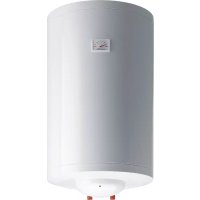

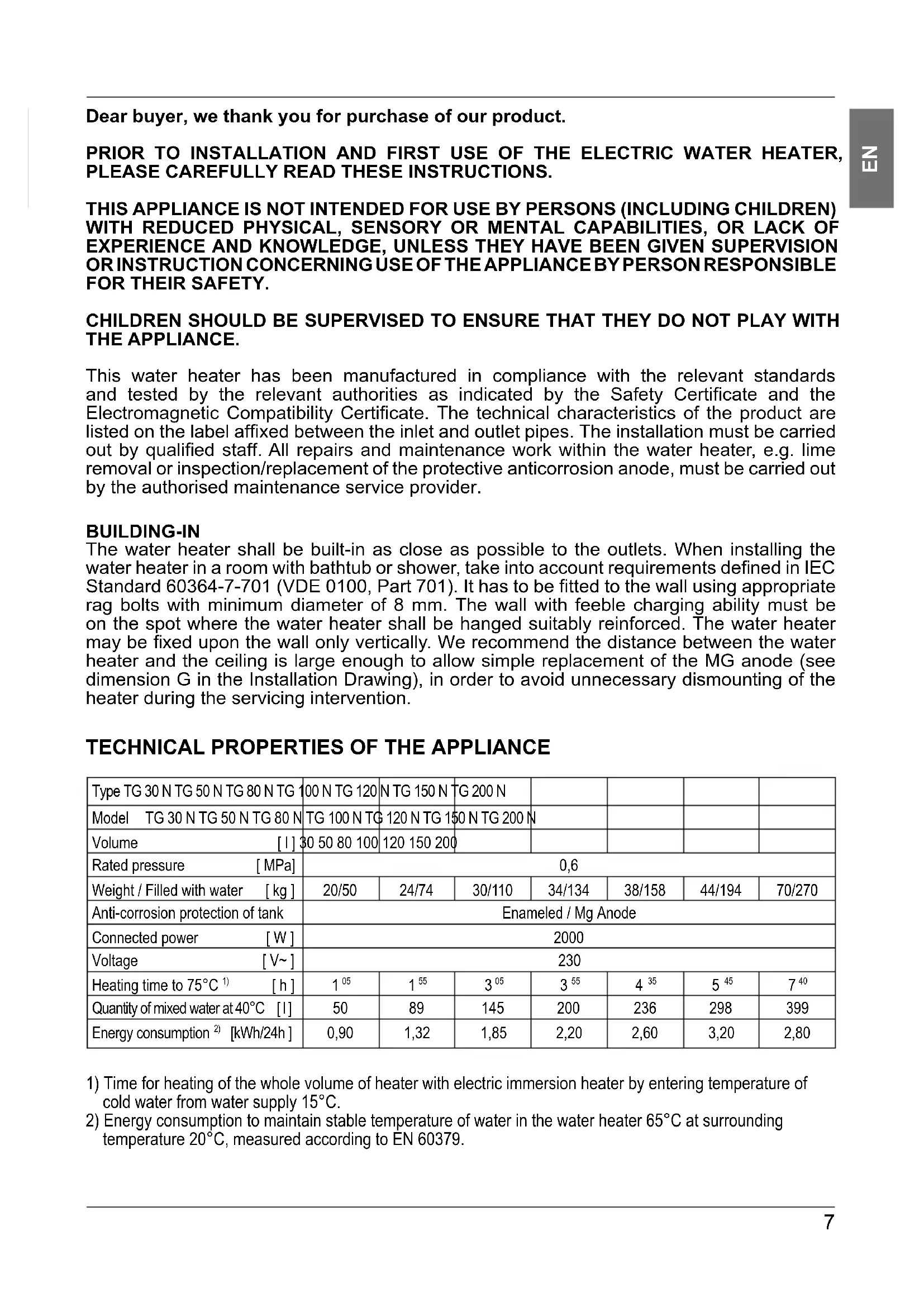


| Product type | Electric storage water heater |
| Brand | Gorenje |
| Model | TG80NC6 |
| Capacity | 80 liters |
| Nominal pressure | 0.6 MPa (6 bar) |
| Empty weight | 30 kg |
| Loaded weight (full of water) | 110 kg |
| Electrical power | 2000 W |
| Supply voltage | 230 V ~ |
| Heating time to 75 °C (cold water at 15 °C) | 3 h 05 min |
| Energy consumption (maintenance at 65 °C) | 1.85 kWh/24 h |
| Mixed water quantity at 40 °C | 145 liters |
| Anti-corrosion protection | Enamelled tank + magnesium anode |
| Water connection | Thread G 1/2" (blue cold inlet, red hot outlet) |
| Dimensions (A x B x C) | 766 x 565 x 190 mm |
| Minimum ceiling clearance (G) | 180 mm (for maintenance) |
| Adjustable temperature range | 20 °C to 75 °C |
| Installation type | Wall-mounted vertical |
| Safety devices | Safety valve, thermostat, bipolar thermal fuse, check valve |
| Operation indicator | Indicator light and bimetallic thermometer |
| Maintenance | Descaling and anode check every 36 months (by authorized technician) |
| Recommended cable cross-section | 1.5 mm² (H05VV-F 3G 1.5 mm²) |
| Standards complied with | IEC 60364-7-701, EN 60379 |
Frequently Asked Questions - TG80NC6 GORENJE
User questions about TG80NC6 GORENJE
0 question about this device. Answer the ones you know or ask your own.
Ask a new question about this device
Download the instructions for your Boiler in PDF format for free! Find your manual TG80NC6 - GORENJE and take your electronic device back in hand. On this page are published all the documents necessary for the use of your device. TG80NC6 by GORENJE.
USER MANUAL TG80NC6 GORENJE
TG 30 - 200 N
| Navodila za uporabo 3 | |
| Instructions for Use 7 | |
| Gebrauchsanweisung 11 | |
| Руководство по эксплуатации | 15 |
| Upute za upotrebu 19 | |
| Упатства за употреба | 23 |
| Návod k obsluze 27 | |
| Instrukcja obsługi | 31 |
| Инсрукции за употреба | 35 |
| Használati útmutató 39 | |
| Упутства за употребу | 43 |
| Upute za upotrebu 47 | |
| Udhëzime për përdorim 51 | |
| Instrucțiuni de utilizare 55 | |
| Návod na obsluhu 59 | |
| Naudojimo instrukcija 63 | |
| Notice d’utilisation 67 | |
| Gebruiksaanwijzing | 71 |
Dear buyer, we thank you for purchasing our product.
PRIOR TO INSTALLATION AND FIRST USE OF THE ELECTRIC WATER HEATER, PLEASE CAREFULLY READ THESE INSTRUCTIONS.
THIS APPLIANCE IS NOT INTENDED FOR USE BY PERSONS (INCLUDING CHILDREN) WITH REDUCED PHYSICAL, SENSORY OR MENTAL CAPABILITIES, OR LACK OF EXPERIENCE AND KNOWLEDGE, UNLESS THEY HAVE BEEN GIVEN SUPERVISION OR INSTRUCTION CONCERNING USE OF THE APPLIANCE BY A PERSON RESPONSIBLE FOR THEIR SAFETY.
CHILDREN SHOULD BE SUPERVISED TO ENSURE THAT THEY DO NOT PLAY WITH THE APPLIANCE.
This water heater has been manufactured in compliance with the relevant standards and tested by the relevant authorities as indicated by the Safety Certificate and the Electromagnetic Compatibility Certificate. The technical characteristics of the product are listed on the label affixed between the inlet and outlet pipes. The installation must be carried out by qualified staff. All repairs and maintenance work within the water heater, e.g. lime removal or inspection/replacement of the protective anticorrosion anode, must be carried out by the authorized maintenance service provider.
BUILDING-IN
The water heater shall be built-in as close as possible to the outlets. When installing the water heater in a room with bathtub or shower, take into account requirements defined in IEC Standard 60364-7-701 (VDE 0100, Part 701). It has to be fitted to the wall using appropriate rag bolts with minimum diameter of 8 mm. The wall with feeble charging ability must be on the spot where the water heater shall be hanged suitably reinforced. The water heater may be fixed upon the wall only vertically. We recommend the distance between the water heater and the ceiling is large enough to allow simple replacement of the MG anode (see dimension G in the Installation Drawing), in order to avoid unnecessary dismounting of the heater during the servicing intervention.
TECHNICAL PROPERTIES OF THE APPLIANCE
| Type TG 30 N TG 50 N TG 80 N TG 1 | 100 N TG 120 | N TG 150 N | TG 200 N | ||||
| Model TG 30 N TG 50 N TG 80 N | TG 100 N TG | 120 N TG 150 N | TG 200 N | ||||
| Volume [I] | 30 50 80 100 | 120 150 200 | |||||
| Rated pressure [MPa] | 0,6 | ||||||
| Weight / Filled with water [kg] | 20/50 | 24/74 | 30/110 | 34/134 | 38/158 | 44/194 | 70/270 |
| Anti-corrosion protection of tank | Enameled / Mg Anode | ||||||
| Connected power [W] | 2000 | ||||||
| Voltage [V~] | 230 | ||||||
| Heating time to 75°C 1) [h] | 105 | 155 | 305 | 355 | 435 | 545 | 740 |
| Quantity of mixed water at 40°C [I] | 50 | 89 | 145 | 200 | 236 | 298 | 399 |
| Energy consumption 2) [kWh/24h] | 0,90 | 1,32 | 1,85 | 2,20 | 2,60 | 3,20 | 2,80 |
1) Time for heating of the whole volume of heater with electric immersion heater by entering temperature of cold water from water supply 15° C. 2) Energy consumption to maintain stable temperature of water in the water heater 65° C at surrounding temperature 20° C, measured according to EN 60379.
| A | B | C | D | E | F | |
| TG 30 N 459 | 275 173 | - 454 46 | 1 80 | |||
| TG 50 N 561 | 365 185 | - 454 46 | 1 130 | |||
| TG 80 N 766 | 565 190 | - 454 46 | 1 180 | |||
| TG 100 N 92 | 6 715 20 | 0 - 454 4 | 61 260 | |||
| TG 120 N 10 | 81 865 2 | 05 - 454 | 461 260 | |||
| TG 150 N 12 | 96 1065 | 220 - 454 | 461 260 | |||
| TG 200 N 15 | 05 1050 | 444 800 | 500 507 | 260 |
G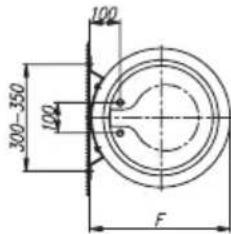
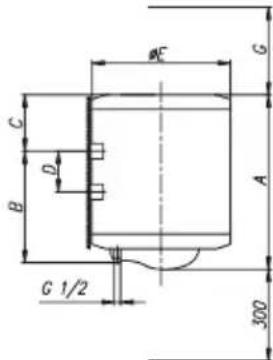
Connection and installation dimensions of the water heater [mm]
CONNECTION TO THE WATER SUPPLY
The water heater connections for the in-flowing and out-flowing water are color-coded. The connection for the supply of cold water is colored blue, while the hot water outlet is colored red.
The water heater may be connected to the water supply in two ways. The closed-circuit pressure system enables several points of use, while the open-circuit gravity system enables a single point of use only. The mixer taps must also be purchased in accordance with the selected installation mode.
The open-circuit gravity system requires the installation of a non-return valve to prevent water from draining out of the tank if the water supply runs dry or is shut down. This installation mode requires the use of an instantaneous mixer tap. As heating water expands its volume, this causes the tap to drip. The dripping cannot be stopped by tightening it further; on the contrary, tightening can only damage the tap.
The closed-circuit pressure system requires the use of pressure mixer taps. For safety reasons, the supply pipe must be fitted with a return safety valve or, alternatively, a valve of the safety class that prevents the pressure in the tank from exceeding the nominal pressure by more than 0.1 MPa. The outlet opening on the relief valve must be equipped with an outlet for atmospheric pressure.
Heating water in the heater causes the pressure in the tank to increase to the level set by the safety valve. As the water cannot return to the water supply system, this can result in dripping from the outlet of the safety valve. The drip can be piped to the drain by installing a catching unit just below the safety valve. The drain installed below the safety valve outlet must be piped down vertically and located in an environment free from freezing conditions.
If the existing plumbing does not allow you to pipe the dripping water from the return safety valve into the drain, you can avoid the dripping by installing a 3-litre expansion tank on the inlet water pipe of the boiler.
To ensure correct operation of the relief valve, the user must carry out periodic inspections of the relief valve. To check the valve, open the outlet of the return safety valve by turning the handle or unscrewing the nut of the valve (depending on the type of valve). The valve is operating properly if water comes out of the nozzle when the outlet is open.
![graph TD subgraph Closed (pressure) system A["1"] --> B["2"] B --> C["3"] C --> D["4"] D --> E["5"] F["T"] --> G["7"] H["2"] --> I["3"] J["6"] --> K["4"] L["H"] --> M["5"] end subgraph Open (non-pressure) system N["3"] --> O["5"] P["T"] --> Q["3"] R["H"] --> S["5"] T["3"] --> U["5"] V["H"] --> W["5"…](/content/2026/02/416721/images/3bc8c70337415f29488325f9e62b7799a3525b5dd9636e447c1416b7222f214c.jpg)

Legend:
1 - Safety valve 6 - Checking fitting 2 - Test valve 7 - Funnel with outlet connection 3 - Non-return valve 4 - Pressure reduction valve H - Cold water 5 - Closing valve T - Hot water
Between the water heater and the return safety valve, no closing valve may be installed because it would impede the function of the return safety valve.
The water heater may be connected to the house water network without a reduction valve if the pressure in the network is lower than 0.5 MPa (5 bar). If the pressure exceeds 0.5 MPa (5 bar), a reduction valve must be installed. Prior to the electrical connection, the water heater must obligatorily be filled with water. When first filling, the tap for hot water upon the mixing tap must be opened. When the heater is filled with water, the water starts to run through the outlet pipe of the mixing tap.
CONNECTION OF THE WATER HEATER TO THE ELECTRIC NETWORK
Before connecting to the power supply network, install a power supply cord in the water heater, with a minimum diameter of 1.5 mm² (H05VV-F 3G 1.5 mm²). For this, the protection plate must be removed from the water heater.
The connection of the water heater to the electric network must be performed according to standards for electric installation. Install a disconnect switch (separating all poles from the power supply network) between the water heater and the permanent power connection, in compliance with national regulations.
Legend:
1 - Thermostat and bipolar thermal fuse 2 - Electric heater 3 - Connection terminal 4 - Pilot lamp
L - Live conductor N - Neutral conductor ± - Earthing conductor
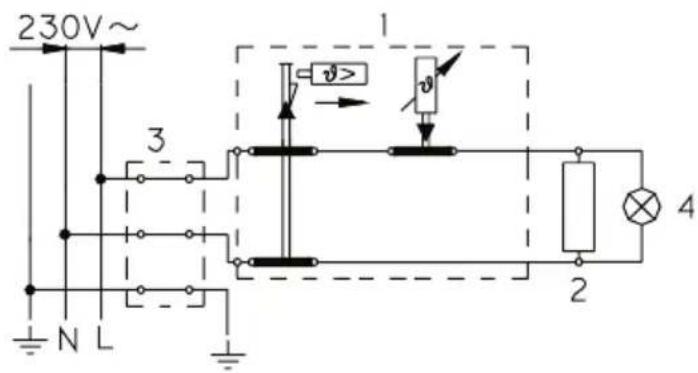
Electric installation
CAUTION: Prior to each access inside the water heater, it must absolutely be disconnected from the electric network!
USE AND MAINTENANCE
After connection to water and electric network, the water heater is ready for use. The temperature of water in the appliance is automatically controlled by the thermostat, which is adjusted by the manufacturer. The adjustment can be modified by turning the adjustment screw on the thermostat inside the water heater. The adjustment range is between 20°C and 75°C. We do not recommend any change to the manufacturer's adjustment, as this ensures the most economical consumption of electric energy and the smallest excretion of limestone. The operation of the electric immersion heater is shown by the pilot light. On the casing of the water heater, a bimetal thermometer is mounted, pointing clockwise (to the right) whenever there is hot water in the water heater.
When the heater is not used for a longer time, it must be disconnected from the electric network. At any risk of freezing of water in the water heater, the water must be emptied from it. Water is discharged from the heater via the inlet pipe. To this purpose, a special fitting (T-fitting) shall be mounted between the relief valve and the heater inlet pipe, or a discharge tap. The heater can be discharged directly through the relief valve, by rotating the handle or the rotating valve cap to the same position as for checking the operation. Before discharge, make sure the heater is disconnected from the power supply, and open the hot water on the connected mixer tap. After discharging through the inlet pipe, there is still some water left in the water heater. The remaining water will be discharged after removing the heating flange, through the heating flange opening.
The external parts of the water heater may be cleaned with a mild detergent solution. Do not use solvents and abrasives.
Regular preventive maintenance inspections ensure faultless performance and long life of your heater. The first of these inspections should be carried out by the authorized maintenance service provider about two years from installation in order to inspect the wear of the protective anticorrosion anode and remove the lime coating and sediment as required. The lime coating and sediment on the walls of the tank and on the heating element is a product of quality, quantity and temperature of water flowing through the water heater. The maintenance service provider shall also issue a condition report and recommend the approximate date of the next inspection.
Never try to repair any possible faults of the water heater by yourself, but inform about it the nearest authorized service workshop.
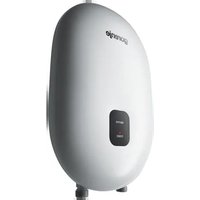


Brand : GORENJE
Model : TG80NC6
Category : Boiler