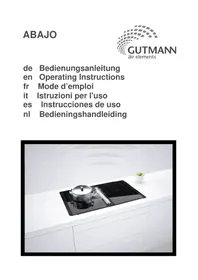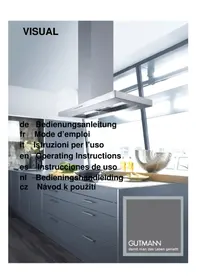
Visual - Basket Gutmann - Free user manual and instructions
Find the device manual for free Visual Gutmann in PDF.



Frequently Asked Questions - Visual Gutmann
User questions about Visual Gutmann
0 question about this device. Answer the ones you know or ask your own.
Ask a new question about this device
Download the instructions for your Basket in PDF format for free! Find your manual Visual - Gutmann and take your electronic device back in hand. On this page are published all the documents necessary for the use of your device. Visual by Gutmann.
USER MANUAL Visual Gutmann
GUTMANN to help you enjoy life
Dear customer,
Thank you for choosing a GUTMANN extractor hood.
Please carefully read the following information and explanations on the proper use of your new GUTMANN hood before using the appliance for the first time. Please also read our operating and installation instructions as well as the cleaning recommendations to ensure that you enjoy many years of service from your appliance.
Safety information
These operating and installation instructions contain important information that must be observed to ensure safe and reliable operation of the extractor hood. Please store them in a safe place for future reference. These operating instructions refer to several versions of the appliance. They may contain descriptions of certain features not found on your model.
The extractor hood must not be used by persons (incl. children) with impaired physical or mental capabilities or persons who lack experience and/or knowledge of how to use it. Children must be supervised to ensure that they do not play with the appliance.
Intended use
The extractor hood may only be used to extract kitchen vapours above the cooking appliances in private households. Any other use will be deemed to be improper. Improper use of the hood may pose a danger to persons and objects. The extractor hood must not be used as a shelf to store objects such as bottles, spice jars or other loose objects.
Installation
The appliance may only be installed and connected by an authorised technician observing all relevant regulations of the electric utility companies and the applicable building regulations. During installation, observe the relevant instructions! Damaged appliances may not be put into operation. Defective parts must be replaced with genuine parts. Repairs should only be carried out by authorised technical staff.
Danger of intoxication!
If the extractor hood is operated in extraction mode at the same time as other room-air-dependent fire appliances (e.g. wood, gas, oil or coal-fired appliances) in the same room, lethal combustion
gases may be directed back into the room due to the resulting negative pressure. For this reason, you must ensure a sufficient air supply at all times! The negative pressure in the room must not exceed 4 Pa (0.04mbar).
Fire hazard!
The extractor hood must never be operated without the grease filter and must always be used under supervision. Filters that are saturated with grease can pose a fire hazard! Keep the extractor hood under constant supervision when deep-frying! Remember to clean out the filters regularly. Flambéing under the extractor hood is not allowed! Gas appliances may only be used under the extractor hood with saucepans placed over them! If you are using more than three gas rings at the same time, operate the extractor hood at power level "2" or higher. This prevents the build-up of heat in the appliance.
Preparing for use
The extractor hood model complies with the relevant safety regulations for kitchen appliances in private households. The requirements regarding the installation location are described in the user documentation supplied with the appliance. If you have any doubts as to whether your intended installation location meets the requirements, please contact our service department. Damaged appliances may not be put into operation. Defective parts must be replaced with genuine spare parts or parts specified by GUTMANN. Repairs should only be carried out by authorised technical staff.
Activated carbon filter
For activated carbon filters fitted in GUTMANN extractor hoods (C Version), please read the separate operating instructions provided!
Transport, unpacking, installation
Condensation may occur if the appliance is brought into the installation site from a cold environment. Please wait
until the appliance has adjusted to the temperature and is completely dry before operating it. The acclimatization period depends on the temperature difference and the type and design of the appliance. However, it should be at least 12 hours.
Connecting the power supply
Check that the rated voltage indicated on the appliance matches the mains voltage in your area. Connection to the incorrect voltage will damage or destroy the appliance.
Before switching on the appliance, check that all cables and lines are properly fitted and undamaged. Make sure in particular that there are no kinks in the cables, that they are not pulled too tightly around corners and that no objects are resting on them. Also make sure that all plug connections are securely inserted. Faulty shielding or wiring poses a health hazard (electric shock) and can destroy other appliances. Appliances with mains plugs are fitted with a safety-tested mains cable for the respective country of use and may only be connected to a correctly earthed safety socket. Otherwise, there is a risk of electric shock. Make sure that the socket on the appliance or the domestic safety socket is easily accessible so that the mains cable can be unplugged from the socket in an emergency or during servicing and maintenance work.
Danger of electric shock!
Do not clean the hood with a steam cleaner or water pressure cleaner. The hood must be disconnected from the power supply prior to cleaning.
General method of operation
The extractor hood has been especially developed for the extraction of cooking vapours in private households. The rising cooking vapours are captured by the extractor hood and sucked out through an internal frame via internal metal filters. The metal filters are held in the
hood body by means of magnets. This type of extraction uses ultra-effective centralised internal extraction. The metal filters in these hood models are easily accessible from below and can be removed without the need for tools. The extraction capacity is controlled via the control panel. In addition to the lighting, which is sunk discreetly into the central panelling, the control panel also controls additional functions. The illumination of the hob is provided by several halogen spot lights.

Product description
1 Hood body
2 Tower
3 Control panel
4 Metal filters
5 Lighting (internal)

The control panel consists of 7 buttons. Fan power
The first four buttons control the fan power:
Button "1" = low fan power
Button "2" = medium fan power
Button "3" = high fan power
Button "Int" = Intensive setting
Press any button to switch on the appliance. Press the backlit button to switch
off the appliance. The intensive setting automatically switches back to high fan power after three minutes (setting 3).
Automatic after-run
Press the button with the clock symbol to activate the after-run time. The extractor hood switches back from level 3 to level 1 and runs for 15 min. at this setting before switching off.
Lighting
Press the button with the lighting symbol to switch in the lighting. Press again to switch off the lighting. The lighting is dimmed by pressing and holding the button. Press and hold the button again to increase the brightness. The fan can switch itself on automatically after a long period of standalone operation of the lighting. This overheating protection function automatically switches the fan off again.
Display grease filter cleaning
If the grease filter display lights up (button on the right), the filter must be cleaned. After cleaning the filter, press and hold the right-hand button for at least five seconds. The indicator lamp goes out. The grease filter indicator is activated after max. 15 operating hours or every two weeks (even if no cooking takes place during this time).
Cleaning and care
Cleaning the surfaces
Danger due to electric shock! Disconnect the extractor hood from the power supply by pulling the plug out of the socket or by switching off the fuse. When cleaning, make sure that no water penetrates the device. Regular cleaning of the surface saves laborious removal of stubborn contamination. Only use conventional detergents or universal cleaning agents suitable for cleaning stainless steel/aluminium. Never use abrasive cleaning agents or steel wool. After cleaning the hood, treat the stainless steel surfaces with a stainless steel care product. Painted surfaces should only be cleaned using a mild detergent solution and a very soft cloth.
Only use a soft damp cloth to clean the operating panel.
On hoods fitted with a panel below the filter (edge extraction), grease deposits occur at the edge of the panel. These deposits occur for physical reasons and are not due to a malfunction of the hood. Please clean the panel underneath the filter regularly to prevent the formation of stubborn residues.
Cleaning and care instructions
When cleaning the grease filters, also remove any grease deposits from the accessible housing components. This will prevent a fire hazard and maintain an optimum range of functions. Use hot soapy water or a mild window cleaning agent to clean the hood. Do not scratch off baked-on deposits. Soften them using a damp cloth. Do not use abrasive agents or scouring pads.
Note: Do not use alcohol (spirits) on plastic surfaces, as dull spots may result.
Caution: Ventilate the kitchen sufficiently, no open flame.
Only clean the operating panel with a soft damp cloth (mild detergent solution). Do not use stainless steel cleaners for the sliding switch/pressure switch.
Stainless steel surfaces:
Use a mild and non-abrasive stainless steel cleaning agent. Do not clean stainless steel surfaces with abrasive scouring pads or with cleaning agents containing sand, soda, acid or chloride! Clean in direction of polish only.
We recommend our stainless steel cleaner no. 461731. See the enclosed service booklet for the order address.
Aluminium, varnished and plastic surfaces:
Use a soft micro fibre cloth. Do not use dry cloths. Use a mild window-cleaning agent. Do not use aggressive cleaning agents or agents containing acid or lye! Do not use scouring agents.
Metal filter
Removing the filters
Fire hazard! The performance of the extractor hood is reduced by grease residues and the fire hazard increases. To prevent a fire hazard, you must clean the filters regularly. The grease filters must be cleaned at the least once a
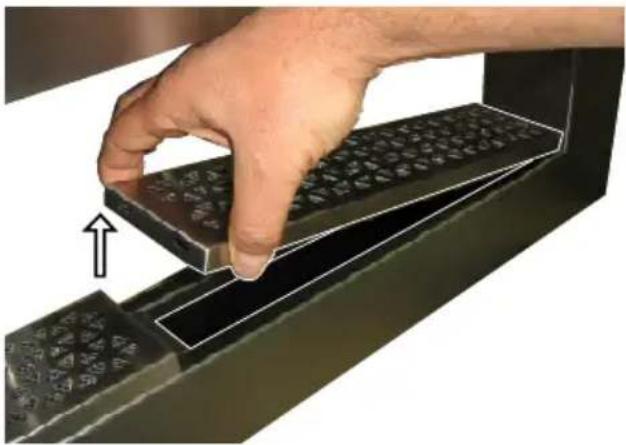
fortnight. To do this, grip the metal filter with both hands at the top and bottom and pull forward until the magnet contact releases. You can now remove the metal filter. Installation in reverse order.
Cleaning the filters
The stainless steel filter is best cleaned in the dishwasher or with a mild dishwashing agent. The manufacturer accepts no liability whatsoever for any discolouration caused by the use of aggressive dishwashing agents. Temperatures exceeding 55 degrees Celsius must be avoided. Caution: Do not use three-phase cleaning agents or clean the filter in a commercial dishwasher. Cleaning with aggressive agents such as petrol, acetone, trichlorethylene, etc. will destroy the filters! Refit the metal filters after cleaning.
Activated carbon filter
The C version model offering the recircu-. culation mode contains an activated carbon filter in the tower. Please refer to the separate instructions entitled "Activated Carbon!" 24
Exchange of the lighting
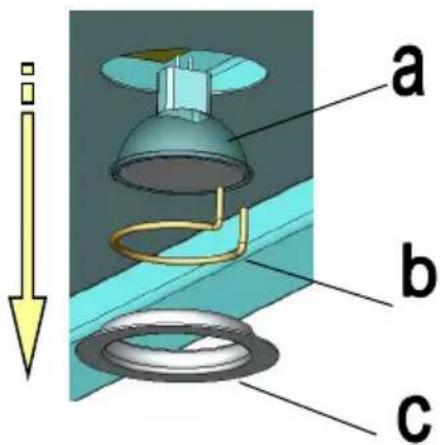
Please cut the connection between the extractor hood and the power supply system! The lighting remains hot for some time. Please wait therefore for some time till the lighting has cooled off. For the exchange of the lighting at first please take the retaining ring (c) out of the extractor hood with a screwdriver. Afterwards solve the plug of the light bulb (a) and separate it from the fixture. Therefore the feather ring (b) must be crushed and be removed upwards. The installation of the new lighting is made in reverse order.
Faults
Please contact our service department immediately, if:
- If the extractor hood creates unusual noises and you are unable to detect any faults after checking the extraction air line
- If you discover, for example, by hearing strange noises, that the motor is faulty or defective
- the switches are not working properly.
Please remember to indicate your extractor hood model and the corresponding serial number. This information can be found on the type plate. This plate is located inside the hood near the filters.
Disposal
Packaging
The packaging for the extractor hood is recyclable. Cardboard and polyethylene film (PE) are used as packaging materials. These materials must be disposed of in an environmentally compatible manner in accordance with local regulations.
Extractor hood
Your local authority will also be happy to advise you on the environmentally sound disposal of old household appliances.
Environmental information

All models manufactured by GUTMANN are identified in accordance with European Directive 2002/96/EC on waste electrical and electronic equipment (WEEE). This directive specifies the framework for the EU-wide return and disposal of used appliances. Please ask your dealer for information about current disposal methods.
We reserve the right to make technical changes.
Technical data
Connection mains:
230 V / 50 Hz, max. 500 Watt
Lighting: Halogen cold light 12V 28Watt