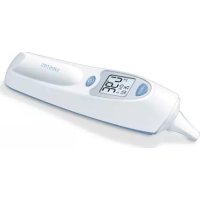
SFT 53 - Thermometer SANITAS - Free user manual and instructions
Find the device manual for free SFT 53 SANITAS in PDF.



| Product Type | Infrared Ear Thermometer |
| Brand | Sanitas |
| Model | SFT 53 |
| Dimensions | 155 x 38 x 47 mm |
| Weight | 63 g (without batteries) |
| Power Supply | 2 AAA 1.5 V batteries |
| Measurement Range (Body) | 34.0 °C to 43.0 °C (93.2 °F to 109.4 °F) |
| Accuracy (Body) | ±0.2 °C between 35.5 °C and 42.0 °C; ±0.3 °C elsewhere |
| Measurement Range (Object) | -20 °C to 100 °C (-4 °F to 212 °F) |
| Accuracy (Object) | ±4% or ±2 °C (4 °F) |
| Measurement Range (Ambient) | 0 °C to 50 °C (32 °F to 122 °F) |
| Accuracy (Ambient) | ±2 °C (±4 °F) |
| Memory | 10 measurements with date and time |
| Measurement Time | Approx. 1 second |
| Auto Power Off | 60 seconds |
| Protection Rating | IP22 |
| Protective caps included | 10 |
| Display | LCD with fever indicator (emoticon) |
| Main Functions | Body measurement, object temperature, ambient temperature, memory, date/time setting |
| Care and Cleaning | Clean the tip with a soft cloth or cotton swab moistened with alcohol or disinfectant; clean the device with a damp cloth |
| Safety | Use complies with directive 93/42/EEC, ASTM E1965-98 standard |
| Optional Accessories | Refill of protective caps 2×10, ref. 795.26 |
| Warranty | 2 years |
Frequently Asked Questions - SFT 53 SANITAS
User questions about SFT 53 SANITAS
0 question about this device. Answer the ones you know or ask your own.
Ask a new question about this device
Download the instructions for your Thermometer in PDF format for free! Find your manual SFT 53 - SANITAS and take your electronic device back in hand. On this page are published all the documents necessary for the use of your device. SFT 53 by SANITAS.
USER MANUAL SFT 53 SANITAS
service@sanitas-online.de
Read these instructions for use care fully and keep them for later use, be sure to make them accessible to other users and observe the information they contain.
Table of contents
- Signs and symbols 17
- Intended use 17
3.Notes 18 - Unit description 19
- Initial use 20
- Settings 20
6.1 Setting the time/date 20
6.2 Setting the temperature unit (^ or ^ F) 21
7.Measuring 21
7.1 Measuring body temperature 21
7.2 Measuring object temperature 23
7.3 Displaying room temperature 24
7.4 Displaying stored measurements 24
- Replacing the battery 25
- Cleaning and storage 25
- Disposal 25
11.What if there are error messages? 26 - Technical data 27
13.Warranty/service. 27
Please read through these Instructions for Use carefully and retain them for future reference; make them available to other users and observe the information they contain.
Included in delivery
Check that the delivery has not been tampered with and make sure that all components are present. Before use, ensure that there is no visible damage to the device or accessories and that all packaging material has been removed. If you have any doubts, do not use the device and contact your retailer or the specified Customer Services address.
1 x ear thermometer
2 x 1.5 V AAA batteries
10 x protective caps
1 x set of instructions for use
Subsequent purchase articles
Protective cap set replacement available: 2 × 10 protective caps, item no. 795.26
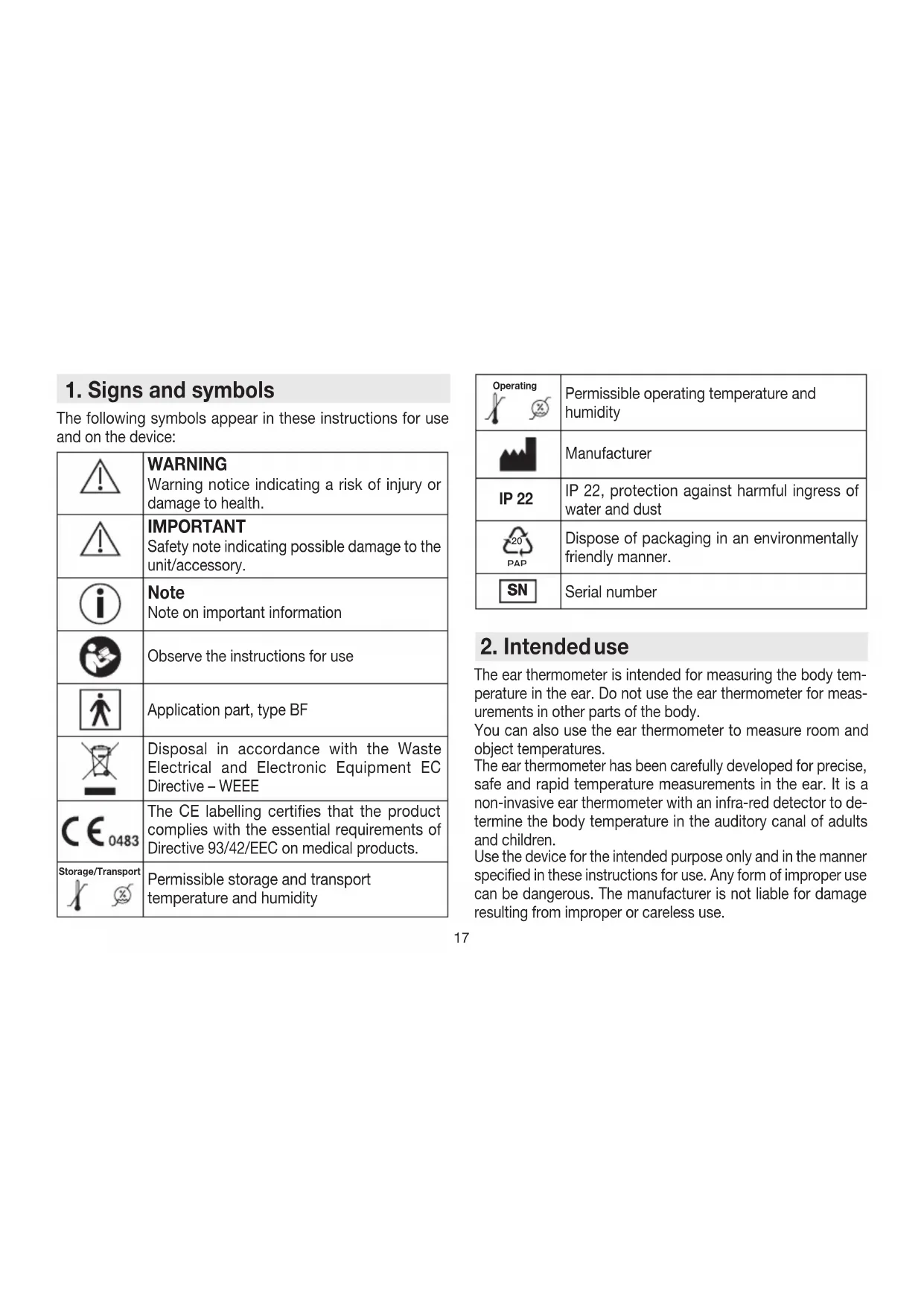
1. Signs and symbols
The following symbols appear in these instructions for use and on the device:
| WARNING Warning notice indicating a risk of injury or damage to health. | |
| IMPORTANT Safety note indicating possible damage to the unit/accessory. | |
| Note Note on important information | |
| Observe the instructions for use | |
| Application part, type BF | |
| Disposal in accordance with the Waste Electrical and Electronic Equipment EC Directive - WEEE | |
| CE 0483 | The CE labelling certifies that the product complies with the essential requirements of Directive 93/42/EEC on medical products. |
| Storage/Transport | Permissible storage and transport temperature and humidity |
| Operating | Permissible operating temperature and humidity |
| Manufacturer | |
| IP 22 | IP 22, protection against harmful ingress of water and dust |
| PAP | Dispose of packaging in an environmentally friendly manner. |
| SN | Serial number |
2. Intendeduse
The ear thermometer is intended for measuring the body temperature in the ear. Do not use the ear thermometer for measurements in other parts of the body.
You can also use the ear thermometer to measure room and object temperatures.
The ear thermometer has been carefully developed for precise, safe and rapid temperature measurements in the ear. It is a non-invasive ear thermometer with an infra-red detector to determine the body temperature in the auditory canal of adults and children.
Use the device for the intended purpose only and in the manner specified in these instructions for use. Any form of improper use can be dangerous. The manufacturer is not liable for damage resulting from improper or careless use.
This device complies with the EU Directive 93/42/EEC concerning medical products, the Medizinproduktegesetz (German Medical Devices Act), the ASTM (American Society for Testing and Materials) E 1965 - 98 and the European Standard EN 12470-5: Clinical thermometers - Part 5: Requirements for infrared ear thermometers (with maximum device) and the European Standard EN 60601-1-2 (in accordance with CISPR 11, IEC 61000-4-2, IEC 61000-4-3, IEC 61000-4-8), and is subject to particular precautions with regard to electromagnetic compatibility.
Please note that portable and mobile HF communication systems may interfere with this device.
3. Notes
Safety notes
WARNING
- To measure temperature, insert the sensor tip of the ear thermometer carefully into the ear.
- Use of the ear thermometer on different persons can be inappropriate in the event of certain acute infectious diseases because of the possible spread of germs despite cleaning and disinfection. If you have any doubts, please consult your doctor.
- The body temperature measured in the ear may differ from other measurements taken in the mouth, rectum or armpits. Any comparison of these values is therefore futile. Measure temperature regularly to calculate the normal ear temperature and then use these measurements as a basis for
comparison when taking measurements in the event of a suspected high temperature.
- This ear thermometer is intended for measuring the temperature in the ear. Do not use this ear thermometer for measurements in other parts of the body.
- Replace the protective cap after each use to ensure an accurate measurement and prevent cross-contamination.
- The ear thermometer may only be used with protective caps from Sanitas; other protective caps may result in faulty measurements. If you have run out of protective caps, contact the manufacturer or retailer for replacements.
- Consult a doctor if you believe your medical condition to be poor.
Notes on handling batteries
WARNING
If your skin or eyes come into contact with battery fluid, rinse the affected areas with water and seek medical assistance.
- Choking hazard! Small children may swallow and choke on batteries. Store the batteries out of the reach of small children.
- Observe the plus (+) and minus (-) polarity signs.
- If a battery has leaked, put on protective gloves and clean the battery compartment with a dry cloth.
- Protect batteries from excessive heat.
- Risk of explosion! Never throw batteries into a fire.
- Do not charge or short-circuit batteries.
- If the device is not to be used for a relatively long period, take the batteries out of the battery compartment.
- Use identical or equivalent battery types only.
Always replace all batteries at the same time. - Do not use rechargeable batteries.
- Do not disassemble, split or crush the batteries.
Risks to the device

IMPORTANT
- Do not subject the device to mechanical impacts.
- Do not expose the device to direct sunlight.
- Do not expose the device to liquids. The device is not waterproof. Avoid all direct contact with water or other liquids.
- Have the device repaired by authorised service centres only, otherwise its warranty is invalidated.
- Portable and mobile HF communication systems may interfere with this device. More details can be requested from the stated Customer Services address or found at the end of the instructions for use.

Notes on electromagnetic compatibility
- The device is suitable for use in all environments listed in these instructions for use, including domestic environments.
- The use of the device may be limited in the presence of electromagnetic disturbances. This could result in issues such as error messages or the failure of the display/device.
- Avoid using this device directly next to other devices or stacked on top of other devices, as this could lead to faulty operation. If, however, it is necessary to use the device in the manner stated, this device as well as the other devices must be monitored to ensure they are working properly.
- The use of accessories other than those specified or provided by the manufacturer of this device can lead to an increase in electromagnetic emissions or a decrease in the device's electromagnetic immunity; this can result in faulty operation.
- Failure to comply with the above can impair the performance of the device.
4. Unit description
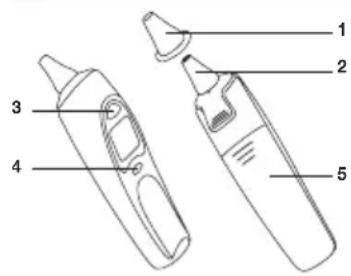
1 Protective cap
2 Measuring sensor
3 START button
4 ON/OFF button
5 Battery compartment
LCD display
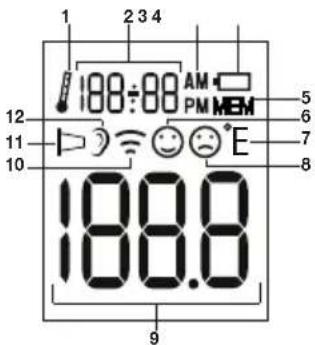
| 1 | Room temperature mode |
| 2 | Displays room temperature/time/date |
| 3 | AM/PM display (time) |
| 4 | Battery symbol |
| 5 | Memory mode |
| 6 | No fever symbol |
| 7 | Temperature unit (°C or °F) |
| 8 | Fever symbol |
| 9 | Temperature display |
| 10 | Object temperature mode |
| 11 | Protective cap symbol |
| 12 | Body temperature mode |
5. Initial use
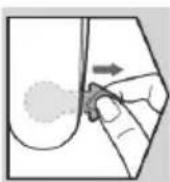
The batteries are already inserted in new devices. Before first use, remove the protruding plastic insulating strip from the battery compartment. The ear thermometer will then switch on automatically.
6. Settings
6.1 Setting the time/date
Before beginning to take measurements, we recommend that you set the current time and date. This will allow you to organise the saved measurements more easily later.
| 1. Press and hold the ON/OFF but- ton on the switched-off de- vice for three seconds. “24 H” appears on the display. | 24 H | |
| 2. Use the START button to select the hour format (12h or 24h) and confirm using the ON/OFF but- ton | 12 H | 24 H |
| 3. The hour setting appears on the display. Use the START button to select the current hour and confirm using the ON/OFF button | 16:00 | |
| 4. The minute setting appears on the display. Use the START but- ton to select the current minute and confirm using the ON/OFF button | 16:00 | |
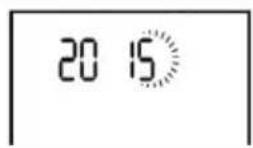
- The year setting appears on the display. Use the START button to select the current year and confirm using the ON/OFF button
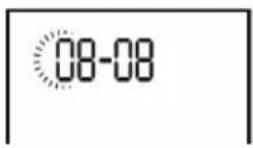
- The day flashes on the display. Use the START button to select the current day and confirm using the ON/OFF button
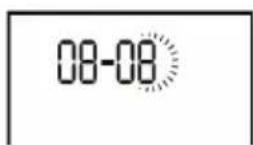
- The month flashes on the display. Use the START button to select the current month and confirm using the ON/OFF button. The device then switches itself off automatically. The date and time are now saved.
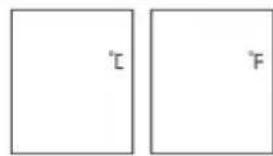
6.2 Setting the temperature unit (^ or ^ F)
You can set the device to display the temperature in degrees Celsius (^) or degrees Fahrenheit (^) .
- Press and hold the START button on the switched-off device for three seconds. "C" appears on the display.
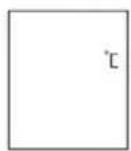
2.Use the START button to select the temperature unit (^ or ^ F) and confirm using the ON/OFF button
7. Measuring

Note
Check before each use that the lens is intact. If it is damaged, contact your retailer or the service address. Bear in mind that the ear thermometer needs to have been in the room in which the measurement is taken for at least 30 minutes before use.
7.1 Measuring body temperature

WARNING
-
Some people produce different readings in their left and right ear. In order to record temperature changes, always measure a person's temperature in the same ear.
-
The ear thermometer may be used by children only under adult supervision. Measurement is usually possible over the age of 6 months. In infants under 6 months, the ear canal is still very narrow so the temperature of the eardrum often cannot be recorded and the result displayed is often too low.
-
The measurement must not be taken in an ear affected by inflammatory diseases (e.g. discharging pus or secretion), after possible ear injuries (e.g. eardrum damage) or in the
healing period after operative procedures. In all of these cases, please consult your doctor.
- Use of the ear thermometer on different persons can be inappropriate in the event of certain acute infectious diseases because of the possible spread of germs despite cleaning and disinfection. If you have any doubts, please consult your doctor.
- This ear thermometer may only be used with the protective cap in place.
- The following circumstances may influence the temperature in the ear: if you have been lying on the ear for an extended period, the ears are covered, the ears are exposed to excessive heat/cold, or after swimming or bathing. In the event of one of these circumstances, wait 20 minutes before performing the measurement.
- As ear wax can affect the measurement, you should clean the ear before measuring if necessary.
| 1. Place a clean protective cap on to the sensor tip of the ear thermometer. | |
| 2. Press the ON/OFF button to switch on the ear thermometer. Three acoustic signals sound and the display switches on. |
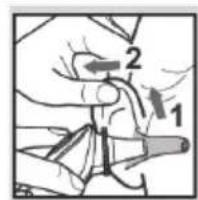
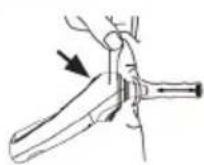
- As the ear canal is slightly curved, you have to pull the ear slightly up and backwards before inserting the sensor tip. This is important so that the tip of the protective cap can be pointed directly at the eardrum.
- Insert the sensor tip with the protective cap carefully into the ear canal and press the START button to begin the measurement.
- After approx. one second, a long acoustic signal sounds and the measurement is shown in the display. Press the ON/OFF button to switch off the ear thermometer.
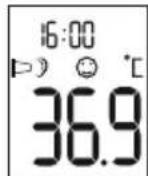
| iNote If no button is pressed for one minute after the measurement, the ear thermometer automatically switches itself off again. Fever indicator If the measured temperature is < 38 °C (100.4 °F), a laughing smiley appears on the display and a short acoustic signal sounds. If the measured temperature falls between 37.5 and 37.9 °C, two short acoustic signals will also sound (the indication for “raised temperature”). If the measured temperature is ≥ 38 °C (100.4 °F), a sad smiley appears on the display and a short, a long and three short acoustic signals sound one after the other. |
7.2 Measuring object temperature
| 1. Remove the protective cap from the sensor tip of the ear thermometer (if it is on). | |
| 2. Press the ON/OFF button to switch on the ear thermometer. Three acoustic signals sound and the display switches on. | 15:00 7°C - - - - |
| 3. Ensure that you are in object tempera-ture mode (To switch between body temperature and object temperature mode, brief-ly press and hold the ON/OFF buttonand the START button at the same time. | 16:00 25.3 |
| 4. Hold the sensor tip of the ear thermom-eter 1 to 2 cm from the desired measur-ing point and press the START button. | |
| 5. After one second, a long acoustic sig-nal sounds and the measurement is shown in the display. Briefly press the ON/OFF buttonto switch off the ear thermometer. | 16:00 25.3 |
7.3 Displaying room temperature
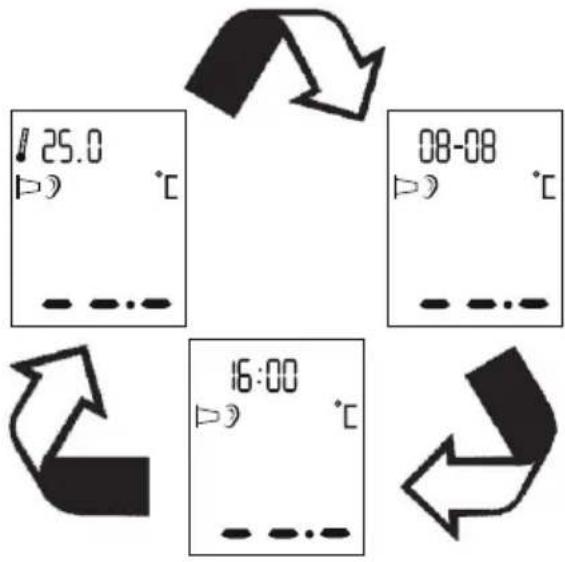
When you switch on the ear thermometer, the room temperature, the date and time appear alternately on the display every 3 seconds.
7.4 Displaying stored measurements
The ear thermometer automatically stores the last 10 temperature measurements of body and object temperature respectively (incl. date and time). To recall the stored measurements, proceed as follows:
| 1. Press the ON/OFF button (to switch on the ear thermometer. | 16:00 → 36.9 |
| 2. Press and hold the ON/OFF button for 3 seconds. An M and the last stored measurement appear on the display. | 16:00 → 36.9 |
| 3. To switch between the individual stored measurements, press the ON/OFF button ↓With each subsequent pressing of the ON/OFF button (the memory space number is displayed first followed by the measurement. | 16:00 → 36.9 |
| 4. If you would like to proceed with a measurement, press the START button. Press and hold the ON/OFF button (for 3 seconds to switch off the ear thermometer. | |
8. Replacing the battery
Before replacing the battery, ensure that the device is switched off.
| 1. Replace the batteries as soon as the battery symbol it appears on the display. | |
| 2. Slide open the battery compartment and remove the used batteries from the battery compartment. | |
| 3. Insert two new 1.5 V AAA batteries. Make sure that the batteries are in-serted the right way round. Close the battery compartment. |
9. Cleaning and storage
Protective caps are only intended for single use.
The sensor tip is the most sensitive part of the ear thermometer. Work carefully when cleaning the sensor tip to avoid causing any damage. Use a clean cloth or cotton bud that can be moistened with disinfectant, alcohol or warm water
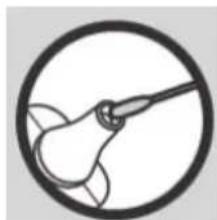
To clean the entire device, use a soft cloth slightly moistened with a mild soapy solution.
Do not use any harsh cleaning products.
If prolonged storage is intended, you should remove the batteries. The device must not be stored or used at an excessively high or low temperature or humidity (see technical data), in sunlight, in association with an electrical current or in dusty locations. Otherwise inaccuracies can occur.
10. Disposal
The empty, completely flat batteries should be disposed of through specially designated collection boxes, recycling points or electronics retailers. You are legally required to dispose of the batteries.
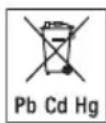
Note: The codes below are printed on batteries containing harmful substances: Pb = Battery contains lead, Cd = Battery contains cadmium, Hg = Battery contains mercury.
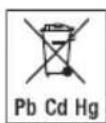
For environmental reasons, do not dispose of the device in the household waste at the end of its useful life.
Dispose of the unit at a suitable local collection or recycling point. Dispose of the device in accordance
with EC Directive - WEEE (Waste Electrical and
Electronic Equipment). If you have any questions, please contact the local authorities responsible for waste disposal.
11. What if there are error messages?
| Error message | Cause Solution | |
| ER1 | The ear thermometer is not yet ready for measurement. | Take measurements only once body (♂) or object temperature mode (♀) appears on the display. |
| ER2 | The measured ambient temperature is not in the range from 10 °C - 40 °C (50 - 104 °F). | Place the ear thermometer in a room with an ambient temperature between 10 °C and 40 °C (50 °F and 104 °F) for at least 30 minutes. |
| ER3 | The ear thermometer is not placed in the ear correctly. | Please observe the notes in the chapter “Measuring”. Perform the measurement again. |
| ER4 | The ear thermometer registered a large change in the ambient temperature. | Place the ear thermometer in a room with an ambient temperature between 10 °C and 40 °C (50 °F and 104 °F) for at least 30 minutes. |
| Error message | Cause Solution | |
| ERS | The ear thermometer is not working properly. | Replace the batteries and try again. If the fault occurs again, contact Customer Services. |
| ER6 | You are in the "Measuring object temperature" mode and the protective cap is still on. | The protective cap must be removed to measure object temperatures. |
| Hi | In-ear measurement: the measured temperature is over 43 °C (109.4°F). Object measurement: the measured temperature is over 100 °C (212°F). | Ensure that the device and the protective cap are fully functioning. Perform the measurement again. |
| Lo | In-ear measurement: the measured temperature is below 34°C (93.2°F). Object measurement: the measured temperature is below -20°C (-4°F). | Ensure that the device and the protective cap are fully functioning. Perform the measurement again. |
| O | The batteries are empty. | Remove the two empty batteries and insert two new 1.5 V AAA batteries into the ear thermometer. |
If you cannot find a solution to your problem here, contact our Customer Services.
12. Technical data
| Temperature range | In ear: 34.0 – 43.0 °C (93.2 – 109.4 °F)Object temperature: -20–100°C(-4-212°F)Room temperature: 0-50°C(32-122°F) |
| Laboratory measurement accuracy | In ear: ± 0 .2 °C (0.4 °F) in meas-urement range of 35.5-42.0°C(95.9-107.6°F); ± 0.3°C (0.5°F) in measurement range of ≤35.5 °C(95.5°F) and ≥42.0°C (107.6°F)Object temperature: ± 4% or ± 2 °C (4 °F)Room temperature: ±2°C (±4°F) |
| Clinical reproducibility 0.1 | 1°C (0.2°F) |
| Duration of measurement | Approx. one second |
| Operating temperature range | 10-40°C (50-104°F),humidity 15-85% (non-condensing) |
| Storage temperature range | -25-55°C (-13-131°F),humidity 15-95% (non-condensing) |
| Memory 10 memory spaces | |
| Display resolution 0.1 °C | or 0.1 °F |
| Battery DC 3 V (2 x 1.5 V) | AAA batteries) |
| Dimensions 155 x 38 x 47 | mm |
| Weight Approx. 63 g (without batteries) | |
| Protective caps 10 | |
| Automatic switch-off 60 seconds | |
| Battery operating life 3,000 | measurements in succession or one year with one to two measurements per day, including standby mode. |
| Safety classification | Connected medical device of type BF |
| IP protection class IP 22, | protection against harmful ingress of water and dust |
The serial number is located on the device or in the battery compartment.
13. Warranty/service
Hans Dinslage GmbH, Riedlinger Straße 28, 89524 Uttenweiler, Germany (hereinafter referred to as "HaDi") provides a warranty for this product, subject to the requirements below and to the extent described as follows.
The warranty conditions below shall not affect the seller's statutory warranty obligations which ensue from the sales agreement with the buyer.
The warranty shall apply without prejudice to any mandatory statutory provisions on liability.
HaDi guarantees the perfect functionality and completeness of this product.
The worldwide warranty period is 2 years, commencing from the purchase of the new, unused product from the seller.
The warranty only applies to products purchased by the buyer as a consumer and used exclusively for personal purposes in the context of domestic use.
German law shall apply.
During the warranty period, should this product prove to be incomplete or defective in functionality in accordance with the following provisions, HaDi shall carry out a repair or a replacement delivery free of charge, in accordance with these warranty conditions.
If the buyer wishes to make a warranty claim, they should approach their local retailer in the first instance: see the attached "International Service" list of service addresses.
The buyer will then receive further information about the processing of the warranty claim, e.g. where they can send the product and what documentation is required.
A warranty claim shall only be considered if the buyer can provide HaDi, or an authorised HaDi partner, with
- a copy of the invoice/purchase receipt, and
- the original product.
The following are explicitly excluded from this warranty:
- deterioration due to normal use or consumption of the product;
- accessories supplied with this product which are worn out or used up through proper use (e.g. batteries, rechargeable
batteries, cuffs, seals, electrodes, light sources, attachments and nebuliser accessories);
- products that are used, cleaned, stored or maintained improperly and/or contrary to the provisions of the instructions for use, as well as products that have been opened, repaired or modified by the buyer or by a service centre not authorised by HaDi;
- damage that arises during transport between manufacturer and customer, or between service centre and customer;
- products purchased as seconds or as used goods;
- consequential damage arising from a fault in this product (however, in this case, claims may exist arising from product liability or other compulsory statutory liability provisions).
Repairs or an exchange in full do not extend the warranty period under any circumstances.
FRANÇAIS

9. Nettoyage/stockage
Ha6op 3aunTHbIX KOJNaYKOB, KOTOpBIM MOXHO npno6peCTI
doJHHTeJIbHO:2x10³aunTHbIX KOJNaYKOB,No apt.
795.26
1.ПОЯСHEняксIMBOJAM
B daHHo IHCTpyKcHn IIO npIMeHeHIO Hn npi6ope nCNoJIb-3yOTc CNeDyUcne CmBOJIbI:
HnKaTOp NOBbIeHHo TEMpePaTypbI
Ecnn n3mepenHna TemnepaTpa<38°C(100,4°F),Ha nncnnnee noBnTcra yIb6auuNcra CmaJInk pa3daetcKoPOTKn 3BYKOBO CNrHaJ.
Ecnn n3MepeHHa TEmpepaTpa HaxoNTcB DnaHana3OHe ot 37,5do 37,9 ^ C ,DOnONHtEnbHo pa3daOTcB Da KopoTkX 3ByKObblxCnHaJa (INHdNkaLma DnA «IOBblJeHHo TEmpePaTypbI»).
Ecnn n3mepenHHa TemnepaTypa ≥ 38^ (100,4°F), Ha nO- nnee noBnEeTcra pcyCThbi CmaJIHK pa3daeTc oINH KOPOTKN 3ByKOBO CNrHaI, NOTOM OINH DInHHbI N TPN KO- POOTKnx CNrHaI.
7.2 N3mepenHe TemnepaTpybIO6beKTa
Yka3aHHe: 3Tu 3HaKn npEpynpExJaIO T O HAnuHn B 6aTapeKkax TOKcUnhBix BeueCTb: Pb = 6aTapeKa coepxNt cBnHeU, Cd = 6aTapeKa coepxNt KaMm, Hg = 6aTapeKa coepxNt pTyTb.
B INHTepecax oxpaHbI OKpyKaIOUeI cpebl KaTeRoPnueckn 3anpeuaetc BbI6pacbIBaT npN6Op no 3aBepseHm Cpoka erO cnJXbI BMeCTe C bITOBblMN OTxODAMN. YTNIN3aUNI DOJXHa IPOIN3BOINTbcR
Yepe3 cooTBcTByIOUne nyHKtbi c6opBaBaWe cTpaHe. Pnp6op cIeDyET yTuINn3NPOBaTb corNaCHO DInpeKTNBe EC NO OTxOaAM 3JIeKTPuueckoro n 3JIeKTPoHnHO o6OpyDoBAHN - WEEE (Waste Electrical and Electronic Equipment). B Cnyuae BONpocOB o6paauTeCB B MeCTHyIO KOMMyHaJIbHyOClyXk6y, OTBcTBeHHHy 3a yTuINn3aUIO OTxOoB.
11.Что дelaь, ecnnoялгOTс coo6eHna 6OwN6kax?

- Read these instructions for use care fully and keep them for later use, be sure to make them accessible to other users and observe the information they contain.
- Table of contents
- Included in delivery
- Subsequent purchase articles
- Signs and symbols
- Intendeduse
- Notes
- Safety notes
- WARNING
- Notes on handling batteries
- Risks to the device
- IMPORTANT
- Notes on electromagnetic compatibility
- Unit description
- LCD display
- Initial use
- Settings
- Setting the time/date
- Setting the temperature unit (°C or ° F)
- Measuring
- Note
- Measuring body temperature
- Measuring object temperature
- Displaying room temperature
- Displaying stored measurements
- Replacing the battery
- Cleaning and storage
- Disposal
- What if there are error messages?
- Technical data
- Warranty/service
- If the buyer wishes to make a warranty claim, they should approach their local retailer in the first instance: see the attached "International Service" list of service addresses.
- FRANÇAIS
- Nettoyage/stockage
- 1.ПОЯСHEняксIMBOJAM
- HnKaTOp NOBbIeHHo TEMpePaTypbI
- N3mepenHe TemnepaTpybIO6beKTa
- 11.Что дelaь, ecnnoялгOTс coo6eHna 6OwN6kax?
Brand : SANITAS
Model : SFT 53
Category : Thermometer