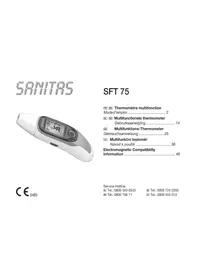
Frequently Asked Questions - SFT 75 SANITAS
How to turn on the Sanitas SFT 75 thermometer?
Press the ON/MEASURE button for one second (the center button).
What are the different measurement modes?
The thermometer offers three modes: forehead (temporal), ear, and object temperature. By default, it is in forehead mode. To switch to object mode, press and hold the M and S buttons for 3 seconds.
How to interpret the LED indicator after a measurement?
If the measured temperature is below 38 °C, the green LED lights up. If it is ≥ 38 °C (fever), the red LED lights up for 3 seconds.
How to view stored measurements?
Turn on the device, then press the M button. The last measurement is displayed. Press M again to scroll through the 30 stored measurements.
What to do if the screen shows 'H1' or 'Lo'?
H1 indicates a temperature out of range (above 43 °C in body mode or 100 °C in object mode). Lo indicates a temperature below 34 °C (body) or 0 °C (object). Check that you are using the appropriate mode and that the lens is clean. If the problem persists, contact customer service.
Can I use the thermometer on a baby under 6 months old?
For ear measurement, it is not recommended before 6 months because the ear canal is too narrow, which may affect results. However, forehead measurement is suitable from birth, provided the forehead is clean and free of sweat.
How to clean the thermometer?
Clean the sensor tip and the cap after each use with a soft cloth or a cotton swab moistened with disinfectant, alcohol, or warm water. Never immerse the device in water.
How to change the batteries?
Turn off the device. Unscrew the battery compartment cover with a screwdriver. Replace the two used batteries with new AAA 1.5 V batteries, observing the polarity. Close and screw back.
Can the key beep be disabled?
Yes. When the device is on, briefly press the S button to disable the beep. The speaker symbol disappears from the screen. Press again to re-enable.
What is the warranty for the Sanitas SFT 75?
The warranty is 3 years from the date of purchase for material or manufacturing defects, excluding normal wear, misuse, or opening by an unauthorized person. Keep the proof of purchase.
USER MANUAL SFT 75 SANITAS
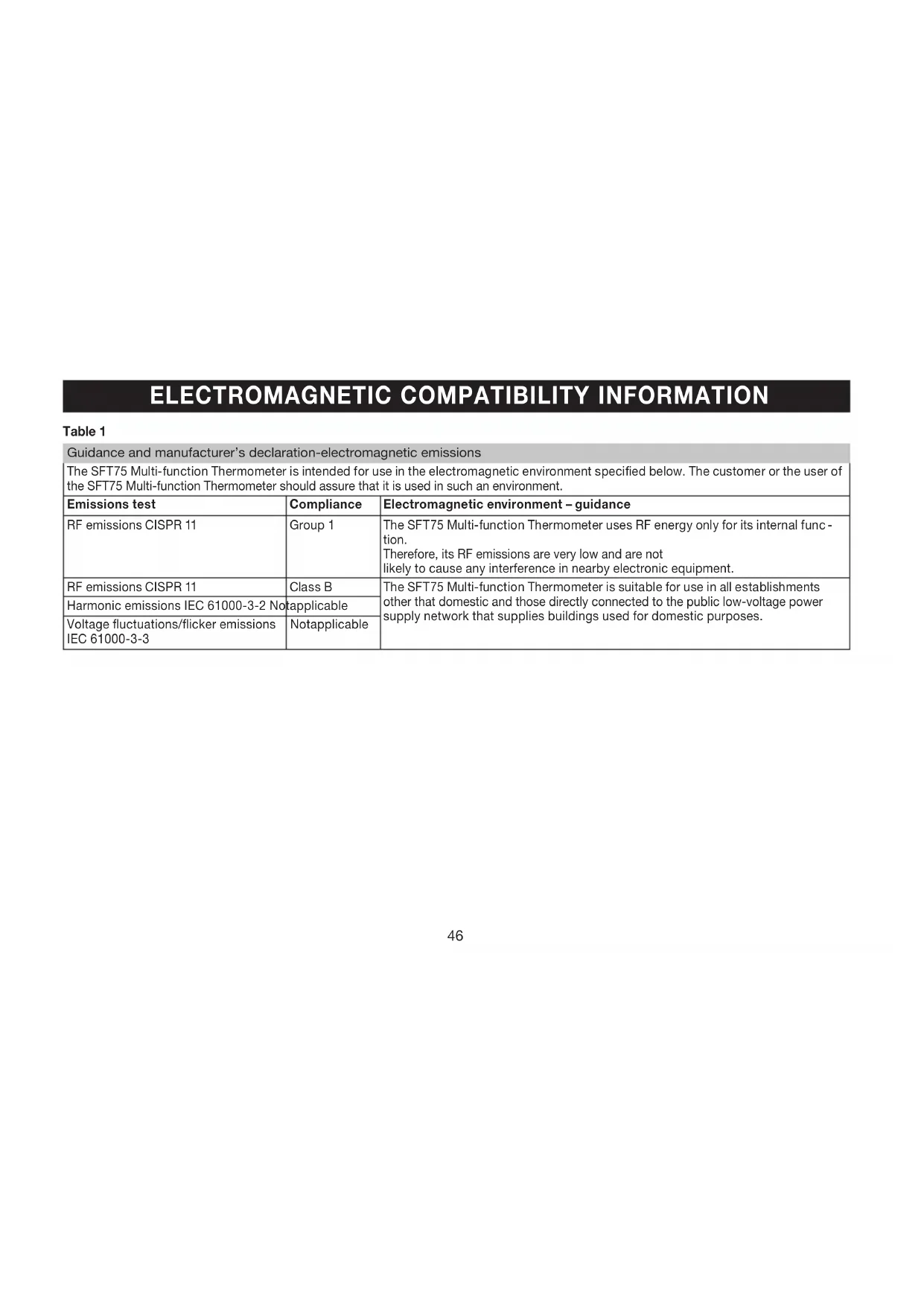
| Guidance and manufacturer's declaration-electromagnetic emissions |
| The SFT75 Multi-function Thermometer is intended for use in the electromagnetic environment specified below. The customer or the user of the SFT75 Multi-function Thermometer should assure that it is used in such an environment. |
| Emissions test | Compliance | Electromagnetic environment - guidance |
| RF emissions CISPR 11 | Group 1 | The SFT75 Multi-function Thermometer uses RF energy only for its internal function. Therefore, its RF emissions are very low and are not likely to cause any interference in nearby electronic equipment. |
| RF emissions CISPR 11 | Class B | The SFT75 Multi-function Thermometer is suitable for use in all establishments other that domestic and those directly connected to the public low-voltage power supply network that supplies buildings used for domestic purposes. |
| Harmonic emissions IEC 61000-3-2 Not applicable |
| Voltage fluctuations/flicker emissions IEC 61000-3-3 | Not applicable |
Table 2
| Guidance and manufacturer's declaration - electromagnetic immunity |
| The SFT75 Multi-function Thermometer is intended for use in the electromagnetic environment specified below. The customer or the user of the SFT75 Multi-function Thermometer should assure that it is used in such an environment. |
| IMMUNITY test | IEC 60601 test level | Compliance level | Electromagnetic environment - guidance |
| Electrostatic discharge (ESD) IEC 61000-4-2 | ±6 kV contact ±8 kV air | ±6 kV contact ±8 kV air | Floor should be wood, concrete or ceramic tile. If floors are covered with synthetic material, the relative humidity should be at least 30%. |
| Electrical fast transient/burst IEC 61000-4-4 | ±2 kV for power supply lines ±1 kV air for input/out put lines | Not applicable | Mains power quality should be that of a typical commercial or hospital environment. |
| Surge IEC 61000-4-5 | ±1kV differential mode ±2kV common mode | Not applicable | Mains power quality should be that of a typical commercial or hospital environment. |
| Voltage dips, short interruptions and voltage variations on power supply input lines IEC 61000-4-11 | <5% UT(>95% dip in UTfor 0.5 cycle40% UT(60% dip in UTfor 5 cycles70% UT(30% dip in UTfor 25 cycles5% UT(>95% dip in UTfor 5 sec | Not applicable | Mains power quality should be that of a typical commercial or hospital environment. If the use of the SFT75 Multi-function Thermometer requires continued operation during power mains interruptions, it is recommended that the SFT75 Multi-function Thermometer be powered from an uninterruptible power supply or a battery. |
| Power frequency (50/60 Hz) magnetic field IEC 61000-4-8 | 3 A/m 3 A/m | | Power frequency magnetic fields should be at levels characteristic of a typical location in a typical commercial or hospital environment. |
| NOTE: UTis the a.c. mains voltage prior to application of the test level. |
Table 3
| Guidance and manufacturer's declaration - electromagnetic immunity |
| The SFT75 Multi-function Thermometer is intended for use in the electromagnetic environment specified below. The customer or the user of the SFT75 Multi-function Thermometer should assure that it is used in such an environment. |
| IMMUNITY test | IEC 60601 test level | Compliance level | Electromagnetic environment - guidance |
| Conducted RF IEC 61000-4-6 Radiated RF IEC 61000-4-3 | 3Vrms 150 kHz to 80 MHz3V/m 80 MHz to 2.5 GHz | 3Vrms3V/m | Portable and mobile RF communications equipment should be used no closer to any part of the SFT75 Multi-function Thermometer, including cables, than the recommended separation distance calculated from the equation applicable to the frequency of the transmitter.Recommended separation distance:d=1.2√Pd=1.2√P80 MHz to 800 MHzd=2.3√P800 MHz to 2.5 GHzWhere P is the maximum output power rating of the transmitter in watts (W) according to the transmitter manufacturer and d is the recommended separation distance in meters (m).Field strengths from fixed RF transmitters, as determined by an electromagnetic site survey, a should be less than the compliance level in each frequency range. bInterference may occur in the vicinity of equipment marked with the following symbol: |
| NOTE 1 At 80 MHz and 800 MHz, the higher frequency range applies.NOTE 2 These guidelines may not apply in all situations. Electromagnetic propagation is affected by absorption and reflection from structures, objects and people. |
| Field strengths from fixed transmitters, such as base stations from radio (cellular/cordless) telephones and land mobile radios, amateur radio, AM and FM radio broadcast and TV broadcast can not be predicted theoretic call with accuracy. To assess the electromagnetic environment due to fixed RF transmitters, an electromagnetic site survey should be considered. If the measured field strength in the location in which the SFT75 Multi-function Thermometer is used exceeds the applicable RF compliance level above, the SFT75 Multi-function Thermometer should be observed to verify normal operation. If abnormal performance is observed, additional measures may be necessary, such as reorienting or relocating the SFT75 Multi-function Thermometer.Over the frequency range 150kHz to 80MHz, field strengths should be less than [V1] V/m. |
Table 4 Recommended separation distances between portable and mobile RF communications equipment and the EQUIPMENT or SYSTEM-for EQUIPMENT and SYSTEMS that are not LIFE-SUPPORTING
| Recommended separation distances between portable and mobile RF communications equipment and the SFT75 Multi-function Thermometer |
| The SFT75 Multi-function Thermometer is intended for use in an electromagnetic environment in which radiated RF distances are controlled. The customer or the user of the SFT75 Multi-function Thermometer can help prevent electromagnetic interference by maintaining a minimum distance between portable and mobile RF communications equipment (transmitters) and the SFT75 Multi-function Thermometer as recommended below according to the maximum output power of the communications equipment. |
| Rated maximum output power of transmitter (W) | Separation distance according to frequency of transmitter (m) |
| 150 kHz to 80 MHzd = 1.2 √P | 80 MHz to 800 MHzd = 1.2 √P | 800 MHz to 2.5 GHzd = 2.3 √P |
| 0.01 0.12 0.12 0.23 | | | |
| 0.1 0.38 0.38 0.73 | | | |
| 1 1.2 1.2 2.3 | | | |
| 10 3.8 3.8 7.3 | | | |
| 100 | 12 | 12 | 23 |
| For transmitters rated at a maximum output power not listed above, the recommended separation distanced in meters (m) can be estimated using the equation applicable to the frequency of the transmitter, where P is the maximum output power rating of the transmitter in watts (W) according to the transmitter manufacturer.
NOTE 1 At 8- MHz and 800 MHz, the separation distance for the higher frequency range applies.
NOTE 2 These guidelines may not apply in all situations. Electromagnetic propagation is affected by absorption and reflection from structures, objects and people. |
Hans Dinslage GmbH, Riedlinger Str. 28, 88524 Uttenweiler, Germany
C∈0483
4140-998°89