
XEA102 - Cash register SHARP - Free user manual and instructions
Find the device manual for free XEA102 SHARP in PDF.
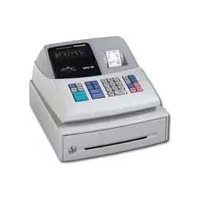



| Product type | Electronic cash register |
| Brand | Sharp |
| Model | XE-A102 |
| Dimensions (L x W x H) | 330 x 363 x 234 mm |
| Weight | 5 kg |
| Power supply | Mains, official voltage and frequency (nominal) |
| Power consumption | Standby 6.4 W / Operation 13 W |
| Display | LED (light-emitting diode) 9 digits |
| Printer | Selective type with 1-station print wheel, max 13 digits |
| Paper | Width 57.5 mm ± 0.5 mm, max diameter 80 mm, watermark quality |
| Cash drawer | 3 banknote compartments, 6 for coins |
| Programmable departments | 8 (including 4 accessible via Shift key) |
| PLU (Price per item) | Up to 80 codes |
| Operating modes | OFF, REG, X/Flash, Z/PGM, etc. |
| Memory backup | 3 AA batteries (R6/LR6) for data retention in case of power outage |
| Operating temperature | 0 to 40 °C |
| Maintenance and cleaning | Soft dry cloth; do not use gasoline or thinner |
| Safety | Sharp printer cutter; batteries: observe polarity, do not mix types |
| Spare parts and consumables | Specific Sharp ink roller, 57.5 mm paper roll, AA batteries |
| Included accessories | Paper roll, 2 mode keys, 2 drawer lock keys, manual, quick guide, ink roller, winding spool, angle bracket |
Frequently Asked Questions - XEA102 SHARP
User questions about XEA102 SHARP
0 question about this device. Answer the ones you know or ask your own.
Ask a new question about this device
Download the instructions for your Cash register in PDF format for free! Find your manual XEA102 - SHARP and take your electronic device back in hand. On this page are published all the documents necessary for the use of your device. XEA102 by SHARP.
USER MANUAL XEA102 SHARP
INSTRUCTION MANUAL
The cash register should be securely fitted to the supporting platforms to avoid instability when the drawer is open.
CAUTION:
The socket-outlet shall be installed near the equipment and shall be easily accessible.
CAUTION:
For a complete electrical disconnection pull out the mains plug.
CAUTION:
This equipment complies with the requirements of Directives 89/336/EEC and 73/23/EEC as amended by 93/68/EEC.
This is a Class A product. In a domestic environment this product may cause radio interference in which case the user may be required to take adequate measures.
Warning
Thank you for purchasing the SHARP Electronic Cash Register Model XE-A102. Please read this manual carefully before operating your machine. Keep this manual for future reference. It will help you solve operational problems that you may encounter.
Handling Cautions
- Be very careful when removing and replacing the printer cover, as the cutter mounted on it is very sharp.
- Install the cash register in a location not subject to direct sunlight, unusual temperature changes, high humidity, or splashing water.
- Never operate the cash register with wet hands. Water can cause internal component failure.
- The cash register plugs into any standard wall outlet (official (nominal) voltage). Other electrical devices on the same electrical circuit can cause the cash register to malfunction.
- Clean the cash register with a dry, soft cloth. Never use volatile liquids, such as benzine or thinner. Chemicals can discolor or damage the cabinet.
- For protection against data loss, please purchase three R6 or LR6 batteries ("AA" size), and install them after resetting your cash register and before using it.
When handling the batteries, please observe the following. Incorrectly using batteries can cause them to burst or leak, possibly damaging the interior of the cash register.
- RISK OF EXPLOSION IF BATTERY IS REPLACED BY AN INCORRECT TYPE. DISPOSE OF USED BATTERIES ACCORDING TO THE INSTRUCTIONS.
- Be sure that the positive (+) and negative (-) poles of each battery are facing in the proper direction for the installation.
- Never mix batteries of different types for the installation.
- Never mix old batteries and new ones for the installation.
- Never leave dead batteries in the battery compartment.
- Remove the batteries if you do not plan to use the cash register for long periods.
- Should a battery leak, clean out the battery compartment immediately, taking care to avoid letting the battery fluid come into direct contact with your skin.
- For battery disposal, follow the corresponding law in your country.
- For a complete electrical disconnection, pull out the main plug.
IMPORTANT!
Before using the cash register for the first time, you must first reset the cash register, and then install three new R6 or LR6 batteries ("AA" size) on the register. Never fail to follow the procedures described in the "Preparing the Cash Register" section.
When you open the carton, make sure that all accessories shown in the "Specifications" section are contained.
Parts and their Functions 3
When an Error Occurs 4
Preparing the Cash Register 5
Quick Start Operations 7
Programming Date and Time. 8 Programming Tax. 8 Programming Department Status 9 Making Basic Sales Entries (Department Entries) 9 Reading/Resetting Sales Data 11
Utilizing Various Features for Sales Entries. 12
PLU Entries. 12 Convenient Sales Entries 12 VAT (Tax) Calculation 13 Discounts and Premiums Using the Percent Key 13 Currency Exchange 14 No Sale 14 Refund 14 Non-add Code Number 14 Received-on Account and Paid-out Entries. 14 Corrections 15
Reading and Resetting of Sales. 15
EURO Migration Function 17
Advanced Programming 19
Department Preset Unit Price Programming 19 PLU Programming 19 Percent Key Programming 19 Exchange Key Programming 20 Printing Format Programming 20 Miscellaneous Programming 21 Consecutive Receipt Number Programming 21 EURO Programming 22 Rounding Programming (For Australian tax system) 22 Secret Code Programming 22
Checking the Programmed Machine Settings 23
Maintenance 24
24 Replacing the Paper Roll. 24 Replacing the Batteries 25 Replacing the Ink Roller 25 In Case of Power Failure or Paper Jam 25 Before Calling for Service 26 Specifications 26
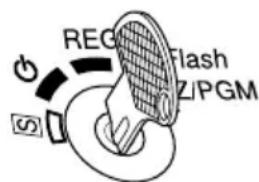
Mode Switch
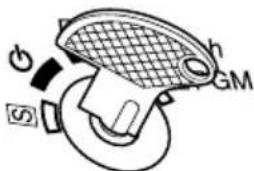
Insert the mode key into the mode switch and move the key to get an appropriate mode.
:Turns the display off. No operations are possible.
REG: Permits transaction entry.
: Permits correction after finalizing a transaction.
X/Flash: Permits printing of sales reports and displaying the flash reports.
Z/PGM: Permits printing and resetting of sales reports and programming.
Keyboard
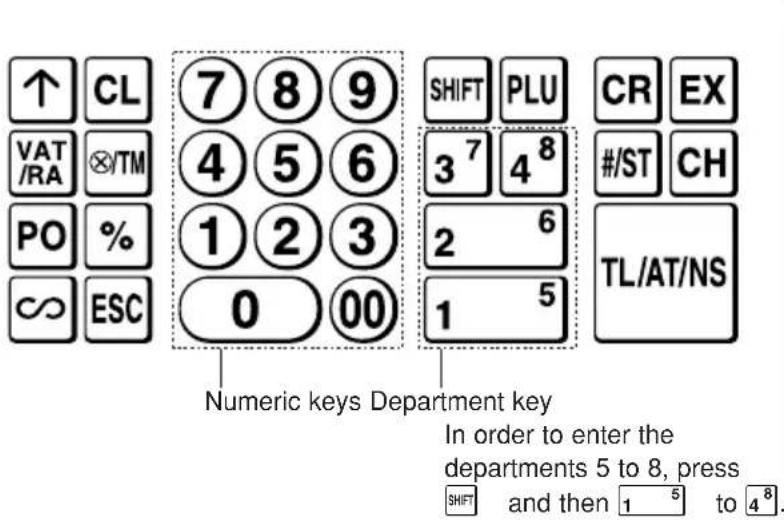
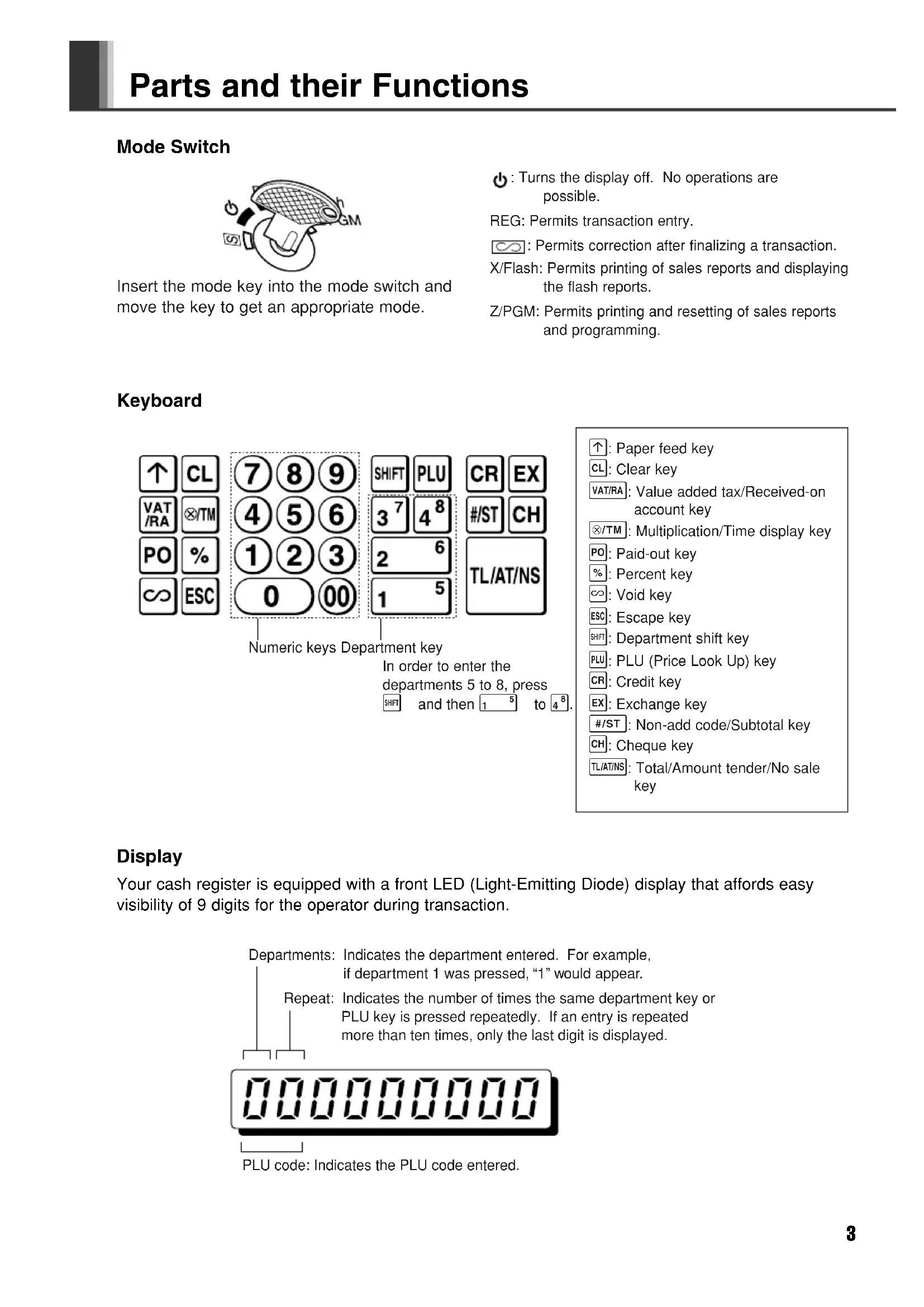
: Paper feed key CL: Clear key VAT/RA: Value added tax/Received-on account key / T M : Multiplication/Time display key P0: Paid-out key % : Percent key : Void key Esc: Escape key Shift: Department shift key PLU: PLU (Price Look Up) key CR: Credit key Ex: Exchange key
/ST:Non-add code/Subtotal key
CH: Cheque key TL/AT/NS: Total/Amount tender/No sale key
Display
Your cash register is equipped with a front LED (Light-Emitting Diode) display that affords easy visibility of 9 digits for the operator during transaction.
PLU code: Indicates the PLU code entered.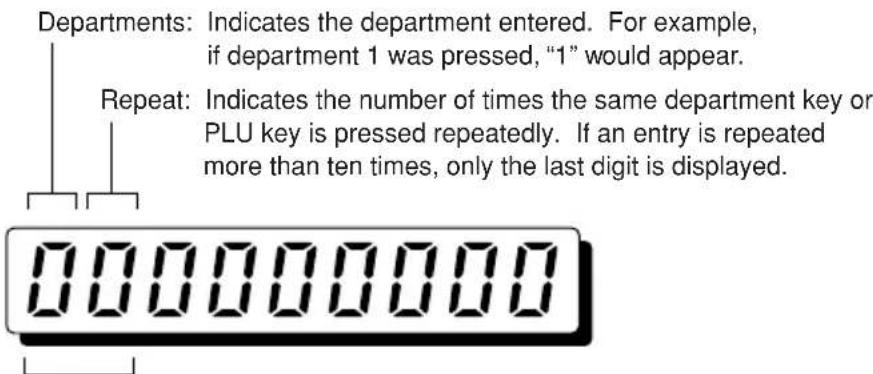
Symbols and figures appearing on the display:
Error: Appears with an alarm sound when an error is made. If this occurs during a transaction because of an extra digit entry, simply press CL and re-enter correctly. Program: Appears when the cash register is being programmed in the "Z/PGM" mode. Finalization: Appears when a transaction is finalized by pressing TL/AT/NS, CR or CH. Subtotal: Appears when the cash register computes a subtotal when #/ST is pressed, and also when an amount tendered is less than the total sales amount. Change: Appears whenever a change due amount is displayed. Exchange: Appears when Ex is pressed to calculate a subtotal in foreign currency. Low battery: Appears when the voltage of the installed batteries is under the required level. You need to replace the batteries with new ones very soon. No battery: Appears when the batteries are not installed, or the installed batteries are dead. You must immediately replace the batteries with new ones.
In addition, the following appear when appropriate:
- The minus sign (-) can appear in positions 2 to 9.
- The decimal point appears in positions 1 to 3.
To display the time and date
Set the mode switch to the REG position, and press the time/date key once to display the time or press it twice to display the date.
Press the CL key to cancel the time/date display.
When an Error Occurs
When your register goes into an error state, it displays the error message "E" accompanied by a warning beep. Clear the error state by pressing CL and take the appropriate action.
- When you enter an over 7-digit number to the department or an over 8-digit number (79999999) to RA (Received-on Account), PO (Paid-Out), credit or cheque:
Press CL and make a correct entry.
- When you make an error in key operation:
Press CL and make a correct entry.
- When you make an entry beyond a programmed entry digit limit:
Check if the entered amount is correct. If correct, check the setting of the entry digit limit.
- When a subtotal exceeds eight digits (7999999):
Press CL and then press TL/AT/NS, CR or CH to finalize the transaction at that point.
- When the number of an item exceeds 3 digits in multiplication entry:
Press CL and re-enter a correct number.
Error Escape Function
When an error or something uncontrollable occurs during transaction entry and you cannot keep the customer waiting, press Esc twice (following CL when in the error state). You can escape the situation and finalize the transaction as a cash sale at that time. Transaction entries until then are registered.
Please do the following before using the register for the first time.
Step 1 Install the Cash Register
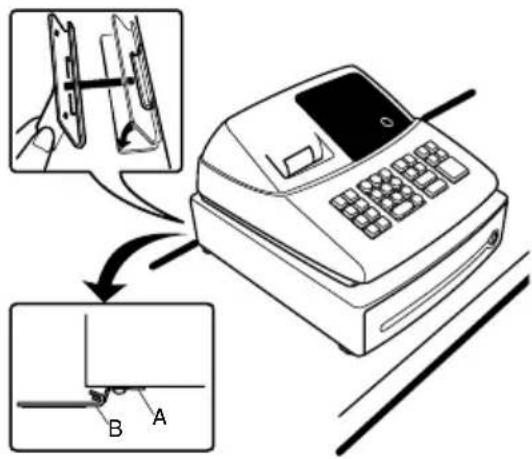
For installing the cash register, find a stable surface near an AC outlet where the cash register will not be subject to water sources or direct sunlight, then install the register using the fixing angle bracket provided with the register.
The fixing angle bracket prevents the register from moving when the drawer opens. By hooking the register on the bracket, you can secure the register to the position.
Follow the procedure shown below for the installation.
How to install the fixing angle bracket
- Thoroughly clean the location where the fixing angle bracket (B) is to be placed.
- Peel off the adhesive tape on the fixing angle bracket.
- Hook the angle bracket onto the hook (A) that is located at the bottom rear of the register.
- Firmly stick the fixing angle bracket to the table surface that you cleaned above.
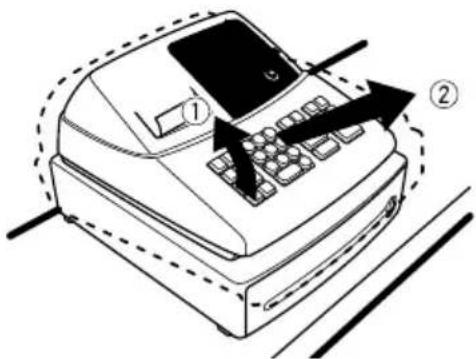
How to remove the register from the fixing angle bracket
- Lift up the front of the register and pull the register towards you.
Step 2 Reset the Cash Register
In order for your cash register to operate properly, you must reset it before programming for the first time. Follow this procedure.
- Insert the mode key into the mode switch and turn the key to the REG position.
- Insert the plug into the AC outlet. A buzzer will sound three times.
IMPORTANT: This operation must be performed without batteries loaded.
- The registrar display should now show "L 0.00".
- Press ※/TM to confirm the clock starts from "1 0-00".
- Press CL to cancel the time display.
Step 3 Install Batteries
Three new R6 or LR6 batteries ("AA"size) must be installed in the cash register to prevent the data and user-programmed settings from being erased from the memory, when the AC cord is accidentally disconnected or in case of power failure. Once installed, the batteries will last approximately one year before needing replacement. At this time, the "L" symbol will appear on the display to indicate that the batteries are low and that you must replace them within two days.
Install three new R6 or LR6 batteries ("AA" size) according to the procedure shown below with the AC cord connected and set the mode switch to the REG position:
- Push the printer cover forward and detach it.
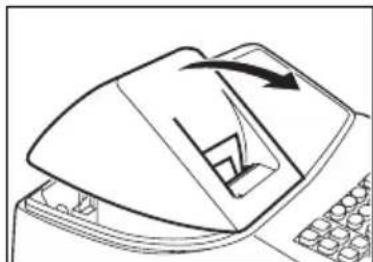
- Open the battery cover next to the paper roll cradle.
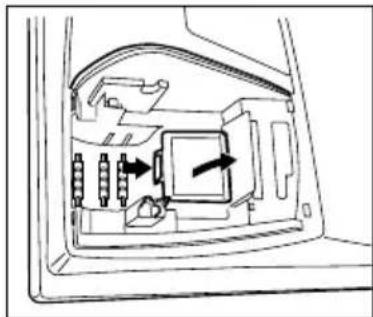
- Insert three new R6 or LR6 batteries ("AA" size).
- Confirm that the no battery symbol "L" lights off.
- Close the battery cover.
Be sure to observe precautions shown on page 1 when handling batteries.
(Views from rear)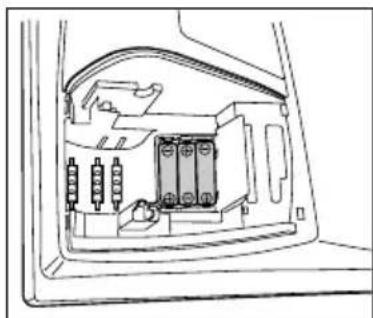
Step 4 Install the Paper Roll
On your register, a printer is mounted, and you can print receipts or journals. For the printer, you must install the paper roll provided with the register, even when you program the register for not printing receipt.
- Set the paper roll in the paper roll cradle as shown in the diagram.
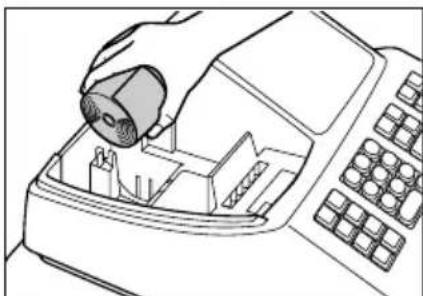
- Insert the paper straight into the paper inlet, and press the up arrow. The paper then feeds through and appears in the print area.
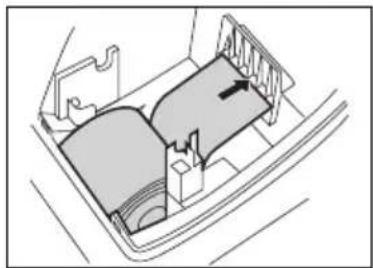
- (For journal printing) Insert the top end of the paper into the slit in the spool shaft and wind the paper two or three turns.
- (For journal printing) Place the take-up spool on the bearing.
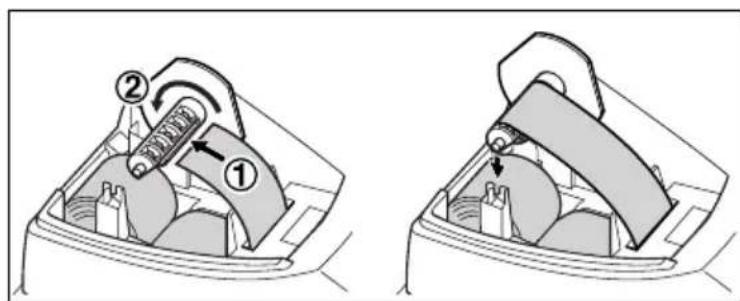
- Replace the printer cover. For receipt printing, pass the paper end through the openings of the printer cover. Be very careful not to cut yourself on the manual cutter.
Quick Start Operations
In this section, how to make basic programming which you must program before starting sales operation and basic sales operation are explained.
Abbreviations and Terminology used in this manual
Dept.: Department; a category for merchandise classifications. Every sales item should belongs to a department.
PLU: Price Look Up; a category for merchandise classifications. PLUs are used to call up preset prices by a code entry (1-80).
Function keys: Function keys are listed in Keyboard section. Please refer to page 3.
VAT: Value Added Tax
X report: Report to read sales data
Z report: Report to read and reset sales data
Receipt ON/OFF function: To print or not to print receipts or journals in the REG mode.
- If your domestic currency decimal position is other than 2, you must change the setting. For setting, please refer to Miscellaneous Programming section.
- You can continue programming (step 1 through 3 below) without printing the programming report by not pressing # /ST at each program step. However, to finish programming, you must press # /ST .
When you press #/ST at the end of programming, the programming report will be printed. On the report you can check the settings you did. Make sure that your programming is correctly done.
For reading the report, please refer to the Checking the Programmed Machine Settings section.
Step 1: Programming Date and Time
For setting the date, enter the date in 6 digits using the day-month-year format. (For example, enter 260805 for 26 August 2005)
For setting the time, enter the time in 4 digits using the 24-hour format.
Set the mode switch to the Z/PGM position, then operate the following key sequences.
Date (DDMMYY) → #/ST (→ #/ST: to finish programming)
Time (max. 4 digits in 24-hour format) → #/ST (→ #/ST)
You can change the date format in the Z/PGM mode. If you change the format, follow the format you changed when setting the date.
Step 2: Programming Tax
Your cash register comes with the ability to program six kinds of tax systems. Program a tax system required by your region, and program tax rates (00.0000% to 99.9999%) on the tax system you selected.
Make sure that the mode switch is at the Z/PGM position, then operate the following key sequences.
Programming the Tax System

Parameter A: Tax system
Manual VAT 1-4: 0 (Default) Auto VAT 1-4: 1 Auto Tax 1-4: 2
Manual VAT 1: 3 Manual Tax 1-4: 4 Auto Tax 1-3 and Auto VAT 1: 5
Programming VAT (Tax) Rate

When lower tax limit is not specified
Parameters
A: VAT (Tax) 1: 1 VAT (Tax) 2: 2 VAT (Tax) 3: 3 VAT (Tax) 4: 4
B: VAT(tax) rate in 6 digits (000000 to 999999) (Default: 000000)
C: Lower tax limit (0 to 9999) only for TAX system. (Default: 0)
Step 3 Programming Department Status
Merchandise can be classified into eight departments. Items sold with use of the department keys can later be printed on a report that shows the quantities sold and sales amounts classified by department. The data is useful for making purchasing decisions and other store operations. When using a department key, you must set the parameters to specify the department status, such as plus or minus sign and tax status.
Make sure that the mode switch is at the Z/PGM position, then operate the following key sequence.
ABCDEFG → / TM → (SHIFT → ) Department key (#/ST)
(Press to program departments 5 to 8.)
Parameters: Selection: Entry:
| A Sign +/- + sign* 0 | ||
| - sign 1 | ||
| B Normal/SICS (Single Item Cash Sale) Normal* 0 | ||
| SICS 1 | ||
| C VAT4 or TAX4 No* 0 | ||
| Yes | 1 | |
| D VAT3 or TAX3 No* 0 | ||
| Yes | 1 | |
| E VAT2 or TAX2 No* 0 | ||
| Yes | 1 | |
| F VAT1 or TAX1 No | 0 | |
| Yes* | 1 | |
| G Entry digit limit (0 to 7 digits) | 0 through 7 (default: 7) | |
| *: Default | ||
Sign
Assign + sign to departments in which normal sale amounts are to be entered, and - sign to departments in which payments for items such as refunds, bottle returns or other minus transactions are to be entered.
SICS (Single Item Cash Sale)
This allows the operator to finalize the transaction entry by entering the unit price of one item and pressing the department key set for SICS. If the unit price is preset for the department key, you can finalize the transaction by pressing the department key only.
- Entry digit limit
Setting this parameter for applicable departments prevents the accidental entry of too large an amount during a sale. For example, if the highest entry to be allowed is 9.99, enter 3. If 0 is entered you cannot enter a price and only a preset price can be entered.
Step 4 Making Basic Sales Entries (Department Entries)
In this section, the basic sales entry method using department key with simple correction (void) method is explained. For more information such as PLU entries, VAT(tax) entries and entries using function keys, please refer to Utilizing Various Features for Sales Entries section.
An operation example (paid by cash) is shown below.
Before starting sales entries, make sure that a paper roll is installed.
- Set the mode switch to the REG position.
- Enter the price for the first department item (in case of 15.00, enter 15.00)
- Press the appropriate department key.
For department 5 to department 8, press first before pressing the department key.
- Repeat steps 1 and 2 for all the department items.
- Press #/ST to display the amount due. (You can omit this step.)
- Press VAT/RA to make the tax calculation in case your tax system is manual VAT1-4 system (default setting).
- Enter the amount received from the customer. (You can omit this step if the amount tendered is the same as the subtotal.)
- Press TL/AT/INS, and the change due is displayed and the drawer is opened.
- Tear off the receipt and give it to the customer (in case you programmed receipt printing) with his or her change displayed. 10. Close the drawer.
- When paid by cheque, press CH instead of TL/AT/NS.
- When paid by credit, press CR instead of TL/AT/NS.
- If you preset unit prices to departments, you can omit entering the unit price of the department item, that is, omit step 1 shown above. For the programming, refer to the Department Preset Unit Price Programming section.
Example
Direct finalization (No change)
Selling a 5.00 item (dept. 1) and an 8.00 item (dept. 3) for cash, and the sales total including tax is 13.00, and receiving the exact amount of money.
5001 5
80037
/ST TL/AT/NS
Price and dept. Price and dept.
Example
Amount tendered operation
Selling a 5.00 item (dept. 1) and an 8.00 item (dept. 3) for cash and receiving 20.00 from your customer.
5001 5
80037
/ST
20 00
TL/AT/NS
Price and dept. Price and dept. Amount tendered
Example
Making tax calculation (tax system: manual VAT1-4)
Selling a 5.00 item (dept. 1) and an 8.00 item (dept. 3) for cash and receiving 20.00 from your customer.
5001 5
80037
/ST
VAT/RA
20 00
TL/AT/NS
To make tax calculation
When making an error entry:
Correction of entered numbers: Delete it by pressing CL immediately after the entry.
Correction of the last item entry: Press
Correction when you found an error on earlier entries:
Void the incorrect entry using the void key, and make the correct entry as shown in the example below.
For details, please refer to Corrections section on page 15.
Example
Correction of earlier entries
Correcting 300 15 entry to 200 15 after another correct entry has been made
3001 5
52537
3000 1
2001 5
TL/AT/NS
Void for 30015 Correct entry
Step 5: Reading/Resetting Sales Data
In order to check sales, you can read a sales report. Also, you should reset sales data after practicing on your cash register.
To read a sales report, take an X report: set the mode switch to the X/Flash position, and press TL/AT/NS.
To reset sales, take a Z report: set the mode switch to the Z/PGM position, and press CH. The accumulated sales data and the grand total (GT) are cleared.
For reading and resetting actual sales data, refer to the "Reading and Resetting of Sales" section. You should reset sales data at the end of each day to clear sales data.
Before making sales entries, make sure that a paper roll is installed in case the receipt function is on. Also, make sure to turn the mode switch to the REG position.
PLU Entries
Enter the PLU code of a PLU item and press PLU. The PLU item will be registered.
Example
Selling a PLU1 item and a PLU15 item by credit.
1 PLU
15 PLU
CR
NOTE
To use PLU item sales entry, you must program PLUs.
Convenient Sales Entries
When selling only one item by cash (Single Item Cash Sale (SICS) entry)
When a sale is for only one item paid by cash, such as a pack of cigarettes, you can use the SICS function. It is applicable only to department keys programmed for SICS or to PLUs associated with such departments. The drawer opens after pressing the department or PLU key.
When entering more than one of the same department or PLU items
You can enter two or more of the same department or PLU item by pressing the department or PLU key repeatedly (repetitive entry), or by using the multiplication key (multiplication entry). It will be convenient to use the multiplication key when selling the same item in bulk. For operation, refer to the example shown below.
Example
Repetitive entry
Selling two 2.00 items (dept. 1) and three PLU5 items for cash
2001515
5PLUPLUPLU
TL/AT/NS
Example
Multiplication entry
Selling six 1.50 items (dept. 1) and twelve PLU5 items for cheque payment
6 /TM
150 1
①② /TM
5PLU
/ST
CH
Mixed tender sale
When the amount tendered by cash or cheque is less than the sales amount including tax, the display shows a deficit and "0". To compensate for the deficit, make an additional amount-tendered entry or make a credit entry.
Example
Your customer pays 8.30 in cash and 50.00 by credit for an including-tax subtotal of 58.30.
/ST
830
TL/AT/NS
CR
Amount received Displays a in cash deficit and
VAT (Tax) Calculation
Your cash register provides the following six tax systems.
Your cash register is pre-programmed as manual VAT 1 to 4 system.
Auto VAT 1 to 4 system (automatic operation method using programmed percentages)
This system, at settlement, calculates VAT for taxable 1 through 4 subtotals by using the corresponding programmed percentages.
Auto tax 1 to 4 system (automatic operation method using programmed percentages)
This system, at settlement, calculates taxes for taxable 1 through 4 subtotals by using the corresponding programmed percentages, and also adds the calculated taxes to those subtotals, respectively.
Manual VAT 1 to 4 system (manual entry method using programmed percentages)
This system provides the VAT calculation for taxable 1 through 4 subtotals. This calculation is performed using the corresponding programmed percentages when VAT/RA is pressed just after #/ST.
Manual VAT 1 system (manual entry method for subtotals that uses VAT 1 preset percentages)
This system enables the VAT calculation for the subtotal. This calculation is performed using the VAT 1 preset percentage when VAT/RA is pressed just after #/ST. For this system, the keyed-in VAT rate can be used. In this case, after pressing #/ST, enter the VAT rate and press VAT/RA.
Manual tax 1 to 4 system (manual entry method using preset percentages)
This system provides the tax calculation for taxable 1 through 4 subtotals. This calculation is performed using the corresponding programmed percentages when VAT/RA is pressed just after #/ST. After this calculation, you must finalize the transaction.
Auto tax 1 to 3 and auto VAT 1 system
This system enables the calculation on the combination with automatic tax 1 through 3 and automatic VAT 1. The combination can be any of VAT 1 corresponding to taxable 4 and any of tax 1 through 3 corresponding to taxable 1 through 3 for each item. The tax amount is calculated automatically with the percentages previously programmed for these taxes.
VAT/tax calculation for PLU items are performed according to the one set for its associated department.
Discounts and Premiums Using the Percent Key
If you want to apply a discount or a premium for an item, enter the percent rate and press the percent key. If you want to apply a discount or premium for the subtotal, enter all the items, press #/ST and then press the percent key following the percent rate.
Your machine is pre-programmed as discount. If you change to premium, refer to the percent key programming section. Also you can preset a percent rate. If a percent rate is preset, you do not have to enter a percent rate before pressing the percent key. For the programming, also refer to the percent key programming section.
Example
Applying a 20.00% discount to an item belonging to department 3
80037
20 00%
TL/AT/NS
Example
Applying a 15.00% discount to the subtotal of a transaction
8PLU
12PLU
8001 5
/ST
①⑤⑩%
TL/AT/NS
Currency Exchange
Your register allows payment entries of foreign currency when you programmed a currency exchange rate. After items entries or during tendering entries, press EX, the subtotal in foreign currency can be displayed. Then enter the tendered amount in foreign currency if not exact amount payment, and press a finalization key (TL/AT/NS / CH or CR when programmed). The change due in domestic currency will be displayed.
- When the amount tendered is short, the deficit is shown in domestic currency.
- If you select "Yes" for cheque and credit operation when tendering in foreign currency in EURO programming, you can finalize a sale in foreign currency using CH or CR.
- If you select "Yes" for exchange amount printing for total and change in EURO programming, you can display a change in foreign currency by pressing EX when the change is displayed in domestic currency. To return to the display in domestic currency, press EX again.
Example
Selling a department 3 item (price 79.50) in a foreign currency. (Preset exchange rate: 1.550220
79503
EX 13000
TL/AT/NS
Amount tendered in foreign currency
No Sale
When you need to open without a sale, for example to make changes, just press TL/ATNS. The drawer will open.
Refund
Since your cash register comes with no refund key, make a negative department (see the required programming on page 9) and use it.
Check that the taxable status of the returned item is the same as that of the negative department. Otherwise the tax will not be calculated correctly.
Non-add Code Number
Non-add code numbers can be entered and printed on the receipt or journal during the entry of a sale. Non-add codes can be used for a variety of things. For example: credit numbers, check numbers, serial numbers, product codes, service charge codes, or any other numbers for later reference to specific transactions. Enter a code number of up to 8 digits and press #/ST.
Received-on Account and Paid-out Entries
When you receive an account from a customer or when you pay an amount to a vendor, it is a good idea to use VAT/RA or PO respectively.
For the received-on-account entry, enter the amount, and press VAT/RA.
For the paid-out entry, enter the amount, and press [p].
The entry limit is 8 digits (79999999), though it is different if you programmed.
Example
Receiving 60.00 on account from a customer whose code number is 12345.
12345 #/ST
6 0 00
VAT/RA
Corrections
If you should make an error when entering an item into a sale, correct it using the following procedures.
- Correction of entered numbers
When you enter an incorrect number, delete it by pressing immediately after the entry.
- Correction of the last entry (direct void)
If you make a mistake when making a department entry, PLU entry, multiplication entry or repetitive entry (the last entry only), you can correct this by pressing l
- Correction of earlier entries (indirect void)
With this function, you can correct department or PLU entry incorrectly made during a transaction if you find it before finalizing the transaction by pressing TL/AT/NS, CR or CH.
Example To correct ③PLU entry to ④PLU after another correct entry has been made, enter the following:
3PLU
150 1
3PLU
4PLU
TL/AT/NS
Indirect void correct for ③ PLU entry
- Correction after issuance of receipt
This function allows you to reverse the entries made on an incorrect receipt. The entries are subtracted from each totalizer and added to a void totalizer. Turn the mode key to position, and enter the same details that are on the incorrect receipt. (If necessary, enter the secret code and press TL/ATINS when you turn the mode key position.)
Reading and Resetting of Sales
All the data on all of your registrations as well as other transaction information will remain in the memory of your cash register as long as your cash register has power (Be sure you have live batteries installed in case of a power failure). This information can be printed in the form of a report which can be helpful to you in running your business.
Flash reports for viewing on the display
Use this function for on-the-spot checking of individual cash register's sales data. The sales total is shown on the display but is not printed nor cleared from the cash register's memory.
To display the flash report for each individual item, press the following keys in the X/Flash mode:
Individual department sales Department key
Sales total #/ST
Cash in drawer CR
X reports for reading of sales
This report, when taken in the X/Flash mode, prints the accumulated information of sales.
Taking an X report is a good way to do a mid-day check on daily sales. You can take X reports any number of times, because they do not affect the cash register's memory.
To issue an X report, set the mode switch to the X/Flash position and press TL/AT/NS.
Z reports for reading and resetting of sales
This report, when taken in the Z/PGM mode, prints the same information as an X report. Once this report has been printed, the cash register's memory of daily information is cleared and all the transaction totals are reset to zero. Be sure to issue a Z report at the end of each day.
With a Z report printing, you can also reset GT (grand total).
To issue a Z report, follow the procedure described below.
- Set the mode switch to the Z/PGM position.
- If necessary, enter the secret code and press TL/AT/NS.
To issue a Z report with resetting of GT: 3. Press CH. 4. If necessary, enter the secret code and press CH.
To issue a Z report without resetting of GT:
- Press TL/AT/NS.
- If necessary, enter the secret code and press TL/AT/NS.
Sample sales report
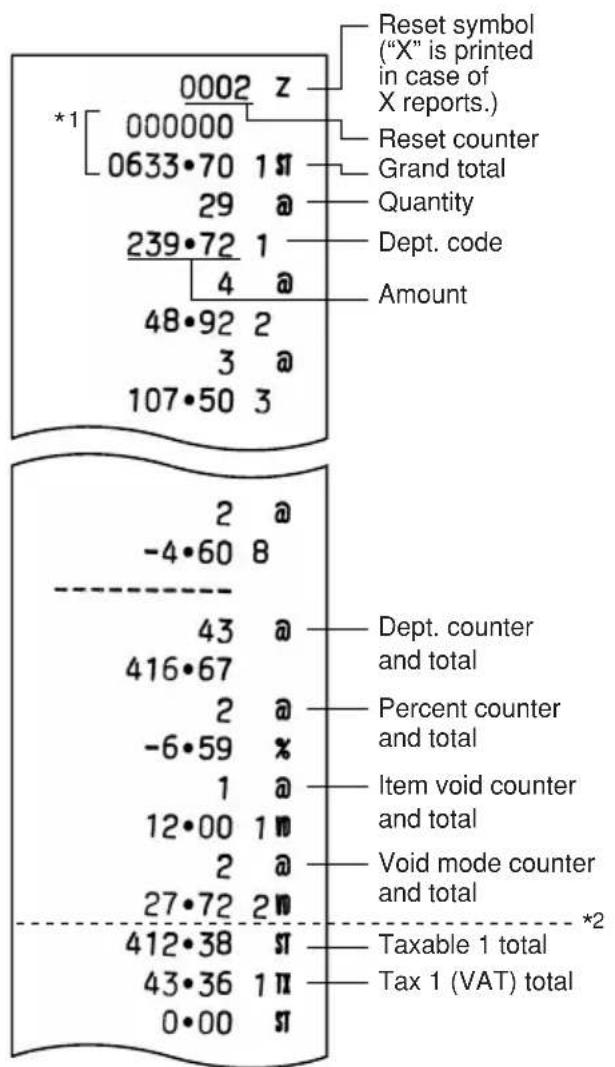
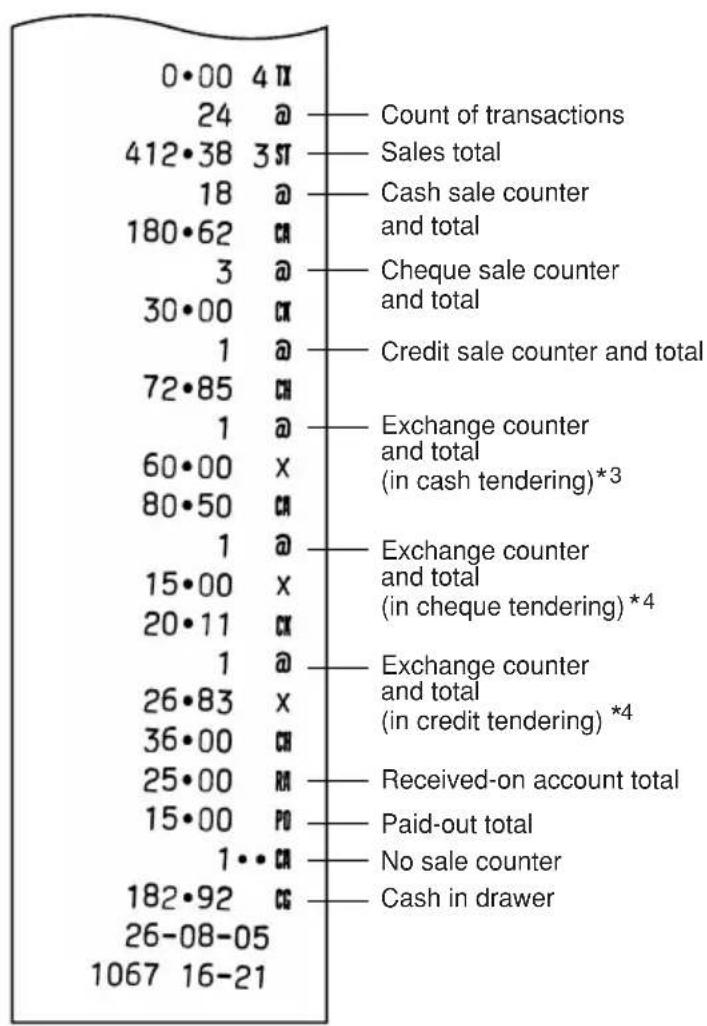
1 Printed in the Z report only. 2 Difference by rounding is printed here in case Australian rounding is applied. 3 Not printed in case that the exchange rate is set to 0.000000. 4 Not printed in case that "Cheque and credit operation when tendering in foreign currency" is set to "No" on EURO programming, and/or the exchange rate is set to 0.000000.
Your register can be modified to correspond with each period set for the introduction of EURO, and in your register each currency is treated as shown on the table below depending on which period you are in.
Basically your register can be automatically modified to correspond to the introduction of EURO by executing automatic EURO modification operation shown below in Z/PGM mode. However, there are several options you must set depending on your need. So, please carefully conduct necessary settings.
How currencies are treated in your register
| Period 1 | Period 2 | Period 3 | ||
| After the introduction of EURO, and before EURO banknotes and coins begin to circulate | After EURO banknotes and coins begin to circulate, and before national currency is withdrawn from circulation. (Coexistence of EURO and national currency) | After the national currency is withdrawn from circulation | ||
| Currency | EURO | Exchange key | Domestic currency | Domestic currency |
| National currency (DM, F, etc.) | Domestic currency | Exchange key | ||
| Foreign currency | Exchange key | |||
Automatic EURO modification operation
Make sure the mode switch is in the Z/PGM position first (if necessary, enter the secret code and press TL/AT/NS) and perform the following procedure. Please note that you can perform each operation only once with the substitution of "A=1", "A=2" and "A=3". For example, if you performed the operation with the substitution of "A=2" first, you cannot perform the operation with the substitution of "A=1".

*A: Enter 1 for period 1, 2 for period 2, and 3 for period 3.
The details of the register system modification are as shown on the following page:
| Items | A=1 (EURO status 1) | A=2 (EURO status 2) | A=3 (EURO status 3) |
| General Z report | Issue | Issue | Issue |
| GT memory | - | Clear | Clear *2 |
| Conversion of preset prices of Dept./PLU | - | Yes *1 | Yes *1 |
| Exchange amount printing for total and change | Yes | Yes | No |
| Exchange calculation method | Division | Multiplication | Multiplication |
| Domestic currency symbol | - | [EURO] | [EURO] |
| Domestic currency decimal point position | - | 2 | 2 |
| Exchange currency symbol | [EURO] | Previous domestic currency symbol | *-3 |
| Exchange currency decimal point position | 2 | Previous domestic currency decimal point position | - |
| Rounding of exchange currency | Round off | Round off | Round off |
- The item marked with "-" remains the same as the previous data. 1: If the Automatic conversion of unit prices of Depts./PLUs by automatic EURO migration operation is set NO (default setting) in EURO Programming, or currency exchange rate is set to 0% (default setting) in Exchange Key Programming, conversion of preset prices of Dept./PLU is not performed in the Automatic EURO modification operation. 2: When you perform from EURO status 2, previous data remains unchanged. *3: When you perform from EURO status 1 or 2, "space" is set.
IMPORTANT
- After the execution of the procedure with "A=1", treat EURO as foreign currency using EX. Set the EURO conversion rate as the currency conversion rate for EX.
- After the execution of the procedure with "A=2", treat EURO as domestic currency and national currency as foreign currency using EX. Set the EURO conversion rate as the currency conversion rate for EX. After the execution of the procedure with "A=3", treat EURO as domestic currency.
- As for the percent rate for % and HALO setting, the automatic conversion is not made. So, when your domestic currency becomes EURO, you must change these settings so that they are based on EURO currency.
- You can receive the amount of exchange (EURO or national currency) in cheque or credit. For the programming, please refer to EURO programming on page 22.
- When "Exchange amount printing for total and change" is set to "Yes", you can display a change in foreign currency by pressing EX when the change is displayed in domestic currency.
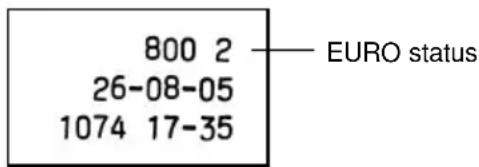
Checking the current EURO status
You can check the EURO status currently set on the cash register. Set the mode switch to the Z/PGM position (if necessary, enter the secret code and press TL/AT/NS) and perform the following procedure. The current EURO status will be printed on the receipt or journal.

Before starting programming, set the mode switch to the Z/PGM mode. Also if necessary, enter the secret code and press TL/AT/NS.
- You can continue programming without printing the programming report by not pressing #/ST at the end of each program step. However, you must program PLUs independent from other programming.
- Unless otherwise specified, programming options marked with * indicate factory setting. In case of values or number settings, the factory settings are shown with the word, "Default".
Department Preset Unit Price Programming
Unit prices can be assigned directly to department keys for frequently purchased items, which enables you to enter the prices by simply pressing the department keys.
Unit price (max. 5 digits) → (SHIFT) Department key (#/ST) (Default: 0.00)
(Press to program departments 5 to 8.)
PLU Programming
The PLU function allows speedy key entries whereby a preset price is automatically called up when a code is entered. Up to 80 PLU settings are possible. Each PLU should belong to a department in order to acquire the parameters of the department. The cash register was factory preset so that PLU1 to 10 are assigned to department 1 and unit price 0.00.

When the next PLU code to be programmed does not directly follow the one just entered.
(Press to program departments 5 to 8.)
To disable a PLU, enter the PLU code and press PU, then press and #/ST.
Percent Key Programming
% can be programmed as a discount key or premium key. As a default, % is programmed as a discount key. Also you can program a percent rate for % .
When 00.00% is programmed, use of preset percent rate is prohibited. (factory setting)
Programming the percent key function (discount or premium)
1 for discount or 0 for premium → /TM→ % (→ # /ST)
Programming the percent rate (00.00 to 99.99%)
Percent rate in 4 digits (0000 to 9999) → % (→ #/ST)
Exchange Key Programming
To handle a foreign currency, you can program a currency exchange rate (000.00000% to 999.99999%) for the exchange key. When 000.00000% is programmed, use of the Ex key is prohibited (factory preset).
Currency exchange rate in 9 digits (000000000 to 999999999) → EX (→ #/ST)
Printing Format Programming
You can program a printing format of the receipt or journal by using the following eight kinds of parameters.

Parameters: Selection: Entry:
| A Currency symbol for domestic currency Space* 0 | ||
| EURO 1 | ||
| B Printing receipt/journal in the REG mode Yes (Receipt ON)* 0 | ||
| (Receipt ON/OFF function) No (Receipt OFF) 1 | ||
| C Printing format Journal format* 0 | ||
| Receipt format 1 | ||
| D Date printing Yes* | 0 | |
| No | 1 | |
| E Time printing | Yes* | |
| No | 1 | |
| F Receipt number printing | Yes* | |
| No | 1 | |
| G Taxable subtotal printing | Yes* | |
| No | 1 | |
| H Subtotal printing with a press of | #/ST | Yes |
| No* | 1 | |
- Printing format
When receipt format is selected, the take-up spool does not move.
Miscellaneous Programming
You can program miscellaneous settings suitable for use.

Parameters: Selection: Entry:
| A Date format MMDDYY 0 | |||
| DDMMYY* 1 | |||
| YYMMDD 2 | |||
| B Time format 12 hour format 0 | |||
| 24 hour format* 1 | |||
| C Decimal point position for domestic currency 0 though 3 (Default: 2) | |||
| D Resetting receipt no. when issuing Z report No* 0 | |||
| Yes | 1 | ||
| E Amount tendered compulsory for TL/AT/NS and CH | No* 0 | ||
| Yes | 1 | ||
| F Subtotaling compulsory | No* 0 | ||
| Yes | 1 | ||
| G Entry digit limit for CR, CH, VAT/RA and PO | 0 though 8 (Default: 8) | ||
| H Rounding | Round off* | 0 | |
| Round up | 1 | ||
| Round down | 2 | ||
Time format
When 12 hour format is set, the a.m. time will be displayed with R and printed without no mark, and the p.m. time will be displayed with P and printed with the mark @.
- Amount tendered compulsory
When set for compulsory, always enter the amount tendered by the customer before finalizing the transaction.
- Subtotaling compulsory
When set for compulsory, always press #/ST before finalizing the transaction.
Consecutive Receipt Number Programming
The receipt number is printed on every receipt or journal, and report, together with the date and time. The number is incremented each time a receipt is issued. To start from a specific consecutive number, enter a figure one less than that number.
Receipt start number (max. 4 digits) → [⊗/TM] → [#/ST] (→ [#/ST]) (Default: 0001)
EURO Programming
For the details of EURO programming, please refer to "EURO Migration Function" on pages 16 and 17.

Parameters: Selection: Entry:
| A | Automatic conversion of unit prices of Depts. | No* 0 | |
| /PLUs by automatic EURO migration operation | Yes 1 | ||
| B Conversion rate printing No* 0 | |||
If you select "Yes" for exchange amount printing for total and change, you can display a change in foreign currency by pressing [EX] when the change is displayed in domestic currency.
Rounding Programming (For Australian tax system)
When Australian rounding is set, the sales total amount is rounded to 0 or 5 when paid in cash.
4 → [#/ST] → [0] for No or 1 for Yes → #/ST (→ #/ST]
(Default: Yes for the register shipped to Australia)
Secret Code Programming
A secret code is used in order to allow only those who know the secret code to operate the machine in REG and Z/PGM modes or to print Z reports. When you need a secret code, program a secret code.
Secret code (max. 4 digits) → [TL/AT/NS] → [#/ST]
(Default: 0000; no application of secret code)
How to enter a secret code:
In case that a secret code has been programmed, "----" is displayed when the mode switch is set to REG or Z/PGM or when you need to issue a Z report. In this case, enter the secret code (max. 4 digits) and press [TL/AT/NS]. Every time you enter a digit, the display of "-" changes to ".".
In case you forget the secret code you programmed:
Set the mode switch to the Z/PGM position, and operate the secret code programming shown above with the substitution of "0000" for the secret code.
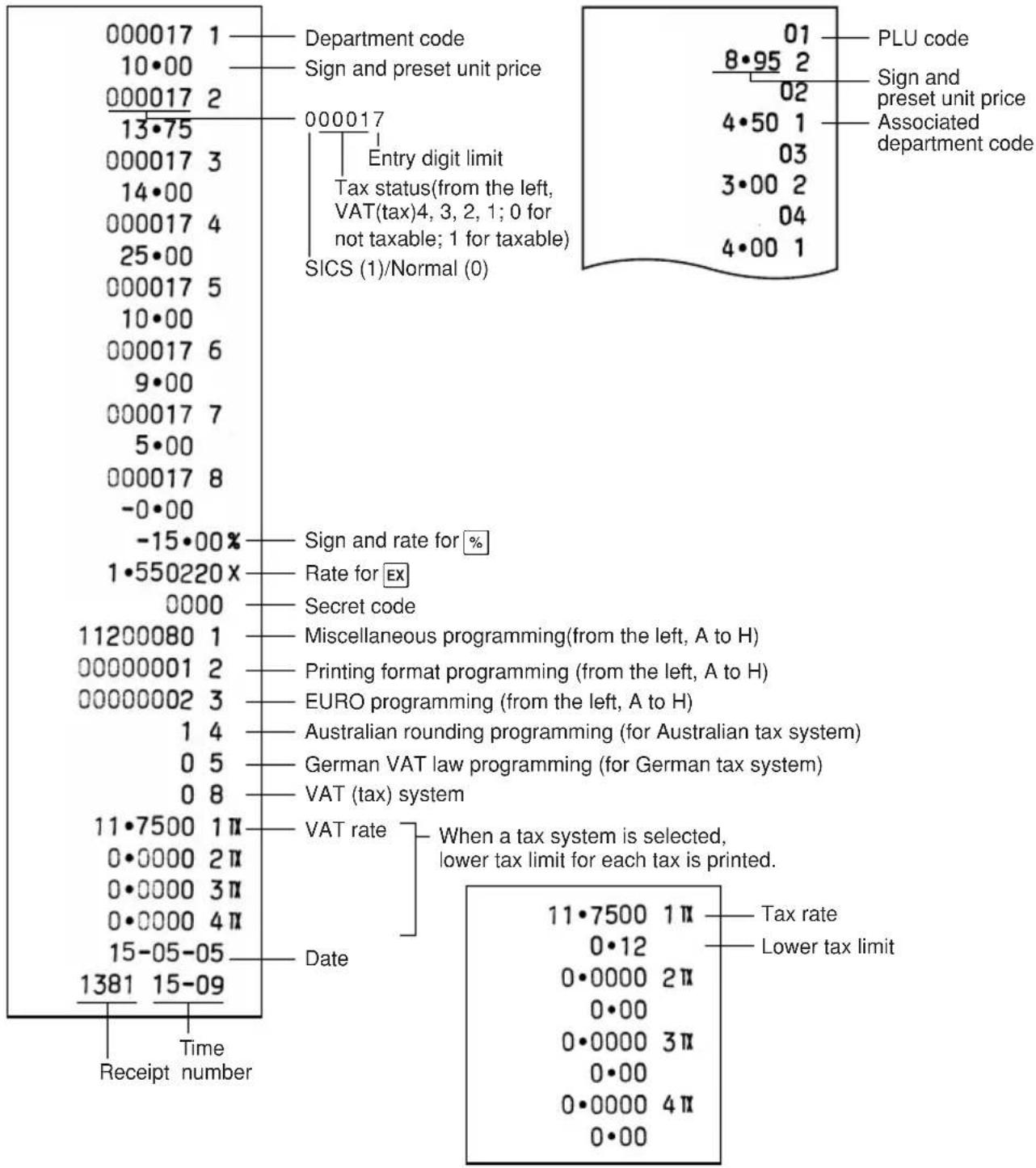
Your machine allows you to print the programmed machine settings, namely, general & tax programming report and PLU programming report.
Set the mode switch to the Z/PGM position, and press [#/ST] to print a general & tax programming report, or press [PLU] to print a PLU programming report.
- General & tax programming report • PLU programming report
Drawer Handling
Locking the Printer
Develop the habit of locking the drawer when not using the register for any extended period of time.
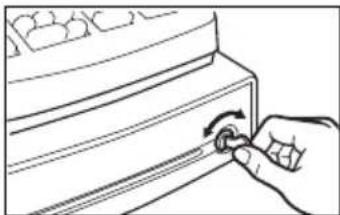
To lock the drawer, turn 90 degrees counter-clockwise, and to unlock the drawer, turn 90 degrees clockwise.
Removing the Printer
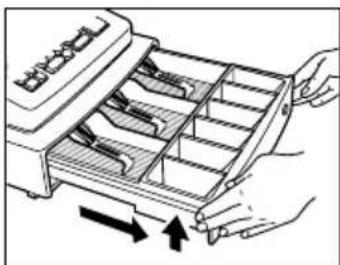
To detach the drawer, pull it forward fully, and remove it by lifting it up. The 6-denomination coin case is detachable from the till. Also the separators of the coin case are removable.
Manually Opening the Printer
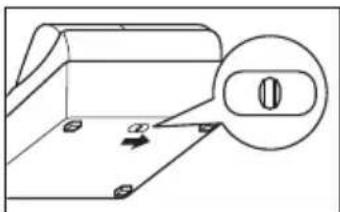
In case of a power failure or if the machine is out of order, slide the lever located on the machine bottom toward the direction of the arrow to open the drawer manually. The drawer will not open if it is locked with a drawer lock key, though.
Using the Slit of the Printer
You can enter bills and cheques from the slit without opening the drawer. The bills and cheques entered are placed under the coin case.
Caution
When taking out the bills and cheques, never fail to hold tightly the both sides of the coin case with your both hands so that the coins in the coin case will not be fallen.
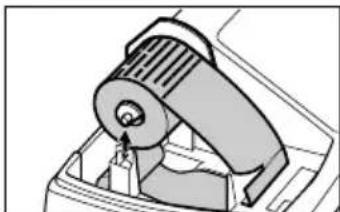
Replacing the Paper Roll
When a dye appears on the paper roll, it is time to replace the paper roll with new one. Be sure to use the paper roll specified in "Specification" section.
In case of journal printing
- Set the mode switch to the REG position.
- Remove the printer cover.
- Press to advance the paper by several lines and then cut it to remove the take-up spool from the bearing.
- After cutting the existing paper, remove the paper roll. Then remove the remaining paper by pressing .
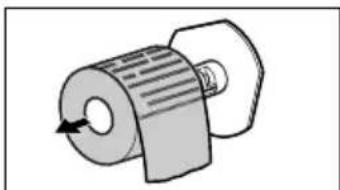
- Remove the paper roll from the take-up spool.
- Install a new paper roll and replace the take-up spool according to the instructions on page 6.
NOTE
In case of receipt printing, do the above steps 1, 2, 4 in this order and then install a new paper roll according to the instructions on page 6.
Replacing the Batteries
This cash register displays a low battery symbol ( when the batteries installed get low, and displays a no battery symbol ( when batteries are extremely low or batteries are not installed.
When the low battery symbol is displayed, replace the batteries with new ones as soon as possible. The existent batteries will be dead in about two days.
When the no battery symbol is displayed, replace the batteries immediately. Otherwise, if the AC power cord is disconnected or a power failure occurs, all the programmed settings will be reset to the default settings and any data stored in memory will be cleared.
For replacing the batteries, be sure that the cash register is plugged in and the mode switch is on the REG position, then replace the batteries with new ones referring to "Install Batteries" section on page 6.
Replacing the Ink Roller
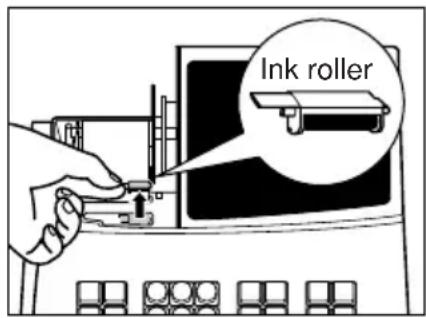
When printing becomes faded, replace the existing ink roller with a new one available from SHARP.
Precautions:
- Be sure to use an ink roller available from SHARP. The use of any other ink rollers could cause troubles in the printer. Never pour ink to the ink roller. After opening the parcel, install it soon.
- Remove the printer cover.
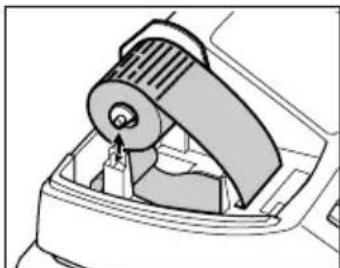
- Pull the ink roller handle upward to remove the ink roller.
- Install a new ink roller.
- Replace the printer cover.
In Case of Power Failure or Paper Jam
When power failure occurs:
If power is lost, the machine retains its memory contents and all information on sales entries when the batteries are in the proper state of charge.
- When power failure occurs in register idle state or during an entry, the machine returns to the normal state of operation after power recovery.
- When power failure occurs during a printing cycle, the register prints "……" and then carries out the correct printing procedure.
When printer motor locks:
If printer motor locks, printing stalls and intermittent beeping starts. First, unplug the power cord and repair paper jam. Then plug in the power cord, feed the roll paper to the proper position and press cl. The register will then resume correct printing after printing
Before Calling for Service
If you encounter a problem, use this chart before calling for service.
| Problem Item to check | |
| ·The display shows symbols that do not make sense. | ·Was the machine reset in the proper way shown on page 5? |
| ·The display will not illuminate even when the mode switch is not set to “\(\bullet\)” The machine fails to operate when any key is pressed. | ·Is the power supplied to the electrical outlet? (Plug . in another electrical device.) ·Is the power cord firmly connected to the electrical outlet? |
| ·The display is illuminated, but the machine does not accept key entries. | ·Is the mode switch properly set to the REG position? ·Was the machine reset in the proper way shown on page 5? |
| ·Journal paper does not feed properly in the printer. | ·Is the take-up spool installed properly? ·Is there a paper jam? |
| ·Printing is faded or illegible. | ·Isn’t the ink roller used up? ·Is the ink roller installed properly? |
Specifications
| Model: XE-A102 | |
| Size: 330(W) x 363(D) x 234(H) millimeters | |
| Weight: 5 kg | |
| Power Source: Official (nominal) voltage and frequency | |
| Power Consumption: Stand-by: 6.4 W Operating: 13 W | |
| Work Temperature: 0 to 40 °C | |
| Display: LED (Light-Emitting Diode) numeric display | |
| Printer: 1 station print wheel selective type | |
| Printing Capacity: Max. 13 digits | |
| Paper Roll: Width: 57.5 mm ± 0.5 mm Max. diameter: 80 mm Paper quality: Bond paper (thickness: 0.06 to 0.085 mm, weight: 47 to 64 g/m2) | |
| Cash Printer: 3 slots for bills, 6 for coins | |
| Accessories (supplied): Paper roll Mode key Drawer lock key Instruction manual Quick start guide Ink roller Take-up spool Fixing angle bracket | 1 roll 2 2 1 copy (this manual) 1 copy 1 (already installed) 1 1 |
- Specifications and appearance are subject to change without notice.
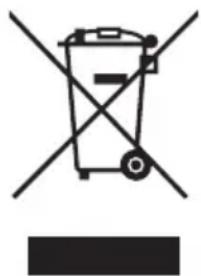
Attention: Your product is marked with this symbol. It means that used electrical and electronic products should not be mixed with general household waste. There is a separate collection system for these products.
A. Information on Disposal for Users (private households)
1. In the European Union
Attention: If you want to dispose of this equipment, please do not use the ordinary dust bin!
Used electrical and electronic equipment must be treated separately and in accordance with legislation that requires proper treatment, recovery and recycling of used electrical and electronic equipment. Following the implementation by member states, private households within the EU states may return their used electrical and electronic equipment to designated collection facilities free of charge. In some countries your local retailer may also take back your old product free of charge if you purchase a similar new one.
*) Please contact your local authority for further details.
If your used electrical or electronic equipment has batteries or accumulators, please dispose of these separately beforehand according to local requirements.
By disposing of this product correctly you will help ensure that the waste undergoes the necessary treatment, recovery and recycling and thus prevent potential negative effects on the environment and human health which could otherwise arise due to inappropriate waste handling.
2. In other Countries outside the EU
If you wish to discard this product, please contact your local authorities and ask for the correct method of disposal.
For Switzerland: Used electrical or electronic equipment can be returned free of charge to the dealer, even if you don't purchase a new product. Further collection facilities are listed on the homepage of www.swico.ch or www.sens.ch.
B. Information on Disposal for Business Users.
1. In the European Union
If the product is used for business purposes and you want to discard it:
Please contact your SHARP dealer who will inform you about the take-back of the product. You might be charged for the costs arising from take-back and recycling. Small products (and small amounts) might be taken back by your local collection facilities.
For Spain: Please contact the established collection system or your local authority for take-back of your used products.
2. In other Countries outside the EU
If you wish to discard of this product, please contact your local authorities and ask for the correct method of disposal.
XE-A102
2001515 5PLUPLUPLU TL/AT/NS
Multiplicative entry
② → #/ST → ABCDEFGH → #/ST (→ #/ST)
VAT (BTW): "Value Added Tax", also known as "Sales Tax".
2001515 5PLUPLUPLU TL/AT/NS
The wires in this mains lead are coloured in accordance with the following code:
BLUE:
Neutral
BROWN:
Live
As the colours of the wires in the mains lead of this apparatus may not correspond with the coloured markings identifying the terminals in your plug proceed as follows.
The wire which is coloured BLUE must be connected to the terminal which is marked with the letter N or coloured black.
The wire which is coloured BROWN must be connected to the terminal which is marked with the letter L or coloured red.
The apparatus must be protected by a 3A fuse in the mains plug or distribution board.
CAUTION: DO NOT CONNECT THE LIVE (BROWN) WIRE OR THE NEUTRAL (BLUE) WIRE TO THE EARTH TERMINAL OF YOUR 3-PIN MAINS PLUG.
Environment Protection
The device is supported by a battery. To dispose the battery safely to protect the environment, please note the following points:
- Take the used battery to your local waste depot, dealer or customer service centre for recycling.
- Do not throw the used battery into fire, into water or into the household waste!
Environmental Protection
- CAUTION
- WARNING
- HANDLING CAUTIONS
- IMPORTANT
- MODE SWITCH
- KEYBOARD
- ST:NON-ADD CODE/SUBTOTAL KEY
- DISPLAY
- SYMBOLS AND FIGURES APPEARING ON THE DISPLAY
- TO DISPLAY THE TIME AND DATE
- WHEN AN ERROR OCCURS
- ERROR ESCAPE FUNCTION
- STEP 1 INSTALL THE CASH REGISTER
- HOW TO INSTALL THE FIXING ANGLE BRACKET
- HOW TO REMOVE THE REGISTER FROM THE FIXING ANGLE BRACKET
- STEP 2 RESET THE CASH REGISTER
- IMPORTANT: THIS OPERATION MUST BE PERFORMED WITHOUT BATTERIES LOADED
- STEP 3 INSTALL BATTERIES
- STEP 4 INSTALL THE PAPER ROLL
- QUICK START OPERATIONS
- ABBREVIATIONS AND TERMINOLOGY USED IN THIS MANUAL
- STEP 1: PROGRAMMING DATE AND TIME
- STEP 2: PROGRAMMING TAX
- PROGRAMMING THE TAX SYSTEM
- PROGRAMMING VAT (TAX) RATE
- STEP 3 PROGRAMMING DEPARTMENT STATUS
- PARAMETERS: SELECTION: ENTRY
- SIGN
- SICS (SINGLE ITEM CASH SALE)
- ENTRY DIGIT LIMIT
- STEP 4 MAKING BASIC SALES ENTRIES (DEPARTMENT ENTRIES)
- EXAMPLE
- DIRECT FINALIZATION (NO CHANGE)
- ST TL/AT/NS
- AMOUNT TENDERED OPERATION
- ST
- MAKING TAX CALCULATION (TAX SYSTEM: MANUAL VAT1-4)
- WHEN MAKING AN ERROR ENTRY
- CORRECTION OF EARLIER ENTRIES
- STEP 5: READING/RESETTING SALES DATA
- PLU ENTRIES
- NOTE
- CONVENIENT SALES ENTRIES
- REPETITIVE ENTRY
- MULTIPLICATION ENTRY
- MIXED TENDER SALE
- VAT (TAX) CALCULATION
- DISCOUNTS AND PREMIUMS USING THE PERCENT KEY
- CURRENCY EXCHANGE
- NO SALE
- REFUND
- NON-ADD CODE NUMBER
- RECEIVED-ON ACCOUNT AND PAID-OUT ENTRIES
- CORRECTIONS
- READING AND RESETTING OF SALES
- FLASH REPORTS FOR VIEWING ON THE DISPLAY
- X REPORTS FOR READING OF SALES
- Z REPORTS FOR READING AND RESETTING OF SALES
- SAMPLE SALES REPORT
- AUTOMATIC EURO MODIFICATION OPERATION
- CHECKING THE CURRENT EURO STATUS
- DEPARTMENT PRESET UNIT PRICE PROGRAMMING
- PLU PROGRAMMING
- PERCENT KEY PROGRAMMING
- EXCHANGE KEY PROGRAMMING
- PRINTING FORMAT PROGRAMMING
- PRINTING FORMAT
- MISCELLANEOUS PROGRAMMING
- TIME FORMAT
- AMOUNT TENDERED COMPULSORY
- SUBTOTALING COMPULSORY
- CONSECUTIVE RECEIPT NUMBER PROGRAMMING
- EURO PROGRAMMING
- ROUNDING PROGRAMMING (FOR AUSTRALIAN TAX SYSTEM)
- SECRET CODE PROGRAMMING
- HOW TO ENTER A SECRET CODE
- IN CASE YOU FORGET THE SECRET CODE YOU PROGRAMMED
- GENERAL & TAX PROGRAMMING REPORT • PLU PROGRAMMING REPORT
- DRAWER HANDLING
- LOCKING THE PRINTER
- REMOVING THE PRINTER
- MANUALLY OPENING THE PRINTER
- USING THE SLIT OF THE PRINTER
- REPLACING THE PAPER ROLL
- IN CASE OF JOURNAL PRINTING
- REPLACING THE BATTERIES
- REPLACING THE INK ROLLER
- PRECAUTIONS
- IN CASE OF POWER FAILURE OR PAPER JAM
- WHEN POWER FAILURE OCCURS
- WHEN PRINTER MOTOR LOCKS
- BEFORE CALLING FOR SERVICE
- SPECIFICATIONS
- INFORMATION ON DISPOSAL FOR USERS (PRIVATE HOUSEHOLDS)
- IN THE EUROPEAN UNION
- IN OTHER COUNTRIES OUTSIDE THE EU
- INFORMATION ON DISPOSAL FOR BUSINESS USERS
- XE-A
- MULTIPLICATIVE ENTRY
- ENVIRONMENT PROTECTION
- ENVIRONMENTAL PROTECTION
Brand : SHARP
Model : XEA102
Category : Cash register