
Espresso & Coffee Centre 242154 - Coffee machine PRINCESS - Free user manual and instructions
Find the device manual for free Espresso & Coffee Centre 242154 PRINCESS in PDF.



| Product type | Automatic coffee machine |
| Brand | PRINCESS |
| Model | Espresso & Coffee Centre 242154 |
| Dimensions (W x D x H) | 280 x 390 x 385 mm |
| Weight | 8 kg |
| Power supply | 220-240 V ~ 50/60 Hz, 1350 W |
| Pump pressure | 15 bars |
| Water tank capacity | 1.3 L |
| Bean hopper capacity | 230 g |
| Boiler material | Stainless steel |
| Coffee types | Whole beans or ground coffee |
| Main functions | Espresso, long coffee, steam, hot water |
| Grind adjustment | Yes (from 1 to 16) |
| Dose adjustment | Yes (dial) |
| Settings | Water hardness, pre-infusion, pre-ground, cup volume |
| Adjustable height dispenser | Yes |
| Swivel steam wand | Yes |
| Cleaning | Removable brewing group, descaling every 3-4 months |
| Safety | Safety valve, safety thermostat, automatic shut-off |
| Included accessories | Cleaning brush, coffee scoop, water hardness test strip |
| Cord length | 1200 mm |
Frequently Asked Questions - Espresso & Coffee Centre 242154 PRINCESS
User questions about Espresso & Coffee Centre 242154 PRINCESS
0 question about this device. Answer the ones you know or ask your own.
Ask a new question about this device
Download the instructions for your Coffee machine in PDF format for free! Find your manual Espresso & Coffee Centre 242154 - PRINCESS and take your electronic device back in hand. On this page are published all the documents necessary for the use of your device. Espresso & Coffee Centre 242154 by PRINCESS.
USER MANUAL Espresso & Coffee Centre 242154 PRINCESS
Instructions for use
Mode d'emploi
Anleitung
Congratulations on your choice!
As the proud owner of the machine, you can now experience the taste of a delicious cup of espresso or cappuccino in the comfort of your own home.


ITALIANO
PRECAUZIONI IMPORTANTI
3 NORME DI SICUREZZA

PRINCESS HOUSEHOLD APPLIANCES
Baronielaan 1
4818 PA Breda
Netherlands
When using electrical appliances, basic safety precautions should always be followed to reduce the risk of fire, electric shock, and/or injury to persons, including the following:
1 Read all instructions and information in this instruction book and any other literature included in this carton referring to this product before operating or using this appliance.
2 Do not touch hot surfaces. Use handles or knobs.
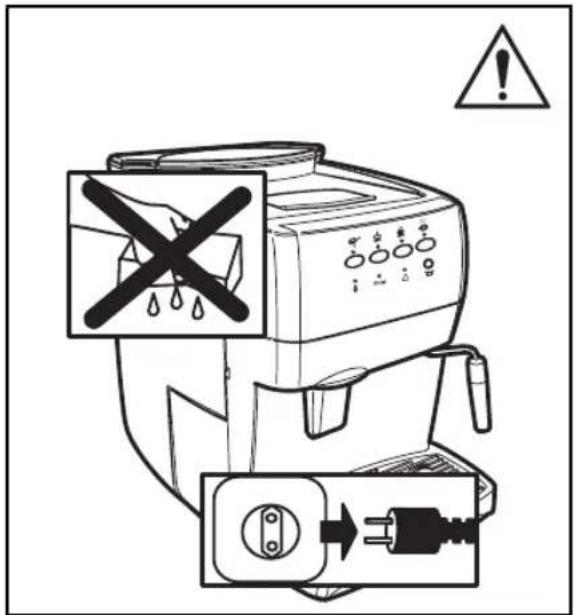
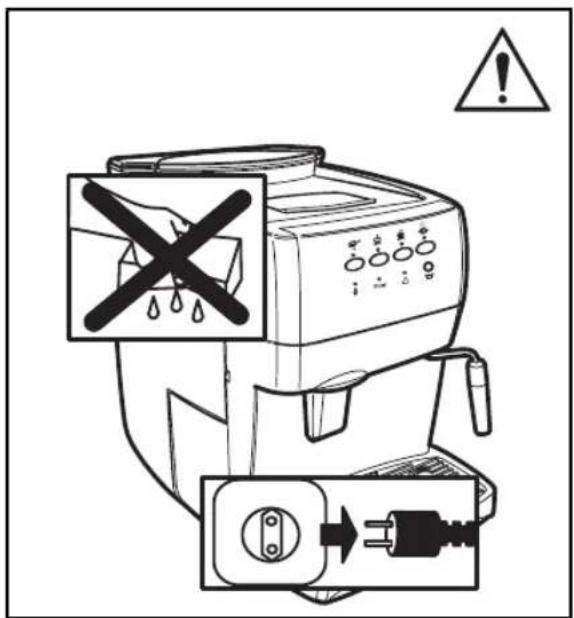
3 To protect against fire, electric shock and personal injury do not immerse cord, plugs or appliance in water or other liquid.
4 Close supervision is necessary when any appliance is used by or near children.
5 Unplug from outlet when not in use and before cleaning. Allow to cool before putting on or taking off parts, and before cleaning the appliance.
6 Do not operate any appliance with a damaged cord or plug or after the appliance malfunctions or has been damaged in any way. Return appliance to the nearest authorized service centre for examination, repair or adjustment.
7 The use of accessory attachments not recommended by the appliance manufacturer may result in fire, electric shock or personal injury.
8 Do not use outdoors.
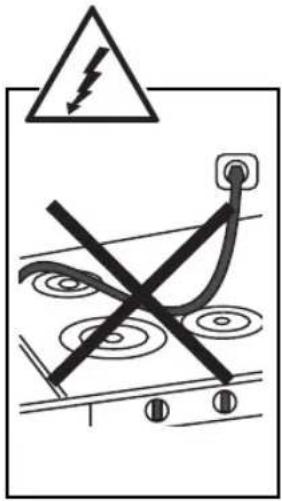
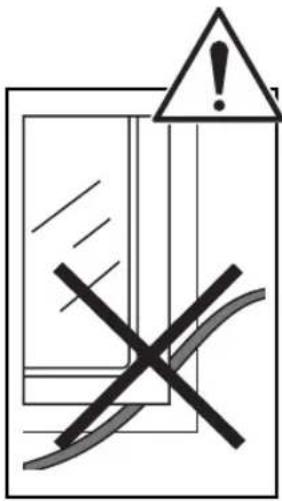
9 Do not let cord hang over edge of table or counter, or touch hot surfaces.
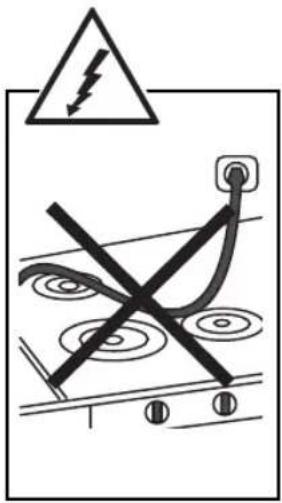
10 Do not place on or near a hot gas or electric burner, or in a heated oven.
11 Always turn appliance "OFF", then plug cord into the wall outlet. To disconnect, turn switch to "OFF", then remove plug from wall outlet.
12 Do not use appliance for other then intended household use.
13 Use extreme caution when using hot steam.
CAUTION
This appliance is for household use. Any servicing, other than cleaning and user maintenance, should be performed by an authorized service centre. Do not immerse base in water. To reduce the risk of fire or electric shock, do not disassemble the base. There are no user serviceable parts inside. Repair should be done by authorized service personnel only.
1 Check voltage to be sure that the voltage indicated on the nameplate agrees with your voltage.
2 Never use warm or hot water to fill the water tank. Use cold water only.
3 Keep your hands and the cord away from hot parts of the appliance during operation.
4 Never clean with scouring powders or hard implements. Simply use a soft cloth dampened with water.
5 To avoid your coffee maker scaling up, use purified or bottled water.
INSTRUCTIONS FOR THE POWER SUPPLY CORD
A A short power-supply cord is provided to reduce risks of getting tangled up or tripping over a longer cord.
B Longer extension cords are available and may be used if care is exercised in their use.
C If a long extension cord is used:
1 the marked electrical rating of the extension cord should be at least as great as the electrical rating of the appliance.
2 if the appliance is of the grounded type, the extension cord should be a grounding type
3 the cable does not hang from the table to avoid the risk of getting caught up in it.
SAVE THESE INSTRUCTIONS
1 GENERALITIES
This coffee maker is designed to make espresso coffee using both coffee beans and ground coffee; it is also equipped with a device for supplying steam and hot water.
This elegantly designed appliance has been designed for household use and is not suitable for continuous, professional-type use.

Caution: The manufacturer cannot be held liable for any damages/injury attributable to following:
- Incorrect use and not in keeping with the indented use.
• Repairs not carried out by authorized service centres.
• Tampering with the supply cord.
• Tampering with any machine part. - Use of not original spare parts and accessory attachments.
In these cases, the guarantee is invalidated.
1.1 Reading this instruction book

The following symbols have been used to facilitate reading:
The caution triangle denotes all instructions important for the safety of the user. Follow these instructions scrupulously to avoid serious injury!

This symbol denotes information that should be taken into account to get the most out of the appliance.
The figures referred to in the text can be found on the cover flap. Keep these pages open when reading the instructions.
1.2 Using this instruction book
Keep these instructions in a safe place and hand them over to any other person who uses this coffee maker. For additional information or for information on topics not covered or inadequately covered in this book, contact the authorized service centres.
2 TECHNICAL PARTICULARS
- Nominal Voltage See nameplate found on the appliance.
- Rated Output
See nameplate found on the appliance.
• Material of Body Thermoplastic (ABS) - Dimensions (l x h x d) (mm)
280 x 385 x 390
• Weight (Kg) 8 - Cord Length (mm) 1200
- Control Panel
Front
• Water Tank Removable
• Power Supply See nameplate found on the appliance.
• Water Tank (I) 1.3
• Coffee Container Capacity (g) 230 of coffee beans - Pump Pressure (bar) 15
- Boiler Stainless Steel
- Safety Devices Boiler pressure safety valve Safety thermostat
The manufacturer reserves the right to change the make up of the machine in the light of any technological breakthrough.
The machine complies to the European Standard 89/336/EEC (legislative decree 476 04.12.92), referring to the elimination of broadcasting disturbance.
ENGLISH
3 SAFETY STANDARDS

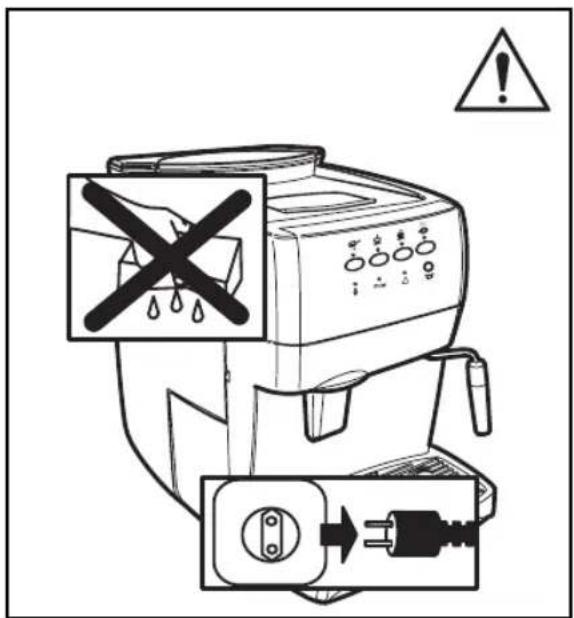
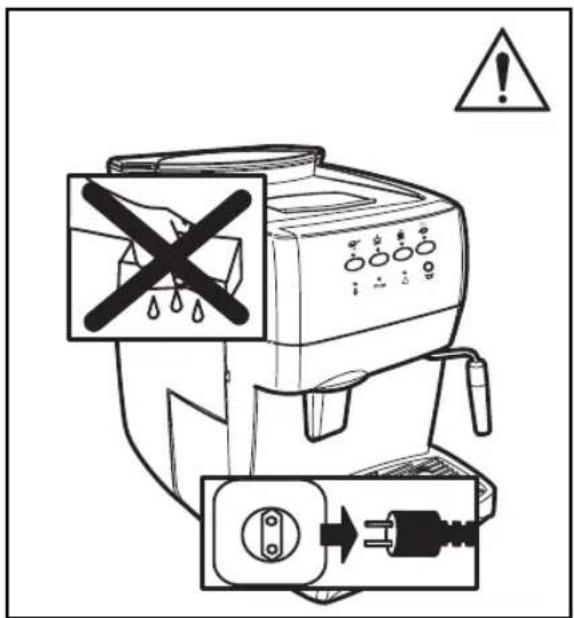
Never let live parts come into contact with water: short-circuit hazard! The superheated steam and hot water can cause scalding! Never direct the steam or the hot water jet towards body parts! Touch the steam /hot water nozzle carefully: scalding hazard!
Intended Use
- This coffee maker is intended for household use only.
- Do not make technical changes and use the appliance inappropriately: damage/injury hazard!
- This appliance is not intended for use by persons (including children) with reduced physical, sensory or mental capabilities, or lack of experience and knowledge, unless they have been given supervision or instruction concerning use of the appliance by a person responsible for their safety.
Power Supply
- Connect the coffee maker to a suitable outlet only.
- The voltage must match the one specified on the nameplate of the appliance.
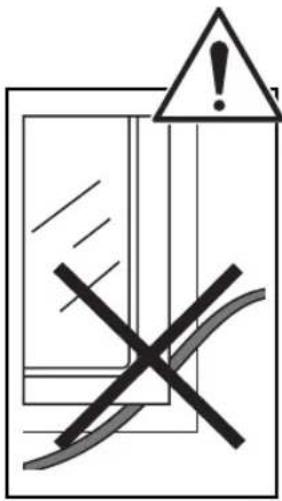
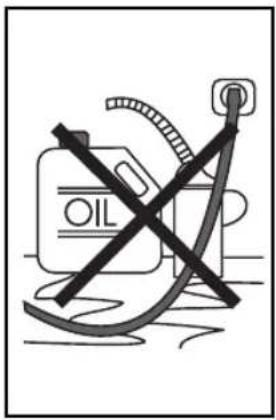
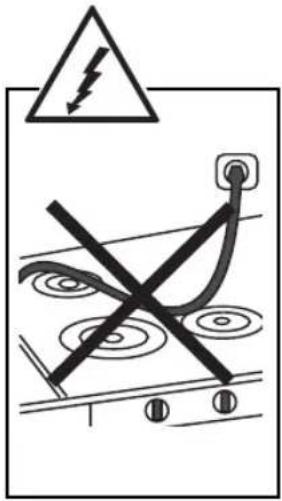
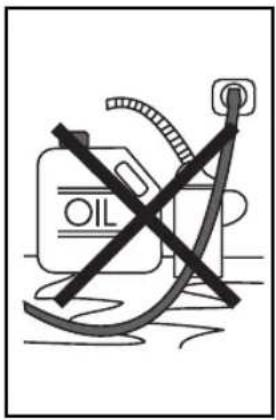
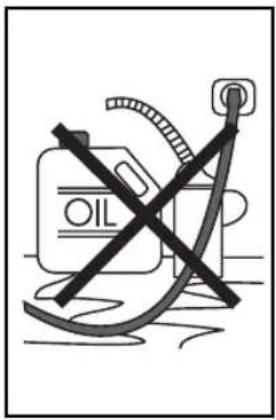
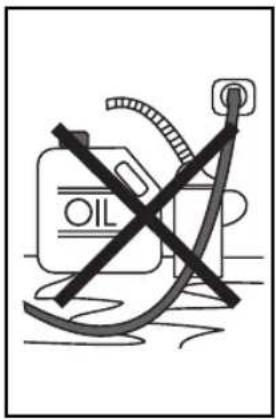
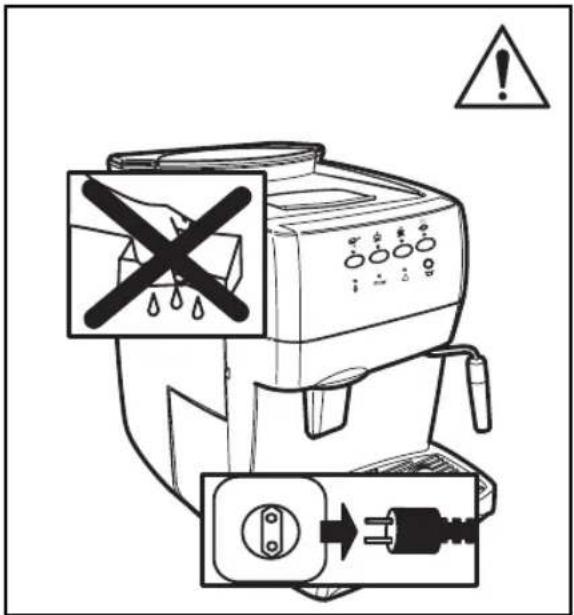
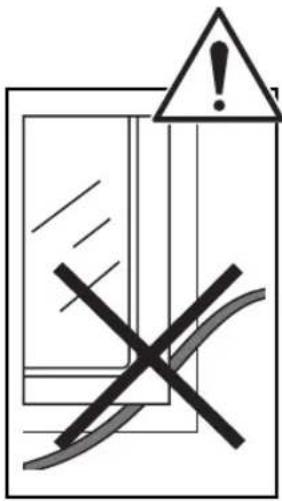
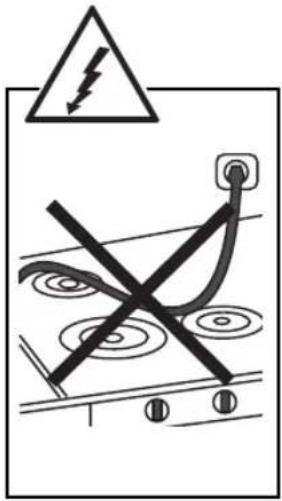
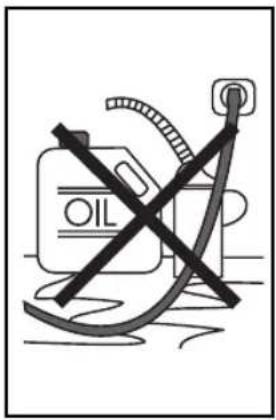
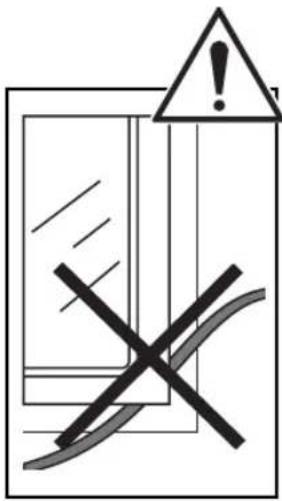
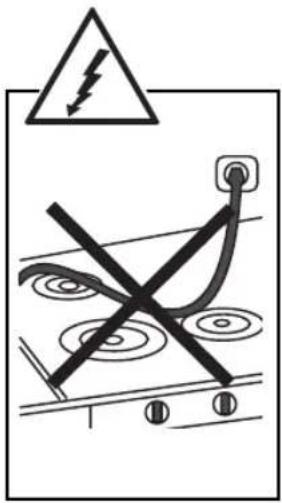
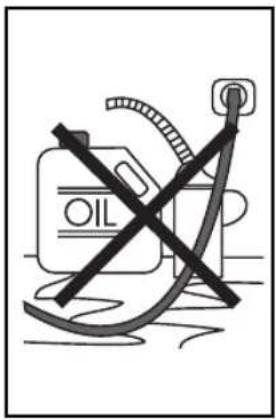
Power Supply Cord (Fig.A)
- Never use the coffee maker if it has a faulty cord.
- The defective cord must be replaced immediately.
- An authorized service centre must replace the defective cords and plugs immediately.
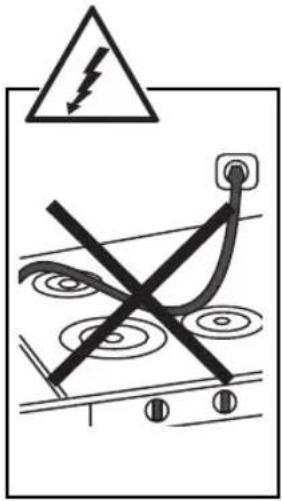
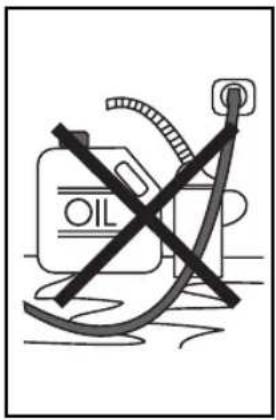
- Do not let the cord touch sharp edges, very hot objects and oily surfaces.
- Do not carry or pull the coffee maker by the cord.
- Do not pull the cable to remove the plug, and do not touch the plug with wet hands or feet.
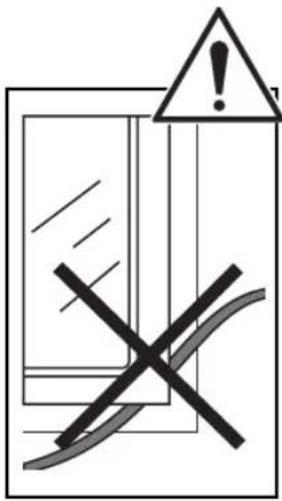
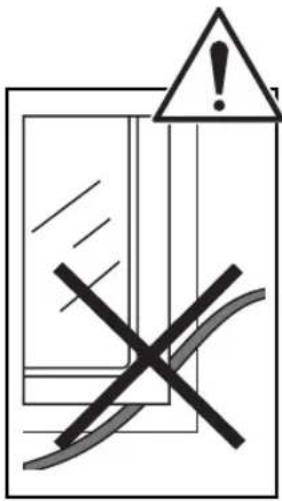
- Avoid letting the cord dangle from tables or raised surfaces.
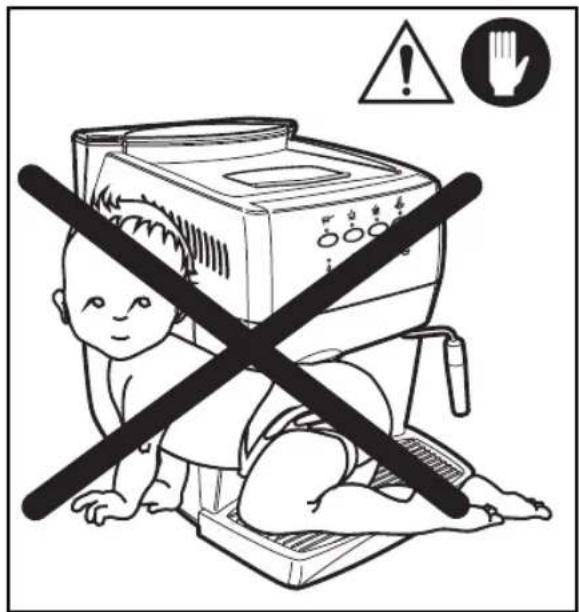
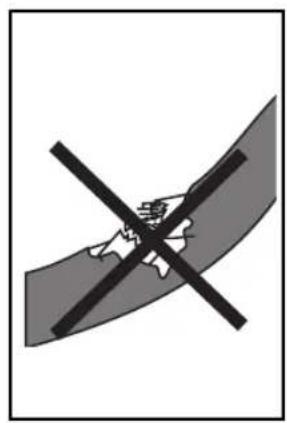
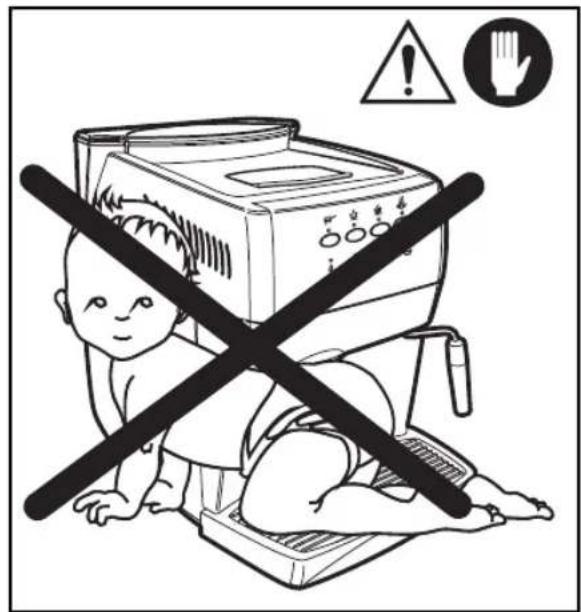
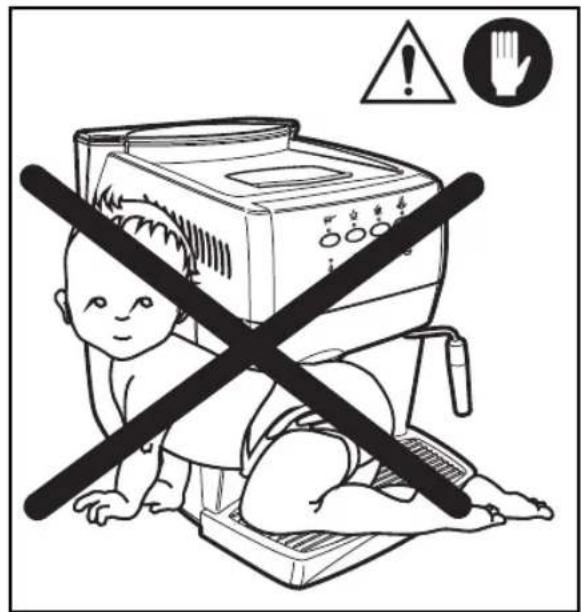
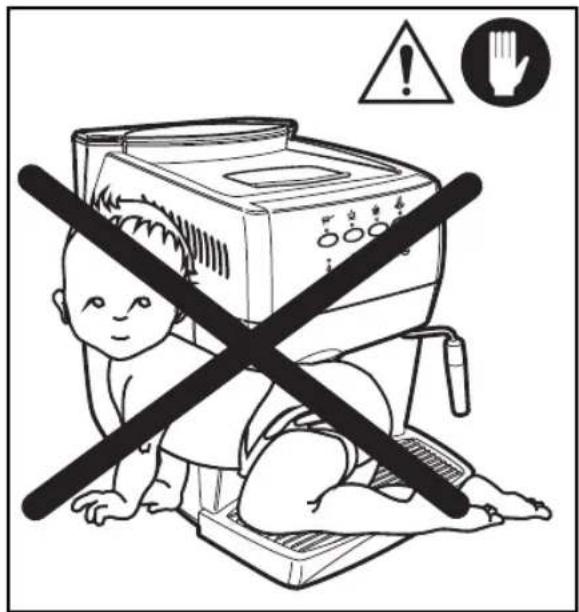
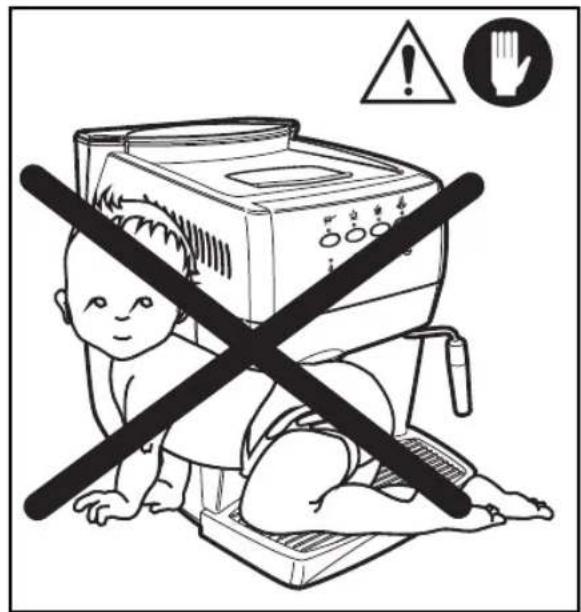
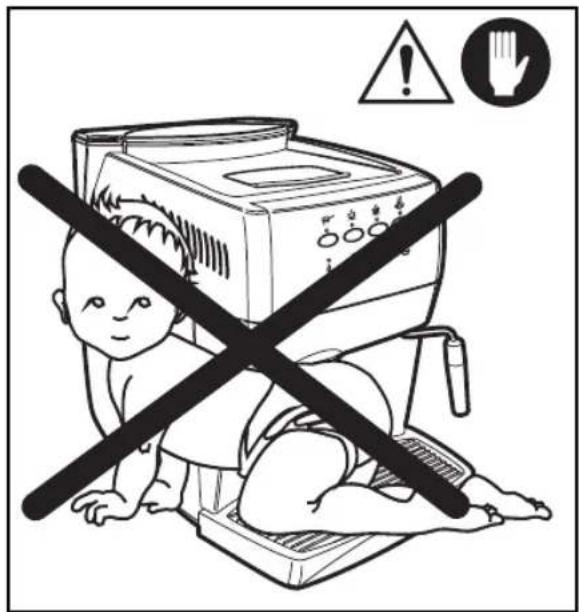
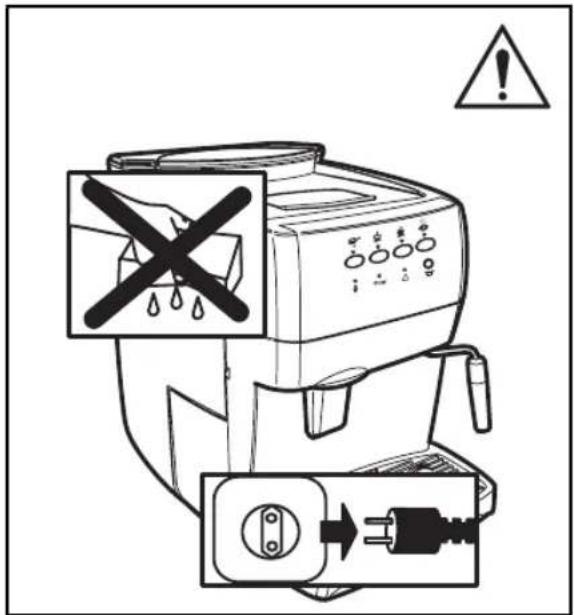
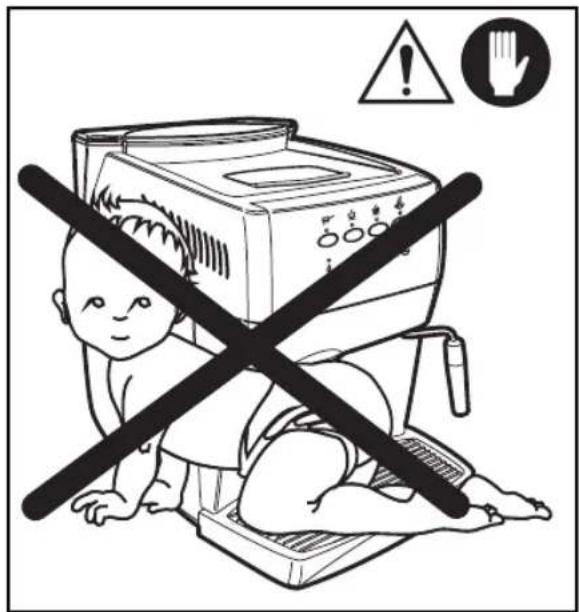
Preventing Injury (Fig.B)
- Children should be supervised to ensure that they do not play with the appliance.
Children are not aware of the risks involved in electrical appliances. - Do not leave packing material near children.
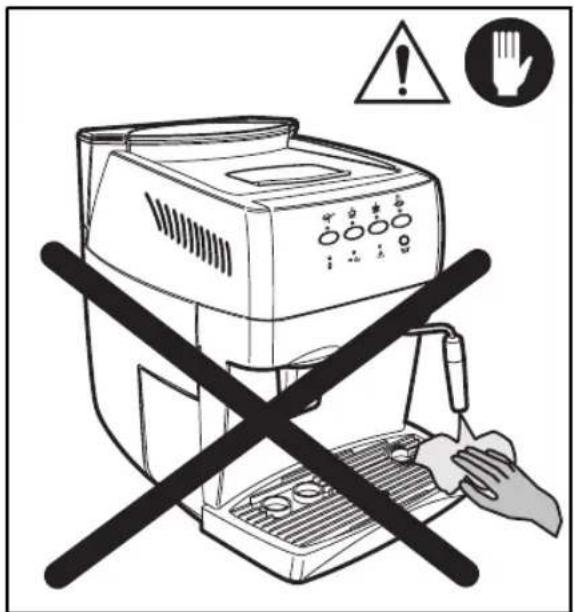
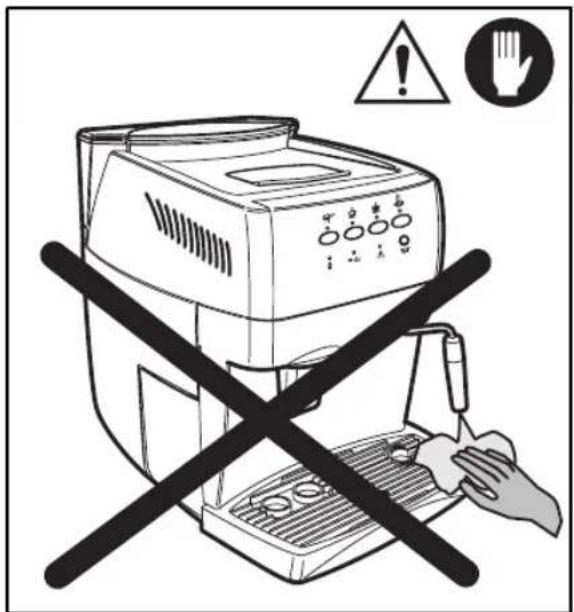
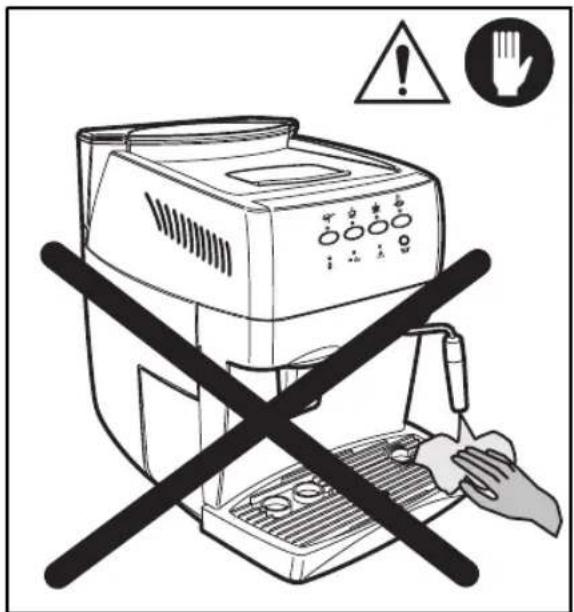
Scalding Hazard (Fig.C)
- Do not direct the flow of the superheated steam and/or hot water towards yourself and/or others: scalding hazard!
- Always use the correct handles or knobs.
- Do not insert objects through the openings in the appliance.
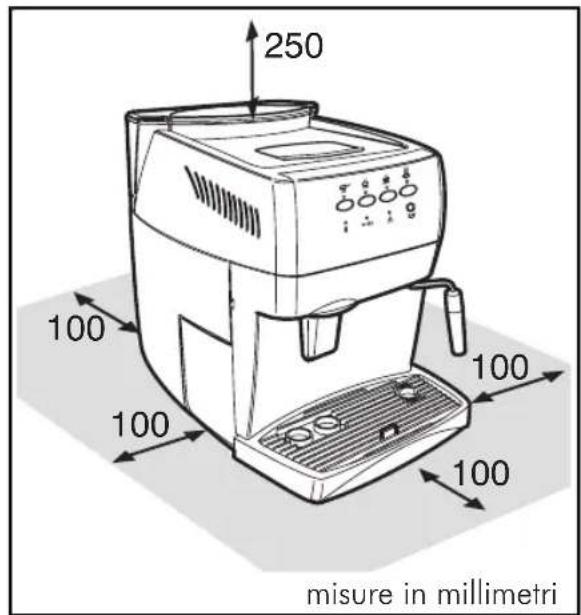
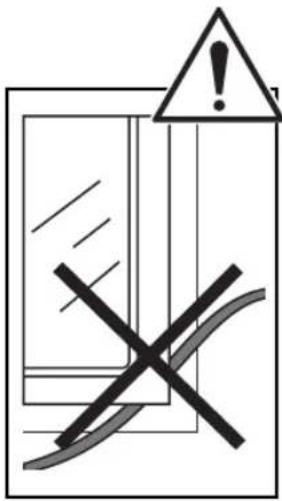
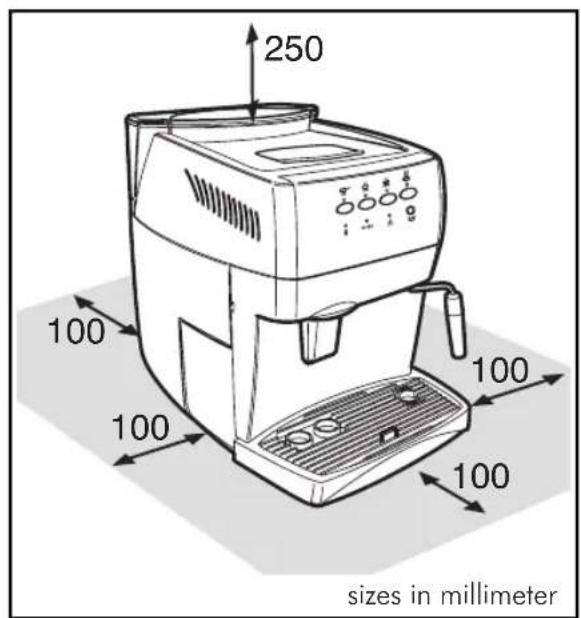
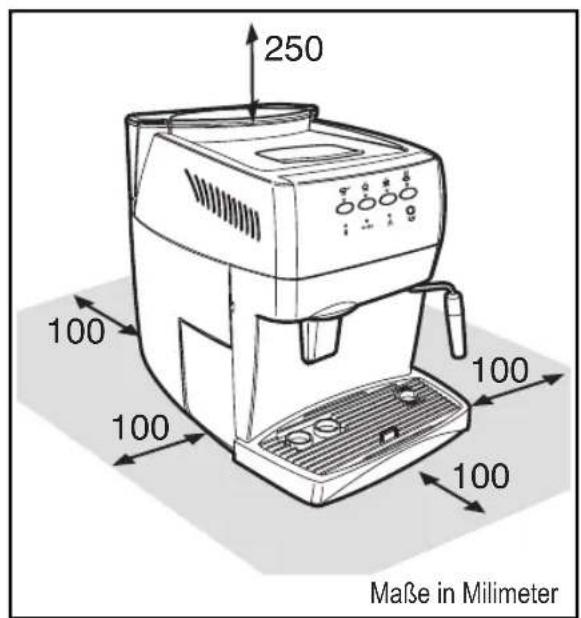
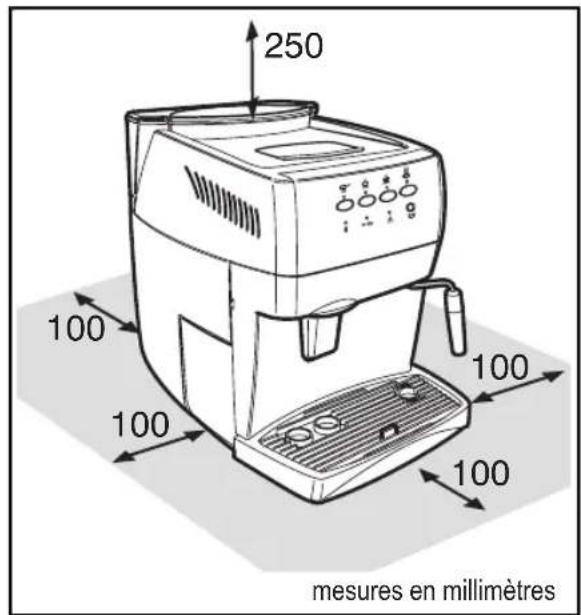
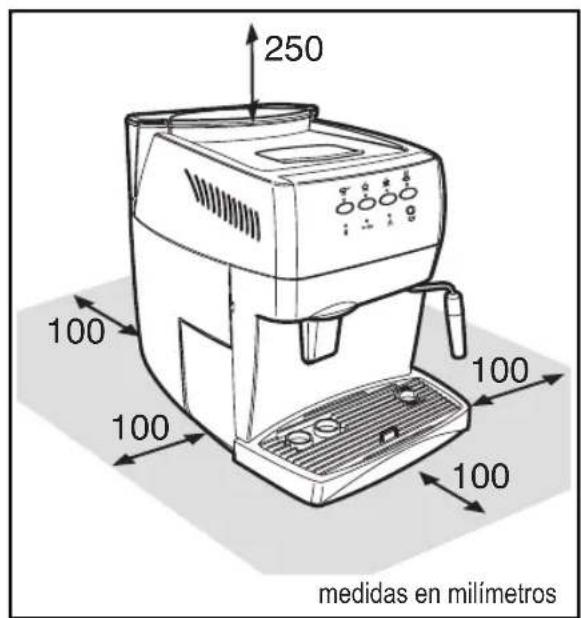
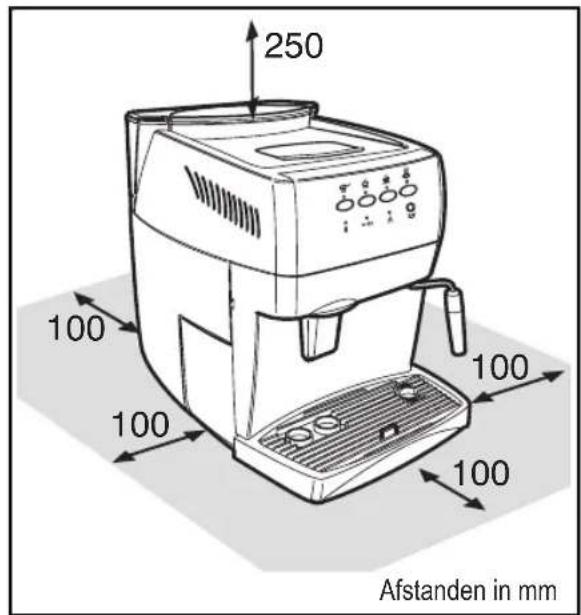
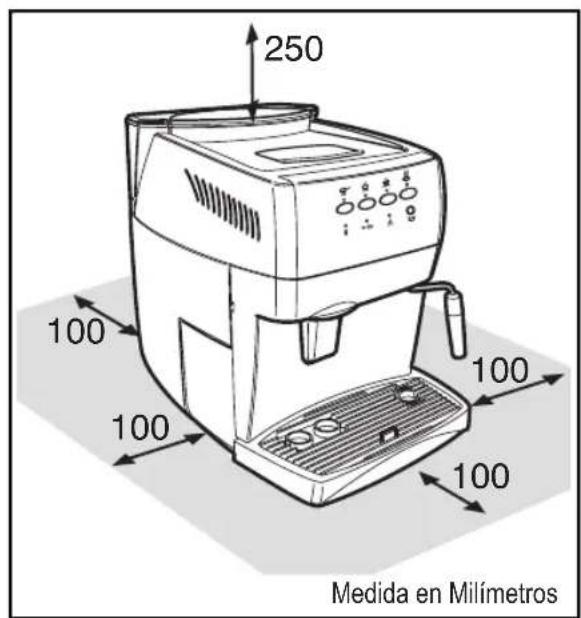
Space necessary to installation, usage, and maintenance. (Fig.D)
- Place the machine on a flat, even surface.
- The machine must be positioned in a safe place where it cannot be knocked over or cause injury.
- Choose a position that is well-lit, hygienic and where a wall socket is easily accessible.
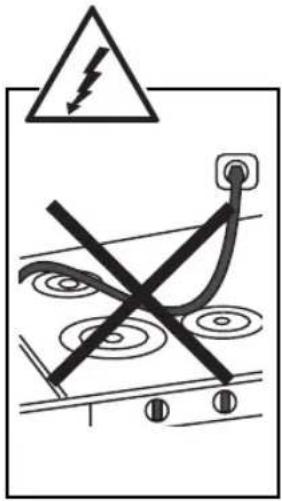
- To prevent melting or damage to the casing, do not rest the machine on very hot surfaces or near open flames.
- Place the coffee maker 10 cm away from walls and cooking tops.
- Do not keep the machine at a temperature below 0° C; frost may damage the machine.
- The wall outlet must be reachable at all times.
- Do not use the coffee maker outdoors.
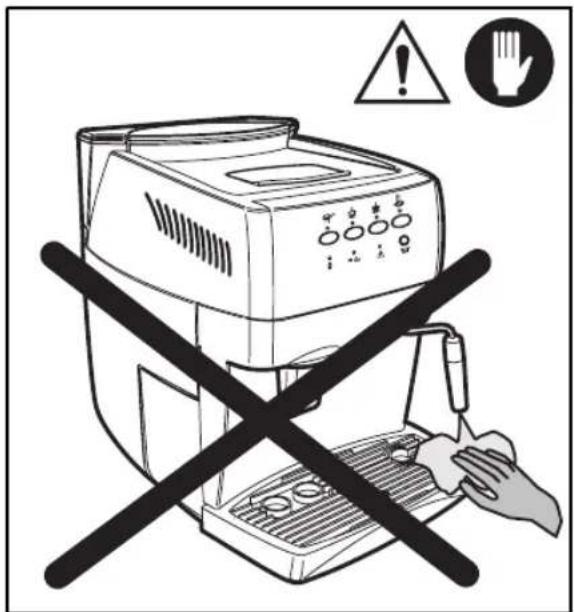
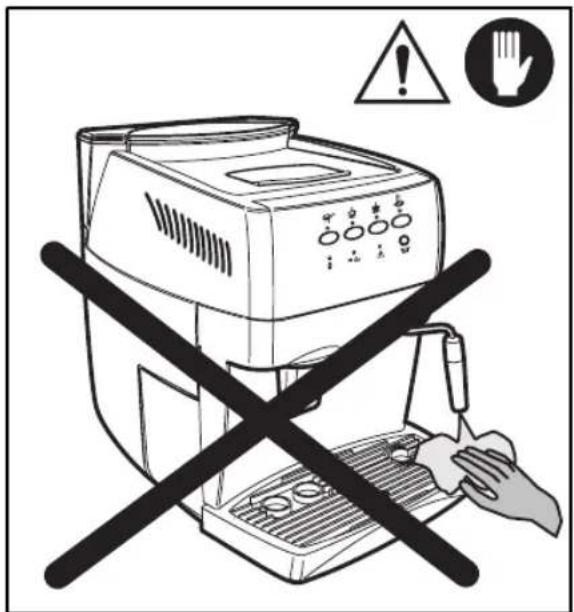
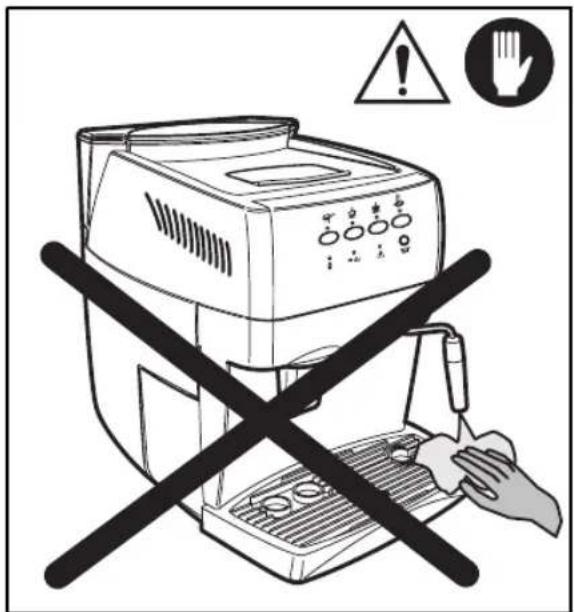
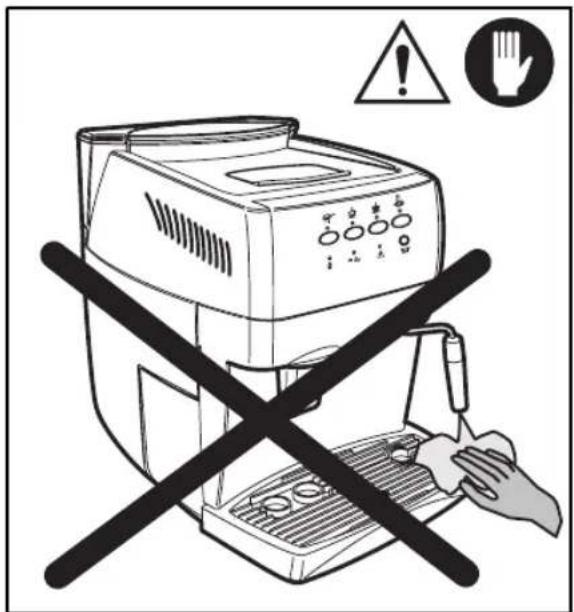
Cleaning (Fig.E)
- Before cleaning the coffee maker, switch the ON/OFF switch (7) to "O"; then, remove the plug from the wall outlet.
- Wait for the machine to cool down.
- Never immerse the appliance in water! Avoid splashes.
- Never tamper with the machine inside parts.
Storing the Appliance
- When the appliance is not used regularly, switch OFF the appliance and remove the plug from the wall outlet.
- Store it in a dry place, away from children.
- Protect it from dust and dirt.
Repairing / Maintenance
- If the coffee maker falls and you see or suspect damages or malfunctions, immediately remove the plug from the wall. Never use faulty machines.
ENGLISH
- Repairs must be made by authorized service centres only.
- If authorized service centres do not carry out maintenance work and/or repairs, the manufacturer is not liable for any damages.
Fire Fighting
- In the event of a fire, use carbon dioxide extinguishers (CO 2 ). Do not use water or powder extinguishers.
DESCRIPTION OF PARTS
See Fig.01
1 Coffee bean container
2 Coffee bean container cover (aroma preserver)
3 Grinding control knob
4 Dose control knob
5 Ground coffee doser cover
6 Drip plate for placing coffee cups
7 ON-OFF switch
8 Water tank cover
9 Water tank
10 Coffee grounds drawer
11 Power cord
12 Drip tray + plate
13 Height adjustable coffee dispenser
14 Steam / hot water nozzle and pipe
15 Front cover
16 Steam knob
17 Coffee dispenser
18 Control panel
19 Full tray warning light
20 Cleaning brush
21 Ground coffee measuring spoon
Control panel
22 Ground coffee button /LED
23 Espresso coffee button / temperature-ready LED
24 Weak coffee button / temperature-ready LED
25 Steam button / LED
26 Descale button / LED
27 Water warning light
28 No ground coffee warning light / full coffee grounds drawer warning light
29 Malfunction warning light
4 INSTALLING THE COFFEE MAKER
For your safety and the safety of third parties, follow the “Safety Standards” (see chapter 3).
4.1 Packaging
The original packaging was designed and made to protect the appliance during shipment.
We recommend you keep it for future needs.
4.2 Preliminaries
- Remove the coffee maker from the packaging and position it in a suitable location that meets the requirements specified and described in the safety standards (chap.3).
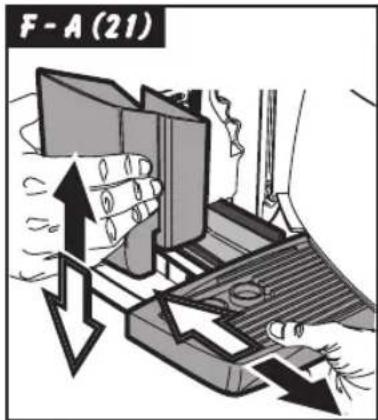
- Open the machine door, take the drip tray (12) from the package, and fit the dregs box (10); then, fit the drip tray in the machine (Fig.21).
- Make sure that the drip tray and plate (Fig.01, pos. 12), the coffee grounds drawer (10) and the coffee dispenser (17) are fitted correctly and that the front cover (15) is closed.
- Keep the cleaning brush (20) and the ground coffee measuring scoop (21) supplied with the appliance within easy reach.
If the red light (29) is still on when the machine is started, it means that one of the parts described above is positioned incorrectly.

Caution: You must read chapter 15. This chapter explains in detail the meaning of all the visual signals displayed to the user through the lights (LEDs) found on the control panel.
4.3 Preparing the coffee maker for use
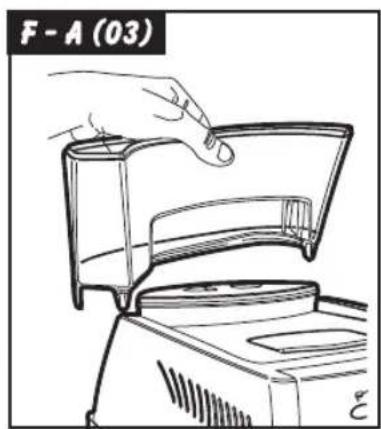
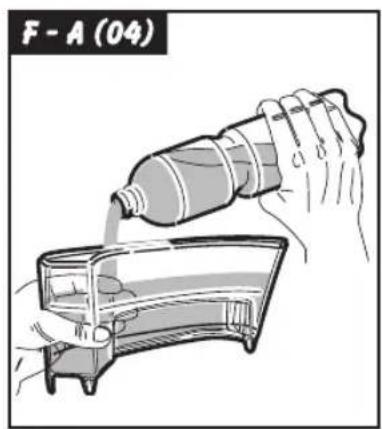
- Open the water tank cover (Fig.02) and remove the tank (Fig.03). Rinse and fill with fresh potable water (Fig.04); we recommend that you do not exceed the "MAX" level mark. Replace the water tank in its housing and reposition the cover on top.

Always fi ll the tank (9) with fresh still water. Hot water and other liquids can damage the tank and/or the appliance. Do not operate the appliance without water: make sure that there is enough water inside the tank.
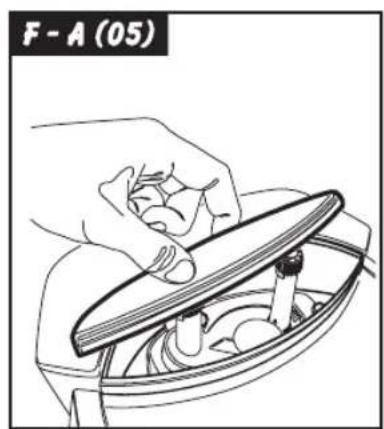
- Lift the cover (Fig.05) and fill the container with coffee beans (Fig.06).

Use coffee beans only. Ground and instant coffee, as well as other items, cause damage appliance.
- Close the cover of the coffee bean container (1).
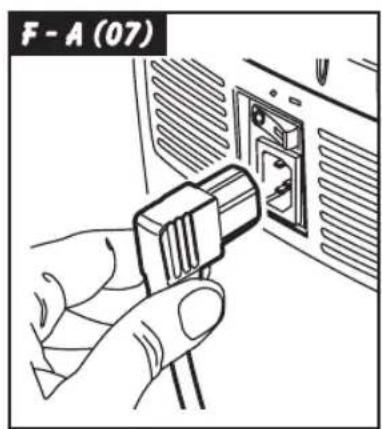
- Insert the plug into the outlet at the back of the coffee maker (Fig.07) after making sure that the ON/OFF switch (7) is in the "O" position.
- Insert the other end of the plug into a suitable wall outlet.
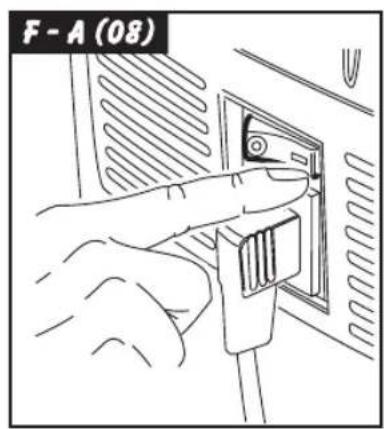
- When not in use, the ON/OFF switch of the appliance is in the "O" position. To switch ON the coffee maker, simply press the switch (Fig.08). The LEDs (23) and (24) start fl ashing on the control panel.
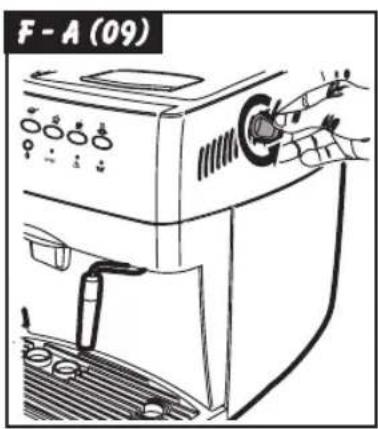
- To fill the circuit, direct the steam/hot water nozzle (Fig.01, item 14) towards the drip tray, place a cup or suitable vessel under the steam nozzle and turn the knob anticlockwise (Fig.09). Wait for water to flow regularly from the nozzle and, then, shut off the flow by turning the knob clockwise.

Note: You must fill the circuit of the appliance if the machine is switched ON for the first time, the machine has not been used for a long time, the water tank has been emptied completely or the warning light (27) fl ashes.
- After switching ON the appliance, LEDs (23) and (24) flash simultaneously during the heating phase. Once the heating phase is finished, LEDs (23) and (24) emit a fixed light.
- At this point, your coffee maker is ready for use.
- Follow the instructions below to dispense coffee, hot water or steam and use the appliance correctly.
ENGLISH
5 THE COFFEE GRINDER (FIG.10)
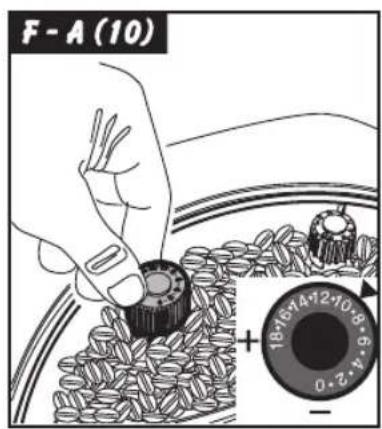
Caution! Only turn the grinding control knob, found inside the coffee bean container (Fig.10), when the coffee grinder is working. Do not insert ground and/or instant coffee in the coffee bean container.
Do not insert anything other than coffee beans in the container. The coffee grinder contains dangerous moving parts; keep fi ngers and/or other objects away. Before carrying out any operations in the coffee bean container, switch OFF the ON/OFF switch (7) and remove the plug from the wall outlet. Do not insert coffee beans when the coffee grinder is working.
The quality and the taste of your coffee depend, in addition to the used blend, also on the grinding coarseness.
The appliance comes with a grinding adjusting knob (Fig.10). To use this feature, turn the graduated knob when the coffee grinder is working; the numbers displayed on the knob indicate the grinding coarseness.
The manufacturer sets the knob to an average grinding coarseness in the factory: if the ground coffee is too fine, turn the knob toward the higher values; if the ground coffee is too coarse, turn the knob toward the lower values.
You will note the change only after pouring three /four coffees.
Use coffee beans for espresso coffee makers. Avoid using limit grinding positions (e.g. 1 and 16); if this is necessary, try using different coffee blends.
Store the coffee in a cool and dry place, in an airtight container.
You should change the grinding position if the coffee does not outflow optimally, specifically:
Too fast = grinding too coarse > grind coffee fi ner; Too slow (drips and/or no flow) = grinding too fine > grind coffee coarser.
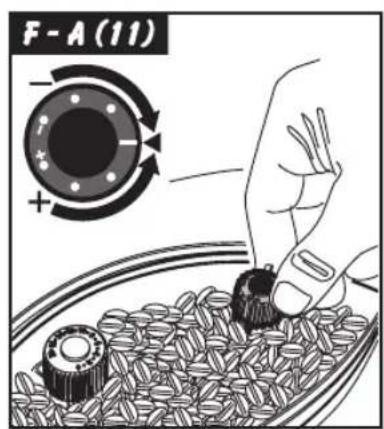
6 ADJUSTING THE COFFEE DOSE (FIG.11)
You may select the quantity of coffee (dose) that you wish to grind. The manufacturer sets an average dose in the factory.
To change the ground coffee dose, simply turn the knob (Fig.11) found inside the coffee container. Turn it anticlockwise to increase the dose and clockwise to decrease the dose.
You must adjust the dose before pressing the coffee dispenser button.
This system allows you to obtain an optimal cup of coffee with all types of marketed coffee.
7 THE COFFEE DISPENSER
Note: If the appliance does not dispense coffee, check the water level in the tank.
- Before making coffee, make sure that the green temperature-ready LEDs (23) and (24) are lit and emit a fixed light and that the water tank and the coffee container are full.
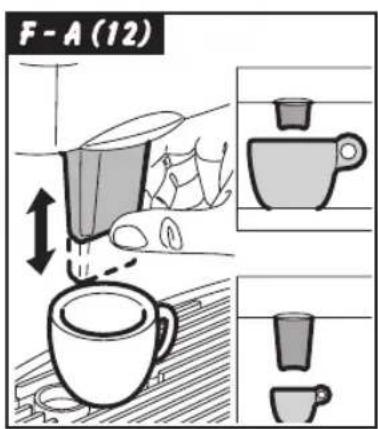
- Place 1 or 2 coffee cups under the coffee dispenser spouts; you can adjust the height of the dispenser by moving it up or down manually (Fig.12) until it suits your cups.
7.1 Making coffee with coffee beans
- To dispense the coffee, press the correct coffee button (23) or (24). The selected button starts fl ashing (see chap.15), while the other switches off.
To make 1 coffee, position a single coffee cup under the coffee dispenser spouts and press the button (23) or (24) only once; to make 2 coffees, position two coffee cups under the spouts and press the button (23) or (24) twice.
In this operating mode, the appliance automatically grinds and doses the right quantity of coffee; making two coffees requires two grinding and dispensing cycles, which are automatically managed by the machine.
- Then, the dispensing cycle starts.
• After carrying out the prebrewing cycle, coffee will start to come out of the spout (Fig.01, pos.13).
The coffee will stop flowing automatically when the preset level is reached (see par.7.3). You can interrupt the flow of coffee by pressing the button (Fig.01, pos.23 or 24).
7.2 Making coffee with ground coffee

In this operating mode, you must use the supplied measuring spoon (Fig.01, pos.21) to dose the ground coffee.

Only use ground coffee suitable for espresso coffee makers in the doser (5); placing coffee beans, instant coffee and other materials inside the doser causes damage to the appliance.

Keep fi ngers away from the ground coffee doser since there are moving parts.
Use the supplied measuring spoon (21) to measure the right quantity of ground coffee to place in the doser. Use only one filled measuring spoon at a time; to make two coffees, you must go through the entire process twice.
- Press the button (22) to select the function; the LED lights up.
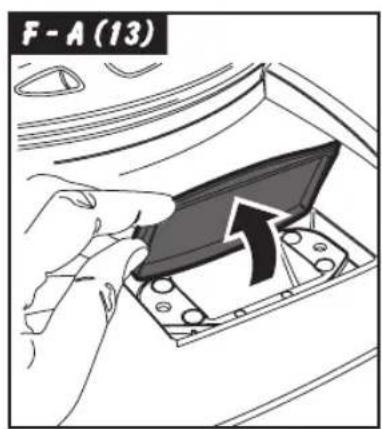
- Lift the cover of the ground coffee doser (Fig.13).
- Fill the measuring spoon with one coffee dose; discard any excess quantity of ground coffee.
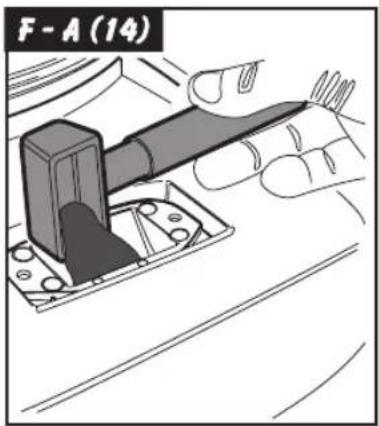
• Fill the doser with the ground coffee (Fig.14) - Close the cover of the ground coffee doser.
- To make the coffee, press the desired coffee button (23) or (24); the selected button starts flashing (see chapter 15), while the other switches off.
• The dispensing cycle begins.
• After carrying out the prebrewing cycle, coffee will start to come out of the spout (13). - The coffee will stop flowing automatically when the preset level is reached (see par. 7.3).
You can interrupt the flow of coffee by pressing the button (23) or (24). - Then the machine automatically returns to the normal operating mode (see para. 7.1).
7.3 Adjusting the quantity of coffee per cup
Your coffee maker has been programmed to make 2 types of coffee: espresso coffee with the button (23) and weak coffee with the button (24).
To adjust the programmed values to the size of your cups, place the cup under the coffee dispenser (13), press the button of the desired type of coffee (23) or (24) and keep it pressed.
Wait for the machine to fill the cup up to the desired level and, then, release the button.

Note: keep the button (23) or (24) pressed during the entire coffee dispensing process.
In this way, the appliance is programmed to supply the quantity of coffee you selected.
8 MAKING HOT WATER

Caution: splashing may occur at the start – scalding hazard! The hot water nozzle and pipe can reach high temperatures: avoid touching directly with your hands.
- Before dispensing hot water, make sure that the green temperature-ready LEDs (23 and 24) emit a fixed light.
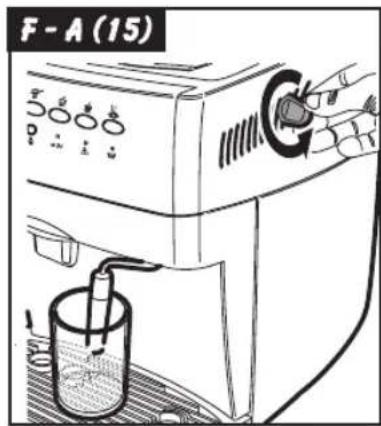
Proceed as follows when the appliance is ready to dispense hot water: - Place a cup and/or pitcher under the steam/hot water nozzle (Fig.15).
- Turn the knob anticlockwise as shown in Fig.15.
- When you have obtained the desired quantity of hot water, turn the knob clockwise to shut off the flow. The appliance resets itself so that it is ready for normal operation.
ENGLISH
9 MAKING STEAM / PREPARING CAP- PUCCINO

Steam can be used to froth the milk for cap- puccinos but also to heat beverages.

Scalding hazard!
Splashing may occur at the start – scalding hazard! The hot water nozzle and pipe can reach high temperatures: avoid touching directly with your hands.
When the appliance is ready to dispense coffee, press the button (25), the LEDs (23) and (24) switch off. The appliance goes through a preheating period; during this phase, the LED (25) fl ashes.
- Before dispensing steam, wait for the green temperature-ready LED (25) to light up in a fixed way; this indicates that the correct operative temperature has been reached.
- Direct the steam nozzle (14) towards the drip tray and turn the "hot water/steam" knob (16) for a few seconds so that any residual water comes out of the steam nozzle. Continue until only steam is dispensed.
- Turn the knob (16) to OFF.
- Fill 1/3 of the vessel that you wish to use to make cappuccino with cold milk.

For best results when making cappuccinos, the milk and the used cup should be cold.
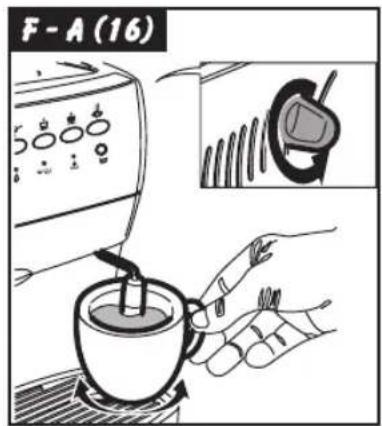
- Immerse the steam nozzle into the milk to be frothed and turn the knob (16); turn the container slowly with up-down movements to make uniform frothing (Fig.16).
• After using the steam for the desired time, shut off the steam (16). - The same system can be used to heat other beverages.
- Clean the steam nozzle with a damp cloth (Fig.17)
9.1 Making coffee after using the steam function
- If you want to make more coffee immediately after steaming milk, you must press the button again (25).
- During the transition period, the LEDs (23), (24) and (25) flash at the same time indicating that the appliance is superheated and cannot make coffee.
- To make coffee, you must drain the water by turning the steam knob (16) until only the temperature-ready LEDs (23) and (24) remain lit in a fixed way.
10 CLEANING AND MAINTE-NANCE
General Cleaning
- Maintenance and cleaning should only be carried out when the appliance is cold and disconnected from the power supply.
- Do not immerse the appliance in water and do not wash the parts in the dishwasher.
- Do not use abrasives or aggressive chemicals (solvents) for cleaning.
- Do not dry the machine and/or any of its parts using a microwave and/or conventional oven.
- We recommend you clean the water tank and change the water daily.
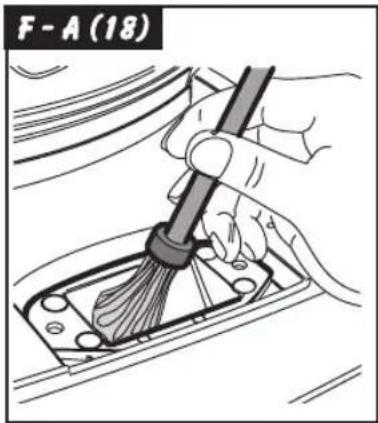
- Clean the ground coffee doser daily.
- Use the supplied brush to clean the doser (Fig.18).
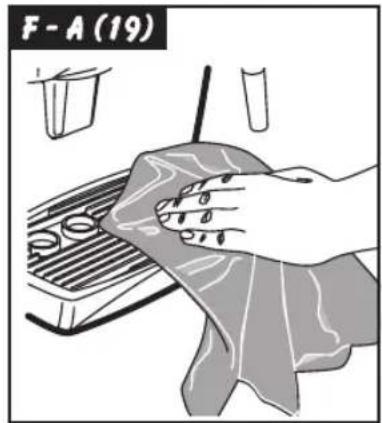
- To clean the appliance, use a soft cloth dampened with water (Fig.19).
- Clean the service area and the coffee dispenser.
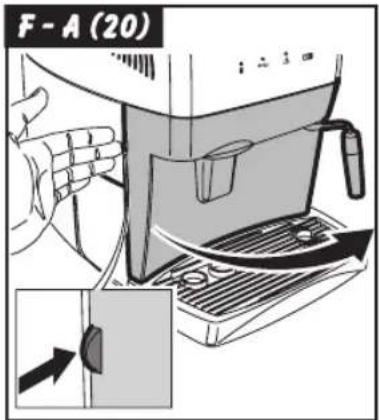
- We recommend you empty and clean the drip tray (12) and the coffee grounds drawer (10) daily; to carry out this operation you must open the front cover (Fig.20) and remove the drip tray (Fig.21); then, you can empty and clean all the components.
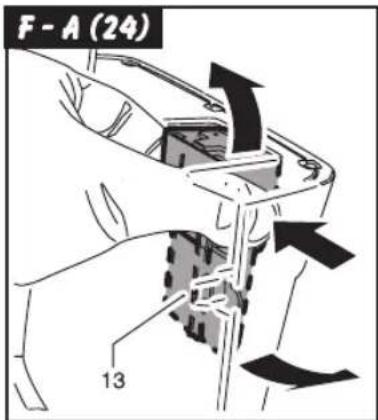
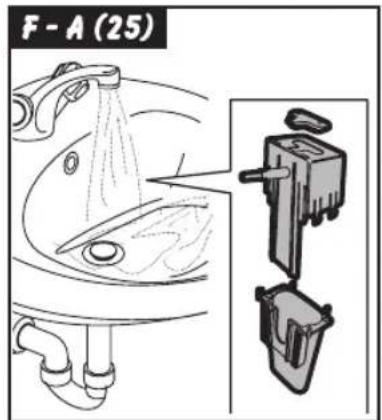
- You can remove the coffee dispenser in order to clean it (Fig.24):
- lower the dispensing unit nozzles
- take the dispensing unit as shown in Fig. 24, and remove it from its housing
- wash the whole unit with warm water.
10.1 The coffee disperser
The coffee dispenser (17) must be cleaned each time you fill the coffee bean container or, anyhow, at least once a week.
- Switch off the appliance by pressing the ON/OFF switch (7) to the "O" position and remove the plug from the wall outlet.
- Open the service cover (15). Remove the drip tray (12) and the coffee grounds drawer.
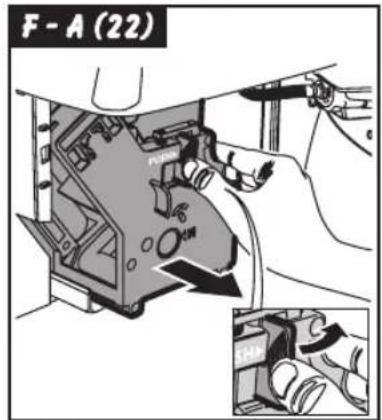
- Remove the coffee dispenser, holding it by its handle and pressing the "PUSH" button (Fig.22)
- Wash the coffee dispenser only with hot water: do not use detergents.
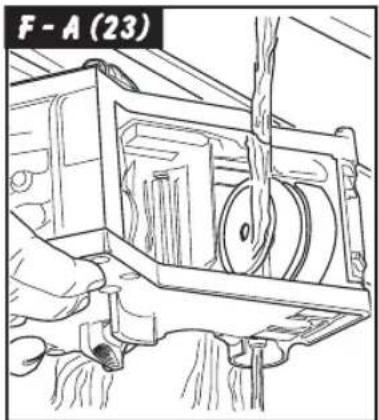
- Carefully wash the top fi Iter (Fig. 23) and make sure it is free from any coffee residues. Then, thoroughly dry all its components.
- Carefully clean the compartment inside the appliance.
- Holding it by its handle, insert the coffee dispenser into its housing until it snaps into place.
- Insert the coffee grounds drawer, the drip tray plate and the drip tray.
- Close the cover (15).
11 DESCALING
Scaling occurs naturally when the appliance is used. Approximately every 3-4 months you should descale it; it is ready for descaling when you notice a reduction in the water flow or when the LED of the button (26) fl ashes.
If you wish to carry this out at home, you can use a descaling product for coffee makers that is non toxic and/or not harmful and commonly available on the market.

Caution! Never use vinegar.
To descale the appliance proceed as follows:
- Mix the descaler with water as specified on the package and fill the water tank.
- Switch ON the appliance with the ON/OFF switch (7).
- Press the button (26) for at least 5 seconds to select the descaling operating mode; the LED emits a fixed
light.
- Direct the steam nozzle (14) toward the drip tray.
- Position a vessel of adequate capacity under the steam nozzle and turn the hot water knob anticlockwise (16). The appliance starts an automatic descaling cycle with pauses preset by the manufacturer and managed automatically by the appliance.
- At the end of the cycle, the flow of the descaling solution is shut off and the 5 buttons start flashing simultaneously.
- Turn the knob of the hot water nozzle (16) clockwise to OFF. In this case, also the warning light (27) flashes.
- Rinse the water tank and fill it with fresh drinking water.
- Position a vessel of adequate capacity under the steam nozzle and empty 2/3 of the contents of the water tank by turning the steam knob (16) anticlockwise; to shut off the flow, turn the knob (16) clockwise.
- Let the appliance heat up and empty the remaining contents of the water tank by turning the steam knob (16) anticlockwise; to stop the flow, turn it clockwise.
If you use a different product from the recommended one, we recommend you follow the instructions of the descaler manufacturer as specified on the package.
If the descaling cycle is interrupted by switching the machine OFF, this is restarted when the machine is switched back ON.
ENGLISH
12 FUNCTION PROGRAMMING
The appliance allows you to programme some parameters depending on your needs.
To programme the functions, you must enter programming mode as follows:
- Ensure that the ON/OFF switch (7) of the appliance is switched to "O" and that the hot water knob (16) is OFF.
- Press the buttons (23) and (25) and, at the same time, switch ON the appliance using the ON/OFF switch (7).
You are now in the programming mode.
To quit the programming mode and implement your changes, switch the machine OFF and, then, back ON again using the main switch (7).
12.1 Programming water hardness
Running water is more or less hard, depending on the area. This coffee maker can be adjusted so that it will work optimally with the water hardness level, expressed on a scale from 1 to 4, of your area.
The appliance is already set to an average value (hardness3).

Before proceeding, you must check the water hardness of your area using the strip supplied with the appliance. Quickly immerse (1 second) the strip into the water and shake slightly. After a minute, the strip shows the test results.
To programme this function, proceed as follows:
- Press the button (22); the number of lit buttons indicates the programmed water hardness;
- If you desire to change the water hardness level, press the button (22) repeatedly up to when the correct number of lit buttons are displayed, indicating the water hardness level.
Hardness 1 = buttons (22) and (23) lit
Hardness 2 = buttons (22), (23) and (24) lit
Hardness 3 = buttons (22), (23), (24) and (25) lit
Hardness 4 = buttons (22), (23), (24), (25) and (26) lit
The hardness index matches the 1-4 squares on the strip.
12.2 Programming the rinsing cycle
Immediately after switching ON, the machine automatically eliminates any remaining water in the piping circuit to guarantee that the coffee is made with fresh water only.
To programme this function, proceed as follows:
- Press the button (23); when the function is ON, the warning light (27) lights up.
12.3 Programming "Prebrewing"
The prebrewing process slightly dampens the coffee before brewing; this brings out the full aroma of the coffee and gives it an excellent taste.
To programme this function, proceed as follows:
- Press the button (24); when the function is ON, the warning light (28) lights up.

Note: the manufacturer has already activated this function.
12.4 Programming "Pregrinding"
The pregrinding procedure makes the machine grind twice: the first time, for the type of selected coffee and, the second, for the next type of coffee (not yet selected). This function is only useful if you must prepare different types of coffee at the same time (for example, during a visit, party).
To programme this function, proceed as follows:
- Press the button (25); when the function is ON, the warning light (29) lights up.
13 LEGAL INFORMATION
- This instruction book contains the necessary information to use and upkeep your appliance correctly.
- The information should be viewed as a guideline to use and upkeep your coffee maker in safety. The information is not exhaustive. For additional information or for information on topics not covered or inadequately covered in this book, please contact the authorized service centres or the manufacturer directly.
- In addition, we should mention that these instructions are not a part of a previous or existing agreement, legal contract or similar and that the information is not changed by any other document.
- All the manufacturer's obligations and liabilities are based on the relative sale contract that also specifies all warrantee terms and conditions.
- The contractual warrantee terms and conditions are not limited or extended based on this instruction book.
- This instruction book contains information protected by copyright.
- This instruction book cannot be photocopied or translated into other languages without the explicit written consent of the manufacturer.
14 SCRAPPING
- Make unusable any appliances not in use.
- Detach the plug from the wall outlet and cut the electric cord.
- Deliver broken appliances to a suitable collection centre.
This product complies with EU Directive 2002/96/EC.

The symbol 🐘 on the product or on its packaging indicates that this product may not be treated as household waste. Instead it shall be handed over to the applicable collection point for the recycling of electrical and electronic equipment.
By ensuring this product is disposed of correctly, you will help prevent potential negative consequences for the environment and human health, which could otherwise be caused by inappropriate waste handling of this product. For more detailed information about recycling of this product, please contact your local city office, your household waste disposal service or the shop where you purchased the product.
ENGLISH
15 CONTROL PANEL LEDS
GREEN LED (22)
- Appliance dispensing ground coffee
GREEN LED (23), FIXED
GREEN LED (24), FIXED SIMULTANEOUSLY
- Temperature-ready:
To dispense coffee
To dispense hot water
GREEN LED (23), FLASHING
GREEN LED (24), FLASHING SIMULTANEOUSLY
- Appliance is heating up to dispense coffee or hot water
GREEN LED (23), SLOW FLASHING
- Appliance dispensing 1 espresso coffee
GREEN LED (23), FAST FLASHING
- Appliance dispensing 2 espresso coffees
GREEN LED (24), SLOW FLASHING
- Appliance dispensing 1 weak coffee
GREEN LED (24), FAST FLASHING
- Appliance dispensing 2 weak coffees
GREEN LED (25), FIXED
- Temperature-ready to dispense steam
GREEN LED (25), FLASHING
- Appliance heating up to dispense steam
RED LED (26), FLASHING
- The appliance needs a descaling cycle
Descale as described in par. 11.
To cancel the selection, press another button keeping the knob turned OFF.
RED LED (26), FIXED
- The descaling function was selected
To descale as described in par. 11, turn the hot water knob to ON (16).
GREEN LED (23), FLASHING
GREEN LED (24), FLASHING
GREEN LED (25), FLASHING SIMULTANEOUSLY
- Appliance superheated; the appliance cannot dispense coffee
You must drain the water into the drip tray by turning the steam knob (16) until the green temperature-ready LEDs (23) and (24) start flashing and the green LED (25) switches off.
RED WARNING LIGHT (27), FIXED
- Inadequate quantity of water in the tank
Fill the tank with fresh potable water, fill the circuit and start the procedure again.
RED WARNING LIGHT (27), FLASHING
- The water circuit is empty
Fill the circuit
RED WARNING LIGHT (28), FIXED
- The coffee bean container is empty
Fill the container with coffee beans and start the procedure again.
RED WARNING LIGHT (28), FLASHING
- The coffee grounds drawer is full
**The flashing red light goes off when the dregs box is emptied.
RED WARNING LIGHT (29), FIXED
- Incorrectly positioned coffee dispenser, drip tray and/or front cover.
The fixed red light goes off when all the components are correctly positioned or closed.
RED WARNING LIGHT (29), FLASHING
- The coffee grinder motor is blocked
- Dispensing unit motor shutdown.
Contact an authorized service centre

**Caution:The coffee grounds drawer must only be emptied when the appliance is ON. The drawer must be removed for at least 5 seconds. If the drawer is emptied with the appliance OFF, coffee will not be dispensed when the machine is switched back ON.
16 TROUBLESHOOTING
| melborP | e | suaC |
| The appliance does not switch ON | The appliance is not connected to ehtsa | et appliance to the sam |
| The coffee is too cold | The cups are cold | Heat the cups |
| No hot water or steam | The hole of the steam nozzle is ged | Clean the steam nozzle hole with a pin |
| Coffee is dispensed slowly | Coffee is too fine | Change the coffee blend or adjust grinding as specified in Par. 5. Decrease the dose (Par. 6) |
| Dirty coffee dispenser | Clean the coffee dispenser (Par. 10) | |
| The coffee has little "crema" (cream - froth layer) | The blend is not suitable or the coffee to freshly ground or is ground too epo | Change the coffee blend or adjust grinding as described in Par. 5. Increase the dose (Par. 6) |
| The appliance takes to up or a limited volume of water comes out of the nozzle | the circuit of the appliance is gal gridasy | Descale the appliance |
| The coffee dispenser is jammed | The coffee dispenser is not snapped into its housing | Switch ON the appliance service cover. The coffee dispenser automatically returns to its initial stop |
| Coffee grounds dra irept | Remove the coffee grounds drawer before removing the coffee dispenser | |
| No coffee is dispensed | No water | Fill the tank with water and fill the circuit |
| Dirty coffee dispenser | Clean the coffee dispenser | |
| Large dose | Decrease the dose | |
| Circuit not filled | Refill the circuit | |
| Coffee is dispensed outside the resps | The coffee dispenser is not fitted dzo | Refit the coffee dispenser |
| The coffee dispenser is clogged | Clean the coffee dispenser and its dps | |
| Coffee comes out to kbuq | Too little coffee inside the container | Fill the container with ground coffee (not instant coffee) |
| Coarse coffee bl en | Change the type of blend | |
| Small dose | Increase the dose | |
| Water comes out of the container | The container is too full | Check the position of the float and empty the container. |
EC DECLARATION OF CONFORMITY
EC 2006/95, EC 2004/118,
EC 1992/31, EC 1993/68
PRINCESS HOUSEHOLD APPLIANCES
Baronielaan 1
4818 PA Breda
Netherlands
declare under our responsibility that the product:
to which this declaration relates is in conformity with the following standards or other normative documents :
- Safety of household and electrical appliances - General requirements EN 60335-1(2002) + A1(2004) + A2(2006) + A11(2004) + A12(2006)
- Safety of household and electrical appliances - Part 2-15 Particular requirements for appliances for heating liquids EN 60335-2-15(2002) + A1(2005)
- Household and similar electrical appliances - Electromagnetic fields - methods for evaluation and measurement EN 50366 (2003) + A1 (2006).
- Household and similar electrical appliances - safety - Part 2-14 Particular requirements for kitchen machines EN 60335-2-14 (2006).
- Electromagnetic compatibility (EMC) - Requirements for household appliances, electric tools and similar apparatus - Part 1 Emission EN 55014-1 (2000) + A1 (2001) + A2 (2002).
- Electromagnetic compatibility (EMC) Part. 3^ Limits - Section 2 : Limits for harmonic current emissions (equipment input current ≤ 16A for phase) - EN 61000-3-2 (2000)
- Electromagnetic compatibility (EMC) Part 3^ : Limits - Section 3 : Limitation of voltage changes, voltage fluctuations and flicker in public low - voltage supply systems, for equipment with rated current ≤ 16 A for phase and not subject to conditional connection EN 61000-3-3 (1995) + A1 (2001)
- Electromagnetic compatibility - Requirements for household appliances, electric tools and similar apparatus - Part 2.
Immunity - Product family standard EN 55014-2 (1997) + A1 (2001)
Following the provision of the directives: EC 73/23, EC 89/336, EC 92/31, EC 93/68
Breda - li, 30/08/2007
WICHTIGE
VORSICHTSMASSNAHMEN
PRINCESS HOUSEHOLD APPLIANCES
Baronielaan 1
4818 PA Breda
Netherlands
3. NORMES DE SÉCURITÉ

DECLARATION DE CONFORMITÉ CE
EC 2006/95, EC 2004/118,
EC 1992/31, EC 1993/68
PRINCESS HOUSEHOLD APPLIANCES
Baronielaan 1
4818 PA Breda
Netherlands
PRINCESS HOUSEHOLD APPLIANCES
Baronielaan 1
4818 PA Breda
Netherlands
NEDERLAND
3 VEILIGHEIDSMAATREGELEN

8 AFGIFTE VAN HET WARME WATER

PRINCESS HOUSEHOLD APPLIANCES
Baronielaan 1
4818 PA Breda
Netherlands
3 NORMAS DE SEGURANÇA

PRINCESS HOUSEHOLD APPLIANCES
Baronielaan 1
4818 PA Breda
Netherlands
PRINCESS HOUSEHOLD APPLIANCES BV
Baronielaan 1, 4818 PA Breda. P.O. Box 4722, 4803 ES Breda, The Netherlands.
Internet http://www.princess.nl, E-mail: info@princess.nl



- CONGRATULATIONS ON YOUR CHOICE
- ITALIANO
- PRECAUZIONI IMPORTANTI
- 3 NORME DI SICUREZZA
- PRINCESS HOUSEHOLD APPLIANCES
- CAUTION
- INSTRUCTIONS FOR THE POWER SUPPLY CORD
- SAVE THESE INSTRUCTIONS
- 1 GENERALITIES
- 1.1 READING THIS INSTRUCTION BOOK
- 1.2 USING THIS INSTRUCTION BOOK
- 2 TECHNICAL PARTICULARS
- 3 SAFETY STANDARDS
- INTENDED USE
- POWER SUPPLY
- POWER SUPPLY CORD (FIG.A)
- PREVENTING INJURY (FIG.B)
- SCALDING HAZARD (FIG.C)
- SPACE NECESSARY TO INSTALLATION, USAGE, AND MAINTENANCE. (FIG.D)
- CLEANING (FIG.E)
- STORING THE APPLIANCE
- REPAIRING / MAINTENANCE
- ENGLISH
- FIRE FIGHTING
- DESCRIPTION OF PARTS
- SEE FIG.01
- CONTROL PANEL
- 4 INSTALLING THE COFFEE MAKER
- 4.1 PACKAGING
- 4.2 PRELIMINARIES
- 4.3 PREPARING THE COFFEE MAKER FOR USE
- 5 THE COFFEE GRINDER (FIG.10)
- 6 ADJUSTING THE COFFEE DOSE (FIG.11)
- 7 THE COFFEE DISPENSER
- 7.1 MAKING COFFEE WITH COFFEE BEANS
- 7.2 MAKING COFFEE WITH GROUND COFFEE
- 7.3 ADJUSTING THE QUANTITY OF COFFEE PER CUP
- 8 MAKING HOT WATER
- 9 MAKING STEAM / PREPARING CAP- PUCCINO
- 9.1 MAKING COFFEE AFTER USING THE STEAM FUNCTION
- 10 CLEANING AND MAINTE-NANCE
- GENERAL CLEANING
- 10.1 THE COFFEE DISPERSER
- THE COFFEE DISPENSER (17) MUST BE CLEANED EACH TIME YOU FILL THE COFFEE BEAN CONTAINER OR, ANYHOW, AT LEAST ONCE A WEEK
- 11 DESCALING
- IF YOU WISH TO CARRY THIS OUT AT HOME, YOU CAN USE A DESCALING PRODUCT FOR COFFEE MAKERS THAT IS NON TOXIC AND/OR NOT HARMFUL AND COMMONLY AVAILABLE ON THE MARKET
- CAUTION! NEVER USE VINEGAR
- IF YOU USE A DIFFERENT PRODUCT FROM THE RECOMMENDED ONE, WE RECOMMEND YOU FOLLOW THE INSTRUCTIONS OF THE DESCALER MANUFACTURER AS SPECIFIED ON THE PACKAGE
- IF THE DESCALING CYCLE IS INTERRUPTED BY SWITCHING THE MACHINE OFF, THIS IS RESTARTED WHEN THE MACHINE IS SWITCHED BACK ON
- 12 FUNCTION PROGRAMMING
- 12.1 PROGRAMMING WATER HARDNESS
- 12.2 PROGRAMMING THE RINSING CYCLE
- 12.3 PROGRAMMING "PREBREWING
- 12.4 PROGRAMMING "PREGRINDING
- 13 LEGAL INFORMATION
- 14 SCRAPPING
- 15 CONTROL PANEL LEDS
- GREEN LED (22)
- GREEN LED (23), FIXED
- GREEN LED (24), FIXED SIMULTANEOUSLY
- GREEN LED (23), FLASHING
- GREEN LED (24), FLASHING SIMULTANEOUSLY
- GREEN LED (23), SLOW FLASHING
- GREEN LED (23), FAST FLASHING
- GREEN LED (24), SLOW FLASHING
- GREEN LED (24), FAST FLASHING
- GREEN LED (25), FIXED
- GREEN LED (25), FLASHING
- RED LED (26), FLASHING
- RED LED (26), FIXED
- GREEN LED (24), FLASHING
- GREEN LED (25), FLASHING SIMULTANEOUSLY
- RED WARNING LIGHT (27), FIXED
- RED WARNING LIGHT (27), FLASHING
- RED WARNING LIGHT (28), FIXED
- RED WARNING LIGHT (28), FLASHING
- RED WARNING LIGHT (29), FIXED
- RED WARNING LIGHT (29), FLASHING
- WICHTIGE
- VORSICHTSMASSNAHMEN
- NORMES DE SÉCURITÉ
- NEDERLAND
- 3 VEILIGHEIDSMAATREGELEN
- 8 AFGIFTE VAN HET WARME WATER
- 3 NORMAS DE SEGURANÇA
- PRINCESS HOUSEHOLD APPLIANCES BV
Brand : PRINCESS
Model : Espresso & Coffee Centre 242154
Category : Coffee machine