EIE - Hi-fi system AKAI - Free user manual and instructions
Find the device manual for free EIE AKAI in PDF.



User questions about EIE AKAI
0 question about this device. Answer the ones you know or ask your own.
Ask a new question about this device
Download the instructions for your Hi-fi system in PDF format for free! Find your manual EIE - AKAI and take your electronic device back in hand. On this page are published all the documents necessary for the use of your device. EIE by AKAI.
USER MANUAL EIE AKAI
Minimum PC Requirements:
• Pentium III 450 MHz Processor
- 128 MB RAM
• Available USB 1.1 Port
- Windows XP (with Service Pack 2 installed)
Minimum Macintosh Requirements:
• Any Apple computer with native USB support
- 128 MB RAM
• Available USB 1.1 Port
• Mac OS X "Jaguar" version 10.2 or later
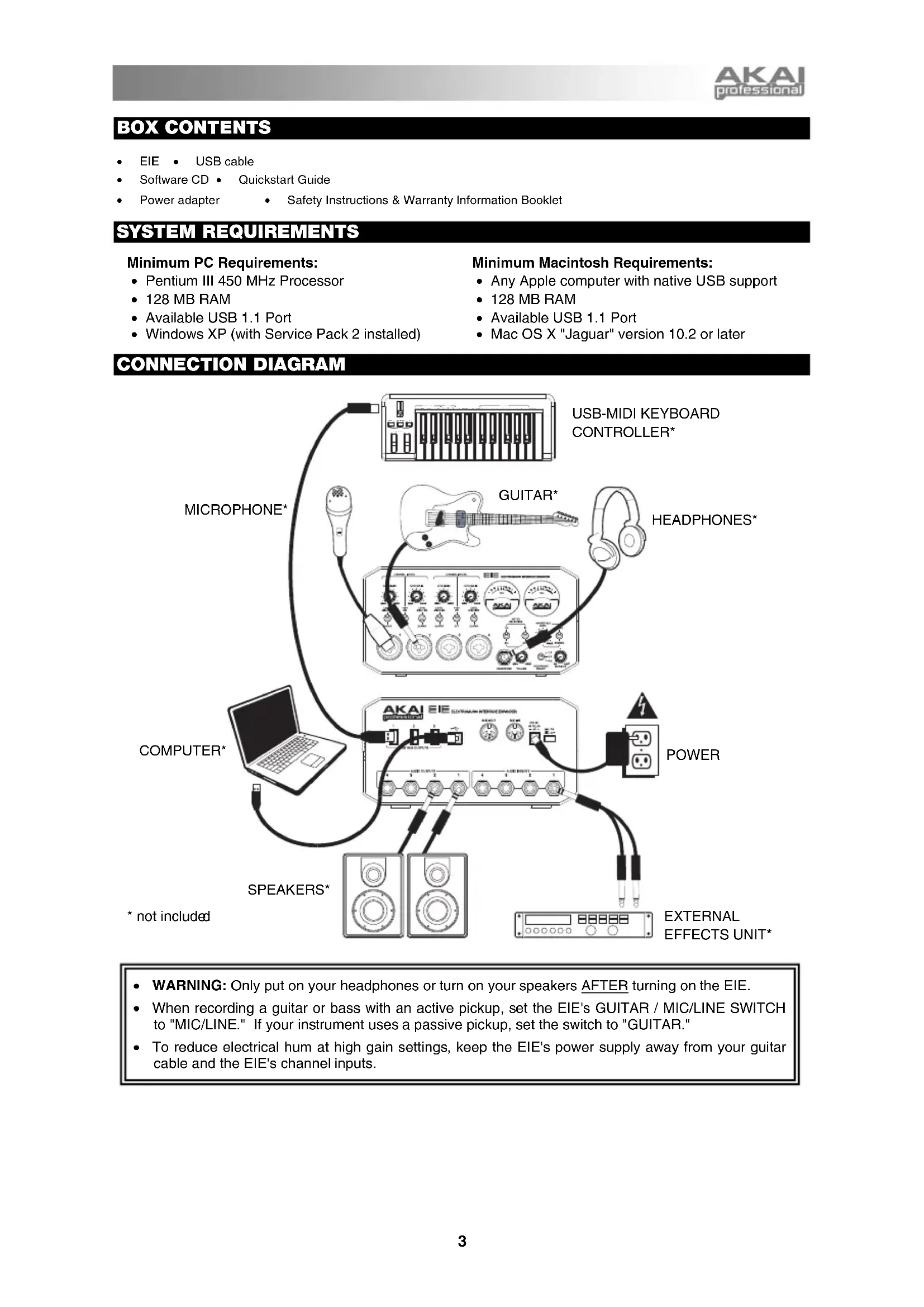
CONNECTION DIAGRAM
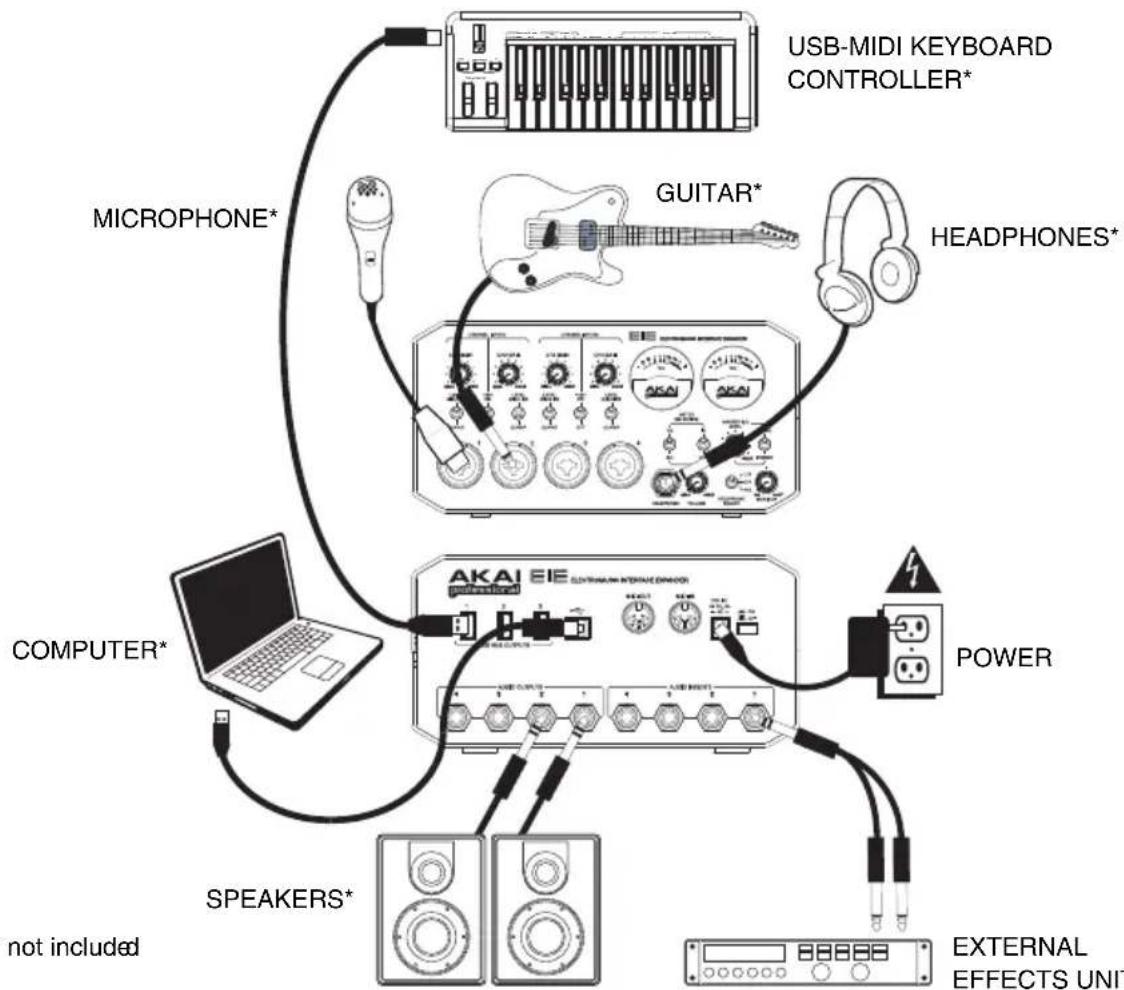
flowchart
graph TD
    A["USB-MIDI KEYBOARD CONTROLLER*"] --> B["GUITAR*"]
    B --> C["HEADPHONES*"]
    C --> D["ACAI EIE"]
    D --> E["POWER"]
    E --> F["EXTERNAL EFFECTS UNIT"]
    G["MICROPHONE*"] --> B
    H["COMPUTER*"] --> D
    I["SPEAKERS*"] --> D
    J["not included"] --> D
- WARNING: Only put on your headphones or turn on your speakers AFTER turning on the EIE.
- When recording a guitar or bass with an active pickup, set the EIE's GUITAR / MIC/LINE SWITCH to "MIC/LINE." If your instrument uses a passive pickup, set the switch to "GUITAR."
- To reduce electrical hum at high gain settings, keep the EIE's power supply away from your guitar cable and the EIE's channel inputs.
AUDIO SETUP
The EIE is a class-compliant device that can be used with any digital audio workstation or recording software that supports USB audio. To enable your EIE to send and receive audio to and from your computer, follow the instructions below for your computer's operating system:
WINDOWS 7:
- Connect EIE to a power source using the included power adapter (6V, 3A, center pin-positive).
- Use the included USB cable to connect the EIE to your computer.
- Go to Start Menu ▶ Control Panel ▶ Hardware and Sound ▶ Sound.
- Click the Playback tab and select EIE as the default device.
- Click the Recording tab and select EIE as the default device.
- Click OK to close the Sound control panel.
WINDOWS VISTA:
- Connect EIE to a power source using the included power adapter (6V, 3A, center pin-positive).
- Use the included USB cable to connect the EIE to your computer.
- Click the Playback tab and select EIE as the default device.
- Click the Recording tab and select EIE as the default device.
-
Click OK to close the Sound control panel.
-
Go to Start Menu ▶ Control Panel ▶ Sound. (If you don't see Sound, select Switch to Classic View, and the Sound Control Panel should become available.)
Be sure your audio software program is set up to receive audio via the EIE. This can usually be done in your software's "Preferences" or "Device Setup." Please consult your software manual for more information.
* If you have other USB audio devices connected to your computer, which may have identical names, you may need to try selecting each one until the EIE is recognized.
If you experience too much latency after adjusting your software latency settings, we recommend the free ASIO4ALL (Audio Stream Input/Output) driver for PC at www.asio4all.com. ASIO drivers generally perform better and with lower latency since they create a more efficient communication between audio devices and software.
WINDOWS XP:
- Connect EIE to a power source using the included power adapter (6V, 3A, center pin-positive).
- Use the included USB cable to connect the EIE to your computer.
- Go to Start Menu ▶ Control Panel ▶ Sounds and Audio Devices.
- Click the Audio tab.
- Under Sound Playback and Sound Recording, select USB Audio Codec* as the default device.
- Click OK.
MAC:
- Connect EIE to a power source using the included power adapter (6V, 3A, center pin-positive).
- Use the included USB cable to connect the EIE to your computer.
- Go to Applications ▶ Utilities ▶ Audio MIDI Setup.
- In the Audio Devices tab under System Settings, select USB Audio Codec* as your Default Input and Default Output.
- Close the window.
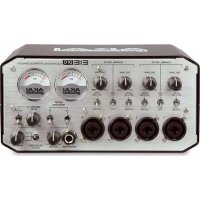
FRONT PANEL FEATURES
- MIC/LINE / GUITAR INPUT - Connect a microphone, line-level device or guitar to this input with an XLR or 1/4" TRS cable.
- GAIN - Adjusts the input's gain level.
- LEVEL MIC/LINE / GUITAR SWITCH - When the switch is in the "MIC/LINE" position, the channel will accept mic or line-level signals. When this switch is in the "GUITAR" position, the channel will serve as a high-impedance input for connecting guitar or bass instruments.
- PHANTOM POWER SWITCH – This switch activates and deactivates phantom power for each channel pair (Channels 1 and 2 and/or Channels 3 and 4). When activated, phantom power supplies +48V to both XLR mic inputs. Please note that most dynamic microphones do not require phantom power, while most condenser microphones do. Consult your microphone's documentation to find out whether it needs phantom power.
- VU METERS – These meters display the volume level of the channel pairs, depending on the setting of the METER SELECTION CHANNEL SWITCH. These meters will be lit whenever EIE is powered on. The red light indicates the signal is distorting or "clipping." If the signal is regularly clipping, reduce the volume of the mix and/or individual channels.
- METER SELECTION CHANNEL SWITCH – This switch selects which pair of channels the left and right VU METERS will display (respectively) – Channels 1 and 2 ("1/2") or Channels 3 and 4 ("3/4").
- METER SELECTION MONITOR SWITCH – This switch selects whether the VU METERS will display the volume level at the inputs ("IN") or outputs ("OUT").
- MASTER LEVEL – Adjusts the output volume of the AUDIO OUTPUTS 1 and 2.
- MONO / STEREO – Adjusts the master mix for mono or stereo operation.
- HEADPHONE - Connect a set of 1/4" TRS headphones to this output.
- HEADPHONE VOLUME – Adjusts the output volume of the PHONES output.
- HEADPHONE SELECT SWITCH – This switch selects what channels are sent out the HEADPHONE output – Channels 1 and 2 ("1/2"), Channels 3 and 4 ("3/4"), or all channels ("ALL").
- MONITOR MIX - Blend in any amount of zero-latency signal from your inputs ("IN") with the output of your computer ("OUT").
REAR PANEL FEATURES
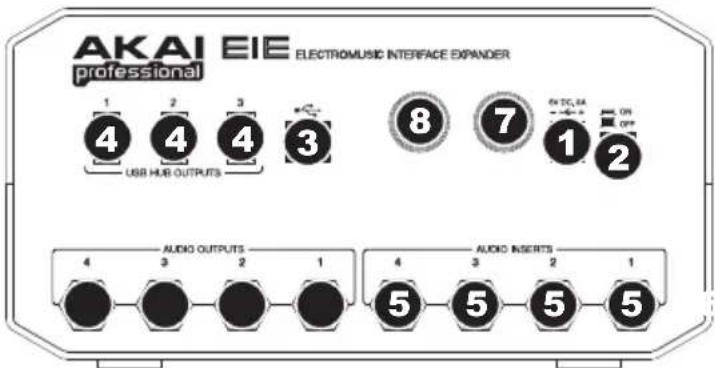
- DC INPUT - Connect the included power adapter (6V, 3A, center pin-positive) here, then connect the adapter to wall power.
- POWER SWITCH – Turns the EIE on and off.
- USB MIDI - This connection will allow you to send MIDI information to/from a computer. Use a USB cable to connect the EIE to a computer.
- USB HUB OUTPUTS - You can connect additional USB devices
Monday, the ports allowed EIE to function as a powered USB hub.
- AUDIO INPUTS (INSERTS) – You can use standard 1/4" TRS cables to connect external processors (such as compressors, limiters, external EQ units, etc.) to these jacks. The signal will be taken after the channel's gain control and returned before the channel's USB audio is sent to the computer.
- AUDIO OUTPUTS – Use standard 1/4" TRS cables to connect these outputs to monitors, an amplifier system, etc. The level of AUDIO OUTPUTS 1 and 2 are controlled by the MASTER LEVEL knob. The level of AUDIO OUTPUTS 3 and 4 are always at full volume.
- MIDI OUT - Use a standard five-pin MIDI cable to connect this output to the MIDI IN of an external MIDI device.
- MIDI IN – Use a standard five-pin MIDI cable to connect this input to the MIDI OUT of an external MIDI device.
CONTENIDO DE LA CAJA
Sampling Rates: 44.1 kHz
Resolution: 16-bit
Interface: USB 1.1
ANALOG INPUTS
Frequency Response: 20 Hz to 21 kHz (+ _0.05dB)
Dynamic Range (@-60dB input): 93 dB, A-weighted
S/N: 93 dB, A-weighted
THD+N: 0.001% @ 1 kHz / -0.1 dBFS
Crosstalk: 93 dB @ 1 kHz / -0.1 dBFS
Pre-amp THD+N: 0.018%
Mic gain (MIC): +9 dB to +51.5 dB
Mic impedance: 6.3 KΩ
Line gain: -10.5 dB to +41 d
Line impedance: 55 KΩ
Guitar gain: +1.6 dB to 53.1 dB
Guitar impedance: 102 KΩ
Insert:
Input sensitivity: 0 dBFS @ +6 dBV
Input impedance: 10 KΩ
ANALOG OUTPUTS
Output level: +6 dBV @ 0 dBFS
Frequency Response: 20 Hz to 20 kHz (+ 0.25 dB)
Dynamic Range (@-60dB input): 93 dB, A-weighted
S/N: -100 dB, A-weighted
THD+N: 0.006% @ 1 kHz / 0 dBFS
Crosstalk: 97 dB @ 1 kHz / 0 dBFS
HEADPHONES
32-Ω load:
Unclipped output power: 10 mW @ 1 kHz
Frequency Response: 20 Hz to 20 kHz (+ _0.25 dB)
S/N: -100 dB, A-weighted
THD+N: 0.007% @ 1 kHz / 0 dBFS
Crosstalk: 95 dB @ 1 kHz / 0 dBFS
600-Ω load:
Unclipped output power: 3.4 mW @ 1 kHz
Frequency Response: 20 Hz to 20 kHz (+ _0.25 dB)
S/N: -100 dB, A-weighted
THD+N: 0.003% @ 1 kHz / 0 dBFS
Crosstalk: 95 dB @ 1 kHz / 0 dBFS
- The unit can be used in the following electromagnetic environments: residential, commercial and light industrial, urban outdoors. This apparatus is not intended for rack-mounting.
- The maximum cable length for audio input and output is 10m.
• Peak inrush current: 387 mA
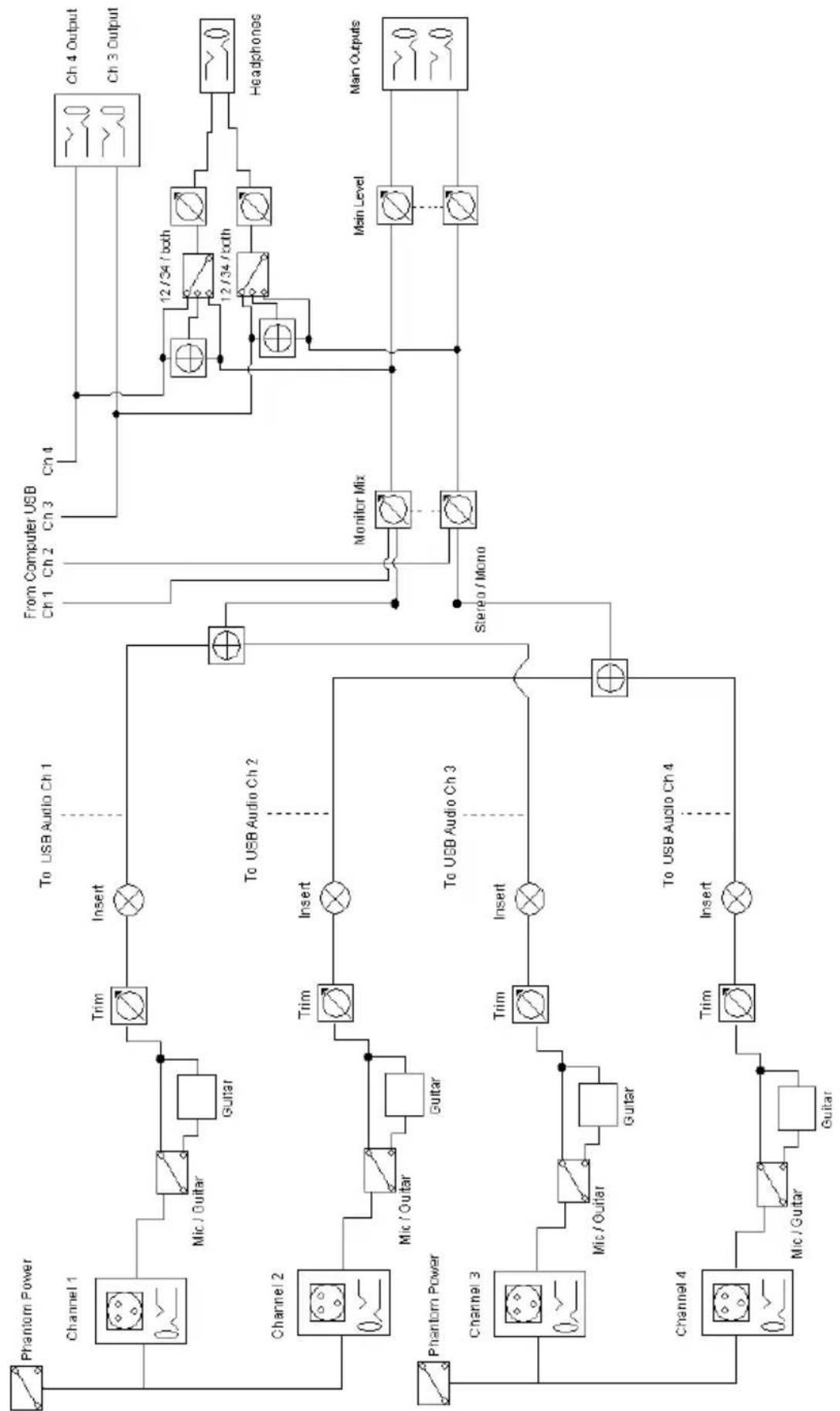
flowchart
graph TD
    A["Phantom Power"] --> B["Channel 1"]
    B --> C["Mic / Guitar"]
    C --> D["Guitar"]
    D --> E["Trim"]
    E --> F["Insert"]
    F --> G["To USB Audio Ch 1"]
    G --> H["From Computer USB"]
    H --> I["Ch 4 Output"]
    H --> J["Ch 3 Output"]
    K["Channel 2"] --> L["Mic / Guitar"]
    L --> M["Guitar"]
    M --> N["Trim"]
    N --> O["Insert"]
    O --> P["To USB Audio Ch 2"]
    P --> Q["Headphones"]
    R["Phantom Power"] --> S["Channel 3"]
    S --> T["Mic / Guitar"]
    T --> U["Guitar"]
    U --> V["Trim"]
    V --> W["Insert"]
    W --> X["To USB Audio Ch 3"]
    X --> Y["Main Level"]
    Y --> Z["Main Outputs"]
    AA["Channel 4"] --> AB["Mic / Guitar"]
    AB --> AC["Guitar"]
    AC --> AD["Trim"]
    AD --> AE["Insert"]
    AE --> AF["To USB Audio Ch 4"]
    AF --> AG["Stereo / Mono"]
    AH["Monitor Mix"] --> AI["Ch 1/2/3/4/both"]
    AI --> AJ["Headphones"]
AKAI
professional