Expedition Pro XP 200 - Hi-fi system SAMSON - Free user manual and instructions
Find the device manual for free Expedition Pro XP 200 SAMSON in PDF.



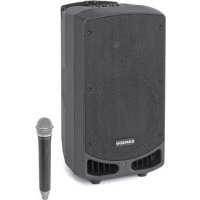
| Brand | Samson |
| Model | Expedition Pro XP200 |
| Product type | Active portable powered speaker, bi-amplified |
| Dimensions (W x D x H) | 371 x 441 x 539 mm |
| Weight | 19.0 kg (42.0 lbs) |
| Power supply | AC 110-120V / 220-240V selectable, 50-60 Hz |
| Amplifier power | 150 W (bass) + 50 W (treble), total 200 W |
| Woofer | 30 cm (12") Kevlar, 6.35 cm voice coil, 1.4 kg barium ferrite |
| Tweeter | 2.5 cm (1") compression tweeter with phenolic diaphragm |
| Active filter | Linkwitz-Riley, 24 dB/octave slope |
| Input connectors | 1 x balanced female XLR (line level) |
| Output connectors | 1 x balanced male XLR (daisy chain or subwoofer) |
| Limiter | On/Off switch, recommended always on |
| Indicators | 3-segment VU meter, battery wear indicator (optional) |
| Handle and wheels | Integrated telescopic handle and wheels for transport |
| Mounting | 1 3/8" pole socket, suspension anchor points |
| Available options | RB2030 battery, EX500 subwoofer, UM1/M32/VM1 wireless receiver |
| Maintenance and cleaning | Clean with a damp cloth only |
| Safety | Do not expose to moisture, do not open the enclosure, disconnect during storms |
| General information | Manual available in PDF at notice-facile.com, Samson technical support |
Frequently Asked Questions - Expedition Pro XP 200 SAMSON
User questions about Expedition Pro XP 200 SAMSON
0 question about this device. Answer the ones you know or ask your own.
Ask a new question about this device
Download the instructions for your Hi-fi system in PDF format for free! Find your manual Expedition Pro XP 200 - SAMSON and take your electronic device back in hand. On this page are published all the documents necessary for the use of your device. Expedition Pro XP 200 by SAMSON.
USER MANUAL Expedition Pro XP 200 SAMSON
natural_image
Black Xiaomi XP300 audio amplifier device with mesh grille and two side ports (no visible text or symbols on body)DO NOT EXPOSE THIS EQUIPMENT
TO RAIN OR MOISTURE
AVIS
RISQUE DE CHOC ELECTRONIQUE
NE PAS OUVRIR
CAUTION
FOR CONTINUED PROTECTION AGAINST RISK
OF FIRE, REPLACE ONLY WITH SAME TYPE FUSE
ATTENTION
UTILISER UN FUSIBLE DE
RECHANGE DE MÊME TYPE

CAUTION
RISK OF ELECTRIC SHOCK DO NOT OPEN

WARNING: To reduce the risk of fire or electric shock, do not expose this unit to rain or moisture. To reduce the hazard of electrical shock, do not remove cover or back. No user serviceable parts inside. Please refer all servicing to qualified personnel. The lightning flash with an arrowhead symbol within an equilateral triangle, is intended to alert the user to the presence of uninsulated "dangerous voltage" within the products enclosure that may be of sufficient magnitude to constitute a risk of electric shock to persons. The exclamation point within an equilateral triangle is intended to alert the user to the presence of important operating and maintenance (servicing) instructions in the literature accompanying the product.
Important Safety Instructions
- Please read all instructions before operating the unit.
- Keep these instructions for future reference.
- Please heed all safety warnings.
- Follow manufacturers instructions.
- Do not use this unit near water or moisture.
- Clean only with a damp cloth.
- Do not block any of the ventilation openings. Install in accordance with the manufacturers instructions.
- Do not install near any heat sources such as radiators, heat registers, stoves, or other apparatus (including amplifiers) that produce heat.
- Do not defeat the safety purpose of the polarized or grounding-type plug. A polarized plug has two blades with one wider than the other. A grounding type plug has two blades and a third grounding prong. The wide blade or third prong is provided for your safety. When the provided plug does not fit your outlet, consult an electrician for replacement of the obsolete outlet.
- Protect the power cord from being walked on and pinched particularly at plugs, convenience receptacles and at the point at which they exit from the unit.
- Unplug this unit during lightning storms or when unused for long periods of time.
- Refer all servicing to qualified personnel. Servicing is required when the unit has been damaged in any way, such as power supply cord or plug damage, or if liquid has been spilled or objects have fallen into the unit, the unit has been exposed to rain or moisture, does not operate normally, or has been dropped.
System Features ....3
Expedition Pro XP100 ....5
Expedition Pro XP200 7
Expedition Pro XP300 9
Positioning and Mounting Instructions 13
Expedition Pro Accessories 15
Specifications 57
FRANÇAIS
Introduction 16
Specifications ....57
DEUTSCHE
Einleitung 29
Printed October, 2005 v4.1
Samson Technologies Corp.
Phone: 1-800-3-SAMSON (1-800-372-6766)
Fax: 516-364-3888
www.samsontech.com
THIS DEVICE COMPLIES WITH PART 15 OF THE FCC RULES CLASS B. OPERATION IS SUBJECT TO THE FOLLOWING TWO CONDITIONS: (1) THIS DEVICE MUST NOT CAUSE HARMFUL INTERFERENCE, AND (2) THIS DEVICE MUST ACCEPT ANY INTERFERENCE RECEIVED INCLUDING INTERFERENCE THAT MAY CAUSE UNDESIRED OPERATION. SUITABLE FOR HOME OR OFFICE USE.
^A K-TEAM
PRODUCTION
Introduction
Welcome to Samson Expedition Pro—the portable audio system for the new millennium! This exceptionally versatile system offers the perfect solution wherever you need portable, high-quality audio: as a main PA system or as onstage monitors in clubs and performance halls; in houses of worship; as a sound system for business presentations, mobile DJs at parties, or aerobics instruction; and for use in outdoor environments such as parks, beaches and flea markets. What's more, every Expedition pro system comes with a built-in telescoping handle and locking wheels, making it easy to take professional audio with you wherever you go!
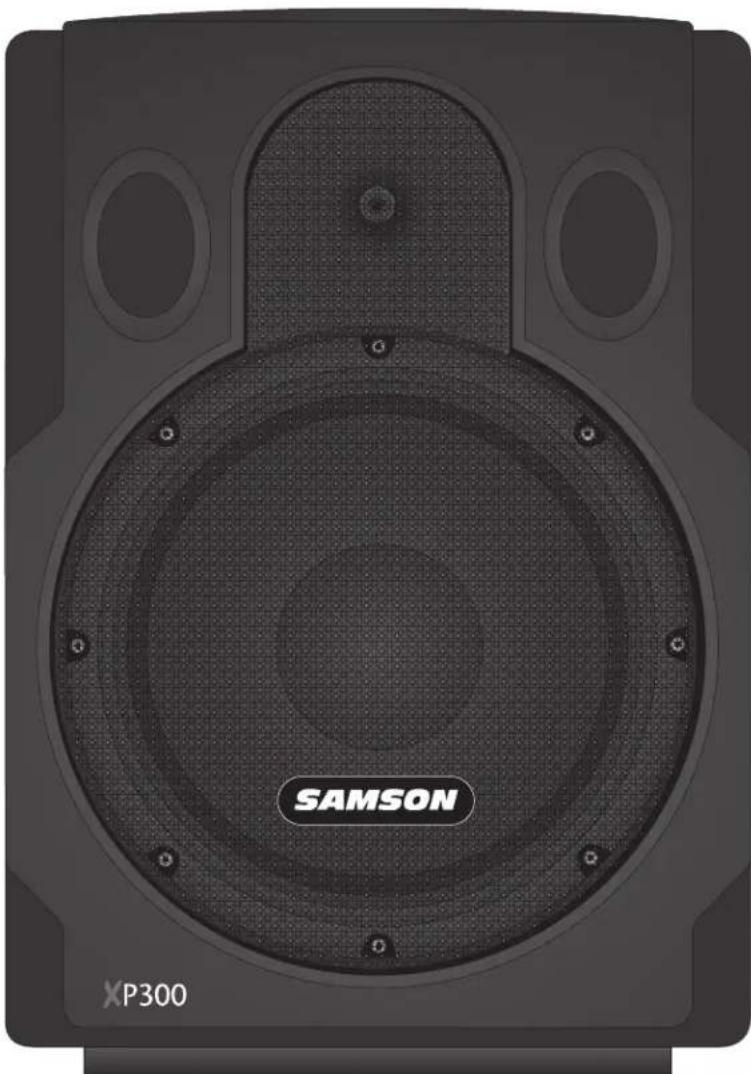
There are three different Samson Expedition Pro systems detailed in this manual. All utilize the same lightweight yet rugged two-way speaker enclosure that pairs a custom designed 12" woofer with a matched 1" compression driver. The Expedition XP100 is a passive 8-ohm enclosure that can be used with any external power amplifier rated at up to 250 watts. The Expedition XP200 is a powered version that includes a bi-amped power cell along with an active crossover, speaker protection circuitry and built-in limiting. And the Expedition XP300 is designed as a total all-in-one portable PA system, adding a four-channel stereo mixer—complete with digital effects—to the equation. In addition, a number of expansion options are available, including a 500-watt active subwoofer (our EX500); a rechargeable Lead-Acid GelCel battery pack; and a rear-panel mountable cassette recorder with pitch control. There's even a prewired custom compartment that accommodates any of three different Samson wireless receivers!
In this manual, you'll find a more detailed description of the features of all three Expedition Pro systems, as well as a guided tour through all components, step-by-step instructions for setting up your system and full specifications. If your Expedition Pro was purchased in the United States, you'll also find a warranty card enclosed—don't forget to fill it out and mail it! This will enable you to receive online technical support and will allow us to send you updated information about this and other Samson products in the future. If your Expedition Pro system was purchased outside of the U.S., contact your local distributor for warranty details. Also, be sure to check out our website (http://www.samsontech.com) for complete information about our full product line.
SPECIAL NOTE for U.S. purchasers: Should your Expedition Pro system ever require servicing, a Return Authorization number (RA) is necessary. Without this number, the unit will not be accepted. If your Expedition Pro system was purchased in the United States, please call Samson at 1-800-372-6766 for a Return Authorization number prior to shipping your system. If possible, return the unit in its original carton and packing materials. If your Expedition Pro system was purchased outside of the U.S., contact your local distributor for information.
System Features
natural_image
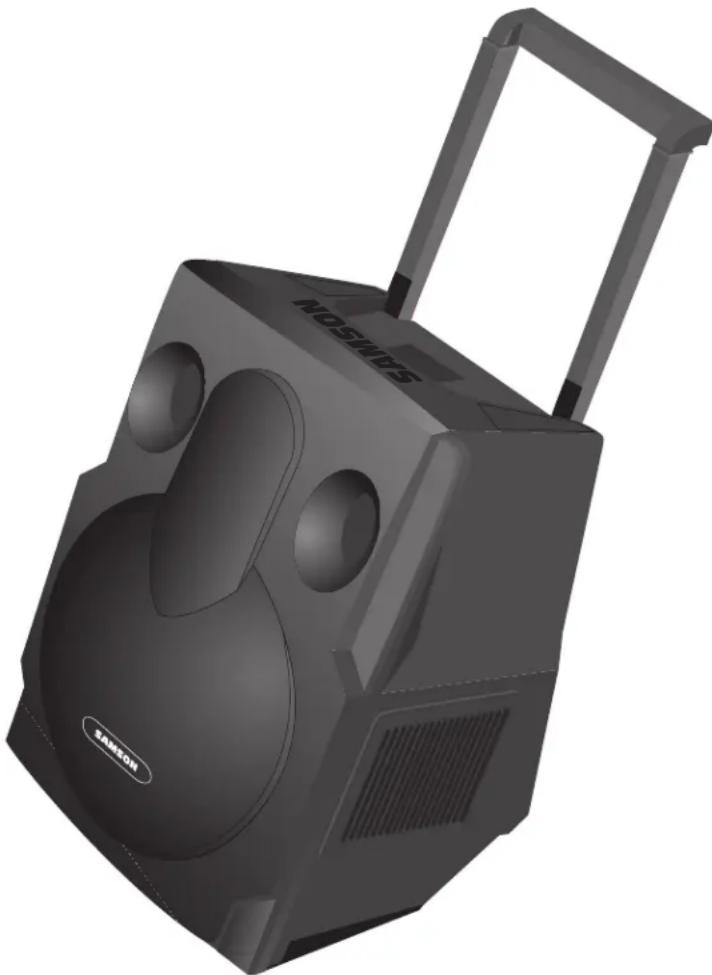
3D rendering of a black NOSWBS portable radio device with handle and ventilation slots (no text or symbols on body)The Samson Expedition Pro system uses state-of-the-art technology to bring a revolutionary new degree of flexibility and portability to professional audio. Its main features include:
- A built-in telescoping handle and locking wheels that make it easier than ever before to transport your audio system.
- All Expedition Pro enclosures are lightweight and compact yet exceptionally durable and roadworthy. Injection-molded with Polypropylene, they feature substantial internal bracing to support a nearly 1/2" thick side wall construction, making them strong and rigid enough to allow maximum energy to be delivered to the sound output. In addition, a steel grill and scuff-resistant textured finish makes for a rugged speaker enclosure that will deliver dependable performance in even the most demanding environments.
- The low frequency section includes a custom designed Kevlar-impregnated 12" low frequency driver with a 2.5" Kapton Former voice coil and 50 ounce barium ferrite magnet for accurate and super-tight bass response.
- A high frequency section that delivers clear, sweet top end thanks to its 1" compression driver with a specially designed phenolic diaphragm, along with a phasing plug for linear response and an elliptical wave guide horn design that reduces nearly all sonic diffraction.
- A tilt position that allows the Expedition Pro to be used as an onstage wedge monitor.
-
Integral 1 3/8" pole-mount receptacle and convenient fly points allow the Expedition Pro to be pole-mounted or "flown" using standard PA hardware.
-
The XP100 is a passive cabinet that can be used with any power amplifier rated at up to 250 watts into 8 ohms. It requires no power and provides dual Speakon™ and 1/4" connectors that allow multiple XP100s to be daisy-chained where extended coverage is required.
- The XP200 contains dual power amplifiers and an active crossover. Operating in a biamped configuration, one power amp drives the low frequency section with 150 watts of power and the other drives the high frequency section with 50 watts of power. The active crossover uses an advanced Linkwist-Riley constant phase filter that provides a steep rolloff of 24 dB per octave to reduce sonic distortion at the crossover frequencies. Dual balanced XLR connectors allow daisy-chaining of multiple Expedition Pro enclosures, and a switchable limiter circuit assures a clean output even when you're pushing the XP200 to maximum levels. In addition, there are three stages of speaker protection, including relay switching for power on and off.
- The XP300 includes all the features of the XP200, and adds a flexible four-channel stereo mixer that provides two monophonic and one stereo mic/line channels with dual XLR and 1/4" connectors. In addition, separate dual phono connectors allow you to hook up an external cassette or CD player. Each mixer channel includes two-band equalization and independent volume control,
System Features
and there's even built-in digital effects for the addition of six different reverb presets. Balanced left and right XLR outputs allow daisy-chaining of multiple Expedition speakers (with a mono/stereo switch that allows operation in either mode), and a VU meter enables you to continuously monitor output levels. The XP200 and XP300 also include a meter that shows battery level when used with the optional RB 2030 rechargeable battery cartridge (see below).
- The top panel of both the XP200 and XP300 provides a prewired compartment that accommodates a variety of Samson wireless systems that offer superior RF and audio performance already proven on stages around the world. Receivers supported include the UM1 or M32 UHF models or the VM1 VHF model.
- A wide range of optional accessories, including: the MP 1030 mounting bracket, which allows any Expedition Pro enclosure to be "flown" from the ceiling; the RB 2030 rechargeable battery cartridge, which provides up to two hours of power to either the XP200 or XP300 from its dual Lead-Acid GelCel batteries; and the TD30 cassette recorder, which fits neatly into a special compartment above the XP300's mixer to provide background music and/or to record meetings or performances. The TD30 even includes a pitch control so you can alter the tempo of the music for applications like aerobic instruction.
- The EX500 is an active subwoofer that pairs a massive 500-watt amplifier with a heavy-duty 15" low frequency driver. It is an ideal complement to any Expedition Pro enclosure or any loudspeaker system, when the application requires deep, powerful low end response. Its built-in stereo electronic crossover allows the EX500 to operate either in mono or as a common subwoofer in a stereo system. It features an all-steel grill and rigid corners, as well as an integral pole mount.
natural_image
Top-down view of a black electronic device labeled 'X P300' with a central circular component and mounting holes (no readable text beyond branding)Expedition Pro XP100
Guided Tour
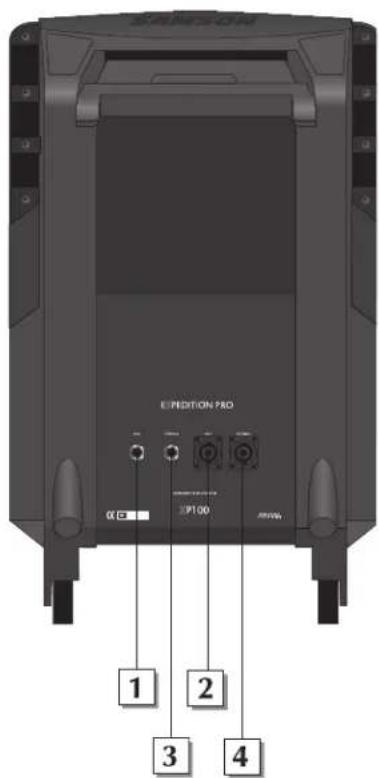
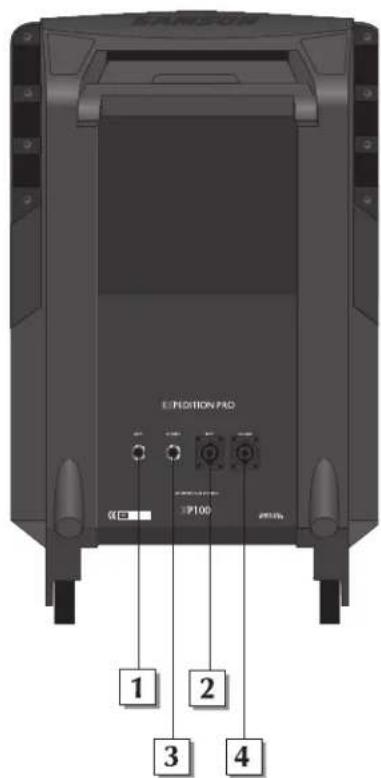
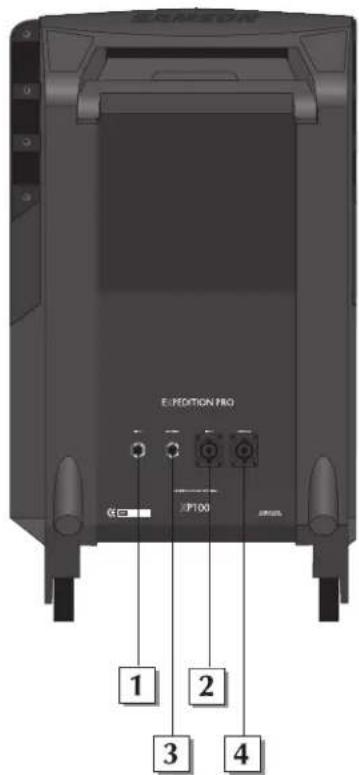
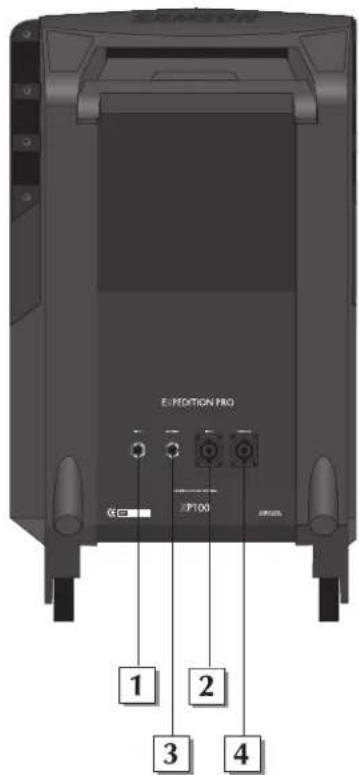
1: 1/4" input - Use this standard 1/4" connector to connect signal from a power amplifier (rated at up to 250 watts into 8 ohms) to the XP100.
2: Speakon™ input - Alternatively, you can use this Speakon™ connector to connect signal from a power amplifier (rated at up to 250 watts into 8 ohms) to the XP100.
3: 1/4" extension - Use this standard 1/4" connector to daisy-chain one XP100 to another. See below for interconnection diagrams.
4: Speakon™ extension - Alternatively, you can use this Speakon™ connector to daisy-chain one XP100 to another. See below for interconnection diagrams.
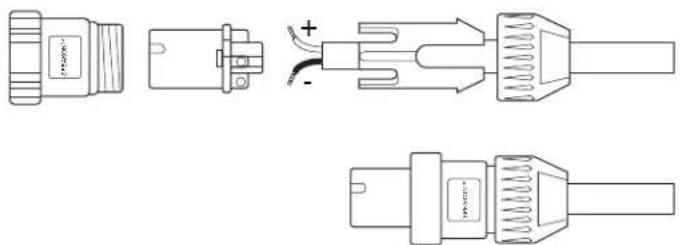
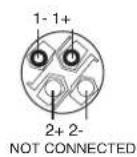
Speakon™ Wiring
natural_image
Technical line drawing of a mechanical component with exploded and assembled views (no text or symbols)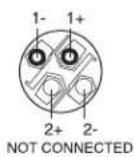
Interconnecting the XP100
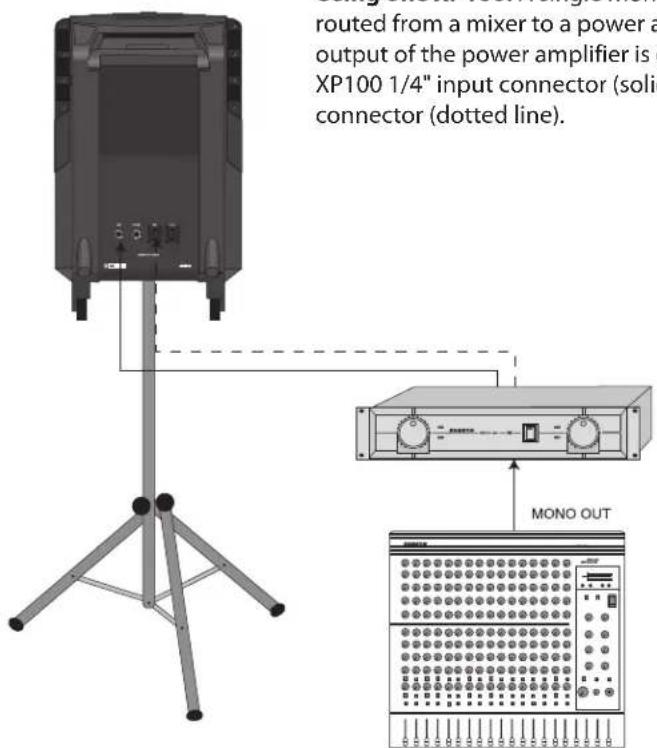
Using one XP100: A single mono signal (bus or aux send) is routed from a mixer to a power amplifier. One speaker output of the power amplifier is connected to either the XP100 1/4" input connector (solid line) or Speakon™ input connector (dotted line).
Expedition Pro XP100
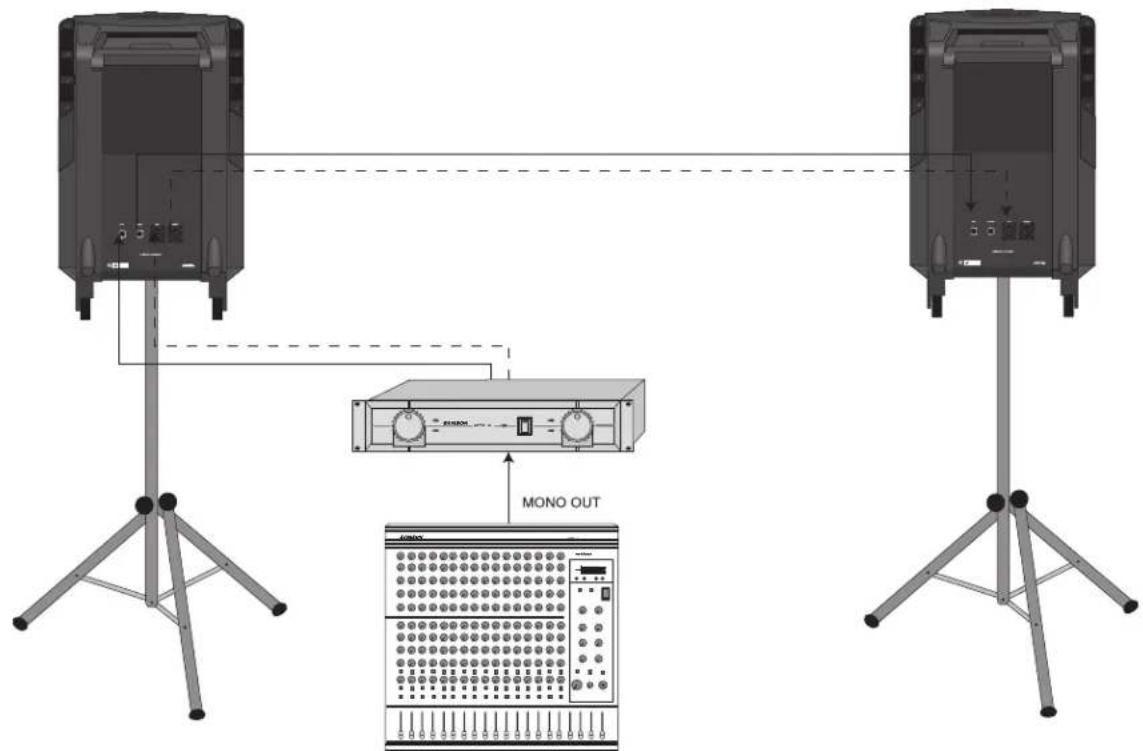
Using two XP100s in mono: A single mono signal (bus or aux send) is routed from a mixer to a power amplifier. One speaker output of the power amplifier is connected to either the XP100 1/4" input (solid line) or Speakon™ input (dotted line), and a connection is made between either the 1/4" extension to a second XP100's input (solid line) or between the Speakon™ extension to a second XP100's Speakon™ input (dotted line).
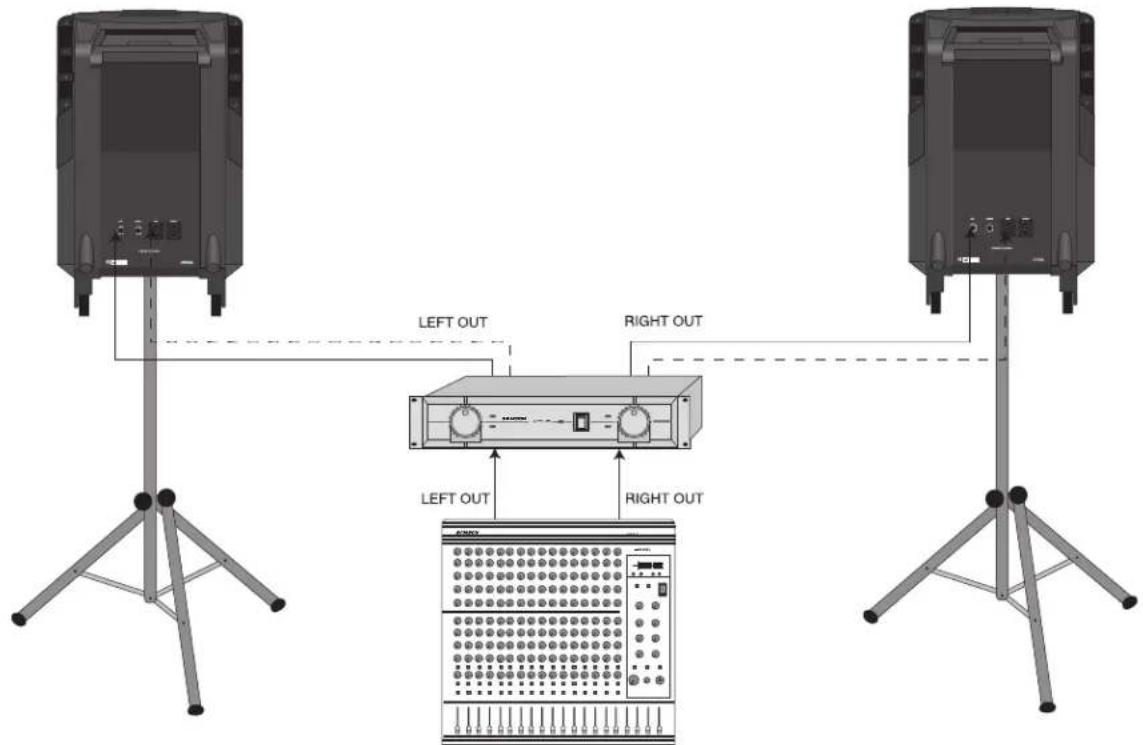
Using two XP100s in stereo: A stereo signal (bus or aux send) is routed from a mixer to a power amplifier. The left speaker output of the power amplifier is connected to one XP100 (using either the 1/4" input [solid line] or Speakon™ input [dotted line]), and the right speaker output of the power amplifier is connected to the other XP100 (again using either the 1/4" input [solid line] or Speakon™ input [dotted line]).
Expedition Pro XP200
Guided Tour
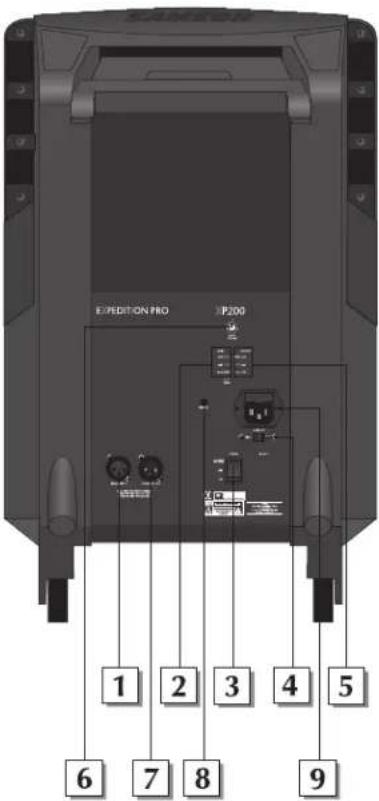
1: Input connector - Use this balanced female XLR connector to route line-level signal into the XP200.
2: Output VU meter - This three-segment bar meter shows the XP200 output level. For optimum signal-to-noise ratio, set the Volume control (see #6 below) so that program material is usually at or around 0 VU, with occasional but not steady excursions to the red "+3 dB" segment.
3: Power switch - Use this to turn power to the XP200 on or off.
4: Voltage selector - Make sure this is set correctly for the country you are in before turning on the power to the XP200.
5: Battery VU meter - If an optional RB 2030 rechargeable battery pack is installed, this meter shows how much battery power remains as it is being charged (Power switch off) or depleted (Power switch on).
6: Volume control - This knob sets the level of the XP200's built-in power amplifiers.
7: Output connector- This balanced male XLR connector carries line-level output signal from the XP200. It is used to send signal to a second XP200 being daisy-chained (see interconnection diagram on the following page) or to an optional EX500 subwoofer.
8: Limiter switch - Use this switch to turn the built-in limiter circuitry on or off. In order to maximize speaker protection, we recommend that this switch be left in the "on" position during normal operation.
9: AC input - Connect the supplied heavy-gauge 3-pin "IEC" power cable here.
Interconnecting the XP200
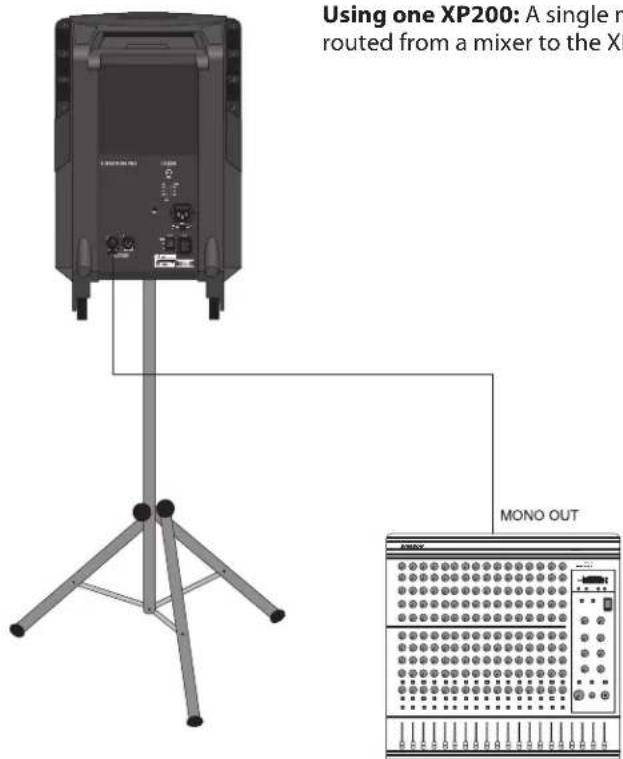
Using one XP200: A single mono signal (bus or aux send) is routed from a mixer to the XP200 XLR input.
Expedition Pro XP200
Using two XP200s in mono: A single mono signal (bus or aux send) is routed from a mixer to one XP200's XLR input, and a connection is made between that XP200's XLR output to a second XP100's XLR input.
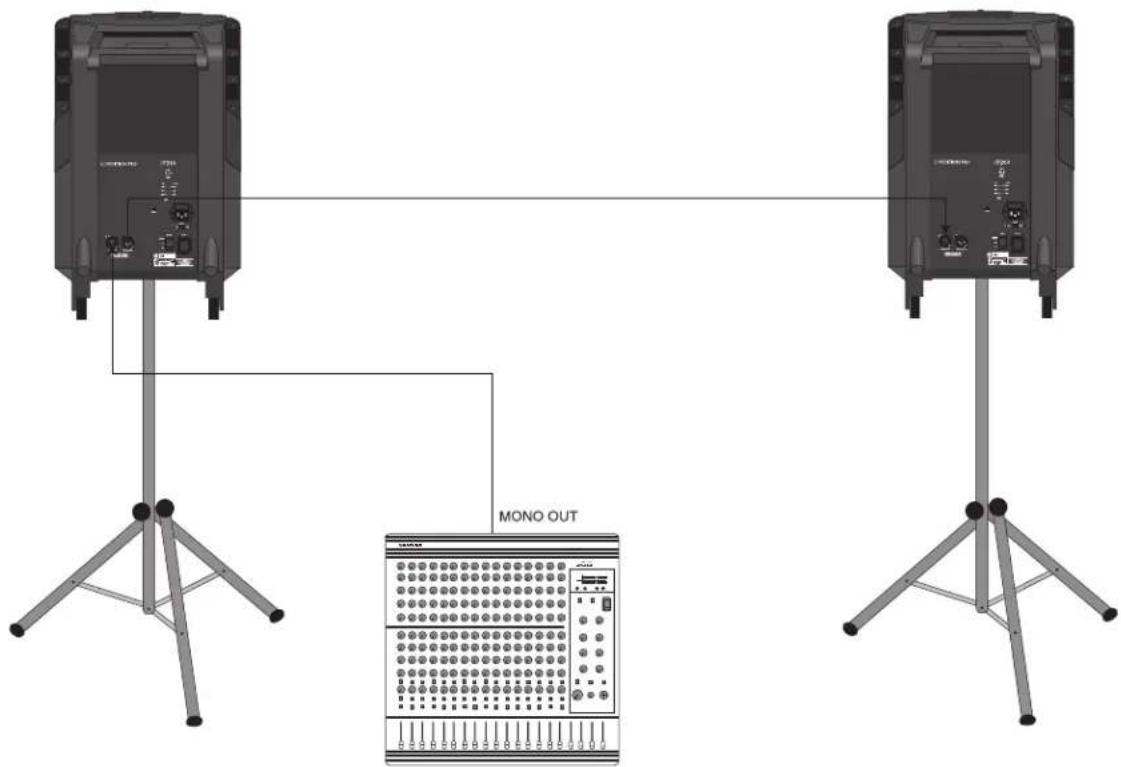
Using two XP200s in stereo: A stereo signal (bus or aux send) is routed from a mixer, with the left side connected to one XP200's XLR input, and the right side connected to the other XP200's XLR input.

Expedition Pro XP300
Guided Tour
natural_image
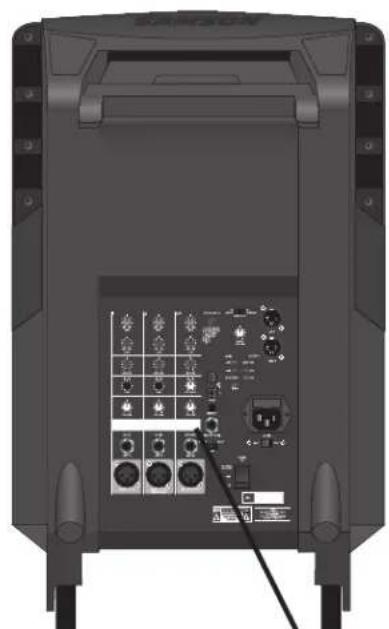
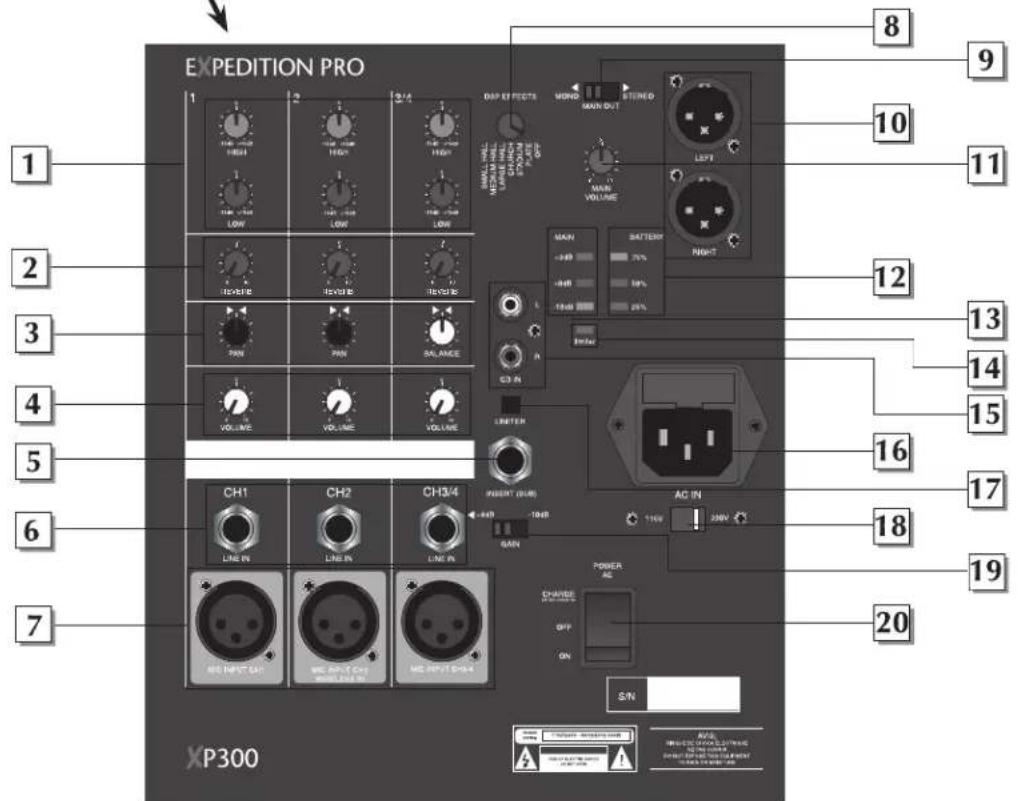
Back view of a black electronic device rear panel with ports and cables (no visible text or symbols)1: Equalizer - These controls allow you to shape your sound by boosting or cutting the amount of bass (at 100 Hz) or treble (at 10 kHz) by up to 15 dB. A center detent in each knob indicates no boost or cut (that is, flat response). As each knob is turned clockwise from the 12 o'clock position, the bass or treble is boosted; as it is turned counterclockwise from the 12 o'clock position, the bass or treble is reduced.
2: Reverb send - These knobs determine how much signal is being sent from the channel to the onboard DSP effects processor. As you move the knob clockwise from 0 to 10, more signal is sent. To hear the effect, one of the six presets must be selected using the DSP Effects control (see #10 on the next page). Be careful not to send too much signal to the DSP, or a distorted sound will result.
3: Pan/Balance control - In channels 1 and 2, this knob acts as a Pan control, allowing you to place the signal anywhere in the left-right stereo spectrum, while keeping the overall signal level constant. When the knob is placed at its center (detented) position, the signal is sent equally to both the left and right outputs. To route a signal hard left or right, place the pan knob either fully counterclockwise or fully clockwise. In channel 3/4 (the stereo channel), this knob acts as a Balance control, allowing you to alter the relative levels of the two input signals. When the knob is placed at its center detented position, both signals are at equal strength. When moved left of center, you'll hear more of the left input signal; when moved right of center, you'll hear more right input signal.
4: Channel volume control - This knob determines the level of the channel In stereo channel 3/4, this knob simultaneously controls the level of both inputs (the relative levels of the two can be adjusted with the Balance knob, as described in #3 above). In practice, you'll use the channel volume controls to continuously adjust the levels of the various signals being blended together by the XP300 mixer.
5: Insert (sub) connector - This 1/4" connector brings line-level signal in directly before the XP300 power amplifiers. It is normally used to return signal from an optional EX500 subwoofer.
Expedition Pro XP300
6: Line inputs - Use these 1/4" jacks to connect line-level sources to the XP300. Channels 1 and 2 are mono 1/4" connectors; channel 3/4 uses a stereo (TRS) 1/4" connector, with tip carrying left signal and ring carrying right signal. Stereo devices should always be connected to the stereo channel (channels 3/4). If a wireless receiver is connected to the XP300 via its internal connectors (see page 14 in this manual), its output arrives at channel 2, which can also carry another line-level source connected to its line input, as well as signal from a microphone connected to its mic input. If an optional TD30 cassette player is installed, its output arrives at channels 3/4, which can also carry another two line-level sources (one connected to its line input and a second connected to the CD inputs [see #15 on the following page]), as well as signal from a microphone connected to its mic input.
7: Mic inputs - Use these XLR jacks to connect microphones to the XP300's built-in mic preamps. Each channel can carry both one or more line level sources (see #6 above) as well as a mic source.
8: DSP Effects control - Use this to select one of six reverb presets (Small Hall, Medium Hall, Large Hall, Church, Stadium, or Plate). If you don't want to hear any reverb, set this switch to the "Off" position.
9: Mono/Stereo switch - When using one XP300, set this switch to "Mono" so that the XP300 power amp receives signal from both the left and right output sections. When using multiple Expedition Pro speaker enclosures, set this switch to "Stereo"; the XP300 will then reproduce only signal from the left output section only (that is, signals panned left at the mixer); the Right output can then be used to send signal from the right output section (that is, signal panned right at the mixer) to a second enclosure. See the interconnection diagrams on pages 10 - 11 for more information.
10: Outputs - The dual XLR connectors carry line-level output signal from the XP300. They are used to send signal to a second XP300 (or XP200) being daisy-chained (see the interconnection diagram on the following page) or to an optional EX500 subwoofer. Note that the signal being output from these connectors is dependent upon the setting of the Mono/Stereo switch (see #9 above). When set to "Stereo," the Left XLR connector carries left signal only and the Right XLR connector carries right signal only; when set to "Mono," both the Left and Right connectors carry the same monophonic signal, summed from both the left and right output sections. See the interconnection diagrams on pages 10 - 11 for more information.
11: Main Volume control - This knob determines the final output signal level—you can think of this as being the "master fader." Signals from all four channels are routed here just before being routed to the XP300's built-in power amplifiers and Left and Right output jacks (see #10 above).
12: Battery VU meter - If an optional RB 2030 rechargeable battery pack is installed, this meter shows how much battery power remains as it is being charged (Power switch off) or depleted (Power switch on). See #20 on the following page.
13: Output VU meter - This three-segment bar meter shows the continuous output level of the XP300. For optimum signal-to-noise ratio, try to adjust all channel and main Volume controls so that program material is usually at or around 0 VU, with occasional but not steady excursions to the red "+3 dB" segment.
14: Limiter LED - Lights whenever the built-in limiter is active. If you see this lighting frequently, it means you're overloading the XP300, so turn down one or more of the Channel volume controls (see #4 on the preceding page) or the main Volume control (see #11 above).
15: CD inputs - Connect the outputs of a CD or tape player to this set of dual phono jacks. Signal arriving here returns to stereo channel 3/4. If an optional TD30 cassette player is installed, note that its output also arrives at channels 3/4, in addition to line-level signal arriving at its 1/4" TRS line input (see #6 on the preceding page) and signal from a microphone connected to its mic input (see #7 on the preceding page).
16: AC input - Connect the supplied heavy-gauge 3-pin "IEC" power cable here.
Expedition Pro XP300
17: Limiter switch - Use this switch to turn the built-in limiter circuitry on or off. In order to maximize speaker protection, we recommend that this switch be left in the "on" position during normal operation.
18: Voltage selector - Make sure this is set correctly for the country you are in before turning on the power to the XP300.
19: Gain switch - Sets the line-level TRS input of channel 3/4 (see #6 on the preceding page) to either +4 (professional) or -10 (consumer) level.
20: Power switch - Use this to turn power to the XP300 on or off. If an optional RB 2030 rechargeable battery pack is installed, it will charge when this switch is in the "Off" position.
Interconnecting the XP300
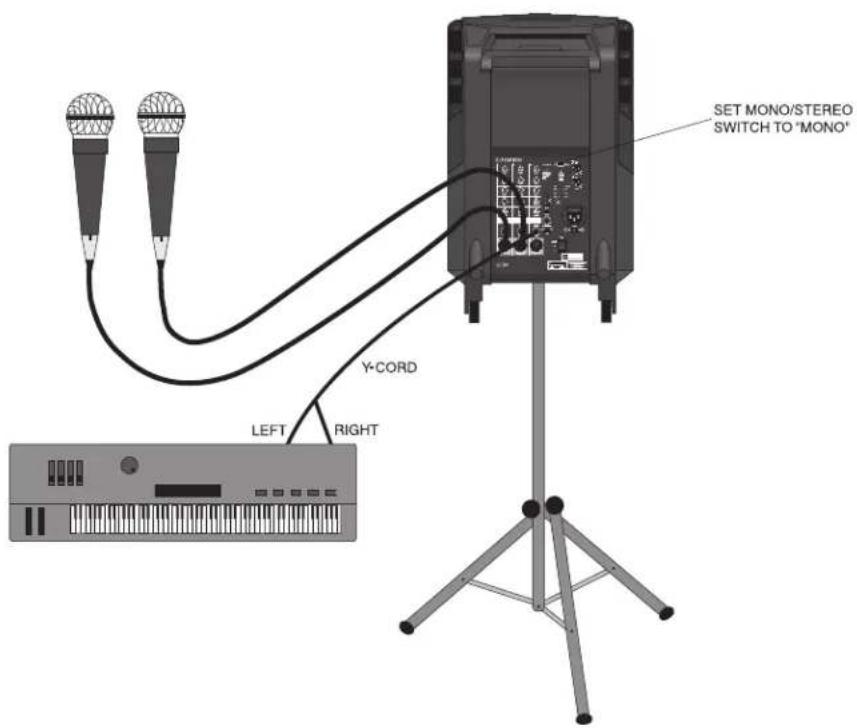
Using one XP300: In this example, microphones are connected to the XLR mic inputs of channels 1 and 2, and a stereo keyboard is connected to the stereo 1/4" TRS connector of channel 3/4 (using a Y-cord, with the tip carrying the left signal and the ring carrying the right signal).
IMPORTANT NOTE: When using just one XP300, always be sure to set its Mono/Stereo switch to "Mono."
Expedition Pro XP300
Using one XP300 and an XP200 (stereo operation): In this example, microphones are connected to the XLR mic inputs of channels 1 and 2 of an XP300, and a stereo keyboard is connected to the stereo 1/4" TRS connector of channel 3/4 of the XP300 (using a Y-cord, with the tip carrying the left signal and the ring carrying the right signal). A connection is then made between the Right output of the XP300 to the XLR input of an XP200. IMPORTANT NOTE: When using the XP300 with additional Expedition Pro enclosures, always be sure to set the XP300 Mono/Stereo switch to "Stereo."

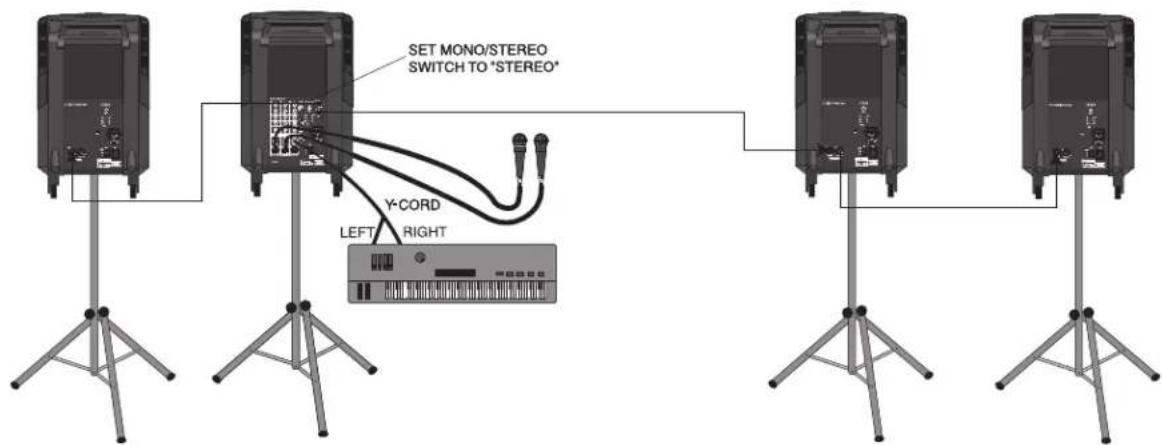
Using one XP300 and three XP200s (extended range stereo operation): In this example, microphones are connected to the XLR mic inputs of channels 1 and 2 of an XP300, and a stereo keyboard is connected to the stereo 1/4" TRS connector of channel 3/4 of the XP300 (using a Y-cord, with the tip carrying the left signal and the ring carrying the right signal). A connection is then made between the Left output of the XP300 to the XLR input of an XP200 (both will then carry the same left channel signal). Finally, a connection is made between the Right output of the XP300 and an XP200, and between that XP200's XLR output and the XLR input of a third XP200 (both will then carry the same right channel signal). IMPORTANT NOTE: When using the XP300 with additional Expedition Pro enclosures, always be sure to set the XP300 Mono/Stereo switch to "Stereo."
Positioning and Mounting Instructions
General Positioning Tips
- Operating a microphone or turntable in front of a speaker is a sure formula for feedback and/or rumble problems, so always place the Expedition Pro in front of any mics or turntables that are being used.
- Use the Expedition Pro upright for all "front-of-house" PA applications; use it in its tilt-back position only for onstage monitoring.
• Always raise the speakers as high above the audience as is practicable for maximum coverage. - Use sufficient enclosures for the space you're in. The larger the space, the more speakers will be required.
Pole-Mounting
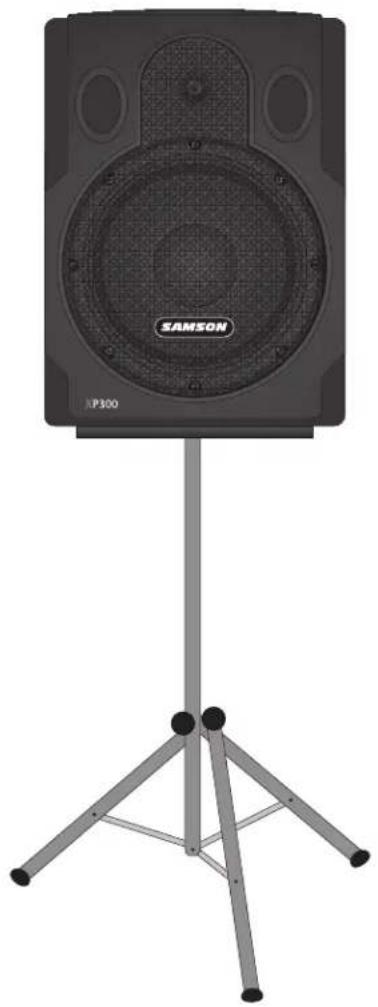
The underside of the Expedition Pro contains a 1-3/8" stand mount socket that allows it to be raised up on any standard speaker pole mounting (such as the Ultimate Support Systems TS-30 or TS-33 speaker stands). Pole-mounting is generally advisable when you want to maximize the distance that the Expedition Pro covers (sometimes called speaker "throw").
If you are using an EX500 subwoofer, you can use its integral pole mount to place an XP100, XP200 or XP300 immediately above it, creating a complete column of sound.
Fly Mounting, Wall Mounting, and Ceiling Mounting
As shown in the illustration below, the top panel of the Expedition Pro contains a number of fly points, located in compartments to the left and right of the wireless receiver compartment. The covers placed over these compartments are simply attached with double-sided sticky tape, so just pull up to remove.
natural_image
Exterior view of a black SAMSON audio amplifier stand with tripod base (no text or symbols on body)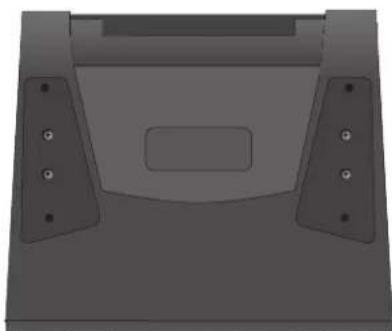
natural_image
3D rendered diagram of a mechanical component with mounting holes and a central rectangular feature (no text or symbols)Expedition Pro fly-mount points
Positioning and Mounting Instructions
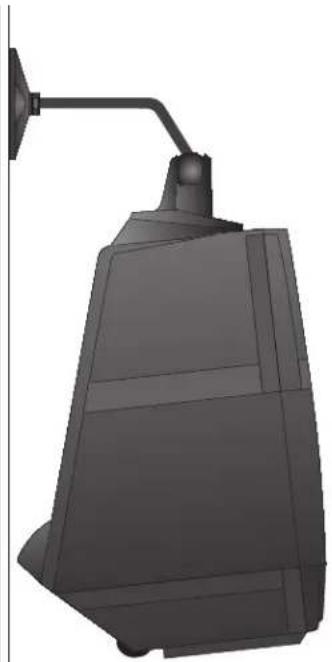
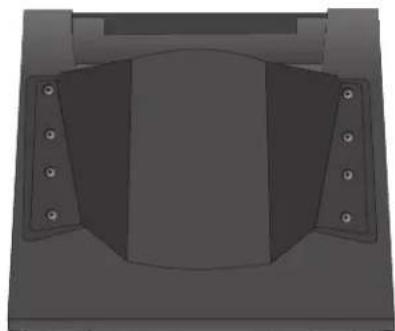
Before fly-mounting, wall-mounting or ceiling-mounting the Expedition Pro, you must first install a Samson MP 1030 mounting bracket to the fly points, as shown in the illustrations on the right
Standard cabling and hardware can then be attached to the MP 1030 mounting bracket in environments where the Expedition Pro needs to be "flown."
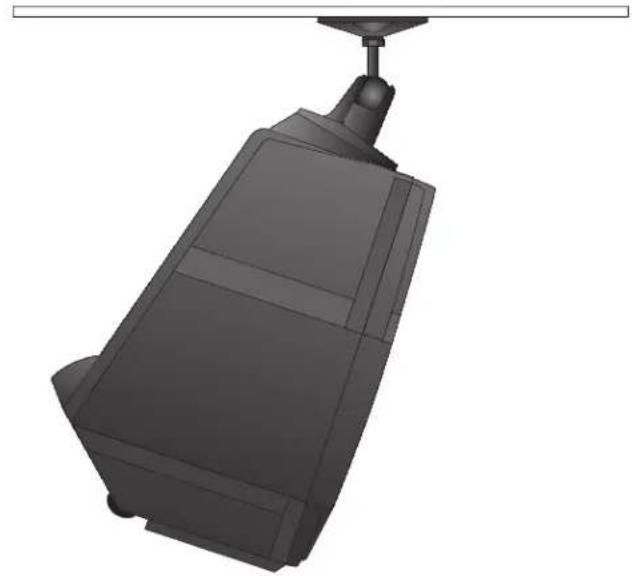
In fixed installations where you wish to mount the Expedition Pro to a ceiling, use the OmniMount model 100-STMP mount, as shown in the illustration below:
natural_image
3D rendered mechanical component with a suspended shaft and mounting bracket (no text or symbols visible)In fixed installations where you wish to mount the Expedition Pro from a wall, use the OmniMount model 100-WB mount, as shown in the illustration below:
natural_image
3D rendered mechanical component with a vertical pipe extending upward (no text or symbols visible)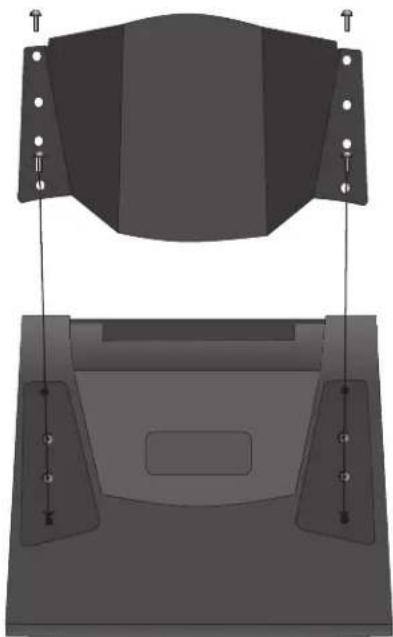
natural_image
Technical illustration of a mechanical component with mounting brackets and a central opening (no text or symbols)Installing the MP 1030 mounting bracket (top view)
natural_image
3D rendered diagram of a mechanical component with mounting holes and a central rectangular body (no text or symbols)Top of Expedition Pro with MP 1030 mounting bracket installed.
Expedition Pro Accessories
natural_image
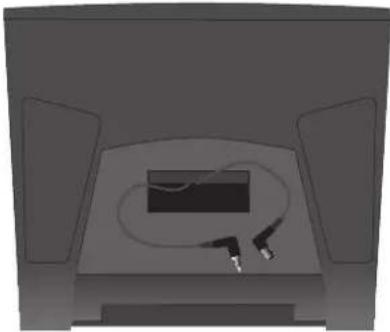
Interior view of a vehicle showing a battery pack and cable with two connectors (no text or symbols visible)XP200/XP300 wireless compartment (top view)
As shown in the illustration on the left, the top panel of the Expedition Pro XP200 and XP300 provides a prewired compartment that accommodates any of three different Samson wireless receivers: the UM1 or M32 UHF models or the VM1 VHF model. Output signal from a wireless receiver mounted in an XP300 arrives at channel 2 of the onboard mixer.
In addition, a number of accessories are available from your local Samson dealer that allow you to expand the capabilities of your Expedition Pro system. These include:
- The EX500 active subwoofer—the ideal complement to any Expedition Pro enclosure (or to any loudspeaker system, for that matter)—pairs a powerful 500-watt amplifier with a heavy-duty 15" low frequency driver in order to provide deep low end response. A built-in stereo electronic crossover allows the EX500 to operate either in mono or as a common subwoofer in a stereo system. It features an all-steel grill and rigid corners, as well as an integral 1 3/8" pole-mount receptacle
- The RB 2030 rechargeable battery cartridge, which provides up to two hours of power to either the XP200 or XP300 from its dual Lead-Acid GelCel batteries.
- The MP 1030 mounting bracket, which allows any Expedition Pro enclosure to be "flown" or mounted on the wall or ceiling using standard OmniMount hardware. For more information, see the "Positioning and Mounting the Expedition Pro" section on page 12.
Introduction
natural_image
3D rendering of a black Sonyi 2000 portable radio device with handle and ventilation slots (no text or symbols on body)natural_image
Top-down view of a black electronic device labeled 'XP300' with a circular speaker grille and 'SAMSON' branding (no additional text or symbols visible)Expedition Pro XP100
Visite guidée
natural_image
Back view of a black electronic device rear panel with ports and wiring (no visible text or symbols)natural_image
Exterior view of a black SAMSON audio amplifier stand with tripod base (no text or symbols on body)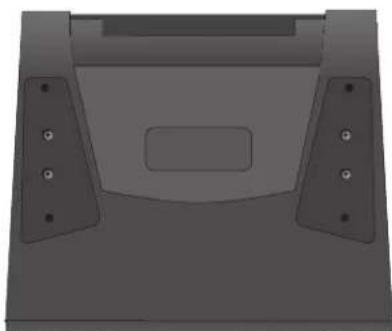
natural_image
3D rendered diagram of a mechanical component with mounting holes and a central rectangular feature (no text or symbols)natural_image
3D rendered mechanical component with a suspended shaft and mounting bracket (no text or symbols visible)natural_image
3D rendered mechanical component with a vertical pipe extending upward (no text or symbols visible)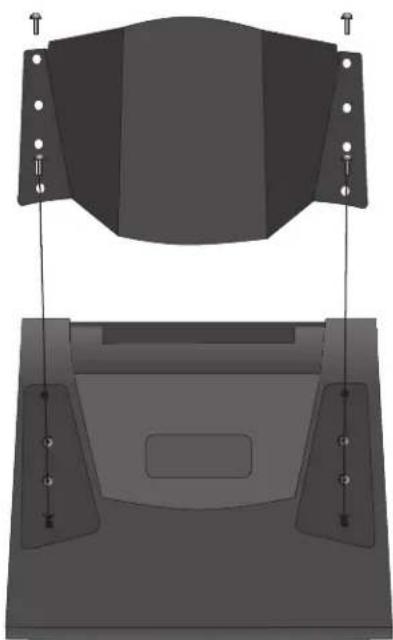
natural_image
Technical illustration of a mechanical component with mounting brackets and a central slot (no text or symbols)natural_image
3D rendered mechanical component with mounting holes and a central rectangular body (no text or symbols)natural_image
3D rendering of a black Sony electric radio device with a handle and ventilation slots (no text or symbols visible)natural_image
Top-down view of a black electronic device labeled 'XP300' with a central circular component and mounting holes (no readable text beyond branding)Expedition Pro XP100
Überblick
natural_image
Technical line drawings of four different electrical connectors or components, including a battery, switch, and plug (no text or symbols present)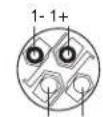
NOT CONNECTED
natural_image
Back view of a black electronic device rear panel with ports and control buttons (no visible text or symbols)Expedition Pro XP300
natural_image
Black SAMSON audio amplifier with tripod stand (no text or symbols visible)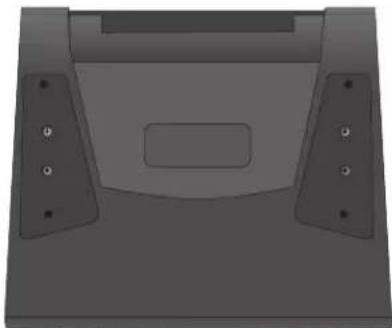
natural_image
3D rendered image of a gray ergonomic device with front panel and side buttons (no text or symbols)natural_image
3D rendered mechanical component with a suspended shaft and mounting bracket (no text or symbols visible)natural_image
3D rendered model of a mechanical component with a vertical support and protruding shaft (no text or symbols visible)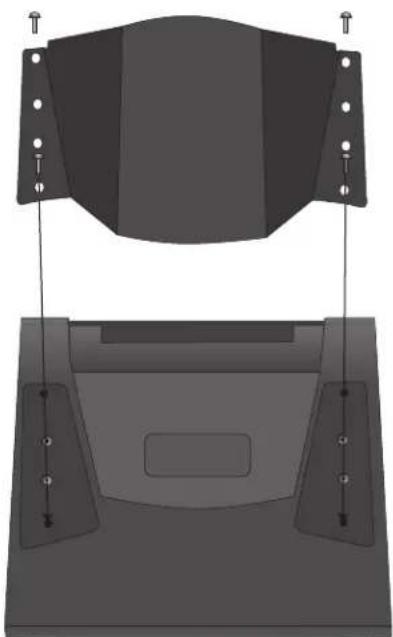
natural_image
Technical illustration of a mechanical component with mounting brackets and a central opening (no text or symbols)natural_image
3D rendered diagram of a mechanical component with mounting holes and a central rectangular body (no text or symbols)natural_image
Top-down view of a device with two cables and a central screen (no visible text or symbols)natural_image
3D rendering of a black NOSHIS portable radio device with handle and ventilation slots (no text or symbols on body)natural_image
Top-down view of a black electronic device labeled 'XP300' with a central circular component and mounting holes (no readable text beyond branding)Expedition Pro XP100
Recorrido guiado
natural_image
Technical line drawings of electrical connectors and components (no text or symbols)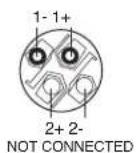
natural_image
Back view of a black electronic device rear panel with ports and connectors (no visible text or symbols)Recorrido guiado
Expedition XP300
natural_image
Exterior view of a black SAMSON audio amplifier speaker mounted on a tripod stand (no text or symbols visible)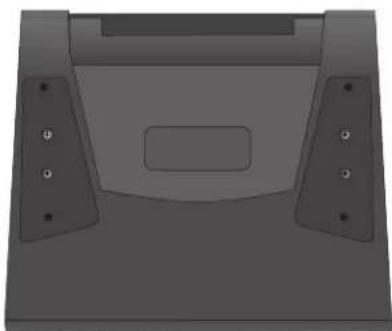
natural_image
3D rendered image of a gray ergonomic device with two side buttons and a central blank space (no text or symbols)natural_image
3D rendered mechanical component with a suspended shaft and mounting bracket (no text or symbols visible)natural_image
3D rendered model of a mechanical component with a vertical pipe extending upward (no text or symbols visible)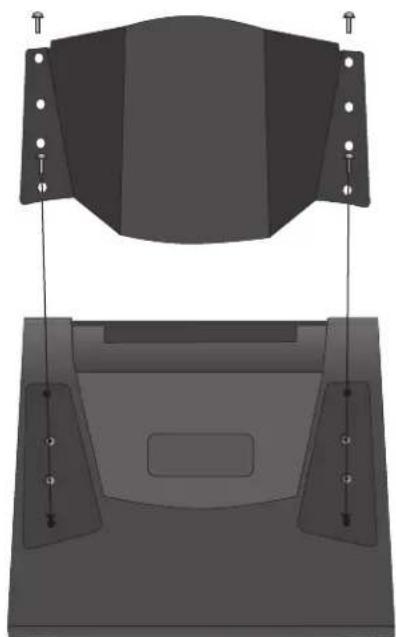
natural_image
Technical illustration of a mechanical component with mounting brackets and a central opening (no text or symbols)natural_image
3D rendered diagram of a mechanical component with mounting holes and a central rectangular body (no text or symbols)natural_image
Top-down view of a device with two cables and a screen, no visible text or symbolsCompartimento de receptor inalámbrico del XP200/XP300 (vista superior)
Power Rating: (@ 8Ω):
XP100 250 Watts Program; 400 Watts Max. Peak
XP200, XP300 200 Watts Total, 160 Watts LF; 40 Watts HF
Frequency Response: (all models) 60 Hz – 15 kHz ± 3 dB
Sensitivity:
XP100 97 dB SPL @ 1W/1m
Crossover Frequency:
XP100 2.3 kHz (12 dB Per Octave)
XP200, XP300 2.3 kHz (24 dB Per Octave Linkwitz-Riley Constant Phase)
LF Driver: (all models) 12" heavy-duty driver,
2.5" voice coil (Kapton Former), 50 oz. barium ferrite magnet
HF Driver: (all models)
1" compression driver
Stereo Mixer Section: (XP300 only)
Inputs
2 Mic/Line XLR/TRS,
1 Stereo Line w/Mic TRS/RCA/XLR
Outputs
+4 Balanced XLR
Frequency Response
10 Hz - 50 kHz
Crosstalk 70 dB @ 1 kHz
Equalization Frequencies
Effects
100 Hz (Low), 10 kHz (High)
DSP Reverb with 6 Presets
Mounting: (all models)
Integral 1 3/8" Pole Mount Receptacle, Fly Points
Dimensions: (all models)
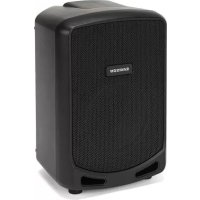
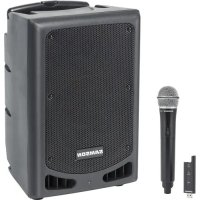
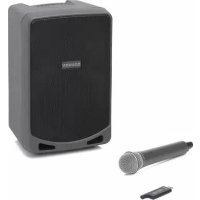
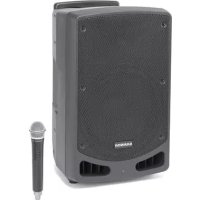
- AVIS
- CAUTION
- ATTENTION
- FRANÇAIS
- DEUTSCHE
- Introduction
- System Features
- Expedition Pro XP100
- Guided Tour
- Speakon™ Wiring
- Interconnecting the XP100
- Expedition Pro XP200
- Interconnecting the XP200
- Expedition Pro XP300
- Interconnecting the XP300
- Positioning and Mounting Instructions
- General Positioning Tips
- Pole-Mounting
- Fly Mounting, Wall Mounting, and Ceiling Mounting
- Expedition Pro Accessories
- Visite guidée
- Überblick
- Recorrido guiado
- Expedition XP300
Brand : SAMSON
Model : Expedition Pro XP 200
Category : Hi-fi system