PAB 1200.1 D - Car stereo MB QUART - Free user manual and instructions
Find the device manual for free PAB 1200.1 D MB QUART in PDF.


| Product type | Mono amplifier |
| Brand | MB Quart |
| Model | PAB 1200.1 D |
| Power supply | 12 V DC (vehicle battery) |
| Load impedance | 4, 2, 1 ohms |
| Input sensitivity | 0.1 V to 9 V |
| Low pass filter (LOW PASS) | 35 Hz - 250 Hz |
| Subsonic filter (SUBSONIC) | 10 Hz - 50 Hz |
| Bass equalizer (BASS EQ) | 0 to +9 dB at 45 Hz |
| Phase shifter (PHASE) | 0° - 180° |
| Output power (estimated) | 1200 W RMS (1 ohm) |
| Display | LED POWER (green), LED PROTECT (red) |
| Cooling | Natural convection via fins |
| Audio input | RCA (LINE IN) |
| Audio output | RCA (LINE OUT) |
| Remote control | Bass remote (REM) |
| Protection | Short circuit, overheating, DC offset |
| Warranty | 1 year (parts and labor) |
| Usage | Car audio system |
| Maintenance | Clean with a dry cloth, avoid moisture |
| Safety | Turn off the device before any intervention, respect minimum impedance |
Frequently Asked Questions - PAB 1200.1 D MB QUART
User questions about PAB 1200.1 D MB QUART
0 question about this device. Answer the ones you know or ask your own.
Ask a new question about this device
Download the instructions for your Car stereo in PDF format for free! Find your manual PAB 1200.1 D - MB QUART and take your electronic device back in hand. On this page are published all the documents necessary for the use of your device. PAB 1200.1 D by MB QUART.
USER MANUAL PAB 1200.1 D MB QUART
74847 Obrigheim, Germany
Phone +49 (0) 62 61-638-0
FAXX +49 (0) 62 61-638-129
E-Mail info@mbquart.de
Website www.mbquart.de

Installation & Operation
Einbau und Betrieb
YcTaHOBka 3KcNiyataaun
Congratulations!
By purchasing an amplifi er from MB QUART, you have decided on a product of the highest technical quality. MB QUART wishes you qrea enjoyment with your amplifi e! Should you have any questions about this system or other MB QUART products, please call us personally or send us an e-mail at info@mbquart.de
| WARRANTY | 2 |
| GENERAL INSTALLATION NOTES | |
| System design | 3 |
| Installation | 3 |
| AMPLIFIER FEATURE DESCRIPTION | |
| PAB 2100 2-Channel Amplifier | 4 |
| PAB 4100 4-Channel Amplifier | 4 |
| PAB 5400 5-Channel Amplifier | 5 |
| PAB 1200.1 D Mono Amplifier | 5 |
| AMPLIFIER APPLICATIONS | |
| PAB 2100 2-Channel Amplifier | |
| Full range stereo | 6 |
| Full range mor c | 6 |
| Stereo high pass with mono low-pass in a 2 way active, or bi-amplifi ed syster | 7 |
| PAB 4100 4-Channel Amplifier | |
| 4 channel full range system | 8 |
| 2 or 3 channel full range system | 8 |
| 2 way active, or bi-amplifi ed systen with mono bass | 9 |
| 2 way active, or bi-amplifi ed systen with mono bass, and faded highs/ lows | 9 |
| Front/rear high pass, using a 2 channel amplifi er for mono sub bas | 10 |
| PAB 5400 5-Channel Amplifier | |
| 5 channel discrete, one being mono low pass | 11 |
| 3 or 4 channel discrete, one being mono low pass | 11 |
| 3 way active, with mono bass | 12 |
| Front/rear high pass, with constant sub bass | 12 |
| PAB 1200.1 D Mono Amplifier | |
| Basic application | 13 |
| AFTER INSTALLATION | |
| Setting up systems after installation for best performance | 14 |
| Troubleshooting a system | 14-15 |
| TECHNICAL DATA | 86 |
Warranty
As the manufacturer of MB QUART car audio products, Maxxsonics USA Inc. and Maxxsonics Europe GmbH warrants to the original consumer purchaser the amplifier to be free from defects in material and workmanship for one (1) year from date of purchase.
This product meets the current EU minimum warranty requirements, if purchased in countries of the EU.
To ensure your warranty policy keep your original receipt proofing the date of purchase.
All other part and accessories of the system are warranted to be free from defects in material and workmanship for one (1) year from date of purchase. Maxxsonics will repair or replace at it's option and free of charge during the warranty period, any system component that proves defective in materials and workmanship under normal installation, use and service provided that the product is returned to the authorised MB QUARI dealer from where it was purchased.
A photo copy of the original receipt must accompany the product being returned. In the absence of the above, the warranty is one (1) year from date of manufacture.
Any damage to the product as a result of misuse, abuse, accident, incorrect wiring, improper installation, alteration of date code or bar code labels, revolution, natural disaster, or any sneaky stuff because someone messed up, repair or alteration out side of our factory or authorised service centers and any thing else you have done that you should not have done is not covered.
This warranty is limited to defective parts and specifically excludes any incidental or consequential damages connected therewith. This warranty is not to be construed as an insurance policy.
Warranty on installation labor, removal, re-installation and freight charges are not the responsibility of Maxxsonics USA Inc. or Maxxsonics Europe GmbH.
System design
The success of any car stereo system relies on several factors, such as the system design, execution of the installation, and system setup. This section is intended to assist the installer by offering several tips and hints about good installation practice. Please remember that any system is only as good as its weakest link.
Determine the system format, e.g., single amplifier, active, front/rear and so on. Then choose the amplifier power points according to persona taste. Please remember that higher power systems are not necessarily useful purely for high sound pressure levels, but also to establish a headroom capability, to reproduce musical peaks cleanly without distortion. Lower power amplifiers will clip earlier than their more powerful cousins, and cause loudspeaker failure when overdriven, due to the harmonics generated by a clipped signal, thus overheating voice coils
Choose loudspeaker and amplifier mounting locations. Loudspeaker location is always a matter of compromise between space and sound stage imaging. Amplifiers should be mounted with the fins running vertically for best convection cooling, to minimize overheating.
Purchase the best quality RCA cables you can afford, for reliability and less engine noise interference in the audio system.
Installation
General:
Mount the amplifi er/s in the chosen location
Run the wiring so that RCA cables are at least 18" away from power and speaker cables. Keep RCA cables away from electrical devices in the vehicle that can cause electrical noise, such as fuel pumps
Power and ground connections
Use a sufficient gauge power cable, at least #8 per amplifier. In a multi amplifier system, it is advisable to mount a large enough fuse right at the battery, and run a master +12 volt power cable to a fused distribution block near the amplifiers. It is then a simple matter to connect the +12 volt terminal of each amplifier to the distribution block
Ground each amplifier with as short a ground lead, again at least #8 gauge, directly to the vehicle chassis. Use a ground distribution block, if you wish, but it is extremely important to keep the main ground lead from this distribution block to the chassis as short as possible, not more than 12". The ground connection integrity to the chassis is very important, and the best way to achieve a good, solid electrical and mechanical contact is to use a large round crimp lug, crimped and soldered to the ground cable. The next step is to scrape the paint off the vehicle chassis, slightly larger than the ground lug, at the connection point. Drill a clearance hole in the chassis, the same size as the lug hole, and use a bolt, spring washer and nut to securely fasten the ground lug. Use petroleum jelly to coat the bolt/lug connection, to prevent oxidization with time
TIP: Use the same approach when installing head units, equalizers or any audio equipment for that matter - run short individual grounds from each piece directly to the vehicle chassis, to minimize ground loops and system noise.
All power, ground and speaker connections should be crimped and soldered for reliability. Make sure that none of the cable insulation can chafe against exposed metal in the vehicle, causing short circuits to the chassis.
Safe connection sequence:
After all cables are run, connect speaker wires to the speakers and amplifiers, then run and plug in RCA cables. Next, connect all power grounds and remote turn on leads. Now connect all +12 volt cables to the amplifier/s and distribution blocks and fuse holders. Finally, connect the main +12 volt cable to the battery, with the main fuse removed, and we are almost ready to power up the system
Power up the system
The following procedure may seem like overkill, but there is nothing more frustrating than turning on a system for the first time, and it does not work properly immediately
First, make sure the head unit is off, and turn all level controls to minimum (anticlockwise), including the head unit volume control. Set all equalizers to 0 dB (no boost), and all crossover frequency controls at approximate frequencies, as recommended by the loudspeaker manufacturer. Set all input selector and crossover switches as required for the application.
Remove all amplifier fuses, and insert the main fuse at the battery. If the fuse does not blow, you can insert the fuse in one of the amplifiers, and we are ready to turn on the system
Turn the head unit on, insert a CD, or select a radio station, and increase the head unit volume control. If the system sounds fine, turn off the head unit, and install fuses in the remaining amplifiers, one by one, till the complete system is powered up and functioning properly.
Premium Multi-Channel Amplifiers
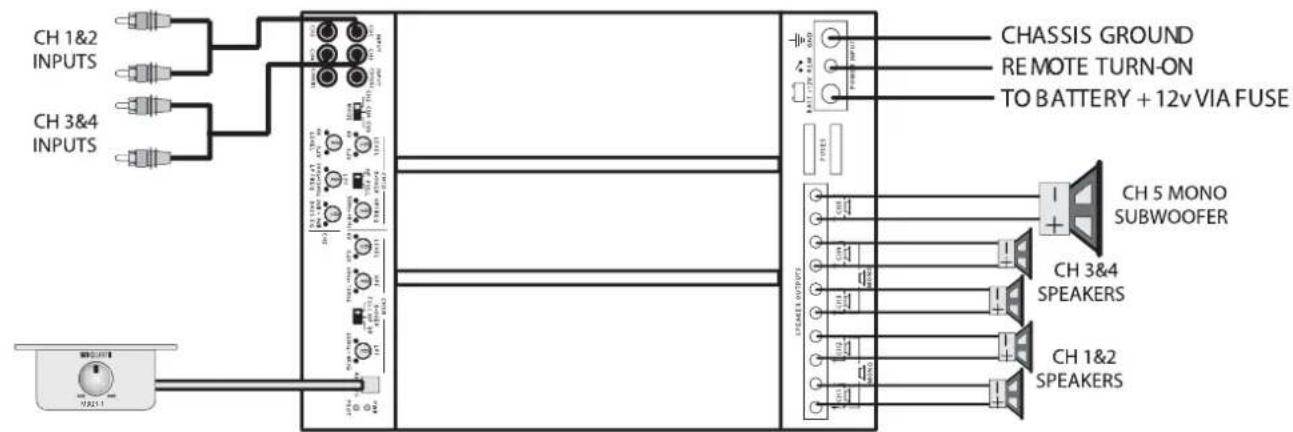
Each model is capable of 4 & 2 ohms stereo per channel, or 4 ohms mono bridged operation
- Tri-Mode operation with any stereo pair of amplifiers channels is possible, as with all bridgeable amplifiers:
- The input sensitivities for rated output powers are variable from 0.2 volt to 6 volt
- All crossovers are fully variable in their respective ranges
- Crossover fi lter slopes are 12 dB/octave for stereo fi lters, and 2 dB/octave for mono fi lters
- A POWER LED indicates the powered "up" and turned "on" condition.
- All MB QUART Premium amplifiers feature a comprehensive diagnostic system, with speaker lead short circuit, and amplifier DC faults indicated by the DIAGNOSTIC, or PROTECT LED.
CAUTION:
DO NOT OPERATE ANY AMPLIFIER BELOW THE INTENDED IMPEDANCE. YOU WILL CAUSE DAMAGE TO THE AMPLIFIER THAT WILL NOT BE COVERED UNDER THE WARRANTY PRINTED IN THE BACK OF THE MANUAL.
Multi-Channel amps: 4 & 2 ohms stereo, 4 ohms mono bridged
PAB 2100 2-Channel Amplifi e
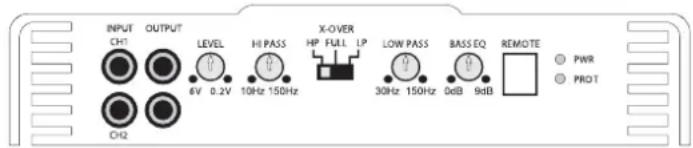
The X-OVER slide switch selects the internal crossover functions:
- The input signal is routed directly to the LINE OUT RCA jacks, regardless of the X-OVER setting simplifying daisy chaining of amplifier.
HP: Selects the built in HIGH PASS fi Iter, variable from 10Hz to 150Hz - FULL: Bypasses all crossovers for full frequency range operation.
- LP: Selects the built in LOW PASS filter, variable from 30 Hz to 150 Hz
Note that the LOW PASS signal is MONO.
- In the LP position, the HIGH PASS fi lter acts as a subsonic fi lte
- When the LP mode is selected, a 0 to +9 dB, at 45 Hz, BASS EQ is also switched
PAB 4100 4-Channel Amplifier
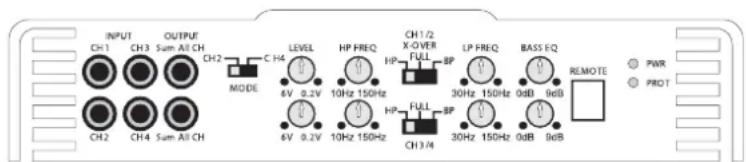
INPUT MODE slide switch:
- In the CH2 position, ALL four amplifier inputs are selected from the CH1/CH2 RCA jacks.
- In the 4CH position, channel pair 1t2 receive input signal from RCA jacks CH1 and CH2, and channel pair 3t4 receive input signal from RCA jacks CH3 and CH4.
The AMPLIFIER CH 1/2CH X-OVER slide switch selects the input signal for channel pair 1&2:
HP: Selects the built in HIGH PASS filter, variable from 10 Hz to 150 Hz.
- FULL: Bypasses all crossovers for full frequency range operation.
- BP: Selects the built in LOW PASS fi Iter, variable from 30 Hz to 150 Hz.
Note that the LOW PASS signal is MONO.
- In the BP position, the HIGH PASS fi Iter acts as a subsonic fi Ite
- When the BP mode is selected, a 0 to +9 dB, at 45 Hz, BASS EQ is also switched in.
The AMPLIFIER CH 3/CH 4 X-OVER slide switch selects the input signal for channel pair 3&4:
- Hi: Selects the built in HIGH PASS fi Iter, variable from 10 Hz to 150 Hz.
- FULL: Bypasses all crossovers for full frequency range operation.
- BP: Selects the built in LOW PASS fi Iter, variable from 30 Hz to 150 Hz.
Note that the LOW PASS signal is MONO.
- In the BP position, the HIGH PASS f1 Iter acts as a subsonic f1 lte
- When the BP mode is selected, a 0 to +9 dB, at 45 Hz, BASS EU is also switched in.
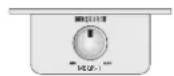
Full range signal from channels 1/2 inputs are routed to the Line JUI RCA jacks, regardless of the setting of the X-Over switches. - The REMOIE jack enables dash mount level control of the LOW ASS signal, CH3/4 only.
PAB 5400 5-Channel Amplifier
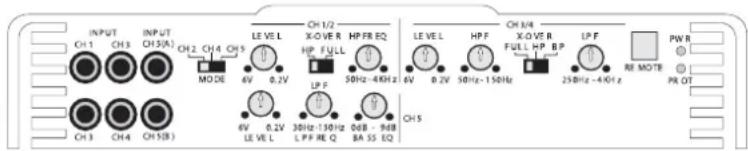
The PAB 5400 has three sets of inputs:
Line inputs on RCA jacks for channel pairs 1Et2, 3Et4, and MO channel 5. These inputs can be used in various combinations, suit the application, depending on the settings of the INPUT MODE switch, and the X-OVER switches for channels 1Et2, and channel 3Et4, respectively.
INPUT MODE slide switch:
- In the CH2 position, ALL fi ve ampli er inputs are selected from the CH1/CH2 RCA jacks. Channel 5 receives a mono mixed signal.
- In the 4CH position, channel pair 1Et2 receive input signal from RC jacks CH1 and CH2, and channel pair 3Et4 receive input signal from RCA jacks CH3 and CH4. A mono mixed signal from these four RCA jacks are also fed to channel 5.
- When 5CH DISCRETE is selected, each channel receives an input signal from its respective input RCA jack. Channel 5 has two jacks on its LINE INPUT, which are summed together
CH1/2 X-OVER slide switch:
- FULL: Sets this pair to full range operation.
HP: Selects the HIGH PASS fi Iter, variable from 50Hz to 4 KHz
CH3/4 X-OVER slide switch:
- FULL: Sets this pair to full range operation.
- B.P.: In this mode, the HIGH PASS and a LOW PASS fi lter, both full variable from 50Hz to 4KHz , are selected to form a BANDPASS crossover fi lte
HP: Selects the HIGH PASS fi Iter, variable from 50Hz to 4 KHz
CH5:
- The channel 5 functions were chosen to be very specific to mono bass operation, and not switchable
- The LOW PASS fi Iter has a variable range from 30Hz to 150Hz
- The BASS EQ gives a bass boost, 0 to +9 dB, at 45 Hz.
Premium Mono Amplifier
- The Premium Mono Amplifier is capable of 4, 2 & 1 Ohm loads
- The input sensitivities for rated output powers are variable from 0.2 volt to 9 volts.
- All crossovers are fully variable in their respective ranges.
Crossover fi iter slopes are 24 dB/octave for mono fi iter - A POWER LED indicates the powered up and turned on condition.
CAUTION:
DO NOT OPERATE ANY AMPLIFIER BELOW THE INTENDED IMPEDANCE. YOU WILL CAUSE DAMAGE TO THE AMPLIFIER THAT WILL NOT BE COVERED UNDER THE WARRANTY PRINTED IN THIS BACK OF THE MANUAL.
Mono amps: 4, 2 & 1 ohms
PAB 1200.1D Mono Amplifi e!
The 1 channel mono amplifiers are capable of 4, 2 and 1 ohm loads and can be used in any of the "bi-amplifier" systems described in the 2 and 4 channel directions.
The line input signal is routed directly to the line output RCA's jacks regardless of the crossover settings
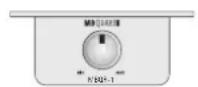
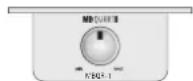
The REMOIE jack allows the addition of the Bass Remote module which controls the BASS EU signal.
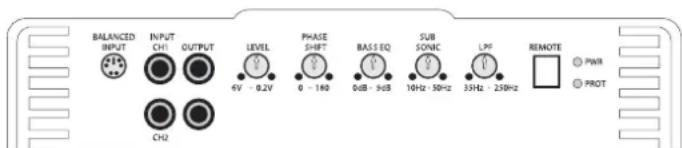
- SUBSONIC allows control from 10 Hz to 35Hz
- BASS EU allows control from 0dB to 9 dB
- LOW PASS allows control from 35Hz to 250Hz
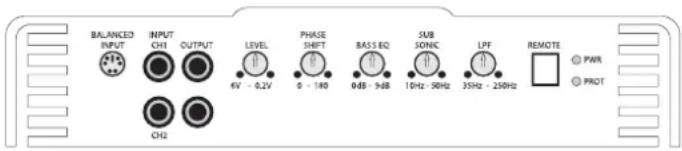
PHASE shift allows 0 degrees to 180 degrees
LEVEL: allows you to match the amplifi er input level (gain) to the Radio/CD player output level
- POWER: indicates that the amp has power, ground and remote turn-on input via a green L.E.D.
PROTECI: indicates that the amplifier has detected a fault and will not operate. There are several possible problems that can cause the amplifier to go into the protect mode. See the trouble shooting guide in the back of the manual for details.
- BALANCED INPUT: Accepts line level balanced input from 0.4v to 18v.
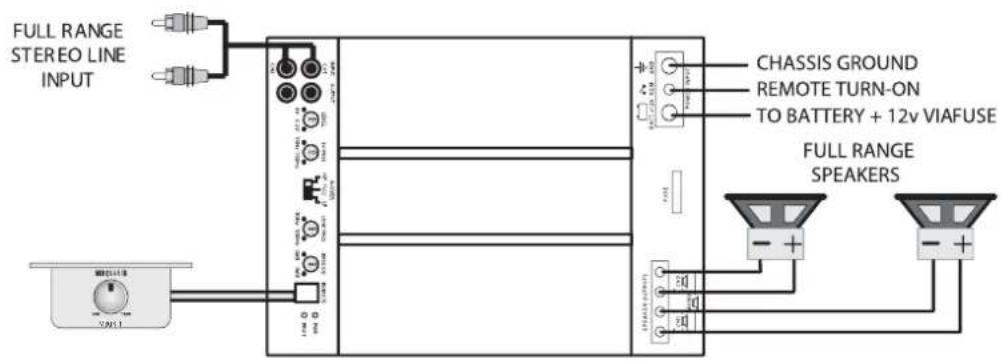
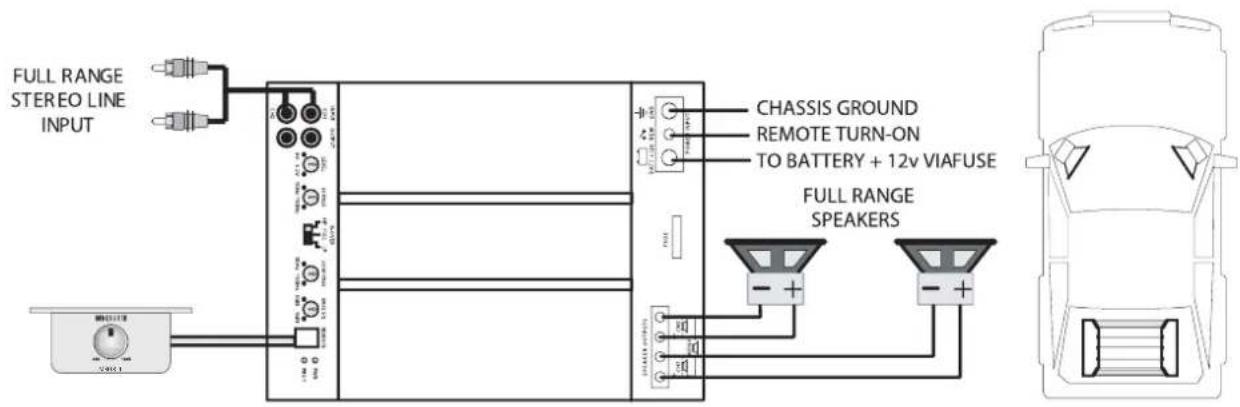
Full range stereo
This is the most basic application for the Premium Series 2 channel amplifier.
- Interconnect cable checklist:
Connect the LINE INPUTS to the Radio/CD with good quality RCA cables.
- Crossover Switch:
The X-OVER switch must be in the FULL position.
- Crossover frequency control checklist:
N/A for full range operation.
- Line Level:
Refer to the section "Setting up systems after installation for best performance"
- Bass Remote Module:
Plug in the Bass Remote Module to the amplifi er "REMOTE" jack
NOTE:
Minimum fi nal loudspeaker impedances
4 Et 2 Ohms stereo mode or 4-Ohms mono mode
This amplifi er will not do 1 Ohm stereo or 2/1 Ohm mon operation.
Full range mono
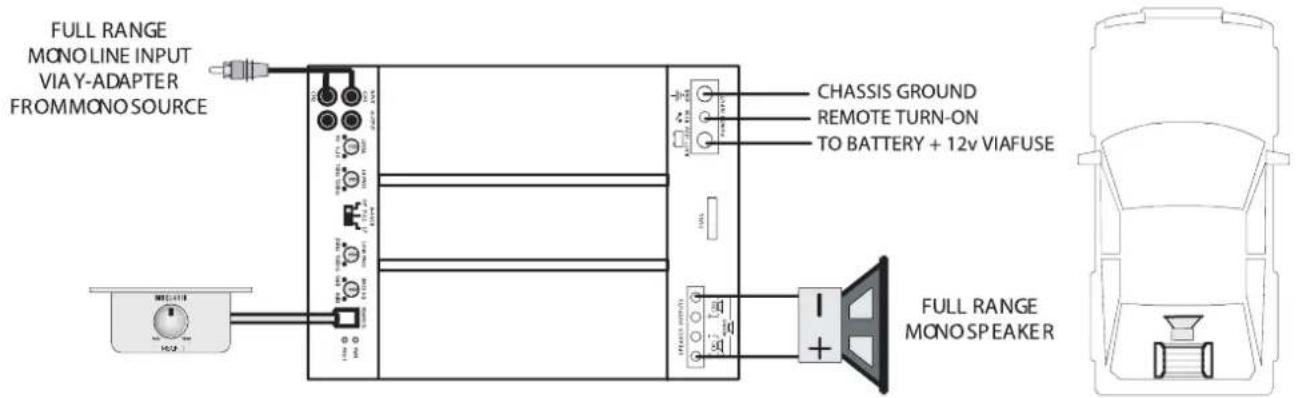
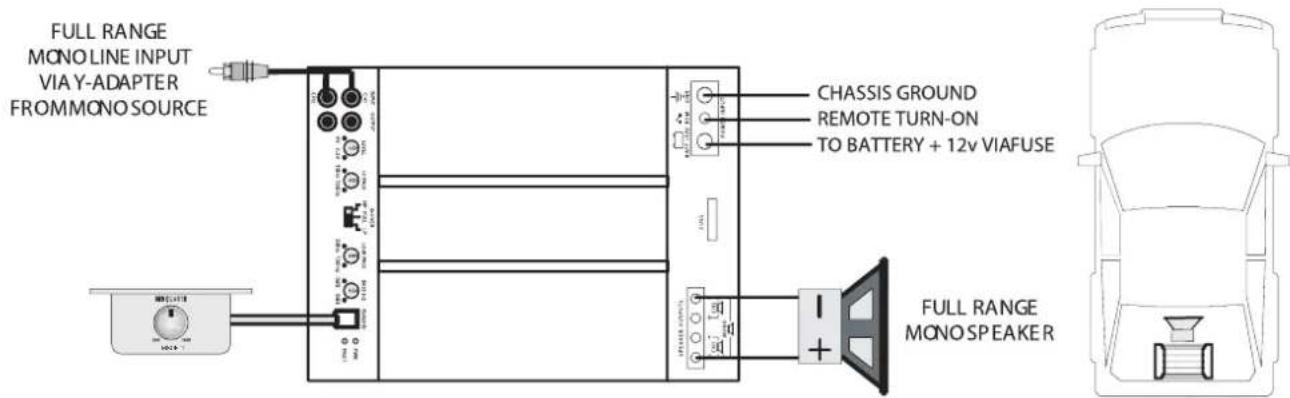
This application illustrates the basic mono bridging method for all MB QUARI amplifiers
Interconnect cable checklist:
A MONO signal source is required, such as would be available from the mono sub bass output of an active crossover, whether stand alone, or built into a head unit or equalizer. Important: Do not be tempted to connect the hot, or positive outputs, from any source together to obtain a mono signal, as this could very well damage the output stage of that source.
It is necessary to feed the SAME signal to both left and right inputs via a Y-adapter RCA cable. Connect the mono speaker positive terminal to the LEFT + , and its negative terminal to RIGHT -
Switch setting checklist:
The AMPLIFIER X-OVER switch must be in the FULL position.
Crossover frequency control setting checklist:
N/A for full range operation.
Tip: If you are using the mono sub bass output of an active crossover there is nothing wrong with switching in the low pass filter in these amplifiers for a steeper low pass rolloff
Minimum final loudspeaker impedance 4 ohm mono
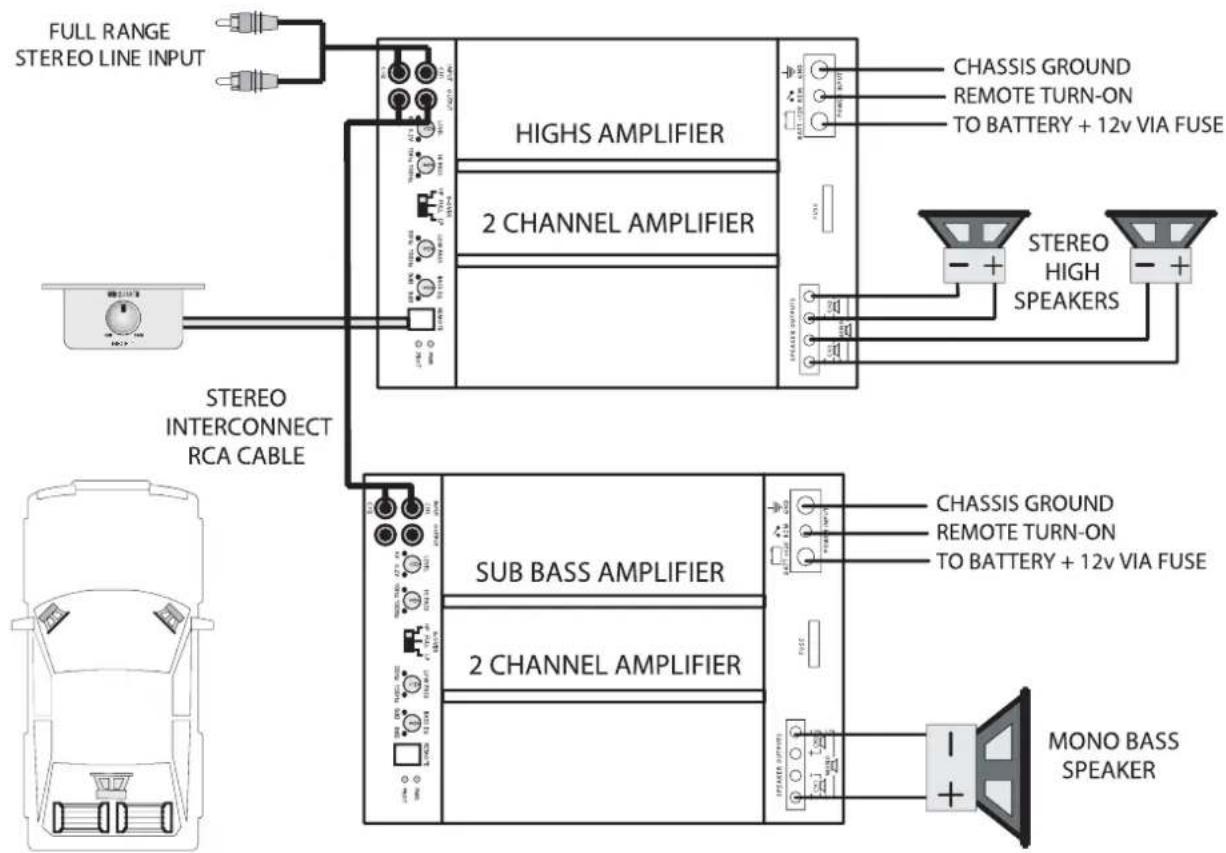
Stereo high pass with mono low-pass in a 2 way active, or bi-amplified system
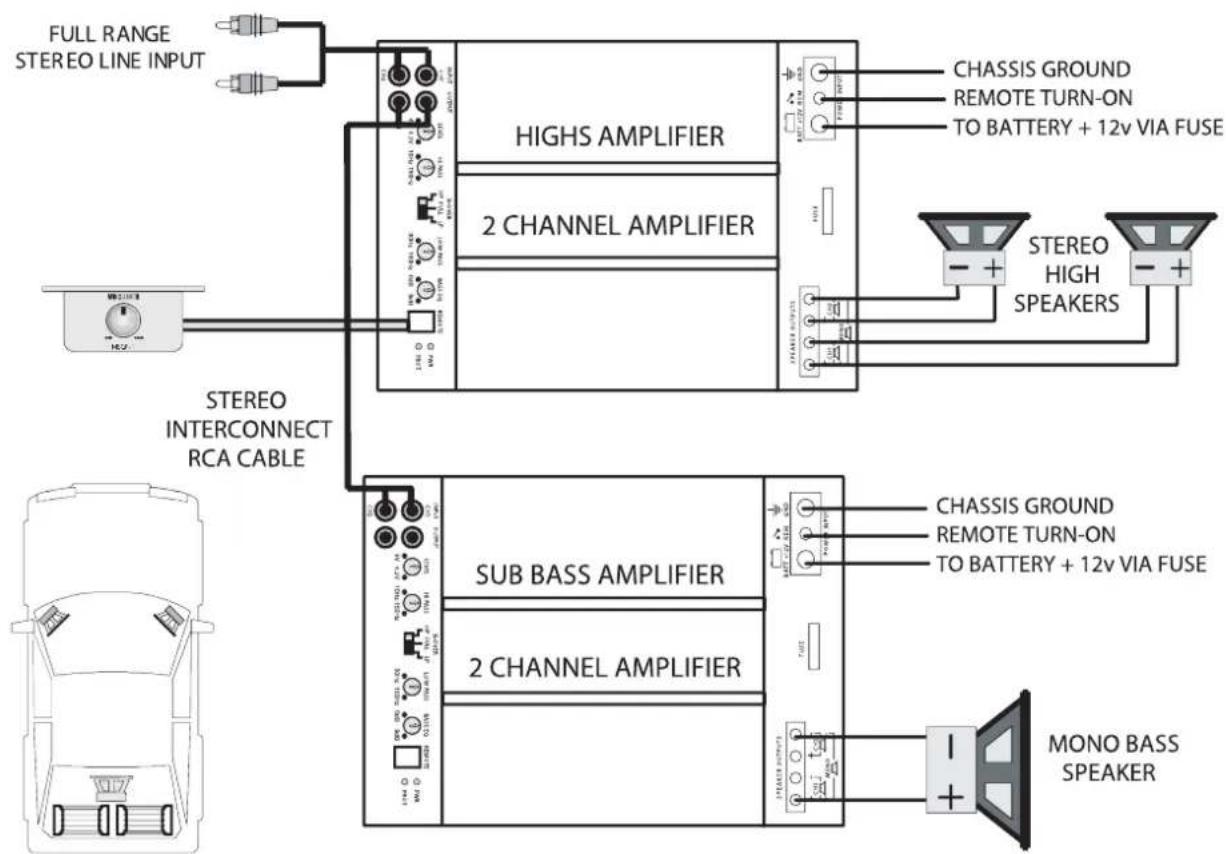
In this application we will use a 2 channel amplifier for the high frequencies, and a second one for the low frequencies, or mono sub bass. Please consult the speaker specifications to determine maximum amplifier power requirement:
Interconnect cable checklist
Connect the inputs of the highs amplifi er to a Radio/CD with good quality RCA cables. Connect the LINE OUI of the highs amplifi er to the inputs of the bass amplifi er with a stereo RCA to RCA cable
Mono bass woofer wiring:
Connect the mono speaker positive terminal to the LEFT + , and its negative terminal to RIGHT -
Switch setting checklist:
- Highs amplifi er: X-OVER switch in the HP position - Lows amplifi er: X-OVER switch in the LP/BP positi
Crossover frequency control checklist:
Highs amplifi et
- HI PASS: 100 Hz
- LOW PASS: N/A
Lows amplifi e
- HI PASS (Subsonic fi Iter): 10 Hz to 40 H
- LOW PASS: 100 Hz
Please note that these frequency points are suggestions only. Refer to the loudspeaker manufacturer specifications and the section "Settling up systems after installation for best performance"
Level control checklist
Refer to the section "Setting up systems after installation for best performance"
Minimum fi nal loudspeaker impedances
- 2 ohm per channel stereo
- 4 ohm mono bridged.
4 channel full range system
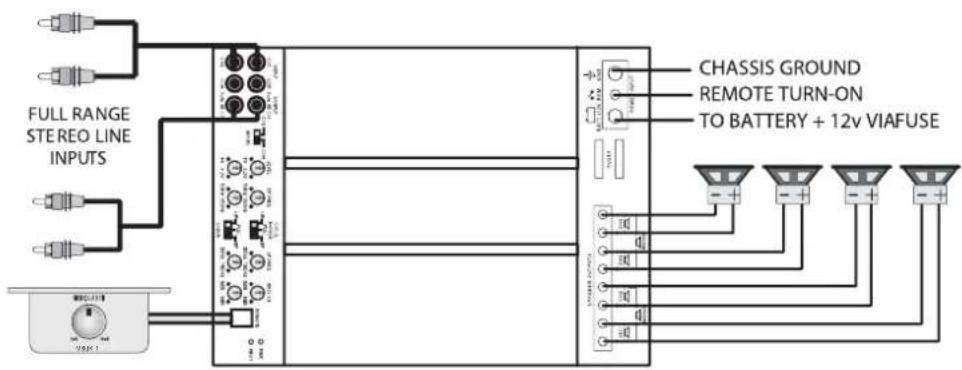
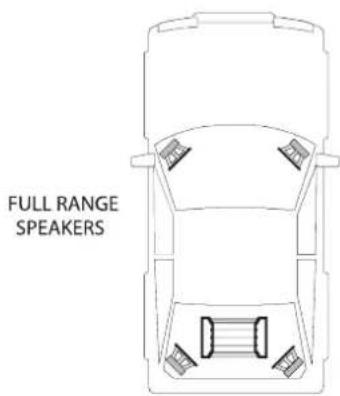
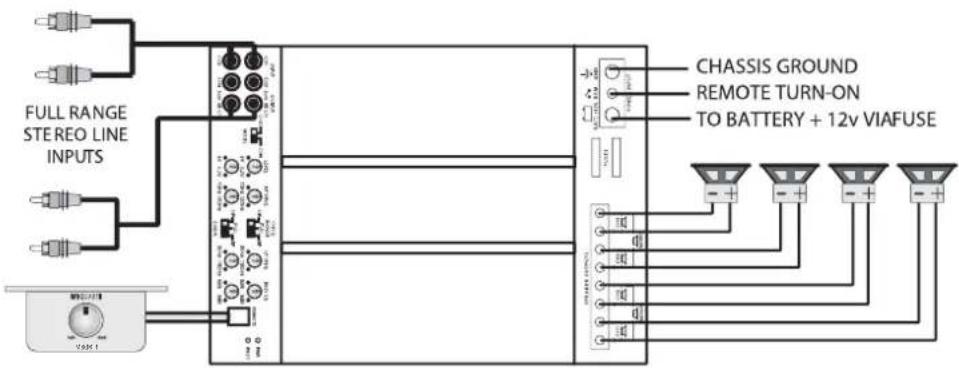
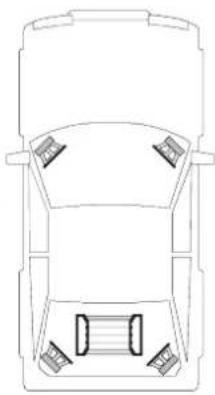
Here we show how to use the 4 channel amplifiers as straightforward discrete 4 channel full range units.
Interconnect cable checklist
Connect the four inputs of the amplifier to a Radio/CD with quality RCA cables.
Switch setting checklist:
-1/2CH X-OVER:FULL
- 3/4CH X-OVER: FULL
Crossover frequency control checklist:
Channels 1/2: Channels 3/4:
- HI PASS: N/A - HI PASS: N/A
- LOW PASS: N/A - LOW PASS: N/A
Level control checklist:
Refer to the section "Setting up systems after installation for best performance"
Minimum final loudspeaker impedances 2 ohm per channel
2 or 3 channel full range system
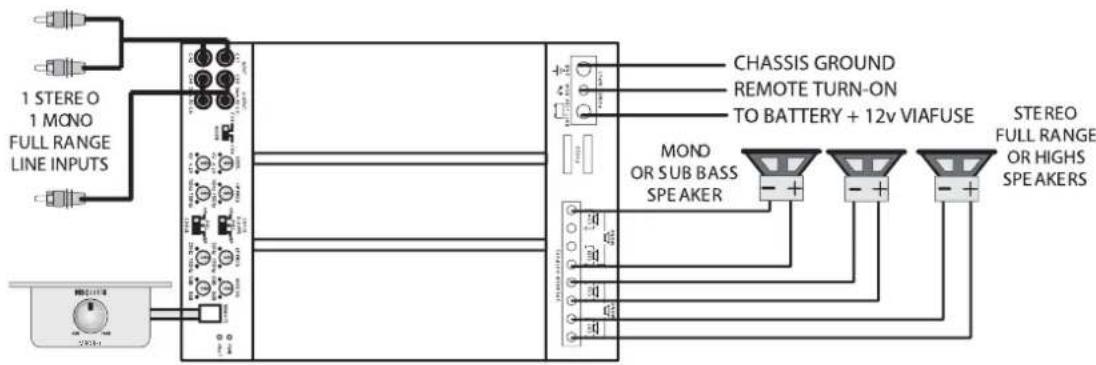
Here we show how to use the 4 channel amplifiers as full range 2 o 3 channel units by taking advantage of the mono bridging capability of all MB QUARI amplifiers:
The following example shows how to create a 3 channel system by mono bridging channel pair 3/4 . In order to create a 2 channel system, simply follow the example to also mono bridge channel pair 1/2
Interconnect cable checklist
- Connect the inputs of channel pair 1/2 to a suitable stereo source, e.g. a head unit with good quality RCA cables
- A MONO signal source is required to bridge channel pair 3/4, such as would be available from the mono sub bass output of an active crossover, whether standalone, or built into a head unit or equalize. Important Do not be tempted to connect the hot, or positive outputs, from any source together to obtain a mono signal, as this could very well damage the output stage of that source
- It is necessary to feed the SAME signal to both left and right input via a Y-adapter RCA cable.
- Connect the mono speaker positive terminal to the LEH+, and its negative terminal to RIGHI - as shown
Switch setting checklist:
- 1/2CH X-OVER: FULL
-3/4CH X-OVER:FULL
Crossover frequency control checklist:
Channels 1/2: Channels 3/4:
- HI PASS: N/A - HI PASS: N/A
- LOW PASS: N/A - LOW PASS: N/A
TIP: If you are using the mono sub bass output of an active crossover there is nothing wrong with switching in the low pass filter in these amplifiers for a steeper low pass rolloff
Level control checklist:
Refer to the section "Setting up systems after installation for best performance"
Minimum final loudspeaker impedances
- 2 ohm per channel in stereo mode.
- 4 ohm mono bridged.
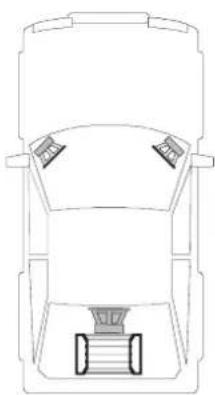
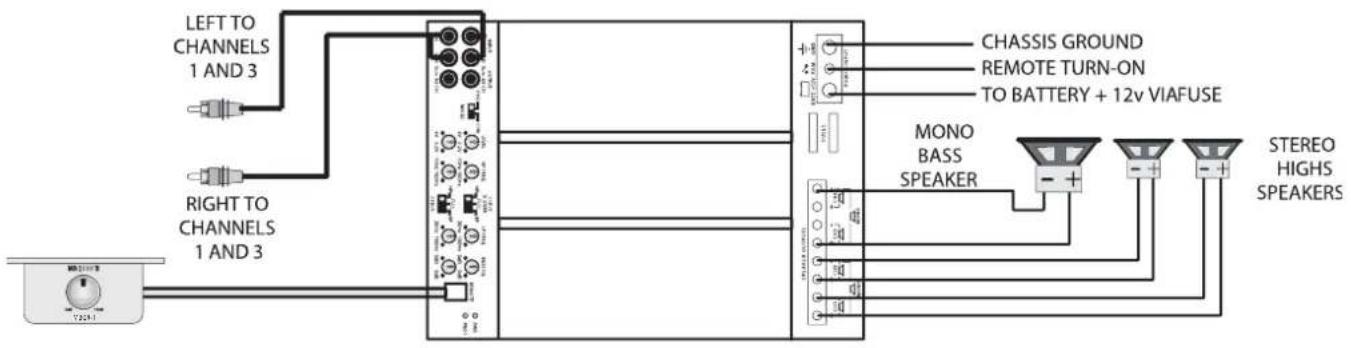
2 way active, or bi-amplified system with mono bass
This application shows how easily a 2 way active system can be implemented using a Premium 4 channel amplifi er. Channels 1 and 2 w be used for highs, and channels 3 and 4 for mono bass
Interconnect cable checklist
We need to feed the same signal to both sets of channels, so must use 2 Y-adapters, one to feed the LEH signal to channels 1 and 3, and the right signal to channels 2 and 4, as shown.
Mono bass woofer wiring:
Connect the mono speaker positive terminal to the LEFT + , and its negative terminal to RIGHT -
Switch setting checklist:
-1/2CH X-OVER: H
-3/4CH X-OVER:LP/BF
Crossover frequency control checklist:
Channels 1/2:
Channels 3/4:
-
HI PASS: 100 Hz
-
HI PASS (subsonic): 20 Hz
-
LOW PASS: N/A
-
LOW PASS: 100 Hz
Please note that these frequency points are suggestions only. Refer to the loudspeaker manufacturer specifications and the section "Settling up systems after installation for best performance".
Level control checklist:
Refer to the section "Setting up systems after installation for best performance"
Minimum fi nal loudspeaker impedances
- 2 ohm per channel in stereo mode
- 4 ohm mono bridged
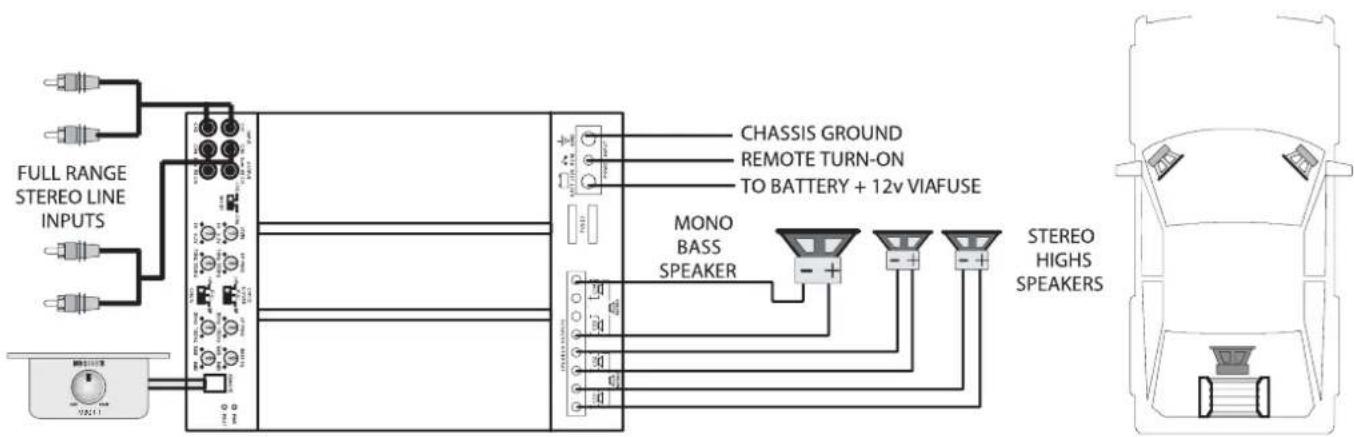
2 way active, or bi-amplified system with mono bass, and faded highs/ lows
Here we present a variation of the previous system. Since this is a 2 way system, we can use the front outputs from a head unit to drive the highs, and the rear output to drive the bass. This method allows the listener to easily adjust the relative levels of bass to highs, with the front to rear fade on the head unit
Channels 1 and 2 will be used for highs, and channels 3 and 4 for mono bass
Interconnect cable checklist:
- Use good quality RCA leads to connect the inputs of the amplifier to the source as shown.
- Follow the instructions as per the previous system for switch and crossover settings
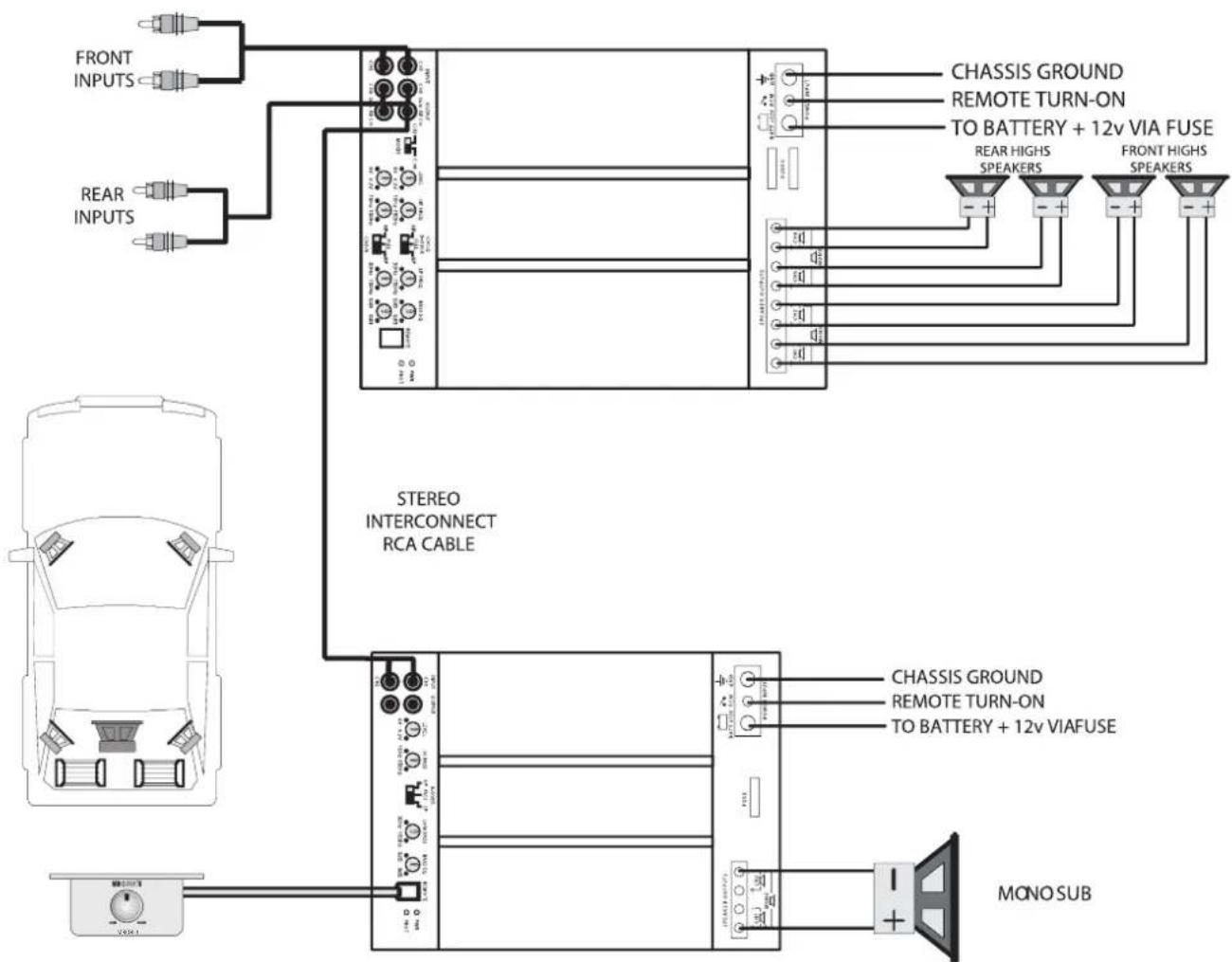
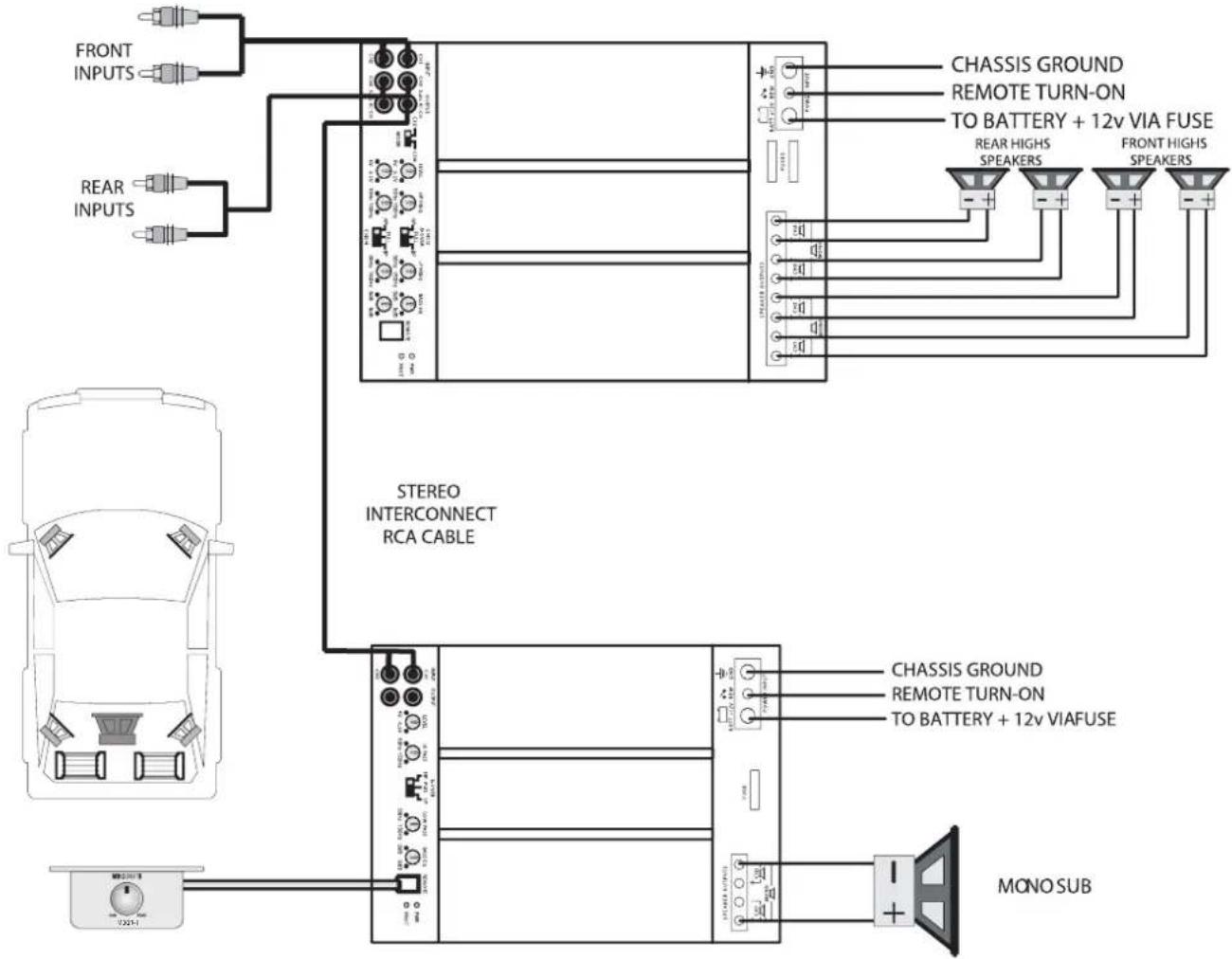
Front/rear high pass, using a 2 channel amplifier for mono sub bass
The combination of a 2 and a 4 channel amplifier, utilizing their buin n crossovers, makes it a snap to put together a full system with fron and rear highs, with mono sub bass.
nterconnect cable checklist:
- Using good quality RCA cables, feed the front and rear outputs of a head unit to the inputs of the 4 channel amplifier as shown
- Also connect the LINE UUI of the 4 channel amplifier to the LINE INPUT of the 2 channel amplifier as shown
Mono bass woofer wiring:
Connect the mono speaker positive terminal to the LEFT + and its negative terminal to RIGHT -
Switch setting checklist:
4 channel highs amplifiers:
2 channel bass amplifier
-1/2CH X-OVER:HI
-X-OVER switch:LP/BP
-3/4CH X-OVER:HI
Crossover frequency control checklist:
4 channel highs amplifi er
Channels 1/2:
Channels 3/4:
-
HI PASS: 100 Hz
-
HI PASS: 100 Hz
-
LOW PASS: N/A
-
LOW PASS: N/A
2 channel bass amplifi er
- HI PASS (Subsonic filter): 10 Hz to 40 Hz
- LOW PASS: 100 Hz
Please note that these frequency points are suggestions only. Refer to the loudspeaker manufacturer specifications and the section "Setting up systems after installation for best performance".
Level control checklist:
Refer to the section "Setting up systems after installation for best performance"
Minimum final loudspeaker impedances
- 2 ohm per channel in stereo mode
- 4 ohm mono bridged
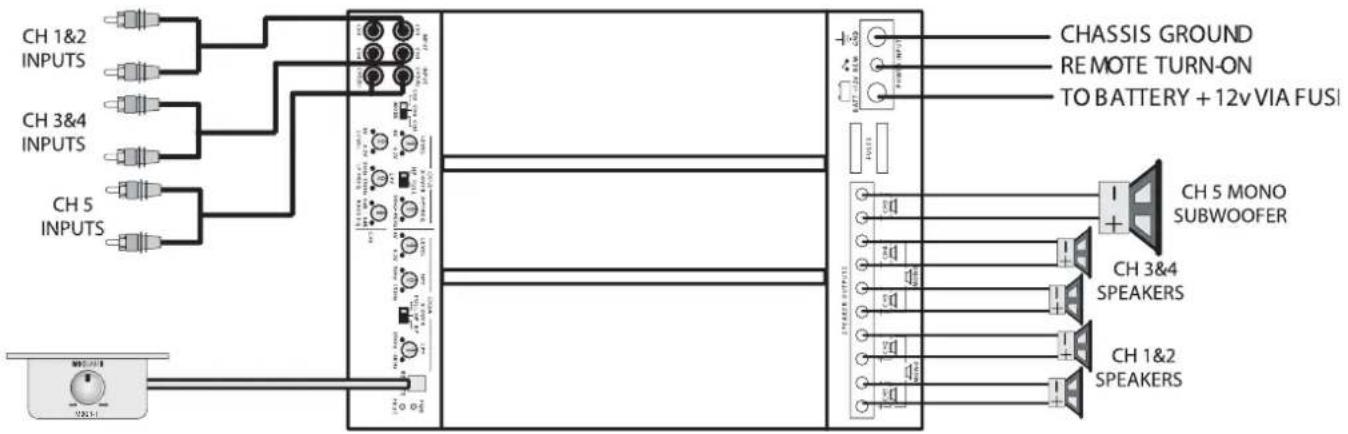
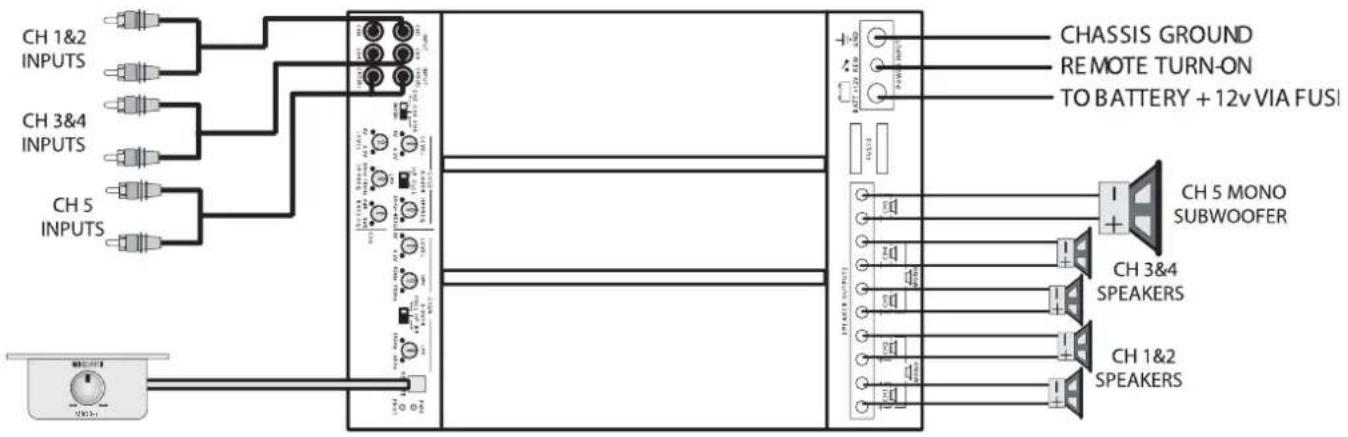
5 channel discrete, one being mono low pass
You can use this configuration simply as 4 discrete full range channels, with a 5th low pass channel. All of the crossovers are bypassed, except the LOW PASS on channel 5. The 5 channels can also be utilized with an outboard active crossover, or with crossovers in head units or equalizers.
nterconnect cable checklist:
Connect channel 1&2 inputs to the front output, channels 3&4 to the rear output, and channel 5 to the mono subwoofer output of a head unit or in dash equalizer. The LOW PASS filter on channel 5 will be in tandem with that of the source. You can either set it to the same frequency for a steeper rolloff, or set it to a higher frequency to minimize its effect. By the same reasoning, you could switch channels 1,2,3&4 high pass crossovers in for steeper high pass slopes.
Switch setting checklist:
- INPUT MODE: 5CH DISCRETE
- CH 1/2 X-OVER: FULL
-CH3/4X-OVER:FULL
Crossover frequency control checklist:
- CH 1/2 HIGH PASS: N/A
- CH 3/4 HIGH PASS: N/A
- CH 3/4 LOW PASS: N/A
-CH5LOWPASS:100Hz
Please note that these frequency points are suggestions only. Refer to the loudspeaker manufacturer specifications and the section "Setting up systems after installation for best performance".
Level control checklist:
Refer to the section "Setting up systems after installation for best performance"
Minimum fi nal loudspeaker impedances 2 ohm per channel
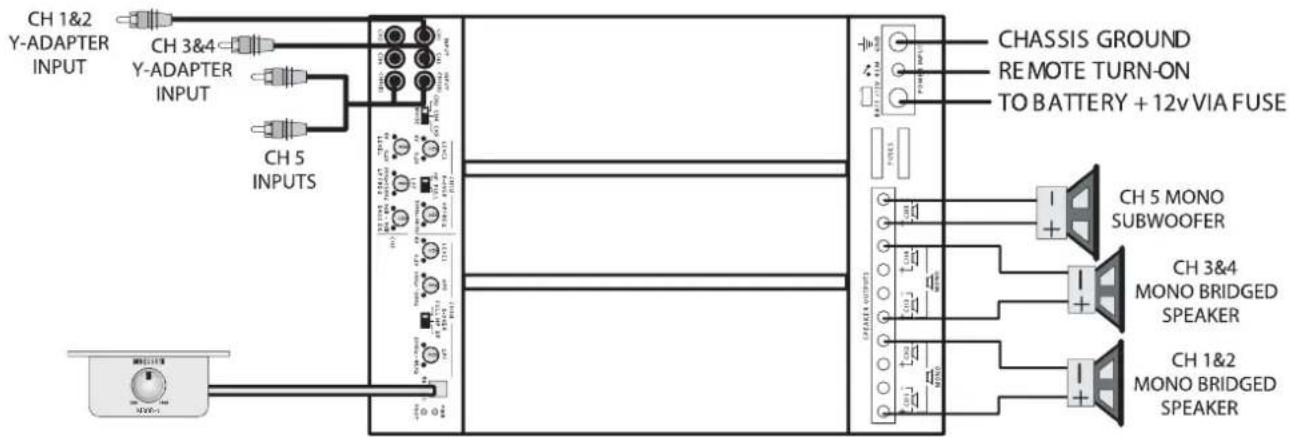
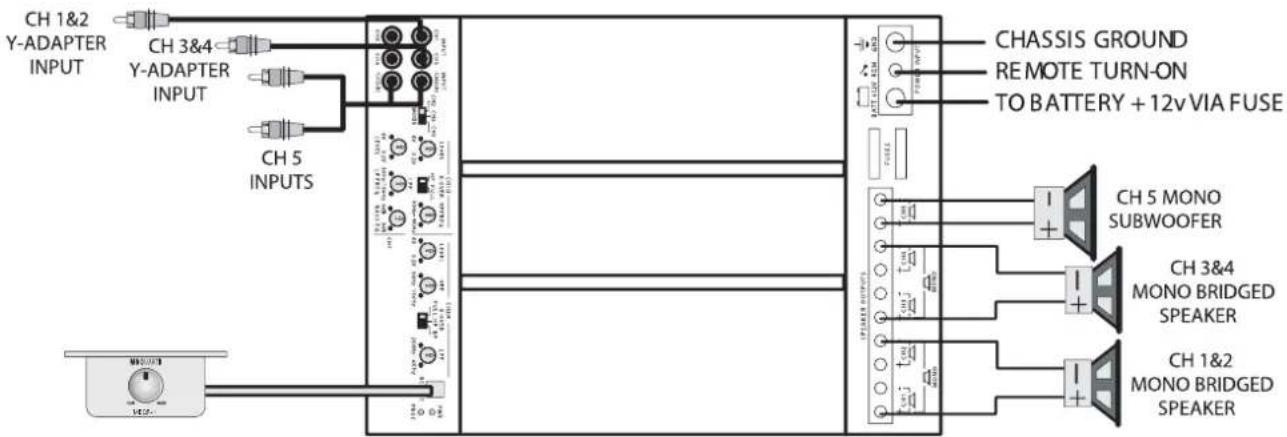
3 or 4 channel discrete, one being mono low pass
Ne will use the same basic setup as above to illustrate a 3 channel arrangement, by mono bridging the stereo channel pairs 1&2, 3&4. For a 4 channel setup, mono bridge only one set.
nterconnect cable checklist:
-
Use 2 Y-adapters RCA cables, one for channels 1&t2, and the second for channels 3&t4, to create 2 inputs for channels 1,2,3&t4 only, as shown.
-
Connect the positive terminal of channels 1&2 mono speaker to channel 1+, and its negative terminal to channel 2-. Connect the positive terminal of channels 3&4 mono speaker to channel 3+, and its negative terminal to channel 4-.
- Channel 5 is a true single channel, and as such is not bridgeable.
Minimum final loudspeaker impedances
- 2 ohm per channel in stereo mode
- 4 ohm per mono bridged pair
-2 ohm on channel 5
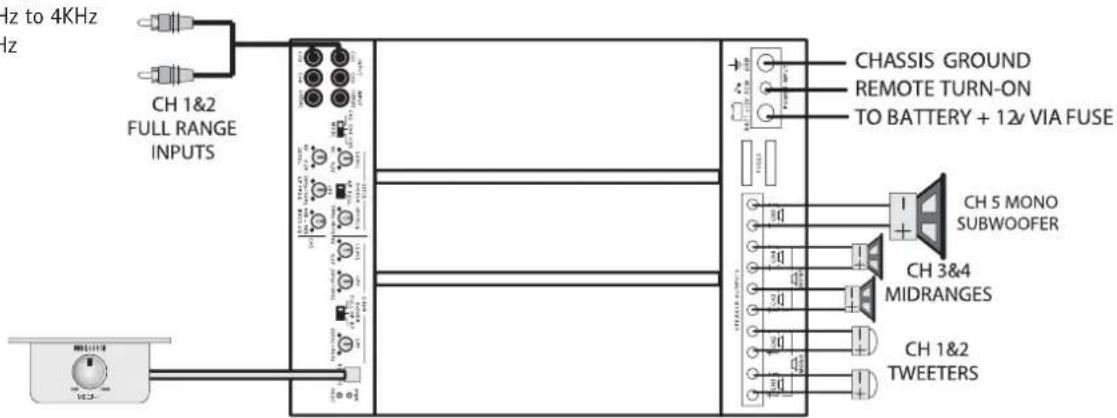
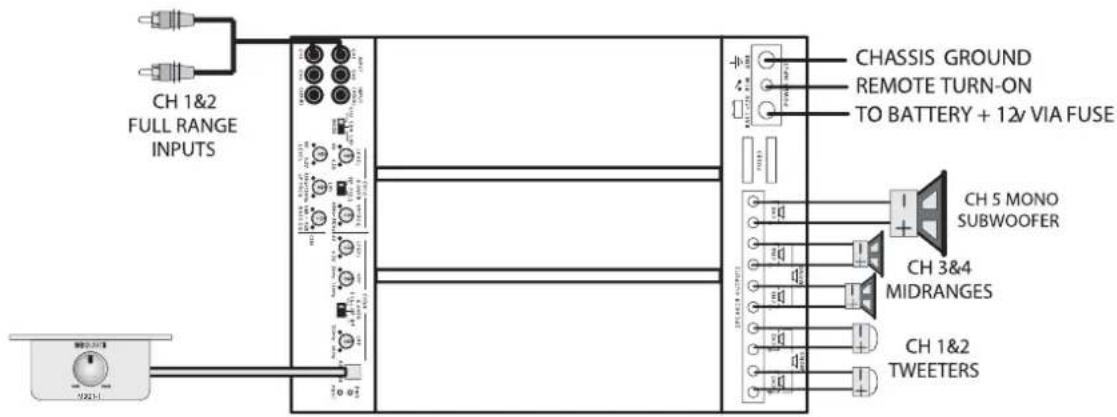
3 way active, with mono bass
The PAB 5400 5 channel amplifier contains all the functions necessary to set up a completely self-contained 3 way active crossover system.
Interconnect cable checklist:
Use good quality RCA cables to connect the inputs of channels 1&2 to the full range outputs of the source.
Switch setting checklist:
-INPUTMODE:CH2
-CH1/2X-OVER:HP
-CH3/4X-OVER:BP
Crossover frequency control checklist:
- CH 1/2 HIGH PASS: 1KHz to 4KHz
-CH3/4 HIGH PASS:100Hz - CH 3/4 LOW PASS: 1KHz to 4KHz
- CH 5 LOW PASS: 100Hz
Vote that the HIGH and LOW PASS controls of channels 3tt4 act as the bandpass controls.
Please note that these frequency points are suggestions only. Refer to the loudspeaker manufacturer specifications and the section "Setting up systems after installation for best performance"
level control checklist:
Refer to the section "Setting up systems after installation for best performance"
Minimum final loudspeaker impedances 2 ohm per channel
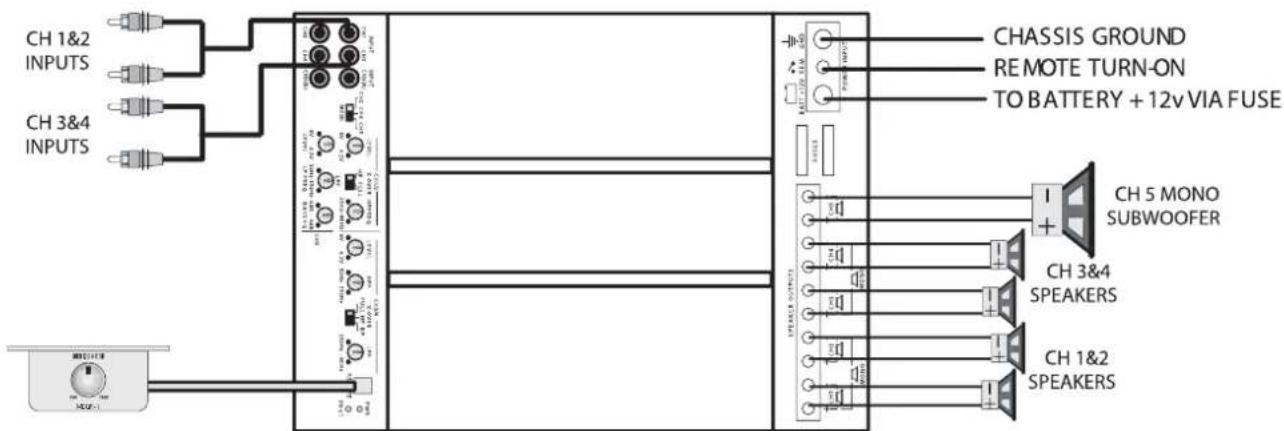
Front/rear high pass, with constant sub bass
Another obvious application for the PAB5400 is to use 4 channels for front/rear satellites, and the mono channel for constant non faded sub bass.
Interconnect cable checklist:
Use good quality RCA cables to connect channels 1,2,3tt4 inputs to the front and rear outputs of the source as shown.
Switch setting checklist:
- INPUT MODE: 4CH
-CH1/2X-OVER:HP
-CH3/4X-OVER:HP
Crossover frequency control checklist:
- CH 1/2 HIGH PASS: 100 Hz
- CH 3/4 HIGH PASS:100 Hz
- CH 3/4 LOW PASS: N/A
-CH5LOWPASS:100Hz
Please note that these frequency points are suggestions only. Refer to the loudspeaker manufacturer specifications and the section "Setting up systems after installation for best performance"
level control checklist:
Refer to the section "Setting up systems after installation for best performance"
Minimum final loudspeaker impedances 2 ohm per channel
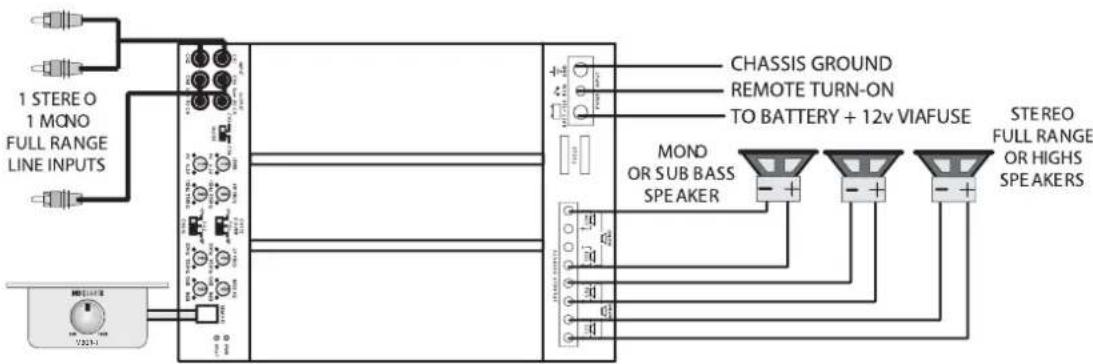
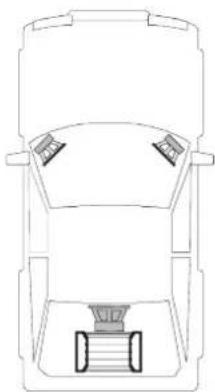
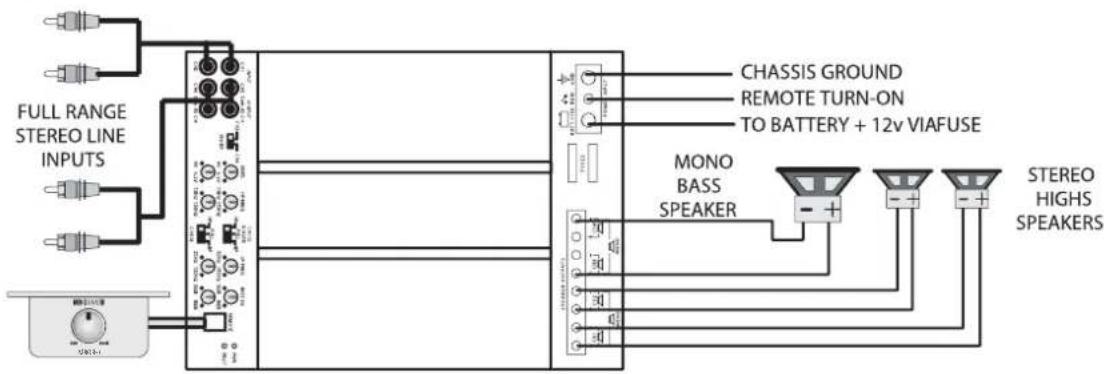
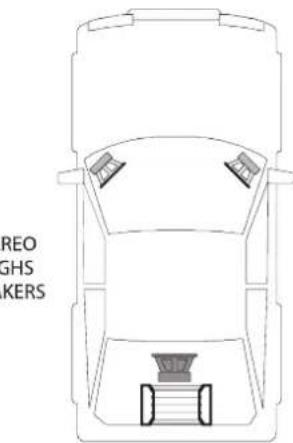
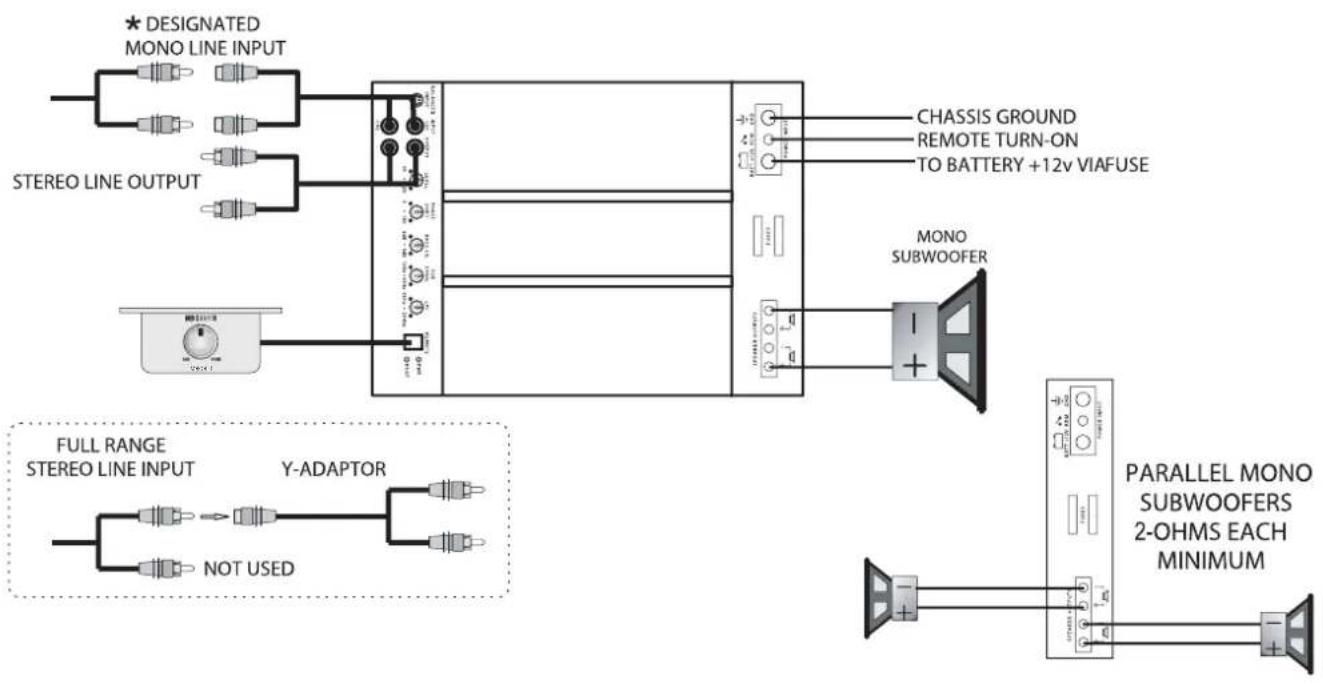
Basic application
nterconnect cable checklist:
-
Connect the line inputs to a Radio/CD RCA outputs or line output of the full range primary amplifier with good quality RCA cables. A Y" adapter may be needed as shown in the diagram.
-
Use at least 16 gauge speaker wiring. These amplifiers have dual speaker terminals, simplifying the hookup of multiple speakers
Crossover frequency control checklist:
- LLOW PASS: 35Hz to 250Hz
- SUBSONIC: 10 Hz to 50 Hz
-BASS EQ:0 to 9 dB
PHASE: 0 to 180 degrees
Level control checklist:
Refer to the section "Setting up systems after installation for best performance"
Minimum final loudspeaker impedance 1 ohm
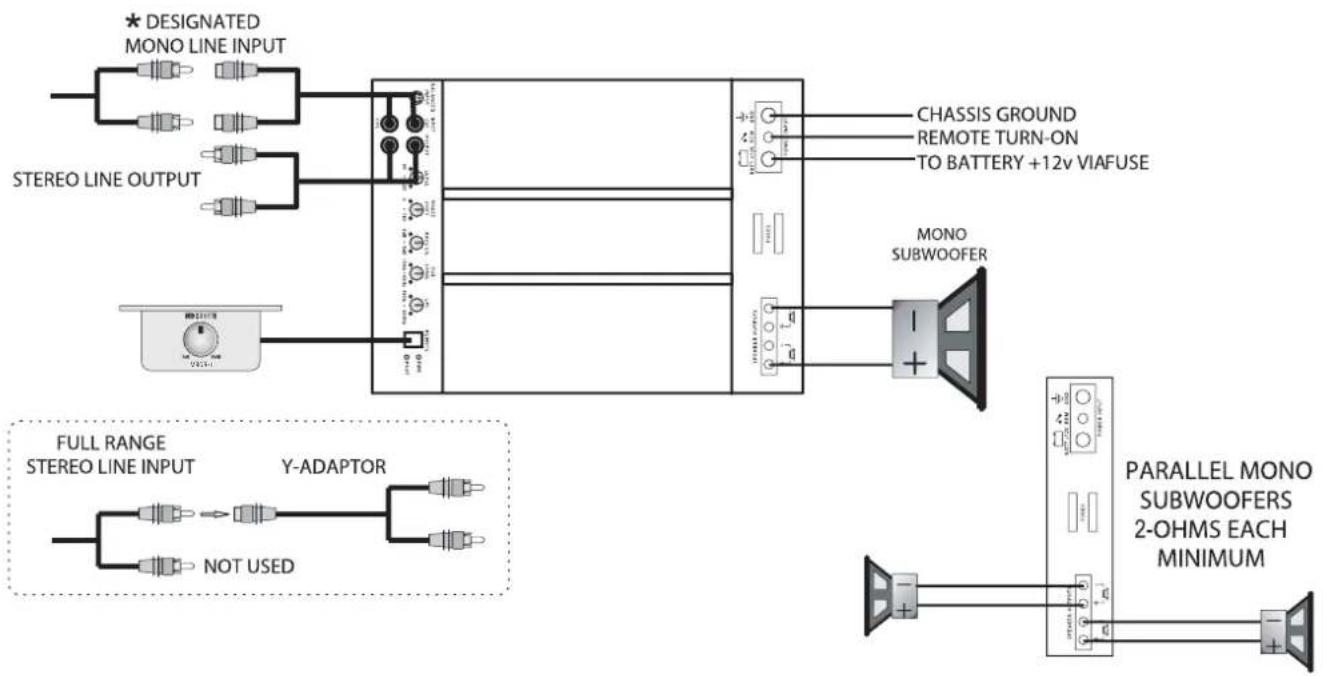
*Note: You can use the Radio/CD designated mono line output or a full range stereo line output. For full range stereo line output, you will need an optional "Y-Adaptor" as shown
AFTER INSTALLATION
Setting up systems after installation for best performance
General:
As mentioned in the "General Installation Notes" section, the system should now be powered up, and working. At this point, all crossover frequency and input selection switches should be properly set for the application, and all volume, level and equalizer controls turned to minimum.
Level control setup:
Insert a CD or cassette that you are familiar with to use as a reference, and turn the head unit volume control to about 80% of its full setting. The system sound level will be very low, and the following procedures will help you to match the amplifier input sensitivities properly to the head unit output signal level.
Single 2 channel amplifiers systems
Turn the level control up slowly, till you hear distortion, then back off a few degrees on the control
Single 4 channel amplifiers systems
Turn the channel 1&2 level control up slowly, till you hear distortion, then back off a few degrees on the control Repeat for channel 3&4.
2 or 3 way active systems:
Always start with the bass, or low frequency amplifier as a reference, by turning its control up to the point where distortion is audible, and back it off some.
Now adjust the level control for the highs or tweeter channels in a 2 way active system, to balance the highs to lows.
In a 3 way active system, match the midrange level to the bass, and then the highs to the midrange and bass. It may be necessary to perform a few iterations of the midrange and highs level control settings to achieve a satisfactory sound balance.
Crossover frequency fi ne tuning
We had started off in the "General Installation Notes" section by setting crossover frequency controls to approximate positions, and now you can adjust these for best sound quality. Be careful not to stray too far from those crossover frequencies as recommended by the loudspeaker manufacturer, as it is quite possible to damage midrange and tweeters with excess power outside their nominal operating frequency ranges.
Equalizer setup:
Once all levels and crossover frequencies have been set for a pleasant sound balance, we can start equalizing the system frequency response. It is important to remember that a boost applied at any frequency, or range of frequencies, will cause severe amplifier clipping. The following comments apply to ALL equalizers and tone controls on the amplifiers, as well as those on head units and dash mount equalizers
Use the head unit volume control to adjust the system to an intermediate level, and proceed to adjust equalizers and tone controls to personal taste. Now go back to the Level control setup above, and readjust all level controls.
Sit back and enjoy the music!
Troubleshooting a system
The key to finding the problem in a misbehaving sound system is to isolate parts of that system in a logical fashion to track down the fault.
Description of the Diagnostic system built into all MB QUART amplifiers
The diagnostic system will shut down the amplifier, until reset by turning the head unit off, and back on. This state of affairs will be indicated by the front panel PROTECI LED lighting up under the following conditions:
1 - A short circuit on the loudspeaker leads
2 - An internal amplifier fault that causes a DC offset on the loudspeaker output
Should the amplifier go into diagnostic mode, simply disconnect all RCA and speaker leads, while keeping +12 volt, power ground and remote leads connected. Now turn the amplifier back on, and if the diagnostic LED lights, the amplifier has an internal fault
If not, plug the RCA cables back, and reset the amplifier. If it goes into diagnostic now, the fault lies in the input, either with bad cables or source unit. If the amplifier seems fine with RCA cables plugged in, connect the speakers, one at a time, and if one of the speakers or its wiring is faulty, it will activate the diagnostic system.
Amplifi er heatsink overheating
The amplifiers will shut down when the heatsink temperature reaches 80 degrees centigrade, and turn back on once the unit has cooled down below that point.
Causes of overheating:
1 - Inadequate cooling - relocate or remount to provide better natural airflow over the fin
2 - Driving high power levels into low impedances - back off on the volume control, and/or make sure you are not loading the amplifier with less than the recommended loudspeaker impedance.
ow output power:
1 - Check that level controls have been set up properly.
2 - Make sure that the battery voltage, as measured at the amplifier's +12 volt and ground terminals, is 11 volts or more.
3 - Check all +12 volt and ground connections.
Fuses blowing:
1 - The use of loudspeaker impedances below the recommended minimums will draw more current - check.
2 - A short on the main +12 volt cable from the battery to the vehicle chassis will cause the main fuse to blow.
3 - If an amplifier fuse blows continually, with only +12 volt, ground and remote leads connected, the amplifier may be faulty.
system does not turn on:
1 - Check all fuses.
2 - Check all connections.
3 - Measure the +12 volt and remote turn on voltages at the amplifier terminals. If these are non existent or low, take voltage measurements at fuse holders, distribution blocks, the head unit's +12 volt and remote leads to localize the problem
Voice problems: system noise can be divided into two categories, hiss, and electrical interference.
iss, or white noise:
1 - High levels of white noise usually occurs when amplifier level controls are turned up too high - readjust according to the procedures in section "Setting up systems after installation for best performance"
2 - Another major problem that can cause excessive hiss, is a noisy head unit - unplug the amplifier input RCA cables, and if the hiss level reduces, the source unit is at fault.
Electrical interference:
The inside of an automobile is a very hostile electrical environment. The multitude of electrical systems, such as the ignition system, alternator, fuel pumps, air conditioners, to mention just a few, create radiated electrical fields, as well as noise on the +12 volt supply and ground. Remember to isolate the problem - first unplug amplifier input RCA cables, if the noise is still present, check the speaker leads, if not, plug the RCA's back, and investigate the source driving the amplifier, one component at a time
A ticking or whine that changes with engine RPM:
1 - This problem could be caused by radiation pickup of RCA cables too near to a fuel pump or a distributor, for instance, - relocate cables.
? - Check that the head unit ground is connected straight to the vehicle chassis, and does not use factory wiring for ground.
3 - Try to supply the head unit with a clean +12 volt supply directly from the battery +, instead of using a supply from the in dash wiring/fusebox.
A constant whine:
This type of noise can be more difficult to pinpoint, but is usually caused by some kind of instability, causing oscillations in the system.
1 - Check all connections, especially for good grounds.
2 - Make sure that no speaker leads are shorting to exposed metal on the vehicle chassis.
3 - RCA cables are notorious for their problematic nature, so check that these are good, in particular the shield connections.
Inhaltsverzeichnis
-1/2 CH X-OVER: Position "FULL"
-3/4 CH X-OVER: Position "FULL"
-1/2 CH X-OVER: Position "H"
-3/4 CH X-OVER: Position "HI"
Mode stereo large bande
Mode mono large bande
- HI PASS: 100 Hz
- LOW PASS: non applicable
- HI PASS: non applicable - HI PASS: non applicable
- LOW PASS: non applicable - LOW PASS: non applicable
- HI PASS: non applicable - HI PASS: non applicable
- LOW PASS: non applicable - LOW PASS: non applicable
-
HI PASS: 100 Hz - HI PASS: 100 Hz
-
LOW PASS: non applicable - LOW PASS: non applicable
- CH 1/2 HIGH PASS: non applicable
- CH 3/4 HIGH PASS: non applicable
- CH 3/4 LOW PASS: non applicable
- CH 5 LOW PASS: 100 Hz
A工程技术 of the selected functions.
A工程技术 of the sensor is shown in Fig. 1.
IpekeNIOUaTeB YaCToTHOro pa3dEnITeBHOrO fHJIbTpapapa KaHaJIOB 1&2 (1/2 CH X-OVER):
FULL: HactpnaBaet nonHodnana30HHbpeKmDn 3to npab KaHAnOB.
HP: Bb6paetФnIbTpBepxHnx yactOT (HI), KOTOpbIMoKET 6bITb HAcTpoEH no-paahomy B dana3ane 50 F-4 Kf.
Ipeeknoateb yactoTHoro pa3dneHtBHOrO fHbTpa npa KaHaIOB 3&4 (3/4 CH X-OVER):
FULL: HactpanBaet nonHdoanana30HHb peKIM dTH 3TOI napbi kAHANOB. BP: B 3TOM peKIMe fNtBt BepXnHX qACTOT (HI) nFInBt NHXHN XACTOT (LOW), KOTOpBE MOrY T 6b1b 6ecCTyNEHATO yctAHOBnHb B DnANA3OHe 30 T -4 KTu, HactpMaBHOTc TaKIM 06pa3OM, 70o 6pa3yHTONOCBOI pa3dienTeHBn FInBt.
HP: Bb6paeT pHnBtp BepxHnx uactoT (HI), KOTOpB MoxKet 6b1b no-pa3Homy yctahOBHeN B dana3OHe 50 T-4 K T.
Kahan5(5CH):
ФИHKПДЯΚАЛа 5БИМВБИРСИВECБмСпсИПЧЕСКЕДЯМоHOPEXMAMH3KIMXACTOTNHEMOY6BITNEPEKJIHOHEBI:
-ΦnIbTp HxHnx HactOT (LOW PASS) NMeET no-pa3Homy HactpnaBaembI dHaIa3OH 30Tg-150Tg.
3KbanaIeep Hn3kXx YactOT o6ecneHBAeT BbldeHMe Hn3kXx YactOT O 0 +9 D npn 45 T.
MOHO-ycnnteJb Premium
- MoHO-yCMHHTenb PAB 1200.1 paccnHa HArpy3Kn 4,2&1 Om.
-ⅡaPamETbI BXOHHYVBCHTENBHOCTINIOE6CNEHnHO HOMHaJIbHOHMOUHOCTN MOYrIKMHeHITbCBAIana3OHe02B-6B. - Bce yactoTbIe pa3dienTeBHeIe fHbI MPyT bIb 6bIT 6ecCTynHato HacTpoHb I npdeJax COOTBETCTBHyOero Dnana30Ha.
MoHO-ycnntePAB1200.1D
1-KaHaHbHbIe MoHO-ycHInTe HpaCHTaHb Ha harpy3ky 4,2&1 OM mMoryT npMmEHaTBcB A IIO6oB DByxycnHteHbOH CmCTeMe (Bi-Amp), OmCaHne KOTopoC oepkntc B HnctpyKuXnA dnr 2-4-KaHaHbHcNCTeMbI.
CinHan Ha Cinch-BxOe (LINE INPUT) HanpaBnIeTcH HenOpceDCTBeHNO Hb BbXoDbHie Cinch-rHe3a (LINE OUTPUT), 6e3 yHeta Hactpoek HAcToTHbIX paAdJeNITbHbIX qmnbTPOB.
Blaorapra peryTTOpy,KOTOpnoNIOJIIOHcKTH3yDMRETOE,KOTOpb,HanpMep,CMOTIPOBAHnO,IITKOMPINIO60OB,IMMeTcBO3MOKHOCTbIyypaBHeHMyPOBHE CMHTHLAHa BbIXoDE3kBaJ3ePAHKHXHACTOT.
SUBSONIC no3BolrE bInoHnTb Oepaun HacpoKm Do3BykoBOrO fnnbTpBa Dnaana30e 10F-50F.
BASS EQ no3BONJET noDHTypoBEH hN3KHX qACTOT B dna3OHe 0 D5-9 D5
- LOW PASS no3B0JIaRb BblIOINHITb HAcTPOIky cIIbTpHa Hn3Kux 1actOT B Dmna3OHe 35 _U - 250_U
Kpytn3ha cna paaednttebHoro dmbtpa (MOHO) coctabnert 24 b/okT.
-TopaHmCBToIOHOHbHHNkAToPPOWERnokaBbAeT,TONoCTyNaetTOK,HTOYCTPOICTBO HAXOITcB R TOBOTOM KpaOte COCTOHNM.
BHIMAHHE:Kak npabHNo,ycunnteHn He doJnxHbBkNooTbcra Bpa6oTy HnKe TOro MMneDAnca,Ha KOTOpB OHn paccuTahb.B npotmbHom cnyae 3TO pNBBeTeK NOBREHmIO NOBpeXdHn YcHNTeHn Ha KOTOpblHe paCnpocTaPraHrTcR DeIcTBn RapaHTn, npBedeHHo B pAMkax pyKOBOcTBA no 3KcNpyataa.
MOHO-ycnHnteJIb: paccHTaH ha 4,2 & 1 O.M.
- PHASE-Shift (cornaobane nooexenpa3b) no3BONET BInonHt bonepaun Hacptpkn Bnana30ne 0° -180°
LEVEL:Bpe3yIbTate 3TOBOxIOHyoPOBHeYcIMInTeNg(Gain)MOKeT6bITb corlacoban C bIXOINbHM yoBHeM paIMOnpHemnHKa/CD- nIeepa.
POWER: NocpeTcBm 3aopanH3eHOro CBeToIOHOHoro HnKaTopo noka3bIaetC,TOHa YcNInTeJIb NoCTynaet ToK,IMeETcCoEINHeHne C3emNei, a ynpabLeHHe BkInouHeHem AJIraTcA KtINBbM (REM).
PROTECT: 3aropaHne HnDkaTopa PROTECT O3hauaet, YTO B ycnInTe IMeeTc HnCnpabHocb, HTO OH He rTOB K paBOte. CyueCTbyKT HeckoJIbKO BnOIB np6bem, KOtOpbe pnpBOdR T KepeKIOHeHIO yCNmTeIe B 3aunTHbi peXIM. DnI NOyUeHn BOeE Noop6HOH INFOpMaUcM CTPOH INCHyPkuHIO NO NOKCY HnCnpabHocTei, KOtOPaNOMeHEn B NOCLJeHn ChAtnpykoBODCTBa NO 3KnIpyatauIN.
BALANCED INPUT: npHmMaet CmmMeTpuHbIe BXoHbIe ypoBn B daNa3OHe 0,4B-18B.
PonHOnnana3oHHb CTepeo-peKIM
3To HAn60eue Aacto BCTpeauoicc Cnyaon OCHOBHO npmehn2-KaHbix yCmnteneepn Premium.
- KoHTpoJIbHbI INepeUHeB IINr CoEINHeHn IPOBOIDOB:
Cinch-BxoDbl (LINE IN) nocpeCTBOM BbICOKOkaeeCTBeHHbIX Cinch-ka6eNei CoeHNHTb c paHnnpHmHKoM/CD-nneepom -
IpeeknouateIb qactoTHoro pa3dennitehoro fnhpa (X-OVER):
IpeekHouateBbactoTHoro pa3dneHTeBHOO fMbtpa IOnKeH HaxOHTbcB noJoxEHn *FULL
3.KoHTpoIbHbI nepeYeHbI pyerynnpoBaHn YaCTObl npexOda:
He OTHOCITcK NOnHODnAna30HHOMypeKIMy(FULL).
4.BxOHaHyBcTBnTebHoCTb (LEVEL):
CMOTpa3dien"HaCTpoiKa CnCTeMbI NocTe MOHTaKa dIra DoCTNKeHnRA HauNyue MoUHOCTM -
Modynb dctaHOnHO ynpabHeHH H3KMm qactotaMn:
Moynb dCtahmHnHO ynpabHeHn H3KmHn YactotAm NocpeCTBOM mHeoEroCBO KOMnkeTye npabHooJero Ka6eI NaqKnIOHTb Ha THe3e "REMOTE ycnnte
OPMMEYAHME:
MHHMMDnBcOkyhBxHmneDaHCOBdHAMKOB
4&2OMBCTpeo-pexnmeHIM4OMBMHOHO-pexnme
3TOT YCNNTENb He pa6oTaet B CTpeo-pexkme 1 OM mHMOHO-pexkme 2/1 OM.
PonHOnaHa30HHb MoHO-pexMM
3TO pIMMEHHEHME DEMOHCTDPYET OCHOBHO MOCTOBOI METoD "MOHO DnRA BCEX yCNITENEΦPMBMB QUART.
KoThpObnHbI npeueH bIra coeMHHeHn npOBdoB:
TpebyeTcNtOHMK CmHAnOB MONO, HnPIMep, MOHObXoD Ca6BydEpa AKTHBHor pa3deHNTBHorO fHbTpA, He3aBNCMO OT TOR, HHTerpPOBaH N OH B BnDEOTdHbHorO VCTPOICTBA N60 B VCTPOICTBO YnPaBHeH,N60 B 3KbAnaIeP
Baxho He nbtaTbc CoeMHnHb Bmte AXTMBHIE NIN NOXKHeBbE BixObl KAKoro-Im6 NoCTOHNkA, YTO6bI NOUYHb MOHO-CrHaN, TAK KAK 3TO, BEcMa BEPOrTHo, MoKet NOpeHb BIXoHNOI KACKaI 3TOI NOCTOHNkA. Heo6xOIMMo, YTO6bI KaK HaeBbI, TAK I HA npabB bXOD NOCTyAN OINIAKOBbI CrrHaN no Cinch-KabeNo Y- aadTepa. CoeMHnHb NOLOXKHeNbHb 3axm NIOKIOHEHMA MOHO-DHHAMKa"LEFT + " n erO pntateHbH 3axm c pa3beMOM RIGHT -".
KohtpnbHnpeHbIHaNCTPOKNPeKNoaTeNaCTOTHOpa3dnttehoro qnltpTa:
IpeeknOHaTeIb AMPLIFIER X-OVERdoJIkeH HaxoMItbCBy nIOJooKeHH FULL.
KoHTpoBbHbI nepeueHb Ira HacTpoHKn peYrJrTopoB hAcToTbI nepexOda:
HEOTOHOCITCRKINHODnana30HHOMyPEXKIMY
COBET: Ecmblnncb3yete MOHObixo ca6byepa akTMBHOrpa3deIHTbHORO
fNtbp, pnn 3TNX YCNNTENX BNOJHE MOHXIO NOKHOHTb fNtbp HNXHIX HACTOT,
TO6bI NcYHb7 b0onee kpyTo cnaqTcHON XapakTePNCTKN fNtbp HNXHIX
actot
MHHMMJINCOKQYNHOIMNEJaHCAHNHAMKKOB4OM"MOHO
CTepeo-ΦnIbTp BepxHnx YactOT C MOHO-ΦnIbTpom HnXHHX YactOT B DByXKaHaJIbHO aKTHBHO IIN DByxycnHtEnbHO CNCTeMe
B daHnOM cyuaeMbI NCNOL3yEM OINH 2-KaHaJIbHbI yCNITe IIN BByICOKHX HACTOT, aDpyrO IN HN3KHX YACTOT, IN60 OIN NHMO-hcABypep. PIOBepTe CNEUHkauin DnHAMKOB,HTo6bI ONPeDEINb MAXCIMAbHbIe Tpe6oBAHnI, PneJbRAEmbl E MOuHOCTN YCNITeNei
KohtpoIbHbI nepeueHbI JnI coeHNHeHn npOboD0B:
Cinch-BxoDb (LINE IN) yCNNTENI DnB BcOKX YACTOT C NOMOUBHO BbICOKKaueCTBeHNbIX Cinch-KaBeN IIOKNIOnHb K PAIDONPNMEHMNKy/CD-NNeepy. BxOdb LINE OUT yCNNTENI DnB BcOKX YACTOT C NOMOUBo Cinch-KaBen "CTepeo" NOkKnOHHTb HxBODb yCNNTENI DnHKNKX YACTOT.
IopKnIOUeHHe MOHO-cabByepa:
PONOXHTENbHbIe 3aXmMbMoHO-DHaHMAKnIOaKnIOHITb Ka pa3bemy"LEFT +", a TAKKe erO pTnAteNbHbIe 3aXmMbKpa3bemy"RIGHT -".
KoHTpOBHbIN nepeueHbIra HacTPOIKn nepeKnOuAteNei pa3dEnITbHbIX
VCINNTenB BbICOKXyACTOT: nepeKIOHATeN X-OVER B noIoxKeHN HP.
VCINNTenB Hn3KxXyACTOT: nepeKIOHATeN X-OVER B noIoxKeHN LB/BP.
KohtpOblbHnIpeueHbIaHaCTponkperyIaTOpBacToBtIpeXoDa:
YCNNTENbBICOKHXACTOT:
-HI PASS:100
- LOW PASS: He noDxOuT
YCMNTENHMMKXHACTOT
- HI PASS (do3bykoobonФильт):10Tu-40Tu
- LOW PASS: 100 Fu
POMNHTE O TOM, YTO 3TN 3HAeHnRApa3dJIteJIbHOH HAcTObIy RAJIYOTcI NIIbIpeNIOXEHnMM. IPOBepbTe CNEUINKACIM IN3GTOBHTEN, KACAHOUNECr DHHAMNKOB, IN PPOHTAte Pa3dEIN "HAcTPOKa CNTem NOcIE MOHTaK dI INI ONJYHEn HAUYHsE MoUHOCNT.
KohtpobhnypeueHbIpyerpyrnapoBLEVEL:CMotpn pa3denn“HaCtpoKa CNTTEMIOCTJMOHTaKaIINIOUYeHnHAJIyUWeiMoUHOCTN
MHHMymIpaCOBkyhIx MMneDaHcoB DnHaMHKOB:
-2OMHaKaHANBCTepeo-peKIMe.
-4OMB WHTNPOBAHHOM MOHO-PEKINME.
4-kaHaJIbHaI IOJIHOdIa3OHHa CnCTema
3debMnKo3BaEM,KaMOKeTNCIOB3OBATc84-KaHAnbHbIyCNINTEBBOCHOBHOM 4-KaHAnbHOM NIOHOHANAOHOHOM PEXXIME.
KoTHpOblhBn nepeueHb Ira coeINHeHHI npOBoDAmI:
YeTbpe BxOda yCnntenr (LINE IN) nocpeCTBOM BbcokKaueCTBeHHbIX Cinch-kaBeney noKnHcytB k padnoepmHmky/CD-neeepy
KohtpoBbHbI nepeueHbI nHaCTpOKn nepeKIOuATeNei pa3dEnntbHbIX
1/2CH X-OVER: nonoxenhe "FULL"
3/4CH X-OVER: nojonokheHne "FULL"
KohtpohBn nepeHb nla Hactpokn peryIaTOpob yactotbl nepeXOa: kaHb1/2: kaHb3/4:
- HI PASS: He noipxodit - HI PASS: He noipxodit
- LOW PASS: He noDxOoNT - LOW PASS: He noDxOoNT
KoTHpoIbHbI nepeueHb IaHaCTpOKn peryrJrTOPOB yOpBHc:CMOTPMpa3dien
"Haetpoika cnCTem nocne MOttaXa JnI pOnyueHn HAnlyuChn MoUHOctn."
MHHMmDnCOBkyhBxMMneDaHcOB DnHaMKOB;2OMHaKaHa
FULL RANGE SPEAKERS
2-ⅢI3-KaHaJIbHaI NOHODnAbaOHHa CNTeMa
3Decb Mbl NOKa3Blaem, KAK 4-KaHaJIbHbI yCINHTeMb MOKET nPIMHeTBC B KaueCTBe 2- INN 3-KaHaJIbHO rno NIOHDManaO3HOrO yCTPOHCTBa, eCNN BOCNl3oBaTcBc BO3MOKHOCTbO, KOtopa COCTNT B TOM, TTO BCE yCINHTeM MapKn MB QUART MOrTy IcONl3oBAbCB TaKKe B KaueCTBe WHTInPoAaHHbIX MoHO-yCINHTeNe.
IomeeHHHn HnKne npMep nok3bBaet, KAK NocpeCTBOM WHTMPOBaHO MOHO CXEMbl pIMMEHNTBbKO nape KAHAIOB 3/4 MOKET 6bITb HAcTPOEA 3-KAHABHcAMCTEMa. Ira TOrO YTO6b1 CMOHTNPOBAbTb 2-KAHALbHyIO CmCTEmy. CNeDyITE PpOCTO npMepy, YTO6b1 CKOHmpyoPobTa TaKke npay KAHAIOB B BnDE WHTNPBOAHHO MOHO CXEMbl
KoThpOnbHbI IpeueHbI nA coeINHeHn npOBoDob:
PocpeCTBOM BbICOKOKaueCTBeHHbIX Cinch-Ka6eNei NOKIOHHT bXoIb npbl KaHANO1/2K COOTBECTBYOuEMy Ctepeo-IOCTOHMy, HApnIMep, yCTpONCTBy ynpabEnHn.
IpyTOOYTO6bIKNHOHTbnapKaHAnOB3/4BnDEMOCTOBCXEMbI,Tpe6yETc HTOCHMKMOHO-CMHAJIaIO6HO Tomy,KOTOpBIMMETCBBAIBDeBVIXoDAHA MOHO- Ca6ByepeAKTHIBHOrpoa3dINITeBHOroФmITpA,BnDEOTdEBHOYCTPOHCTBaNN B BnDEpa3dINITeBHOroФmITpA,INTerPnpOBaHHORBOYCTPOCTBOYTPaBNEHnIMB 3kBaJAAeep
BaxHo He nbTaeBcoeHHb Bmecte akTHbIe NnNacBbIe BixObl KaKOro
No6tOHTHnKa, T06bl NOyHTb MOHO-CnHAn, TaK KAc 3TO, BeCbMa BepoTHO, MoKet
NoBpeHb BixOIOH Kackd 3TO 10CTOHnKa
KaHa npabBt, TaK Ha neBb BxOJdoJIKeH nocTyNaTb No Cinch-ka6eIHO Y-aanTepa OINHAKObBcHn
-ПОДКИОМТБ ПОЛЖNTIELН ПИССЕДНIELТБИЗ 3AZIMMOHO-DINHAMNKBA COOTBTCTBMC pncyHkOM K pa3bemy"LEFT +",a OTPnIaTeBHy 3AZIMK pa3bemy "RIGHT -".
Kohtpobhni nepeeyb dny hactpoikn nepeknoyateen pa3dneTebhix
-1/2 CH X-OVER: noIooJIeHne "FULL"
-3/4 CH X-OVER: noJooXeHne "FULL"
KohtpObHbI nepeHbI Ia HAcTpOKn peryIaTOpOB nepExoJa cactOtbl: KaHbI 1/2: KaHbI 3/4:
- HI PASS: He noxdoxoDHT - HI PASS: He noxdoxoDHT
- LOW PASS: He noxoxoit - LOW PASS: He noxoxoit
Cobet: Ecnbl bni nnoi3yete BixoHa na cabiyepeakntBHO paoenlntbHoro qnIbtp, npn 3NtX ycnnteBx BNOJIHe MOXHO NOKIOHTb FnhTp HxHnx YactOT, T06bl nOlyTb 6oEe 3NaHTbHy HO KpyTH3Y HAcTOHON XapAtePCTNK FnhTp HxHnx YACTOT.
KoHTpoIbHbI nepeueHbI dIa HAcTpoKn peryIyIaTOPOB yOPOBHa: CmOTpIa3dEi
Hactpokma CNTem Nocle MOHTaKa dnnnoyHeHHaHnlyuWee MoOHocTm
MHHyM DnI COBkyhBx HmneDacOB DnHaMHKOB:
-2OMhaKaHaJBCTpeo-peKIMe.
-4OMBUYHTYPOBAHHOMMOHOPEKMME.
2-KaHaJIbHaa AKTINBHa HnI DByxycnITeJIbHa CnCTema C Hn3KmM YAcTOTAMN "MOHO
3Ta KOMHOBKA NOK3aBbAET, KAK MOXHO pOCTbIM TYTEM C NCHONBJOBAHEM 4-KAHANBOY YCINNTENI MOnEBHORPOraD PRemiUM yCTAHOBHTB 2-KAHANBJHYo AKTHBHNO CMCTeMy. KaHAnb1 1 2 NcN0b3yHOTc DnR BbICOKHX qACTOT, KaHAnb1 3 4 dnn HmKHX qACTOT "MOHO".
KoThpObnbIyIpepeHdIa coeMHHeH npOBdoB:
MbIdoJIKNHbI NOaTb OINHAKOBi CnHaHa 06a BxOda (LINE IN), NToMY cneyetye IcnoIb3oBaTB DaY-ADAnTepe, OmH aAdanTe pIra TOrO, YTO6bI B COOTBETCTBMn CpNcyKOM NOaTb NEbB CnHaB B KaHaB1 1 3, a TaKHe BTOpO adAnTeP, YTO6bI NOaTb npAba CnHaB B KaHaB2 4.
IpoKJIouChHeMoHO-cabByepea:
CoeINHITb IIOXHTBbHbI pnpOeHNHTbHb3aXM MMOHO-DnHaMkC 3aXMOM "LEFT ^+ *otpmaTeHBb3aXMc pa3bemOM"RIGHT -".
KohtpOBhBnpepeHbIraHactpoKnpeekNouatee npa3dennTeNbHbIX
-1/2 CH X-OVER: noJoxHeHn, H
-3/4 CH X-OVER: noonoxenhe,LP/BP
KohtpOblnIpeueHbIaHaCTponkperyIaTOpB aCtToIbI nepeXoDa:
BbICOKNX/HN3KNX ChaCTOT
B daHHOM cHyaeMb npedctabnem OIN H3 BapnaHTOB hBaBHHO BbIe CNTcEMbl. TaK K B daHHOM cHyaepeHy nEe 02-KaHaJIbHO CNCTeMe, MBI MOxEM NcIOJIb3OBaTb pOHTaJIbHb bIXoJb yCTPOJCTBA YpPABHeH, YTO6bI AKTNBOPAb TB BICOKHE aCtOTb, H3aHIne BIXoJb, YTO6bI AKTNBOPAb TB H3KHe cAToTb. BpeYbTaTe BbIOHNHE NIO6bHX DeCTBm C NMOUBo peryIITOPa DPERpyIIPoBAHMy yPOBn CmHana cpeDn H caDn (fader) Ha yCTPOJCTBE YpPABHeH CNYaATeB MoXET Be3 Tpyda aadTIPOBaTb OTHCINTeHb HypoBHe H3NKx qACTOT K BVCOKM cAChTAM. KaHAnI 1 2 NCNOJIb3yIOcTg I BAICOKX qACTOT, KaHAnI 3 4 dNRAH3KHX qACTOT "MOHO"
KohtpohblnpeueHbIra coedHHen npoBdoB:
VcnoB30aBb BcKOKKaehCTBeHHHe Cinch-kabeHn Ira nOdkHouHn BxdoB yCNHTeN K HCTOHmky COnnacHO pncyHK.
BbIIOJIHNTe IeCTBnO THOCTeJIbHO HAcTpoIK NpeKIOUaTeJIy CactOTbIX pa3dJIeTIeJIbHbXΦMbIbTPOH NaCtpoIKNpePexoB OACTOT TaK, KAK 3TO bIIO yka3aHO dIra CnCTeMbI, KOTOPA ONmCAHa BbIue.
ΦnIbTp BbICOKnx YacTObpepeHne N 3aDHeuactn
cNtOJIb3OBAHnEM 2-KaHaJIbHOrO yCNIHTeIa I
MOHO-ca6ByΦepa
BpeyntateKOMMHNPOBAHn2-KaHaJIbHOrO YcINNTeIc4-KaHaJIbHbIM YcINNTeIeM CNOJIb3OBaHMEM HHTERPPOBaHHbIX pa3dJIENTeHbIX DInltpoB MoKHO CKOMIOHOBaTb JERKYO, KOMTIeKTHyO CNTEmy C BcICOKIMn IactOTAMB PepeJHn 3aDHeN YaCTn MOHO-CaBvepOp
KohtpoBbHnpeueHbIa coeHNHeHH npOBOOB:
NcnoIb3yBaBicokKaaeCTBeHHbIe Cinch-ka6JI,coeMHHTbpeHnne H3aHnne BbyxoIbYCTpoiCTBaYnpaBHeHnCOrnaCHO pncyHKo BxOaAMn (LINE IN) 4-KaHaNbHorO yCNITTEI
ToH0TAKJHe3doLINEOUT4-KaHaJIbHOrOycnIITeRcOrlaCHOpcVHKycoEHHHTb CHe3dOMLINEINPUT2-KaHaJIbHOrOycnIITeR.
Поклочене моно-cабуфера:
IopKIOHHTbNOJOKHTeBbHnPnCOeHNHTeBbH3aXMMMOHO-DnHaMnKaKpa3bemy"LEFT ^+ ,OTpNATeBbHn3axkMKnpa3bemy"RIGHT-."
KoHTpOBHbHnpepeHbIra HAcTPOHKn pepeKnOuAteNeI pa3dEnHtBbIX
4-KaHaHbHbYcHHTeB bBICOKXuACTOT:
-1/2 CH X-OVER: noIoxKeHne ,H"
-3/4 CH X-OVER: noJIOxKeHne, H
2-KaHaJIbHbI yCINHTeIb Hm3Knx HaCTOT:
- nepeknoateX-OVER:nonoxene.LP/BP
KohtpOblbHnIpeueHbIaHacTpOKn peryJyToPob aCtToBi nepeXoDa:
4-KaHaHbHbYcUNHTeB BbICOKHXyACTOT:
Kahany1/2: KAHany3/4:
- HI PASS: 100 Γu - HI PASS: 100 Γu
- LOW PASS: He noDxOoHIT - LOW PASS: He noDxOoHIT
2-KaHaJIbHbIy YcHInTeJb Hn3Kxq ActOT:
HI PASS (do3bkykoBoiФильТp):10Tq-40Tq
-LOWPASS:100T
POMHHTEOTM,HTO3TNpa3dJIeNTbHbHeyCACToTbYBRAHOTcRIMMbIpeNDIOXEHARMM.
PpOBepeBcneuMnKauNn3rTOBHTeIaIINHAMNKOBnPOOHtTaPa3deI
HactpoKa CNTem NocJe MOHTaKa IaI NOJyHeHn HAJIYUWe MoUHOCTNa.
KohtpobHyI nepeueHb IyI peryIaTOpOB LEVEL: CmToPn pa3den "HaCtpoKa
CNCTEM NOCLE MOHTAKA DnI NOLYeHnHaHJyUHmOuHocTn.
MHHMMyMN DnIaCOBkyNtBx IMNeDaHcOB dHaAMNKOB:
-2OMHaKaHAnBCTpeo-peKIMe.
-4OMBMOCTOBOCXEMe“MOHO
KoHnHypaunB BnDe 5 DnCKpeTHbIX KaHaNoB, OINH KAnB KauecTBe MOHO-ΦnIbTp aHHNx YactOT
BbMoKTe HcNoJIb30BaT 3Ty KOHfHyrpaIIO npocTo KaCmCTEmy C 4 NCKpeTHbIMN NOHOJnAa3OHbIMKaHaIaMn I NpTBiMaHOM H3KHX qactOT.Bce pa3dJeNTeHbIe
ΦIbTp baiNaOpOBaHbI, 3a NKIOUHeHem ΦIbTa PAHKNHX qactOT Ha KaHAN5.
PiTa KaHAnOB MOrY ICNOJIb30BaT Bc TaKKe C BHEUHM AKTMBHbIM pa3dJeNTeHbIM
ΦIbTpom Ni6o C pa3dJeNTeHbIMM ΦIbTpamn B yCTPOCTBax ynpabJIeHn HA
3KBaJAA3epax.
KoThpObnbIyI nepeYeH IaI coeMHHeH npOBoDob:
IIOKIOHTB XOJb (LINE IN)INa 1&2 Ha nepeHn BixoJ, KaHAnb 3&4 Ha 3aHn BixoA, a TAKKe KAHan 5 Ha BixoJ MOHO-cabByepa yCTPOCTBA ynpABHeHn IIN HA 3KBANaJIepe B rpi6OpHn PAHeHn. FmNtLP LOW PASS Hs KaHAN 5 BKNHOaETc nocDeBaTeHbO C fHbTpOM UCTOnHkA. BblMOxete NHO hAcPTOnB erO ha TakyHO JxactOTy, YTObI NOyHTB 60nee 3HAHTENbHy KpyTN3HY cactOTHOXapakTePncTKn, M60 Ha 60nee BbICOKyU qACTOTy, YTObI "CMrTb" erO BnHInne. ToJx pRnHMe IINI NOUYEHn 60nee 3HAHTENbHn KpyTN3HBI NOKIOHTB NEPExoBd fHbTa BbOCKx YACTOT dHa KaHana 1, 2, 3&4.
KohtpOBhBn nepeHbI nHaCTpOKn nepeKIOuHaTeNe HaCTOnHbIX pa3aENITeNbHbIX ΦINbTPOB:
-INPUT-Modus:monokonene,5CH DISCRETE
-CH1/2X-OVER:nonoxehne,"FULL"
- CH 3/4 X-OVER: nonoxeHne ,FULL"
KohtpohblnpepeHbIaHaCTpOKnpepyrAToPOb qAcToTbIpePexOda:
-CH1/2 HIGH PASS:He noDxOuT
-CH3/4HIGHPASS:He noDxOuT
-CH3/4LOWPASS:HnepoxoxnT
-CH5LOWPASS:100T
POMHHTO TOM,HTO 3TN pa3dJIENTbIbIe YaCTOTbI YBnIOTcN HbIbIpeINOXEHINMM.
O3HAKoMbTeCb C0cNEUIMKALIIMN I3ROTOBtEINI DnI HAMKOB npa3dienOM
Hactpokma CNTEM Nocme MOHTaKa DnA NOUYeHnHaHnUyWeM OMOHOCTN.
KoTHpOBHbI nepeueHbI pyerpyrAtoPob LEVE: CmToPi pa3dE "HaCtpoKa
CNCTeM NOCNE MOHTAXA dIa IIOJIYeHnI HAIIyIeM MoUHOCTNa
MHHMym dno COKyNhbix HmTeJaHCOB DnHaMHKOB: 2OM Ha KaHani
KoHpyaB BnE 3 nnn 4 dNckpeTHbIX KaHaNoB, OINH KAHAN B KaueCTBe MOHO-ФnIbTp a HxHHX YaCTOT
B DAHOM CTUYAe MBI NCIJIb3yEM TY JIe 6a3OByHO HAcTPOIKY, KAK VKa3aHO BIIue, YTO6bl
PNECTABNTB 3-KaHANbHYO CIXTEMY, PnN 3OTM MBI BKHNOaE mApBI KAHANO BCTepeo
182 H3&4 BMOCTOBYKO CXEMY MOHO.ДЯ 4-KaHANbHO HcTeMBo MOnTak B BInDE MOHO-MOCTA TOIbKO pIN HCNOJIb30BAHIM KAKOI-NIO60 napBI KAHANO.
KoTHpOblHbI nepeYeH bIJI coeHHeHn IpoBOIOB:
NcnoIb3oBaTb2Cinch-ka6eY-aapantepa,0uHINJnKaHANOB1&2,aBtOPOIN KaHANOB 3&4,TO6bIcornachoPucyHKoCo3aTbToBko2BXOJaNkAHANOB1,2,3&4.
IpoiknOHTb noJIOKtTeHbH 3aKIM pa3eMa KaHana 1&2 MoHO-dHaMnKa Ka Hany
1+,OTPnATeNBH33aJMMK KaHany 2-,IIOJNtEhBn3aJMMpa3bemaKaHana 3&4 MOHO-DINHAMHKa KHaANY 3+,OTPnATeNBH33aJMMK KaHany 4-
-KaHaJI 5 DeCTBNTENbHO BnIeTcR OAnHOuHbIM KaHaIOM N, KAK TAKOB, HE MOKET 6bIb WHTMPOBaH.
MHIMyM DnBc0BkyhBx HmneDaHcoB DnHaMHKOB:
-2OMhaKaHaBCTepeo-pexKIMe
-4OMHaIyHTMPOBaHHHNo npay“MOHO
2OMHaKaHa15
3-KaHaJIbHaA kAHTBHaCnCTeMa C Hn3KmM
YACTOTAMN“MOHO
5-KaHaHbHbYcHHTePAB 5400 codepKHTBce FyHKnK, KOTOpBie Heo6xOIMbI dIra co3aHnroNIOHOCTbOzAMKHYTOB BYTPrCe63-KaHaHbHOINCTEMbICAKTNBBHM pa3dJIeNTeHbHmФHbTPOM
KoThpObnbIy IpepeHdIa CoeMHHeHn npoBOIOB:
C nOmoIbIy BbICOKOKaHeCTBHeHbIX Cinch-ka6enei noDkNIOHTb BxOdbI KaHana 1&2 K nIOHOHaIa3OHbIM BbIXoDM yCTPOJCTBa ynpabJIeHHI
KoTHpOBHbHnepeHbIaHcTPOKnpeKeHIOuATEeNHaCTOTHBIX pa3dnteBbIXΦHbTPOB:
INPUT-pexmm:nonoxehmeCH2"
CH 1/2 X-OVER: noJoxHeHn,HP
CH3/4X-OVER:noJoxeHnB
Kohtpobhny npeuehen dna hactpoyn perynaytopoa cactotb npexeda:
-CH1/2 HIGH PASS: 1kT -4kT
-CH3/4 HIGH PASS:100 Fu
-CH3/4LOWPASS:1KfU-4KfU
-CH5LOWPASS:100TJ
POMNHTEOTOM:YTOpeyIaTOpbI pINbTPOB BepxHnx Hn3ux XactOT dNkKaHana 3&4 BblIOJIHOHT dyHKUIOpeyIaTOpa pINbTpa Hn3ux XactOT.
POMHNTO TOM,HTO 3TN pa3dENTbHbI YeACTOTbI ABNHOCT NIMb PpeIOXeHHM. O3hAKoMbTEcB CO cTeUHkauHMn HrTOBmTeIra Dn HAMKOB n Pa3dEOM "HactpoKa CNTem NoCte MOHTaKa dI rnoyHeHaHnyu MeoHocT".
KohtpobhnypeuehnyperynrtoPOB LEVEL:CMOTpn pa3den "HactpoknCACTEM POCNE MOHTaKa DnI NOnyueHnHaNvUwe MoUHOCTn"
MHHMMDIOBOKOyHbIX MMNEaHCOB DHaMHKO:B:2OMHaKaHAn
ΦnIbTp BepxHnx YactOT B npeJeH/3aHne Yactn C NoCToHHbIM ca6ByΦepom
EeOdaHO3MOxHocbTnIcNtlo3oBaHnPAB5400coCTOH TOM,HTo6bl
IOCb3oBaT 4 KaHaA nIra CateJIIMTHbIX DnHAMMKOBpepeHe/3aDHeYactn,A MOHO-
KaHAn IIOCToHHOrO,HEMKKUpyEmo c6byepa
KoThpObnbIy npeyeH bIra coeMHHeH npOBoDob:
C nomoub b Bbcokokachecbhhx Cinch-ka6ene noKnHouTb BxoBk KaHaoB 1,2,3&4 Cnnacho pncyHKy KpOHTaBbHM H aDHHM BbxOdAm yCTpoHCTBa npabHeHMA.
KoHTpOBHbHnpepeHbIraHAcTPOHKnpeekNIOvATEeNe pa3dEnNTbHbIXΦHbTpOB:
INPUT-pekmm:noJooXeHMe,4CH
CH 1/2 X-OVER: noloxene, HP
CH 3/4 X-OVER: noloxhenpe HP
KohtpohblnpepeHbIaHaCtpoKnpepyrAToPOb qactobIpepexOda:
-CH1/2 HIGH PASS:100 Fu
-CH3/4 HIGH PASS:100Tu
-CH3/4LOWPASS:HEpoXoHHT
-CH5LOWPASS:100TJ
POMHNTO TOM, YTO 3TN pa3dENTbHbIe HAcTOTb I RBAHOTc NMb IppeIOXeHMRN. O3hAKoMBTEcB CO cTeUINKauHMI N3rTOBtEJI DnI DHAMKOB n pa3dONM "HactpoKa CNTem NocJe MOHTaKa dI INJyHeHn HAIUYuMe MOUHOCTM."
KohtpobhmynepeHbIpyerpyTOpOBLEVEL:CMotpnpa3en "HaCtpoika CNTTEMTOCTJMOHTaKaIINIOYUeHHHnHAJIyUeHMeOuHcTn.
MIMHMMy Dn CBOKuyhBx HmpeaHCoB DaHmKOB:2OMHaKaHAn
OchOBHoe npmHeHne
KoThpObnHbI nepeueHd nla coeMHHeH npOBdoB:
C noMoUbBo BbICOKoKaueCTBeHbix Cinch-Ka6eJIeNoKnKHOHTe BxObl (LINE IN) Ha Cinch-BbIXoBpaDnOpnpMmHka/CD-tnpeepaIIN BbXoBbNHOHnDnHa30HOro nepBnHOrO yCNInTeJr.Bo3MOxHo,ДгЗTO NOHaO6bTcY-aanTep,кak nokazaho Ha pncyHke
IcnoB3yIteKa6eINuHAMKOBceEHMeHE MeHee 1.5 MM2.3TN yCNIITeIN paOJNaraiot pa3bEAMnIaYaNbHbIX DNHAMKOB, KOtOpBe YnpOuaOT NOkNHOHepe pa3NHyBx KOMbHauJIu DNHAMKOB
KoTHpOlbHbIpepeHbIaHaCTPOkNpeyraTOpOBaCToBtIpePexOda:
LOW PASS:35 _U - 250_U
-SUBSONIC:10 _U - 50_U
-BASS EQ:0-9dB
PHASE: 0^ - 180^
KohtpohBn nepeHb nI pyerIaTOPOB LEVEL: CmOtpn pa3denn "HaCtpoHc CNTCTEM NOCIE MOHTaJa IINIOYHEH HANJUYH Ee MoUHocTn"
MIMHMMyIIN CBOKQyHbIX MmNeJaHcOB DnHaMMKOB:1OM
A PnmeHHe: Bm MoKeTe nCnlo3oBaTb BixO, 603HaeeHHb Ha paHOnpneHMeKc/CD-llpee B KaectBe MOHO-pa3bema, ININ NOnHOmaa3OHbI cTepeo-BbIXoJ. KaokKa3aHO h pncyke, IraonNoHOnuaa3OHbIX cTepeo-BbXoOB Bam donOnHntelbo NoTpebyetc Y-adantep
Hactpoikacntemblnoce mohtka dny noyuHnHaunyUwero 0f0ekTa 3ByaHn
06hne cbeHn:
Kak yka3b1anocbBa p3deNe "O6aHnHCTpykua No MOHTaxy"Tepeb CmTeMa d0xHa 6bTB BkIOUeHa n D0xHa pa6oTaB. Bce nepeKIOuATEnnpeXoHOJ hAcToT b IN BxOHDIE peKIOUaTeEN DOxHHb 6bTB HAcTPOEHb HAdNEXaUMM O6pa3OM Ha KOHKpETHb cnyAaPiPmeHEHNA, a BCE peryIaTObpI rPoMKoCTy, yOBHn I peryIaTObpI 3KBaIaIepOB DoJIKNbI 6bTB yCTaHOBNEHb HA MINIMAMbHyO BENMNHy.
Hactpoika perynatoB ypOBHa:
BCTabTe KOMNAKT-DNK IIN KACCETy, KOtpora Bam XOpOo K3BecCTHa, N KOTpora MoKet CnyKHTb KaCteBte 3TALHO. YCTAHOBITE perynTop rPOMKcToH aYnpaBIAIOeM yCTPOIcTBe pInmepHo Ha 80% Bcero perynIpyemoro obSeMa. PazyMeTcR, yPoBeHb 3ByKa ChTeMb6yET OChEHN H3KMM, HoN3NoXeHbHnHXe NopAOK DeIcTBn NOMoKET Bam TuaTeLbHO BbINOHNTb HAcTPOky BXoHDH yCBTBeTJIbHOCTu YCHINTELA Ha yPoBeHb BxOdHOro cTrHana yPapBraHOZero yCTPOIcTBa.
CTaHapThbIe DBykHaHaJIbHbIe ycTpoCtBa yCunHeHHa 3Byka (RAB 250):
MeIeHNO IOBOPaHbAaTe BBePxpyKypeRyTOpa yPoBnDo TEx np, noka He yCbIbIHTe MCKaKeHH, 3aTeMIOBepHTe pyKypeRyTOpa HEMHOTo Ha3d.
CTaHapThIbe YetbipexKaHaJIbHbIe ycTpoIcTbA yCInHeN3Byka (RAB 450):
MeDneHNO nobopaunBai Te Bepx pyky peyIaTOpa ypoBn da KaHana 1&2 do Tex nop, noka He ycbluNTe NcKaJKeHHa, 3aTeM IOBepHIne pyky peyIaTOpa HEMHO Ha3aI. NobTopntb dnn 3&4.
AKTHBhle 2-IMN3-KaHaJIbHbe CnCTeMbI (Bce):
Bcerda HnHnHaTb CnH3KHX YactOT INYcYNHTeINH3KHX XACTOT BKaCTeB 3tanOHa, npN 30m erpoeyrnapoBnIOOBaBt BBepx Do TOro MOMeHTa, noka He 6ydyT cnliuhi NCKaKeHHa, 3aTeM pykypeRyIaTOpA HEMHO OTBepyb Ha3ad.
Tepeh HactpothpeyTnTOp TPOMKOCTIN KAHANOB BBCCKNX H3KHX TOHOB AAKTHBOH 2-KAHALHOH CNTEME, YTObI PnBECTN B COOTBETCTBE BDCCKNE qACTOTbC H3KIMM HACTOTAM.
BakTHBHOH3-KaHaIbHOH CNTeMe corIacOBaT bcpdHHe cactObC H3KMMH aCTOTAM, a 3aTEM BcKOHe qACToTb IINBECTB CCOBTCTBNE C DnAa3OHOM cpeHHX Hm3KHX qACTOT. MoKET NOTpe6oBaTc NOBTOPTb HECKOJIbKO pa3 HAcTPOky peryJrTOPOB cpeHHX H BcOKNX qACTOT, YTObI NOnyUHTy DOBNETBOPTeNbHb6aJIAC 38yAHNA.
ToHka HAcTpoHaIepeXoHOH qacToBtI:
BpaDene "Obuaa Hnctpykunno moTatay"MbHaann C hactpnyrtoptob npexoHOnu cactotb Ha onpeDeneHHbe noJooXeHn. Tenebp BmOxete npdojkaTb 3To corlacOBaHne dnnoluyehn HauhyuIero pe3yIbTa 38yAHn. Ipocm 6paTb BHMaHHe Ha To, YTOb6 He bIoCNIuKOM 60IbO OTKIOHEHn OTnapaMeTPO npexoHOnu cactotb, KOTObie peKoMeHDoBaHb I3ROBtEJM DnHaMKOB, TAK KApneBbUeHne dnaia3oHOB HmHaHbHn paOboe uactotb BINOHe MOKeCTaTb pMHNHO BVIXOA n3 CTPoCpeDHe-N BICOKOHaCTOThBXINDAHMKOB.
HacTroika3Kbala3epa:
Iocne toro kOrda Bce ypoBHN HnepexOdbhe cactoTb 6dyHT hactpeHbHa nnpnTHbI
Ira BOCpmaTBA banaHC 3ByaHn, MblMOxem HaHnBaTb BbyapBnBaHHe. IpocmB
063aTeNbHOM nopAke yUHTbBaTb TO, YTO yCmHeHKe, KOTOpoe pImMeHReCTK qACTOTE
HIM dInaH3OHy cactoT, MOxET pINBeCTN K 3aMeTHOMy IpepeyIpOBaHIO ycInTeJI
PomeeHHbe HnxE pIMeHaHN OTHcOaTcK BOcEM 9kBaIaN3epam n peryIaTopAM
3Byka HA ycInTeJIax, A TAKKe peYrTaTOpAM Ha npabJHOuXyctpoCTbAX n
3kBaan3epam, BMOHTPOBaAHbHbM B npnbOpHyio NaHbIe.
IcnoJb3yIepeYnTOp rPOMKoCTHa OCHOBHOM yCTPOiCTBe IaTOrO,HTo6bl NaCTPOITb CNTTEMy Ha CpeHHIOr pOMKoCTb, H 3aTe mpeNepuDte K TOMy,HTo6bl 3KBaIIaJIeBpI u peYnTOpB 3Byka npMBecTN B COOTBETCTBNE C BAIMM NINHbIMn npdeNoTHmMn. Pocne 3TOrO BEpHnTeB k HAcTPOKe peYnTOpOB ypOBH daJIbWe BBepx NCKOPPeTKpyIe HAcTPOkY BCExpeYnTOpOB ypOBH.
OTKINHBTeb Ha3adHn HacnaJdaTHeB My3bIKoI
Ponck HeucnpaBHOCTeB IpepeJax CnCTembl
ДяTOTOyObIOnpeDenITbMeCToHaxOxKDeHHeHEmcnpaBHOCTN BnpeDenA kAcTyHeCKo CnCTeMbI, cactn 3Toi CNCTeMbI nOruHbIM oBa3oM pa3dienrOt MeKdy Co6oYTObIOnpeDenITb pInmHy NoBnHnE HTo HcncpabHOCTN.
Onncahne CmCTembl dnaHocTNKn, BcTpoeHHoB BO BCE yCNIMTeIN MODEIbHOrpnda MB QUART:
CnCTema dmaHNOCTHK DEpKNT YCNINTEB B BkNIOHcHOM COCTOHN Do TEX nop, NOA B pe3yIbTaTe BkNIOHcHcN OCHOBHOYCTPOCTBA NOCNEJHOeero NOBTOHORO BKIOHcHcHcN OH He YCTaHOBTCB HauJIbHOE cOCTOHHe. 3TO COCTOHHe FHyNKIOHMPOBaHnO TOppaKaJcTc H aNaHEi YnpaBHeN NOCpeCTBOM 3aRopaHn CBEToHOdHOr INMdkatopAp PROTECT, eCm6yDet BblnoHeo OdoHn CneDykuixx yCNOBn
1-KopotKoe 3aMbKaHHe HnPiNCoEINHInTeBnBbX Ka6eJx DnHaMnKOB.
2-BHyTreHnHa HEnoJa yCmHTeTnKOTopa nPbBOuNT KnppebHaHIO NOCTOHHORTOKA HA BbIXOe DnHAMNKa.
Korda ycnntelnepeknHOTCB PekHM DmaHcNKH, npocTo OTOeHNHTe BCE cinch-ka6en n Ka6en dHaAMNKOB, H0 octaBte noKIOHueHHbIMKa6en +12 B, Ka6en maccbl K6eJI MCTAHNOHOHOYnpaBHeHn. Tenebp ChOBA BKIOHHTe YCNNTelb. EcIeTep3arOpNTC DaHcHOTMeckm CBeTeIOHOHn HINDKaTOP, 3HaHT, Ha ycHNTe NMeETCA BHyTpEHn HenoJaKa.
EcHn HET,TO CHOB NoKIOHOTe cinch-Ka6eHN CHOBA BkIOHOTe YCNHTENb.EcHn OH Tenebp nepeKIOHOTcB Pekm DnaHocTNKn,Henoladka 6yDet HaxoINTbCn Ha BXOe IINBO HHeNCpABHom Ka6eJI, NIOB B INCTOCHMKe NTAHN.
Ecnnoe noeknue Hnir cinch-kabene bkyet katabcr, 4TO ymntenB nnpaKe, nooceHHTE dHAMKIN IN60 INx HAcToTHBe pa3deNtEBHbfe pInbTpbl OINH 3a npyHM. Ecn Tenepb 6ydyT HeCnPabHBIOHN 3DnHaMKOB INN erO NOKnueHn, 3TO npMBedET K AKTNIBPOBAHNI CNTEMBI DnARHOCTKN.
74847 Obrigheim, Germany
Phone +49 (0) 62 61 - 6 38-0
FAXX +49 (0) 62 61-638-129
E-Mail info@mbquart.de
Website www.mbquart.de