 ManualGo.com
 BPT350RFE - Scie MAKITA - Free user manual and instructions
Find the device manual for free BPT350RFE MAKITA in PDF.


Download the instructions for your Scie in PDF format for free! Find your manual BPT350RFE - MAKITA and take your electronic device back in hand. On this page are published all the documents necessary for the use of your device. BPT350RFE by MAKITA.
USER MANUAL BPT350RFE MAKITA
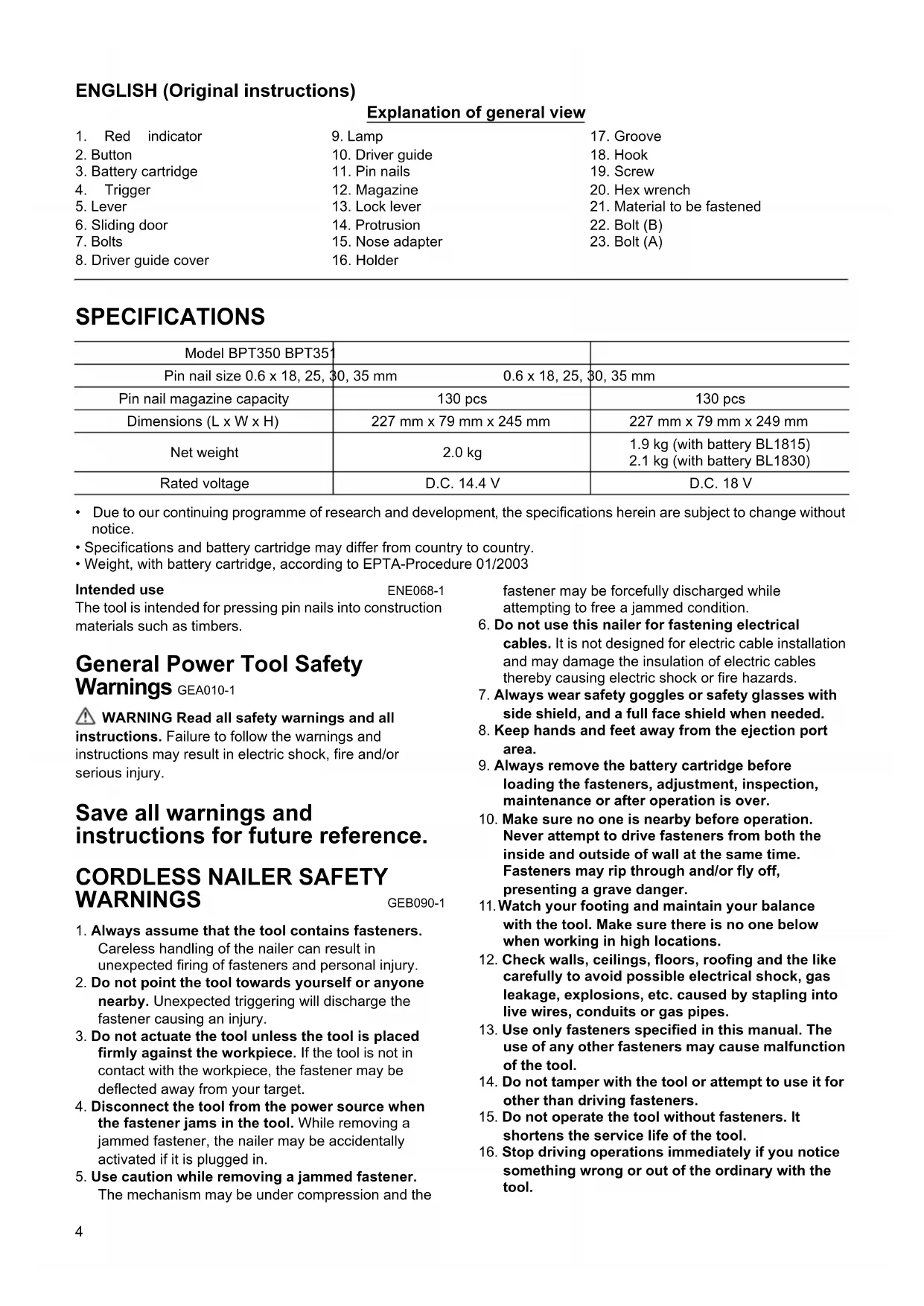
ENGLISH (Original instructions)
Explanation of general view
• Due to our continuing programme of research and development, the specifications herein are subject to change without
• Specifications and battery cartridge may differ from country to country.
• Weight, with battery cartridge, according to EPTA-Procedure 01/2003
The tool is intended for pressing pin nails into construction
materials such as timbers.
General Power Tool Safety
WARNING Read all safety warnings and all
instructions. Failure to follow the warnings and
instructions may result in electric shock, fire and/or
Save all warnings and
instructions for future reference.
CORDLESS NAILER SAFETY WARNINGS GEB090-1
1. Always assume that the tool contains fasteners.
Careless handling of the nailer can result in
unexpected firing of fasteners and personal injury.
2. Do not point the tool towards yourself or anyone
nearby. Unexpected triggering will discharge the
fastener causing an injury.
3. Do not actuate the tool unless the tool is placed
firmly against the workpiece. If the tool is not in
contact with the workpiece, the fastener may be
deflected away from your target.
4. Disconnect the tool from the power source when
the fastener jams in the tool. While removing a
jammed fastener, the nailer may be accidentally
activated if it is plugged in.
5. Use caution while removing a jammed fastener.
The mechanism may be under compression and the
fastener may be forcefully discharged while
attempting to free a jammed condition.
6. Do not use this nailer for fastening electrical
cables. It is not designed for electric cable installation
and may damage the insulation of electric cables
thereby causing electric shock or fire hazards.
7. Always wear safety goggles or safety glasses with
side shield, and a full face shield when needed.
8. Keep hands and feet away from the ejection port
9. Always remove the battery cartridge before
loading the fasteners, adjustment, inspection,
maintenance or after operation is over.
10. Make sure no one is nearby before operation.
Never attempt to drive fasteners from both the
inside and outside of wall at the same time.
Fasteners may rip through and/or fly off,
presenting a grave danger.
11. Watch your footing and maintain your balance
with the tool. Make sure there is no one below
when working in high locations.
12. Check walls, ceilings, floors, roofing and the like
carefully to avoid possible electrical shock, gas
leakage, explosions, etc. caused by stapling into
live wires, conduits or gas pipes.
13. Use only fasteners specified in this manual. The
use of any other fasteners may cause malfunction
14. Do not tamper with the tool or attempt to use it for
other than driving fasteners.
15. Do not operate the tool without fasteners. It
shortens the service life of the tool.
16. Stop driving operations immediately if you notice
something wrong or out of the ordinary with the
21. Material to be fastened
Pin nail size 0.6 x 18, 25, 30, 35 mm 0.6 x 18, 25, 30, 35 mm
Dimensions (L x W x H) 227 mm x 79 mm x 245 mm 227 mm x 79 mm x 249 mm
1.9 kg (with battery BL1815)
2.1 kg (with battery BL1830)
Rated voltage D.C. 14.4 V D.C. 18 V5
17. Never drive fastener into any materials which may
allow the fastener to puncture and fly through as a
18. Never actuate the switch trigger and safety lever
at the same time until you are prepared to fastener
workpieces. Allow the workpiece to depress the
safety lever. Never defeat its purpose by securing
the safety lever back or by depressing it by hand.
19. Never tamper with the safety lever. Check the
safety lever frequently for proper operations.
SAVE THESE INSTRUCTIONS.
DO NOT let comfort or familiarity with product (gained
from repeated use) replace strict adherence to safety
rules for the subject product. MISUSE or failure to
follow the safety rules stated in this instruction
manual may cause serious personal injury.
IMPORTANT SAFETY INSTRUCTIONS ENC007-7
FOR BATTERY CARTRIDGE
1. Before using battery cartridge, read all
instructions and cautionary markings on (1)
battery charger, (2) battery, and (3) product using
2. Do not disassemble battery cartridge.
3. If operating time has become excessively shorter,
stop operating immediately. It may result in a risk
of overheating, possible burns and even an
4. If electrolyte gets into your eyes, rinse them out
with clear water and seek medical attention right
away. It may result in loss of your eyesight.
5. Do not short the battery cartridge:
(1) Do not touch the terminals with any
conductive material.
(2) Avoid storing battery cartridge in a container
with other metal objects such as nails, coins,
(3) Do not expose battery cartridge to water or
A battery short can cause a large current flow,
overheating, possible burns and even a
6. Do not store the tool and battery cartridge in
locations where the temperature may reach or
exceed 50°C (122°F).
7. Do not incinerate the battery cartridge even if it is
severely damaged or is completely worn out. The
battery cartridge can explode in a fire.
8. Be careful not to drop or strike battery.
9. Do not use a damaged battery.
SAVE THESE INSTRUCTIONS.
Tips for maintaining maximum battery life
1. Charge the battery cartridge before completely
Always stop tool operation and charge the battery
cartridge when you notice less tool power.
2. Never recharge a fully charged battery cartridge.
Overcharging shortens the battery service life.
3. Charge the battery cartridge with room
temperature at 10°C - 40°C (50°F - 104°F). Let a hot
battery cartridge cool down before charging it.
4. Charge the battery cartridge once in every six
months if you do not use it for a long period of
FUNCTIONAL DESCRIPTION CAUTION:
• Always be sure that the tool is switched off and the
battery cartridge is removed before adjusting or
checking function on the tool.
Installing or removing battery cartridge
• Always switch off the tool before installing or removing
of the battery cartridge.
• To remove the battery cartridge, slide it from the tool
while sliding the button on the front of the cartridge.
• To install the battery cartridge, align the tongue on the
battery cartridge with the groove in the housing and slip
it into place. Always insert it all the way until it locks in
place with a little click. If you can see the red indicator
on the upper side of the button, it is not locked
completely. Install it fully until the red indicator cannot
be seen. If not, it may accidentally fall out of the tool,
causing injury to you or someone around you.
• Do not use force when installing the battery cartridge. If
the cartridge does not slide in easily, it is not being
• Make sure all safety systems are in working order
before operation. Failure to do so may cause personal
Test safety systems for possible faulty operation before
pin-nailing as follows.
1. Make sure that the tool is not loaded with pin nails
2. Pull the sliding door of the magazine toward yourself.
3. The tool accidentally operates if only the trigger is
pulled although the lever is not pulled.
4. The tool does not operate when the trigger is pulled
with the lever pulled.
In case of 3 and 4 above, the safety systems are faulty.
• Before inserting the battery cartridge into the tool,
always check to see that the switch trigger actuates
properly and returns to the “OFF” position when
The tool is provided with lever as a safety system in
addition to the usual trigger. (Fig. 5)6
To fire pin-nails, first pull the lever and then pull the
Adjusting the depth of pin-nailing
• Always make sure that your fingers are not placed on
the trigger or the lever and the battery cartridge is
removed before loading the pin nailer. (Fig. 6)
Depth of pin-nailing can be adjusted on this pin nailer.
Turn two bolts a quarter turn using the hex wrench
provided with the tool and the driver guide cover will slide
up or down. Depth can be adjusted 1.5 mm to the
maximum. At desired depth, secure it with two bolts firmly.
Lighting up the lamps
• Do not look in the light or see the source of light
To turn on the lamp, pull the lever. Release the lever to
• Use a dry cloth to wipe the dirt off the lens of lamp. Be
careful not to scratch the lens of lamp, or it may lower
• Even if the lamp lights up when the battery power
residual gets small, pin nailer may not fire pin nails. In
this case, charge the battery cartridge.
Anti-dry firing device
• Always make sure that your fingers are not placed on
the trigger or the lever and the battery cartridge is
removed before loading the pin nailer.
When the number of remaining pin nails in the magazine
are 0 - 3 pcs., the trigger can no longer be pulled. At this
time, insert a new strip of pin nails in the magazine and
the trigger can be pulled again.
• When firing a different length of pin nails shortly after
the anti- dry firing device has actuated, insert a new
strip of pin nails into the magazine and fire away all the
prior pin nails that have remained on junk material.
• Always make sure that your fingers are not placed on
the trigger or the lever and the battery cartridge is
removed before carrying out any work on the pin nailer.
Loading the pin nailer
• Always make sure that your fingers are not placed on
the trigger or the lever and the battery cartridge is
removed before loading the pin nailer.
• Do not abruptly slide the magazine of the pin nailer
loaded with pin nails. Accidentally dropping pin nails
especially when working in high places may cause
• Load pin nails in the correct direction. Loading in wrong
direction may cause premature wear and tear of the
driver and damage of the other parts. (Fig. 8)
Remove the battery cartridge.
Press the locking lever and slide the magazine.
Place pin nails against the magazine and insert into the
slit all the way. (Be careful to place pin nails in the right
Keeping pin nails in this position, insert these nails all the
way into the driver guide.
Return the magazine to the original position and lock it
with the locking lever.
• Do not use deformed connected pin nails. Use pin nails
specified in this manual. Using pin nails other than
those specified may cause pin nail jamming and
breakage of the pin nailer.
Unloading pin nailer
• When removing pin nails, make sure that your fingers
are not placed on the trigger or the lever and the
battery cartridge is removed from the pin nailer.
Misfiring may cause personal injuries and property
Remove the battery cartridge.
Press the locking lever and slide the magazine.
Take out pin nails from the magazine slit.
• Always make sure that your fingers are not placed on
the trigger or the lever and the battery cartridge is
removed before installing the nose adapter. (Fig. 9)
When firing pin nails on the material to be fastened with
easily-marred surfaces, use the nose adapter. To install
the nose adapter, place it over the driver guide cover so
that the protrusion inside the nose adapter fits to the slit in
the driver guide cover.
When not in use, store the nose adapter in the holder at
the back end of the magazine to keep it from being lost.
• Always make sure that your fingers are not placed on
the trigger or the lever and the battery cartridge is
removed before using the hook. (Fig. 10)
• Do not hang the hook from the waist belt. Dropping the
pin nailer, which is caused by the hook accidentally
coming out of place, may cause misfiring and personal
The hook is convenient for temporarily hanging the tool.
This can be installed on either side of the tool.
To install the hook, insert it into a groove in the tool
housing on either side and then secure it with a screw.
To remove, loosen the screw and then take it out.
Hex wrench storage (Fig. 12)
When not in use, store the hex wrench as shown in the
figure to keep it from being lost.7
OPERATION Driving pin nails
• Before pulling the trigger, always make sure that the
opening that pin-nails are fired contacts material to be
fastened. Just pulling the trigger fires pin nails.
Misfiring may cause personal injuries. (Fig. 13)
Place flat the opening of the tool that pin-nails are fired on
the material to be fastened and hold the tool firmly against
the material. Then pull the lever and then pull the trigger
fully to drive the pin nail. The grip is shaped so that the
tool head can be held down securely with index finger and
thumb. After driving a pin-nail, be sure to release the
trigger fully. (Fig. 14)
When the head of driven pin-nail remains above the
surface of the material, drive the pin-nail while holding the
pin nailer head firmly.
• When the trigger is pulled after a quick trigger action,
the nailer may do nothing but operates momentarily
and may not fire pin nails. This is not a trouble. At this
time, release the trigger once, pull it again and the pin
• Using the pin nailer continuously with the head of fired
pin nails remaining above the surface of material to be
fastened may cause damage to the driver of the pin
nailer and nailer jamming etc.
Removing jammed pin nails
• Always make sure that the lever is released and the
battery cartridge is removed before removing jammed
Remove the battery cartridge from the pin nailer.
Take out pin nails that remain inside the magazine.
Loosen bolt (A) and bolt (B) by turning them
approximately two turns using the hex wrench provided
with the pin nailer.
Remove driver guide cover by sliding it.
Remove stuck pin nails, debris, adhesives and woodchips
etc. from the passage for pin nails.
Check the driver guide cover for stuck pin nails or other
foreign matters and then secure it with these two bolts.
MAINTENANCE CAUTION:
• Always be sure that the tool is switched off and the
battery cartridge is removed before attempting to
perform inspection or maintenance.
• Never use gasoline, benzine, thinner, alcohol or the
like. Discoloration, deformation or cracks may result.
• To maintain product SAFETY and RELIABILITY,
repairs, any other maintenance or adjustment should
be performed by Makita Authorized Service Centers,
always using Makita replacement parts.
OPTIONAL ACCESSORIES CAUTION:
• These accessories or attachments are recommended
for use with your Makita tool specified in this manual.
The use of any other accessories or attachments might
present a risk of injury to persons. Only use accessory
or attachment for its stated purpose.
If you need any assistance for more details regarding
these accessories, ask your local Makita Service Center.
• Various type of Makita genuine batteries and chargers
• Some items in the list may be included in the tool
package as standard accessories. They may differ
from country to country.
The typical A-weighted noise level determined according
Sound pressure level (L
The noise level under working may exceed 80 dB (A).
Sound pressure level (L
Uncertainty (K): 3 dB (A)
The noise level under working may exceed 80 dB (A).
Wear ear protection.
The vibration emission value determined according to
Vibration emission (a
• The declared vibration emission value has been
measured in accordance with the standard test method
and may be used for comparing one tool with another.
• The declared vibration emission value may also be
used in a preliminary assessment of exposure.
• The vibration emission during actual use of the power
tool can differ from the declared emission value
depending on the ways in which the tool is used.
• Be sure to identify safety measures to protect the
operator that are based on an estimation of exposure in
the actual conditions of use (taking account of all parts
of the operating cycle such as the times when the tool
is switched off and when it is running idle in addition to
For European countries only
EC Declaration of Conformity
We Makita Corporation as the responsible
manufacturer declare that the following Makita
Designation of Machine:
Model No./ Type: BPT350, BPT351
are of series production and
Conforms to the following European Directives:
And are manufactured in accordance with the following
standards or standardised documents:
The technical documentation is kept by our authorised
representative in Europe who is:
Makita International Europe Ltd.
Michigan Drive, Tongwell,
Michigan Drive, Tongwell,
Michigan Drive, Tongwell,
Michigan Drive, Tongwell,
WAARSCHUWING Lees alle
Michigan Drive, Tongwell,
Michigan Drive, Tongwell,
Michigan Drive, Tongwell,
Vibrationsemission (a
Michigan Drive, Tongwell,
Michigan Drive, Tongwell,