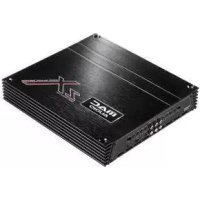
ZX 4000 - Receiver MAC AUDIO - Free user manual and instructions
Find the device manual for free ZX 4000 MAC AUDIO in PDF.

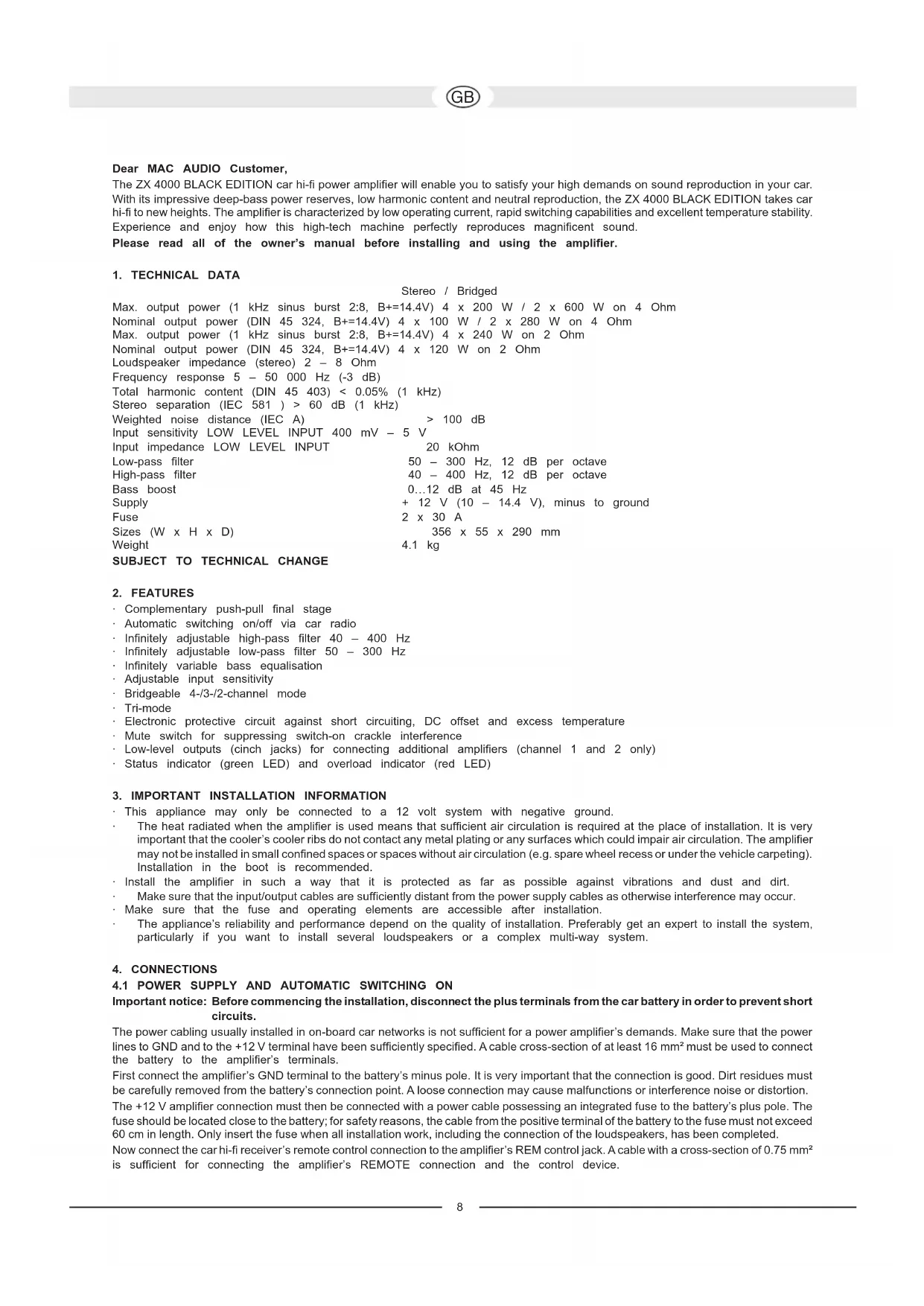


| Product type | 4-channel car amplifier |
| Brand | Mac Audio |
| Model | ZX 4000 |
| Maximum output power (4 ohms, stereo) | 4 x 200 W |
| Maximum output power (4 ohms, bridged) | 2 x 600 W |
| RMS power (4 ohms, stereo, DIN 45 324) | 4 x 100 W |
| RMS power (4 ohms, bridged, DIN 45 324) | 2 x 280 W |
| Maximum power (2 ohms, stereo) | 4 x 240 W |
| RMS power (2 ohms, stereo, DIN 45 324) | 4 x 120 W |
| Speaker impedance (stereo) | 2 - 8 ohms |
| Frequency response | 5 - 50 000 Hz (-3 dB) |
| Total harmonic distortion | < 0.05% (1 kHz) |
| Signal-to-noise ratio | > 100 dB (IEC A) |
| Input sensitivity (Low Level) | 400 mV - 5 V |
| Input impedance (Low Level) | 20 k ohms |
| Low-pass filter | 50 - 300 Hz, 12 dB/octave |
| High-pass filter | 40 - 400 Hz, 12 dB/octave |
| Bass Boost | 0 - 12 dB at 45 Hz |
| Supply voltage | 12 V (10 - 14.4 V), negative ground |
| Fuse | 2 x 30 A |
| Dimensions (W x H x D) | 356 x 55 x 290 mm |
| Weight | 4.1 kg |
| Operating modes | 4 channels, 3 channels, 2 channels bridged, Tri-mode |
| Auto turn-on | Yes (via REM signal from car stereo) |
| Protection | Short circuit, thermal overload, DC offset |
| LED indicators | Green (operation), Red (overload) |
| Additional outputs | RCA outputs (channels 1 and 2) for additional amplifiers |
Frequently Asked Questions - ZX 4000 MAC AUDIO
User questions about ZX 4000 MAC AUDIO
0 question about this device. Answer the ones you know or ask your own.
Ask a new question about this device
Download the instructions for your Receiver in PDF format for free! Find your manual ZX 4000 - MAC AUDIO and take your electronic device back in hand. On this page are published all the documents necessary for the use of your device. ZX 4000 by MAC AUDIO.
USER MANUAL ZX 4000 MAC AUDIO
ZX 4000 Black Edition
4 KANAL LEISTUNGSVERSTARKER
4 CHANNEL POWER AMPLIFIER
AMPLIFICATEUR DE PUISSANCE 4 CANAUX
At the end of the product's useful life, please dispose of it at appropriate collection points provided in your country.
The ZX 4000 BLACK EDITION car hi-fi power amplifier will enable you to satisfy your high demands on sound reproduction in your car. With its impressive deep-bass power reserves, low harmonic content and neutral reproduction, the ZX 4000 BLACK EDITION takes care of new heights. The amplifier is characterized by low operating current, rapid switching capabilities and excellent temperature stability. Experience and enjoy how this high-tech machine perfectly reproduces magnificent sound.
Please read all of the owner's manual before installing and using the amplifier.
1. TECHNICAL DATA
Stereo / Bridged
Max. output power (1 kHz sinus burst 2:8, B+=14.4V) 4 x 200 W / 2 x 600 W on 4 Ohm
Nominal output power (DIN 45 324, B+=14.4V) 4 x 100 W / 2 x 280 W on 4 Ohm
Max. output power (1 kHz sinus burst 2:8, B+=14.4V) 4 x 240 W on 2 Ohm
Nominal output power (DIN 45 324, B+=14.4V) 4 x 120 W on 2 Ohm
Loudspeaker impedance (stereo) 2 - 8 Ohm
Frequency response 5 - 50 000 Hz (-3 dB)
Total harmonic content (DIN 45 403) < 0.05% (1 kHz)
Stereo separation (IEC 581) > 60 dB (1 kHz)
Weighted noise distance (IEC A) > 100 dB
Input sensitivity LOW LEVEL INPUT 400 mV - 5 V
Input impedance LOW LEVEL INPUT 20 kOhm
Low-pass filter 50 - 300 Hz, 12 dB per octave
High-pass filter 40 - 400 Hz, 12 dB per octave
Bass boost 0...12 dB at 45 Hz
Supply +12V 10-14.4 V), minus to ground
Fuse 2x30A
Sizes (W x H x D) 356 x 55 x 290 mm
Weight 4.1 kg
SUBJECT TO TECHNICAL CHANGE
2 FEATURES
- Complementary push-pull final stage
Automatic switching on/off via car radio - Infinitely adjustable high-pass filter 40 - 400 Hz
- Infinitely adjustable low-pass filter 50 - 300 Hz
- Infinitely variable bass equalisation
Adjustable input sensitivity - Bridgeable 4-/3-/2-channel mode
- Tri-mode
Electronic protective circuit against short circuiting, DC offset and excess temperature - Mute switch for suppressing switch-on crackle interference
Low-level outputs (cinch jacks) for connecting additional amplifiers (channel 1 and 2 only) - Status indicator (green LED) and overload indicator (red LED)
3. IMPORTANT INSTALLATION INFORMATION
- This appliance may only be connected to a 12 volt system with negative ground.
The heat radiated when the amplifier is used means that sufficient air circulation is required at the place of installation. It is very important that the cooler's cooler ribs do not contact any metal plating or any surfaces which could impair air circulation. The amplifier may not be installed in small confined spaces or spaces without air circulation (e.g. spare wheel recess or under the vehicle carpeting). Installation in the boot is recommended.
Install the amplifier in such a way that it is protected as far as possible against vibrations and dust and dirt.
Make sure that the input/output cables are sufficiently distant from the power supply cables as otherwise interference may occur. - Make sure that the fuse and operating elements are accessible after installation.
The appliance's reliability and performance depend on the quality of installation. Preferably get an expert to install the system, particularly if you want to install several loudspeakers or a complex multi-way system.
4. CONNECTIONS
4.1 POWER SUPPLY AND AUTOMATIC SWITCHING ON
Important notice: Before commencing the installation, disconnect the plus terminals from the car battery in order to prevent short circuits.
The power cabling usually installed in on-board car networks is not sufficient for a power amplifier's demands. Make sure that the power lines to GND and to the +12V terminal have been sufficiently specified. A cable cross-section of at least 16mm2 must be used to connect the battery to the amplifier's terminals.
First connect the amplifier's GND terminal to the battery's minus pole. It is very important that the connection is good. Dirt residues must be carefully removed from the battery's connection point. A loose connection may cause malfunctions or interference noise or distortion.
The +12V amplifier connection must then be connected with a power cable possessing an integrated fuse to the battery's plus pole. The fuse should be located close to the battery; for safety reasons, the cable from the positive terminal of the battery to the fuse must not exceed 60 cm in length. Only insert the fuse when all installation work, including the connection of the loudspeakers, has been completed.
Now connect the car hi-fi receiver's remote control connection to the amplifier's REM control jack. A cable with a cross-section of 0.75mm2 is sufficient for connecting the amplifier's REMOTE connection and the control device.
4.2 AUDIO CABLES
When installing the audio cable between the cinch output of your car receiver and the cinch input of the amplifier inside your car, the audio and power supply cables should, wherever possible, not be routed along the same side of the vehicle. We recommend an isolated installation, e.g. routing the power cable through the cable duct on the left-hand side and the audio cable through the cable duct on the right-hand side or vice versa. This reduces interference due to crosstalk into the audio cables.
4.3 LOUDSPEAKER CONNECTIONS
In normal operating mode (i.e. one loudspeaker on each individual amplifier channel), the lowest terminal resistance is 2 ohm per channel.
In bridging mode (two amplifier outputs combined) the lowest terminal resistance doubles to 4 ohm.
The impedance in tri-mode may not fall below 2 ohm per channel.
- Never connect the loudspeakers' minus terminals to the vehicle chassis.
- Never connect the +12V supply voltage to a loudspeaker output as this would destroy the amplifier final stage. If the amplifier is operated with lower terminal resistances or incorrectly used as described above, both the amplifier and the loudspeakers may be damaged. The warranty becomes void in such cases.
5. OPERATING ELEMENTS AND IN/OUTPUTS
5.1 SETTING THE INPUT SENSITIVITY
The input sensitivity may be adapted to any car radio or tape deck. Turn the volume control of your radio to its central position and then adjust the input-level controls (5) and (9) to produce an average medium volume. This setting usually provides sufficient power reserves at optimum weighted noise voltage.
ATTENTION: only reproduce loud test noises briefly to prevent damaging the loudspeakers.
5.2 LOW-PASS FILTER WITH ADJUSTABLE CROSS-OVER FREQUENCY
If the amplifier is used as a subwoofer amplifier, set the switch (1)/(13) to "LPF". Set the desired cross-over frequency using the control (2)/(12). This makes the filter adaptable to the installed woofer's sound requirements.
The filter's high edge steepness is responsible for the precision reduction of medium and high frequency ranges.
5.3 HIGH-PASS FILTER WITH ADJUSTABLE CROSS-OVER FREQUENCY
If the amplifier is to be used as an amplifier for satellite loudspeakers (mid-range/tweeter loudspeakers), set switch (1)/(13) to "HPF". Set the desired cross-over frequency using the control (3)/(11). Only the frequencies above the set cross-over frequency will then be amplified. This effectively minimizes distortions caused by excessive membrane movement at low frequencies and small satellite loudspeakers without reducing the bass level.
5.4 BASS-BOOST
The bass-boost function (4/10) is used to increase or equalize the lower bass frequencies.
5.5 OUTPUTS FOR CONNECTING ADDITIONAL AMPLIFIERS
The input signal of the INPUT connections CH1 / CH2 (6) is forwarded directly to the OUTPUT (7) jacks. The OUTPUT connections allow the use of additional amplifiers without requiring additional T-plugs and cables.
FIG. 1 POWER SUPPLY / REMOTE SWITCH-ON CONNECTIONS
(1) Terminal for +12V battery voltage
(2) REM terminal for remote switch-on
(3) GND terminal for the ground, to the battery's minus pole
(4) Battery
(5) Cable fuse
(6) To your car radio's automatic aerial connection If your car is not equipped with an automatic aerial connection, connect this cable's plus pole (+) to the ignition lock. An on/off switch should be inserted in this case. Make sure that this switch is switched off if the amplifier is not used.
FIG. 2 4-CHANNEL MODE
Connect and set the amplifier as shown in Fig. 2 if it is to be controlled by a car radio with four output channels and used with four loudspeakers:
(1) To the car radio, front left output
(2) To the car radio, front right output
(3) To the car radio, rear left output
(4) To the car radio, rear right output
(5) Front left loudspeaker
(6) Front right loudspeaker
(7) Rear left loudspeaker
(8) Rear right loudspeaker
FIG. 3/4 3-CHANNEL MODE
The 3-channel mode uses the high-pass filter for channels 1/2 and the low-pass filter for Channels 3/4 . Section 5 describes how they are used.
FIG. 3
Connect and set the amplifier as shown in Fig. 3 if it is to be controlled by a car radio with stereo output and used with stereo satellite loudspeakers and a subwoofer.
(1) To the car radio, left output
(2) To the car radio, right output
(3) Left satellite loudspeaker
(4) Right satellite loudspeaker
(5) Subwoofer
FIG. 4
Connect and set the amplifier as shown in Fig. 4 if it is to be controlled by a car radio with stereo receiver and separate subwoofer output and used with stereo satellite loudspeakers and a subwoofer.
(1) To the car radio, left output
(2) To the car radio, right output
(3) To the car radio, subwoofer output
(4) Left satellite loudspeaker
(5) Right satellite loudspeaker
(6) Subwoofer
FIG. 5 2-CHANNEL MODE
If the amplifier has to generate more power to operate two subwoofoers, connect and set it as shown in Fig. 5. The use of the low-pass filter used is described in Chapter 5.
(1) To the car radio, left output
(2) To the car radio, right output
(3) Subwoofer
(4) Subwoofer
FIG. 6 USE AS AN AMPLIFIER FOR FOUR SATELLITE LOUDSPEAKERS AND A SUBWOOFER USING AN ADDITIONAL 1-CHANNEL AMPLIFIER (ZX 1000 BLACK EDITION)
(1) To the car radio, front left output
(2) To the car radio, front right output
(3) To the car radio, rear left output
(4) To the car radio, rear right output
(5) Front left loudspeaker
(6) Front right loudspeaker
(7) Rear left loudspeaker
(8) Rear right loudspeaker
(9) Subwoofer
FIG. 7 OPERATING ELEMENTS AND IN/OUTPUTS
(1) HPF (high-pass filter) / LPF (low-pass filter) / OFF option switch for channel 1/2
(2) Cross-over frequency control for the low pass (channel 1/2)
(3) Cross-over frequency control for the high pass (channel 1/2)
(4) Bass-boost control (channel 1/2, front)
(5) Input-level control channel 1/2
(6) Low-level inputs (channel 1/2, front)
(7) Low level outputs (channel 1/2)
(8) Low-level inputs (channel 3/4, rear)
(9) Input-level control channel 3/4
(10) Bass-boost control (channel 3/3, rear)
(11) Cross-over frequency control for the high pass (channel 3/4)
(12) Cross-over frequency control for the high pass (channel 3/4)
(13) HPF (high-pass filter) / LPF (low-pass filter) / OFF option switch for channel 3/4
(14) Channel mode selector switch
Cher client de MAC AUDIO,
Ave 4000 Bk 1000 5000 5000 5000 5000 5000 5000 5000 5000 5000 5000 5000 5000 5000 5000 5000 5000 5000 5000 5000 5000 2
Dimensioni (L x A x P)
Peso
60 dB (1 kHz)
100 dB
400 mV - 5 V
20 Kohm
Ybaxaembl nokynateNB MAC AUDIOa,
Pnno6peHne ycnnteMa Moochtn DnA BtOMo6nla C BbICOKKauecTbeHHbIM BOCnpOn3BeDeHem 3Byka ZX 4000 BLACK EDITION Da Bam Bo3MOxHocThyDobJeBopntb Baun BbICOaHnne Tpe6OBaHnK BOCnpON3BeDeHnIO 3Byka B aBtOMo6nIe HnnnyuHmM 0pa3OM.
ZX 4000 BLACK EDITION OTKpbIbAeT HOBIE ROPIN3OHTbl KaeeCTBa BbICOKOTOHORBOCnpon3BeDEHn 3ByKa B aBTOMoBHNE; He3aBNCIMOTTO, INETNIpeYb O BneaTJNIOUeM pe3epBE MoUHOCTN HN3KHX YACTOT, O HN3KOM Ko3ΦDcHNeHTe HENHeHbIX NcKaJehn INHNHeITpAlbHom BOCPON3BeDEHn. UCNINTeB OTNlueTcN HN3KIM TOKOM Bo36yXdEh, CNOcObHocTbO b6tPrO nepeKJIouHEnn INOTNIHn TEMnepaTyHOn CTaNbHObctBo. IPOuyCBTByIte, KAKoe BeNIOKOLJeHn BOcnpraTbe 3ByKa B cOBepWeHCTBe MoKeT oBeCneuHTB Bam 3TO yCTpoiCTBO, COzDAHnOE NO COBpeMeHHo TExHONOrn. Mbl XeNaEM Bam orpOMHOro yDOBOJbCTBn!
Ipexe qem Haatb yctahOBky ycHnten I BBectn ero B 3KcNpyatauio, npouHTaTe, noxanynta, pykoBocTBO no yctaHO do KOHua.
1. TEXHnueCKNE DAHHbIE
CTepeo / uepe3 nepeMbIky
MaKc. BbXoHnA MoUHocTb (1 KfSinus Burst 2:8, B+ = 14,4B ) 4 x 200 BT / 2 x 600 Bt k 4 OM
HomHaBna BbXoHnMa MoHocTb (DIN 45 324, E + = 14,4B) 4x100BT/2x280BTk4OM
MaKc. BbXoHna MoUHocTb (1 KTu Sinus Burst 2:8, B+=14,4B) 4 x 240 BT K 2 OM
HOMHaJIbHaBbIXOHaMaMoUHocTb(DIN45324,B+=14,4B) 4x120BT K2OM
NoHoe cnpotnBHeHne rpoMkoRbOpuTeTna (cTepeo)
Yactotha xapaktepuCTnka
06uKo3ΦΦnIeHT HeJIHHeHbIX NCKaXeHN (DIN 45
NepexoHoe 3atyxaHne (IEC 581)
OTHOSeHHe CnHAn/UmM (IEC A)
UyBCTBUNbHOCtHa BxOe LOW LEVEL INPUT
BxodHoe nonHoe conpoTnBHeHne LOW LEVEL INPUT
HnBtp HxKHXx YactOT
ΦnBtp BepxHux YactOT
YcHHeHHe Hn3Knx YactOT (Bass-Boost)
Питане
PpeoXpaHnteB
Pa3Mepbl (U x B x F)
Bec
2-8OM
5-50 000 Γ(3D)
< 0.05% (1 kT)
60dB(1KΓU)
100
400 MB - 5 B
20 KOM
50-300T4,12DHa OKTaby
-400T,12Hn OKTaby
0...12 AB npn 45 T
BO3MOXHbI TEXHNUeCKNE 3MEHEHNA
2.OCOSEHHOCTN
3. BAXHAR INHOPMAUINIPEUDYCTAHOBKOH
- DOnONHHTeBHBn DBYXTaKTHbN BbIXoHNo KaKaI
AbTomaTHueeKoe BkHoueHne/BbIKJIOueHHe Yepe3 aBTopaIIOnpMnIK
PnabHo perynpyemblc fnlbtpbl BepxHx qactOT 40 do 500 T
PnabHO perynpemybte nIbtpbl HxhHxuacto 50 do 250
PnabHo perynpyemar KoppeKun Hn3Kxu ActOT
Perynpyemar yBCTBnteIbHOCtBa BXOe
Bo3MOxHocTb nepeMbikHn4, 4-/3-/2-kaHaBbHbI peKIM
Tpmon-pekm (Tri-Mode)
3NeKtpoHHa CXema 3aunTbI OT KOpOTKOro 3ambKaHn, CMeueHn NOCTOHHORo HnprjKeHn n nepepeBa
Hemar cxema nnoaBJeHH Tpecka npn BkNoeHH
BbIXoDb C Hn3Km yPoBHe m nepeKnIOeHn (Cinch-rHc3da) nI NOkNIOeHn DOONHITeNbHbX ycNITeNe (KaHa1 1/2)
HdkaPpeKMa (3eHbCBeToNDo) HnHdkaTOp neperpy3Kn (KpaChb CBeToNDo).
To yctpoiCTBO npedHa3HaeHo NCKHouHTeBHO DnI NOKIOUeHnK 12-BOJbTHoN CNTeMe COTPiuaTeJIbHO MAccO.
BcBraC BbDeneHem Tennn npo Odae MouHocTn, Ha MeTe dno MOHTaKa DOnKHa 6bItb DoCTaTOHHa LInpKynpaN BO3dyxa.
Oueh Baxho, OTO6bI oxnaJdaHounepe6pa TnnooTbOa He Kacannb Metanuuecko nn npyro nOBepxHocTN, H3-3a Yero Mo 6bl 6blb OrpauHHe NaPKyIaun Bo3dyxa. Henb3y yCTaHabINBaB yCnInTeB B MaIbIX nII He BeHTnInpyEmbIX NIOCTRX (HanB bYrny6IeHHn drr 3aNaCHoro KOleca IIN NOKOBPOBBIM NOKpbITMe ABTomobJIy). PekOMeHdyETcpa3MaeeHne B 6baraxHke.
YcTahabINBaIte YcINITeB TaKIM O6pa3OM, YTO6bI OH 6bl XOPOo 3aUuH EHT Bn6paun, OT NIIIN Ipr3N.
CneIe 3a TEm, YTObI KaBEn BxOda/BbIXoHa HaxOINrca Ha DCtAToHOM paCCToHn OT KaBEn 3NeKtpOnHnra, TAK KAK 3TO MoKeT PnBecTu K O6nyehu, Bb3bBaUeMy NOMexN.
Cneinte 3a Tem, TTo6bI npedoxpAHTeN I OprAhbl npabJIeHNOCTaBAINCB Nocme MOHTaKa IOCTyINHbIMN.
Pa60a NnAedEHHocTb yCTaHOBKn HaxoDITcB nPraMoN 3aBNCIMOCtN OT KaueCTBa MoHTaKa. BblIe 6bl IpeDnOHTeJIbHO npuyNTb MOHTaK CneuAnIncty, oObeHNO, ecn peYb NdET ob yCTaHOBKe C HeCKoJbKIMN rPOMKOfOBOpTeJIaM NIN O KOMJIeKCHO MHorocToPOHNHe cNCTeme.
4.BXOdbI N BblOXdbI
4.1 3JEKTPONITAHNE IN ABTOMATNA KBIIOUEHNR
Baxhna ccbIka: PpexJe yem hauatb ycTaHOBky Bbl dOnxHbl OTcoeHNHTb NOLOXHTJIbHbI 3aXIM aBTOMo6nIbHorO aKkymyIraTopa, YTO6bl n36ExaTb KopoTKnx 3AmIkaHn.
O6bIyHnA DnA aBtOMoBnBHO 6OpTOBoi CeTn Ka6eNbHa pa3BODka AByIeTcH HeDcTaOuHOn I nI NOTpe6HoCTe MoUHorO yCNITeJI. CTeIte 3a TeM, YTo6bl pa3Mepebl 3NeKtpoPBOdKn K 3a3emJIOuei 1nHe (GND) n K +12B-3aXmMy 6bln DoCTaOHTbIM. Ipn CoedINHeHnA kKymIpyTopa C 3JeKtpnueckmN 3aKmAMn ycJIInTeJI peKOMeHdyETc npImeHrBa Ka6eNb c nonepuHbIM ceHHeM MHNMyM 16 mm².
Chayana Bam Heo6xodnmo coeHNHTb 3axm 3aemnlouei shhbl (GND) ycHnntenc mHycobO klemmo aKKymnyTopopa. Oehb Baxho yctahOBtB npouHoe coeHNHeHne. Klemma aKKymyTApOH 6aTape n DOnJHs KaTeNbHO ouuheHa ot 3arpzHeHH. Cbo60dHoe coeHNHeHne MoKeT Bb3BaTb cboi nn ShyMOBble nomexn u NckaxKeHH 3Byka.
Tenepb 3axm ycnnten ha +12B nooCoeHnreTc 3neKtpokabeem C nHTerpnpOBaHHbIM npdoxpaHnten m K noIOXHTbHO KnEMM aKKymyItope. Ipeoxpanhtb doJKeH haoDntc B6bn3n akymnyItope, dInHa Ka6ben O nOIOXHTbHO rnoCa aKKymyItope do npdoxpaHnte JOnJx 60 cm. Ppeoxpanhtb DoJKeH 6bItb yCTaHOHe NnBn 3abephenr Bex pa6ot no MoTacky, BkIOUOa naKIOUOHe rpoMKorOBopTe ne.
Tenepb nooCoeHNHte Ka6enb nctaHnOHoro ynpabHeHra bTomO6nHoro HiFi-npemHka K rhe3dy npabHeHRA REM ycInTeHa.
Ira coeHHeHMaexdy BBOOM REMOTE ycInTeHa n ynpabJIouzIM ycToPcTBOM DocTaTOeH Ka6eJb c nonpeuHbIM ceHHeMe 0,75 MM2.
4.2 AYDNOKABENb
Pn moTatae aydnokabema MeKdy BbXoDM Cinch abTOMobunbHoro padonnpemHnka n BxOdom Cinch ycInntenB aBTOMoBne Cteintb 3a Tem, yTo6bl aydnokabebn I TOKOOnDBoJusnn Ka6ebn NO BO3MOXHOCTn He npKnaDbIbAINcH b Ha ToI Ke CTOpOHe aBTOMoB NpyuHm peSeHHem ABJeTcra OTdeNbHb MOHTax, T.e. npKnaJaKa TKONODBoJzero Ka6eR B neBOi Ka6eBHOJ hXtTe n npOKnAdka aydnokabena B npABoB Ka6eBhoH oXaTe nn HAObOpot. TakIM o6pa3om cHnkaeTcra onachoctb nepeKpcthBix nomEx 3ByKOBOrO cnHana.
4.3 NOOKJIIOUeHnI rPOMKOrOBOpTEJEn
B HopMaJIbHOM pexIme pa6OBy (T.e. no OndHomy rpoMkoROBOpTeIHO Ha oIN H KaHaN yCnInTeIa) HAmMeHbJee Harpy3oHoe copoTnBHeHne paBHO 2 Om Ha oIN KaHaI.
BpeKIme nepembyKn (coBmecThoe BKNIOueHne COOTBeTCTBeHHO DByX BblxOIOB ycNNTeJI) HAnMeHbWee Harpy3oHoe coppoTnBHeHne yDbaaBaETcra 4 OM.
BpeKMe TpIMoI NOJIHoe COIpOTnBnEHNHe DOJXHO 6bITb He HnKe 2 OMaOnn KaHaJI.
Hn B Koem cnyae He NpOcEINHrTe MmHycOBbIe KJIeMMbl rPOMKOrOBOpHTeJI K WACCn aBTOMoBnJIA.
HnB KoeM cnyae He coeunrte HaprrkHe nntaHn +12BC bixoDm rpmKorOBopTeTn. 3To Beet K pa3pyeHIO BixOHO KAckada ycnIHTeJIa.
Ecn ycnntenb 3knpyatpyetc c 60one Hn3Km COnpoTnBHeHem Nn HnPaBnBHo, KaO nCaHO Bblwe, To 3To MoKeT npne K nobpeJdeHIO kak camoro ycunnteJI, taK n rpmkoROBOpTeJI. B 3tOM cnYae rapaHTn nponaadaet.
5. 3NEMEHTbI CNTTEMbl YNPABJIENH N BXObl/BblXObl
5.1 PEGYUNPOBKA YBCTBNTBJHOCTN HA BXODE
YyBCTBnTeNbHocb Ha BxOe MoKet 6bTb noOrHaHa K IIObOMy ABTomOBnHOMy paDOnpneMHNky Nn ABToMaHHTone. NObepHntpepyIaTrop rPomKocTN BaWero padOnnpemHKa do cpeHNbI n HAcTpOte peryIaTOp BXoHDoro yPoBn (5) n (9) TakIM oBa3OM, YTO6bI NOJyHnacb CpeHra rPomKocTB. O6bUHO TAKa HAcTpOka ObecneHnBaET DOCTaOHTb pe3epB MOuHOCTHn np ONTMaJIbHOMOTHOseHHn CnHaI/7ym.
BHIMAHHE: TpOMKHe TcTcHnbl BKNHObTaTOJbKO Ha KOpOTKe BpeM YTO6bI H36ExaTb NOBpeXeHINr pOMKOROBOpTeNei.
5.2ФИьТР HIXKHXX YACTOT C PERYINPYEMO INPEXODHOU YACTOTO
Ecn ycnntelb nnonb3yetc B kaectBe ycintela drr rpmkorobopnta Hn3Kx qactoT, to Bam Heo6xmo nepeBHytb nepeKIOHTe (1)nn (13) ha ,LPF". YctahOBITE peyIATOPOM (2) nn (12) xenaemy npexoHyo qactoty. TAKIM o6pa30m pfnltp MoKeT 6bltpnncO6bHeN K 3ByKOBbIM Ntpe6HOCTM pImMeHReMO rpmkOROBOPTeA Dn Hn3Kx qactOT.
BbICOKa KpyTn3Ha pOHTa 0ncneHbaeToHoe cHKeHne CpeHNx N BbICOKx dHaNa3OHOB YactOT.
5.3ФИьТВЕРХИXЧАСТОСЕГУПУЕМОДЕPEXODHOUCHACTOTOJ
Ecni ycnntenb npedha3nueH dIy nCnObl3OBaHnB B KaeeCTBe ycNITeJI dIy CnyTHNKOBbIX rpOMKOROBOpTeJI (rpOMKOROBOpTeJI dIy cpeHNX/ BbcOKNX TOHO,TO Bbl DOnKbI nepeDlnHyTB nepeKnHouTeBI (1) HN (13) Ha,HPF". YcTaHOBtpepyrTOpOM (3) HN (11) JeaMyo nepexoHyu qactOTy. TaKIM o6pa3OM 6ydyT ycInHeBToNbKO qactOtBi BblE yctAHOBNeHHo nepexoHoi qactOtBl. TaK M 3ΦΦeKTINBHO CBecTN K MNHMMy NCKaKeHnB, BblBaHhBle CNIbKOM 60JIbUIM pa3MaxOM Mem6paHbI pni Hn3KNX qactOTax N MaIbIX pa3Mepax cnyTHNKOBbIX rpOMKOROBOpTeJI, He ChNkA ypOBHnH3KNX qactOT.
5.4 YCUNIEHNE HN3KNX YACTOT (BASS-BOOST)
C noMoIbI nepeKIOUaTeIy ycIIeHn IIN3KIX qACTOT (4 INI 10) MoXET 6bITb DOCTNHyTO IOdEpkINBaHne INI KOPPEKUNCAmbix HuaCTOT.
5.5 BbIXOdbI INI NOIKIOUOHEH Npynx YCNNTJEIe
BxOHOH CnHAN BBOIOB INPUT CH1 n CH2 (6) nepeDaetra Hapmyo K BbIXOBIM rHe3dAM OUTPUT (7). BbIXObl OUTPUT daIOI BO3MOXHOCTb NOKNUOeHnA pyrnx ycINHTeNe 6e3 DOONHITeBHoro T-WeKepa n Ka6en.
PNC.1 NOIDKIIIOUeyHnE 3JEKTPoNTAHnI IN DUCTAHLIOHOHOrO BKIOUeyHnR
(1) CoeHHTeBHaN KHeMa dIa HAnpJxHeHn aKkMyJrTopHo 6aTapeu +12 B
(2) CoeHHTeBna KEmma REM dIa TcHOnHO BKnHouHn
(3) CoeHnTeIbHaK NEmMa GND IaMaccbl, K MmHycOBoi K NEmMe aKKMyJrTopHO 6atape
(4) AkkymyIaTOPHa 6aTape
(5) Ka6eBbHb npeOxpaHnTeNb
(6) K BbOy aBtOMaTnecko aHTeHHb BaIero aBtOMobnIbHoro paDNopnpMnka Ecn BaIb aBtOMoBnIbHbI paDNOpnpMnIK He IMeET BBOda aBtOMaTnecko aHTeHHbI, To Bbl DOJKNbI NOcEOHNITb 3OT Ka6 noJOnKInTeNbHO KnEMMO (+) K 3Amky 3axirAHn. B 3TOM cNyae Heo6xOIMNO IpomExyTOOHoe BKIIIOueHe nepeKIOUaTeJIY «BKn./BbIK#. CneIte 3a Tem, YTo6bl 3TOT nepeKIOUaTeJIb HaxoINCR B BbIKIOueHHom COCTOHN, ecNI BHe nONb3yeTecb ycunntenem.
PNC.24-KAHAJbHbIPEKIM
Ecn ynpaBHeHne ycInTeIeM dONKHO BcTncb c ABtOMo6nIbHorO padonnpmHnka C 4-My BbIXoHbIMn KaHanaMn n K Hemy DoJNkHb5bItb noKJIuOeHb 4 rpOMKOrOBOpTeIe, TOrda cNeDyET npOn3BeCTn NoDCoeINHeHne n HAcTpOky kak NOKa3aHo Ha pnc.2:
(1)KabtopaOnnpMnky,BbIXoD cpepeNcneBa
(2)K aBTopaOnpMnky, BbIXoD cpeepn cnpBa
(3)KabTopaDnONpEmHnky,BbIXoDc3aDnCneBa
(4)K aBtopaIOnpIeMHNky,BbIXoI c3aIcnpaBa
(5)PomKorOBOpntIb cpeDn CneBa
(6)PomKorOBopnteNb cnepeDn cnpaBa
(7)POMKOROBOpTeIb c3aIcCneBa
(8)PomKorOBopnteB c3aDn cnpaBA
PNC.3/4 3-KAHANbHbIPEKIM
B 3-kaHaJIbHOM pexKHe M nI KaHaIOB 1/2 npImeHReTcA fNbTp BepxHIX qactOT, a dIy kaHaIOB 3/4 - fNbTp HxHIX qactOT. Ix npImeHHe OncaHO B ab3aue 5.
PNC. 3
Ecn ynpablenHe ycnntenem DoJHKHO Bectncb c ABTOMbHoro paHOpnemMnka co Ctepeo-BbxOdom n K Hemy doJHKb 6bItb noKIOeHb cyTHNKOBBe Ctepeo-rgomKOROBOPTei n rpmOKOROBOPTeI bIra H3Knx YactOT (Subwoofer), torda cneyet npon3Bectn noCoedHHeHne HacTpOky kak Noka3aHo Ha pnc. 3.
(1)K aBTOpaHNOpHmHNky,BbIXoD CneBa
(2)K aTopaAnOpnEmHnky,BbIXoD cnpaBa
(3) CnyTHNKOBbI rpOMKOROBOpNTeB cneBa
(4) CnyTHIKOBbI rPOMKOROBOpntJIb cnpaBa
(5)PpOMKOrOBOpntb Hn3KxuactOT
PNC. 4
Ecn ynpablenHe ycnntenem DoJxho Bectncb c ABTOmObnHoro paonnpMnka co Ctepeo-BbxOdom n OTJeNbHbIM BixOdom nI rpmKorOBopTeJI H3Knx YacTOT n K HeMy DoJxHbI b6tB NkInoueHb CnyTHNKOBble Ctepeo-rrpOMKOROBOpTeJI n rpmKorOBopTeJI dnn H3Knx YacTOT, TOrda cneDyET npOn3BeCTn NODcoEnHeHne n HactpOnky kak Noka3aHO Ha pnc. 4.
(1)K aBTOpaIOnpIeMHNky,BbIXoD CneBa
(2)K aTopaAnOpnEeMHNky,BbIXoD cnpaBa
(3)KabTopaIOnpIeMHNky,BbIXoHa rPOMKOrOBOpHTeNb dIy Hn3Knx qactOT
(4) CnyTHIKOBbI rpoMkoROBOpNTeNb cneBa
(5) CnyTHNKOBbI rPOMKOROBOpnteJb cnpaBa
(6)PomKorOBOpntb Hn3KxuactOT
PNC.52-KAHAJbHbIPEXKIM
Ecn ycnntenem dojxha 6bIb doctnHyta 6onbwa moohocb dny kcnnyataun Dbyx rpoKOROBpntene nH3knx qactOT,TO Heo6xoMo npOn3Bectn noCoeDHeHne n HactpoKy kaN oka3aHo ha pnc.5.BbO B deiCTBne npImeHReMOro fNtpa HxKnHex qactOT onncaH B rnaBe 5.
(1)KabtopaOnnpMnky,BbIXoD CneBa
(2)K aBTOpaAaONpneMnHky,BbIXoD cnpaBa
(3)POMKOROBOPHTeNb HN3KNX qACTOT
(4)PpOMKOrOBOpnteIb IINH3KNX qactOT
PNC.6 PEXKMM B KAYECTBE YCNJNTEJII DII4 CNYTHIKOBbIX TPOMKOROBOPTEJIEN I CABBYΦEA C IPNMEHEHEM DONOJIHNTeJIbHO 1-KAHAJbHO 1-KAHAJbHO 1-KAHAJbHO (ZX 1000 BLACK EDITION)
(1)KabtopaonnpMnky,BbIXoCpeepn CneBa
(2)K aBTopaIOnpIeMHNky, BbIXoI cpepeI cnpaBa
(3)KabTopaHnonpEmHKy,BbIXoC3aNcneBa
(4)K aBTopaDnOnpEeMHNky,BbIXoD c3aDn Cnpaba
(5) FrpomKorOBopntJIb cnepeDn CneBa
(6)PomKorOBopntel cnpeDn cnpBa
(7)PomKorOBopntJIb c3aIcneBa
(8)PomKorOBopnte b c3aDn cnpaBa
(9)POMKOROBOpHTeJIb HN3KxuactOT
PNC.7 3IEMEHTbICNTTEMbl YNPABJIENHn BXOdb/BlXOdbI
(1) Npeeknouateb: HPF (fmbtp Bepxhnx qactot) / LPF (fmbtp Hxhhnx qactot) / OFF dna KaHana 1/2
(2) Perynatop nepexoHno yactObl nIy hnltpa Hxhnx yactOT (kaHn 1/2)
(3) PerynTop nepexoHOn qactObl nna fmbtpa BepxHnx qactot (kana 1/2)
(4) PerynTop Bass Boost (kaHan 1/2, cnepeu)
(5) PeryIaTOp BxOdHoro ypoBn KaHaJa 1/2
(6) BxOdbHn3Koro ypOBHRA (KaHa1 1/2, cnepeDu)
(7) BbIXOdbI Hn3KOrO ypOBHn (KaHaJ 1/2)
(8) BxodbHn3Koro ypoBna (KaHaI 3/4, c3aDi)
(9) Peryntop BXoHoro ypOBHa KaHaJa 3/4
(10) Perynatop Bass Boost (kaHan 3/4, c3a#n)
(11) Perynatop nepexoHoi qactotbl dny fnbtpa BepxHnx qactOT (kaHan 3/4)
(12) PerynTop nepexoHou qactobI nIe nnbtpa HxHnx qactOT (KaHaI 3/4)
(13)ПepeknioateIb:HPF(ФиьтbpВерхнхчacToT)/LPF(ФиьтbpHнхнхчacToT)/OFFdЯKaHana 3/4
(14) IpeeknouaTeIb KaHaIbHoro peKIma
尊敬的MACAUID - 用户,
GB Congratulations! You have made a wise selection in becoming the owner of a Mac Audio HiFi equipment. Due to high quality Mac Audio products have earned an excellent reputation through the western world. And this high quality standard enables us to grant a 2-years warranty for Mac Audio HiFi products.
The equipments are checked and tested continuously during the entire production process. In case you have problems with your Mac Audio HiFi equipment, kindly observe the following:
- The guarantee period commences with the purchase of the component and is applicable only to the original owner.
- During the guarantee period we will rectify any defects due to faulty material or workmanship by replacing or repairing the defective part at our discretion. Further claims, and in particular those for price reduction, cancellation of sale, compensation for damages or subsequent damages, are excluded. The guarantee period is not altered by the fact that we have carried out guarantee work.
- Unauthorized tampering with the equipment will invalidate this guarantee.
- Consult your authorized dealer first, if guarantee service is needed. Should it prove necessary to return the component to the factory, please insure that the component is packed in original factory packing in good condition the quality control card has been filled out and enclosed with the component, your enclose your receipt as proof of purchase.
- Exclued from the guarantee are: - Illuminates - Wear parts - Shipping damages, either readily apparent or concealed (claims for such damages must be lodged immediately with forwarding agent, the railway express office or post office). - Scratches in cases, metal components, front panels, etc. (You must notify your dealer directly of such defects within three days of purchase.) - Defects caused by incorrect installation or connection, by operation errors (see operating instructions), by overloading or by external force. - Equipments which have been repaired incorrectly or modified or where the case has been opened by persons other than us. - Consequential damages to other equipments. - Reimbursement of cools, without our prior consent, when repairing damages by third parties.

Toutes nos félicitations!



- ZX 4000 Black Edition
- TECHNICAL DATA
- SUBJECT TO TECHNICAL CHANGE
- FEATURES
- IMPORTANT INSTALLATION INFORMATION
- CONNECTIONS
- POWER SUPPLY AND AUTOMATIC SWITCHING ON
- AUDIO CABLES
- LOUDSPEAKER CONNECTIONS
- OPERATING ELEMENTS AND IN/OUTPUTS
- SETTING THE INPUT SENSITIVITY
- LOW-PASS FILTER WITH ADJUSTABLE CROSS-OVER FREQUENCY
- HIGH-PASS FILTER WITH ADJUSTABLE CROSS-OVER FREQUENCY
- BASS-BOOST
- OUTPUTS FOR CONNECTING ADDITIONAL AMPLIFIERS
- 1 POWER SUPPLY / REMOTE SWITCH-ON CONNECTIONS
- 2 4-CHANNEL MODE
- 3/4 3-CHANNEL MODE
- 3
- 4
- 5 2-CHANNEL MODE
- 6 USE AS AN AMPLIFIER FOR FOUR SATELLITE LOUDSPEAKERS AND A SUBWOOFER USING AN ADDITIONAL 1-CHANNEL AMPLIFIER (ZX 1000 BLACK EDITION)
- 7 OPERATING ELEMENTS AND IN/OUTPUTS
- Cher client de MAC AUDIO,
- Ybaxaembl nokynateNB MAC AUDIOa,
- TEXHnueCKNE DAHHbIE
- BO3MOXHbI TEXHNUeCKNE 3MEHEHNA
- 2.OCOSEHHOCTN
- BAXHAR INHOPMAUINIPEUDYCTAHOBKOH
- 4.BXOdbI N BblOXdbI
- 3JEKTPONITAHNE IN ABTOMATNA KBIIOUEHNR
- AYDNOKABENb
- NOOKJIIOUeHnI rPOMKOrOBOpTEJEn
- 3NEMEHTbI CNTTEMbl YNPABJIENH N BXObl/BblXObl
- PEGYUNPOBKA YBCTBNTBJHOCTN HA BXODE
- 5.2ФИьТР HIXKHXX YACTOT C PERYINPYEMO INPEXODHOU YACTOTO
- 5.3ФИьТВЕРХИXЧАСТОСЕГУПУЕМОДЕPEXODHOUCHACTOTOJ
- YCUNIEHNE HN3KNX YACTOT (BASS-BOOST)
- BbIXOdbI INI NOIKIOUOHEH Npynx YCNNTJEIe
- PNC.1 NOIDKIIIOUeyHnE 3JEKTPoNTAHnI IN DUCTAHLIOHOHOrO BKIOUeyHnR
- PNC.24-KAHAJbHbIPEKIM
- PNC.3/4 3-KAHANbHbIPEKIM
- 3
- 4
- PNC.52-KAHAJbHbIPEXKIM
- PNC.6 PEXKMM B KAYECTBE YCNJNTEJII DII4 CNYTHIKOBbIX TPOMKOROBOPTEJIEN I CABBYΦEA C IPNMEHEHEM DONOJIHNTeJIbHO 1-KAHAJbHO 1-KAHAJbHO 1-KAHAJbHO (ZX 1000 BLACK EDITION)
- PNC.7 3IEMEHTbICNTTEMbl YNPABJIENHn BXOdb/BlXOdbI
- Toutes nos félicitations!
Brand : MAC AUDIO
Model : ZX 4000
Category : Receiver