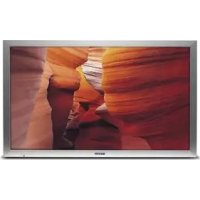
32LM5R - Monitor SANYO - Free user manual and instructions
Find the device manual for free 32LM5R SANYO in PDF.


| Product Type | LCD Monitor |
| Brand | Sanyo |
| Model | 32LM5R |
| Screen Size | 32 inches (81 cm) |
| Native Resolution | 1366 x 768 (WXGA) |
| Contrast Ratio | 1500:1 |
| Viewing Angles | 176° horizontal / 176° vertical |
| Power Supply | 100-240 V, 50/60 Hz |
| Dimensions (W x H x D) | 803 x 493 x 150 mm |
| Weight | 20.5 kg |
| Color System | PAL / SECAM / NTSC 3.58 |
| Video Inputs | Scart (AV1), BNC (AV2: RGB H/V or YPbPr), BNC (AV3: composite), DVI-D, PC (mini D-SUB 15) |
| Audio Inputs | 3.5 mm jack (PC), RCA (DVI/AV2) |
| Audio Outputs | RCA (L/R), speakers 2 x 6 W |
| Main Functions | Multilingual OSD menu, image settings (brightness, contrast, color, tint), display modes (16:9, 4:3, zoom, etc.), noise reduction, energy saving, sleep timer, remote and child lock, winter mode |
| Maintenance | Unplug before cleaning, use a damp cloth, do not use liquid or aerosol cleaners |
| Safety | Do not expose to rain or moisture, do not block ventilation openings, use a grounded outlet, disconnect power if not used for long periods |
| Spare Parts and Repairability | The device contains no user-serviceable parts; refer all repairs to qualified service personnel; use original replacement parts |
| General Information | Manual available in multiple languages; follow safety instructions; product recyclable (WEEE symbol) |
Frequently Asked Questions - 32LM5R SANYO
User questions about 32LM5R SANYO
0 question about this device. Answer the ones you know or ask your own.
Ask a new question about this device
Download the instructions for your Monitor in PDF format for free! Find your manual 32LM5R - SANYO and take your electronic device back in hand. On this page are published all the documents necessary for the use of your device. 32LM5R by SANYO.
USER MANUAL 32LM5R SANYO
Please read this Instruction book before using your LCD monitor. We wish you many hours of pleasure from your new LCD monitor
CAUTION: Please read and retain for your safety. This unit has been engineered and manufactured to assure your personal safety, but improper use can result in potential electric shock or fire hazards. In order not to defeat the safeguards incorporated in this monitor observe the following basic rules for its installation, use and servicing.
Installation and Use
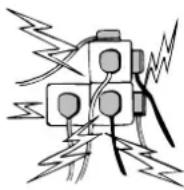
Do not allow anything to rest on the power cord. Do not locate this LCD monitor where the cord will be damaged by people walking on it.
Do not overload wall outlets and extension cords as this can result in fire or electric shock.
A suitable socket outlet must be provided and shall be easily accessible.
Do not place this LCD monitor near any heat sources such as radiators, heaters, stoves and other heat-generating products (including amplifiers).
Do not place your LCD monitor on an unstable stand, shelf or table. Serious injury to an individual, and damage to the LCD monitor may result if it should fall. Your sales person can recommend approved wall mounting kit. A special wall mounting kit is available for this model.
This LCD monitor should be operated only from the type of power source indicated on the monitor or as indicated in the Operating Instructions. If you are not sure of the type of power supply, consult your sales person or your local power company
For added protection it is strongly recommended that this LCD monitor is supplied via an approved earth fault protection device.
WARNING: To prevent injury the LCD monitor must be securely attached to the wall in accordance with the manufacturers installation instructions.
IMPORTANT:
This product must be earthed
This unit is not disconnected from the mains unless the mains lead is unplugged. The installer must make sure that the mains plug is easily accessible.
Do not use immediately after moving the LCD monitor from a low temperature to a high temperature environment, as this causes condensation, which may result in fire, electric shock, or other hazards. Before cleaning, unplug the monitor from the wall socket.
Do not mount near an open flame source. Open flames must never be used near this LCD monitor.
This LCD monitor should not be built in or enclosed in any way, heat build up will reduce the life of the monitor.
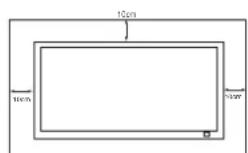
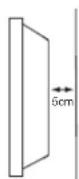
This LCD monitor should have a minimum distance of 5cm away from the wall and the monitor should have 10cm distance around the top and sides.
Always mount using recommended and substantial fixtures and fittings.
The rear finned section around the cabinet functions as a heat sink, removing heat away from the monitor. The external surface of the cabinet (finned area) must not be covered or the airflow restricted in anyway by enclosing the LCD monitor.
Do not apply liquid cleaners or aerosol cleaners directly onto the LCD monitor. Use a damp cloth for cleaning.
Important: (UK only)
THIS PRODUCT MUST BE EARTHED
This equipment is fitted with an approved mains lead and an approved non rewireable UK mains plug. To change a fuse in this type of plug proceed as follows:
- Remove the fuse cover and fuse.
- Fit a new fuse which should be a BS1362 13 Amp A.S.T.A. or BSI approved type.
- Ensure that the fuse cover is correctly refitted.
If the fuse cover is lost or damaged the plug must NOT be used but replaced with a serviceable plug.
If the fitted plug is not suitable for your socket outlets, it should be cut off and an appropriate plug fitted in its place. If the mains plug contains a fuse, this should have a rating of 13 Amp, ensure the fuse cover is correctly fitted. If a plug without a fuse is used, the fuse at the distribution board should not be greater than 13 Amp.
Note: The severed plug must be destroyed to avoid a possible shock hazard should it be inserted into a 13 Amp socket elsewhere.
The wires in this mains lead are coloured in accordance with the following code:
Blue --Neutral
Brown --->Live
Green and Yellow ---> Earth
- The Blue wire must be connected to the terminal which is marked with the letter "N" or coloured BLACK.
- The Brown wire must be connected to the terminal with the letter "L" or coloured RED.
- The Green and Yellow wire must be connected to the terminal which is marked with the letter "E" or coloured GREEN or GREEN and YELLOW.
Before replacing the plug cover, make certain that the cord grip is clamped over the sheath of the lead - not simply over the wires.
Do not attempt to bypass the safety purpose of the grounding type plug.
THIS UNIT IS NOT DISCONNECTED FROM THE MAINS UNLESS THE MAINS LEAD IS UNPLUGGED.
THE INSTALLER MUST MAKE SURE THE MAINS LEAD IS EASILY ACCESSIBLE.
Servicing
Your monitor is fully transistorised and does not contain any user serviceable components.
You must not remove the rear cover of the monitor by yourself. The apparatus is working with high voltages and could damage objects or even endanger people. Leave all required repair and service jobs to an authorised service technician. He will exclusively use such spare parts that are complying with the same safety standards as applicable to the original parts. The use of original spare parts can prevent fire, shock and other hazards.
Unplug the LCD monitor from the wall outlet and refer servicing to qualified service personnel under the following conditions:
If the power cord or plug is damaged.
If liquid has been spilt in to the LCD monitor.
If the LCD monitor has been exposed to rain or water.
If the LCD monitor has been dropped or the cabinet has been damaged.
If the LCD monitor exhibits a distinct change in performance.
If the LCD monitor does not operate normally by following the operating instructions.

Adjust only those controls that are covered in the operating instructions as improper adjustment of other controls may result in damage. This will often require extensive work by a qualified technician to restore the monitor to normal operation.
Important recycling information.

Your SANYO product is designed and manufactured with high quality materials and components which can be recycled and reused.
This symbol means that electrical and electronic equipment, at their end-of-life, should be disposed of separately.
In the European Union there are separate collection systems for used electrical and electronic products.
Please help us to conserve the environment we live in!
Note: This symbol mark and recycle system are applied only to EU countries are not applied to other countries of the world.
End-User License
The product (meaning the equipment or appliance to which this documentation relates) incorporates Software (the software applications, utilities and modules embedded within the Product) which is owned by Sanyo or its licensors. Before using the product, please read the End-User License Conditions detailed below. If you do not agree to the terms and conditions of the End-User License, Please do not proceed to use the Product- repack the Product unused and return it to your supplier together with proof of purchase for a full refund. By using the product, you agree to be bound by the terms and conditions of the End-User License.
License Grant, Conditions and restrictions
- Sanyo grants you a non-exclusive, world-wide (subject to export controls), non-transferrable (except as permitted by 2 below), royalty-free license to use the Software upon and with the Product.
- You may not transfer any of your license rights in the Software without the prior written consent of SANYO and if consent is provided then the Software shall only be transferred in conjunction with the transfer of the Product AND provided that the transferee has read and agreed to accept the terms and conditions of this license.
- You must ensure that the copyright, trademark and other protective notices contained in the Software are maintained and not altered or removed.
- The Software provided hereunder is copyrighted and licensed (not sold). SANYO especially does not transfer title or and ownership rights in the Software to you. The Software provided hereunder may contain or be derived from portions of materials provided to SANYO under license by a third party supplier.
-
Except as expressly permitted by statute you may not;
-
use the Software in conjunction with any other computer hardware other than the product;
-
copy all or part of the Software;
-
incorporate all (or any of) the Software into other programs developed by (or on behalf of) you and/or used by you;
-
reverse-engineer, decompile or disassemble the Software;
- make the Software (or any part of it) available, or permit its redistribution, for use with any computer hardware other than the Product; or rent, lease, gift, loan, sell, distribute or transfer possession of the whole or any part of the Software.
Termination
This license is effective until terminated. This license will terminate automatically without notice if you fail to comply with any of its provisions.
Disclaimer
- The Software is (to the extent permitted by law) supplied 'as is' and SANYO and its suppliers expressly exclude all warranties, express or implied, including (but not limited to) warranties of satisfactory quality, fitness for purpose and non-infringement (save to the extent that the same are not capable of exclusion at law).
- In no circumstances will SANYO be liable for any direct, indirect, consequential, or incidental damage (including loss of profits, business interruption, loss of data or the cost of procurement of substitute goods, technology or services) arising out of the use or the inability to use the Software (save to the extent that such liability is not capable of exclusion at law).
General
- This End-User License will be governed by laws of England and the User may only bring claims in the English Courts and SANYO shall be entitled to bring a claim in the courts of any jurisdiction.
- The above terms and conditions supersede any prior agreement, oral or written, between you and SANYO relating to the Software.
Step:1 Mains Connection
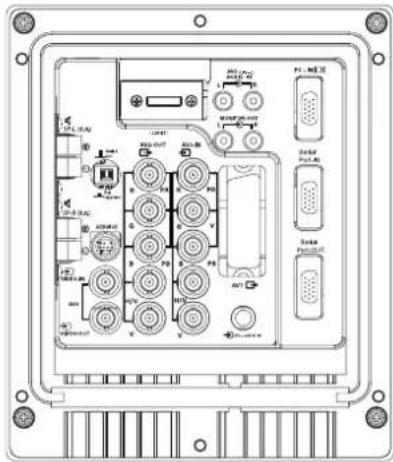
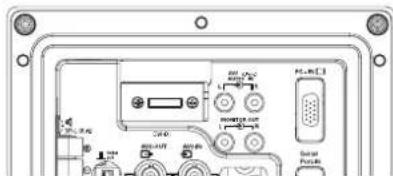
Connect the display unit to VGA, BNC and Scart connector as required.
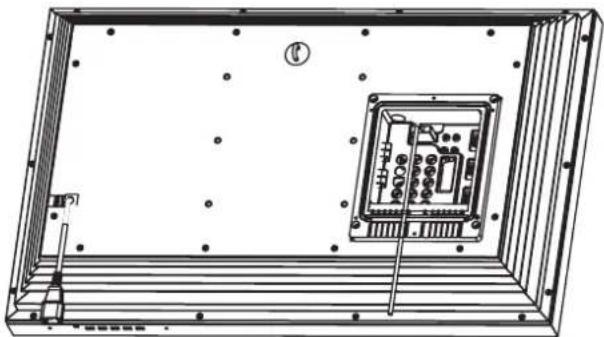
- Connect the IEC power connector to the mains coupler at the rear of the LCD monitor as shown above.
- Connect the power cord of the LCD monitor to a wall outlet.
As this product does not have a mains On/Off switch, please ensure your mains plug is easily accessible.
The LCD monitor is prepared for a mains voltage AC100~240V, 50Hz/60Hz. To completely switch off the mains, or when the display unit is not to be used for an extended period of time, it is advisable to disconnect the power cord from the power outlet.
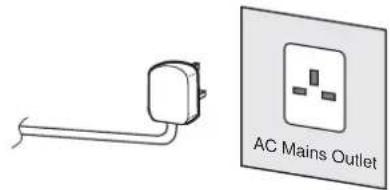
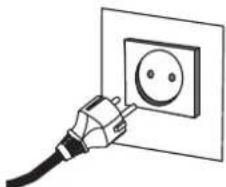
Please use the correct mains lead supplied with the set for your area.
3. Warning: To prevent injury, the unit must be securely attached to the wall in accordance with the installation instructions.
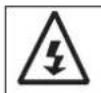
WARNING! High voltages are used in the operation of this set. Refer service to qualified service personnel.
Step : 2 Connections
INPUT selection
To switch between AV1, RGB, AV2 (RGB H/V or Y, Pb, Pr) AV3, DVI or PC mode press the TV/ AV button on your remote control repeatedly or press and hold the TV/AV button for a few seconds and a selection menu will appear on screen.Use the 5 or 6 buttons to select the correct input.
1.AV1
SCART connection.
2.RGB
TTL input (5V RGB signals) into SCART terminal.
3. Y,Pb,Pr/ RGBHV connection (AV2)
This LCD monitor has a choice of Y, Pb, Pr or RGB H/V connections. You can connect your DVD player to the Y, Pb, Pr terminals instead of using a scart lead. This can support high definition in analogue component form. RGB H/V can be used as a PC input via the BNC terminals.Both options support a large range of resolutions (page 12).
4.AV3
Composite (CVBS) signal input
AV3 OUT is to output the composite video signal from the VIDEO IN so that you can connect monitors with the use of a loop through function.
- RS232C IN/OUT: Is a input for external commands to control the monitor (see page 9).
6. DVI-D (Digital Video Interface)
This monitor has a DVI connector. This is located at the back of the monitor next to the phono sockets. This input will support a large range of resolutions as shown on page 12. See page 7 for details of menu operation.
7 PC connection
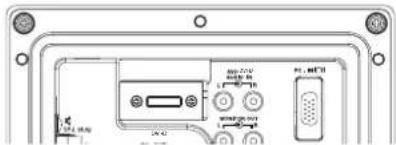
This LCD monitor has a PC connector (PC-IN D-SUB). You can connect a PC to the LCD monitor and use it as a monitor display (see page 8). This input will support a large range of resolutions (see pg12). Audio can be connected via the 3.5mm PC audio in socket.
8. External Audio Output
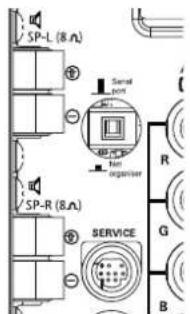
To output the audio signal from AV 1,2,3, PC and DVI. The speaker impedance should be 8 ohms.
9. Use of Monitor Audio Output Connections
The audio monitor out sockets on the rear of the set provide a fixed level audio output for reproducing sound via your audio equipment.
TV/AV button
To switch from AV1, RGB, AV2, AV3, DVI or PC mode press repeatedly or Press and hold in a few seconds, an AV selection menu appears. Select the mode you require using the 5 6 buttons
Screen mode selector
To select the screen mode, Auto, Natural, Full Zoom 16:9, Title 16:9,Zoom 14:9, title 14:9 or Normal. Refer to page 10
Standby
To switch the monitor on and off. Also see page 7
Recall
To display Input selection information and the OFF Timer if set.
You can also select colour systems in AV mode as follows AUTO PAL SECAM NTSC3.58
MENU
To enter and exit the main menu, and sub menus.
Level up/down
To adjust the sound volume level, or enter sub menus
Picture mode selection
Press the button repeatedly to select the following picture modes.
Personal - Personal preference mode.
Dynamic - Suitable for brightly lit rooms.
Standard - Normal viewing mode.
Eco - Suitable for dimly lit rooms and gives a cinema - like effect.
Surround mode selector
To select the surround mode, OFF, MID, MAX
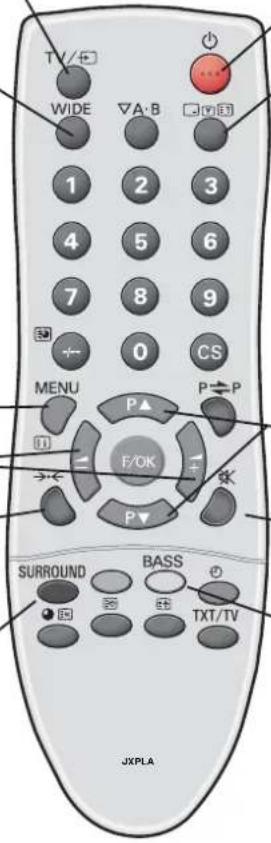
Up and down
To select the next item
Sound mute
To mute the sound from the speakers.
The sound changes as follows;
Normal volume -> Mute
Bass expander
To get an emphasised bass sound ON or OFF.
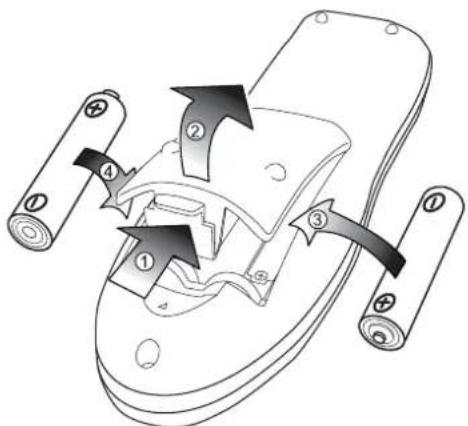
Remote control battery installation
Install two "AA" 1.5 volt batteries so that the "+" and "-" marks on the batteries match the "+" and "-" marks inside the unit into the remote control handset.
Controls and Menus
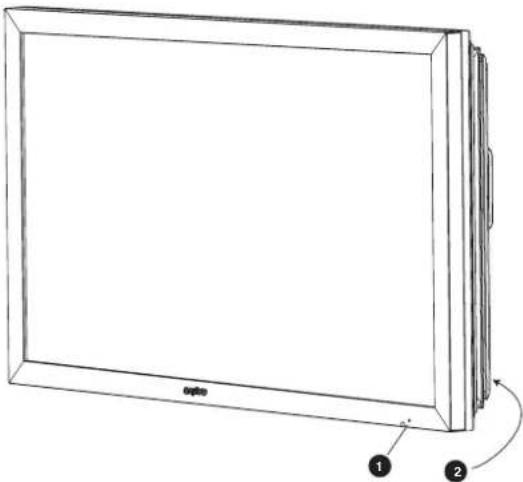
- The LCD display has a Standby light to show there is power.
Switching into/from standby mode
The Standby mode is used for switching the LCD monitor off for short periods of time. In standby mode the monitor is switched off but is still receiving mains power.
To turn the monitor into standby mode, press the 4 button. The blue power indicator illuminates more brightly.
To turn the monitor ON from standby mode, press any of the following buttons: 4, 5, 6 or 0-9 buttons.
If you find the power indicator flashing, disconnect power cord from the power outlet and contact our Service desk.
This warning is a sign to let you know that the power protection function of this TV set is now operating.
2. Control buttons (bottom edge of cabinet)
Menu/F button: rotate between volume, Brightness, contrast, colour, sharpness and OSD language.


Input/ OK button: Switch between AV1, RGB, AV2, AV3, DVI and PC mode.
ed buttons:provide up and down adjustments.
4 button: To switch from display to standby mode (to switch off completely disconnect the monitor from the power supply).
Menu Operation
Many of your monitors functions are controlled through the menu function, using the remote control handset.
MENU
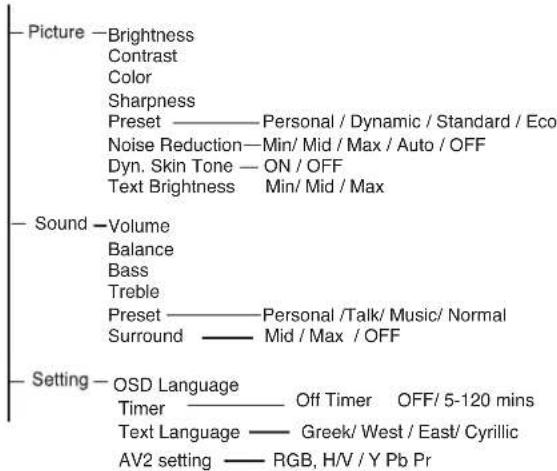
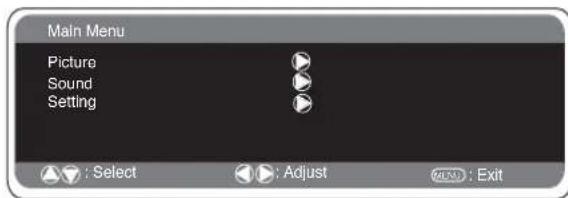
During menu operation the bottom of the on screen display will show which controls can be used for menu navigation.
Press the MENU button to enter the main menu.
A sub menu is selected using the 5 or 6 button and pressing the1 button when the required sub menu is highlighted.
When you have finished you can press the MENU button to exit, then the MENU button again to exit the main menu.
Picture menu
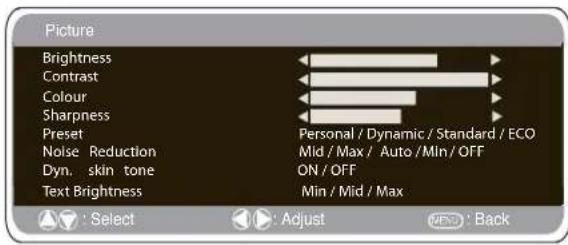
- Press the MENU button. Select Picture using the 5 or 6 button. Press the1 button to enter.
Set the picture settings for your "personal" preference. - Use the 5 or 6 button to select eg. Brightness and the 1 button to adjust levels.
- Preset : You can select either your "Personal" settings, or Dynamic, Standard or Eco settings.
- Noise Reduction: May be used to reduce any local picture 'noise' (granular appearance) being experienced by using 1 or2 button to select between Mid / Max / Auto / OFF /Min.
- Dynamic skin tone: May be used to enhance skin tone by using 1 or2 button to select between On / Off.
Tint : is only available if NTSC equipment is connected.
- Text Brightness: May be adjusted by using 1 or2 button to select between Min / Mid / Max.
Press the MENU button to return to Main Menu. These settings automatically store when you exit the menu.
Sound menu
Press the MENU button and select Sound using the 5 or 6 buttons, press the1 button to enter.
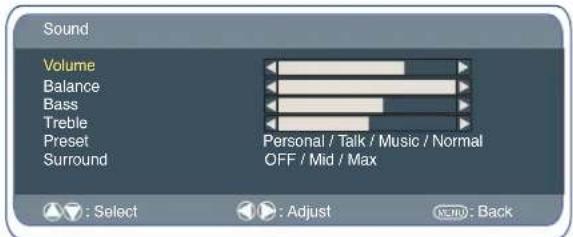
Select and adjust to obtain the best sound settings for your environment using the 5 or 6 and 1 or2 buttons. Press the MENU button to return to Main Menu. These settings automatically store when you exit the menu. Press the MENU button to exit menu.
Setting menu
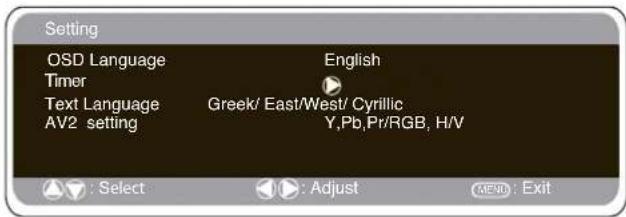
OSD Language
Use the 1 or 2 button to select the preferred OSD language (English, French, German, Italian, Spanish, Dutch). Press the MENU button to return to main menu.
Off-timer setting
The Off timer will switch the monitor into the standby mode when the selected time has elapsed.
Press the MENU button. Select Setting using the 5 or 6 button press the 1 button to enter. Select Timer using the 5 or 6 button, press 1 button to enter Timer Menu. Press the 1 or 2 button to change time.

The time changes in 5 minute steps. The maximum time is 120 minutes.
If you have set the off timer, a count down display appears in the corner of the screen when the recall button is pressed.
If the monitor is switched off by the standby button 4 on the remote control or by the standby switch 4 on the bottom of the LCD monitor the timer settings will be cancelled.
Text Language
Press the MENU button. Select Setting using the 5 or 6 button press the 2 button to enter. Select Text language using the 5 or 6 button. Press the 1 or 2 button to select West, East, Cyrillic or Greek. Press the MENU button to exit.
| WE | EAST | GREEK | CYRILLIC | |||
| ENGLISH GERMAN SWEDISH ITALIAN FINNISH HUNGARIAN FRENCH SPANISH TURKISH DANISH PORTUGUESE | POLISH ROMANIAN SLOVAKIAN GERMAN SWEDISH ITALIAN FINNISH HUNGARIAN FRENCH SPANISH DANISH PORTUGUESE | ESTONIAN CZECH CROATIAN SLOVENIAN | ENGLISH GERMAN SWEDISH ITALIAN FINNISH HUNGARIAN FRENCH SLOVOKIAN GREEK CROATIAN | FINNISH DANISH HUNGARIAN FRENCH TURKISH CROATIAN | POLISH GERMAN SWEDISH ITALIAN FINNISH HUNGARIAN CROATIAN LETTISH | SLOVENIAN RUSSIAN LETTISH |
AV2 setting
Press the MENU button. Select Setting using the 5 or 6 button press the 1 button to enter.
Select AV2 setting using the 5 or 6 button.
Press the 1 or 2 button to select either Y, Pb, Pr or RGB H/V. Press the MENU button to exit, this automatically stores your changes. Press the MENU button again to exit the main menu.
PC menu settings
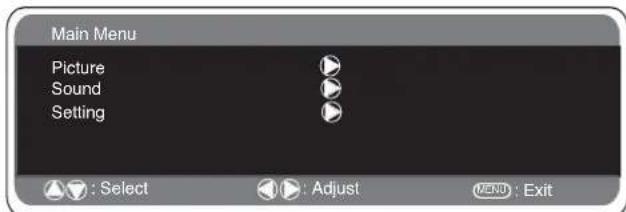
Connect your PC to either PC-IN, DVI or RGBHV on the rear of the set. Once connected select PC mode, DVI or AV2 (RGBHV, see page 5 for AV2 input settings) via the v button on your remote control. The set will become a monitor for the PC.
By pressing the MENU button on the remote control a menu window will appear on screen, this allows the settings to be adjusted.
To adjust the Picture settings select picture using the 5 or 6 buttons on the remote control then the1 button to enter the following picture settings menu.
Press the 1 or 2 buttons to adjust the Picture brightness and the same to adjust the contrast of the picture.
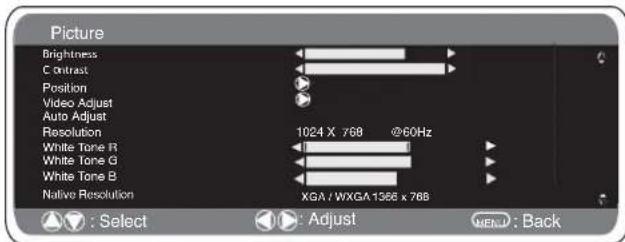
Position changes the picture horizontally and vertically.
Press the1 button to enter the sub menus, adjustment is carried out using the1 or 2 buttons on the remote control.
Video adjust changes the Phase and the clock of the screen. If the picture is blurred or grainy this function will adjust it to a clearer picture, adjustment is carried out using the 1 or 2 buttons on the remote control.
Auto Adjust will automatically centralize the picture by using the 1 button. This will change all the above settings automatically.
Auto adjust can also be achieved by pressing the red button on the remote control without having to select the menu
Resolution displays the current resolution of the picture. This is for information only and cannot be adjusted.
White tone: Using the 1 or2 buttons it is possible to adjust the colour tone of the picture using the White tone Red(R) / Green (G)/ Blue(B). This will adjust the picture to show more or less of the chosen colour. For example if red is selected you can adjust the proportion of red in the picture to increase or decrease using the 1 or 2 buttons.
Native Resolution is used when the PC can output WXGA 1366 x 768. The setting on your Monitor set can be changed to receive XGA/WXGA signal using the1 or 2 buttons. Once the native resolution has been selected, save the settings by switching the monitor off then on using the standby button.
For Sound settings refer to sound menu (Page 8).
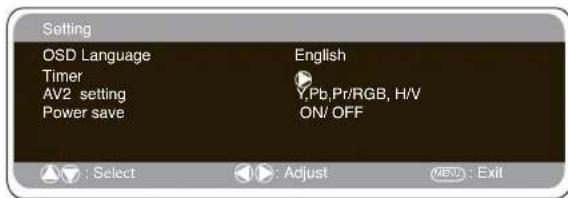
Setting: Press the menu button on your remote control and using the 5 or 6 buttons to select Settings. The 1 button will enter the settings menu.
GB
OSD Language, Timer and AV2 settings are the same as in all input modes (pg 8).
Power save if turned ON will switch the monitor into Powersave mode after 1 minute if no signal is detected, the LED light will turn a brighter blue to indicate stand by. The monitor will automatically turn back on when a signal has been detected (PC input / RGBHV / DVI). Use1 or 2 buttons to select power save ON or OFF. Press the menu button twice to initiate Powersave.
Installation Menu
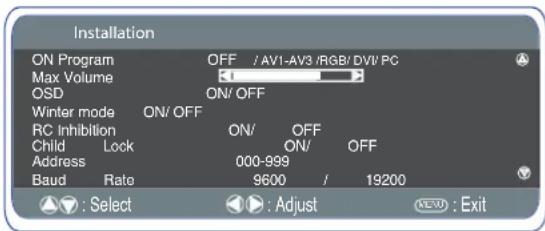
This LCD monitor allows you to set up the following:
SETTING PROCEDURE
- Press and hold the green button on the Remote control handset for 5 seconds.(Installation menu will appear)
2.Use the 5 or 6 button to highlight each option, use the 1 or 2 button to adjust each option.
■ On Program
Select ON program using the 5 or 6 button, select the start up position using the 1 or 2 buttons. (Off / AV1 / RGB/ AV2/ AV3/ DVI/ PC) Press the MENU button to exit the menu.
Max Volume
Select Max volume using the 5 or 6 button, use the 1 or 2 buttons to set the maximum volume required.
OSD (On screen display)
Select OSD using the 5 or 6 button, select ON/OFF using the 1 or 2 buttons. Selecting OFF will inhibit the OSD. To re- instate OSD, press and hold the green button on the remote control to re-enter installation menu and select OSD ON.
Winter mode
This Function can be activated when the LCD monitor is used during cold temperature conditions, approximately 38^ / 4^ or below to maintain picture performance. Using the 5 or 6 button select winter mode, once highlighted you can select ON or OFF by pressing the 1 or 2 button. IMPORTANT: The AC cord should not be disconnected during the operation of Winter mode function. When in winter mode, power consumption is higher than normal standby consumption. This is entirely due to the operation of heating circuitry. We strongly recommend to turn off Winter mode when the ambient temperature is above 38^ / 4^ .
■ RC Inhibition
You can prevent unwanted remote control operation by selecting RC Inhibition. When selected an inhibit symbol will appear on screen when a button is pressed on the remote control. Select using the 5 or 6 button. Press the 1 or 2 button to select On or OFF. To re-instate RC operation press and hold the green button on the remote control and select RC inhibition OFF.
Child lock
You can prevent unwanted operation of the LCD monitor via the buttons on the bottom edge of monitor. Select using the 5 or 6 button. Press the 1 button to select On or OFF.
Disconnecting the mains supply before exiting installation menu will cancel the following features On program, RC inhibition, Address and Baud Rate.
RS232C settings
This monitor can be controlled via the RS232C connector using a suitable computer/ control commands.
Serial Interface Specification
Transfer Specification
- Transmission Speed: initial setting value is 19200
- Transmission speed can be changed via the Installation menu. (see below baud rate)
| ITEM | SPECIFICATION |
| Synchronous system | Asynchronous |
| Transmission Speed | 9600 / 19200 |
| Data Length | 8 bit |
| Parity | None |
| Stop Bit | 1 |
| Flow Control | None |
Connection
The Designated RS-232C serial cable must be used for a connection to a computer and LCD monitor.
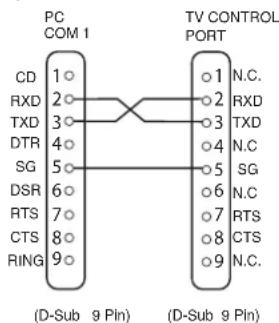
The TV command is defined by one command/ one line that starts with "C" and ends with carriage return. (0x0D)
There are two types of commands:
Functional Execution Command e.g Co5[CR] (table on page 64)
Status Read Commands e.g "CR0 [CR] (see table on page 64)
Setting the monitor address in RS232 mode
To Access Installation mode press the green button on the remote control and hold for 5 seconds. A new screen will appear.
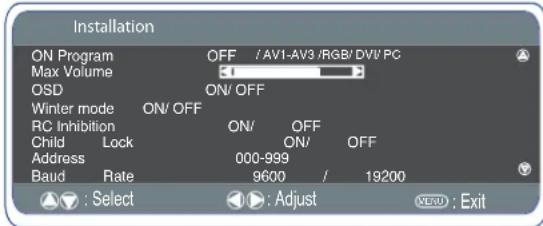
Each monitor can have a specific Address for example 007, which enables the monitor to be controlled individually and will not affect other monitors connected to a controlling PC.
Address format command
The addressing format command is used for operating multiple monitor sets from a single PC via the RS232C command line. If you set your monitor address to '000', it will never respond to any addressing command from the PC.
If the address from the PC is 'FFF', all monitor sets will execute the command.
The Address format command is defined by one command, one line which starts with 'A' and ends with carriage return. (0 x0D)
The Monitor starts to decode when it receives a carriage return. (0x0D)
An address is added at the top of a control command Example:
Functional execution command:
"A001C05" [CR] means address is 001 and the control command is C05
Status read command
"A001CR0"[CR] means address is 001 and command is CR0.
The monitor can set its own address in the Installation option menu (above) The address range is 000 - 999, the default address will be 000.
The baud rate indicates the unit for transfer speed of data from the PC to the monitor sets.
Selecting of picture size
Screen options
Today there are various transmission formats with different size ratios, eg. 4:3, 14.9, 16:9 and video formats such as letterbox.
Press the WIDE button repeatedly to select your desired setting.
When in High Resolution (720p / 1080i) YPbPr or DVI, the picture will remain fixed in 16:9 format 'Full size' and may not be changed.
Natural
| 4:3 14:9 16:9 | Letterbox Video | ||
| Stretches the picture horizontally to fill the screen. The picture is more stretched at the edges. | The height is expanded to fill the whole screen. | The picture fills the screen and is proportionally correct. | The black bars top and bottom remain and the height is compressed to fit the picture area. |
Zoom 14:9
| 4:3 14:9 16:9 | |||
| The correct picture width is maintained but the top and bottom are cropped. | Zooms in slightly cropping the top and bottom. | Zooms in slightly cropping the top and bottom. | The black bars top and bottom are smaller and the picture height is compressed slightly. |
Title-In 14:9
| 4:3 14:9 16:9 | Letterbox Video | ||
| TITLES: SCREEN | TITLES: SCREEN | TITLES: SCREEN | TITLES: SCREEN |
| As zoom (14:9), but bottom is compressed even more to allow subtitles to be seen. | As zoom (14:9), but bottom is compressed even more to allow subtitles to be seen. | As zoom (14:9), but bottom is compressed even more to allow subtitles to be seen. | As zoom (14:9), but bottom is compressed even more to allow subtitles to be seen. |
Zoom 16:9
| 4:3 14:9 | 6:9 | Letterbox Video | |
| The correct picture width is maintained but the top and bottom are cropped. | Zooms in slightly cropping the top and bottom. | Zooms in slightly cropping the top and bottom. | The black bars top and bottom are smaller and the picture height is compressed slightly. |
Title-In 16:9
| 4:3 14:9 16:9 | Letterbox Video | ||
| TITLE SCREEN | TITLE SCREEN | TITLE SCREEN | TITLE SCREEN |
| As Zoom (16:9), but bottom is compressed even more to allow subtitles to be seen. | As Zoom (16:9), but bottom is compressed even more to allow subtitles to be seen. | As Zoom (16:9), but bottom is compressed even more to allow subtitles to be seen. | As Zoom (16:9), but bottom is compressed even more to allow subtitles to be seen. |
Full
| 4:3 14:9 16:9 | Letterbox Video | ||
| The whole screen is filled stretching the width. | The whole screen is filled stretching the height slightly at the edges. | The whole screen is filled with the correct picture ratio. | The black bars top and bottom are present and the height is compressed. |
■ Normal
| 4:3 14:9 16:9 | Letterbox Video | ||
| The correct ratio is maintained with black bars on the left and right. | Black bars left and right, picture height is stretched. | Black bars left and right, picture height is stretched. | Black bars left, right, top and bottom. |
Specification
Common specifica
Power source
100~240V 50Hz/60Hz
Colour system
PAL NTSC3.58,SECAM
AV terminal
AV1:Scart CENELEC Standard
Input: Composite video, RGB (5V RGB with 5V sync to
pin 14) and audio-L/R
Output: Composite video, audio L/R
AV2:BNC
Input: RGB, H and V / Y, Pb, Pr and audio L/R
Output: RGB, H and V / Y, Pb, Pr
AV3:BNC
Input: Composite video
Output : Composite video
Audio In (DV1/AV2): Cinch L/R
Audio Monitor.Out: CINCH L/R
Audio Speaker out: 2 × 6W
DVI Input : DVI-D GROUP Standard
PC Input: Mini D-SUB 15 PIN and
Audio in 3.5mm jack
Contrast Ratio 1500:1
Screen(inches/cm) 32^ / 81 cm
viewing measured
diagonally)
Display Native Resolution 1366 x 768 (WXGA)
Viewing angles H:176°, V:176°
Dimensions (WxHxDmm) 803 X 493 X 150
Weight (kg) 20.5
Helpful hints
NO PICTURE, NO SOUND
- Check if monitor is plugged in.
- Check monitor is not in standby mode.
POOR PICTURE, SOUND OK
Adjust BRIGHTNESS/ CONTRAST LEVELS (too low).
NO COLOUR, PICTURE OK
Adjust COLOUR control.
- Check lead connections.
- Does the signal input have colour.
■ REMOTE CONTROL DOES NOT WORK
- Check batteries are inserted correctly.
- Check condition of batteries.
- Check to see if remote control inhibit is set ON.
■ PICTURE OK, NO SOUND
- Check external speakers are connected correctly.
- Check lead connections to external equipment.
Volume turned down or mute selected.
PC signal support timing
| Resolution | Horizontal Frequency (kHz) | Vertical Frequency (Hz) | Remark |
| 720_400 | 31.47 | 70.09 | DOS(VGA) |
| 640_480 | 31.50 | 60.00 | DOS(VGA VESA 60Hz) |
| 640_480 | 37.50 | 75.00 | VGA VESA 75Hz |
| 640_480 | 37.86 | 72.81 | VGA VESA 70Hz |
| 640_480 | 37.86 | 74.38 | VGA |
| 640_480 | 35.00 | 67.00 | Mac. |
| 640_480 | 34.97 | 66.60 | Mac LC 13" |
| 800_600 | 35.16 | 56.25 | SVGA VESA 56Hz |
| 800_600 | 37.90 | 60.32 | SVGA VESA 60Hz |
| 800_600 | 46.90 | 75.00 | SVGA VESA 75Hz |
| 800_600 | 32.70 | 51.09 | SVGA |
| 800_600 | 34.50 | 55.38 | SVGA |
| 800_600 | 37.90 | 61.03 | SVGA |
| 800_600 | 38.00 | 60.51 | SVGA |
| 800_600 | 38.60 | 60.31 | SVGA |
| 832_624 | 49.00 | 74.00 | Mac. |
| 1024_768 | 48.40 | 60.00 | XGA VESA 60Hz |
| 1024_768 | 56.50 | 70.00 | XGA VESA 70Hz |
| 1024_768 | 60.000 | 75.00 | XGA VESA 75Hz |
| 1024_768 | 44.00 | 54.58 | XGA |
| 1024_768 | 46.90 | 58.20 | XGA |
| 1024_768 | 47.00 | 58.30 | XGA |
| 1024_768 | 48.50 | 60.02 | XGA |
| 1024_768 | 58.03 | 72.00 | XGA |
| 1024_768 | 60.31 | 74.92 | XGA |
| 1024_768 | 61.00 | 75.70 | XGA |
| 1024_768 | 60.24 | 75.08 | MAC_Normal 19" |
| 1280_960 | 60.00 | 60.00 | SXGA VESA 60Hz |
| 1280_1024 | 79.976 | 75.025 | SXGA VESA 75Hz |
| 1280_1024 | 62.50 | 58.60 | SXGA |
| 1280_1024 | 63.370 | 60.01 | SXGA |
| 1280_1024 | 63.34 | 59.98 | SXGA |
| 1280_1024 | 63.74 | 60.01 | SXGA |
| 1280_1024 | 63.79 | 60.18 | SXGA |
| 1280_1024 | 63.90 | 60.00 | SXGA |
| 1280_1024 | 71.69 | 67.19 | SXGA |
| 1280_1024 | 76.97 | 72.00 | SXGA |
| 1280_1024 | 81.13 | 76.107 | SXGA |
| 1152_864 | 64.20 | 70.40 | SXGA |
| 1152_900 | 61.20 | 65.20 | SXGA |
| 1152_900 | 61.85 | 66.00 | SXGA |
| 1152_900 | 71.40 | 75.60 | SXGA |
| 1152_870 | 68.68 | 75.06 | MAC_Normal 21" |
| 1280_960 | 75.00 | 75.08 | Mac. |
| 1280_1024 | 80.00 | 75.00 | Mac.. |
| 1600_1200 | 75.00 | 60.00 | UXGA VESA 60Hz |
| 1366_768 | 48.36 | 60.00 | WXGA |
| 1360_768 | 47.70 | 60.00 | WXGA |
Component signal support timing
| Resolution | Horizontal frequency (KHz) | Vertical frequency (Hz) | Remark |
| 720x480 15 | 735 60i SDTV 480 | ||
| 720x576 15 | 625 50i SDTV 576 | ||
| 720x480 31 | 25 60p SDTV 4 80p | ||
| 720x576 31 | 25 50p DTV 576p | S | |
| 1280x720 45 | .00 60p HDTV 7 20p | ||
| 1280x720 37 | .50 50p HDTV 7 20p | ||
| 1920x1080 | 33.75 | 60i HDTV | 1 080i |
| 1920x1080 | 28.13 | 50i HDTV | 1 080i |
DVI-D SIGNAL SUPPORT TIMING
| Resolution | Horizontal Frequency (kHz) | Vertical Frequency (Hz) | Remark |
| 640_480 | 31.43 | 59.88 | VGA VESA 60Hz |
| 640_480 | 37.86 | 72.81 | VGA VESA 72Hz |
| 640_480 | 37.5 | 75 | VGA VESA 75Hz |
| 640_480 | 34.97 | 66.6 MAC | LC 13" |
| 640_480 | 35 | 66.67 | MAC_NORMAL 13" |
| 800_600 | 35.16 | 56.25 | SVGA VESA 56Hz |
| 800_600 | 37.88 | 60.32 | SVGA VESA 60Hz |
| 800_600 | 46.875 | 75 | SVGA VESA 75Hz |
| 832_624 | 49.72 | 74.55 | MAC_NORMAL 16" |
| 1024_768 | 48.36 | 60 XGA | VESA 60Hz |
| 1024_768 | 60.23 | 75.03 | XGA VESA 75Hz |
| 1024_768 | 56.47 | 70.07 | XGA VESA 70Hz |
| 1024_768 | 60.24 | 75.08 | MAC_NORMAL 19" |
| 1152_870 | 68.68 | 75.06 | MAC_NORMAL 21" |
| 1280_1024 | 63.98 | 60.02 | SXGA VESA 60Hz |
| 720_480 | 31.7 | 59.94 | 480p |
| 768_575 | 31.25 | 50 | 575p |
| 1280_720 | 37.5 | 50 | 720p-50Hz |
| 1280_720 | 45 | 60 | 720p-60Hz |
| 1366_768 | 48.36 | 60 | WXGA |
| 1360_768 | 47.7 | 60 | WXGA |
| 1920_1080 | 28.125 | 50 | 1080i-50Hz |
| 1920_1080 | 33.75 | 60 | 1080i-60Hz |
Depending on the condition of signals and the type and length of cables, these signals may not be properly viewed. To save the native resolution 1366_768 setting switch the monitor off then on using the standby button.
Installation/Utilisation
Concession de license, conditions et restrictions
PAS D'IMAGE NI DE SON
PAS DE COULEURS, IMAGE CORRECTE
DIESES PRODUKT MULLS GEERDET WERDEN.
Audio Monitor Out: CINCH:L/R
DIT PRODUCT MOET GEAARD ZIJN
6. DVI-D (Digital Video Interface)
AV1: SCART CENELEC standard
Input: RGB, He V/Y, Pb, Pr. audio-L/R
Output: RGB, He V/ Y,Pb,Pr.
AV3:
Input: video composito
Output: video composito
Audio input (DVI / AV2) Cinch L/R
Audio speaker out: 2x 6W
Ingrezzo DVI: DVI group Standard
Input PC: Mini D-SUB 15 poli e Presa audio da 3,5 mm
SANYO Industries (U.K.) Limited
Oulton Works, School Road, Lowestoft,
Suffolk, NR33 9NA, United Kingdom.
Consiglio Utili
QUANDONONE'PRESENTENESUONO NIMMAGINE
PC signal support timing
| Resolution | Horizontal Frequency (kHz) | Vertical Frequency (Hz) | Remark |
| 720_400 | 31.47 | 70.09 | DOS(VGA) |
| 640_480 | 31.50 | 60.00 | DOS(VGA VESA 60Hz) |
| 640_480 | 37.50 | 75.00 | VGA VESA 75Hz |
| 640_480 | 37.86 | 72.81 | VGA VESA 70Hz |
| 640_480 | 37.86 | 74.38 | VGA |
| 640_480 | 35.00 | 67.00 | Mac. |
| 640_480 | 34.97 | 66.60 | Mac LC 13" |
| 800_600 | 35.16 | 56.25 | SVGA VESA 56Hz |
| 800_600 | 37.90 | 60.32 | SVGA VESA 60Hz |
| 800_600 | 46.90 | 75.00 | SVGA VESA 75Hz |
| 800_600 | 32.70 | 51.09 | SVGA |
| 800_600 | 34.50 | 55.38 | SVGA |
| 800_600 | 37.90 | 61.03 | SVGA |
| 800_600 | 38.00 | 60.51 | SVGA |
| 800_600 | 38.60 | 60.31 | SVGA |
| 832_624 | 49.00 | 74.00 | Mac. |
| 1024_768 48.40 | 60.00 | XGA VESA 60Hz | |
| 1024_768 56.50 | 70.00 | XGA VESA 70Hz | |
| 1024_768 | 60.000 | 75.00 | XGA VESA 75Hz |
| 1024_768 44.00 | 54.58 | XGA | |
| 1024_768 46.90 | 58.20 | XGA | |
| 1024_768 47.00 | 58.30 | XGA | |
| 1024_768 48.50 | 60.02 | XGA | |
| 1024_768 58.03 | 72.00 | XGA | |
| 1024_768 60.31 | 74.92 | XGA | |
| 1024_768 61.00 | 75.70 | XGA | |
| 1024_768 60.24 | 75.08 | MAC_Normal 19" | |
| 1280_960 | 60.00 | 60.00 | SXGA VESA 60Hz |
| 1280_1024 | 79.976 | 75.025 | SXGA VESA 75Hz |
| 1280_1024 62.50 | 58.60 | SXGA | |
| 1280_1024 | 63.370 | 60.01 | SXGA |
| 1280_1024 63.34 | 59.98 | SXGA | |
| 1280_1024 63.74 | 60.01 | SXGA | |
| 1280_1024 63.79 | 60.18 | SXGA | |
| 1280_1024 63.90 | 60.00 | SXGA | |
| 1280_1024 71.69 | 67.19 | SXGA | |
| 1280_1024 76.97 | 72.00 | SXGA | |
| 1280_1024 81.13 | 76.107 | SXGA | |
| 1152_864 64.20 | 70.40 | SXGA | |
| 1152_900 61.20 | 65.20 | SXGA | |
| 1152_900 61.85 | 66.00 | SXGA | |
| 1152_900 71.40 | 75.60 | SXGA | |
| 1152_870 68.68 | 75.06 | MAC_Normal 21" | |
| 1280_960 75.00 | 75.08 | Mac. | |
| 1280_1024 80.00 | 75.00 | Mac_. | |
| 1600_1200 | 75.00 | 60.00 | UXGA VESA 60Hz |
| 1366_768 | 48.36 | 60.00 | WXGA |
| 1360_768 | 47.70 | 60.00 | WXGA |
Component signal support timing
| Resolution | Horizontal frequency (KHz) | Vertical frequency (Hz) | Dot Clock Frequency(Mhz) | Remark |
| 720x480 15 | 735 60i 12.27 SDT | V 4 80i | ||
| 720x576 15 | 625 50i 13.50 SDT | V 5 76i | ||
| 720x480 31 | 25 60p 27 SDTV 4 | 80p | ||
| 720x576 31 | 25 50p 27 HDTV 5 | 76p | ||
| 1280x720 45 | 00 60p 74.25 | HDTV 720p | ||
| 1280x720 37 | 50 50p 74.25 | HDTV 720p | ||
| 1920x1080 | 33.75 | 60i 74.25 | IHTDV 10 | 80i |
| 1920x1080 | 28.13 | 50i 74.25 | HDTV 10 | 80i |
| 1920x1080 | 31.25 | 50i 74.25 | HDTV 11 | 52i |
DVI-D SIGNAL SUPPORT TIMING
| Resolution | Horizontal Frequency (kHz) | Vertical Frequency (Hz) | Remark |
| 640_480 | 31.43 | 59.88 VGA VESA 60Hz | |
| 640_480 | 37.86 | 72.81 VGA VESA 72Hz | |
| 640_480 | 37.5 | 75 | VGA VESA 75Hz |
| 640_480 | 34.97 | 66.6 | MAC LC 13" |
| 640_480 | 35 | 66.67 | MAC_NORMAL 13" |
| 800_600 | 35.16 | 56.25 | SVGA VESA 56Hz |
| 800_600 | 37.88 | 60.32 | SVGA VESA 60Hz |
| 800_600 | 46.875 | 75 SVGA VESA 75Hz | |
| 832_624 | 49.72 | 74.55 | MAC_NORMAL 16" |
| 1024_768 | 48.36 | 60 | XGA VESA 60Hz |
| 1024_768 | 60.23 | 75.03 | XGA VESA 75Hz |
| 1024_768 | 56.47 | 70.07 | XGA VESA 70Hz |
| 1024_768 | 60.24 | 75.08 | MAC_NORMAL 19" |
| 1152_870 | 68.68 | 75.06 | MAC_NORMAL 21" |
| 1280_1024 | 63.98 | 60.02 | SXGA VESA 60Hz |
| 720_480 | 31.7 | 59.94 | 480p |
| 768_575 | 31.25 | 50 | 575p |
| 1280_720 | 37.5 | 50 | 720p-50Hz |
| 1280_720 | 45 | 60 | 720p-60Hz |
| 1366_768 | 48.36 | 60 | WXGA |
| 1360_768 | 47.7 | 60 | WXGA |
| 1920_1080 | 28.125 | 50 | 1080i-50Hz |
| 1920_1080 | 33.75 | 60 | 1080i-60Hz |
Depending on the condition of signals and the type and length of cables, these are simple ways to control the
These signals may not be properly viewed.
To save the native resolution 1366_768 setting switch the monitor off then on
RS-232C COMMAND TABLES
Functional Execution Command Table
| Command | Item | Comment |
| C00 | Power ON | |
| C01 | Power OFF | |
| C23 | Wide "Auto" direct | |
| C24 | Wide "Natural" direct | |
| C29 | Wide "Full" direct | |
| C0F | Wide "Normal" direct | |
| C30 | Picture | Toggle (Dynamic, Standard, Eco, Perconal) |
| C70 | AV1 direct | |
| C71 | RGB direct | |
| C72 | AV2 RGBHV direct | |
| C73 | AV2 YPbPr direct | |
| C74 | AV3 direct | |
| C75 | DVI direct | |
| C76 | PC direct | |
| C64 | PC Auto adjust | |
| C92 | Factory settings | |
| CF PSAVE ON | Power save ON | |
| CF PSAVE OFF | Power save OFF | |
| CF CLOK ON | Child Lock ON | |
| CF CLOK OFF | Child Lock OFF | |
| CF DEA RMCY | RC inhibition OFF | |
| CF DEA RMCN | RC inhibition ON |
--" _means "No Function".
Status Read Command Table
| Command | Item | Note |
| CRO | Power | On, Standby, power error,... |
| CR1 | Input Mode | AV1, AV2,..., HDMI, PC |
| CR WIDE | Wide Mode | Auto, Normal, Full,... |
| CR PICTURE | Picture mode | Dynamic, Standard, ... |
| CR SIGNAL | Signal existence | Signal / No signal |
| CR CHILD | Child Lock | On / Off |
| CR PSAVE | Power Save (On/Off) | On / Off |
| CR TM | Panel operating time |
`