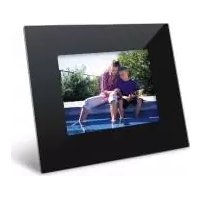
DigiFrame 1040 - Digital photo frame BRAUN - Free user manual and instructions
Find the device manual for free DigiFrame 1040 BRAUN in PDF.


| Product type | Digital photo frame |
| Brand | Braun |
| Model | DigiFrame 1040 |
| Dimensions | 315 × 261 × 60 mm approx. |
| Weight | 1,450 g approx. |
| Screen | 10.4 inches (26 cm) TFT LCD, resolution 800×600 pixels (4:3) |
| Power supply | Input: 100-240 V AC, 50 Hz; Output: 12 V DC, 1.5 A (power adapter included) |
| Internal memory | Capacity varies by model (see packaging) |
| Supported memory card formats | CompactFlash, Secure Digital, MultiMedia Card, Memory Stick, Memory Stick Pro, Memory Stick Duo, USB flash drives |
| Supported image file formats | JPEG up to 12 megapixels |
| Audio file formats (MP3 model) | MP3 |
| Video file formats (video model) | Motion JPEG AVI |
| Built-in speakers | 2 x 1 W (only on MP3 model) |
| Connectivity | USB 2.0 (host and device) |
| Remote control | Infrared, CR2025 battery included |
| Main functions | Slideshow with transition effects, rotation, zoom (×16), photo copy/delete, screen settings (brightness, contrast, hue, saturation), music playback (MP3 model), video playback (video model), sleep timer |
| Care and cleaning | Screen: soft, non-abrasive cloth (lens cloth type), no direct spray. Frame: soft cloth slightly dampened with water. Unplug before cleaning. |
| Safety | Do not expose to water or moisture; do not open the casing; do not block ventilation openings; use only the supplied power adapter; unplug if not used for an extended period. |
| Spare parts and repairability | Power adapter (12 V, 1.5 A); remote control; CR2025 battery for remote. No user-serviceable parts; refer servicing to qualified personnel. |
| Certifications | CE, FCC, PSE (adapter), SGSS, RoHS (WEEE) |
Frequently Asked Questions - DigiFrame 1040 BRAUN
User questions about DigiFrame 1040 BRAUN
0 question about this device. Answer the ones you know or ask your own.
Ask a new question about this device
Download the instructions for your Digital photo frame in PDF format for free! Find your manual DigiFrame 1040 - BRAUN and take your electronic device back in hand. On this page are published all the documents necessary for the use of your device. DigiFrame 1040 by BRAUN.
USER MANUAL DigiFrame 1040 BRAUN
Important Safety Precautions 13
Cleaning the LCD screen 13
Cleaning the Digital Picture Frame. 13
Introduction. 14
Box Content. 14
Setting up the Digital Picture Frame 15
Control Buttons and Remote Control 15
Using the control buttons. 15
Using the remote control. 16
Setting Up a Slideshow 16
Card selection screen. 16
Mode selection screen 16
Thumbsail screen 17
Slideshow with selected pictures. 17
Displaying a single photo full screen 17
Controlling Slideshows and Photos 17
Changing the displayed photo manually. 17
Rotating a photo 17
Enlarging a photo. 18
Copying displayed photo to built-in memory.....18
Deleting the displayed photo
from built-in memory. 18
Adjusting the LCD color 18
Adding music to a slideshow
(only model with MP3 function) 18
Copying Photos from Flash Card
to Built-in Memory. 18
Deleting Photos from Built-in Memory. 19
Listening to Music
(only model with MP3 function) 19
Controlling the volume
(only model with MP3 function) 19
Watching a Video
(only model with video function) 19
Setting Viewing Options. 19
Advanced Operations 21
Connecting to a Windows Computer. 21
Disconnecting the Digital Picture Frame
from the Computer 21
Connecting to a Macintosh 22
Connecting a USB Flash Drive 22
Frequently Asked Questions 22
Technical Specifications. 23
Important Safety Precautions
Always follow these basic safety precautions when using your Digital Picture Frame. This will reduce the risk of fire, electric shock, and injury.
Warning: To reduce the risk of fire or shock hazard, do not expose this product to rain or moisture.
Warning: To prevent the risk of electric shock, do not remove the cover. There are no user-serviceable parts inside. Refer all servicing to qualified personnel.
The Digital Picture Frame is for indoor use only.
- Unplug the Digital Picture Frame before performing care and maintenance.
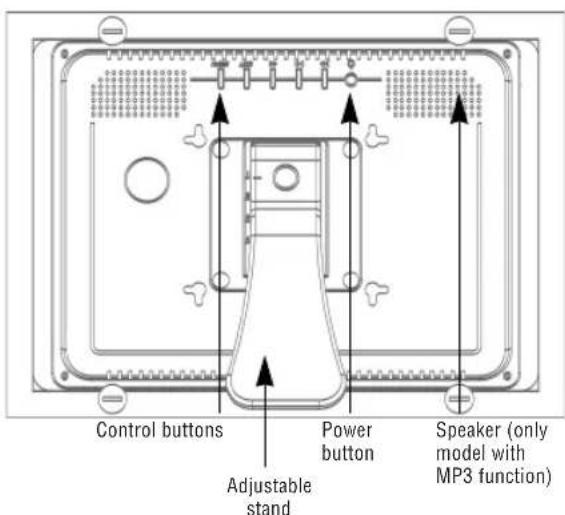
- Do not block the ventilation holes on the back of the Digital Picture Frame.
- Keep your Digital Picture Frame out of direct sunlight and heat sources.
- Protect the power cord. Route power cords so that they are not likely to be walked on or pinched by items placed on or against them. Pay particular attention to the point where the cord is plugged into the Digital Picture Frame.
Only use the AC adapter included with the Digital Picture Frame. Using any other power adapter will void your warranty.
- Unplug the power cord from the outlet when the Digital Picture Frame is not in use.
Cleaning the LCD screen
Treat the screen gently. The screen is made of glass and can be scratched or broken.
To clean fingerprints or dust from the LCD screen, we recommend using a soft, non-abrasive cloth such as a camera lens cloth.
If you use a commercial LCD cleaning kit, do not apply the cleaning liquid directly to the LCD screen, but moisten a soft cloth with the liquid.
Cleaning the Digital Picture Frame
Clean the outer surface of the Digital Picture Frame (excluding the screen) with a soft cloth moistened with water.
Introduction
Welcome to the Digital Picture Frame!
Now you can display your digital photos directly from your memory card without needing a computer. Simply insert a memory card into the Digital Picture Frame, turn it on, and you will be treated to a slideshow of your photos.
It's as easy as that.
You can also display individual photos, play video clips, or play background music with your slideshow (only model with video and MP3 functions).
To learn more about your new Digital Picture Frame's features and take full advantage of them, please take a few minutes to read this User Guide.
Important!
Please note that this Digital Picture Frame comes in different versions, with and without video or MP3 functions. The detailed features of each Digital Picture Frame are specified on the package.
The Digital Picture Frame offers the following key features:
- Displaying digital photos (JPEG) without a computer.
- Simply insert a compatible memory card (memory card not included) into the Digital Picture Frame to show photos, play music or supported video files (only model with video and MP3 functions).
- Compatible memory cards include Compact Flash™, Secure Digital™, MultiMedia Card™, Memory Stick™, Memory Stick Pro™ and Memory Stick Duo™.
Music is played instantly with the integrated speakers (only model with MP3 function). - Digital photo slideshow with background music (only model with MP3 function).
- Displaying JPEG images and motion JPEG AVI files (only model with video function) stored on digital cameras.
Supports AVI/MJPEG and music (only model with video and MP3 functions).
Supports up to 12 mega pixel image files (JPEG format). - Main functions are controlled via the buttons on the frame or the included infrared remote control.
Bright TFT LCD screen. - USB 2.0 high-speed connection to connect to your PC.
- USB 2.0 (host) for connecting to your digital camera.
Built-in memory.
Box Content
- Digital Picture Frame
Power adapter (12 V, 1.5 A) - User Guide
Remote control
ENGLISH
Setting up the Digital Picture Frame
The Digital Picture Frame is easy to set up. Just follow these steps:
- Connect the AC power adapter to the Digital Picture Frame and a wall outlet.
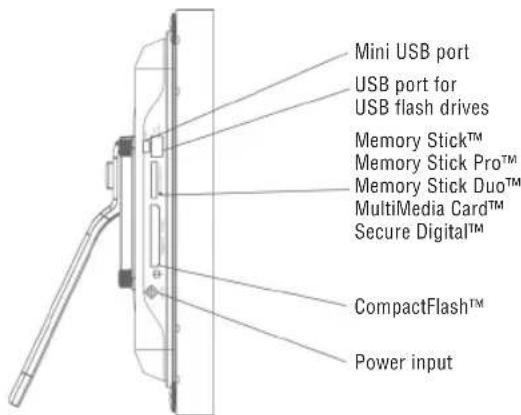
- Insert a memory card into the appropriate slot. Slot 1: Compact FlashTM
Slot 2: Secure DigitalTM, MultiMedia CardTM, Memory StickTM, Memory Stick ProTM or Memory Stick DuoTM
Note: The card will only fit in one direction. Do not force it. The card should fit snugly when properly inserted.
- Press the On/Off switch on the back of the DigiFrame for about 2 seconds until the LED at the side is on. A slideshow of the photos will start automatically.
- To display photos individually, press the EXIT button to open the thumbnail screen. Use the four arrow buttons to choose a photo. Press the Play button (>11) on the top of the Digital Picture Frame or the ENTER button on the remote control.
Note: Pull the plastic tab sticking out of the remote control. It protects the battery, and the remote control will not work unless it is removed.
- To restart the slideshow, press the Play button (>11) on the Digital Picture Frame again, or press the SlIDESHOW button on the remote control.
Control Buttons and Remote Control
You can access all of the Digital Picture Frame features either with the buttons on top of the frame or via the remote control.
Using the control buttons
The control buttons are located on top of the Digital Picture Frame. Their basic functions are the same, no matter when you press them.
Note: You can open the appropriate menu any time by pressing the EXIT button for a second. This corresponds to the SETUP button of the remote control.
Button Action
<<Move highlighting up or left Display previous photo Select previous file
II Select highlighted option Start slideshow Pause Play
Move highlighting down or right Display next photo Select next file
EXIT Exit current screen Go back a screen
MENU Open control and setup menu
ENGLISH16
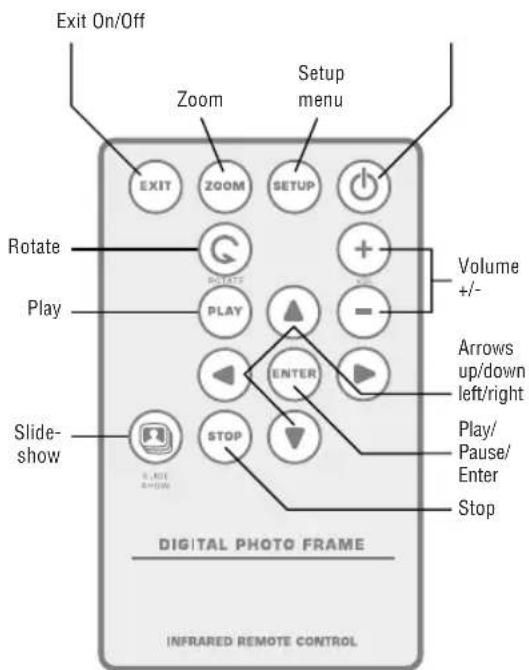
Using the remote control
The remote control included with your Digital Picture Frame may look slightly different from the one shown here, but it offers the same buttons and functions.
Replacing the remote control battery
- Hold the remote control with the control buttons facing downward.
- While pressing the ridged lug of the battery cover to the inside, pull the tray out.
- Place a CR2025 lithium battery on the tray with the positive "+" end facing toward you.
- Close the tray.
Setting Up a Slideshow
You can control all of the Digital Picture Frame functions either with the buttons on top of the frame or via the remote control. To display a menu, simply keep the EXIT button on the frame pressed for a second, or press the SETUP button on the remote control.
Card selection screen
Use the Select Card menu to choose between memory cards and the built-in memory.
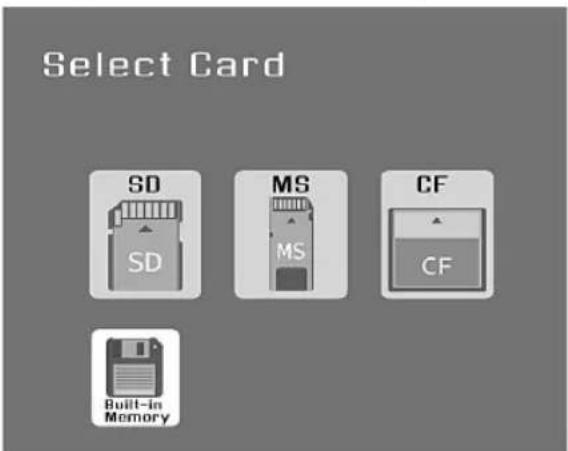
- To open the Select Card menu, either insert a new card or press the EXIT button repeatedly to return to the menu screen.
- Press the left and right arrow buttons to select the desired memory card or the built-in memory.
- Press the ENTER button to confirm your selection. The Select Mode screen opens.
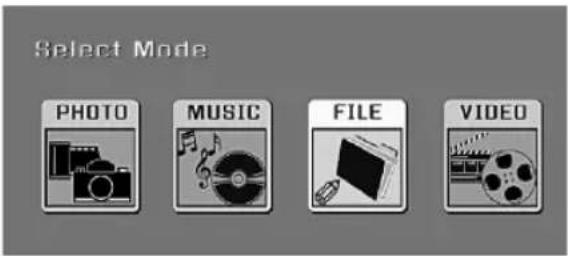
Mode selection screen
The Select Mode screen appears after selecting the memory source to choose the type of files you wish to play or display. The screen shown here is from the Digital Picture Frame model with video and MP3 functions.
ENGLISH 17
PHOTO: Display JPEG photo slideshows.
MUSIC: Play audio files
(only model with MP3 function).
VIDEO: Show motion JPEG AVI movies
(only model with video function).
FILE: View the file structure on the memory
card (only model with video and
MP3 functions).
- Press the left and right arrow buttons on the remote control or the Digital Picture Frame to select the desired file type.
- Press the ENTER button to confirm your selection. If you selected PHOTO, the thumbnail screen opens which is described below. If you selected another file type, a screen will open listing all available files of the chosen type. The files are selectable in the same way as photos (only model with video and MP3 functions).
- To go back to the Select Mode screen, press EXIT.
Thumbnail screen
This screen shows thumbnail versions of all photos on the selected memory source. Up to 12 photos are displayed at a time. Use this screen to select a single photo to be displayed or to start a slideshow of all photos.
- Press the arrow buttons on the remote control or Digital Picture Frame until the desired photo is highlighted. The photo file name will be displayed at the top of the screen.
- Press the SlIDESHOW button to start the slideshow with the selected photo.
- To stop the slideshow and return to the thumbnail screen, press the EXIT button.
Slideshow with selected pictures
In the thumbnail screen
- Use the four arrow buttons to select the desired photos.
- Confirm each selected photo by pressing the VOL+ button. To undo the selection, press the VOL- button.
- Press the SETUP button and select Start Slideshow, then Slideshow Selected.
Displaying a single photo full screen
You can choose a single photo to be displayed without a slideshow.
- With the thumbnail screen displayed, select a photo and press ENTER to display the selected photo on the full screen.
- Press the left arrow button to go to the previous photo.
- Press the right arrow button to display the next photo.
- To stop the full screen display and return to the thumbnail screen, press the EXIT button.
Controlling Slideshows and Photos
The Digital Picture Frame provides many options for customising the display and for file management.
These options are available only when viewing photos.
Changing the displayed photo manually
During a slideshow, each photo replaces the previous one at the interval set for the slideshow speed in the Setup menu.
You can also change the displayed photo at any time during a slideshow.
- Press the left arrow button to go to the previous photo.
- Press the right arrow button to display the next photo.
Rotating a photo
You can rotate a photo displayed in full screen mode using the remote control.
Press the ROTATE button to rotate the photo 90 counterclockwise.
ENGLISH18
Enlarging a photo
To magnify a photo displayed in full screen mode, press the ZOOM button.
The photo doubles in size each time you press the button until it is 16 × normal size. Then it will return to normal size.
- When the photo is in zoom mode, use the arrow buttons to move the photo to display the portions that are not currently visible.
Copying displayed photo to built-in memory
Use the remote control to copy the displayed photo from the memory card to the built-in memory.
- Press the SETUP button to open the menu.
- Press the up or down arrow button to select Copy Photo.
- Press ENTER. A confirmation message will be displayed.
- Press EXIT to close the menu.
Deleting the displayed photo from built-in memory
When displaying a photo stored in the built-in memory, you can delete it from the built-in memory with the remote control.
- Press the SETUP button to open the menu.
- Press the up or down arrow button to select Delete Photo.
- Press ENTER. A confirmation message is displayed.
Caution: The photo will be deleted immediately and irrevocably. - Press EXIT to close the menu.
Adjusting the LCD color
This option is used to adjust the brightness, contrast, tone, and colour of the display.
- Press the SETUP button to open the Setup menu.
- Press the up or down arrow buttons to select Adjust LCD Color.
- Press ENTER. A second menu opens.
- Use the arrow buttons to select the option to be adjusted.
- Use the left and right arrow buttons to select the desired value. The display will change according to the selected setting.
-
Use the arrow buttons to select another option to be adjusted.
-
When the display looks the way you want it to, press EXIT to close the menu.
Adding music to a slideshow (only model with MP3 function)
To play background music with a slideshow, copy audio files onto the same memory card as your photos. The music will play as the slideshow runs. See "Connecting to a Windows computer" for details on copying files.
You can also choose a music file to play without a slideshow. Just select it from the MUSIC screen.
Note: Music files must be standard MP3 format and not from licensed music download services.
Copying Photos from Flash Card to Built-in Memory
In the thumbnail screen
- Use the four arrow buttons to select the desired photos.
- Confirm each selected photo by pressing the VOL+ button. To undo the selection, press the VOL- button.
- Press the SETUP button and select Copy Photo, then Copy Selected.
Alternative:
Press the SETUP button and select Copy Photo. Afterwards, select Copy All. This will copy all photos to the built-in memory.
In the FILE screen (only model with video and MP3 functions)
- Use the four arrow buttons to select the desired photos.
- Confirm your selection by pressing the left arrow button.
- Press the SETUP button and select Copy.
ENGLISH 19
Deleting Photos from Built-in Memory
In the thumbnail screen
- Use the four arrow buttons to select the desired photos.
- Confirm each selected file by pressing the VOL+ button. To undo the selection, press the VOL- button.
- Press the SETUP button and select Delete, then Delete Selected.
Alternative:
Press the SETUP button and select Delete. Afterwards, select Delete All. This will delete all photos from the built-in memory.
In the FILE screen (only model with video and MP3 functions)
- Use the four arrow buttons to select the desired photos.
- Confirm your selection by pressing the left arrow button.
- Press the SETUP button and select Delete.
Listening to Music
(only model with MP3 function)
If there are music files on a memory card or built-in memory, you can play them on your Digital Picture Frame.
- Use the remote control to open the Select Mode screen (described above) and select MUSIC. A new screen opens listing all music files on the selected card.
- Use the left and right arrow buttons to choose a file.
- Press ENTER to play the file.
- To stop the music and return to the MUSIC screen, press the EXIT button.
Controlling the volume
(only model with MP3 function)
Use the remote control to adjust the volume on your Digital Picture Frame during a slideshow or when playing audio files. Press the VOL+/VOL- buttons to adjust the volume up or down.
Watching a Video
(only model with video function)
You can watch video files on your Digital Picture Frame as well. It supports the Motion JPEG (AVI) video format used by most digital cameras. The screen shown here is from the Digital Picture Frame model with video and MP3 functions.
Select Mode


- Insert a memory card with video files on it. The card selection screen opens. Choose the desired card.
- Press ENTER. The Select Mode screen opens.
- Use the arrow buttons to select VIDEO and press ENTER. A list with all available video files will be displayed.
- Use the arrow buttons to choose the desired file and press ENTER. The Digital Picture Frame will play the video.
- Use the VOL+/VOL- buttons on the remote control to adjust the volume.
Setting Viewing Options
You can control all viewing options in the Setup menu using the buttons on the top of the frame or the remote control. You can display the on-screen Setup menu any time the Digital Picture Frame is not displaying photos or videos by pressing the SETUP button.
- To display the Setup menu during a slideshow or while playing a video, press the EXIT button followed by the SETUP button.
- With the Setup menu open, use the up and down arrow buttons to choose a viewing option.
- Press ENTER to select the respective option. A second menu will open listing the available settings. A white square indicates the current setting.
- Use the up and down arrow buttons to choose the desired setting.
ENGLISH20
- Press ENTER to confirm the setting. The second menu closes.
-
You can make any changes to the viewing options in this manner. When you are finished, press the EXIT button to close the Setup menu and return to the thumbnail screen.
-
The following table lists the viewing options in the Setup menu as well as the available settings and their effects.
Viewing Option Settings Description
| Magic Window ON/OFF ON: Shows 4 photos in the display OFF: Shows 1 photo in the display | ||
| Display Image Size Original/Optimal The Digital Picture Frame can optimise the display of your photos to the screen size. | ||
| Slideshow Transition Normal Special effects used for the transition from one Random photo to the next in a slideshow. Fade Curtain Open_Door Cross_Comb | ||
| Slideshow Speed 3S Defines the speed of the slideshow 5S (display interval of photos). 10S 30S 60S | ||
| Slideshow Music ON/OFF Slideshow runs with or without music. | ||
| Slideshow Shuffle ON/OFF Displays photos randomly. | ||
| Video Playback Repeat Repeat Single Choose to repeat a single video file, (only model with video function) Repeat All all video file No Repeat or play the selected file only once. | ||
| Audio Playback Repeat Repeat Single Choose to repeat a single audio file, (only model with MP3 function) Repeat All all audio files, No Repeat | or play the selected file only once. | |
| Power Saving | 2 Hours | The Digital Picture Frame will turn itself off after the specified amount of idle time. |
| 4 Hours | ||
| 8 Hours | ||
| No Power Saving | ||
Factory Default
Immediately resets all settings to the factory defaults. There is no warning message.
ENGLISH 21
Advanced Operations
In addition to the basic functions described above, you can connect the Digital Picture Frame to your computer to copy files to the built-in memory.
Connecting to a Windows Computer
To copy files between your computer and the Digital Picture Frame, perform the following steps:
- Plug in and turn on the Digital Picture Frame.
- Connect the small end of the USB cable to the USB port on the side of the Digital Picture Frame.
- Connect the larger end of the USB cable to a USB port on your computer.
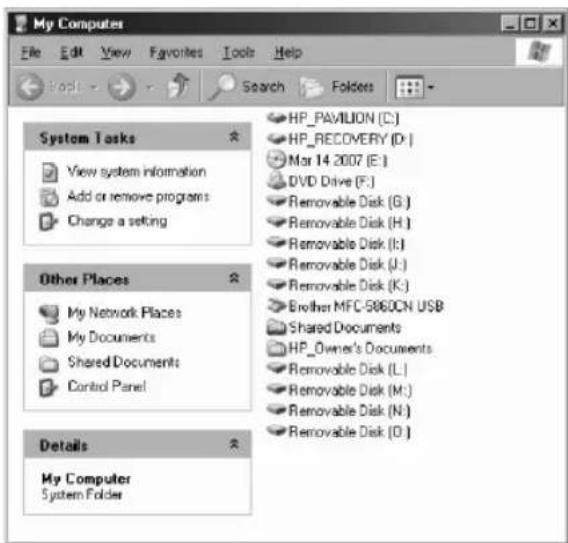
- Open My Computer on your Desktop. A window showing all drives connected to your computer will open.
- Each readable memory card and the built-in memory of the Digital Picture Frame are listed as Removable Disk.
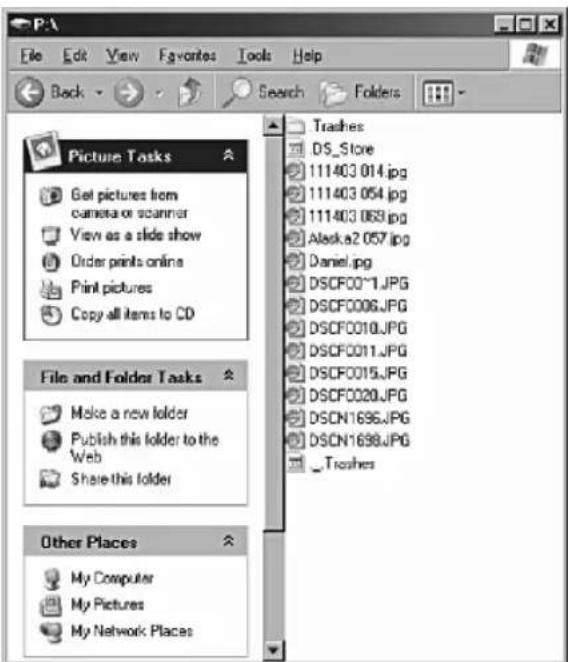
- Double-click the desired drive to display the files on the respective card.
The example below shows a card with several JPG images on it.
- To copy files from the card, simply select and drag them to the desired location on your computer.
- To copy photos from your computer to the card, locate the files on your computer at first. Most cameras and graphic programs store photos in the My Pictures folder of Windows. If you didn't move them somewhere else, they are probably there.
- Select the files you wish to copy. Use the right mouse button to open the context menu and select Copy. Now, return to the path of your removable card.
- Click in the window, and use the right mouse button to open the context menu and select Paste.
Note: If your PC is connected to Local Area Network drives, or if you have multiple drive letters already assigned to peripheral devices, you will need to manage your drive settings in Windows to free up the four drive letters immediately following your CD-ROM drive so that the Digital Picture Frame can assign them to the memory card slots properly.
Disconnecting the Digital Picture Frame from the Computer
It is important not to just unplug the Digital Picture Frame when you are done transferring files. It can seriously damage the memory.
ENGLISH22
- In Windows, look for the USB icon and select Safely Remove Hardware. A dialog box opens.
- Select USB Mass Storage Device and click Stop. Another dialog box opens.
- Click OK. A final dialog box opens.
- Select Close. When the message It is Now Safe to Disconnect Hardware appears, you can disconnect the USB cable from your computer.
Connecting to a Macintosh
You can also copy files from your Macintosh computer to your Digital Picture Frame.
- Use the included USB cable to connect your Digital Picture Frame to your Macintosh. Macintosh will recognize the Digital Picture Frame as an external storage device.
- Drag and drop the files between the two devices as you normally move photo files.
- To safely disconnect the Digital Picture Frame from your Macintosh, drag the Digital Picture Frame icon on your desktop to the eject icon (paper basket). When the icon is no longer on the desktop, it is safe to unplug the USB cable.
Connecting a USB Flash Drive
Your Digital Picture Frame will see a USB Flash Drive the same way it sees memory cards.
Frequently Asked Questions
Q: How do I set up my Digital Picture Frame?
A: It is very simple to get your Digital Picture Frame out of the box and running in just a few minutes. Just plug the power adapter into the Digital Picture Frame and into a standard wall socket. Insert a memory card into the appropriate card slot on the side of the Digital Picture Frame, and turn it on. Your first slideshow will automatically start to play.
Q: What memory cards can the Digital Picture Frame read?
A: Compatible memory cards include Compact Flash™, Secure Digital™, MultiMedia Card™, Memory Stick™, Memory Stick Pro™ and Memory Stick Duo™.
Q: I set up the Digital Picture Frame. Why won't it turn on?
A: The adapter is not securely connected to the Digital Picture Frame or the power switch is not on.
Q: I have a memory card in the Digital Picture Frame. Why can't I view my photos?
A: First, make sure that the memory card is one of the formats listed above and that the files on the card are JPEG image files. Second, turn the Digital Picture Frame off and make sure that the memory card is inserted all the way into the card slot and is facing in the correct direction. Third, turn the frame on. After a couple of seconds, you should see your first photo. Press EXIT to open the Select Card screen and select the card. Then select PHOTO. You should see the thumbnail screen listing all photos on the card. If you don't, you may want to try another card.
Note: Some digital cameras save images in other formats. Please refer to your camera's manual if your photos are not JPEG files.
Q: Why is the picture display slower with some pictures and faster with others?
A: Higher resolution pictures load more slowly. Try using lower resolution pictures or down sampling your images. See your camera's operating manual for details on down sampling photos.
Q: Can I insert multiple memory cards?
A: Yes. Turn on the Digital Picture Frame before inserting any card. The Select Card screen lets you choose between all available memory cards.
Q: Does the Digital Picture Frame have a built-in memory?
A: Yes. The volume depends on your model.
Q: Does the Digital Picture Frame support all JPEG and Motion JPEG files?
A: No, it supports JPEG and Motion JPEG files taken from a digital camera. The Digital Picture Frame may not read all image or video files downloaded from the internet or from other software graphics applications. Some video formats downloaded from the internet are not supported either. To support video files, a Digital Picture Frame featuring video functions is required.
ENGLISH 23
Technical Specifications
Product: 10.4" (approx. 26 cm) LCD screen Digital Picture Frame
Resolution: 800× 600 pixel (4:3)
Internal memory: See package specifications
Memory card Compact Flash™, Secure
format: DigitalTM, MultiMedia CardTM, Memory StickTM, Memory Stick ProTM, Memory Stick DuoTM and USB Flash Drives
File formats: Standard JPEG, Motion JPEG AVI (only model with video function), MP3 (only model with MP3 function)
Features: Slideshow mode Multiple transitional styles for slideshow Variable speed for slideshow four position adjustable stand for optimum viewing angle
USB Ports: USB 2.0 (host) and USB 2.0
Internal speakers: 2 × 1 W (only model with MP3 function)
Power input: 100V - 240V AC, 50Hz
Output: 12 V DC, 1.5 A
Dimensions: approx. 315 × 261 × 60 mm
Weight: approx. 1,450 g
Certification: CE/FCC/PSE (adapter)/SGSS/RoHS
ENGLISH24
FRANÇAIS
Sommaire
Brightness: Luminosità
Contrast: Contrasto
Brightness: Helderheid
Contrast: Contrast
Tint: Kleurnuance
Color:Kleur
Certificate: CE/FCC/PSE (Adapter)/SGSS/RoHS
NEDERLAND72
PORTUGUES
Conteudo
Slot 2: Secure DigitalTM (SD), Multimedia KortTM, Minne PinneTM (MS), Minne Pinne ProTM (MS Pro), Minne Pinne DuoTM (MS Duo).
Controlling the volume (only model with MP3 function)
ProTM(MS Pro), Minne Pinne
Duo^TM (MS Duo) and USB Flash
Drives
Filformat: Standard JPEG, Motion JPEG
AVI (endast modellen med video
Certificering: CE/FCC/PSE (adapter)/
SGSS/RoHS