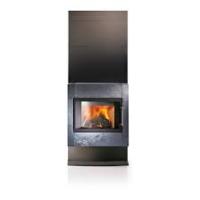
OTTAWA - Wood stove HASE - Free user manual and instructions
Find the device manual for free OTTAWA HASE in PDF.


| Product type | Wood stove |
| Brand | HASE |
| Model | OTTAWA |
| Dimensions (H x W x D) | 156 x 48 x 48 cm |
| Weight | 324 to 343 kg (depending on version) |
| Nominal power | 6 kW |
| Authorized fuel | Logs (max 25 cm) and lignite briquettes |
| Energy efficiency | 79 % (wood), 84 % (briquettes) |
| Flue gas temperature (pipe) | 280 °C |
| Minimum required draft | 12 Pa |
| Flue pipe diameter | 15 cm |
| Door opening | 1106 cm² |
| Rotation | Swivel base 160°, locking in 15° increments |
| Thermal storage block | Magnesium stones, progressive heat diffusion |
| Safety distances (front / sides) | 80 cm / 40 cm in radiation zone |
| Floor protection | Non-combustible plate extending 50 cm in front and 21 cm on sides |
| Glass cleaning | With cold ash on newspaper |
| Flue cleaning | Annually, after the heating period |
| Steel cladding maintenance | Slightly damp cloth, avoid acidic products |
| Certification | DIN-EN 13240:2001+A2:2004, Art. 15a B-VG (Austria) |
| Warranty | Not covered for improper use or prohibited fuel |
Frequently Asked Questions - OTTAWA HASE
User questions about OTTAWA HASE
0 question about this device. Answer the ones you know or ask your own.
Ask a new question about this device
Download the instructions for your Wood stove in PDF format for free! Find your manual OTTAWA - HASE and take your electronic device back in hand. On this page are published all the documents necessary for the use of your device. OTTAWA by HASE.
USER MANUAL OTTAWA HASE
Chere clientele, Cher client,
In deciding on a Hase stove, you have purchased a top quality product. It goes without saying that we only use first-rate materials and process them with superior craftsmanship and the greatest care and precision. At our headquarters in Trier, Germany, we put our love of detail into every stove we develop and manufacture, thus ensuring that they meet the highest standards in design, functionality, and eco-friendliness.
The well-balanced design, state-of-the-art production processes, as well as our efficient and environmentally-friendly combustion technology will let you keep enjoying your Hase stove for years to come.
Please read carefully through these operating instructions. They provide important instructions and offer useful tips for spending cosy hours around the fire.
We hope you will enjoy your new Hase stove.
- General Information 55
1.1. Definition of Safety Notes.. 55
1.2 Proper Use 56
1.3 Safety Instructions.. 56 - Control Elements 57
- Installation Conditions and Relevant Building Regulations 58
- Safety Distances 58
- Installation 58
-
Revolving Console. 59
-
Heat Retaining Block 59
- Chimney 60
- Flue Pipe Connection 61
- Butterfly Valve 61
- The Right Fuel 61
- Regulating the Combustion Air. 62
12.1 Primary Air.. 62
12.2 Secondary Air 62 - Fuel Load Sizes and Thermal Output 62
- Initial Operation 62
- Lighting the Fire 63
- Adding Fuel / Heating at Nominal Thermal Output .63
- Heating with Brown Coal Briquettes 63
- Banking the Fire and Raising the Temperature 64
- Heating at Low Thermal Output.. 64
- Emptying the Ash Analyzer 64
- The Combustion Process 65
21.1 Drying Phase.. 65
21.2 Degasification Phase 65
21.3 Burn-off Phase 65
21.4 Expansion Noises 65 - The Chemistry of Wood 65
- Contribution to Environmental Protection.. 65
- Evaluating the Combustion Quality 65
- Wood Moisture Content and Calorific Value.. 66
- Storing and Drying Wood 66
- Cleaning and Maintenance 66
27.1 Steel Cladding 66
27.2 Flue Gas Paths 67
27.3 Ceramic Glass Panels and Windows 67
27.4 Fire Box Lining.. 67
27.5 Sealing Strips.. 67 - Troubleshooting 68
- Technical Data 69
- CE Declaration of Conformity 70
1. General Information
This section contains important information on using this technical documentation. Utmost care was taken in preparing this document. Nevertheless, suggestions for improvement and comments regarding any errors are always welcome.
1.1 Definition of Safety Notes

WARNING!
This symbol alerts you to a potentially hazardous situation. Non-compliance with this warning can cause severe injuries, or even death.

CAUTION!
This symbol alerts you to a potentially hazardous situation. Non-compliance can cause damage to property or injuries to persons.

NOTE!
Provides additional tips about using the stove as well as useful information.

ENVIRONMENT!
Sections marked with this symbol provide information about safe and environmentally-friendly operation as well as environmental laws and regulations.
1.2 Proper Use
The stove may only be used for heating suitable living spaces and may only be fuelled with wood (firewood) and brown coal (lignite) briquettes.

WARNING!
Any other use is considered improper use and can cause severe damage to the product or even fatal injuries to persons.
The manufacturer's warranty does not apply to any damage or injury caused by improper use of the stove.
1.3 Safety Instructions

WARNING!
Never use spirits, petrol, or other flammable fluids to light the stove. During operation, the external surfaces of the stove become very hot, and thus the entire stove poses a burn hazard. To ensure the safe operation of this stove, we are enclosing a glove with the delivery of your stove.
Children should never be left unattended near the stove while it is in operation. There is a burn hazard.
Do not wear loose-fitting and/or easily flammable clothes when adding fuel to the fire.
Do not burn improper or unsuitable materials such as chipboard, varnished, laminated, treated or plastic-coated wood, waste, refuse, etc. These materials are harmful to the environment and can damage the entire combustion system and stove.
Do not store flammable or combustible materials or fluids (e.g., spray cans) in the immediate vicinity of the stove.
If the air slider is closed while the fire is burning or the embers are still glowing, the flammable gases still present in the stove can burn off explosively (deflagration), thus causing severe damage to the stove.
Never put laundry or other objects on the stove to dry them. Do not place heat-sensitive materials on or near the stove.
Make sure that clothes drying racks and other similar objects are placed at a sufficient distance away from the stove.
Never put your life at risk in a chimney or house fire. Your own safety always takes precedence!
Modifying or making any changes to the stove is not permitted. Only original replacement parts from Hase Kaminofenbau GmbH may be used.

CAUTION!
Be sure to connect the stove to a chimney that meets the applicable regional and national regulations and standards.
For safety reasons, make sure that all joints and connections between the stove and chimney are sealed tightly.
Improperly installed or leaking flue gas pipes pose a particular risk due to smoke emission and/or fire hazards. Please make sure to consult a licensed specialised company to determine the correct arrangement and installation of the pipes.
We recommend using a lined wall sleeve and installing a connecting piece with a butterfly valve.
Please comply with the applicable country-specific legal regulations.
Within a radius of 20~cm and around the connection opening, you are legally required to remove all flammable, combustible, or heat-sensitive materials located on or inside the wall, and replace them with non-flammable materials. This regulation applies to Germany only. Outside of Germany, the pertinent national fire protection regulations have to be complied with.

NOTE!
In case of a chimney fire:
- Ring the emergency phone number to alert the fire brigade!
- Notify your chimney sweep!
- Never extinguish the fire with water!
- Remove any flammable objects located in the vicinity of the chimney!
- Wait for the fire brigade to arrive!
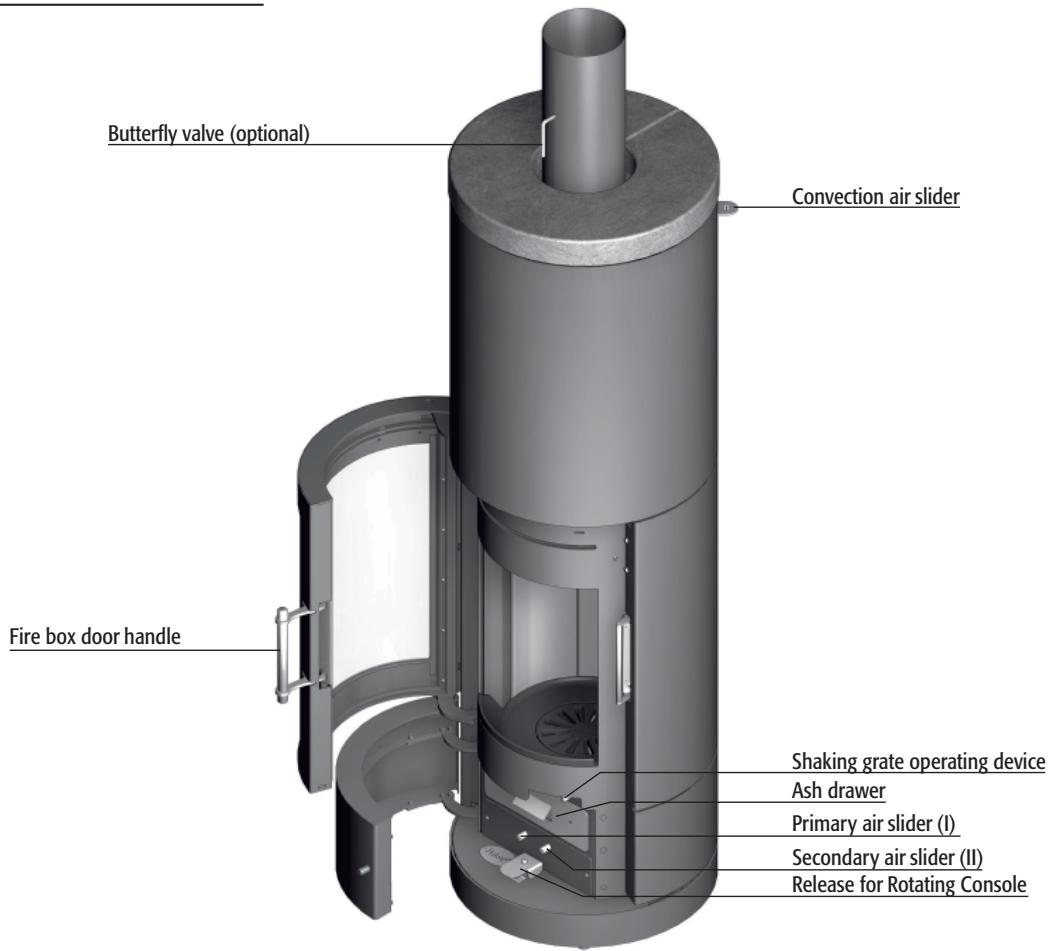
2. Control Elements
3. Installation Conditions and Relevant Building Regulations
The stove must be installed in accordance with the instructions and requirements stipulated by the respective national and European standards and local regulations.
In Germany, the stove must be registered with the local master chimney sweep for inspection prior to initial operation.
4. Safety Distances
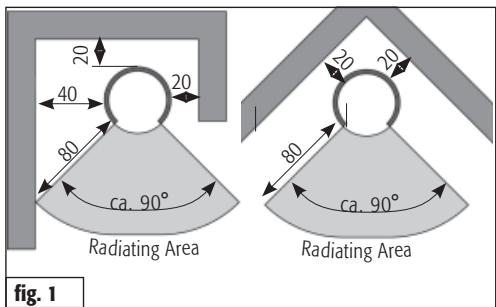
Within a radius of 80~cm in front of and 40~cm around the stove, flammable, combustible, or heat-sensitive materials (e.g. furniture, wood or plastic panelling, curtains, etc.) are not allowed to be located in the heat radiating area of the fire box window (Fig. 1).
In regards to flammable materials beyond the heat radiating area, a safety distance of 20~cm at the sides of and behind the stove has to be adhered to (Fig.1).

WARNING!
Flammable flooring materials (e.g., wood, laminate, carpeting,) must be protected with a floorplate made of non-combustible material (e.g., tiles, safety glass, slate, or sheet steel).
The size of the floorplate must be larger than the base of the stove by at least 50~cm in front and at least 21~cm at the sides of the stove (Fig. 2).
Dimensions in cm
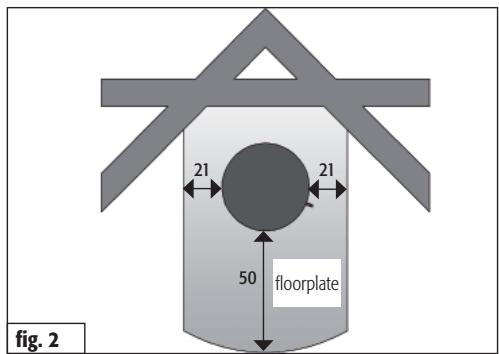
Dimensions in cm

WARNING!
Never turn stove when lighting fire!
5. Installation
Check to make sure that the load-bearing capacity of the installation surface is sufficient. If necessary, using a floorplate to distribute the load can increase the load bearing capacity.
Check whether the room in which the Ottawa will be installed is adequately supplied with enough fresh air. If the windows and doors are tightly sealed, the necessary supply of fresh air may not be ensured, which can interfere with the draught capability of the stove and chimney.
If additional combustion air inlet openings are required, they are not permitted to be closed or blocked.

CAUTION!
Simultaneous operation of the stove with ventilation systems and/or exhaust hoods can cause negative pressure to build up in the room where the stove is installed, which can lead to problems such as flue gas escaping from the stove.

NOTE!
To ensure that air is not drawn out of the room where the stove is installed, we recommend using a window contact switch to lock exhaust hoods that guide the air to the outside.
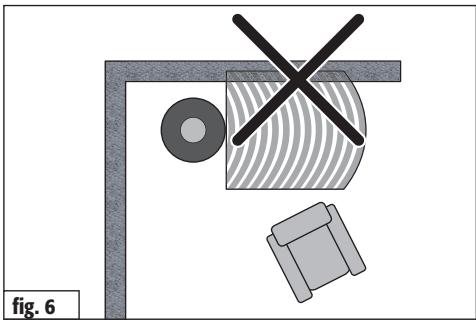
6. Revolving Console
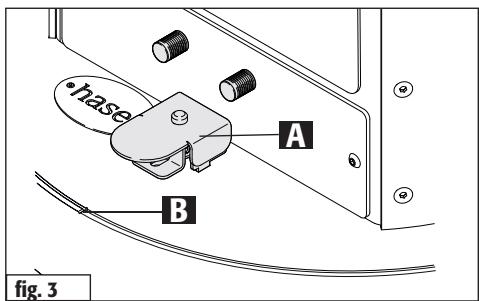
The Ottawa features a revolving console as a standard feature. To turn the Ottawa to the desired position, pull the lever (A) to disengage the locking mechanism. The marking (B) indicates the middle position for the installation.
The Ottawa has a maximum rotational angle of 160 degrees; you can adjust the rotational angle in 15-degree increments.

WARNING!
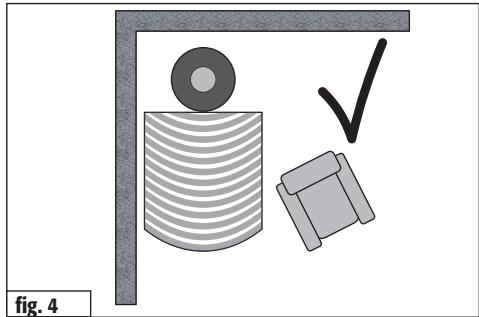
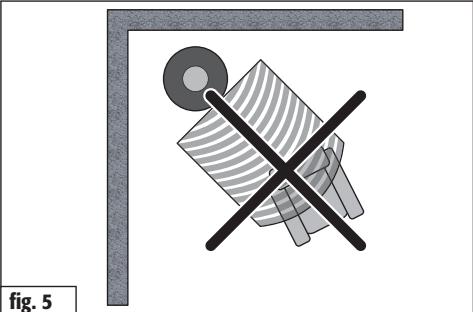
Always comply with the safety distances to combustible and flammable materials!

NOTE!
The revolving function does not work for stoves with rear-mounted flue pipes
If a floor plate is required, its size must match the rotating range of the stove. Never turn stove when lighting fire!
7. Heat Retaining Block
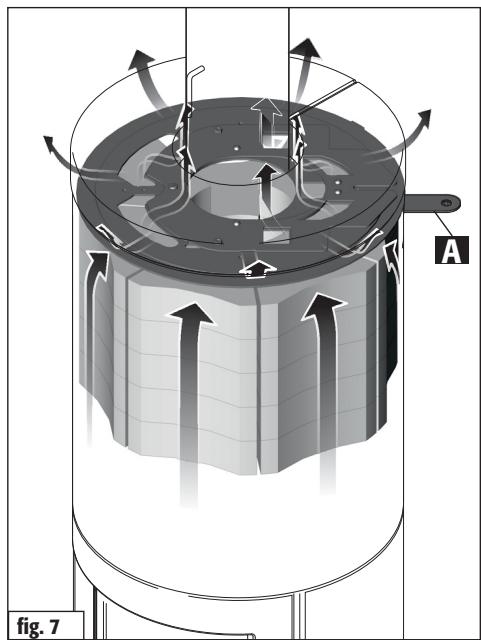
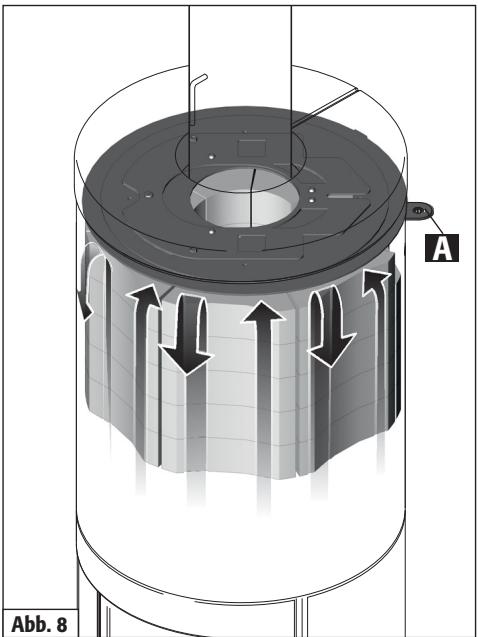
Massive heat-retaining blocks made from magnetite are located above the fire box. These blocks absorb the heat generated by the fire and gradually emit cosy warmth into the room. To heat up the room more quickly, you can also let the warm air flow directly into the living room.
When you open the slider (A), the warm air flows into the living room through the convection vents.
When you close the slider (A), the majority of the warm air flows to the heat retaining block and is gradually dispersed back into the room as cosy warmth.
8. Chimney
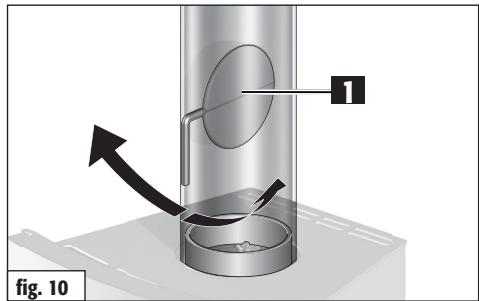
The Ottawa has to be connected to a suitable chimney with a minimum effective chimney height of 4.50m . It can be connected to a chimney to which other fireplaces are already connected. The chimney cross section should correspond to the flue pipe cross section. If the effective chimney height is too low and/or the chimney cross section is too large or too small, the draught capability of your stove can be impaired. The Ottawa stove requires a 12 Pa output pressure (chimney draft). At higher output pressures, the stove emissions increase, which puts a high load on the stove and can lead to damage. The Ottawa stove has a maximum permissible output pressure of 35 Pa. To limit the output pressure, a butterfly valve (Fig. 10) or output pressure limiter can be used.
9. Flue Pipe Connection
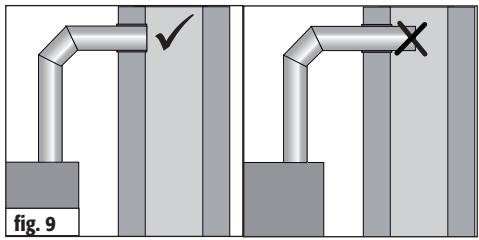
The Ottawa has to be connected to the chimney with a flue pipe with an inside diameter of 15cm . Please ensure that all pipe pieces are tightly fit at the connection junctions. We recommend using elbow pipes with cleaning hatches.

CAUTION!
The flue pipe must be well sealed at the chimney entrance and cannot project into the inner cavity of the chimney; otherwise the flue venting will be impaired (Fig. 9).
10. Butterfly Valve
The butterfly valve (Fig. 10/1) is an optional control element. It is fitted in the flue pipe and used to regulate the flue gas flow, and can thus slow down the burning-off process. When the handle's position is diagonal to the flue pipe, the flue gas flow rate is turned to minimum. We strongly recommend installing a butterfly valve to reduce the output pressure. Please comply with the country-specific legal regulations.

NOTE!
Make sure butterfly valve (Fig. 10) is open before opening the fire box door during the burning phase.
11. The Right Fuel
Only fuels which generate low quantities of smoke may be burned in stoves. Only fuel in the form of natural, untreated wood logs or bricks, including the adherent bark, can be used for the Ottawa.
For the most attractive stove fire, use beech wood logs. If other types of wood are used, such as oak, birch, pine or larch, we recommend adding beech wood for picturesque dancing flames. Brushwood and small pieces of wood are good kindling materials.
Highly resinous coniferous wood (e.g. spruce, pine, fir) tends to emit flying sparks and leaves behind a fine layer of flue ash that can swirl up when the fire box door is opened.
The firewood should be stored for at least two years to achieve the required maximum residual moisture content of 20% .

CAUTION!
If the wood used as fuel is too moist, water vapour can condense and damage the stove. In addition, it will reduce the thermal output.

CAUTION!
Burning, e.g.:
- damp or moist wood(residual moisture content over 20% ),
- varnished, laminated, treated, or plastic-coated wood,
- wood treated with wood preservatives,
household waste, - paper briquettes (contains pollutants such as cadmium, lead, zinc), or
- any flammable fluids (including methanol and ethanol) as well as any fuel pastes or gels
is not permitted.

ENVIRONMENT!
Combustion of the materials listed above not only gives off unpleasant odours, but also generates emissions that damage the environment and are harmful to health.
Combustion of non-permitted fuels constitutes a violation of the German Federal Immission Control Act.
Improper fuels and their combustion residues can be detrimental to the functioning and service life of the stove and chimney - use of such fuels voids both the warranty and guarantee.
12. Regulating the Combustion Air
To effectively guide the required volume of air to the right places, a customized air flow system has been developed for your Hase stove.
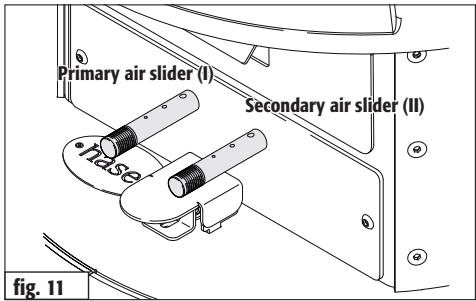
When lighting the fire and adding fuel, you can use the primary air and secondary slider to regulate the combustion air.
12.1 Primary Air
The primary air is guided through the grate and into the fire box from below, which allows the stove to reach the required fire box temperature more quickly during the warming up phase.
12.2 Secondary Air
The secondary air is guided into the fire box from the top, via air ducts in the stove. It supplies the fire box with the volume of preheated oxygen necessary to completely burn off the wood gas and reduces the build up of soot on the fire box windows.
For regulating the secondary air, the following general rule applies: a small fire requires little secondary air; a large fire requires ample secondary air.

WARNING!
If the secondary air slider (Fig. 11/II) is closed too tightly, there is a risk that the flue gases will not burn completely (smouldering fire), that soot will build up on the fire box window, or that the amassed wood gases will burn explosively (overfiring/deflagration).
Burning wood when the primary air slider (Fig. 11/I) is opened too wide poses the risk of overheating the stove (forge fire effect).

CAUTION!
During operation, the secondary air slider (Fig. 11/II) should never be completely closed. In contrast, however, the fire box door and ash compartment must always be tightly shut.
13. Fuel Load Sizes and Thermal Output
The thermal output depends on the amount of fuel you put in the stove. When adding more fuel, please do not exceed the maximum fuel load size of 2kg . Exceeding the maximum fuel load size leads to a danger of overheating, which can result in damage to the stove and the risk of a stove fire.

NOTE!
To attain a thermal output of approx. 6kWm burn wood logs that weigh 1.4kg and are no longer than 25~cm in length for about 45min (1.7kg / 60min at browncoal briquettes

NOTE!
To attain a thermal output of approx. 3.5kWm burn wood logs that weigh 0.5kg and are no longer than 25~cm in length for about 35 min. (0.8kg / 60min at brown coal briquettes).
The Ottawa is intended for intermittent operation, please only apply one fuel layer at a time.
14. Initial Operation

NOTE!
During shipment, condensation moisture can accumulate in the stove's interior, which may possibly lead to the appearance of condensation or water on the stove or flue pipes. Please dry off these damp areas immediately.
The surface of your stove was treated in a sandblasting machine before applying the colour coating. Despite careful and thorough inspection, there may still be some residual material in the stove body, which can fall out when your stove is being installed.

NOTE!
To prevent any damage, please immediately vacuum up these small steel pellets with a vacuum cleaner.
The first time a stove is operated, the heat development causes the emission of volatile components from the coating, sealing strips and lubricants, and smoke and odours can occur.
At a higher combustion temperature, this one-time process can take between 4 to 5 hours.
To achieve this higher combustion temperature, please increase the fuel quantity recommended in Section 16, "Adding Fuel/ Heating with Nominal Thermal Output", by approximately 25% .

CAUTION!
To prevent adverse effects on health, nobody should stay in the room(s) during this process unless absolutely necessary. Make sure the room is well-ventilated and open the windows and outside doors. If needed, use a fan for faster air circulation.
If the maximum temperature is not reached during the first heating operation, you may notice an odour for a short period of time the next time the stove is used as well.
15. Lighting the Fire
The firing up phase should be as short as possible, since higher emissions can occur during this phase.
The slider settings described in Table 1 (see figure on the right) are recommendations that were determined under conformance testing conditions, in compliance with the relevant standard. Depending on the weather conditions and the draught capability of your chimney, accordingly adjust the slider positions for your Ottawa to the local conditions.

NOTE!
The Ottawa may only be operated when the fire box door is closed; the fire box door may only be opened to add fuel

WARNING!
Never use spirits, petrol, or other flammable fluids to light the stove.
Lighting the Fire
Tab. 1
| Procedure | Position of Control Elements |
| Completely open primary and secondary air. | Pull secondary air slider all the way out |
| Open fire grate | Pull out fire grate slider |
| Pile up any remaining ash and unburned Charcoal into the centre of the combustion chamber. | |
| Place 2-3 small logs into the middle of the fire box; stack approx. 0.5 kg of dry wood chips on top. | Open fire box door |
| Light the ignition material at several places. | Close fire box door |
16. Adding Fuel / Heating at Nominal Thermal Output
More fuel should be added to the fire when the flames from the previous burning off phase have just gone out.
Adding Fuel / Heating at Nominal Output
Tab. 2
| Procedure | Position of Control Elements |
| Adjust primary and secondary air. | Close primary air slider (I), set secondary air slider (II) to position 3. |
| Close fire grate. | Push in fire grate slider. |
| Add two logs weighing approx. 1.4 kg in total. Place logs with one end to the front of fire box. Only add a single layer of fuel. | Open fire box door |
| Close fire box door |
17. Heating with Brown Coal Briquettes
Wood should be used for the warming-up phase and when adding fuel for the first time, see "Warming-up Phase". As soon as a basic glowing firebed is reached, place 2-3 brown coal briquettes on the grate in the middle of the firebox, keeping a finger's width between the briquettes, and use the following procedure and settings:
Heating with Brown Coal Briquettes
Tab. 3
| Procedure | Position of Control Elements |
| Open primary air completely. | Pull out primary air slider (I) as far as it will go. |
| Adjust secondary air completely. | Set secondary air slider (II) to position 1. |
| Open fire grate. | Pull out fire grate slider. |
18. Banking the Fire and Raising the Temperature
Keep the stove set as described above until the brown coal briquettes are thoroughly burnt. Then close the primary air (I) and the fire grate. Slide the secondary air slider (II) to position 2/3.

NOTE!
While the stove is in operation, the secondary air slider should never be completely closed.
To raise the temperature of the fire, stir up the rest of the glowing embers with the fire grate slider. Open the primary air (I) and add new logs to the fire.
19. Heating at Low Thermal Output (during Transitional Seasons)
You can vary the thermal output of your Ottawa by adjusting the quantity of fuel used.

NOTE!
Do not attempt to slow down the combustion by reducing the air supply. When heating with wood, this can result in an incomplete burning process and pose the risk of an explosive-like combustion of the accumulated wood gases (deflagration)
Heating with Wood at Low Thermal Output
Tab. 4
| Procedure | Position of Control Elements |
| Position of Control Elements | Push in primary air slider (I) as far as it will go. |
| Adjust secondary air. | Set secondary air slider (II) between position 1 and 2. |
| Close fire grate. | Push in fire grate slider. |
| Add two logs (weighing approx. 0.5 kg total) into the middle of the fire box. |
Heating with Briquettes at Low Thermal Output
Tab. 5
| Procedure | Position of Control Elements |
| Place 1.5 briquettes on the fire grate. | |
| Open fire grate. | Pull out fire grate slider. |
| Adjust primary air. | Set primary air slider (II) to position 2. |
| Adjust secondary air. | Set secondary air slider (II) to position 1. |
20. Emptying the Ash Analyzer
As a safety precaution, please make sure to wait until the ashes are cold before you dispose of them. While the ash collects during the fire, the lid is located under the ash drawer.
Remove both the ash drawer and the lid located underneath it. Slide the lid onto the ash drawer so that it is closed; this prevents ashes from flying around, which in turn means your home stays clean. To place the ash drawer back into the stove, proceed in the reverse order.

CAUTION!
Piled up ashes can impair or even block the supply of primary air supply to the stove. Please ensure that the air supply path for the primary air between the ash drawer and the bottom of the ash compartment remains clear.
21. The Combustion Process
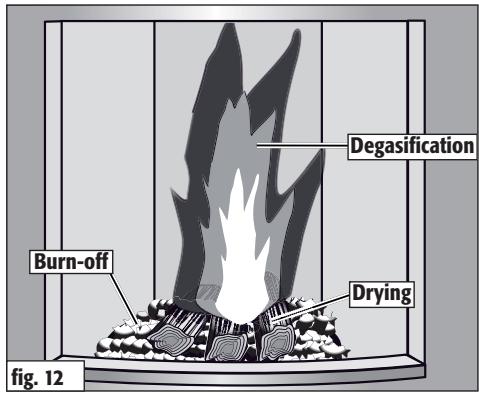
EA piece of wood burns in three phases. In a wood fire, however, these processes occur both consecutively and simultaneously.
21.1 Drying Phase
The moisture still remaining in the air-dried wood (approx. 15 - 20% is evaporated. This takes place at temperatures of approx. 100^ . For the evaporation to occur, the wood must be supplied with heat during the warming up phase; this is achieved by using small wood logs.
21.2 Degasification Phase
At temperatures between 100^ and 150^ , the contents of the wood start - slowly at first - to disintegrate and gasify and the wood begins its thermal decomposition. At temperatures above 150^ , the gas development accelerates. The proportion of volatile components makes up around 80% of the wood substance. The actual combustion begins at a temperature of about 225^ (ignition temperature) with the ignition of the resultant gases and the release of heat. There must be an adequate supply of oxygen available for this purpose. The peak of the combustion process is reached at approx. 300^ . The reaction process is now so rapid that the largest amount of heat is released at this point; flames can reach temperatures of up to 1100^ .
21.3 Burn-off Phase
Glowing charcoal embers remain after the volatile components have been burned off. These burn slowly, almost without flames, at a temperature of approx. 800^ Crucial to a clean and efficient combustion process is a
complete as possible chemical reaction of the wood gases with the oxygen in the combustion air. In your Hase stove, the combustion air is pre-heated and guided into the fire box via wide air inlet openings, so that at high temperatures, there is a good, thorough mixing of the gases with the air. An important variable in any combustion phase is the amount of combustion air. Too little air leads to an oxygen deficiency and incomplete combustion, while too much air reduces the fire box temperature and thus the efficiency. Incomplete combustion can generate air pollutants such as dust, carbon monoxide, and hydrocarbons.
21.4 Expansion Noises
Steel expands upon heating and contracts as it cools. These movements occur during the warming up and cooling down phases, as well as when adding fuel. They can cause your stove to emit audible expansion sounds. However, the design and construction of your stove takes this into account and prevents this physical process from damaging the stove.
22. The Chemistry of Wood
Wood predominantly consists of the elements carbon, hydrogen, and oxygen. It contains virtually no environmentally hazardous substances such as sulphur, chloride and heavy metals. As a result, complete wood combustion produces mainly carbon dioxide and water vapour as the primary gaseous products as well as a small quantity of wood ash as the solid combustion residue. On the other hand, incomplete combustion can generate a number of pollutant substances, such as carbon monoxide, acetic acid, phenols, methanol, formaldehyde, soot, and tar.
23. Contribution to Environmental Protection
Whether your Ottawa burns in an environmentally-friendly or environmentally hazardous manner depends to a large extent on how you operate it and the type of fuel you use (see Section 11, "The Right Fuel"). Therefore, use only dry wood; hardwoods such as birch and beech are most suitable.
Only use small pieces of wood to light the fire. They burn faster than large logs and as a result, the temperature required for complete combustion is reached more quickly.
For continuous heating, adding smaller quantities of wood more frequently is more efficient and more ecological.
24. Evaluating the Combustion Quality
The following characteristics can help you easily evaluate the quality of the combustion:
Colour and composition of the ash If the combustion process is clean and efficient, the
result is a fine white ash. Dark colouration indicates that the ash contains charcoal residue; in this case, the burn-off phase was incomplete.
The colour of the flue gases emitted at the chimney pot Here, the following applies: the more invisible the flue gases exiting the chimney, the better the combustion quality.
During the transitional seasons (spring/autumn), outdoor temperatures above 16^ can impair the chimney draught. If a draught cannot be created at these temperatures by rapidly burning paper or thin wood shavings (quick fire), you should refrain from lighting the stove.
25. Wood Moisture Content and Calorific Value
Rule of thumb: the more damp the wood, the lower the calorific value.
The calorific value of the wood depends largely on the wood moisture content. The more moisture the wood contains, the more energy expended to evaporate it during the combustion phase; this energy is then lost. The more damp the wood, the lower its calorific value.
An example: freshly cut wood has a moisture content of approx. 50% and a calorific value of around 2.3kWh / kg ; in contrast, wood which has been efficiently air-dried has a moisture content of approx. 15% and a calorific value of around 4.3kWh / kg .
Accordingly, if you burn very moist wood, you will have about half the thermal output with the same quantity of wood. Furthermore, burning moist wood results in substantial soot
build-up on the fire box window. Moreover, when moist wood is burned, the resultant water vapour can condense in the flue pipe or chimney, which can lead to a build up of shiny soot on the chimney or chimney creosote. Chimney creosote can cause unpleasant odours and damage brick chimneys, while shiny soot poses a fire hazard (chimney fire). In addition, if the wood has a high moisture content, the combustion temperature decreases, which prevents complete combustion of all the wood components and causes considerable environmental pollution.
You can use a wood moisture meter to determine the residual moisture content of your firewood.
26. Storing and Drying Wood
Wood needs time to dry. If stored properly, it will air-dry in approx. 2 to 3 years.
Saw, split, and store the wood ready for use; this ensures rapid drying because smaller pieces of wood dry better than larger, uncut logs.
Stack and store your wood logs in a ventilated location that is as sunny as possible, ideally facing south, and ensure that the wood is protected from rain.
Leave a hand's width between the individual piles of wood so that air can flow between them and carry away any escaping moisture..
Do not cover your wood stacks with plastic sheeting or tarpaulins; otherwise the moisture cannot escape.
Do not stack fresh wood in a cellar or basement, since it will rot rather than dry due to the lack of airflow.
Only store already dried wood in dry and well-ventilated cellar or basement rooms.
27. Cleaning and Maintenance
27.1 Steel Cladding
Hase stoves are coated with a heat-resistant open pore lacquer that provides only limited corrosion protection; accordingly, a rust film may develop in some cases.
Do not use any detergents containing acid (e.g. citrus or vinegar cleaners) to clean the steel parts. The steel parts can be adequately cleaned by wiping them down with a slightly moistened cloth.
Avoid using excessive water to clean the floor/floorplate. Any water that spills from kettles, boilers, or dishes should be immediately mopped up.
Do not install the Ottawa in „damp rooms“, e.g. conservatories or winter gardens. Do not temporarily store the stove in an unheated building shell or garage.

NOTE!
Treat areas covered in a rust film with the original Hase Stove Lacquer Spray. Be sure and follow the instructions on the spray can. Your authorised Hase dealer carries the stove lacquer spray and can give you tips on using it.
27.2 Flue Gas Paths
The stove and flue pipes should be inspected for sediment and deposits at the end of each year's heating period (even more often if required, e.g. after the chimney has been cleaned), and then cleaned if necessary.
To clean the flue-gas channels remove the upper heat-resisting slab and the deflectors, if present (see Instructions for Installation and Maintenance). Any soot and dust deposits can be brushed off and vacuumed. After cleaning, re-assemble the parts removed.

NOTE!
Use a flexible pipe brush to clean the flue pipe at the cleaning port located on the flue pipe.
27.3 Ceramic Glass Panels and Windows
When the stove is properly operated, the secondary air forms an air curtain at the pane, which minimises the formation of soot on the glass.
If ash particles get on the ceramic glass panels, we recommend a tried and true environmentally-friendly cleaning method as an alternative to conventional glass cleaners:
Ball some up paper towels or newspaper, moisten the ball, dip it into the cold wood ash, rub the panel with it and then wipe the glass with a clean, dry ball of paper.
27.4 Fire Box Lining
The heat-resisting slabs in the fire box of your Ottawa stove are made of Vermiculite. Vermiculite is a fire-resistant mineralogical granulate material with excellent insulating properties. The density of the slabs arises from the optimal balance between mechanical stability and insulation properties. The relatively soft surface is subject to natural wear and tear, depending on use. The heat-resisting slabs have to be replaced if parts break off and the back wall of the fire box, located behind the slabs, becomes visible. Tears or cracks in the heat-resisting slabs do not impair the functioning of your stove.

NOTE!
To prevent damaging the heat-resisting slabs, place logs carefully in the fire box and do not let them fall against the walls of the fire box.
27.5 Sealing Strips
The sealing strips are made of highly heat-resistant, asbestos-free fibreglass. The sealing strips are wearing parts and thus have to be replaced in line with the frequency of use.
We advise having your stove regularly inspected by a specialist.
28. Troubleshooting
| Possible Problem | Possible Cause |
| The wood does not light or lights only slowly. | - The wood is too thick. / The wood is too damp. - The air supply is inadequate. |
| The wood burns without a bright, yellow flame, smoulders, or even goes out. | - The wood is too damp. - The air supply is inadequate. / The butterfly valve is closed too tightly. - The outside temperature is too high. |
| Too much soot is produced; the heat-resisting slabs do not stay clean and free of soot during operation. | - The outside temperature is too high. - The air supply is inadequate. - The quantity of wood is too small and thus the combustion chamber remains too cold. |
| The fire box window becomes sooty. | - The wood is too damp. - The secondary air supply is inadequate. - The secondary air supply is inadequate. - The chimney draught is too weak. |
| The wood burns too quickly. | - The chimney draught is too strong. - The wood logs are too small. - The control elements are positioned or set incorrectly. |
| Smoke escapes into the room while the stove is in operation. | - The air supply is inadequate. / The butterfly valve is closed too tightly. - The chimney cross section is too narrow. - The flue gas ducts in the stove pipe or chimney are extremely sooty. - Wind is blowing down on the chimney. - Fans (bathroom, kitchen) are creating negative pressure in the living room and drawing smoke from the stove. |
| The chimney becomes wet and coated with creosote, condensate leaks out of the stove pipe. | - The wood is too damp. - The flue gases are too cold. / The chimney is too cold. - The chimney cross section is too wide. |
| Although the fire burns well, the stove does not get warm. | - The chimney draught is too strong. - The air sliders are not in the correct position. |
| Smoke escapes when the fire box door is opened. | - The chimney draught is too weak. / The chimney cross section is too wide or too narrow. - The fire is still burning too strongly. - The fire box door was opened too quickly. - Fans (bathroom, kitchen) are creating negative pressure in the living room and drawing smoke from the stove. - The butterfly valve is closed. |
| Your authorised Hase dealer or local planning officer will be glad to answer any questions you might have. |
29. Technical Data
The Ottawa, certified in compliance with DIN-EN 13240:2001 + A2 2004 and Art. 15 a B-VG (Austria), can only be operated when the fire box is closed; more than one device can be connected to the chimney.
VKF-No.: requested; Inspection Report No. (AT): requested
The following data applies to the chimney characteristics in accordance with EN 13384-1/2
| Combustion Values | Wood | Briquette | |
| Nominal Thermal Output | 6 | 6 | kW |
| Waste Gas Mass Flow Rate | 6,0 | 6,0 | g/s |
| Waste Gas Outlet Temp. | 280 | 280 | °C |
| Min. Supply Pressure at Nominal Thermal Output | 12 | 12 | Pa |
| CO content at 13% O2 | 971 | 769 | mg/m3 |
| Efficiency | 79 | 84 | % |
| Particulate | 19 | 32 | mg/m3 |
Depending on the insulation of the building, the nominal thermal output of 6 kW indicated on 20 bis 80m^2 (subject to change).
| Dimensions: | Height | Width | Depth |
| Stove | 156 cm | 48 cm | 48 cm |
| Fire box | 43 cm | 28 cm | 30 cm |
| Weight (incl. heat retaining block140kg) ceramic/soapst./steel: | 324/343/319 | kg |
| Fire Box Opening: | 1106 | cm2 |
| Flue pipe diameter: | 15 | cm |
| Pipe diameter of Hase ventilation system* | 10 | cm |
| Vertical chimney flue connector | min. 42 | cm |
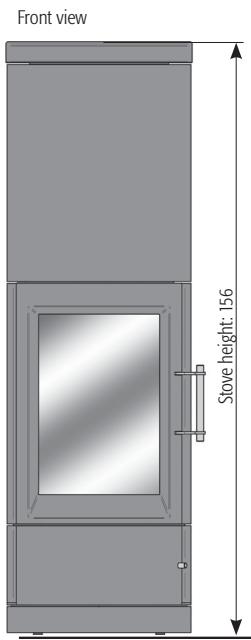
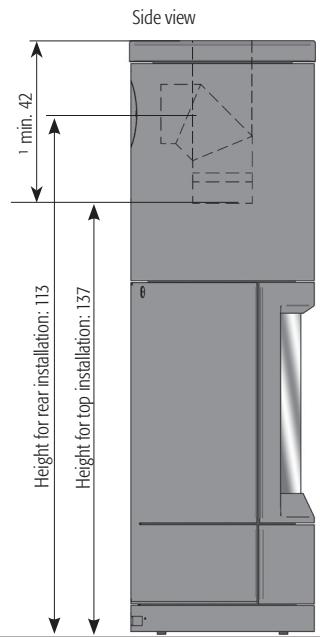
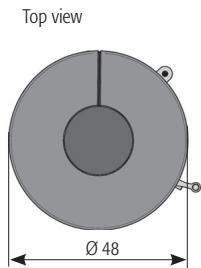
- For separate air supply in low-energy houses and insufficient combustion air supply in the room where the stove is installed.
Dimensions in cm
30. CE Declaration of Conformity
The original Declaration of Conformity and associated documents are available from the manufacturer upon request.
Hereby declares that the room heating appliance for use with solid fuels, bearing the trade name:
Ottawa
complies with the stipulations and provisions of the:
CE Construction Products Directive 89/106/EEC and the M129 Mandate
and is in compliance with the following harmonised standard:
EN 13240:2001+EN 13240:2001/A2:2004
The notified testing institute listed below has performed the inspection and testing of the room heating appliance for use with solid fuels in regards to conformity with the requirements specified by the standard:
RWE Power AG
Trier, Germany, dated 12.05.2010
Fernando Najera, Executive Manager
Please observe the safety notes and precautions contained in the installation and operating instructions that are shipped with the product.