USER MANUAL BARI HASE
Chere clientele, Cher client,
These operating instructions provide important information about the safe operation and handling of your Bari stove. Please read carefully through these operating instructions before using the stove for the first time.
In addition, your Bari stove comes with general operating instructions (part II) containing further instructions and helpful tips on how to use Hase stoves.
Enjoy your Bar stove!
- General Information 31
1.1. Definition of Safety Notes 31
- Control Elements 32
- Safety Distances 33
- Fuel Load Sizes and Thermal Output 33
- Operating the Revolving Console 34
- Initial Operation 34
- Lighting the Fire 35
- Adding Fuel / Heating at Nominal Thermal Output .35
- Heating with Brown Coal Briquettes 36
- Banking the Fire and Raising the Temperature 36
- Emptying the Ash Analyzer 36
- Technical Data 37
- CE Declaration of Conformity 38
Page
This section contains important information on using this technical documentation. Utmost care was taken in preparing this document. Nevertheless, suggestions for improvement and comments regarding any errors are always welcome.
1.1 Definition of Safety Notes

WARNING!
This symbol alerts you to a potentially hazardous situation. Non-compliance with this warning can cause severe injuries, or even death.

CAUTION!
This symbol alerts you to a potentially hazardous situation. Non-compliance can cause damage to property or injuries to persons.

NOTE!
Provides additional tips about using the stove as well as useful information.

ENVIRONMENT!
Sections marked with this symbol provide information about safe and environmentally-friendly operation as well as environmental laws and regulations.
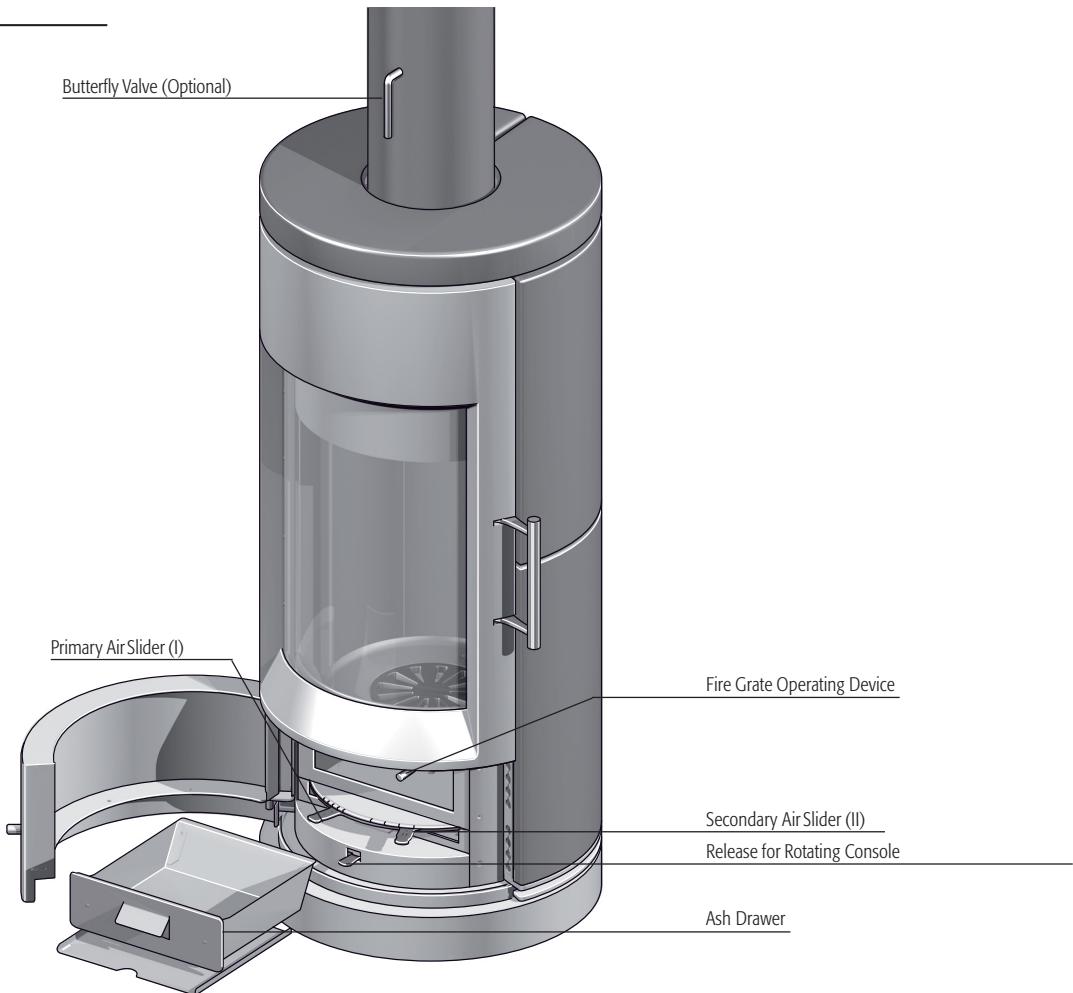
2. Control Elements
3. Safety Distances
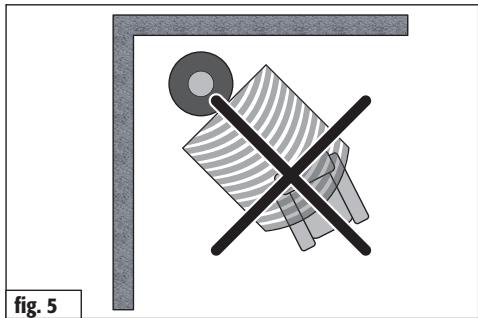
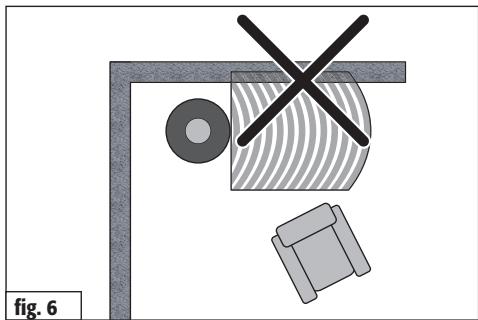
Within a radius of 100cm in front of and 40cm around the stove, flammable, combustible, or heat-sensitive materials (e.g. furniture, wood or plastic panelling, curtains, etc.) are not allowed to be located in the heat radiating area of the fire box window (Fig. 1).
With regard to flammable materials beyond the heat radiating area, a safety distance of 20cm at the sides of the stove and 20cm behind the stove has to be adhered to (Fig. 1).

WARNING!
Flammable flooring materials (e.g., wood, laminate, carpeting,) must be protected with a floorplate made of non-combustible material (e.g., tiles, safety glass, slate, or sheet steel). If a floor plate is required, its size must match the rotating range of the stove.
The size of the floorplate must be larger than the base of the stove by at least 50~cm in front and at least 21~cm at the sides of the stove (Fig. 2).
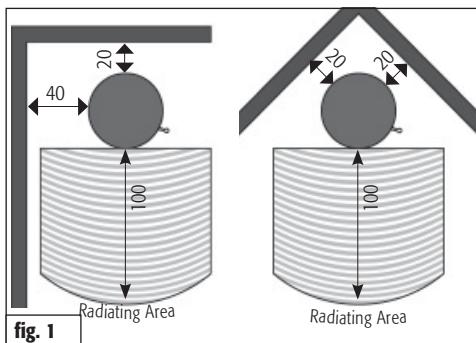
Dimensions in cm
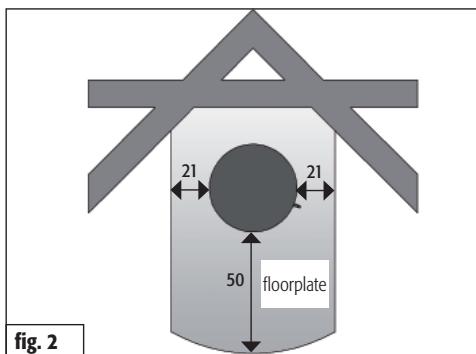
Dimensions in cm
4. Fuel Load Sizes and Thermal Output
The thermal output depends on the amount of fuel you put in the stove. When adding more fuel, please do not exceed the maximum fuel load size of 2kg . Exceeding the maximum fuel load size leads to a danger of overheating, which can result in damage to the stove and the risk of a stove fire.

NOTE!
To attain a thermal output of approx. 6kWm burn wood logs that weigh 1.5kg and are no longer than 25~cm in length for about 45 min. (with brown coal briquettes 3 briquettes with a total of approx. 1,5kg at approx. 60min

NOTE!
To attain a thermal output of approx. 3.0kWm burn wood logs that weigh 0.5kg and are no longer than 25~cm in length for about 30 min. (with brown coal briquettes 1 briquette with a total of approx. 0,5kg at approx. 30min)
The Bari is intended for intermittent operation, please only apply one fuel layer at a time.
5. Operating the Revolving Console
The Bari is equipped with a rotating console. Just lift the handle (a) to release the latch and then rotate the Bari to the desired position. (Not applicable if Hase ventilation system is used.) When installing the Bari, ensure that the score (b) faces towards the front (Fig. 3).
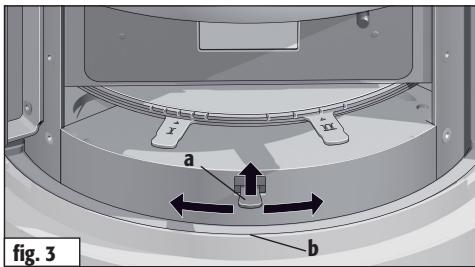

WARNING!
Always comply with the safety distances to combustible and flammable materials! Never turn stove when lighting fire!
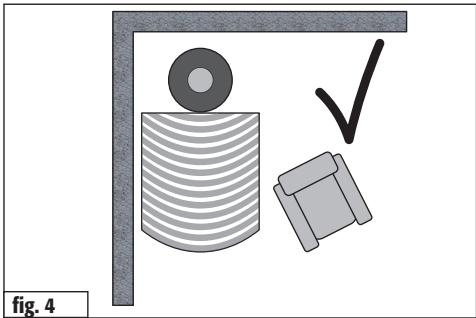
6. Initial Operation

NOTE!
During shipment, condensation moisture can accumulate in the stove's interior, which may possibly lead to the appearance of condensation or water on the stove or flue pipes. Please dry off these damp areas immediately.
The surface of your stove was treated in a sandblasting machine before applying the colour coating. Despite careful and thorough inspection, there may still be some residual material in the stove body, which can fall out when your stove is being installed.

NOTE!
To prevent any damage, please immediately vacuum up these small steel pellets with a vacuum cleaner.
The first time a stove is operated, the heat development causes the emission of volatile components from the coating, sealing strips and lubricants, and smoke and odours can occur.
At a higher combustion temperature, this one-time process can take between 4 to 5 hours.
To achieve this higher combustion temperature, please increase the fuel quantity recommended in Section 7, "Adding Fuel/ Heating with Nominal Thermal Output", by approximately 25% .

CAUTION!
To prevent adverse effects on health, nobody should stay in the room(s) during this process
unless absolutely necessary. Make sure the room is well-ventilated and open the windows and outside doors. If needed, use a fan for faster air circulation.
If the maximum temperature is not reached during the first heating operation, you may notice an odour for a short period of time the next time the stove is used as well.
7. Lighting the Fire
The firing up phase should be as short as possible, since higher emissions can occur during this phase.
The slider settings described in Table 1 (see figure on the right) are recommendations that were determined under conformance testing conditions, in compliance with the relevant standard. Depending on the weather conditions and the draught capability of your chimney, accordingly adjust the slider positions for your Bari to the local conditions.

NOTE!
The Bari may only be operated when the fire box door is closed; the fire box door may only be opened to add fuel.

WARNING!
Never use spirits, petrol, or other flammable fluids to light the stove.
Lighting the Fire
Tab. 1
| Procedure | Position of Control Elements |
| Completely open primary and secondary air. | Slide primary and secondary air slider all the way to the middle. |
| Open fire grate | Pull out fire grate slider |
| Pile up any remaining ash and unburned Charcoal into the centre of the combustion chamber. | |
| Place 2-3 small logs into the middle of the fire box; stack approx. 0.5 kg of dry wood chips on top. | |
| Light the ignition material at several places. | |
8. Adding Fuel / Heating at Nominal Thermal Output
More fuel should be added to the fire when the flames from the previous burning off phase have just gone out.
Adding Fuel / Heating at Nominal Output
Tab. 2
| Procedure | Position of Control Elements |
| Adjust primary and secondary air. | Move primary air slider (I) to position 1 from left.
Move secondary air slider (II) to position 3. |
| Close fire grate. | Push in fire grate slider. |
| Add two logs weighing approx. 1.5 kg in total. Place logs with one end to the front of fire box.
Only add a single layer of fuel. | |
GB
9. Heating with Brown Coal Briquettes
Wood should be used for the warming-up phase and when adding fuel for the first time, see "Warming-up Phase". As soon as a basic glowing firebed is reached, place 2-3 brown coal briquettes on the grate in the middle of the firebox, keeping a finger's width between the briquettes, and use the following procedure and settings:
Heating with Brown Coal Briquettes
Tab. 3
| Procedure | Position of Control Elements |
| Open primary air completely. | Slide primary air slider all the way to the middle. |
| Adjust secondary air completely. | Set secondary air slider (II) to position 2. |
| Open fire grate. | Pull out fire grate slider. |
10. Banking the Fire and Raising the Temperature
Keep the stove set as described above until the brown coal briquettes are thoroughly burnt. Then close the primary air (I) and the fire grate. Slide the secondary air slider (II) to position 2/3.
i NOTE! While the stove is in operation, the secondary air slider should never be completely closed.
To raise the temperature of the fire, stir up the rest of the glowing embers with the fire grate slider. Open the primary air (I) and add new logs to the fire.
11. Emptying the Ash Analyzer
As a safety precaution, please make sure to wait until the ashes are cold before you dispose of them. While the ash collects during the fire, the lid is located under the ash drawer.
Remove both the ash drawer and the lid located underneath it. Slide the lid onto the ash drawer so that it is closed; this prevents ashes from flying around, which in turn means your home stays clean. To place the ash drawer back into the stove, proceed in the reverse order.

CAUTION!
Piled up ashes can impair or even block the supply of primary air supply to the stove. Please ensure that the air supply path for the primary air between the ash drawer and the bottom of the ash compartment remains clear.
12. Technical Data
The Bari, certified in compliance with DIN-EN 13240: 2001 + A2 2004 and Art. 15 a B-VG (Austria), can only be operated when the fire box is closed; more than one device can be connected to the chimney.
VFK-No.: 14262; Inspection Report No. (A): FSPS-WA 2005-A
The following data applies to the chimney characteristics in accordance with EN 13384-1 / 2
| Combustion Values | Wood | Briquette | |
| Nominal Thermal Output | 6 | 6 | kW |
| Waste Gas Mass Flow Rate | 5,5 | 5,5 | g/s |
| Waste Gas Outlet Temp. | 320 | 320 | °C |
| Min. Supply Pressure at Nominal Thermal Output | 12 | 12 | Pa |
| CO content at 13% O2 | 1104 | 882 | mg/m3 |
| Efficiency | 80 | 79 | % |
| Particulate | 13 | 26 | mg/m3 |
Depending on the insulation of the building, the nominal thermal output of 6 kW indicated on 20 - 80m^2 (subject to change)
| Dimensions: | Height | Width | Depth |
| Stove | 107,5 / 111,5 / 112 cm | 48 cm | 48 cm |
| Fire box | 43 cm | 28 cm | 30 cm |
| Steel | Ceramic | Soapstone |
| Weight | 146 kg | 165 kg | 205 kg |
| 140 kg with ceramic | | |
| 154 kg with soapstone | | |
Fire Box Opening: 1185 cm2
Flue pipe diameter: 15 cm
Pipe diameter of Hase ventilation system* 10 cm
Rotating system not applicable if Hase ventilation system is used!
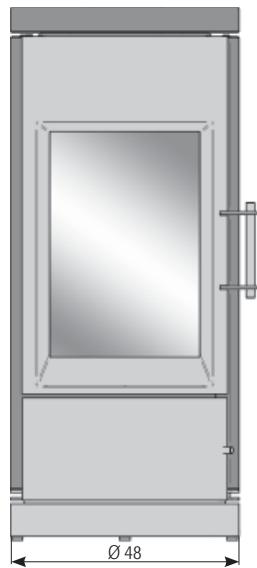
Front view
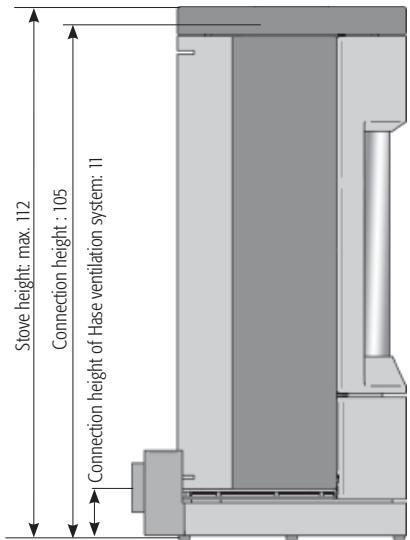
Side view
Top view
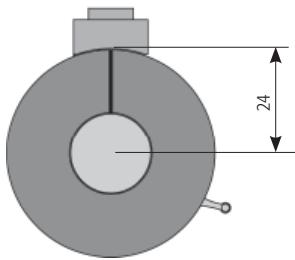
Stove's angle of rotation: 360^
Can be stopped in place and locked right/left in 15^ gradients.
Observe safety distances to
combustible or flammable materials!
- For separate air supply in low-energy houses and insufficient combustion air supply in the room where the stove is installed
The original Declaration of Conformity and associated documents are available from the manufacturer upon request.
Hereby declares that the room heating appliance for use
with solid fuels, bearing the trade name:
Bari
complies with the stipulations and provisions of the:
CE Construction Products Directive 89/106/EEC and the M129 Mandate
and is in compliance with the following harmonised standard:
EN 13240:2001+EN 13240:2001/A2:2004
The notified testing institute listed below has performed the inspection and testing of the room heating appliance for use with solid fuels in regards to conformity with the requirements specified by the standard:
RWE Power AG
Trier, Germany, dated 19.01.2011
Fernando Najera, Executive Manager
Please observe the safety notes and precautions contained in the installation and operating instructions that are shipped with the product.
Beste klant,