
RC-995 - AV receiver ROTEL - Free user manual and instructions
Find the device manual for free RC-995 ROTEL in PDF.


| Product Type | Stereo Control Amplifier (Preamplifier) |
| Brand | ROTEL |
| Model | RC-995 |
| Dimensions (W × H × D) | 440 × 70 × 325 mm |
| Weight | 5.4 kg |
| Power Supply | 230 V, 50 Hz (European version) / 115 V, 60 Hz (US version) |
| Power Consumption | 13 W |
| Audio Inputs | Phono (MM/MC), CD, Tuner, Aux, Tape 1, Tape 2 (RCA) |
| Audio Outputs | 2 x RCA (Preamp), 2 x XLR Balanced, 1/4" Headphone Output |
| Frequency Response | Line Input: 4 Hz - 100 kHz ±0.5 dB; Phono Input: 20 Hz - 20 kHz ±0.2 dB |
| Signal-to-Noise Ratio | Phono MC/MM: 70/75 dB; Line: 100 dB |
| Total Harmonic Distortion | < 0.004% at 1 V |
| Input Sensitivity (Phono MC) | 0.25 mV / 100 ohms |
| Input Sensitivity (Phono MM) | 2.5 mV / 47 kohms |
| Input Sensitivity (Line) | 150 mV / 18 kohms |
| Main Functions | Volume control, balance, source selector, recording selector, mute, programmable infrared remote control RR-949 |
| Maintenance and Cleaning | Clean the casing with a dry cloth or vacuum cleaner |
| Safety | Do not expose to moisture or water; do not block ventilation openings; refer all repairs to qualified service personnel |
| Spare Parts and Repairability | No user serviceable parts; internal fuse replacement by qualified technician |
| General Information | Designed for home use; compatible with MM and MC phono cartridges; toroidal transformer and custom capacitors |
Frequently Asked Questions - RC-995 ROTEL
User questions about RC-995 ROTEL
0 question about this device. Answer the ones you know or ask your own.
Ask a new question about this device
Download the instructions for your AV receiver in PDF format for free! Find your manual RC-995 - ROTEL and take your electronic device back in hand. On this page are published all the documents necessary for the use of your device. RC-995 by ROTEL.
USER MANUAL RC-995 ROTEL
This symbol is to alert the user to the presence of uninsulated dangerous voltages inside the product's enclosure that may constitute a risk of electric shock.

This symbol is to alert the user to important operating and maintenance (service) instructions in this manual and literature accompanying the product.
WARNING:
There are no user serviceable parts inside. Refer all servicing to qualified service personnel.
WARNING:
To reduce the risk of fire or electrical shock, do not expose the unit to moisture or water. Do not allow foreign objects to get into the enclosure. If the unit is exposed to moisture, or a foreign object gets into the enclosure, immediately disconnect the power cord from the wall. Take the unit to a qualified service person for inspection and necessary repairs.
Read all the instructions before connecting or operating the unit. Keep this manual so you can refer to these safety instructions.
Heed all warnings and safety information in these instructions and on the product itself. Follow all operating instructions.
Clean the unit only with a dry cloth or a vacuum cleaner.
Keep the ventilation inlets on the unit unobstructed. For example, do not place the unit on a bed, sofa, rug, or similar surface that could block the ventilation slots. If the unit is placed in a bookcase or cabinet, there must be sufficient clearance around the unit and ventilation of the cabinet to allow proper cooling.
Keep the unit away from radiators, heat registers, stoves, or any other appliance that produces heat.
The unit must be connected to a power supply only of the type and voltage specified on the rear panel of the unit.
Connect the unit to the power outlet only with the supplied 2-pin polarized power supply cable or an exact equivalent. Do not modify the supplied cable in any way. Do not attempt to defeat grounding and/or polarization provisions. The cable should be connected to a 2-pin polarized wall outlet, matching the wide blade of the plug to the wide slot of the receptacle. Do not use extension cords.
Do not route the power cord where it will be crushed, pinched, bent at severe angles, exposed to heat, or damaged in any way. Pay particular attention to the power cord at the plug and where it exits the back of the unit.
The power cord should be unplugged from the wall outlet if the unit is to be left unused for a long period of time.
Immediately stop using the unit and have it inspected and/or serviced by a qualified service agency if:
- The power supply cord or plug has been damaged.
- Objects have fallen, or liquid has been spilled, into the unit.
- The unit has been exposed to rain.
- The unit shows signs of improper operation
- The unit has been dropped or damaged in any way
Place the unit on a fixed, level surface strong enough to support its weight. Do not place the unit on a moveable cart that could tip over.
Figure 1: Controls and Connections
Commandes et prises
Bedienelemente und Anschlüsse
Controllie Collegamenti
Controles y Conexiones
De bedieningsorganen en de ingangen voor de bronnen
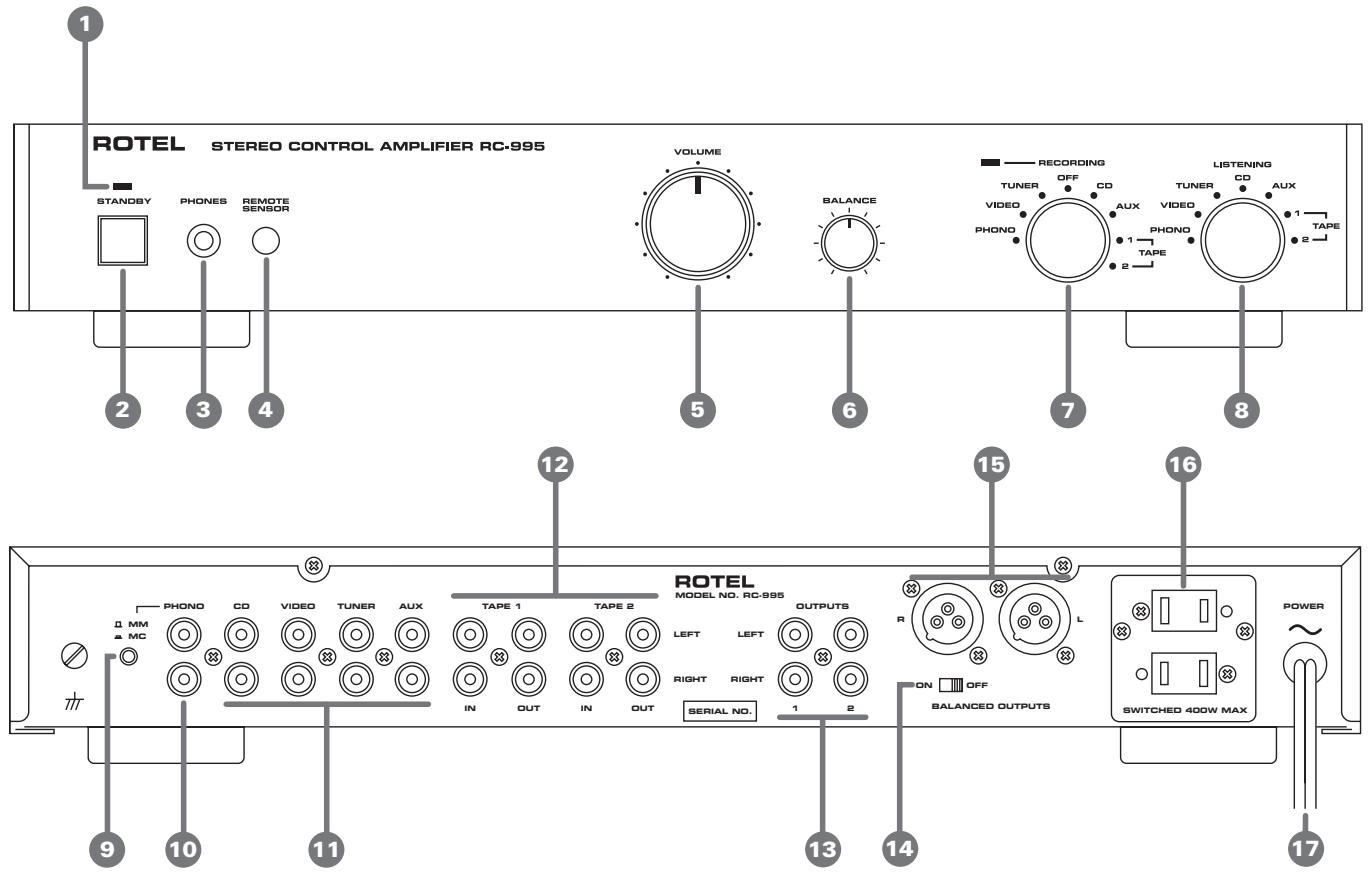
Figure 2: RCA Cable Connections
Figure 3: XLR Balanced Output Connection
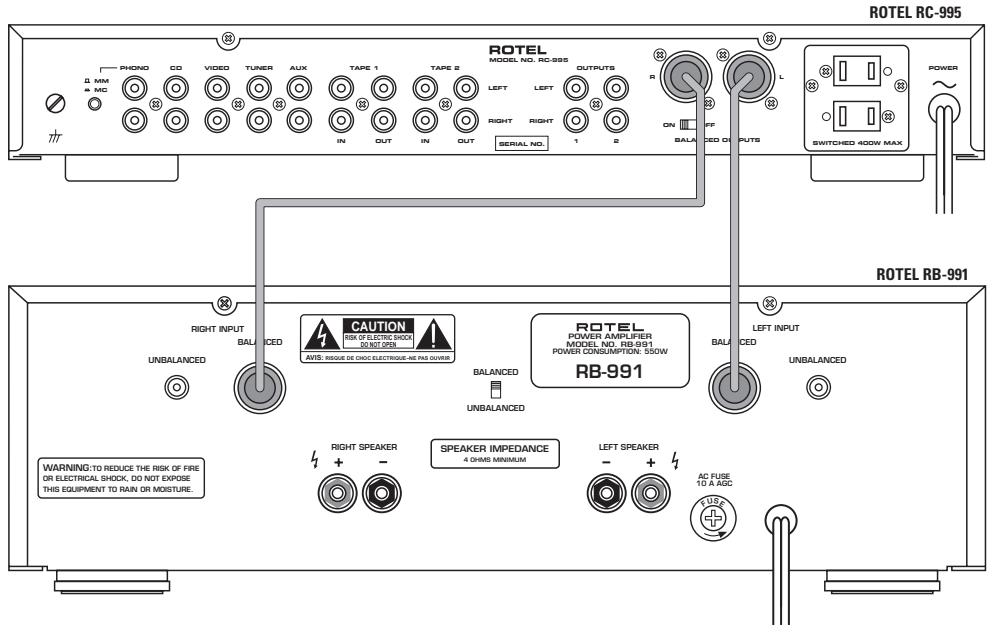
Figure 4: Phono Input Connection
Figure 5: Line Level Input Connection
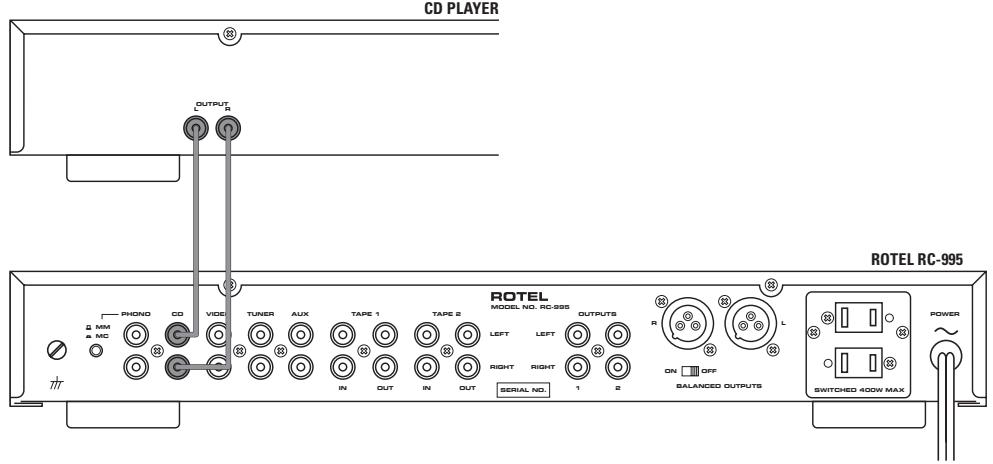
Figure 6: Recorder Connections
Contents (circled numbers refer to illustration)
About Rotel 6
Getting Started 6
A Few Precautions 7
Placement 7
Cables 7
AC Power and Control 7
AC Power Input 17
Power/Standby Switch 2 and Power Indicator 1 7
Auxiliary Power Outputs 16
Input Signal Connections 10 and 11 8
Phono Input Selector Switch 9 8
Phono Input Connection 10 8
Line Level Inputs 11 8
Recorder Connections 8
Output Connections 8
Balanced Output Switch 14 8
RCA Outputs 13
Balanced XLR Outputs 15
Front Panel Controls 9
Volume Control 5 9
Balance Control 6 9
Listening Selector 8 9
Recording Selector 9
9
Remote Sensor 4 9
Troubleshooting 9
Standby Power Indicator Is Not Lit 9
Fuse Replacement 9
No Sound 9
RR-949 Remote Control 10
Programming the RR-949 10
Device Selector Buttons 18 10
Power Button 19 10
Volume Buttons 20 10
Mute Button 21 10
Input Select Buttons 23 10
Numeric Buttons 10
Specifications 41
About Rotel
A family whose passionate interest in music led them to manufacture high fidelity components of uncompromising quality founded Rotel over 30 years ago. Through the years that passion has remained undiminished and the family goal of providing exceptional value for audiophiles and music lovers, regardless of their budget, is shared by all Rotel employees.
The engineers work as a close team, listening to, and fine tuning each new product until it reaches their exacting musical standards. They are free to choose components from around the world in order to make that product the best they can. You are likely to find capacitors from the United Kingdom and Germany, semi conductors from Japan or the United States, while toroidal power transformers are manufactured in Rotel's own factory.
Rotel's reputation for excellence has been earned through hundreds of good reviews and awards from the most respected reviewers in the industry, who listen to music every day. Their comments keep the company true to its goal – the pursuit of equipment that is musical, reliable and affordable.
All of us at Rotel thank you for buying this product and hope it will bring you many hours of enjoyment.
Getting Started
Thank you for purchasing the Rotel RC-995 Stereo Control Amplifier. When used in a high-quality music audio system, it will provide years of musical enjoyment.
The RC-995 is a full featured, high performance preamplifier. All aspects of the design have been optimized to retain the full dynamic range and subtle nuances of your music. The RC-995 has a highly regulated power supply incorporating a Rotel custom-designed toroidal power transformer and custom-made slit foil capacitors. This low impedance power supply has ample power reserves, which enables the RC-995 to easily reproduce the most demanding audio signals. This type of design is more expensive to manufacture, but it is better for the music.
The RC-995 has both XLR (balanced) and RCA cable main output connections. The printed circuit boards (PCB) are designed with Symmetrical Circuit Traces. This insures that the precise timing of the music is maintained and faithfully recreated. The RC-995 circuitry uses metal film resistors and polystyrene or polypropylene capacitors in important signal paths. All aspects of this design have been examined with the final goal being faithful reproduction of music.
The RC-995 has a superb phono preamp stage, derived from Rotel's finest phono preamplifier, the RHQ 10. The preamp stage can be used with either a moving magnet (MM) or a moving coil (MC) phono cartridge. This shows our commitment to phono sound quality and our interest in the recreation of fine music.
The RC-995 is straightforward in its installation and operation. If you have experience with other stereo systems, you shouldn't find anything perplexing. Simply plug in the associated components and enjoy.
A Few Precautions
Please read this manual carefully. It provides complete information on how to incorporate the RC-995 into your system as well as general information that will help you get optimum sound performance. Please contact your authorized Rotel audio retailer for answers to any questions you might have. In addition, all of us at Rotel welcome your questions and comments.
Save the RC-995 shipping carton and all enclosed packing material for future use. Shipping or moving the RC-995 in anything other than the original packing material may result in severe damage to your amplifier.
Fill out and send in the owner's registration card packed with the RC-995. Also be sure to keep the original sales receipt. It is your best record of the date of purchase, which you will need in the event warranty service is ever required.
Placement
Like all audio components that handle low-level signals, the RC-995 can be affected by its environment. Do not stack the RC-995 on top of a power amplifier. This will minimize chance it will pick up hum or interference. We recommend installing the RC-995 in furniture designed to house audio components. Such furniture is designed to reduce or suppress vibration which can adversely affect sound quality. Ask your authorized Rotel dealer for advice about component furniture and proper installation of audio components.
Cables
Be sure to keep the power cords, digital signal cables and regular audio signal cables in your installation away from each other. This will minimize the chance of the regular audio signal cables picking up noise or interference from the power cords or digital cables. Using only high quality, shielded cables will also help to prevent noise or interference from degrading the sound quality of your system. If you have any questions see your authorized Rotel dealer for advice about the best cable to use with your system
AC Power and Control
AC Power Input 17
The RC-995 does not use a significant amount of power. However there are two auxiliary power outlets on the back of the unit, which can be used to supply power for other units. Consequently it is usually best to plug the RC-995 directly into a 2-pin polarized wall outlet. Avoid the use of extension cords. A heavy duty multitap power outlet strip may be used if it (and the wall outlet) is rated to handle the current demanded by the components connected to it.
Note: Do not connect the power cord for a power amplifier to the auxiliary power outlets on the RC-995. Power amplifiers often draw more power than these outlets can provide.
Your RC-995 is configured at the factory for the proper AC line voltage in the country where you purchased it (either 115 volts AC or 230 volts AC with a line frequency of either 50Hz or 60Hz ). The AC line configuration is noted on a decal on the left side.
Note: Should you move your RC-995 amplifier to another country, it is possible to reconfigure your amplifier for use on a different line voltage. Do not attempt to perform this conversion yourself. Opening the enclosure of the RC-995 exposes you to dangerous voltages. Consult a qualified service person or the Rotel factory service department for information.
If you are going to be away from home for an extended period of time such as a month-long vacation, it is a sensible precaution to unplug your amplifier (as well as other audio and video components) while you are away.
Power/Standby Switch 2 and Power Indicator 1
The Power/Standby switch is located on the left side of the front panel. When it is pressed the RC-995 is turned on and the function indicator lights are illuminated. Pressing the Standby switch again will put the RC-995 in "standby" mode and the function indicators are turned off. The Power Indicator light above the Standby button is always illuminated when the RC-995 is connected to a "live" AC outlet.
Auxiliary Power Outputs 16
The RC-995 has two switched outlets on the back panel. Power is available from these outlets when the RC-995 is playing. Power to these outlets is turned off when the RC-995 is in Standby mode. These outlets can provide up to a total of 400 watts. They are appropriate for supplying power to signal sources, such as CD players, tuners, or tape decks. They should not be used for power amplifiers. Connecting components that will draw more than 400 watts to these outputs could damage the Standby switch in the RC-995.
Input Signal Connections 10 and 11
[See Figure 4 for phono input connection illustration.]
The RC-995 has conventional RCA type input connectors, the type found on nearly all audio equipment.
Note: To prevent loud noises that neither you nor your speakers will appreciate, make sure the system is turned off when you make any signal connections.
Phono Input Selector Switch 9
The Phono input is for a moving magnet (MM) or moving coil (MC) phono cartridge only and is incompatible with line level components. Set the phono input selector switch 9 as appropriate for the phono cartridge you are using. Leave the switch button in the out position for a moving magnet cartridge; push the switch in for a moving coil cartridge. Some high output moving coil cartridges are designed to operate in the moving magnet position. If you are in doubt about the correct setting, check the instruction manual for your phono cartridge for information regarding its output voltage and the expected input impedance. The Phono input has 47 kOhms input impedance and 2.5mV sensitivity in the MM position and 100 Ohms input impedance and 0.25mV sensitivity in the MC position. If you still have questions about the proper setting of the phono input selector switch, consult your authorized Rotel dealer.
Phono Input Connection 10
Plug the cable from the turntable into the appropriate left and right phono inputs. If the turntable has a "ground" wire connect it to the screw terminal to the left of the Phono inputs. It will help prevent hum and noise.
Line Level Inputs 1
[See Figure 5 for line level input connection illustration.]
The CD, Video, Tuner, and Aux inputs of the RC-995 are "line level" inputs. These are for connecting components such as CD players, Hi Fi or NICAM Stereo video cassette recorders, tuners for audio or video, Laser Disc players or the analog output from a CD ROM drive.
The Left and Right channels are clearly labeled and should be connected to the corresponding channels of the source component. The Left RCA connectors are white, the Right connectors are red. Use high quality RCA cables for connecting input source components to the RC-995. Ask your authorized Rotel dealer for advice about cables.
Recorder Connections 12
[See Figure 6 for recorder connection illustration.]
The Tape 1 and Tape 2 inputs and outputs can be connected to any record/playback device that accepts standard line level analog input and output signals. Typically that will be a conventional tape recorder.
When connecting a recorder to the RC-995 remember that the outputs of the recorder must be connected to the tape inputs of the RC-995. Similarly the tape outputs of the RC-995 must be connected to the inputs of the recorder. As with other sources be sure to connect the Left and Right channels of each device to the proper channels on the associated components. Use high quality connecting cables to prevent loss of sound quality.
Output Connections
Note: The RC-995 has both RCA and XLR type output connectors. The two sets of outputs must not be used at the same time.
Balanced Output Switch 14
When the RCA outputs are used the Balanced Output switch must be set to the Off position. Set the switch in the On position when using the XLR Balanced outputs.
RCA Outputs 13
[See Figure 2 for RCA output connection illustration.]
Most power amplifiers have RCA-type input connectors. With such amplifiers the Balanced Outputs switch 14 must be set to the Off position. Then connect a set of cables between the outputs of the RC-995 and the inputs of the amplifier. As always, use high quality cables and be sure to connect the Left and Right channel outputs of the RC-995 to the correct channels of the amplifier.
Note: There are two sets of RCA outputs on the RC-995. The second set of outputs may be used in custom system configurations to drive a second power amplifier or to supply a signal to a special signal processor.
Balanced XLR Outputs 15
[See Figure 3 for Balanced XLR output connection illustration.]
The XLR type outputs of the RC-995 are "balanced" outputs. These provide the advantage of allowing the power amplifier to be placed a great distance from the RC-995 without causing loss of sound quality or picking up noise over the long cable run. Of course the associated power amplifier must have balanced XLR-type inputs in order to use this feature.
When using the XLR outputs the Balanced Output switch 14 must be set to the On position. Then simply connect a cable with XLR connectors to the RC-995 outputs and power amplifier inputs. Be sure to connect the Left and Right channel outputs of the RC-995 to the correct channels of the amplifier. If you have questions about the proper type of cable to use, consult your authorized Rotel dealer.
Front Panel Controls
Volume Control 5
The Volume control increase or decreases the volume in both channels at the same time. Turn it clockwise to increase the volume and counterclockwise to decrease the volume.
Balance Control
The Balance Control alters the relative volume level of the two channels. Turn the Balance Control to the right to make the right channel louder. Turn it to the left to make the left channel louder.
Listening Selector 8
The setting of the Listening Selector controls which of the input signals goes to the main outputs and onto the power amplifier — or, more simply, which source is heard. The source selected is indicated by an LED that illuminates next to the source name on the front panel.
Recording Selector
The setting of the Recording Selector controls which of the input signals goes to the record outputs. The source selected is indicated by an LED that illuminates next to the source name on the front panel. When you are not recording, the Recording Selector should be set to the Off position to minimize the chance of interference from other components in the system.
Having a separate Recording and Listening selector adds a significant degree of flexibility in how you can use the RC-995. For example by setting the Record Selector to CD and the Listening Selector to Tuner you could record a CD onto a tape while listening to the tuner.
If you wish to duplicate ("dub") a recording from one recorder to another, the source unit should be connected to Tape 1 input. The Recording Selector should be set to Tape 1. The unit recording the signal should be connected to Tape 2 output.
3 Phones Output
The Phones output allows you to connect headphones for private listening. This output accommodates standard stereo phone (1/4") plugs. If your headphones have another type of plug, such as a 1/8" miniplug, you will need an adapter plug. Contact your authorized Rotel dealer, to get the correct adapter plug. Note: Plugging in a set of headphones does not cut off the signal to the outputs. The power amplifier will continue to receive a signal and the speakers will continue to play.
Remote Sensor 4
The Remote Sensor is located to the right of the Phones jack on the front panel. It picks up the infra-red signals from the remote control. Do not cover or block the sensor. It must be clear of obstructions or the remote control will not work properly. The operation of the Remote Sensor can also be affected if it is exposed to bright light, particularly sun light. In addition remote control functions may not work reliably if the batteries in the RR-949 are weak.
Troubleshooting
Most difficulties in audio systems are the result of incorrect connections, or improper control settings. If you encounter problems, isolate the area of the difficulty, check the control settings, determine the cause of the fault and make the necessary changes. If you are unable to get sound from the RC-995, refer to the suggestions for the following conditions:
Standby Power Indicator Is Not Lit
The Standby Power Indicator should be lit whenever the RC-995 is plugged into the wall power outlet. If it does not light, test the power outlet with another electrical device, such as a lamp. Be sure the power outlet being used is not controlled by a switch that has been turned off.
Fuse Replacement
If another electrical device works when plugged into the power outlet, and the Standby Indicator still will not light when the RC-995 is plugged into the wall outlet, it indicates that the internal power fuse may have blown. If you believe this has happened, contact your authorized Rotel dealer to get the fuse replaced.
No Sound
Check the signal source to see if it is functioning properly. Make sure the cables from the signal source to the RC-995 inputs are connected properly. Be sure the Listening Selector is set to the proper input. Check the power amplifier for power and proper operation. Check all the wiring between the RC-995 and the power amplifier, and the power amplifier and speakers.
RR-949 Remote Control
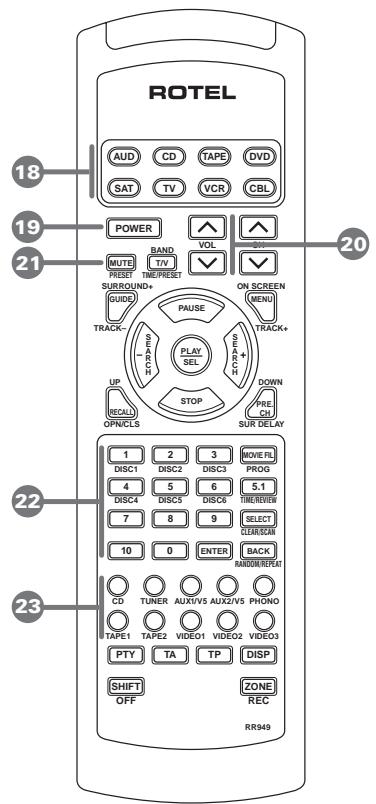
The RC-995 includes a hand held remote control that does more than operate the RC-995. The RR-949 is a full-function programmable remote control that can operate up to 8 audio/video components.
A separate manual, included with the remote, gives detailed information on programming and use of the RR-949 to replace all of the remote controls in your system. This section provides only the information which pertains to the use of the RR-949 with the RC-995.
Note: Many functions duplicate the RC-995 front panel controls and are listed here only for your reference. Please refer to the Front Panel Controls section of this manual for detailed information.
Programming the RR-949
The RR-949 must be programmed before it is used to control the RC-995.
Step One: First you must assign one of the Device Selection buttons 18 to the RC-995. In this example we are assigning the Audio button ("AUD") to the RC-995. Press the AUD button at the top of the remote while simultaneously pressing the Mute button 21 and hold both for at least one second. The next step must be done within 20 seconds period, or the RR-949 will revert to its standard operating mode.
Step Two: Use the Numeric Buttons 22 to enter the 3-digit code. For the RC-995 press 001; or 002 if you are using the RR-949 with the RT-940. Press each digit of the code separately.
Step Three: Store the code number by pressing the AUD button again.
Following this programming the RR-949 will operate the RC-995 after you press the AUD button. It will continue to do so until another Device Selector button is pressed, which will make the RR-949 control the component assigned to that button.
Device Selector Buttons 18
Press one of these button to select the component the RR-949 will control.
Power Button 19
Duplicates the function of the front panel Standby switch. Press the button to activate the RC-995. Press again to deactivate it.
Volume Buttons 20
These buttons duplicate the function of the front panel volume control. Press Volume Up to increase the volume and press Volume Down to decrease the volume.
Mute Button 21
Press this button to mute the sound. Press it again to restore normal sound output. The LED in the Volume Control will flash when the unit is muted.
Input Select Buttons

Two rows of buttons which duplicate the function of the Listening Selector control on the RC-995 front panel. Select an input source by pressing the corresponding button.
Numeric Buttons 22
Ten buttons, labeled 1 through 10. Used with the RC-995 only when entering the 3 digit address code during initial programing.
AVERTISSEMENT
EEN LAATSTE WAARSCHUWING:
Total Harmonic Distortion (20Hz-20kHz) < 0.004%
Intermodulation Distortion (60 Hz : 7 kHz, 4:1) < 0.004% at 1V output
Input Sensitivity / Impedance
Phono - MC
Phono - MM
Line Level
Phono Overload (MC/MM)
Output Sensitivity / Impedance
Frequency Response
Phono Input
Line Level Input
Signal to Noise Ratio (IHF "A" weighted)
Phono-MC/MM
Line Level
Power Requirements
USA Version
European Version
Power Consumption
Dimensions (W× H× D)
250 V / 100 ohms
2.5mV/47kOhms
150mV/18kOhms
16mV/160mV
1 V/ 100 Ohms
20Hz-20kHz, ±0.2dB
4Hz-100kHz, ±0.5dB
115 Volts, 60 Hz
230 Volt, 50 Hz
13 Watts
440 × 70 × 325 mm
173 / 8 × 23 / 4 × 123 / 4
5.4 kg, 11.9 lbs.
Weight (net)
All specifications are accurate at the time of printing.
Rotel reserves the right to make improvements without notice.
Fiche technique
Distorsion harmonique totale (20 Hz-20 kHz) <0.004%
Distorsion d'intermodulation (60 Hz: 7 kHz, 4:1)
Saturation phono (bobine mobile/aimant mobile)
Dimensions (L, H, P)
<0.004%
Rapporto S/N, (HIF pesato A)
phono - MC/MM
livello linea
North Reading, MA 01864-2699
USA
Phone: +1 978-664-3820
Fax: +1 978-664-4109
Rotel Europe
Meadow Road
Worthing, West Sussex BN11 2RX
England
Phone: +44 1903-524-813
Fax: +44 1903-524-831
Rotel Deutschland
Kleine Heide 12