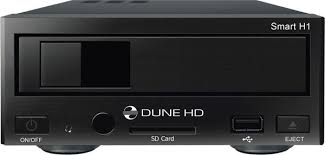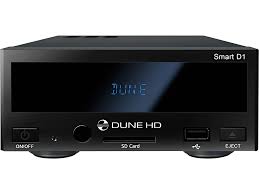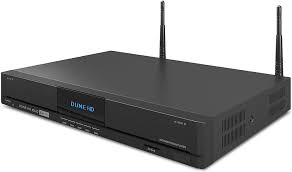
DUO - Media player DUNE HD - Free user manual and instructions
Find the device manual for free DUO DUNE HD in PDF.



User questions about DUO DUNE HD
0 question about this device. Answer the ones you know or ask your own.
Ask a new question about this device
Download the instructions for your Media player in PDF format for free! Find your manual DUO - DUNE HD and take your electronic device back in hand. On this page are published all the documents necessary for the use of your device. DUO by DUNE HD.
USER MANUAL DUO DUNE HD
KpaTkoe pykoBOIDCTBO
KopoTkn noci6nK
Manufactured under license from Dolby Laboratories.
Dolby and the double-D symbol are trademarks of Dolby Laboratories.

dtts-hd
High Resolution Audio
Manufactured under license under U.S. Patent #s: 5,451,942; 5,956,674; 5,974,380; 5,978,762; 6,226,616; 6,487,535; 7,212,872; 7,333,929 & other U.S. and worldwide patents issued & pending. DTS and the Symbol are registered trademarks, & DTS-HD, DTS-HD High Resolution Audio and the DTS logos are trademarks of DTS, Inc. Product includes software. © DTS, Inc. All Rights Reserved.

| 4 | English Quick Start Guide |
| 12 | François Guide de démarrage rapide |
| 20 | Deutsch Anweisung für einen schnellen Start |
| 28 | Nederlands Snel Start Gids |
| 36 | Espanol Guía de instalación=rápida |
| 44 | Italiano Guida Rapida |
| 52 | Puplesny Кратукке ручовODSTBO |
| 60 | Украïnhсьka Коротkin посбник |
| 68 | Polski Skrócona instrukcja Szybki Start |
Introduction
Dune HD Duo is an all-in-one solution for up to Full HD (1080p) video playback.
Key Features
- The newest Sigma Designs 8642/8643 media processor: enjoy excellent playback and performance of interactive features.
- HDD player: connect an HDD to the player and play content directly from the HDD.
- Network player: connect the player to a local network and play content directly from PC or NAS (UPnP, SMB, NFS).
- MKV player: play HD and SD video in a popular MKV format and other modern video file formats, including top quality HD video with very high bitrate.
RealD: watch 3D video in this ultra modern format used in cinema for the latest movies. - HD audio: enjoy top-quality audio tracks (Dolby TrueHD, DTS HD Master Audio, LPCM, FLAC).
- 3 USB ports: conveniently connect HDDs, USB flash drives, USB card readers and other USB storage devices.
- Two HDD racks with hot swap function: easily and quickly insert and exchange up to two internal 3.5" SATA HDDs.
- SD card slot: easily play media files on SD memory cards from your camera or other devices, or use an SD memory card as a local or system storage (required for BD Live function).
- HDMI 1.3: ensure the best possible quality of HD video and HD audio.
- A rich set of standard A/V connectors: use S/PDIF optical audio, stereo audio, component video, composite video outputs to easily connect any A/V equipment.
- Extended support for Dolby TrueHD and DTS HD Master Audio: output bitstream (up to 7.1 channels) or decode to LPCM (up to 7.1 channels) for maximum flexibility when connecting audio equipment, and for extended support of advanced playback features (such as Picture-in-Picture).
- Video output flexibility: output video in any resolution and format (from SD to 1080p, 24p/PAL/NTSC).
- Upscaling: high quality upscaling of DVD and any other SD video content to Full HD (1080p) or other HD resolution.
- File browser: convenient file browser with powerful file management (copy, move, delete, rename, organize, sort).
Extra Functions
- High-quality music playback: play very high-quality (up to 192 Khz / 24-bit) music files in various formats (FLAC, Monkey's Audio APE, WAV/PCM, DTS, etc).
- Playlists: build playlists from your folders, use your own playlists, use repeat and shuffle functions.
- NAS function: access files on storage devices (HDD, optical drive, etc) attached to the player from the local network (using SMB or FTP).
- BitTorrent: use built-in BitTorrent client to download files from P2P networks.
- Customizable user interface: work with media collections using cover art and icon browsing (with Full HD graphics).
- Flash applications: extend the player functionality with FlashLite applications.
- Internet radio: playback and record various Internet radio stations (HTTP/MP3).
- IPTV: playback and record IPTV streams (multicast UDP/RTP) from your Internet provider*.
- Digital TV option: playback and record Digital TV channels using an optional Digital TV USB dongle**.
-
Internet browsing: view Internet Web sites on your TV using the built-in Web browser***.
-
Check availability of multicast UDP/RTP streams with your Internet provider.
Digital TV USB dongle is not included; this option can be purchased separately.
* Built-in Web browser has limitations and may not allow to view some Internet Web sites.
Package Contents
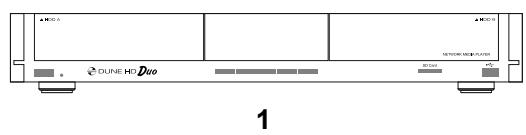
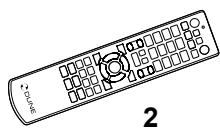
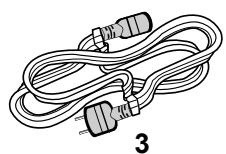
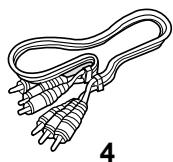
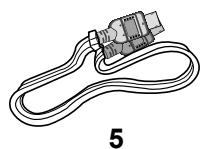
- Dune HD Duo media player
-
Remote control (batteries may not be included)
-
Power supply cord
- AV cable
5.HDMI cable
6. Quick start guide
NOTE: Additional items (optional) may be included into the package, depending on player configuration, region, and distributor.
Exterior
Front view
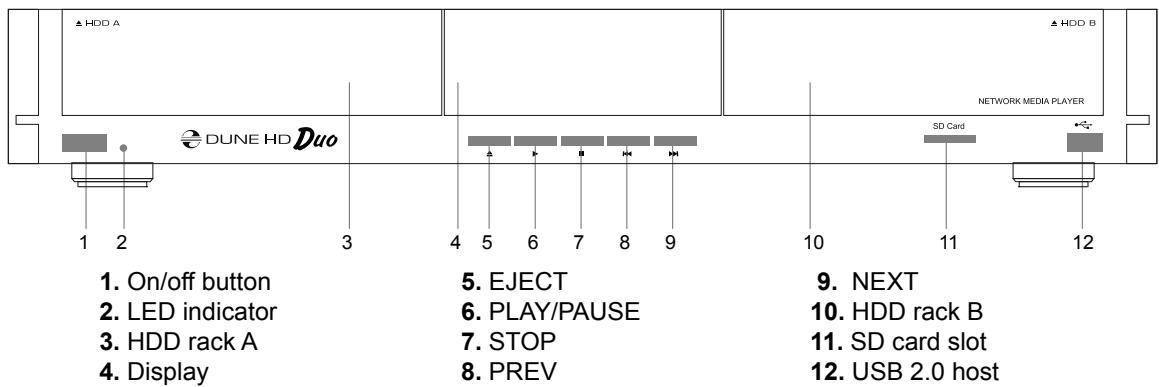
Rear view
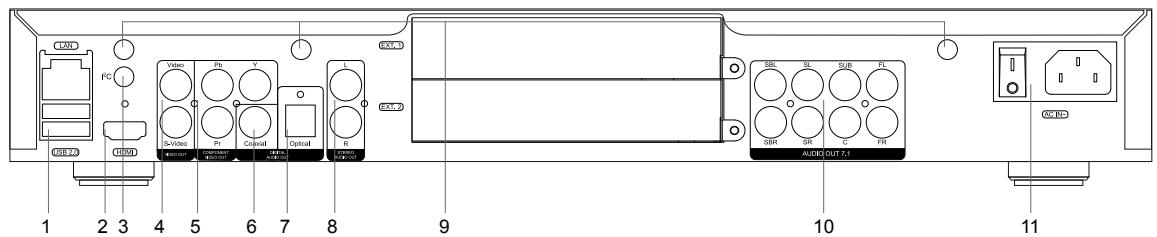
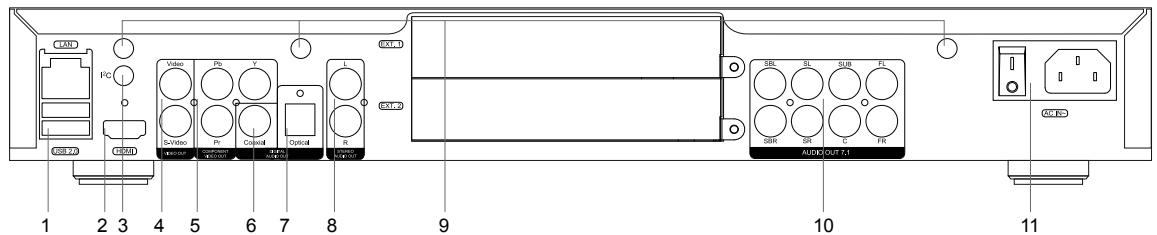
- LAN and 2xUSB 2.0 host
2.HDMI 1.3 - Dedicated bus connector (I²C) (for future connecting external devices)*
- Composite video and S-Video output
-
Component (Y/Pb/Pr) video output
-
Coaxial digital audio output
- Optical digital audio output
- Analog stereo (left/right) audio output
- Openings for optional Wi-Fi antennas
- Multichannel (7.1) analog audio output
-
AC power and power switch
-
Not for headphones or other A/V devices; connecting headphones or other A/V devices may damage your equipment
Remote Control
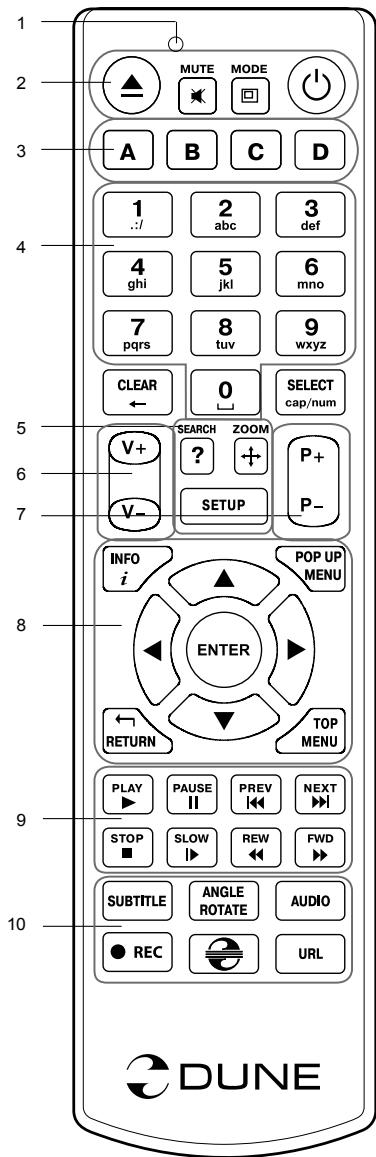
- Command indicator — flashes in response to RC button pressing.
- EJECT — open/close the optical drive tray. MUTE — turn the sound on/off. MODE — switch the video output mode; control some other player functions. POWER — toggle the standby mode.
- A (Red), B (Green), C (Yellow), D (Blue) — access Blu-ray disc features; control some other player functions.
- 0-9 — enter numbers and text; control some other player functions.
- SEARCH — jump to a specified playback position. ZOOM — change the zoom factor for the video content being played. SET-UP — enter/leave the setup menu; adjust playback settings during playback.
- V+/V- (volume up / volume down) — adjust the volume.
- P+/P- (page up / page down) — scroll up and down in various lists; control some other player functions.
- Arrows (LEFT, RIGHT, DOWN, UP), ENTER, RETURN, TOP MENU, POP UP MENU, INFO — main buttons for controlling the player (navigate across the items on the screen, open/use the currently selected item, go back to the previous screen, go to main menu, show popup menu with actions, show information, control some other player functions).
- PLAY, PAUSE, STOP, SLOW, REW, FWD, PREV, NEXT — control the playback.
- SUBTITLE, ANGLE/ROTATE, AUDIO, REC, DUNE, URL — control the playback and some other player functions.
NOTES:
- Use alkaline AAA batteries.
- Observe polarity when inserting batteries.
- Direct the remote control to the player. There must be no obstacles between the RC and the player.
- If RC functions only at short distances or stops functioning, make sure to replace the batteries.
- Some RC buttons may have several functions depending on the current player mode.
- Some RC buttons may be available only in certain player modes or only during playback of a certain content.
Getting Started
Remove the transparent protecting film from the front panel of the player to ensure good look of the player.
Ensure there is enough space around the player for proper cooling. The space at each side should be not less than 10~cm .
Ensure the RC has batteries installed.
Connect the player to your TV and to other A/V equipment in an appropriate way. Use HDMI connection to get the best possible quality of video and audio. Make sure to switch off the player and all relevant A/V equipment before connecting them. Ensure your TV and other A/V equipment are configured to use proper inputs.
Switch on the player. The player will perform its initial loading procedure, which may take up to about 1 minute. During the loading procedure, "DUNE" logo is shown on the TV.
-
If you do not see "DUNE" logo on the TV when you switch on the player, it may mean some problem with the connection between the player and the TV or that a wrong video input is chosen in the TV or A/V receiver/switch. In such a case, recheck the cables and the settings of the TV or A/V receiver/switch, or try to use different cables or a different way of connecting the player to the TV.
-
If you see "DUNE" logo on the TV when you switch on the player, but then the picture disappears and no other picture appears during at least 10 seconds, it may mean that a wrong video output mode is configured in the player. In such a case, press the "MODE" RC button, and then press one of the RC buttons "1", "2", "3", "4" or "5" to switch to a different video output mode (see "Quick Setting of Video Output Mode").
Finally, you should see the main screen of the player menu. The main screen shows items allowing to use different player functions and access all storage devices and network drives connected to the player.
Adjust the player settings as needed using "SETUP" item on the main screen of the player menu (or by pressing the "SETUP" RC button). In particular, you may want to adjust video settings, audio settings, and network settings.
To choose the language of the player menu, use "Setup / General / Interface language" setting.
Use the RC buttons "LEFT", "RIGHT", "UP", "DOWN", "ENTER", "RETURN" to navigate through the player menu. Use the "MENU" RC button to show the list of available commands. Use the "INFO" RC button to show the information about the selected item.
Quick Setting of Video Output Mode
The "MODE" RC button allows quick setting of video output mode without entering the player setup menu. This way of video output configuration may be required if you see no picture on the screen after connecting your player to a TV.
Press the "MODE" RC button and then one of the RC buttons "1", "2", "3", "4", or "5" to switch to one of the following video output modes respectively:
-
Composite/Component, PAL
-
Composite/Component, NTSC
-
HDMI, 480i, 60 Hz
4.HDMI,720p,60Hz
5.HDMI,1080i,60Hz
After you see a picture on the TV, press the "ENTER" RC button, and then go to the player setup menu to perform a more precise configuration of the video output mode if needed.
NOTE: The procedure of quick setting of video output mode can not be used during playback. To ensure this procedure can be used, switch the player off, then switch the player on, and the wait about 1 minute to ensure the player loading is finished.
Connecting USB Drives
To connect a USB drive, ensure you are on the main screen of the player menu and connect the USB drive to an USB port of the player. The player will recognize the USB drive, and will show an item corresponding to the USB drive on the main screen.
When connecting a USB drive requiring significant power (such as USB HDD), use an external power supply for the USB drive. Power provided by the USB ports of the player may not be enough for correct functioning of the USB drive.
Do not disconnect or switch off the USB drive when some write operation is in progress.
Using Internal HDD
To insert the internal 3.5" SATA HDD, ensure you are on the main screen of the player menu, open the HDD rack door, insert the HDD into the HDD rack and close the HDD rack door. The player will recognize the internal HDD, and will show an item corresponding to the internal HDD on the main screen of the player menu.
Do not eject the internal HDD when some write operation is in progress.
It is recommended to use "green" HDD models with small RPM value, small heat emission, and small power consumption; for more information, please see here:
http://dune-hd.com/support/hw_compat/
Using SD Memory Cards
To insert an SD memory card, ensure you are on the main screen of the player menu and insert the memory card into the SD card slot of the player. The player will recognize the memory card, and will show an item corresponding to the memory card on the main screen. Some SD memory cards may not be recognized by the player or may work incorrectly; in such a case, use other models of SD memory cards.
Do not eject the SD memory card when some write operation is in progress.
Accessing Network Drives
To connect a network drive using SMB or NFS protocol, ensure you are on the main screen of the player menu, press the "MENU" RC button, and choose "Create Network Folder", then fill the parameters of the network drive as needed. The player will show an item corresponding to the configured network drive on the main screen.
To browse the list of network resources accessible via SMB or UPnP protocols, use "Network Browser" item on the main screen of the player menu. NOTE: If some network resources are not shown by the player, you may need to wait some minutes and then retry (or press the "MENU" RC button and choose "Refresh" command).
Formatting HDD
To format a HDD attached to the player, select the drive item on the main screen of the player menu, press the "INFO" RC button and choose "Format Disk" (to format the entire disk) or "Format Partition" (or to format an already existing disk partition only). The player will format the disk using "EXT2" filesystem. NOTE: To use disks formatted by the player on a Windows PC, you may need to install additional software on the PC, such as "EXT2FSD" (http://www.ext2fsd.com/).
Switching the Player On and Off
To switch on the player, ensure the power switch on the rear panel is in "on" state, and press the "POWER" RC button or the "on/off" button on the front panel.
To put the player into the standby mode, press the "POWER" RC button or the "on/off" button on the front panel. To exit the standby mode, press any of these buttons again.
Depending on the player settings (see the player setup menu), the "hardware standby" or "software standby" mode may be used. In the "hardware standby" mode, almost complete power-off takes place and the player consumes almost no power. In the "software standby" mode, the player produces no signal on the video output, but is still functioning. For example, if you have some storage devices connected to the player, you may still access them from network ("NAS" function of the player). Exiting the "software standby" mode takes just a few seconds. When the player is in the "software standby" mode, it still consumes significant power. It is not recommended to keep the player in the "software standby" mode for a while if you do not need it.
To switch off the player completely, toggle the power switch on the rear panel. Do not do it if some drive is connected to the player and some write operation is in progress.
NOTE: After switching off the player or putting the player into the "hardware standby" mode, it is recommended to wait about 1 minute before switching it on again.
NAS (Network Attached Storage)
You can access storage devices connected to the player from the local network using FTP and SMB protocols. On a Windows PC, just type "ftp://ip_address" or "\ip_address" in the Windows explorer, where "ip_address" is the IP address of the player.
WiFi
You can use a USB WiFi adapter to connect the player to the local network via WiFi.
Please see here for the information on supported USB WiFi adapters:
http://dune-hd.com/support/hw_compat/
Limitations
Compatibility of the player with a particular hardware (A/V equipment, network equipment, disk drives, etc) may depend on various factors (particular hardware model, specifics of hardware installation and usage, configuration of the player and the hardware, etc). If the player does not correctly work with a particular hardware, try to adjust the configuration of the player or hardware, try to use the hardware in a different way, or try to use some other hardware.
Compatibility of the player with a particular media content (files, discs, etc) may depend on various factors (specifics of media content encoding, specifics of the configuration of the player, etc). If the player does not play correctly a particular media content, try to adjust the configuration of the player, or try to use media content encoded in a different way.
Updating Your Player and Getting More Information
Please check here for updated versions of player firmware (which may improve player functioning and extend player possibilities):
http://dune-hd.com/firmware/
(Note: You can also connect the player to Internet and use the online firmware upgrade function, see Setup / Misc / Firmware Upgrade.)
Please check here for more detailed and up-to-date documentation and information on player usage:
http://dune-hd.com/manuals/
http://dune-hd.com/support/
Support for Extension Boards
The Dune HD Duo player is equipped with two extension slots located at the rear panel of the player. Additional information is available on the Internet site http://www.dune-hd.com
Support for Extension Modules
The functions of Dune HD Duo player can be extended with Extension Modules of Dune HD Smart product line, such as Dune HD Smart HE (one more SATA 3.5" HDD with hot swap feature) and Dune HD Smart ME (two more slots for extension boards). Additional information is available on the Internet site
http://www.dune-hd.com
Introduction
http://dune-hd.com/firmware/.
NAS (Network Attached Storage)
Extra Functionalities
NAS (Network Attached Storage)
NAS (Network Attached Storage)
- Tasto On/off
- indicator LED
3.HDD rack A - Display
5.EJECT
6. PLAY/PAUSE
7. STOP
8. PREV
- NEXT
- HDD rack B
- SD card slot
- USB 2.0 host
Vista posteriore
NAS (Network Attached Storage)
NAS (Network Attached Storage)
Mожно пolyuHTь дocTyн К накОптелЯm, поКЛIOчЕнБИМ К npOIrpBbAteJIIO, ИЗ loKaJIbHосети по npOTOKoIam FTPи SMB.Η кOMПьЮтepe с Windows npocTo habepnTe «ftp://ip_address» ил «\ip_address» в П ropOBdNHke (Windows Explorer), рд «ip_address» — IP-адPEC npOriRpbIbATEЯ.
WiFi
Moxho nCpOJIb30BaTb WiFi-aIaIaTeP, noKJIuOHaembl no USB, dIy noKJIuOHeHn npOnIrpaTeJ K 6ecnpoBODHOi (WiFi) IokaJIbHOi cETn.
3a INΦopMaζηe O ΠΟДερχΝΑεMbIx USB-WiFi-aΩaΠΕρax σβασaΙηΤεCb Na CΤρaΗιύγ:
http://dune-hd.com/support/hw_compat/.
OrpaHnueHn
CobmeCTHMOCTb npoInrpBbATEn c KOHNpeTbIM O6OpyIDOBaHnEM (ayDIO-BINDeOo6OpyIDOBaHne, ceTeBOe O6OpyIDOBaHne, HAKONITeN n T.n.) MoKet 3aBnCeTb OT pa3NIuNbIX fakTopoB (KOHNpeTHo moDEI N O6OpyIDOBaHn, OC6EHNOCTe annapatthoi IHCTaJIaUcN i ee IcNoIb3OBaHn, HAcTpoE KpOINrpBbATeN n O6OpyIDOBaHn, n T.n.). EcIn npoINrpBbATEJb He pa6OtaET KopkeTHO C HeKOTOpbIM O6OpyIDOBaHnEM, IOnbTaIaNTECb I3MeHNTb KOHNpyaUIO npOriPbIBaTeJr IIN o6OpyIDOBaHn, IOnpOByTe IcNoIb3OBA Tb O6OpYIDOBaHne dpyrIM O6pa3OM, IIn60 IcNoIb3OBAt b DpyrOE O6OpyIDOBaHne.
Cobmectnmoctb nponrpbIbATEc KOHNpeTbIM BIDOM MeDnAmatepnaIOB (paJIbI, DNCKN T.I.) MoKET 3aBNCetb OT pa3JIuHbIX paKTopOB (OCO6eHHoCTN KoINPOBaHnmeDnAmatepnaIOB, OC06eHHoCTN HaCTPOe KpONrPbIBaTeJI N.T.I.). EcnI npONrPbIBaTeJI He BOCpON3BOJNT KopReKTHO HEKOTOpBIE MeDnAmatepnaJIbI, nonpoByte I3MeHHTb HAcTPOJKN npONrPbIBaTeJI INI NCIONB3OBaTb MeDnAmatepnaJIbI, 3aKOINPOBaHbI B OTJIuHOM fOpMaTe.
OboBneHnpeepa ndoi.nHopMaun
Ioxaynynta, npOBepaTe DoCTynHocTb O6HOBHeHn npOprMaMHOro 6oeCneHn npOIrpBaTeT («PpO- shuBKn») Ha cNeMyUcSe nHTepHET-CTpaHnue (3TO MOKeT yLyuWntb fYHKUHOHaJIbHOCt b npOIrpBaTeTn paacSnprNTb erO BO3MOXHOCTn):
http://dune-hd.com/firmware/
(3aMeuHHe: BbI TaKke MoKTe NOpKJIIOHTb PIIeep K INHTepHET N BOCNoJIb3OBAtbcra ΦyHKUne OHNaH-ObHOBJeHnI pOoINBKn, cm. HAcTpoiKn / Pa3Hoe / O6HOBJeHne IpooINBKn.)
Ioxaayncta, obaaainTecb K cneyohm INThepHET-CTpaHnam dIy nOlyeHn 6oonee npDp6HO n aKtayalho DOKymentauu n HOpMaun oB NCNoIb3OBAHIN POnrpbBaTeN:
http://dune-hd.com/manuals/
http://dune-hd.com/support/
- KomnoTHn/KomnoHeHTn, PAL
- Komno3nTHn/KomnoHeHTHn, NTSC
3.HDMI,480i,60
4.HDMI,720p,60T
5.HDMI,1080i,60T
Iicra toro k Bn 6aHTe 306paKeHH na ekpaHi TeNeBisopa, HATNCHITb KhoNkY npIbTa "ENTER", a notim nepeiDITb B MeHIO HanaStyBaHb nporpaBaHa, 1O6 BnKoHAtn 6IbS ToCHI HanaSTyBaHHr peKIMy BnBOdy BiDeo B pa3i notpe6n.
ПРИМТКА: Пюцени ршвдкого Нашитуваим Biideobuxody He може 6ут BiKориста на пд чс BiIDтборень. Дял забзпechень ВИКОнанн сizіпюцедури, ВIMKHITь пограва, a NOTIM - yBIMKHITb, i NOчекайтблзьк 1xbilinlnu, zuob 3abepшпtnюцEDур.
He BminkaIte USB-hakonuYbau, nid vac onepaui 3anicy.
He BnMaIte BHyTpIwHiHDD, nIz ac onepaui 3anucy.
PekomehnyeTcBnVKopncTOByaTn «3eneHi» HDD moJIeni 3 MaJIIM YIcNOM RPM, HeBeJIkoIO TeJIIOBIDaueo I MaJIIM eHeprocNOXINBaHHaM;ДЯ OTPImaHNaДODaTKOBoI INΦOpMaciI,БydI NaCa, DInBiTbcr Tyt:
http://dune-hd.com/support/hw_compat/