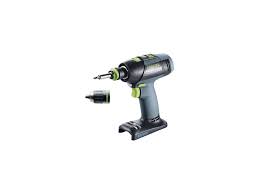
T 15PLUS3 - Cordless drill driver FESTOOL - Free user manual and instructions
Find the device manual for free T 15PLUS3 FESTOOL in PDF.



| Product type | Cordless drill/driver |
| Brand | FESTOOL |
| Model | T 15+3 |
| Nominal voltage | 14,4 - 15,6 V |
| No-load speed (1st gear) | 0 - 450 min⁻¹ |
| No-load speed (2nd gear) | 0 - 1500 min⁻¹ |
| Max. torque (soft wood screwdriving) | 27 Nm |
| Max. torque (hard metal screwdriving) | 40 Nm |
| Adjustable torque | 0,5 - 8 Nm |
| Drilling capacity in wood | 35 mm |
| Drilling capacity in metal | 16 mm |
| Drill chuck (clamping range) | 1,5 - 13 mm |
| Tool holder (in spindle) | 1/4" (hexagon socket) |
| Weight (without battery) | 1,02 kg |
| Battery type | Li-ion 14,4 V / 2,6 Ah (BPC 15 Li) |
| Charger | TRC 3 (220-240 V~, 50/60 Hz) |
| Charging time (Li-ion 80%) | approx. 45 minutes |
| Sound pressure level | 65 dB(A) |
| Sound power level | 76 dB(A) |
| Vibration value (metal drilling) | < 2,5 m/s² |
| Safety | Automatic shutdown in case of jamming, overload protection |
| Maintenance | Clean ventilation openings and contacts |
| Compatible accessories | CENTROTEC chucks, BF-FX, angle attachment DD-AS, eccentric module DD-ES |
Frequently Asked Questions - T 15PLUS3 FESTOOL
User questions about T 15PLUS3 FESTOOL
0 question about this device. Answer the ones you know or ask your own.
Ask a new question about this device
Download the instructions for your Cordless drill driver in PDF format for free! Find your manual T 15PLUS3 - FESTOOL and take your electronic device back in hand. On this page are published all the documents necessary for the use of your device. T 15PLUS3 by FESTOOL.
USER MANUAL T 15PLUS3 FESTOOL
Drucken = EIN, Loslassen = AUS
Original operating manual
1 Symbols 13
2 Machine features 13
3 Intended use 13
4 Technical data 13
5 Safety instructions. 14
6 Operation 15
7 Settings 16
8 Tool holder, attachments. 16
9 Working with the machine. 17
10 Service and maintenance. 17
11 Accessories 18
12 Disposal 18
13 Transport 18
14 Warranty 18
15 EU Declaration of Conformity.... 18
The specified illustrations appear at the beginning of the Operating Instructions.
1 Symbols

Warning of general danger

Risk of electric shock

Read the Operating Instructions/ Notes!

Wear ear protection.
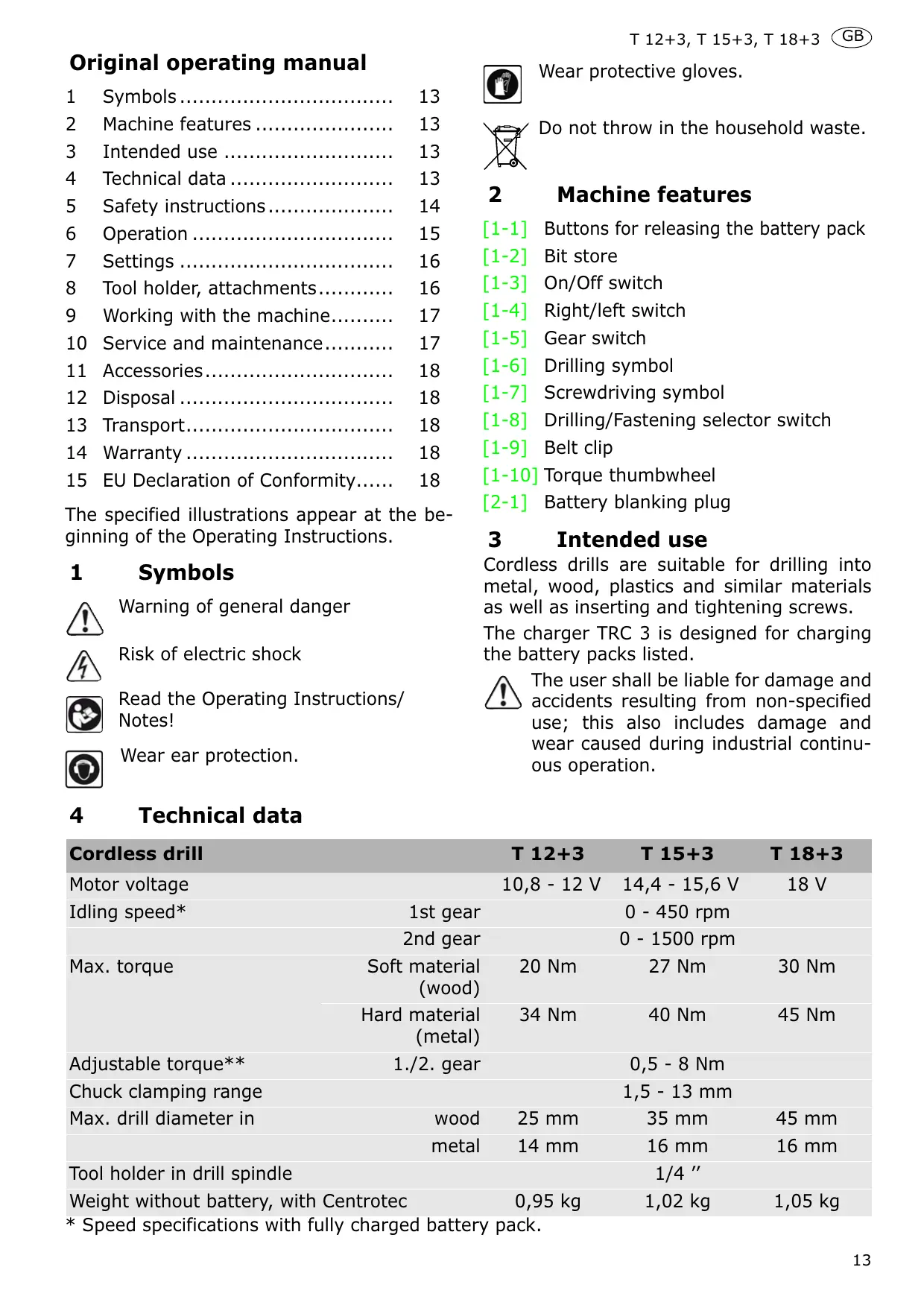
4 Technical data
| Cordless drill | T 12+3 | T 15+3 | T 18+3 | |
| Motor voltage | 10,8 - 12 V | 14,4 - 15,6 V | 18 V | |
| Idling speed* | 1st gear | 0 - 450 rpm | ||
| 2nd gear | 0 - 1500 rpm | |||
| Max. torque | Soft material (wood) | 20 Nm | 27 Nm | 30 Nm |
| Hard material (metal) | 34 Nm | 40 Nm | 45 Nm | |
| Adjustable torque** | 1./2. gear | 0,5 - 8 Nm | ||
| Chuck clamping range | 1,5 - 13 mm | |||
| Max. drill diameter in | wood | 25 mm | 35 mm | 45 mm |
| metal | 14 mm | 16 mm | 16 mm | |
| Tool holder in drill spindle | 1/4 ″ | |||
| Weight without battery, with Centrotec | 0,95 kg | 1,02 kg | 1,05 kg | |
- Speed specifications with fully charged battery pack.

Wear protective gloves.
Do not throw in the household waste.
2 Machine features
[1-1] Buttons for releasing the battery pack
[1-2] Bit store
[1-3] On/Off switch
[1-4] Right/left switch
[1-5] Gear switch
[1-6] Drilling symbol
[1-7] Screwdriving symbol
[1-8] Drilling/Fastening selector switch
[1-9] Belt clip
[1-10] Torque thumbwheel
[2-1] Battery blanking plug
3 Intended use
Cordless drills are suitable for drilling into metal, wood, plastics and similar materials as well as inserting and tightening screws.
The charger TRC 3 is designed for charging the battery packs listed.

The user shall be liable for damage and accidents resulting from non-specified use; this also includes damage and wear caused during industrial continuous operation.
| Charger | TRC 3 | |
| Mains voltage (input) | 220 - 240 V ~ | |
| Mains frequency | 50/60 Hz | |
| Charging voltage (output) | 7,2 - 18 V= | |
| Rapid charging | max. 3 A | |
| Conservation charging current, pulsating | approx. 0,06 A | |
| Charging times forr | LiIon 1,3 Ah/ 2,6 Ah, 80 % | approx. 22/ 45 min |
| LiIon 1,3 Ah/ 2.6 Ah, 100 % | approx. 35/ 70 min | |
| NiCd 1,3 Ah/ 2,4 Ah | approx. 25/ 50 min | |
| NiMH 2,0 Ah/ 3,0 Ah | approx. 50/ 70 min | |
| Permitted charging temperature range | -5 °C to +45 °C | |
| Temperature monitoring | via NTC resistor | |
| Battery packs for | T 12+3 | T 15+3 | T 18+3 |
| BPC 12 Li | BPC 15 Li | BPC 18 Li | |
| LiIon | LiIon | LiIon | |
| Order number | 497952 | 497020 | 497253 |
| Voltage | 10.8 V | 14.4 V | 18 V |
| Capacity | 2.6 Ah | 2.6 Ah | 2.6 Ah |
| Weight | 0.5 kg | 0.6 kg | 0.7 kg |
| BPS 12 C | BPS 15,6 S | ||
| NiMH | NiMH | ||
| Order number | 491825 | 491823 | |
| Voltage | 12 V | 15.6 V | |
| Capacity | 2.0 Ah | 3.0 Ah | |
| Weight | 0.6 kg | 0.9 kg |
5 Safety instructions
5.1 General safety instructions
WARNING! Read all safety warnings and all instructions. Failure to follow the warnings and instructions may result in electric shock, fire and/or serious injury.
Save all warnings and instructions for future reference.
The term "power tool" in the warnings refers to your mains-operated (corded) power tool or battery-operated (cordless) power tool.
5.2 Machine-related safety instructions
- Hold power tool by insulated gripping surfaces, when performing an operation where the cutting accessory may contact hidden wiring or its own cord.
Cutting accessory contacting a "live" wire
may make exposed metal parts of the power tool "live" and could give the operator an electric shock.
- The charger and power tool are not intended for use by persons (including children) with limited physical, sensory or mental ability or without sufficient experience and/or knowledge, unless they are supervised by a person responsible for their safety or have been instructed on how the charger or power tool is to be used. Children should always be supervised to ensure that they do not play with the charger or the power tools.
- Switch of the power tool immediately if the tool is blocked. Always be pre
pared for high reaction torques that can cause kickback.
The tool blocks if:
- the power tool is overloaded or
-
it becomes jammed in the workpiece being processed.
-
Wait until the power tool stops completely until placing it down. The tool can become entangled and lead to a loss of control of the power tool.
- Avoid unintentional activation. Ensure that the on/off switch is in switched-off position before inserting a battery. Carrying the power tool with your finger at the on/off switch, or inserting the battery when the power tool is switched on, can result in accidents.
- Take care when drilling into walls as there is a danger of rupturing concealed gas/water pipes or cutting through power cables.
- Do not open the battery pack or the charger. Even after disconnection from the mains, there is still a high capacitor voltage inside the charger.
- Make sure that metal objects (such as metal chips) or fluids do not collect in the battery pack retaining slots or enter the machine through the air vent slits (danger of short circuit).
- Do not charge battery packs from external manufacturers. The charger is designed for charging original battery packs only. Never charge the battery packs in chargers from external manufacturers. Otherwise there is a danger of fire and explosion.
- Protect the battery pack from excessive heat or constant heat sources such as sunlight or naked flames. There is a risk of explosion.
- Never use water to extinguish burning Li-Ion battery packs, always use sand or a fire blanket.
5.3 Emission levels
Levels determined in accordance with EN 60745 are typically:
Sound pressure level L_PA = 65 ~dB(A)
Noise level L_WA = 76 ~dB(A)
Uncertainty K = 3 dB

CAUTION
Operating noise
Damage to hearing
▶ Use ear protection!
Vibration emission value a_h (vector sum for three directions) and uncertainty K measured in accordance with EN 60745:
Drilling in metal a_h < 2,5 ~m / s^2
$$ K = 1, 5 \mathrm {m} / \mathrm {s} ^ {2} $$
Screws a_h < 2,5 ~m / s^2
$$ K = 1, 5 \mathrm {m} / \mathrm {s} ^ {2} $$
The emission values specified (vibration, noise) were measured in accordance with the test conditions stipulated in EN 60745 and are intended for machine comparisons. They are also used for making preliminary estimates regarding vibration and noise loads during operation.
The emission values specified refer to the main applications for which the power tool is used. If the electric power tool is used for other applications, with other tools or is not maintained sufficiently prior to operation, however, the vibration and noise load may be higher when the tool is used. Take into account any machine idling times and downtimes to estimate these values more accurately for a specified time period. This may significantly reduce the load during the machine operating period.
6 Operation
6.1 Changing the battery pack [2]
① All battery packs in the BPS and BPC series can be used with the Festool cordless drills T12+3, T15+3, T18+3. Li-ion Battery packs can also be used with a lower voltage than that of the cordless drill.
① When using NiMH or NiCd battery packs, the vacant opening can be closed with the blanking plug [2-1].
6.2 Charging the battery pack [3]
① The battery pack is delivered partially charged.
NiMH: Charge the battery pack completely before using for the first time.
GB T12+3,T15+3,T18+3
LiIon: The battery pack is immediately ready for operation and can be charged at any time without shortening the service life. The charger TRC 3 can be used to charge all Festool battery packs of the BPS and BPC series. The charger automatically detects the type of the inserted battery (NiCd, NiMH or LiIon). A microprocessor controls the charging process in line with the charging state, temperature and voltage of the battery pack. If a warm NiMH battery pack ( >37^ ) is inserted, the pack is charged with a reduced charging current and will take longer to charge.
The LED [3-1] on the charger indicates the respective operating status of the charger.
LED yellow - lit continuously
Charger is ready to use.
LED green - flashing quickly
Battery pack is charged to maximum capacity.
LED green - flashing slowly
Battery pack is charged with reduced current, LiIon is charged to 80% .
LED green - lit continuously
Battery pack is fully charged, or charging is not started again, because the battery is charged to more than 80% .
LED red - flashing
General fault display, e.g. incomplete contact, short circuit, battery pack faulty, etc.
LED red - lit continuously
Battery temperature is outside the permitted range.
6.3 Charger wall mount
The charger TRC 3 has two elongated holes on its back. It can be mounted on a wall using two screws (e.g. round head or flat head screw with shank diameter of 5mm ) (see Fig. [3]).
7 Settings
7.1 Changing direction of rotation [1-4]
- Switch to the left = clockwise rotation
- Switch to the right = counterclockwise rotation
7.2 Changing gear [1-5]
① Only actuate the gear switch with the tool switched off. Otherwise there is a risk of damaging the gear unit.
Gear switch forwards (digit 1 visible) = 1st gear
Gear switch to rear (digit 2 visible) = 2nd gear
7.3 Fastening
Adjust the switch so that [1-8] its marking faces the screw [1-7] symbol. The torque can be adjusted in this position.
(i) The switch-over function only works if the machine is switched off.
Adjust the torque accordingly at the torque [1-10] wheel:
Position 1 = low torque
Position 25 = high torque
The machine switches off when the preset torque is reached and an acoustic signal sounds. The machine only continues running when the on/off switch is [1-3] released and then pressed again.
7.4 Drilling
Adjust the switch [1-8] so that its marking faces the drilling symbol [1-6]. Maximum torque is set in this position.
8 Tool holder, attachments

WARNING
Risk of injury, electric shock
Always disconnect the battery pack before any type of work on the machine!
8.1 Tool chuck CENTROTEC WH-CE [4]
The tool chuck CENTROTEC WH-CE allows you to change tools with a CENTROTEC shank in a matter of seconds.
(1) Always use a CENTROTEC tool chuck to clamp CENTROTEC tools.
![FESTOOL T 15PLUS3 - Tool chuck CENTROTEC WH-CE [4] - 1](/content/2019/12/17290/images/c1dddc61537519ef4068d8eace372b658bc171edacbe1e0a81baf8fcef9bc6e1.jpg)
CAUTION
Tool has sharp edges and can cause cutting injuries during a tool change.
Wear protective gloves!
8.2 Chuck BF-FX [5]
The chuck BF-FX is used for clamping drill and screwdriver bits.
![FESTOOL T 15PLUS3 - Chuck BF-FX [5] - 1](/content/2019/12/17290/images/4323dbfdd53e3292bab543976b0f3132423fa8294e7b123a7d8c860faf0118fc.jpg)
CAUTION
Risk of injury
Clamp the tool centrally in the chuck!
8.3 Angle attachment DD-AS [6]
The angle attachment DD-AS (in part, additional equipment) permits drilling and screwdriving at a right angle to the machine.
8.4 Eccentric attachment DD-ES [7]
The eccentric attachment (in part, additional equipment) permits screwdriving near edges with bits according to DIN 3126.
8.5 Tool holder in the drill spindle [8]
Bits can be inserted directly in the hexagon socket holder on the drill spindle to shorten and reduce the weight of the machine.
9 Working with the machine
9.1 On/Off switch [1-3]
Press = ON, release = OFF
(1) The speed of the machine depends on how far the on/off switch is pressed in.
9.2 Bit store [1-2]
Bits or bit holders are inserted sideways into the bit store.
9.3 Acoustic warning signal
Acoustic warning signals sound and the machine switches off in the following operating states:

peep — —
- Battery flat or machine overloaded.
Change the battery.
Place the machine under reduced stress.

peep peep —
- Machine is overheating.
You must allow the machine to cool before using again.

peep peep peep
- LiIon battery pack is faulty or has overheated.
Once the battery pack has cooled, perform a functional check using the charger.
10 Service and maintenance
Observe the following instructions:
- Keep the air slits on the machine and the charger free and clean to ensure adequate cooling.
- Keep the contacts on the machine, charger and battery pack clean.
Information on battery packs
- Where possible, store the battery pack in a cool, dry place at a temperature between 5^ C and 25^ C .
- Battery packs are most efficient at temperatures between 20^ and 30^ .
- Protect the battery pack from moisture, water and heat.
Significantly shorter operating times after each charge indicate that the battery pack is worn and should be replaced with a new one. - The LiIon battery pack is fully compatible with the charger! Integrated electronics prevent overloading and overheating during the charging process.
- Do not leave flat battery packs in a charger disconnected from the mains power supply for longer than one month. There is a risk of total discharge and the maximum power of the battery pack may decrease.
- Store the battery pack in its packaging to reduce the risk of short circuits..
- The following applies if the battery packs are to be taken out of service and stored for a long period: NiMH battery packs should be stored when fully charged; Li-ion battery packs should be stored with a charge of 40% (charging period approx. 15 mins.).
- NiMH battery packs that are new or have not been used for long periods reach full capacity after approx. five charging and discharging cycles.
- The capacity of NiMH battery packs decreases drastically at ambient temperatures below 0^ or above 45^ .
- Charge NiMH battery packs every four months to retain maximum capacity.
- After every ten charging processes, leave
- NiMH battery packs in the charger for an extra hour following rapid charging to compensate for potential differences in capacity between the battery cells.
11 Accessories
Use only original Festool accessories and Festool consumable material intended for this machine because these components are designed specifically for the machine. Using accessories and consumable material from other suppliers will most likely affect the quality of your working results and limit any warranty claims. Machine wear or your own personal workload may increase depending on the application. Protect yourself and your machine, and preserve your warranty claims by always using original Festool accessories and Festool consumable material!
The order numbers of the accessories and tools can be found in the Festool catalogue or on the Internet under "www.festool.com".
12 Disposal
Do not throw the power tool in your household waste! Dispose of machines, accessories and packaging at an environmentally responsible recycling centre. Observe the valid national regulations.
EU only: European Directive 2002/96/EC stipulates that used electric power tools must be collected separately and disposed of at an environmentally responsible recycling centre.
Return used or faulty battery packs to your local specialist retailer, Festool after-sales service or a designated public waste management facility. The battery packs will then be recycled. (Observe the regulations applicable in your country). The batteries must be discharged on return.
EU only: European Directive 91/157/EEC stipulates that faulty or used battery packs/batteries must be recycled.
13 Transport
The equivalent amount of lithium in the LiIon battery pack is less than the applicable limit value and certified as per UN manual ST/SG/ AC.10/11/rev. 3 part III, subsection 38.3. The LiIon battery pack is therefore not subject to national and international dangerous goods regulations, neither as an individual component nor as a fitted machine component. However, dangerous goods regulations may apply when several battery packs are transported, in which case you may have to fulfil special conditions. Refer to ADR special regulation 230 for more information relevant for the EU.
14 Warranty
We offer a warranty for material and production defects for all our tools in accordance with the locally applicable legal provisions, but for a minimum of 12 months. Within the EU member states, the warranty period is 24 months (verification through invoice or delivery note). Damage caused by the operator, natural wear, overloading, incorrect handling or through the use of the equipment not specified in the operating manual, or damage which was known at the time of purchase, is not covered by the warranty. Furthermore, damage caused by the use of non-original accessories and consumable materials (e.g. sanding pads) is also excluded.
Complaints can only be accepted if the tool is returned while still assembled to the supplier or an authorised Festool Customer Service workshop. Keep the operating manual, safety instructions, spare parts list and purchase receipt in a safe place. Otherwise the current warranty conditions of the manufacturer shall apply.
Note
Due to continuous research and development work, we reserve the right to make changes to the technical content of this documentation.
15 EU Declaration of Conformity
| Cordless drill | Serial no. |
| T 12+3 | 493533 |
| T 15+3 | 494374 |
| Year of CE mark: 2007 | |
| T 18+3 | 496958 |
| Year of CE mark: 2010 | |
We declare under sole responsibility that this product complies with the following directives and standards:
2006/42/EC, 2004/108/EC, EN 60745-1, EN 60745-2-1, EN 60745-2-2, EN 55014-1, EN 55014-2.
| Charger | Serial no. |
| TRC 3 | 494635, 494636, 494637 |
| Year of CE mark: 2007 | |
We declare under sole responsibility that this product complies with the following directives and standards:
2004/108/EC, 2006/95/EC, EN 60335-1, EN EN 60335-2-29, EN 61000-3-2, EN 61000-3-3, EN 61204-3.
Festool GmbH
Wertstr. 20, D-73240 Wendlingen, Germany
p90. 91. Jcbnnn nn
Head of Research, Development and Technical Documentation
19.07.2010
REACH for Festool products, its accessories and consumable materials:
REACH is a European Chemical Directive that came into effect in 2007. As "downstream users" and product manufacturers, we are aware of our duty to provide our customers with information. We have set up the following website to keep you updated with all the latest news and provide you with information on all the materials used in our existing products:
www.festool.com/reach
Position 1 = petit couple,
F T 12+3, T 15+3, T 18+3
Position 25 = grand couple
8.1 Mandrin CENTROTEC WH-CE [4]
Presser = ON, relâcher = OFF
- Interruption能做到 the same as in the previous example, but with a different name: giro.
- Interruptor hacía la derecha = giro a la iz-quierda
8.1 Mandril CENTROTEC WH-CE [4]
6.2 Accumack laden [3]
- Machine is oververhit.
Varning for allman risk!
![FESTOOL T 15PLUS3 - Accumack laden [3] - 1](/content/2019/12/17290/images/316d0122af794c77b783454999e836ccf3d1bb413bf35118aafcf125e3a002f6.jpg)
Varning for elstötar
![FESTOOL T 15PLUS3 - Accumack laden [3] - 2](/content/2019/12/17290/images/8e6db30e1acbfd4bcf0c6afe9ad1e5b383b04483baca9246a689ca552ec3ad5c.jpg)
Tryk = TÄEND, slip = SLUK
2 CoCTaBhble yactn HHCTpyMeHTa
[1-1] Khoŋka Дя pa36лokировки
aKKумлЯторного 6лoka
[1-2] Čeρжатейь 6итов
[1-3] BbIKJIouaTeIb
[1-4] Переклочаель наразвileни врашени.
[1-5] ΠepeKJIuOuTaTeIb ckOpocTei
[1-6] CnmboJcBepJeHnJ
[1-7] CnMBoJ 3aBnHcNbHaHn
[1-8] Πepeключateь CBepJIeHnIy/ 3aBInHcNBAHnI
[1-9] 3axim对阵pehenocknHa peMHe
[1-10] Perjatop Kpytzaero MOMeHTa
[2-1] KpbiSha aKKyMnyTopa
AkkymylatopHbI DpeHn-wwpynpOBepTbI
IpeHa3HaueHbI IJIa CBepLeHnMaTaJIa,
DpeBecnHbI, PnactIKOB N PoO6HbIX
MaTePnaJIOB,a TaKKe IJIy BbIBNcHbAHnY 3aBnHcNBAHn YwpyNoB.
3apraHoe yctpoiCTBO TRC 3 npedHa3NaueHo DJI 3aprakn aKKyMylTopoB BblseyKa3aHHbIX TINOB.

OTBETCTBEHHOCTb 3a NOBpeXdEHNyITpaBMnPOBaHHe npN NcNoJIb3OBAHnHE NoHa3NaYeHNU HeCET
NoIb30BaTeJIb; CIOJa TaKJxe OTHOCaTcI NOBpeXdEHHI Nn3HOC BCJeDCTBVe
ДЛNTeJIbHон эКсПлуаТaци BnpOMblIeHHOM pOu3BODCTBe.
CoxpaHЯTe BCE yKa3aHnNo TExHnKe 6e3OpacHOCTn n HnCTpyKcnn.
IcnoJb3yeMby B yka3aHnayx nO TexHnke 6e3oNaChOCTn TepMH
«3JIeKTPoHnHCTpymeHT» OTHOCNTcK CeTeBbIM 3JIeKTPoHnHCTpymeHTam (c ceTeBbIM Ka6eIem) n aKKyMylTOpHbIM 3JIeKTPoHnHCTpymeHTam (6e3 cTeBOrO ka6eIa).
5.2 Yka3aHnЯ nO TexHnKe 6e3oNaChOCTn npI nOJIb3OBaHn INHCTpyMeHTOM
-Пи ВьИОЛнHeHn pa6OT,при KOTOpbIX
HHCTpyMeHT MOxET KOHTaKTHpOBaTb
Со CkpyTOH эЛeKTPoPBOJKOH,
ДерЖITE ДрELТToMbKO 3a
N3OJInPoBaHhbIeЧаTи pyKOrTkn. B
ПрOTиВHOM Clyuae ПOBpeждЕнe
эЛeKTPoPBOJKn pejxUeJЧaCTbI O MoXeT
ВьI3BaTb yДapэЛeKTPruYeCKm TOKOM.
-лцam (ВКЛЮЧАДTeи) C OгразнчehньIMN ΦИЗнчecKMN, CEHCOPHBIMN ИП NmYMCTBeHbIMN CNoC6HObTЯМN ИП He NmEIOUmM HeO6xODnMOrO onbIa N/ИПN 3HaHn 3aPpeuaetc NcNoJIb3OBaTb 3TO 3apJdHoe UcTpoiCTBO N 3JIeKTPoIHCTpymeHT 6e3 IprncMoTpa INI INHCTpykTaJaCo CTOpONbI OTBETCTBeHHORO LIIca. He pa3pewaite DeTЯm INrpaTb C 3aPЯны IM YcTpoIcTBOM INIлзJIeKTPoIHCTpymeHTOM.
- Cpa3y JKe BbIKIIOUaJIte 3JIeKTPoINHCTpymEHT npn 6JIoKIpOBKe Bpa7aIOUxxCa JEtAJIeN. BydTe FOToBbl K BbICOKOMY MOMHTy peakun, KOtOpbl Bbl3bIBaET OTdaCy. Bpa7aIOUncEca JEtAJIu 6JIoKpUOTcra, KOrda:
-
BO3HnKaeT neperpy3ka
Злекtpоинстчм enta -
Злекtpоинстчрм ent pepekaшиBaetcB
Бобрабатываемо 3arotOBke. -
Пеег Tem Кам РОжнь ИНстчмент ПОДЖДNTe, ПOKA Вал ДВИгател ПОЛНСТБЮ OCTAHOBINTС.ВПрOTиВHOM Слуаe BO3MOЖHO Зацелене Врашаношихся DeТалей,ЧTO ппвetedETК ПOTеpe KOHTРЯ над ИНстчментом.
-
Hedonyckaite cnyuahoro BkIIOueHn HNCTpymeHTa. Npeed yCTaHOBko aKKymJlATopa y6eINTecb, YTO BbIKIOUaTeJIb HaxoHTcB NOLOXKeHn "BbIKIOUeHo". Npehenocka 3JIeKTPoIHnCTpymeHTa C nalbceM Ha BbIKIOuAteJe IJIY UCTaHOBka aKKymJlAToPa BO BKIOUChHHbI INHCTpymeHT MOKeT npINBeCTn K HechactHomy clyuaio.
YpOBeHb 3ByKOBOrO LpA=65D(B(A) DaBLeHnIa
UpoBBeHb MOuHOCTN LwA = 76 dB(A) 3ByKOBbIX KOJIe6aHnI
Погршносты K = 3 ДБ

OctopoxHo
CD, Kpaçhbl - RopHT HenpepbIbHO
Tempepatpa aKKyMylTopa npeBbIaet DOpyCTmOe 3HaueHne.
6.3 HacTeHHbIM MOHTaX 3apYdHOrO yCTpoIcTBA
Ha 3aDHei CTOpOHe 3apAINHO yCTpOiCTBa TRC 3 nmeOTcra Dba npoIOJIbHbIX OTBepCTn. C NOMOuBO DByX wypynOB (dnaMeTpom 5 MM, HApnpMep, c NOlyKpyrIoN nnPiLoCKoI rOLOBkoI) yCTpoiCTBO MOxHo IOBeCNTb Ha CTeHy (CM. pnc. [3]).
7 Hac troponk
7.1 Пе配电ичесншаразвileни врашиени [1-4]
CdBnHyTbpeeklouaTeIbBLeBO npaBoe BpaueHne
CdBnHyTbpeeklouaTeIbBnpaBO JeBOe BpaueHne
7.2 IapekeIIOUeHne cKOpocTn [1-5]
HnCTpyMeHTaJIbHbI NaTPOH CENTROTEC WH-CE n03B0JAreT 6bICTpo MeHrTb HnCTpyMeHT C XBOCTOBVKOM CENTROTEC.
① 3aximaiTe NHCTpyMeHT CENTROTEC Tobilko B natoH CENTROTEC.
![FESTOOL T 15PLUS3 - IapekeIIOUeHne cKOpocTn [1-5] - 1](/content/2019/12/17290/images/5027fca7bdb3ec879f302bf76b810dfba11fbf95117e0628755fcffd735b687d.jpg)
OctopoxHo
3axmayTe nHctpymeHT B ZaHROBbI naTPOH no ceHTpy!
8.3 YrloBaHaHacaKa DD-AS [6]
YrIIOBaHacaIka DD-AS(B KOMIIeKTe NJIOnOIpN)No3BOJAEt CBePJIITb I 3aBnHcNBaTbPOd PpMbIM YrIOM K DpeJI.
8.4 Θкцentprнковая наcaДka DD-ES [7]
3KcCeHTpNkOBaHaHacJa (B KOMPJIeKTe NJIOnOncn) P03BOJareT 3aBNHcNbTaB 7UpynbI B6In3n Kpa c 6ntamn no DIN 3126.
8.5 3aЖиMHoe npncnoc6JeHne B shHHdeJIe [8]
Дя уMeиьшеня МаСы I ДИнБI ДрЛМоЖно BCTaBЯТь 6NTbI HeNOCpeДCTBeHNO BКрЕпЕне BШПИНDEЛЕ C BHYTpEHHIMшecTNrpaHHNKOM.
9 BbIpoJIHHeHne pa6oT c NOMOuIbIO MaunHKn
9.1 BkJIoueHne/ByIKJIoueHne [1-3]
HaxaTb = BKJI, oTnyCTnTb = BblKJI
① B 3aBnCmOCTn OT CnIbI HaxaTna Ha BbyIKJIIOuATEJIb ПlaBHO MeHЯETcY YaCTOTa BpaUeHnY.
9.2 Čeprжатейь 6иТ [1-2]
B āperkaTeIb moXHo BCTaBnTb 6ntbl nllc6oky āperkaTeIb 6nt.
9.3 3ByKOBblc CnHbIbI
B cIeNyIoUx Clyuayx pa3daIOTC8 3ByKObIe cnHaNbl N dpelb BblKIIOuaETc8:

peep — —
- aKKymyIaTOp pa3pJxKeH nIi DpeIb pa6oTaet c nepeRpy3KoI
CmeHnte aKKymyJrTOp.
UmehbunTe HaRpy3Ky Ha dpeIb.

peep peep —
Yka3aHnna, aKKymyIaTOPOB
Kacauounec
-XpaHnTe aKKyMylTOpbl B cyXOM MeCTe npi TempeType oT 5 do 25 ^ C
-Оптимальная pa60tocno6hoctb aKKymyIaTOpOB 06ecneuBaetc npi Tempepatye ot 20do 30^
- AkkyjTOpbl Heo6xOJMo 3aUuTaB OT BlaRn N BOJbl, a TaKKe OT BBICOKOJ Tempeatypbl.
- 3aMeTHoe cokpaueHne BpeMeHn pa60TbI nocLe 3apJkN yKa3bIBaet Ha Heo6xOIMOCtB 3aMeHb aKKyMylTopa.
-Литун-ионны akКумларTopи зapадноe yстpoICTBO aДаNTИрОВаны Дpyг K дpyг! BстpoEHня олектюнka пpeДOTВрацael onacHyо поеррузky Или поеррев В прочeccе зардк.
-Благодаразхраненю akКумлаятора В ГOTOBOM K pa6Ote 3apЯДHOM yCTpoICTBe OH BCErda NOДерЖИВaETcR B 3apЯЖeHHOM COCTOHAHIN.
- He octablaIte pa3pJxKeHHbIe aKKymyJIaTOpbI B TeueHne 6oJIee OndHOr oMeCA B 3apJdHOM yCTpoiCTBe, eCNI 3apJdHoe yCTpoiCTBO OTKJIuOHeHO OT cETn. Bo3MoJxeh rIy60kni pa3pJd aKKymyJIaTOpa n CHNXeHne erO pa6OTocNo6HoCTn.
-ДяпразоваяняonaCHOCTN KOPOTKOTO 3ambikaHЯ aKKyMylarTop Heo6xOdmo XpaHnTb B ynaKOBKe, BXODAJIeB KOMPJIeKT NOCTaBKn.
- Прн Heo6xOДmOCTn XpaHEnn
akKymyJIaTOpHbIX 6JIOKOB B TeueHne
IpoJoJXITeJIbHOrO BpeMeHN
pyKOBoDCTByITeCb CJeDyUOuM IpaBnIOM:
HKeJIb-MeTaJIIoTnIDprIdHbIe
akKymyJIaTOpbl — B NOJIHOCTbIO
3apJxJehHom COCTOJHn; JNTN-INoHHbIe
akKymyJIaTOpbl — B 3apJxJehHom Do 40 %
EМКОCTn COCTOJHn (COOTB. pRIM. 15 MInH
3apJdKn).
- HoBbie nIIN HeNCNoJIb3OBAuBwHeCRA TeueHne IInTeJIbHO BpeMeHN HKeJIbKaADMnEeBIE/ HKeJIb-MeTaJIIOrIaPnIDHbIE aKKyMUYJrTOpbl DoCTnraIOT CBOe NOLHOI
RUS T 12+3, T 15+3, T 18+3
EMKOCTH TOJIbKO IprIM. NocIe PAnTn cIKIOB 3apAdkn-pa3PraDKN.
-При TemпетаType Okржkaюцero BO3duyha
ноже 0 °C по Вьише 45 °C мошноctь
нікелыmetаллогидринны
akКуМУЛТОРВ OЧУТМО падаet.
- 3apjkaaTe HKeJIb-MeTaJIIOrIaPnIDHbIe aKKyMylAToPbI npIM. KaJdbIe YeTbIpe MeCyaДЯ NOdIepXaHnI IN X NOLHOJ EMKOCTN.
- OctabJIte HnKeJIb-MeTaJIIOrHpNlHbIe aKKymyJIaTOpbI nPIM. NocLe KaXdoJ DeCraTOn 6bICTpo3apJdKn eUe Odn Yac B 3apJdHOM yCTPOiCTBe DnA TOrO, UTO6bl CKOMpeHCnPoBaTb BO3MOxHHyO pa3HnCy EMKoCTe JauEeK.
11 Ochactka
Испοлььту Te TольКо пеДиЗнчЕныдя Даднов Maшины Opигиналы Бгіе OСHаCTКУ IpacxODны МATEрпалы Festool,Тak кak 3TN KOMПОНБТы ONTIMaJIbHO COrIaCObAны MexdY c6ob.В сlyuae ИспοльзOBaHnry OСHаCTКИ IpacxODны МATEрпалов ДpyгИХ ПрОЗВODINTele СLEdYEТПрИHMaTБ BO BHNMaHne BO3MOЖHOCtB ChNЖeHЯ KaueCTBa pa6Oы I ORpaHnUeHn NO rapaHTиныIM 663aTeJbCTBam. Пpr BBINOЛHEnH INTeHcNBhI N3HOC INHCTpymeHTa INIy VBeJIuHHeNe HaRpy3KN Ha IcNoIHNITeJIA. ИспοльзуЯ OPIGINHaJIbHyIO OСHаCTKУ IpacxODны МATEрпалы Фирмы Festool, Bbl 3aUnsTaete CBOI INHCTpymeHT OT NOВржdeHn, 3KOHOMITE CInbl I obecneuBaTe пpeDIOCTaBLeHnE Bam yCnyr IO rapaHTnB N POnHom O6beMe!
KoDbI DJIa 3aKa3a OChactKN u HCTpyMeHTOB MoXHo HaTn B KaTalore Festool u B INThepHeTe Ha www.festool.com
12 ytni3aun
He BbIbpaCbIBaIte əJIeKTPoINHCTpyMeHTbI BmecTe C bIbOBbIMN OTXOdAmn! OBecepebTe 6e3OpacHyU DIA OKpyKaIOuSei CpeDbI YtINJIn3aUIO INHCTpyMeHTOB, OCHaCTKN I yPaKOBKn. Co6JIouDaIte DeIcTBYIOuJe HaUNOHaJIbHbIe INHCTpyKcNl.
ToIbKO dIe EC: cOrIaIcHo EByPoneiCKoI dIupeKTHBe 2002/96/EG OTClyJxNIBuWe CBOICpOK 3JIeKTPOINHCTpyMeHTbl DOJXHbIOTdEJIbHO OT IpoUHX OTXOIOB HAnpaBJIaTbcHa 3KoJIoRnueckn 6e3OpacHyU yTNIIN3aIuHO.
CdaBaIte OTCnyJXNBShne CBOI CpOK IJIH HeNCnPaBHeIe AKKyMylTOpbl B CneuAIn3nPoBAHHyIO TOpROBIO, cepBnCHyIO CnyK6y Festool IIN B IpeDnCaHNbIe rOcydapCTBOM IpeDnPnTnIa No c60py, yHnUToXeHNo, 06e3BpeXnBaHnIO UytNlN3aUe NOTXoOB. (co6IIOaTe DeiCTByUOuNe HaCuHOHaNbHbIe IpeDnCaHna). Ppi BO3BpaTe aKKyMylTopbl DOJXHbI HaxOOnTbcra B pa3PjaKeHHOM COCTOAHNN. TaK aKKyMylTopbl IOdBepraIoTcI nepepa6Otke B UCTaHOBLeHHOM NOPaIKe.
ToIbKO DIA EC: B COOTBETCTBHN C EByPoneiCKoN DnpeKTHBOH 91/157/EWG HeNCpBaHBie NJIOn OTCnyJXNBWHne CBOH cPoK aKKyMylTOpbl/6aTapeN POnJIeXkAT BTOpNUHOI nepepa60Tke.
13 TpaHcnpTnpOBka
3KBNBaJIeHTHOe KOJInueCTBO JIITN B JIITNIHNOHHOM aKKymyJTope HaxOJTcH NHXe COOTBETCTBYUOuNX IpeJeIbHbIX 3HaueHIn InpOBepaETCB B COOTBeTCTBn C pYKOBoDCTBOM OOH ST/SG/AC.10/11/PebIO 3 qAcTb III, noJa3deI 38.3. NoTOM yIITN-IOHHbI aKKymyJToP, HN OTdEJIbHO, HN UCTaHOBJIeHHbI B dpeJIb, He NOJaDAeT IOd HaunOHaJIbHbIe I MekJyHapOJNbIE Tpe6oBaHnK ONaChbIM rpy3am. OHaKo Tpe6oBaHnK O NaChbIM rpy3am MOrYT Imetb cnly npi TpaHCnOpTnPoBKe HeCKOJIbKnx aKKymyJIaTOpOB. B 3tOM cIyuae Heo6xOJMo BblONHtB cneuaJIbHbIe Tpe6oBaHnJ.
14 TapaHTnA
Ha Haaw HNCTpymeHT MbI Daem rapaHTnIO,
pacnpoctpaHanyUOscra Ha MaTePnaJIb I
DeΦeKtBI N3rOTOBLeHnRA B COOTBeTCTBmC
3aKoHOdaTeJIbCTBOM KaJDoI N3 CTpaH, Ha
cPoK He MeHee 12 Mecyaeev. B CTPaHax EC
CpOK rapaHTn COCTaBnAeT 24 Mecya
(NoDTBepXdEHNr PO CUYeHbIe B pe3yJIbTaTe
ecteCTBeHHOr O3HOca/INcNoJb3OBaHnRA,
peperpy3Kn, HeHaJdLexKaIeRO
NCNoJb3OBaHnRA, NOBpeXdEHNr PO BVHe
NoJb3OBaTeJI NaPi NCNoJb3OBaHnR
BOIpReKn pyKOBoODCTBy PO 3KcNlYaTaUzNI,
JIb60 N3BeCThBiE Ha MOMENT NOKyPkn (uZehka ToBapa). TaKxe NCKJIouaETcra
OTBeTCTBeHHocTb 3a yuep6, Bbl3BaHbIy INcNoJIb3OBAHnEm HeOpnHaJIbHOJ OChAcTkN I paCXoIbIX MaTePnaIob (HaIpIMep, ShInΦTapeIoK).
Peklamaци npinHmAJOTcK paCCMOptpeHIO Toblko B TOM clyuae, ecn INHCTpymeHT NOCTyNil K NOCTaBzIKU YIN B aTTecTOBaHNHyO MaCTepCKU O CepBnCHoI cLyj6bl Festool B Hepa306paHHOM BVide. CoxpanYe pyKOBOdCTBO NO 3KcNpyaTauNi, yKa3aHnI PO TexHnke 6e3OpacHOCTN, CNICOK 3ApacbIX qacteN I KBNTaHcNIO O NOKyInke. B OCTaJIbHOM IMeOT cNly DeJCTBYUOnne Ha ONpeJeHbIM MOMENT YCLOBNI ppeOCTabJIeHnra rapaHTn N3rOToBtTeJem.
PpimmeaHne
B CB83N C NOCTO8HHbIMN NCCJIeOBOHn8MNI HOBBIMN TEXHNueCKMn pa3pa6oTKaMn 0cnpMa OCTabIeT 3a c6oB npabo Ha BHeceHne N3MeHEnB TEXHNueCKNe XapaKTePNCtIKN.
15 Декларачи COOTBETCTBNA EC