
YM350E - Yogurt maker CUISINART - Free user manual and instructions
Find the device manual for free YM350E CUISINART in PDF.

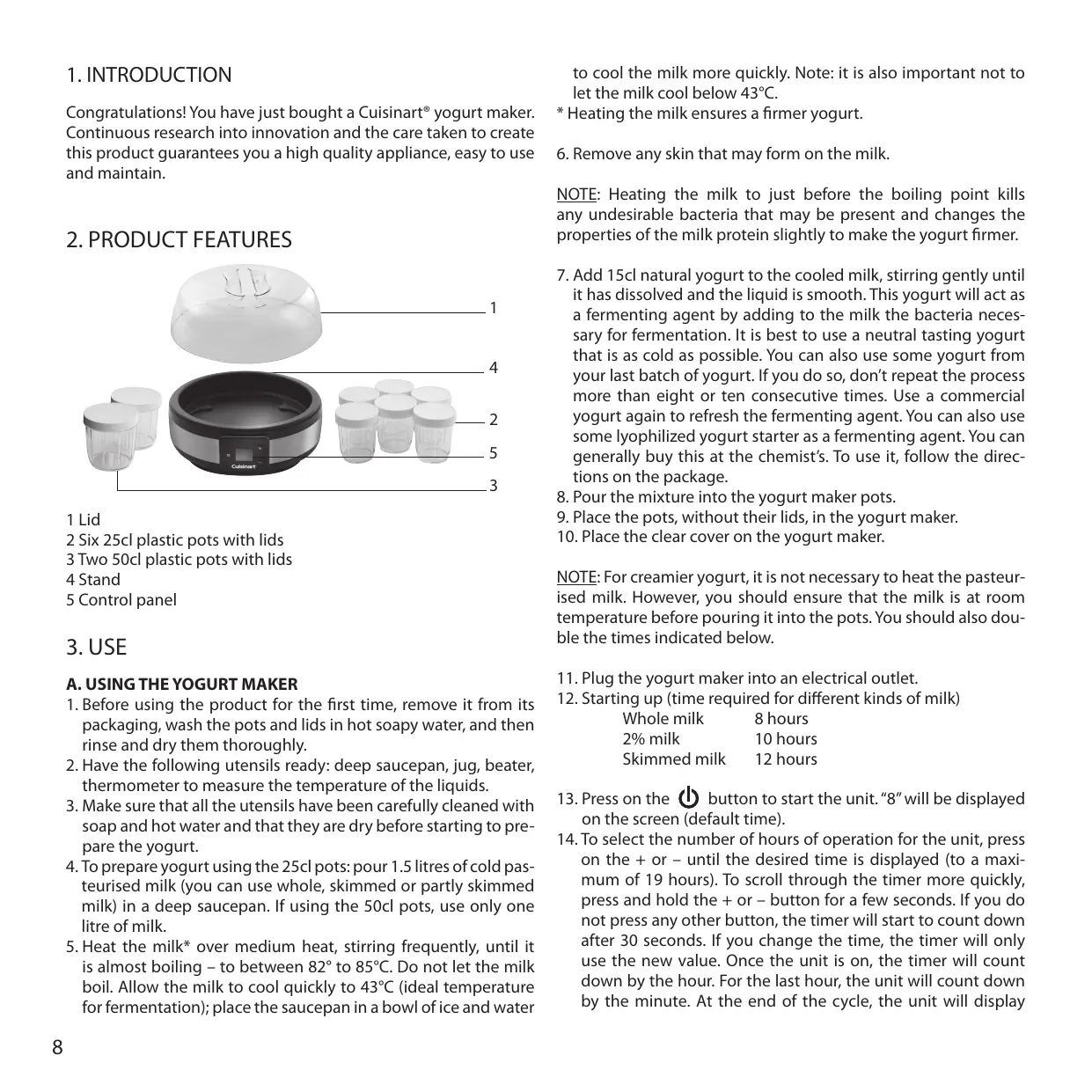


| Product type | Yogurt maker |
| Brand | CUISINART |
| Model | YM350E |
| Total pot capacity | 2.5 L (6 x 25 cl + 2 x 50 cl) |
| Number of pots | 8 (6 small + 2 large) |
| Power supply | 220-240 V, 50 Hz |
| Power | 15 W (estimated) |
| Adjustable timer | 8 to 19 hours |
| Display | LCD screen |
| Automatic shut-off | Yes, with audible signal |
| Fermentation temperature | 43 °C maintained |
| Pot material | Food-grade plastic |
| Lid | Transparent |
| Washing pots and lids | Dishwasher (top rack) or warm soapy water |
| Cleaning the base | Wipe with a damp cloth |
| Do not immerse | Do not immerse the base in water |
| Usable milk types | Pasteurized milk, UHT, powdered, farm, soy, sheep |
| Yogurt storage | 7 to 10 days in refrigerator |
| Included accessories | 6 pots 25 cl with lids, 2 pots 50 cl with lids, instruction manual |
| Repairability | Not user-repairable, return to manufacturer |
| Certifications | CE |
Frequently Asked Questions - YM350E CUISINART
User questions about YM350E CUISINART
0 question about this device. Answer the ones you know or ask your own.
Ask a new question about this device
Download the instructions for your Yogurt maker in PDF format for free! Find your manual YM350E - CUISINART and take your electronic device back in hand. On this page are published all the documents necessary for the use of your device. YM350E by CUISINART.
USER MANUAL YM350E CUISINART
A. Using the yogurt maker 9
B. Advice for use. 9
- Advice from Chefs 9
A.How does it work? 9
B. Suggestions for the choice of milk. 10
C. Tips 10
D. Yogurt recipe from the chefs 10
5 Cleaning and maintenance 10
6. Safety Instructions 10
INHALTSVERZEICHNIS
2. CHARACTERISTIQUES DU PRODUIT
Congratulations! You have just bought a Cuisinart® yogurt maker. Continuous research into innovation and the care taken to create this product guarantees you a high quality appliance, easy to use and maintain.
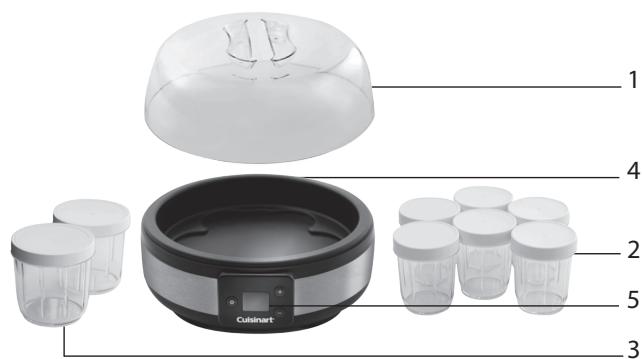
2.PRODUCT FEATURES
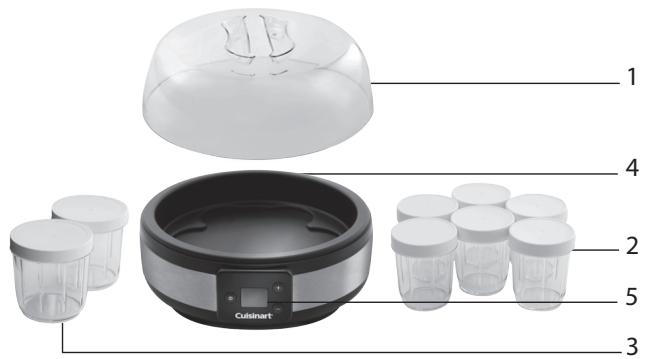
1 Lid
2 Six 25cl plastic pots with lids
3 Two 50cl plastic pots with lids
4 Stand
5 Control panel
3. USE
A. USING THE YOGURT MAKER
- Before using the product for the first time, remove it from its packaging, wash the pots and lids in hot soapy water, and then rinse and dry them thoroughly.
- Have the following utensils ready: deep saucepan, jug, beater, thermometer to measure the temperature of the liquids.
- Make sure that all the utensils have been carefully cleaned with soap and hot water and that they are dry before starting to prepare the yogurt.
- To prepare yogurt using the 25cl pots: pour 1.5 litres of cold pasteurised milk (you can use whole, skimmed or partly skimmed milk) in a deep saucepan. If using the 50cl pots, use only one litre of milk.
- Heat the milk* over medium heat, stirring frequently, until it is almost boiling – to between 82° to 85° C. Do not let the milk boil. Allow the milk to cool quickly to 43° C (ideal temperature for fermentation); place the saucepan in a bowl of ice and water
to cool the milk more quickly. Note: it is also important not to let the milk cool below 43°C .
-
Heating the milk ensures a firmer yogurt.
-
Remove any skin that may form on the milk.
NOTE: Heating the milk to just before the boiling point kills any undesirable bacteria that may be present and changes the properties of the milk protein slightly to make the yogurt firmer.
- Add 15cl natural yogurt to the cooled milk, stirring gently until it has dissolved and the liquid is smooth. This yogurt will act as a fermenting agent by adding to the milk the bacteria necessary for fermentation. It is best to use a neutral tasting yogurt that is as cold as possible. You can also use some yogurt from your last batch of yogurt. If you do so, don't repeat the process more than eight or ten consecutive times. Use a commercial yogurt again to refresh the fermenting agent. You can also use some lyophilized yogurt starter as a fermenting agent. You can generally buy this at the chemist's. To use it, follow the directions on the package.
- Pour the mixture into the yogurt maker pots.
- Place the pots, without their lids, in the yogurt maker.
- Place the clear cover on the yogurt maker.
NOTE: For creamier yogurt, it is not necessary to heat the pasteurised milk. However, you should ensure that the milk is at room temperature before pouring it into the pots. You should also double the times indicated below.
- Plug the yogurt maker into an electrical outlet.
- Starting up (time required for different kinds of milk)
Whole milk 8 hours
2% milk 10 hours
Skimmed milk 12 hours
- Press on the button to start the unit. "8" will be displayed on the screen (default time).
- To select the number of hours of operation for the unit, press on the + or - until the desired time is displayed (to a maximum of 19 hours). To scroll through the timer more quickly, press and hold the + or - button for a few seconds. If you do not press any other button, the timer will start to count down after 30 seconds. If you change the time, the timer will only use the new value. Once the unit is on, the timer will count down by the hour. For the last hour, the unit will count down by the minute. At the end of the cycle, the unit will display
"0" and beep 3 times to indicate that the yogurt maker has completed the process.
- Water may condense on the lid of the yogurt maker. When you remove the lid, make sure you don't let any of the water drip into the prepared yogurt.
- Cover the individual pots with their lids and place them in the refrigerator for at least 4 hours before eating the yogurt.
Important:
The yogurt maker must remain perfectly still during the entire incubation process. Do not move the unit and do not remove the pots.
B. ADVICE FOR USE
- Longer cooking times produce firmer and yogurt that is slightly more acid.
- Be careful not to heat the milk for too long, nor at a temperature that is too high.
- Always check the temperature of the milk with a thermometer.
- The yogurt can be kept for 7 to 10 days in the refrigerator.
- You can add various flavours and sweeteners to your natural yogurt once it has been refrigerated. It is also possible to sweeten the mixture when preparing it. To do so, add the sugar (the equivalent of one to three spoonfuls per pot) at the same time as the fermenting agent. Then whip the mixture until the sugar is mixed in evenly.
- For firmer yogurt, without heating the milk: add 10 tablespoons of powdered milk to the pasteurised milk at room temperature before pouring the mixture into the pots.
- If the yogurt does not thicken, here are some possible reasons:
- The yogurt starter was not strong enough or the milk was too hot when it was added.
- The fermenting agent or the powdered milk was past its use-by date.
- The yogurt was not completely mixed into the milk.
- The preparation time was not long enough.
- If the yogurt is sour or there is water on the surface, the preparation time may have been too long or the refrigeration time was not long enough.
- If the yogurt that you obtain is too soft, add a little powdered milk and increase the cooking time.
-
The taste and the texture of the yogurt will vary according to the milk and the yogurt starter used. For best results, don't use:
-
milk that has past its use-by date
- yogurt that has past its use-by date
- yogurt that contains additives, fruit or other ingredients
4. ADVICE FROM CHEFS

A. How does it work?
To master yogurt making, it is important to be very familiar with the way milk changes into yogurt.
Required conditions
Yogurt comes from fermented milk.
For the change to take place, the milk must be at a certain temperature (between 40 and 45°C ) and thermophilic bacteria must be added to this milk. The bacteria in fact need a lukewarm temperature to grow. If it's too hot (over 45°C ), then it will die. If, by contrast, it is too cold (under 40°C ), then it will remain stiff. The Cuisinart® yogurt maker is designed to ensure that optimal conditions are combined. Its role is thus to raise the temperature to 43°C and maintain that temperature so that the fermenting agents can develop.
Good bacteria
What makes yogurt different from milk that has simply fermented is the nature itself of the bacteria used. The bacteria of yogurt come from the family of lactic bacteria. Two bacteria must be present: Lactobacillus Bulgaricus and Streptococcus Thermophilus. Each plays a specific role. The first gives yogurt its acidity and the second develops its flavour.
The process
Once the yogurt is pitched in the milk raised to the right temperature, the bacteria will feed off the sugar in the milk (lactose) and will transform it into acid (lactic acid). This acidity will trigger a reaction that causes the proteins (casein) in the milk to coagulate. The milk then thickens and becomes yogurt. At this point, and depending on the desired consistency, it must be chilled to a temperature of 4°C to stop the activity of the bacteria without killing them. Yogurt must contain at least 10 million live bacteria per gram. These should remain alive until the use-by date.
B. Suggestions for the choice of milk
Yogurt can be made from any milk, and you can use all types of milk with your yogurt maker. The choice will thus depend directly on your personal preferences.
- Pasteurised milk of any fat content (rich in fat, 2% , 1% ). This milk is used most often and gives the best results.
- Powdered milk. This results in a firm yogurt, richer in calcium and in proteins.
- Long-life sterilised UHT milk. This results in a relatively firm yogurt without skin.
- Farm milk. It is advised that you boil this kind of milk before using it to kill any harmful bacteria. If using goat or sheep milk, the yogurt produced will not be as firm.
- Soy milk. Make sure you use UHT soy milk that contains one of the following ingredients: fructose, honey or malt. One of these ingredients at least is absolutely necessary.
NOTE: The level of fat and solids in the milk directly affects the flavour, texture and nutritional value of the final product. Also, the firmest yogurt is the kind obtained with whole milk. It also has more flavour, fat content and energy. Skimmed and semi-skimmed milk result in more fluid yogurt.
C.Tips
- Yogurt made from whole milk will be creamier than that made from semi-skimmed milk. Note: If you use skimmed milk, it won't work!
- UHT milk can be used directly chilled.
- Fresh (farm) milk must be boiled for long enough before using. Make sure you chill it (to about 43°C ) before adding the fermenting agents.
- You can keep the yogurt for between 7 and 10 days in your refrigerator, but it is better to eat it within four days of making it.
- People who have an allergy or an intolerance to cow milk can use goat or soy milk. Goat milk is rich in proteins and easier to digest.
D. Yogurt recipe from the chefs
1 I semi-skimmed milk
1 natural yogurt (preferably farm), about 140g
- Semi-skimmed powdered milk (amount: 2 pots from the farm yogurt that you will be using)
Mix all the ingredients when cold, and then pour into the pots provided. Place the pots in the yogurt maker and allow to cook for 9 hours. Cover the pots again with the lids and allow to chill for at least four hours in the refrigerator before eating.
5. CLEANING AND MAINTENANCE
- Make sure the unit has cooled completely before cleaning and storing. Always unplug the unit from the electrical outlet and clean it carefully before storing.
- The pots, lids and the yogurt maker lid can be washed with hot, soapy water and dried with a towel or they can be placed on the top rack of the dishwasher.
- To clean the base and the inside of the yogurt maker, wipe with a damp cloth. Do not use abrasive cleansers.
- Do not immerse the base of the yogurt maker in water or any other liquid.
6. SAFETY INSTRUCTIONS
- Keep these instructions for future reference.
- Never immerse the plug, the cord or the motor block in water or any other liquid.
- Unplug the unit immediately after use, before attaching or removing accessories and before cleaning the unit.
- Avoid any contact with moving parts.
- Never move the unit when it is in operation.
- Do not place the unit on a vibrating surface, like a refrigerator, or place it in a draft.
- Do not keep yogurt in the refrigerator for longer than 10 days.
- Never place the unit in the refrigerator.
- Do not use the unit if the cord is damaged or if the unit has been dropped or appears damaged. If the cord is damaged, it should be replaced by the manufacturer. Return the unit to the manufacturer for inspection, repair, or electrical or mechanical adjustment. Do not carry out any repairs yourself.
- Use only accessories provided with the unit.
- Do not allow the cord to dangle from the table or counter. To avoid all risk of damage, do not let the cord come in contact with the hot surfaces.
- IMPORTANT: Do not cover the base of the unit. None of the parts included with this unit may be repaired or replaced by the user. Repairs may only be carried out by the manufacturer.
- This unit is not intended for use by adults or children without experience with or knowledge of the product or whose incapacity may cause danger, unless they have been given instructions beforehand and are adequately supervised.
- Children should be supervised when using the unit to ensure they do not use it like a toy.
- This appliance meets the basic requirements of Directives
04/108/EEC (electromagnetic compatibility) and 06/95/EEC (safety of domestic electrical equipment), as amended by Directive 93/68/EEC (CE marking).
- Use this unit only according to the description in this insert and according to the instructions.

ELECTRICAL AND ELECTRONIC EQUIPMENT AT THE END OF LIFE.
In everybody's interest and to participate actively in protecting the environment:
- Do not discard these products with your household waste.
- Use return and collection systems available in your country.
Some materials can in this way be recycled or recovered.
1. EINLEITUNG
- INHALTSVERZEICHNIS
- CHARACTERISTIQUES DU PRODUIT
- 2.PRODUCT FEATURES
- USE
- USING THE YOGURT MAKER
- IMPORTANT
- ADVICE FOR USE
- ADVICE FROM CHEFS
- HOW DOES IT WORK
- REQUIRED CONDITIONS
- GOOD BACTERIA
- THE PROCESS
- SUGGESTIONS FOR THE CHOICE OF MILK
- C.TIPS
- YOGURT RECIPE FROM THE CHEFS
- CLEANING AND MAINTENANCE
- SAFETY INSTRUCTIONS
- ELECTRICAL AND ELECTRONIC EQUIPMENT AT THE END OF LIFE
- EINLEITUNG
Brand : CUISINART
Model : YM350E
Category : Yogurt maker