
CT-S651 - Thermal printer CITIZEN - Free user manual and instructions
Find the device manual for free CT-S651 CITIZEN in PDF.



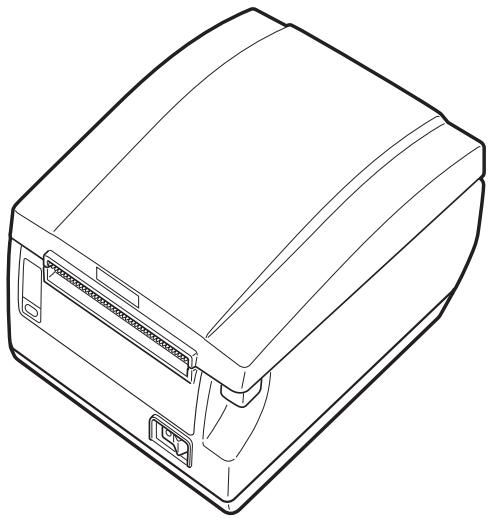
| Product Type | Thermal Printer |
| Brand | CITIZEN |
| Model | CT-S651 |
| Print Method | Line thermal matrix |
| Print Speed | Up to 200 mm/s |
| Resolution | 203 dpi (8 × 8 dots/mm) |
| Supported Paper Widths | 58, 60, 80, 83 mm |
| Max Roll Diameter | 83 mm |
| Dimensions (W × D × H) | CT-S651S: 145 × 192 × 142 mm CT-S651A: 145 × 192 × 114 mm |
| Weight | CT-S651S: 1.9 kg CT-S651A: 1.5 kg |
| Power Supply | 24 V DC ±5% (AC adapter 100-240 V AC optional) |
| Power Consumption | Approx. 45 W (printing), 3 W (standby) |
| Interfaces | RS-232C serial, IEEE 1284 parallel, USB, USB with hub, Ethernet, Powered USB |
| Main Functions | High-speed printing, auto-cutter system, LED indicators and buzzer, 384 KB user memory, barcode printing (UPC-A/E, JAN, ITF, Code 39, Code 128, Codabar, Code 93, PDF417, QR Code) |
| Maintenance | Periodic cleaning of the print head and platen with an alcohol-soaked cotton swab every 2-3 months |
| Safety | Risk of burn on the print head after use; disconnect before cleaning; avoid moisture and shocks |
| Repairability | Do not disassemble yourself; contact Citizen Systems dealer for any repairs |
| General Information | Manual available in French and other languages, downloadable for free from notice-facile.com |
Frequently Asked Questions - CT-S651 CITIZEN
User questions about CT-S651 CITIZEN
0 question about this device. Answer the ones you know or ask your own.
Ask a new question about this device
Download the instructions for your Thermal printer in PDF format for free! Find your manual CT-S651 - CITIZEN and take your electronic device back in hand. On this page are published all the documents necessary for the use of your device. CT-S651 by CITIZEN.
USER MANUAL CT-S651 CITIZEN
LINE THERMAL PRINTER
MODEL CT-S651
User's Manual
Mode d'emploi
Benutzerhandbuch
Manuale dell'utente
Manual de Nombre
WEEE MARK
En
If you want to dispose of this product, do not mix it with general household waste. There is a separate collection systems for used electronics products in accordance with legislation under the WEEE Directive (Directive 2002/96/EC) and is effective only within European Union.
Ge
Declaration of Conformity
This printer conforms to the following Standards:
The Low Voltage Directive 2006/95/EC, the EMC Directive 2004/108/EC, the RoHS Directive 2002/95/EC, and the WEEE Directive 2002/96/EC.
LVD:EN60950-1
EMC:EN55022
EN61000-3-2
EN61000-3-3
EN55024
Class A
This declaration applies only to the 230-V model.
IMPORTANT: This equipment generates, uses, and can radiate radio frequency energy and if not installed and used in accordance with the instruction manual, may cause interference to radio communications. It has been tested and found to comply with the limits for a Class A computing device pursuant to Subpart J of Part 15 of FCC Rules, which are designed to provide reasonable protection against such interference when operated in a commercial environment. Operation of this equipment in a residential area is likely to cause interference, in which case the user at his own expense will be required to take whatever measures may be necessary to correct the interference.
CAUTION: Use shielded cable for this equipment.
Sicherheitshinweis
This Class A digital apparatus complies with Canadian ICES-003.
This digital apparatus does not exceed the Class A limits for radio noise emissions from digital apparatus, as set out in the radio interference regulations of the Canadian department of communications.
- Before using this product, be sure to read through this manual. After having read this manual, keep it in a safe, readily accessible place for future reference.
- The information contained herein is subject to change without prior notice.
- Reproduction or transfer of part or all of this document in any means is prohibited without permission from Citizen Systems.
- Note that Citizen Systems is not responsible for any operation results regardless of omissions, errors, or misprints in this manual.
- Note that Citizen Systems is not responsible for any trouble caused as a result of using options or consumables that are not specified in this manual.
- Except explained elsewhere in this manual, do not attempt to service, disassemble, or repair this product.
- Note that Citizen Systems is not responsible for any damage attributable to incorrect operation/handling or improper operating environments that are not specified in this manual.
- Data is basically for temporary use and not stored for an extended period of time or permanently. Please note that Citizen Systems is not responsible for damage or lost profit resulting from the loss of data caused by accidents, repairs, tests or other occurrences.
- If you find omissions, errors, or have questions, please contact your Citizen Systems dealer.
- If you find any pages missing or out of order, contact your Citizen Systems dealer for a replacement.
SAFETY PRECAUTIONS...WHICH SHOULD BE STRICTLY OBSERVED
Before using this product for the first time, carefully read these SAFETY PRECAUTIONS. Improper handling may result in accidents (fire, electric shock or injury).
In order to prevent injury to operators, third parties, or damage to property, special warning symbols are used in the User's Manual to indicate important items to be strictly observed.
- After having read this Manual, keep it in a safe, readily accessible place for future reference.
- Some of the descriptions contained in this manual may not be relevant to some printer models.
The following describes the degree of hazard and damage that could occur if the printer is improperly operated by ignoring the instructions indicated by the warning symbols.

WARNING
Neglecting precautions indicated by this symbol may result in fatal or serious injury.

CAUTION
Neglecting precautions indicated by this symbol may result in injury or damage to property.

This symbol is used to alert your attention to important items.

This symbol is used to alert you to the danger of electric shock or electrostatic damage.

This symbol denotes a request to unplug the printer from the wall outlet.

This symbol is used to indicate that the power supply must be grounded.

This symbol is used to indicate useful information, such as procedures, instructions or the like.

This symbol is used to indicate prohibited actions.
| PRECAUTIONS ON PRINTER INSTALLATION | |
| WARNING | |
| ■ Do not use or store this product in a place where it will be exposed to: * Flames or moist air. * Direct sunlight. * Hot airflow or radiation from a heating device. * Salty air or corrosive gases. * Ill-ventilated atmosphere. * Chemical reactions in a laboratory. * Airborne oil, steel particles, or dust. * Static electricity or strong magnetic fields. · Neglecting these warnings may result in printer failure, overheating, emission of smoke, fire, or electric shock. | |
| ■ Do not drop any foreign object nor spill liquid into the printer. Do not place any object on the printer either. ■ Do not drop any metallic object such as paper clips, pins or screws into the printer. ■ Do not place a flower vase, pot, or anything containing water on the printer. ■ Do not spill coffee, soft drinks, or any other liquid into the printer. ■ Do not spray insecticide or any other chemical liquid over the printer. · Dropping a metallic foreign object into the printer, may cause printer failure, fire, or electric shock. Should it occur, immediately turn the printer off, unplug it from the supply outlet, and call your local Citizen Systems dealer. | |
| Do not handle the printer in the following ways: ■ Do not subject the printer to strong impacts or hard jolts (e.g., being stepped on, dropped or struck). ■ Never attempt to disassemble or modify the printer. · Neglecting to handle properly may result in printer failure, overheating, emission of smoke, fire, or electric shock. | |
| ■ Install, use, or store the printer out of the reach of children. · Electric appliances could cause an unexpected injury or accident if they are handled or used improperly. · Keep the power cord and signal cables out of the reach of children. Also children should not be allowed to gain access to any internal part of the printer. · The plastic bag the printer came in must be disposed of properly or kept away from children. Wearing it over the head may lead to suffocation. | |
| CAUTION | |
| Do not use the printer under the following conditions. ■ Avoid locations subject to vibration or instability. ■ Avoid locations where the printer is not level. · The printer may fall and cause an injury. · The quality of printing may deteriorate. ■ Do not obstruct the printer's air vents. ■ Do not place anything on the printer. ■ Do not cover or wrap the printer in cloth or blankets. · Doing so could cause heat to build up and deform the case or start a fire. ■ Avoid using the printer near a radio or TV set or from supplying it from the same electric outlet as these appliances. ■ Avoid using the printer interconnected with a cable or cord that has no protection against noise. (For interconnections, use shielded or a twisted pair of cables and ferrite cores, or other anti-noise devices.) ■ Avoid using the printer with a device that is a strong source of noise. · The printer may have an adverse effect on nearby radio or TV transmissions. There may also be cases when nearby electrical appliances adversely influence the printer, causing data errors or malfunction. ■ Installed in any orientation other than those specified. · Malfunction, failure, or electric shock may result. | |
| Connect the printer to a ground. · Electric leakage may cause an electric shock. ■ Do not connect the printer's ground to any of the following: * Gas piping · A gas explosion could result. * Telephone line ground * Lightning rod · If lightning strikes a large surge of current may cause fire or shock. * Water pipes · Plastic water pipes should not be used for grounding. (Those approved by a Waterworks Department may be used.) ■ Before connecting or disconnecting the grounding lead to or from the printer, always unplug it from the electric outlet. | |
PRECAUTIONS IN HANDLING THE PRINTER

WARNING
Please observe the following precautions for power source and power cord:
- Do not plug or unplug the power cord with a wet hand.
■ Use the printer only at the specified supply voltage and frequency.
Use only the specified AC adapter with the printer. - Check to make sure that the supply outlet from which the printer is powered has a sufficient capacity.
- Do not supply the printer from a power strip or current tap shared with other appliances.
- Do not plug the power cord into an electric outlet with dust or debris left on the plug.
- Do not use a deformed or damaged power cord.
- Do not move the printer while its power is on.
- Neglecting to handle it properly may result in printer failure, emission of smoke, fire, or electric shock.
- An overload may cause the power cord to overheat, catch fire, or the circuit breaker to trip.
- Do not allow anything to rest on the power cord. Do not place the printer where the power cord may be stepped on.
- Do not use or carry the printer with its power cord bent, twisted, or pulled.
■ Do not attempt to modify the power cord unnecessarily. - Do not place the power cord near any heating device.
- Neglecting these cautions may cause wires or insulation to break, which could result in electric leakage, electric shock, or printer failure. If the power cord sustains damage, contact your Citizen Systems dealer.
- Do not leave things around the electric outlet.
Supply power to the printer from a convenient electric outlet, readily accessible in an emergency. - Pull the plug to immediately shut it down in an emergency.
Insert the power plug fully into the outlet.
If the printer will not be used for a long time, disconnect it from its electric outlet.
Hold the plug and connector when plugging or unplugging the power cord or signal cable after turning off the printer and the appliance connected to it.







| CAUTION | |
| Caution label is attached in the position shown in the following figure. Carefully read the handling precautions before using the printer. THIS LABEL INDICATES THE RISK OF BURNS DUE TO THE HIGH TEMPERATURE OF THE PRINT HEAD AND A RISK OF BEING CUT BY THE MANUAL AND AUTO CUTTERS WHILE THE PAPER COVER IS OPEN. | |
| ■ Do not transport this printer with the paper roll inside. · Printer failure or damage may occur. | |
| To prevent possible malfunction or failure observe the following. ■ Do not open the paper cover during printing. ■ Avoid operating the printer without paper properly loaded. ■ Avoid the use of paper not complying with specifications. · May result in poor print quality. ■ Avoid using torn pieces of paper or paper spliced with plastic adhesive tape. ■ Avoid forcibly pulling already loaded paper by hand. ■ Avoid using a sharp pointed device to operate panel buttons. | |
| ■ Be sure to firmly insert the cable plugs into their mating sockets. · A cross connection may damage the printer's internal electronics or the host system's hardware. ■ Only use the printer with devices that have designated solenoid specifications for the cash drawer interface connector. · Neglecting this caution may result in malfunction or failure. |

CAUTION
To prevent injury and printer failures from worsening, observe the following:
■ While the paper cover is open, be careful to not touch the manual cutter that is in the paper eject slot.

- Do not touch the printing surface of the thermal head.
- Do not touch any of the moving parts (e.g., paper cutter, gears, active electric parts) while the printer is working.
In case of trouble do not attempt to repair the printer. Ask Citizen Systems service for repair.
■ Be careful that the covers do not pinch your hands or fingers.
■ Be careful of the sharp edges on the printer. Do not allow them to injure you or damage property. - May result in electric shock, burn, or injury.
If the printer emits smoke, an odd smell, or unusual noise while printing, immediately abort the current print session and unplug the printer from the electric outlet.


DAILY MAINTENANCE
Observe the following precautions for daily maintenance.
■ When cleaning the printer, always turn it off and unplug it from the electric outlet.
- Use a soft, dry cloth for cleaning the surface of the printer case. For severe stains, use a soft cloth slightly dampened with water. Never use organic cleaning solvent such as alcohol, paint thinner, trichloroethylene, benzene, or ketone. Never use a chemically processed cleaning cloth.
To remove paper dust, use a soft brush.


CAUTION
- The thermal head is at a dangerously high temperature immediately after printing. Allow it to cool off before starting maintenance work.
Visit the following site to get documentation, drivers, utilities, and other information.
http://www citizenen-systems.co.jp/english/support/index.html
THE TABLE OF CONTENTS
1. GENERAL OUTLINE 9
1.1 Features 9
1.2 Unpacking 10
1.3 Model Classification 10
1.4 Basic Specifications 11
2. EXPLANATION OF PRINTER PARTS 12
2.1 Printer Appearance 12
2.2 Inside the Paper Cover 15
2.3 Other Built-in Functions 16
3. SETUP 17
3.1 Connecting the AC Power Cord 17
3.2 Connecting Interface Cables 18
3.3 Connecting the CashDrawer 20
3.4 Precautions for Installing the Printer 22
3.5 Partition for Paper Roll 23
3.6 Setting the DIP Switch on the Serial Interface Board 24
3.7 Adjusting the Paper Near-end Sensor 25
3.8 Loading Paper 26
3.9 Attaching the Power Switch Cover 27
3.10 Attaching the Interface Cover 28
3.11 Removing the Interface Cover 28
4. MAINTENANCE AND TROUBLESHOOTING 29
4.1 Periodic Cleaning 29
4.2 Clearing a Cutter Lock (1) 30
4.3 Clearing a Cutter Lock (2) 30
4.4 Self-printing 32
4.5 Hexadecimal Dump Printing 33
4.6 Error Messages 34
5. OTHER 36
5.1 External Views and Dimensions 36
5.2 Printing Paper 37
5.3 Manual Setting of Memory Switches 38
1. GENERAL OUTLINE
The CT-S651 line thermal printer series is designed for use with a broad array of terminal equipment including data, POS, and kitchen terminals.
These printers have extensive features so they can be used in a wide range of applications.
1.1 Features
- High-speed (200 mm/s) printing
- Design so compact it can be installed anywhere (maximum 3-inch (83-mm) paper roll size)
- Waterproof construction prevents water from entering through the top
- Paper is output from the front so the printer can be placed in restricted spaces
- Choose from two models with either 3-inch (83/80 mm) or 2-inch (60/58 mm) wide paper rolls
Built-in power supply or AC adapter types available - Printer status and errors indicated by LED and a buzzer
- Equipped with a fast and quiet cutter
- Easy to clear cutter jams
- Interchangeable interface
Built-in cash drawer kick-out interface - Memory switches make customization possible
- Store user-defined characters and logos on user memory
- Barcode and 2D barcode printing supported
- 2-color printing supported (when specified paper used)
- Driver and utility software included
1.2 Unpacking
Make sure the following items are included with your printer.
Printer: 1
- Interface cover: 1
- AC power cord: 1
Power switch cover: 1
Sample paper roll: 1 roll
CD-ROM: 1
Quick Start Guide: 1
- AC adapter1: 1
- USB cable2: 1
Notes:
1: CT-S651A only
2: USB interface types only In designated markets
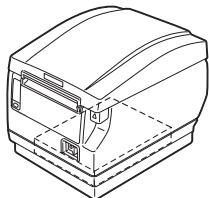
CT-S651S
(Built-in power supply type)
36AD3 AC adapter built in
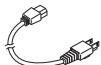
AC power cord

USB cable

Sample paper roll
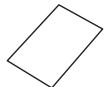
Quick Start Guide

Power switch cover

CD-ROM

Interface cover
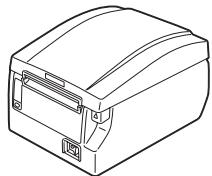
CT-S651A
(AC adapter type)
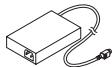
AC adapter (36AD2)
Quick Start Guide

AC power cord

Power switch cover

USB cable

CD-ROM

Sample paper roll

E-BK-P
Interface cover
1.3 Model Classification
Model numbers indicate printer features according to the following system.
CT - S651S 3 RS
Power supply
DC:No power source
S: Built-in power supply type
A: AC adapter type
Paper width
3: 3 inch (80/83 mm)
2: 2 inch (58/60 mm)
Interface
PA: Parallel
RS: Serial RS-232C
UB: USB only
UH: USB with hub
ET: Ethernet (standard type)
ES: Ethernet (multi-function type)
UP: Powered USB
-Market*
J: Japan
U: North America
C: China
PNE sensor
:No
P: PNE sensor
Body case color
WH: Cool white
BK: Black
1.4 Basic Specifications
| Item | Specifications | |||||
| Model | CT-S651 | |||||
| Print method | Line thermal dot print method | |||||
| Print width *1 | 80 mm/640 dots, 72 mm/576 dots, 64 mm/512 dots, 54.5 mm/436 dots, 54 mm/432 dots, 52.5 mm/420 dots, 48 mm/384 dots, 45 mm/360 dots, 48.75 mm/390 dots, 68.25 mm/546 dots | |||||
| Dot density | 8 × 8 dots/mm (203 dpi) | |||||
| Print speed | 200 mm/s (fastest, print density 100%), 1600 dot-lines/s | |||||
| Number of print columns *2 | - | Maximum number of characters (columns) | Dot configuration (dots) | |||
| Paper width Font | 83 mm | 80 mm | 60 mm | 58 mm | ||
| Font A | 53 | 48 | 36 | 35 | 12 × 24 | |
| Font B | 71 | 64 | 48 | 46 | 9 × 17 | |
| Font C | 80 | 72 | 54 | 52 | 8 × 16 | |
| Character size*3 | Font A: 1.50 × 3.00 mmFont B: 1.13 × 2.13 mmFont C: 1.00 × 2.00 mm | |||||
| Character type | Alphanumeric, international, PC437/850/852/857/858/860/863/864/865/866/WPC1252/katakana/Thai code 18 | |||||
| User memory | 384 KB (capable of storing user-defined characters and logos) | |||||
| Bar code types | UPC-A/E, JAN (EAN) 13/8 columns, ITF, CODE39, CODE128, CODABAR (NW-7), CODE93, PDF417, OR Code | |||||
| Line spacing | 4.23 mm (1/6 inch) (changeable using commands) | |||||
| Paper roll | Paper roll: 83+0-1 mm/80+0-1 mm/60+0-1 mm/58+0-1 mm × maximum φ83 mmPaper thickness: 65-75 μm (core tube diameter: inner 12 mm/outer 18 mm)75-85 μm (core tube diameter: inner 25.4 mm/outer 32 mm) | |||||
| Interface | Serial (RS-232C compliant), parallel (IEEE 1284 compliant), USB, USB with hub, Ethernet, Powered USB | |||||
| Cash drawer kick-out | Supports 2 cash drawers | |||||
| Buffer size | 4 k bytes/45 bytes | |||||
| Supply voltage | DC 24 V ±5% | |||||
| Power consumption | Approximately 45 W (normal printing), 3 W (standby) | |||||
| AC adapter *4(36AD2, 36AD3) | Rated input: AC 100 to 240 V, 50/60 Hz, 150 VARated output: DC 24 V, 2.1 A | |||||
| Weight | CT-S651S: Approx. 1.9 kg, CT-S651A: Approx. 1.5 kg | |||||
| Outside dimensions | CT-S651S: 145 (W) × 192 (D) × 142 (H) mmCT-S651A: 145 (W) × 192 (D) × 114 (H) mm | |||||
| Operating temperature and humidity | 5 to 45°C, 10 to 90% RH (no condensation) | |||||
| Storage temperature and humidity | -20 to 60°C, 10 to 90% RH (no condensation) | |||||
| Reliability | Print head life: 150 km, 200 million pulses (at normal temperature/humidity, using recommended paper and paper thickness)Auto cutter life: 2 million cuts (full cut), 1.6 million cuts (partial cut) (at normal temperature/humidity, using recommended paper and paper thickness) | |||||
| Safety standard *5 | UL, C-UL, FCC Class A, TÜV-Bauart, CE Marking | |||||
Notes:
1: When paper width is 83, 80, 60, or 58 mm.
2: The number of printable columns is selected using a memory switch. The numbers of columns noted in this table refer to typical models. The number of columns varies depending on specifications.
3: Characters appear small because the dimensions include a blank area surrounding each character.
4: The 36AD2 is the AC adapter packaged as an accessory with the CT-S651A. The 36AD3 is the AC adapter built in to the CT-S651S.
*5: Compliant if the Citizen Systems AC adapter (36AD2/36AD3) is used.
2. EXPLANATION OF PRINTER PARTS
2.1 Printer Appearance
Names of parts
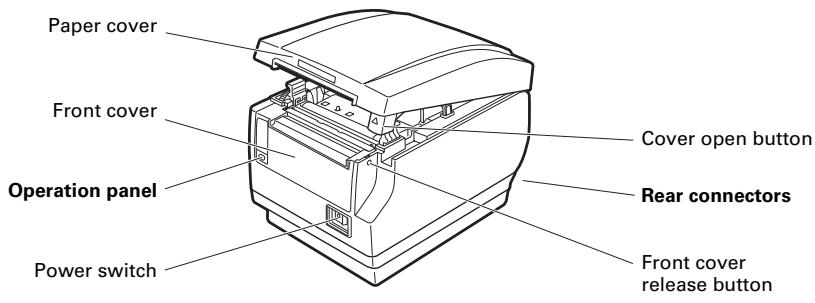
- Paper cover Open to load paper.
- Cover open button Use this button to open the paper cover.
- Front cover
- Open and close this cover to clear a cutter lock.

Refer to 4.3 Clearing a Cutter Lock (2)
- Front cover release button Press this button to open the front cover.
- Power switch Press this switch to turn the power on or off.
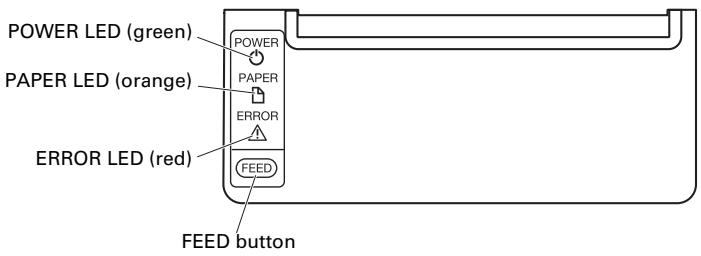
POWER LED (green)
Lights when the power is on, turns off when the power is off. Flashes when data is incoming or a memory error has occurred.
PAPER LED (orange)
Lights orange when paper is low (paper near-end) or there is no paper (paper end).
- ERROR LED (red)
Flashes if the print head is hot, the paper cover is open, a cutter lock occurs, and so forth.
- FEED button
Press this button to feed paper.
In case of a cutter lock, remove the cause of the lock, close the paper cover, and then press the FEED button.
The printer enters the mode for setting memory switches and running self-printing.

Refer to 4.4 Self-printing

Refer to 4.6 Error Messages

Refer to 5.3 Manual Setting of Memory Switches
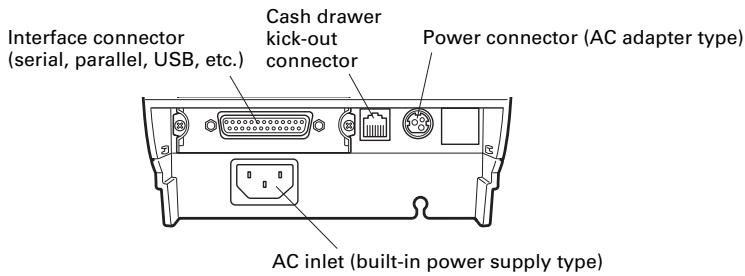
- Interface connector (serial, parallel, USB, etc.) Connects to the interface cable. The serial interface board is equipped with a DIP switch.
- Cash drawer kick-out connector Connects to the cable from the cash drawer.
- Power connector (AC adapter type) Connects to the AC adapter cable.
- AC inlet (built-in power supply type) Connects to the AC power cord.
2.2 Inside the Paper Cover
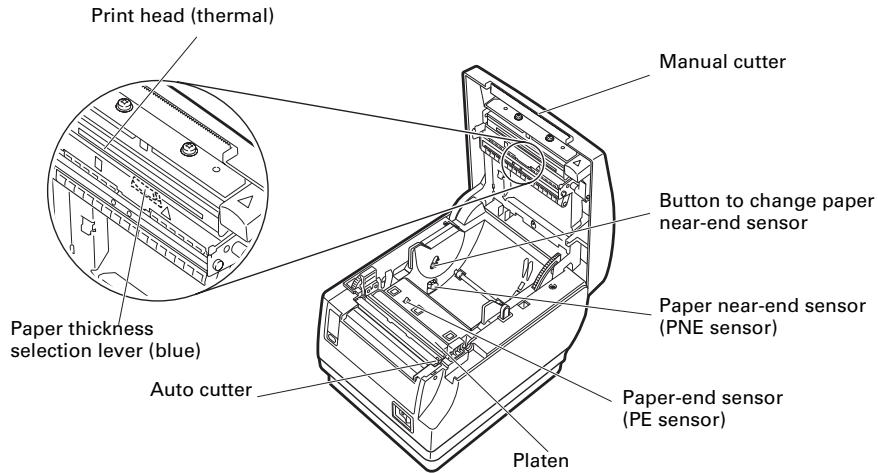
- Platen
Feeds the paper.
Do not remove the platen except to do maintenance.
- Paper near-end sensor (PNE sensor)
Detects when the paper is near the end of the roll. Adjust the position of the sensor to determine when it detects the end of the paper is near.
- Button to change paper near-end sensor
Change the position of the paper near-end sensor to match the paper being used.

Refer to 3.7 Adjusting the Paper Near-end Sensor
- Manual cutter
For cutting the paper manually when printing is finished.
- Auto cutter
Automatically cuts the paper when printing is finished.

Refer to 5.3 Manual Setting of Memory Switches
- Print head (thermal)
Prints characters and graphic data on paper (paper rolls).
- Paper end sensor (PE sensor)
Detects when there is no paper. Printing stops when this sensor detects there is no paper.
- Paper thickness selection lever (blue)
Use this lever to select regular or thick paper according to the thickness of the paper being loaded. (Factory setting: 1)

CAUTION
Do not change the position of the paper thickness selection lever from the factory setting.
2.3 Other Built-in Functions
- Buzzer
Buzzes when errors occur or when operations or command operations are performed.

Refer to 4.6 Error Messages
- User memory
You can save user-defined logo and character data in this memory. Data remains stored in this memory even if the printer is turned off. For information on how to save data, refer to the Command Reference.
- Memory switch
Setting of various kinds of functions can be stored in memory. Settings remain stored in the memory even if the printer is turned off.
3.1 Connecting the AC Power Cord
- Turn off the power.
- For the built-in power type printer, connect the AC power cord to the AC inlet, and insert the plug into an electric outlet.
- For the AC adapter type printer, connect the cable connector of the AC adapter to the power connector. Next, connect the AC power cord to the AC inlet, and insert the plug into an electric outlet.
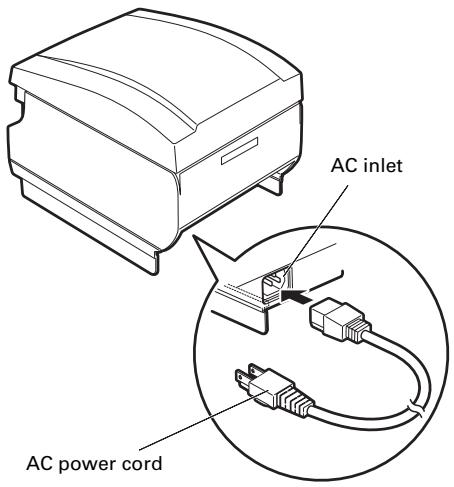
Built-in power supply type
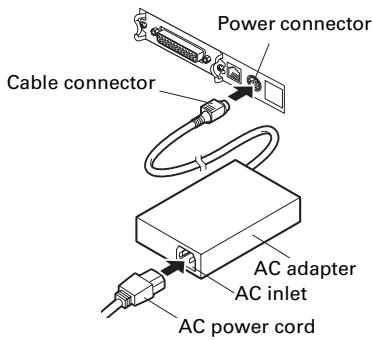
AC adapter type

CAUTION
Use only an AC adapter that complies with the specified ratings.
Always hold the AC adapter's cable connector by the connector when removing or inserting it.
■ Use an AC power source that does not also supply power to equipment that generates electromagnetic noise.
Pulling on the AC power cord may damage it, cause a fire, electric shock, or break a wire.
If a lightning storm is approaching, unplug the AC power cord from the electric outlet. A lightning strike may cause a fire or electric shock.
- Keep the AC power cord away from heat generating appliances. The insulation on the AC power cord may melt and cause a fire or electric shock.
If the printer is not going to be used for a long time, unplug the AC power cord from the electric outlet.
Place the AC power cord so that people do not trip on it.
3.2 Connecting Interface Cables
- Turn off the power.
- Orient the interface cable correctly and insert it into the interface connector.
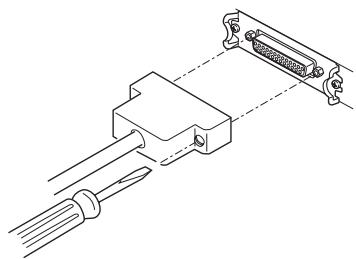
Serial interface
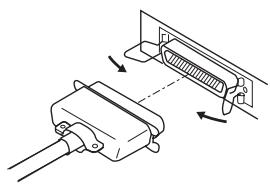
Parallel interface
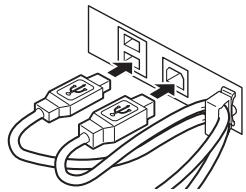
USB interface (hub type)
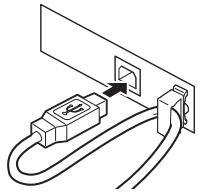
USB interface
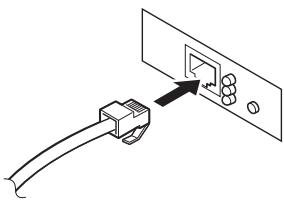
Ethernet interface
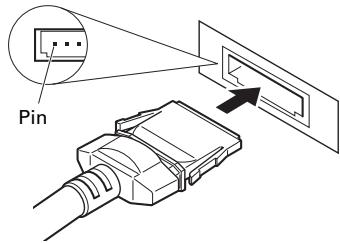
Front view
Powered USB interface
Always unplug the AC adapter from the printer before connecting the printer to a Powered USB interface. Failure to do so may damage the host PC. For information about installing a Powered USB interface, contact your Citizen Systems dealer.
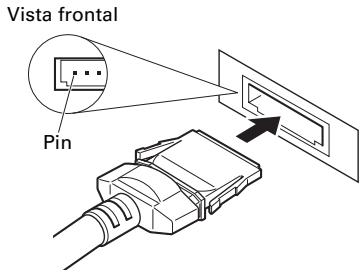
- Check the orientation of the Powered USB cable connector before connecting it. Insert it straight in so that the pins do not bend. Push it in until it clicks.
■ When disconnecting the cable, always hold the connector.
■ Be careful not to insert the USB interface cable into the cash drawer kick-out connector.
- To connect more than one printer to a single computer via a USB interface you must change the serial number of the USB interface.
- Hold the connector of the Ethernet interface cable perpendicular and straight when connecting or disconnecting it. Doing it at an angle may cause the connector to misconnect.
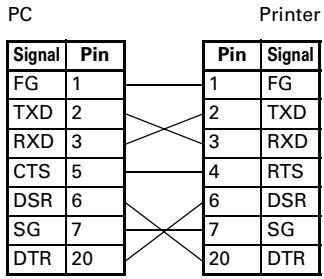
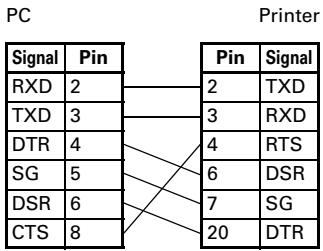
Use a serial interface cable with the connection layout shown below.
25-pin - 25-pin cable
9-pin - 25-pin cable

CAUTION
Place the interface cable so people do not trip on it.
3.3 Connecting the Cash Printer
- Turn off the power.
- Confirm the orientation of the cash drawer kick-out cable connector and connect it to the cash drawer kick-out connector at the back of the printer.
- Remove the screw for the ground wire.
- Screw the cash drawer's ground wire to the body of the printer.
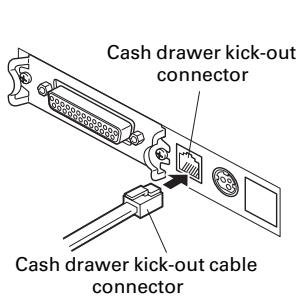
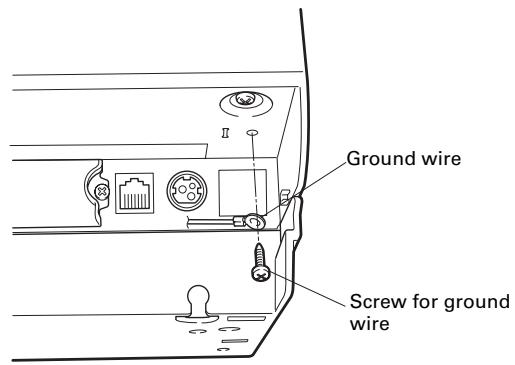

CAUTION
- Connect only the cash drawer kick-out cable connector to the cash drawer kick-out connector. (Do not connect a telephone line.)
Signals cannot be output from the cash drawer kick-out connector while printing.
Hold the connector of the drawer kick cable perpendicular and straight when connecting or disconnecting it. Doing it at an angle may cause the connector to misconnect.
(1) Connector pin configuration
| No. | Signal | Function |
| 1 | FG | Frame ground |
| 2 | DRAWER1 | Cash drawer 1 drive signal |
| 3 | DRSW | Cash drawer switch input |
| 4 | VDR | Cash drawer drive power supply |
| 5 | DRAWER2 | Cash drawer 2 drive signal |
| 6 | GND | Signal ground (common ground on circuits) |
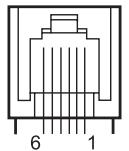
Connector used: TM5RJ3-66 (Hirose) or equivalent
Applicable connector: TM3P-66P (Hirose) or equivalent
(2) Electric characteristics
1) Drive voltage: 24 VDC
2) Drive current: Approx. 1 A max. (not to exceed 510 ms.)
3) DRSW signal: Signal levels: "L" = 0 to 0.8 V, "H" = 2 to 3.3 V
(3) DRSW signal
DRSW signal status can be tested with the DLE+EOT, GS+a, or GS+r command or at pin 34 on the parallel interface port.
(4) Drive circuit
Cash drawer kick-out connector
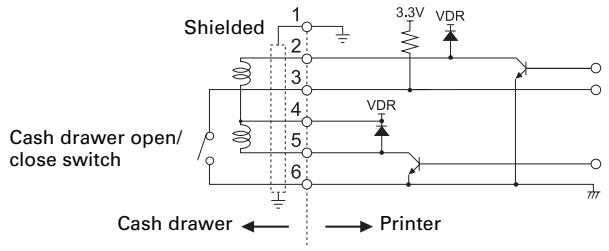

CAUTION
Cash drawers 1 and 2 cannot be operated at the same time.
The solenoid used for the cash drawer should be 24 or more. Do not allow the electric current to exceed 1 A. Excessive current could damage or burn out the circuits.
3.4 Precautions for Installing the Printer
This printer can only be positioned horizontally. It cannot be positioned vertically or on a wall.
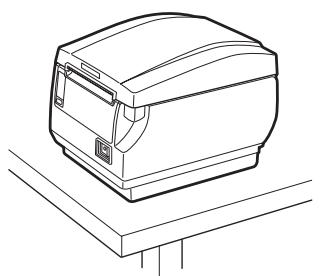
Horizontal position
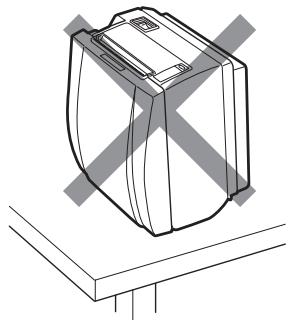
Vertical position

CAUTION
Do not use the printer under the following conditions.
Locations subject to vibration or instability.
Locations that are very dirty or dusty.
Locations where the printer is not level.
- The printer may fall and cause an injury.
- The quality of printing may deteriorate.
Oriented other than as specified.
- The printer may malfunction, be damaged, or cause an electric shock.
3.5 Partition for Paper Roll
Set the partition to the width of the paper roll you are loading.
The partition is set at the factory to the position shown below.
For 3-inch type: 80-mm wide paper roll
- For 2-inch type: 58-mm wide paper roll, 60-mm wide paper roll
(2-sheet partition installed.)
- Turn off the power.
- Press up on the cover open button to open the paper cover.
- Press in the position shown by the arrow and set the partition in a slot that matches the width of the paper roll you are using. However, to use an 83-mm wide paper roll, remove the partition. Or, when you are using a 60-mm wide paper roll with the 2-inch type, remove the partition installed for 58-mm.
- Refer to "5.3 Manual Setting of Memory Switches" to change the paper width settings.
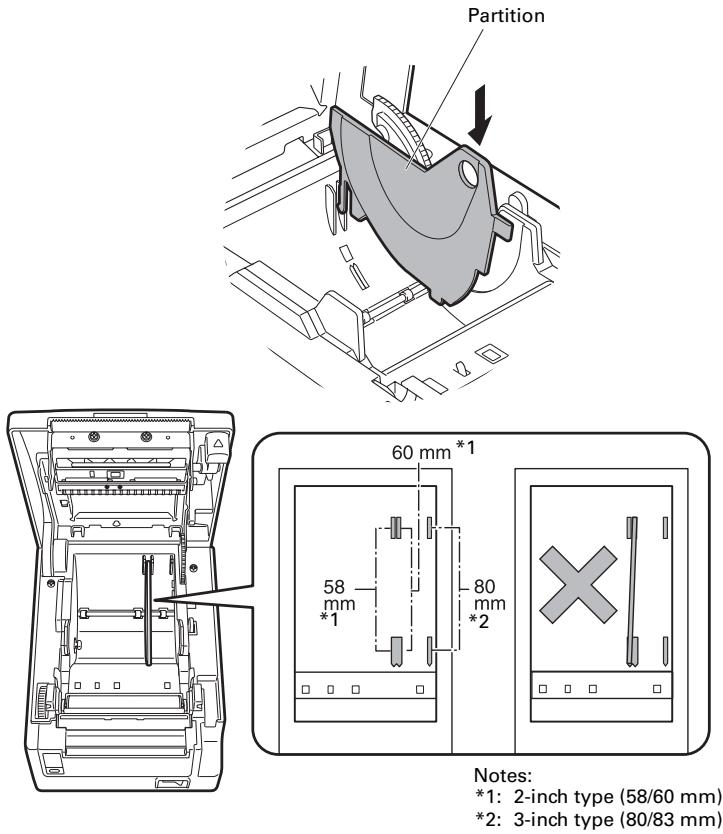

CAUTION
Make sure the partition is not slanted when setting it for 58-mm or 60-mm paper rolls.
3.6 Setting the DIP Switch on the Serial Interface Board
- Turn off the printer and unplug the power cord from the electric outlet.
- Remove the mounting screws of the serial interface board.
- Remove the serial interface board from the printer.
- Set the DIP switch according to the following table.
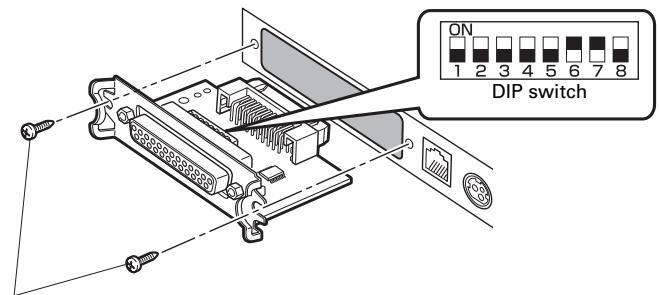
Serial interface board mounting screws

CAUTION
When setting the DIP switch, do not remove any screws except the serial interface board mounting screws.
The function of each switch is shown below. (Shaded values are factory settings. However, factory settings differ depending on the destination market.)
| Switch no. | Function | ON | OFF |
| 1 | Communication condition setting | According to DIP switch settings | According to memory switch settings |
| 2 | Hand shake | XON/XOFF | DTR/DSR |
| 3 | Bit length | 7 bits | 8 bits |
| 4 | Parity check | Yes | No |
| 5 | Parity selection | Even parity | Odd parity |
| 6 | Baud rate selection | Refer to table below. | |
| 7 | |||
| 8 | INIT | Reset | Invalid |
Baud rate selection
| Baud rate (bps) | Switch no. | |
| 6 | 7 | |
| 2400 | OFF | OFF |
| 4800 | ON | OFF |
| 9600 | OFF | ON |
| 19200 | ON | ON |
When switch no. 1 is set to OFF, you can use a command or a memory switch to select 1200, 38400, 57600, or 115200 bps.
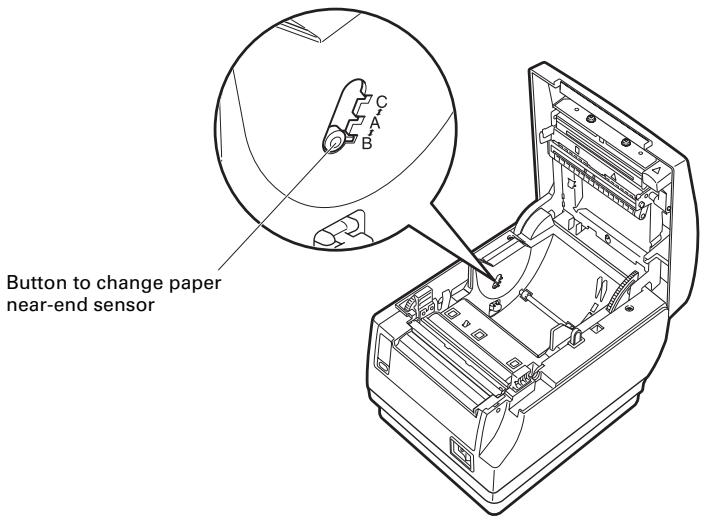
3.7 Adjusting the Paper Near-end Sensor
Change the settings of the paper near-end sensor to set the position at which the near-end of the paper is detected.
- Use a pointed object, such as a pen, to gently press the button to change the paper near-end sensor.
- Press and hold down the button while moving the paper near-end sensor up and down. The sensor positions are shown below for the various diameters of the paper roll used.
(Unit: mm)
| Sensor position | Exterior diameter when detected as near end | Exterior/ interior diameter of core of paper roll used |
| A | Approximately φ31 | φ18/φ12 |
| B* | Approximately φ23 | φ18/φ12 |
| C | Paper near-end sensor function is off | |
Note:
*: Position of sensor when shipped from factory. However, factory settings differ depending on the destination market.

CAUTION
The diameter of the roll of paper that is detected is an estimate. Some variations may occur depending on the paper.
3.8 Loading Paper
- Turn on the power.
- Press up on the cover open button to open the paper cover.
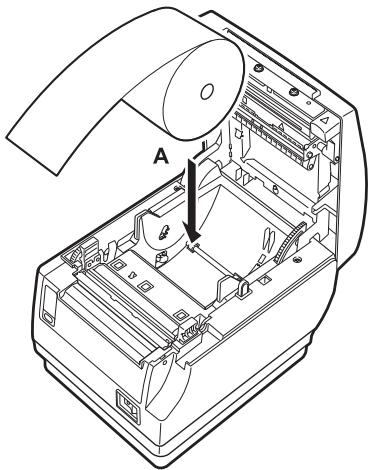
- Load the paper roll so that the printable side of the paper is facing up, as shown by arrow A.
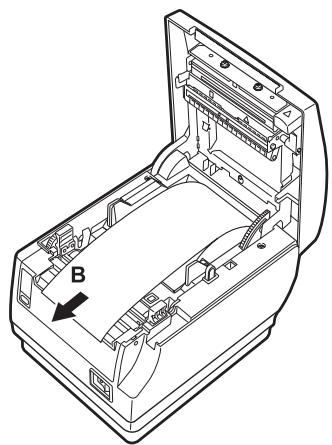
- Pull a few cm of paper straight out in the direction of arrow B.
- Close the paper cover until you hear a click. Paper is fed and cut automatically (by the factory setting).

Refer to 5.3 Manual Setting of Memory Switches

CAUTION
Always use the specified types of paper rolls.
■ Confirm that the paper roll is set correctly.
■ If the paper is skewed and not coming straight out of the paper cover, open it and straighten the paper.
Always pull a few cm of paper straight out of the printer if you open the paper cover while paper is loaded.
Press on the center of the paper cover to close it securely.
■ Be careful of paper cuts while loading the paper.
- Do not touch the print head, manual cutter, or auto cutter while the paper cover is open. Doing so may cause a burn or cut.
3.9 Attaching the Power Switch Cover
Attach this cover to prevent the power switch from being used.
- Press the power switch cover onto the power switch compartment until it clicks.
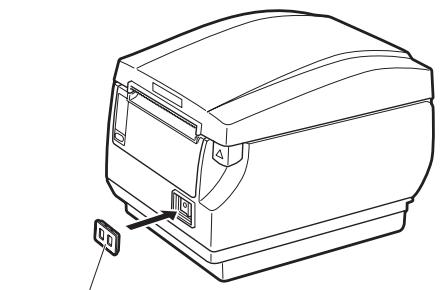
Power switch cover
Put a screwdriver or other pointed object into the grooves on the power switch cover to remove it.
3.10 Attaching the Interface Cover
Attach the interface cover to the back of the printer.
The shape of the interface cover is different depending on the type of power source.
- Press the interface cover as shown in the diagram until you hear it click.
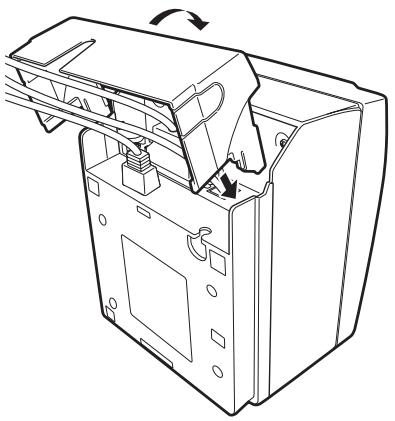
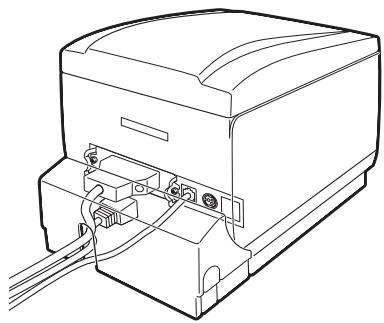
CT-S651S
3.11 Removing the Interface Cover
Press in on both sides at the point indicated by A to remove the interface cover.
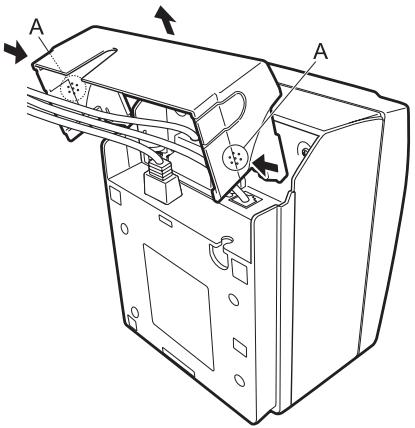
CT-S651S
4. MAINTENANCE AND TROUBLESHOOTING
4.1 Periodic Cleaning
A dirty print head or platen may reduce printing quality or cause malfunctions. We recommend cleaning the printer periodically (every 2 to 3 months) as shown below.
- Turn off the power.
- Press up on the cover open button to open the paper cover.
- Wait a few minutes until the print head cools.
- Use a cotton swab dampened with ethyl alcohol to wipe off any dirt and dust that is on the print head and platen.
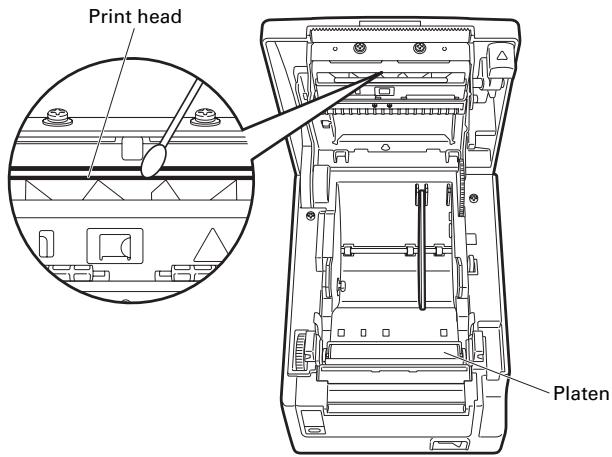

CAUTION
The print head is hot immediately after printing. Do not touch it.
■ Do not touch the print head with bare hands or metal objects.
4.2 Clearing a Cutter Lock (1)
The ERROR LED flashes and the auto cutter blade remains extended because a foreign object or paper jam is obstructing it.
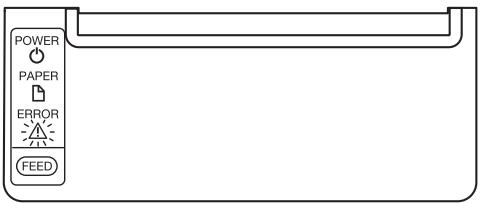
If the ERROR LED is flashing, clear the locked cutter as shown below.
- Turn on the power.
- Press up on the cover open button to open the paper cover.
- Remove any jammed paper including any scraps of paper. (Remove the paper roll that is loaded in the holder also.)
- Reload the paper roll and close the paper cover.

CAUTION
The print head is hot immediately after printing. Do not touch it.
- Do not touch the print head with bare hands or metal objects.
After doing the procedure in "Clearing a Cutter Lock (1)" and then opening the paper cover, if the blade of the auto cutter is extended, do the procedure in "Clearing a Cutter Lock (2)".

Refer to 4.3 Clearing a Cutter Lock (2)
4.3 Clearing a Cutter Lock (2)
The paper cover is designed to be opened by pressing up on the cover open button if the cutter locks. If the blade of the auto cutter still remains extended, use the following procedure to clear the locked cutter.
- Turn off the printer and unplug the power cord from the electric outlet.
- Press up on the cover open button to open the paper cover.
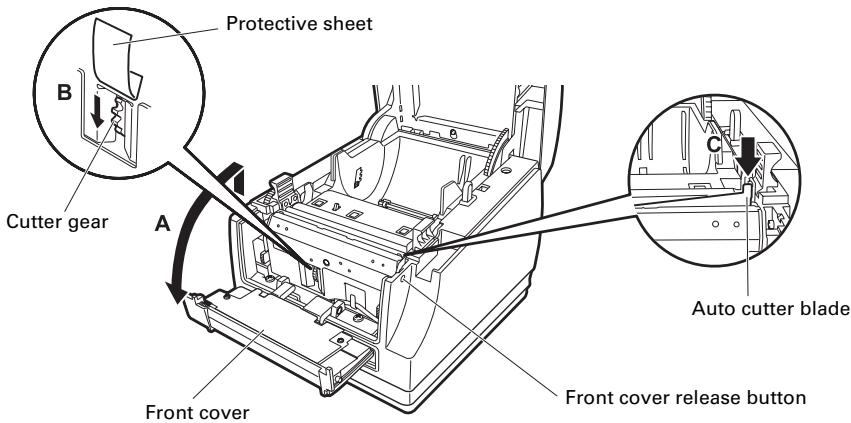
- While pressing on the front cover release button with a pen or something, slide the front cover about 10mm upward.
-
Rotate the front cover forward in the direction of arrow A.
-
Lift the protective sheet and turn the cutter gear in the direction of arrow B to return the auto cutter to a position where the paper cover can be opened.
Turn the cutter gear until the auto cutter blade retracts in the direction of arrow C. If the blade of the auto cutter does not move when you turn the cutter gear in the direction of arrow B, turn it in the other direction.
- Remove whatever caused the cutter to lock.
- Close the front cover.
Rotate the front cover in the opposite direction of arrow A, and push on the top of the front cover until it clicks.
- Load a paper roll and close the paper cover.
- Insert the power cord plug into an electric outlet and turn the power on.
Check that the POWER LED lights.

CAUTION
Before starting to do maintenance work, be sure to turn off the printer and unplug the power cord from the electric outlet.
■ Be careful not to touch the manual cutter while the front cover is open.
■ Be careful not to touch the opening for the auto cutter while the paper cover is open.
The print head is hot immediately after printing. Do not touch it.
■ Do not touch the print head with bare hands or metal objects.
■ If the above procedure does not retract the auto cutter, contact your Citizen Systems dealer.
4.4 Self-printing
While paper is loaded, press and hold the FEED button while turning the power on. Hold the FEED button down for about one second and then release it to start self-printing. The printer prints its model name, version, DIP switch settings, memory switch settings, and a list of built-in fonts.
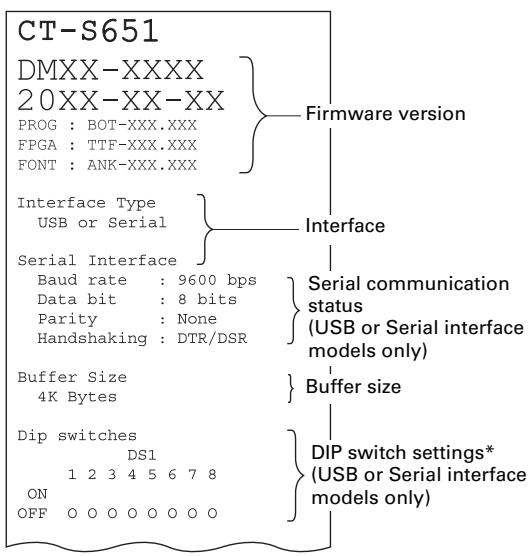
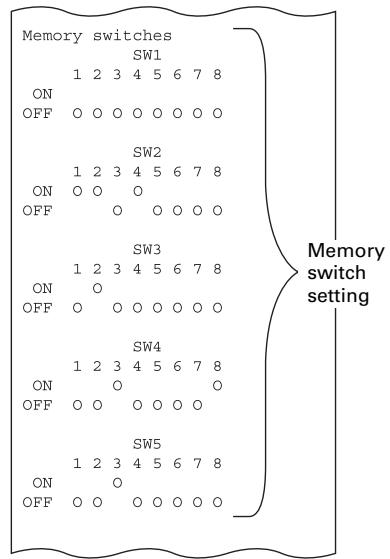
Note:
*: Printers with a USB interface do not have DIP switches, so the DIP switches all appear off on the self-printing printout.
4.5 Hexadecimal Dump Printing
Print received data in hexadecimal. If problems such as missing or duplicated data occur, this function allows you to check whether or not the printer is receiving data correctly.
How to do hexadecimal dump printing
- Load paper.
- While the paper cover is open, press and hold the FEED button while turning the power on, and then close the paper cover.
- The printer prints "HEX dump print mode" followed by the received data printed in hexadecimal numbers and some characters.
How to stop hexadecimal dump printing
Do one of the following to stop printing.
- Press the FEED button three times in a row
- Turn off the power
- Receive a reset command from an interface

CAUTION
The printer prints ". ." if there is no character corresponding to the data.
None of the commands function during hexadecimal dump printing.
■ If print data does not cover a complete line, press the FEED button to advance the paper.
Print example
HEX dump print mode
61 62 63 64 65 66 67 0A 0D 0D 0D 0D abcdefg....
OD OD 0D
4.6 Error Messages
- Paper-end
The end of the roll of paper is detected at two stages, paper near-end and paper-end.
When paper near-end is detected, the PAPER LED lights. Prepare a new paper roll.
When paper end is detected, the PAPER LED and ERROR LED light. Load a new paper roll.
- Paper cover open
Do not open the paper cover during printing. If the paper cover is opened, the ERROR LED lights or flashes. Check the paper and always pull a few cm of paper straight out of the printer before closing the paper cover. Printing resumes. Sending a command to resume printing may be required depending on the memory switch setting.
- Cutter locked
If the auto cutter cannot move because of a paper jam or something else, the ERROR LED flashes. Remove the cause of the trouble and press the FEED button. If the auto cutter still does not operate and the paper cover does not open, refer to "4.3 Clearing a Cutter Lock (2)".

Refer to 4.3 Clearing a Cutter Lock (2)
- Print head hot
When you print dense characters, dark images, or for an extended time in a hot environment, the print head temperature increases. If the print head exceeds a specified temperature, the printer stops printing and waits for the print head to cool. When this happens, the ERROR LED flashes. Printing resumes automatically when the print head cools.
The status display for various messages is shown below.
| Status | POWER LED (green) | PAPER LED (orange) | ERROR LED (red) | Buzzer*3 |
| Paper near-end | Lights | Lights | - | - |
| Paper-end | Lights | Lights | Lights | Yes |
| Paper cover open or front cover open*1 | Lights | - | Lights | Yes |
| Paper cover open or front cover open*2 | Lights | - | Yes | |
| Cutter locked | Lights | - | Yes | |
| Memory error | - | - | Yes | |
| Print head hot | Lights | - | Yes | |
| Low-voltage error | Lights | - | Yes | |
| High-voltage error | Lights | - | Yes | |
| Waiting for macro to execute | Lights | - | - |
Notes:
1: If the paper cover or front cover is open in standby.
2: If the paper cover or front cover is open when printing or feeding paper.
*3: Buzzer sounds when MSW5-1 (buzzer setting) is set to ON.
5.1 External Views and Dimensions
(Unit: mm)
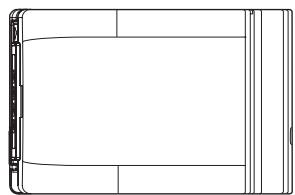
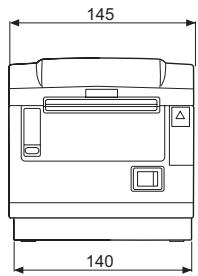
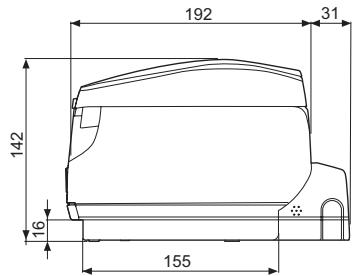
Built-in power supply type
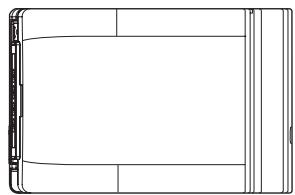
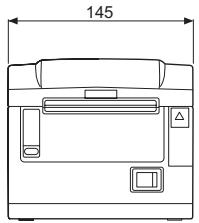
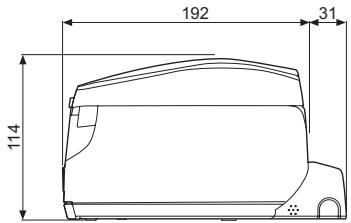
AC adapter type
5.2 Printing Paper
Use the paper shown in the following table or paper of the same quality.
| Paper type | Product name |
| Recommended thermal roll paper | TF50KS-E2D, TF50KS-E or TF60KS-E from Nippon Paper PD150R or PD160R from Ohji Paper PA220AG, HP220A, HP220AB-1, F230AA, P220AB, or PB670 (2-color paper) from Mitsubishi Paper |
(Unit: mm)
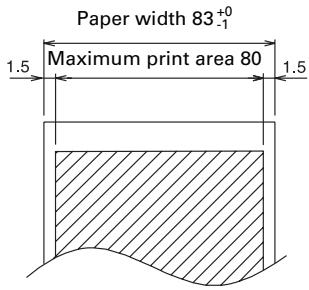
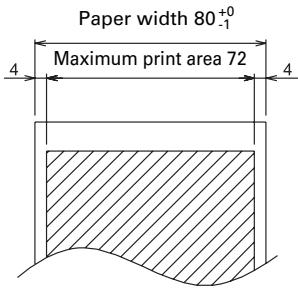
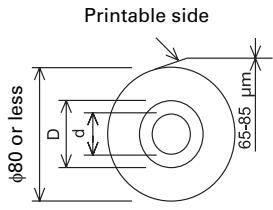
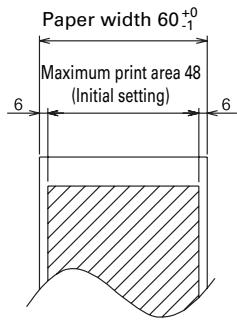
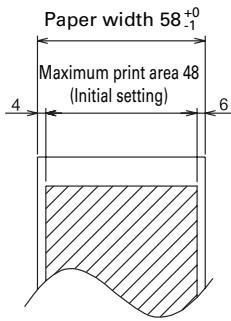
| Paper thickness (μm) | 65-75 | 75-85 |
| Core inner diameter d (mm) | φ12 | φ25.4 |
| Core outer diameter D (mm) | φ18 | φ32 |

CAUTION
Use thermal paper that is wound as follows:
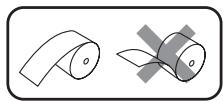
Not creased and fits tight to the core.
Not folded.
Not glued to the core.
■ Rolled with the printable side out.
5.3 Manual Setting of Memory Switches
Memory switches are used to set various printer settings. The memory switches can be set manually (set by hand on the printer) or by commands. This section explains how to perform manual settings.
For information on how to set the memory switches using commands, please refer to the Command Reference.
Quick setting mode
The settings for the memory switches for a replacement printer's manufacturer, model, paper width, and character spacing can be set at the same time to the optimum settings.
Do the settings while confirming the selected items on the printout.
- Load paper.
- While the paper cover is open, press and hold the FEED button while turning the power on.
- Press the FEED button three times and close the paper cover.
The printer enters memory switch quick setting mode.
The selectable item "Manufacturer" and the selection are printed.
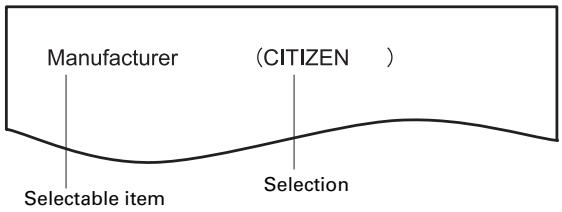
- Press the FEED button.
A selection is printed in order through the cycle each time the FEED button is pressed. Press the FEED button until the selection you want is printed.
- Press the FEED button for at least two seconds.
The selection is set.
If there is another selectable item, it and the selection are printed.
- Repeat steps 4 and 5 to select and set the printer's model, paper width, character spacing (EPSON T88 only).
When all the items are set, "Save To Memory" is printed.
- Press the FEED button for at least two seconds.
The changed memory switch settings are saved and a list of them is printed.
The printer exits quick setting mode when printing is finished.
Selected item
| Manufacturer | Model | Paper width | Character space |
| CITIZEN | CBM1000 | 58 mm | - |
| 80 mm | - | ||
| CT-S300 | 58 mm | - | |
| 80 mm | - | ||
| CT-S2000 | 58 mm | - | |
| 60 mm | - | ||
| 80 mm | - | ||
| 83 mm | - | ||
| EPSON | T88 | 58 mm | 0dot |
| 1dot | |||
| 80 mm | 0dot | ||
| 1dot | |||
| 203dpi | 58 mm | - | |
| 60 mm | - | ||
| 80 mm | - |
Automatic memory switch settings
| MSW2-4 Full Col Print | MSW3-7 CBM1000 Mode | MSW8-1 Print Width | MSW6-2 Character Space |
| Auto linefeed | Valid | 432dots | — |
| Auto linefeed | Valid | 576dots | — |
| WaitData | Invalid | 384dots | — |
| WaitData | Invalid | 576dots | — |
| Auto linefeed | Valid | 432dots | — |
| Auto linefeed | Valid | 436dots | — |
| Auto linefeed | Valid | 576dots | — |
| Auto linefeed | Valid | 640dots | — |
| WaitData | Invalid | 360dots | 0dot |
| WaitData | Invalid | 390dots | 1dot |
| WaitData | Invalid | 512dots | 0dot |
| WaitData | Invalid | 546dots | 1dot |
| WaitData | Invalid | 420dots | — |
| WaitData | Invalid | 436dots | — |
| WaitData | Invalid | 576dots | — |
Individual setting mode
Set the memory switches individually.
Do the settings while confirming the memory switch function and settings on the printout.
- Load paper.
-
While the paper cover is open, press and hold the FEED button while turning the power on.
-
Press the FEED button twice and close the paper cover.
The printer enters the mode for setting memory switches individually.
The printer prints "Memory SW (1)" and the current setting, 0 (off) or 1 (on).
(The current settings for memory switches 7 to 10 are not printed.)

- Press the FEED button.
The list of memory switches cycles through in order from "Memory SW (1)" "Memory SW (2)" ... "Memory SW (10)" "Save To Memory" "Memory SW (1)" each time the FEED button is pressed.
Press the FEED button until the number for the memory switch you want to change is printed.
5. Press the FEED button for at least two seconds.
A setting for the memory switch is printed, through the cycle, each time the FEED button is pressed for at least two seconds.
Press the FEED button for at least two seconds to cycle through the list until the function of the memory switch you want to change is printed.
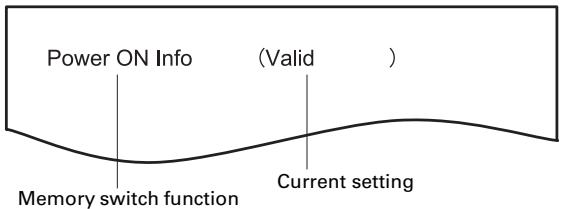
6. Press the FEED button.
A setting is printed each time the FEED button is pressed in order through the cycle. When the current settings are printed, the ERROR LED lights.
Press the FEED button until the setting you want is printed.
7. Press the FEED button for at least two seconds.
The selected settings are set.
The next memory switch function and settings are printed.
8. Repeat steps 5 to 7 to change different functions for the current memory switch number.
9. Open the paper cover and close it.
The changed memory switch settings are printed.
10. Repeat steps 4 to 9 to change functions for a different memory switch number.
11. Press the FEED button until "Save To Memory" is printed.
12. Press the FEED button for at least two seconds.
The changed memory switch settings are saved and a list of them is printed. The printer exits individual setting mode when printing is finished.
Memory switch initialization
Set all the memory switches to the factory settings.
- Do steps 1 through 3 of the procedure to enter individual setting mode.
- Press the FEED button until "Save To Memory" is printed.
- Open the paper cover.
- Press the FEED button for at least two seconds.
All memory switches change to the factory settings.
5. Close the paper cover.
The function of each memory switch is shown in the following table. (Shaded values are factory settings.)
| Switch no. | Function | OFF | ON |
| MSW1-1 | Power ON Info | Valid | Not Send |
| MSW1-2 | Buffer Size | 4K bytes | 45 bytes |
| MSW1-3 | Busy Condition | Full/Err | Full |
| MSW1-4 | Receive Error | Print“?” | No Print |
| MSW1-5 | CR Mode | Ignored | LF |
| MSW1-6 | Reserved | Fixed | — |
| MSW1-7 | DSR Signal | Invalid | Valid |
| MSW1-8 | Init Signal | Invalid | Valid |
| MSW2-1 | Reserved | — | Fixed |
| MSW2-2 | Auto Cutter | Invalid | Valid |
| *1 MSW2-3 | Spool Print | Invalid | Valid |
| MSW2-4 | Full Col Print | LineFeed | WaitData |
| MSW2-5 | Resume aft PE | Next | Top |
| MSW2-6 | Reserved | Fixed | — |
| MSW2-7 | Reserved | Fixed | — |
| MSW2-8 | PNE Sensor | Valid | Invalid |
| MSW3-1 | Resume Ctrr Err | Valid | Invalid |
| MSW3-2 | PE signal by PNE | Valid | Invalid |
| MSW3-3 | Parallel 31 Pin | Valid | Invalid |
| MSW3-4 | Reserved | Fixed | — |
| MSW3-5 | Reserved | Fixed | — |
| MSW3-6 | Reserved | Fixed | — |
| MSW3-7 | CBM1000 Mode | Invalid | Valid |
| MSW3-8 | Resume Open Err | Close | Command |
| MSW4-1 | Reserved | Fixed | — |
| MSW4-2 | Reserved | Fixed | — |
| MSW4-3 | Feed&Cut at TOF | Invalid | Valid |
| MSW4-4 | Reserved | Fixed | — |
| MSW4-5 | Reserved | Fixed | — |
| MSW4-6 | Reserved | Fixed | — |
| MSW4-7 | Reserved | Fixed | — |
| MSW4-8 | Partial Only | Invalid | Valid |
| MSW5-1 | Buzzer | Valid | Invalid |
| MSW5-2 | Line Pitch | 1/360 | 1/406 |
| MSW5-3 | USB Mode | Virtual COM | Printer Class |
| MSW5-4 | Reserved | Fixed | — |
| MSW5-5 | Reserved | Fixed | — |
| MSW5-6 | Reserved | Fixed | — |
| MSW5-7 | Reserved | Fixed | — |
| MSW5-8 | Reserved | Fixed | — |
| MSW6-1 | Act. For Driver | Invalid | Valid |
| MSW6-2 | Character Space | Invalid | Valid |
| MSW6-3 | Reserved | Fixed | - |
| MSW6-4 | Reserved | Fixed | - |
| MSW6-5 | Reserved | Fixed | - |
| MSW6-6 | Reserved | Fixed | - |
| MSW6-7 | Reserved | Fixed | - |
| MSW6-8 | Reserved | Fixed | - |
| Switch no. | Function | Initial setting | Setting value |
| *2 MSW7-1 | Baud Rate | 9600 bps | 1200 bps, 2400 bps, 4800 bps, 9600 bps, 19200 bps, 38400 bps, 57600 bps, 115200 bps |
| *2 MSW7-2 | Data Length | 8bits | 7bits, 8bits |
| *2 MSW7-3 | Stop Bit | 1bit | 1bit, 2bits |
| *2 MSW7-4 | Parity | NONE | NONE, EVEN, ODD |
| *2 MSW7-5 | Flow Control | DTR/DSR | DTR/DSR, XON/XOFF |
| *2 MSW7-6 | DMA Control | Valid | Valid, Invalid |
| *2 MSW7-7 | VCom Protocol | PC Setting | PC Setting, DTR/DSR, XON/XOFF |
| MSW8-1 | Print Width | 576dots(3-inch type)384dots(2-inch type) | 640dots, 576dots, 512dots, 436dots, 432dots,420dots, 384dots, 360dots, 390dots, 546dots,390dots, 546dots |
| MSW8-2 | Paper Type | 1 ColorNormal | 1 Color Normal, 2 Color Normal |
| MSW9-1 | Code Page | PC 437 | PC 437, Katakana, PC 850,858, PC 860, PC 863,PC 865, PC 852, PC 866, PC 857, WPC1252,Space page, PC 864, Thai Code 18 |
| MSW9-2 | Int’Char Set | USA | USA, France, Germany, England, Denmark,Sweden, Italy, Spain, Japan, Norway, Denmark 2,Spain 2, Latin America, Korea, Croatia, China |
| MSW9-3 | Kanji | OFF | ON, OFF |
| MSW9-4 | JIS/Shift JIS | JIS | JIS, Shift JIS |
| MSW10-1 | Print Density | 100 % | 70%, 75%, 80%, 85%, 90%, 95%, 100%, 105%,110%, 115%, 120%, 125%, 130%, 135%, 140% |
| MSW10-2 | Print Speed | Level 9 | Level 1, Level 2, Level 3, Level 4, Level 5, Level 6,Level 7, Level 8, Level 9 |
| MSW10-3 | ACK Timing | Before Busy | Before Busy, Same Period, After Busy |
| MSW10-4 | Reserved | ||
| MSW10-5 | Reserved | ||
| MSW10-6 | Buzzer Sound | Tone 2 | Tone 1, Tone 2, Tone 3, Tone 4 |
Notes:
*1: If print data is very dense, the print head is hot, data transmission is slow, or some other conditions, the motor and printing may occasionally stop which causes white stripes in the printout. To print high-density data, set MSW2-3 (Spool Print) to ON to reduce striping, although this increases the time before printing starts.
For a serial interface, increase the transmission speed to prevent the motor from stopping.
*2: The values for memory switches MSW7-X are only effective when DIP switch no. 1 is set to OFF.
FRANÇAIS
PRECAUTIONS GENÉRALES
| N° du commutateur | Fonction | OFF | ON |
| MSW1-1 | Power ON Info | Valid | Not Send |
| MSW1-2 | Buffer Size | 4K bytes | 45 bytes |
| MSW1-3 | Busy Condition | Full/Err | Full |
| MSW1-4 | Receive Error | Print“?” | No Print |
| MSW1-5 | CR Mode | Ignored | LF |
| MSW1-6 | Reserved | Fixed | — |
| MSW1-7 | DSR Signal | Invalid | Valid |
| MSW1-8 | Init Signal | Invalid | Valid |
| MSW2-1 | Reserved | — | Fixed |
| MSW2-2 | Auto Cutter | Invalid | Valid |
| *1 MSW2-3 | Spool Print | Invalid | Valid |
| MSW2-4 | Full Col Print | LineFeed | WaitData |
| MSW2-5 | Resume aft PE | Next | Top |
| MSW2-6 | Reserved | Fixed | — |
| MSW2-7 | Reserved | Fixed | — |
| MSW2-8 | PNE Sensor | Valid | Invalid |
| MSW3-1 | Resume Ctrr Err | Valid | Invalid |
| MSW3-2 | PE signal by PNE | Valid | Invalid |
| MSW3-3 | Parallel 31 Pin | Valid | Invalid |
| MSW3-4 | Reserved | Fixed | — |
| MSW3-5 | Reserved | Fixed | — |
| MSW3-6 | Reserved | Fixed | — |
| MSW3-7 | CBM1000 Mode | Invalid | Valid |
| MSW3-8 | Resume Open Err | Close | Command |
| MSW4-1 | Reserved | Fixed | — |
| MSW4-2 | Reserved | Fixed | — |
| MSW4-3 | Feed&Cut at TOF | Invalid | Valid |
| MSW4-4 | Reserved | Fixed | — |
| MSW4-5 | Reserved | Fixed | — |
| MSW4-6 | Reserved | Fixed | — |
| MSW4-7 | Reserved | Fixed | — |
| MSW4-8 | Partial Only | Invalid | Valid |
| MSW5-1 | Buzzer | Valid | Invalid |
| MSW5-2 | Line Pitch | 1/360 | 1/406 |
| MSW5-3 | USB Mode | Virtual COM | Printer Class |
| MSW5-4 | Reserved | Fixed | — |
| MSW5-5 | Reserved | Fixed | — |
| MSW5-6 | Reserved | Fixed | — |
| MSW5-7 | Reserved | Fixed | — |
| MSW5-8 | Reserved | Fixed | — |
| MSW6-1 | Act. For Driver | Invalid | Valid |
| MSW6-2 | Character Space | Invalid | Valid |
| MSW6-3 | Reserved | Fixed | - |
| MSW6-4 | Reserved | Fixed | - |
| MSW6-5 | Reserved | Fixed | - |
| MSW6-6 | Reserved | Fixed | - |
| MSW6-7 | Reserved | Fixed | - |
| MSW6-8 | Reserved | Fixed | - |
| N° du commutateur | Fonction | Réglage initial | Valeur régée |
| *2 MSW7-1 | Baud Rate | 9600 bps | 1200 bps, 2400 bps, 4800 bps, 9600 bps, 19200 bps, 38400 bps, 57600 bps, 115200 bps |
| *2 MSW7-2 | Data Length | 8bits | 7bits, 8bits |
| *2 MSW7-3 | Stop Bit | 1bit | 1bit, 2bits |
| *2 MSW7-4 | Parity | NONE | NONE, EVEN, ODD |
| *2 MSW7-5 | Flow Control | DTR/DSR | DTR/DSR, XON/XOFF |
| *2 MSW7-6 | DMA Control | Valid | Valid, Invalid |
| *2 MSW7-7 | VCom Protocol | PC Setting | PC Setting, DTR/DSR, XON/XOFF |
| MSW8-1 | Print Width | 576dots (type 3 pouces) 384dots (type 2 pouces) | 640dots, 576dots, 512dots, 436dots, 432dots, 420dots, 384dots, 360dots, 390dots, 546dots, 390dots, 546dots |
| MSW8-2 | Paper Type | 1 Color Normal | 1 Color Normal, 2 Color Normal |
| MSW9-1 | Code Page | PC 437 | PC 437, Katakana, PC 850,858, PC 860, PC 863, PC 865, PC 852, PC 866, PC 857, WPC1252, Space page, PC 864, Thai Code 18 |
| MSW9-2 | Int’Char Set | USA | USA, France, Germany, England, Denmark, Sweden, Italy, Spain, Japan, Norway, Denmark 2, Spain 2, Latin America, Korea, Croatia, China |
| MSW9-3 | Kanji | OFF | ON, OFF |
| MSW9-4 | JIS/Shift JIS | JIS | JIS, Shift JIS |
| MSW10-1 | Print Density | 100 % | 70%, 75%, 80%, 85%, 90%, 95%, 100%, 105%, 110%, 115%, 120%, 125%, 130%, 135%, 140% |
| MSW10-2 | Print Speed | Level 9 | Level 1, Level 2, Level 3, Level 4, Level 5, Level 6, Level 7, Level 8, Level 9 |
| MSW10-3 | ACK Timing | Before Busy | Before Busy, Same Period, After Busy |
| MSW10-4 | Reserved | ||
| MSW10-5 | Reserved | ||
| MSW10-6 | Buzzer Sound | Tone 2 | Tone 1, Tone 2, Tone 3, Tone 4 |
Remarques:
CITIZEN is a registered trade mark of Citizen Holdings Co., Japan
CITIZEN es unamarca registrada de Citizen Holdings Co.,Japon
Company names and product names in this manual are trademarks or registered trademarks of relevant companies.
Copyright © 2010 by CITIZEN SYSTEMS JAPAN CO., LTD.
| Signal | Pin | Pin | Signal | |
| FG | 1 | 1 | FG | |
| TXD | 2 | 2 | TXD | |
| RXD | 3 | 3 | RXD | |
| CTS | 5 | 4 | RTS | |
| DSR | 6 | 6 | DSR | |
| SG | 7 | 7 | SG | |
| DTR | 20 | 20 | DTR |
9-Pin - 25-Pin-Kabel
PC
Drucker
| Signal | Pin |
| RXD | 2 |
| TXD | 3 |
| DTR | 4 |
| SG | 5 |
| DSR | 6 |
| CTS | 8 |
| Pin | Signal |
| 2 | TXD |
| 3 | RXD |
| 4 | RTS |
| 6 | DSR |
| 7 | SG |
| 20 | DTR |

VORSICHT
| Schalter Nr. | Funktion | OFF | ON |
| MSW1-1 | Power ON Info | Valid | Not Send |
| MSW1-2 | Buffer Size | 4K bytes | 45 bytes |
| MSW1-3 | Busy Condition | Full/Err | Full |
| MSW1-4 | Receive Error | Print“?” | No Print |
| MSW1-5 | CR Mode | Ignored | LF |
| MSW1-6 | Reserved | Fixed | — |
| MSW1-7 | DSR Signal | Invalid | Valid |
| MSW1-8 | Init Signal | Invalid | Valid |
| MSW2-1 | Reserved | — | Fixed |
| MSW2-2 | Auto Cutter | Invalid | Valid |
| *1 MSW2-3 | Spool Print | Invalid | Valid |
| MSW2-4 | Full Col Print | LineFeed | WaitData |
| MSW2-5 | Resume aft PE | Next | Top |
| MSW2-6 | Reserved | Fixed | — |
| MSW2-7 | Reserved | Fixed | — |
| MSW2-8 | PNE Sensor | Valid | Invalid |
| MSW3-1 | Resume Cttr Err | Valid | Invalid |
| MSW3-2 | PE signal by PNE | Valid | Invalid |
| MSW3-3 | Parallel 31 Pin | Valid | Invalid |
| MSW3-4 | Reserved | Fixed | — |
| MSW3-5 | Reserved | Fixed | — |
| MSW3-6 | Reserved | Fixed | — |
| MSW3-7 | CBM1000 Mode | Invalid | Valid |
| MSW3-8 | Resume Open Err | Close | Command |
| MSW4-1 | Reserved | Fixed | — |
| MSW4-2 | Reserved | Fixed | — |
| MSW4-3 | Feed&Cut at TOF | Invalid | Valid |
| MSW4-4 | Reserved | Fixed | — |
| MSW4-5 | Reserved | Fixed | — |
| MSW4-6 | Reserved | Fixed | — |
| MSW4-7 | Reserved | Fixed | — |
| MSW4-8 | Partial Only | Invalid | Valid |
| MSW5-1 | Buzzer | Valid | Invalid |
| MSW5-2 | Line Pitch | 1/360 | 1/406 |
| MSW5-3 | USB Mode | Virtual COM | Printer Class |
| MSW5-4 | Reserved | Fixed | — |
| MSW5-5 | Reserved | Fixed | — |
| MSW5-6 | Reserved | Fixed | — |
| MSW5-7 | Reserved | Fixed | — |
| MSW5-8 | Reserved | Fixed | — |
| MSW6-1 | Act. For Driver | Invalid | Valid |
| MSW6-2 | Character Space | Invalid | Valid |
| MSW6-3 | Reserved | Fixed | - |
| MSW6-4 | Reserved | Fixed | - |
| MSW6-5 | Reserved | Fixed | - |
| MSW6-6 | Reserved | Fixed | - |
| MSW6-7 | Reserved | Fixed | - |
| MSW6-8 | Reserved | Fixed | - |
| Schalter Nr. | Funktion | Voreinstellung | Einstellwert |
| *2 MSW7-1 | Baud Rate | 9600 bps | 1200 bps, 2400 bps, 4800 bps, 9600 bps, 19200 bps, 38400 bps, 57600 bps, 115200 bps |
| *2 MSW7-2 | Data Length | 8bits | 7bits, 8bits |
| *2 MSW7-3 | Stop Bit | 1bit | 1bit, 2bits |
| *2 MSW7-4 | Parity | NONE | NONE, EVEN, ODD |
| *2 MSW7-5 | Flow Control | DTR/DSR | DTR/DSR, XON/XOFF |
| *2 MSW7-6 | DMA Control | Valid | Valid, Invalid |
| *2 MSW7-7 | VCom Protocol | PC Setting | PC Setting, DTR/DSR, XON/XOFF |
| MSW8-1 | Print Width | 576dots(3-Zoll-Ausführung)384dots(2-Zoll-Ausführung) | 640dots, 576dots, 512dots, 436dots, 432dots, 420dots, 384dots, 360dots, 390dots, 546dots, 390dots, 546dots |
| MSW8-2 | Paper Type | 1 Color Normal | 1 Color Normal, 2 Color Normal |
| MSW9-1 | Code Page | PC 437 | PC 437, Katakana, PC 850,858, PC 860, PC 863,PC 865, PC 852, PC 866, PC 857, WPC1252,Space page, PC 864, Thai Code 18 |
| MSW9-2 | Int'Char Set | USA | USA, France, Germany, England, Denmark,Sweden, Italy, Spain, Japan, Norway, Denmark 2,Spain 2, Latin America, Korea, Croatia, China |
| MSW9-3 | Kanji | OFF | ON, OFF |
| MSW9-4 | JIS/Shift JIS | JIS | JIS, Shift JIS |
| MSW10-1 | Print Density | 100 % | 70 %, 75 %, 80 %, 85 %, 90 %, 95 %, 100 %, 105 %,110 %, 115 %, 120 %, 125 %, 130 %, 135 %, 140 % |
| MSW10-2 | Print Speed | Level 9 | Level 1, Level 2, Level 3, Level 4, Level 5, Level 6,Level 7, Level 8, Level 9 |
| MSW10-3 | ACK Timing | Before Busy | Before Busy, Same Period, After Busy |
| MSW10-4 | Reserved | ||
| MSW10-5 | Reserved | ||
| MSW10-6 | Buzzer Sound | Tone 2 | Tone 1, Tone 2, Tone 3, Tone 4 |
Hinweise:
| N. switch | Funzione | OFF | ON |
| MSW1-1 | Power ON Info | Valid | Not Send |
| MSW1-2 | Buffer Size | 4K bytes | 45 bytes |
| MSW1-3 | Busy Condition | Full/Err | Full |
| MSW1-4 | Receive Error | Print“?” | No Print |
| MSW1-5 | CR Mode | Ignored | LF |
| MSW1-6 | Reserved | Fixed | — |
| MSW1-7 | DSR Signal | Invalid | Valid |
| MSW1-8 | Init Signal | Invalid | Valid |
| MSW2-1 | Reserved | — | Fixed |
| MSW2-2 | Auto Cutter | Invalid | Valid |
| *1 MSW2-3 | Spool Print | Invalid | Valid |
| MSW2-4 | Full Col Print | LineFeed | WaitData |
| MSW2-5 | Resume aft PE | Next | Top |
| MSW2-6 | Reserved | Fixed | — |
| MSW2-7 | Reserved | Fixed | — |
| MSW2-8 | PNE Sensor | Valid | Invalid |
| MSW3-1 | Resume Ctrr Err | Valid | Invalid |
| MSW3-2 | PE signal by PNE | Valid | Invalid |
| MSW3-3 | Parallel 31 Pin | Valid | Invalid |
| MSW3-4 | Reserved | Fixed | — |
| MSW3-5 | Reserved | Fixed | — |
| MSW3-6 | Reserved | Fixed | — |
| MSW3-7 | CBM1000 Mode | Invalid | Valid |
| MSW3-8 | Resume Open Err | Close | Command |
| MSW4-1 | Reserved | Fixed | — |
| MSW4-2 | Reserved | Fixed | — |
| MSW4-3 | Feed&Cut at TOF | Invalid | Valid |
| MSW4-4 | Reserved | Fixed | — |
| MSW4-5 | Reserved | Fixed | — |
| MSW4-6 | Reserved | Fixed | — |
| MSW4-7 | Reserved | Fixed | — |
| MSW4-8 | Partial Only | Invalid | Valid |
| MSW5-1 | Buzzer | Valid | Invalid |
| MSW5-2 | Line Pitch | 1/360 | 1/406 |
| MSW5-3 | USB Mode | Virtual COM | Printer Class |
| MSW5-4 | Reserved | Fixed | — |
| MSW5-5 | Reserved | Fixed | — |
| MSW5-6 | Reserved | Fixed | — |
| MSW5-7 | Reserved | Fixed | — |
| MSW5-8 | Reserved | Fixed | — |
| MSW6-1 | Act. For Driver | Invalid | Valid |
| MSW6-2 | Character Space | Invalid | Valid |
| MSW6-3 | Reserved | Fixed | - |
| MSW6-4 | Reserved | Fixed | - |
| MSW6-5 | Reserved | Fixed | - |
| MSW6-6 | Reserved | Fixed | - |
| MSW6-7 | Reserved | Fixed | - |
| MSW6-8 | Reserved | Fixed | - |
| N. switch | Funzione | Impostazione iniziale | Valore impostato |
| *2 MSW7-1 | Baud Rate | 9600 bps | 1200 bps, 2400 bps, 4800 bps, 9600 bps, 19200 bps, 38400 bps, 57600 bps, 115200 bps |
| *2 MSW7-2 | Data Length | 8bits | 7bits, 8bits |
| *2 MSW7-3 | Stop Bit | 1bit | 1bit, 2bits |
| *2 MSW7-4 | Parity | NONE | NONE, EVEN, ODD |
| *2 MSW7-5 | Flow Control | DTR/DSR | DTR/DSR, XON/XOFF |
| *2 MSW7-6 | DMA Control | Valid | Valid, Invalid |
| *2 MSW7-7 | VCom Protocol | PC Setting | PC Setting, DTR/DSR, XON/XOFF |
| MSW8-1 | Print Width | 576dots (Tipo da 3 pollici) 384dots (Tipo da 2 pollici) | 640dots, 576dots, 512dots, 436dots, 432dots, 420dots, 384dots, 360dots, 390dots, 546dots, 390dots, 546dots |
| MSW8-2 | Paper Type | 1 Color Normal | 1 Color Normal, 2 Color Normal |
| MSW9-1 | Code Page | PC 437 | PC 437, Katakana, PC 850,858, PC 860, PC 863, PC 865, PC 852, PC 866, PC 857, WPC1252, Space page, PC 864, Thai Code 18 |
| MSW9-2 | Int’Char Set | USA | USA, France, Germany, England, Denmark, Sweden, Italy, Spain, Japan, Norway, Denmark 2, Spain 2, Latin America, Korea, Croatia, China |
| MSW9-3 | Kanji | OFF | ON, OFF |
| MSW9-4 | JIS/Shift JIS | JIS | JIS, Shift JIS |
| MSW10-1 | Print Density | 100 % | 70 %, 75 %, 80 %, 85 %, 90 %, 95 %, 100 %, 105 %, 110 %, 115 %, 120 %, 125 %, 130 %, 135 %, 140 % |
| MSW10-2 | Print Speed | Level 9 | Level 1, Level 2, Level 3, Level 4, Level 5, Level 6, Level 7, Level 8, Level 9 |
| MSW10-3 | ACK Timing | Before Busy | Before Busy, Same Period, After Busy |
| MSW10-4 | Reserved | ||
| MSW10-5 | Reserved | ||
| MSW10-6 | Buzzer Sound | Tone 2 | Tone 1, Tone 2, Tone 3, Tone 4 |
Note:
Interfaz Powered USB

PRECAUCION
Conector applicable:
TM3P-66P (Hirose) o equivalente
(2) Caracteristicas electrolycas
| N° de interruptor | Función | OFF | ON |
| MSW1-1 | Power ON Info | Valid | Not Send |
| MSW1-2 | Buffer Size | 4K bytes | 45 bytes |
| MSW1-3 | Busy Condition | Full/Err | Full |
| MSW1-4 | Receive Error | Print“?” | No Print |
| MSW1-5 | CR Mode | Ignored | LF |
| MSW1-6 | Reserved | Fixed | — |
| MSW1-7 | DSR Signal | Invalid | Valid |
| MSW1-8 | Init Signal | Invalid | Valid |
| MSW2-1 | Reserved | — | Fixed |
| MSW2-2 | Auto Cutter | Invalid | Valid |
| *1 MSW2-3 | Spool Print | Invalid | Valid |
| MSW2-4 | Full Col Print | LineFeed | WaitData |
| MSW2-5 | Resume aft PE | Next | Top |
| MSW2-6 | Reserved | Fixed | — |
| MSW2-7 | Reserved | Fixed | — |
| MSW2-8 | PNE Sensor | Valid | Invalid |
| MSW3-1 | Resume Cttr Err | Valid | Invalid |
| MSW3-2 | PE signal by PNE | Valid | Invalid |
| MSW3-3 | Parallel 31 Pin | Valid | Invalid |
| MSW3-4 | Reserved | Fixed | — |
| MSW3-5 | Reserved | Fixed | — |
| MSW3-6 | Reserved | Fixed | — |
| MSW3-7 | CBM1000 Mode | Invalid | Valid |
| MSW3-8 | Resume Open Err | Close | Command |
| MSW4-1 | Reserved | Fixed | — |
| MSW4-2 | Reserved | Fixed | — |
| MSW4-3 | Feed&Cut at TOF | Invalid | Valid |
| MSW4-4 | Reserved | Fixed | — |
| MSW4-5 | Reserved | Fixed | — |
| MSW4-6 | Reserved | Fixed | — |
| MSW4-7 | Reserved | Fixed | — |
| MSW4-8 | Partial Only | Invalid | Valid |
| MSW5-1 | Buzzer | Valid | Invalid |
| MSW5-2 | Line Pitch | 1/360 | 1/406 |
| MSW5-3 | USB Mode | Virtual COM | Printer Class |
| MSW5-4 | Reserved | Fixed | — |
| MSW5-5 | Reserved | Fixed | — |
| MSW5-6 | Reserved | Fixed | — |
| MSW5-7 | Reserved | Fixed | — |
| MSW5-8 | Reserved | Fixed | — |
| MSW6-1 | Act. For Driver | Invalid | Valid |
| MSW6-2 | Character Space | Invalid | Valid |
| MSW6-3 | Reserved | Fixed | - |
| MSW6-4 | Reserved | Fixed | - |
| MSW6-5 | Reserved | Fixed | - |
| MSW6-6 | Reserved | Fixed | - |
| MSW6-7 | Reserved | Fixed | - |
| MSW6-8 | Reserved | Fixed | - |
| N° de interruptor | Función | Valor inicial | Valor de configuración |
| *2 MSW7-1 | Baud Rate | 9600 bps | 1200 bps, 2400 bps, 4800 bps, 9600 bps, 19200 bps, 38400 bps, 57600 bps, 115200 bps |
| *2 MSW7-2 | Data Length | 8bits | 7bits, 8bits |
| *2 MSW7-3 | Stop Bit | 1bit | 1bit, 2bits |
| *2 MSW7-4 | Parity | NONE | NONE, EVEN, ODD |
| *2 MSW7-5 | Flow Control | DTR/DSR | DTR/DSR, XON/XOFF |
| *2 MSW7-6 | DMA Control | Valid | Valid, Invalid |
| *2 MSW7-7 | VCom Protocol | PC Setting | PC Setting, DTR/DSR, XON/XOFF |
| MSW8-1 | Print Width | 576dots(Tipo de 3 pulgadas)384dots(Tipo de 2 pulgadas) | 640dots, 576dots, 512dots, 436dots, 432dots, 420dots, 384dots, 360dots, 390dots, 546dots, 390dots, 546dots |
| MSW8-2 | Paper Type | 1 Color Normal | 1 Color Normal, 2 Color Normal |
| MSW9-1 | Code Page | PC 437 | PC 437, Katakana, PC 850,858, PC 860, PC 863,PC 865, PC 852, PC 866, PC 857, WPC1252,Space page, PC 864, Thai Code 18 |
| MSW9-2 | Int’Char Set | USA | USA, France, Germany, England, Denmark,Sweden, Italy, Spain, Japan, Norway, Denmark 2,Spain 2, Latin America, Korea, Croatia, China |
| MSW9-3 | Kanji | OFF | ON, OFF |
| MSW9-4 | JIS/Shift JIS | JIS | JIS, Shift JIS |
| MSW10-1 | Print Density | 100 % | 70 %, 75 %, 80 %, 85 %, 90 %, 95 %, 100 %, 105 %,110 %, 115 %, 120 %, 125 %, 130 %, 135 %, 140 % |
| MSW10-2 | Print Speed | Level 9 | Level 1, Level 2, Level 3, Level 4, Level 5, Level 6,Level 7, Level 8, Level 9 |
| MSW10-3 | ACK Timing | Before Busy | Before Busy, Same Period, After Busy |
| MSW10-4 | Reserved | ||
| MSW10-5 | Reserved | ||
| MSW10-6 | Buzzer Sound | Tone 2 | Tone 1, Tone 2, Tone 3, Tone 4 |
Notas:
- LINE THERMAL PRINTER
- WEEE MARK
- En
- Ge
- Declaration of Conformity
- Sicherheitshinweis
- SAFETY PRECAUTIONS...WHICH SHOULD BE STRICTLY OBSERVED
- WARNING
- CAUTION
- PRECAUTIONS IN HANDLING THE PRINTER
- DAILY MAINTENANCE
- THE TABLE OF CONTENTS
- GENERAL OUTLINE 9
- EXPLANATION OF PRINTER PARTS 12
- SETUP 17
- MAINTENANCE AND TROUBLESHOOTING 29
- OTHER 36
- GENERAL OUTLINE
- Features
- Unpacking
- Model Classification
- Basic Specifications
- Notes:
- EXPLANATION OF PRINTER PARTS
- Printer Appearance
- Names of parts
- Inside the Paper Cover
- Refer to 3.7 Adjusting the Paper Near-end Sensor
- Refer to 5.3 Manual Setting of Memory Switches
- Other Built-in Functions
- Connecting the AC Power Cord
- Connecting Interface Cables
- Connecting the Cash Printer
- Connector pin configuration
- Electric characteristics
- DRSW signal
- Drive circuit
- Precautions for Installing the Printer
- Partition for Paper Roll
- Setting the DIP Switch on the Serial Interface Board
- Adjusting the Paper Near-end Sensor
- Note:
- Loading Paper
- Attaching the Power Switch Cover
- Attaching the Interface Cover
- Removing the Interface Cover
- MAINTENANCE AND TROUBLESHOOTING
- Periodic Cleaning
- Clearing a Cutter Lock (1)
- Clearing a Cutter Lock (2)
- Self-printing
- Hexadecimal Dump Printing
- How to do hexadecimal dump printing
- How to stop hexadecimal dump printing
- Print example
- HEX dump print mode
- Error Messages
- - Paper-end
- - Paper cover open
- - Cutter locked
- - Print head hot
- External Views and Dimensions
- Printing Paper
- Manual Setting of Memory Switches
- Quick setting mode
- Individual setting mode
- Press the FEED button for at least two seconds.
- Press the FEED button.
- Press the FEED button for at least two seconds.
- Repeat steps 5 to 7 to change different functions for the current memory switch number.
- Open the paper cover and close it.
- Repeat steps 4 to 9 to change functions for a different memory switch number.
- Press the FEED button until "Save To Memory" is printed.
- Press the FEED button for at least two seconds.
- Memory switch initialization
- Close the paper cover.
- FRANÇAIS
- PRECAUTIONS GENÉRALES
- Remarques:
- VORSICHT
- Hinweise:
- PRECAUCION
- Caracteristicas electrolycas
Brand : CITIZEN
Model : CT-S651
Category : Thermal printer