
ES-3148 - Network switch ZYXEL - Free user manual and instructions
Find the device manual for free ES-3148 ZYXEL in PDF.


| Product Type | Manageable network switch |
| Brand | ZYXEL |
| Model | ES-3148 |
| Number of ports | 48 RJ-45 10/100/1000 Mbps ports |
| Uplink ports | 4 SFP slots (Gigabit) |
| Dimensions (W x D x H) | 44.0 x 26.0 x 4.4 cm |
| Weight | 4.0 kg |
| Power supply | 100-240 VAC, 50-60 Hz, maximum consumption 45 W |
| Main functions | Layer 2 management (VLAN, STP, QoS, IGMP snooping), 802.1X security, ACL, management via web interface/SNMP/CLI |
| Maintenance and cleaning | Dust with a soft dry cloth. Do not use chemical products. Maintain adequate ventilation. |
| Safety | Do not open the casing, avoid contact with liquids, unplug before cleaning |
| Spare parts and repairability | Fans and power supply replaceable by a qualified technician |
| General information | Compliant with Canadian NMB-003 standard (Class A). 2-year warranty. |
Frequently Asked Questions - ES-3148 ZYXEL
User questions about ES-3148 ZYXEL
0 question about this device. Answer the ones you know or ask your own.
Ask a new question about this device
Download the instructions for your Network switch in PDF format for free! Find your manual ES-3148 - ZYXEL and take your electronic device back in hand. On this page are published all the documents necessary for the use of your device. ES-3148 by ZYXEL.
USER MANUAL ES-3148 ZYXEL
Copyright © 2005 by ZyXEL Communications Corporation.
The contents of this publication may not be reproduced in any part or as a whole, transcribed, stored in a retrieval system, translated into any language, or transmitted in any form or by any means, electronic, mechanical, magnetic, optical, chemical, photocopying, manual, or otherwise, without the prior written permission of ZyXEL Communications Corporation.
Published by ZyXEL Communications Corporation. All rights reserved.
Disclaimer
ZyXEL does not assume any liability arising out of the application or use of any products, or software described herein. Neither does it convey any license under its patent rights nor the patent rights of others. ZyXEL further reserves the right to make changes in any products described herein without notice. This publication is subject to change without notice.
Interference Statements andWarnings
FCC Statement
This switch complies with Part 15 of the FCC rules. Operation is subject to the following two conditions:
1 This switch may not cause harmful interference.
2 This switch must accept any interference received, including interference that may cause undesired operations.
FCC Warning
This equipment has been tested and found to comply with the limits for a Class A digital switch, pursuant to Part 15 of the FCC Rules. These limits are designed to provide reasonable protection against harmful interference in a commercial environment. This equipment generates, uses, and can radiate radio frequency energy and, if not installed and used in accordance with the instruction manual, may cause harmful interference to radio communications. Operation of this equipment in a residential area is likely to cause harmful interference in which case the user will be required to correct the interference at his own expense.
CE Mark Warning:
This is a class A product. In a domestic environment this product may cause radio interference in which case the user may be required to take adequate measures.
Taiwanese BSMI (Bureau of Standards, Metrology and Inspection) A Warning:
警告使用者
Changes or modifications not expressly approved by the party responsible for compliance could void the user's authority to operate the equipment.
This Class A digital apparatus complies with Canadian ICES-003.
1 Go to www.zyxel.com.
2 Select your product from the drop-down list box on the ZyXEL home page to go to that product's page.
3 Select the certification you wish to view from this page.
SafetyWarnings
For your safety, be sure to read and follow all warning notices and instructions.
- To reduce the risk of fire, use only No. 26 AWG (American Wire Gauge) or larger telecommunication line cord.
- Do NOT open the device or unit. Opening or removing covers can expose you to dangerous high voltage points or other risks. ONLY qualified service personnel can service the device. Please contact your vendor for further information.
- Use ONLY the dedicated power supply for your device. Connect the power cord or power adaptor to the right supply voltage (110V AC in North America or 230V AC in Europe).
- Do NOT use the device if the power supply is damaged as it might cause electrocution.
- If the power supply is damaged, remove it from the power outlet.
- Do NOT attempt to repair the power supply. Contact your local vendor to order a new power supply
- Place connecting cables carefully so that no one will step on them or stumble over them. Do NOT allow anything to rest on the power cord and do NOT locate the product where anyone can walk on the power cord.
- If you wall mount your device, make sure that no electrical, gas or water pipes will be damaged.
- Do NOT install nor use your device during a thunderstorm. There may be a remote risk of electric shock from lightning.
- Do NOT expose your device to dampness, dust or corrosive liquids.
- Do NOT use this product near water, for example, in a wet basement or near a swimming pool.
- Make sure to connect the cables to the correct ports.
- Do NOT obstruct the device ventilation slots, as insufficient airflow may harm your device.
- Do NOT store things on the device.
- Connect ONLY suitable accessories to the device.
ZyXEL Limited Warranty
ZyXEL warrants to the original end user (purchaser) that this product is free from any defects in materials or workmanship for a period of up to two years from the date of purchase. During the warranty period, and upon proof of purchase, should the product have indications of failure due to faulty workmanship and/or materials, ZyXEL will, at its discretion, repair or replace the defective products or components without charge for either parts or labor, and to whatever extent it shall deem necessary to restore the product or components to proper operating condition. Any replacement will consist of a new or re-manufactured functionally equivalent product of equal or higher value, and will be solely at the discretion of ZyXEL. This warranty shall not apply if the product has been modified, misused, tampered with, damaged by an act of God, or subjected to abnormal working conditions.
Note
Repair or replacement, as provided under this warranty, is the exclusive remedy of the purchaser. This warranty is in lieu of all other warranties, express or implied, including any implied warranty of merchantability or fitness for a particular use or purpose. ZyXEL shall in no event be held liable for indirect or consequential damages of any kind to the purchaser.
To obtain the services of this warranty, contact ZyXEL's Service Center for your Return Material Authorization number (RMA). Products must be returned Postage Prepaid. It is recommended that the unit be insured when shipped. Any returned products without proof of purchase or those with an out-dated warranty will be repaired or replaced (at the discretion of ZyXEL) and the customer will be billed for parts and labor. All repaired or replaced products will be shipped by ZyXEL to the corresponding return address, Postage Paid. This warranty gives you specific legal rights, and you may also have other rights that vary from country to country.
Registration
Register your product online to receive e-mail notices of firmware upgrades and information at www.zyxel.com for global products, or at www.us.zyxel.com for North American products.
Customer Support
Please have the following information ready when you contact customer support.
Product model and serial number.
Warranty Information.
- Date that you received your device.
- Brief description of the problem and the steps you took to solve it.
| METHOD LOCATION | SUPPORT E-MAIL | TELEPHONE* | WEB SITE | REGULAR MAIL |
| SALES E-MAIL | FAX | FTP SITE | ||
| CORPORATE HEADQUARTERS (WORLDWIDE) | support@zyxel.com.tw | +886-3-578-3942 | www.zyxel.com www.europe.zyxel.com | ZyXEL Communications Corp. 6 Innovation Road II Science Park Hsinchu 300 Taiwan |
| sales@zyxel.com.tw | +886-3-578-2439 | ftp.zyxel.com ftp.europe.zyxel.com | ||
| CZECH REPUBLIC | info@cZ.zyxel.com | +420-241-091-350 | www.zyxel.cz | ZyXEL Communications Czech s.r.o. Modranská 621 143 01 Praha 4 - Modraney Ceská Republika |
| info@cZ.zyxel.com | +420-241-091-359 | |||
| DENMARK | support@zyxel.dk | +45-39-55-07-00 | www.zyxel.dk | ZyXEL Communications A/S Columbusvej 2860 Soeborg Denmark |
| sales@zyxel.dk | +45-39-55-07-07 | |||
| FINLAND | support@zyxel.fi | +358-9-4780-8411 | www.zyxel.fi | ZyXEL Communications Oy Malminkaari 10 00700 Helsinki Finland |
| sales@zyxel.fi | +358-9-4780 8448 | |||
| FRANCE | info@zyxel.fr | +33-4-72-52-97-97 | www.zyxel.fr | ZyXEL France 1 rue des Vergers Bat. 1 / C 69760 Limonest France |
| +33-4-72-52-19-20 | ||||
| GERMANY | support@zyxel.de | +49-2405-6909-0 | www.zyxel.de | ZyXEL Deutschland GmbH. Adenauerstr. 20/A2 D-52146 Wuerselen Germany |
| sales@zyxel.de | +49-2405-6909-99 | |||
| HUNGARY | support@zyxel.hu | +36-1-3361649 | www.zyxel.hu | ZyXEL Hungary 48, Zoldlomb Str. H-1025, Budapest Hungary |
| info@zyxel.hu | +36-1-3259100 | |||
| KAZAKHSTAN | http://zyxel.kz/support | +7-3272-590-698 | www.zyxel.kz | ZyXEL Kazakhstan 43, Dostyk ave., Office 414 Dostyk Business Centre 050010, Almaty Republic of Kazakhstan |
| sales@zyxel.kz | +7-3272-590-689 | |||
| NORTH AMERICA | support@zyxel.com | 1-800-255-4101 | www.us.zyxel.com | ZyXEL Communications Inc. 1130 N. Miller St. Anaheim |
| +1-714-632-0882 | ||||
| sales@zyxel.com | +1-714-632-0858 | ftp.us.zyxel.com | CA 92806-2001 U.S.A. | |
| NORWAY | support@zyxel.no | +47-22-80-61-80 | www.zyxel.no | ZyXEL Communications A/S Nils Hansens vei 13 0667 Oslo Norway |
| sales@zyxel.no | +47-22-80-61-81 | |||
| POLAND | info@pl.zyxel.com | +48-22-5286603 | www.pl.zyxel.com | ZyXEL Communications ul Emilli Plater 53 00-113 Warszawa Poland |
| +48-22-5206701 | ||||
| RUSSIA | http://zyxel.ru/support | +7-095-542-89-29 | www.zyxel.ru | ZyXEL Russia Ostrovityanova 37a Str. Moscow, 117279 Russia |
| sales@zyxel.ru | +7-095-542-89-25 | |||
| SPAIN | support@zyxel.es | +34-902-195-420 | www.zyxel.es | ZyXEL Communications Alejandro Villegas 33 1°, 28043 Madrid Spain |
| sales@zyxel.es | +34-913-005-345 | |||
| SWEDEN | support@zyxel.se | +46-31-744-7700 | www.zyxel.se | ZyXEL Communications A/S Sjöporten 4, 41764 Göteborg Sweden |
| sales@zyxel.se | +46-31-744-7701 | |||
| UKRAINE | support@ua.zyxel.com | +380-44-247-69-78 | www.ua.zyxel.com | ZyXEL Ukraine 13, Pimonenko Str. Kiev, 04050 Ukraine |
| sales@ua.zyxel.com | +380-44-494-49-32 | |||
| UNITED KINGDOM | support@zyxel.co.uk | +44-1344 303044 08707 555779 (UK only) | www.zyxel.co.uk | ZyXEL Communications UK Ltd.,11 The Courtyard, Eastern Road, Bracknell, Berkshire, RG12 2XB, United Kingdom (UK) |
| sales@zyxel.co.uk | +44-1344 303034 | ftp.zyxel.co.uk |
- “+” is the (prefix) number you enter to make an international telephone call.
Table of Contents
Copyright 1
Interference Statements andWarnings 2
ZyXEL Limited Warranty 4
Customer Support 5
Preface 25
Chapter 1
Getting to Know Your Switch 27
1.1 Introduction 27
1.2 Software Features 27
1.3 Hardware Features 30
1.4 Applications 31
1.4.1 Backbone Application 31
1.4.2 Bridging Example 32
1.4.3 High Performance Switched Example 32
1.4.4 IEEE 802.1Q VLAN Application Examples 33
1.4.4.1 Tag-based VLAN Example 33
1.4.4.2 VLAN Shared Server Example 34
Chapter 2 Hardware Installation and Connection 35
2.1 Freestanding Installation 35
2.2 Mounting the Switch on a Rack 36
2.2.1 Rack-mounted Installation Requirements 36
2.2.1.1 Precautions 36
2.2.2 Attaching the Mounting Brackets to the Switch 36
2.2.3 Mounting the Switch on a Rack 36
Chapter 3 Hardware Overview 39
3.1 Panel Connections 39
3.1.1 Console Port 40
3.1.2 Ethernet Ports 40
3.1.2.1 Default Ethernet Settings 40
3.1.3 Mini-GBIC Slots 41
3.1.3.1 Transceiver Installation 41
3.1.3.2 Transceiver Removal 42
3.1.4 Power Connector 42
3.1.5 External Backup Power Supply Connector 42
3.2 Panel LEDs 43
Chapter 4
The Web Configurator 45
4.1 Introduction 45
4.2 System Login 45
4.3 The Status Screen 46
4.3.1 Change Your Password 50
4.4 Switch Lockout 50
4.5 Resetting the Switch 51
4.5.1 Reload the Configuration File 51
4.5.2 Reset to the Factory Defaults 52
4.6 Logging Out of the Web Configurator 53
4.7 Help 53
Chapter 5
Initial Setup Example 55
5.1 Overview 55
5.1.1 Creating a VLAN 55
5.1.2 Setting Port VID 57
5.1.3 Configuring Switch Management IP Address 58
Chapter 6
System Status and Port Statistics 59
6.1 Overview 59
6.2 Port Status Summary 59
6.2.1 Status: Port Details 61
Chapter 7
Basic Setting 65
7.1 Overview 65
7.2 System Information 65
7.3 General Setup 67
7.4 Introduction to VLANs 69
7.5 Switch Setup Screen 70
7.6 IP Setup 71
7.6.1 Management IP Addresses 72
7.7 Port Setup 74
Chapter 8
VLAN 77
8.1 Introduction to IEEE 802.1Q Tagged VLAN 77
8.1.1 Forwarding Tagged and Untagged Frames 77
8.2 Automatic VLAN Registration 78
8.2.1 GARP 78
8.2.1.1 GARP Timers 78
8.2.2 GVRP 78
8.3 Port VLAN Trunking 79
8.4 Select the VLAN Type 79
8.5 Static VLAN .80
8.5.1 Static VLAN Status 80
8.5.2 Configure a Static VLAN 81
8.5.3 Configure VLAN Port Settings 83
8.6 Port-based VLAN Setup 85
8.6.1 Configure a Port-based VLAN 86
Chapter 9
Static MAC Forwarding 89
9.1 Overview 89
9.2 Configuring Static MAC Forwarding 89
Chapter 10
Filtering 91
10.1 Introduction to Filtering 91
10.2 Configure a Filtering Rule 91
Chapter 11
Spanning Tree Protocol 93
11.1 STP/RSTP Overview 93
11.1.1 STP Terminology 93
11.1.2 How STP Works 94
11.1.3 STP Port States 94
11.2 STP Status 94
11.3 Configure STP 96
Chapter 12
Bandwidth Control 99
12.1 Bandwidth Control Overview 99
12.1.1 CIR and PIR 99
12.2 Bandwidth Control Setup 99
Chapter 13
Broadcast Storm Control 103
13.1 Overview 103
13.2 Broadcast Storm Control Setup 103
Chapter 14
Mirroring 107
14.1 Introduction to Port Mirroring 107
14.2 Port Mirroring Setup 107
Chapter 15
Link Aggregation 111
15.1 Introduction to Link Aggregation 111
15.2 Dynamic Link Aggregation 111
15.2.1 Link Aggregation ID 112
15.3 Link Aggregation Status 112
15.4 Link Aggregation Setup 113
Chapter 16
Port Authentication 117
16.1 Introduction to Authentication 117
16.1.1 RADIUS 117
16.2 Port Authentication Configuration 117
16.2.1 Configuring RADIUS Server Settings 118
16.2.2 Activate IEEE 802.1x Security 118
Chapter 17
Port Security 121
17.1 About Port Security 121
17.2 Port Security Setup 121
Chapter 18
Access Control 125
18.1 Overview 125
18.2 The Access Control Main Screen 125
18.3 About SNMP 126
18.3.1 Supported MIBs 127
18.3.2 SNMP Traps 127
18.3.3 Configuring SNMP 127
18.3.4 Setting Up Login Accounts 128
18.4 SSH Overview 130
18.5 How SSH works 130
18.6 SSH Implementation on the Switch 131
18.6.1 Requirements for Using SSH 131
18.7 Introduction to HTTPS 131
18.8 HTTPS Example 132
18.8.1 Internet Explorer Warning Messages 132
18.8.2 Netscape Navigator Warning Messages 133
18.8.3 The Main Screen 134
18.9 Service Port Access Control 135
18.10 Remote Management 136
Chapter 19
Queuing Method 139
19.1 Introduction to Queuing 139
19.1.1 Strictly Priority 139
19.1.2 Weighted Fair Scheduling 139
19.2 Configuring Queuing 140
Chapter 20
Classifier 143
20.1 About the Classifier and QoS 143
20.2 Configuring the Classifier 143
20.3 Viewing and Editing Classifier Configuration 146
20.4 Classifier Example 147
Chapter 21
Policy Rule 149
21.1 About Policy Rules 149
21.1.1 DiffServ 149
21.1.2 DSCP and Per-Hop Behavior 149
21.2 Configuring Policy Rules 150
21.3 Viewing and Editing Policy Configuration 152
21.4 Policy Example 153
Chapter 22
VLAN Stacking 155
22.1 Introduction 155
22.1.1 VLAN Stacking Example 155
22.2 VLAN Stacking Port Roles 156
22.3 VLAN Tag Format 156
22.3.1 Frame Format 157
22.4 Configuring VLAN Stacking 158
Chapter 23
Multicast 161
23.1 Overview 161
23.1.1 IP Multicast Addresses 161
23.1.2 IGMP Filtering 161
23.1.3 IGMP Snooping 161
23.2 Multicast Status 162
23.3 Multicast Setup 162
23.4 IGMP Filtering Profile 164
23.5 MVR Overview 166
23.5.1 Types of MVR Ports 166
23.5.2 MVR Modes 166
23.5.3 How MVR Works 167
23.6 General MVR Configuration 167
23.7 MVR Group Configuration 169
23.7.1 MVR Configuration Example 171
Chapter 24
DHCP Relay 175
24.1 DHCP Relay Overview 175
24.1.1 DHCP Relay Agent Information 175
24.2 DHCP Relay Configuration 175
Chapter 25
Static Route 177
25.1 Configuring 177
Chapter 26
Maintenance 179
26.1 The Maintenance Screen 179
26.2 Firmware Upgrade 179
26.3 Restore a Configuration File 180
26.4 Backing Up a Configuration File 180
26.5 Load Factory Defaults 181
26.6Reboot System 181
26.7 FTP Command Line 182
26.7.1 Filename Conventions 182
26.7.1.1 Example FTP Commands 183
26.7.2 FTP Command Line Procedure 183
26.7.3 GUI-based FTP Clients 184
26.7.4 FTP Restrictions 184
Chapter 27
Diagnostic 185
27.1 Diagnostic 185
Chapter 28
Cluster Management 187
28.1 Overview 187
28.2 Cluster Management Status 188
28.2.1 Cluster Member Switch Management 189
28.2.1.1 Uploading Firmware to a Cluster Member Switch 189
28.3 Configuring Cluster Management 190
Chapter 29
MAC Table 193
29.1 Overview 193
29.2 Viewing the MAC Table 194
Chapter 30
ARP Table 195
30.1 Overview 195
30.1.1 How ARP Works 195
30.2 Viewing the ARP Table 195
Chapter 31
Introducing the Commands 197
31.1 Overview 197
31.1.1 Switch Configuration File 197
31.2 Accessing the CLI 197
31.2.1 Access Priority 198
31.2.2 The Console Port 198
31.2.2.1 Initial Screen 198
31.2.3 Telnet 198
31.3 The Login Screen 199
31.4 Command Syntax Conventions 199
31.5 Getting Help 200
31.5.1 List of Available Commands 200
31.5.2 Detailed Command Information 201
31.6 Command Modes 201
31.7 Using Command History 202
31.8 Saving Your Configuration 202
31.8.1 Logging Out 203
31.9 Command Summary 203
31.9.1 User Mode 203
31.9.2 Enable Mode 204
31.9.3 General Configuration Mode 208
31.9.4 interface port-channel Commands 218
31.9.5 config-vlan Commands 221
31.9.6 mvr Commands 223
Chapter 32
Command Examples 225
32.1 Overview 225
32.2 show Commands 225
32.2.1 show system-information 225
32.2.2 show ip 226
32.2.3 show logging 226
32.2.4 show interface 227
32.2.5 show mac address-table 227
32.3 ping 228
32.4 traceroute 229
32.5 Enabling RSTP 229
32.6 Configuration File Maintenance 230
32.6.1 Using a Different Configuration File 230
32.6.2 Resetting to the Factory Default 230
32.7 no Command Examples 231
32.7.1 no mirror-port 231
32.7.2 no https timeout 231
32.7.3 no trunk 232
32.7.4 no port-access Authenticator 232
32.7.5 no ssh 233
32.8 interface Commands 234
32.8.1 interface port-channel 234
32.8.2 bpdu-control 234
32.8.3 broadcast-limit 235
32.8.4 bandwidth-limit 236
32.8.5 mirror 236
32.8.6 gvrp 237
32.8.7 ingress-check 238
32.8.8 frame-type 238
32.8.9 weight 239
32.8.10 egress set 239
32.8.11 qos priority 240
32.8.12 name 240
32.8.13 speed-duplex 241
Chapter 33
IEEE 802.1Q Tagged VLAN Commands 243
33.1 IEEE 802.1Q Tagged VLAN Overview 243
33.2 VLAN Databases 243
33.2.1 Static Entries (SVLAN Table) 243
33.2.2 Dynamic Entries (DVLAN Table) 244
33.3 Configuring Tagged VLAN 244
33.4 Global VLAN1Q Tagged VLAN Configuration Commands 245
33.4.1 GARP Status 245
33.4.2 GARP Timer 245
33.4.3 GVRP Timer 246
33.4.4 Enable GVRP 246
33.4.5 Disable GVRP 247
33.5 Port VLAN Commands 247
33.5.1 Set Port VID 247
33.5.2 Set Acceptable Frame Type 247
33.5.3 Enable or Disable Port GVRP 248
33.5.4 Modify Static VLAN 248
33.5.4.1 Modify a Static VLAN Table Example 249
33.5.4.2 Forwarding Process Example 249
33.5.5 Delete VLAN ID 249
33.6 Enable VLAN 250
33.7 Disable VLAN 250
33.8 Show VLAN Setting 250
Chapter 34
Troubleshooting 253
34.1 Problems Starting Up the Switch 253
34.2 Problems Accessing the Switch 253
34.2.1 Pop-up Windows, JavaScripts and Java Permissions 254
34.2.1.1 Internet Explorer Pop-up Blockers 254
34.2.1.2 JavaScripts 257
34.2.1.3 Java Permissions 259
34.3 Problems with the Password 261
Appendix A
Product Specifications 263
Appendix B
IP Subnetting 267
Index 275
List of Figures
Figure 1 Backbone Application 32
Figure 2 Bridging Application 32
Figure 3 High Performance Switched Application 33
Figure 4 Tag-based VLAN Application 34
Figure 5 Shared Server Using VLAN Example 34
Figure 6 Attaching Rubber Feet 35
Figure 7 Attaching the Mounting Brackets 36
Figure 8 Mounting the Switch on a Rack 37
Figure 9 Front Panel 39
Figure 10 Rear Panel 39
Figure 11 Transceiver Installation Example 41
Figure 12 Installed Transceiver 42
Figure 13 Opening the Transceiver's Latch Example 42
Figure 14 Transceiver Removal Example 42
Figure 15 Web Configurator: Login 46
Figure 16 Web Configurator Home Screen (Status) 46
Figure 17 Change Administrator Login Password 50
Figure 18 Example Xmodem Upload 51
Figure 19 Reload the Configuration file: Via Console Port 52
Figure 20 Resetting the Switch: Via the Console Port 53
Figure 21 Web Configurator:Logout Screen 53
Figure 22 Initial Setup Network Example: VLAN 55
Figure 23 Initial Setup Network Example: Port VID 57
Figure 24 Initial Setup Example: Management IP Address 58
Figure 25 Status 60
Figure 26 Status: Port Details 62
Figure 27 System Info 66
Figure 28 General Setup 68
Figure 29 Switch Setup 70
Figure 30 IP Setup 72
Figure 31 Port Setup 75
Figure 32 Port VLAN Trunking 79
Figure 33 Switch Setup: Select VLAN Type 80
Figure 34 VLAN: VLAN Status 80
Figure 35 VLAN: Static VLAN 82
Figure 36 VLAN: VLAN Port Setting 84
Figure 37 Port Based VLAN Setup (All Connected) 86
Figure 38 Port Based VLAN Setup (Port Isolation) 87
Figure 39 Static MAC Forwarding 89
Figure 40 Filtering 91
Figure 41 Spanning Tree Protocol: Status 95
Figure 42 Spanning Tree Protocol: Configuration 97
Figure 43 Bandwidth Control 100
Figure 44 Broadcast Storm Control 104
Figure 45 Mirroring 108
Figure 46 Link Aggregation Control Protocol Status 112
Figure 47 Link Aggregation: Configuration 114
Figure 48 RADIUS Server 117
Figure 49 Port Authentication 118
Figure 50 Port Authentication: RADIUS 118
Figure 51 Port Authentication: 802.1x 119
Figure 52 Port Security 122
Figure 53 Console Port Priority 125
Figure 54 Access Control 125
Figure 55 SNMP Management Model 126
Figure 56 Access Control: SNMP 128
Figure 57 Access Control: Logins 129
Figure 58 SSH Communication Example 130
Figure 59 How SSH Works 130
Figure 60 HTTPS Implementation 132
Figure 61 Security Alert Dialog Box (Internet Explorer) 133
Figure 62 Security Certificate 1 (Netscape) 133
Figure 63 Security Certificate 2 (Netscape) 134
Figure 64 Login Screen (Internet Explorer) 134
Figure 65 Login Screen (Netscape) 135
Figure 66 Access Control: Service Access Control 136
Figure 67 Access Control: Remote Management 137
Figure 68 Queuing Method 140
Figure 69 Classifier 144
Figure 70 Classifier: Summary Table 146
Figure 71 Classifier: Example 148
Figure 72 Policy 150
Figure 73 Policy: Summary Table 152
Figure 74 Policy Example 154
Figure 75 VLAN Stacking Example 156
Figure 76 VLAN Stacking 158
Figure 77 Multicast Setting 163
Figure 78 Multicast: IGMP Filtering Profile 165
Figure 79 MVR Network Example 166
Figure 80 MVR Multicast Television Example 167
Figure 81 MVR 168
Figure 82 MVR: Group Configuration 170
Figure 83 MVR Configuration Example 171
Figure 84 MVR Configuration Example 172
Figure 85 MVR Group Configuration Example 173
Figure 86 MVR Group Configuration Example 173
Figure 87 DHCP Relay 176
Figure 88 Static Routing 177
Figure 89 Maintenance 179
Figure 90 Firmware Upgrade 179
Figure 91 Restore Configuration 180
Figure 92 Backup Configuration 180
Figure 93 Load Factory Default: Conformation 181
Figure 94 Load Factory Default: Start 181
Figure 95 Reboot System: Confirmation 182
Figure 96 Reboot System: Start 182
Figure 97 Diagnostic 185
Figure 98 Clustering Application Example 187
Figure 99 Cluster Management: Status 188
Figure 100 Cluster Management: Cluster Member Web Configurator Screen 189
Figure 101 Example: Uploading Firmware to a Cluster Member Switch 190
Figure 102 Clustering Management Configuration 191
Figure 103 MAC Table Flowchart 193
Figure 104 MAC Table 194
Figure 105 ARP Table 196
Figure 106 Initial Console Port Screen 198
Figure 107 CLI: Login Screen 199
Figure 108 CLI Help: List of Commands: Example 1 200
Figure 109 CLI Help: List of Commands: Example 2 201
Figure 110 CLI Help: Detailed Command Information: Example 1 201
Figure 111 CLI: Help: Detailed Command Information: Example 2 201
Figure 112 CLI: History Command Example 202
Figure 113 CLI: write memory 203
Figure 114 show system-information Command Example 225
Figure 115 show ip Command Example 226
Figure 116 show logging Command Example 226
Figure 117 show interface Command Example 227
Figure 118 show mac address-table Command Example 228
Figure 119 ping Command Example 229
Figure 120 traceroute Command Example 229
Figure 121 Enable RSTP Command Example 230
Figure 122 CLI: boot config Command Example 230
Figure 123 CLI: reload config Command Example 230
Figure 124 CLI: Reset to the Factory Default Example 231
Figure 125 no mirror-port Command Example 231
Figure 126 no https timeout Command Example 232
Figure 127 no trunk Command Example 232
Figure 128 no port-access-authenticated Command Example 233
Figure 129 no ssh Command Example 234
Figure 130 interface Command Example 234
Figure 131 interface bpdu-control Command Example 235
Figure 132 broadcast-limit Command Example 236
Figure 133 bandwidth-limit Command Example 236
Figure 134 mirror Command Example 237
Figure 135 gvrp Command Example 238
Figure 136 ingress-check Command Example 238
Figure 137 frame-type Command Example 239
Figure 138 weight Command Example 239
Figure 139 egress set Command Example 240
Figure 140 qos priority Command Example 240
Figure 141 name Command Example 241
Figure 142 speed-duplex Command Example 241
Figure 143 Tagged VLAN Configuration and Activation Example 244
Figure 144 CPU VLAN Configuration and Activation Example 245
Figure 145 GARP STATUS Command Example 245
Figure 146 GARP Timer Command Example 246
Figure 147 GVRP Status Command Example 246
Figure 148 vlan1q port default vid Command Example 247
Figure 149 frame type Command Example 248
Figure 150 no gvrp Command Example 248
Figure 151 Modifying Static VLAN Example 249
Figure 152 no vlan Command Example 250
Figure 153 show vlan Command Example 251
Figure 154 Pop-up Blocker 254
Figure 155 Internet Options 255
Figure 156 Internet Options 256
Figure 157 Pop-up Blocker Settings 257
Figure 158 Internet Options 258
Figure 159 Security Settings - Java Scripting 259
Figure 160 Security Settings - Java 260
Figure 161 Java (Sun) 261
List of Tables
Table 1 Panel Connections 39
Table 2 Front Panel LEDs 43
Table 3 Navigation Panel Sub-links Overview 47
Table 4 Web Configurator Screen Sub-links Details 47
Table 5 Navigation Panel Links 48
Table 6 Status 60
Table 7 Status: Port Details 62
Table 8 System Info 66
Table 9 General Setup 68
Table 10 Switch Setup 70
Table 11 IP Setup 73
Table 12 Port Setup 75
Table 13 IEEE 802.1Q VLAN Terminology 78
Table 14 VLAN: VLAN Status 81
Table 15 VLAN: Static VLAN 83
Table 16 VLAN: VLAN Port Setting 85
Table 17 Port Based VLAN Setup 88
Table 18 Static MAC Forwarding 90
Table 19 Filtering 92
Table 20 STP Path Costs 93
Table 21 STP Port States 94
Table 22 Spanning Tree Protocol: Status 95
Table 23 Spanning Tree Protocol: Configuration 98
Table 24 Bandwidth Control 100
Table 25 Broadcast Storm Control 105
Table 26 Mirroring 109
Table 27 Link Aggregation ID: Local Switch 112
Table 28 Link Aggregation ID: Peer Switch 112
Table 29 Link Aggregation Control Protocol Status 113
Table 30 Link Aggregation Control Protocol: Configuration 115
Table 31 Port Authentication: RADIUS 118
Table 32 Port Authentication: 802.1x 120
Table 33 Port Security 123
Table 34 Access Control Overview 125
Table 35 SNMP Commands 126
Table 36 SNMP Traps 127
Table 37 Access Control: SNMP 128
Table 38 Access Control: Logins 129
Table 39 Access Control: Service Access Control 136
Table 40 Access Control: Remote Management 137
Table 41 Queuing Method 141
Table 42 Classifier 144
Table 43 Classifier: Summary Table 146
Table 44 Common Ethernet Types and Protocol Number 146
Table 45 Common IP Ports 147
Table 46 Policy 151
Table 47 Policy: Summary Table 153
Table 48 VLAN Tag Format 156
Table 49 Single and Double Tagged 802.11Q Frame Format 157
Table 50 802.1Q Frame 157
Table 51 VLAN Stacking 159
Table 52 Multicast Status 162
Table 53 Multicast Setting 164
Table 54 Multicast: IGMP Filtering Profile 165
Table 55 MVR 169
Table 56 MVR: Group Configuration 170
Table 57 DHCP Relay 176
Table 58 Static Routing 177
Table 59 Filename Conventions 182
Table 60 Diagnostic 185
Table 61 ZyXEL Clustering Management Specifications 187
Table 62 Cluster Management: Status 188
Table 63 FTP Upload to Cluster Member Example 190
Table 64 Clustering Management Configuration 191
Table 65 MAC Table 194
Table 66 ARP Table 196
Table 67 Command Summary: User Mode 203
Table 68 Command Summary: Enable Mode 204
Table 69 Command Summary: Configuration Mode 208
Table 70 interface port-channel Commands 218
Table 71 Command Summary: config-vlan Commands 221
Table 72 mvr Commands 223
Table 73 Troubleshooting the Start-Up of Your Switch 253
Table 74 Troubleshooting Accessing the Switch 253
Table 75 Troubleshooting the Password 261
Table 76 General Product Specifications 263
Table 77 Management Specifications 264
Table 78 Physical and Environmental Specifications 264
Table 79 Classes of IP Addresses 267
Table 80 Allowed IP Address Range By Class 268
Table 81 "Natural" Masks 268
Table 82 Alternative Subnet Mask Notation 269
Table 83 Two Subnets Example 269
Table 84 Subnet 1 270
Table 85 Subnet 2 270
Table 86 Subnet 1 271
Table 87 Subnet 2 271
Table 88 Subnet 3 271
Table 89 Subnet 4 272
Table 90 Eight Subnets 272
Table 91 Class C Subnet Planning 272
Table 92 Class B Subnet Planning 273
Preface
Congratulations on your purchase of the ES-3148 Intelligent Layer 2+ Switch.
This preface introduces you to the ES-3148 Intelligent Layer 2+ Switch and discusses the conventions of this User's Guide. It also provides information on other related documentation.
About This User's Guide
This manual is designed to guide you through the installation and configuration of your ES-3148 for its various applications.
Related Documentation
Web Configurator Online Help
Embedded web help for descriptions of individual screens and supplementary information.
ZyXEL Glossary and Web Site
Please refer to www.zyxel.com for an online glossary of networking terms and additional support documentation.
Syntax Conventions
- "Enter" means for you to type one or more characters. "Select" or "Choose" means for you to use one of the predefined choices.
Command and arrow keys are enclosed in square brackets. [ENTER] means the Enter, or carriage return key; [ESC] means the Escape key and [SPACE BAR] means the Space Bar. - Mouse action sequences are denoted using a comma. For example, "In Windows, click Start, Settings and then Control Panel" means first click the Start button, then point your mouse pointer to Settings and then click Control Panel.
-e.g.," is a shorthand for "for instance", and "i.e.," means "that is" or "in other words". - The ES-3148 Intelligent Layer 2+ Switch may be referred to as "the ES-3148" or "the switch" in this User's Guide.
Graphics Icons Key
| ES-3148 | Computer | Server |
| Computer | DSLAM | Gateway |
| Central Office/ ISP | Internet | Hub/Switch |
User Guide Feedback
Help us help you. E-mail all User Guide-related comments, questions or suggestions for improvement to techwriters@zyxel.com.tw or send regular mail to The Technical Writing Team, ZyXEL Communications Corp., 6 Innovation Road II, Science-Based Industrial Park, Hsinchu, 300, Taiwan. Thank you.
CHAPTER 1
Getting to Know Your Switch
This chapter introduces the main features and applications of the switch.
1.1 Introduction
The ES-3148 is a stand-alone layer 2 Ethernet switch with 48 10/100Mbps ports, two RJ-45 Gigabit (1Gbps or 1000Mbps)/mini-GBIC (Gigabit Interface Converter) combo ports for uplink, two RJ-45 Gigabit ports and a console port and a management port for local management. A combo port contains one Gigabit port and one slot for mini-GBIC transceiver (SFP module).
With its built-in web configurator, managing and configuring the switch is easy. In addition, the switch can also be managed via Telnet, any terminal emulator program on the console port, or third-party SNMP management.
1.2 Software Features
This section describes the general software features of the switch.
DHCP Client
DHCP (Dynamic Host Configuration Protocol RFC 2131 and RFC 2132) allows individual computers to obtain TCP/IP configuration at start-up from a server. You can configure the switch as a DHCP client to obtain TCP/IP information (such as the IP address and subnet mask) from a DHCP server. If you disable the DHCP service, you must manually enter the TCP/IP information.
VLAN
A VLAN (Virtual Local Area Network) allows a physical network to be partitioned into multiple logical networks. Devices on a logical network belong to one group. A device can belong to more than one group. With VLAN, a device cannot directly talk to or hear from devices that are not in the same group(s); the traffic must first go through a router.
Queuing
Queuing is used to help solve performance degradation when there is network congestion. Two scheduling services are supported: Strict Priority and Weighted Fair Scheduling. This allows the switch to maintain separate queues for packets from each individual source or flow and prevent a source from monopolizing the bandwidth.
Port Mirroring
Port mirroring allows you to copy traffic going from one or all ports to another or all ports in order that you can examine the traffic from the mirror port (the port you copy the traffic to) without interference.
Static Route
Static routes tell the switch how to forward IP traffic when you configure the TCP/IP parameters manually.
IGMP Snooping
The switch supports IGMP snooping enabling group multicast traffic to be only forwarded to ports that are members of that group; thus allowing you to significantly reduce multicast traffic passing through your switch.
Multicast VLAN Registration (MVR)
Multicast VLAN Registration (MVR) is designed for applications (such as Media-on-Demand (MoD)) using multicast traffic across a network. MVR allows one single multicast VLAN to be shared among different subscriber VLANs on the network.
This improves bandwidth utilization by reducing multicast traffic in the subscriber VLANs and simplifies multicast group management.
STP (Spanning Tree Protocol) / RSTP (Rapid STP)
(R)STP detects and breaks network loops and provides backup links between switches, bridges or routers. It allows a switch to interact with other (R)STP -compliant switches in your network to ensure that only one path exists between any two stations on the network.
Link Aggregation
Link aggregation (trunking) is the grouping of physical ports into one logical higher-capacity link. You may want to trunk ports if for example, it is cheaper to use multiple lower-speed links than to under-utilize a high-speed, but more costly, single-port link.
Port Authentication and Security
For security, the switch allows authentication using IEEE 802.1x with an external RADIUS server and port security that allows only packets with dynamically learned MAC addresses and/or configured static MAC addresses to pass through a port on the switch.
Cluster Management
Cluster Management allows you to manage switches through one switch, called the cluster manager. The switches must be directly connected and be in the same VLAN group so as to be able to communicate with one another using same cluster management implementation.
Maintenance and Management Features
- Access Control
You can specify the service(s) and computer IP address(es) to control access to the switch for management.
- Cluster Management
Cluster management (also known as iStacking) allows you to manage switches through one switch, called the cluster manager. The switches must be directly connected and be in the same VLAN group so as to be able to communicate with one another.
- Configuration and Firmware Maintenance
You can backup or restore the switch configuration or upgrade the firmware on the switch.
IP Protocols
- IP Host (No routing)
- Telnet for configuration and monitoring
SNMP for management
SNMP MIB II (RFC 1213)
SNMP v1 RFC 1157
- SNMPv2, SNMPv2c or later version, compliant with RFC 2011 SNMPv2 MIB for IP, RFC 2012 SNMPv2 MIB for TCP, RFC 2013 SNMPv2 MIB for UDP
- Ethernet MIBs RFC 1643
Bridge MIBs RFC 1493
SMIRFC1155
RMON RFC 1757
SNMPv2, SNMPv2c RFC 2674
System Monitoring
- System status (link status, rates, statistics counters)
SNMP - Temperatures, voltage, fan speed reports and alarms
- Port Mirroring allows you to analyze one port's traffic from another.
Security
-
System management password protection
-
Port-based VLAN
- IEEE 802.1Q VLAN
802.1x Authentication - Limit dynamic port MAC address learning
Static MAC address filtering
Bandwidth Control
- The ES-3148 supports rate limiting in 1Mbps increments allowing you to create different service plans.
- The ES-3148 supports IGMP snooping enabling group multicast traffic to be only forwarded to ports that are members of that group; thus allowing you to significantly reduce multicast traffic passing through your switch.
- Broadcast storm control
Quality of Service
Eight queues so you can ensure mission-critical data gets delivered on time.
- Follows the IEEE 802.1p priority setting standard based on source/destination MAC addresses.
1.3 Hardware Features
This section describes the hardware features of the ES-3148.
Power
The ES-3148 requires 100 240VAC / 1.5A power.
48 10/100 Mbps Fast Ethernet Ports
Connect up to 48 computers or switches to the 10/100Mbps auto-negotiating, automatic cable sensing (auto-MDIX) Ethernet RJ-45 ports. All Ethernet ports support:
- IEEE 802.3/3u/3z/3ab standards
- Back pressure flow control in half duplex mode
- IEEE 802.3x flow control in full duplex mode
Two Gigabit Ethernet Ports for Uplink Modules
The gigabit ports allow the ES-3148 to connect to another WAN switch or daisy-chain to other switches.
Two Slots for Mini-GBIC Modules
The mini-GBIC (Gigabit Interface Converter) module transceivers allow flexibility in connection options. You can use mini-GBIC transceivers for fiber connections to backbone Ethernet switches.
iStacking
Up to 24 switches may be stacked.
Console Port
Use the console port for local management of the switch.
Fans
The fans cool the switch sufficiently to allow reliable operation of the switch in even poorly ventilated rooms or basements.
1.4 Applications
This section shows a few examples of using the switch in various network environments.
1.4.1 Backbone Application
In this application, the switch is an ideal solution for small networks where rapid growth can be expected in the near future.
The switch can be used standalone for a group of heavy traffic users. You can connect computers directly to the switch's port or connect other switches to the switch.
In this example, all computers can share high-speed applications on the server. To expand the network, simply add more networking devices such as switches, routers, computers, print servers etc.
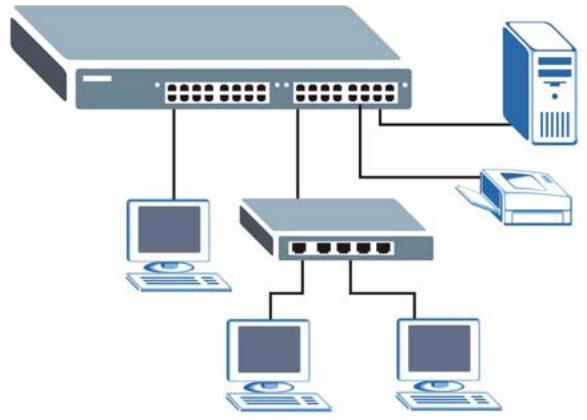
Figure 1 Backbone Application
1.4.2 Bridging Example
In this example application the switch connects different company departments (RD and Sales) to the corporate backbone. It can alleviate bandwidth contention and eliminate server and network bottlenecks. All users that need high bandwidth can connect to high-speed department servers via the switch. You can provide a super-fast uplink connection by using a Gigabit Ethernet/mini-GBIC port on the switch.
Moreover, the switch eases supervision and maintenance by allowing network managers to centralize multiple servers at a single location.
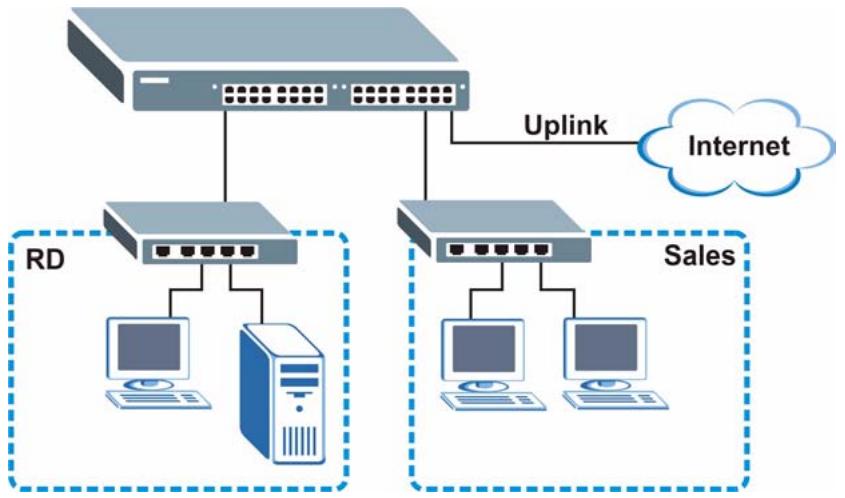
Figure 2 Bridging Application
1.4.3 High Performance Switched Example
The switch is ideal for connecting two networks that need high bandwidth. In the following example, use trunking to connect these two networks.
Switching to higher-speed LANs such as ATM (Asynchronous Transmission Mode) is not feasible for most people due to the expense of replacing all existing Ethernet cables and adapter cards, restructuring your network and complex maintenance. The switch can provide the same bandwidth as ATM at much lower cost while still being able to use existing adapters and switches. Moreover, the current LAN structure can be retained as all ports can freely communicate with each other.
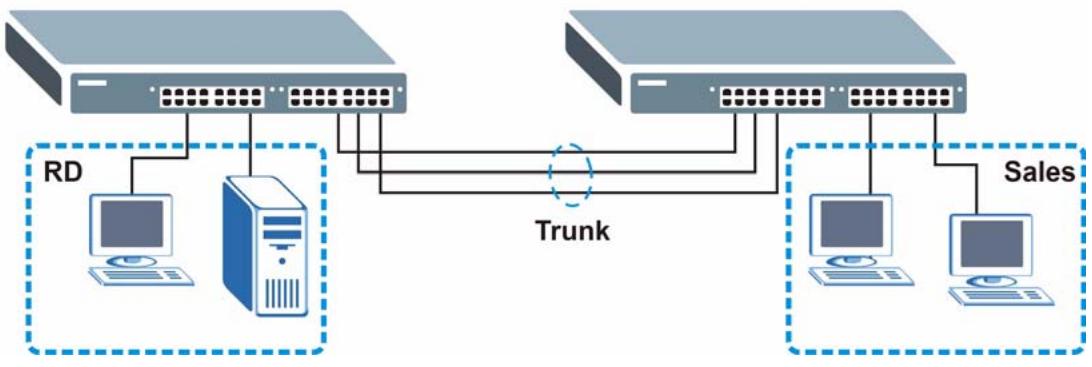
Figure 3 High Performance Switched Application
1.4.4 IEEE 802.1Q VLAN Application Examples
This section shows a workgroup and a shared server example using 802.1Q tagged VLANs.
A VLAN (Virtual Local Area Network) allows a physical network to be partitioned into multiple logical networks. Stations on a logical network belong to one group. A station can belong to more than one group. With VLAN, a station cannot directly talk to or hear from stations that are not in the same group(s) unless such traffic first goes through a router.
For more information on VLANs, refer to Chapter 8 on page 77.
1.4.4.1 Tag-based VLAN Example
Ports in the same VLAN group share the same frame broadcast domain thus increase network performance through reduced broadcast traffic. VLAN groups can be modified at any time by adding, moving or changing ports without any re-cabling.
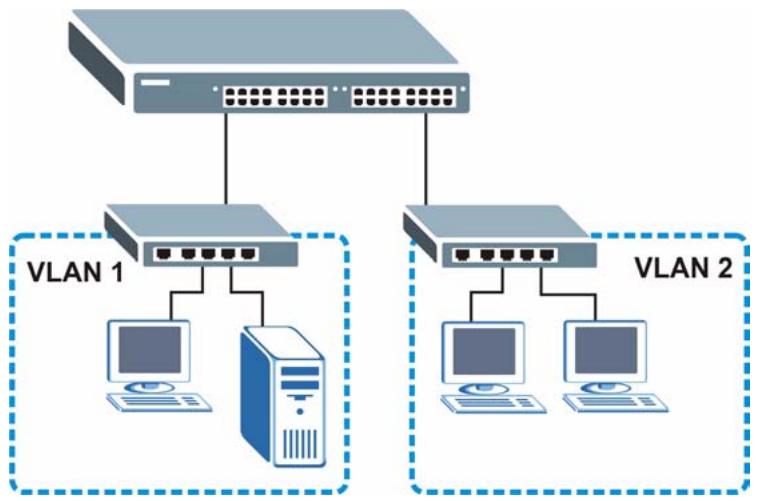
Figure 4 Tag-based VLAN Application
1.4.4.2 VLAN Shared Server Example
Shared resources such as a server can be used by all ports in the same VLAN as the server, as shown in the following example. In this example, only ports that need access to the server need belong to VLAN 1. Ports can belong to other VLAN groups too.
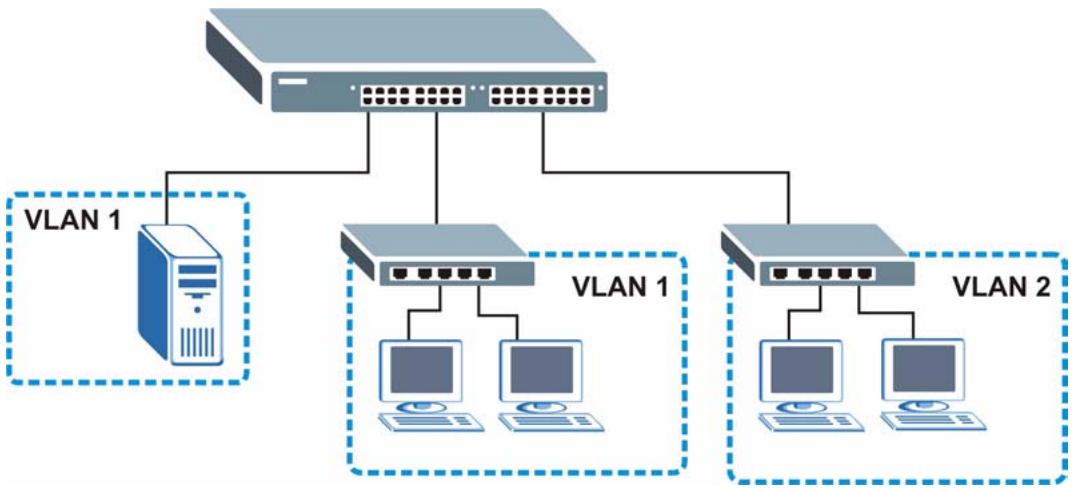
Figure 5 Shared Server Using VLAN Example
CHAPTER 2
Hardware Installation and Connection
This chapter shows you how to install and connect the switch.
2.1 Freestanding Installation
1 Make sure the switch is clean and dry.
2 Set the switch on a smooth, level surface strong enough to support the weight of the switch and the connected cables. Make sure there is a power outlet nearby.
3 Make sure there is enough clearance around the switch to allow air circulation and the attachment of cables and the power cord.
4 Remove the adhesive backing from the rubber feet.
5 Attach the rubber feet to each corner on the bottom of the switch. These rubber feet help protect the switch from shock or vibration and ensure space between devices when stacking.
Figure 6 Attaching Rubber Feet
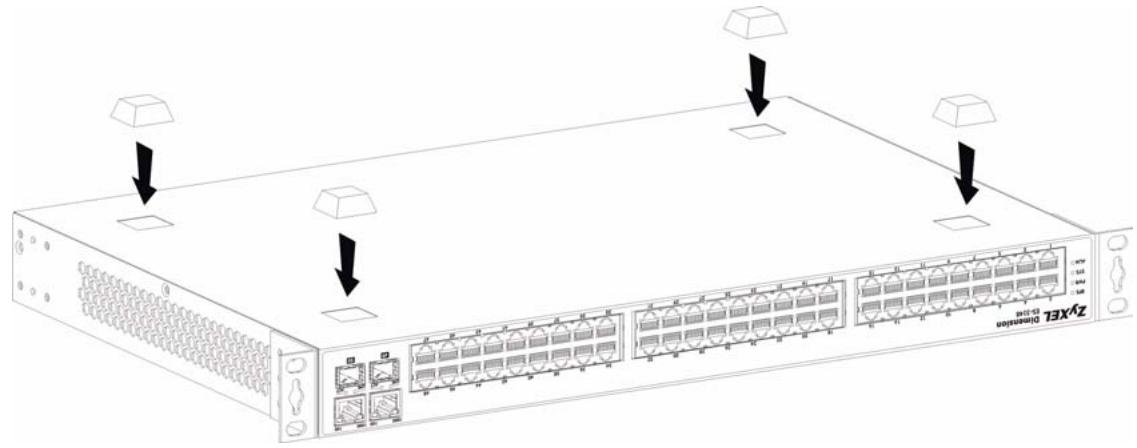
Note: Do NOT block the ventilation holes. Leave space between devices when stacking.
For proper ventilation, allow at least 4 inches (10 cm) of clearance at the front and 3.4 inches (8 cm) at the back of the switch. This is especially important for enclosed rack installations.
2.2 Mounting the Switch on a Rack
This section lists the rack mounting requirements and precautions and describes the installation steps.
2.2.1 Rack-mounted Installation Requirements
- Two mounting brackets.
Eight M3 flat head screws and a #2 Philips screwdriver. - Four M5 flat head screws and a #2 Philips screwdriver.
Note: Failure to use the proper screws may damage the unit.
2.2.1.1 Precautions
- Make sure the rack will safely support the combined weight of all the equipment it contains.
- Make sure the position of the switch does not make the rack unstable or top-heavy. Take all necessary precautions to anchor the rack securely before installing the unit.
2.2.2 Attaching the Mounting Brackets to the Switch
1 Position a mounting bracket on one side of the switch, lining up the four screw holes on the bracket with the screw holes on the side of the switch.
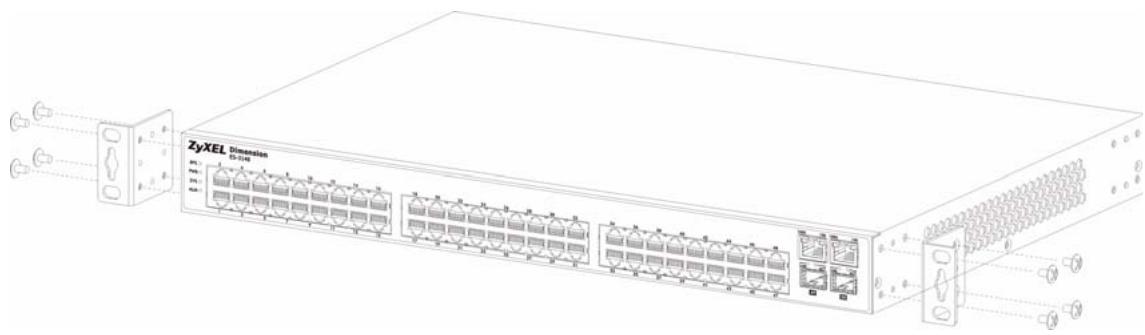
Figure 7 Attaching the Mounting Brackets
2 Using a #2 Philips screwdriver, install the M3 flat head screws through the mounting bracket holes into the switch.
3 Repeat steps 1 and 2 to install the second mounting bracket on the other side of the switch.
4 You may now mount the switch on a rack. Proceed to the next section.
2.2.3 Mounting the Switch on a Rack
1 Position a mounting bracket (that is already attached to the switch) on one side of the rack, lining up the two screw holes on the bracket with the screw holes on the side of the rack.
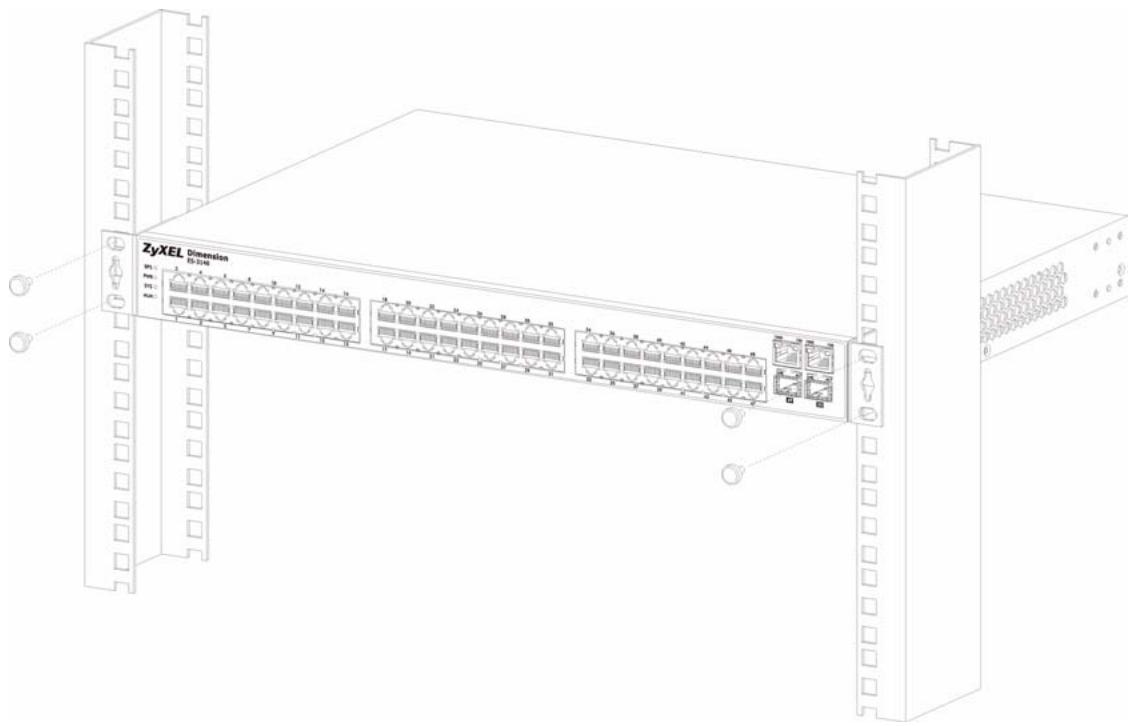
Figure 8 Mounting the Switch on a Rack
2 Using a #2 Philips screwdriver, install the M5 flat head screws through the mounting bracket holes into the rack.
3 Repeat steps 1 and 2 to attach the second mounting bracket on the other side of the rack.
CHAPTER 3
Hardware Overview
This chapter describes the front panel and rear panel of the switch and shows you how to make the hardware connections.
3.1 Panel Connections
The figures below show the front panel and the rear panel of the switch.
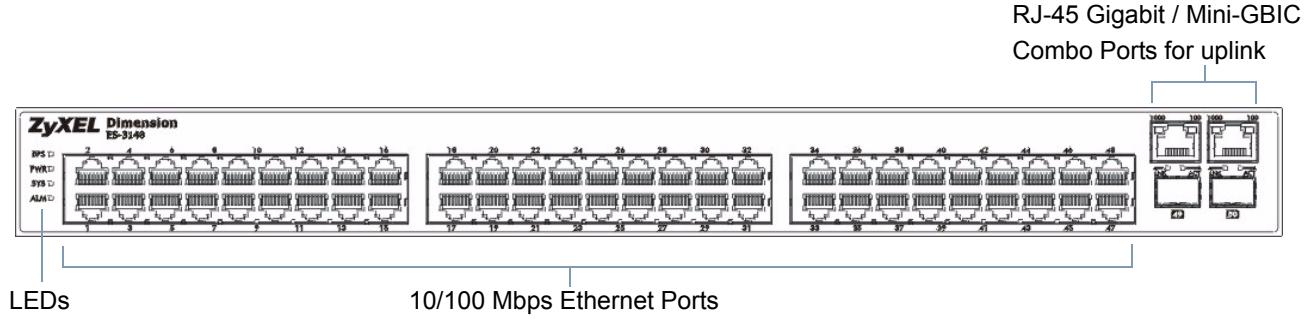
Figure 9 Front Panel
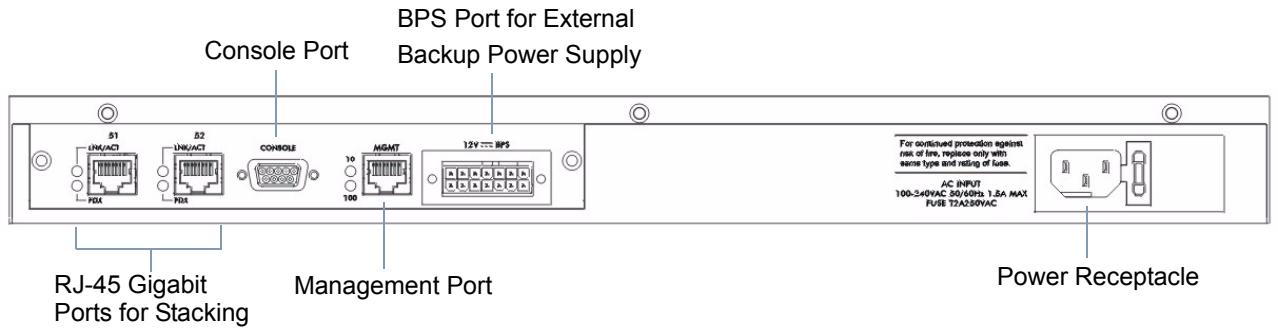
Figure 10 Rear Panel
The following table describes the ports on the panels.
Table 1 Panel Connections
| CONNECTOR | DESCRIPTION |
| 48 10/100 Mbps RJ-45 Ethernet Ports | Connect these ports to a computer, a hub, an Ethernet switch or router. |
| Four 100/1000 Mbps RJ-45 Gigabit Ports | Connect these Gigabit Ethernet ports to high-bandwidth backbone network Ethernet switches or use them to daisy-chain other switches. |
| Mini-GBIC Ports | Use mini-GBIC transceivers in these slots for fiber-optical connections to backbone Ethernet switches. |
| Console Port | Only connect this port if you want to configure the switch using the command line interface (CLI) via the console port. |
| Management Port | Connect to a computer using an RJ-45 Ethernet cable for local configuration of the switch. |
3.1.1 Console Port
For local management, you can use a computer with terminal emulation software configured to the following parameters:
- VT100 terminal emulation
9600 bps - No parity, 8 data bits, 1 stop bit
- No flow control
Connect the male 9-pin end of the console cable to the console port of the switch. Connect the female end to a serial port (COM1, COM2 or other COM port) of your computer.
3.1.2 Ethernet Ports
The switch has 24 100/1000Mbps auto-negotiating, auto-crossover Ethernet ports. In 100/1000Mbps Fast Ethernet, the speed can be 100Mbps or 1000Mbps and the duplex mode can be half duplex or full duplex.
There are two pairs of Gigabit Ethernet/mini-GBIC ports. The mini-GBIC ports have priority over the Gigabit ports. This means that if a mini-GBIC port and the corresponding Gigabit port are connected at the same time, the Gigabit port will be disabled. The speed of the Gigabit Ethernet/mini-GBIC ports can be 100Mbps or 1000Mbps and the duplex mode can be half duplex (at 100 Mbps) or full duplex.
An auto-negotiating port can detect and adjust to the optimum Ethernet speed (100/ 1000Mpbs) and duplex mode (full duplex or half duplex) of the connected device.
An auto-crossover (auto-MDI/MDI-X) port automatically works with a straight-through or crossover Ethernet cable.
3.1.2.1 Default Ethernet Settings
The factory default negotiation settings for the Ethernet ports on the switch are:
- Speed: Auto
-
Duplex: Auto
-
Flow control: Off
3.1.3 Mini-GBIC Slots
These are slots for mini-GBIC (Gigabit Interface Converter) transceivers. A transceiver is a single unit that houses a transmitter and a receiver. The switch does not come with transceivers. You must use transceivers that comply with the SFP Transceiver MultiSource Agreement (MSA). See the SFF committee's INF-8074i specification Rev 1.0 for details.
There are two pairs of Gigabit Ethernet/mini-GBIC ports. The mini-GBIC ports have priority over the Gigabit ports. This means that if a mini-GBIC port and the corresponding Gigabit port are connected at the same time, the Gigabit port will be disabled.
You can change transceivers while the switch is operating. You can use different transceivers to connect to Ethernet switches with different types of fiber-optic connectors.
- Type: SFP connection interface
- Connection speed: 1 Gigabit per second (Gbps)
Note: To avoid possible eye injury, do not look into an operating fiber-optic module's connectors.
3.1.3.1 Transceiver Installation
Use the following steps to install a mini GBIC transceiver (SFP module).
1 Insert the transceiver into the slot with the exposed section of PCB board facing down.
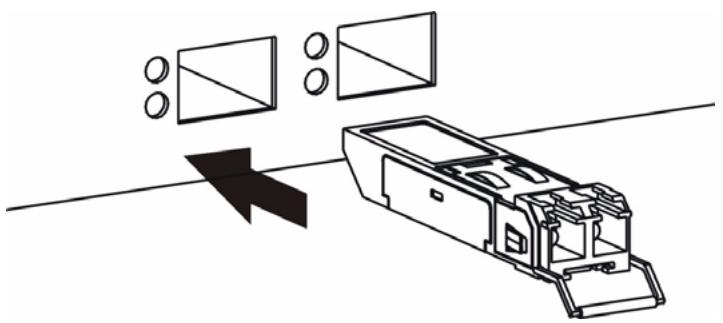
Figure 11 Transceiver Installation Example
2 Press the transceiver firmly until it clicks into place.
3 The switch automatically detects the installed transceiver. Check the LEDs to verify that it is functioning properly.

Figure 12 Installed Transceiver
3.1.3.2 Transceiver Removal
Use the following steps to remove a mini GBIC transceiver (SFP module).
1 Open the transceiver's latch (latch styles vary).

Figure 13 Opening the Transceiver's Latch Example
2 Pull the transceiver out of the slot.
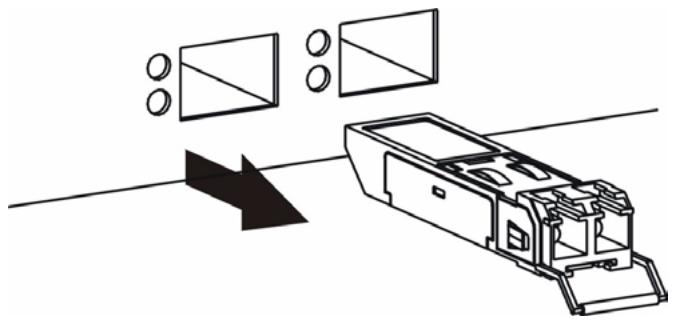
Figure 14 Transceiver Removal Example
3.1.4 Power Connector
Make sure you are using the correct power source as shown on the panel.
To connect the power to the switch, insert the female end of power cord to the power receptacle on the rear panel. Connect the other end of the supplied power cord to the power source. Make sure that no objects obstruct the airflow of the fans.
3.1.5 External Backup Power Supply Connector
The switch supports external backup power supply (BPS).
The backup power supply constantly monitors the status of the internal power supply. The backup power supply automatically provides power to the switch in the event of a power failure. Once the switch receives power from the backup power supply, it will not automatically switch back to using the internal power supply even when the power is resumed.
3.2 Panel LEDs
The following table describes the LEDs on the panels.
Table 2 Front Panel LEDs
| LED | COLOR | STATUS | DESCRIPTION |
| BPS | Green | Blinking | The system is receiving power from the backup power supply. |
| On | The backup power supply is connected and active. | ||
| Off | The backup power supply is not ready or not active. | ||
| PWR | Green | On | The system is turned on. |
| Off | The system is off. | ||
| SYS | Green | Blinking | The system is rebooting and performing self-diagnostic tests. |
| On | The system is on and functioning properly. | ||
| Off | The power is off or the system is not ready/malfunctioning. | ||
| ALM | Red | On | There is a hardware failure. |
| Off | The system is functioning normally. | ||
| 10 | Green | Blinking | The system is transmitting/receiving to/from an Ethernet device. |
| On | The port is connected at 10Mbps. | ||
| Off | The port is not connected at 10Mbps or to an Ethernet device. | ||
| 100 | Amber | Blinking | The system is transmitting/receiving to/from an Ethernet device. |
| On | The port is connected at 100Mbps. | ||
| Off | The port is not connected at 100Mbps or to an Ethernet device. | ||
| Uplink Gigabit Port | |||
| 1000 | Green | Blinking | The system is transmitting/receiving to/from an Ethernet device. |
| On | The port is connected at 1000Mbps. | ||
| Off | The port is not connected at 1000Mbps or to an Ethernet device. | ||
| 100 | Amber | Blinking | The system is transmitting/receiving to/from an Ethernet device. |
| On | The port is connected at 100Mbps. | ||
| Off | The port is not connected at 100Mbps or to an Ethernet device. | ||
| GBIC Slots | |||
| LNK | Green | On | The port has a successful connection. |
| Off | No Ethernet device is connected to this port. | ||
| ACT | Green | Blinking | The port is receiving or transmitting data. |
| Gigabit Port | |||
| LNK/ACT | Green | Blinking | The system is transmitting/receiving to/from a 1000 Mbps Ethernet network. |
| On | The link to a 1000 Mbps Ethernet network is up. | ||
| Amber | Blinking | The system is transmitting/receiving to/from a 100 Mbps Ethernet network. | |
| On | The link to a 100 Mbps Ethernet network is up. | ||
| Off | The link to an Ethernet network is down. | ||
| FDX | Amber | On | The Gigabit port is negotiating in full-duplex mode. |
| Off | The Gigabit port is negotiating in half-duplex mode and no collisions are occurring. | ||
| MGMT | |||
| 10 | Green | Blinking | The system is transmitting/receiving to/from an Ethernet device. |
| On | The port is connected at 10 Mbps. | ||
| Off | The port is not connected at 10 Mbps or to an Ethernet device. | ||
| 100 | Amber | Blinking | The system is transmitting/receiving to/from an Ethernet device. |
| On | The port is connected at 100 Mbps. | ||
| Off | The port is not connected at 100 Mbps or to an Ethernet device. | ||
CHAPTER 4
The Web Configurator
This section introduces the configuration and functions of the web configurator.
4.1 Introduction
The web configurator is an HTML-based management interface that allows easy switch setup and management via Internet browser. Use Internet Explorer 6.0 and later or Netscape Navigator 7.0 and later versions. The recommended screen resolution is 1024 by 768 pixels.
In order to use the web configurator you need to allow:
- Web browser pop-up windows from your device. Web pop-up blocking is enabled by default in Windows XP SP (Service Pack) 2.
JavaScript (enabled by default). - Java permissions (enabled by default).
4.2 System Login
1 Start your web browser.
2 Type "http://" and the IP address of the switch (for example, the default for the management port is 192.168.0.1 and for the switch port is 192.168.1.1) in the Location or Address field. Press [ENTER].
3 The login screen appears. The default username is admin and associated default password is 1234. The date and time display as shown if you have not configured a time server nor manually entered a time and date in the General Setup screen.
Figure 15 Web Configurator: Login
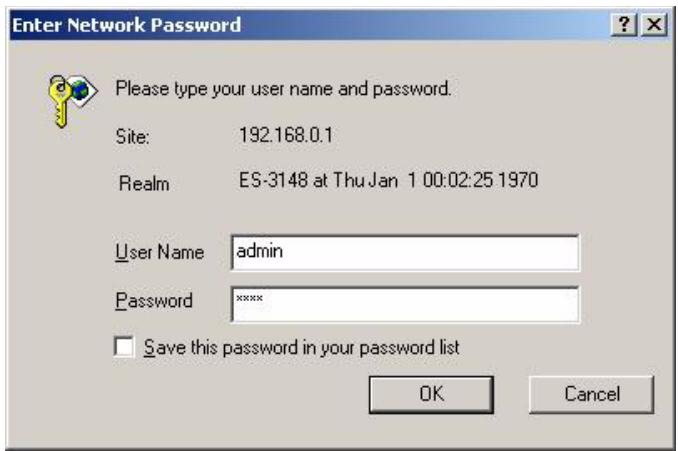
4 Click OK to view the first web configurator screen.
4.3 The Status Screen
The Status screen is the first screen that displays when you access the web configurator.
The following figure shows the navigating components of a web configurator screen.
Figure 16 Web Configurator Home Screen (Status)
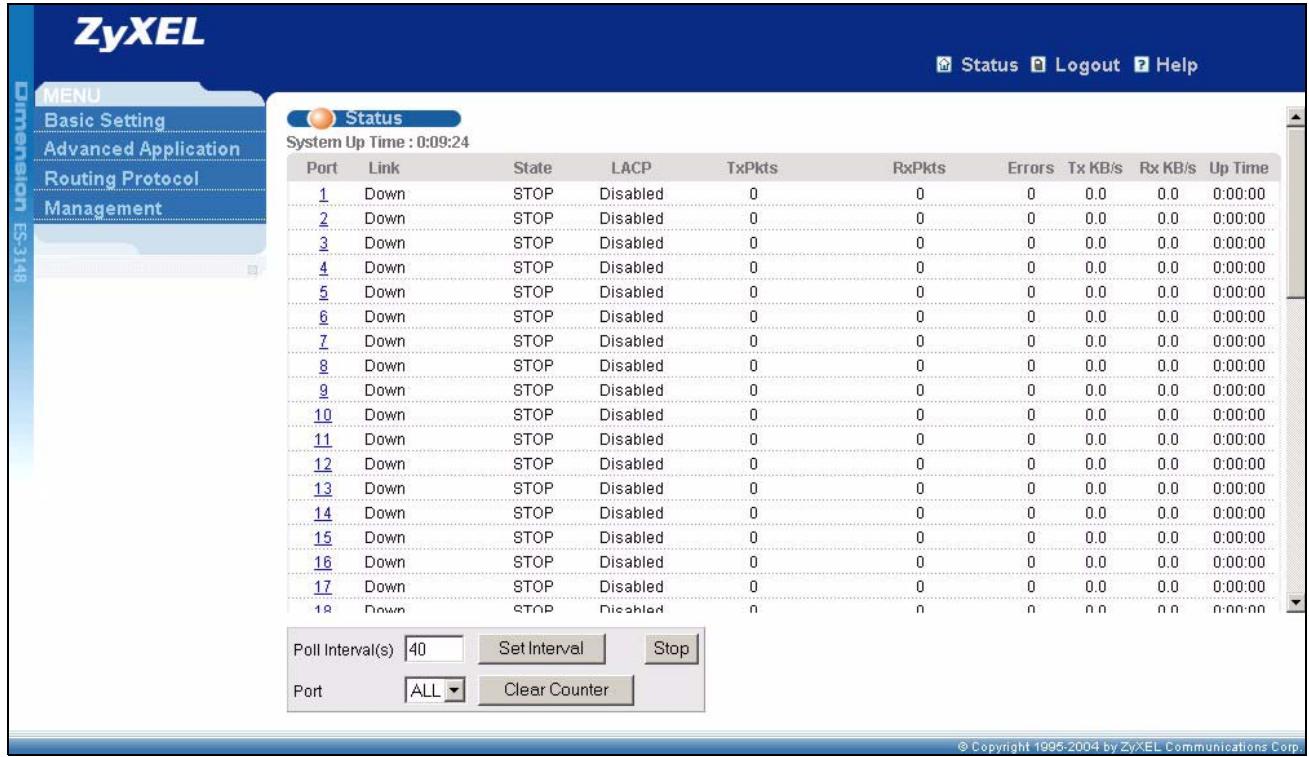
In the navigation panel, click a main link to reveal a list of submenu links.
Table 3 Navigation Panel Sub-links Overview
| BASIC SETTING | ADVANCED APPLICATION | ROUTING PROTOCOL | MANAGEMENT |
| MENU | MENU | MENU | MENU |
| Basic Setting | Basic Setting | Basic Setting | Basic Setting |
| Advanced Application | Advanced Application | Advanced Application | Advanced Application |
| Routing Protocol | Routing Protocol | Routing Protocol | Routing Protocol |
| Management | Management | Management | Management |
| System Info | VLAN | Static Routing | Maintenance |
| General Setup | Static MAC Forwarding | Static Routing | Diagnostic |
| Switch Setup | Filtering | Cluster Management | |
| IP Setup | Spanning Tree Protocol | MAC Table | |
| Port Setup | Bandwidth Control | ARP Table | |
| Broadcast Storm Control | |||
| Mirroring | |||
| Link Aggregation | |||
| Port Authentication | |||
| Port Security | |||
| Access Control | |||
| Queuing Method | |||
| Classifier | |||
| Policy Rule | |||
| VLAN Stacking | |||
| Multicast | |||
| DHCP Relay |
The following table lists the various web configurator screens within the sub-links.
Table 4 Web Configurator Screen Sub-links Details
| BASIC SETTING | ADVANCED APPLICATION | ROUTING PROTOCOL | MANAGEMENT |
| System Info | VLAN | Static Routing | Maintenance |
| General Setup | VLAN Status | Firmware Upgrade | |
| Switch Setup | VLAN Port Setting | Restore | |
| IP Setup | Static VLAN | Configuration | |
| Port Setup | Static MAC Forwarding | Backup | |
| Filtering | Configuration | ||
| Spanning Tree Protocol | Load Factory Default | ||
| Status | Reboot System | ||
| Configuration | Diagnostic | ||
| Bandwidth Control | Cluster Management | ||
| Broadcast Storm Control | Status | ||
| Mirroring | Configuration | ||
| MAC Table | |||
| ARP Table | |||
| Link Aggregation Status Configuration Port Authentication RADIUS 802.1x Port Security Access Control SNMP Logins Service Access Control Remote Management Queuing Method Classifier Policy Rule VLAN Stacking Multicast Multicast Status Multicast Setting IGMP Filtering Profile MVR DHCP Relay |
The following table describes the links in the navigation panel.
Table 5 Navigation Panel Links
| LINK | DESCRIPTION |
| Basic Settings | |
| System Info | This link takes you to a screen that displays general system and hardware monitoring information. |
| General Setup | This link takes you to a screen where you can configure general identification information about the switch. |
| Switch Setup | This link takes you to a screen where you can set up global switch parameters such as VLAN type, MAC address learning, GARP and priority queues. |
| IP Setup | This link takes you to a screen where you can configure the management IP address, subnet mask (necessary for switch management) and DNS (domain name server). |
| Port Setup | This link takes you to screens where you can configure settings for individual switch ports. |
| Advanced Application | |
| VLAN | This link takes you to screens where you can configure port-based or 802.1Q VLAN (depending on what you configured in the Switch Setup menu). |
| Static MAC Forwarding | This link takes you to screens where you can configure static MAC addresses for a port. These static MAC addresses do not age out. |
| Filtering | This link takes you to a screen to set up filtering rules. |
| Spanning Tree Protocol | This link takes you to screens where you can configure the STP/RSTP to prevent network loops. |
| Bandwidth Control | This link takes you to screens where you can cap the maximum incoming bandwidth allowed on specified port(s). |
| Broadcast Storm Control | This link takes you to a screen to set up broadcast filters. |
| Mirroring | This link takes you to screens where you can copy traffic from one port or ports to another port in order that you can examine the traffic from the first port without interference |
| Link Aggregation | This link takes you to a screen where you can logically aggregate physical links to form one logical, higher-bandwidth link. |
| Port Authentication | This link takes you to a screen where you can configure RADIUS (Remote Authentication Dial-In User Service), a protocol for user authentication that allows you to use an external server to validate an unlimited number of users. |
| Port Security | This link takes you to a screen where you can activate maximum port security through the use of configured static MAC addresses. |
| Access Control | This link takes you to screens where you can change the system login password and configure SNMP and remote management. |
| Queuing Method | This link takes you to a screen where you can configure strictly priority or weighted fair scheduling with associated queue weights for each port. |
| Classifier | This link takes you to a screen where you can configure classifiers. |
| Policy Rule | This link takes you to a screen where you can configure policy rules. |
| VLAN Stacking | This link takes you to a screen where you can configure VLAN stacking. |
| Multicast | This link takes you to a screen where you can configure various multicast features and create multicast VLANs. |
| DHCP Relay | This link takes you to a screen where you can configure DHCP relay information and specify the DHCP server(s). |
| Routing Protocol | |
| Static Routing | This link takes you to screens where you can configure static routes. A static route defines how the switch should forward traffic by configuring the TCP/IP parameters manually. |
| Management | |
| Maintenance | This link takes you to screens where you can perform firmware and configuration file maintenance as well as reboot the system. |
| Diagnostic | This link takes you to screens where you can view system logs and test port(s). |
| Cluster Management | This link takes you to a screen where you can configure clustering management and view its status. |
| MAC Table | This link takes you to a screen where you can view the MAC addresses (and types) of devices attached to what ports and VLAN IDs. |
| ARP Table | This link takes you to a screen where you can view the MAC addresses - IP address resolution table. |
4.3.1 Change Your Password
After you log in for the first time, it is recommended you change the default administrator password. Click Advanced Application, Access Control and then Logins to display the next screen.
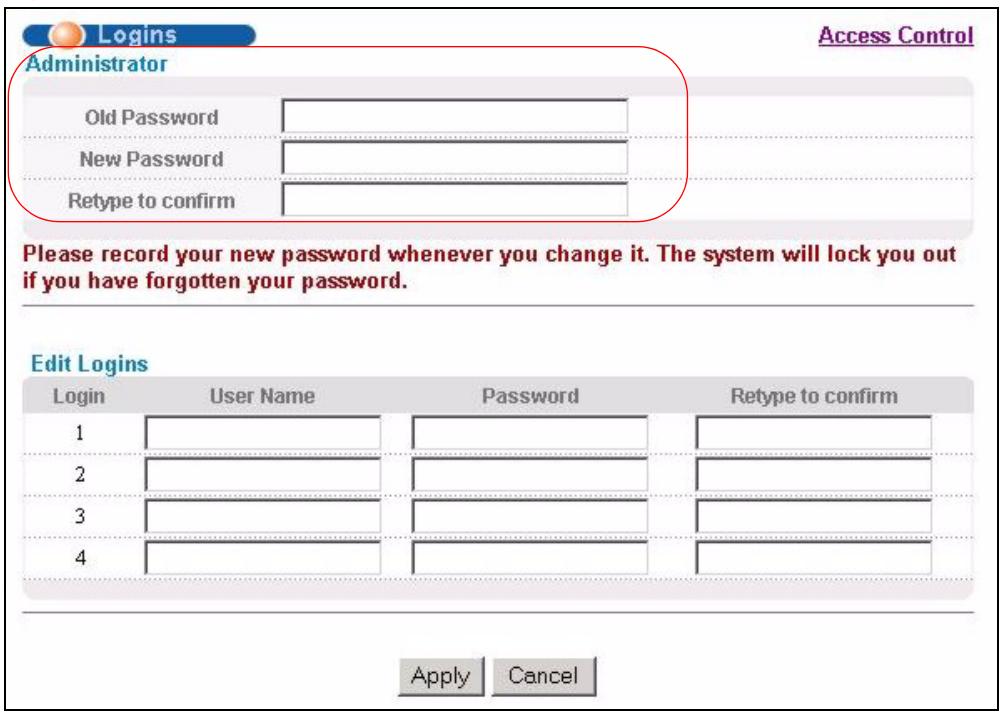
Figure 17 Change Administrator Login Password
4.4 Switch Lockout
You could block yourself (and all others) from accessing the switch through the web configurator if you do one of the following:
1 Deleting the management VLAN (default is VLAN 1).
2 Deleting all port-based VLANs with the CPU port as a member. The "CPU port" is the management port of the switch.
3 Filtering all traffic to the CPU port.
4 Disabling all ports.
5 Misconfiguring the text configuration file.
6 Forgetting the password and/or IP address.
7 Preventing all services from accessing the switch.
8 Changing a service port number but forgetting it.
Note: Be careful not to lock yourself and others out of the switch.
4.5 Resetting the Switch
If you lock yourself (and others) from the switch or forget the switch password, you will need to reload the factory-default configuration file or reset the switch back to the factory defaults.
4.5.1 Reload the Configuration File
Uploading the factory-default configuration file replaces the current configuration file with the factory-default configuration file. This means that you will lose all previous configurations and the speed of the console port will be reset to the default of 9600bps with 8 data bit, no parity, one stop bit and flow control set to none. The password will also be reset to "1234" and the IP address to 192.168.1.1.
To upload the configuration file, do the following:
1 Connect to the console port using a computer with terminal emulation software. See Section 3.1.1 on page 40 for details.
2 Disconnect and reconnect the switch's power to begin a session. When you reconnect the switch's power, you will see the initial screen.
3 When you see the message "Press any key to enter Debug Mode within 3 seconds ..." press any key to enter debug mode.
4 Type atlc after the "Enter Debug Mode" message.
5 Wait for the "Starting XMODEM upload" message before activating XMODEM upload on your terminal.
6 This is an example Xmodem configuration upload using HyperTerminal. Click Transfer, then Send File to display the following screen.
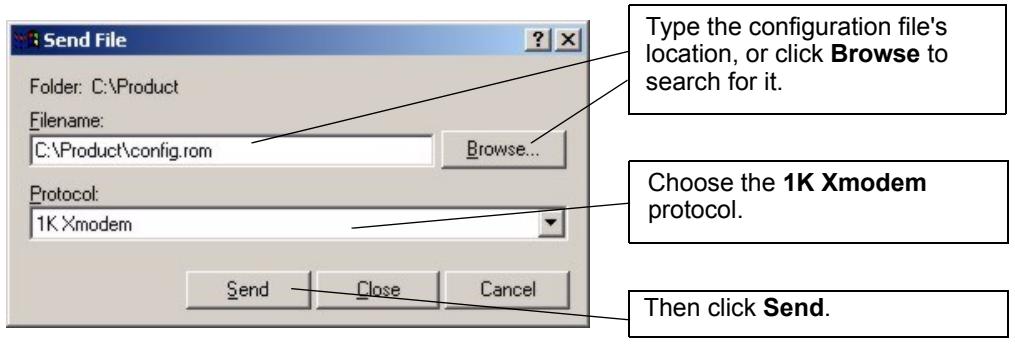
Figure 18 Example Xmodem Upload
7 After a configuration file upload, type atgo to restart the switch.
Figure 19 Reload the Configuration file: Via Console Port
Bootbase Version: V0.6 | 05/02/2005 16:32:24
RAM:Size = 32 Mbytes
DRAM POST: Testing: 32768K OK
DRAM Test SUCCESS!
FLASH: Intel 32M
ZyNOS Version: V3.60(TZ.0)b0.1 | 05/24/2005 10:28:06
Press any key to enter debug mode within 3 seconds.
Enter Debug Mode
ES-3148>atlc
Starting XMODEM upload (CRC mode)...
CCCCCCCCCCCCCCCCCC
Total 262144 bytes received.
Erasing..
OK
ES-3148>atgo
The switch is now reinitialized with a default configuration file including the default password of “1234”.
4.5.2 Reset to the Factory Defaults
To reset the switch back to the factory defaults, do the following:
1 Connect to the console port using a computer with terminal emulation software. See the chapter on hardware connections for details.
2 Disconnect and reconnect the switch's power to begin a session. When you reconnect the switch's power, you will see the initial screen.
3 When you see the message "Press any key to enter Debug Mode within 3 seconds" press any key to enter debug mode.
4 Type atbr after the "Enter Debug Mode" message.
Figure 20 Resetting the Switch: Via the Console Port
Bootbase Version: V0.6 | 05/02/2005 16:32:24
RAM:Size = 32 Mbytes
DRAM POST: Testing: 32768K OK
DRAM Test SUCCESS!
FLASH: Intel 32M
ZyNOS Version: V3.60(TZ.0)b0.1 | 05/24/2005 10:28:06
Press any key to enter debug mode within 3 seconds.
Enter Debug Mode
ES-3148> atbr
Restore default
Romfile...OK
ES-3148> atgo
5 After the resetting, type atgo to restart the switch.
4.6 Logging Out of the Web Configurator
Click Logout in a screen to exit the web configurator. You have to log in with your password again after you log out. This is recommended after you finish a management session both for security reasons and so as you don't lock out other switch administrators.
Figure 21 Web Configurator:Logout Screen
4.7 Help
The web configurator's online help has descriptions of individual screens and some supplementary information.
Click the Help link from a web configurator screen to view an online help description of that screen.
CHAPTER 5 Initial Setup Example
This chapter shows how to set up the switch for an example network.
5.1 Overview
The following lists the configuration steps for the initial setup:
Create a VLAN
- Set port VLAN ID
- Configure the switch IP management address
5.1.1 Creating a VLAN
VLANs confine broadcast frames to the VLAN group in which the port(s) belongs. You can do this with port-based VLAN or tagged static VLAN with fixed port members.
In this example, you want to configure port 10 as a member of VLAN 2.
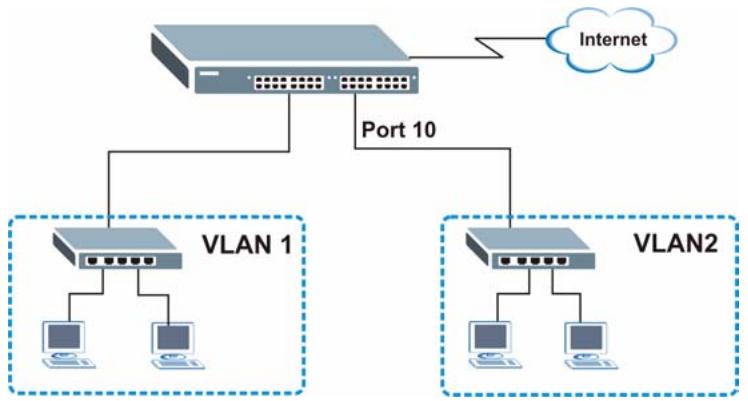
Figure 22 Initial Setup Network Example: VLAN
1 Click Advanced Application and VLAN in the navigation panel and click the Static VLAN link.
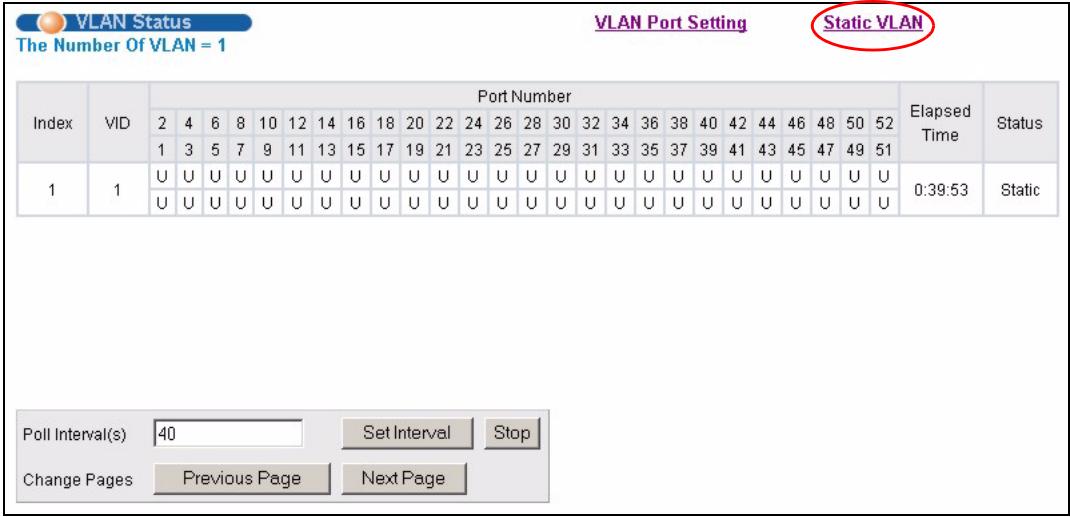
2 In the Static VLAN screen, select ACTIVE, enter a descriptive name in the Name field and enter 2 in the VLAN Group ID field for the VLAN2 network.
Note: The VLAN Group ID field in this screen and the VID field in the IP Setup screen refer to the same VLAN ID.
3 Since the VLAN2 network is connected to port 10 on the switch, select Fixed to configure port 10 to be a permanent member of the VLAN only.
4 To ensure that VLAN-unaware devices (such as computers and hubs) can receive frames properly, clear the TX Tagging check box to set the switch to remove VLAN tags before sending.
5 Click Add to save the settings.

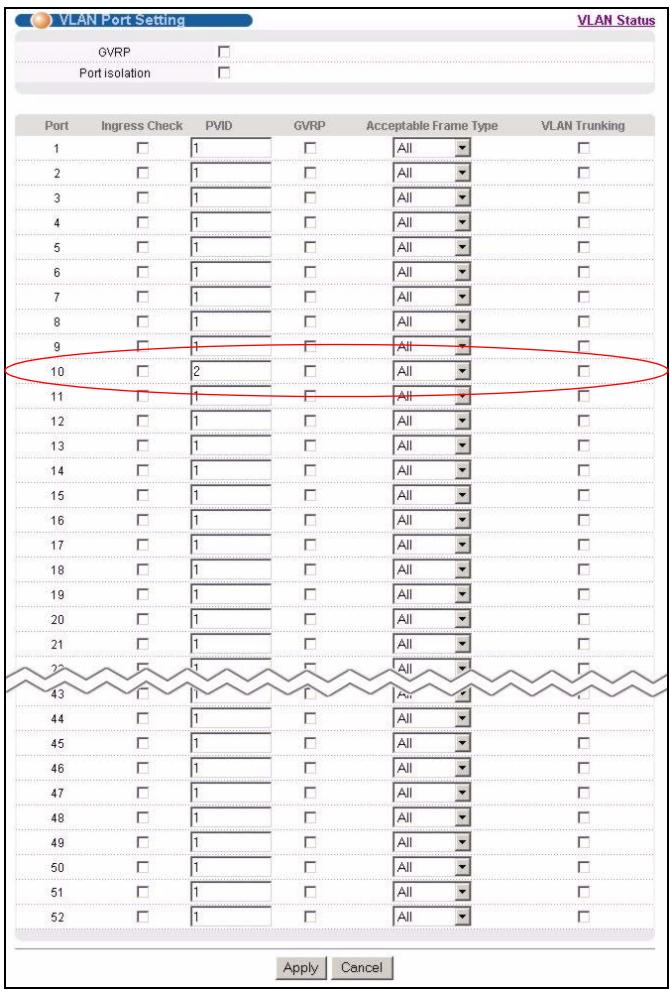
5.1.2 Setting Port VID
Use PVID to add a tag to incoming untagged frames received on that port so that the frames are forwarded to the VLAN group that the tag defines.
In the example network, configure 2 as the port VID on port 10 so that any untagged frames received on that port get sent to VLAN 2.
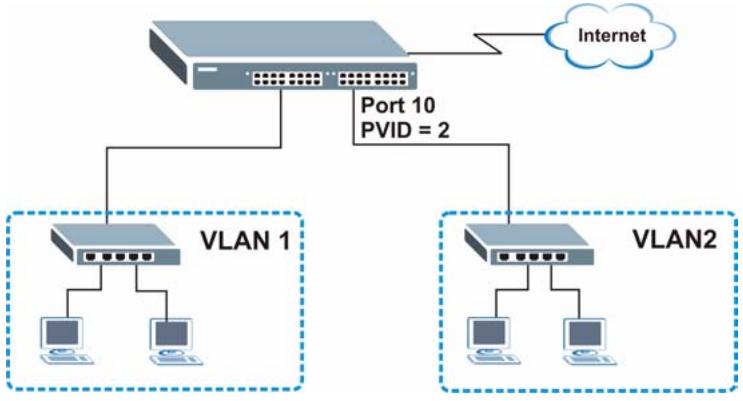
Figure 23 Initial Setup Network Example: Port VID
1 Click Advanced Applications and VLAN in the navigation panel. Then click the VLAN Port Setting link.
2 Enter 2 in the PVID field for port 10 and click Apply to save the settings.
5.1.3 Configuring Switch Management IP Address
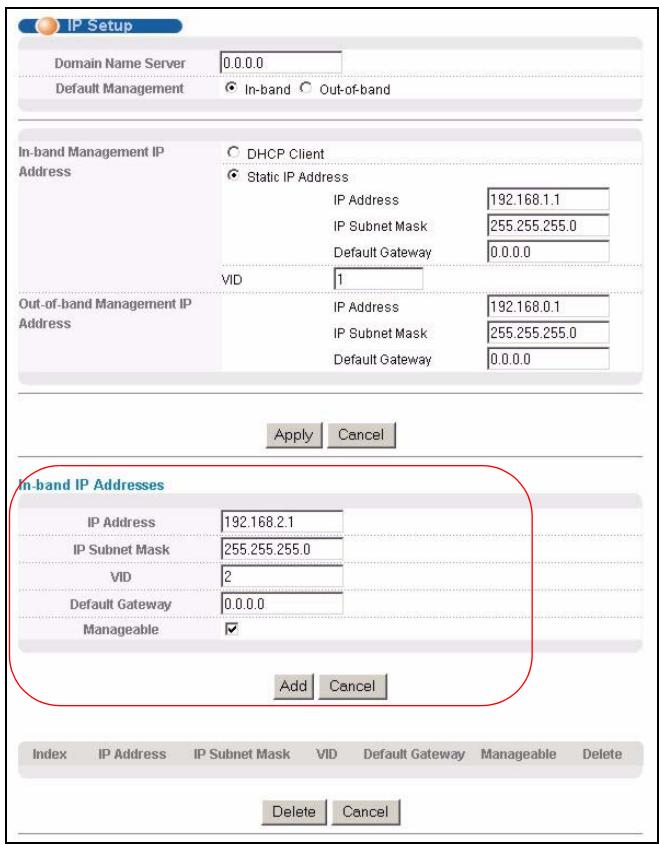
The default management IP address of the switch is 192.168.1.1. You can configure another IP address in a different subnet for management purposes. The following figure shows an example.
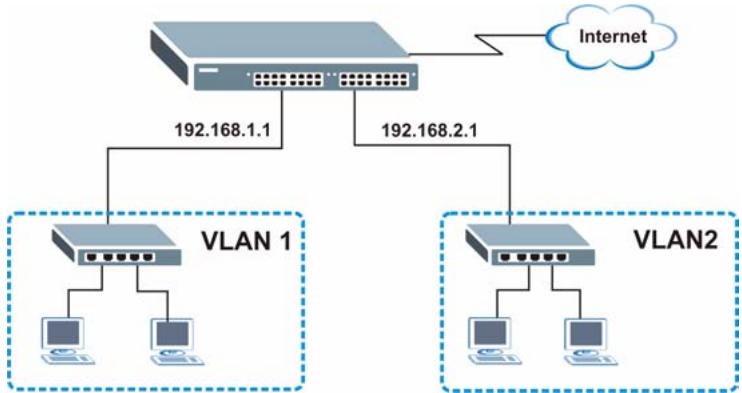
Figure 24 Initial Setup Example: Management IP Address
1 Connect your computer to any Ethernet port on the switch. Make sure your computer is in the same subnet as the switch.
2 Open your web browser and enter 192.168.1.1 (the default IP address) in the address bar to access the web configurator. See Section 4.2 on page 45 for more information.
3 Click Basic Setting and IP Setup in the navigation panel.
4 Configure the related fields in the IP Setup screen.
For the VLAN2 network, enter 192.168.2.1 as the IP address and 255.255.255.0 as the subnet mask.
5 In the VID field, enter the ID of the VLAN group to which you want this management IP address to belong. This is the same as the VLAN ID you configure in the Static VLAN screen.
6 Select the Manageable check box to allow the switch to be managed from the ports belonging to VLAN2 using this specified IP address.
7 Click Add.
CHAPTER 6
System Status and Port
Statistics
This chapter describes the system status (web configurator home page) and port details screens.
6.1 Overview
The home screen of the web configurator displays a port statistical summary table with links to each port showing statistical details.
6.2 Port Status Summary
To view the port statistics, click Status in all web configurator screens to display the Status screen as shown next.
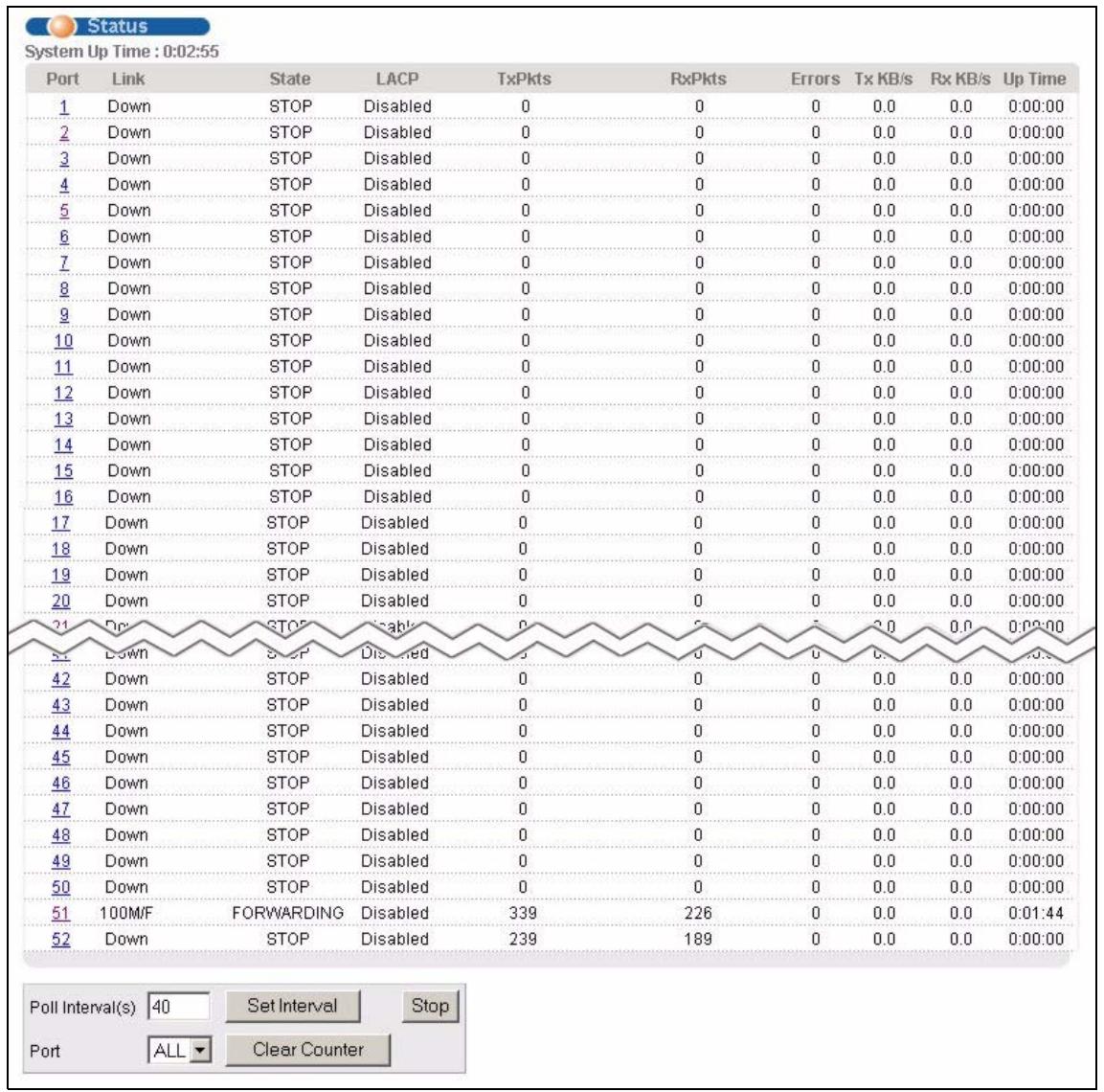
Figure 25 Status
The following table describes the labels in this screen.
Table 6 Status
| LABEL | DESCRIPTION |
| System up Time | This field shows how long the system has been running since the last time it was started. |
| Port | This identifies the Ethernet port. Click a port number to display the Port Details screen (refer to Figure 26 on page 62). |
| Link | This field displays the speed (either 10M for 10Mbps, 100M for 100Mbps or 1000M for 1000Mbps) and the duplex (F for full duplex or H for half). It also shows the cable type (Copper or Fiber) for the combo ports. |
| State | This field displays the STP (Spanning Tree Protocol) state of the port. See the chapter on STP for details on STP states. |
| LACP | This fields displays whether LACP (Link Aggregation Control Protocol) has been enabled on the port. |
| TxPkts | This field shows the number of transmitted frames on this port. |
| RxPkts | This field shows the number of received frames on this port. |
| Errors | This field shows the number of received errors on this port. |
| Tx KB/s | This field shows the number of kilobytes per second transmitted on this port. |
| Rx KB/s | This field shows the number of kilobytes per second received on this port. |
| Up Time | This field shows the total amount of time in hours, minutes and seconds the port has been up. |
| Poll Interval(s) | The text box displays how often (in seconds) this screen refreshes. You may change the refresh interval by typing a new number in the text box and then clicking Set Interval. |
| Stop | Click Stop to halt system statistic polling. |
| Clear Counter | Select a port from the Port drop-down list box and then click Clear Counter to erase the recorded statistical information for that port. |
6.2.1 Status: Port Details
Click a number in the Port column in the Status screen to display individual port statistics. Use this screen to check status and detailed performance data about an individual port on the switch.
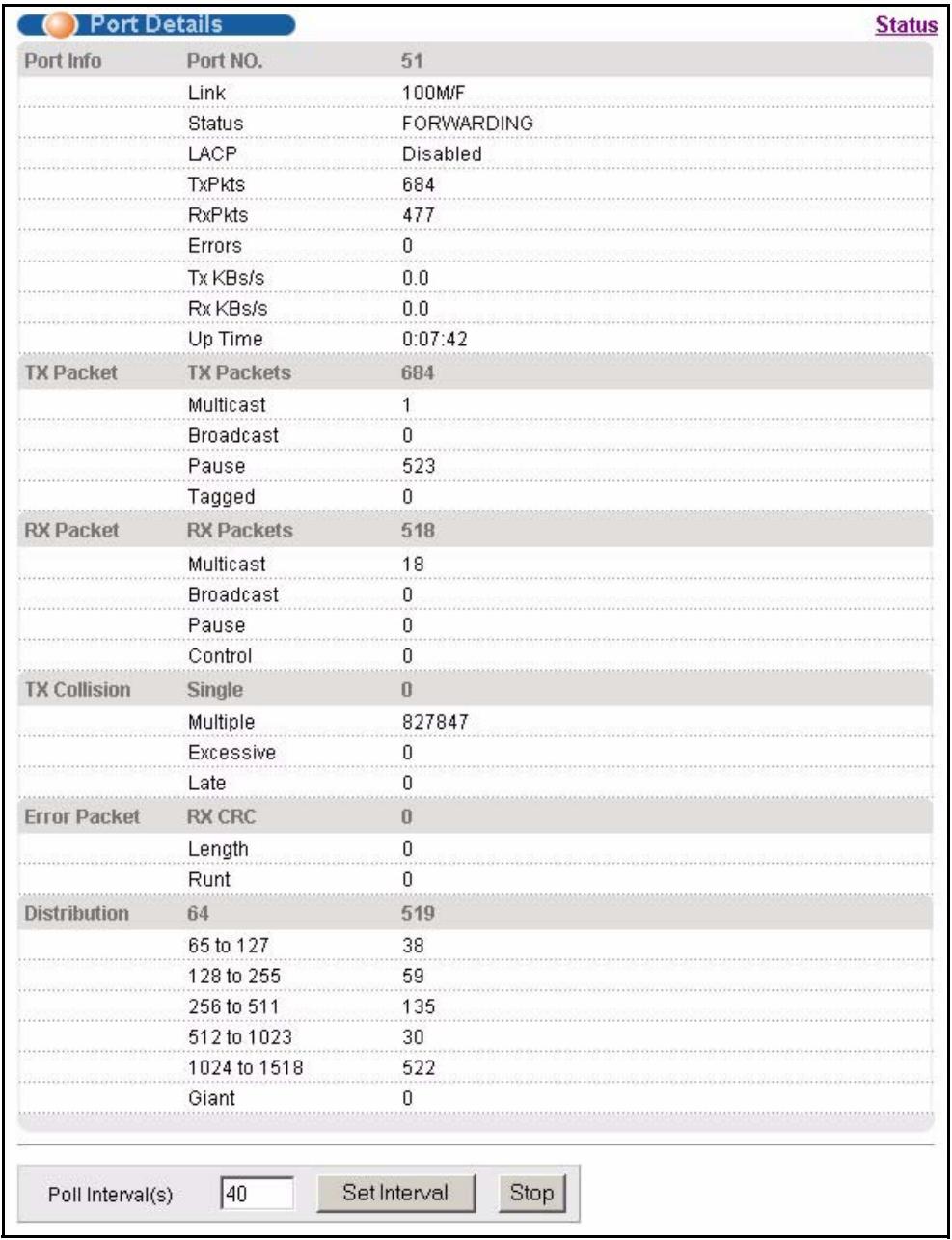
Figure 26 Status: Port Details
The following table describes the labels in this screen.
Table 7 Status: Port Details
| LABEL | DESCRIPTION |
| Port Info | |
| Link | This field shows whether the Ethernet connection is down, and the speed/duplex mode. It also shows the cable type (Copper or Fiber) for the combo ports. |
| Status | This field shows the training state of the ports. The states are FORWARDING (forwarding), which means the link is functioning normally or STOP (the port is stopped to break a loop or duplicate path). |
| LACP | This field shows if LACP is enabled on this port or not. |
| TxPkts | This field shows the number of transmitted frames on this port |
| RxPkts | This field shows the number of received frames on this port |
| Errors | This field shows the number of received errors on this port. |
| Tx KB/s | This field shows the number kilobytes per second transmitted on this port. |
| Rx KB/s | This field shows the number of kilobytes per second received on this port. |
| Up Time | This field shows the total amount of time the connection has been up. |
| Tx PacketThe following fields display detailed information about packets transmitted. | |
| TX Packet | This field shows the number of good packets (unicast, multicast and broadcast) transmitted. |
| Multicast | This field shows the number of good multicast packets transmitted. |
| Broadcast | This field shows the number of good broadcast packets transmitted. |
| Pause | This field shows the number of 802.3x Pause packets transmitted. |
| Tagged | This field shows the number of packets with VLAN tags transmitted. |
| Rx PacketThe following fields display detailed information about packets received. | |
| RX Packet | This field shows the number of good packets (unicast, multicast and broadcast) received. |
| Multicast | This field shows the number of good multicast packets received. |
| Broadcast | This field shows the number of good broadcast packets received. |
| Pause | This field shows the number of 802.3x Pause packets received. |
| Control | This field shows the number of control received (including those with CRC error) but it does not include the 802.3x Pause frames. |
| TX CollisionThe following fields display information on collisions while transmitting. | |
| Single | This is a count of successfully transmitted frames for which transmission is inhibited by exactly one collision. |
| Multiple | This is a count of successfully transmitted frames for which transmission was inhibited by more than one collision. |
| Excessive | This is a count of frames for which transmission failed due to excessive collisions. Excessive collision is defined as the number of maximum collisions before the retransmission count is reset. |
| Late | This is the number of times a late collision is detected, that is, after 512 bits of the frame have already been transmitted. |
| Error Packet | |
| RX CRC | This field shows the number of packets received with CRC (Cyclic Redundant Check) error(s). |
| Length | This field shows the number of frames received with a length that was out of range. |
| Runt | This field shows the number of packets received that were too short (shorter than 64 octets), including the ones with CRC errors. |
| Distribution | |
| 64 | This field shows the number of packets (including bad packets) received that were 64 octets in length. |
| 65-127 | This field shows the number of packets (including bad packets) received that were between 65 and 127 octets in length. |
| 128-255 | This field shows the number of packets (including bad packets) received that were between 128 and 255 octets in length. |
| 256-511 | This field shows the number of packets (including bad packets) received that were between 256 and 511 octets in length. |
| 512-1023 | This field shows the number of packets (including bad packets) received that were between 512 and 1023 octets in length. |
| 1024-1518 | This field shows the number of packets (including bad packets) received that were between 1024 and 1518 octets in length. |
| Giant | This field shows the number of packets dropped because they were bigger than the maximum frame size. |
| Poll Interval(s) | The text box displays how often (in seconds) this screen refreshes. You may change the refresh interval by typing a new number in the text box and then clicking Set Interval. |
| Stop | Click Stop to stop port statistic polling. |
CHAPTER 7 Basic Setting
This chapter describes how to configure the System Info, General Setup, Switch Setup, IP Setup and Port Setup screens.
7.1 Overview
The System Info screen displays general switch information (such as firmware version number) and hardware polling information (such as fan speeds). The General Setup screen allows you to configure general switch identification information. The General Setup screen also allows you to set the system time manually or get the current time and date from an external server when you turn on your switch. The real time is then displayed in the switch logs. The Switch Setup screen allows you to set up and configure global switch features. The IP Setup screen allows you to configure a switch IP address, subnet mask(s) and DNS (domain name server) for management purposes.
7.2 System Information
In the navigation panel, click Basic Setting and System Info to display the screen as shown. You can check the firmware version number and monitor the switch temperature, fan speeds and voltage in this screen.
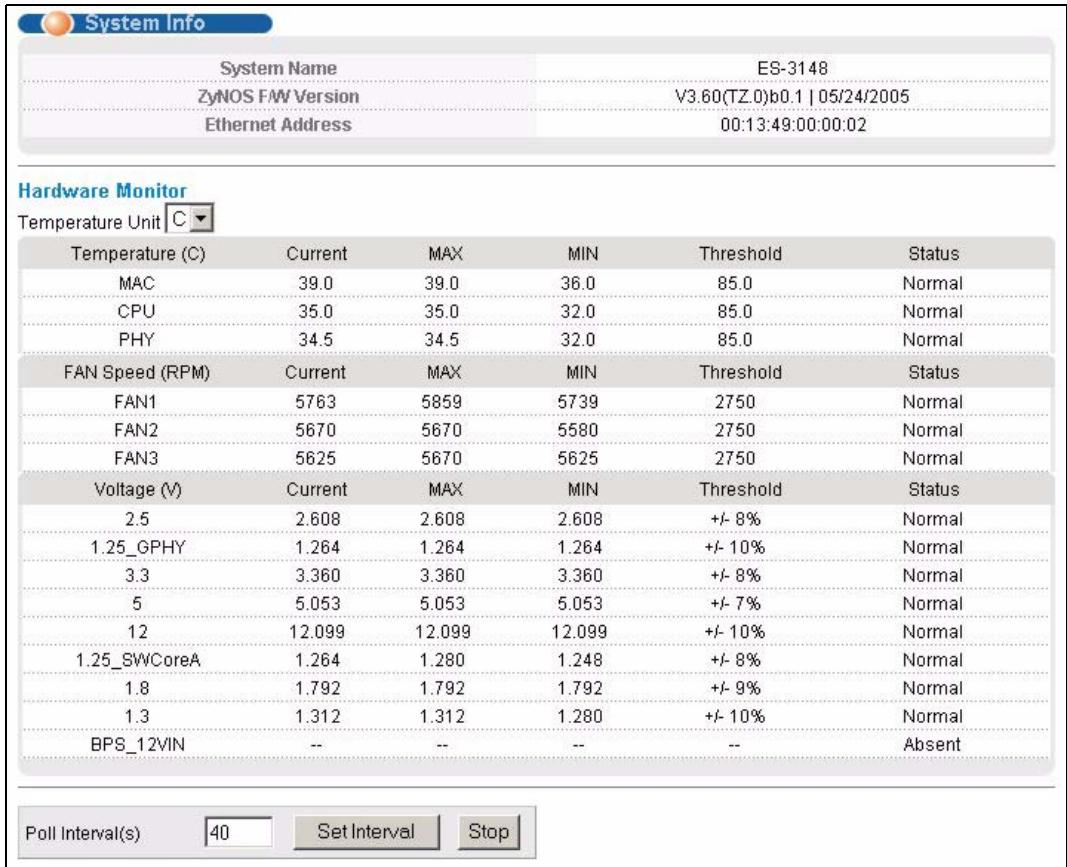
Figure 27 System Info
The following table describes the labels in this screen.
Table 8 System Info
| LABEL | DESCRIPTION |
| System Name | This field displays the descriptive name of the switch for identification purposes. |
| ZyNOS F/W Version | This field displays the version number of the switc 's current firmware including the date created. |
| Ethernet Address | This field refers to the Ethernet MAC (Media Access Control) address of the switch. |
| Hardware Monitor | |
| Temperature Unit | The switch has temperature sensors that are capable of detecting and reporting if the temperature rises above the threshold. You may choose the temperature unit (Centigrade or Fahrenheit) in this field. |
| Temperature | MAC, CPU and PHY refer to the location of the temperature sensors on the switch printed circuit board. |
| Current | This field displays the current temperature measured at this sensor. |
| MAX | This field displays the maximum temperature measured at this sensor. |
| MIN | This field displays the minimum temperature measured at this sensor. |
| Threshold | This field displays the upper temperature limit at this sensor. |
| Status | This field displays Normal for temperatures below the threshold and Error for those above. |
| Fan speed (RPM) | A properly functioning fan is an essential component (along with a sufficiently ventilated, cool operating environment) in order for the device to stay within the temperature threshold. Each fan has a sensor that is capable of detecting and reporting if the fan speed falls below the threshold shown. |
| Current | This field displays this fan's current speed in Revolutions Per Minute (RPM). |
| MAX | This field displays this fan's maximum speed measured in Revolutions Per Minute (RPM). |
| MIN | This field displays this fan's minimum speed measured in Revolutions Per Minute (RPM). "<41" is displayed for speeds too small to measure (under 2000 RPM). |
| Threshold | This field displays the minimum speed at which a normal fan should work. |
| Status | Normal indicates that this fan is functioning above the minimum speed. Error indicates that this fan is functioning below the minimum speed. |
| Voltage (V) | The power supply for each voltage has a sensor that is capable of detecting and reporting if the voltage falls out of the tolerance range. |
| Current | This is the current voltage reading. |
| MAX | This field displays the maximum voltage measured at this point. |
| MIN | This field displays the minimum voltage measured at this point. |
| Threshold | This field displays the minimum voltage at which the switch should work. |
| Status | Normal indicates that the voltage is within an acceptable operating range at this point; otherwise Error is displayed. |
| Poll Interval(s) | The text box displays how often (in seconds) this screen refreshes. You may change the refresh interval by typing a new number in the text box and then clicking Set Interval. |
| Stop | Click Stop to halt statistic polling. |
7.3 General Setup
Click Basic Setting and General Setup in the navigation panel to display the screen as shown.
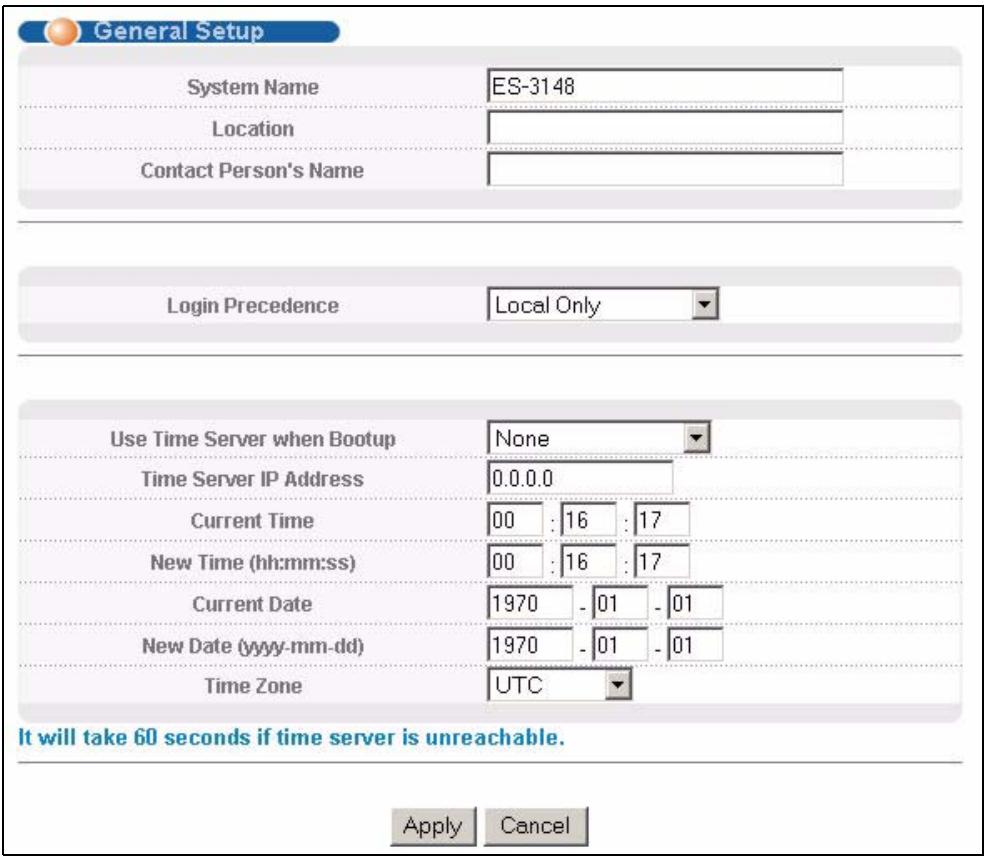
Figure 28 General Setup
The following table describes the labels in this screen.
Table 9 General Setup
| LABEL | DESCRIPTION |
| System Name | Choose a descriptive name for identification purposes. This name consists of up to 32 printable characters; spaces not allowed. |
| Location | Enter the geographic location of your switch. You can use up to 32 printable ASCII characters; spaces are not allowed. |
| Contact Person's Name | Enter the name of the person in charge of this switch. You can use up to 32 printable ASCII characters; spaces are not allowed. |
| Login Precedence | Use this drop-down list box to select which database the switch should use (first) to authenticate an administrator (user for switch management).Configure the local user accounts in the Access Control Logins screen. The RADIUS is an external server. Before you specify the priority, make sure you have set up the corresponding database correctly first.Select Local Only to have the switch just check the administrator accounts configured in the Access Control Logins screen.Select Local then RADIUS to have the switch check the administrator accounts configured in the Access Control Logins screen. If the user name is not found, the switch then checks the user database on the specified RADIUS server. You need to configure Port Authentication Radius first.Select RADIUS Only to have the switch just check the user database on the specified RADIUS server for a login username and password. |
| Use Time Server when Bootup | Enter the time service protocol that your timeserver uses. Not all time servers support all protocols, so you may have to use trial and error to find a protocol that works. The main differences between them are the time format.When you select the Daytime (RFC 867) format, the switch displays the day, month, year and time with no time zone adjustment. When you use this format it is recommended that you use a Daytime timeserver within your geographical time zone.Time (RFC-868) format displays a 4-byte integer giving the total number of seconds since 1970/1/1 at 0:0:0.NTP (RFC-1305) is similar to Time (RFC-868).None is the default value. Enter the time manually. Each time you turn on the switch, the time and date will be reset to 1970-1-1 0:0. |
| Time Server IP Address | Enter the IP address of your timeserver. The switch searches for the timeserver for up to 60 seconds. If you select a timeserver that is unreachable, then this screen will appear locked for 60 seconds. Please wait. |
| Current Time | This field displays the time you open this menu (or refresh the menu). |
| New Time (hh:min:ss) | Enter the new time in hour, minute and second format. The new time then appears in the Current Time field after you click Apply. |
| Current Date | This field displays the date you open this menu. |
| New Date (yyyy-mm-dd) | Enter the new date in year, month and day format. The new date then appears in the Current Date field after you click Apply. |
| Time Zone | Select the time difference between UTC (Universal Time Coordinated, formerly known as GMT, Greenwich Mean Time) and your time zone from the drop-down list box. |
| Apply | Click Apply to save the settings. |
| Cancel | Click Cancel to reset the fields to your previous configuration. |
7.4 Introduction to VLANs
A VLAN (Virtual Local Area Network) allows a physical network to be partitioned into multiple logical networks. Devices on a logical network belong to one group. A device can belong to more than one group. With VLAN, a device cannot directly talk to or hear from devices that are not in the same group(s); the traffic must first go through a router.
In MTU (Multi-Tenant Unit) applications, VLAN is vital in providing isolation and security among the subscribers. When properly configured, VLAN prevents one subscriber from accessing the network resources of another on the same LAN, thus a user will not see the printers and hard disks of another user in the same building.
VLAN also increases network performance by limiting broadcasts to a smaller and more manageable logical broadcast domain. In traditional switched environments, all broadcast packets go to each and every individual port. With VLAN, all broadcasts are confined to a specific broadcast domain.
Note: VLAN is unidirectional; it only governs outgoing traffic.
See Chapter 8 on page 77 for information on port-based and 802.1Q tagged VLANs.
7.5 Switch Setup Screen
Click Basic Setting and then Switch Setup in the navigation panel to display the screen as shown. The VLAN setup screens change depending on whether you choose 802.1Q or Port Based in the VLAN Type field in this screen. Refer to the chapter on VLAN.
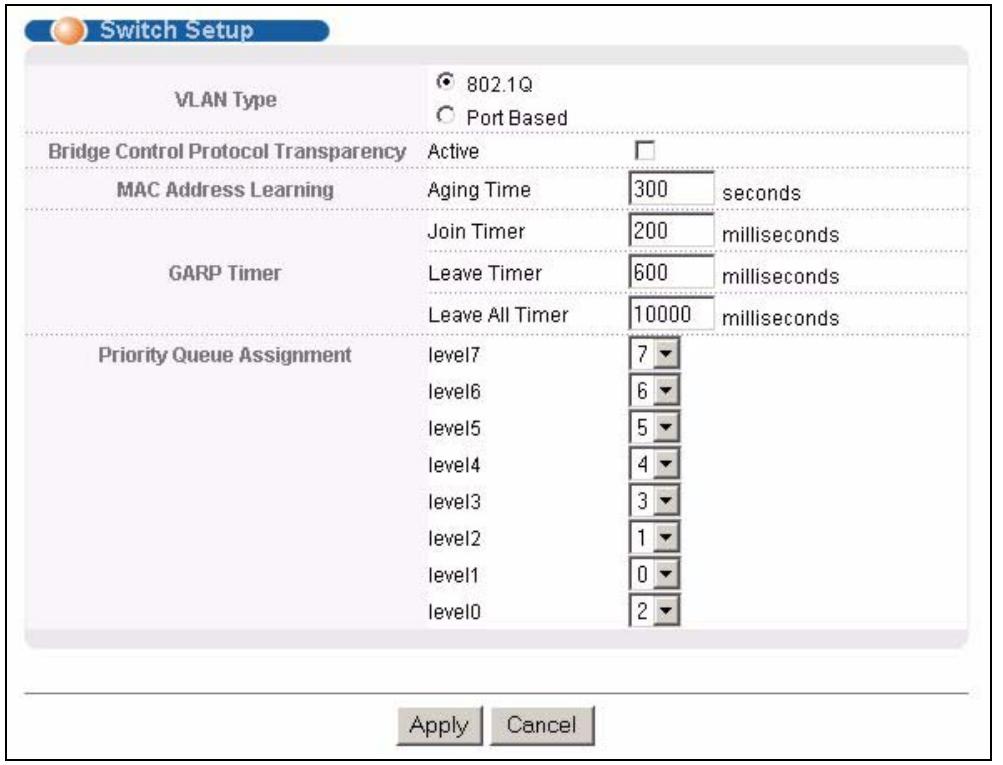
Figure 29 Switch Setup
The following table describes the labels in this screen.
Table 10 Switch Setup
| LABEL | DESCRIPTION |
| VLAN Type | Choose 802.1Q or Port Based. The VLAN Setup screen changes depending on whether you choose 802.1Q VLAN type or Port Based VLAN type in this screen. See Chapter 8 on page 77 for more information. |
| Bridge Control Protocol Transparency | Select Active to allow the switch to handle bridging control protocols (STP for example). You also need to define how to treat a BPDU in the Port Setup screen. |
| MAC Address Learning | MAC address learning reduces outgoing traffic broadcasts. For MAC address learning to occur on a port, the port must be active. |
| Aging Time | Enter a time from 10 to 3000 seconds. This is how long all dynamically learned MAC addresses remain in the MAC address table before they age out (and must be relearned). |
| GARP Timer: Switches join VLANs by making a declaration. A declaration is made by issuing a Join message using GARP. Declarations are withdrawn by issuing a Leave message. A Leave All message terminates all registrations. GARP timers set declaration timeout values. See the chapter on VLAN setup for more background information. | |
| Join Timer | Join Timer sets the duration of the Join Period timer for GVRP in milliseconds. Each port has a Join Period timer. The allowed Join Time range is between 100 and 65535 milliseconds; the default is 200 milliseconds. See the chapter on VLAN setup for more background information. |
| Leave Timer | Leave Time sets the duration of the Leave Period timer for GVRP in milliseconds. Each port has a single Leave Period timer. Leave Time must be two times larger than Join Timer; the default is 600 milliseconds. |
| Leave All Timer | Leave All Timer sets the duration of the Leave All Period timer for GVRP in milliseconds. Each port has a single Leave All Period timer. Leave All Timer must be larger than Leave Timer. |
| Priority Queue Assignment IEEE 802.1p defines up to eight separate traffic types by inserting a tag into a MAC-layer frame that contains bits to define class of service. Frames without an explicit priority tag are given the default priority of the ingress port. Use the next two fields to configure the priority level-to-physical queue mapping. The switch has eight physical queues that you can map to the 8 priority levels. On the switch, traffic assigned to higher index queues gets through faster while traffic in lower index queues is dropped if the network is congested. | |
| Priority Level (The following descriptions are based on the traffic types defined in the IEEE 802.1d standard (which incorporates the 802.1p). | |
| Level 7 | Typically used for network control traffic such as router configuration messages. |
| Level 6 | Typically used for voice traffic that is especially sensitive to jitter (jitter is the variations in delay). |
| Level 5 | Typically used for video that consumes high bandwidth and is sensitive to jitter. |
| Level 4 | Typically used for controlled load, latency-sensitive traffic such as SNA (Systems Network Architecture) transactions. |
| Level 3 | Typically used for “excellent effort” or better than best effort and would include important business traffic that can tolerate some delay. |
| Level 2 | This is for “spare bandwidth”. |
| Level 1 | This is typically used for non-critical “background” traffic such as bulk transfers that are allowed but that should not affect other applications and users. |
| Level 0 | Typically used for best-effort traffic. |
| Apply | Click Apply to save the settings. |
| Cancel | Click Cancel to reset the fields to your previous configuration. |
7.6 IP Setup
Use the IP Setup screen to configure the default gateway device, the default domain name server and add switch IP address.
7.6.1 Management IP Addresses
The switch needs an IP address for it to be managed over the network. The factory default IP address is 192.168.1.1. The subnet mask specifies the network number portion of an IP address. The factory default subnet mask is 255.255.255.0.
You can configure up to 64 IP addresses which are used to access and manage the switch from the ports belonging to the pre-defined VLAN(s).
Note: You must configure a VLAN first.
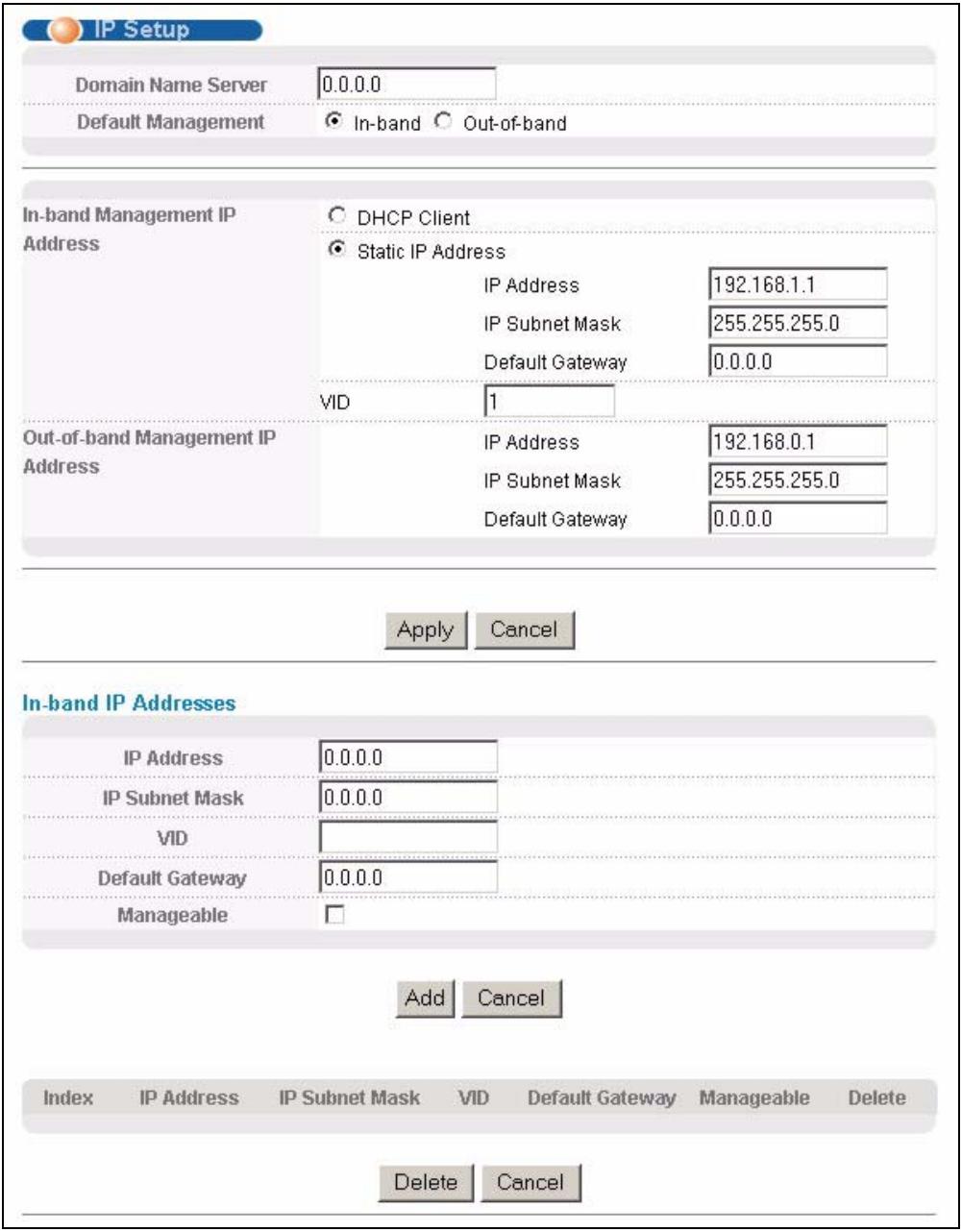
Figure 30 IP Setup
The following table describes the labels in this screen.
Table 11 IP Setup
| LABEL | DESCRIPTION |
| Domain Name Server | DNS (Domain Name System) is for mapping a domain name to its corresponding IP address and vice versa. Enter a domain name server IP address in order to be able to use a domain name instead of an IP address. |
| Default Management | Specify which traffic flow (In-Band or Out-of-band) the switch is to send packets originating from itself (such as SNMP traps) or packets with unknown source. Select Out-of-band to have the switch send the packets to the out-of-band management port. This means that device(s) connected to the other port(s) do not receive these packets. Select In-Band to have the switch send the packets to all ports except the out-of-band management port to which connected device(s) do not receive these packets. |
| In-band Management IP Address | |
| DHCP Client | Select this option if you have a DHCP server that can assign the switch an IP address, subnet mask, a default gateway IP address and a domain name server IP address automatically. |
| Static IP Address | Select this option if you don't have a DHCP server or if you wish to assign static IP address information to the switch. You need to fill in the following fields when you select this option. |
| IP Address | Enter the IP address of your switch in dotted decimal notation for example 192.168.1.1. |
| IP Subnet Mask | Enter the IP subnet mask of your switch in dotted decimal notation for example 255.255.255.0. |
| Default Gateway | Enter the IP address of the default outgoing gateway in dotted decimal notation, for example 192.168.1.254. |
| VID | Enter the VLAN identification number associated with the switch IP address. VID is the VLAN ID of the CPU and is used for management only. The default is "1". All ports, by default, are fixed members of this "management VLAN" in order to manage the device from any port. If a port is not a member of this VLAN, then users on that port cannot access the device. To access the switch make sure the port that you are connected to is a member of Management VLAN. |
| Out-of-band Management IP Address | |
| IP Address | Enter the IP address of your switch in dotted decimal notation for example 192.168.0.1. If you change this IP address, make sure the computer connected to this management port is in the same subnet before accessing the switch. |
| IP Subnet Mask | Enter the IP subnet mask of your switch in dotted decimal notation for example 255.255.255.0. |
| Default Gateway | Enter the IP address of the default outgoing gateway in dotted decimal notation, for example 192.168.0.254. |
| Apply | Click Apply to save your changes back to the switch. |
| Cancel | Click Cancel to begin configuring the fields again. |
| In-band IP Addresses | You can create up to 64 IP addresses which are used to access and manage the switch from the ports belonging to the pre-defined VLAN(s). You must configure a VLAN first. |
| IP Address | Enter the IP address for managing the switch by the members of the VLAN specified in the VID field below. |
| IP Subnet Mask | Enter the IP subnet mask in dotted decimal notation. |
| VID | Type the VLAN group identification number. |
| Default Gateway | Enter the IP address of the default outgoing gateway in dotted decimal notation. |
| Manageable | Select this option to allow the switch to be managed using this specified IP address. |
| Add | Click Add to save the new rule to the switch. It then displays in the summary table at the bottom of the screen. |
| Cancel | Click Cancel to reset the fields to your previous configuration. |
| Index | This field displays the index number of an entry. Click an index number to edit the rule. |
| IP Address | This field displays the IP address. |
| Subnet Mask | This field displays the subnet mask. |
| VID | This field displays the VLAN identification number of the network. |
| Default Gateway | This field displays the the IP address of the default outgoing gateway. |
| Manageable | This field displays whether the switch can be managed using the specified IP address. |
| Delete | Click Delete to remove the selected entry from the summary table. |
| Cancel | Click Cancel to clear the Delete check boxes. |
7.7 Port Setup
Click Basic Setting and then Port Setup in the navigation panel to enter the port configuration screen.
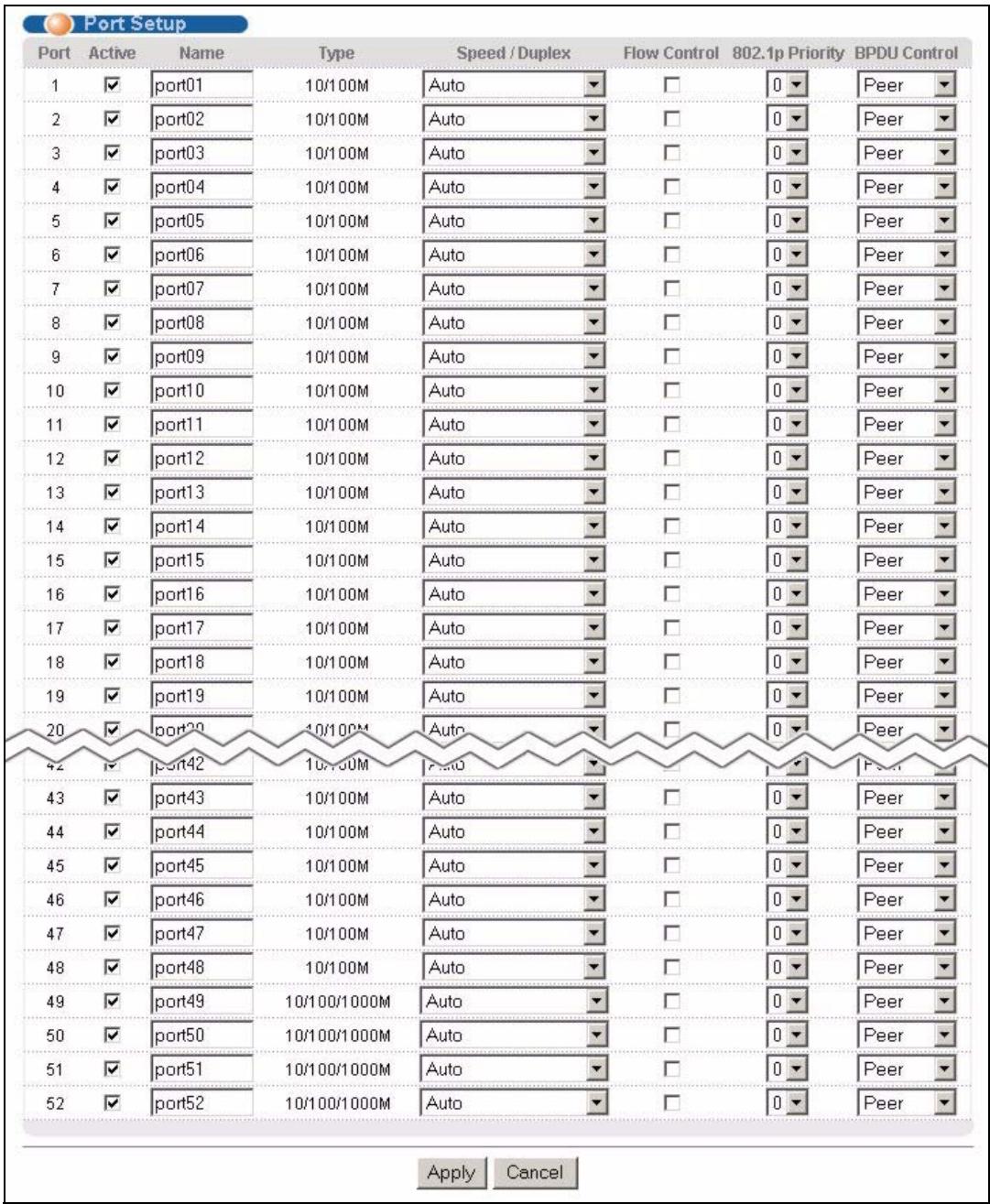
Figure 31 Port Setup
The following table describes the labels in this screen.
Table 12 Port Setup
| LABEL | DESCRIPTION |
| Port | This is the port index number. |
| Active | Select this check box to enable a port. The factory default for all ports is enabled. A port must be enabled for data transmission to occur. |
| Name | Enter a descriptive name that identifies this port. |
| Type | This field displays 10/100M for an Ethernet/Fast Ethernet connection and 10/100/1000M for Gigabit connections. |
| Speed/Duplex | Select the speed and the duplex mode of the Ethernet connection on this port. Choices are Auto, 10M/Half Duplex, 10M/Full Duplex, 100M/Half Duplex, 100M/Full Duplex and 1000M/Full Duplex (for Gigabit ports only). Selecting Auto (auto-negotiation) allows one port to negotiate with a peer port automatically to obtain the connection speed and duplex mode that both ends support. When auto-negotiation is turned on, a port on the switch negotiates with the peer automatically to determine the connection speed and duplex mode. If the peer port does not support auto-negotiation or turns off this feature, the switch determines the connection speed by detecting the signal on the cable and using half duplex mode. When the switch's auto-negotiation is turned off, a port uses the pre-configured speed and duplex mode when making a connection, thus requiring you to make sure that the settings of the peer port are the same in order to connect. |
| Flow Control | A concentration of traffic on a port decreases port bandwidth and overflows buffer memory causing packet discards and frame losses. Flow Control is used to regulate transmission of signals to match the bandwidth of the receiving port. The switch uses IEEE802.3x flow control in full duplex mode and backpressure flow control in half duplex mode. IEEE802.3x flow control is used in full duplex mode to send a pause signal to the sending port, causing it to temporarily stop sending signals when the receiving port memory buffers fill. Back Pressure flow control is typically used in half duplex mode to send a "collision" signal to the sending port (mimicking a state of packet collision) causing the sending port to temporarily stop sending signals and resend later. Select Flow Control to enable it. |
| 802.1p Priority | This priority value is added to incoming frames without a (802.1p) priority queue tag. See Priority Queue Assignment in Table 10 on page 70 for more information. |
| BPDU Control | Configure the way to treat BPDUs received on this port. You must activate bridging control protocol transparency in the Switch Setup screen first. Select Peer to process any BPDU (Bridge Protocol Data Units) received on this port. Select Tunnel to forward BPDUs received on this port. Select Discard to drop any BPDU received on this port. Select Network to process a BPDU with no VLAN tag and forward a tagged BPDU. |
| Apply | Click Apply to save the settings. |
| Cancel | Click Cancel to reset the fields to your previous configuration. |
CHAPTER 8 VLAN
The type of screen you see here depends on the VLAN Type you selected in the Switch Setup screen. This chapter shows you how to configure 802.1Q tagged and port-based VLANs.
8.1 Introduction to IEEE 802.1Q Tagged VLAN
A tagged VLAN uses an explicit tag (VLAN ID) in the MAC header to identify the VLAN membership of a frame across bridges - they are not confined to the switch on which they were created. The VLANs can be created statically by hand or dynamically through GVRP. The VLAN ID associates a frame with a specific VLAN and provides the information that switches need to process the frame across the network. A tagged frame is four bytes longer than an untagged frame and contains two bytes of TPID (Tag Protocol Identifier, residing within the type/length field of the Ethernet frame) and two bytes of TCI (Tag Control Information, starts after the source address field of the Ethernet frame).
The CFI (Canonical Format Indicator) is a single-bit flag, always set to zero for Ethernet switches. If a frame received at an Ethernet port has a CFI set to 1, then that frame should not be forwarded as it is to an untagged port. The remaining twelve bits define the VLAN ID, giving a possible maximum number of 4,096 (212) VLANs. Note that user priority and VLAN ID are independent of each other. A frame with VID (VLAN Identifier) of null (0) is called a priority frame, meaning that only the priority level is significant and the default VID of the ingress port is given as the VID of the frame. Of the 4096 possible VIDs, a VID of 0 is used to identify priority frames and value 4095 (FFF) is reserved, so the maximum possible VLAN configurations are 4,094.
| TPID 2 Bytes | User Priority 3 Bits | CFI 1 Bit | VLAN ID 12 bits |
8.1.1 Forwarding Tagged and Untagged Frames
Each port on the switch is capable of passing tagged or untagged frames. To forward a frame from an 802.1Q VLAN-aware switch to an 802.1Q VLAN-unaware switch, the switch first decides where to forward the frame and then strips off the VLAN tag. To forward a frame from an 802.1Q VLAN-unaware switch to an 802.1Q VLAN-aware switch, the switch first decides where to forward the frame, and then inserts a VLAN tag reflecting the ingress port's default VID. The default PVID is VLAN 1 for all ports, but this can be changed.
8.2 Automatic VLAN Registration
GARP and GVRP are the protocols used to automatically register VLAN membership across switches.
8.2.1 GARP
GARP (Generic Attribute Registration Protocol) allows network switches to register and de-register attribute values with other GARP participants within a bridged LAN. GARP is a protocol that provides a generic mechanism for protocols that serve a more specific application, for example, GVRP.
8.2.1.1 GARP Timers
Switches join VLANs by making a declaration. A declaration is made by issuing a Join message using GARP. Declarations are withdrawn by issuing a Leave message. A Leave All message terminates all registrations. GARP timers set declaration timeout values.
8.2.2 GVRP
GVRP (GARP VLAN Registration Protocol) is a registration protocol that defines a way for switches to register necessary VLAN members on ports across the network. Enable this function to permit VLANs groups beyond the local switch.
Please refer to the following table for common IEEE 802.1Q VLAN terminology.
Table 13 IEEE 802.1Q VLAN Terminology
| VLAN PARAMETER | TERM | DESCRIPTION |
| VLAN Type | Permanent VLAN | This is a static VLAN created manually. |
| Dynamic VLAN | This is a VLAN configured by a GVRP registration/deregistration process. | |
| VLAN Administrative Control | Registration Fixed | Fixed registration ports are permanent VLAN members. |
| Registration Forbidden | Ports with registration forbidden are forbidden to join the specified VLAN. | |
| Normal Registration | Ports dynamically join a VLAN using GVRP. | |
| VLAN Tag Control | Tagged | Ports belonging to the specified VLAN tag all outgoing frames transmitted. |
| Untagged | Ports belonging to the specified VLAN don't tag all outgoing frames transmitted. | |
| VLAN Port | Port VID | This is the VLAN ID assigned to untagged frames that this port received. |
| Acceptable frame type | You may choose to accept both tagged and untagged incoming frames or just tagged incoming frames on a port. | |
| Ingress filtering | If set, the switch discards incoming frames for VLANs that do not have this port as a member |
8.3 Port VLAN Trunking
Enable VLAN Trunking on a port to allow frames belonging to unknown VLAN groups to pass through that port. This is useful if you want to set up VLAN groups on end devices without having to configure the same VLAN groups on intermediary devices.
Refer to the following figure. Suppose you want to create VLAN groups 1 and 2 (V1 and V2) on devices A and B. Without VLAN Trunking, you must configure VLAN groups 1 and 2 on all intermediary switches C, D and E; otherwise they will drop frames with unknown VLAN group tags. However, with VLAN Trunking enabled on a port(s) in each intermediary switch you only need to create VLAN groups in the end devices (A and B). C, D and E automatically allow frames with VLAN group tags 1 and 2 (VLAN groups that are unknown to those switches) to pass through their VLAN trunking port(s).
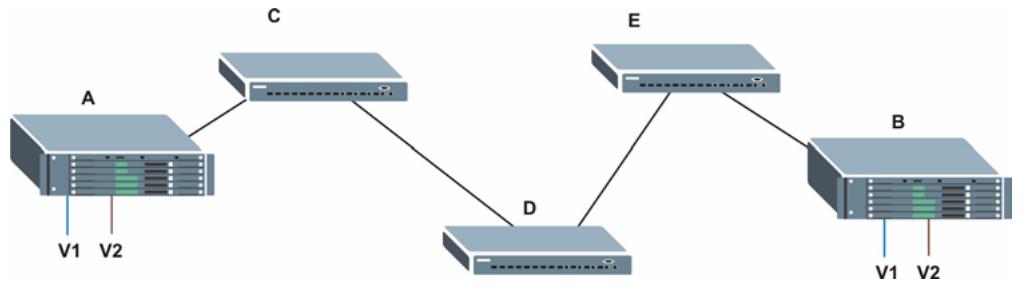
Figure 32 Port VLAN Trunking
8.4 Select the VLAN Type
1 Select a VLAN type in the Switch Setup screen.

Figure 33 Switch Setup: Select VLAN Type
8.5 Static VLAN
Use a static VLAN to decide whether an incoming frame on a port should be
- sent to a VLAN group as normal depends on its VLAN tag.
- sent to a group whether it has a VLAN tag or not.
- blocked from a VLAN group regardless of its VLAN tag.
You can also tag all outgoing frames (that were previously untagged) from a port with the specified VID.
8.5.1 Static VLAN Status
Click Advanced Application, VLAN from the navigation panel to display the VLAN Status screen as shown next.
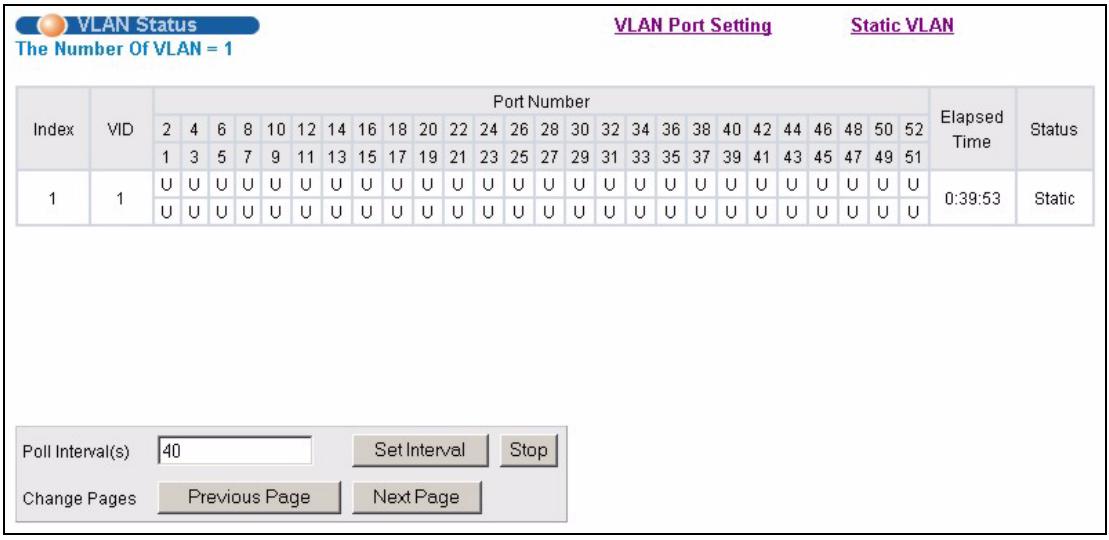
Figure 34 VLAN: VLAN Status
The following table describes the labels in this screen.
Table 14 VLAN: VLAN Status
| LABEL | DESCRIPTION |
| The Number of VLAN | This is the number of VLANs configured on the switch. |
| Index | This is the VLAN index number. |
| VID | This is the VLAN identification number that was configured in the Static VLAN screen. |
| Port Number | This column displays the ports that are participating in a VLAN. A tagged port is marked as T, an untagged port is marked as U and ports not participating in a VLAN are marked as “-”. |
| Elapsed Time | This field shows how long it has been since a normal VLAN was registered or a static VLAN was set up. |
| Status | This field shows how this VLAN was added to the switch; dynamically using GVRP or statically, that is, added as a permanent entry. |
| Poll Interval(s) | The text box displays how often (in seconds) this screen refreshes. You may change the refresh interval by typing a new number in the text box and then clicking Set Interval. |
| Stop | Click Stop to halt polling statistics. |
| Change Pages | Click Previous Page or Next Page to show the previous/next screen if all status information cannot be seen in one screen. |
8.5.2 Configure a Static VLAN
To configure a static VLAN, click Static VLAN in the VLAN Status screen to display the screen as shown next.
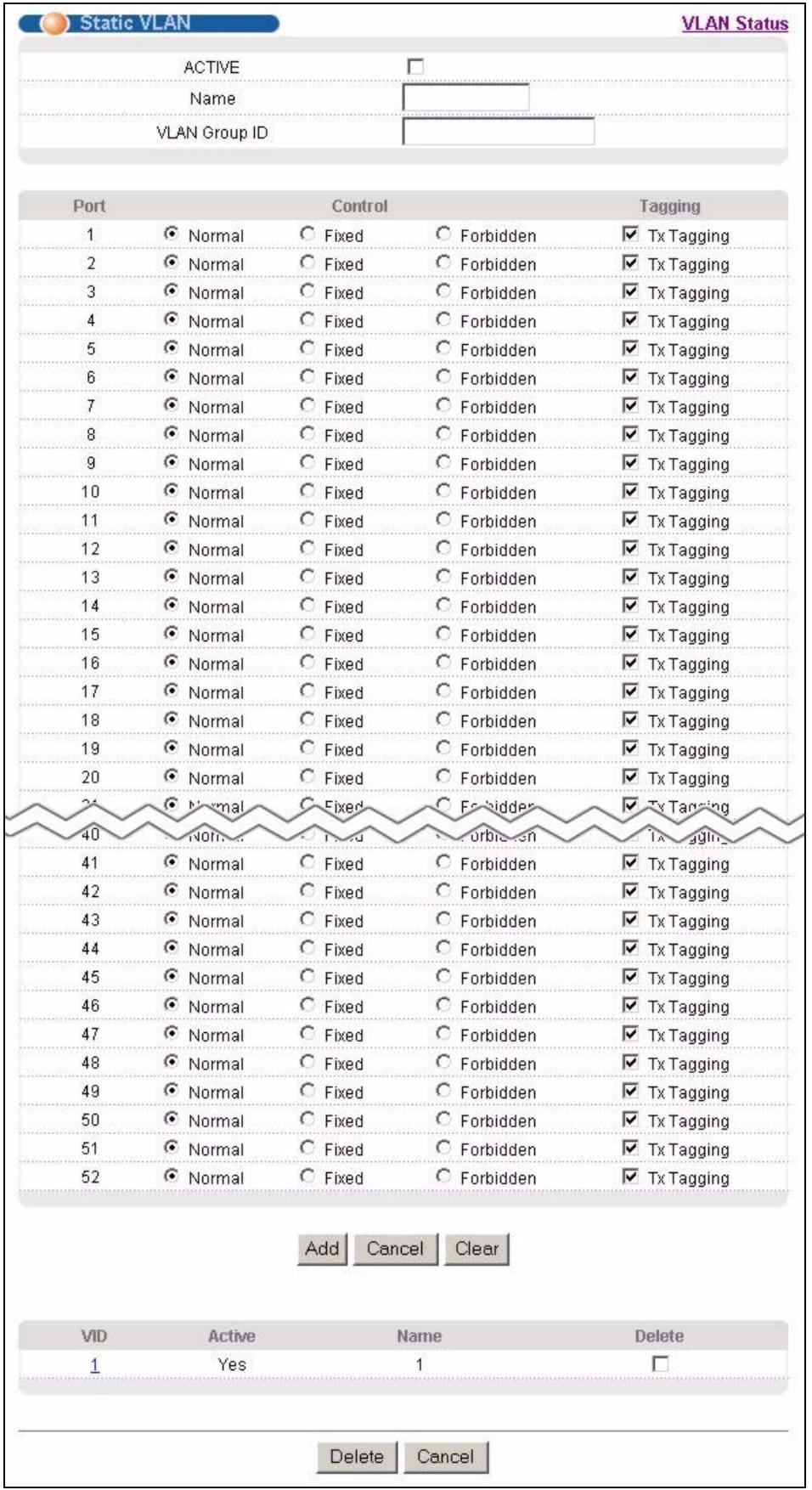
Figure 35 VLAN: Static VLAN
The following table describes the related labels in this screen.
Table 15 VLAN: Static VLAN
| LABEL | DESCRIPTION |
| ACTIVE | Select this check box to activate the VLAN settings. |
| Name | Enter a descriptive name for the VLAN group for identification purposes. |
| VLAN Group ID | Enter the VLAN ID for this static entry; the valid range is between 1 and 4094. |
| Port | The port number identifies the port you are configuring. |
| Control | Select Normal for the port to dynamically join this VLAN group using GVRP. This is the default selection. Select Fixed for the port to be a permanent member of this VLAN group. Select Forbidden if you want to prohibit the port from joining this VLAN group. |
| Tagging | Select TX Tagging if you want the port to tag all outgoing frames transmitted with this VLAN Group ID. |
| Add | Click Add to add the settings as a new entry in the summary table below. |
| Cancel | Click Cancel to reset the fields. |
| Clear | Click Clear to start configuring the screen again. |
| VID | This field displays the ID number of the VLAN group. Click the number to edit the VLAN settings. |
| Active | This field indicates whether the VLAN settings are enabled (Yes) or disabled (No). |
| Name | This field displays the descriptive name for this VLAN group. |
| Delete | Click Delete to remove the selected entry from the summary table. |
| Cancel | Click Cancel to clear the Delete check boxes. |
8.5.3 Configure VLAN Port Settings
To configure the VLAN settings on a port, click the VLAN Port Setting link in the VLAN Status screen.
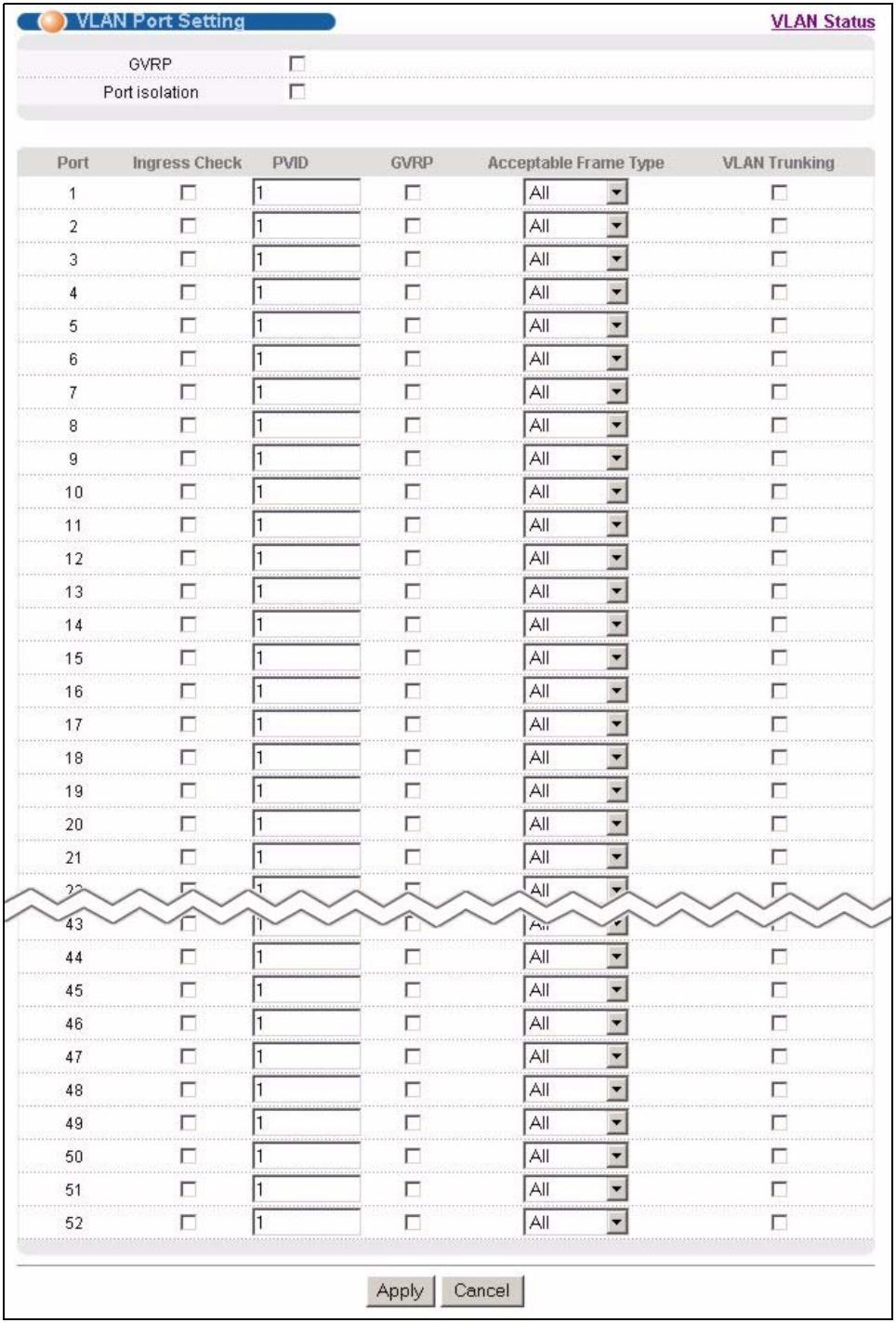
Figure 36 VLAN: VLAN Port Setting
The following table describes the labels in this screen.
Table 16 VLAN: VLAN Port Setting
| LABEL | DESCRIPTION |
| GVRP | GVRP (GARP VLAN Registration Protocol) is a registration protocol that defines a way for switches to register necessary VLAN members on ports across the network. Select this check box to permit VLAN groups beyond the local switch. |
| Port Isolation | Port Isolation allows each port (1 to 26) to communicate only with the CPU management port but not communicate with each other. All incoming ports are selected while only the CPU outgoing port is selected. This option is the most limiting but also the most secure. |
| Port | This field displays the port number. |
| Ingress Check | If this check box is selected for a port, the device discards incoming frames for VLANs that do not include this port in its member set. Clear this check box to disable ingress filtering. |
| PVID | Enter a number between 1 and 4094 as the port VLAN ID. |
| GVRP | Select this check box to allow GVRP on this port. |
| Acceptable Frame Type | Specify the type of frames allowed on a port. Choices are All and Tag Only. Select All from the drop-down list box to accept all untagged or tagged frames on this port. This is the default setting. Select Tag Only to accept only tagged frames on this port. All untagged frames will be dropped. |
| VLAN Trunking | Enable VLAN Trunking on ports connected to other switches or routers (but not ports directly connected to end users) to allow frames belonging to unknown VLAN groups to pass through the switch. |
| Apply | Click Apply to save the changes |
| Cancel | Click Cancel to start configuring the screen again. |
8.6 Port-based VLAN Setup
Port-based VLANs are VLANs where the packet forwarding decision is based on the destination MAC address and its associated port.
Port-based VLANs require allowed outgoing ports to be defined for each port. Therefore, if you wish to allow two subscriber ports to talk to each other, for example, between conference rooms in a hotel, you must define the egress (an egress port is an outgoing port, that is, a port through which a data packet leaves) for both ports.
Port-based VLANs are specific only to the switch on which they were created.
Note: When you activate port-based VLAN, the switch uses a default VLAN ID of 1. You cannot change it.
In screens (such as IP Setup and Filtering) that require a VID, you must enter 1 as the VID.
The port-based VLAN setup screen is shown next. The CPU management port forms a VLAN with all Ethernet ports.
8.6.1 Configure a Port-based VLAN
Select Port Based as the VLAN Type in the Switch Setup screen (see Figure 33 on page 80) and then click VLAN from the navigation panel to display the next screen.
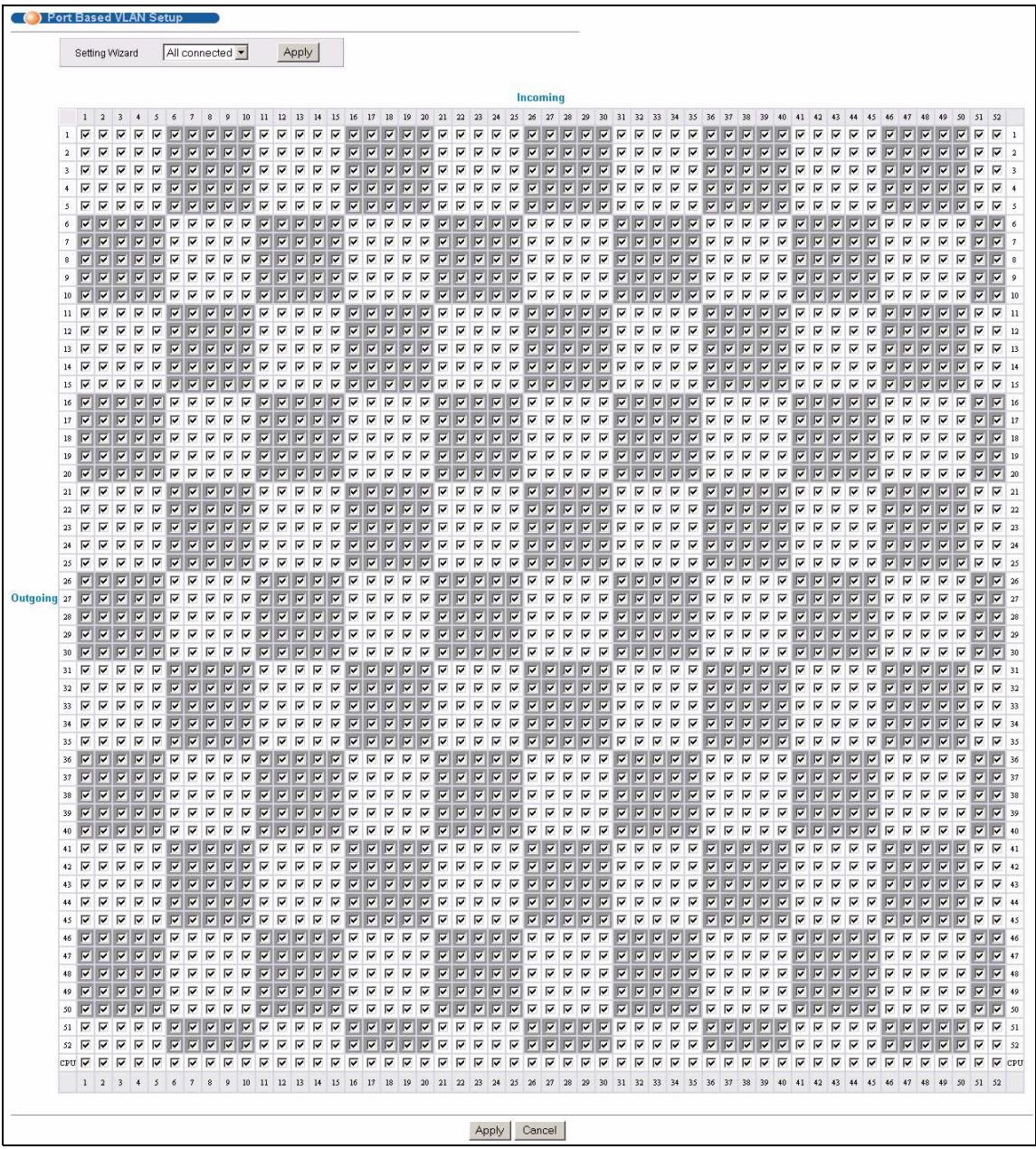
Figure 37 Port Based VLAN Setup (All Connected)
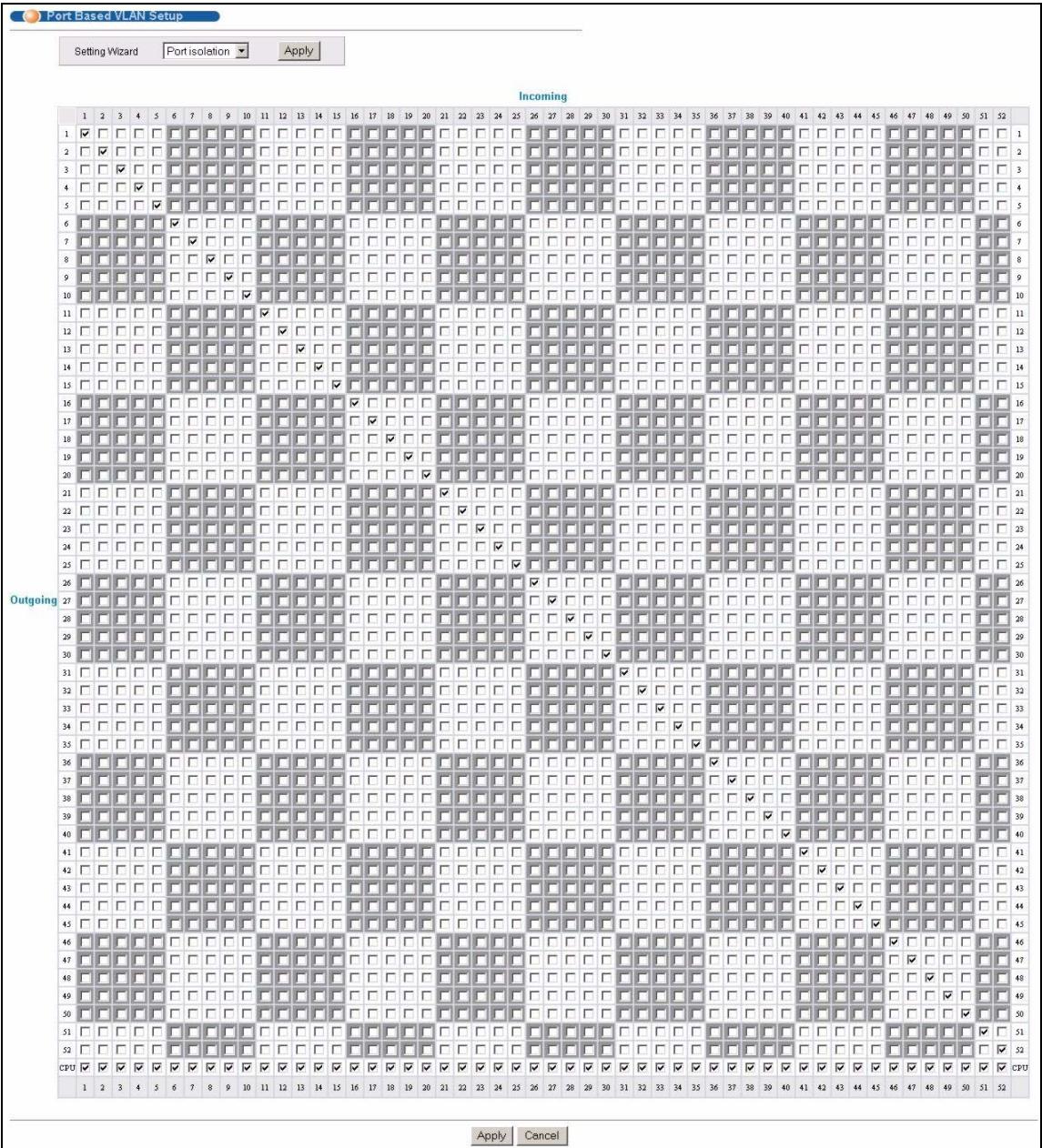
Figure 38 Port Based VLAN Setup (Port Isolation)
The following table describes the labels in this screen.
Table 17 Port Based VLAN Setup
| LABEL | DESCRIPTION |
| Setting Wizard | Choose All connected or Port isolation.All connected means all ports can communicate with each other, that is, there are no virtual LANs. All incoming and outgoing ports are selected. This option is the most flexible but also the least secure.Port isolation means that each port can only communicate with the CPU management port and cannot communicate with each other. All incoming ports are selected while only the CPU outgoing port is selected. This option is the most limiting but also the most secure.After you make your selection, click Apply (top right of screen) to display the screens as mentioned above. You can still customize these settings by adding/deleting incoming or outgoing ports, but you must also click Apply at the bottom of the screen. |
| Incoming | These are the ingress ports; an ingress port is an incoming port, that is, a port through which a data packet enters. If you wish to allow two subscriber ports to talk to each other, you must define the ingress port for both ports. The numbers in the top row denote the incoming port for the corresponding port listed on the left (its outgoing port).CPU refers to the switch management port. By default it forms a VLAN with all Ethernet ports. If it does not form a VLAN with a particular port then the switch cannot be managed from that port. |
| Outgoing | These are the egress ports; an egress port is an outgoing port, that is, a port through which a data packet leaves. If you wish to allow two subscriber ports to talk to each other, you must define the egress port for both ports. CPU refers to the switch management port. By default it forms a VLAN with all Ethernet ports. If it does not form a VLAN with a particular port then the switch cannot be managed from that port. |
| Apply | Click Apply to save the changes. |
| Cancel | Click Cancel to start configuring the screen again. |
CHAPTER 9
Static MAC Forwarding
Use these screens to configure static MAC address forwarding.
9.1 Overview
A static MAC address is an address that has been manually entered in the MAC address table. Static MAC addresses do not age out. When you set up static MAC address rules, you are setting static MAC addresses for a port. This may reduce the need for broadcasting.
Static MAC address forwarding together with port security allow only computers in the MAC address table on a port to access the switch. See Chapter 17 on page 121 for more information on port security.
9.2 Configuring Static MAC Forwarding
Click Advanced Applications, Static MAC Forwarding in the navigation panel to display the configuration screen as shown.
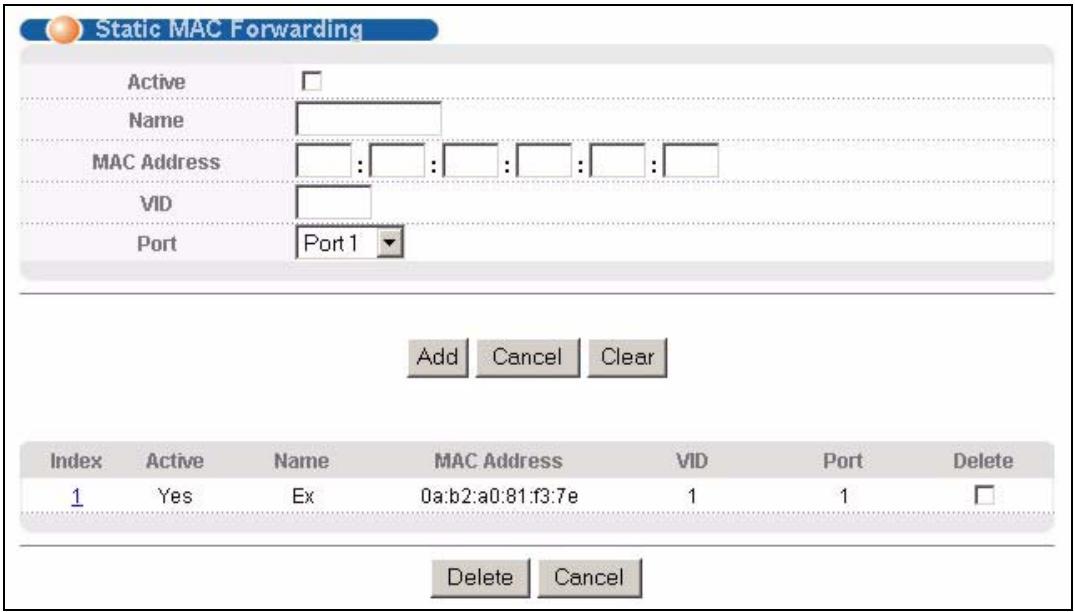
Figure 39 Static MAC Forwarding
The following table describes the labels in this screen.
Table 18 Static MAC Forwarding
| LABEL | DESCRIPTION |
| Active | Select this check box to activate your rule. You may temporarily deactivate a rule without deleting it by clearing this check box. |
| Name | Enter a descriptive name for identification purposes for this static MAC address forwarding rule. |
| MAC Address | Enter the MAC address in valid MAC address format, that is, six hexadecimal character pairs.Note: Static MAC addresses do not age out. |
| VID | Enter the VLAN identification number. |
| Port | Select a port where the MAC address entered in the previous field will be automatically forwarded. |
| Add | After you set the fields above, click Add to insert a new rule. |
| Cancel | Click Cancel to reset the fields. |
| Clear | Click Clear to begin configuring this screen afresh. |
| Index | Click an index number to modify a static MAC address rule for a port. |
| Active | This field displays whether this static MAC address forwarding rule is active (Yes) or not (No). You may temporarily deactivate a rule without deleting it. |
| Name | This field displays the descriptive name for identification purposes for this static MAC address-forwarding rule. |
| MAC Address | This field displays the MAC address that will be forwarded and the VLAN identification number to which the MAC address belongs. |
| VID | This field displays the ID number of the VLAN group. |
| Port | This field displays the port where the MAC address shown in the next field will be forwarded. |
| Delete | Click Delete to remove the selected entry from the summary table. |
| Cancel | Click Cancel to clear the Delete check boxes. |
CHAPTER 10 Filtering
This chapter discusses static IP and MAC address port filtering.
10.1 Introduction to Filtering
Filtering means sifting traffic going through the switch based on the source and/or destination MAC addresses and VLAN group (ID).
10.2 Configure a Filtering Rule
Click Advanced Application and Filtering in the navigation panel to display the screen as shown next.
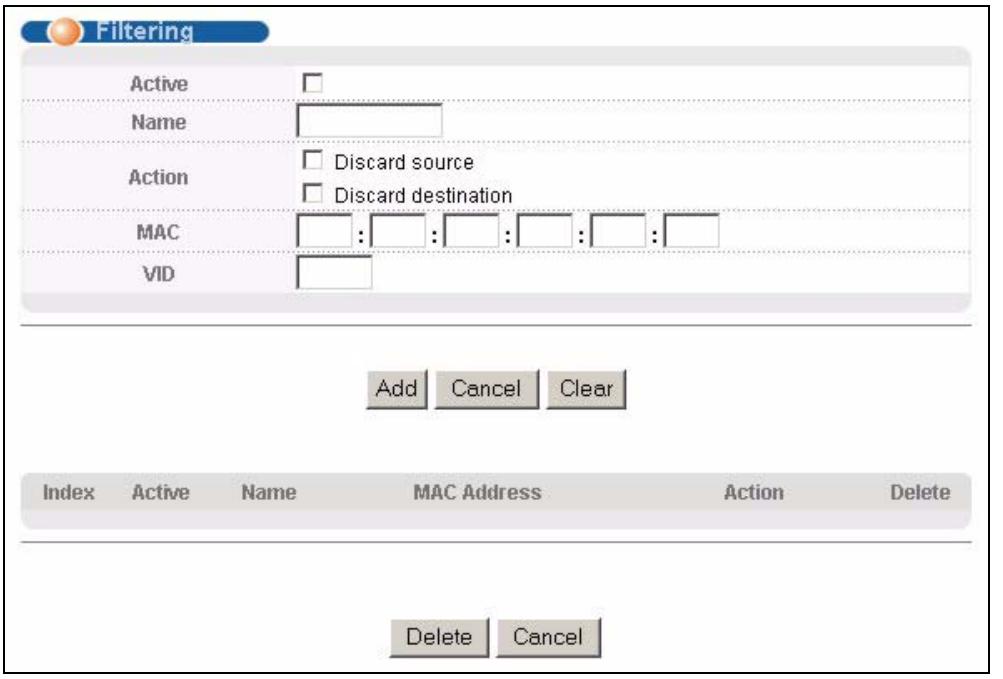
Figure 40 Filtering
The following table describes the related labels in this screen.
Table 19 Filtering
| LABEL | DESCRIPTION |
| Active | Make sure to select this check box to activate your rule. You may temporarily deactivate a rule without deleting it by deselecting this check box. |
| Name | Type a descriptive name (up to 32 printable ASCII characters) for this rule. This is for identification purpose only. |
| Action | Select Discard source to drop frame from the source MAC address (specified in the MAC field). The switch can still send frames to the MAC address. Select Discard destination to drop frames to the destination MAC address (specified in the MAC address). The switch can still receive frames originating from the MAC address. Select Discard source and Discard destination to block traffic to/from the MAC address specified in the MAC field. |
| MAC | Type a MAC address in valid MAC address format, that is, six hexadecimal character pairs. |
| VID | Type the VLAN group identification number. |
| Add | Click Add to save the new rule to the switch. It then displays in the summary table at the bottom of the screen. |
| Cancel | Click Cancel to reset the fields to your previous configuration. |
| Clear | Click Clear to clear the fields to the factory defaults. |
| Index | This field displays the index number of the rule. Click an index number to change the settings. |
| Active | This field displays Yes when the rule is activated and No when is it deactivated. |
| Name | This field displays the descriptive name for this rule. This is for identification purpose only. |
| MAC Address | This field displays the source/destination MAC address with the VLAN identification number to which the MAC address belongs. |
| Action | This field displays the filtering action (Discard both, Discard source or Discard dest.). |
| Delete | Check the rule(s) that you want to remove in the Delete column and then click the Delete button. |
| Cancel | Click Cancel to clear the selected checkbox(es) in the Delete column. |
CHAPTER 11
Spanning Tree Protocol
This chapter introduces the Spanning Tree Protocol (STP) and Rapid Spanning Tree Protocol (RSTP).
11.1 STP/RSTP Overview
(R)STP detects and breaks network loops and provides backup links between switches, bridges or routers. It allows a switch to interact with other (R)STP -compliant switches in your network to ensure that only one path exists between any two stations on the network.
The switch uses IEEE 802.1w RSTP (Rapid Spanning Tree Protocol) that allow faster convergence of the spanning tree than STP (while also being backwards compatible with STP-only aware bridges). In RSTP, topology change information is directly propagated throughout the network from the device that generates the topology change. In STP, a longer delay is required as the device that causes a topology change first notifies the root bridge that then notifies the network. Both RSTP and STP flush unwanted learned addresses from the filtering database. In RSTP, the port states are Discarding, Learning, and Forwarding.
Note: In this user's guide, "STP" refers to both STP and RSTP.
11.1.1 STP Terminology
The root bridge is the base of the spanning tree; it is the bridge with the lowest identifier value (MAC address).
Path cost is the cost of transmitting a frame onto a LAN through that port. It is assigned according to the speed of the link to which a port is attached. The slower the media, the higher the cost.
Table 20 STP Path Costs
| LINK SPEED | RECOMMENDED VALUE | RECOMMENDED RANGE | ALLOWED RANGE | |
| Path Cost | 4Mbps | 250 | 100 to 1000 | 1 to 65535 |
| Path Cost | 10Mbps | 100 | 50 to 600 | 1 to 65535 |
| Path Cost | 16Mbps | 62 | 40 to 400 | 1 to 65535 |
| Path Cost | 100Mbps | 19 | 10 to 60 | 1 to 65535 |
| Path Cost | 1Gbps | 4 | 3 to 10 | 1 to 65535 |
| Path Cost | 10Gbps | 2 | 1 to 5 | 1 to 65535 |
On each bridge, the root port is the port through which this bridge communicates with the root. It is the port on this switch with the lowest path cost to the root (the root path cost). If there is no root port, then this switch has been accepted as the root bridge of the spanning tree network.
For each LAN segment, a designated bridge is selected. This bridge has the lowest cost to the root among the bridges connected to the LAN.
11.1.2 How STP Works
After a bridge determines the lowest cost-spanning tree with STP, it enables the root port and the ports that are the designated ports for connected LANs, and disables all other ports that participate in STP. Network packets are therefore only forwarded between enabled ports, eliminating any possible network loops.
STP-aware switches exchange Bridge Protocol Data Units (BPDUs) periodically. When the bridged LAN topology changes, a new spanning tree is constructed.
Once a stable network topology has been established, all bridges listen for Hello BPDUs (Bridge Protocol Data Units) transmitted from the root bridge. If a bridge does not get a Hello BPDU after a predefined interval (Max Age), the bridge assumes that the link to the root bridge is down. This bridge then initiates negotiations with other bridges to reconfigure the network to re-establish a valid network topology.
11.1.3 STP Port States
STP assigns five port states to eliminate packet looping. A bridge port is not allowed to go directly from blocking state to forwarding state so as to eliminate transient loops.
Table 21 STP Port States
| PORT STATE | DESCRIPTION |
| Disabled | STP is disabled (default). |
| Blocking | Only configuration and management BPDUs are received and processed. |
| Listening | All BPDUs are received and processed. |
| Learning | All BPDUs are received and processed. Information frames are submitted to the learning process but not forwarded. |
| Forwarding | All BPDUs are received and processed. All information frames are received and forwarded. |
11.2 STP Status
Click Advanced Application, Spanning Tree Protocol in the navigation panel to display the status screen as shown next.
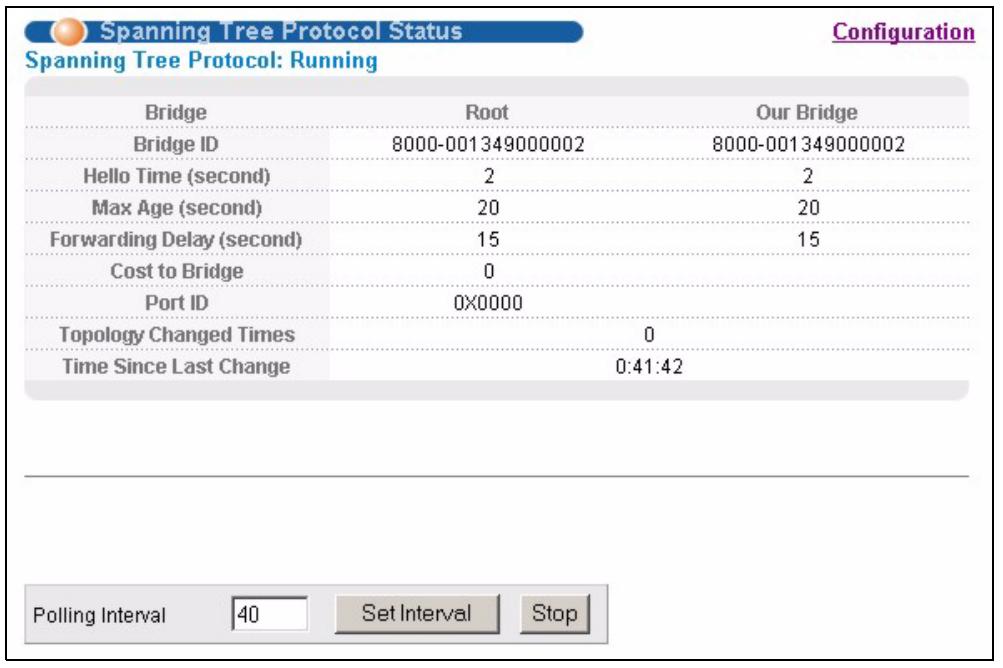
Figure 41 Spanning Tree Protocol: Status
The following table describes the labels in this screen.
Table 22 Spanning Tree Protocol: Status
| LABEL | DESCRIPTION |
| Spanning Tree Protocol | This field displays Running if STP is activated. Otherwise, it displays Down. |
| Configuration | Click Configuration to configure STP settings. Refer to Section 11.3 on page 96. |
| Bridge | Root refers to the base of the spanning tree (the root bridge). Our Bridge is this switch. This switch may also be the root bridge. |
| Bridge ID | This is the unique identifier for this bridge, consisting of bridge priority plus MAC address. This ID is the same for Root and Our Bridge if the switch is the root switch. |
| Hello Time (second) | This is the time interval (in seconds) at which the root switch transmits a configuration message. The root bridge determines Hello Time, Max Age and Forwarding Delay |
| Max Age (second) | This is the maximum time (in seconds) a switch can wait without receiving a configuration message before attempting to reconfigure. |
| Forwarding Delay (second) | This is the time (in seconds) the root switch will wait before changing states (that is, listening to learning to forwarding). |
| Cost to Bridge | This is the path cost from the root port on this switch to the root switch. |
| Port ID | This is the priority and number of the port on the switch through which this switch must communicate with the root of the Spanning Tree. |
| Topology Changed Times | This is the number of times the spanning tree has been reconfigured. |
| Time Since Last Change | This is the time since the spanning tree was last reconfigured. |
| Polling Interval | The text box displays how often (in seconds) this screen refreshes. You may change the refresh interval by typing a new number in the text box and then clicking Set Interval. |
| Stop | Click Stop to halt STP statistic polling. |
11.3 Configure STP
To configure STP, click the Configuration link in the Spanning Tree Protocol screen as shown next.
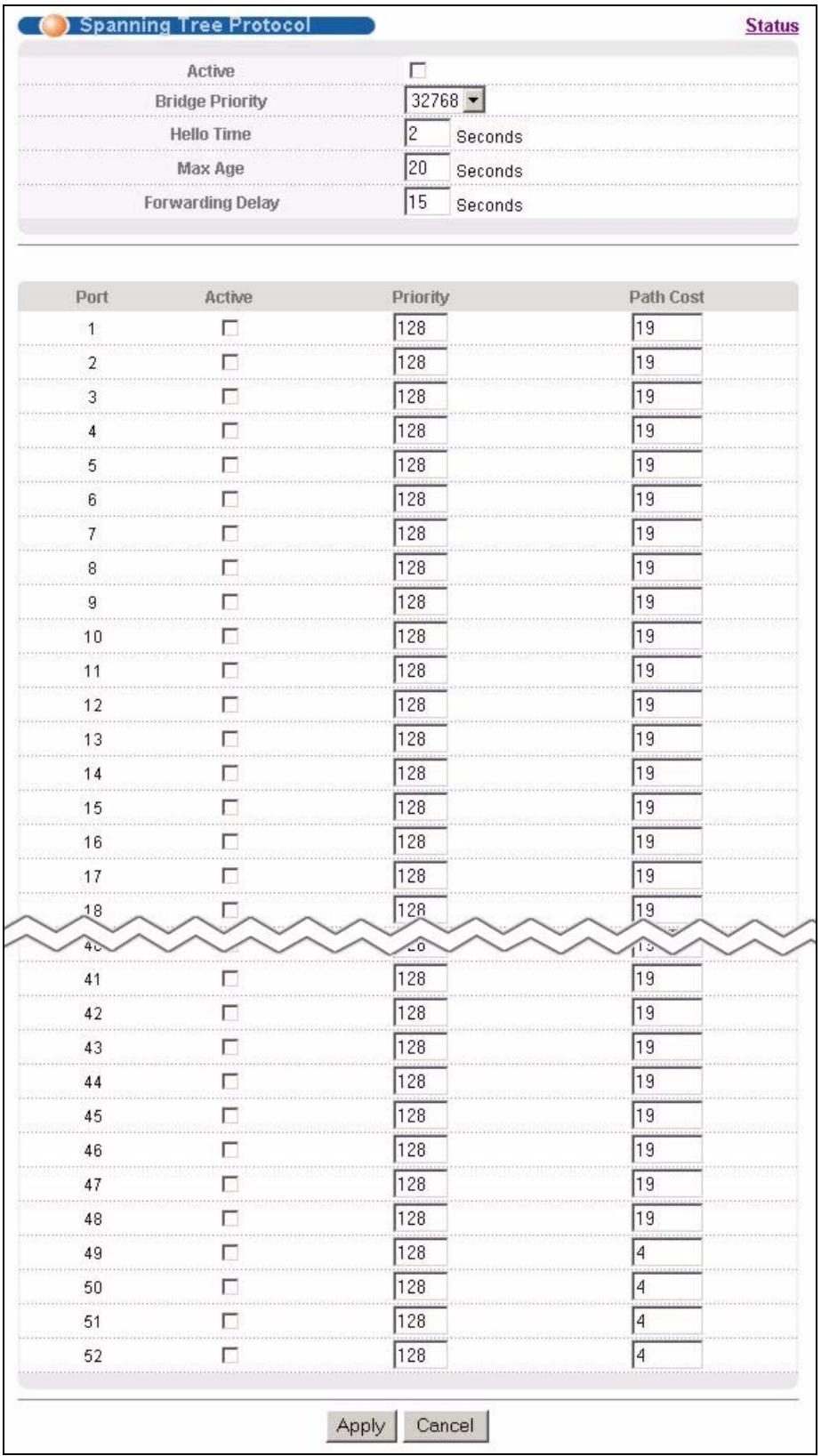
Figure 42 Spanning Tree Protocol: Configuration
The following table describes the labels in this screen.
Table 23 Spanning Tree Protocol: Configuration
| LABEL | DESCRIPTION |
| Status | Click Status to display the Spanning Tree Protocol Status screen (see Figure 41 on page 95). |
| Active | Select this check box to activate STP. Clear this checkbox to disable STP. |
| Bridge Priority | Bridge priority is used in determining the root switch, root port and designated port. The switch with the highest priority (lowest numeric value) becomes the STP root switch. If all switches have the same priority, the switch with the lowest MAC address will then become the root switch. Select a value from the drop-down list box.The lower the numeric value you assign, the higher the priority for this bridge.Bridge Priority determines the root bridge, which in turn determines Hello Time, Max Age and Forwarding Delay. |
| Hello Time | This is the time interval in seconds between BPDU (Bridge Protocol Data Units) configuration message generations by the root switch. The allowed range is 1 to 10 seconds. |
| Max Age | This is the maximum time (in seconds) a switch can wait without receiving a BPDU before attempting to reconfigure. All switch ports (except for designated ports) should receive BPDUs at regular intervals. Any port that ages out STP information (provided in the last BPDU) becomes the designated port for the attached LAN. If it is a root port, a new root port is selected from among the switch ports attached to the network. The allowed range is 6 to 40 seconds. |
| Forwarding Delay | This is the maximum time (in seconds) a switch will wait before changing states. This delay is required because every switch must receive information about topology changes before it starts to forward frames. In addition, each port needs time to listen for conflicting information that would make it return to a blocking state; otherwise, temporary data loops might result. The allowed range is 4 to 30 seconds.As a general rule:Note: 2* (Forward Delay - 1) >= Max Age >= 2* (Hello Time + 1) |
| Port | This field displays the port number. |
| Active | Select this check box to activate STP on this port. |
| Priority | Configure the priority for each port here.Priority decides which port should be disabled when more than one port forms a loop in a switch. Ports with a higher priority numeric value are disabled first. The allowed range is between 0 and 255 and the default value is 128. |
| Path Cost | Path cost is the cost of transmitting a frame on to a LAN through that port. It is assigned according to the speed of the bridge. The slower the media, the higher the cost - see Table 20 on page 93 for more information. |
| Apply | Click Apply to save your changes back to the switch. |
| Cancel | Click Cancel to begin configuring this screen afresh. |
CHAPTER 12 Bandwidth Control
This chapter shows you how you can cap the maximum bandwidth using the Bandwidth Control screen.
12.1 Bandwidth Control Overview
Bandwidth control means defining a maximum allowable bandwidth for incoming and/or outgoing traffic flows on a port.
12.1.1 CIR and PIR
The Committed Information Rate (CIR) is the guaranteed bandwidth for the incoming traffic flow on a port. The Peak Information Rate (PIR) is the maximum bandwidth allowed for the incoming traffic flow on a port when there is no network congestion.
The CIR and PIR should be set for all ports that use the same uplink bandwidth. If the CIR is reached, packets are sent at the rate up to the PIR. When network congestion occurs, packets through the ingress port exceeding the CIR will be marked for drop.
Note: The CIR should be less than the PIR.
The sum of CIRs cannot be greater than or equal to the uplink bandwidth.
12.2 Bandwidth Control Setup
Click Advanced Application and then Bandwidth Control in the navigation panel to bring up the screen as shown next.
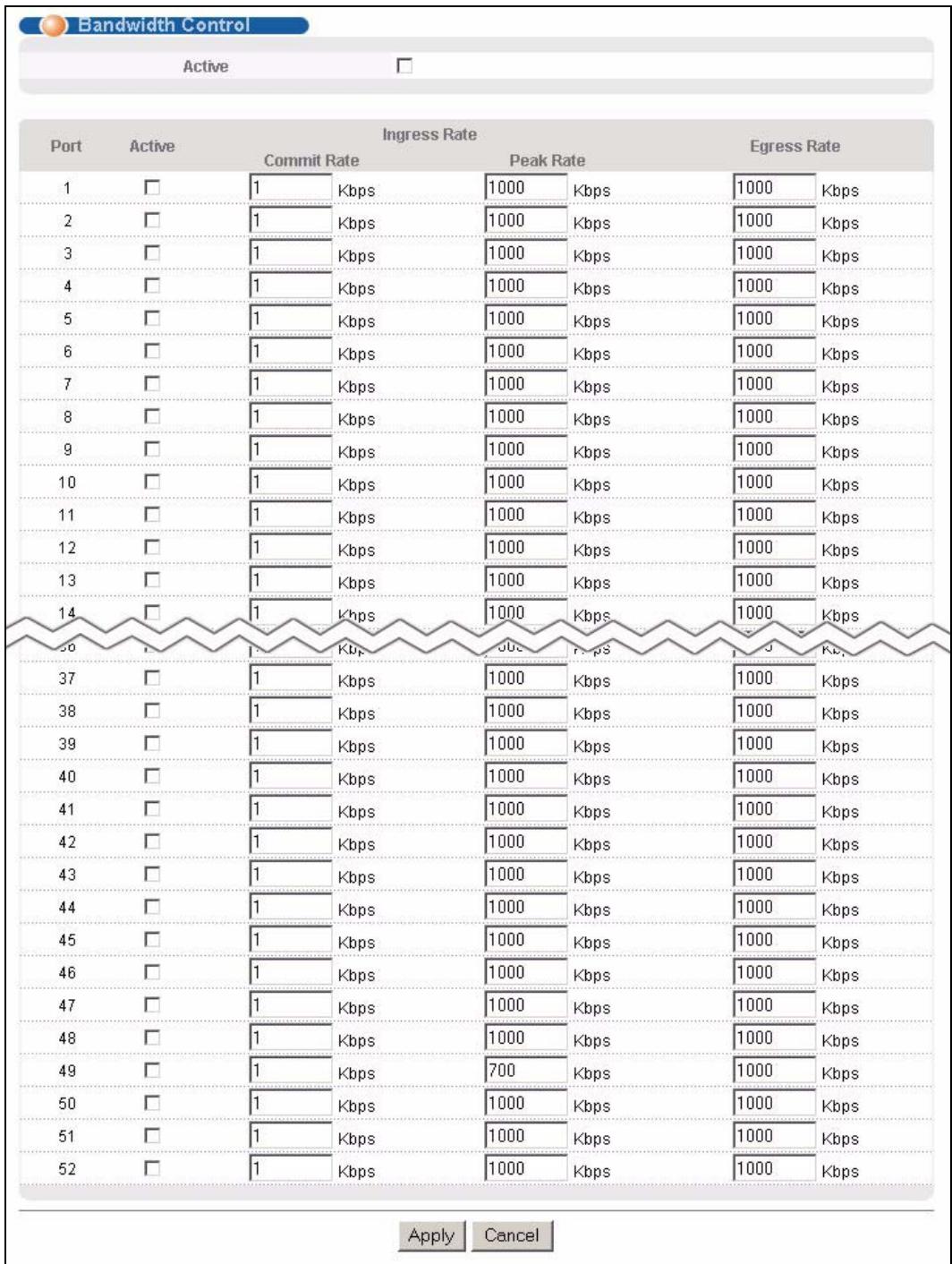
Figure 43 Bandwidth Control
The following table describes the related labels in this screen.
Table 24 Bandwidth Control
| LABEL | DESCRIPTION |
| Active | Select this check box to enable bandwidth control on the switch. |
| Port | This field displays the port number. |
| Active | Make sure to select this check box to activate bandwidth control on a port. You may temporarily deactivate a rule without deleting it by clearing this check box. |
| Ingress Rate | |
| Commit Rate | Specify the guaranteed bandwidth allowed in kilobits per second (Kbps) for the incoming traffic flow on a port. The commit rate should be less than the peak rate. The sum of commit rates cannot be greater than or equal to the uplink bandwidth. |
| Peak Rate | Specify the maximum bandwidth allowed in kilobits per second (Kbps) for the incoming traffic flow on a port. |
| Egress Rate | Specify the maximum bandwidth allowed in kilobits per second (Kbps) for the out-going traffic flow on a port. |
| Apply | Click Apply to save the settings. |
| Cancel | Click Cancel to reset the fields to your previous configuration. |
CHAPTER 13
Broadcast Storm Control
This chapter introduces and shows you how to configure the broadcast storm control feature.
13.1 Overview
Broadcast storm control limits the number of broadcast, multicast and destination lookup failure (DLF) packets the switch receives per second on the ports. When the maximum number of allowable broadcast, multicast and/or DLF packets is reached per second, the subsequent packets are discarded. Enable this feature to reduce broadcast, multicast and/or DLF packets in your network. You can specify limits for each packet type on each port.
13.2 Broadcast Storm Control Setup
Click Advanced Application, Broadcast Storm Control in the navigation panel to display the screen as shown next.
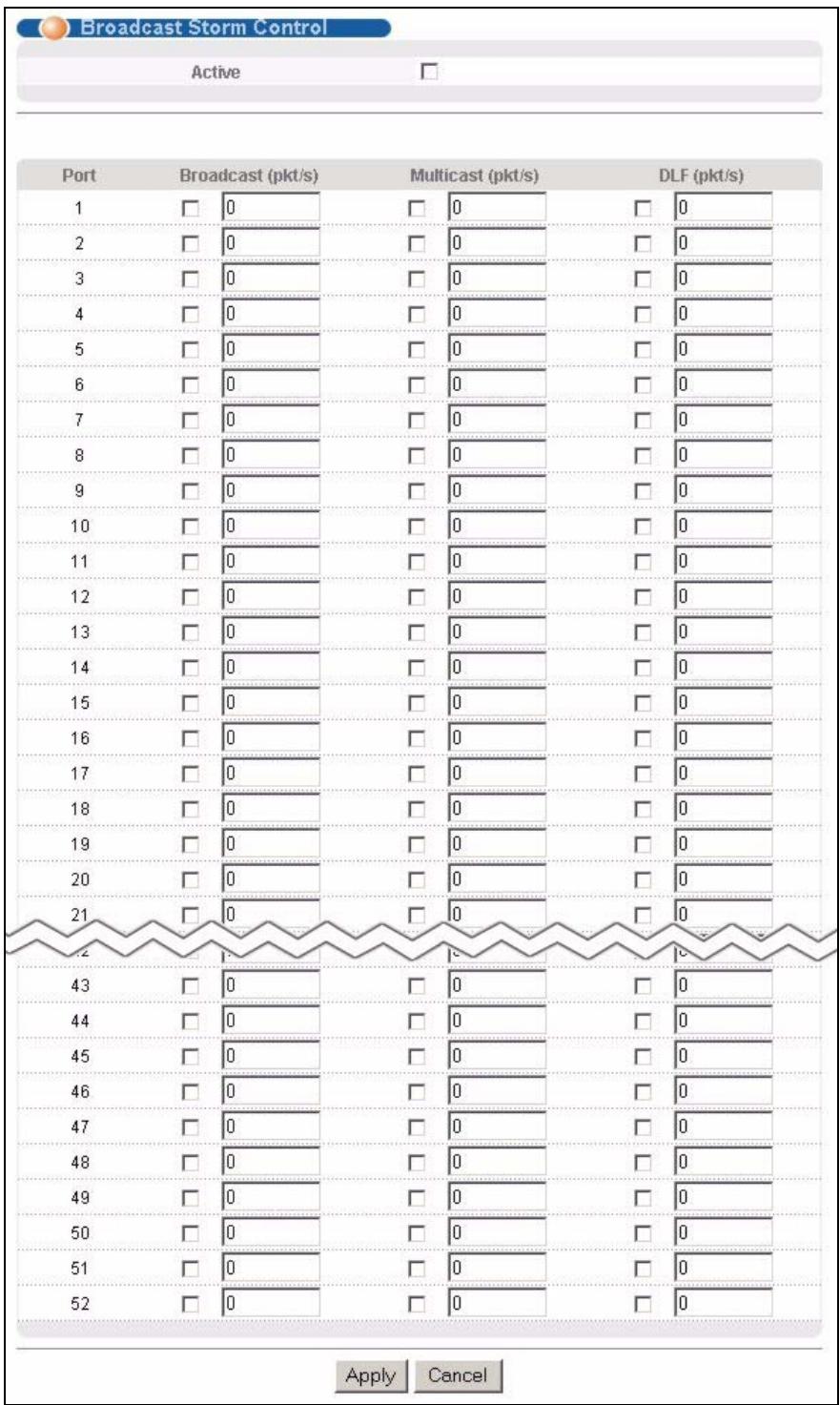
Figure 44 Broadcast Storm Control
The following table describes the labels in this screen.
Table 25 Broadcast Storm Control
| LABEL | DESCRIPTION |
| Active | Select this check box to enable traffic storm control on the switch. Clear this check box to disable this feature. |
| Port | This field displays a port number. |
| Broadcast (pkt/s) | Select this option and specify how many broadcast packets the port receives per second. |
| Multicast (pkt/s) | Select this option and specify how many multicast packets the port receives per second. |
| DLF (pkt/s) | Select this option and specify how many destination lookup failure (DLF) packets the port receives per second. |
| Apply | Click Apply to save your changes back to the switch. |
| Cancel | Click Cancel to begin configuring this screen afresh. |
CHAPTER 14 Mirroring
This chapter discusses the Mirror setup screens.
14.1 Introduction to Port Mirroring
Port mirroring allows you to copy a traffic flow to a monitor port (the port you copy the traffic to) in order that you can examine the traffic from the monitor port without interference.
14.2 Port Mirroring Setup
Click Advanced Application, Mirroring in the navigation panel to display the Mirroring screen. Use this screen to select a monitor port and specify the traffic flow to be copied to the monitor port.
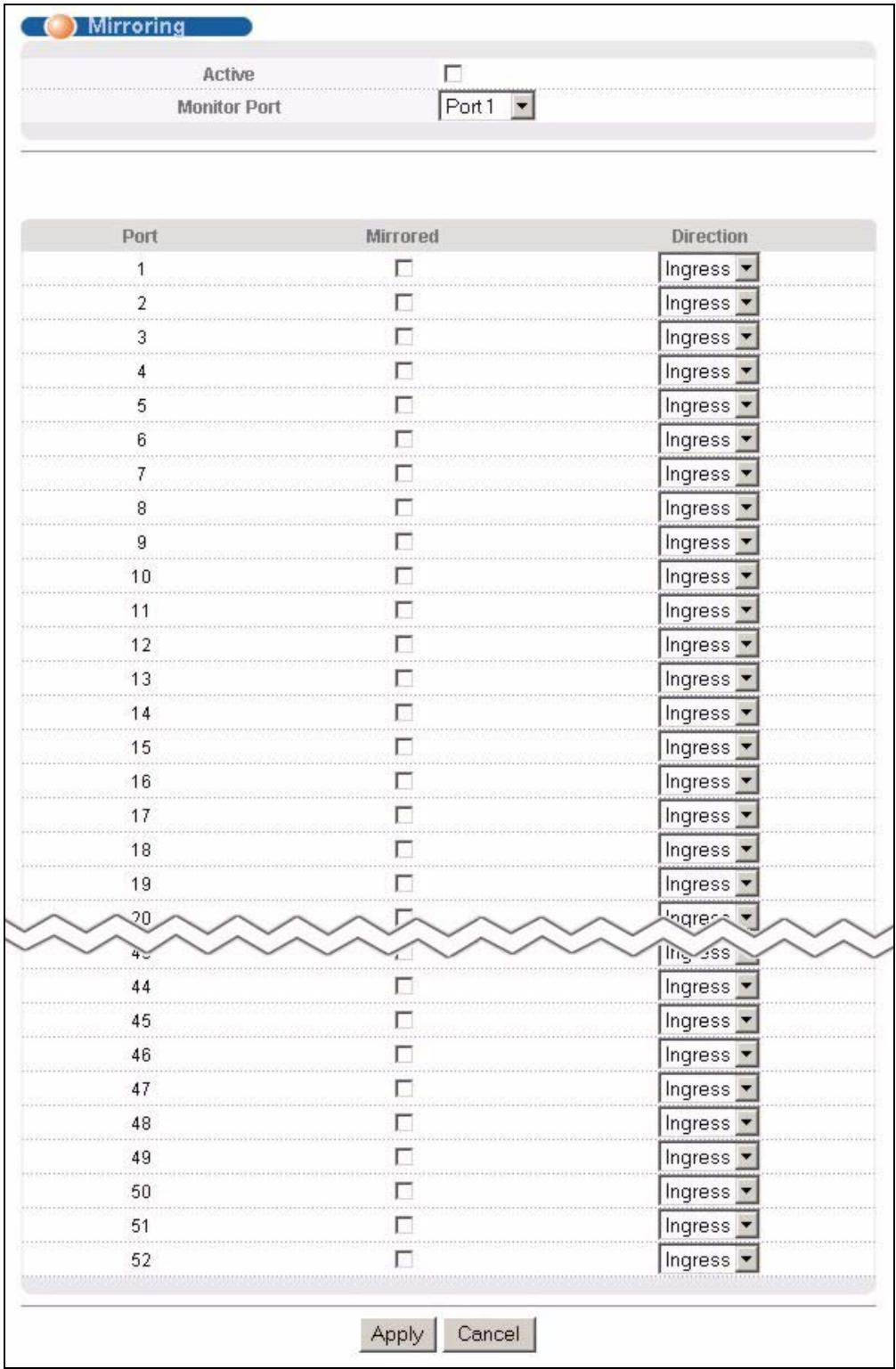
Figure 45 Mirroring
The following table describes the labels in this screen.
Table 26 Mirroring
| LABEL | DESCRIPTION |
| Active | Select this check box to activate port mirroring on the switch. Clear this check box to disable the feature. |
| Monitor Port | The monitor port is the port you copy the traffic to in order to examine it in more detail without interfering with the traffic flow on the original port(s). Select a port from the drop-down list box. |
| Port | This field displays the port number. |
| Mirrored | Select this option to mirror the traffic on a port. |
| Direction | Specify the direction of the traffic to mirror by selecting from the drop-down list box. Choices are Egress (outgoing), Ingress (incoming) and Both. |
| Apply | Click Apply to save the changes. |
| Cancel | Click Cancel to start configuring the screen again. |
CHAPTER 15 Link Aggregation
This chapter shows you how to logically aggregate physical links to form one logical, higher-bandwidth link.
15.1 Introduction to Link Aggregation
Link aggregation (trunking) is the grouping of physical ports into one logical higher-capacity link. You may want to trunk ports if for example, it is cheaper to use multiple lower-speed links than to under-utilize a high-speed, but more costly, single-port link.
However, the more ports you aggregate then the fewer available ports you have. A trunk group is one logical link containing multiple ports.
The beginning port of each trunk group must be physically connected to form a trunk group.
15.2 Dynamic Link Aggregation
The switch adheres to the IEEE 802.3ad standard for static and dynamic (LACP) port trunking.
The switch supports the link aggregation IEEE802.3ad standard. This standard describes the Link Aggregate Control Protocol (LACP), which is a protocol that dynamically creates and manages trunk groups.
When you enable LACP link aggregation on a port, the port can automatically negotiate with the ports at the remote end of a link to establish trunk groups. LACP also allows port redundancy, that is, if an operational port fails, then one of the "standby" ports become operational without user intervention. Please note that:
- You must connect all ports point-to-point to the same Ethernet switch and configure the ports for LACP trunking.
LACP only works on full-duplex links. - All ports in the same trunk group must have the same media type, speed, duplex mode and flow control settings.
Configure trunk groups or LACP before you connect the Ethernet switch to avoid causing network topology loops.
15.2.1 Link Aggregation ID
LACP aggregation ID consists of the following information1:
Table 27 Link Aggregation ID: Local Switch
| SYSTEM PRIORITY | MAC ADDRESS | KEY | PORT PRIORITY | PORT NUMBER |
| 0000 | 00-00-00-00-00 | 0000 | 00 | 0000 |
Table 28 Link Aggregation ID: Peer Switch
| SYSTEM PRIORITY | MAC ADDRESS | KEY | PORT PRIORITY | PORT NUMBER |
| 0000 | 00-00-00-00-00 | 0000 | 00 | 0000 |
15.3 Link Aggregation Status
Click Advanced Application, Link Aggregation in the navigation panel. The Link Aggregation Control Protocol Status screen displays by default.
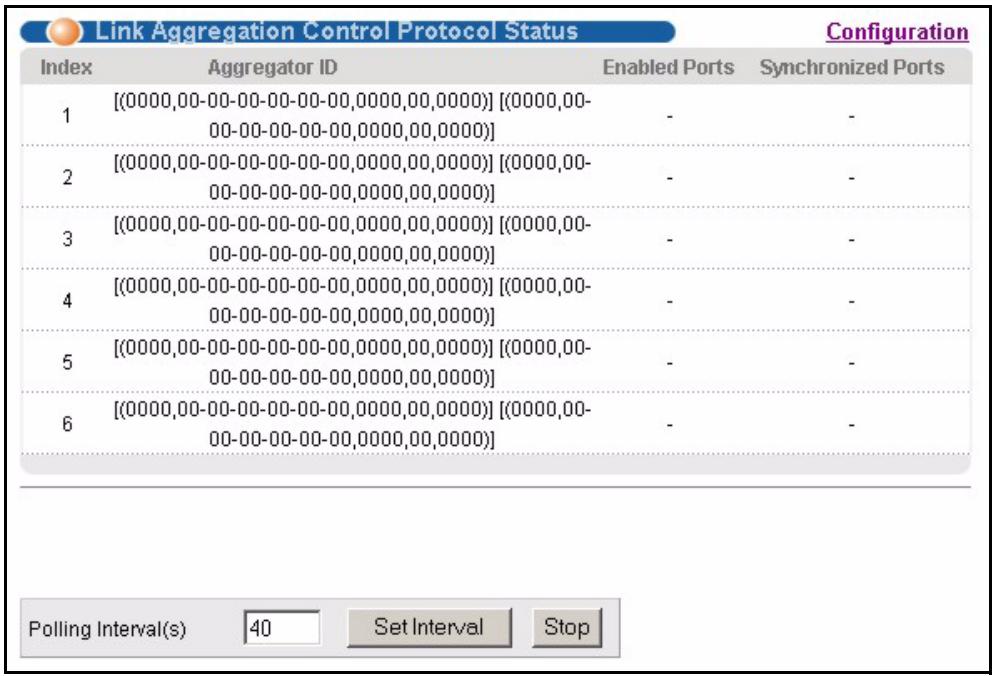
Figure 46 Link Aggregation Control Protocol Status
The following table describes the labels in this screen.
Table 29 Link Aggregation Control Protocol Status
| LABEL | DESCRIPTION |
| Index | This field displays the trunk ID to identify a trunk group, that is, one logical link containing multiple ports. |
| Aggregator ID | Refer to Section 15.2.1 on page 112 for more information on this field. |
| Enabled Port | These are the ports you have configured in the Link Aggregation screen to be in the trunk group. |
| Synchronized Ports | These are the ports that are currently transmitting data as one logical link in this trunk group. |
| Polling Interval(s) | The text box displays how often (in seconds) this screen refreshes. You may change the refresh interval by typing a new number in the text box and then clicking Set Interval. |
| Stop | Click Stop to halt statistic polling. |
15.4 Link Aggregation Setup
Click Configuration in the Link Aggregation Control Protocol Status screen to display the screen shown next.
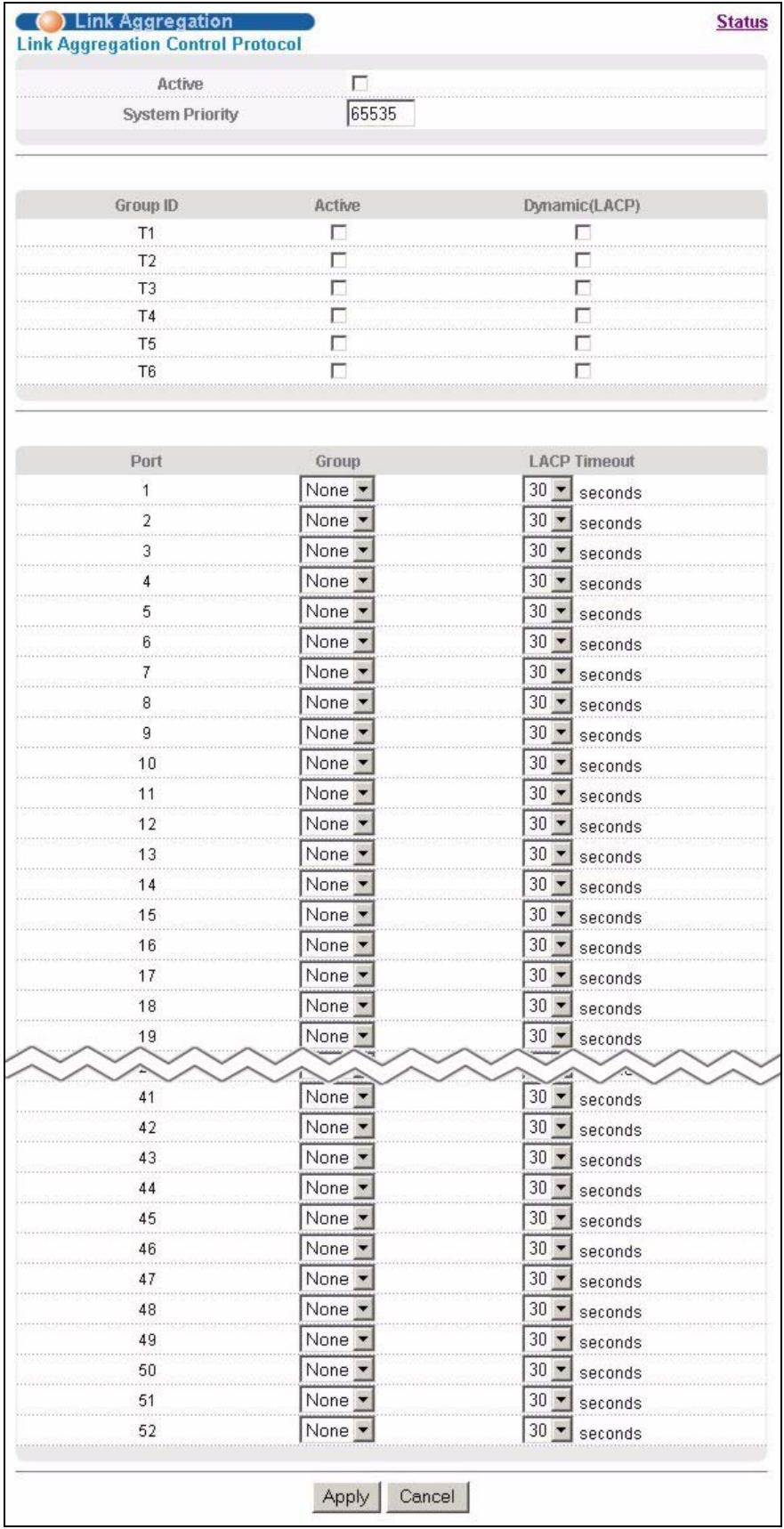
Figure 47 Link Aggregation: Configuration
The following table describes the labels in this screen.
Table 30 Link Aggregation Control Protocol: Configuration
| LABEL | DESCRIPTION |
| Link Aggregation Control Protocol | |
| Active | Select this checkbox to enable Link Aggregation Control Protocol (LACP). |
| System Priority | LACP system priority is a number between 1 and 65,535. The switch with the lowest system priority (and lowest port number if system priority is the same) becomes the LACP "server". The LACP "server" controls the operation of LACP setup. Enter a number to set the priority of an active port using Link Aggregate Control Protocol (LACP). The smaller the number, the higher the priority level. |
| Group ID | The field identifies the link aggregation group, that is, one logical link containing multiple ports. |
| Active | Select this option to activate a trunk group. |
| Dynamic (LACP) | Select this check box to enable LACP for a trunk. |
| Port | This field displays the port number. |
| Group | Select the trunk group to which a port belongs. |
| LACP Timeout | Timeout is the time interval between the individual port exchanges of LACP packets in order to check that the peer port in the trunk group is still up. If a port does not respond after three tries, then it is deemed to be "down" and is removed from the trunk. Set a short timeout (one second) for busy trunked links to ensure that disabled ports are removed from the trunk group as soon as possible. Select either 1 second or 30 seconds. |
| Apply | Click Apply to save your changes back to the switch. |
| Cancel | Click Cancel to begin configuring this screen afresh. |
CHAPTER 16 Port Authentication
This chapter describes the 802.1x authentication method and RADIUS server connection setup.
16.1 Introduction to Authentication
IEEE 802.1x is an extended authentication protocol² that allows support of RADIUS (Remote Authentication Dial In User Service, RFC 2138, 2139) for centralized user profile and accounting management on a network RADIUS server.
16.1.1 RADIUS
RADIUS (Remote Authentication Dial-In User Service) authentication is a popular protocol used to authenticate users by means of an external server instead of (or in addition to) an internal device user database that is limited to the memory capacity of the device. In essence, RADIUS authentication allows you to validate an unlimited number of users from a central location.
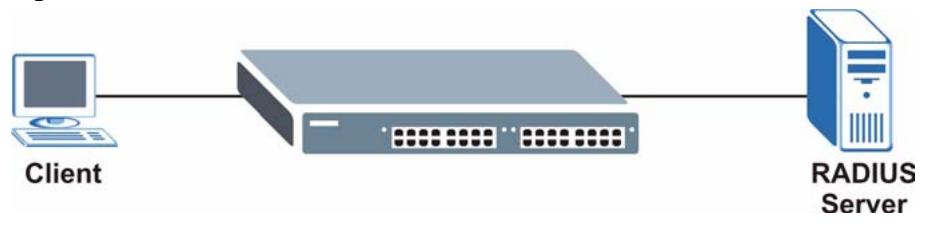
Figure 48 RADIUS Server
16.2 Port Authentication Configuration
To enable port authentication, first activate IEEE802.1x security (both on the switch and the port(s)) then configure the RADIUS server settings.
Click Advanced Application, Port Authentication in the navigation panel to display the screen as shown.
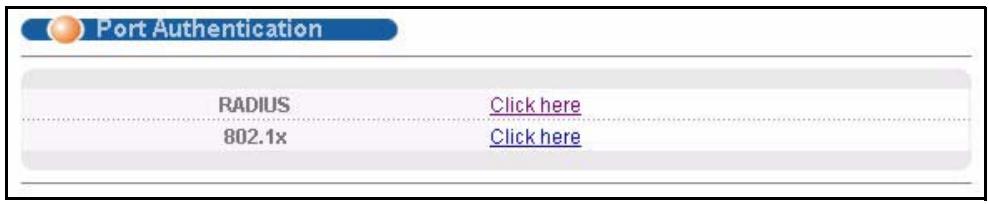
Figure 49 Port Authentication
16.2.1 Configuring RADIUS Server Settings
From the Port Authentication screen, click RADIUS to display the configuration screen as shown.
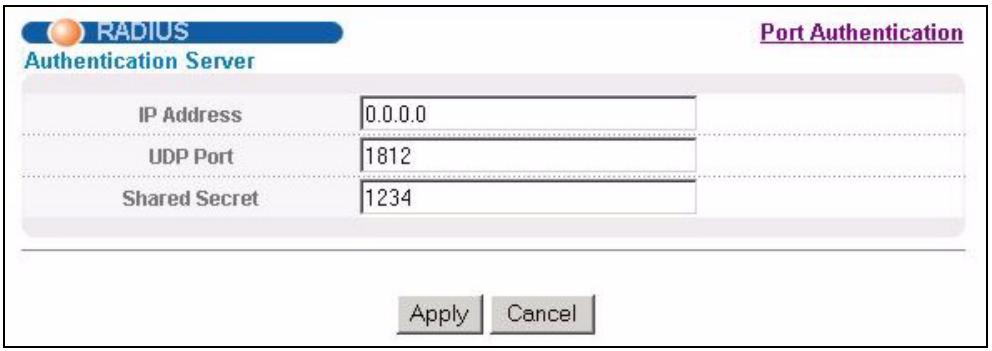
Figure 50 Port Authentication: RADIUS
The following table describes the labels in this screen.
Table 31 Port Authentication: RADIUS
| LABEL | DESCRIPTION |
| Authentication Server | |
| IP Address | Enter the IP address of the external RADIUS server in dotted decimal notation. |
| UDP Port | The default port of the RADIUS server for authentication is 1812. You need not change this value unless your network administrator instructs you to do so. |
| Shared Secret | Specify a password (up to 32 alphanumeric characters) as the key to be shared between the external RADIUS server and the switch. This key is not sent over the network. This key must be the same on the external RADIUS server and the switch. |
| Apply | Click Apply to save your changes back to the switch. |
| Cancel | Click Cancel to begin configuring this screen afresh. |
16.2.2 Activate IEEE 802.1x Security
From the Port Authentication screen, display the configuration screen as shown.
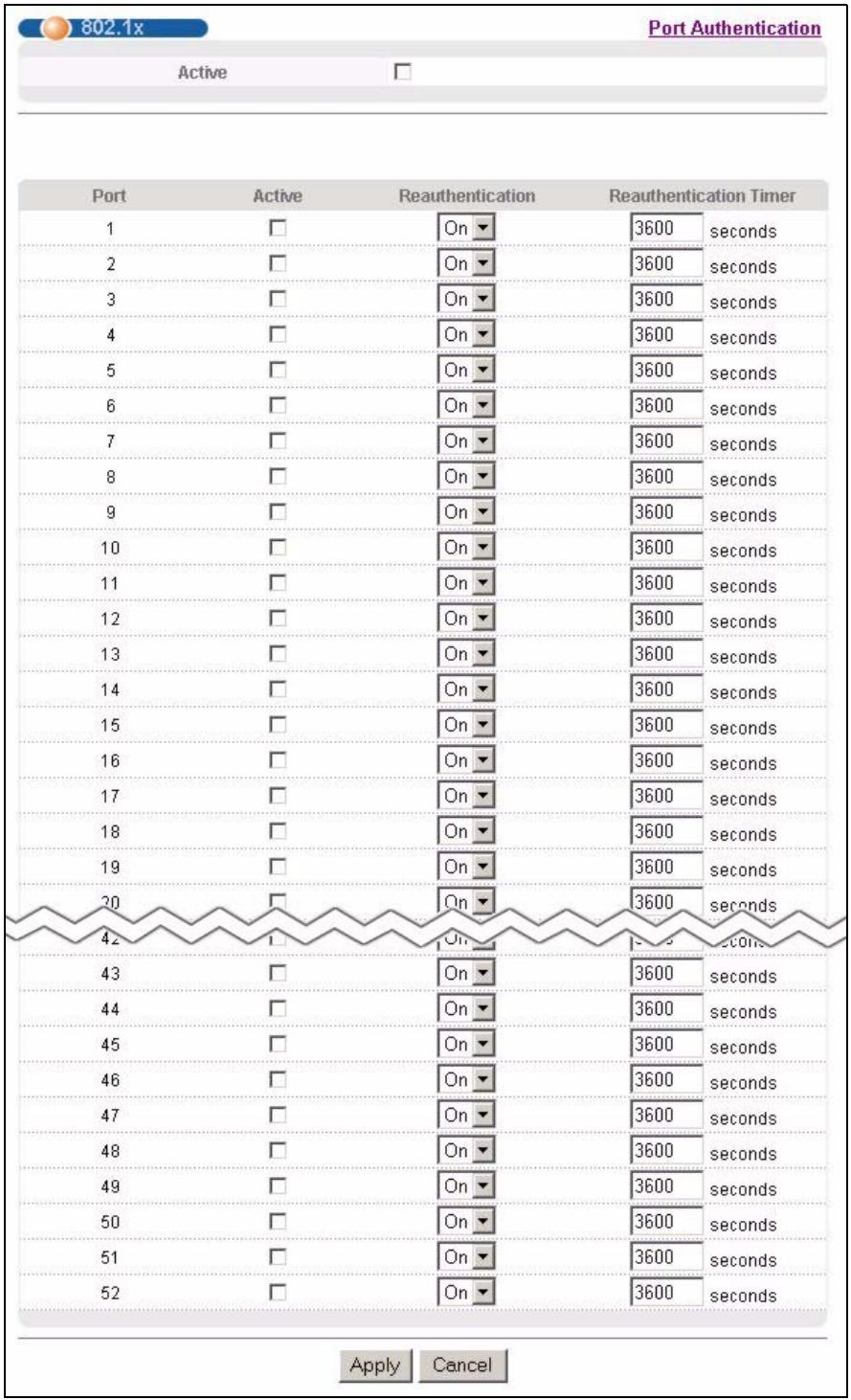
Figure 51 Port Authentication: 802.1x
The following table describes the labels in this screen.
Table 32 Port Authentication: 802.1x
| LABEL | DESCRIPTION |
| Active | Select this check box to permit 802.1x authentication on the switch.Note: You must first enable 802.1x authentication on the switch before configuring it on each port. |
| Port | This field displays a port number. |
| Active | Select this checkbox to permit 802.1x authentication on this port. You must first allow 802.1x authentication on the switch before configuring it on each port. |
| Reauthentication | Specify if a subscriber has to periodically re-enter his or her username and password to stay connected to the port. |
| Reauthentication Timer | Specify how often a client has to re-enter his or her username and password to stay connected to the port. |
| Apply | Click Apply to save your changes back to the switch. |
| Cancel | Click Cancel to begin configuring this screen afresh. |
CHAPTER 17 Port Security
This chapter shows you how to set up port security.
17.1 About Port Security
Port security allows only packets with dynamically learned MAC addresses and/or configured static MAC addresses to pass through a port on the switch. The switch can learn up to 16K MAC addresses in total with no limit on individual ports other than the sum cannot exceed 16K.
For maximum port security, enable this feature, disable MAC address learning and configure static MAC address(es) for a port. It is not recommended you disable port security together with MAC address learning as this will result in many broadcasts. By default, MAC address learning is still enabled even though the port security is not activated.
17.2 Port Security Setup
Click Advanced Application, Port Security in the navigation panel to display the screen as shown.
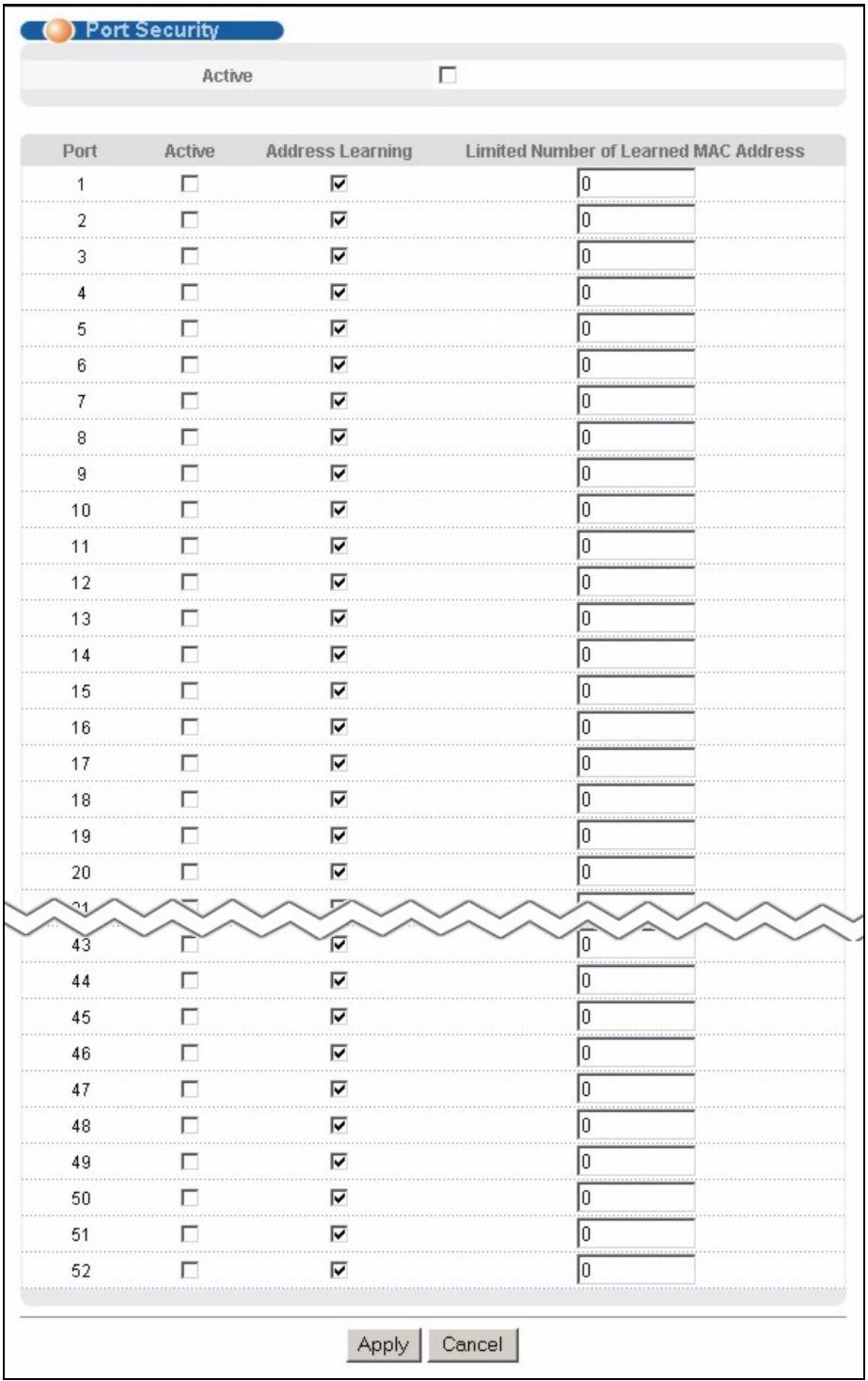
Figure 52 Port Security
The following table describes the labels in this screen.
Table 33 Port Security
| LABEL | DESCRIPTION |
| Active | Select this option to enable port security on the switch. |
| Port | This field displays a port number. |
| Active | Select this check box to enable the port security feature on this port. The switch forwards packets whose MAC address(es) is in the MAC address table on this port. Packets with no matching MAC address(es) are dropped.Clear this check box to disable the port security feature. The switch forwards all packets on this port. |
| Address Learning | MAC address learning reduces outgoing broadcast traffic. For MAC address learning to occur on a port, the port itself must be active with address learning enabled. |
| Limited Number of Learned MAC Address | Use this field to limit the number of (dynamic) MAC addresses that may be learned on a port. For example, if you set this field to "5" on port 2, then only the devices with these five learned MAC addresses may access port 2 at any one time. A sixth device would have to wait until one of the five learned MAC addresses aged out. MAC address aging out time can be set in the Switch Setup screen. The valid range is from "0" to "254". "0" means this feature is disabled. |
| Apply | Click Apply to save your changes back to the switch. |
| Cancel | Click Cancel to begin configuring this screen afresh. |
CHAPTER 18 Access Control
This chapter describes how to control access to the switch.
18.1 Overview
- A console port access control session and Telnet access control session cannot coexist. The console port has higher priority. If you telnet to the switch and someone is already logged in from the console port, then you will see the following message.
Figure 53 Console Port Priority
"Local administrator is configuring this device now!! Connection to host lost."
- A console port or Telnet session can coexist with one FTP session, up to five Web sessions (five different usernames and passwords) and/or limitless SNMP access control sessions.
Table 34 Access Control Overview
| Console Port | SSH | Telnet | FTP | Web | SNMP |
| The console port, SSH and Telnet share one session. The Console port has the highest priority and Telnet has the lowest priority. | One session | Up to five accounts | No limit | ||
18.2 The Access Control Main Screen
Click Management, Access Control in the navigation panel to display the main screen as shown.
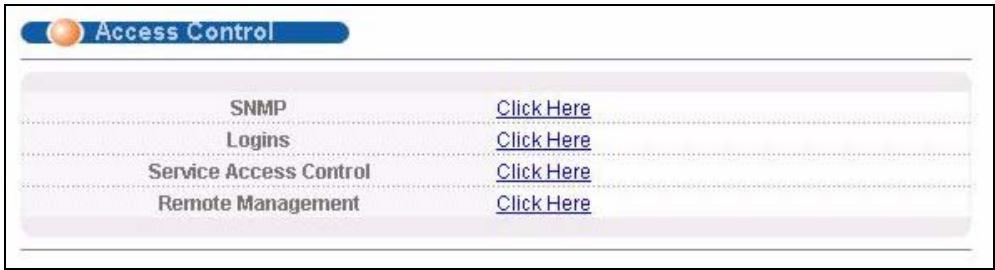
Figure 54 Access Control
18.3 About SNMP
Simple Network Management Protocol (SNMP) is an application layer protocol used to manage and monitor TCP/IP-based devices. SNMP is used to exchange management information between the network management system (NMS) and a network element (NE). A manager station can manage and monitor the switch through the network via SNMP version one (SNMPv1) and/or SNMP version 2c. The next figure illustrates an SNMP management operation. SNMP is only available if TCP/IP is configured.
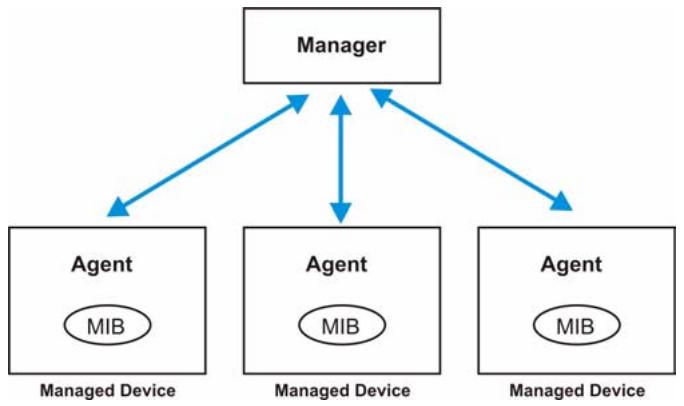
Figure 55 SNMP Management Model
An SNMP managed network consists of two main components: agents and a manager.
An agent is a management software module that resides in a managed switch (the switch). An agent translates the local management information from the managed switch into a form compatible with SNMP. The manager is the console through which network administrators perform network management functions. It executes applications that control and monitor managed devices.
The managed devices contain object variables/managed objects that define each piece of information to be collected about a switch. Examples of variables include such as number of packets received, node port status etc. A Management Information Base (MIB) is a collection of managed objects. SNMP allows a manager and agents to communicate for the purpose of accessing these objects.
SNMP itself is a simple request/response protocol based on the manager/agent model. The manager issues a request and the agent returns responses using the following protocol operations:
Table 35 SNMP Commands
| COMMAND | DESCRIPTION |
| Get | Allows the manager to retrieve an object variable from the agent. |
| GetNext | Allows the manager to retrieve the next object variable from a table or list within an agent. In SNMPv1, when a manager wants to retrieve all elements of a table from an agent, it initiates a Get operation, followed by a series of GetNext operations. |
Table 35 SNMP Commands
| COMMAND | DESCRIPTION |
| Set | Allows the manager to set values for object variables within an agent. |
| Trap | Used by the agent to inform the manager of some events. |
18.3.1 Supported MIBs
MIBs let administrators collect statistics and monitor status and performance.
The switch supports the following MIBs:
SNMP MIB II (RFC 1213)
- RFC 1157 SNMP v1
- RFC 1493 Bridge MIBs
- RFC 1643 Ethernet MIBs
RFC 1155 SMI
- RFC 2674 SNMPv2, SNMPv2c
RFC 1757 RMON
- SNMPv2, SNMPv2c or later version, compliant with RFC 2011 SNMPv2 MIB for IP, RFC 2012 SNMPv2 MIB for TCP, RFC 2013 SNMPv2 MIB for UDP
18.3.2 SNMP Traps
The switch sends traps to an SNMP manager when an event occurs. SNMP traps supported are outlined in the following table.
Table 36 SNMP Traps
| GENERIC TRAP | SPECIFIC TRAP | DESCRIPTION |
| 0 (Cold Start) | 0 | This trap is sent when the switch is turned on. |
| 1 (WarmStart) | 0 | This trap is sent when the switch restarts. |
| 2 (linkDown) | 0 | This trap is sent when the Ethernet link is down. |
| 3 (linkUp) | 0 | This trap is sent when the Ethernet link is up. |
| 4 (authenticationFailure) | 0 | This trap is sent when an SNMP request comes from non-authenticated hosts. |
18.3.3 Configuring SNMP
From the Access Control screen, display the SNMP screen. You can click Access Control to go back to the Access Control screen.
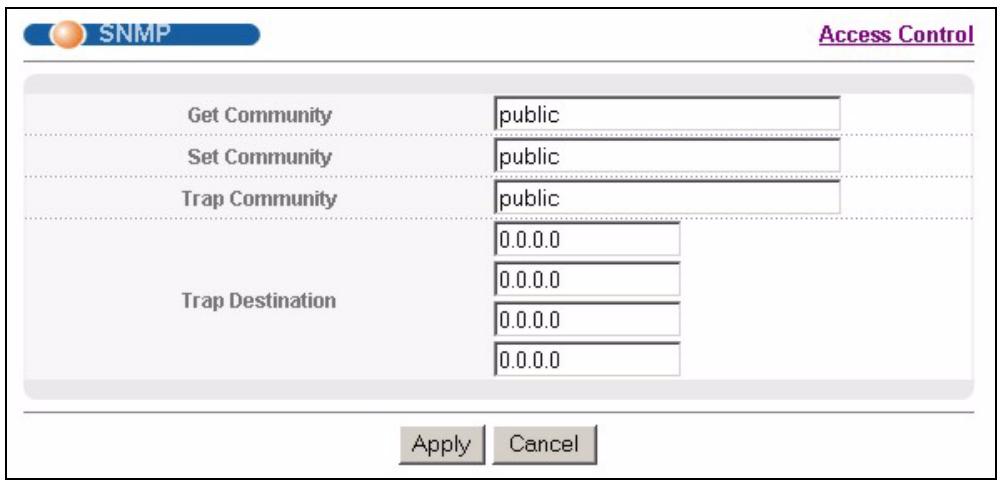
Figure 56 Access Control: SNMP
The following table describes the labels in this screen.
Table 37 Access Control: SNMP
| LABEL | DESCRIPTION |
| Get Community | Enter the get community, which is the password for the incoming Get- and GetNext-requests from the management station. |
| Set Community | Enter the set community, which is the password for incoming Set- requests from the management station. |
| Trap Community | Enter the trap community, which is the password sent with each trap to the SNMP manager. |
| Trap Destination | Enter the IP addresses of up to four stations to send your SNMP traps to. |
| Apply | Click Apply to save your changes back to the switch. |
| Cancel | Click Cancel to begin configuring this screen afresh. |
18.3.4 Setting Up Login Accounts
Up to five people (one administrator and four non-administrators) may access the switch via web configurator at any one time.
- An administrator is someone who can both view and configure switch changes. The username for the Administrator is always admin. The default administrator password is 1234.
Note: It is highly recommended that you change the default administrator password (1234).
- A non-administrator (username is something other than admin) is someone who can view but not configure switch settings.
Click Access Control from the navigation panel and then click Logins from this screen.
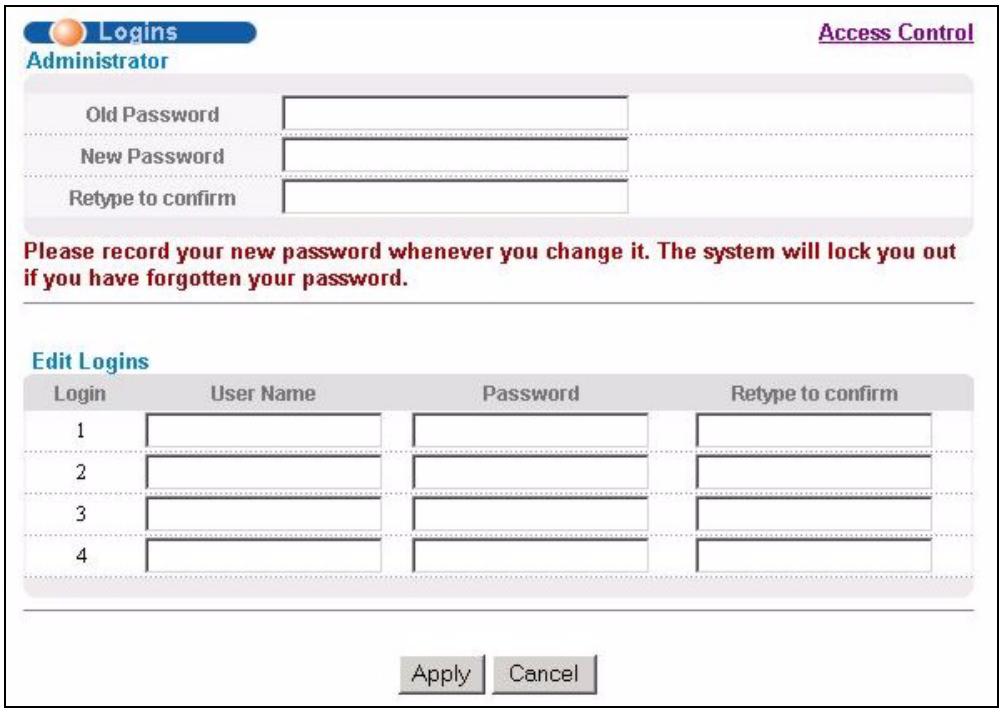
Figure 57 Access Control: Logins
The following table describes the labels in this screen.
Table 38 Access Control: Logins
| LABEL | DESCRIPTION |
| AdministratorThis is the default administrator account with the “admin” user name. You cannot change the default administrator user name. Only the administrator has read/write access. | |
| Old Password | Type the existing system password (1234 is the default password when shipped). |
| New Password | Enter your new system password. |
| Retype to confirm | Retype your new system password for confirmation |
| Edit LoginsYou may configure passwords for up to four users. These people have read-only access. | |
| User Name | Set a user name (up to 32 ASCII characters long). |
| Password | Enter your new system password. |
| Retype to confirm | Retype your new system password for confirmation |
| Apply | Click Apply to save your changes back to the switch. |
| Cancel | Click Cancel to begin configuring this screen afresh. |
18.4 SSH Overview
Unlike Telnet or FTP, which transmit data in clear text, SSH (Secure Shell) is a secure communication protocol that combines authentication and data encryption to provide secure encrypted communication
between two hosts over an unsecured network.

Figure 58 SSH Communication Example
18.5 How SSH works
The following table summarizes how a secure connection is established between two remote hosts.
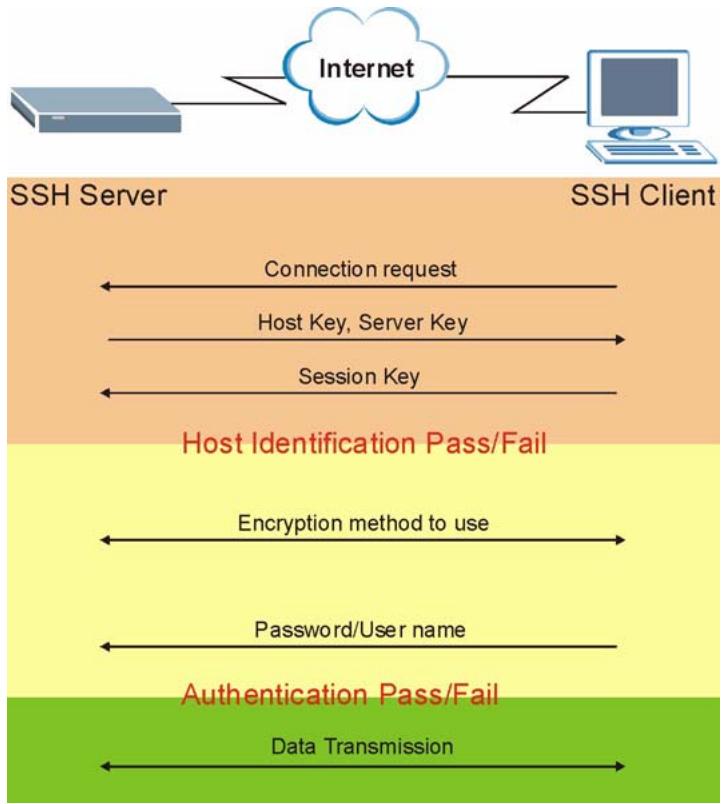
Figure 59 How SSH Works
1 Host Identification
The SSH client sends a connection request to the SSH server. The server identifies itself with a host key. The client encrypts a randomly generated session key with the host key and server key and sends the result back to the server.
The client automatically saves any new server public keys. In subsequent connections, the server public key is checked against the saved version on the client computer.
2 Encryption Method
Once the identification is verified, both the client and server must agree on the type of encryption method to use.
3 Authentication and Data Transmission
After the identification is verified and data encryption activated, a secure tunnel is established between the client and the server. The client then sends its authentication information (user name and password) to the server to log in to the server.
18.6 SSH Implementation on the Switch
Your switch supports SSH version 2 using RSA authentication and three encryption methods (DES, 3DES and Blowfish). The SSH server is implemented on the switch for remote management and file transfer on port 22. Only one SSH connection is allowed at a time.
18.6.1 Requirements for Using SSH
You must install an SSH client program on a client computer (Windows or Linux operating system) that is used to connect to the switch over SSH.
18.7 Introduction to HTTPS
HTTPS (HyperText Transfer Protocol over Secure Socket Layer, or HTTP over SSL) is a web protocol that encrypts and decrypts web pages. Secure Socket Layer (SSL) is an application-level protocol that enables secure transactions of data by ensuring confidentiality (an unauthorized party cannot read the transferred data), authentication (one party can identify the other party) and data integrity (you know if data has been changed).
It relies upon certificates, public keys, and private keys.
HTTPS on the switch is used so that you may securely access the switch using the web configurator. The SSL protocol specifies that the SSL server (the switch) must always authenticate itself to the SSL client (the computer which requests the HTTPS connection with the switch), whereas the SSL client only should authenticate itself when the SSL server requires it to do so. Authenticating client certificates is optional and if selected means the SSL-client must send the switch a certificate. You must apply for a certificate for the browser from a CA that is a trusted CA on the switch.
Please refer to the following figure.
1 HTTPS connection requests from an SSL-aware web browser go to port 443 (by default) on the switch's WS (web server).
2 HTTP connection requests from a web browser go to port 80 (by default) on the switch's WS (web server).
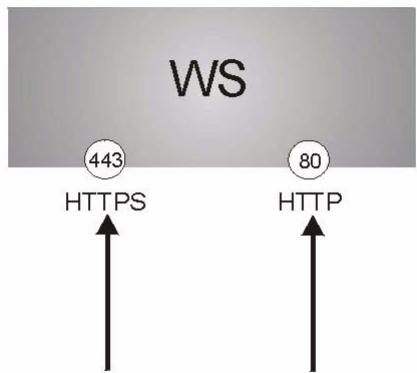
Figure 60 HTTPS Implementation
Note: If you disable HTTP in the Service Access Control screen, then the switch blocks all HTTP connection attempts.
18.8 HTTPS Example
If you haven't changed the default HTTPS port on the switch, then in your browser enter "https://switch IP Address/" as the web site address where "switch IP Address" is the IP address or domain name of the switch you wish to access.
18.8.1 Internet Explorer Warning Messages
When you attempt to access the switch HTTPS server, a Windows dialog box pops up asking if you trust the server certificate. Click View Certificate if you want to verify that the certificate is from the switch.
You see the following Security Alert screen in Internet Explorer. Select Yes to proceed to the web configurator login screen; if you select No, then web configurator access is blocked.
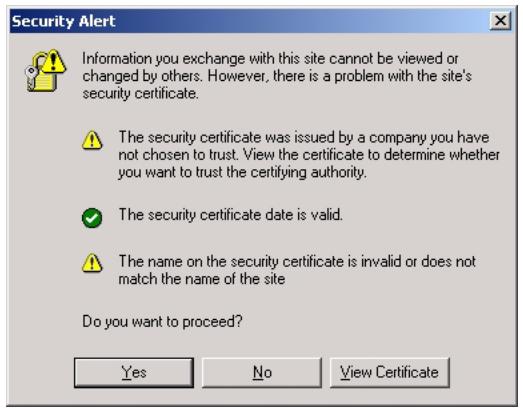
Figure 61 Security Alert Dialog Box (Internet Explorer)
18.8.2 Netscape Navigator Warning Messages
When you attempt to access the switch HTTPS server, a Website Certified by an Unknown Authority screen pops up asking if you trust the server certificate. Click Examine Certificate if you want to verify that the certificate is from the switch.
If Accept this certificate temporarily for this session is selected, then click OK to continue in Netscape.
Select Accept this certificate permanently to import the switch's certificate into the SSL client.
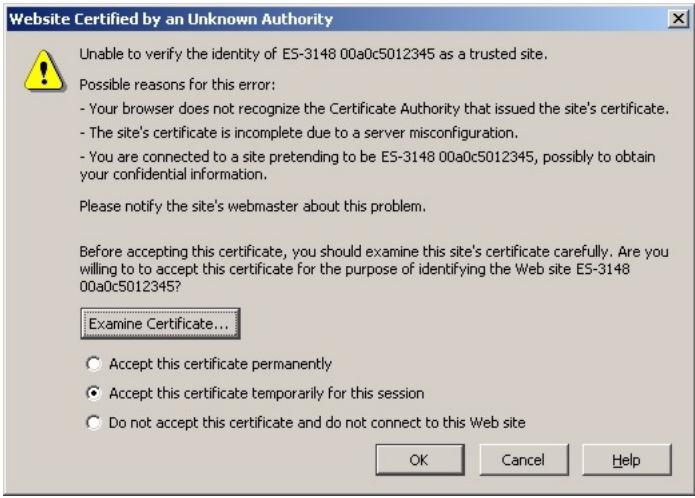
Figure 62 Security Certificate 1 (Netscape)
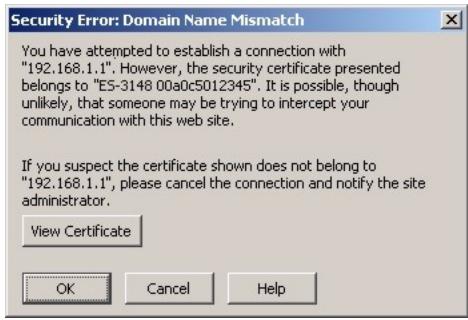
Figure 63 Security Certificate 2 (Netscape)
18.8.3 The Main Screen
After you accept the certificate and enter the login username and password, the switch main screen appears. The lock displayed in the bottom right of the browser status bar denotes a secure connection.
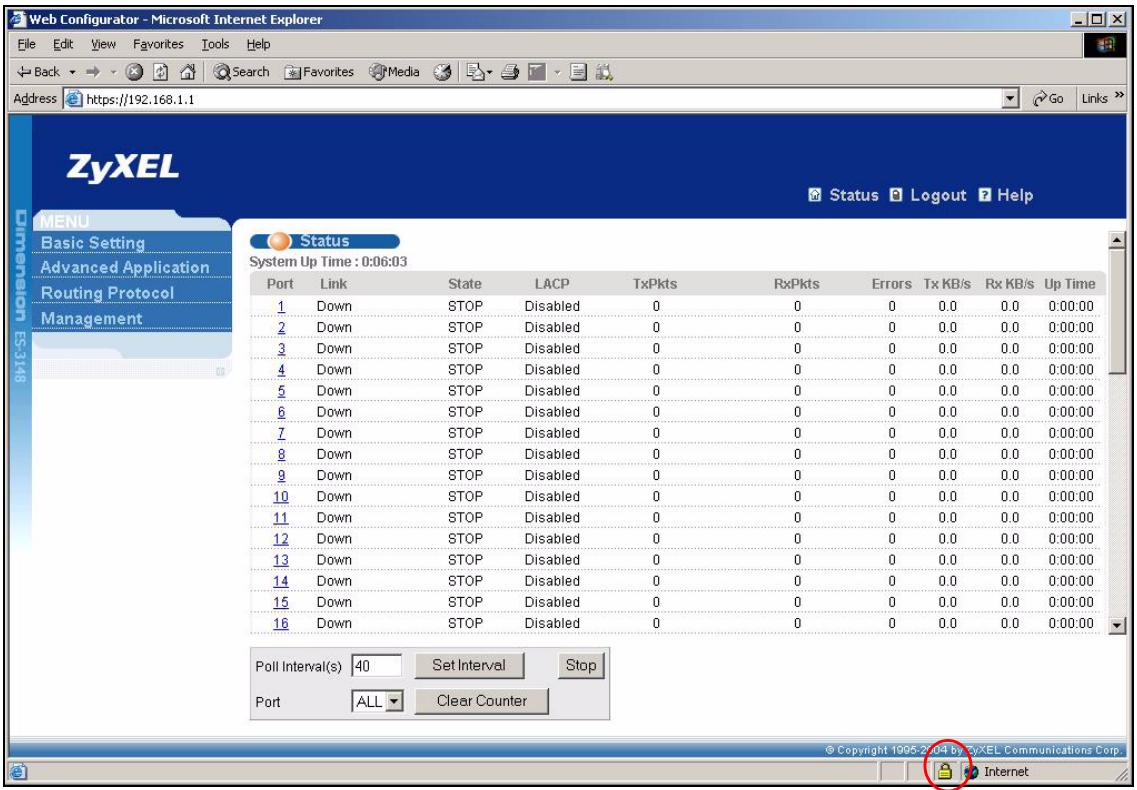
Figure 64 Login Screen (Internet Explorer)
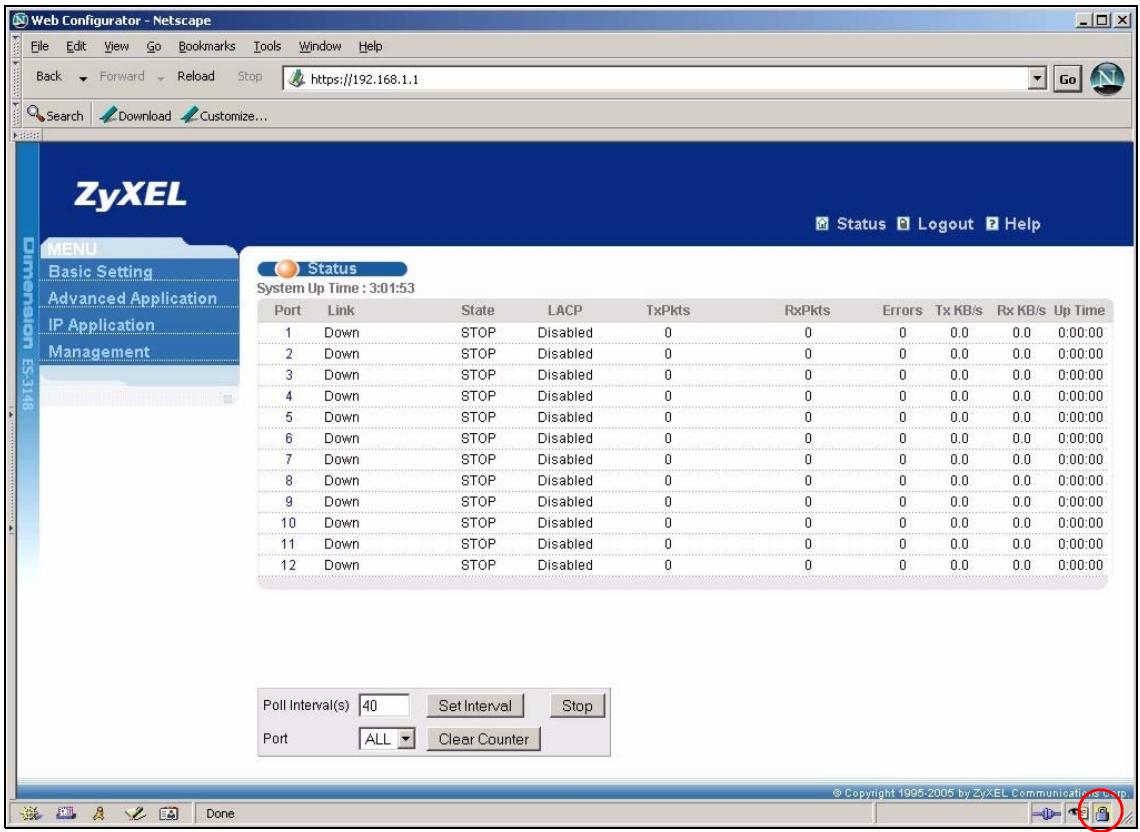
Figure 65 Login Screen (Netscape)
18.9 Service Port Access Control
Service Access Control allows you to decide what services you may use to access the switch. You may also change the default service port and configure "trusted computer(s)" for each service in the Remote Management screen (discussed later). Click Access Control to go back to the main Access Control screen.
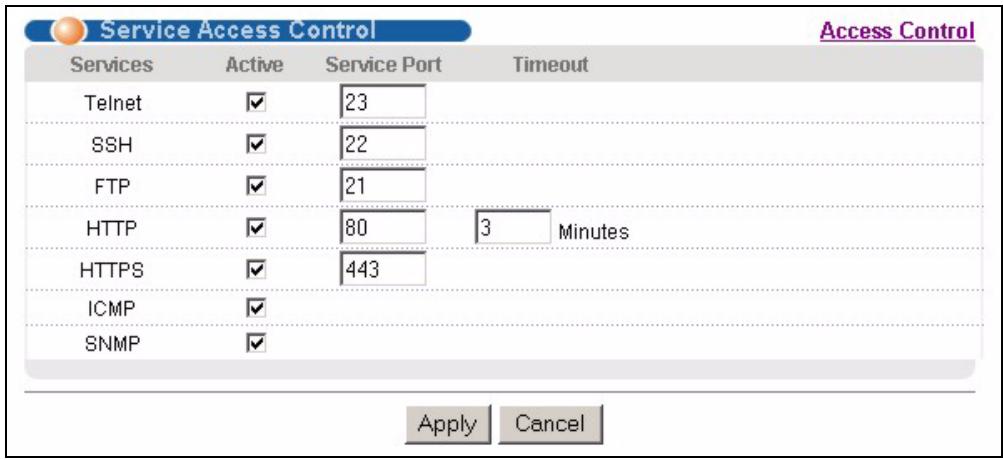
Figure 66 Access Control: Service Access Control
The following table describes the fields in this screen.
Table 39 Access Control: Service Access Control
| LABEL | DESCRIPTION |
| Services | Services you may use to access the switch are listed here. |
| Active | Select this option for the corresponding services that you want to allow to access the switch. |
| Service Port | For Telnet, SSH, FTP, HTTP or HTTPS services, you may change the default service port by typing the new port number in the Server Port field. If you change the default port number then you will have to let people (who wish to use the service) know the new port number for that service. |
| Timeout | Type how many minutes a management session (via the web configurator) can be left idle before the session times out. After it times out you have to log in with your password again. Very long idle timeouts may have security risks. |
| Apply | Click Apply to save your changes back to the switch. |
| Cancel | Click Cancel to begin configuring this screen afresh. |
18.10 Remote Management
From the Access Control screen, display the Remote Management screen as shown next.
You can specify a group of one or more "trusted computers" from which an administrator may use a service to manage the switch. Click Access Control to return to the Access Control screen.
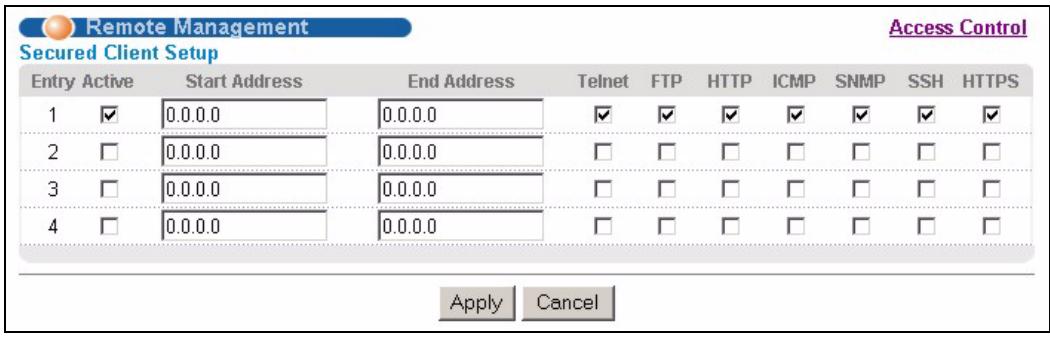
Figure 67 Access Control: Remote Management
The following table describes the labels in this screen.
Table 40 Access Control: Remote Management
| LABEL | DESCRIPTION |
| Entry | This is the client set index number. A “client set” is a group of one or more “trusted computers” from which an administrator may use a service to manage the switch. |
| Active | Select this check box to activate this secured client set. Clear the check box if you wish to temporarily disable the set without deleting it. |
| Start Address End Address | Configure the IP address range of trusted computers from which you can manage this switch. The switch checks if the client IP address of a computer requesting a service or protocol matches the range set here. The switch immediately disconnects the session if it does not match. |
| Telnet/FTP/ HTTP/ICMP/ SNMP/SSH/ HTTPS | Select services that may be used for managing the switch from the specified trusted computers. |
| Apply | Click Apply to save your changes back to the switch. |
| Cancel | Click Cancel to begin configuring this screen afresh. |
CHAPTER 19 Queuing Method
This chapter introduces the queuing methods supported.
19.1 Introduction to Queuing
Queuing is used to help solve performance degradation when there is network congestion. Use the Queuing Method screen to configure queuing algorithms for outgoing traffic. See also Priority Queue Assignment in Switch Setup and 802.1p Priority in Port Setup for related information.
Queuing algorithms allow switches to maintain separate queues for packets from each individual source or flow and prevent a source from monopolizing the bandwidth.
19.1.1 Strictly Priority
Strictly Priority (SP) services queues based on priority only. As traffic comes into the switch, traffic on the highest priority queue, Q7 is transmitted first. When that queue empties, traffic on the next highest-priority queue, Q6 is transmitted until Q6 empties, and then traffic is transmitted on Q5 and so on. If higher priority queues never empty, then traffic on lower priority queues never gets sent. SP does not automatically adapt to changing network requirements.
19.1.2 Weighted Fair Scheduling
Weighted Fair Scheduling is used to guarantee each queue's minimum bandwidth based on its bandwidth weight (portion) (the number you configure in the Weight field - see Figure 18.1) when there is traffic congestion. WFS is activated only when a port has more traffic than it can handle. Queues with larger weights get more guaranteed bandwidth than queues with smaller weights. This queuing mechanism is highly efficient in that it divides any available bandwidth across the different traffic queues. By default, the weight for Q0 is 1, for Q1 is 2, for Q2 is 3, and so on. Guaranteed bandwidth is calculated as follows:
$$ \frac {\text {Q u a e W e i g h t}}{\text {T o t a l Q u a e W e i g h t}} \times \text {P o r T S p e e d} $$
For example, using the default setting, Q0 on Port 1 gets a guaranteed bandwidth of:
$$ \frac {1}{1 + 2 + 3 + 4 + 5 + 6 + 7 + 8} \times 1 0 0 \mathrm {M b p s} = 3 \mathrm {M b p s} $$
19.2 Configuring Queuing
Click Advanced Application, Queuing Method in the navigation panel.
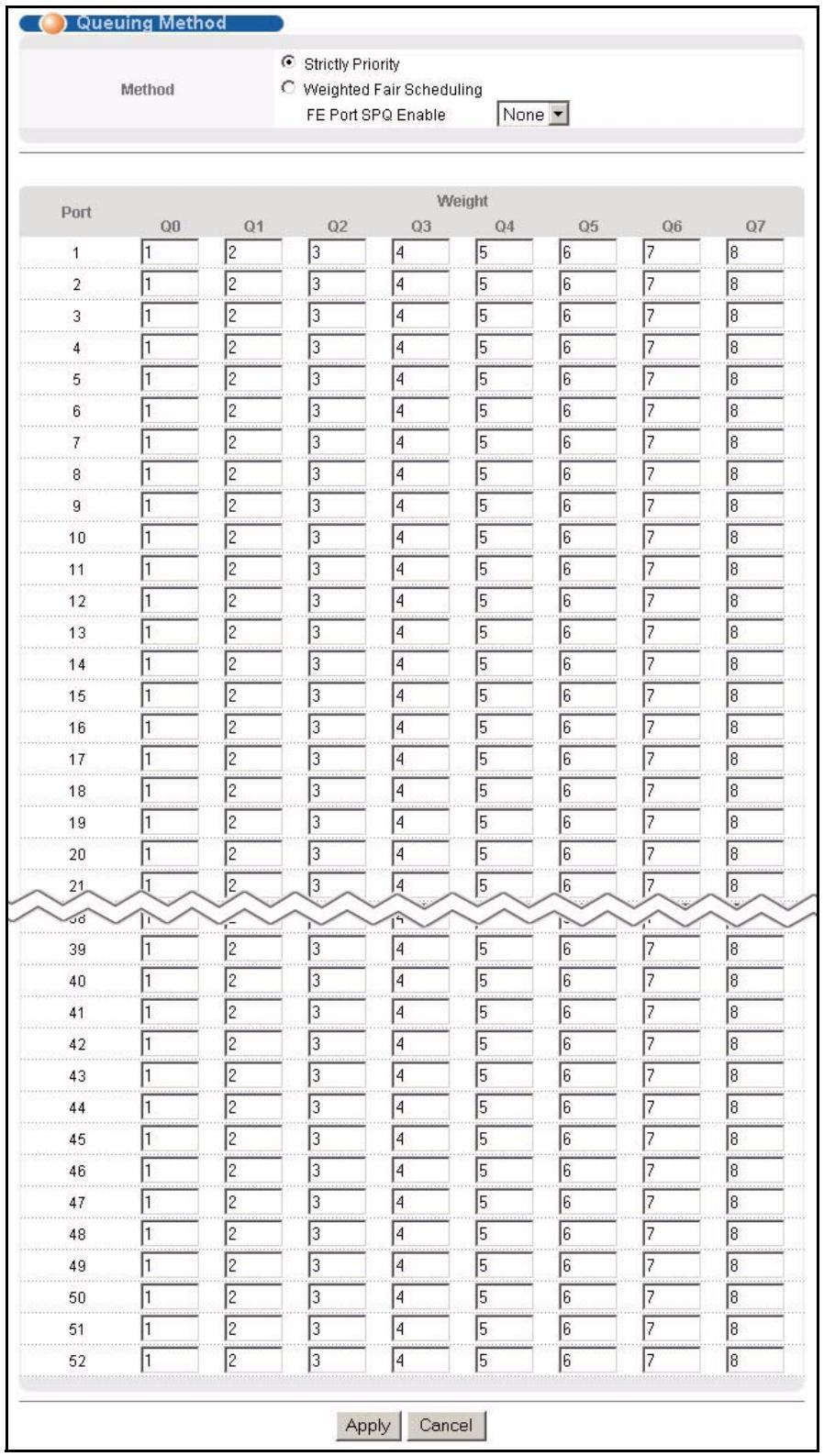
Figure 68 Queuing Method
The following table describes the labels in this screen.
Table 41 Queuing Method
| LABEL | DESCRIPTION |
| Method | Select Strictly Priority or Weighted Fair Scheduling.Strictly Priority services queues based on priority only. When the highest priority queue empties, traffic on the next highest-priority queue begins. Q7 has the highest priority and Q0 the lowest.Weighted Fair Scheduling is used to guarantee each queue's minimum bandwidth based on their bandwidth portion (weight) (the number you configure in the Weight field). Queues with larger weights get more guaranteed bandwidth than queues with smaller weights. |
| FE Port SPQ Enable | This field is applicable only when you select Weighted Fair Scheduling.Select a queue (Q0 to Q7) to have the switch use Strictly Priority to service the subsequent queue(s) after and including the specified queue for the 10/100 Mbps Ethernet ports. For example, if you select Q5, the switch services traffic on Q5, Q6 and Q7 using Strictly Priority.Select None to always use Weighted Fair Scheduling for the 10/100 Mbps Ethernet ports. |
| Port | This label shows the port you are configuring. |
| Weight | When you select Weighted Fair Scheduling, enter the queue weight here. Bandwidth is divided across the different traffic queues according to their weights.For Gigabit ports, if you enter 0 for the queue weight, the switch uses Strictly Priority to service the queue. |
| Apply | Click Apply to save your changes back to the switch. |
| Cancel | Click Cancel to begin configuring this screen afresh. |
CHAPTER 20 Classifier
This chapter introduces and shows you how to configure the packet classifier on the switch.
20.1 About the Classifier and QoS
Quality of Service (QoS) refers to both a network's ability to deliver data with minimum delay, and the networking methods used to control the use of bandwidth. Without QoS, all traffic data is equally likely to be dropped when the network is congested. This can cause a reduction in network performance and make the network inadequate for time-critical application such as video-on-demand.
A classifier groups traffic into data flows according to specific criteria such as the source address, destination address, source port number, destination port number or incoming port number. For example, you can configure a classifier to select traffic from the same protocol port (such as Telnet) to form a flow.
Configure QoS on the switch to group and prioritize application traffic and fine-tune network performance. Setting up QoS involves two separate steps:
1 Configure classifiers to sort traffic into different flows.
2 Configure policy rules to define actions to be performed for a classified traffic flow (refer to Chapter 21 on page 149 to configure policy rules).
20.2 Configuring the Classifier
Use the Classifier screen to define the classifiers. After you define the classifier, you can specify actions (or policy) to act upon the traffic that match the rules. To configure policy rules, refer to Chapter 21 on page 149.
Click Advanced Application and Classifier in the navigation panel to display the configuration screen as shown.
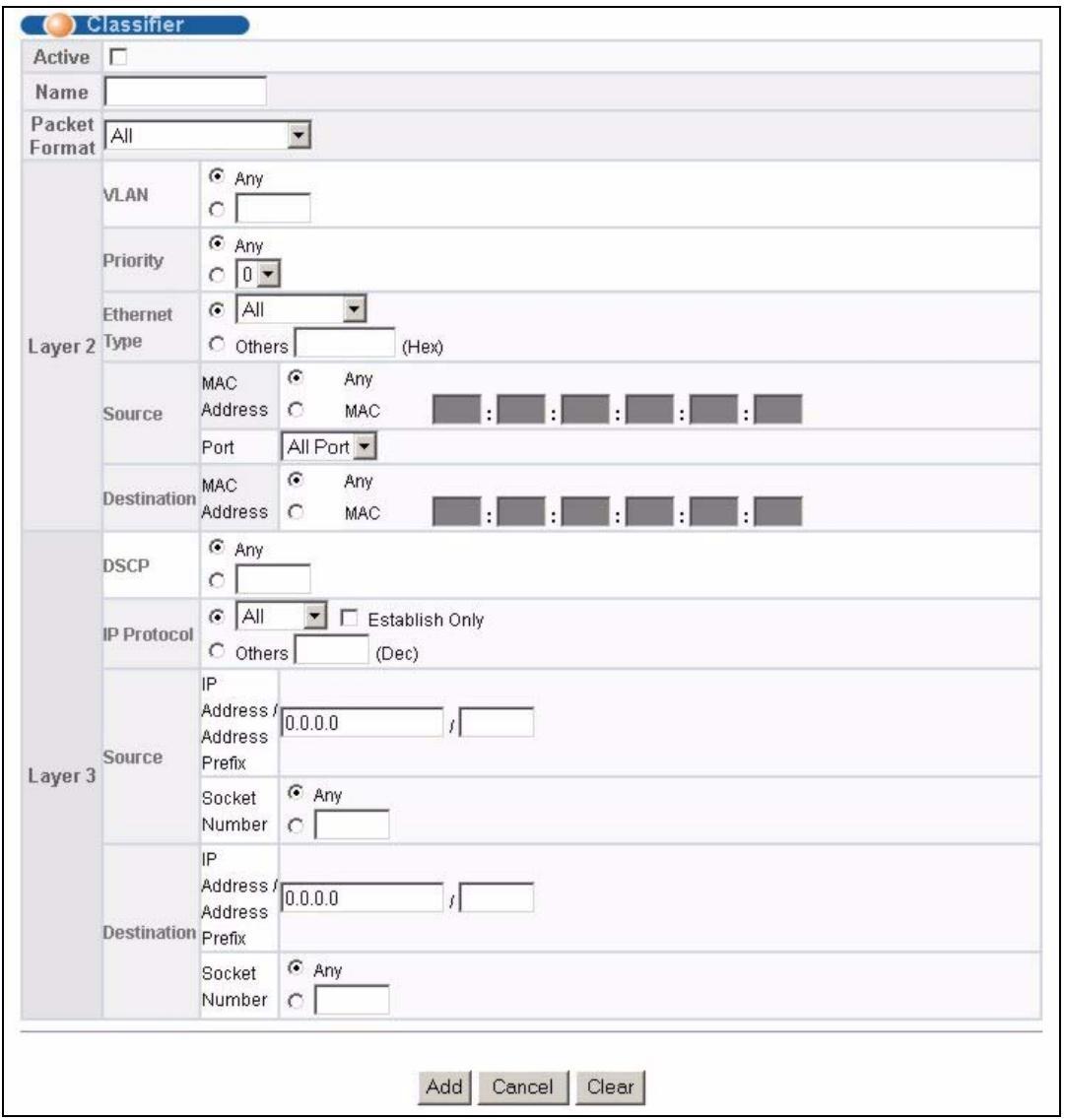
Figure 69 Classifier
The following table describes the labels in this screen.
Table 42 Classifier
| LABEL | DESCRIPTION |
| Active | Select this option to enable this rule. |
| Name | Enter a descriptive name for this rule for identifying purposes. |
| Packet Format | Specify the format of the packet. Choices are All, 802.3 tagged, 802.3 untagged, Ethernet II tagged and Ethernet II untagged.A value of 802.3 indicates that the packets are formatted according to the IEEE 802.3 standards.A value of Ethernet II indicates that the packets are formatted according to RFC 894, Ethernet II encapsulation. |
| Layer 2Specify the fields below to configure a layer 2 classifier. | |
| VLAN | Select Any to classify traffic from any VLAN or select the second option and specify the source VLAN ID in the field provided. |
| Priority | Select Any to classify traffic from any priority level or select the second option and specify a priority level in the field provided. |
| Ethernet Type | Select an Ethernet type or select Other and enter the Ethernet type number in hexadecimal value. Refer to Table 44 on page 146 for information. |
| Source | |
| MAC Address | Select Any to apply the rule to all MAC addresses.To specify a source, select the second choice and type a MAC address in valid MAC address format (six hexadecimal character pairs). |
| Port | Select the port to which the rule should be applied. You may choose one port only or all ports (All Ports). |
| Destination | |
| MAC Address | Select Any to apply the rule to all MAC addresses.To specify a destination, select the second choice and type a MAC address in valid MAC address format (six hexadecimal character pairs). |
| Layer 3 Specify the fields below to configure a layer 3 classifier. | |
| DSCP | Select Any to classify traffic from any DSCP or select the second option and specify a DSCP (DiffServ Code Point) number between 0 and 63 in the field provided. |
| IP Protocol | Select an IP protocol type or select Other and enter the protocol number in decimal value.Refer to Table 45 on page 147 for more information.You may select Establish Only for TCP protocol type. This means that the switch will pick out the packets that are sent to establish TCP connections. |
| Source | |
| IP Address/Address Prefix | Enter a source IP address in dotted decimal notation.Specify the address prefix by entering the number of ones in the subnet mask. |
| Socket Number | Note: You must select either UDP or TCP in the IP Protocol field before you configure the socket numbers.Select Any to apply the rule to all TCP/UDP protocol port numbers or select the second option and enter a TCP/UDP protocol port number. |
| Destination | |
| IP Address/Address Prefix | Enter a destination IP address in dotted decimal notation.Specify the address prefix by entering the number of ones in the subnet mask. |
| Socket Number | Note: You must select either UDP or TCP in the IP Protocol field before you configure the socket numbers.Select Any to apply the rule to all TCP/UDP protocol port numbers or select the second option and enter a TCP/UDP protocol port number. |
| Add | Click Add to insert the entry in the summary table below. |
| Cancel | Click Cancel to reset the fields back to your previous configuration. |
| Clear | Click Clear to set the above fields back to the factory defaults. |
20.3 Viewing and Editing Classifier Configuration
To view a summary of the classifier configuration, scroll down to the summary table at the bottom of the Classifier screen. To change the settings of a rule, click a number in the Index field.
Note: When two rules conflict with each other, a higher layer rule has priority over lower layer rule.

Figure 70 Classifier: Summary Table
The following table describes the labels in this screen.
Table 43 Classifier: Summary Table
| LABEL | DESCRIPTION |
| Index | This field displays the index number of the rule. Click an index number to edit the rule. |
| Active | This field displays Yes when the rule is activated and No when it is deactivated. |
| Name | This field displays the descriptive name for this rule. This is for identification purpose only. |
| Rule | This field displays a summary of the classifier rule's settings. |
| Delete | Click Delete to remove the selected entry from the summary table. |
| Cancel | Click Cancel to clear the Delete check boxes. |
The following table shows some other common Ethernet types and the corresponding protocol number.
Table 44 Common Ethernet Types and Protocol Number
| ETHERNET TYPE | PROTOCOL NUMBER |
| IP ETHII | 0800 |
| X.75 Internet | 0801 |
| NBS Internet | 0802 |
| ECMA Internet | 0803 |
Table 44 Common Ethernet Types and Protocol Number
| ETHERNET TYPE | PROTOCOL NUMBER |
| Chaosnet | 0804 |
| X.25 Level 3 | 0805 |
| XNS Compat | 0807 |
| Banyan Systems | 0BAD |
| BBN Simnet | 5208 |
| IBM SNA | 80D5 |
| AppleTalk AARP | 80F3 |
Some of the most common IP ports are:
Table 45 Common IP Ports
| PORT NUMBER | PORT NAME |
| 21 | FTP |
| 23 | Telnet |
| 25 | SMTP |
| 53 | DNS |
| 80 | HTTP |
| 110 | POP3 |
20.4 Classifier Example
The following figure shows an example where you configure a classifier that identifies all traffic from MAC address 00:50:ba:ad:4f:81 on port 2.
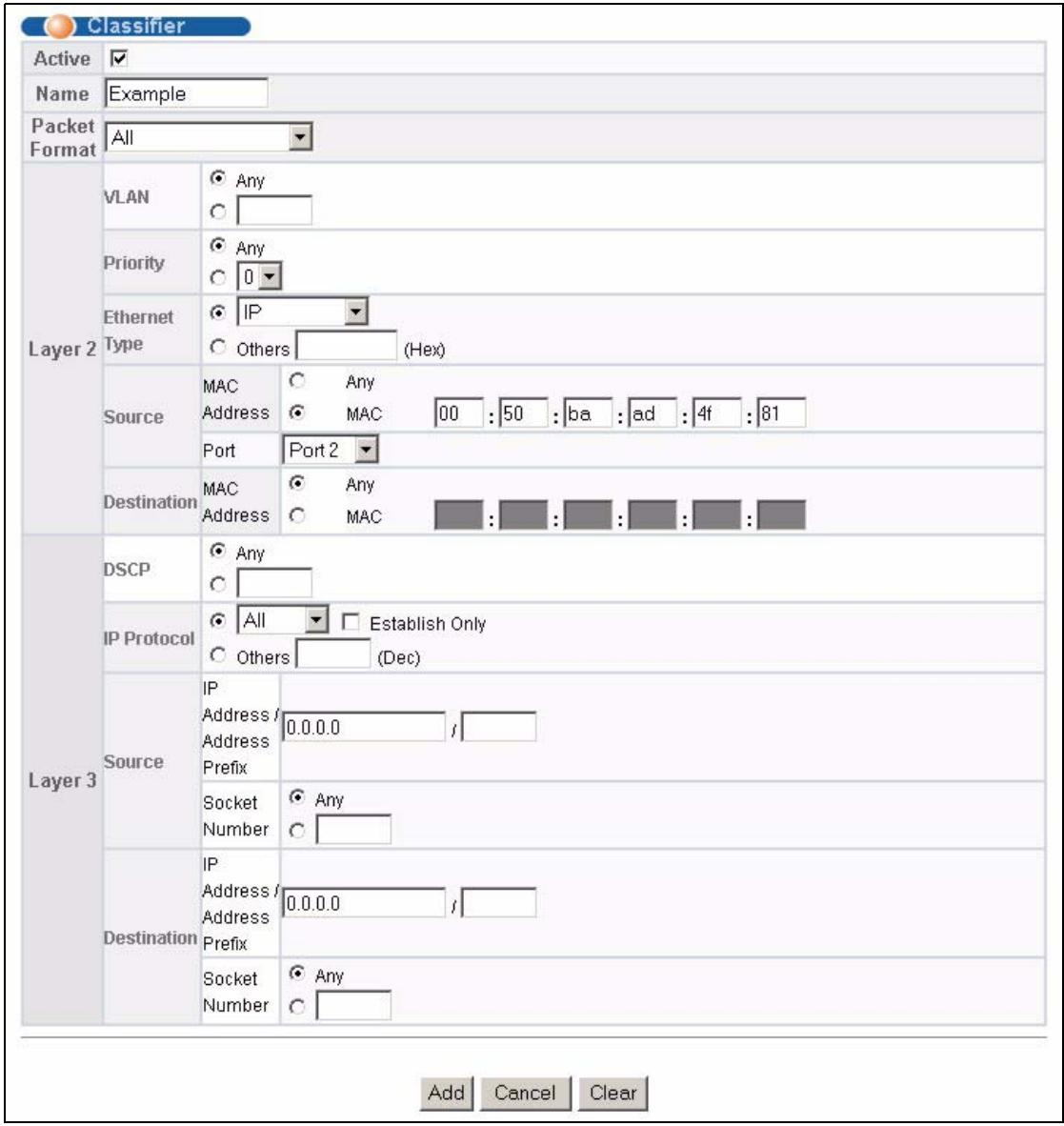
Figure 71 Classifier: Example
CHAPTER 21 Policy Rule
This chapter shows you how to configure policy rules.
21.1 About Policy Rules
A classifier distinguishes traffic into flows based on the configured criteria (refer to Chapter 20 on page 143 for more information). A policy rule ensures that a traffic flow gets the requested treatment in the network.
21.1.1 DiffServ
DiffServ (Differentiated Services) is a class of service (CoS) model that marks packets so that they receive specific per-hop treatment at DiffServ-compliant network devices along the route based on the application types and traffic flow. Packets are marked with DiffServ Code Points (DSCPs) indicating the level of service desired. This allows the intermediary DiffServ-compliant network devices to handle the packets differently depending on the code points without the need to negotiate paths or remember state information for every flow. In addition, applications do not have to request a particular service or give advanced notice of where the traffic is going.
21.1.2 DSCP and Per-Hop Behavior
DiffServ defines a new DS (Differentiated Services) field to replace the Type of Service (TOS) field in the IP header. The DS field contains a 2-bit unused field and a 6-bit DSCP field which can define up to 64 service levels. The following figure illustrates the DS field.
DSCP is backward compatible with the three precedence bits in the ToS octet so that non-DiffServ compliant, ToS-enabled network device will not conflict with the DSCP mapping.
| DSCP (6 bits) | Unused (2 bits) |
The DSCP value determines the forwarding behavior, the PHB (Per-Hop Behavior), that each packet gets across the DiffServ network. Based on the marking rule, different kinds of traffic can be marked for different kinds of forwarding. Resources can then be allocated according to the DSCP values and the configured policies.
21.2 Configuring Policy Rules
You must first configure a classifier in the Classifier screen. Refer to Chapter 20 on page 143 for more information.
Click Advanced Applications and then Policy Rule in the navigation panel to display the screen as shown.
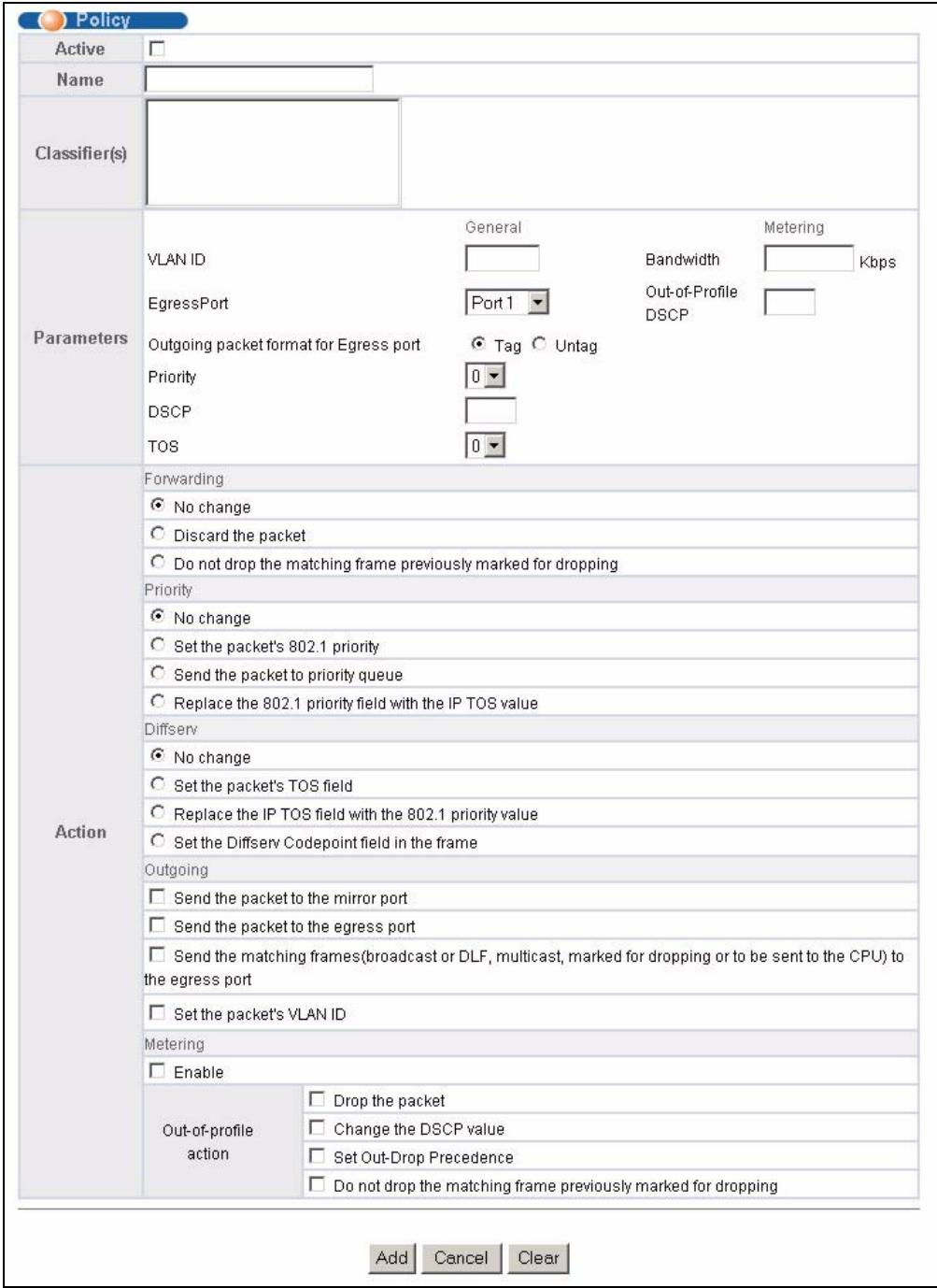
Figure 72 Policy
The following table describes the labels in this screen.
Table 46 Policy
| LABEL | DESCRIPTION |
| Active | Select this option to enable the policy. |
| Name | Enter a descriptive name for identification purposes. |
| Classifier(s) | This field displays the active classifier(s) you configure in the Classifier screen. Select the classifier(s) to which this policy rule applies. To select more than one classifier, press [SHIFT] and select the choices at the same time. |
| Parameters Set the fields below for this policy. You only have to set the field(s) that is related to the action(s) you configure in the Action field. | |
| General | |
| VLAN ID | Specify a VLAN ID number. |
| Egress Port | Select an outgoing port. |
| Outgoing packet format for Egress port | Select Tag to add the specified VID to packets on the specified outgoing port. Otherwise, select Untag. |
| Priority | Specify a priority level. |
| DSCP | Specify a DSCP (DiffServ Code Point) number between 0 and 63. |
| TOS | Specify the type of service (TOS) priority level. |
| Metering | You can configure the desired bandwidth available to a traffic flow. Traffic that exceeds the maximum bandwidth allocated (in cases where the network is congested) is called out-of-profile traffic. |
| Bandwidth | Specify the bandwidth in kilobit per second (Kbps). Enter a number between 1 and 1000000. |
| Out-of-Profile DSCP | Specify a new DSCP number (between 0 and 63) if you want to replace or remark the DSCP number for out-of-profile traffic. |
| Action Specify the action(s) the switch takes on the associated classified traffic flow. | |
| Forwarding | Select No change to forward the packets. Select Discard the packet to drop the packets. Select Do not drop the matching frame previously marked for dropping to retain the frames that were marked to be dropped before. |
| Priority | Select No change to keep the priority setting of the frames. Select Set the packet's 802.1 priority to replace the packet's 802.1priority field with the value you set in the Priority field. Select Send the packet to priority queue to put the packets in the designated queue. Select Replace the 802.1 priority field with the IP TOS value to replace the packet's 802.1 priority field with the value you set in the TOS field. |
| Diffserv | Select No change to keep the TOS and/or DSCP fields in the packets. Select Set the packet's TOS field to set the TOS field with the value you configure in the TOS field. Select Replace the IP TOS with the 802.1 priority value to replace the TOS field with the value you configure in the Priority field. Select Set the Diffserv Codepoint field in the frame to set the DSCP field with the value you configure in the DSCP field. |
| Outgoing | Select Send the packet to the mirror port to send the packet to the mirror port. Select Send the packet to the egress port to send the packet to the egress port. Select Send the matching frames (broadcast or DLF, multicast, marked for dropping or to be sent to the CPU) to the egress port to send the broadcast, multicast, DLF, marked-to-drop or CPU frames to the egress port. Select Set the packet's VLANID to set the VLAN ID of the packet with the value you configure in the VLANID field. |
| Metering | Select Enable to activate bandwidth limitation on the traffic flow(s) then set the actions to be taken on out-of-profile packets. |
| Out-of-profile action | Select the action(s) to be performed for out-of-profile traffic. Select Drop the packet to discard the out-of-profile traffic. Select Change the DSCP value to replace the DSCP field with the value specified in the Out of profile DSCP field. Select Set Out-Drop Precedence to mark out-of-profile traffic and drop it when network is congested. Select Do not drop the matching frame previously marked for dropping to queue the frames that are marked to be dropped. |
| Add | Click Add to inset the entry to the summary table below. |
| Cancel | Click Cancel to reset the fields back to your previous configuration. |
| Clear | Click Clear to set the above fields back to the factory defaults. |
21.3 Viewing and Editing Policy Configuration
To view a summary of the classifier configuration, scroll down to the summary table at the bottom of the Policy screen. To change the settings of a rule, click a number in the Index field.

Figure 73 Policy: Summary Table
The following table describes the labels in this screen.
Table 47 Policy: Summary Table
| LABEL | DESCRIPTION |
| Index | This field displays the policy index number. Click an index number to edit the policy. |
| Active | This field displays Yes when policy is activated and No when is it deactivated. |
| Name | This field displays the descriptive name for this policy. This is for identification purposes only. |
| Classifier(s) | This field displays the name(s) of the classifier to which this policy applies. |
| Delete | Click Delete to remove the selected entry from the summary table. |
| Cancel | Click Cancel to clear the Delete check boxes. |
21.4 Policy Example
The figure below shows an example Policy screen where you configure a policy to limit bandwidth and discard out-of-band traffic on a traffic flow classified using the Example classifier (refer to Section 20.4 on page 147).
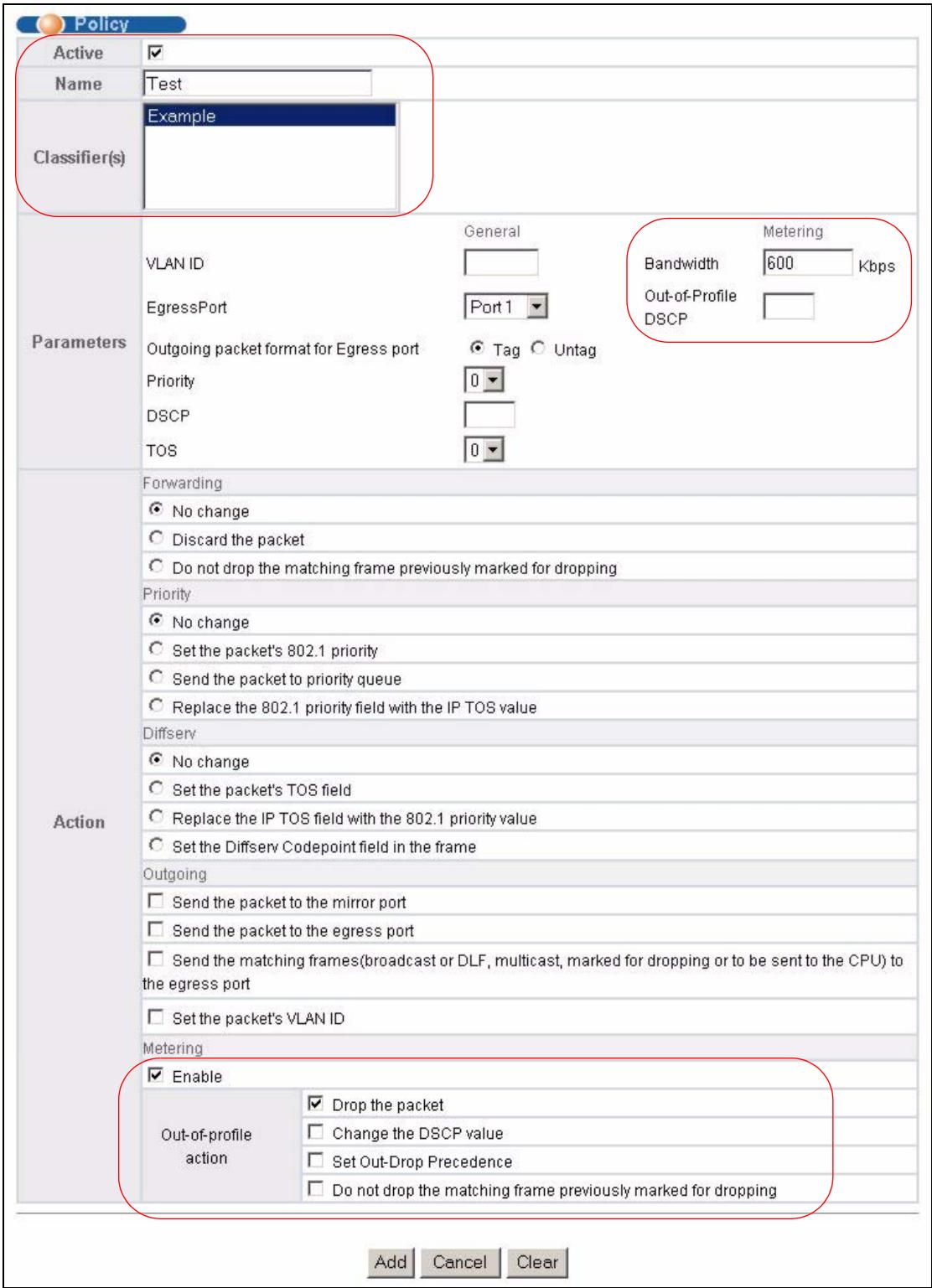
Figure 74 Policy Example
CHAPTER 22 VLAN Stacking
This chapter shows you how to configure VLAN stacking on your switch. See the chapter on VLANs for more background information on Virtual LAN
22.1 Introduction
A service provider can use VLAN stacking to allow it to distinguish multiple customers VLANs, even those with the same (customer-assigned) VLAN ID, within its network.
Use VLAN stacking to add an outer VLAN tag to the inner IEEE 802.1Q tagged frames that enter the network. By tagging the tagged frames ("double-tagged" frames), the service provider can manage up to 4,094 VLAN groups with each group containing up to 4,094 customer VLANs. This allows a service provider to provide different service, based on specific VLANs, for many different customers.
A service provider's customers may require a range of VLANs to handle multiple applications. A service provider's customers can assign their own inner VLAN tags on ports for these applications. The service provider can assign an outer VLAN tag for each customer. Therefore, there is no VLAN tag overlap among customers, so traffic from different customers is kept separate.
22.1.1 VLAN Stacking Example
In the following example figure, both A and B are Service Provider's Network (SPN) customers with VPN tunnels between their head offices and branch offices respectively. Both have an identical VLAN tag for their VLAN group. The service provider can separate these two VLANs within its network by adding tag 37 to distinguish customer A and tag 48 to distinguish customer B at edge device 1 and then stripping those tags at edge device 2 as the data frames leave the network.
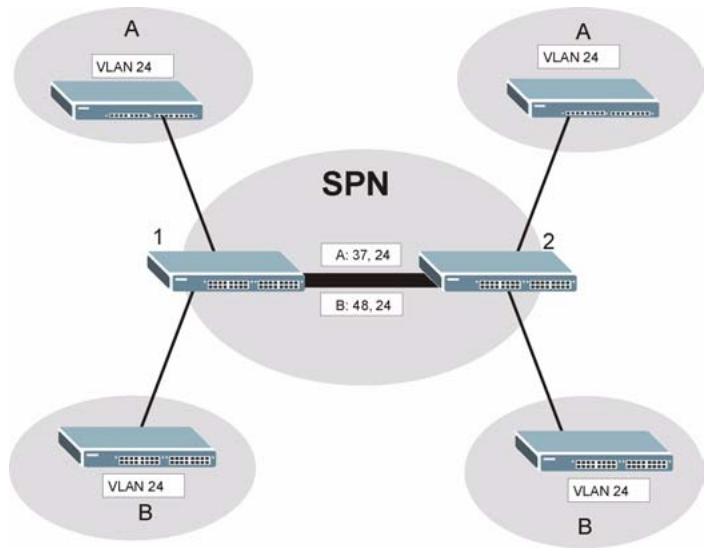
Figure 75 VLAN Stacking Example
22.2 VLAN Stacking Port Roles
Each port can have three VLAN stacking "roles", Normal, Access Port and Tunnel (the latter is for Gigabit ports only).
- Select Normal for "regular" (non-VLAN stacking) IEEE 802.1Q frame switching.
- Select Access Port for ingress ports on the service provider's edge devices (1 and 2 in the VLAN stacking example figure). The incoming frame is treated as "untagged", so a second VLAN tag (outer VLAN tag) can be added.
Note: Static VLAN Tx Tagging MUST be disabled on a port where you choose Normal or Access Port.
- Select Tunnel (available for Gigabit ports only) for egress ports at the edge of the service provider's network. All VLANs belonging to a customer can be aggregated into a single service provider's VLAN (using the outer VLAN tag defined by SP VID).
Note: Static VLAN Tx Tagging MUST be enabled on a port where you choose Tunnel.
22.3 VLAN Tag Format
A VLAN tag (service provider VLAN stacking or customer IEEE 802.1Q) consists of the following three fields.
Table 48 VLAN Tag Format
| Type | Priority | VID |
Type is a standard Ethernet type code identifying the frame and indicates that whether the frame carries IEEE 802.1Q tag information. SP TPID (Service Provider Tag Protocol Identifier) is the service provider VLAN stacking tag type. Many vendors use 0x8100 or 0x9100.
TPID (Tag Protocol Identifier) is the customer IEEE 802.1Q tag.
- If the VLAN stacking port role is Access Port, then the switch adds the SP TPID tag to all incoming frames on the service provider's edge devices (1 and 2 in the VLAN stacking example figure).
- If the VLAN stacking port role is Tunnel, then the switch only adds the SP TPID tag to all incoming frames on the service provider's edge devices (1 and 2 in the VLAN stacking example figure) that have an SP TPID different to the one configured on the switch. (If an incoming frame's SP TPID is the same as the one configured on the switch, then the switch will not add the tag.)
Priority refers to the IEEE 802.1p standard that allows the service provider to prioritize traffic based on the class of service (CoS) the customer has paid for.
- On the switch, configure priority level of inner IEEE 802.1Q tag in the Port Setup screen.
- "0" is the lowest priority level and "7" is the highest.
VID is the VLAN ID. SP VID is the VID for the second (service provider's) VLAN tag.
22.3.1 Frame Format
The frame format for an untagged Ethernet frame, a single-tagged 802.1Q frame (customer) and a "double-tagged" 802.1Q frame (service provider) is shown next.
Configure the fields as circled in the switch VLAN Stacking screen.
Table 49 Single and Double Tagged 802.11Q Frame Format
| DA | SA | Len/Type | Data | FCS | Untagged Ethernet frame | ||||||
| DA | SA | TPID | Priority | VID | Len/Type | Data | FCS | IEEE 802.1Q customer tagged frame | |||
| DA | SA | SPTPID | Priority | VID | TPID | Priority | VID | Len/Type | Data | FCS | Double-tagged frame |
Table 50 802.1Q Frame
| DA | Destination Address | Priority | 802.1p Priority |
| SA | Source Address | Len/Type | Length and type of Ethernet frame |
| (SP)TPID | (Service Provider) Tag Protocol IDentifier | Data | Frame data |
| VID | VLAN ID | FCS | Frame Check Sequence |
22.4 Configuring VLAN Stacking
Click Advanced Applications and then VLAN Stacking in the navigation panel to display the screen as shown.
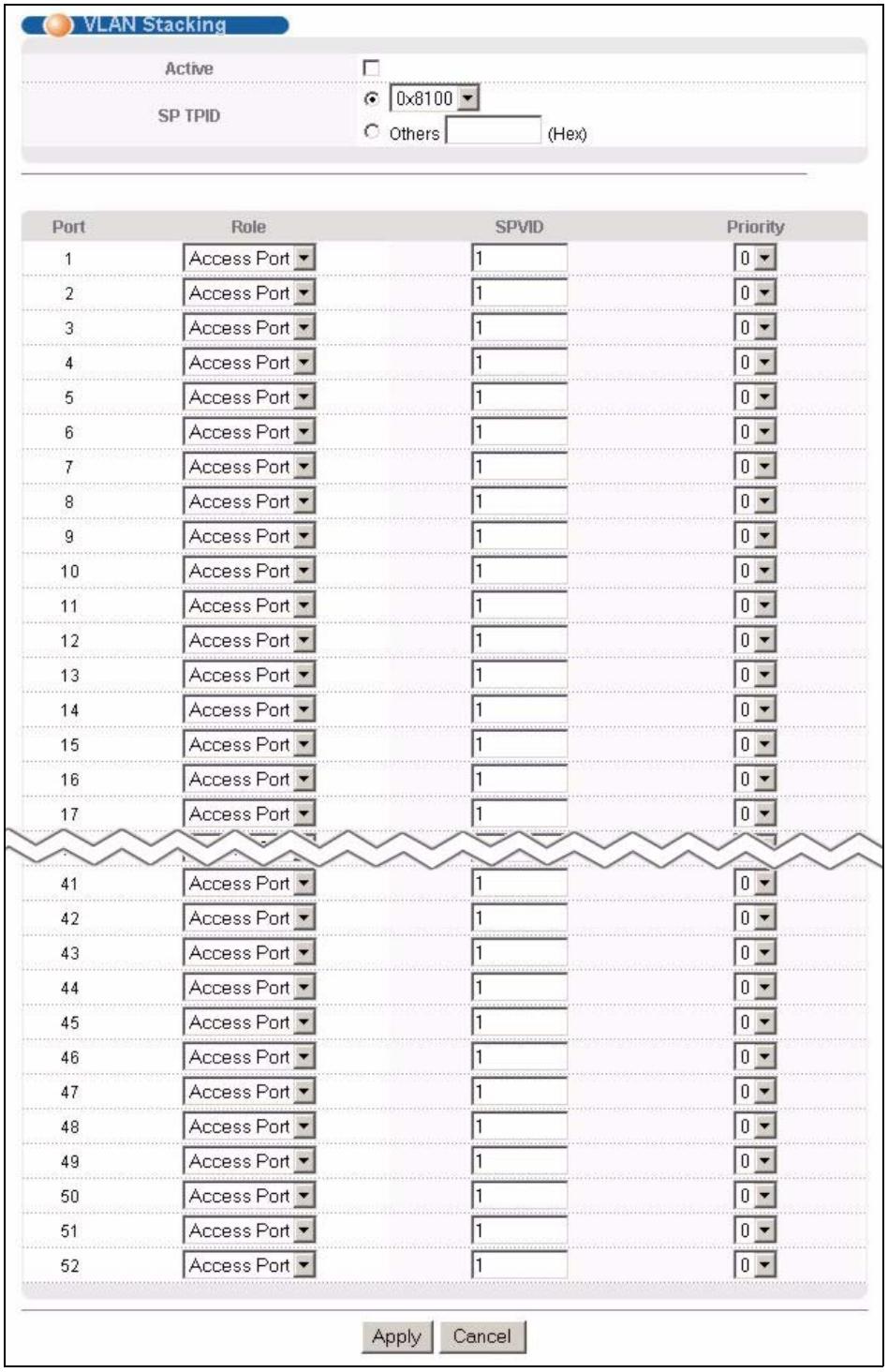
Figure 76 VLAN Stacking
The following table describes the labels in this screen.
Table 51 VLAN Stacking
| LABEL | DESCRIPTION |
| Active | Select this checkbox to enable VLAN stacking on the switch. |
| SP TPID | SP TPID is a standard Ethernet type code identifying the frame and indicates whether the frame carries IEEE 802.1Q tag information. Choose 0x8100 or 0x9100 from the drop-down list box or select Others and then enter a four-digit hexadecimal number from 0x0000 to 0xFFFF. 0x denotes a hexadecimal number. It does not have to be typed in the Others text field. |
| Port | The port number identifies the port you are configuring. |
| Role | Select Normal to have the switch ignore frames received (or transmitted) on this port with VLAN stacking tags. Anything you configure in SPVID and Priority are ignored. Select Access Port to have the switch add the SP TPID tag to all incoming frames received on this port. Select Access Port for ingress ports at the edge of the service provider's network. Select Tunnel (available for Gigabit ports only) for egress ports at the edge of the service provider's network. In order to support VLAN stacking on a port, the port must be able to allow frames of 1526 Bytes (1522 Bytes + 4 Bytes for the second tag) to pass through it. |
| SPVID | SPVID is the service provider's VLAN ID (the outer VLAN tag). Enter the service provider ID (from 1 to 4094) for frames received on this port. See Chapter 8 on page 77 for more background information on VLAN ID. |
| Priority | On the switch, configure priority level of inner IEEE 802.1Q tag in the Port Setup screen. "0" is the lowest priority level and "7" is the highest. |
| Apply | Click Apply to save your changes back to the switch. |
| Cancel | Click Cancel to begin configuring this screen afresh. |
CHAPTER 23 Multicast
This chapter shows you how to configure various multicast features.
23.1 Overview
Traditionally, IP packets are transmitted in one of either two ways - Unicast (1 sender to 1 recipient) or Broadcast (1 sender to everybody on the network). Multicast delivers IP packets to just a group of hosts on the network.
IGMP (Internet Group Multicast Protocol) is a network-layer protocol used to establish membership in a multicast group - it is not used to carry user data. Refer to RFC 1112 and RFC 2236 for information on IGMP versions 1 and 2 respectively.
23.1.1 IP Multicast Addresses
In IPv4, a multicast address allows a device to send packets to a specific group of hosts (multicast group) in a different subnetwork. A multicast IP address represents a traffic receiving group, not individual receiving devices. IP addresses in the Class D range (224.0.0.0 to 239.255.255.255) are used for IP multicasting. Certain IP multicast numbers are reserved by IANA for special purposes (see the IANA web site for more information).
23.1.2 IGMP Filtering
With the IGMP filtering feature, you can control which IGMP groups a subscriber on a port can join. This allows you to control the distribution of multicast services (such as content information distribution) based on service plans and types of subscription.
You can set the switch to filter the multicast group join reports on a per-port basis by configuring an IGMP filtering profile and associating the profile to a port.
23.1.3 IGMP Snooping
A switch can passively snoop on IGMP Query, Report and Leave (IGMP version 2) packets transferred between IP multicast routers/switches and IP multicast hosts to learn the IP multicast group membership. It checks IGMP packets passing through it, picks out the group registration information, and configures multicast accordingly. IGMP snooping allows the switch to learn multicast groups without you having to manually configure them.
The switch forwards multicast traffic destined for multicast groups (that it has learned from IGMP snooping or that you have manually configured) to ports that are members of that group. IGMP snooping generates no additional network traffic, allowing you to significantly reduce multicast traffic passing through your switch.
23.2 Multicast Status
Click Advanced Applications and Multicast to display the screen as shown. This screen shows the multicast group information.

The following table describes the labels in this screen.
Table 52 Multicast Status
| LABEL | DESCRIPTION |
| Index | This is the index number of the entry. |
| VID | This field displays the multicast VLAN ID. |
| Port | This field displays the port number that belongs to the multicast group. |
| Multicast Group | This field displays IP multicast group addresses. |
23.3 Multicast Setup
Click Advanced Applications, Multicast and the Multicast Setting link to display the screen as shown.
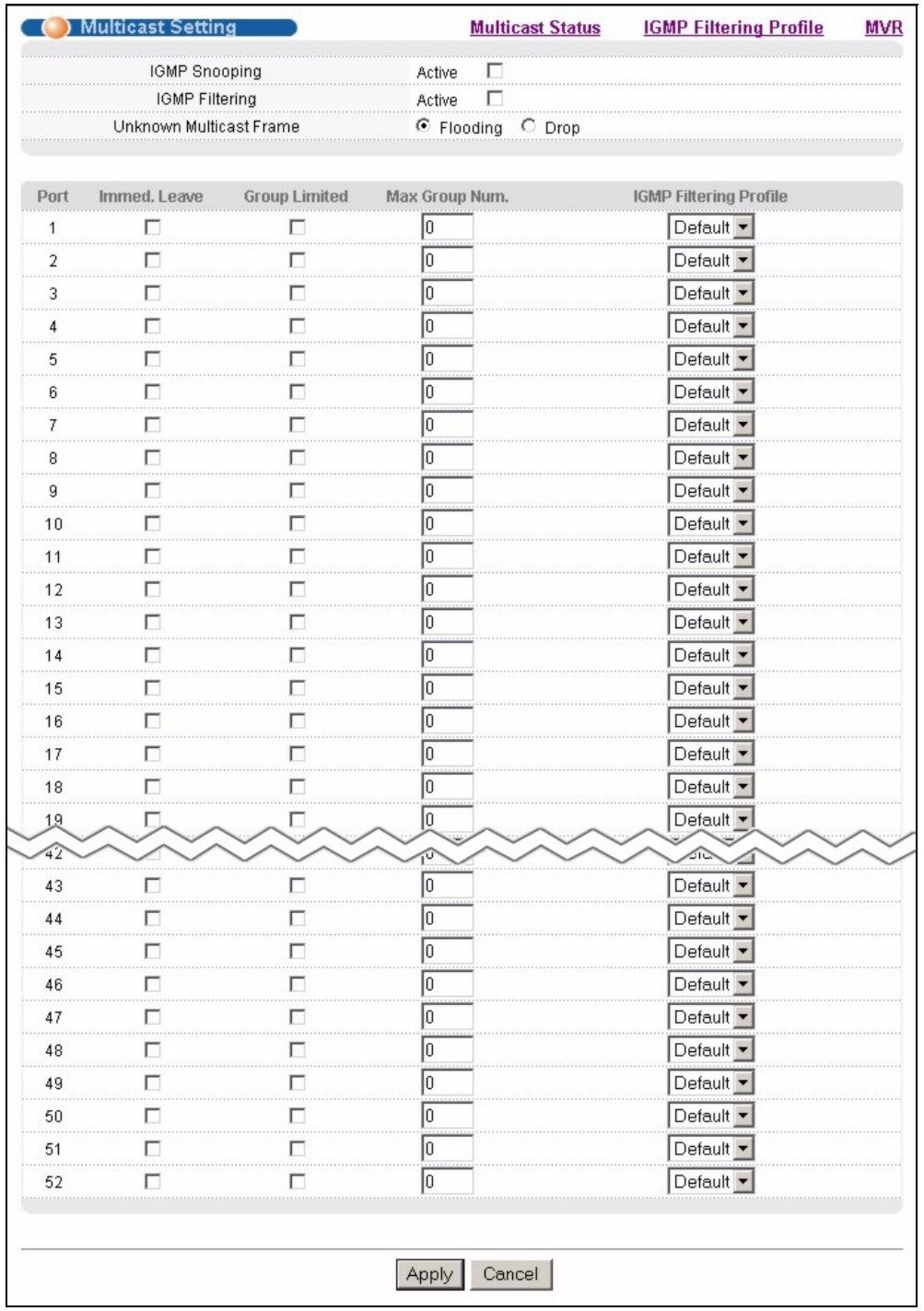
Figure 77 Multicast Setting
The following table describes the labels in this screen.
Table 53 Multicast Setting
| LABEL | DESCRIPTION |
| IGMP Snooping | Select Active to enable IGMP snooping to forward group multicast traffic only to ports that are members of that group. |
| IGMP Filtering | Select Active to enable IGMP filtering to control which IGMP groups a subscriber on a port can join. |
| Unknown Multicast Frame | Specify the action to perform when the switch receives an unknown multicast frame. Select Drop to discard the frame(s). Select Flooding to send the frame(s) to all ports. |
| Port | This field displays the port number. |
| Immed. Leave | Select this option to set the switch to remove this port from the multicast tree when an IGMP version 2 leave message is received on this port. Select this option if there is only one host connected to this port. |
| Group Limited | Select this option to limit the number of multicast groups this port is allowed to join. |
| Max Group Num. | Enter the number of multicast groups this port is allowed to join. Once a port is registered in the specified number of multicast groups, any new IGMP join report frame(s) is dropped on this port. |
| IGMP Filtering Profile | Select the name of the IGMP filtering profile to use for this port. Otherwise, select Default to prohibit the port from joining any multicast group. |
| Apply | Click Apply to save your changes back to the switch. |
| Cancel | Click Cancel to begin configuring this screen afresh. |
23.4 IGMP Filtering Profile
IGMP filter profiles allow you to control access to IGMP multicast groups. This allows you to have a service available to a specific IGMP multicast group. You can configure an IGMP filter profile for an IGMP multicast group that has access to a service (like a SIP server for example). Within a profile, configure an IGMP filter to specify the multicast IP address ranges. Then assign the IGMP filter profile to the ports (in the Multicast Setting screen) that are allowed to use the service.
Click Advanced Applications and Multicast in the navigation panel. Click the Multicast Setting link and then the IGMP Filtering Profile link to display the screen as shown.
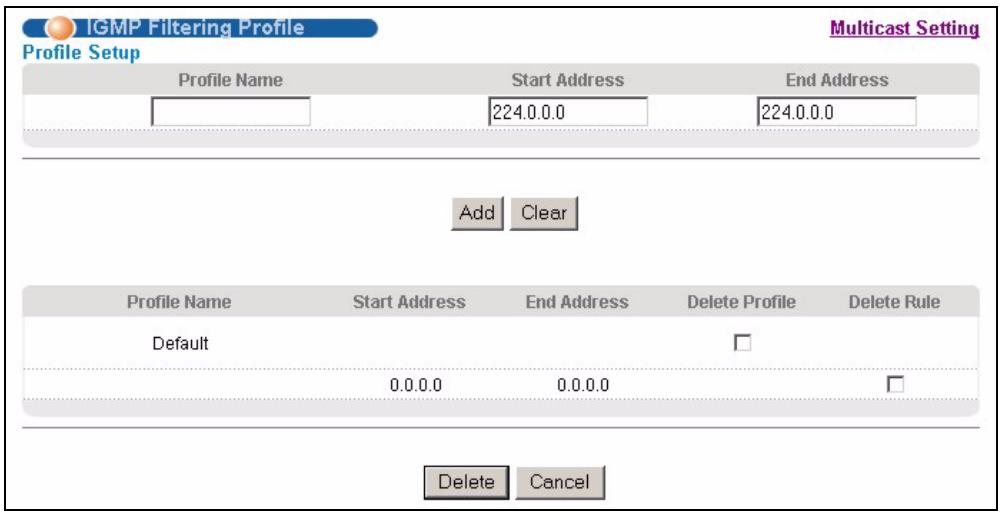
Figure 78 Multicast: IGMP Filtering Profile
The following table describes the labels in this screen.
Table 54 Multicast: IGMP Filtering Profile
| LABEL | DESCRIPTION |
| Profile Name | Enter a descriptive name for the profile for identification purposes.To configure additional rule(s) for a profile that you have already added, enter the profile name and specify a different IP multicast address range. |
| Start Address | Type the starting multicast IP address for a range of multicast IP addresses that you want to belong to the IGMP filter profile. |
| End Address | Type the ending multicast IP address for a range of IP addresses that you want to belong to the IGMP filter profile.If you want to add a single multicast IP address, enter it in both the Start Address and End Address fields. |
| Add | Click Add to save the settings to the switch. |
| Clear | Click Clear to clear the fields to the factory defaults. |
| Profile Name | This field displays the descriptive name of the profile. |
| Start Address | This field displays the start of the multicast address range. |
| End Address | This field displays the end of the multicast address range. |
| Delete | To delete the profile(s) and all the accompanying rules, select the profile(s) that you want to remove in the Delete Profile column, then click the Delete button.To delete a rule(s) from a profile, select the rule(s) that you want to remove in the Delete Rule column, then click the Delete button. |
| Cancel | Click Cancel to clear the Delete Profile/Delete Rule check boxes. |
23.5 MVR Overview
Multicast VLAN Registration (MVR) is designed for applications (such as Media-on-Demand (MoD)) that use multicast traffic across an Ethernet ring-based service provider network.
MVR allows one single multicast VLAN to be shared among different subscriber VLANs on the network. While isolated in different subscriber VLANs, connected devices can subscribe to and unsubscribe from the multicast stream in the multicast VLAN. This improves bandwidth utilization with reduced multicast traffic in the subscriber VLANs and simplifies multicast group management.
You must enable IGMP snooping to use MVR. However, MVR only responds to IGMP join and leave control messages from multicast groups that are configured under MVR. Join and leave reports from other multicast groups are managed by IGMP snooping.
The following figure shows a network example. The subscriber VLAN (1, 2 and 3) information is hidden from the streaming media server, S. In addition, the multicast VLAN information is only visible to the switch and S.
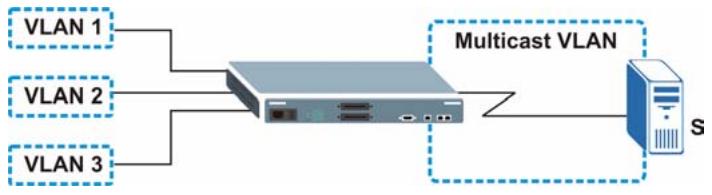
Figure 79 MVR Network Example
23.5.1 Types of MVR Ports
In MVR, a source port is a port on the switch that can send and receive multicast traffic in a multicast VLAN while a receiver port can only receive multicast data. Once configured, the switch maintains a forwarding table that matches the multicast stream to the associated multicast group.
23.5.2 MVR Modes
You can set your switch to operate in either dynamic or compatible mode.
In dynamic mode, the switch sends IGMP leave and join reports to the other multicast devices (such as multicast routers or servers) in the multicast VLAN. This allows the multicast devices to update the multicast forwarding table to forward or not forward multicast traffic to the receiver ports.
In compatible mode, the switch does not send any IGMP reports. In this case, you must manually configure the forwarding settings on the multicast devices in the multicast VLAN.
23.5.3 How MVR Works
The following figure shows a multicast television example where a subscriber device (such as a computer) in VLAN 1 receives multicast traffic from the streaming media server, S, via the switch. Multiple subscriber devices can connect through a port configured as the receiver on the switch.
When the subscriber selects a television channel, computer A sends an IGMP report to the switch to join the appropriate multicast group. If the IGMP report matches one of the configured MVR multicast group addresses on the switch, an entry is created in the forwarding table on the switch. This maps the subscriber VLAN to the list of forwarding destinations for the specified multicast traffic.
When the subscriber changes the channel or turns off the computer, an IGMP leave message is sent to the switch to leave the multicast group. The switch sends a query to VLAN 1 on the receiver port (in this case, a DSL port on the switch). If there is another subscriber device connected to this port in the same subscriber VLAN, the receiving port will still be on the list of forwarding destination for the multicast traffic. Otherwise, the switch removes the receiver port from the forwarding table.
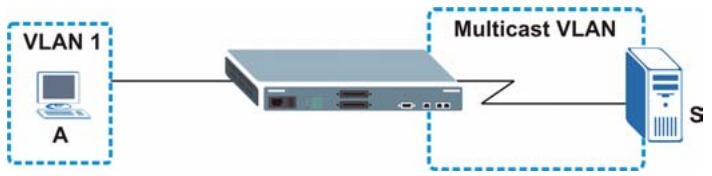
Figure 80 MVR Multicast Television Example
23.6 General MVR Configuration
Use the MVR screen to create multicast VLANs and select the receiver port(s) and a source port for each multicast VLAN. Click Advanced Applications and Multicast in the navigation panel. Click the Multicast Setting link and then the MVR link to display the screen as shown next.
Note: You can create up to three multicast VLANs and up to 256 multicast rules on the switch.
Your switch automatically creates a static VLAN (with the same VID) when you create a multicast VLAN in this screen.
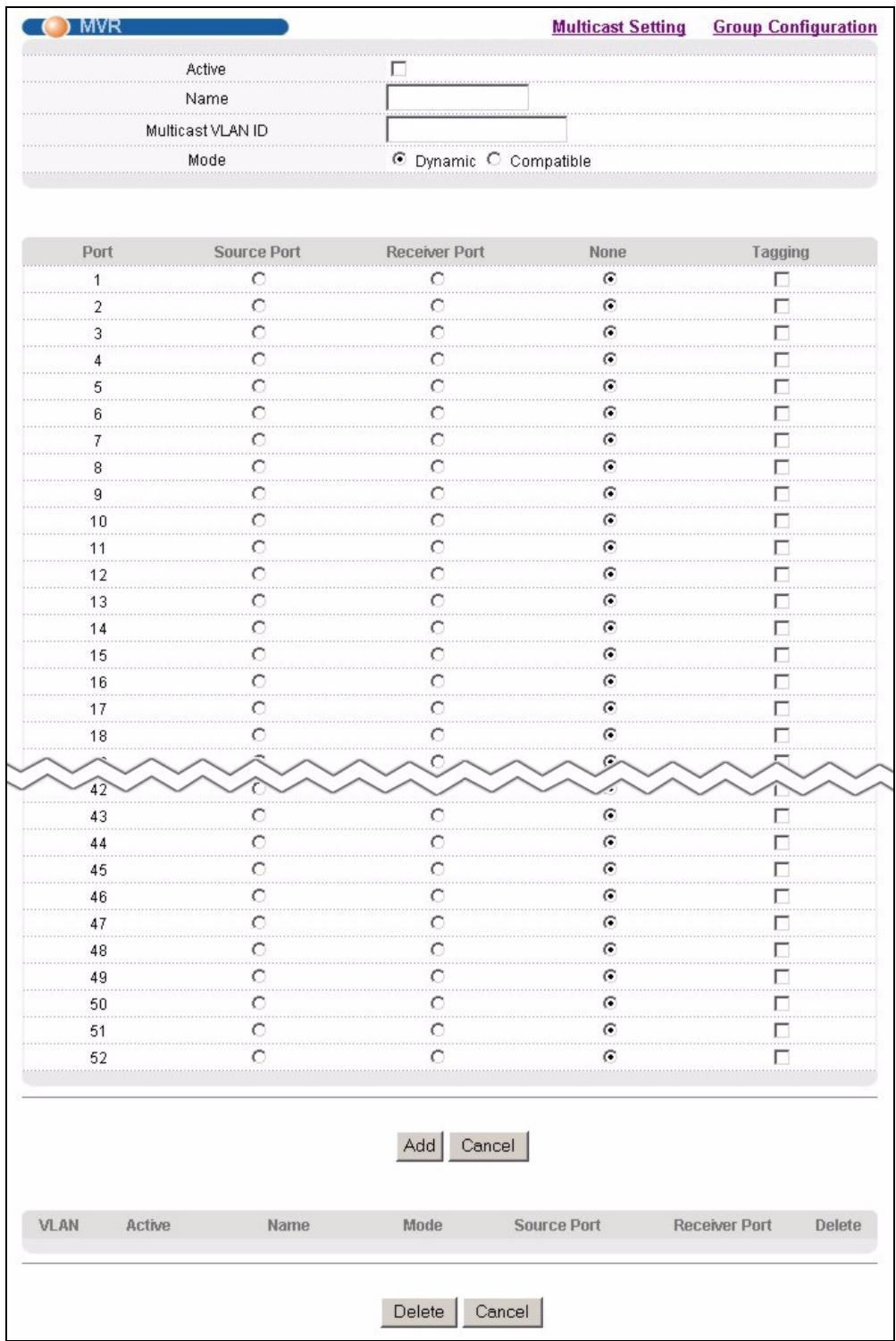
Figure 81 MVR
The following table describes the related labels in this screen.
Table 55 MVR
| LABEL | DESCRIPTION |
| Active | Select this check box to enable MVR to allow one single multicast VLAN to be shared among different subscriber VLANs on the network. |
| Name | Enter a descriptive name (up to 32 printable ASCII characters) for identification purposes. |
| Multicast VLAN ID | Enter the VLAN ID (1 to 4094) of the multicast VLAN. |
| Mode | Specify the MVR mode on the switch. Choices are Dynamic and Compatible. Select Dynamic to send IGMP reports to all MVR source ports in the multicast VLAN. Select Compatible to set the switch not to send IGMP reports. |
| Port | This field displays the port number on the switch. |
| Source Port | This field is applicable for Ethernet ports. Select this option to set this port as the MVR source port that sends and receives multicast traffic. All source ports must belong to a single multicast VLAN. |
| Receiver Port | Select this option to set this port as a receiver port that only receives multicast traffic. A receiver port cannot belong to a multicast VLAN. |
| None | Select this option to set the port not to participate in MVR. No MVR multicast traffic is sent or received on this port. |
| Tagging | Select this checkbox if you want the port to tag the VLAN ID in all outgoing frames transmitted. |
| Add | Click Add to save the settings. |
| Cancel | Click Cancel to discard all changes. |
| VLAN | This field displays the multicast VLAN ID. |
| Active | This field displays whether the multicast group is enabled or not. |
| Name | This field displays the descriptive name for this setting. |
| Mode | This field displays the MVR mode. |
| Source Port | This field displays the source port number(s). |
| Receiver Port | This field displays the receiver port number(s). |
| Delete | To delete a multicast VLAN(s), select the rule(s) that you want to remove in the Delete column, then click the Delete button. |
| Cancel | Click Cancel to clear the Delete check boxes. |
23.7 MVR Group Configuration
All source ports and receiver ports belonging to a multicast group can receive multicast data sent to this multicast group.
Configure MVR IP multicast group address(es) in the Group Configuration screen. Click Group Configuration in the MVR screen.
Note: A port can belong to more than one multicast VLAN. However, IP multicast group addresses in different multicast VLANs cannot overlap.
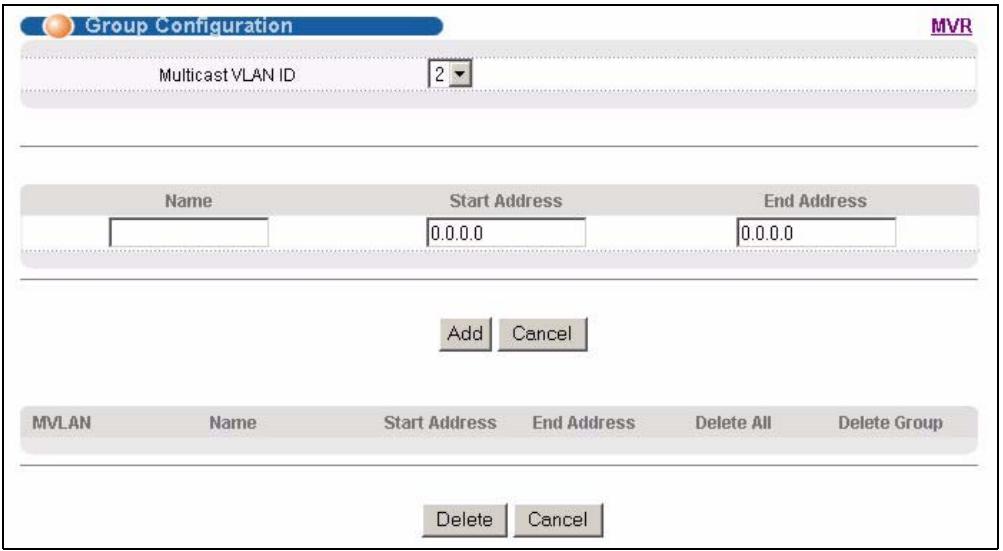
Figure 82 MVR: Group Configuration
The following table describes the labels in this screen.
Table 56 MVR: Group Configuration
| LABEL | DESCRIPTION |
| Multicast VLAN ID | Select a multicast VLAN ID (that you configured in the MVR screen) from the drop-down list box. |
| Name | Enter a descriptive name for identification purposes. |
| Start Address | Enter the starting IP multicast address of the multicast group in dotted decimal notation.Refer to Section 23.1.1 on page 161 for more information on IP multicast addresses. |
| End Address | Enter the ending IP multicast address of the multicast group in dotted decimal notation.Enter the same IP address as the Start Address field if you want to configure only one IP address for a multicast group.Refer to Section 23.1.1 on page 161 for more information on IP multicast addresses. |
| Add | Click Add to save the settings. |
| Cancel | Click Cancel to discard all changes. |
| MVLAN | This field displays the multicast VLAN ID. |
| Name | This field displays the descriptive name for this setting. |
| Start Address | This field displays the starting IP address of the multicast group. |
| End Address | This field displays the ending IP address of the multicast group. |
| Delete | Select Delete All and click Delete to remove all entries from the table Select Delete Group and click Delete to remove the selected entry(ies) from the table. |
| Cancel | Select Cancel to clear the checkbox(es) in the table. |
23.7.1 MVR Configuration Example
The following figure shows a network example where ports 1, 2 and 3 on the switch belong to VLAN 1. In addition, port 17 belongs to the multicast group with VID 200 to receive multicast traffic (the News and Movie channels) from the remote streaming media server, S. Computers A, B and C in VLAN are able to receive the traffic.
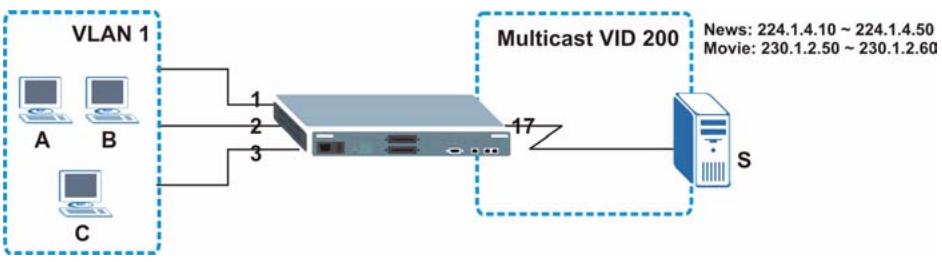
Figure 83 MVR Configuration Example
To configure the MVR settings on the switch, create a multicast group in the MVR screen and set the receiver and source ports.
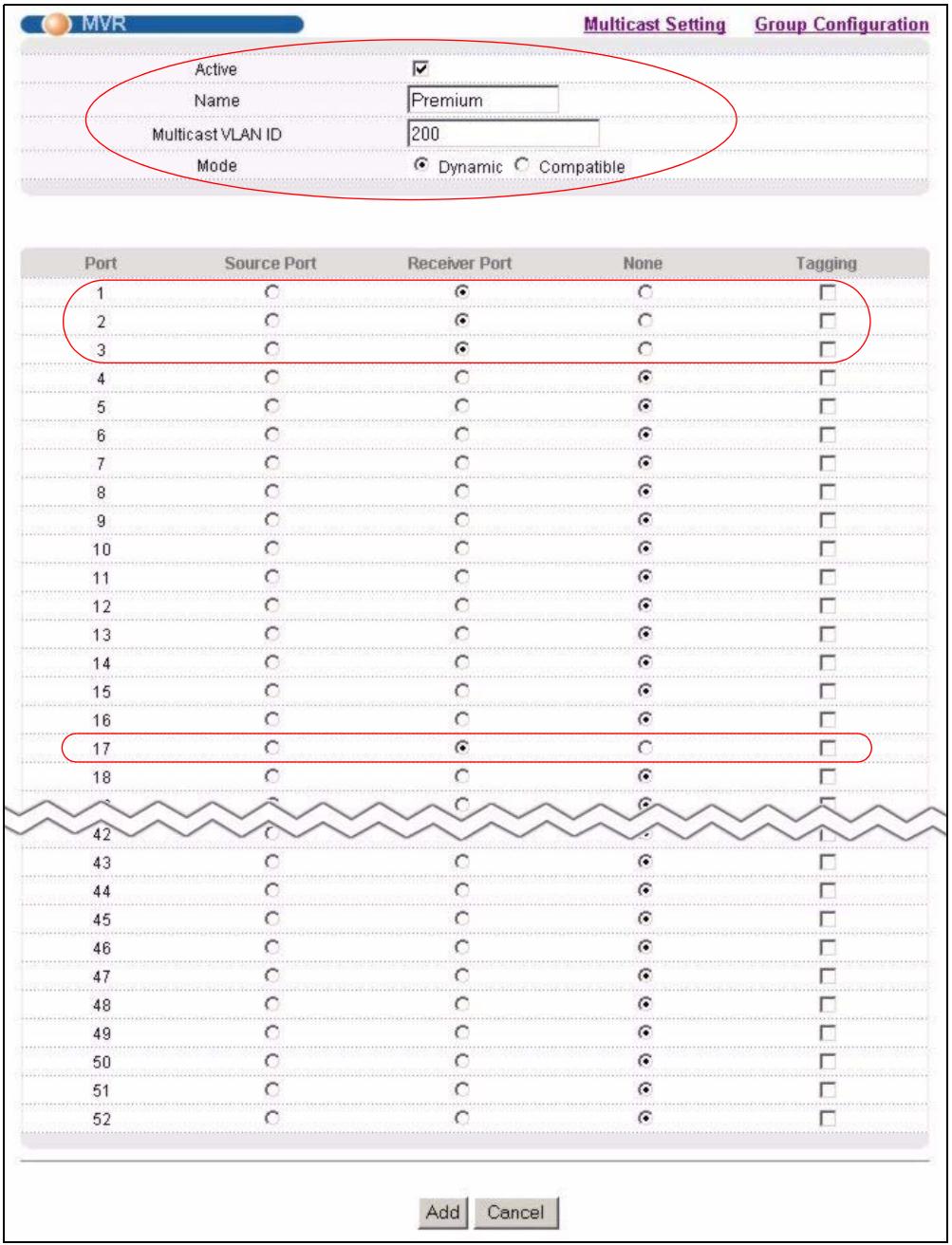
Figure 84 MVR Configuration Example
To set the switch to forward the multicast group traffic to the subscribers, configure multicast group settings in the Group Configuration screen. The following figure shows an example where two multicast groups (News and Movie) are configured for the multicast VLAN 200.
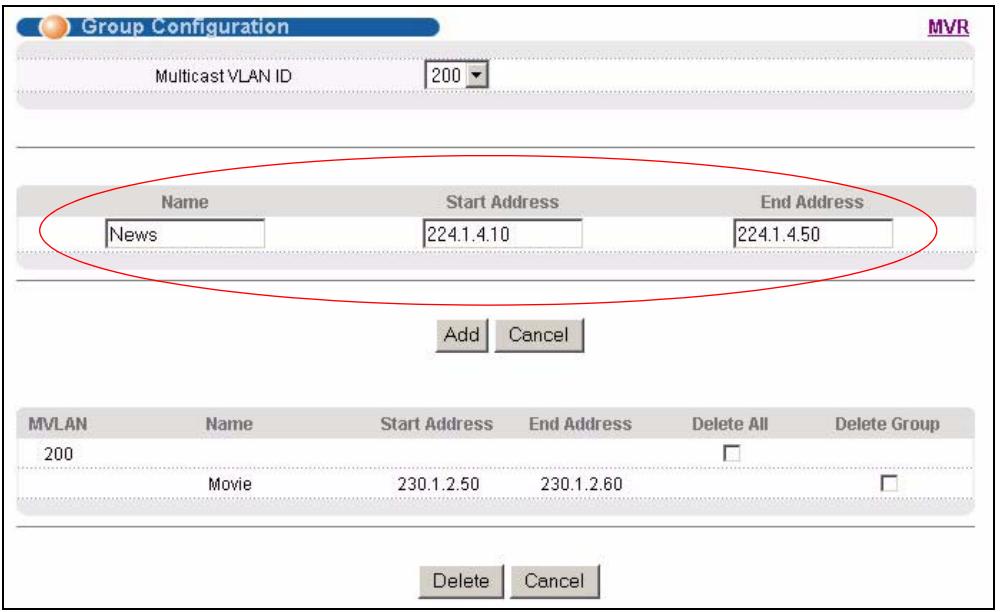
Figure 85 MVR Group Configuration Example
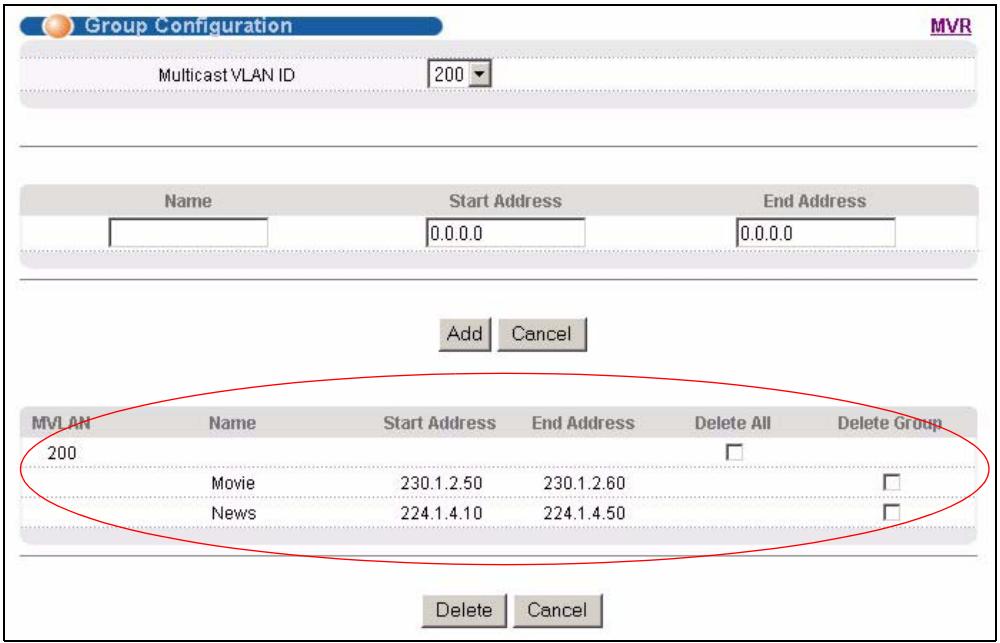
Figure 86 MVR Group Configuration Example
CHAPTER 24 DHCP Relay
This chapter shows you how to set up DHCP relay.
24.1 DHCP Relay Overview
DHCP (Dynamic Host Configuration Protocol, RFC 2131 and RFC 2132) allows individual clients to obtain TCP/IP configuration at start-up from a DHCP server. You can configure the switch to relay client DHCP requests to a DHCP server and the server's responses back to the clients.
24.1.1 DHCP Relay Agent Information
The switch can add information to client DHCP requests that it relays to a DHCP server. This helps provide authentication about the source of the requests. You can also specify additional information for the switch to add to the client DHCP requests that it relays to the DHCP server. Please refer to RFC 3046 for more details.
The DHCP relay agent information feature adds an Agent Information field to the option 82 field of the DHCP headers of client TCP/IP configuration request frames that the switch relays to a DHCP server. The following lists the DHCP relay agent option 82 information that the switch sends to the DHCP server:
- Slot ID (1 byte)
- Port ID (1 byte)
- VLAN ID (2 bytes)
- System name (up to 32 bytes, this is optional).
24.2 DHCP Relay Configuration
To configure DHCP relay information and specify the DHCP server(s), click Advanced Application and DHCP Relay to display the screen as shown next.
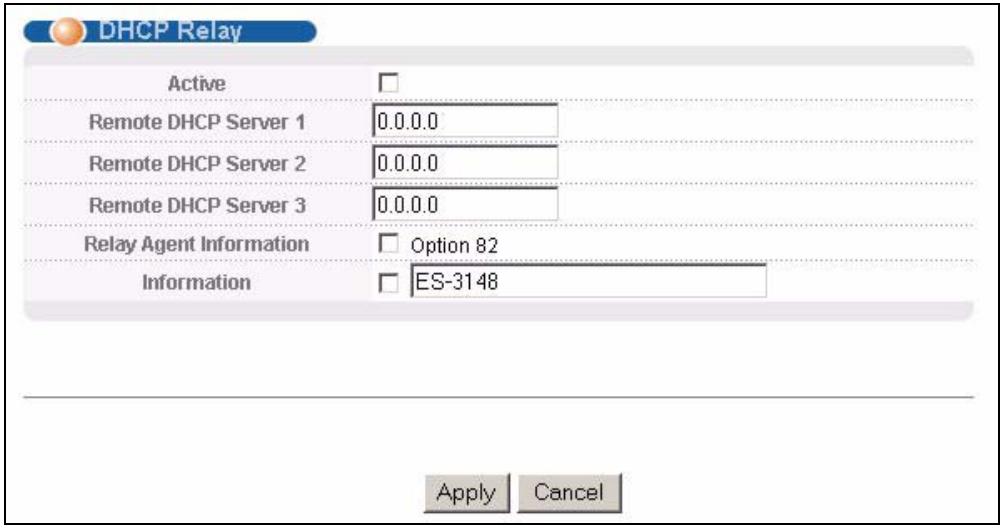
Figure 87 DHCP Relay
The following table describes the labels in this screen.
Table 57 DHCP Relay
| LABEL | DESCRIPTION |
| Active | Select this check box to enable DHCP relay. |
| Remote DHCP Server 1 . . 3 | Enter the IP address of a DHCP server in dotted decimal notation. |
| Relay Agent Information | Select the Option 82 check box to have the switch add information (slot number, port number and VLAN ID) to client DHCP requests that it relays to a DHCP server. |
| Information | This read-only field displays the system name you configure in the General Setup screen. Select the check box for the switch to add the system name to the DHCP client DHCP requests that it relays to a DHCP server. |
| Apply | Click Apply to save your changes back to the switch. |
| Cancel | Click Cancel to begin configuring this screen afresh. |
CHAPTER 25 Static Route
This chapter shows you how to configure static routes.
25.1 Configuring
Static routes tell the switch how to forward IP traffic when you configure the TCP/IP parameters manually.
Click IP Application, Static Routing in the navigation panel to display the screen as shown.
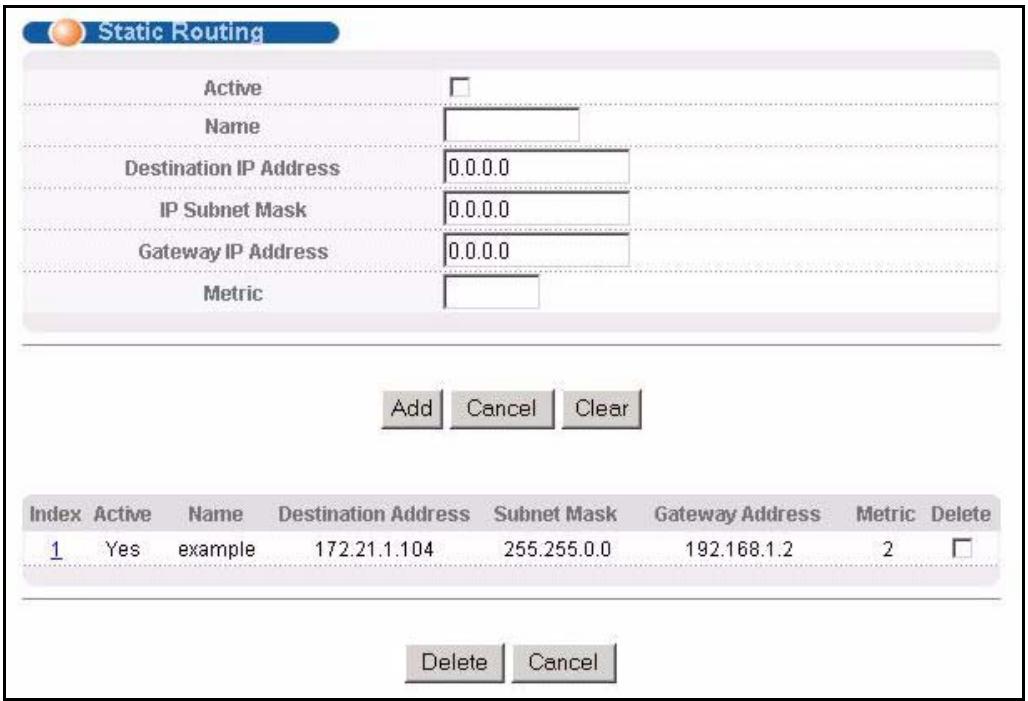
Figure 88 Static Routing
The following table describes the related labels you use to create a static route.
Table 58 Static Routing
| LABEL | DESCRIPTION |
| Active | This field allows you to activate/deactivate this static route. |
| Name | Enter a descriptive name (up to 32 printable ASCII characters) for identification purposes. |
| Destination IP Address | This parameter specifies the IP network address of the final destination. Routing is always based on network number. If you need to specify a route to a single host, use a subnet mask of 255.255.255.255 in the subnet mask field to force the network number to be identical to the host ID. |
| IP Subnet Mask | Enter the subnet mask for this destination. |
| Gateway IP Address | Enter the IP address of the gateway. The gateway is an immediate neighbor of your switch that will forward the packet to the destination. The gateway must be a router on the same segment as your switch. |
| Metric | The metric represents the “cost” of transmission for routing purposes. IP routing uses hop count as the measurement of cost, with a minimum of 1 for directly connected networks. Enter a number that approximates the cost for this link. The number need not be precise, but it must be between 1 and 15. In practice, 2 or 3 is usually a good number. |
| Add | Click Add to insert a new static route. |
| Cancel | Click Cancel to reset the above fields to your previous configuration. |
| Clear | Click Clear to set the above fields back to the factory defaults. |
| Index | This field displays the index number of the route. Click a number to edit the static route entry. |
| Active | This field displays Yes when the static route is activated and NO when it is deactivated. |
| Name | This field displays the descriptive name for this route. This is for identification purpose only. |
| Destination Address | This field displays the IP network address of the final destination. |
| Subnet Mask | This field displays the subnet mask for this destination. |
| Gateway Address | This field displays the IP address of the gateway. The gateway is an immediate neighbor of your switch that will forward the packet to the destination. |
| Metric | This field displays the cost of transmission for routing purposes. |
| Delete | Click Delete to remove the selected entry from the summary table. |
| Cancel | Click Cancel to clear the Delete check boxes. |
CHAPTER 26 Maintenance
This chapter explains how to configure the maintenance screens that let you maintain the firmware and configuration files.
26.1 The Maintenance Screen
Click Management, Maintenance in the navigation panel to open the following screen.
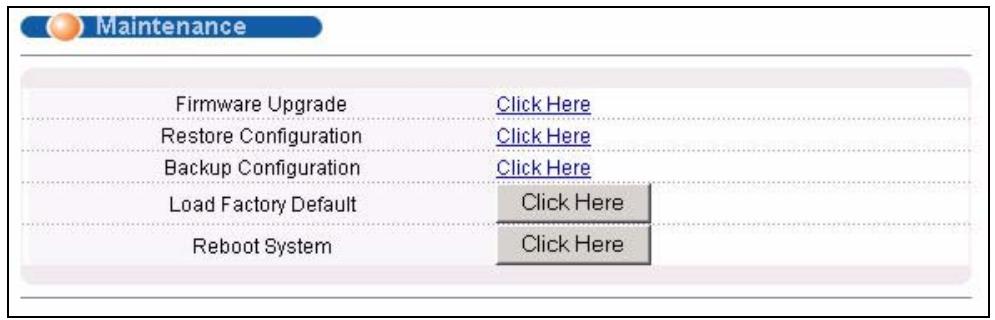
Figure 89 Maintenance
26.2 Firmware Upgrade
Make sure you have downloaded (and unzipped) the correct model firmware and version to your computer before uploading to the device.
Note: Be sure to upload the correct model firmware as uploading the wrong model firmware may damage your device.
From the Maintenance screen, display the Firmware Upgrade screen as shown next.
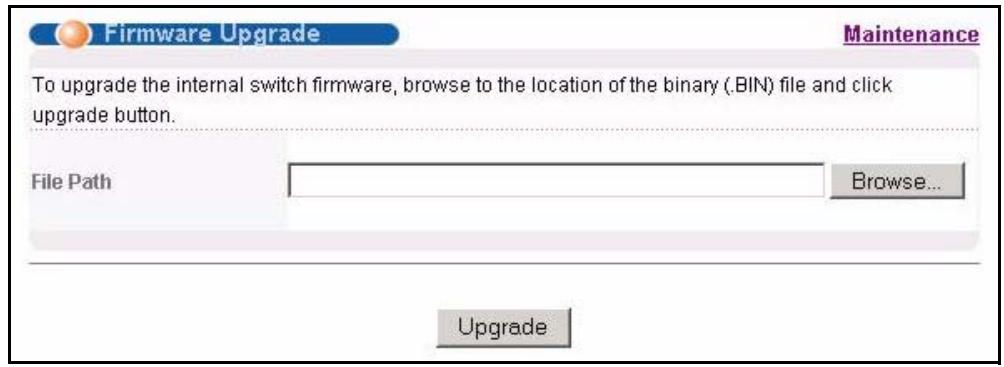
Figure 90 Firmware Upgrade
Type the path and file name of the firmware file you wish to upload to the switch in the File Path text box or click Browse to locate it. After you have specified the file, click Upgrade.
After the firmware upgrade process is complete, see the System Info screen to verify your current firmware version number.
26.3 Restore a Configuration File
Restore a previously saved configuration from your computer to the switch using the Restore Configuration screen.
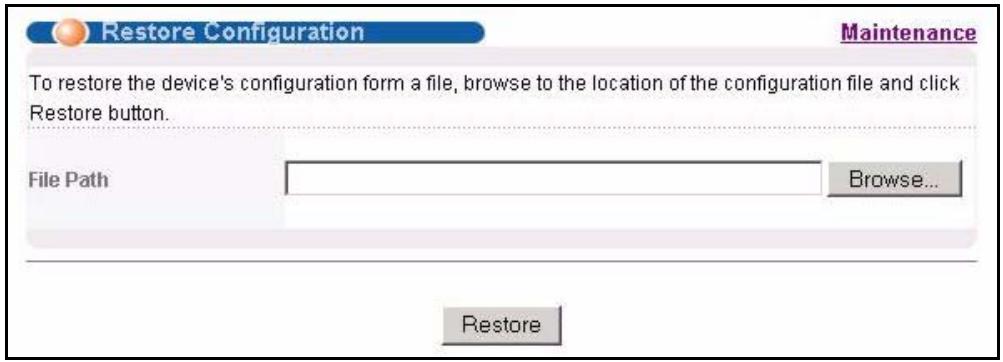
Figure 91 Restore Configuration
Type the path and file name of the configuration file you wish to restore in the File Path text box or click Browse to display the Choose File screen (below) from which you can locate it. After you have specified the file, click Restore. "config" is the name of the configuration file on the switch, so your backup configuration file is automatically renamed when you restore using this screen.
26.4 Backing Up a Configuration File
Backing up your switch configurations allows you to create various "snap shots" of your device from which you may restore at a later date.
Back up your current switch configuration to a computer using the Backup Configuration screen.
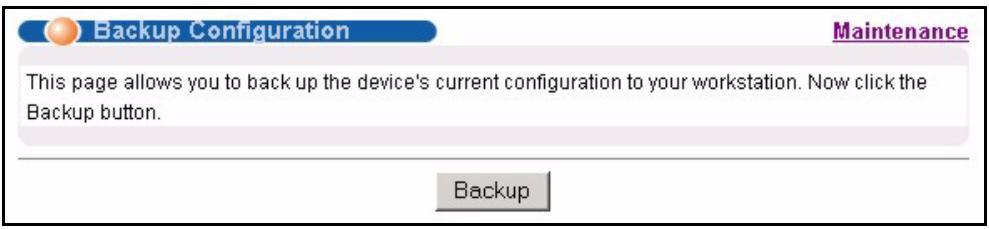
Figure 92 Backup Configuration
Follow the steps below to back up the current switch configuration to your computer in this screen.
1 Click Backup.
2 Click Save to display the Save As screen.
3 Choose a location to save the file on your computer from the Save in drop-down list box and type a descriptive name for it in the File name list box. Click Save to save the configuration file to your computer.
26.5 Load Factory Defaults
Follow the steps below to reset the switch back to the factory defaults.
1 In the Maintenance screen, click the Click Here button next to Load Factory Defaults to clear all switch configuration information you configured and return to the factory defaults. The following message appears.
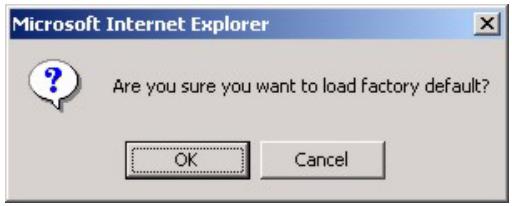
Figure 93 Load Factory Default: Conformation
2 Click OK to display the screen shown next.
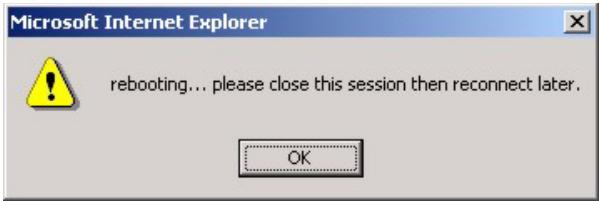
Figure 94 Load Factory Default: Start
3 Click OK to begin resetting all switch configurations to the factory defaults and then wait for the switch to restart. This takes up to two minutes. If you want to access the switch web configurator again, you may need to change the IP address of your computer to be in the same subnet as that of the default switch IP address (192.168.1.1).
26.6 Reboot System
Reboot System allows you to restart the switch without physically turning the power off. Follow the steps below to reboot the switch.
1 In the Maintenance screen, click the Click Here button next to Reboot System to display the next screen.
Figure 95 Reboot System: Confirmation
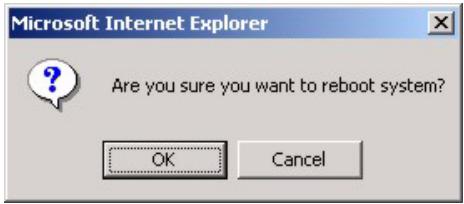
2 Click OK to display the screen shown next.
Figure 96 Reboot System: Start
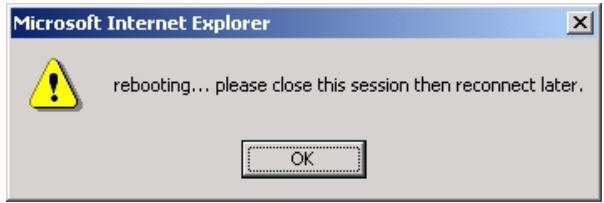
3 Click OK again and then wait for the switch to restart. This takes up to two minutes. This does not affect the switch's configuration.
26.7 FTP Command Line
This section shows some examples of uploading to or downloading files from the switch using FTP commands. First, understand the filename conventions.
26.7.1 Filename Conventions
The configuration file (also known as the romfile or ROM) contains the factory default settings in the screens such as password, switch setup, IP Setup, etc.. Once you have customized the switch's settings, they can be saved back to your computer under a filename of your choosing.
ZyNOS (ZyXEL Network Operating System sometimes referred to as the "ras" file) is the system firmware and has a "bin" filename extension.
Table 59 Filename Conventions
| FILE TYPE | INTERNAL NAME | EXTERNAL NAME | DESCRIPTION |
| Configuration File | config | This is the configuration filename on the switch. Uploading the config file replaces the specified configuration file system, including your switch configurations, system-related data (including the default password), the error log and the trace log. | |
| Firmware | Ras | *.bin | This is the generic name for the ZyNOS firmware on the switch. |
26.7.1.1 Example FTP Commands
ftp> put firmware.bin ras
This is a sample FTP session showing the transfer of the computer file "firmware.bin" to the switch.
ftp> get config config.cfg
This is a sample FTP session saving the current configuration to a file called "config.cfg" on your computer.
If your (T)FTP client does not allow you to have a destination filename different than the source, you will need to rename them as the switch only recognizes "config" and "ras". Be sure you keep unaltered copies of both files for later use.
Note: Be sure to upload the correct model firmware as uploading the wrong model firmware may damage your device.
26.7.2 FTP Command Line Procedure
1 Launch the FTP client on your computer.
2 Enter open, followed by a space and the IP address of your switch.
3 Press [ENTER] when prompted for a username.
4 Enter your password as requested (the default is "1234").
5 Enter bin to set transfer mode to binary.
6 Use put to transfer files from the computer to the switch, for example, put firmware.bin ras transfers the firmware on your computer (firmware.bin) to the switch and renames it to "ras". Similarly, put config.cfg config transfers the configuration file on your computer (config.cfg) to the switch and renames it to "config". Likewise get config config.cfg transfers the configuration file on the switch to your computer and renames it to "config.cfg". See Table 59 on page 182 for more information on filename conventions.
7 Enter quit to exit the ftp prompt.
26.7.3 GUI-based FTP Clients
The following table describes some of the commands that you may see in GUI-based FTP clients.
General Commands for GUI-based FTP Clients
| COMMAND | DESCRIPTION |
| Host Address | Enter the address of the host server. |
| Login Type | Anonymous.This is when a user I.D. and password is automatically supplied to the server for anonymous access. Anonymous logins will work only if your ISP or service administrator has enabled this option.Normal.The server requires a unique User ID and Password to login. |
| Transfer Type | Transfer files in either ASCII (plain text format) or in binary mode.Configuration and firmware files should be transferred in binary mode. |
| Initial Remote Directory | Specify the default remote directory (path). |
| Initial Local Directory | Specify the default local directory (path). |
26.7.4 FTP Restrictions
FTP will not work when:
- FTP service is disabled in the Service Access Control screen..
- The IP address(es) in the Remote Management screen does not match the client IP address. If it does not match, the switch will disconnect the Telnet session immediately.
CHAPTER 27 Diagnostic
This chapter explains the Diagnostic screen.
27.1 Diagnostic
Click Management, Diagnostic in the navigation panel to open this screen. Use this screen to check system logs, reset the system or ping IP addresses.
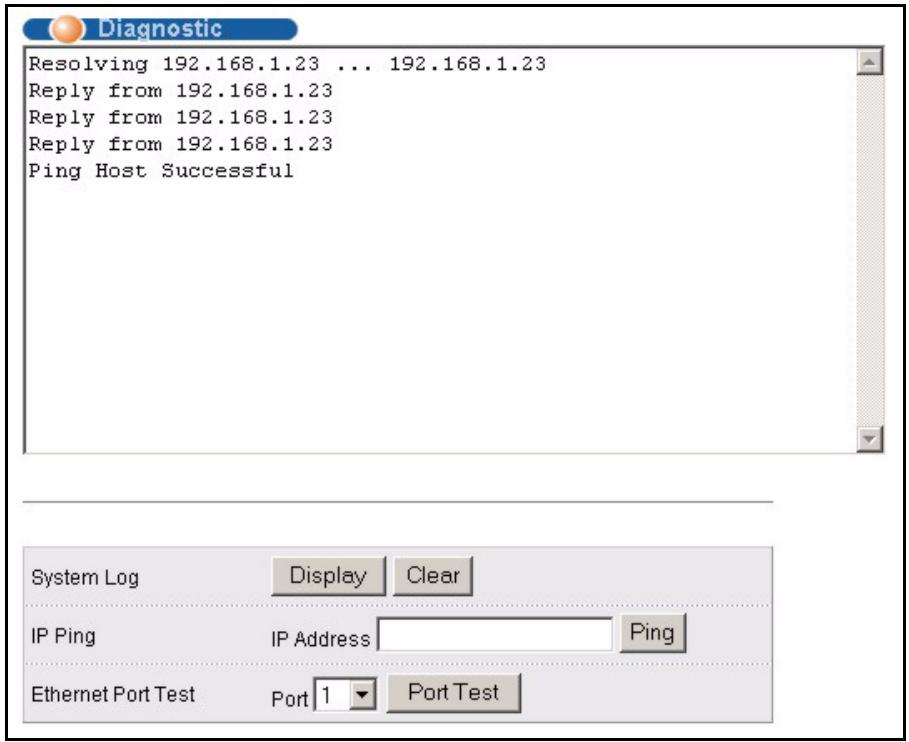
Figure 97 Diagnostic
The following table describes the labels in this screen.
Table 60 Diagnostic
| LABEL | DESCRIPTION |
| System Log | Click Display to display a log of events in the multi-line text box. Click Clear to empty the text box and reset the syslog entry. |
| IP Ping | Type the IP address of a device that you want to ping in order to test a connection. Click Ping to have the switch ping the IP address (in the field to the left). |
| Ethernet Port Test | From the Port drop-down list box, select a port number and click Port Test to perform internal loopback test. |
CHAPTER 28
Cluster Management
This chapter introduces cluster management.
28.1 Overview
Cluster Management allows you to manage switches through one switch, called the cluster manager. The switches must be directly connected and be in the same VLAN group so as to be able to communicate with one another.
Table 61 ZyXEL Clustering Management Specifications
| Maximum number of cluster members | 24 |
| Cluster Member Models | Must be compatible with ZyXEL cluster management implementation. |
| Cluster Manager | The switch through which you manage the cluster member switches. |
| Cluster Members | The switches being managed by the cluster manager switch. |
In the following example, switch A in the basement is the cluster manager and the other switches on the upper floors of the building are cluster members.
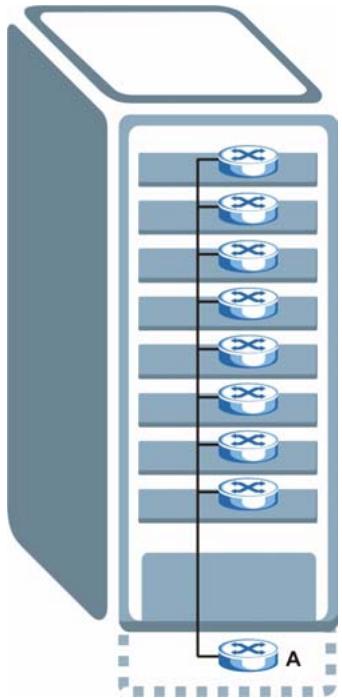
Figure 98 Clustering Application Example
28.2 Cluster Management Status
Click Management, Cluster Management in the navigation panel to display the following screen.
Note: A cluster can only have one manager.
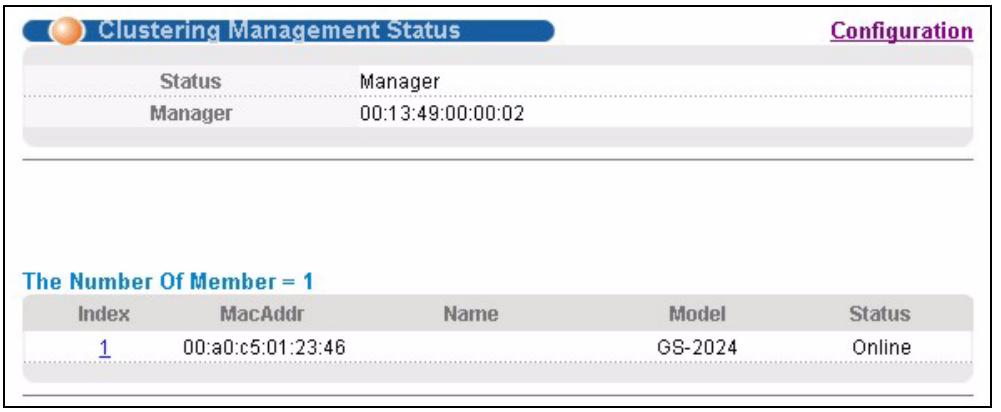
Figure 99 Cluster Management: Status
The following table describes the labels in this screen.
Table 62 Cluster Management: Status
| LABEL | DESCRIPTION |
| Status | This field displays the role of this switch within the cluster. Manager Member (you see this if you access this screen in the cluster member switch directly and not via the cluster manager) None (neither a manager nor a member of a cluster) |
| Manager | This field displays the cluster manager switch's hardware MAC address. |
| The Number of Member | This field displays the number of switches that make up this cluster. The following fields describe the cluster member switches. |
| Index | You can manage cluster member switches via the cluster manager switch. Each number in the Index column is a hyperlink leading to the cluster member switch's web configurator (see Figure 100 on page 189). |
| MacAddr | This is the cluster member switch's hardware MAC address. |
| Name | This is the cluster member switch's System Name. |
| Model | This field displays the model name. |
| Status | This field displays: Online (the cluster member switch is accessible) Error (for example the cluster member switch password was changed or the switch was set as the manager and so left the member list, etc.) Offline (the switch is disconnected - Offline shows approximately 1.5 minutes after the link between cluster member and manager goes down) |
28.2.1 Cluster Member Switch Management
Go to the Clustering Management Status screen of the cluster manager switch and then select an Index hyperlink from the list of members to go to that cluster member switch's web configurator home page. This cluster member web configurator home page and the home page that you'd see if you accessed it directly are different.
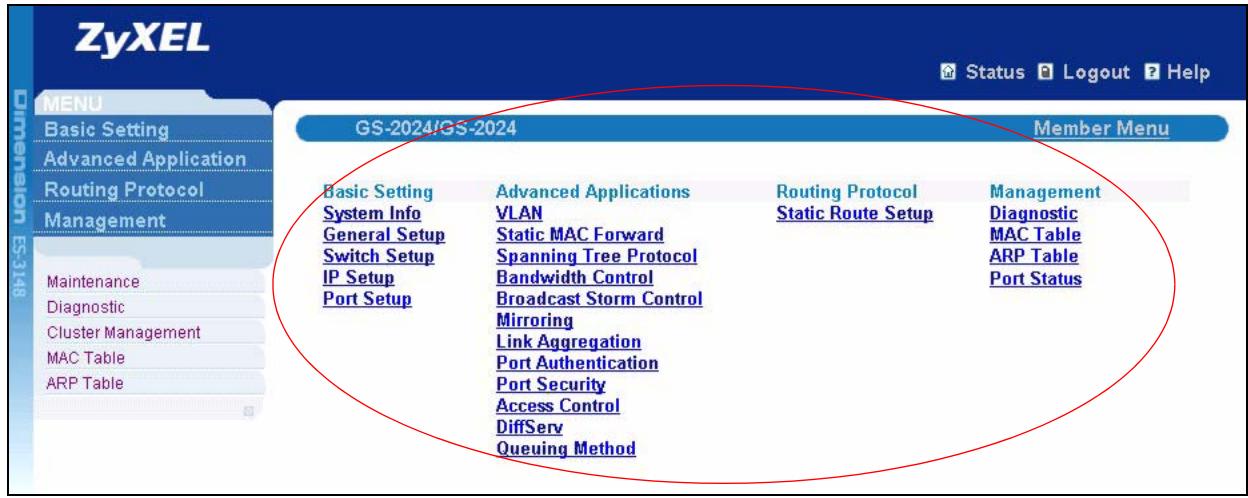
Figure 100 Cluster Management: Cluster Member Web Configurator Screen
28.2.1.1 Uploading Firmware to a Cluster Member Switch
You can use FTP to upload firmware to a cluster member switch through the cluster manager switch as shown in the following example.
Figure 101 Example: Uploading Firmware to a Cluster Member Switch
C:\>ftp 192.168.1.1
Connected to 192.168.1.1.
220 ES-3148 FTP version 1.0 ready at Thu Jan 1 00:58:46 1970
User (192.168.0.1:(none)): admin
331 Enter PASS command
Password:
230 Logged in
ftp> ls
200 Port command okay
150 Opening data connection for LIST
--w--w--w- 1 owner group 3042210 Jul 01 12:00 ras
-rw-rw-rw- 1 owner group 393216 Jul 01 12:00 config
--w--w--w- 1 owner group 0 Jul 01 12:00 fw-00-a0-c5-01-23-46
-rw-rw-rw- 1 owner group 0 Jul 01 12:00 config-00-a0-c5-01-23-46
226 File sent OK
ftp: 297 bytes received in 0.00Seconds 297000.00Kbytes/sec.
ftp> bin
200 Type I OK
ftp> put 360lt0.bin fw-00-a0-c5-01-23-46
200 Port command okay
150 Opening data connection for STOR fw-00-a0-c5-01-23-46
226 File received OK
ftp: 262144 bytes sent in 0.63Seconds 415.44Kbytes/sec.
ftp>
The following table explains some of the FTP parameters.
Table 63 FTP Upload to Cluster Member Example
| FTP PARAMETER | DESCRIPTION |
| User | Enter “admin”. |
| Password | The web configurator password default is 1234. |
| ls | Enter this command to list the name of cluster member switch’s firmware and configuration file. |
| 3601t0.bin | This is the name of the firmware file you want to upload to the cluster member switch. |
| fw-00-a0-c5-01-23-46 | This is the cluster member switch’s firmware name as seen in the cluster manager switch. |
| config-00-a0-c5-01-23-46 | This is the cluster member switch’s configuration file name as seen in the cluster manager switch. |
28.3 Configuring Cluster Management
Click Configuration from the Cluster Management screen to display the next screen.
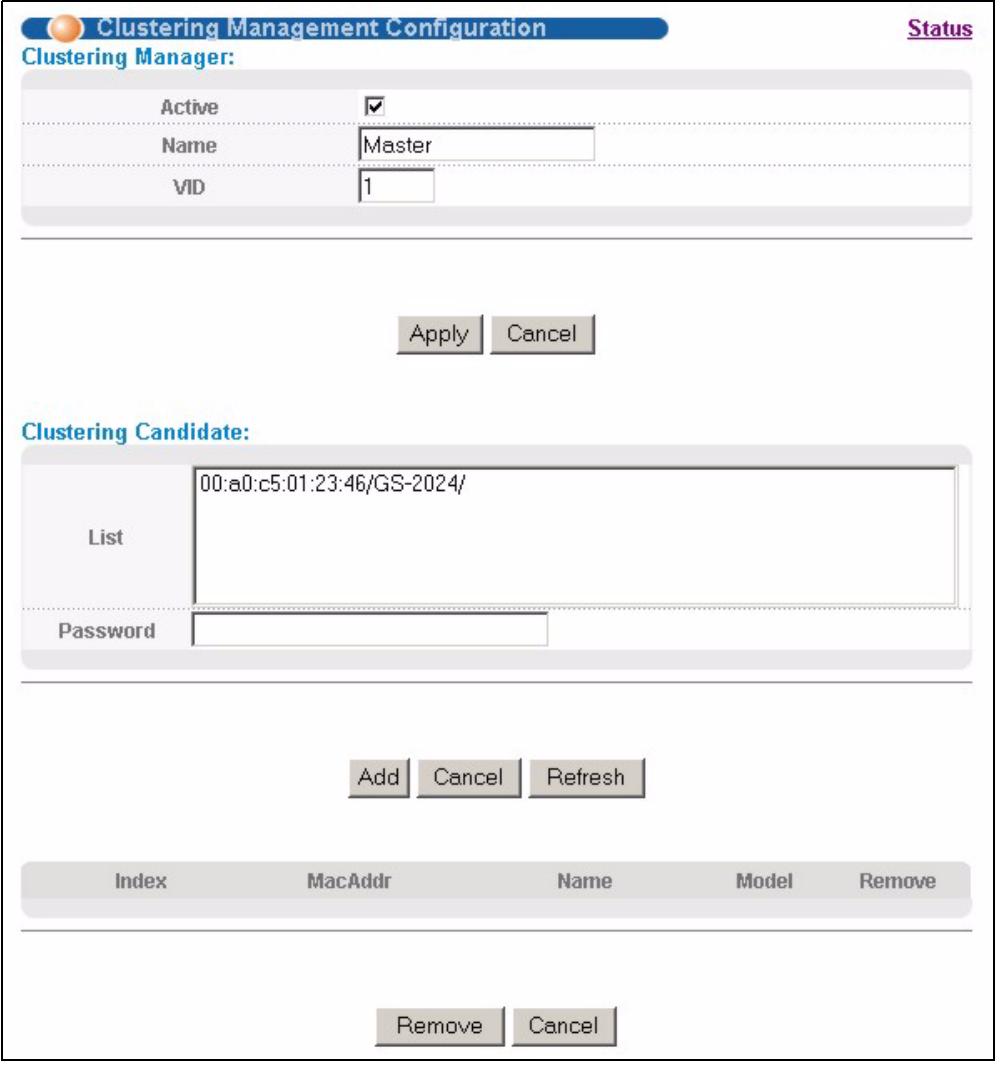
Figure 102 Clustering Management Configuration
The following table describes the labels in this screen.
Table 64 Clustering Management Configuration
| LABEL | DESCRIPTION |
| Clustering Manager | |
| Active | Select Active to have this switch become the cluster manager switch. A cluster can only have one manager. Other (directly connected) switches that are set to be cluster managers will not be visible in the Clustering Candidates list. If a switch that was previously a cluster member is later set to become a cluster manager, then its Status is displayed as Error in the Cluster Management Status screen and a warning icon (▲) appears in the member summary list below. |
| Name | Type a name to identify the Clustering Manager. You may use up to 20 printable characters (no spaces are allowed). |
| VID | This is the VLAN ID and is only applicable if the switch is set to 802.1Q VLAN. All switches must be directly connected and in the same VLAN group to belong to the same cluster. Switches that are not in the same VLAN group are not visible in the Clustering Candidates list. This field is ignored if the Clustering Manager is using Port-based VLAN. |
| Apply | Click Apply to save these changes to the switch. |
| Cancel | Click Cancel to begin configuring this part of the screen afresh. |
| Clustering Candidate | The following fields relate to the switches that are potential cluster members. |
| List | A list of suitable candidates found by auto-discovery is shown here. The switches must be directly connected. Directly connected switches that are set to be cluster managers will not be visible in the Clustering Candidate list. Switches that are not in the same management VLAN group will not be visible in the Clustering Candidate list. |
| Password | Each cluster member's password is its web configurator password. Select a member in the Clustering Candidate list and then enter its web configurator password. If that switch administrator changes the web configurator password afterwards, then it cannot be managed from the Cluster Manager. Its Status is displayed as Error in the Cluster Management Status screen and a warning icon (▲) appears in the member summary list below. If multiple devices have the same password then hold [SHIFT] and click those switches to select them. Then enter their common web configurator password. |
| Add | Click Add to save this part of the screen to the switch. |
| Cancel | Click Cancel to begin configuring this part of the screen afresh. |
| Refresh | Click Refresh to perform auto-discovery again to list potential cluster members. |
| The next summary table shows the information for the clustering members configured. | |
| Index | This is the index number of a cluster member switch. |
| MacAddr | This is the cluster member switch's hardware MAC address. |
| Name | This is the cluster member switch's System Name. |
| Model | This is the cluster member switch's model name. |
| Remove | Select this checkbox and then click the Remove button to remove a cluster member switch from the cluster. |
| Cancel | Click Cancel to begin configuring this part of the screen afresh. |
CHAPTER 29 MAC Table
This chapter introduces the MAC Table screen.
29.1 Overview
The MAC Table screen (a MAC table is also known as a filtering database) shows how frames are forwarded or filtered across the switch's ports. It shows what device MAC address, belonging to what VLAN group (if any) is forwarded to which port(s) and whether the MAC address is dynamic (learned by the switch) or static (manually entered in the Static MAC Forwarding screen).
The switch uses the MAC table to determine how to forward frames. See the following figure.
1 The switch examines a received frame and learns the port on which this source MAC address came.
2 The switch checks to see if the frame's destination MAC address matches a source MAC address already learned in the MAC table.
- If the switch has already learned the port for this MAC address, then it forwards the frame to that port.
- If the switch has not already learned the port for this MAC address, then the frame is flooded to all ports. Too much port flooding leads to network congestion.
- If the switch has already learned the port for this MAC address, but the destination port is the same as the port it came in on, then it filters the frame.
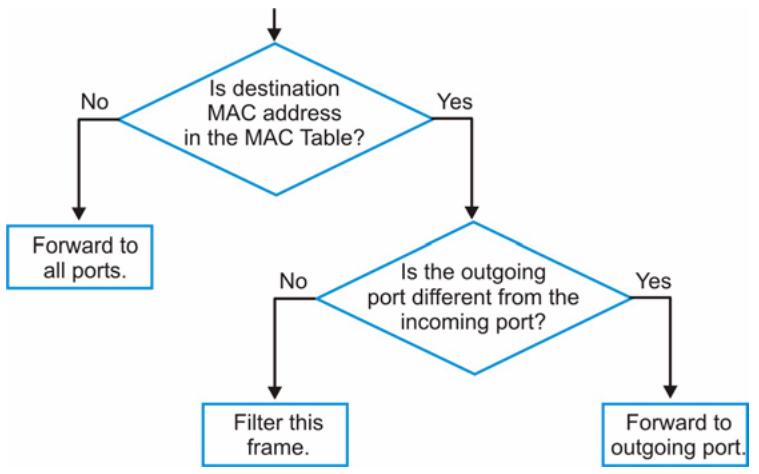
Figure 103 MAC Table Flowchart
29.2 Viewing the MAC Table
Click Management, MAC Table in the navigation panel to display the following screen.
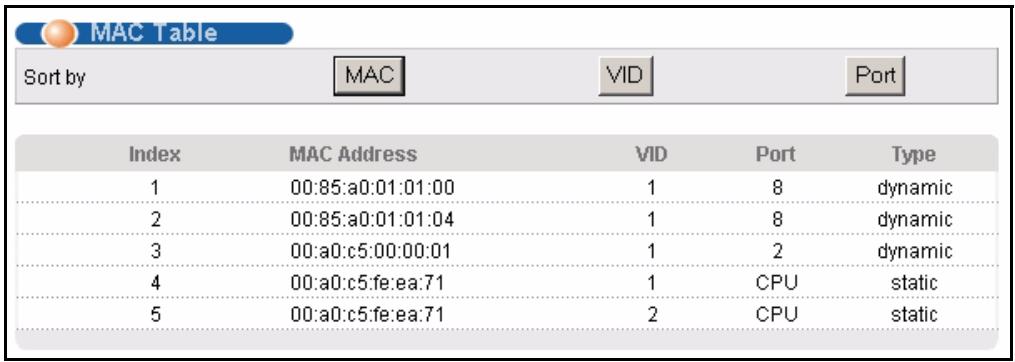
Figure 104 MAC Table
The following table describes the labels in this screen.
Table 65 MAC Table
| LABEL | DESCRIPTION |
| Sort by | Click one of the following buttons to display and arrange the data according to that button type. The information is then displayed in the summary table below. |
| MAC | Click this button to display and arrange the data according to MAC address. |
| VID | Click this button to display and arrange the data according to VLAN group. |
| Port | Click this button to display and arrange the data according to port number. |
| Index | This is the incoming frame index number. |
| MAC Address | This is the MAC address of the device from which this incoming frame came. |
| VID | This is the VLAN group to which this frame belongs. |
| Port | This is the port from which the above MAC address was learned. |
| Type | This shows whether the MAC address is dynamic (learned by the switch) or static (manually entered in the Static MAC Forwarding screen). |
CHAPTER 30 ARP Table
This chapter introduces ARP Table.
30.1 Overview
Address Resolution Protocol (ARP) is a protocol for mapping an Internet Protocol address (IP address) to a physical machine address, also known as a Media Access Control or MAC address, on the local area network.
An IP (version 4) address is 32 bits long. In an Ethernet LAN, MAC addresses are 48 bits long. The ARP Table maintains an association between each MAC address and its corresponding IP address.
30.1.1 How ARP Works
When an incoming packet destined for a host device on a local area network arrives at the switch, the switch's ARP program looks in the ARP Table and, if it finds the address, sends it to the device.
If no entry is found for the IP address, ARP broadcasts the request to all the devices on the LAN. The switch fills in its own MAC and IP address in the sender address fields, and puts the known IP address of the target in the target IP address field. In addition, the switch puts all ones in the target MAC field (FF.FF.FF.FF.FF.FF is the Ethernet broadcast address). The replying device (which is either the IP address of the device being sought or the router that knows the way) replaces the broadcast address with the target's MAC address, swaps the sender and target pairs, and unicast the answer directly back to the requesting machine. ARP updates the ARP Table for future reference and then sends the packet to the MAC address that replied.
30.2 Viewing the ARP Table
Click Management, ARP Table in the navigation panel to open the following screen. Use the ARP table to view IP-to-MAC address mapping(s).
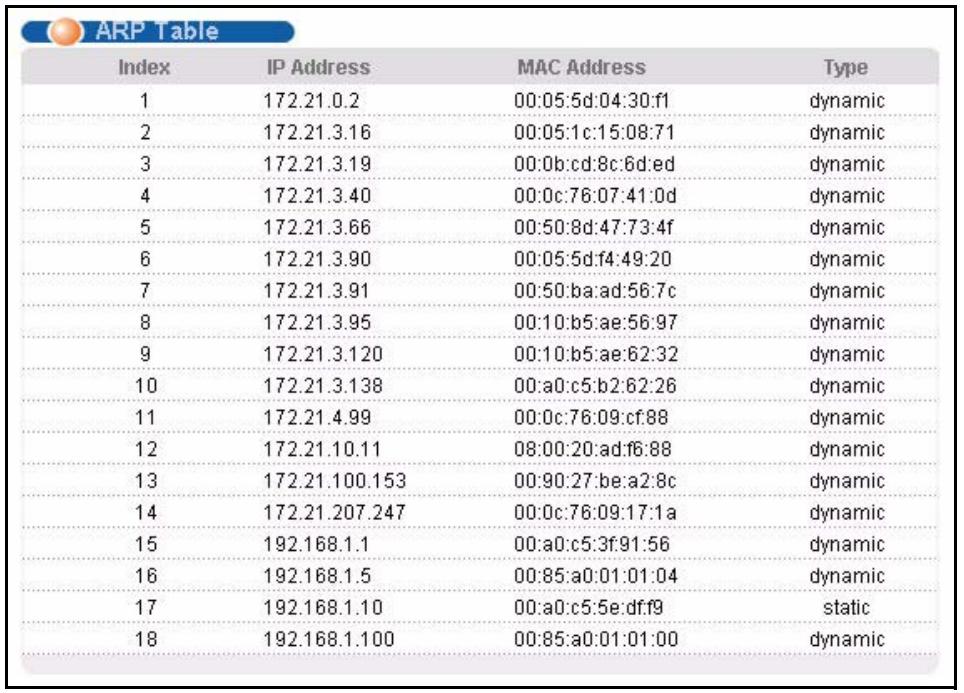
Figure 105 ARP Table
The following table describes the labels in this screen.
Table 66 ARP Table
| LABEL | DESCRIPTION |
| Index | This is the ARP Table entry number. |
| IP Address | This is the learned IP address of a device connected to a switch port with corresponding MAC address below. |
| MAC Address | This is the MAC address of the device with corresponding IP address above. |
| Type | This shows whether the MAC address is dynamic (learned by the switch) or static (manually entered in the Static MAC Forwarding screen). |
CHAPTER 31
Introducing the Commands
This chapter introduces the commands and gives a summary of commands available.
31.1 Overview
In addition to the web configurator, you can use line commands to configure the switch. Use line commands for advanced switch diagnosis and troubleshooting. If you have problems with your switch, customer support may request that you issue some of these commands to assist them in troubleshooting.
Note: See the web configurator parts of this User's Guide for background information on features configurable by the web configurator.
31.1.1 Switch Configuration File
When you configure the switch using either the CLI (Command Line Interface) or web configurator, the settings are saved as a series of commands in a configuration file on the switch. You can perform the following with a configuration file:
- Back up switch configuration once the switch is set up to work in your network.
- Restore switch configuration.
- Use the same configuration file to set all switches (of the same model) in your network to the same settings.
Note: You may also edit a configuration file using a text editor.
Make sure you use valid commands. The switch rejects configuration files with invalid or incomplete commands.
31.2 Accessing the CLI
You can use a direct console connection or Telnet to access the CLI on the switch.
Note: The switch automatically logs you out of the management interface after five minutes of inactivity. If this happens to you, simply log back in again.
31.2.1 Access Priority
- You can only access the CLI with the administrator account (the default username is admin and password is 1234).
- By default, only one CLI management session is allowed via either the console port or Telnet. Console port access has higher priority.
- Use the configure multi-login command in the configuration mode to allow multiple concurrent logins. However, no more than five concurrent login sessions are allowed.
31.2.2 The Console Port
Connect to the switch's console port using a terminal emulation software configured to the following settings:
- VT100 terminal emulation
9600 bps - No parity
8 data bits
1 stop bit - No flow control
31.2.2.1 Initial Screen
When you turn on your switch, it performs several internal tests as well as line initialization. You can view the initialization information using the console port. After the initialization, the login screen displays (refer to Section 31.3 on page 199).
Figure 106 Initial Console Port Screen
Copyright (c) 1994 - 2005 ZyXEL Communications Corp. initialize mgmt, ethernet address: 00:13:49:00:00:01 initialize switch, ethernet address: 00:13:49:00:00:02 Initializing switch unit 0... Press ENTER to continue...
31.2.3 Telnet
Use the following steps to telnet into your switch.
1 For local management, connect your computer to the RJ-45 management port (labeled MGMT) on the switch.
2 Make sure your computer IP address and the switch IP address are on the same subnet. In Windows, click Start (usually in the bottom left corner), Run and then type telnet 192.168.0.1 (the default management IP address) and click OK.
3 A login screen displays (refer to Section 31.3 on page 199).
31.3 The Login Screen
After you have successfully established a connection to the switch using a direct console connection or Telnet, a login screen displays as shown below. For your first login, enter the default administrator login username "admin" and password "1234".
Figure 107 CLI: Login Screen
Enter User Name : admin
Enter Password :XXXX
31.4 Command Syntax Conventions
The rules of the commands are listed next.
- The command keywords are in courier new font.
- The required fields in a command are enclosed in angle brackets , for instance, ping means that you must specify an IP number for this command.
- The optional fields in a command are enclosed in square brackets [ ], for instance,
configure snmp-server [contact <system contact>] [location <system location>]
means that the contact and location fields are optional.
- "Command" refers to a command used in the command line interface (CI command).
- The | symbol means "or".
- The entry <cr> in the command lines refers to carriage return. Press [ENTER] or carriage return after a command to execute the command.
- Use the up () or down () arrow key to scroll through the command history list.
- You may enter a unique part of a command and press [TAB] to have the switch automatically display the full command. For example, if you enter "config" and press [TAB], the full command of "configure" automatically displays.
- Each interface refers to an Ethernet port on the switch. Commands configured after the interface command correspond to those ports.
- Type multiple ports or port ranges separated by a comma. Ranges of port numbers are typed separated by a dash.
31.5 Getting Help
The system includes a help facility to provide you with the following information about the commands:
- List of available commands under a command group.
Detailed descriptions of the commands.
31.5.1 List of Available Commands
Enter "help" to display a list of available commands and the corresponding sub commands.
Enter "?" to display a list of commands you can use.
Figure 108 CLI Help: List of Commands: Example 1
ras> help
Commands available:
help
logout
exit
history
enable
show ip <cr>
show hardware-monitor <C|F>
show system-information
ping <ip|host-name> <cr>
ping <ip|host-name> [vlan <vlan-id>] [. .]
ping help
traceroute <ip|host-name> <cr>
traceroute <ip|host-name> [vlan <vlan-id>] [. .]
traceroute help
ssh <1|2> <[user@]dest-ip> <cr>
ssh <1|2> <[user@]dest-ip> [command [/]
ras>
Figure 109 CLI Help: List of Commands: Example 2
ras> ? enable Turn on privileged commands exit Exit from the EXEC help Description of the interactive help system history Show a list of previously run commands logout Exit from the EXEC ping Exec ping show Show system information ssh SSH client traceroute Exec traceroute ras>
31.5.2 Detailed Command Information
Enter
Enter
Figure 110 CLI Help: Detailed Command Information: Example 1
ras>ping help
Commands available: ping
< [in-band|out-of-band|vlan
ras>
Figure 111 CLI:Help:Detailed Command Information:Example 2
ras>ping? <ip|host-name> destination ip address help Description of ping help ras>
31.6 Command Modes
There are three CLI command modes: User, Enable and Configure.
When you first log into the CLI, the initial command mode is the User mode. The User mode commands are a subset of the Enable mode commands. The User mode command prompt ends with an angle bracket (>) .
To enter Enable (or privileged) mode, type enable and enter a password when prompted (the default is 1234). When you enter the Enable mode, the command prompt changes to the pound sign (#).
To enter the configuration mode, type configure or config. The Configure mode command prompt consists of the word "config" and the pound sign (#). There are various sub configuration modes: interface, MVR and VLAN.
- To enter config-vlan mode, type vlan followed by a number (between 1 to 4094). For example, vlan 10 to configure settings for VLAN 10.
- To enter config-interface mode and configure the ports, enter interface port-channel followed by a port number. For example, interface port-channel 10.
- To enter MVR mode, enter mvr followed by a VLAN ID (between 1 and 4094). For example, enter mvr 2 to configure multicast settings on VLAN 2.
Enter exit or logout to quit from the current mode or log out from the CLI.
31.7 Using Command History
The switch keeps a list of up to 256 commands(s) you have entered for the current CLI session. You can use any commands in the history again by pressing the up (▲) or down (▼) arrow key to scroll through the previously used commands and press [ENTER]. Use the history command to display the list of commands.
Figure 112 CLI: History Command Example
ras> history enable exit show ip history ras>
31.8 Saving Your Configuration
After you set the switch settings with the configuration commands, use the write memory command to save the changes permanently.
Figure 113 CLI: write memory
ras# write memory
Note: The write memory command is not available in User mode.
You must save your changes after each CLI session. All unsaved configuration changes are lost once you restart the switch.
31.8.1 Logging Out
In User mode, enter the exit or logout command to log out of the CLI.
31.9 Command Summary
The following sections summarize the commands available in the switch together with a brief description of each command. Commands listed in the tables are in the same order as they are displayed in the CLI. See the related section in the User's Guide for more background information.
31.9.1 User Mode
The following table describes the commands available for User mode.
Table 67 Command Summary: User Mode
| COMMAND | DESCRIPTION | |
| help | Displays help information. | |
| logout | Exits from the CLI. | |
| exit | Logs out from the CLI. | |
| history | Displays a list of previously command(s) that you have executed. The switch stores up to 256 commands in history. | |
| enable | Accesses Enable (or privileged) mode. See Section 31.9.2 on page 204. | |
| show | ip | Displays IP related information. |
| hardware-monitor <C|F> | Displays current hardware monitor information with the specified temperature unit (Celsius C or Fahrenheit F). | |
| system-information | Displays general system information. | |
| ping | <IP|host-name> | Sends Ping request to an Ethernet device. |
| <IP|host-name> [vlan <vlan-id>][size <0-1472>] [-t] | Sends Ping request to an Ethernet device in the specified VLAN(s) with the specified parameters. | |
| help | Displays command help information. | |
| traceroute | <ip|host-name> | Determines the path a packet takes to a device. |
| <ip|host-name>[vlan <vlan-id>] [ttl <1-255>] [wait <1-60>] [queries <1-10>] | Determines the path a packet takes to a device in a VLAN. | |
| help | Displays command help information. | |
| ssh | <1|2> <[user@]dest-ip> | Connects to an SSH server with the specified SSH version. |
31.9.2 Enable Mode
The following table describes the commands available for Enable mode.
Table 68 Command Summary: Enable Mode
| COMMAND | DESCRIPTION | ||
| help | Displays help information. | ||
| logout | Exits Enable (or privileged) mode. | ||
| exit | Exits Enable (or privileged) mode. | ||
| history | Displays a list of command(s) that you have previously executed. | ||
| enable | Accesses Enable (or privileged) mode. | ||
| disable | Exits Enable (or privileged) mode. | ||
| configure | Accesses Configuration mode. See Section 31.9.3 on page 208. | ||
| no | logging | Disables syslog logging. | |
| arp | Flashes the ARP (Address Resolution Protocol) table. | ||
| interface <port-number> | Cleared the interface status of the specified port(s). | ||
| show | ip | Displays IP related information. | |
| arp | Displays the ARP table. | ||
| route | Displays IP routing information. | ||
| route static | Displays IP static route information. | ||
| hardware-monitor<C|F> | Displays current hardware monitor information with the specified temperature unit (Celsius C or Fahrenheit F). | ||
| system-information | Displays general system information. | ||
| vlan1q | gvrp | Displays GVRP settings. | |
| port-isolation | Displays port isolation settings. | ||
| spanning-tree | config | Displays Spanning Tree Protocol (STP) settings. | |
| mac | address-table <all [mac|vid|port]> | Displays MAC address table. You can sort by MAC address, VID or port. | |
| address-table static | Displays static MAC address table. | ||
| lacp | Displays LACP (Link Aggregation Control Protocol) settings. | ||
| trunk | Displays link aggregation information. | ||
| radius-server | Displays RADIUS server settings. | ||
| port-access- authenticator | Displays all port authentication settings. | ||
| <port-list> | Displays port authentication settings on the specified port(s). | ||
| port-security | Displays all port security settings. | ||
| <port-list> | Displays port security settings on the specified port(s). | ||
| snmp-server | Displays SNMP settings. | ||
| logins | Displays login account information. | ||
| service-control | Displays service control settings. | ||
| remote-management | Displays all secured client information. | ||
| index> | Displays the specified secured client information. | ||
| classifier | Displays all classifier related information. | ||
| name> | Displays the specified classifier related information. | ||
| policy | Displays all policy related information. | ||
| name> | Displays the specified policy related information. | ||
| interface <port-number> | Displays current interface status. | ||
| interfaces config <port-list> | Displays current interface configuration. | ||
| bandwidth-control | Displays bandwidth control settings. | ||
| egress | Displays outgoing port information. | ||
| bstorm-control | Displays broadcast storm control settings. | ||
| igmp-immediate- leave | Displays IGMP immediate leave settings. | ||
| igmp-filtering | Displays IGMP filter profile settings. | ||
| igmp-group-limited | Displays IGMP group settings. | ||
| igmp-query-mode | Displays IGMP query mode settings on the port(s). | ||
| vlan | Displays the status of all VLANs. | ||
| <vlan-id> | Displays the status of the specified VLAN. | ||
| running-config | Displays current operating configuration. | ||
| timesync | Displays time server information. | ||
| time | Displays current system time and date. | ||
| garp | Displays GARP information. | ||
| loginPrecedence | Displays login precedence settings. | ||
| logging | Displays system logs. | ||
| vlan-stacking | Displays VLAN stacking configuration. | ||
| ssh | Displays general SSH settings. | ||
| known-hosts | Displays known SSH hosts information. | ||
| key<rsa|rsa|DSA> | Displays internal SSH public and private key information. | ||
| session | Displays current SSH session(s). | ||
| https | Displays the HTTPS information. | ||
| session | Displays current HTTPS session(s). | ||
| certificate | Displays the HTTPS certificates. | ||
| key<rsa|DSA> | Displays the HTTPS key. | ||
| timeout | Displays the HTTPS session timeout. | ||
| multi-login | Displays multi-login information | ||
| plt | Displays Packet Loop Test (PLT). | ||
| mac-aging-time | Displays MAC learning aging time. | ||
| cluster | Displays cluster management status. | ||
| candidates | Displays cluster candidate information. | ||
| member | Displays the MAC address of the cluster member(s). | ||
| member mac<mac-addr> | Displays the status of the cluster member(s). | ||
| members config | Displays the configuration of the cluster member(s). | ||
| igmp-filteringprofile | Displays IGMP filter profile settings. | ||
| igmp-snooping | Displays IGMP snooping settings. | ||
| multicast | Displays multicast settings. | ||
| mvr | DIsplays all MVR (Multicast VLAN Registration) settings. | ||
| <vlan-id> | DIsplays specified MVR information. | ||
| igmp-flush | Removes all IGMP information. | ||
| mac-flush | Clears the MAC address table. | ||
| <port-num> | Removes all learned MAC address on the specified port(s). | ||
| erase | running-config | Reset to the factory default settings. | |
| baudrate | <1|2|3|4|5> | Changes the console port speed. Choices are 1 (9600), 2 (19200), 3(38400), 4 (57600) and 5 (115200). | |
| boot | config <index> | Restarts the system with the specified configuration file. | |
| reload | config <index> | Restarts the system and use the specified configuration file. | |
| write | memory | Saves current configuration to the configuration file the switch is currently using. | |
| <index> | Saves current configuration to the specified configuration file on the switch. | ||
| copy | tftp flash <ip><remote-file> | Restores firmware via TFTP. | |
| tftp config <index><ip><remote-file> | Restores configuration with the specified filename from the specified TFTP server. | ||
| running-config tftp <ip><remote-file> | Backs up running configuration to the specified TFTP server with the specified file name. | ||
| ping | <ip|host-name> | Sends Ping request to an Ethernet device. | |
| [vlan <vlan-id>] [. .] | Sends Ping request to an Ethernet device in the specified VLAN(s). | ||
| help | Displays command help information. | ||
| traceroute | <ip|host-name>[in-band|out-of-band|vlan <vlan-id>] [ttl <1-255>] [wait <1-60>] [queries <1-10>] | Determines the path a packet takes to a device. | |
| help | Displays command help information. | ||
| ssh | <1|2><[user@]dest-ip> | Connects to an SSH server with the specified SSH version. | |
| [command [/] | Connects to an SSH server with the specified SSH version and addition commands to be executed on the server. | ||
31.9.3 General Configuration Mode
The following table lists the commands in Configuration (or Config) mode.
Table 69 Command Summary: Configuration Mode
| COMMAND | DESCRIPTION | ||
| help | Displays help information. | ||
| logout | Exits from the CLI. | ||
| history | Displays a list of previous command(s) that you have executed. | ||
| exit | Exits from the CLI. | ||
| mode | zynos | Changes the CLI mode to the ZyNOS format. | |
| password | Change the password for Enable mode. | ||
| no | ip | Sets the management IP address to the default value. | |
| route <ip> <mask> | Removes a specified IP static route. | ||
| route <ip> <mask> inactive | Enables a specified IP static route. | ||
| igmp-filtering | C clears the IGMP filtering settings on the switch. | ||
| profile <name> | Deletes the IGMP filtering profile. | ||
| profile <name> start-address <ip> end-address <ip> | Deletes a rule in the IGMP filtering profile. | ||
| igmp-snooping | Disables IGMP snooping. | ||
| mac-forward | mac <mac ADDR> vlan <vlan-id> interface <interface-id> | Removes the specified MAC forwarding entry, belonging to a VLAN group (if any) forwarded through an interface(s). | |
| mac <mac ADDR> vlan <vlan-id> interface <interface-id> inactive | Enables the specified MAC address, belonging to a VLAN group (if any) forwarded through an interface(s). | ||
| mac-filter | mac <mac ADDR> vlan <vlan-id> inactive | Enables the specified MAC filter rule. | |
| mac <mac ADDR> vlan <vlan-id> | Disables the specified MAC filter rule. | ||
| mirror-port | Disables port mirroring on the switch. | ||
| lacp | Disables the link aggregation control protocol (dynamic trunking) on the switch. | ||
| trunk | Disables the specified trunk group. | ||
| Disables LACP in the specified trunk group. | |||
| Removes ports from the specified trunk group. | |||
| bcp-transparency | Disables Bridge Control Protocol (BCP) transparency. | ||
| storm-control | Disables broadcast storm control. | ||
| bandwidth-control | Disable bandwidth control on the switch. | ||
| vlan1q | gvrp | Disables GVRP on the switch. | |
| port-isolation | Disables port isolation. | ||
| spanning-tree | Disables STP. | ||
| Disables STP on listed ports. | |||
| timesync | Disables timeserver settings. | ||
| radius-server | Disables the use of authentication from the RADIUS server. | ||
| port-access Authenticator | Disables port authentication on the switch. | ||
| Disables authentication on the listed ports. | |||
| Disables the re-authentication mechanism on the listed port(s). | |||
| port-security | Disables port security on the switch. | ||
| Disables port security on the specified ports. | |||
| Enables MAC address learning on the specified ports. | |||
| snmp-server | trap-destination | Disables sending of SNMP traps to a station. | |
| logins | Disables login access to the specified name. | ||
| service-control | Disables telnet access to the switch. | ||
| ftp | Disables FTP access to the switch. | ||
| http | Disables web browser control to the switch. | ||
| ssh | Disables SSH (Secure Shell) server access to the switch. | ||
| https | Disables secure web browser access to the switch. | ||
| icmp | Disables ICMP access to the switch such as pinging and tracerouting. | ||
| snmp | Disables SNMP management. | ||
| remote-management | (index> | Cleared a secure client set entry from the list of secure clients. | |
| (index> service [<telnet] [ftp] [http] [icmp] [snmp] [ssh] [https]> | Disables a secure client set entry number from using the selected remote management service(s). | ||
| classifier | {name> | Disables the classifier. Each classifier has one rule. If you disable a classifier you cannot use policy rule related information. | |
| {name> inactive | Enables a classifier. | ||
| policy | {name> | Deletes the policy. A policy sets actions for classifier traffic. | |
| {name> inactive | Enables a policy. | ||
| vlan | {vlan-id> | Deletes the static VLAN entry. | |
| dhcp-relay | Disables DHCP relay. | ||
| option | Disables the relay agent information option 82. | ||
| information | System name is not appended to option 82 information field. | ||
| vlan-stacking | Disables VLAN stacking. | ||
| ssh | key<rsa|rsa|DSA> | Disables the secure shell server encryption key. Your switch supports SSH versions 1 and 2 using RSA and DSA authentication. | |
| known-hosts | Removes all remote hosts. | ||
| known-hosts<host-ip> | Removes the specified remote hosts from the list of all known hosts. | ||
| known-hosts<host-ip>[1024|ssh-rsa|ssh-dsa] | Removes remote known hosts with the specified public key (1024-bit RSA1, RSA or DSA). | ||
| https | timeout | Reset the session timeout to the default of 300 seconds. | |
| multi-login | Disables another administrator from logging into Telnet or the CLI. | ||
| cluster | Disables cluster management on the switch. | ||
| cluster member | Removes the cluster member. | ||
| mvr | Disables MVR on the switch. | ||
| wfq fe-spq | Sets the switch to use WFQ to service all queues for the 10/100Mbps Ethernet port. | ||
| vlan | <1-4094> | Enters the VLAN configuration mode. See Section 31.9.5 on page 221 for more information. | |
| vlan-type | <802.1q|port-based> | Specifies the VLAN type. | |
| igmp-snooping | Enables IGMP snooping. | ||
| unknown-multicast-frame | Sets how to treat traffic from unknown multicast group. | ||
| <drop|flooding> | |||
| igmp-filtering | Enables IGMP filtering on the switch. | ||
| profile <name>start-address <ip>end-address <ip> | Sets the range of multicast address(es) in a profile. | ||
| interface | port-channel <port-list> | Enables a port or a list of ports for configuration. See Section 31.9.4 on page 218 for more details. | |
| spq | Sets the queuing method to SPQ (Strictly Priority Queuing). | ||
| wfq | Sets the queuing method to WFQ (Weighted Fair Queuing). | ||
| fe-spq <Q0-Q7> | Sets the switch to use SPQ to service the subsequent queue(s) after and including the specified queue for the 10/100 Mbps Ethernet ports. | ||
| ip | route | Creates a static route. | |
| Sets the metric of a static route or deactivates a static route. | |||
| name-server | Sets the IP address of a domain name server. | ||
| address default-gateway | <ip> | Sets the default gateway's IP address for the out-of-band management port. | |
| address | <ip><mask> | Sets the IP address and subnet mask of the out-of-band management port. | |
| mac-forward | name <name> mac <mac ADDR> vlan <vlan-id> interface <interface-id> | Configures a static MAC address forwarding rule. | |
| inactive | Disables a static MAC address forwarding rule. | ||
| mac-filter | name <name> mac <mac ADDR> vlan <vlan-id> drop <src/dst/both> | Configures a static MAC address port filtering rule. | |
| inactive | Disables a static MAC address port filtering rule. | ||
| mirror-port | Enables port mirroring. | ||
| <port-num> | Sets a monitor port (the port to which traffic is copied for analysis). | ||
| lacp | Enables Link Aggregation Control Protocol (LACP). | ||
| system-priority | <1-65535> | Sets the priority of an active port using LACP. | |
| trunk | <T1|T2|T3|T4|T5|T6> | Activates a trunk group. | |
| <T1|T2|T3|T4|T5|T6> lacp | Enables LACP for a trunk group. | ||
| <T1|T2|T3|T4|T5|T6> interface <port-list> | Adds a port(s) to the specified trunk group. | ||
| interface <port-list> timeout <lacp-timeout> | Defines the port number and LACP timeout period. | ||
| cluster | <Vlan-id> | Sets the cluster management VLAN ID. | |
| name <cluster name> | Configs a name to identify the cluster manager. | ||
| member <mac-address> password <password-str> | Sets the cluster member switch's hardware MAC address and password. | ||
| rcommand <mac-address> | Logs into a cluster member switch. | ||
| classifier | <name> <[ packet-format <802.3untag|802.3tag |EtherIIuntag|EtherI Itag>] [priority<0-7>] [ vlan <vlan-id> ] [ ethernet-type <ether-num|ip|ipx|arp|rarp| appletalk|decnet|sna |netbios|dlc>] [ source-mac <src-mac ADDR] [ source-port <port-num] [ destination-mac <dest-mac ADDR] [ dscp <0-63] [ ip-protocol <protocol-num|tcp|udp|icmp|egp |ospf|rsp|igmp|igp| pim|ipsec>[establish-only] ] [ source-ip <src-ip ADDR> [mask-bits <mask-bits>] [ source-socket <socket-num] [ destination-ip <dest-ip ADDR> [mask-bits <mask-bits>] ] [destination-socket <socket-num] [inactive] > | Configures a classifier. A classifier groups traffic into data flows according to specific criteria such as the source address, destination address, source port number, destination port number or incoming port number. | |
| policy | <classname> classifier<classifier-list><[ vlan<vlan-id] [ egress-port <port-num>] [priority <0-7>] [ dscp <0-63>] [ tos <0-7] [ bandwidth <bandwidth>] [ outgoing-packet-format <tagged|untagged>] [ out-of-profile-dscp <0-63>] [ forward-action <drop|forward>] [ queue-action <prio-set|prio-queue|prio-replace-tos>] [ diffserv-action <diff-set-tos|diff-replace-priority|diff-set-dscp>] [ outgoing-mirror] [ outgoing-report] [ outgoing-non-unicast-report] [ outgoing-set-vlan] [ metering] [out-of-profile-action [<change-dscp][drop][forward][set-drop-prec]>] [inactive] > | Configures a policy. A classifier distinguishes traffic into flows based on the configured criteria. A policy rule ensures that a traffic flow gets the requested treatment in the network. | |
| radius-server | host <ip> [acct-port <socket-number>] [key <key-string>] | Sets the IP address and/or the port number and key of the external RADIUS server. | |
| port-access-authenticator | Enables 802.1x authentication on the switch. | ||
| <port-list> | Enables 802.1x authentication on the specified port(s). | ||
| reauthenticate | Sets a subscriber to periodically re-enter his or her username and password to stay connected to a specified port. | ||
| reauth-period <reauth-period> | Specifies how often a client has to re-enter the username and password to stay connected to the specified port(s). | ||
| port-security | Enables port security on the switch. | ||
| <port-list> | Enables the port security feature on the specified port(s). | ||
| learn inactive | Disables MAC address learning on the specified port(s). | ||
| address-limit | Limits the number of (dynamic) MAC addresses that may be learned on a port. | ||
| MAC-freeze | Disables MAC address learning and enables port security. | ||
| Note: All previously learned dynamic MAC addresses are saved to the static MAC address table. | |||
| vlan1q | gvrp | Enables GVRP. | |
| port-isolation | Enables port-isolation. | ||
| garp | join <100-65535> leave <msec> leaveall <msec> | Configures GARP time settings. | |
| spanning-tree | Enables STP on the switch. | ||
| priority <0-61440> | Sets the bridge priority of the switch. | ||
| hello-time <1-10> maximum-age <6-40> forward-delay <4-30> | Sets Hello Time, Maximum Age and Forward Delay. | ||
| <port-list> | Enables STP on a specified port. | ||
| <port-list> path-cost <1-65535> | Sets the STP path cost for a specified port. | ||
| <port-list> priority <0-255> | Sets the priority for a specified port. | ||
| help | Displays help information. | ||
| hostname | <name_string> | Sets the switch's name for identification purposes. | |
| time | <Hour:Min:Sec> | Sets the time in hour, minute and second format. | |
| timezone<-1200|...|1200> | Selects the time difference between UTC (formerly known as GMT) and your time zone. | ||
| date <month/day/year> | Sets the date in year, month and day format. | ||
| help | Displays help information. | ||
| timesync | <daytime|time|ntp> | Sets the time server protocol. | |
| server <ip> | Sets the IP address of your time server. | ||
| loginPrecedence | <LocalOnly | LocalRADIUS | RADIUSOnly> | Select which database the switch should use (first) to authenticate a user. | |
| bcp-transparency | Enables Bridge Control Protocol (BCP) transparency. | ||
| queue | level <0-7> priority <0-7> | Sets the priority level-to- physical queue mapping. | |
| storm-control | Enables broadcast storm control on the switch. | ||
| bandwidth-control | Enables bandwidth control. | ||
| mac-aging-time | <10-3000> | Sets learned MAC aging time. | |
| snmp-server | get-community <property> | Sets the get community. | |
| set-community <property> | Sets the set community. | ||
| trap-community <property> | Sets the trap community. | ||
| trap-destination <ip> | Sets the IP addresses of up to four stations to send your SNMP traps to. | ||
| [contact <system contact>] [location <system location>] | Sets the geographic location and the name of the person in charge of this switch. | ||
| logins | username <name> password <pwd> | Configs up to four read-only login accounts. | |
| service-control | icmp | Allows ICMP access for services such as Ping. | |
| snmp | Allows SNMP management. | ||
| http <socket-number> <timeout> | Allows HTTP access on the specified service port and defines the timeout period. | ||
| telnet <socket-number> | Allows Telnet access on the specified service port. | ||
| ftp <socket-number> | Allows FTP access on the specified service port. | ||
| ssh <socket-number> | Allows SSH access on the specified service port. | ||
| https <socket-number> | Allows HTTPS access on the specified service port. | ||
| remote-management | index | Enables a specified secured client set. | |
| <index> start-addr <ip> end-addr <ip> service <[telnet] [ftp] [http] [icmp] [snmp] [ssh] [https] | Specifies a group of trusted computer(s) from which an administrator may use a service to manage the switch. | ||
| admin-password | <pw-string> <confirm-string> | Changes the administrator password. | |
| vlan-stacking | Enables VLAN stacking on the switch. | ||
| <SPTPID> | Sets the SP TPID (Service Provider Tag Protocol Identifier). | ||
| default-management | <in-band|out-of-band> | Specifies through which traffic flow the switch is to send packets. | |
| ssh | known-hosts <host-ip> <1024|ssh-rsa|ssh-dsa> <key> | Adds a remote host to which the switch can access using SSH service. | |
| https | cert-regeneration <rsa|DSA> | Re-generates a certificate. | |
| timeout <0-65535> | Sets the HTTPS timeout period. | ||
| multi-login | Enables multi-login. | ||
| mvr <vlan-id> | Enters the MVR (Multicast VLAN Registration) configuration mode. See Section 31.9.6 on page 223 for more information. | ||
| dhcp-relay | Enables DHCP relay. | ||
| helper-address <svr_ip> [svr2_ip] [svr3_ip] | Sets the IP addresses of up to 3 DHCP servers. | ||
| option | Allows the switch to add DHCP relay agent information. | ||
| information | Allows the switch to add system name to agent information. | ||
31.9.4 interface port-channel Commands
The following table lists the interface port-channel commands in configuration mode. Use these commands to configure the ports.
Table 70 interface port-channel Commands
| COMMAND | DESCRIPTION | ||
| interface port-channel <port-list> | Enables a port or a list of ports for configuration. | ||
| weight <wt1> <wt2> ... <wt8> | Sets the interface to use WFQ weighting. A weight value of one to eight is given to each variable from wt 1 to wt 8. | ||
| egress set <port-list> | Sets the outgoing traffic port list for a port-based VLAN. | ||
| igmp-immediate-leave | Enables IGMP immediate leave on the port. | ||
| igmp-filtering profile <name> | Sets the IGMP filtering profile for this port. | ||
| igmp-group-limited | Limits the number of multicast groups. | ||
| igmp-group-limited number <number> | Sets the number of multicast groups this port is allowed to join. | ||
| igmp-querier-mode <auto|fixed|edge> | Sets the IGMP querier mode of a port. Selects auto to treat the IGMP queries normally, fixed to always treat the port as a querier port no matter there is a query or edge to treat the port as a non-querier port which drops any IGMP queries received. | ||
| pvid <1-4094> | The default PVID is VLAN 1 for all ports. Sets a PVID in the range 1 to 4094 for the specified interface. | ||
| ingress-check | Enables the device to discard incoming frames for VLANs that are not included in a port member set. | ||
| gvrp | Enables this function to permit VLAN groups beyond the local switch. | ||
| frame-type <all|tagged> | Choose to accept both tagged and untagged incoming frames or just tagged incoming frames on a port. | ||
| name <port-name-string> | Sets a name for the port(s).Enter a descriptive name (up to nine printable ASCII characters). | ||
| vlan-trunking | Enables VLAN Trunking on ports connected to other switches or routers (but not ports directly connected to end users) to allow frames belonging to unknown VLAN groups to pass through the switch. | ||
| flow-control | Enables interface flow control. Flow control regulates transmissions to match the bandwidth of the receiving port. | ||
| bandwidth-limit | Enables bandwidth control on the port(s). | ||
| ingress <Kbps> | Sets the maximum bandwidth allowed for incoming traffic on the port(s). | ||
| cir <Kbps> | Sets the guaranteed bandwidth allowed for incoming traffic on the port(s). | ||
| pir <Kbps> | Sets the maximum bandwidth allowed for incoming traffic on the port(s). | ||
| egress <Kbps> | Sets the maximum bandwidth allowed for outgoing traffic on the port(s). | ||
| broadcast-limit | Enables broadcast storm control limit on the switch. | ||
| <pkt/s> | Sets how many broadcast packets the interface receives per second. | ||
| multicast-limit | Enables the interface multicast limit. | ||
| <pkt/s> | Sets how many multicast packets the interface receives per second. | ||
| dlf-limit | Enables the Destination Lookup Failure (DLF) limit. | ||
| <pkt/s> | Sets the interface DLF limit in packets per second (pps). | ||
| qos priority | <0 .. 7> | Sets the quality of service priority for an interface. | |
| mirror | Enables port mirroring in the interface. | ||
| dir | Enables port mirroring for incoming, outgoing or both incoming and outgoing traffic. Port mirroring copies traffic from one or all ports to another or all ports for external analysis. | ||
| speed-duplex | <auto|10-half|10-full|100-half|100-full|1000-full> | Sets the duplex mode (half or full) and speed (10, 100 or 1000 Mbps) of the connection on the interface. Selecting auto (auto-negotiation) makes one port able to negotiate with a peer automatically to obtain the connection speed and duplex mode that both ends support. | |
| bpdu-control | Sets how Bridge Protocol Data Units (BPDUs) are used in STP port states. | ||
| no | egress set | Disables the outgoing traffic port list for a port-based VLAN. | |
| igmp-immediate-leave | Disables IGMP immediate leave on the port. | ||
| igmp-filtering profile | Disables IGMP filtering on the port. | ||
| igmp-group-limited | Disables IGMP group limitation. | ||
| ingress-check | Disables ingress checking on the port(s). | ||
| gvrp | Disable GVRP on the port(s). | ||
| flow-control | Disables flow control on the port(s). | ||
| vlan-trunking | Disables VLAN trunking on the port(s). | ||
| mirror | Disables port mirroring on the port(s). | ||
| bandwidth-limit | Disables bandwidth limit on the port(s). | ||
| broadcast-limit | Disables broadcast storm control limit on the switch. | ||
| multicast-limit | Disables multicast limit on the switch. | ||
| dlf-limit | Disables destination lookup failure (DLF) limit on the switch. | ||
| inactive | Enables the port(s) on the switch. | ||
| intrusion-lock | Disables intrusion-lock on a port so that a port can be connected again after you disconnected the cable. | ||
| inactive | Disables the specified port(s) on the switch. | ||
| help | Displays a description of the interface port-channel commands. | ||
| exit | Exits from the interface port-channel command mode. | ||
| vlan-stacking role <normal|access|tunnel> | Sets the VLAN stacking port roles of the specified interface. | ||
| vlan-stacking SPVID <1-4094> | Sets the service provider VID of the specified interface. | ||
| vlan-stacking priority <0-7> | Sets the priority of the specified interface in VLAN stacking. | ||
| cable_diagnostics | Displays whether a cable is connected to the port (good) or not (open). | ||
| intrusion-lock | Enables intrusion lock on a port and a port cannot be connected again after you disconnected the cable. | ||
| test | Performs an interface loopback test. | ||
31.9.5 config-vlan Commands
The following table lists the vlan commands in configuration mode.
Table 71 Command Summary: config-vlan Commands
| COMMAND | DESCRIPTION | ||
| vlan <1-4094> | Creates a new VLAN group. | ||
| name <name-str> | Specifies a name for identification purposes. | ||
| normal <port-list> | Specifies the port(s) to dynamically join this VLAN group using GVRP | ||
| fixed <port-list> | Specifies the port(s) to be a permanent member of this VLAN group. | ||
| forbidden <port-list> | Specifies the port(s) you want to prohibit from joining this VLAN group. | ||
| untagged <port-list> | Specifies the port(s) you don't want to tag all outgoing frames transmitted with this VLAN Group ID. | ||
| inactive | Disables the specified VLAN. | ||
| help | Displays a list of available VLAN commands. | ||
| no | fixed <port-list> | Sets fixed port(s) to normal port(s). | |
| forbidden <port-list> | Sets forbidden port(s) to normal port(s). | ||
| untagged <port-list> | Enables VLAN tagging for outgoing traffic on the specified port(s). | ||
| inactive | Enables the specified VLAN. | ||
| ip address inband-default dhcp-bootp | Sets the default in-band interface to use a static IP address in this VLAN. The switch will use the default IP address of 0.0.0.0 if you do not configure a static IP address. | ||
| ip address <ip-address> <mask> | Deletes the IP address and subnet mask from this VLAN. | ||
| ip address default-gateway | Deletes the default gateway from this VLAN. | ||
| exit | Leaves the VLAN configuration mode. | ||
| ip address | inband-default dhcp-bootp | Sets the dynamic in-band IP address | |
| inband-default dhcp-bootp release | Releases the dynamic in-band IP address. | ||
| inband-default dhcp-bootp renew | Updates the dynamic in-band IP address. | ||
| inband-default <ip-address> <mask> | Sets a static in-band IP address and subnet mask. | ||
| <ip-address> <mask> manageable | Sets the management IP address and subnet mask of the switch in the specified VLAN. | ||
| <ip-address> <mask> | Sets the IP address and subnet mask of the switch in the specified VLAN. | ||
| default-gateway <ip-address> | Sets a default gateway IP address for this VLAN. | ||
31.9.6 mvr Commands
The following table lists the mvr commands in configuration mode.
Table 72 mvr Commands
| COMMAND | DESCRIPTION | ||
| mvr <1-4094> | Enters the MVR (Multicast VLAN Registration) configuration mode. | ||
| source-port <port-list> | Sets the source port(s). An MVR source port can send and receive multicast traffic in a multicast VLAN. | ||
| receiver-port <port-list> | Sets the receiver port(s). An MVR receiver port can only receive multicast traffic in a multicast VLAN. | ||
| inactive | Disables MVR settings. | ||
| mode | Sets the MVR mode (dynamic or compatible). | ||
| name | Sets the MVR name for identification purposes. | ||
| tagged <port-list> | Sets the port(s) to tag VLAN tags. | ||
| group <name-str> | Sets the multicast group range for the MVR. | ||
| start-address <ip> | |||
| end-address <ip> | |||
| exit | Exist from the MVR configuration mode. | ||
| no source-port <port-list> | Disables the source port(s). An MVR source port can send and receive multicast traffic in a multicast VLAN. | ||
| no receiver-port <port-list> | Disables the receiver port(s). An MVR receiver port can only receive multicast traffic in a multicast VLAN. | ||
| no tagged <port-list> | Sets the port(s) to untag VLAN tags. | ||
| no inactive | Enables MVR. | ||
| no group | Disables all MVR group settings. | ||
| no group <name-str> | Disables the specified MVR group setting. | ||
CHAPTER 32
Command Examples
This chapter describes some commands in more detail.
32.1 Overview
These are commands that you may use frequently in maintaining your switch.
32.2 show Commands
These are the commonly used show commands.
32.2.1 show system-information
Syntax:
show system-information
This command shows the general system information (such as the firmware version and system up time).
An example is shown next.
Figure 114 show system-information Command Example
ras> show system-information
System Name : ES-3148
System Contact :
System Location :
Ethernet Address : 00:13:49:00:00:02
ZyNOS F/W Version : V3.60(TZ.0)b0.1 | 05/24/2005
RomRasSize : 3042210
System up Time : 0:00:54 (1556 ticks)
Bootbase Version : V0.6 | 05/02/2005
ZyNOS CODE : RAS May 24 2005 09:22:08
Product Model : ES-3148
ras>
32.2.2 show ip
Syntax:
show ip
This command displays the IP related information (such as IP address and subnet mask) on all switch interfaces.
The following figure shows the default interface settings.
Figure 115 show ip Command Example
ras> show ip
Out-of-band Management IP Address = 192.168.0.1
Management IP Address
IP[192.168.0.1], Netmask[255.255.255.0], VID[0]
IP Interface
IP[192.168.1.1], Netmask[255.255.255.0], VID[1]
ras>
32.2.3 show logging
Note: This command is not available in User mode.
Syntax:
show logging
This command displays the system logs. The following figure shows an example.
Figure 116 show logging Command Example
ras# show logging
1 Thu Jan 1 00:02:08 1970 PP05 -WARN SNMP TRAP 3: link up
2 Thu Jan 1 00:03:14 1970 INFO adjtime task pause 1 day
3 Thu Jan 1 00:03:16 1970 PPOf -WARN SNMP TRAP 26: Event On Trap
4 Thu Jan 1 00:03:16 1970 PINI -WARN SNMP TRAP 1: warm start
5 Thu Jan 1 00:03:16 1970 PINI -WARN SNMP TRAP 3: link up
6 Thu Jan 1 00:03:16 1970 PINI INFO main: init completed
7 Thu Jan 1 00:00:13 1970 PP26 INFO adjtime task pause 1 day
8 Thu Jan 1 00:00:14 1970 PPOf -WARN SNMP TRAP 26: Event On Trap
9 Thu Jan 1 00:00:14 1970 PINI -WARN SNMP TRAP 0: cold start
10 Thu Jan 1 00:00:14 1970 PINI INFO main: init completed
11 Thu Jan 1 00:00:04 1970 PP05 -WARN SNMP TRAP 3: link up
11 Thu Jan 1 00:00:04 1970 PP05 -WARN SNMP TRAP 3: link up
Clear Error Log (y/n):
Note: If you clear a log (by entering y at the Clear Error Log (y/n) : prompt), you cannot view it again.
32.2.4 show interface
Syntax:
show interface [port-number]
This command displays statistics of a port. The following example shows that port 2 is up and the related information.
Figure 117 show interface Command Example
ras# show interface 2
Port Info Port NO. :2
Link :100M/F
Status :FORWARDING
LACP :Disabled
TxPkts :0
RxPkts :63
Errors :0
Tx KBs/s :0.0
Rx KBs/s :0.0
Up Time :0:02:33
TX Packet Tx Packets :0
Multicast :0
Broadcast :0
Pause :0
Tagged :0
RX Packet Rx Packets :63
Multicast :0
Broadcast :63
Pause :0
Control :0
Single :0
Multiple :0
Excessive :0
Late :0
RX CRC :0
Length :0
Runt :0
Distribution 64 :3
65 to 127 :44
128 to 255 :14
256 to 511 :2
512 to 1023 :0
1024 to 1518 :0
Giant :0
ras#
32.2.5 show mac address-table
Syntax:
show mac address-table
Where
sort = Specifies the sorting criteria (MAC, VID or port).
This command displays the MAC address(es) stored in the switch. The following example shows the static MAC address table.
Figure 118 show mac address-table Command Example
ras# show mac address-table static
Port VLAN ID MAC Address Type
CPU 1 00:a0:c5:01:23:46 Static
ras#
32.3 ping
Syntax:
ping <ip|host-name>< [in-band|out-of-band|vlan <vlan-id>] [ size <0-1472>] [-t]
where
<ip|host-name> = The IP address or host name of an Ethernet device.
[in-band|out-of- = Specifies the network interface or the VLAN ID to which the band|vlan <vlan-id> Ethernet device belongs.
]
out-of-band refers the management port while in-band means the other ports on the switch.
[ size <0-1472> ] = Specifies the packet size to send.
[ -t ] = Sends Ping packets to the Ethernet device indefinitely. Click [CTRL] + C to terminate the Ping process.
This command sends Ping packets to an Ethernet device. The following example sends Ping requests to and displays the replies from an Ethernet device with an IP address of 192.168.1.100.
Figure 119 ping Command Example
ras# ping 192.168.1.100 sent rcvd rate rtt avg mdev max min reply from 1 1 100 0 0 0 0 192.168.1.100 2 2 100 0 0 0 0 192.168.1.100 3 3 100 0 0 0 0 192.168.1.100 ras#
32.4 traceroute
Syntax:
traceroute <ip|host-name> [in-band|out-of-band|vlan <vlan-id>] [ttl <1-255>] [wait <1-60>] [queries <1-10>]
where
<ip|host-name> = The IP address or host name of an Ethernet device.
[in-band|out-of- = Specifies the network interface or the VLAN ID to which the band|vlan <vlan-id>]
[ttl <1-255>] = Specifies the Time To Live (TTL) period.
[wait <1-60>] = Specifies the time period to wait.
[quesries <1-10>] = Specifies how many tries the switch performs the traceroute function.
This command displays information about the route to an Ethernet device. The following example displays route information to an Ethernet device with an IP address of 192.168.1.100.
Figure 120 traceroute Command Example
ras>traceroute 192.168.1.100
traceroute to 192.168.1.100,30 hops max,40 byte packet 1:192.168.1.100 (10 ms) (10 ms) (0 ms)
traceroute done:
ras>
32.5 Enabling RSTP
To enable RSTP on a port. Enter spanning-tree followed by the port number and press [ENTER].
An example is shown next.
- Enable RSTP on the switch.
- Enable RSTP on port 10.
Figure 121 Enable RSTP Command Example
ras(config)# spanning-tree ras(config)# spanning-tree 10
32.6 Configuration File Maintenance
The following sections show how to manage the configuration files.
32.6.1 Using a Different Configuration File
You can store up to two configuration files on the switch. Only one configuration file is used at a time. By default the switch uses the first configuration file (with an index number of 1). You can set the switch to use a different configuration file. There are two ways in which you can set the switch to use a different configuration file: restart the switch (cold reboot) and restart the system (warm reboot).
Use the boot config command to restart the switch and use a different configuration file (if specified). The following example restarts the switch to use the second configuration file.
Figure 122 CLI: boot config Command Example
ras# boot config 2
Use the reload config command to restart the system and use a different configuration file (if specified). The following example restarts the system to use the second configuration file.
Figure 123 CLI: reload config Command Example
ras# reload config 2
Note: When you use the write memory command without specifying a configuration file index number, the switch saves the changes to the configuration file the switch is currently using.
32.6.2 Resetting to the Factory Default
Follow the steps below to reset the switch back to the factory defaults.
1 Enter erase running config to reset the current running configuration.
2 Enter write memory to save the changes to the current configuration file. If you want to reset the second configuration file, use the write memory command again with the specified index number.
The following example resets both configuration files to the factory default settings.
Figure 124 CLI: Reset to the Factory Default Example
ras# erase running-config
ras# write memory
ras# write memory 2
32.7 no Command Examples
These are the commonly used command examples that belong to the no group of commands.
32.7.1 no mirror-port
Syntax:
no mirror-port
Disables port mirroring on the switch.
An example is shown next.
Figure 125 no mirror-port Command Example
ras(config)# no mirror-port
32.7.2 no https timeout
Syntax:
no https timeout
Resetsthehttpssessiontimeouttodefault.
An example is shown next. The session timeout is reset to 300 seconds.
Figure 126 no https timeout Command Example
ras(config)# no https timeout Cache timeout 300
32.7.3 no trunk
Syntax:
no trunk <T1|T2|T3|T4|T5|T6>
no trunk <T1|T2|T3|T4|T5|T6> lacp
no trunk <T1|T2|T3|T4|T5|T6> interface <port-list>
where
<T1|T2|T3|T4|T5|T6> Disables the trunk group. <T1|T2|T3|T4|T5|T6> lacp Disables LACP in the trunk group. <T1|T2|T3|T4|T5|T6> Removes ports from the trunk group. interface <port-list>
An example is shown next.
- Disable trunk one (T1).
- Disable LAPC on trunk three (T3).
- Remove ports one, three, four and five from trunk two (T2).
Figure 127 no trunk Command Example
ras(config)# no trunk T1
ras(config)# no trunk T3 lacp
ras(config)# no trunk T2 interface 1,3-5
32.7.4 no port-access-authentication
Syntax:
no port-access Authenticator
no port-access Authenticator <port-list> reauthENTICate
no port-access Authenticator <port-list>
where
= Disables port authentication on the switch.
<port-list> = Disables the re-authentication mechanism on the listed port(s).
reauthENTICate
<port-list> = Disables authentication on the listed ports.
An example is shown next.
- Disable authentication on the switch.
- Disable re-authentication on ports one, three, four and five.
- Disable authentication on ports one, six and seven.
Figure 128 no port-access-authentication Command Example
ras(config)# no port-access Authenticator
ras(config)# no port-access Authenticator 1,3-5 reauthENTICate
ras(config)# no port-access Authenticator 1,6-7
32.7.5 no ssh
Syntax:
no ssh key <rsa|rsa|DSA>
no ssh known-hosts <host-ip>
no ssh known-hosts <host-ip> [1024|ssh-rsa|ssh-dsa]
where
key <rsa1|rsa|DSA> Disables the secure shell server encryption key. Your switch supports SSH versions 1 and 2 using RSA and DSA authentication.
known-hosts <host-ip> Remove specific remote hosts from the list of all known hosts.
known-hosts <host-ip> Remove remote known hosts with a specified public key (1024-bit RSA1, RSA or DSA).
An example is shown next.
- Disable the secure shell RSA1 encryption key.
- Remove the remote host with IP address 172.165.1.8 from the list of known hosts.
- Remove the remote host with IP address 172.165.1.9 and with an SSH-RSA encryption key from the list of known hosts.
Figure 129 no ssh Command Example
ras(config)# no ssh key rsal
ras(config)# no ssh known-hosts 172.165.1.8
ras(config)# no ssh known-hosts 172.165.1.9 ssh-rsa
32.8 interface Commands
These are some commonly used commands that belong to the interface group of commands.
32.8.1 interface port-channel
Syntax:
interface port-channel <port-list>
Use this command to enable the specified ports for configuration. Type multiple ports or port ranges separated by a comma. Ranges of port numbers are typed separated by a dash.
An example is shown next.
- Enter the configuration mode.
- Enable ports one, three, four and five for configuration.
- Begin configuring for those ports.
Figure 130 interface Command Example
ras# config
ras(config)# interface port-channel 1,3-5
ras(config-interface)#
32.8.2 bpdu-control
Syntax:
bpdu-control <peer|tunnel|discard|network>
where
peer|tunnel|discard|network> =
Type peer to process any BPDUs received on these ports.
Type tunnel to forward BPDUs received on these ports.
Type discard to drop any BPDUs received on these ports.
Type network to process a BPDU with no VLAN tag and forward a tagged BPDU.
An example is shown next.
- Enable ports one, three, four and five for configuration.
- Set the BPDU control to tunnel, to forward BPDUs received on ports one, three, four and five.
Figure 131 interface bpdu-control Command Example
ras(config)#interface port-channel 1,3-5 ras(config-interface)# bpdu-control tunnel ras(config-interface)#
32.8.3 broadcast-limit
Syntax:
broadcast-limit
broadcast-limit <pkt/s>
where
Enables broadcast storm control limit on the switch.
Limits broadcast packet traffic the interface receives per second.
An example is shown next.
- Enable port one for configuration.
- Enable broadcast control.
- Set the broadband packet traffic the interface receives per second.
Figure 132 broadcast-limit Command Example
ras(config)#interface port-channel1 ras(config-interface)#broadcast-limit ras(config-interface)#broadcast-limit21
32.8.4 bandwidth-limit
Syntax:
bandwidth-limit
bandwidth-limit pir <Kbps>
bandwidth-limit cir <Kbps>
bandwidth-limit egress <Kbps>
where
Enables bandwidth control on the switch.
< Kbps> Sets the maximum bandwidth allowed for outgoing traffic (egress) or incoming traffic (ingress) on the switch.
An example is shown next.
- Enable port one for configuration.
- Enable bandwidth control.
- Set the outgoing traffic bandwidth limit to 5000Kbps.
- Set the guaranteed bandwidth allowed for incoming traffic to 4000Kbps.
- Set the maximum bandwidth allowed for incoming traffic to 8000Kbps.
Figure 133 bandwidth-limit Command Example
ras(config)#interface port-channel1 ras(config-interface)#bandwidth-limit ras(config-interface)#bandwidth-limit egress 5000 ras(config-interface)#bandwidth-limit cir 4000 ras(config-interface)#bandwidth-limit pir 8000
32.8.5 mirror
Syntax:
mirror
mirror dir <ingress|egress|both>
where
Enables port mirroring on the interface. <ingress|egress|both> = Enables port mirroring for incoming, outgoing or both incoming and outgoing traffic. Port mirroring copies traffic from one or all ports to another or all ports for external analysis.
An example is shown next.
- Enable port mirroring.
- Enable the monitor port three.
- Enable ports one, four, five and six for configuration.
- Enable port mirroring on the ports.
- Enable port mirroring for outgoing traffic. Traffic is copied from ports one, four, five and six to port three in order to examine it in more detail without interfering with the traffic flow on the original port(s).
Figure 134 mirror Command Example
ras(config)# mirror-port
ras(config)# mirror-port 3
ras(config)# interface port-channel 1,4-6
ras(config-interface)# mirror
ras(config-interface)# mirror dir egress
32.8.6 gvrp
Syntax:
gvrp
GVRP (GARP VLAN Registration Protocol) is a registration protocol that defines a way for switches to register necessary VLAN members on ports across the network. Enable this function to permit VLANs groups beyond the local switch.
An example is shown next.
- Enable the IEEE 802.1Q tagged VLAN command to configure tagged VLAN for the switch.
- Enable ports one, three, four and five for configuration.
- Enable GVRP on the interface.
Figure 135 gvrp Command Example
ras(config)# vlan1q gvrp
ras(config)# interface port-channel 1,3-5
ras(config-interface)# gvrp
32.8.7 ingress-check
Syntax:
ingress-check
Enables the device to discard incoming frames for VLANs that are not included in a port member set.
An example is shown next.
- Enable ports one, three, four and five for configuration.
- Enable ingress checking on the interface.
Figure 136 ingress-check Command Example
ras(config)#interface port-channel1,3-5 ras(config-interface)# ingress-check
32.8.8 frame-type
Syntax:
frame-type <all|tagged>
where
<all|tagged> Choose to accept both tagged and untagged incoming frames or just tagged incoming frames on a port.
An example is shown next.
- Enable ports one, three, four and five for configuration.
- Enable ingress checking on the ports.
- Enable tagged frame-types on the interface.
Figure 137 frame-type Command Example
ras(config)# interface port-channel 1,3-5
ras(config-interface)# ingress-check
ras(config-interface)# frame-type tagged
32.8.9 weight
Syntax:
weight <wt1> <wt2> ... <wt8>
where
<wt1> <wt2> ... Sets the interface WFQ weighting. A weight value of one to eight is <wt8> given to each variable from wt 1 to wt 8.
An example is shown next.
- Enable WFQ queuing on the switch.
- Enable port two and ports six to twelve for configuration.
- Set the queue weights from Q0 to Q7.
Figure 138 weight Command Example
ras# configure
ras(config)# wfq
ras(config)# interface port-channel 2,6-12
ras(config-interface)# weight 8 7 6 5 4 3 2 1
32.8.10 egress set
Syntax:
egress set <port-list>
where
<port-list> Sets the outgoing traffic port list for a port-based VLAN.
An example is shown next.
- Enable port-based VLAN tagging on the switch.
- Enable ports one, three, four and five for configuration.
- Set the outgoing traffic ports as the CPU (0), seven (7), eight (8) and nine (9).
Figure 139 egress set Command Example
ras(config)# vlan-type port-based
ras(config)# interface port-channel 1,3-5
ras(config-interface)# egress set 0,7-9
32.8.11 qos priority
Syntax:
qospriority < 0 ..7>
where
< 0 7> Sets the quality of service priority for a port.
An example is shown next.
- Enable ports one, three, four and five for configuration.
- Set the IEEE 802.1p quality of service priority as four (4).
Figure 140 qos priority Command Example
ras(config)# interface port-channel 1,3-5 ras(config-interface)# qos priority 4
32.8.12 name
Syntax:
name <port-name-string>
where
<port-name-string> Sets a name for your port interface(s).
An example is shown next.
- Enable ports one, three, four and five for configuration.
- Set a name for the ports.
Figure 141 name Command Example
ras(config)# interface port-channel 1,3-5 ras(config-interface)# name Test
32.8.13 speed-duplex
Syntax:
speed-duplex <auto|10-half|10-full|100-half|100-full|1000-full>
where
<auto|10-half|10-full|100-half|100-full|1000-full>
Sets the duplex mode (half or full) and speed (10, 100 or 1000 Mbps) of the connection on the port. Selecting auto (auto-negotiation) makes one port able to negotiate with a peer automatically to obtain the connection speed and duplex mode that both ends support.
An example is shown next.
- Enable ports one, three, four and five for configuration.
- Set the speed to 100 Mbps in half duplex mode.
Figure 142 speed-duplex Command Example
ras(config)#interface port-channel 1,3-5 ras(config-interface)#speed-duplex 100-half
CHAPTER 33
IEEE 802.1Q Tagged VLAN
Commands
This chapter describes the IEEE 802.1Q Tagged VLAN and associated commands.
33.1 IEEE 802.1Q Tagged VLAN Overview
See the VLAN chapter for more information on VLANs. There are two kinds of tagging:
1 Explicit Tagging
A VLAN identifier is added to the frame header that identifies the source VLAN.
2 Implicit Tagging
The MAC (Media Access Control) number, the port or other information is used to identify the source of a VLAN frame.
The IEEE 802.1Q Tagged VLAN uses both explicit and implicit tagging.
Whether to tag an outgoing frame depends on the setting of the egress port on a per-LAN, per-port basis (recall that a port can belong to multiple VLANs). If the tagging on the egress port is enabled for the VID of a frame, then the frame is transmitted as a tagged frame; otherwise, it is transmitted as an untagged frame.
33.2 VLAN Databases
A VLAN database stores and organizes VLAN registration information useful for switching frames to and from a switch. A VLAN database consists of a static entries (Static VLAN or SVLAN table) and dynamic entries (Dynamic VLAN or DVLAN table).
33.2.1 Static Entries (SVLAN Table)
Static entry registration information is added, modified and removed by administrators only.
33.2.2 Dynamic Entries (DVLAN Table)
Dynamic entries are learned by the switch and cannot be created or updated by administrators. The switch learns this information by observing what port, source address and VLAN ID (or VID) is associated with a frame. Entries are added and deleted using GARP VLAN Registration Protocol (GVRP), where GARP is the Generic Attribute Registration Protocol.
33.3 Configuring Tagged VLAN
The following procedure shows you how to configure tagged VLAN.
1 Use the IEEE 802.1Q tagged VLAN commands to configure tagged VLAN for the switch.
- Use the vlan
- Use the interface port-channel
- Use the exit command when you are finished configuring the VLAN.
Example:
Figure 143 Tagged VLAN Configuration and Activation Example
ras (config)# vlan 2000
ras (config-vlan)# name up1
ras (config-vlan)# fixed 10-12
ras (config-vlan)# no untagged 10-12
ras (config-vlan)# exit
ras (config)# interface port-channel 10-12
ras (config-interface)# pvid 2000
ras (config-interface)# exit
2 Configure your management VLAN.
- Use the vlan
command to create a VLAN (VID 3 in this example) for managing the switch, and the switch will activate the new management VLAN. - Use the inactive command to disable the new management VLAN.
Example:
Figure 144 CPU VLAN Configuration and Activation Example
ras (config)# vlan 3
ras (config-vlan)# inactive
33.4 Global VLAN1Q Tagged VLAN Configuration Commands
This section shows you how to configure and monitor the IEEE 802.1Q Tagged VLAN.
33.4.1 GARP Status
Syntax:
show garp
This command shows the switch's GARP timer settings, including the join, leave and leave all timers.
An example is shown next.
Figure 145 GARP STATUS Command Example
ras # show garp
GARP Timer
Join Timer = 200
Leave Timer = 600
Leave All Timer = 10000
ras#
33.4.2 GARP Timer
Syntax:
garp join <msec> leave <msec> leaveall <msec>
where
join <msec> = This sets the duration of the Join Period timer for GVRP in milliseconds. Each port has a Join Period timer. The allowed Join Time range is between 100 and 32767 milliseconds; the default is 200 milliseconds.
leave
leaveall = This sets the duration of the Leave All Period timer for GVRP in milliseconds. Each port has a single Leave All Period timer. Leave All Timer must be larger than Leave Timer; the default is 10000 milliseconds.
This command sets the switch's GARP timer settings, including the join, leave and leave all timers.
Switches join VLANs by making a declaration. A declaration is made by issuing a Join message using GARP. Declarations are withdrawn by issuing a Leave message. A Leave All message terminates all registrations. GARP timers set declaration timeout values.
The following example sets the Join Timer to 300 milliseconds, the Leave Timer to 800 milliseconds and the Leave All Timer to 11000 milliseconds.
Figure 146 GARP Timer Command Example
ras (config)# garp join 300 leave 800 leaveall 11000
33.4.3 GVRP Timer
Syntax:
show vlan1q gvrp
This command shows the switch's GVRP settings.
An example is shown next.
Figure 147 GVRP Status Command Example
ras # show vlan1q gvrp
GVRP Support
gvrpEnable = YES
ras #
33.4.4 Enable GVRP
Syntax:
vlan1q gvrp
This command turns on GVRP in order to propagate VLAN information beyond the switch.
33.4.5 Disable GVRP
Syntax:
no vlan1q gvrp
This command turns off GVRP so that the switch does not propagate VLAN information to other switches.
33.5 Port VLAN Commands
You must configure the switch port VLAN settings in config-interface mode.
33.5.1 Set Port VID
Syntax:
pvid<VID>
where
This command sets the default VLAN ID on the port(s).
The following example sets the default VID to 200 on ports 1 to 5.
Figure 148 vlan1q port default vid Command Example
ras (config)# interface port-channel 1-5 ras (config-interface)# pvid 200
33.5.2 Set Acceptable Frame Type
Syntax:
frame-type <all|tagged>
where
<all|tagged> = Specifies all Ethernet frames (tagged and untagged) or only tagged Ethernet frames.
This command sets the specified port to accept all Ethernet frames or only those with an IEEE 802.1Q VLAN tag.
The following example sets ports 1 to 5 to accept only tagged frames.
Figure 149 frame type Command Example
ras (config)# interface port-channel 1-5 ras (config-interface)# frame-type tagged
33.5.3 Enable or Disable Port GVRP
Use the gvrp command to enable GVRP on the port(s). Use the no gvrp command to disable GVRP.
The following example turns off GVRP for ports 1 to 5.
Figure 150 no gvp Command Example
ras (config)# interface port-channel 1-5 ras (config-interface)# no gvrp
33.5.4 Modify Static VLAN
Use the following commands in the config-vlan mode to configure the static VLAN table.
Syntax:
vlan <vlan-id>
fixed <port-list>
forbidden <port-list>
name <name-str>
normal <port-list>
untagged <port-list>
no fixed <port-list>
no forbidden <port-list>
no Untagged <port-list>
where
<vlan-id> = The VLAN ID [1 - 4094].
<name-str> = A name to identify the SVLAN entry.
<port-list> = This is the switch port list.
- Enter fixed to register the
to the static VLAN table with . -
Enter normal to confirm registration of the
to the static VLAN table with . -
Enter forbidden to block a
from joining the static VLAN table with - Enter no fixed or no forbidden to change
to normal status. - Enter untagged to send outgoing frames without a tag.
- Enter no untagged to tag outgoing frames.
33.5.4.1 Modify a Static VLAN Table Example
The following example configures ports 1 to 5 as fixed and untagged ports in VLAN 2000.
Figure 151 Modifying Static VLAN Example
ras (config) # vlan 2000
ras (config-vlan) # fixed 1-5
ras (config-vlan) # untagged 1-5
33.5.4.2 Forwarding Process Example
33.5.4.2.1 Tagged Frames
1 First the switch checks the VLAN ID (VID) of tagged frames or assigns temporary VIDs to untagged frames.
2 The switch then checks the VID in a frame's tag against the SVLAN table.
3 The switch notes what the SVLAN table says (that is, the SVLAN tells the switch whether or not to forward a frame and if the forwarded frames should have tags).
4 Then the switch applies the port filter to finish the forwarding decision. This means that frames may be dropped even if the SVLAN says to forward them. Frames might also be dropped if they are sent to a CPE (customer premises equipment) DSL device that does not accept tagged frames.
33.5.4.2.2 Untagged Frames
1 An untagged frame comes in from the LAN.
2 The switch checks the PVID table and assigns a temporary VID of 1.
3 The switch ignores the port from which the frame came, because the switch does not send a frame to the port from which it came. The switch also does not forward frames to "forbidden" ports.
4 If after looking at the SVLAN, the switch does not have any ports to which it will send the frame, it won't check the port filter.
33.5.5 Delete VLAN ID
Syntax:
no vlan <vlan-id>
where
<Vlan-id> = The VLAN ID [1 - 4094].
This command deletes the specified VLAN ID entry from the static VLAN table. The following example deletes entry 2 in the static VLAN table.
Figure 152 no vlan Command Example
ras (config)# no vlan 2
33.6 Enable VLAN
Syntax:
vlan <vlan-id>
This command enables the specified VLAN ID in the SVLAN (Static VLAN) table.
33.7 Disable VLAN
Syntax:
vlan <vlan-id> inactive
This command disables the specified VLAN ID in the SVLAN (Static VLAN) table.
33.8 Show VLAN Setting
Syntax:
show vlan
This command shows the IEEE 802.1Q Tagged SVLAN (Static VLAN) table.
An example is shown next.
- For the AdCtl section of the last column, “-“ is a port set to normal, “x” is a forbidden port and “F” is a fixed port.
- For the TagCt1 section of the last column, "T" is a tagged port, "U" is an untagged port.
Figure 153 show vlan Command Example
ras# show vlan 802.1Q VLAN Static Entry: idx.Name VID Active AdCt1 / TagCt1 0 1 1 active FFFFFFFF UUUUUUUUUUUUUUUUUUUUUUU 2 test2 2 active FFXFXXFFFFXXFXXXXXX UUUUUTUUUUUUUUUUUUUUUUUU ras#
CHAPTER 34 Troubleshooting
This chapter covers potential problems and possible remedies.
34.1 Problems Starting Up the Switch
Table 73 Troubleshooting the Start-Up of Your Switch
| PROBLEM | CORRECTIVE ACTION |
| None of the LEDs turn on when you turn on the switch. | Check the power connection and make sure the power source is turned on. |
| If the error persists, you may have a hardware problem. In this case, you should contact your vendor. |
34.2 Problems Accessing the Switch
Table 74 Troubleshooting Accessing the Switch
| PROBLEM | CORRECTIVE ACTION |
| I cannot access the switch using Telnet. | Make sure the ports are properly connected. You may have exceeded the maximum number of concurrent Telnet sessions. Close other Telnet session(s) or try connecting again later. Check that you have enabled Telnet service access. If you have configured a secured client IP address, your computer's IP address must match it. Refer to the chapter on access control for details. |
| I cannot access the web configurator. | The administrator username is “admin”. The default administrator password is “1234”. The username and password are case-sensitive. Make sure that you enter the correct password and username using the proper casing. If you have changed the password and have now forgotten it, you will need to upload the default configuration file. This restores all of the factory defaults including the password. Check that you have enabled web service access. If you have configured a secured client IP address, your computer's IP address must match it. Refer to the chapter on access control for details. Your computer's and the switch's IP addresses must be on the same subnet. See the following section to check that pop-up windows, JavaScripts and Java permissions are allowed. |
34.2.1 Pop-up Windows, JavaScripts and Java Permissions
In order to use the web configurator you need to allow:
- Web browser pop-up windows from your device.
- JavaScripts (enabled by default).
- Java permissions (enabled by default).
Note: Internet Explorer 6 screens are used here. Screens for other Internet Explorer versions may vary.
34.2.1.1 Internet Explorer Pop-up Blockers
You may have to disable pop-up blocking to log into your device.
Either disable pop-up blocking (enabled by default in Windows XP SP (Service Pack) 2) or allow pop-up blocking and create an exception for your device's IP address.
34.2.1.1.1 Disable pop-up Blockers
1 In Internet Explorer, select Tools, Pop-up Blocker and then select Turn Off Pop-up Blocker.
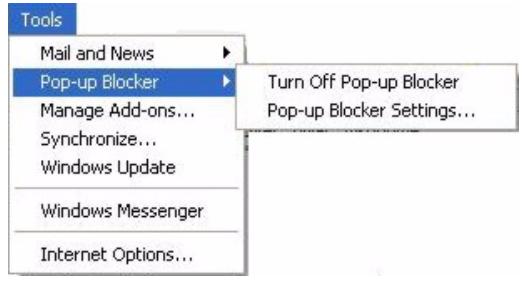
Figure 154 Pop-up Blocker
You can also check if pop-up blocking is disabled in the Pop-up Blocker section in the Privacy tab.
1 In Internet Explorer, select Tools, Internet Options, Privacy.
2 Clear the Block pop-ups check box in the Pop-up Blocker section of the screen. This disables any web pop-up blockers you may have enabled.
Figure 155 Internet Options
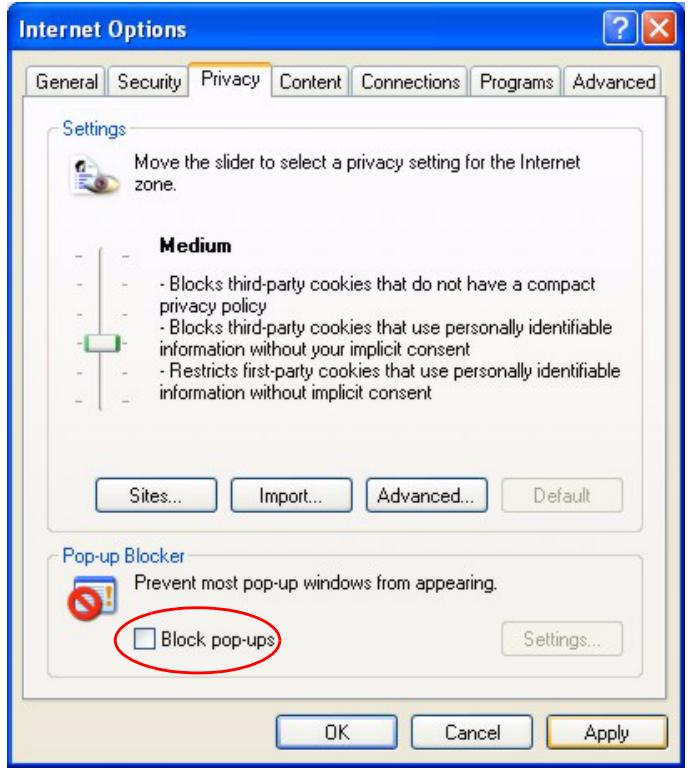
3 Click Apply to save this setting.
34.2.1.1.2 Enable pop-up Blockers with Exceptions
Alternatively, if you only want to allow pop-up windows from your device, see the following steps.
1 In Internet Explorer, select Tools, Internet Options and then the Privacy tab.
2 Select Settings...to open the Pop-up Blocker Settings screen.
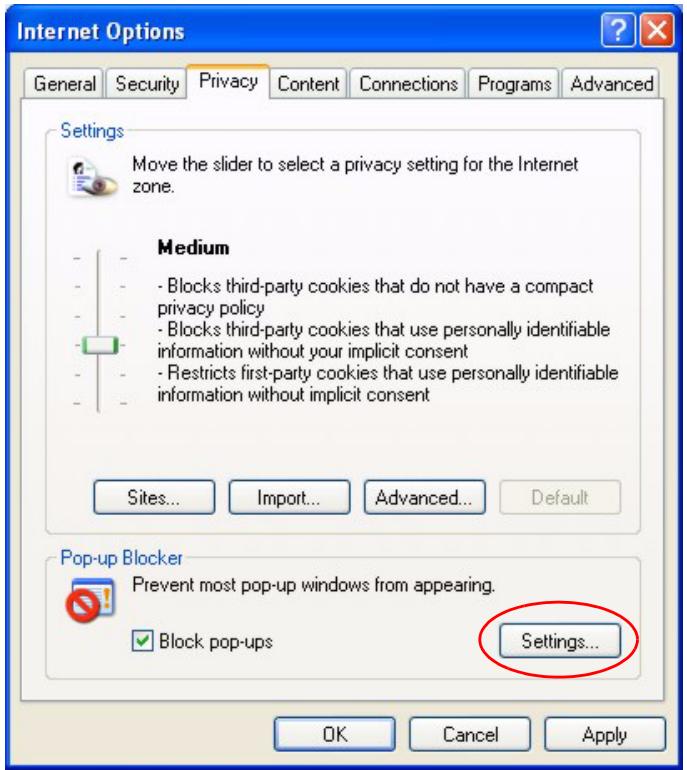
Figure 156 Internet Options
3 Type the IP address of your device (the web page that you do not want to have blocked) with the prefix "http://". For example, http://192.168.1.1.
4 Click Add to move the IP address to the list of Allowed sites.
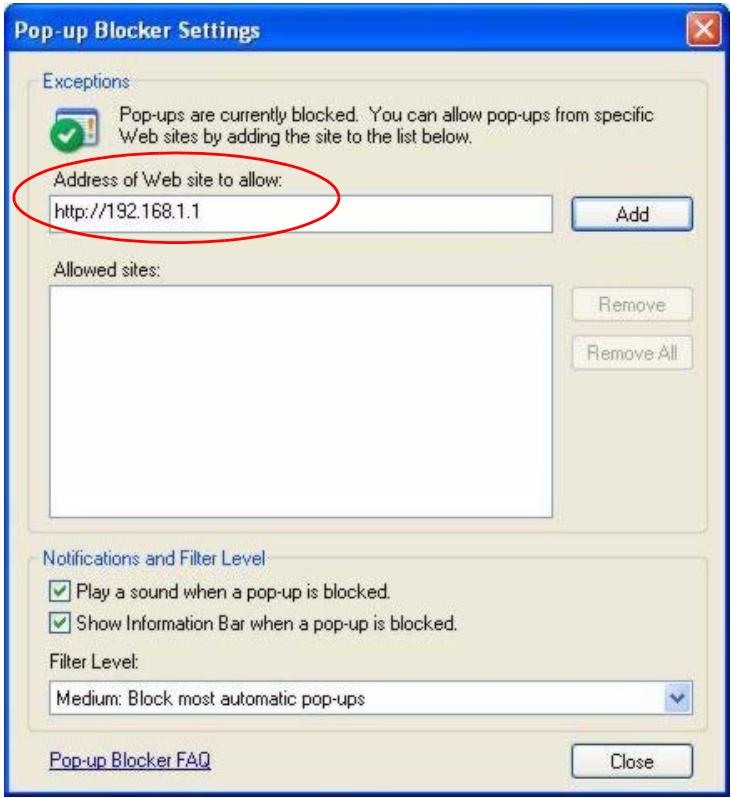
Figure 157 Pop-up Blocker Settings
5 Click Close to return to the Privacy screen.
6 Click Apply to save this setting.
If pages of the web configurator do not display properly in Internet Explorer, check that JavaScripts are allowed.
1 In Internet Explorer, click Tools, Internet Options and then the Security tab.
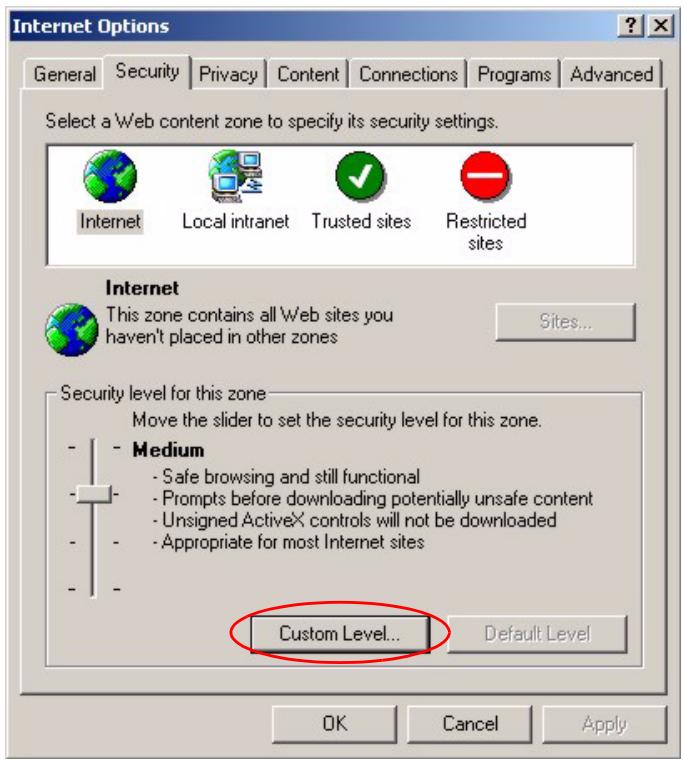
Figure 158 Internet Options
2 Click the Custom Level... button.
3 Scroll down to Scripting.
4 Under Active scripting make sure that Enable is selected (the default).
5 Under Scripting of Java applets make sure that Enable is selected (the default).
6 Click OK to close the window.
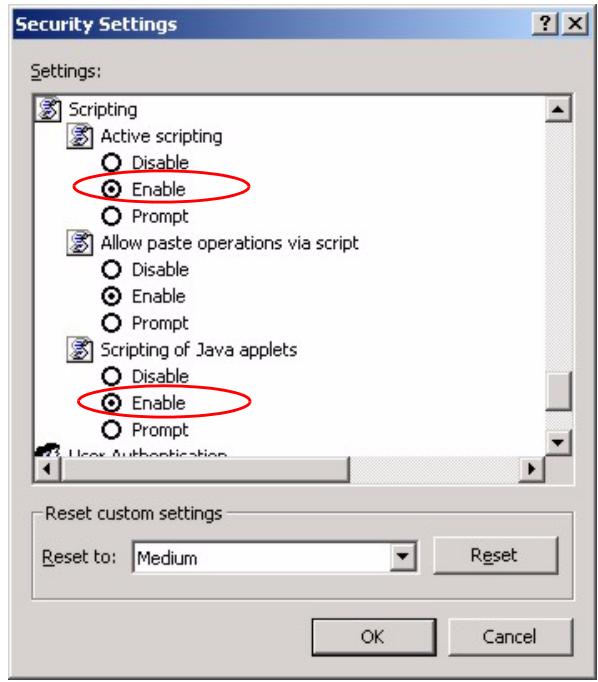
Figure 159 Security Settings - Java Scripting
34.2.1.3 Java Permissions
1 From Internet Explorer, click Tools, Internet Options and then the Security tab.
2 Click the Custom Level... button.
3 Scroll down to Microsoft VM.
4 Under Java permissions make sure that a safety level is selected.
5 Click OK to close the window.
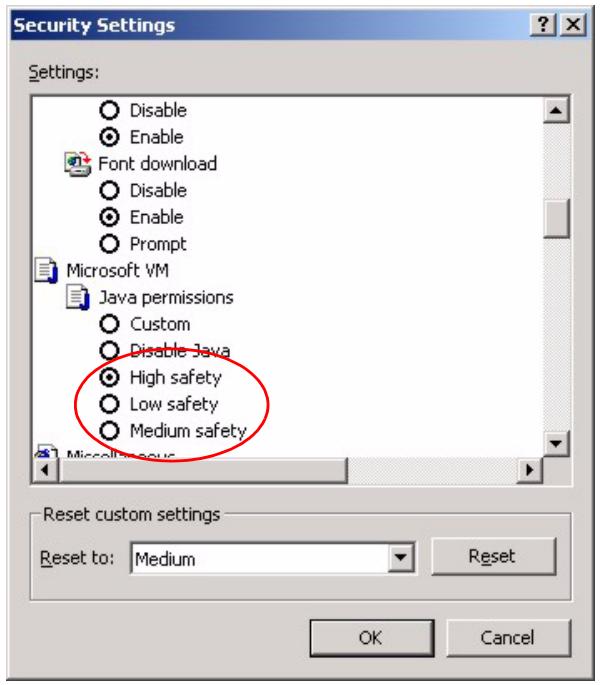
Figure 160 Security Settings - Java
34.2.1.3.1 JAVA (Sun)
1 From Internet Explorer, click Tools, Internet Options and then the Advanced tab.
2 make sure that Use Java 2 for
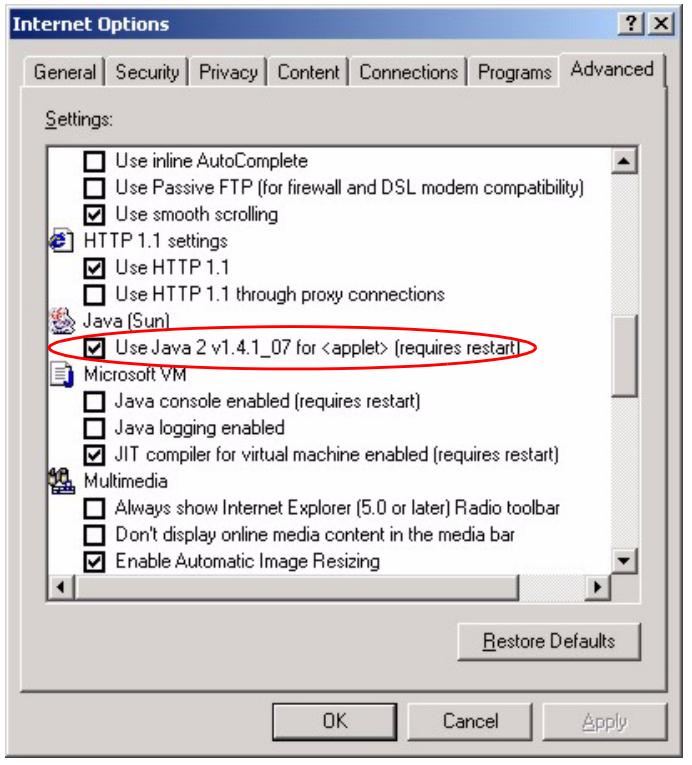
Figure 161 Java (Sun)
34.3 Problems with the Password
Table 75 Troubleshooting the Password
| PROBLEM | CORRECTIVE ACTION |
| Cannot access the switch. | The password field is case sensitive. Make sure that you enter the correct password using the proper casing. |
| The administrator username is “admin”. The default administrator password is “1234”. The username and password are case-sensitive. Make sure that you enter the correct password and username using the proper casing. If you have changed the password and have now forgotten it, you will need to upload the default configuration file. This restores all of the factory defaults including the password. |
APPENDIX A
Product Specifications
These are the switch product specifications.
Table 76 General Product Specifications
| Ethernet Interface | 48 10/100 Base-TX interfaces Auto-negotiation Auto-MDI/MDIX Compliant with IEEE 802.3/3u Back pressure flow control for half duplex Flow control for full duplex (IEEE 802.3x) RJ-45 Ethernet cable connector |
| Gigabit Interface | Two Gigabit/mini-GBIC combo ports Two Gigabit ports |
| Bridging | 16K MAC addresses Static MAC address filtering (port lock) Broadcast storm control Limited maximum number of MAC addresses per port |
| Switching | Switching fabric: 17.6Gbps, non-blocking Max. Frame size: 1522 bytes Forwarding frame: IEEE 802.3, IEEE 802.1q, Ethernet II, PPPoE Prevent the forwarding of corrupted packets |
| STP | IEEE 802.1d spanning tree protocol IEEE 802.1w, rapid reconfiguration to recover network failure |
| QoS | IEEE 802.1p Four priority queues Supports RFC 2475 DiffServ, DSCP to IEEE 802.1p priority mapping |
| Security | IEEE 802.1x port-based authentication Static MAC Address Forward |
| VLAN | Port-based VLAN setting Tag-based (IEEE 802.1Q) VLAN Number of VLAN: 4K (256 static VLANs) Supports GVRP |
| Link aggregation | Supports IEEE 802.3ad; static and dynamic (LACP) port trunking Up to six groups and each group can aggregate up to eight ports |
| Port mirroring | All ports support port mirroring |
| Bandwidth control | Supports rate limiting at 64Kbps increment |
Table 77 Management Specifications
| System Control | Alarm/Status surveillance LED indication for alarm and system status Performance monitoring Line speed Four RMON groups (history, statistics, alarms, and events) Throughput monitoring CMP packet transmission Port mirroring and aggregation Spanning Tree Protocol IGMP snooping Firmware upgrade and download through FTP/TFTP Login authorization and security levels (read only and read/write) Self diagnostics FLASH memory |
| Network Management | CLI through console port and telnet Web-based management Clustering: up to 24 switches can be manage by one IP SNMP RMON groups (history, statistics, alarms and events) |
| MIB | RFC1213 MIB II RFC1493 Bridge MIB RFC1643 Ethernet MIB RFC1757 Four groups of RMON RFC 1155 SMI RFC2674 Bridge MIB extension (for IEEE 802.1Q) |
Table 78 Physical and Environmental Specifications
| LEDs | Per switch: PWR, SYS, ALM, BPS Per Ethernet port: LNK/ACT, FDX/COL |
| Dimension | 438 mm (W) x 300 mm (D) x 44.45 mm (H) Standard 19" rack mountable |
| Weight | 4.2Kg |
| Temperature | Operating: 0° C ~ 45°C Storage: -10°C ~ 70°C |
| Humidity | 10 ~ 90% (non-condensing) |
| Power Supply | Overload protection 100-240VAC, 50/60Hz, 1.5A Max. |
| Safety | ANS/UL 60950-1 CSA 60950-1 EN 60950-1 IEC 60950-1 |
| EMC | FCC Part 15 (Class A) CE EMC (Class A) |
APPENDIX B IP Subnetting
IP Addressing
Routers "route" based on the network number. The router that delivers the data packet to the correct destination host uses the host ID.
IP Classes
An IP address is made up of four octets (eight bits), written in dotted decimal notation, for example, 192.168.1.1. IP addresses are categorized into different classes. The class of an address depends on the value of its first octet.
- Class “A” addresses have a 0 in the left most bit. In a class “A” address the first octet is the network number and the remaining three octets make up the host ID.
- Class “B” addresses have a 1 in the left most bit and a 0 in the next left most bit. In a class “B” address the first two octets make up the network number and the two remaining octets make up the host ID.
- Class “C” addresses begin (starting from the left) with 1 1 0. In a class “C” address the first three octets make up the network number and the last octet is the host ID.
- Class “D” addresses begin with 1 1 1 0. Class “D” addresses are used for multicasting. (There is also a class “E” address. It is reserved for future use.)
Table 79 Classes of IP Addresses
| IP ADDRESS: | OCTET 1 | OCTET 2 | OCTET 3 | OCTET 4 | |
| Class A | 0 | Network number | Host ID | Host ID | Host ID |
| Class B | 10 | Network number | Network number | Host ID | Host ID |
| Class C | 110 | Network number | Network number | Network number | Host ID |
Note: Host IDs of all zeros or all ones are not allowed.
Therefore:
A class "C" network (8 host bits) can have 2^8 - 2 or 254 hosts.
A class "B" address (16 host bits) can have 2^16 - 2 or 65534 hosts.
A class "A" address (24 host bits) can have 2^24 - 2 hosts (approximately 16 million hosts).
Since the first octet of a class "A" IP address must contain a "0", the first octet of a class "A" address can have a value of 0 to 127.
Similarly the first octet of a class "B" must begin with "10", therefore the first octet of a class "B" address has a valid range of 128 to 191. The first octet of a class "C" address begins with "110", and therefore has a range of 192 to 223.
Table 80 Allowed IP Address Range By Class
| CLASS | ALLOWED RANGE OF FIRST OCTET (BINARY) | ALLOWED RANGE OF FIRST OCTET (DECIMAL) |
| Class A | 00000000 to 01111111 | 0 to 127 |
| Class B | 10000000 to 10111111 | 128 to 191 |
| Class C | 11000000 to 11011111 | 192 to 223 |
| Class D | 11100000 to 11101111 | 224 to 239 |
Subnet Masks
A subnet mask is used to determine which bits are part of the network number, and which bits are part of the host ID (using a logical AND operation). A subnet mask has 32 is a “1” then the corresponding bit in the IP address is part of the network number. If a bit in the subnet mask is “0” then the corresponding bit in the IP address is part of the host ID.
Subnet masks are expressed in dotted decimal notation just as IP addresses are. The "natural" masks for class A, B and C IP addresses are as follows.
Table 81 "Natural" Masks
| CLASS | NATURAL MASK |
| A | 255.0.0.0 |
| B | 255.255.0.0 |
| C | 255.255.255.0 |
Subnetting
With subnetting, the class arrangement of an IP address is ignored. For example, a class C address no longer has to have 24 bits of network number and 8 bits of host ID. With subnetting, some of the host ID bits are converted into network number bits. By convention, subnet masks always consist of a continuous sequence of ones beginning from the left most bit of the mask, followed by a continuous sequence of zeros, for a total number of 32 bits.
Since the mask is always a continuous number of ones beginning from the left, followed by a continuous number of zeros for the remainder of the 32 bit mask, you can simply specify the number of ones instead of writing the value of each octet. This is usually specified by writing a “/” followed by the number of bits in the mask after the address.
For example, 192.1.1.0 /25 is equivalent to saying 192.1.1.0 with mask 255.255.255.128.
The following table shows all possible subnet masks for a class "C" address using both notations.
Table 82 Alternative Subnet Mask Notation
| SUBNET MASK IP ADDRESS | SUBNET MASK “1” BITS | LAST OCTET BIT VALUE |
| 255.255.255.0 | /24 | 0000 0000 |
| 255.255.255.128 | /25 | 1000 0000 |
| 255.255.255.192 | /26 | 1100 0000 |
| 255.255.255.224 | /27 | 1110 0000 |
| 255.255.255.240 | /28 | 1111 0000 |
| 255.255.255.248 | /29 | 1111 1000 |
| 255.255.255.252 | /30 | 1111 1100 |
The first mask shown is the class "C" natural mask. Normally if no mask is specified it is understood that the natural mask is being used.
Example: Two Subnets
As an example, you have a class "C" address 192.168.1.0 with subnet mask of 255.255.255.0.
Table 83 Two Subnets Example
| NETWORK NUMBER | HOST ID | |
| IP Address | 192.168.1. | 0 |
| IP Address (Binary) | 11000000.10101000.00000001. | 00000000 |
| Subnet Mask | 255.255.255. | 0 |
| Subnet Mask (Binary) | 11111111.11111111.11111111. | 00000000 |
The first three octets of the address make up the network number (class "C"). You want to have two separate networks.
Divide the network 192.168.1.0 into two separate subnets by converting one of the host ID bits of the IP address to a network number bit. The "borrowed" host ID bit can be either "0" or "1" thus giving two subnets; 192.168.1.0 with mask 255.255.255.128 and 192.168.1.128 with mask 255.255.255.128.
Note: In the following charts, shaded/bolded last octet bit values indicate host ID bits "borrowed" to form network ID bits. The number of "borrowed" host ID bits determines the number of subnets you can have. The remaining number of host ID bits (after "borrowing") determines the number of hosts you can have on each subnet.
Table 84 Subnet 1
| NETWORK NUMBER | LAST OCTET BIT VALUE | |
| IP Address | 192.168.1. | 0 |
| IP Address (Binary) | 11000000.10101000.00000001. | 00000000 |
| Subnet Mask | 255.255.255. | 128 |
| Subnet Mask (Binary) | 11111111.11111111.11111111. | 10000000 |
| Subnet Address: 192.168.1.0 | Lowest Host ID: 192.168.1.1 | |
| Broadcast Address: 192.168.1.127 | Highest Host ID: 192.168.1.126 | |
Table 85 Subnet 2
| NETWORK NUMBER | LAST OCTET BIT VALUE | |
| IP Address | 192.168.1. | 128 |
| IP Address (Binary) | 11000000.10101000.00000001. | 10000000 |
| Subnet Mask | 255.255.255. | 128 |
| Subnet Mask (Binary) | 11111111.11111111.11111111. | 10000000 |
| Subnet Address: 192.168.1.128 | Lowest Host ID: 192.168.1.129 | |
| Broadcast Address: 192.168.1.255 | Highest Host ID: 192.168.1.254 | |
The remaining 7 bits determine the number of hosts each subnet can have. Host IDs of all zeros represent the subnet itself and host IDs of all ones are the broadcast address for that subnet, so the actual number of hosts available on each subnet in the example above is 2^7 - 2 or 126 hosts for each subnet.
192.168.1.0 with mask 255.255.255.128 is the subnet itself, and 192.168.1.127 with mask 255.255.255.128 is the directed broadcast address for the first subnet. Therefore, the lowest IP address that can be assigned to an actual host for the first subnet is 192.168.1.1 and the highest is 192.168.1.126. Similarly the host ID range for the second subnet is 192.168.1.129 to 192.168.1.254.
Example: Four Subnets
The above example illustrated using a 25-bit subnet mask to divide a class "C" address space into two subnets. Similarly to divide a class "C" address into four subnets, you need to "borrow" two host ID bits to give four possible combinations of 00, 01, 10 and 11. The subnet mask is 26 bits (1111111.11111111.11111111.11000000) or 255.255.255.192. Each subnet contains 6 host ID bits, giving 2^6 - 2 or 62 hosts for each subnet (all 0's is the subnet itself, all 1's is the broadcast address on the subnet).
Table 86 Subnet 1
| NETWORK NUMBER | LAST OCTET BIT VALUE | |
| IP Address | 192.168.1. | 0 |
| IP Address (Binary) | 11000000.10101000.00000001. | 00000000 |
| Subnet Mask (Binary) | 11111111.11111111.11111111. | 11000000 |
| Subnet Address: 192.168.1.0 | Lowest Host ID: 192.168.1.1 | |
| Broadcast Address: 192.168.1.63 | Highest Host ID: 192.168.1.62 | |
Table 87 Subnet 2
| NETWORK NUMBER | LAST OCTET BIT VALUE | |
| IP Address | 192.168.1. | 64 |
| IP Address (Binary) | 11000000.10101000.00000001. | 01000000 |
| Subnet Mask (Binary) | 11111111.11111111.11111111. | 11000000 |
| Subnet Address: 192.168.1.64 | Lowest Host ID: 192.168.1.65 | |
| Broadcast Address: 192.168.1.127 | Highest Host ID: 192.168.1.126 | |
Table 88 Subnet 3
| NETWORK NUMBER | LAST OCTET BIT VALUE | |
| IP Address | 192.168.1. | 128 |
| IP Address (Binary) | 11000000.10101000.00000001. | 10000000 |
| Subnet Mask (Binary) | 11111111.11111111.11111111. | 11000000 |
| Subnet Address: 192.168.1.128 | Lowest Host ID: 192.168.1.129 | |
| Broadcast Address: 192.168.1.191 | Highest Host ID: 192.168.1.190 | |
Table 89 Subnet 4
| NETWORK NUMBER | LAST OCTET BIT VALUE | |
| IP Address | 192.168.1. | 192 |
| IP Address (Binary) | 11000000.10101000.00000001. | 11000000 |
| Subnet Mask (Binary) | 11111111.11111111.11111111. | 11000000 |
| Subnet Address: 192.168.1.192 | Lowest Host ID: 192.168.1.193 | |
| Broadcast Address: 192.168.1.255 | Highest Host ID: 192.168.1.254 | |
Example Eight Subnets
Similarly use a 27-bit mask to create 8 subnets (001, 010, 011, 100, 101, 110).
The following table shows class C IP address last octet values for each subnet.
Table 90 Eight Subnets
| SUBNET | SUBNET ADDRESS | FIRST ADDRESS | LAST ADDRESS | BROADCAST ADDRESS |
| 1 | 0 | 1 | 30 | 31 |
| 2 | 32 | 33 | 62 | 63 |
| 3 | 64 | 65 | 94 | 95 |
| 4 | 96 | 97 | 126 | 127 |
| 5 | 128 | 129 | 158 | 159 |
| 6 | 160 | 161 | 190 | 191 |
| 7 | 192 | 193 | 222 | 223 |
| 8 | 224 | 223 | 254 | 255 |
The following table is a summary for class "C" subnet planning.
Table 91 Class C Subnet Planning
| NO. “BORROWED” HOST BITS | SUBNET MASK | NO. SUBNETS | NO. HOSTS PER SUBNET |
| 1 | 255.255.255.128 (/25) | 2 | 126 |
| 2 | 255.255.255.192 (/26) | 4 | 62 |
| 3 | 255.255.255.224 (/27) | 8 | 30 |
| 4 | 255.255.255.240 (/28) | 16 | 14 |
| 5 | 255.255.255.248 (/29) | 32 | 6 |
| 6 | 255.255.255.252 (/30) | 64 | 2 |
| 7 | 255.255.255.254 (/31) | 128 | 1 |
Subnetting With Class A and Class B Networks.
For class "A" and class "B" addresses the subnet mask also determines which bits are part of the network number and which are part of the host ID.
A class “B” address has two host ID octets available for subnetting and a class “A” address has three host ID octets (see Table 79 on page 267) available for subnetting.
The following table is a summary for class "B" subnet planning.
Table 92 Class B Subnet Planning
| NO. “BORROWED” HOST BITS | SUBNET MASK | NO. SUBNETS | NO. HOSTS PER SUBNET |
| 1 | 255.255.128.0 (/17) | 2 | 32766 |
| 2 | 255.255.192.0 (/18) | 4 | 16382 |
| 3 | 255.255.224.0 (/19) | 8 | 8190 |
| 4 | 255.255.240.0 (/20) | 16 | 4094 |
| 5 | 255.255.248.0 (/21) | 32 | 2046 |
| 6 | 255.255.252.0 (/22) | 64 | 1022 |
| 7 | 255.255.254.0 (/23) | 128 | 510 |
| 8 | 255.255.255.0 (/24) | 256 | 254 |
| 9 | 255.255.255.128 (/25) | 512 | 126 |
| 10 | 255.255.255.192 (/26) | 1024 | 62 |
| 11 | 255.255.255.224 (/27) | 2048 | 30 |
| 12 | 255.255.255.240 (/28) | 4096 | 14 |
| 13 | 255.255.255.248 (/29) | 8192 | 6 |
| 14 | 255.255.255.252 (/30) | 16384 | 2 |
| 15 | 255.255.255.254 (/31) | 32768 | 1 |
Index
Symbols
"standby" ports 111
Numerics
110V AC 3
230V AC 3
802.1P priority 76
A
AC 3
Access control 185
Access priority 125
Limitation 125
Login account 128
Remote management 136
Service port 135
SNMP 126
Accessories 3
Address Resolution Protocol (ARP) 195
Administrator password 129
Aggregator ID 113
Aging time 70
Airflow 3
Alternative Subnet Mask Notation 269
American Wire Gauge 3
Application 31
Backbone 31
Bridging 32
IEEE 802.1Q VLAN 33
Switched workgroup 32
ARP 195
How it works 195
View 195
Authority 2
Automatic VLAN registration 78
AWG 3
B
Basement 3
Basic setting 65
BPDUs (Bridge Protocol Data Units) 94
Bridge Protocol Data Units (BPDUs) 94
C
Cables, Connecting 3
CFI (Canonical Format Indicator) 77
Change password 50
Changes or Modifications 2
CI Commands 199
CLI Command
Configure tagged VLAN example 244
Static VLAN Table example 249
Cluster management 29, 187
Cluster manager 187, 191
Cluster member 187, 192
Cluster member firmware upgrade 189
Network example 187
Setup 190
Specification 187
Status 188
Switch models 187
VID 191
Web configurator 189
Cluster manager 187
Cluster member 187
Command
Forwarding Process Example 249
Summary 203
Syntax conventions 199
Command Line Interface
Accessing 197
Introduction 197
Configuration file 51
Backup 180
Restore 51, 180
Connecting Cables 3
Console port 31
Settings 40
Copyright 1
Corrosive Liquids 3
Covers 3
CPU management port 86
CRC (Cyclic Redundant Check) 63
Current date 69
Current time 69
Customer Support 5
D
Damage 3
Dampness 3
Danger 3
Denmark, Contact Information 5
DHCP 27
DHCP (Dynamic Host Configuration Protocol) 27
DHCP Relay 175
DHCP Relay Agent Information 175
Diagnostic 185
Ethernet port test 185
Ping 185
System log 185
Double-tagged Frames 155
Dust 3
DVLAN Table 243
Dynamic link aggregation 111
E
Egress port 88
Electric Shock 3
Electrical Pipes 3
Electrocution 3
Ethernet broadcast address 195
Ethernet port test 185
Ethernet ports 40
Default settings 40
Europe 3
Exposure 3
Extended authentication protocol 117
External authentication server 117
F
FCC
Compliance 2
Feature
Hardware 30
File Transfer using FTP
command example 183
Filename convention 182
Filtering 91
Filtering database 193
Finland, Contact Information 5
Firmware 66
Upgrade 179, 189
Flow control 76
Back pressure 76
IEEE802.3x76
France, Contact Information 5
Front panel 39
FTP 182
File transfer procedure 183
Restrictions over WAN 184
G
GARP 78,244
GARP (Generic Attribute Registration Protocol) 78
garp status 245
GARP Status Command 245
GARP terminology 78
GARP timer 71, 78
Gas Pipes 3
General setup 67
Germany, Contact Information 5
Getting help 53
GMT (Greenwich Mean Time) 69
GVRP 78, 85, 244
GVRP (GARP VLAN Registration Protocol) 78, 237
gvp disable 247
gvp enable 246
gvp status 246
H
Hardware installation 35
Hardware overview 39
High Voltage Points 3
Host IDs 267
How SSH works 130
HTTPS 131
HTTPS Example 132
1
IEEE 802.1p 71
IEEE 802.1Q Tagged VLAN 243
IEEE 802.1x 117
Activate 118
Note 117
Reauthentication 120
IGMP snooping 161
Ingress port 88
Installation
Freestanding 35
Precautions 36
Rack-mounting 36
Introduction 27
IP Addressing 267
IP Classes 267
IP interface 72
IP setup 71
iStacking 29
L
LACP 111
System priority 115
Timeout 115
LEDs 43
Lightning 3
Limit MAC address learning 123
Link Aggregate Control Protocol (LACP) 111
Link aggregation 28, 111
Dynamic 111
ID information 112
Setup 113
Status 113
Liquids, Corrosive 3
Lockout 50
Log 185
Login 45
Password 50
Login account 128
Administrator 128
Non-administrator 128
Number of 128
Login password 129
M
MAC (Media Access Control) 66
MAC address 66, 195
Maximum number per port 123
MAC address learning 28, 70, 89, 123
Specify limit 123
MAC table 193
How it works 193
View 194
Maintenance 179
Management Information Base (MIB) 126
Management port 88
MIB 126
Supported MIBs 127
Mini GBIC ports 41
Connection speed 41
Connector type 41
Transceiver installation 41
Transceiver removal 42
Mirror port 107
Modifications 2
Mounting brackets 36
MSA (MultiSource Agreement) 41
MTU (Multi-Tenant Unit) 69
N
Network management system (NMS) 126
North America 3
North America Contact Information 5
Norway, Contact Information 5
NTP (RFC-1305) 69
0
Opening 3
P
Password 50, 192
Ping 185
Pipes 3
Pool 3
Port authentication 117
IEEE802.1x 118
RADIUS server 118
Port Based VLAN Type 70
Port details 61
Port isolation 85, 88
Port Mirroring 220, 237
Port mirroring 28, 107
Port redundancy 111
Port security 28
Limit MAC address learning 123
Port setup 74
Port speed/duplex 76
Port status 59
Port VID
Default for all ports 218
Port VLAN trunking 79
Port-based VLAN 85
All connected 88
Port isolation 88
Setting Wizard 88
Power Adaptor 3
Power Cord 3
Power Outlet 3
Power Supply 3
Power Supply, repair 3
Priority 71
Priority level 71
Priority queue assignment 71
Product specification 263
PVID 77, 85
PVID (Priority Frame) 77
Q
Qualified Service Personnel 3
Queuing 27, 139
Queuing algorithm 139, 141
Queuing method 139, 141
R
RADIUS 117
RADIUS (Remote Authentication Dial In User Service) 117
RADIUS server 117
Advantages 117
Network example 117
Settings 118
Rapid Spanning Tree Protocol 93
Regular Mail 5
Related Documentation 25
Remote management 136
Service 137
Trusted computers 137
Removing 3
Repair 3
Reset 51
Reset to factory default settings 181
Restore configuration 51
Risk 3
Risks 3
RSTP 93
RSTP (Rapid STP) 28
Rubber feet 35
s
SafetyWarnings 3
Service 3, 4
Service access control 135
Service port 136
Service Personnel 3
Service Provider Tag Protocol Identifier 157
Service Provider's Network 155
Shock, Electric 3
Simple Network Management Protocol (SNMP) 126
SNMP 126
Agent 126
Communities 128
Management model 126
Manager 126
MIB 126, 127
Network components 126
Object variables 126
Protocol operations 126
Setup 127
Traps 127
Versions supported 126
SP TPID 157
Spain, Contact Information 6
Spanning Tree Protocol (STP) 93
SSH 130
SSH Implementation 131
Static MAC address 28, 89
Static MAC forwarding 89
Static VLAN 81
Control 83
Tagging 83
Status 46, 59
LED 43
Link aggregation 113
Port 59
Port details 61
STP 94
VLAN 80
STP 93
Bridge ID 95
Bridge priority 98
Configuration 96
Designated bridge 94
Forwarding Delay 98
Hello BPDU 94
Hello Time 95, 98
How it works 94
Max Age 95, 98
Path cost 93, 98
Port priority 98
Port state 94
Root port 94
Status 94
Terminology 93
STP (Spanning Tree Protocol) 28
Subnet Masks 268
Subnetting 268
Supply Voltage 3
Support E-mail 5
SVLAN Table 243
Sweden, Contact Information 6
Swimming Pool 3
Switch lockout 50
Switch reset 51
Switch setup 70
Syntax Conventions 25
sys Commands
examples 225, 231, 234
sys log disp 226, 231, 234
sys sw mac list 227
System information 65
System log 185
System reboot 181
System up time 60
T
Tagged VLAN 77
Telecommunication Line Cord. 3
Telephone 5
Thunderstorm 3
Time
Current 69
Time zone 69
Timeserver 69
Time (RFC-868) 69
Time service protocol 69
Time format 69
Time zone 69
Timeserver 69
Transceiver
Installation 41
Removal 42
Trap
Destination 128
Traps 127
Trunk group 111
Trunking 28, 111
U
UTC (Universal Time Coordinated) 69
V
Vendor 3
Ventilation 35
Ventilation holes 35
Ventilation Slots 3
VID 77, 81, 157
Number of possible VIDs 77
Priority frame 77
VID (VLAN Identifier) 77
VLAN 69, 77
Acceptable frame type 85
Automatic registration 78
Explicit Tagging 243
ID77
ID (VID) 244
Implicit Tagging 243
Ingress filtering 85
Introduction 69
Number of VLANs 81
Port isolation 85
Port number 81
Port settings 83
Port-based VLAN 85
Registration Information 243
Static VLAN 81
Status 80, 81
Tagged 77
Trunking 79
Type 70, 79
VLAN (Virtual Local Area Network) 27, 69
VLAN Databases 243
VLAN Stacking 155
VLAN trunking 85
vlan1q port accept 247
vlan1q port gvrp 248
vlan1q svlan active 250
vlan1q svlan delentry 249
vlan1q svlan inactive 250
vlan1q svlan list 250
vlan1q svlan setentry 248
Voltage Supply 3
Voltage, High 3
W
Wall Mount 3
Warnings 3
Water 3
Water Pipes 3
Web configuration
Screen summary 47
Web configurator
Getting help 53
Home 46
Login 45
Logout 53
Navigation panel 46
Web Site 5
Wet Basement 3
Worldwide Contact Information 5
Z
ZyNOS (ZyXEL Network Operating System) 182
ZyXEL Limited Warranty
Note 4
- Disclaimer
- Interference Statements andWarnings
- FCC Statement
- FCC Warning
- CE Mark Warning:
- Taiwanese BSMI (Bureau of Standards, Metrology and Inspection) A Warning:
- SafetyWarnings
- ZyXEL Limited Warranty
- Note
- Registration
- Customer Support
- Table of Contents
- Chapter 4
- The Web Configurator 45
- Chapter 5
- Initial Setup Example 55
- Chapter 6
- System Status and Port Statistics 59
- Chapter 7
- Basic Setting 65
- Chapter 8
- Chapter 9
- Chapter 10
- Chapter 11
- Chapter 12
- Chapter 13
- Broadcast Storm Control 103
- Chapter 14
- Mirroring 107
- Chapter 15
- Link Aggregation 111
- Chapter 16
- Port Authentication 117
- Chapter 17
- Port Security 121
- Chapter 18
- Access Control 125
- Chapter 19
- Queuing Method 139
- Chapter 20
- Classifier 143
- Chapter 21
- Policy Rule 149
- Chapter 22
- VLAN Stacking 155
- Chapter 23
- Multicast 161
- Chapter 24
- DHCP Relay 175
- Chapter 25
- Static Route 177
- Chapter 26
- Maintenance 179
- Chapter 27
- Chapter 28
- Chapter 29
- Chapter 30
- Chapter 31
- Chapter 32
- Command Examples 225
- Chapter 33
- IEEE 802.1Q Tagged VLAN Commands 243
- Chapter 34
- Troubleshooting 253
- Appendix A
- Product Specifications 263
- Appendix B
- IP Subnetting 267
- Index 275
- List of Figures
- List of Tables
- Preface
- About This User's Guide
- Related Documentation
- Syntax Conventions
- Graphics Icons Key
- User Guide Feedback
- CHAPTER 1
- Getting to Know Your Switch
- Introduction
- Software Features
- DHCP Client
- VLAN
- Queuing
- Port Mirroring
- Static Route
- IGMP Snooping
- Multicast VLAN Registration (MVR)
- STP (Spanning Tree Protocol) / RSTP (Rapid STP)
- Link Aggregation
- Port Authentication and Security
- Cluster Management
- Maintenance and Management Features
- IP Protocols
- System Monitoring
- Security
- Bandwidth Control
- Quality of Service
- Hardware Features
- Power
- 10/100 Mbps Fast Ethernet Ports
- Two Gigabit Ethernet Ports for Uplink Modules
- Two Slots for Mini-GBIC Modules
- iStacking
- Console Port
- Fans
- Applications
- Backbone Application
- Bridging Example
- High Performance Switched Example
- IEEE 802.1Q VLAN Application Examples
- Tag-based VLAN Example
- VLAN Shared Server Example
- CHAPTER 2
- Hardware Installation and Connection
- Freestanding Installation
- Mounting the Switch on a Rack
- Rack-mounted Installation Requirements
- Precautions
- Attaching the Mounting Brackets to the Switch
- Mounting the Switch on a Rack
- CHAPTER 3
- Hardware Overview
- Panel Connections
- Console Port
- Ethernet Ports
- Default Ethernet Settings
- Mini-GBIC Slots
- Transceiver Installation
- Transceiver Removal
- Power Connector
- External Backup Power Supply Connector
- Panel LEDs
- The Web Configurator
- Introduction
- System Login
- The Status Screen
- Change Your Password
- Switch Lockout
- Resetting the Switch
- Reload the Configuration File
- Reset to the Factory Defaults
- Logging Out of the Web Configurator
- Help
- CHAPTER 5 Initial Setup Example
- Overview
- Creating a VLAN
- Setting Port VID
- Configuring Switch Management IP Address
- System Status and Port
- Statistics
- Overview
- Port Status Summary
- Status: Port Details
- CHAPTER 7 Basic Setting
- Overview
- System Information
- General Setup
- Introduction to VLANs
- Switch Setup Screen
- IP Setup
- Management IP Addresses
- Port Setup
- CHAPTER 8 VLAN
- Introduction to IEEE 802.1Q Tagged VLAN
- Forwarding Tagged and Untagged Frames
- Automatic VLAN Registration
- GARP
- GARP Timers
- GVRP
- Port VLAN Trunking
- Select the VLAN Type
- Static VLAN
- Static VLAN Status
- Configure a Static VLAN
- Configure VLAN Port Settings
- Port-based VLAN Setup
- Configure a Port-based VLAN
- Static MAC Forwarding
- Overview
- Configuring Static MAC Forwarding
- CHAPTER 10 Filtering
- Introduction to Filtering
- Configure a Filtering Rule
- Spanning Tree Protocol
- STP/RSTP Overview
- STP Terminology
- How STP Works
- STP Port States
- STP Status
- Configure STP
- CHAPTER 12 Bandwidth Control
- Bandwidth Control Overview
- CIR and PIR
- Bandwidth Control Setup
- Broadcast Storm Control
- Overview
- Broadcast Storm Control Setup
- CHAPTER 14 Mirroring
- Introduction to Port Mirroring
- Port Mirroring Setup
- CHAPTER 15 Link Aggregation
- Introduction to Link Aggregation
- Dynamic Link Aggregation
- Link Aggregation ID
- Link Aggregation Status
- Link Aggregation Setup
- CHAPTER 16 Port Authentication
- Introduction to Authentication
- RADIUS
- Port Authentication Configuration
- Configuring RADIUS Server Settings
- Activate IEEE 802.1x Security
- CHAPTER 17 Port Security
- About Port Security
- Port Security Setup
- CHAPTER 18 Access Control
- Overview
- The Access Control Main Screen
- About SNMP
- Supported MIBs
- SNMP Traps
- Configuring SNMP
- Setting Up Login Accounts
- SSH Overview
- How SSH works
- Host Identification
- Encryption Method
- Authentication and Data Transmission
- SSH Implementation on the Switch
- Requirements for Using SSH
- Introduction to HTTPS
- HTTPS Example
- Internet Explorer Warning Messages
- Netscape Navigator Warning Messages
- The Main Screen
- Service Port Access Control
- Remote Management
- CHAPTER 19 Queuing Method
- Introduction to Queuing
- Strictly Priority
- Weighted Fair Scheduling
- Configuring Queuing
- CHAPTER 20 Classifier
- About the Classifier and QoS
- Configuring the Classifier
- Viewing and Editing Classifier Configuration
- Classifier Example
- CHAPTER 21 Policy Rule
- About Policy Rules
- DiffServ
- DSCP and Per-Hop Behavior
- Configuring Policy Rules
- Viewing and Editing Policy Configuration
- Policy Example
- CHAPTER 22 VLAN Stacking
- Introduction
- VLAN Stacking Example
- VLAN Stacking Port Roles
- VLAN Tag Format
- Frame Format
- Configuring VLAN Stacking
- CHAPTER 23 Multicast
- Overview
- IP Multicast Addresses
- IGMP Filtering
- IGMP Snooping
- Multicast Status
- Multicast Setup
- IGMP Filtering Profile
- MVR Overview
- Types of MVR Ports
- MVR Modes
- How MVR Works
- General MVR Configuration
- MVR Group Configuration
- MVR Configuration Example
- CHAPTER 24 DHCP Relay
- DHCP Relay Overview
- DHCP Relay Agent Information
- DHCP Relay Configuration
- CHAPTER 25 Static Route
- Configuring
- CHAPTER 26 Maintenance
- The Maintenance Screen
- Firmware Upgrade
- Restore a Configuration File
- Backing Up a Configuration File
- Load Factory Defaults
- Reboot System
- FTP Command Line
- Filename Conventions
- Example FTP Commands
- FTP Command Line Procedure
- GUI-based FTP Clients
- FTP Restrictions
- CHAPTER 27 Diagnostic
- Diagnostic
- Overview
- Cluster Management Status
- Cluster Member Switch Management
- Uploading Firmware to a Cluster Member Switch
- Configuring Cluster Management
- CHAPTER 29 MAC Table
- Overview
- Viewing the MAC Table
- CHAPTER 30 ARP Table
- Overview
- How ARP Works
- Viewing the ARP Table
- Introducing the Commands
- Overview
- Switch Configuration File
- Accessing the CLI
- Access Priority
- The Console Port
- Initial Screen
- Figure 106 Initial Console Port Screen
- Telnet
- The Login Screen
- Command Syntax Conventions
- Getting Help
- List of Available Commands
- Detailed Command Information
- Command Modes
- Using Command History
- Saving Your Configuration
- Logging Out
- Command Summary
- User Mode
- Enable Mode
- General Configuration Mode
- interface port-channel Commands
- config-vlan Commands
- mvr Commands
- Command Examples
- Overview
- show Commands
- show system-information
- Figure 114 show system-information Command Example
- show ip
- show logging
- show interface
- show mac address-table
- ping
- traceroute
- Enabling RSTP
- Configuration File Maintenance
- Using a Different Configuration File
- Resetting to the Factory Default
- no Command Examples
- no mirror-port
- no https timeout
- no trunk
- no port-access-authentication
- no ssh
- interface Commands
- interface port-channel
- bpdu-control
- Figure 131 interface bpdu-control Command Example
- broadcast-limit
- bandwidth-limit
- mirror
- gvrp
- ingress-check
- frame-type
- weight
- egress set
- qos priority
- name
- speed-duplex
- IEEE 802.1Q Tagged VLAN
- Commands
- IEEE 802.1Q Tagged VLAN Overview
- VLAN Databases
- Static Entries (SVLAN Table)
- Dynamic Entries (DVLAN Table)
- Configuring Tagged VLAN
- Global VLAN1Q Tagged VLAN Configuration Commands
- GARP Status
- GARP Timer
- GVRP Timer
- Enable GVRP
- Disable GVRP
- Port VLAN Commands
- Set Port VID
- Set Acceptable Frame Type
- Enable or Disable Port GVRP
- Modify Static VLAN
- Modify a Static VLAN Table Example
- Forwarding Process Example
- Tagged Frames
- Untagged Frames
- Delete VLAN ID
- Enable VLAN
- Disable VLAN
- Show VLAN Setting
- CHAPTER 34 Troubleshooting
- Problems Starting Up the Switch
- Problems Accessing the Switch
- Pop-up Windows, JavaScripts and Java Permissions
- Internet Explorer Pop-up Blockers
- Disable pop-up Blockers
- Enable pop-up Blockers with Exceptions
- Java Permissions
- JAVA (Sun)
- Problems with the Password
- Product Specifications
- APPENDIX B IP Subnetting
- IP Addressing
- IP Classes
- Subnet Masks
- Subnetting
- Example: Two Subnets
- Example: Four Subnets
- Example Eight Subnets
- Subnetting With Class A and Class B Networks.
- Index
- Symbols
- Numerics
- A
- B
- C
- D
- E
- F
- G
- H
- 1
- L
- M
- N
- 0
- P
- Q
- R
- s
- T
- U
- V
- W
- Z
Brand : ZYXEL
Model : ES-3148
Category : Network switch